
All Topics  
Metropolitan Museum of Art

 
Metropolitan Museum of Art

   Email Print
   Bookmark   Link


Metropolitan Museum of Art


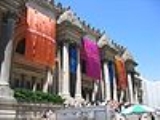
The Metropolitan Museum of Art is an art museum located on the eastern edge of Central Park
Central Park

Central Park is a large public, urban park in New York City, with about twenty-five million visitors annually. Most of the areas immediately adjacent to the park are known for impressive buildings and valuable real estate....
, along what is known as Museum Mile in New York City
New York City

The City of New York is the List of United States cities by population in the United States, while the New York metropolitan area ranks among the List of urban areas by population....
, USA. It has a permanent collection containing more than two million works of art, divided into nineteen curatorial departments. The main building, often referred to simply as "the Met," is one of the world's largest art galleries
Art gallery

An art gallery or art museum is a space for the art exhibition, usually visual art. Paintings are the most commonly displayed art objects; however, sculpture, photographs, illustrations, installation art and objects from the applied arts may also be shown....
, and has a much smaller second location in Upper Manhattan
Upper Manhattan

Upper Manhattan denotes the more northerly region of the New York City Borough of Manhattan. Its southern boundary may be defined anywhere between 59th Street and 155th Street ....
, at "The Cloisters
The Cloisters

The Cloisters is the branch of the Metropolitan Museum of Art dedicated to the art and architecture of the European Middle Ages. The Cloisters is located in New York City, USA, specifically Fort Tryon Park near the northern tip of Manhattan island on a hill overlooking the Hudson River....
," which features medieval art
Medieval art

Medieval art covers a vast scope of time and place, over 1000 years of art history in Western art history, the Islamic art. It includes major art movements and periods, national and regional art, genres, revivals, the artists crafts, and the artists themselves....
.

Represented in the permanent collection are works of art from classical antiquity
Classical antiquity

Classical antiquity is a broad term for a long period of cultural history centered on the Mediterranean Sea, comprising the interlocking civilizations of Ancient Greece and Ancient Rome....
 and Ancient Egypt
Art of Ancient Egypt

Ancient Egyptian art refers to the style of painting, sculpture, crafts and architecture developed by the civilization in the lower Nile Valley from 5000 BC to 300 AD....
, paintings and sculptures from nearly all the European
Western painting

The history of Western painting represents a continuous, though disrupted, tradition from classical antiquity. Until the mid 19th century it was primarily concerned with Representational art and Classical antiquity modes of production, after which time more Modern art, Abstract art and Conceptual art forms gained favor....
 masters, and an extensive collection of American
Visual arts of the United States

Visual arts of the United States refers to the history of painting and visual art in the United States. In the late eighteenth and early nineteenth centuries, artists primarily painted landscapes and portraits in a realistic style....
 and modern art
Modern art

Modern art is a term that refers to artistic works produced during the period extending roughly from the 1860s through the 1970s, and denotes the style and philosophy of the art produced during that era....
.


Discussion
Ask a question about 'Metropolitan Museum of Art'
Start a new discussion about 'Metropolitan Museum of Art'
Answer questions from other users
Full Discussion Forum


Recent Posts


Encyclopedia


The Metropolitan Museum of Art is an art museum located on the eastern edge of Central Park
Central Park

Central Park is a large public, urban park in New York City, with about twenty-five million visitors annually. Most of the areas immediately adjacent to the park are known for impressive buildings and valuable real estate....
, along what is known as Museum Mile in New York City
New York City

The City of New York is the List of United States cities by population in the United States, while the New York metropolitan area ranks among the List of urban areas by population....
, USA. It has a permanent collection containing more than two million works of art, divided into nineteen curatorial departments. The main building, often referred to simply as "the Met," is one of the world's largest art galleries
Art gallery

An art gallery or art museum is a space for the art exhibition, usually visual art. Paintings are the most commonly displayed art objects; however, sculpture, photographs, illustrations, installation art and objects from the applied arts may also be shown....
, and has a much smaller second location in Upper Manhattan
Upper Manhattan

Upper Manhattan denotes the more northerly region of the New York City Borough of Manhattan. Its southern boundary may be defined anywhere between 59th Street and 155th Street ....
, at "The Cloisters
The Cloisters

The Cloisters is the branch of the Metropolitan Museum of Art dedicated to the art and architecture of the European Middle Ages. The Cloisters is located in New York City, USA, specifically Fort Tryon Park near the northern tip of Manhattan island on a hill overlooking the Hudson River....
," which features medieval art
Medieval art

Medieval art covers a vast scope of time and place, over 1000 years of art history in Western art history, the Islamic art. It includes major art movements and periods, national and regional art, genres, revivals, the artists crafts, and the artists themselves....
.

Represented in the permanent collection are works of art from classical antiquity
Classical antiquity

Classical antiquity is a broad term for a long period of cultural history centered on the Mediterranean Sea, comprising the interlocking civilizations of Ancient Greece and Ancient Rome....
 and Ancient Egypt
Art of Ancient Egypt

Ancient Egyptian art refers to the style of painting, sculpture, crafts and architecture developed by the civilization in the lower Nile Valley from 5000 BC to 300 AD....
, paintings and sculptures from nearly all the European
Western painting

The history of Western painting represents a continuous, though disrupted, tradition from classical antiquity. Until the mid 19th century it was primarily concerned with Representational art and Classical antiquity modes of production, after which time more Modern art, Abstract art and Conceptual art forms gained favor....
 masters, and an extensive collection of American
Visual arts of the United States

Visual arts of the United States refers to the history of painting and visual art in the United States. In the late eighteenth and early nineteenth centuries, artists primarily painted landscapes and portraits in a realistic style....
 and modern art
Modern art

Modern art is a term that refers to artistic works produced during the period extending roughly from the 1860s through the 1970s, and denotes the style and philosophy of the art produced during that era....
. The Met also maintains extensive holdings of African
African art

African art constitutes one of the most diverse legacies on earth. Though many casual observers tend to generalize "traditional" African art, the continent is full of peoples, societies, and civilizations, each with a unique visual special culture....
, Asian
Asian art

Asian art can refer to art amongst many cultures in Asia.Many modern Asian artists seek to blend ancient Asian themes with contemporary artistic styles....
, Oceanic, Byzantine
Byzantine art

Byzantine art is the term commonly used to describe the artistic products of the Byzantine Empire from about the 4th century until the Fall of Constantinople in 1453....
 and Islamic art
Islamic art

File:Caucasian panel.jpgIslamic art encompasses the arts produced from the 7th century onwards by people who lived within the territory that was inhabited by culturally Islamic populations....
. The museum is also home to encyclopedic collections of musical instruments, costumes and accessories, and antique weapon
Weapon

A weapon is a tool used to apply or threaten to apply force for the purpose of hunting, attack or defense in combat, subduing enemy personnel, or to destroy enemy weapons, equipment and defensive structures....
s and armor from around the world. A number of notable interiors, ranging from 1st century Rome through modern American design, are permanently installed in the Met's galleries.

The Metropolitan Museum of Art was founded in 1870 by a group of American citizens. The founders included businessmen and financiers, as well as leading artists and thinkers of the day, who wanted to open a museum to bring art and art education to the American people. It opened on February 20, 1872, and was originally located at 681 Fifth Avenue.

As of 2007, the Met measures almost a quarter mile long and occupies more than two million square feet.

Overview

The Met's permanent collection is cared for and exhibited by nineteen separate departments, each with a specialized staff of curator
Curator

Curator , means manager, Wiktionary:overseer.Traditionally, a curator or keeper of a culture heritage institution is a content specialist responsible for an institution's Collection s and, together with a publications specialist, their associated collections catalogs....
s, restorers
Art conservation and restoration

Conservation-restoration, also referred to as Conservation, is a profession devoted to the preservation of cultural heritage for the future. Conservation activities include examination, documentation, treatment, and preventive care....
, and scholars.

Represented in the permanent collection are works of art from classical antiquity
Classical antiquity

Classical antiquity is a broad term for a long period of cultural history centered on the Mediterranean Sea, comprising the interlocking civilizations of Ancient Greece and Ancient Rome....
 and Ancient Egypt
Art of Ancient Egypt

Ancient Egyptian art refers to the style of painting, sculpture, crafts and architecture developed by the civilization in the lower Nile Valley from 5000 BC to 300 AD....
, paintings and sculptures from nearly all the European
Western painting

The history of Western painting represents a continuous, though disrupted, tradition from classical antiquity. Until the mid 19th century it was primarily concerned with Representational art and Classical antiquity modes of production, after which time more Modern art, Abstract art and Conceptual art forms gained favor....
 masters, and an extensive collection of American
Visual arts of the United States

Visual arts of the United States refers to the history of painting and visual art in the United States. In the late eighteenth and early nineteenth centuries, artists primarily painted landscapes and portraits in a realistic style....
 and modern art
Modern art

Modern art is a term that refers to artistic works produced during the period extending roughly from the 1860s through the 1970s, and denotes the style and philosophy of the art produced during that era....
. The Met also maintains extensive holdings of African
African art

African art constitutes one of the most diverse legacies on earth. Though many casual observers tend to generalize "traditional" African art, the continent is full of peoples, societies, and civilizations, each with a unique visual special culture....
, Asian
Asian art

Asian art can refer to art amongst many cultures in Asia.Many modern Asian artists seek to blend ancient Asian themes with contemporary artistic styles....
, Oceanic, Byzantine
Byzantine art

Byzantine art is the term commonly used to describe the artistic products of the Byzantine Empire from about the 4th century until the Fall of Constantinople in 1453....
 and Islamic art
Islamic art

File:Caucasian panel.jpgIslamic art encompasses the arts produced from the 7th century onwards by people who lived within the territory that was inhabited by culturally Islamic populations....
. The museum is also home to encyclopedic collections of musical instruments, costumes and accessories, and antique weapon
Weapon

A weapon is a tool used to apply or threaten to apply force for the purpose of hunting, attack or defense in combat, subduing enemy personnel, or to destroy enemy weapons, equipment and defensive structures....
s and armor from around the world. A number of notable interiors, ranging from 1st century Rome through modern American design, are permanently installed in the Met's galleries.

In addition to its permanent exhibitions, the Met organizes and hosts large travelling shows throughout the year.

As of January 2009, the current director of the museum is Thomas P. Campbell
Thomas P. Campbell

Thomas P. Campbell is a tapestry curator who became the ninth director of the Metropolitan Museum of Art on January 1, 2009.Campbell was born and raised in Cambridge, England....
, a long-time curator, who replaced the legendary Philippe de Montebello
Philippe de Montebello

Philippe de Montebello served from 1977 to 2008 as the director of the Metropolitan Museum of Art in New York City. On his retirement, he was both the longest-serving director in the institution's history, and the longest-serving director of any major art museum in the world....
 following his retirement at the end of 2008.

History


The New York State Legislature
New York Legislature

The New York Legislature is the State legislature of the U.S. state of New York. It is a bicameral legislature, consisting of the lower house New York State Assembly and the upper house New York Senate....
 granted the The Metropolitan Museum of Art an Act of Incorporation on April 13, 1870 "for the purpose of establishing and maintaining in said City a Museum and Library of Art, of encouraging and developing the Study of the Fine Arts, and the application of Art to manufacture and natural life, of advancing the general knowledge of kindred subjects, and to that end of furnishing popular instruction and recreations."

The museum first opened on February 20, 1872, housed in a building located at 681 Fifth Avenue in New York City. John Taylor Johnston
John Taylor Johnston

John Taylor Johnston was born in 1820, the son of John Boorman Johnston. Johnston was the founding president of the Metropolitan Museum of Art, as well as the President of the Central Railroad of New Jersey....
, a railroad executive whose personal art collection seeded the museum, served as its first President, and the publisher George Palmer Putnam
George Palmer Putnam

This article is about the American book publisher who lived from 1814 to 1872. For his grandson, the American publisher, author and explorer who lived from 1887 to 1950 and was married to...
 came on board as its founding Superintendent. The artist Eastman Johnson
Eastman Johnson

Eastman Johnson was an United States painter, and Co-Founder of the Metropolitan Museum of Art, New York City, with his name inscribed at its entrance....
 acted as Co-Founder of the museum. Under their guidance, the Met's holdings, initially consisting of a Roman stone sarcophagus and 174 mostly European paintings, quickly outgrew the available space. In 1873, occasioned by the Met's purchase of the Cesnola Collection
Luigi Palma di Cesnola

Luigi Palma di Cesnola , an Italian American soldier and amateur Archaeology, was born near Turin. He received the Medal of Honor for his actions during the American Civil War....
 of Cypriot
Cyprus

Cyprus , officially the Republic of Cyprus , is an island country situated in the eastern Mediterranean Sea, east of Greece, west of Lebanon, Syria, and Israel, south of Turkey and north of Egypt....
 antiquities, the museum decamped from Fifth Avenue and took up residence at the Douglas Mansion at 128 West 14th Street. However, these new accommodations proved temporary, as the growing collection required more space than the mansion could provide.

After negotiations with the city of New York in 1871, the Met acquired land on the east side of Central Park
Central Park

Central Park is a large public, urban park in New York City, with about twenty-five million visitors annually. Most of the areas immediately adjacent to the park are known for impressive buildings and valuable real estate....
, where it built its permanent home, a red-brick stone "mausoleum" designed by American architect Calvert Vaux
Calvert Vaux

Calvert Vaux , was an architect and landscape designer. He is best remembered as the co-designer , of New York's Central Park.Little is known about Vaux's childhood and upbringing....
 and his collaborator Jacob Wrey Mould
Jacob Wrey Mould

Jacob Wrey Mould was an architect, illustrator, Linguistics and musician, noted for his many contributions to the design and construction of New York City's Central Park....
. Vaux's ambitious building was not well-received; the building's High Victorian Gothic style was already going out of fashion by the time construction was completed, and the president of the Met termed the project "a mistake." Within 20 years, a new architectural plan, incorporating the Vaux building solely as an interior and stripping it of many of its distinctive design elements, was already being executed. Since that point, a host of new galleries and architectural elements, including the distinctive Beaux-Arts
Beaux-Arts architecture

Beaux-Arts architecture denotes the academic Neoclassical architecture architectural style that was taught at the ?cole des Beaux-Arts in Paris....
 facade, designed by architect and Met trustee Richard Morris Hunt
Richard Morris Hunt

Richard Morris Hunt was a well-known American architect of the nineteenth century and a preeminent figure in the history of American architecture....
 and completed in 1926, have continued to expand the museum's physical structure, with the Vaux-designed structure completely surrounded by later additions. (The Met's great entrance hall was also designed by Hunt, who died before it was finished. Hunt's son Richard Howland Hunt oversaw completion of the great hall to his father's specifications.)

As of 2007, the Met measures almost a quarter mile long and occupies more than two million square feet, more than 20 times the size of the original 1880 building.

Collections


American decorative arts

The American Decorative Arts Department includes about 12,000 examples of American decorative art
Decorative art

The decorative arts are traditionally defined as ornamental and functional works in ceramic, wood, glass, metal, textile. The field includes Ceramics , furniture, furnishings, interior design, and architecture....
, ranging from the late seventeenth to the early twentieth century. Though the Met acquired its first major holdings of American decorative arts via a 1909 donation by Margaret Olivia Slocum Sage
Margaret Olivia Slocum Sage

Olivia Slocum Sage was an United States philanthropist. Upon the death of her Russell Sage she received a fortune estimated at more than $50,000,000, to be used as she saw fit....
, wife of the financier Russell Sage
Russell Sage

Russell Sage was a financier and politician from New York, United States.Sage was born at Verona, New York in Oneida County, New York. He received a public school education and worked as a farm hand until he was 15, when he became an errand boy in a grocery conducted by his brother, Henry R....
, a decorative arts department specifically dedicated to American works was not established until 1934. One of the prizes of the American Decorative Arts department is its extensive collection of American stained glass
Stained glass

For the Blackford Oakes novel, see Stained Glass The term stained glass can refer to the material of coloured glass or the craft of working with it....
. This collection, probably the most comprehensive in the world, includes many pieces by Louis Comfort Tiffany
Louis Comfort Tiffany

Louis Comfort Tiffany was an American artist and designer who worked in the decorative arts and is best known for his work in stained glass and is the American artist most associated with the Art Nouveau and Aestheticism movements....
. The department maintains twenty-five period rooms in the museum, each of which recreates an entire room, complete with furnishings, from a noted period or designer. The department's current holdings also include an extensive silver
Silver

Silver is a chemical element with the chemical symbol Ag and atomic number 47. A soft, white, lustrous transition metal, it has the highest electrical conductivity of any element and the highest thermal conductivity of any metal....
 collection notable for containing numerous pieces by Paul Revere
Paul Revere

Paul Revere was an American silversmith and a Patriot in the American Revolution.He was glorified after his death for his role as a messenger in the battles of Lexington and Concord, and Revere's name and his "midnight ride" are well-known in the United States as a patriotic symbol....
 as well as works by Tiffany & Co.
Tiffany & Co.

Tiffany & Co. is a United States jewellery and Silver company founded by Charles Lewis Tiffany and Teddy Young in New York City in 1837 as a "stationery and fancy goods emporium."...


American paintings and sculpture

Washington Crossing the Delaware
Since its founding, the Metropolitan Museum of Art has placed a particular emphasis on collecting American art. The first piece to enter the Met's collection was an allegorical sculpture
Allegorical sculpture

Allegorical sculpture refers to sculptures that symbolize and particularly personify abstract ideas.Common in the Western world, for example, are statues of 'Justice ', a female figure traditionally holding scales in one hand, as a symbol of her weighing issues and arguments, and a Sword of Justice in the other....
 by Hiram Powers
Hiram Powers

Hiram Powers was a United States of America neoclassicism Sculpture....
 titled California, acquired in 1870, which can still be seen in the Met's galleries today. In the following decades, the Met's collection of American paintings and sculpture has grown to include more than one thousand paintings, six hundred sculptures, and 2,600 drawings, covering the entire range of American art from the early Colonial period through the early twentieth century. Many of the best-known American paintings are held in the Met's collection, including a portrait of George Washington
George Washington

George Washington was the leader of the Continental Army in the American Revolutionary War and served as the List of Presidents of the United States President of the United States of the United States of Americas ....
 by Gilbert Stuart
Gilbert Stuart

Gilbert Charles Stuart was an American Painting from Rhode Island.Gilbert Stuart is widely considered to be one of America's foremost portraitists....
 and Emanuel Leutze's
Emanuel Leutze

Emanuel Gottlieb Leutze was a German American History painting best-known for his painting Washington Crossing the Delaware.Leutze was born to a Jewish family in Schw?bisch Gm?nd, W?rttemberg , was brought to America as a child, and then returned to Germany as an adult....
 monumental Washington Crossing the Delaware
Washington Crossing the Delaware

Washington Crossing the Delaware is an 1851 oil-on-canvas painting by German American Artist Emanuel Leutze. It is in commemoration of Washington's crossing of the Delaware on December 25, 1776, during the American Revolutionary War, the first move in a surprise attack against the Hessians forces at Trenton, New Jersey in the Battle of Tr...
. The collection also includes masterpieces by such notable American painters as Winslow Homer
Winslow Homer

Winslow Homer was an United States landscape painter and printmaker, best known for his marine subjects. He is considered one of the foremost painters in 19th century America and a preeminent figure in American art....
, George Caleb Bingham
George Caleb Bingham

George Caleb Bingham ? 19th century American painting of the American West. The majority of Bingham's paintings and virtually all of his drawings are held in American museums, with the largest selection of paintings at the St....
, John Singer Sargent
John Singer Sargent

John Singer Sargent was the most successful portrait painter of his era. During his career, he created roughly 900 oil paintings and more than 2,000 watercolors, as well as countless sketches and charcoal drawings....
, James McNeill Whistler
James McNeill Whistler

'James Abbott McNeill Whistler' was an United States-born, United Kingdom of Great Britain and Ireland-based artist. Averse to sentimentality and moral in painting, he was a leading proponent of the credo "art for art's sake"....
, and Thomas Eakins
Thomas Eakins

Thomas Cowperthwait Eakins was an United States Realism Painting, photographer, Sculpture, and fine arts educator. He is widely acknowledged to be one of the most important artists in American art history....
.

Ancient Near Eastern art

Beginning in the late 1800s, the Met started to acquire ancient art and artifacts from the Near East
Near East

Near East today is an ambiguous term that covers different countries for archeologists and historians, on one hand, and for political scientists, economists, and journalists, on the other....
. From a few cuneiform
Cuneiform

Cuneiform can refer to:*Cuneiform script, an ancient writing system originating in Mesopotamia in the 4th millennium BC*Cuneiform , three bones in the human foot...
 tablets and seals
Seal (device)

A seal can mean a wax seal bearing an impressed figure, or an embossed figure in paper, with the purpose of authenticating a document, but the term can also mean any device for making such impressions or embossments, essentially being a Molding that has the mirror image of the figure in counter-relief, such as mounted on rings known a...
, the Met's collection of Near Eastern art has grown to more than 7,000 pieces. Representing a history of the region beginning in the Neolithic Period and encompassing the fall of the Sassanian Empire and the end of Late Antiquity
Late Antiquity

Late Antiquity is a periodization used by historians to describe the transitional centuries from Classical antiquity to the Middle Ages, in both mainland Europe and the Mediterranean world: generally from the end of the Roman Empire's Crisis of the Third Century to the Islamic conquests and the re-organization of the Byzantine Empire under...
, the collection includes works from the Sumer
Sumer

Sumer was a civilization and a historical region located in Southern Iraq , known as the Cradle of civilization. It lasted from the first settlement of Eridu in the Ubaid period through the Uruk period and the Dynastic periods until the rise of Babylon in the early 2nd millennium BC....
ian, Hittite
Hittites

The Hittites were an ancient Anatolian people who spoke a Hittite language of the Anatolian languages of the Indo-European languages family, and established a kingdom centered at Hattusa in north-central Anatolia ca....
, Sassanian, Assyria
Assyria

Assyria was a political state centered on the Upper Tigris river, in Mesopotamia , that came to rule regional empires a number of times in history....
n, Babylonian and Elamite cultures (among others), as well as an extensive collection of unique Bronze Age
Bronze Age

The Bronze Age is, with respect to a given prehistory, the period in that society when the most advanced metalworking included smelting copper and tin from naturally-occurring outcroppings of copper and tin ores, creating a bronze alloy by melting those metals together, and casting them into bronze artifact s....
 objects. The highlights of the collection include a set of monumental stone lammasu, or guardian figures, from the Northwest Palace of the Assyrian king Ashurnasirpal II.

Arms and armor

The Met's Department of Arms and Armor is one of the museum's most popular collections. The distinctive "parade" of armored figures on horseback installed in the first-floor Arms and Armor gallery is one of the most recognizable images of the museum. The department's focus on "outstanding craftsmanship and decoration", including pieces intended solely for display, means that the collection is strongest in late medieval
Late Middle Ages

The Late Middle Ages is a term used by historians to describe history of Europe in the periodization of the 14th and 15th centuries . The Late Middle Ages were preceded by the High Middle Ages, and followed by the Early modern Europe ....
 Europe
Europe

Europe is, conventionally, one of the world's seven continents. Comprising the westernmost peninsula of Eurasia, Europe is generally divided from Asia to its east by the water divide of the Ural Mountains, the Ural , the Caspian Sea, and by the Caucasus Mountains to the southeast....
an pieces and Japan
Japan

Japan is an island country in East Asia. Located in the Pacific Ocean, it lies to the east of the Sea of Japan, People's Republic of China, North Korea, South Korea and Russia, stretching from the Sea of Okhotsk in the north to the East China Sea and Taiwan in the south....
ese pieces from the fifth through the nineteenth centuries. However, these are not the only cultures represented in Arms and Armor; the collection spans more geographic regions than almost any other department, including weapons and armor from dynastic Egypt
Early Dynastic Period of Egypt

The Archaic or Early Dynastic Period of Egypt immediately follows the unification of Lower and Upper Egypt c. 3150 BC. It is generally taken to include the First dynasty of Egypt and Second dynasty of Egypt Dynasties, lasting from the Protodynastic Period of Egypt until 2686 BC, or the beginning of the Old Kingdom....
, ancient Greece
Ancient Greece

The term Ancient Greece refers to the period of History of Greece lasting from the Greek Dark Ages ca. 1100 BC and the Dorian invasion, to 146 BC and the Roman Republic conquest of Greece after the Battle of Corinth ....
, the Roman Empire
Roman Empire

The Roman Empire was the Roman Republic phase of the Ancient Rome, characterised by an autocracy form of government and large territorial holdings in Europe and around the Mediterranean....
, the ancient Near East
Near East

Near East today is an ambiguous term that covers different countries for archeologists and historians, on one hand, and for political scientists, economists, and journalists, on the other....
, Africa
Africa

Africa is the world's second-largest and second most-populous continent, after Asia. At about 30.2 million km? including adjacent islands, it covers 6% of the Earth's total surface area and 20.4% of the total land area....
, Oceania
Oceania

Oceania is a geography, often geopolitics, region consisting of numerous lands—mostly islands in the Pacific Ocean and vicinity. The term "Oceania" was coined in 1831 by French explorer Jules Dumont d'Urville....
, and the Americas
Americas

The Americas are the region of the Western hemisphere that consists of the continents of North America and South America with their associated islands and regions....
, as well as American firearms (especially Colt
Colt's Manufacturing Company

Colt's Manufacturing Company is a United States firearms manufacturer founded in 1847. It is best known for the engineering, production, and marketing of dozens of different firearms over the later half of the 19th and the 20th century....
 firearms) from the nineteenth and 20th centuries. Among the collection's 15,000 objects are many pieces made for and used by kings and princes, including armor belonging to Henry II of France
Henry II of France

Henry II , of the House of Valois and the son and successor of Francis I of France, was King of France from 31 March 1547, until his death....
 and Ferdinand I of Germany.

Arts of Africa, Oceania, and the Americas

Though the Met first acquired a group of Peruvian antiquities in 1882, the museum did not begin a concerted effort to collect works from Africa, Oceania, and the Americas until 1969, when American businessman and philanthropist
Philanthropist

A philanthropist is someone who engages in philanthropy; that is, someone who donates his or her time, money, and/or reputation to charitable organization....
 Nelson A. Rockefeller
Nelson Rockefeller

Nelson Aldrich Rockefeller was the List of Vice Presidents of the United States Vice President of the United States, the 49th governor of New York, a philanthropist, and a businessperson....
 donated his more than 3,000-piece collection to the museum. Today, the Met's collection contains more than 11,000 pieces from sub-Saharan Africa
Sub-Saharan Africa

Sub-Saharan Africa is a geographical term used to describe the area of the African continent which lies south of the Sahara, or those African countries which are fully or partially located south of the Sahara....
, the Pacific Islands
Pacific Islands

The Pacific Ocean contains an estimated 20,000 to 30,000 islands . Those islands lying south of the tropic of Cancer but excluding Australia are traditionally grouped into three divisions: Melanesia, Micronesia, and Polynesia....
 and the Americas
Americas

The Americas are the region of the Western hemisphere that consists of the continents of North America and South America with their associated islands and regions....
 and is housed in the Rockefeller Wing on the south end of the museum. The collection ranges from 40,000-year-old Australian Aboriginal rock paintings, to a group of fifteen-foot high memorial poles carved by the Asmat people
Asmat people

The Asmat are an ethnic group of New Guinea, residing in the Papua province of Indonesia. Possessing one of the most well-known and vibrant wood carving traditions in the Pacific, their art is sought by collectors worldwide....
 of New Guinea
New Guinea

New Guinea, located just north of Australia, is the List of islands by area, having become separated from the Australian mainland when the area now known as the Torres Strait flooded after the last glacial period....
, to a priceless collection of ceremonial and personal objects from the Nigeria
Nigeria

Nigeria, officially the Federal Republic of Nigeria, is a federation constitutional republic comprising States of Nigeria and one Federal Capital Territory, Nigeria....
n Court of Benin
Benin Empire

The Benin Empire or Edo Empire was a large pre-colonial African state of modern Nigeria. It is not to be confused with the modern-day country called Benin ....
. The range of materials represented in the Africa, Oceania, and Americas collection is undoubtedly the widest of any department at the Met, including everything from precious metals to porcupine
Porcupine

Porcupines are rodents with a coat of sharp Spine , or quills, that defend them from predators. They are endemic in both the Old World and the New World....
 quills.

Asian art

's The Great Wave off Kanagawa
The Great Wave off Kanagawa

is a famous woodblock printing in Japan by the Japanese artist Hokusai. It was published in 1832 as the first in Hokusai's series 36 Views of Mount Fuji and is his most famous work....
]] The Met's Asian department holds a collection of Asia
Asia

Asia is the world's largest and most populous continent. It covers 8.6% of the Earth's total surface area and, with over 4 billion people, it contains more than 60% of the world's current human population....
n art that is arguably the most comprehensive in the West. The collection dates back almost to the founding of the museum: many of the philanthropists who made the earliest gifts to the museum included Asian art in their collections. Today, an entire wing of the museum is dedicated to the Asian collection, which contains more than 60,000 pieces and spans 4,000 years of Asian art. Every Asian civilization is represented in the Met's Asian department, and the pieces on display include every type of decorative art, from painting and printmaking to sculpture and metalworking. The department is well-known for its comprehensive collection of Chinese
China

China is a Culture of China, an ancient civilization, and, depending on perspective, a national or multinational entity extending over a large area in East Asia....
 calligraphy and painting
Chinese painting

Chinese painting is one of the oldest continuous artistic traditions in the world. The earliest paintings were not representational but ornamental; they consisted of patterns or designs rather than pictures....
, as well as for its Nepal
Nepal

Nepal , officially the Federal Democratic Republic of Nepal, is a landlocked country in South Asia and is the world's youngest republic. It is bordered to the north by the People's Republic of China, and to the south, east, and west by India....
ese and Tibet
Tibet

Tibet is a Tibetan Plateau in Asia, north of the Himalayas, and the home to the indigenous Tibetan people and its related ethnic groups. With an average elevation of 4,900 metres , it is the highest region on Earth and has in recent decades increasingly been referred to as the "Roof of the World"....
an works. However, not only "art" and ritual objects are represented in the collection; many of the best-known pieces are functional objects. The Asian wing even contains a complete Ming Dynasty
Ming Dynasty

The Ming Dynasty , or Empire of the Great Ming , was the ruling Dynasties in Chinese history of China from 1368 to 1644, following the collapse of the Mongol-led Yuan Dynasty....
 garden court, modeled on a courtyard in the Garden of the Master of the Fishing Nets
Master of the Nets Garden

The Master of the Nets Garden or Wangshi Yuan is among the finest gardens in China. Recognized with nine other Suzhou gardens as United Nations World Heritage sites, it demonstrates Chinese garden designers? adept skills for synthesizing art, nature, and architecture to create unique metaphysical masterpieces....
 in Suzhou
Suzhou

Suzhou is a city on the lower reaches of the Yangtze River and on the shores of Lake Taihu in the province of Jiangsu, China. The city is renowned for its beautiful stone bridges, pagodas, and meticulously designed Chinese garden which have contributed to its status as a great tourist attraction....
.

The Costume Institute

The Museum of Costume Art was founded by Aline Bernstein
Aline Bernstein

Aline Bernstein was an American Tony Award-winning costume designer. She and Irene Lewisohn founded the Museum of Costume Art....
 and Irene Lewisohn
Irene Lewisohn

Irene Lewisohn was the founder of the Neighborhood Playhouse and the Museum of Costume Art....
. In 1937 they merged with the Met and became its Costume Institute department. Today, its collection contains more than 80,000 costumes and accessories. Due to the fragile nature of the items in the collection, the Costume Institute does not maintain a permanent installation. Instead, every year it holds two separate shows in the Met's galleries using costumes from its collection, with each show centering on a specific designer or theme. In past years, Costume Institute shows organized around famous designers such as Chanel
Chanel

Chanel S.A. ), is a Parisian fashion house created by Coco Chanel. Specializing in luxury goods , the Chanel label has become one of the most recognized names in luxury and haute couture fashion ....
 and Gianni Versace
Gianni Versace

Gianni Versace was an Italian fashion designer and founder of Versace, an international fashion house, which produces accessories, perfume, makeup and home furnishings as well as clothes....
 have drawn significant crowds to the Met. The Costume Institute's annual Benefit Gala, co-chaired by Vogue
Vogue (magazine)

Vogue is a fashion and lifestyle magazine published in eighteen countries by Cond? Nast Publications. Each month, Vogue publishes a magazine addressing topics of fashion, life and design....
 editor-in-chief Anna Wintour
Anna Wintour

Anna Wintour Order of the British Empire is a British fashion editor & the editor-in-chief of Media in the United States Vogue , a position she has held since 1988....
, is an extremely popular, if exclusive, event in the fashion world; in 2007, the 700 available tickets started at $6,500 per person.

Drawings and prints

Melencolia I
Though other departments contain significant numbers of drawing
Drawing

Drawing is a visual art that makes use of any number of drawing instruments to mark a two-dimensional medium. Common instruments include graphite pencils, pen and ink, inked brushes, wax color pencils, crayons, charcoals, chalk, pastels, marker pens, stylus, or various metals like silverpoint....
s and prints
Printmaking

Printmaking is the process of making artworks by printing, normally on paper. Except in the case of monotyping, the process is capable of producing multiples of the same piece, which is called a 'print....
, the Drawings and Prints department specifically concentrates on North America
North America

North America is the northern continent of the Americas, situated in the Earth's northern hemisphere and almost totally in the western hemisphere....
n pieces and western Europe
Western Europe

Western Europe refers to the countries in the western most half of Europe. This concept has had different meanings, political and cultural as well as geographical issues have influenced the area....
an works produced after the Middle Ages
Middle Ages

File:Karl 1 mit papst gelasius gregor1 sacramentar v karl d kahlen.jpgThe Middle Ages of European history are a period in history which lasted for roughly a millennium, commonly dated from the fall of the Roman Empire in the 5th century to the beginning of the Early Modern Period in the 16th century, marked by the division of Western Christi...
. Currently, the Drawings and Prints collection contains more than 11,000 drawings, 1.5 million prints, and twelve thousand illustrated books. The collection has been steadily growing ever since the first bequest of 670 drawings donated to the museum by Cornelius Vanderbilt
Cornelius Vanderbilt

Cornelius Vanderbilt , also known by the sobriquets Commodore or Commodore Vanderbilt, was an United States entrepreneur who built his wealth in shipping and Rail transport and was the patriarch of the Vanderbilt family....
 in 1880. The great masters of European painting, who produced many more sketches and drawings than actual paintings, are extensively represented in the Drawing and Prints collection. The department's holdings contain major drawings by Michelangelo
Michelangelo

Michelangelo di Lodovico Buonarroti Simoni , commonly known as Michelangelo, was an Italian Renaissance Painting, sculptor, architect, poet, and engineer....
, Leonardo da Vinci
Leonardo da Vinci

Leonardo di ser Piero da Vinci was an Italy polymath, being a scientist, mathematician, engineer, inventor, anatomist, Painting, sculptor, architect, botanist, musician and writer....
, and Rembrandt
Rembrandt

Rembrandt Harmenszoon van Rijn was a Netherlands Painting and etching. He is generally considered one of the greatest painters and printmakers in European art history and the most important in History of the Netherlands....
, as well as prints and etchings by Van Dyck
Anthony van Dyck

Sir Anthony van Dyck was a Flemish Baroque painting who became the leading court painter in England. He is most famous for his portraits of Charles I of England and his family and court, painted with a relaxed elegance that was to be the dominant influence on English school of painting for the next 150 years....
, Dürer
Albrecht Dürer

'Albrecht D?rer' was a Germans Painting, printmaker and theorist from Nuremberg. His still-famous works include the Apocalypse woodcuts, commons:Image:Duerer - Ritter, Tod und Teufel .jpg , St....
, and Degas
Edgar Degas

Edgar Degas , born Hilaire-Germain-Edgar Degas , was a French artist famous for his work in painting, sculpture, printmaking and drawing. He is regarded as one of the founders of Impressionism although he rejected the term, and preferred to be called a realist....
 among many others.

Egyptian art

Though the majority of the Met's initial holdings of Egypt
Egypt

Egypt is a country mainly in North Africa, with the Sinai Peninsula forming a land bridge in Western Asia. Covering an area of about , Egypt borders the Mediterranean Sea to the north, the Gaza Strip and Israel to the northeast, the Red Sea to the east, Sudan to the south and Libya to the west....
ian art came from private collections, items uncovered during the museum's own archeological excavations, carried out between 1906 and 1941, constitute almost half of the current collection. More than 36,000 separate pieces of Egyptian art from the Paleolithic
Paleolithic

The Paleolithic or Palaeolithic or "Old Stone" era is a Prehistory era distinguished by the development of the first stone tools, and covers roughly 99% of human history....
 era through the Roman
Ancient Rome

Ancient Rome was a civilization that grew out of a small agricultural community founded on the Italian Peninsula as early as the 10th century BC....
 era constitute the Met's Egyptian collection, and almost all of them are on display in the museum's massive wing of 40 Egyptian galleries. Among the most valuable pieces in the Met's Egyptian collection are a set of 24 wooden models, discovered in a tomb in Deir el-Bahri
Deir el-Bahri

Deir el-Bahri is a complex of mortuary temples and tombs located on the west bank of the Nile, opposite the city of Luxor, Egypt.In 1997, 58 tourists and 4 Egyptians were massacred here by Islamic terrorists from Al-Gama'a al-Islamiyya in what has become to be known as The 'Luxor massacre'....
 in 1920. These models depict, in unparalleled detail, a cross-section of Egyptian life in the early Middle Kingdom
Middle Kingdom of Egypt

The middle kingdom is the period in the history of ancient Egypt stretching from the establishment of the Eleventh dynasty of Egypt to the end of the Fourteenth dynasty of Egypt, roughly between 2040 BC and 1640 BC....
: boats, gardens, and scenes of daily life are represented in miniature. However, the popular centerpiece of the Egyptian Art department continues to be the Temple of Dendur
Temple of Dendur

The Temple of Dendur is a Nubian temple that was built by the Roman governor of Egypt, Petronius, around 15 BC and dedicated to the goddess Isis, Osiris, as well as two deified sons of a local Nubian chieftain, Pediese and Pihor ....
. Dismantled by the Egyptian government to save it from rising waters caused by the building of the Aswan High Dam, the large sandstone
Sandstone

Sandstone is a sedimentary rock composed mainly of sand-size mineral or rock Particle size . Most sandstone is composed of quartz and/or feldspar because these are the most common minerals in the Earth's crust ....
 temple was given to the United States in 1965 and assembled in the Met's Sackler Wing in 1978. Situated in a large room, partially surrounded by a reflecting pool and illuminated by a wall of windows opening onto Central Park, the Temple of Dendur is one of the Met's most enduring attractions. The oldest items at the Met, a set of Archeulian flints from Deir el-Bahri
Deir el-Bahri

Deir el-Bahri is a complex of mortuary temples and tombs located on the west bank of the Nile, opposite the city of Luxor, Egypt.In 1997, 58 tourists and 4 Egyptians were massacred here by Islamic terrorists from Al-Gama'a al-Islamiyya in what has become to be known as The 'Luxor massacre'....
 which date from the Lower Paleolithic
Lower Paleolithic

The Lower Paleolithic is the earliest subdivision of the Paleolithic or Old Stone Age. It spans the time from around 1 E13 ss ago when the first evidence of craft and use of stone tools by Hominidaes appears in the current archaeological record, until around 1 E12 s ago when important evolutionary and technological changes ushered in the Mi...
 period (between 300,000 - 75,000 BC), are part of the Egyptian collection.

European paintings

Though the Met's collection of Europe
Europe

Europe is, conventionally, one of the world's seven continents. Comprising the westernmost peninsula of Eurasia, Europe is generally divided from Asia to its east by the water divide of the Ural Mountains, the Ural , the Caspian Sea, and by the Caucasus Mountains to the southeast....
an paintings numbers only around 2,200 pieces, it contains many of the world's most instantly recognizable paintings. The bulk of the Met's purchasing has always been in this department, primarily focusing on Old Master
Old Master

"Old Master" is a term for a European painting of skill who worked before about 1800, or a painting by such a painter. An "old master print" is an original printmaking made by an artist in the same period....
s and nineteenth-century European paintings, with an emphasis on French, Italian and Dutch artists. Many great artists are represented in remarkable depth in the Met's holdings: the museum owns thirty-seven paintings by Monet, twenty-one oils by Cézanne
Paul Cézanne

Paul C?zanne was a French artist and Post-Impressionist Painting whose work laid the foundations of the transition from the 19th century conception of artistic endeavour to a new and radically different world of art in the 20th century....
, and eighteen Rembrandt
Rembrandt

Rembrandt Harmenszoon van Rijn was a Netherlands Painting and etching. He is generally considered one of the greatest painters and printmakers in European art history and the most important in History of the Netherlands....
s including Aristotle With a Bust of Homer. The Met's five paintings by Vermeer represent the largest collection of the artist's work anywhere in the world. Other highlights of the collection include Van Gogh's
Vincent van Gogh

Vincent Willem van Gogh was a Dutch people Post-Impressionism artist. Some of his paintings are now among the world's best known, most popular and expensive works of art....
 Self-Portrait with a Straw Hat, Pieter Bruegel the Elder's The Harvesters
The Harvesters

The Harvesters is an oil painting on wood painting by Pieter Brueghel the Elder in 1565. The painting is one in a series of six works, five of which are still extant, that depict different times of the year....
, Georges de La Tour's
Georges de La Tour

Georges de La Tour was a Painting, who spent most of his working life in the Duchy of Lorraine, which became part of France the year before his death....
 The Fortune Teller
The Fortune Teller (de La Tour painting)

The Fortune Teller is an oil painting of circa 1630 by the French artist Georges de La Tour. The work was uncovered in about 1960 and purchased that year by the Metropolitan Museum of Art in New York City....
, El Greco's View of Toledo
View of Toledo

View of Toledo, is one of the two surviving landscapes painted by El Greco today. The other, called View and Plan of Toledo lies at Museo Del Greco, Toledo, Spain, Spain....
, Raphael's Colonna Altarpiece
Madonna and Child Enthroned with Saints (Raphael)

The Madonna and Child Enthroned with Saints, also known as the Colonna Altarpiece, is a painting by the Italy High Renaissance artist Raphael, circa 1504....
, Botticelli's Last Communion of St Jerome
Last Communion of St Jerome (Botticelli)

The Last Communion of St. Jerome, is a painting by the Italian Renaissance master Sandro Botticelli, finished around 1494-1495. It is housed in the Metropolitan Museum of Art, in New York City....
, and Jacques-Louis David's
Jacques-Louis David

Jacques-Louis David was a highly influential France painter in the Neoclassicism style, considered to be the preeminent painter of the era. In the 1780s his cerebral brand of history painting marked a change in taste away from Rococo frivolity toward a classical austerity and severity, chiming with the moral climate of the final years of th...
 The Death of Socrates
The Death of Socrates

The Death of Socrates is a 1787 painting by the French painter Jacques-Louis David.It represents the scene of the death of Greek philosopher Socrates, condemned to die by drinking hemlock, for the expression of his ideas against those of Athens' and corrupting the minds of the youth....
. In recent decades, the Met has carried out a policy of deaccessioning its "minor" holdings in order to purchase a smaller number of "world-class" pieces. Though this policy remains controversial, it has gained a number of outstanding (and outstandingly expensive) masterpieces for the European Paintings collection, beginning with Velázquez's
Diego Velázquez

Diego Rodr?guez de Silva y Vel?zquez was a Spain painting who was the leading artist in the Noble court of King Philip IV of Spain. He was an individualistic artist of the contemporary baroque period, important as a portrait painting....
 Juan de Pareja
Juan de Pareja

Juan de Pareja , a native of Seville and mulatto son of a female slave, is primarily known as a member of the household and workshop of painter Diego Vel?zquez....
 in 1971. A more recent purchase is Duccio
Duccio

Duccio di Buoninsegna was one of the most influential Italian art of his time. Born in Siena, Tuscany, he worked mostly with pigment and egg tempera and like most of his contemporaries he painted religious subject matters....
's Madonna and Child
Madonna and Child (Duccio)

Madonna and Child is a panel painting by Italian medieval artist Duccio. painting in tempera with gilding on wood panel around the year 1300, it depicts Mary, the mother of Jesus holding the infant Jesus....
, which cost the museum more than $45 million, more than twice the amount it had paid for any previous painting. The painting itself is only slightly larger than 9 by , but has been called "the Met's Mona Lisa
Mona Lisa

Mona Lisa is a 16th century portrait painting painted in oil painting on a poplar panel painting by Leonardo da Vinci during the Italian Renaissance....
".

European sculpture and decorative arts

The European Sculpture and Decorative Arts collection is one of the largest departments at the Met, holding in excess of 50,000 separate pieces from the 1400s through the early twentieth century. Though the collection is particularly concentrated in Renaissance sculpture—much of which can be seen in situ surrounded by contemporary furnishings and decoration—it also contains comprehensive holdings of furniture, jewelry, glass and ceramic pieces, tapestries, textiles, and timepieces and mathematical instruments. Visitors can enter dozens of completely furnished period rooms, transplanted in their entirety into the Met's galleries. The collection even includes an entire sixteenth-century patio
Patio

A patio is an outdoor space generally used for meal or recreation that often adjoins a House and is typically Pavement . It may refer to a roofless inner courtyard of the sort found in Spain-style dwellings or a paved area between a residence and the garden....
 from the Spanish castle of Vélez Blanco, reconstructed in a two-story gallery. Sculptural highlights of the sprawling department include Bernini's Bacchanal, a cast of Rodin's The Burghers of Calais
The Burghers of Calais

The Burghers of Calais is one of the most famous sculptures by Auguste Rodin, completed in 1889. It serves as a monument to an occurrence in 1347 during the Hundred Years' War, when Calais, an important France port on the English Channel, was under siege by the England for over a year....
, and several unique pieces by Houdon
Jean-Antoine Houdon

Jean-Antoine Houdon was a France neoclassical sculptor. Houdon is famous for his portrait busts and statues of philosophers, inventors and political figures of the Age of Enlightenment....
, including his Bust of Voltaire
Voltaire

Fran?ois-Marie Arouet , better known by the pen name Voltaire, was a French Age of Enlightenment writer, essayist, and philosophy known for his wit, philosophical sport, and defense of civil liberty, including freedom of religion and free trade....
 and his famous portrait of his daughter Sabine.

Greek and Roman art

The Met's collection of Greek and Roman art contains more than 35,000 works dated through A.D. 312. The Greek and Roman collection dates back to the founding of the museum—in fact, the museum's first accessioned object was a Roman sarcophagus
Sarcophagus

A sarcophagus is a funeral receptacle for a corpse, most commonly carved or cut from stone. The word "sarcophagus" comes from the Greek language sa?? sarx meaning "flesh", and fa?e?? phagein meaning "to eat", hence sarkophagus means "flesh-eating"; from the phrase lithos sarkophagos the word came to refer to the limestone t...
, still currently on display. Though the collection naturally concentrates on items from ancient Greece
Ancient Greece

The term Ancient Greece refers to the period of History of Greece lasting from the Greek Dark Ages ca. 1100 BC and the Dorian invasion, to 146 BC and the Roman Republic conquest of Greece after the Battle of Corinth ....
 and the Roman Empire
Roman Empire

The Roman Empire was the Roman Republic phase of the Ancient Rome, characterised by an autocracy form of government and large territorial holdings in Europe and around the Mediterranean....
, these historical regions represent a wide range of cultures and artistic styles, from classic Greek black-figure
Black-figure pottery

The black-figure pottery technique is a style of ancient Pottery of Ancient Greece painting in which the decoration appears as black silhouettes on a red background....
 and red-figure
Red-figure pottery

Red-figure vase painting is one of the most important styles of figural Pottery of ancient Greece. It developed in Athens around 530 BC and remained in use until the late 3rd century BC....
 vases to carved Roman tunic
Tunic

A tunic is any of several types of clothing for the body, with or without sleeves, and of various lengths reaching from the shoulders to somewhere between the hips and the ankles....
 pins. Several highlights of the collection include the Euphronios krater
Euphronios krater

The Euphronios krater is an Ancient Greece terra cotta krater, a bowl used for Ancient Greece and wine. Created around the year 515 BC, it is the only complete example of the surviving 27 vases painted by the renowned Euphronios and is considered one of the finest Greek vase Artifact in existence....
 depicting the death of Sarpedon
Sarpedon

In Greek mythology, Sarpedon referred to at least three different people....
 (whose ownership has since been transferred to the Republic of Italy), the monumental Amathus sarcophagus, and a magnificently detailed Etruscan chariot known as the "Monteleone chariot
Monteleone Chariot

The Monteleone chariot is an Etruscan civilization chariot dated to ca. 530 BC. It was originally uncovered at Monteleone di Spoleto and is currently part of the collection of the Metropolitan Museum of Art in New York City....
". The collection also contains many pieces from far earlier than the Greek or Roman empires—among the most remarkable are a collection of early Cycladic
Cyclades

The Cyclades are a Greece island group in the Aegean Sea, south-east of the mainland of Greece; and an administrative prefectures of Greece of Greece....
 sculptures from the mid-third millennium BCE, many so abstract as to seem almost modern. The Greek and Roman galleries also contain several large classical wall paintings and reliefs from different periods, including an entire reconstructed bedroom from a noble villa
Villa

A villa was originally an upper-class country house, though since its origins in Roman Republic times the idea and function of a villa has evolved considerably....
 in Boscoreale
Boscoreale

Boscoreale is a comune and town in the province of Naples, Campania, located in the Vesuvius National Park under the slopes of Mount Vesuvius, known for the fruit and vineyards of Lacryma Christi....
, excavated after its entombment by the eruption of Vesuvius
Mount Vesuvius

Mount Vesuvius is an stratovolcano east of Naples Italy. It is the only volcano on the European mainland to have erupted within the last hundred years, although it is not currently eruption....
 in A.D. 79. In 2007, the Met's Greek and Roman galleries were expanded to approximately , allowing the majority of the collection to be on permanent display.

Islamic art

The Met's collection of Islamic art
Islamic art

File:Caucasian panel.jpgIslamic art encompasses the arts produced from the 7th century onwards by people who lived within the territory that was inhabited by culturally Islamic populations....
 is not confined strictly to religious art, though a significant number of the objects in the Islamic collection were originally created for religious use or as decorative elements in mosque
Mosque

A mosque is a place of worship for followers of Islam. Muslims often refer to the mosque by its Arabic name, masjid, ? . The word "mosque" in English refers to all types of buildings dedicated for Islamic worship, although there is a distinction in Arabic between the smaller, privately owned mosque and the larger, "collective" mosque ,...
s. Much of the 12,000 strong collection consists of secular items, including ceramics and textiles, from Islamic cultures ranging from Spain
Spain

Spain or the Kingdom of Spain , is a country located in Southern Europe on the Iberian Peninsula.The Spanish constitution does not establish any official denomination of the country, even though Espa?a , Estado espa?ol and Naci?n espa?ola are used interchangeably....
 to North Africa
North Africa

North Africa or Northern Africa is the northernmost region of the African continent, separated by the Sahara from Sub-Saharan Africa.Geopolitically, the United Nations subregion of Northern Africa includes the following seven countries or territories:...
 to Central Asia
Central Asia

Central Asia is a region of Asia from the Caspian Sea in the west to central China in the east, and from southern Russia in the north to northern India in the south....
. The Islamic Art department's collection of miniature paintings from Iran
Iran

Iran , officially the Islamic Republic of Iran and formerly known internationally as Persian Empire until 1935, is a country in Central Eurasia, located on the northeastern shore of the Persian Gulf and the southern shore of the Caspian Sea....
 and Mughal India
Mughal Empire

The Mughal Empire was a Muslim imperial power of the Indian subcontinent which began in 1526, ruled most of the Indian Subcontinent by the late 17th and early 18th centuries, and ended in the mid-19th century....
 are a highlight of the collection. Calligraphy
Calligraphy

Calligraphy is the art of writing . A contemporary definition of calligraphic practice is "the art of giving form to signs in an expressive, harmonious and skillful manner" ....
 both religious and secular is well-represented in the Islamic Art department, from the official decrees of Suleiman the Magnificent
Suleiman the Magnificent

Suleiman I, His Imperial Majesty , was the tenth and longest-reigning Sultan of the Ottoman Empire, from 1520 to his death in 1566. He is known in Western world as Suleiman the Magnificent and in Eastern world, as the Lawgiver , for his complete reconstruction of the Ottoman legal system....
 to a number of Qur'an
Qur'an

The Qur?an is the central religious text of Islam. Muslims believe the Qur?an to be the book of divine guidance and direction for mankind, and consider the original Arabic text to be the final revelation of God....
 manuscripts reflecting different periods and styles of calligraphy. As with many other departments at the Met, the Islamic Art galleries contain many interior pieces, including the entire reconstructed Nur Al-Din Room from an early 18th century house in Damascus
Damascus

Damascus is the capital and largest city of Syria. It is List of oldest continuously inhabited cities and its current population is estimated at about 4,000,000....
. The Islamic Arts galleries are undergoing expansion since 2002 and are projected to be opened early 2011. Until that time, a narrow selection of items from the collection are on temporary display throughout the museum.

Robert Lehman Collection

On the passing of banker Robert Lehman
Robert Lehman

Robert Lehman was an United States banker....
 in 1969, his Foundation donated close to 3,000 works of art to the museum. Housed in the "Robert Lehman Wing," the museum refers to the collection as "one of the most extraordinary private art collections ever assembled in the United States". To emphasize the personal nature of the Robert Lehman Collection, the Met housed the collection in a special set of galleries which evoked the interior of Lehman's richly decorated townhouse
Townhouse

Historically in the United Kingdom, Ireland and in many other countries, a townhouse was a residence of a peer or member of the aristocracy in the capital or major city....
; this intentional separation of the Collection as a "museum within the museum" met with mixed criticism and approval at the time, though the acquisition of the collection was seen as a coup for the Met. Unlike other departments at the Met, the Robert Lehman collection does not concentrate on a specific style or period of art; rather, it reflects Lehman's personal interests. Lehman the collector concentrated heavily on paintings of the Italian Renaissance
Italian Renaissance

The Italian Renaissance began the opening phase of the Renaissance, a period of great cultural change and achievement in Europe that spanned the period from the end of the 13th century to about 1600, marking the transition between Medieval and Early Modern Europe....
, particularly the Sienese
Siena

Siena is a city in Tuscany, Italy. It is the capital of the province of Siena.The historic centre of Siena has been declared by UNESCO a World Heritage Site....
 school. Paintings in the collection include masterpieces by Botticelli and Domenico Veneziano
Domenico Veneziano

Domenico Veneziano was an Italy painter of the early Renaissance, active mostly in Perugia and Tuscany.Little is known of his birth, though he is thought to have been born in Venice, hence his last name....
, as well as works by a significant number of Spanish
Spain

Spain or the Kingdom of Spain , is a country located in Southern Europe on the Iberian Peninsula.The Spanish constitution does not establish any official denomination of the country, even though Espa?a , Estado espa?ol and Naci?n espa?ola are used interchangeably....
 painters, El Greco
El Greco

El Greco was a painting, sculpture, and architecture of the Spanish Renaissance. "El Greco" was a nickname, a reference to his Greek origin, and the artist normally signed his paintings with his full birth name in Greek alphabet, ????????? Te?t???p????? ....
 and Goya
Francisco Goya

Francisco Jos? de Goya y Lucientes was a Spanish Painting and Printmaking. Goya was a court painter to the Spanish Crown and a chronicler of history....
 among them. Lehman's collection of drawings by the Old Masters, featuring works by Rembrandt
Rembrandt

Rembrandt Harmenszoon van Rijn was a Netherlands Painting and etching. He is generally considered one of the greatest painters and printmakers in European art history and the most important in History of the Netherlands....
 and Dürer
Albrecht Dürer

'Albrecht D?rer' was a Germans Painting, printmaker and theorist from Nuremberg. His still-famous works include the Apocalypse woodcuts, commons:Image:Duerer - Ritter, Tod und Teufel .jpg , St....
, is particularly valuable for its breadth and quality. Princeton University Press
Princeton University Press

The Princeton University Press is an independent Academic publishing with close connections to Princeton University. Its mission is to disseminate scholarship within academia and society at large....
 has documented the massive collection in a multi-volume book series published as "The Robert Lehman Collection Catalogues."

Libraries

The main library at the Met is the Thomas J. Watson
Thomas J. Watson

Thomas John Watson, Sr. was the United States president of International Business Machines , who oversaw that company's growth into an international force from the 1920s to the 1950s....
 Library, named after its benefactor. The Watson Library primarily collects books related to the history of art, including exhibition catalogues and auction sale publications, and generally attempts to reflect the emphasis of the museum's permanent collection. Several of the museum's departments have their own specialized libraries relating to their area of expertise. The Watson Library and the individual departments' libraries also hold substantial examples of early or historically important books which are works of art in their own right. Among these are books by Dürer
Albrecht Dürer

'Albrecht D?rer' was a Germans Painting, printmaker and theorist from Nuremberg. His still-famous works include the Apocalypse woodcuts, commons:Image:Duerer - Ritter, Tod und Teufel .jpg , St....
 and Athanasius Kircher
Athanasius Kircher

Athanasius Kircher was a 17th century Germany Society of Jesus scholar who published around 40 works, most notably in the fields of Orientalism, geology, and medicine....
, as well as editions of the seminal Surrealist magazine "VVV
VVV (journal)

VVV was a journal devoted to the dissemination of Surrealism, published in New York City from 1942 through 1944.Only four issues of VVV were ever produced ....
" and a copy of "Le Description de l'Egypte," commissioned in 1803 by Napoleon Bonaparte and considered one of the greatest achievements of French publishing.

Several of the departmental libraries are open to members of the public without prior appointment. The Library and Teacher Resource Center, Ruth and Harold Uris Center for Education, is open to visitors of all ages to study art and art history and to learn about the Museum, its exhibitions and permanent collection. The Robert Goldwater Library
Robert Goldwater Library

The Robert Goldwater Library in the department of the #Arts of Africa, Oceania, and the Americas, of The Metropolitan Museum of Art is a noncirculating research library dedicated to the documentation of African art, the Pacific Islands, and Indigenous peoples of the Americas....
 in the department of the Arts of Africa, Oceania, and the Americas documents the visual arts of sub-Saharan Africa
African art

African art constitutes one of the most diverse legacies on earth. Though many casual observers tend to generalize "traditional" African art, the continent is full of peoples, societies, and civilizations, each with a unique visual special culture....
, the Pacific Islands, and Native and Precolumbian America
Indigenous peoples of the Americas

The indigenous peoples of the Americas are the pre-Columbian inhabitants of the Americas, their descendants, and many ethnic groups who identify with those peoples....
. It is open to adult researchers, including college and graduate students. Most of the other departmental libraries are for museum staff only or are open to the general public by appointment only.

Medieval art

The Met's collection of medieval art consists of a comprehensive range of Western art from the 4th century through the early 16th century, as well as Byzantine
Byzantine art

Byzantine art is the term commonly used to describe the artistic products of the Byzantine Empire from about the 4th century until the Fall of Constantinople in 1453....
 and pre-medieval European antiquities not included in the Ancient Greek and Roman collection. Like the Islamic collection, the Medieval collection contains a broad range of two- and three-dimensional art, with religious objects heavily represented. In total, the Medieval Art department's permanent collection numbers about 11,000 separate objects, divided between the main museum building on Fifth Avenue and The Cloisters
The Cloisters

The Cloisters is the branch of the Metropolitan Museum of Art dedicated to the art and architecture of the European Middle Ages. The Cloisters is located in New York City, USA, specifically Fort Tryon Park near the northern tip of Manhattan island on a hill overlooking the Hudson River....
.

Main building
The medieval collection in the main Metropolitan building, centered on the first-floor medieval gallery, contains about six thousand separate objects. While a great deal of European medieval art is on display in these galleries, most of the European pieces are concentrated at the Cloisters (see below). However, this allows the main galleries to display much of the Met's Byzantine art side-by-side with European pieces. The main gallery is host to a wide range of tapestries and church and funerary statuary, while side galleries display smaller works of precious metals and ivory, including reliquary
Reliquary

A reliquary is a container for relics. These may be the physical remains of saints, such as bones, pieces of clothing, or some object associated with saints or other religious figures....
 pieces and secular items. The main gallery, with its high arched ceiling, also serves double duty as the annual site of the Met's elaborately decorated Christmas tree.

The Cloisters
Cloistershudson
The Cloisters was a principal project of John D. Rockefeller, Jr.
John D. Rockefeller, Jr.

John Davison Rockefeller, Jr. was a major philanthropist and a pivotal member of the prominent Rockefeller family. He was the sole son and descendant of the billionaire Standard Oil industrialist, John D....
, who was a major benefactor of the Met. Located in Fort Tryon Park
Fort Tryon Park

Fort Tryon Park is a public park located in the Inwood, Manhattan section of the New York City borough of Manhattan, United States, . It is situated on a 67 acre ridge in Upper Manhattan, with a commanding view of the Hudson River, the George Washington Bridge, the New Jersey Palisades and the Harlem River....
 and completed in 1938, it is a separate building dedicated solely to medieval art. The Cloisters collection was originally that of a separate museum, assembled by George Grey Barnard
George Grey Barnard

George Grey Barnard was an United States sculpture. Barnard was born in Bellefonte, Pennsylvania, but grew up in Kankakee, Illinois. He first studied at the Art Institute of Chicago, and in 1883–1887 worked in P....
 and acquired in toto by Rockefeller in 1925 as a gift to the Met.

The Cloisters are so named on account of the five medieval French cloisters whose salvaged structures were incorporated into the modern building, and the five thousand objects at the Cloisters are strictly limited to medieval European works. The collection exhibited here features many items of outstanding beauty and historical importance; among these are the Belles Heures of Jean de France, Duc de Berry
Belles Heures of Jean de France, Duc de Berry

The Belles Heures of Jean de France, Duc de Berry is a fifteenth century illuminated manuscript Book of Hours commissioned by John, Duke of Berry....
 illustrated by the Limbourg Brothers
Limbourg brothers

The Limbourg brothers, or in Dutch Gebroeders van Limburg , were famous Dutch Renaissance miniature painters from the city of Nijmegen. They were active in the early 15th century in France and Burgundy, working in the style known as International Gothic....
 in 1409, the Romanesque
Romanesque art

Romanesque art refers to the art of Western Europe from approximately 1000 AD to the rise of the Gothic Art in the 13th century, or later, depending on region....
 altar cross known as the "Cloisters Cross
Cloisters Cross

The Cloisters Cross, also referred to as the "Bury St. Edmunds Cross," is a 12th century Romanesque art altar cross decorated with ninety-two intricately carved figures and ninety-eight inscriptions....
" or "Bury Cross," and the seven heroically detailed tapestries
Tapestry

Tapestry is a form of textile art. It is Weaving by hand on a vertical loom. It is weft-faced weaving, in which all the warp threads are hidden in the completed work, unlike cloth weaving where both the warp and the weft threads may be visible....
 depicting the Hunt of the Unicorn
The Hunt of the Unicorn

The Hunt of the Unicorn is a series of seven tapestry dating from 1495–1505. The tapestries, often referred to as the Unicorn Tapestries, show a group of nobility and hunters in pursuit of a unicorn....
.

Modern art

With more than 10,000 artworks, primarily by European and American artists, the modern art collection occupies , of gallery space and contains many iconic modern works. Cornerstones of the collection include Picasso's portrait of Gertrude Stein
Gertrude Stein

Gertrude Stein was an American writer who spent most of her life in France, and who became a catalyst in the development of modern art and Modernist literature....
, Jasper Johns's
Jasper Johns

File:Jasper Johns's 'Map', 1961.jpgJasper Johns, Jr. is a contemporary American artist who works primarily in painting and printmaking. He is represented by the Matthew Marks Gallery....
 White Flag, Jackson Pollock's
Jackson Pollock

Paul Jackson Pollock was an influential American painter and a major force in the abstract expressionism movement. In October 1945, he married the artist Lee Krasner....
 Autumn Rhythm (Number 30), and Max Beckmann's
Max Beckmann

Max Beckmann was a Germany Painting, drawing, printmaker, sculpture, and writer. Although he is usually classified as an Expressionist artist, he rejected both the term and the movement....
 triptych
Triptych

A triptych is a work of art which is divided into three sections, or three Wood carving panels which are hinged together and folded. It is therefore a type of polyptych, the term for all multi-panel works; the diptych has two panels....
 Beginning. Certain artists are represented in remarkable depth, for a museum whose focus is not exclusively on modern art: for example, the collection contains forty paintings by Paul Klee
Paul Klee

Paul Klee was a Switzerland Painting of Germany nationality. His highly individual style was influenced by many different art trends, including expressionism, cubism, and surrealism....
, spanning his entire career. Due to the Met's long history, "contemporary" paintings acquired in years past have often migrated to other collections at the museum, particularly to the American and European Paintings departments.

Musical instruments

The Met's collection of musical instruments, with about five thousand examples of musical instruments from all over the world, is virtually unique among major museums. The collection began in 1889 with a donation of several hundred instruments by Lucy W. Drexel
Lucy Wharton Drexel

Lucy Wharton Drexel was a Manhattan socialite.She was the second daughter of Lucy Wharton, and Joseph William Drexel, her sister was Elizabeth Wharton Drexel....
, but the department's current focus came through donations over the following years by Mary Elizabeth Adams, wife of John Crosby Brown. Instruments were (and continue to be) included in the collection not only on aesthetic grounds, but also insofar as they embodied technical and social aspects of their cultures of origin. The modern Musical Instruments collection is encyclopedic in scope; every continent is represented at virtually every stage of its musical life. Highlights of the department's collection include several Stradivari
Antonio Stradivari

Antonio Stradivari was an Italian luthier, a crafter of stringed instruments such as violins, cellos, guitars and harps. Stradivari is generally considered the most significant artisan in this field....
 violin
Violin

The violin is a Bow string instrument with four strings usually tuned in perfect fifths. It is the smallest and highest-pitched member of the violin family of string instruments, which also includes the viola and cello....
s, a collection of Asia
Asia

Asia is the world's largest and most populous continent. It covers 8.6% of the Earth's total surface area and, with over 4 billion people, it contains more than 60% of the world's current human population....
n instruments made from precious metals, and the oldest surviving piano
Piano

The piano is a musical instrument played by means of a keyboard instrument. Widely used in Western music for solo performance, ensemble use, chamber music, and accompaniment, the piano is also very popular as an aid to musical composition and rehearsal....
, a 1720 model by Bartolomeo Cristofori
Bartolomeo Cristofori

Bartolomeo Cristofori di Francesco was an Italy maker of musical instruments, generally regarded as the inventor of the piano....
. Many of the instruments in the collection are playable, and the department encourages their use by holding concerts and demonstrations by guest musicians.

Photographs

The Met's collection of photograph
Photograph

A photograph is an created by light falling on a light-sensitive surface, usually photographic film or an electronic imager such as a Charge-coupled device or a Complementary metal?oxide?semiconductor chip....
s, numbering more than 20,000 in total, is centered on five major collections plus additional acquisitions by the museum. Alfred Stieglitz
Alfred Stieglitz

Alfred Stieglitz was an American photographer and modern art promoter who was instrumental over his fifty-year career in making photography an accepted art form....
, a famous photographer himself, donated the first major collection of photographs to the museum, which included a comprehensive survey of Photo-Secessionist
Pictorialism

?Pictorialism was a photography movement in vogue from around 1885 following the widespread introduction of the dry-plate process. It reached its height in the early years of the 20th century, and declined rapidly after 1914 after the widespread emergence of Modernism....
 works, a rich set of master prints by Edward Steichen
Edward Steichen

Edward Steichen was an American photography, Painting, and art gallery and museum curator, born in Bivange, Luxembourg. His family moved to the United States in 1881 and he became a naturalized citizen in 1900....
, and an outstanding collection of Stieglitz's photographs from his own studio. The Met supplemented Stieglitz's gift with the 8,500-piece Gilman Paper Company Collection
Gilman Paper Company Collection

The Gilman Paper Company Collection is an archive of original photographic prints and negatives, and it was donated to the Metropolitan Museum of Art....
, the Rubel Collection, and the Ford Motor Company Collection, which respectively provided the collection with early French and American photography, early British photography, and post-WWI
World War I

World War I, or the First World War , was a global military conflict which involved the Great powers, organized into two opposing military alliances: the Allies of World War I and the Central Powers....
 American and European photography. The museum also acquired Walker Evans's
Walker Evans

Walker Evans was an United States Photography best known for his work for the Farm Security Administration documenting the effects of the Great Depression....
 personal collection of photographs, a particular coup considering the high demand for his works. Though the department gained a permanent gallery in 1997, not all of the department's holdings are on display at any given time, due to the sensitive materials represented in the photography collection. However, the Photographs department has produced some of the best-received temporary exhibits in the Met's recent past, including a Diane Arbus
Diane Arbus

Diane Arbus was an United States photographer, noted for her portraits of people on the fringes of society, such as transvestites, dwarfism, giantism, prostitutes and ordinary working class citizens, in unconventional poses and settings....
 retrospective and an extensive show devoted to spirit photography.

Roof Garden

The Iris and B. Gerald Cantor Roof Garden exists towards the southern end of the museum. It offers views of Central Park and the Manhattan skyline, and features a variety of outdoor sculpture exhibitions. With food and drinks available, the Roof Garden is a popular museum spot during the mild-weathered months.

Special exhibitions

The museum often hosts special exhibitions, often focusing on the works of one artist that have been loaned out from a variety of other museums and sources for the duration of the exhibition.

Acquisitions and deaccessioning

During the 1970s, under the directorship of Thomas Hoving
Thomas Hoving

Thomas P. F. Hoving , is an American museum executive and consultant and the former director of the Metropolitan Museum of Art....
, the Met revised its deaccessioning
Collection (museum)

A museum is distinguished by a collection of often unique objects that forms the core of its activities for wikt:exhibitions, education, research, etc....
 policy. Under the new policy, the Met set its sights on acquiring "world-class" pieces, regularly funding the purchases by selling mid- to high-value items from its collection. Though the Met had always sold duplicate or minor items from its collection to fund the acquisition of new pieces, the Met's new policy was significantly more aggressive and wide-ranging than before, and allowed the deaccessioning of items with higher values which would normally have precluded their sale. The new policy provoked a great deal of criticism (in particular, from the New York Times) but had its intended effect.

Many of the items then purchased with funds generated by the more liberal deaccessioning policy are now considered the "stars" of the Met's collection, including Velázquez
Diego Velázquez

Diego Rodr?guez de Silva y Vel?zquez was a Spain painting who was the leading artist in the Noble court of King Philip IV of Spain. He was an individualistic artist of the contemporary baroque period, important as a portrait painting....
's Juan de Pareja
Juan de Pareja

Juan de Pareja , a native of Seville and mulatto son of a female slave, is primarily known as a member of the household and workshop of painter Diego Vel?zquez....
 and the Euphronios krater
Euphronios krater

The Euphronios krater is an Ancient Greece terra cotta krater, a bowl used for Ancient Greece and wine. Created around the year 515 BC, it is the only complete example of the surviving 27 vases painted by the renowned Euphronios and is considered one of the finest Greek vase Artifact in existence....
 depicting the death of Sarpedon
Sarpedon

In Greek mythology, Sarpedon referred to at least three different people....
. In the years since the Met began its new deaccessioning policy, other museums have begun to emulate it with aggressive deaccessioning programs of their own. The Met has continued the policy in recent years, selling such valuable pieces as Edward Steichen
Edward Steichen

Edward Steichen was an American photography, Painting, and art gallery and museum curator, born in Bivange, Luxembourg. His family moved to the United States in 1881 and he became a naturalized citizen in 1900....
's 1904 photograph The Pond-Moonlight (of which another copy was already in the Met's collection) for a record price of $2.9 million.

In popular culture

Met Hall New Yorkcity
*The Met was famously used as the setting for much of the Newbery Medal
Newbery Medal

The John Newbery Medal is a literary award given by the Association for Library Service to Children, a division of the American Library Association ....
-winning children's book From the Mixed-Up Files of Mrs. Basil E. Frankweiler
From the Mixed-Up Files of Mrs. Basil E. Frankweiler

From the Mixed-Up Files of Mrs. Basil E. Frankweiler is a novel by E. L. Konigsburg that won the Newbery Medal for excellence in United States children's literature in 1968....
, in which the two young protagonists run away from home and secretly stay several nights in the museum. However, Michelangelo's Angel statue, central to the book's plot, is purely fictional and not actually part of the museum's collection.

  • The 1948 film Portrait of Jennie
    Portrait of Jennie

    Portrait of Jennie is a 1948 in film fantasy film based on the novella by Robert Nathan....
     was filmed at the both the Museum and The Cloisters
    The Cloisters

    The Cloisters is the branch of the Metropolitan Museum of Art dedicated to the art and architecture of the European Middle Ages. The Cloisters is located in New York City, USA, specifically Fort Tryon Park near the northern tip of Manhattan island on a hill overlooking the Hudson River....
    .


  • Blair Waldorf
    Blair Waldorf

    Blair Cornelia Waldorf is the central Character of the Gossip Girl franchise of literary and television media. She is the protagonist of the original novel series, the most widely publicized figure from the Gossip Girl , and the most #Reception....
    , Serena van der Woodsen
    Serena van der Woodsen

    Serena Caroline van der Woodsen is a character from the book series Gossip Girl and the television adaptation Gossip Girl . Serena is described as an ethereally beautiful, incredibly rich, and popular girl who is featured prominently on the blog of the mysterious Gossip Girl....
    , and a few select classmates at the Constance Billard School for Girls from Gossip Girl
    Gossip Girl (TV series)

    Gossip Girl is an American television show inspired by the popular Gossip Girl of the same name written by Cecily von Ziegesar. The series revolves around the lives of socialite teenagers growing up on New York City's Upper East Side who attend elite academic institutions while dealing with, friends, family, jealousy, and other issues....
     TV series usually eat their lunch on the steps of the Met.


  • The Met was featured as the first level in the tactical first-person shooter Tom Clancy's Rainbow Six: Rogue Spear
    Tom Clancy's Rainbow Six: Rogue Spear

    Tom Clancy's Rainbow Six: Rogue Spear is a tactical shooter first-person shooter Video game video game developer and video game publisher by Red Storm Entertainment....


  • The 1999 version of The Thomas Crown Affair
    The Thomas Crown Affair (1999 film)

    The Thomas Crown Affair is a 1999 in film heist film by John McTiernan, director of Die Hard and The Hunt for Red October . It is a remake of the The Thomas Crown Affair of the same name....
     uses the Met as a major setting; however, only the exterior scenes were shot at the museum, with the interior scenes filmed on soundstages.


  • In 1983, there was a Sesame Street
    Sesame Street

    Sesame Street is an Television in the United States educational children's television series and a pioneer of the contemporary educational television standard, combining both edutainment....
     special entitled Don't Eat the Pictures: Sesame Street at the Metropolitan Museum of Art, where the cast goes to visit the museum on-location.


  • An episode of Inspector Gadget
    Inspector Gadget

    Inspector Gadget is an animated television series about a clumsy, absent-minded and oblivious detective, Inspector Gadget, who is a human being with various bionic "gadgets" built into his anatomy....
     entitled "Art Heist" had Gadget and Penny and Brain travel to the Met, with Gadget being assigned to protect the artwork. But M.A.D. Agents steal the masterpieces and plan to replace them with fakes.


  • In the 2007 movie I Am Legend
    I Am Legend (film)

    I Am Legend is a 2007 in film Apocalyptic and post-apocalyptic fiction science fiction film directed by Francis Lawrence and starring Will Smith....
    , the main character, Dr. Robert Neville, is shown fishing in the reflecting pool in front of the Temple of Dendur
    Temple of Dendur

    The Temple of Dendur is a Nubian temple that was built by the Roman governor of Egypt, Petronius, around 15 BC and dedicated to the goddess Isis, Osiris, as well as two deified sons of a local Nubian chieftain, Pediese and Pihor ....
     in the Sackler Wing.


  • The Met is featured in a season four episode of Project Runway
    Project Runway

    Project Runway is a Peabody Award-winning American reality television series on the Bravo which focuses on fashion design and is hosted by supermodel Heidi Klum....
    , where five remaining designers must create an outfit based on a work of art.


  • In season 9 of the television show Friends
    Friends

    Friends is an American situation comedy created by David Crane and Marta Kauffman, which premiered on NBC on September 22, 1994. The series revolves around a group of friends in the area of Manhattan, New York City, who occasionally live together and share living expenses....
    , Joey takes his love interest, Charlie, to the museum to try to impress her. He does not know anything about the artwork at the Met, so he memorizes information about specific pieces, but takes Charlie in the wrong direction when they enter, so his plan backfires.


  • GTA IV features a museum named the Libertonian, based on the Met.


  • In the novel The Last Templar
    The Last Templar

    The Last Templar is a 2005 novel by Raymond Khoury, and also is his debut work. It was on the New York Times bestseller list for 22 months....
     by Raymond Khoury
    Raymond Khoury

    Raymond Khoury is a screenwriter and novelist, best known as the author of the 2006 New York Times Bestseller The Last Templar....
    , the Met is the setting for the crime scene at the start of the book and much of the story line is based around it.


Gallery of paintings

Image:George Caleb Bingham 001.jpg|Bingham
George Caleb Bingham

George Caleb Bingham ? 19th century American painting of the American West. The majority of Bingham's paintings and virtually all of his drawings are held in American museums, with the largest selection of paintings at the St....
Image:Pieter Bruegel d. Ä. 100.jpg|Bruegel Image:Mary Cassatt 001.jpg|Cassatt
Mary Cassatt

Mary Stevenson Cassatt was an United States painter and printmaker. She lived much of her adult life in France, where she first befriended Edgar Degas and later exhibited among the Impressionists....
Image:Paul Cézanne 171.jpg|Cézanne
Paul Cézanne

Paul C?zanne was a French artist and Post-Impressionist Painting whose work laid the foundations of the transition from the 19th century conception of artistic endeavour to a new and radically different world of art in the 20th century....
Image:Jacques-Louis David 023.jpg|David
Jacques-Louis David

Jacques-Louis David was a highly influential France painter in the Neoclassicism style, considered to be the preeminent painter of the era. In the 1780s his cerebral brand of history painting marked a change in taste away from Rococo frivolity toward a classical austerity and severity, chiming with the moral climate of the final years of th...
Image:Irakischer Maler des Kräuterbuchs des Dioskurides 001.jpg|Dioscorides
Pedanius Dioscorides

Pedanius Dioscorides was an ancient ancient Greece physician, pharmacologist and botanist from Anazarbus, Cilicia, Asia Minor, who practised in ancient Rome during the time of Nero....
Image:El Greco 049.jpg|El Greco
El Greco

El Greco was a painting, sculpture, and architecture of the Spanish Renaissance. "El Greco" was a nickname, a reference to his Greek origin, and the artist normally signed his paintings with his full birth name in Greek alphabet, ????????? Te?t???p????? ....
Image:Winslow Homer 004.jpg|Homer
Winslow Homer

Winslow Homer was an United States landscape painter and printmaker, best known for his marine subjects. He is considered one of the foremost painters in 19th century America and a preeminent figure in American art....
Image:Georges de La Tour 016.jpg|De La Tour
Georges de La Tour

Georges de La Tour was a Painting, who spent most of his working life in the Duchy of Lorraine, which became part of France the year before his death....
Image:Édouard Manet --The Monet Family in Their Garden at Argenteuil.jpg|Manet
Édouard Manet

?douard Manet , 23 January 1832 – 30 April 1883, was a French Painting. One of the first nineteenth century artists to approach modern-life subjects, he was a pivotal figure in the transition from realism to Impressionism....
Image:Römisch-Ägyptischer Meister 001.jpg Image:Tizian 099.jpg|Titian
Titian

File:Tizian 090.jpg Tiziano Vecelli or Tiziano Vecellio, born 1473/1490 , died 27 August 1576, better known as Titian , was the leading painter of the 16th-century Venice school of the Italian Renaissance....
Image:Turner, J. M. W. - The Grand Canal - Venice.jpg|Turner
J. M. W. Turner

Joseph Mallord William Turner Royal Academy was an English Romanticism Landscape art, watercolourist and printmaker, whose style is said to have laid the foundation for Impressionism....
Image:Jan van Eyck 055.jpg|Van Eyck
Jan van Eyck

Jan van Eyck or Johannes de Eyck was an Early Netherlandish painting active in Bruges and considered one of the best Northern European painters of the 15th century....
Image:Vincent Willem van Gogh 059.jpg|Van Gogh
Vincent van Gogh

Vincent Willem van Gogh was a Dutch people Post-Impressionism artist. Some of his paintings are now among the world's best known, most popular and expensive works of art....


See also

  • List of museums and cultural institutions in New York City
    List of museums and cultural institutions in New York City

    New York City is home to hundreds of cultural institutions and historic sites, many of which are internationally known. This List of New York City lists contains the most famous or well-regarded organizations, based on their mission....
  • Education in New York City
    Education in New York City

    Education in New York City is provided by a vast number of public and private institutions. The city's public school system, the New York City Department of Education, is the largest in the United States, and New York is home to some of the most important libraries, universities, and research centers in the world....


External links