

Decolonization of Africa

Encyclopedia
The decolonization of Africa followed World War II
as colonized peoples agitated for independence and colonial
powers withdrew their administrators from Africa
.
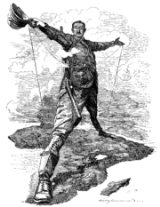
in the late nineteenth century, Europe
an powers divided Africa and its resources into political partitions at the Berlin Conference
of 1884-85. By 1905, African soil was almost completely controlled by European governments, with the only exceptions being Liberia
(which had been settled by African-American former slaves) and Ethiopia
(which had successfully resisted colonization by Italy). Britain
and France
had the largest holdings, but Germany
, Spain
, Italy
, Belgium
, and Portugal
also had colonies. As a result of colonialism and imperialism, Africa suffered long term effects, such as the loss of important natural resources like gold and rubber, economic devastation, cultural confusion, geopolitical division, and political subjugation. Europeans often justified this using the concept of the White Man's Burden, an obligation to "civilize" the peoples of Africa.
supported Adolf Hitler
while most French colonial governors loyally supported the Vichy government
until 1943. German wartime propaganda had a part in this defiance of British rule. Imperial Japan's conquests in the Far East
caused a shortage of raw materials such as rubber and various minerals. Africa was therefore forced to compensate for this shortage and greatly benefited from this change. Another key problem the Europeans faced were the U-boat
s patrolling the Atlantic Ocean
. This reduced the amount of raw materials being transported to Europe and prompted the creation of local industries in Africa. Local industries in turn caused the creation of new towns, and existing towns doubled in size. As urban community and industry grew so did trade unions. In addition to trade unions, urbanization brought about increased literacy, which allowed for pro-independence newspapers.
On February 12th 1941, United States President Franklin D. Roosevelt and British Prime Minister Winston Churchill
met to discuss the postwar world. The result was the Atlantic Charter
. One of the provisions, introduced by Roosevelt, was the autonomy of imperial colonies. After World War II, the US and the African colonies put pressure on Britain
to abide by the terms of the Atlantic Charter. When Winston Churchill
introduced the Charter to Parliament, he purposely mistranslated the colonies to be recently captured countries by Germany
in order to get it passed. After the war, the British still considered their African colonies as "children" and "immature"; they introduced democratic government only at the local levels.
By the 1930s, the colonial powers had cultivated a small elite of leaders educated in Western universities and familiar with ideas such as self-determination
. These leaders, including leading nationalists such as Jomo Kenyatta
(Kenya
), Kwame Nkrumah
(Gold Coast
, now Ghana
), Léopold Sédar Senghor
(Senegal
), and Félix Houphouët-Boigny
(Côte d'Ivoire
), came to lead the struggles for independence.
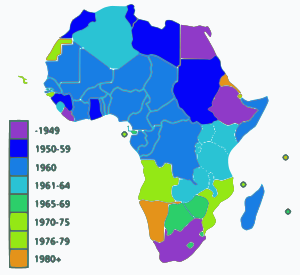
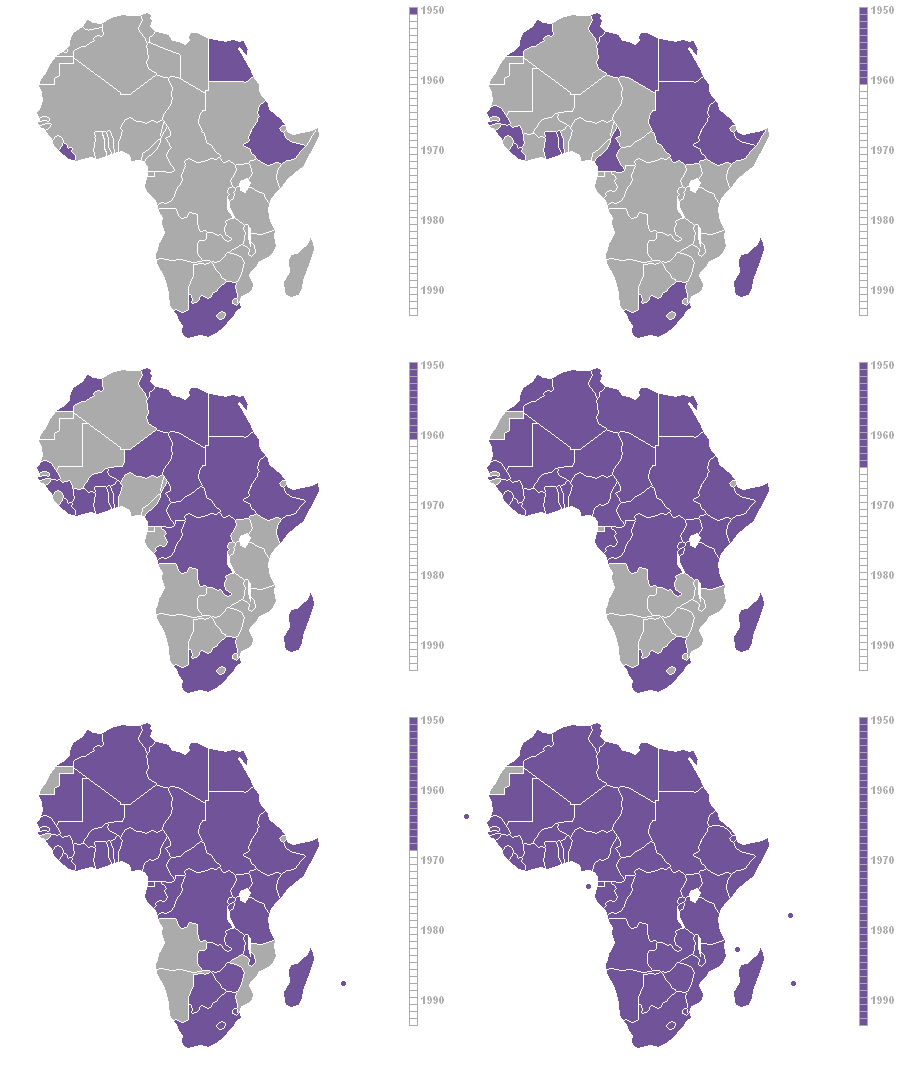 The "colonial power" and "colonial name" columns are merged when required to denote territories, where current countries are established, that have not been decolonized, but achieved independence in different way.
1 The Spanish colonial rule de facto terminated over the Western Sahara
(then Rio de Oro), when the territory was passed on to and partitioned between Mauritania
and Morocco
(which annexed the entire territory in 1979), rendering the declared independence of the Saharawi Arab Democratic Republic ineffective to the present day (it controls only a small portion
east of the Moroccan Wall
). Since Spain did not have the right to give away Western Sahara, under international law de jure the territory is still under Spanish administration. However, the de facto administrator is Morocco (see United Nations list of Non-Self-Governing Territories
).
World War II
World War II, or the Second World War , was a global conflict lasting from 1939 to 1945, involving most of the world's nations—including all of the great powers—eventually forming two opposing military alliances: the Allies and the Axis...
as colonized peoples agitated for independence and colonial
Colonialism
Colonialism is the establishment, maintenance, acquisition and expansion of colonies in one territory by people from another territory. It is a process whereby the metropole claims sovereignty over the colony and the social structure, government, and economics of the colony are changed by...
powers withdrew their administrators from Africa
Africa
Africa is the world's second largest and second most populous continent, after Asia. At about 30.2 million km² including adjacent islands, it covers 6% of the Earth's total surface area and 20.4% of the total land area...
.
Background
During the Scramble for AfricaScramble for Africa
The Scramble for Africa, also known as the Race for Africa or Partition of Africa was a process of invasion, occupation, colonization and annexation of African territory by European powers during the New Imperialism period, between 1881 and World War I in 1914...
in the late nineteenth century, Europe
Europe
Europe is, by convention, one of the world's seven continents. Comprising the westernmost peninsula of Eurasia, Europe is generally 'divided' from Asia to its east by the watershed divides of the Ural and Caucasus Mountains, the Ural River, the Caspian and Black Seas, and the waterways connecting...
an powers divided Africa and its resources into political partitions at the Berlin Conference
Berlin Conference
The Berlin Conference of 1884–85 regulated European colonization and trade in Africa during the New Imperialism period, and coincided with Germany's sudden emergence as an imperial power...
of 1884-85. By 1905, African soil was almost completely controlled by European governments, with the only exceptions being Liberia
Liberia
Liberia , officially the Republic of Liberia, is a country in West Africa. It is bordered by Sierra Leone on the west, Guinea on the north and Côte d'Ivoire on the east. Liberia's coastline is composed of mostly mangrove forests while the more sparsely populated inland consists of forests that open...
(which had been settled by African-American former slaves) and Ethiopia
Ethiopia
Ethiopia , officially known as the Federal Democratic Republic of Ethiopia, is a country located in the Horn of Africa. It is the second-most populous nation in Africa, with over 82 million inhabitants, and the tenth-largest by area, occupying 1,100,000 km2...
(which had successfully resisted colonization by Italy). Britain
United Kingdom of Great Britain and Ireland
The United Kingdom of Great Britain and Ireland was the formal name of the United Kingdom during the period when what is now the Republic of Ireland formed a part of it....
and France
French Third Republic
The French Third Republic was the republican government of France from 1870, when the Second French Empire collapsed due to the French defeat in the Franco-Prussian War, to 1940, when France was overrun by Nazi Germany during World War II, resulting in the German and Italian occupations of France...
had the largest holdings, but Germany
German Empire
The German Empire refers to Germany during the "Second Reich" period from the unification of Germany and proclamation of Wilhelm I as German Emperor on 18 January 1871, to 1918, when it became a federal republic after defeat in World War I and the abdication of the Emperor, Wilhelm II.The German...
, Spain
Spain under the Restoration
The Restoration was the name given to the period that began on December 29, 1874 after the First Spanish Republic ended with the restoration of Alfonso XII to the throne after a coup d'état by Martinez Campos, and ended on April 14, 1931 with the proclamation of the Second Spanish Republic.After...
, Italy
Kingdom of Italy (1861–1946)
The Kingdom of Italy was a state forged in 1861 by the unification of Italy under the influence of the Kingdom of Sardinia, which was its legal predecessor state...
, Belgium
Belgium
Belgium , officially the Kingdom of Belgium, is a federal state in Western Europe. It is a founding member of the European Union and hosts the EU's headquarters, and those of several other major international organisations such as NATO.Belgium is also a member of, or affiliated to, many...
, and Portugal
History of Portugal (1834-1910)
The history of Portugal from the end of the Liberal Civil War in 1834 to the republican revolution of 1910 was marked by several events that made way for the proclamation of the Portuguese Republic in the 5 October 1910 revolution....
also had colonies. As a result of colonialism and imperialism, Africa suffered long term effects, such as the loss of important natural resources like gold and rubber, economic devastation, cultural confusion, geopolitical division, and political subjugation. Europeans often justified this using the concept of the White Man's Burden, an obligation to "civilize" the peoples of Africa.
Causes
World War II saw the colonies help their colonial masters fight against an unknown enemy, but with no mention of independence for African nations. Future Prime Ministers Henrik Verwoerd and B. J. Vorster of South AfricaSouth Africa
The Republic of South Africa is a country in southern Africa. Located at the southern tip of Africa, it is divided into nine provinces, with of coastline on the Atlantic and Indian oceans...
supported Adolf Hitler
Adolf Hitler
Adolf Hitler was an Austrian-born German politician and the leader of the National Socialist German Workers Party , commonly referred to as the Nazi Party). He was Chancellor of Germany from 1933 to 1945, and head of state from 1934 to 1945...
while most French colonial governors loyally supported the Vichy government
Vichy France
Vichy France, Vichy Regime, or Vichy Government, are common terms used to describe the government of France that collaborated with the Axis powers from July 1940 to August 1944. This government succeeded the Third Republic and preceded the Provisional Government of the French Republic...
until 1943. German wartime propaganda had a part in this defiance of British rule. Imperial Japan's conquests in the Far East
Far East
The Far East is an English term mostly describing East Asia and Southeast Asia, with South Asia sometimes also included for economic and cultural reasons.The term came into use in European geopolitical discourse in the 19th century,...
caused a shortage of raw materials such as rubber and various minerals. Africa was therefore forced to compensate for this shortage and greatly benefited from this change. Another key problem the Europeans faced were the U-boat
U-boat
U-boat is the anglicized version of the German word U-Boot , itself an abbreviation of Unterseeboot , and refers to military submarines operated by Germany, particularly in World War I and World War II...
s patrolling the Atlantic Ocean
Atlantic Ocean
The Atlantic Ocean is the second-largest of the world's oceanic divisions. With a total area of about , it covers approximately 20% of the Earth's surface and about 26% of its water surface area...
. This reduced the amount of raw materials being transported to Europe and prompted the creation of local industries in Africa. Local industries in turn caused the creation of new towns, and existing towns doubled in size. As urban community and industry grew so did trade unions. In addition to trade unions, urbanization brought about increased literacy, which allowed for pro-independence newspapers.
On February 12th 1941, United States President Franklin D. Roosevelt and British Prime Minister Winston Churchill
Winston Churchill
Sir Winston Leonard Spencer-Churchill, was a predominantly Conservative British politician and statesman known for his leadership of the United Kingdom during the Second World War. He is widely regarded as one of the greatest wartime leaders of the century and served as Prime Minister twice...
met to discuss the postwar world. The result was the Atlantic Charter
Atlantic Charter
The Atlantic Charter was a pivotal policy statement first issued in August 1941 that early in World War II defined the Allied goals for the post-war world. It was drafted by Britain and the United States, and later agreed to by all the Allies...
. One of the provisions, introduced by Roosevelt, was the autonomy of imperial colonies. After World War II, the US and the African colonies put pressure on Britain
United Kingdom
The United Kingdom of Great Britain and Northern IrelandIn the United Kingdom and Dependencies, other languages have been officially recognised as legitimate autochthonous languages under the European Charter for Regional or Minority Languages...
to abide by the terms of the Atlantic Charter. When Winston Churchill
Winston Churchill
Sir Winston Leonard Spencer-Churchill, was a predominantly Conservative British politician and statesman known for his leadership of the United Kingdom during the Second World War. He is widely regarded as one of the greatest wartime leaders of the century and served as Prime Minister twice...
introduced the Charter to Parliament, he purposely mistranslated the colonies to be recently captured countries by Germany
Germany
Germany , officially the Federal Republic of Germany , is a federal parliamentary republic in Europe. The country consists of 16 states while the capital and largest city is Berlin. Germany covers an area of 357,021 km2 and has a largely temperate seasonal climate...
in order to get it passed. After the war, the British still considered their African colonies as "children" and "immature"; they introduced democratic government only at the local levels.
By the 1930s, the colonial powers had cultivated a small elite of leaders educated in Western universities and familiar with ideas such as self-determination
Self-determination
Self-determination is the principle in international law that nations have the right to freely choose their sovereignty and international political status with no external compulsion or external interference...
. These leaders, including leading nationalists such as Jomo Kenyatta
Jomo Kenyatta
Jomo Kenyattapron.] served as the first Prime Minister and President of Kenya. He is considered the founding father of the Kenyan nation....
(Kenya
Kenya
Kenya , officially known as the Republic of Kenya, is a country in East Africa that lies on the equator, with the Indian Ocean to its south-east...
), Kwame Nkrumah
Kwame Nkrumah
Kwame Nkrumah was the leader of Ghana and its predecessor state, the Gold Coast, from 1952 to 1966. Overseeing the nation's independence from British colonial rule in 1957, Nkrumah was the first President of Ghana and the first Prime Minister of Ghana...
(Gold Coast
Gold Coast (British colony)
The Gold Coast was a British colony on the Gulf of Guinea in west Africa that became the independent nation of Ghana in 1957.-Overview:The first Europeans to arrive at the coast were the Portuguese in 1471. They encountered a variety of African kingdoms, some of which controlled substantial...
, now Ghana
Ghana
Ghana , officially the Republic of Ghana, is a country located in West Africa. It is bordered by Côte d'Ivoire to the west, Burkina Faso to the north, Togo to the east, and the Gulf of Guinea to the south...
), Léopold Sédar Senghor
Léopold Sédar Senghor
Léopold Sédar Senghor was a Senegalese poet, politician, and cultural theorist who for two decades served as the first president of Senegal . Senghor was the first African elected as a member of the Académie française. Before independence, he founded the political party called the Senegalese...
(Senegal
Senegal
Senegal , officially the Republic of Senegal , is a country in western Africa. It owes its name to the Sénégal River that borders it to the east and north...
), and Félix Houphouët-Boigny
Félix Houphouët-Boigny
Félix Houphouët-Boigny , affectionately called Papa Houphouët or Le Vieux, was the first President of Côte d'Ivoire. Originally a village chief, he worked as a doctor, an administrator of a plantation, and a union leader, before being elected to the French Parliament and serving in a number of...
(Côte d'Ivoire
Côte d'Ivoire
The Republic of Côte d'Ivoire or Ivory Coast is a country in West Africa. It has an area of , and borders the countries Liberia, Guinea, Mali, Burkina Faso and Ghana; its southern boundary is along the Gulf of Guinea. The country's population was 15,366,672 in 1998 and was estimated to be...
), came to lead the struggles for independence.
Timeline
| Country | Colonial name | Colonial power | Independence date | First head of state | War for independence |
| Ethiopia Ethiopia Ethiopia , officially known as the Federal Democratic Republic of Ethiopia, is a country located in the Horn of Africa. It is the second-most populous nation in Africa, with over 82 million inhabitants, and the tenth-largest by area, occupying 1,100,000 km2... | colspan="2" align="center"| establishment History of Ethiopia This article covers the prehistory and history of Ethiopia.-Prehistory:Lucy, discovered in the Awash Valley of Ethiopia's Afar region, is considered the world's second-oldest, but most complete and best preserved, adult Australopithecine fossil... as the Kingdom of Aksum | 4th century BC | Menelik I Menelik I Menelik I , first Jewish Emperor of Ethiopia, is traditionally believed to be the son of King Solomon of ancient Israel and Makeda, ancient Ethiopia Queen of Sheba. He ruled around 950 BC, according to traditional sources... | - |
|||||
| Liberia Liberia Liberia , officially the Republic of Liberia, is a country in West Africa. It is bordered by Sierra Leone on the west, Guinea on the north and Côte d'Ivoire on the east. Liberia's coastline is composed of mostly mangrove forests while the more sparsely populated inland consists of forests that open... | Commonwealth of Liberia | American Colonization Society American Colonization Society The American Colonization Society , founded in 1816, was the primary vehicle to support the "return" of free African Americans to what was considered greater freedom in Africa. It helped to found the colony of Liberia in 1821–22 as a place for freedmen... | July 26, 1847 | Joseph Jenkins Roberts Joseph Jenkins Roberts Joseph Jenkins Roberts was the first and seventh President of Liberia. Born free in Norfolk, Virginia, USA, Roberts emigrated to Liberia in 1829 as a young man. He opened a trading store in Monrovia, and later engaged in politics... | - |
|||||
| Libya Libya Libya is an African country in the Maghreb region of North Africa bordered by the Mediterranean Sea to the north, Egypt to the east, Sudan to the southeast, Chad and Niger to the south, and Algeria and Tunisia to the west.... | Italian Libya Italian Libya Italian Libya was a unified colony of Italian North Africa established in 1934 in what represents present-day Libya... , Allied Military Administration | Italy; Britain/France | December 24, 1951 | Idris Idris I of Libya Idris, GBE , , was the first and only king of Libya, reigning from 1951 to 1969, and the Chief of the Senussi Muslim order.- Early life :... | - |
|||||
| Egypt Egypt Egypt , officially the Arab Republic of Egypt, Arabic: , is a country mainly in North Africa, with the Sinai Peninsula forming a land bridge in Southwest Asia. Egypt is thus a transcontinental country, and a major power in Africa, the Mediterranean Basin, the Middle East and the Muslim world... | Egypt | Britain | 1922/1936/1953 | n/a | Urabi Revolt Urabi Revolt The Urabi Revolt or Orabi Revolt , also known as the Orabi Revolution, was an uprising in Egypt in 1879-82 against the Khedive and European influence in the country... , Suez Crisis Suez Crisis The Suez Crisis, also referred to as the Tripartite Aggression, Suez War was an offensive war fought by France, the United Kingdom, and Israel against Egypt beginning on 29 October 1956. Less than a day after Israel invaded Egypt, Britain and France issued a joint ultimatum to Egypt and Israel,... |
|||||
| Sudan Sudan Sudan , officially the Republic of the Sudan , is a country in North Africa, sometimes considered part of the Middle East politically. It is bordered by Egypt to the north, the Red Sea to the northeast, Eritrea and Ethiopia to the east, South Sudan to the south, the Central African Republic to the... | Anglo-Egyptian Sudan Anglo-Egyptian Sudan Anglo-Egyptian Sudan referred to the manner by which Sudan was administered between 1899 and 1956, when it was a condominium of Egypt and the United Kingdom.-Union with Egypt:... | Britain | January 1, 1956 | Ismail al-Azhari Ismail al-Azhari Ismail al-Azhari was a Sudanese nationalist and political figure. He served as the Prime Minister of Sudan between 1954 and 1956, and as President of Sudan from 1964 until he was overthrown by Gaafar Nimeiry in 1969.-Early life:... | - |
|||||
| Tunisia Tunisia Tunisia , officially the Tunisian RepublicThe long name of Tunisia in other languages used in the country is: , is the northernmost country in Africa. It is a Maghreb country and is bordered by Algeria to the west, Libya to the southeast, and the Mediterranean Sea to the north and east. Its area... | French protectorate of Tunisia French Protectorate of Tunisia The French protectorate of Tunisia was established in 1881, during the Scramble for Africa, and lasted until Tunisian independence in 1956.... | France | March 20, 1956 | Muhammad VIII al-Amin Muhammad VIII al-Amin Muhammad VIII al-Amin was the last bey of Tunisia . He was the first head of state of independent Tunisia from 1956 until he was deposed in 1957... | - |
|||||
| Morocco Morocco Morocco , officially the Kingdom of Morocco , is a country located in North Africa. It has a population of more than 32 million and an area of 710,850 km², and also primarily administers the disputed region of the Western Sahara... | Protectorate of Morocco Protectorate of Morocco Protectorate of Morocco may refer to:* The Spanish Protectorate of Morocco * The French Protectorate of Morocco... | France/Spain | April 7, 1956 | Mohammed V | Rif War Rif War (1920) The Rif War, also called the Second Moroccan War, was fought between Spain and the Moroccan Rif Berbers.-Rifian forces:... , Ifni War Ifni War The Ifni War, sometimes called the Forgotten War in Spain , was a series of armed incursions into Spanish West Africa by Moroccan insurgents and Sahrawi rebels that began in October 1957 and culminated with the abortive siege of Sidi Ifni.The war, which may be seen as part of the general movement... |
|||||
| Ghana Ghana Ghana , officially the Republic of Ghana, is a country located in West Africa. It is bordered by Côte d'Ivoire to the west, Burkina Faso to the north, Togo to the east, and the Gulf of Guinea to the south... | Gold Coast Gold Coast (British colony) The Gold Coast was a British colony on the Gulf of Guinea in west Africa that became the independent nation of Ghana in 1957.-Overview:The first Europeans to arrive at the coast were the Portuguese in 1471. They encountered a variety of African kingdoms, some of which controlled substantial... | Britain/Germany; Britain | March 6, 1957 | Kwame Nkrumah Kwame Nkrumah Kwame Nkrumah was the leader of Ghana and its predecessor state, the Gold Coast, from 1952 to 1966. Overseeing the nation's independence from British colonial rule in 1957, Nkrumah was the first President of Ghana and the first Prime Minister of Ghana... | - |
|||||
| Guinea Guinea Guinea , officially the Republic of Guinea , is a country in West Africa. Formerly known as French Guinea , it is today sometimes called Guinea-Conakry to distinguish it from its neighbour Guinea-Bissau. Guinea is divided into eight administrative regions and subdivided into thirty-three prefectures... | French Guinea French Guinea French Guinea was a French colonial possession in West Africa. Its borders, while changed over time, were in 1958 those of the independent nation of Guinea.... (part of French West Africa French West Africa French West Africa was a federation of eight French colonial territories in Africa: Mauritania, Senegal, French Sudan , French Guinea , Côte d'Ivoire , Upper Volta , Dahomey and Niger... ) | France | October 2, 1958 | Sékou Touré | - |
|||||
| Cameroon Cameroon Cameroon, officially the Republic of Cameroon , is a country in west Central Africa. It is bordered by Nigeria to the west; Chad to the northeast; the Central African Republic to the east; and Equatorial Guinea, Gabon, and the Republic of the Congo to the south. Cameroon's coastline lies on the... | Cameroun Cameroun Cameroun was a French and British mandate territory in central Africa, now constituting the majority of the territory of the Republic of Cameroon.... | Germany; France/Britain | January 1, 1960 | Ahmadou Ahidjo Ahmadou Ahidjo Ahmadou Babatoura Ahidjo was the first President of Cameroon from 1960 until 1982.-Early life:Ahidjo was born in Garoua, a major river port along the Benue River in northern Cameroun, which was at the time a French mandate territory... | UPC rebellion Union of the Peoples of Cameroon The Union of the Peoples of Cameroon is a political party in Cameroon.-History:UPC was founded on April 10, 1948, at a meeting in the bar Chez Sierra in Bassa. 12 men assisted the founding meeting, including Charles Assalé, Léonard Bouli, and Guillaume Bagal. The majority of the participants were... |
|||||
| Senegal Senegal Senegal , officially the Republic of Senegal , is a country in western Africa. It owes its name to the Sénégal River that borders it to the east and north... | part of French West Africa French West Africa French West Africa was a federation of eight French colonial territories in Africa: Mauritania, Senegal, French Sudan , French Guinea , Côte d'Ivoire , Upper Volta , Dahomey and Niger... | France | April 4, 1960 | Léopold Senghor | - |
|||||
| Togo Togo Togo, officially the Togolese Republic , is a country in West Africa bordered by Ghana to the west, Benin to the east and Burkina Faso to the north. It extends south to the Gulf of Guinea, on which the capital Lomé is located. Togo covers an area of approximately with a population of approximately... | French Togoland French Togoland French Togoland was a France Mandate territory in West Africa, which later became the Togolese Republic.-Mandate territory:... | Germany; France | April 27, 1960 | Sylvanus Olympio Sylvanus Olympio Sylvanus Epiphanio Olympio was a Togolese political figure who served as Prime Minister, and then President, of Togo from 1958 until his assassination in 1963.-Political career:... | - |
|||||
| Mali Mali Mali , officially the Republic of Mali , is a landlocked country in Western Africa. Mali borders Algeria on the north, Niger on the east, Burkina Faso and the Côte d'Ivoire on the south, Guinea on the south-west, and Senegal and Mauritania on the west. Its size is just over 1,240,000 km² with... | French Sudan French Sudan French Sudan was a colony in French West Africa that had two separate periods of existence, first from 1890 to 1899, then from 1920 to 1960, when the territory became the independent nation of Mali.-Colonial establishment:... (part of French West Africa French West Africa French West Africa was a federation of eight French colonial territories in Africa: Mauritania, Senegal, French Sudan , French Guinea , Côte d'Ivoire , Upper Volta , Dahomey and Niger... ) | France | June 20, 1960 | Modibo Keita Modibo Keïta Modibo Keita ; was the first President of Mali and the Prime Minister of the Mali Federation. He espoused a form of African socialism.-Youth:... | - |
|||||
| Madagascar Madagascar The Republic of Madagascar is an island country located in the Indian Ocean off the southeastern coast of Africa... | Malagasy Protectorate Malagasy Protectorate The Malagasy Protectorate was a French protectorate in what is now Madagascar. Its status was to protect the Kingdom of Imerina. It ended in 1897 as Madagascar became a French colony.... | France | June 26, 1960 | Philibert Tsiranana Philibert Tsiranana Philibert Tsiranana was a Malagasy politician and leader, who served as the first President of Madagascar from 1959 to 1972.... | Malagasy Uprising |
|||||
| DR Congo | Belgian Congo Belgian Congo The Belgian Congo was the formal title of present-day Democratic Republic of the Congo between King Leopold II's formal relinquishment of his personal control over the state to Belgium on 15 November 1908, and Congolese independence on 30 June 1960.-Congo Free State, 1884–1908:Until the latter... | Belgium | June 30, 1960 | Joseph Kasa-Vubu Joseph Kasa-Vubu Joseph Kasa-Vubu was the first President of the Republic of the Congo, today called Democratic Republic of the Congo.... | Congo Crisis Congo Crisis The Congo Crisis was a period of turmoil in the First Republic of the Congo that began with national independence from Belgium and ended with the seizing of power by Joseph Mobutu... |
|||||
| Somalia Somalia Somalia , officially the Somali Republic and formerly known as the Somali Democratic Republic under Socialist rule, is a country located in the Horn of Africa. Since the outbreak of the Somali Civil War in 1991 there has been no central government control over most of the country's territory... | British Somaliland British Somaliland British Somaliland was a British protectorate in the northern part of present-day Somalia. For much of its existence, British Somaliland was bordered by French Somaliland, Ethiopia, and Italian Somaliland. From 1940 to 1941, it was occupied by the Italians and was part of Italian East Africa... Italian Somaliland Trust Territory of Somalia The Trust Territory of Somalia was a United Nations Trust Territory that was administered by Italy from 1949 to 1960, following the dissolution of the former Italian Somaliland inside the territory of modern-day Somalia.-History:In 1941, Italian Somaliland was occupied by British and South African... | Britain Italy | June 26, 1960 July 1, 1960 | Muhammad Haji Ibrahim Egal Aden Abdullah Osman Daar Aden Abdullah Osman Daar Aden Abdulle Osman Daar , popularly known as Aadan Cadde, was a Somali politician and the country's first President from July 1, 1960 to June 10, 1967.-Biography:... | - - |
|||||
| Benin Benin Benin , officially the Republic of Benin, is a country in West Africa. It borders Togo to the west, Nigeria to the east and Burkina Faso and Niger to the north. Its small southern coastline on the Bight of Benin is where a majority of the population is located... | French Dahomey French Dahomey Dahomey was a French colony of and a part of French West Africafrom 1904 to 1958. After World War II, by the establishment of the French Fourth Republic in 1947, Dahomey became part of the French Union with an increased autonomy. On 11 December 1958, the French Fifth Republic was established and... (part of French West Africa French West Africa French West Africa was a federation of eight French colonial territories in Africa: Mauritania, Senegal, French Sudan , French Guinea , Côte d'Ivoire , Upper Volta , Dahomey and Niger... ) | France | August 1, 1960 | Hubert Maga Hubert Maga Coutoucou Hubert Maga was a politician from Dahomey .Dahomey was renamed Benin in 1975. See . He arose on a political scene where one's power was dictated by what region in Dahomey they lived... | - |
|||||
| Niger Niger Niger , officially named the Republic of Niger, is a landlocked country in Western Africa, named after the Niger River. It borders Nigeria and Benin to the south, Burkina Faso and Mali to the west, Algeria and Libya to the north and Chad to the east... | Colony of Niger Colony of Niger The French Colony of Niger was a French Colonial possession covering much of the territory of the modern West African state of Niger, as well as portions of Mali, Burkina Faso and Chad... (part of French West Africa French West Africa French West Africa was a federation of eight French colonial territories in Africa: Mauritania, Senegal, French Sudan , French Guinea , Côte d'Ivoire , Upper Volta , Dahomey and Niger... ) | France | August 3, 1960 | Hamani Diori Hamani Diori Hamani Diori was the first President of the Republic of Niger. He was appointed to that office in 1960, when Niger gained independence.- Youth :... | - |
|||||
| Burkina Faso Burkina Faso Burkina Faso – also known by its short-form name Burkina – is a landlocked country in west Africa. It is surrounded by six countries: Mali to the north, Niger to the east, Benin to the southeast, Togo and Ghana to the south, and Côte d'Ivoire to the southwest.Its size is with an estimated... | French Upper Volta French Upper Volta Upper Volta was a colony of French West Africaestablished on March 1, 1919, from territories that had been part of the colonies of Upper Senegal and Niger and the Côte d'Ivoire... (part of French West Africa French West Africa French West Africa was a federation of eight French colonial territories in Africa: Mauritania, Senegal, French Sudan , French Guinea , Côte d'Ivoire , Upper Volta , Dahomey and Niger... ) | France | August 5, 1960 | Maurice Yaméogo Maurice Yaméogo Maurice Yaméogo was the first President of the Republic of Upper Volta, now called Burkina Faso. He proclaimed the independence of the country on August 5, 1960 and also tried to create a union between Cote d'Ivoire and Upper-Volta... | - |
|||||
| Côte d'Ivoire Côte d'Ivoire The Republic of Côte d'Ivoire or Ivory Coast is a country in West Africa. It has an area of , and borders the countries Liberia, Guinea, Mali, Burkina Faso and Ghana; its southern boundary is along the Gulf of Guinea. The country's population was 15,366,672 in 1998 and was estimated to be... | Ivory Coast (part of French West Africa) | France | August 7, 1960 | Félix Houphouët-Boigny Félix Houphouët-Boigny Félix Houphouët-Boigny , affectionately called Papa Houphouët or Le Vieux, was the first President of Côte d'Ivoire. Originally a village chief, he worked as a doctor, an administrator of a plantation, and a union leader, before being elected to the French Parliament and serving in a number of... | - |
|||||
| Chad Chad Chad , officially known as the Republic of Chad, is a landlocked country in Central Africa. It is bordered by Libya to the north, Sudan to the east, the Central African Republic to the south, Cameroon and Nigeria to the southwest, and Niger to the west... | French Chad (part of French Equatorial Africa French Equatorial Africa French Equatorial Africa or the AEF was the federation of French colonial possessions in Middle Africa, extending northwards from the Congo River to the Sahara Desert.-History:... ) | France | August 11, 1960 | François Tombalbaye François Tombalbaye François Tombalbaye, also called Ngarta Tombalbaye , was a teacher and a trade union activist who served as the first president of Chad. He was born in the southern region of the country in the Moyen-Chari Prefecture near the city of Koumara and was of the Sara ethnic group, the prominent ethnicity... | - |
|||||
| Central African Republic Central African Republic The Central African Republic , is a landlocked country in Central Africa. It borders Chad in the north, Sudan in the north east, South Sudan in the east, the Democratic Republic of the Congo and the Republic of the Congo in the south, and Cameroon in the west. The CAR covers a land area of about ,... | Ubangi-Shari (part of French Equatorial Africa French Equatorial Africa French Equatorial Africa or the AEF was the federation of French colonial possessions in Middle Africa, extending northwards from the Congo River to the Sahara Desert.-History:... ) | France | August 13, 1960 | David Dacko David Dacko David Dacko was the first President of the Central African Republic , from August 14, 1960 to January 1, 1966, and the third president of the CAR from September 21, 1979 to September 1, 1981... | - |
|||||
| Republic of the Congo Republic of the Congo The Republic of the Congo , sometimes known locally as Congo-Brazzaville, is a state in Central Africa. It is bordered by Gabon, Cameroon, the Central African Republic, the Democratic Republic of the Congo , the Angolan exclave province of Cabinda, and the Gulf of Guinea.The region was dominated by... | French Congo French Congo The French Congo was a French colony which at one time comprised the present-day area of the Republic of the Congo, Gabon, and the Central African Republic... (part of French Equatorial Africa French Equatorial Africa French Equatorial Africa or the AEF was the federation of French colonial possessions in Middle Africa, extending northwards from the Congo River to the Sahara Desert.-History:... ) | France | August 15, 1960 | Fulbert Youlou Fulbert Youlou Abbé Fulbert Youlou was a Brazzaville-Congolese Roman Catholic priest, nationalist leader and politician.-Early life:... | - |
|||||
| Gabon Gabon Gabon , officially the Gabonese Republic is a state in west central Africa sharing borders with Equatorial Guinea to the northwest, Cameroon to the north, and with the Republic of the Congo curving around the east and south. The Gulf of Guinea, an arm of the Atlantic Ocean is to the west... | part of French Equatorial Africa French Equatorial Africa French Equatorial Africa or the AEF was the federation of French colonial possessions in Middle Africa, extending northwards from the Congo River to the Sahara Desert.-History:... | France | August 17, 1960 | Léon M'ba Léon M'ba Gabriel Léon M'ba was the first Prime Minister and President of Gabon. A member of the Fang ethnic group, M'ba was born into a relatively privileged village family. After studying at a seminary, he held a number of small jobs before entering the colonial administration as a customs agent... | - |
|||||
| Nigeria Nigeria Nigeria , officially the Federal Republic of Nigeria, is a federal constitutional republic comprising 36 states and its Federal Capital Territory, Abuja. The country is located in West Africa and shares land borders with the Republic of Benin in the west, Chad and Cameroon in the east, and Niger in... | British Nigeria | Britain | October 1, 1960 | Nnamdi Azikiwe Nnamdi Azikiwe Benjamin Nnamdi Azikiwe , usually referred to as Nnamdi Azikiwe and popularly known as "Zik", was one of the leading figures of modern Nigerian nationalism who became the first President of Nigeria after Nigeria secured its independence from the United Kingdom on 1 October 1960; holding the... | - |
|||||
| Mauritania Mauritania Mauritania is a country in the Maghreb and West Africa. It is bordered by the Atlantic Ocean in the west, by Western Sahara in the north, by Algeria in the northeast, by Mali in the east and southeast, and by Senegal in the southwest... | part of French West Africa French West Africa French West Africa was a federation of eight French colonial territories in Africa: Mauritania, Senegal, French Sudan , French Guinea , Côte d'Ivoire , Upper Volta , Dahomey and Niger... | France | November 28, 1960 | Moktar Ould Daddah Moktar Ould Daddah Moktar Ould Daddah was the President of Mauritania from 1960, when his country gained its independence from France, to 1978, when he was deposed in a military coup d'etat.- Background :... | - |
|||||
| Sierra Leone Sierra Leone Sierra Leone , officially the Republic of Sierra Leone, is a country in West Africa. It is bordered by Guinea to the north and east, Liberia to the southeast, and the Atlantic Ocean to the west and southwest. Sierra Leone covers a total area of and has an estimated population between 5.4 and 6.4... | Sierra Leone | Britain | April 27, 1961 | Milton Margai Milton Margai Sir Milton Augustus Strieby Margai was a Sierra Leonean politician and the first prime minister of Sierra Leone... | - |
|||||
| South Africa South Africa The Republic of South Africa is a country in southern Africa. Located at the southern tip of Africa, it is divided into nine provinces, with of coastline on the Atlantic and Indian oceans... | British South Africa | Britain | 1910/1931/1961 | n/a | - |
|||||
| Tanzania Tanzania The United Republic of Tanzania is a country in East Africa bordered by Kenya and Uganda to the north, Rwanda, Burundi, and the Democratic Republic of the Congo to the west, and Zambia, Malawi, and Mozambique to the south. The country's eastern borders lie on the Indian Ocean.Tanzania is a state... | Tanganyika Tanganyika Tanganyika , later formally the Republic of Tanganyika, was a sovereign state in East Africa from 1961 to 1964. It was situated between the Indian Ocean and the African Great Lakes of Lake Victoria, Lake Malawi and Lake Tanganyika... Zanzibar Zanzibar Zanzibar ,Persian: زنگبار, from suffix bār: "coast" and Zangi: "bruin" ; is a semi-autonomous part of Tanzania, in East Africa. It comprises the Zanzibar Archipelago in the Indian Ocean, off the coast of the mainland, and consists of numerous small islands and two large ones: Unguja , and Pemba... | Germany; Britain Britain | December 9, 1961 December 10, 1963 | Julius Nyerere Julius Nyerere Julius Kambarage Nyerere was a Tanzanian politician who served as the first President of Tanzania and previously Tanganyika, from the country's founding in 1961 until his retirement in 1985.... Jamshid ibn Abdullah | - - |
|||||
| Rwanda Rwanda Rwanda or , officially the Republic of Rwanda , is a country in central and eastern Africa with a population of approximately 11.4 million . Rwanda is located a few degrees south of the Equator, and is bordered by Uganda, Tanzania, Burundi and the Democratic Republic of the Congo... | part of Ruanda-Urundi Ruanda-Urundi Ruanda-Urundi was a Belgian suzerainty from 1916 to 1924, a League of Nations Class B Mandate from 1924 to 1945 and then a United Nations trust territory until 1962, when it became the independent states of Rwanda and Burundi.- Overview :... | Germany; Belgium | July 1, 1962 | Grégoire Kayibanda Grégoire Kayibanda Grégoire Kayibanda was the first elected and second President of the Republic of Rwanda. He led Rwanda's struggle for independence from Belgium, and replaced the Tutsi monarchy with a republican form of government. He asserted Hutu majority power.-Early life and education:Grégoire Kayibanda was... | - |
|||||
| Burundi Burundi Burundi , officially the Republic of Burundi , is a landlocked country in the Great Lakes region of Eastern Africa bordered by Rwanda to the north, Tanzania to the east and south, and the Democratic Republic of the Congo to the west. Its capital is Bujumbura... | part of Ruanda-Urundi Ruanda-Urundi Ruanda-Urundi was a Belgian suzerainty from 1916 to 1924, a League of Nations Class B Mandate from 1924 to 1945 and then a United Nations trust territory until 1962, when it became the independent states of Rwanda and Burundi.- Overview :... | Germany; Belgium | July 1, 1962 | Mwambutsa IV | - |
|||||
| Algeria Algeria Algeria , officially the People's Democratic Republic of Algeria , also formally referred to as the Democratic and Popular Republic of Algeria, is a country in the Maghreb region of Northwest Africa with Algiers as its capital.In terms of land area, it is the largest country in Africa and the Arab... | French Algeria French Algeria French Algeria lasted from 1830 to 1962, under a variety of governmental systems. From 1848 until independence, the whole Mediterranean region of Algeria was administered as an integral part of France, much like Corsica and Réunion are to this day. The vast arid interior of Algeria, like the rest... | France | July 3, 1962 | Ahmed Ben Bella Ahmed Ben Bella Mohamed Ahmed Ben Bella was a soldier and Algerian revolutionary, who became the first President of Algeria.-Youth:... | Algerian War of Independence Algerian War of Independence The Algerian War was a conflict between France and Algerian independence movements from 1954 to 1962, which led to Algeria's gaining its independence from France... |
|||||
| Uganda Uganda Uganda , officially the Republic of Uganda, is a landlocked country in East Africa. Uganda is also known as the "Pearl of Africa". It is bordered on the east by Kenya, on the north by South Sudan, on the west by the Democratic Republic of the Congo, on the southwest by Rwanda, and on the south by... | Uganda Protectorate | Britain | October 9, 1962 | Milton Obote Milton Obote Apolo Milton Obote , Prime Minister of Uganda from 1962 to 1966 and President of Uganda from 1966 to 1971, then again from 1980 to 1985. He was a Ugandan political leader who led Uganda towards independence from the British colonial administration in 1962.He was overthrown by Idi Amin in 1971, but... | - |
|||||
| Kenya Kenya Kenya , officially known as the Republic of Kenya, is a country in East Africa that lies on the equator, with the Indian Ocean to its south-east... | Kenya Colony Kenya Colony The Colony and Protectorate of Kenya was part of the British Empire in Africa. It was established when the former East Africa Protectorate was transformed into a British crown colony in 1920... | Britain | December 12, 1963 | Jomo Kenyatta Jomo Kenyatta Jomo Kenyattapron.] served as the first Prime Minister and President of Kenya. He is considered the founding father of the Kenyan nation.... | Mau Mau Uprising Mau Mau Uprising The Mau Mau Uprising was a military conflict that took place in Kenya between 1952 and 1960... |
|||||
| Malawi Malawi The Republic of Malawi is a landlocked country in southeast Africa that was formerly known as Nyasaland. It is bordered by Zambia to the northwest, Tanzania to the northeast, and Mozambique on the east, south and west. The country is separated from Tanzania and Mozambique by Lake Malawi. Its size... | Nyasaland Protectorate | Britain | July 6, 1964 | Hastings Kamuzu Banda | - |
|||||
| Zambia Zambia Zambia , officially the Republic of Zambia, is a landlocked country in Southern Africa. The neighbouring countries are the Democratic Republic of the Congo to the north, Tanzania to the north-east, Malawi to the east, Mozambique, Zimbabwe, Botswana and Namibia to the south, and Angola to the west.... | Northern Rhodesia Northern Rhodesia Northern Rhodesia was a territory in south central Africa, formed in 1911. It became independent in 1964 as Zambia.It was initially administered under charter by the British South Africa Company and formed by it in 1911 by amalgamating North-Western Rhodesia and North-Eastern Rhodesia... | Britain | October 24, 1964 | Kenneth Kaunda Kenneth Kaunda Kenneth David Kaunda, known as KK, served as the first President of Zambia, from 1964 to 1991.-Early life:Kaunda was the youngest of eight children. He was born at Lubwa Mission in Chinsali, Northern Province of Northern Rhodesia, now Zambia... | - |
|||||
| The Gambia The Gambia The Republic of The Gambia, commonly referred to as The Gambia, or Gambia , is a country in West Africa. Gambia is the smallest country on mainland Africa, surrounded by Senegal except for a short coastline on the Atlantic Ocean in the west.... | Gambia | Britain | February 18, 1965 | Dawda Kairaba Jawara | - |
|||||
| Botswana Botswana Botswana, officially the Republic of Botswana , is a landlocked country located in Southern Africa. The citizens are referred to as "Batswana" . Formerly the British protectorate of Bechuanaland, Botswana adopted its new name after becoming independent within the Commonwealth on 30 September 1966... | Bechuanaland Protectorate | Britain | September 30, 1966 | Seretse Khama Seretse Khama Sir Seretse Khama, KBE was a statesman from Botswana. Born into one of the more powerful of the royal families of what was then the British Protectorate of Bechuanaland, and educated abroad in neighbouring South Africa and in the United Kingdom, he returned home—with a popular but controversial... | - |
|||||
| Lesotho Lesotho Lesotho , officially the Kingdom of Lesotho, is a landlocked country and enclave, surrounded by the Republic of South Africa. It is just over in size with a population of approximately 2,067,000. Its capital and largest city is Maseru. Lesotho is a member of the Commonwealth of Nations. The name... | Basutoland Basutoland Basutoland or officially the Territory of Basutoland, was a British Crown colony established in 1884 after the Cape Colony's inability to control the territory... | Britain | October 4, 1966 | Leabua Jonathan Leabua Jonathan Joseph Leabua Jonathan was the second Prime Minister of Lesotho. He succeeded Chief Sekhonyana Nehemia Maseribane following a by-election and held that post from 1965 to 1986.-Early life and career:... | - |
|||||
| Mauritius Mauritius Mauritius , officially the Republic of Mauritius is an island nation off the southeast coast of the African continent in the southwest Indian Ocean, about east of Madagascar... | | Britain | March 12, 1968 | | - |
|||||
| Swaziland Swaziland Swaziland, officially the Kingdom of Swaziland , and sometimes called Ngwane or Swatini, is a landlocked country in Southern Africa, bordered to the north, south and west by South Africa, and to the east by Mozambique... | Swaziland | Britain | September 6, 1968 | Sobhuza II | - |
|||||
| Equatorial Guinea Equatorial Guinea Equatorial Guinea, officially the Republic of Equatorial Guinea where the capital Malabo is situated.Annobón is the southernmost island of Equatorial Guinea and is situated just south of the equator. Bioko island is the northernmost point of Equatorial Guinea. Between the two islands and to the... | Spanish Guinea Spanish Guinea Spanish Guinea was an African colony of Spain that became the independent nation of Equatorial Guinea.-History:The Portuguese explorer, Fernão do Pó, seeking a route to India, is credited with having discovered the island of Bioko in 1472. He called it Formosa , but it quickly took on the name of... | Spain | October 12, 1968 | Francisco Macías Nguema Francisco Macías Nguema Francisco Macías Nguema was the first President of Equatorial Guinea, from 1968 until his overthrow in 1979.-Rise to power:... | - |
|||||
| Guinea-Bissau Guinea-Bissau The Republic of Guinea-Bissau is a country in West Africa. It is bordered by Senegal to the north, and Guinea to the south and east, with the Atlantic Ocean to its west.... | Portuguese Guinea Portuguese Guinea Portuguese Guinea was the name for what is today Guinea-Bissau from 1446 to September 10, 1974.-History:... | Portugal | September 24, 1973 | Luis Cabral Luis Cabral Luis Cabral may refer to:*Luis Cabral , a Portuguese Protestant evangelist*Luís Cabral, president of Guinea-Bissau*Luis Cabral , paraguayan footballer who plays for Club Sol de América... | Guinea-Bissau War of Independence Guinea-Bissau War of Independence Guinea-Bissau War of Independence was an armed conflict and national liberation struggle in Portuguese Guinea between 1963 and 1974.-Background:... |
|||||
| Mozambique Mozambique Mozambique, officially the Republic of Mozambique , is a country in southeastern Africa bordered by the Indian Ocean to the east, Tanzania to the north, Malawi and Zambia to the northwest, Zimbabwe to the west and Swaziland and South Africa to the southwest... | Portuguese East Africa Portuguese East Africa Mozambique or Portuguese East Africa was the common name by which the Portuguese Empire's territorial expansion in East Africa was known across different periods of time... | Portugal | June 25, 1975 | Samora Machel Samora Machel Samora Moisés Machel was a Mozambican military commander, revolutionary socialist leader and eventual President of Mozambique... | Mozambican War of Independence Mozambican War of Independence The Mozambican War of Independence was an armed conflict between the guerrilla forces of the Mozambique Liberation Front or FRELIMO , and Portugal... |
|||||
| Cape Verde Cape Verde The Republic of Cape Verde is an island country, spanning an archipelago of 10 islands located in the central Atlantic Ocean, 570 kilometres off the coast of Western Africa... | | Portugal | July 5, 1975 | | influenced by Guinea-Bissau War of Independence Guinea-Bissau War of Independence Guinea-Bissau War of Independence was an armed conflict and national liberation struggle in Portuguese Guinea between 1963 and 1974.-Background:... |
|||||
| Comoros Comoros The Comoros , officially the Union of the Comoros is an archipelago island nation in the Indian Ocean, located off the eastern coast of Africa, on the northern end of the Mozambique Channel, between northeastern Mozambique and northwestern Madagascar... | | France | July 6, 1975 | | - |
|||||
| São Tomé and Príncipe São Tomé and Príncipe São Tomé and Príncipe, officially the Democratic Republic of São Tomé and Príncipe, is a Portuguese-speaking island nation in the Gulf of Guinea, off the western equatorial coast of Central Africa. It consists of two islands: São Tomé and Príncipe, located about apart and about , respectively, off... | | Portugal | July 12, 1975 | | - |
|||||
| Angola Angola Angola, officially the Republic of Angola , is a country in south-central Africa bordered by Namibia on the south, the Democratic Republic of the Congo on the north, and Zambia on the east; its west coast is on the Atlantic Ocean with Luanda as its capital city... | Portuguese West Africa | Portugal | November 11, 1975 Alvor Agreement The Alvor Agreement, signed on January 15, 1975, granted Angola independence from Portugal on November 11, ending the war for independence while marking the transition to civil war... | Agostinho Neto Agostinho Neto António Agostinho Neto served as the first President of Angola , leading the Popular Movement for the Liberation of Angola in the war for independence and the civil war... | Angolan War of Independence Angolan War of Independence The Angolan War of Independence began as an uprising against forced cotton cultivation, and became a multi-faction struggle for control of Portugal's Overseas Province of Angola with three nationalist movements and a separatist movement... |
|||||
| Seychelles Seychelles Seychelles , officially the Republic of Seychelles , is an island country spanning an archipelago of 115 islands in the Indian Ocean, some east of mainland Africa, northeast of the island of Madagascar.... | | Britain | June 29, 1976 |James Richard Marie Mancham James Mancham Sir James Richard Marie Mancham KBE was the first President of Seychelles from 1976 to 1977.-Political background:... | - |
|||||
| Djibouti Djibouti Djibouti , officially the Republic of Djibouti , is a country in the Horn of Africa. It is bordered by Eritrea in the north, Ethiopia in the west and south, and Somalia in the southeast. The remainder of the border is formed by the Red Sea and the Gulf of Aden at the east... | French Somaliland French Somaliland French Somaliland was a French colony in the Horn of Africa. Established after the French signed various treaties between 1883 and 1887 with the then ruling Somali Sultans, the colony lasted from 1896 until 1946, when it became an overseas territory of France.... | France | June 27, 1977 | Hassan Gouled Aptidon Hassan Gouled Aptidon Hassan Gouled Aptidon was the first President of Djibouti from 1977 to 1999.-Biography:... | - |
|||||
| Zimbabwe Zimbabwe Zimbabwe is a landlocked country located in the southern part of the African continent, between the Zambezi and Limpopo rivers. It is bordered by South Africa to the south, Botswana to the southwest, Zambia and a tip of Namibia to the northwest and Mozambique to the east. Zimbabwe has three... | Southern Rhodesia Southern Rhodesia Southern Rhodesia was the name of the British colony situated north of the Limpopo River and the Union of South Africa. From its independence in 1965 until its extinction in 1980, it was known as Rhodesia... | Britain | April 18, 1980 | Canaan Banana Canaan Banana Canaan Sodindo Banana served as the first President of Zimbabwe from 18 April 1980 until 31 December 1987. A Methodist minister, he held the largely ceremonial office of the presidency while his eventual successor, Robert Mugabe, served as Prime Minister of Zimbabwe.During his lifetime, Banana... | Rhodesian Bush War Rhodesian Bush War The Rhodesian Bush War – also known as the Second Chimurenga or the Zimbabwe War of Liberation – was a civil war which took place between July 1964 and December 1979 in the unrecognised country of Rhodesia... |
|||||
| Namibia Namibia Namibia, officially the Republic of Namibia , is a country in southern Africa whose western border is the Atlantic Ocean. It shares land borders with Angola and Zambia to the north, Botswana to the east and South Africa to the south and east. It gained independence from South Africa on 21 March... | South West Africa South West Africa South-West Africa was the name that was used for the modern day Republic of Namibia during the earlier eras when the territory was controlled by the German Empire and later by South Africa.... | Germany; South Africa | March 21, 1990 | Sam Nujoma Sam Nujoma Samuel Daniel Shafiishuna Nujoma is a Namibian politician who was the first President of Namibia from 1990 to 2005. He led the South-West Africa People's Organisation in its long struggle against South African rule and took office as President when Namibia obtained independence on 21 March 1990... | Namibian War of Independence Namibian War of Independence See also South African Border War.The Namibian War of Independence, also known as the South African Border War, which lasted from 1966 to 1988, was a guerrilla war, which the nationalist South-West Africa People's Organization and others, fought against the apartheid government in South... |
|||||
| Eritrea Eritrea Eritrea , officially the State of Eritrea, is a country in the Horn of Africa. Eritrea derives it's name from the Greek word Erethria, meaning 'red land'. The capital is Asmara. It is bordered by Sudan in the west, Ethiopia in the south, and Djibouti in the southeast... | Eritrea | Italy; Britain; Ethiopia | May 24, 1993 | Isaias Afewerki Isaias Afewerki Isaias Afewerki is the first and current President of Eritrea, attaining that status when he led the Eritrean People's Liberation Front to victory in May 1991, thus ending the 30-year old armed liberation struggle that the Eritrean people refer to as "Gedli".-Early life and rise to power:Afewerki... | Eritrean War of Independence Eritrean War of Independence The Eritrean War of Independence was a conflict fought between the Ethiopian government and Eritrean separatists, both before and during the Ethiopian Civil War. The war started when Eritrea’s autonomy within Ethiopia, where troops were already stationed, was unilaterally revoked... |
|||||
| South Sudan | Southern Sudan | Britain; Sudan | July 9, 2011 | Salva Kiir Mayardit Salva Kiir Mayardit Salva Kiir Mayardit is the first President of the Republic of South Sudan.-Sudanese civil wars:In the late 1960s, Kiir joined the Anyanya in the First Sudanese Civil War. By the time of the 1972 Addis Ababa Agreement, he was a low-ranking officer... | Sudanese Civil War Sudanese Civil War The term Sudanese Civil War refers to at least two separate conflicts:*First Sudanese Civil War - 1955–1972*Second Sudanese Civil War - 1983–2005... |
|||||
| Sahrawi Republic 1 | Spanish Sahara Spanish Sahara Spanish Sahara was the name used for the modern territory of Western Sahara when it was ruled as a territory by Spain between 1884 and 1975... ; Moroccan Sahara |
Spain; Morocco |
February 27, 1976; Currently |
El-Ouali Mustapha Sayed El-Ouali Mustapha Sayed El-Ouali Mustapha Sayed was a Sahrawi nationalist leader, co-founder and second Secretary-General of the Polisario Front, & also the first President of the Sahrawi Arab Democratic Republic.... ; Mohamed Abdelaziz Mohamed Abdelaziz Mohamed Abdelaziz is the 3rd and current Secretary General of the Polisario Front and President of the Sahrawi Arab Democratic Republic since 1976... |
Western Sahara War Western Sahara War The Western Sahara War was an armed conflict primarily between the Polisario Front and Morocco, the conflict erupted after the withdrawal of Spain from the Spanish Sahara in accordance with the Madrid Accords by which it gave administrative control of the territory to Morocco and Mauritania... ; Saharawi Intifada |
1 The Spanish colonial rule de facto terminated over the Western Sahara
Western Sahara
Western Sahara is a disputed territory in North Africa, bordered by Morocco to the north, Algeria to the northeast, Mauritania to the east and south, and the Atlantic Ocean to the west. Its surface area amounts to . It is one of the most sparsely populated territories in the world, mainly...
(then Rio de Oro), when the territory was passed on to and partitioned between Mauritania
Mauritania
Mauritania is a country in the Maghreb and West Africa. It is bordered by the Atlantic Ocean in the west, by Western Sahara in the north, by Algeria in the northeast, by Mali in the east and southeast, and by Senegal in the southwest...
and Morocco
Morocco
Morocco , officially the Kingdom of Morocco , is a country located in North Africa. It has a population of more than 32 million and an area of 710,850 km², and also primarily administers the disputed region of the Western Sahara...
(which annexed the entire territory in 1979), rendering the declared independence of the Saharawi Arab Democratic Republic ineffective to the present day (it controls only a small portion
Free Zone (region)
The Free Zone or Liberated Territories is a term used by the Polisario Front to describe the part of Western Sahara that lies to the east of the Moroccan Berm and west and north of the borders with Algeria and Mauritania, respectively...
east of the Moroccan Wall
Moroccan Wall
The Berm of Western Sahara is an approximately 2,700 km-long defensive structure, mostly a sand wall , running through Western Sahara and the southeastern portion of Morocco...
). Since Spain did not have the right to give away Western Sahara, under international law de jure the territory is still under Spanish administration. However, the de facto administrator is Morocco (see United Nations list of Non-Self-Governing Territories
United Nations list of Non-Self-Governing Territories
The United Nations list of Non-Self-Governing Territories is a list of countries that, according to the United Nations, are non-decolonized. The list was initially prepared in 1946 pursuant to Chapter XI of the United Nations Charter, and has been updated by the General Assembly on recommendation...
).
See also
- ColonialismColonialismColonialism is the establishment, maintenance, acquisition and expansion of colonies in one territory by people from another territory. It is a process whereby the metropole claims sovereignty over the colony and the social structure, government, and economics of the colony are changed by...
- DecolonizationDecolonizationDecolonization refers to the undoing of colonialism, the unequal relation of polities whereby one people or nation establishes and maintains dependent Territory over another...
- Scramble for AfricaScramble for AfricaThe Scramble for Africa, also known as the Race for Africa or Partition of Africa was a process of invasion, occupation, colonization and annexation of African territory by European powers during the New Imperialism period, between 1881 and World War I in 1914...
- Wars of national liberationWars of national liberationIn Marxist terminology, wars of national liberation or national liberation revolutions are conflicts fought by oppressed nationalities against imperial powers to establish separate sovereign states for the subjugated nationality. From a Western point of view, these same wars are called insurgencies...
- Year of AfricaYear of Africa-Granted independence in 1960 from France:* Mauritania* Mali Federation * Gabon* Republic of the Congo * Central African Republic* Chad* Ivory Coast...
External links
- Africa: 50 years of independence Radio France Internationale in English
- "Winds of Change or Hot Air? Decolonization and the Salt Water Test" Legal Frontiers International Law Blog