

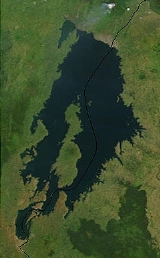
Lake Kivu

Encyclopedia
Lake Kivu is one of the African Great Lakes
. It lies on the border between the Democratic Republic of the Congo
and Rwanda
, and is in the Albertine (western) Rift, a part of the Great Rift Valley
. Lake Kivu empties into the Ruzizi River
, which flows southwards into Lake Tanganyika
. The name comes from kivu which means "lake" in Bantu language, just like the words tanganyika or nyanza.
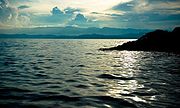 The lake
covers a total surface area of some 2700 km² (1,042.5 sq mi) and stands at a height of 1460 metres (4,790 ft) above sea level. Some 1 370 km2 or 58% of the lake's waters lie within DRC borders. The lake bed sits upon a rift valley
that is slowly being pulled apart, causing volcanic activity in the area, and making it particularly deep: its maximum depth of 480 m (1,575 ft) is ranked eighteenth in the world. The lake is surrounded by majestic mountains.
The world's tenth-largest inland island, Idjwi
, lies in Lake Kivu, as does the tiny island of Tshegera, which also lies within the boundaries of Virunga National Park
; while settlements on its shore include Bukavu
, Kabare
, Kalehe, Sake
and Goma
in Congo and Gisenyi
, Kibuye
and Cyangugu
in Rwanda.
Native fish include species of Barbus
, Clarias
, and Haplochromis
, as well as Nile Tilapia
. Limnothrissa miodon, one of two species known as the Tanganyika sardine
, was introduced in 1959 and formed the basis of a new pelagic zone
fishery. In the early 1990s, the number of fishers on the lake was 6,563, of which 3,027 were associated with the pelagic fishery and 3,536 with the traditional fishery. Widespread armed conflict in the surrounding region from the mid-1990s resulted in a decline in the fisheries harvest.
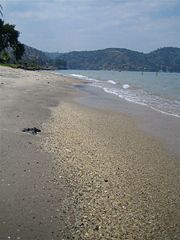 Lake Kivu is one of three known exploding lakes
, along with Cameroonian Lake Nyos
and Lake Monoun
, that experience violent lake overturn
s. Analysis of Lake Kivu's geological history indicates sporadic massive biological extinction on millennial timescales. The trigger for lake overturns in Lake Kivu's case is unknown but volcanic activity is suspected. The gaseous chemical composition of exploding lakes is unique to each lake; in Lake Kivu's case, methane and carbon dioxide due to lake water interaction with a volcano. The amount of methane is estimated to be 65 cubic kilometers (if burnt over one year, it would give an average power
of about 100 gigawatts for the whole period). There is also an estimated 256 cubic kilometers of carbon dioxide. The methane is reported to be produced by microbial reduction of the volcanic CO2. The risk from a possible Lake Kivu overturn is catastrophic, dwarfing other documented lake overturns at Lakes Nyos and Monoun, because of the approximately two million people living in the lake basin.
Cores from the Bukavu Bay area of the lake reveal that the bottom has layered deposits of the rare mineral monohydrocalcite
interlain with diatoms, on top of sapropel
ic sediments with high pyrite
content. These are found at three different intervals. The sapropelic layers are believed to be related to hydrothermal discharge and the diatoms to a bloom which reduced the carbon dioxide levels low enough to precipitiate monohydrocalcite.
Scientists hypothesize that sufficient volcanic interaction with the lake's bottom water that has high gas concentrations would heat water, force the methane out of the water, spark a methane explosion, and trigger a nearly simultaneous release of carbon dioxide.
The carbon dioxide would then suffocate large numbers of people in the lake basin as the gases roll off the lake surface. It is also possible that the lake could spawn lake tsunami
s as gas explodes out of it.
The risk posed by Lake Kivu began to be understood during the analysis of more recent events at Lake Nyos. Lake Kivu's methane was originally thought to be merely a cheap natural resource for export, and for the generation of cheap power. Once the mechanisms that caused lake overturns began to be understood, so did awareness of the risk the lake posed to the local population.
An experimental vent pipe was installed at Lake Nyos in 2001 to remove gas from the deep water, but such a solution for the much larger Lake Kivu would be considerably more expensive. No plan has been initiated to reduce the risk posed by Lake Kivu. The about 500 million tonnes of carbon dioxide in the lake is a little under 2 percent of the amount released annually by human fossil fuel burning. Therefore the process of releasing it could potentially have costs beyond building and operating the system.
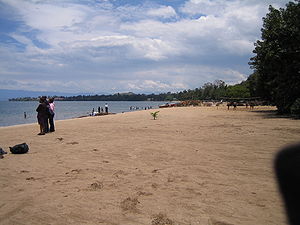 Lake Kivu has recently been found to contain approximately 55 billion cubic metres (72 billion cubic yards) of dissolved methane gas at a depth of 300 metres (984.3 ft). Until 2004, extraction of the gas was done on a small scale, with the extracted gas being used to run boilers at a brewery
, the Bralirwa brewery
in Gisenyi
. As far as large-scale exploitation of this resource is concerned, the Rwandan government is in negotiations with a number of parties to produce methane from the lake. Extraction is said to be cost-effective and simple because once the gas-rich water is pumped up, the dissolved gases (primarily carbon dioxide, hydrogen sulphide and methane) begin to bubble out as the water pressure gets lower. This project is expected to increase Rwanda's energy generation capability by as much as 20 times and will enable Rwanda to sell electricity
to neighboring African countries.
A problem associated with the prevalence of methane is that of mazuku
.
(cichlid
s) and a small clupeid, Limnothrissa miodon. Its exploitable stock was estimated at 2000 - 4000 tons per year. The sardine Limnothrissa miodon was introduced to Lake Kivu in the late 1950s by a Belgian Engineer A. Collart. At present, Lake Kivu is the sole natural lake in which Limnothrissa miodon, an endemic sardine originally from Lake Tanganyika, has been introduced initially to fill an empty niche. Indeed, prior to the introduction, no planktivorous fish was present in the pelagic waters of Lake Kivu.
Following this introduction, the sardine has gained substantial economic and nutritional importance for the lakeside human population but from an ecosystem standpoint, the introduction of planktivorous fish may result in important modifications of plankton community structure. Recent observations showed the disappearance during the last decades of a large grazer, Daphnia curvirostris, and the dominance of mesozooplankton community by three species of cyclopoid copepod: Thermocyclops consimilis, Mesocyclops aequatorialis and Tropocyclops confinis.
The first comprehensive phytoplankton survey was released in 2006. With an annual average chlorophyll a in the mixed layer of 2.2 mg m-3 and low nutrient levels in the euphotic zone, the lake is clearly oligotrophic. Diatoms are the dominant group in the lake, particularly during the dry season episodes of deep mixing. During the rainy season, the stratified water column, with high light and lower nutrient availability, favoure dominance of cyanobacteria with high numbers of phototrophic picoplankton. The actual primary production is 0.71 g C m-2 d-1 (~ 260 g C m-2 y-1).
A study of evolutionary genetics showed that the cichlids from lakes in northern Virunga (Edward, George, Victoria ...) would have evolved in a "proto-lake Kivu", much older than the intense volcanic activity (20,000-25,000 years ago) which cut the connection. The elevation of the mountains west of the lake (which is currently the Kahuzi-Biega National Park, one of the largest reserves of mountain gorillas in the world), combined with the elevation of the eastern rift (located in eastern Rwanda) would be responsible for drainage of water from central Rwanda in the actual Lake Kivu. This concept of "proto-lake Kivu" was challenged by lack of consistent geological evidence, although the cichlid's molecular clock suggests the existence of a lake much older than the commonly cited 15,000 years.
 The first Europe
an to visit the lake was German
Count Adolf von Götzen
in 1894. Since then it has been caught up in the conflict between Hutu
and Tutsi
people in Rwanda, and their allies in DR Congo, which led to the 1994 Rwandan Genocide
and the First
and Second Congo War
s. Lake Kivu gained notoriety as a place where many of the victims of the genocide were dumped.
African Great Lakes
The African Great Lakes are a series of lakes and the Rift Valley lakes in and around the geographic Great Rift Valley formed by the action of the tectonic East African Rift on the continent of Africa...
. It lies on the border between the Democratic Republic of the Congo
Democratic Republic of the Congo
The Democratic Republic of the Congo is a state located in Central Africa. It is the second largest country in Africa by area and the eleventh largest in the world...
and Rwanda
Rwanda
Rwanda or , officially the Republic of Rwanda , is a country in central and eastern Africa with a population of approximately 11.4 million . Rwanda is located a few degrees south of the Equator, and is bordered by Uganda, Tanzania, Burundi and the Democratic Republic of the Congo...
, and is in the Albertine (western) Rift, a part of the Great Rift Valley
Great Rift Valley
The Great Rift Valley is a name given in the late 19th century by British explorer John Walter Gregory to the continuous geographic trench, approximately in length, that runs from northern Syria in Southwest Asia to central Mozambique in South East Africa...
. Lake Kivu empties into the Ruzizi River
Ruzizi River
The Ruzizi , is a river which flows from Lake Kivu to Lake Tanganyika in Central Africa, descending rapidly from about 1,500 metres above sea level to about 770 metres above sea level over its length...
, which flows southwards into Lake Tanganyika
Lake Tanganyika
Lake Tanganyika is an African Great Lake. It is estimated to be the second largest freshwater lake in the world by volume, and the second deepest, after Lake Baikal in Siberia; it is also the world's longest freshwater lake...
. The name comes from kivu which means "lake" in Bantu language, just like the words tanganyika or nyanza.
Geography and fisheries
Lake
A lake is a body of relatively still fresh or salt water of considerable size, localized in a basin, that is surrounded by land. Lakes are inland and not part of the ocean and therefore are distinct from lagoons, and are larger and deeper than ponds. Lakes can be contrasted with rivers or streams,...
covers a total surface area of some 2700 km² (1,042.5 sq mi) and stands at a height of 1460 metres (4,790 ft) above sea level. Some 1 370 km2 or 58% of the lake's waters lie within DRC borders. The lake bed sits upon a rift valley
Rift valley
A rift valley is a linear-shaped lowland between highlands or mountain ranges created by the action of a geologic rift or fault. This action is manifest as crustal extension, a spreading apart of the surface which is subsequently further deepened by the forces of erosion...
that is slowly being pulled apart, causing volcanic activity in the area, and making it particularly deep: its maximum depth of 480 m (1,575 ft) is ranked eighteenth in the world. The lake is surrounded by majestic mountains.
The world's tenth-largest inland island, Idjwi
Idjwi
Idjwi or Ijwi is an island in Lake Kivu, belonging to the Democratic Republic of the Congo. At 70 km in length and with an area of 340 km², it is the second largest inland island in Africa, and the tenth largest in the world...
, lies in Lake Kivu, as does the tiny island of Tshegera, which also lies within the boundaries of Virunga National Park
Virunga National Park
The Virunga National Park , formerly named Albert National Park, is a 7800 square km National Park that stretches from the Virunga Mountains in the South, to the Rwenzori Mountains in the North, in the eastern Democratic Republic of Congo, bordering Volcanoes National Park in Rwanda and Rwenzori...
; while settlements on its shore include Bukavu
Bukavu
Bukavu is a city in eastern Democratic Republic of the Congo , lying at the extreme south-eastern extent of Lake Kivu, west of Cyangugu in Rwanda, and separated from it by the outlet of the Ruzizi River. It is the capital of the Sud-Kivu province and as of 2009 it had an estimated population of...
, Kabare
Kabaré
Kabaré is a town in the Bilanga Department of Gnagna Province in eastern Burkina Faso. The town has a population of 1,734....
, Kalehe, Sake
Sake, DRC
Sake is a town in the Democratic Republic of the Congo in the eastern province of North Kivu. It is located at the northwestern extremity of Lake Kivu, 25 km west-northwest of Goma on National Road No. 2, at the edge of the volcanic lava plains in the bottom of the Great Rift Valley, western...
and Goma
Goma
Goma is a city in the eastern Democratic Republic of the Congo, on the northern shore of Lake Kivu, next to the Rwandan city of Gisenyi. The lake and the two cities are in the western branch of the Great Rift Valley, and Goma lies only 13 to 18 km due south of the crater of the active...
in Congo and Gisenyi
Gisenyi
Gisenyi is a city in Rubavu district in the Western Province of Rwanda. Gisenyi is contiguous with Goma, the city across the border in the Democratic Republic of the Congo. The population of the city is about 106 000 .-Description:...
, Kibuye
Kibuye
Kibuye is a city in Karongi district, and the capital of Western Province in Rwanda. The city lies on the eastern shore of Lake Kivu, about halfway down, and between Gisenyi and Cyangugu. It is known as a beach resort and is home to a genocide memorial marking the massacre of 90% of the town's...
and Cyangugu
Cyangugu
Cyangugu is a city and capital of the Rusizi district of Western Province, Rwanda. The city lies at the southern end of Lake Kivu, and is contiguous with Bukavu, Democratic Republic of the Congo, but separated from it by the Ruzizi River...
in Rwanda.
Native fish include species of Barbus
Barbus
Barbus is a ray-finned fish genus in the family Cyprinidae. The type species of Barbus is the Common Barbel, first described as Cyprinus barbus and now named Barbus barbus...
, Clarias
Clarias
Clarias is a genus of catfishes of the family Clariidae, the airbreathing catfishes. The name is derived from the Greek chlaros, which means lively, in reference to the ability of the fish to live for a long time out of water....
, and Haplochromis
Haplochromis
Haplochromis is a ray-finned fish genus in the family Cichlidae. It has been used as the default "wastebin taxon" for Pseudocrenilabrinae cichlids of the East African Rift, and as such became the "largest" fish "genus"...
, as well as Nile Tilapia
Oreochromis niloticus
The Nile Tilapia, Oreochromis niloticus is a relatively large cichlid fish, which is native to Africa from Egypt south to East and Central Africa, and as far west as Gambia. It is also native to Israel, and numerous introduced populations exist outside its natural range.It is also commercially...
. Limnothrissa miodon, one of two species known as the Tanganyika sardine
Kapenta
The Tanganyika sardine, known as Kapenta in Zambia and Zimbabwe or Dagaa or Ndgaa elsewhere, is really two species both of which are small, planktivorous, pelagic, freshwater clupeid originating from Lake Tanganyika in East Africa...
, was introduced in 1959 and formed the basis of a new pelagic zone
Pelagic zone
Any water in a sea or lake that is not close to the bottom or near to the shore can be said to be in the pelagic zone. The word pelagic comes from the Greek πέλαγος or pélagos, which means "open sea". The pelagic zone can be thought of in terms of an imaginary cylinder or water column that goes...
fishery. In the early 1990s, the number of fishers on the lake was 6,563, of which 3,027 were associated with the pelagic fishery and 3,536 with the traditional fishery. Widespread armed conflict in the surrounding region from the mid-1990s resulted in a decline in the fisheries harvest.
Chemistry
Limnic eruption
A limnic eruption, also referred to as a lake overturn, is a rare type of natural disaster in which carbon dioxide suddenly erupts from deep lake water, suffocating wildlife, livestock and humans. Such an eruption may also cause tsunamis in the lake as the rising CO2 displaces water. Scientists...
, along with Cameroonian Lake Nyos
Lake Nyos
Lake Nyos is a crater lake in the Northwest Region of Cameroon, located about northwest of Yaoundé. Nyos is a deep lake high on the flank of an inactive volcano in the Oku volcanic plain along the Cameroon line of volcanic activity...
and Lake Monoun
Lake Monoun
Lake Monoun is a lake in West Province, Cameroon, that lies in the Oku Volcanic Field . On August 15, 1984, the lake exploded in a limnic eruption, which resulted in the release of a large amount of carbon dioxide that killed 37 people. At first, the cause of the deaths was a mystery, and...
, that experience violent lake overturn
Limnic eruption
A limnic eruption, also referred to as a lake overturn, is a rare type of natural disaster in which carbon dioxide suddenly erupts from deep lake water, suffocating wildlife, livestock and humans. Such an eruption may also cause tsunamis in the lake as the rising CO2 displaces water. Scientists...
s. Analysis of Lake Kivu's geological history indicates sporadic massive biological extinction on millennial timescales. The trigger for lake overturns in Lake Kivu's case is unknown but volcanic activity is suspected. The gaseous chemical composition of exploding lakes is unique to each lake; in Lake Kivu's case, methane and carbon dioxide due to lake water interaction with a volcano. The amount of methane is estimated to be 65 cubic kilometers (if burnt over one year, it would give an average power
Power (physics)
In physics, power is the rate at which energy is transferred, used, or transformed. For example, the rate at which a light bulb transforms electrical energy into heat and light is measured in watts—the more wattage, the more power, or equivalently the more electrical energy is used per unit...
of about 100 gigawatts for the whole period). There is also an estimated 256 cubic kilometers of carbon dioxide. The methane is reported to be produced by microbial reduction of the volcanic CO2. The risk from a possible Lake Kivu overturn is catastrophic, dwarfing other documented lake overturns at Lakes Nyos and Monoun, because of the approximately two million people living in the lake basin.
Cores from the Bukavu Bay area of the lake reveal that the bottom has layered deposits of the rare mineral monohydrocalcite
Monohydrocalcite
Monohydrocalcite is a mineral that is a hydrous form of calcium carbonate, CaCO3·H2O. It was formerly also known by the name hydrocalcite, which is now discredited by the IMA. It is a trigonal mineral which is white when pure...
interlain with diatoms, on top of sapropel
Sapropel
Sapropel is a term used in marine geology to describe dark-coloured sediments that are rich in organic matter...
ic sediments with high pyrite
Pyrite
The mineral pyrite, or iron pyrite, is an iron sulfide with the formula FeS2. This mineral's metallic luster and pale-to-normal, brass-yellow hue have earned it the nickname fool's gold because of its resemblance to gold...
content. These are found at three different intervals. The sapropelic layers are believed to be related to hydrothermal discharge and the diatoms to a bloom which reduced the carbon dioxide levels low enough to precipitiate monohydrocalcite.
Scientists hypothesize that sufficient volcanic interaction with the lake's bottom water that has high gas concentrations would heat water, force the methane out of the water, spark a methane explosion, and trigger a nearly simultaneous release of carbon dioxide.
The carbon dioxide would then suffocate large numbers of people in the lake basin as the gases roll off the lake surface. It is also possible that the lake could spawn lake tsunami
Tsunami
A tsunami is a series of water waves caused by the displacement of a large volume of a body of water, typically an ocean or a large lake...
s as gas explodes out of it.
The risk posed by Lake Kivu began to be understood during the analysis of more recent events at Lake Nyos. Lake Kivu's methane was originally thought to be merely a cheap natural resource for export, and for the generation of cheap power. Once the mechanisms that caused lake overturns began to be understood, so did awareness of the risk the lake posed to the local population.
An experimental vent pipe was installed at Lake Nyos in 2001 to remove gas from the deep water, but such a solution for the much larger Lake Kivu would be considerably more expensive. No plan has been initiated to reduce the risk posed by Lake Kivu. The about 500 million tonnes of carbon dioxide in the lake is a little under 2 percent of the amount released annually by human fossil fuel burning. Therefore the process of releasing it could potentially have costs beyond building and operating the system.
Methane extraction
Brewery
A brewery is a dedicated building for the making of beer, though beer can be made at home, and has been for much of beer's history. A company which makes beer is called either a brewery or a brewing company....
, the Bralirwa brewery
Bralirwa
Bralirwa, also known by its French name Brasseries et Limonaderies du Rwanda, is the largest brewer and soft beverage company in the Republic of Rwanda.-History:The history of Bralirwa goes back to 1957...
in Gisenyi
Gisenyi
Gisenyi is a city in Rubavu district in the Western Province of Rwanda. Gisenyi is contiguous with Goma, the city across the border in the Democratic Republic of the Congo. The population of the city is about 106 000 .-Description:...
. As far as large-scale exploitation of this resource is concerned, the Rwandan government is in negotiations with a number of parties to produce methane from the lake. Extraction is said to be cost-effective and simple because once the gas-rich water is pumped up, the dissolved gases (primarily carbon dioxide, hydrogen sulphide and methane) begin to bubble out as the water pressure gets lower. This project is expected to increase Rwanda's energy generation capability by as much as 20 times and will enable Rwanda to sell electricity
Electricity
Electricity is a general term encompassing a variety of phenomena resulting from the presence and flow of electric charge. These include many easily recognizable phenomena, such as lightning, static electricity, and the flow of electrical current in an electrical wire...
to neighboring African countries.
A problem associated with the prevalence of methane is that of mazuku
Mazuku
In geology, a mazuku is a pocket of oxygen-poor air that can be lethal to any human or animal life inside. Mazuku are created when an odorless and invisible gas such as carbon dioxide accumulates in pockets low to the ground...
.
Biology
The fish fauna in Lake Kivu is relatively poor (28 species). There are several endemic species of HaplochromisHaplochromis
Haplochromis is a ray-finned fish genus in the family Cichlidae. It has been used as the default "wastebin taxon" for Pseudocrenilabrinae cichlids of the East African Rift, and as such became the "largest" fish "genus"...
(cichlid
Cichlid
Cichlids are fishes from the family Cichlidae in the order Perciformes. Cichlids are members of a group known as the Labroidei along with the wrasses , damselfish , and surfperches . This family is both large and diverse. At least 1,300 species have been scientifically described, making it one of...
s) and a small clupeid, Limnothrissa miodon. Its exploitable stock was estimated at 2000 - 4000 tons per year. The sardine Limnothrissa miodon was introduced to Lake Kivu in the late 1950s by a Belgian Engineer A. Collart. At present, Lake Kivu is the sole natural lake in which Limnothrissa miodon, an endemic sardine originally from Lake Tanganyika, has been introduced initially to fill an empty niche. Indeed, prior to the introduction, no planktivorous fish was present in the pelagic waters of Lake Kivu.
Following this introduction, the sardine has gained substantial economic and nutritional importance for the lakeside human population but from an ecosystem standpoint, the introduction of planktivorous fish may result in important modifications of plankton community structure. Recent observations showed the disappearance during the last decades of a large grazer, Daphnia curvirostris, and the dominance of mesozooplankton community by three species of cyclopoid copepod: Thermocyclops consimilis, Mesocyclops aequatorialis and Tropocyclops confinis.
The first comprehensive phytoplankton survey was released in 2006. With an annual average chlorophyll a in the mixed layer of 2.2 mg m-3 and low nutrient levels in the euphotic zone, the lake is clearly oligotrophic. Diatoms are the dominant group in the lake, particularly during the dry season episodes of deep mixing. During the rainy season, the stratified water column, with high light and lower nutrient availability, favoure dominance of cyanobacteria with high numbers of phototrophic picoplankton. The actual primary production is 0.71 g C m-2 d-1 (~ 260 g C m-2 y-1).
A study of evolutionary genetics showed that the cichlids from lakes in northern Virunga (Edward, George, Victoria ...) would have evolved in a "proto-lake Kivu", much older than the intense volcanic activity (20,000-25,000 years ago) which cut the connection. The elevation of the mountains west of the lake (which is currently the Kahuzi-Biega National Park, one of the largest reserves of mountain gorillas in the world), combined with the elevation of the eastern rift (located in eastern Rwanda) would be responsible for drainage of water from central Rwanda in the actual Lake Kivu. This concept of "proto-lake Kivu" was challenged by lack of consistent geological evidence, although the cichlid's molecular clock suggests the existence of a lake much older than the commonly cited 15,000 years.
Human history
Europe
Europe is, by convention, one of the world's seven continents. Comprising the westernmost peninsula of Eurasia, Europe is generally 'divided' from Asia to its east by the watershed divides of the Ural and Caucasus Mountains, the Ural River, the Caspian and Black Seas, and the waterways connecting...
an to visit the lake was German
Germany
Germany , officially the Federal Republic of Germany , is a federal parliamentary republic in Europe. The country consists of 16 states while the capital and largest city is Berlin. Germany covers an area of 357,021 km2 and has a largely temperate seasonal climate...
Count Adolf von Götzen
Gustav Adolf von Götzen
Count Gustav Adolf von Götzen was a German explorer and Governor of German East Africa. He was the second European to set foot in Rwanda, after Dr Oscar Baumann, and later presided over the bloody quashing of the Maji Maji Rebellion in what is now Tanzania.- Early life :Götzen studied law at the...
in 1894. Since then it has been caught up in the conflict between Hutu
Hutu
The Hutu , or Abahutu, are a Central African people, living mainly in Rwanda, Burundi, and eastern DR Congo.-Population statistics:The Hutu are the largest of the three peoples in Burundi and Rwanda; according to the United States Central Intelligence Agency, 84% of Rwandans and 85% of Burundians...
and Tutsi
Tutsi
The Tutsi , or Abatutsi, are an ethnic group in Central Africa. Historically they were often referred to as the Watussi or Watusi. They are the second largest caste in Rwanda and Burundi, the other two being the Hutu and the Twa ....
people in Rwanda, and their allies in DR Congo, which led to the 1994 Rwandan Genocide
Rwandan Genocide
The Rwandan Genocide was the 1994 mass murder of an estimated 800,000 people in the small East African nation of Rwanda. Over the course of approximately 100 days through mid-July, over 500,000 people were killed, according to a Human Rights Watch estimate...
and the First
First Congo War
The First Congo War was a revolution in Zaire that replaced President Mobutu Sésé Seko, a decades-long dictator, with rebel leader Laurent-Désiré Kabila. Destabilization in eastern Zaire that resulted from the Rwandan genocide was the final factor that caused numerous internal and external actors...
and Second Congo War
Second Congo War
The Second Congo War, also known as Coltan War and the Great War of Africa, began in August 1998 in the Democratic Republic of the Congo , and officially ended in July 2003 when the Transitional Government of the Democratic Republic of the Congo took power; however, hostilities continue to this...
s. Lake Kivu gained notoriety as a place where many of the victims of the genocide were dumped.