

Kigali

Encyclopedia
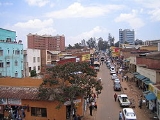
Kigali, population 965,398 (2009), is the capital and largest city of Rwanda
Rwanda
Rwanda or , officially the Republic of Rwanda , is a country in central and eastern Africa with a population of approximately 11.4 million . Rwanda is located a few degrees south of the Equator, and is bordered by Uganda, Tanzania, Burundi and the Democratic Republic of the Congo...
. It is situated near the geographic centre of the nation, and has been the economic, cultural, and transport hub of Rwanda since it became capital at independence in 1962. The main residence and offices of the President of Rwanda are located in the city, as are the government ministries. The city is coterminous with the province
Provinces of Rwanda
Image:Rwanda Provinces 2006.png|left|300pxpoly 211 66 216 74 223 76 230 102 262 85 306 169 296 177 277 166 247 178 241 188 209 179 193 160 176 155 172 127 167 123 140 119 131 107 153 84 174 84 189 74 204 79 Northern Province, Rwanda...
of Kigali City, which was enlarged in January 2006 as part of local government reorganisation in the country. The city's urban area covers about 70% of the municipal boundaries.
History
Kigali was founded in 1907 under GermanGermany
Germany , officially the Federal Republic of Germany , is a federal parliamentary republic in Europe. The country consists of 16 states while the capital and largest city is Berlin. Germany covers an area of 357,021 km2 and has a largely temperate seasonal climate...
colonial rule, but did not become the capital until Rwandan independence in 1962. The traditional capital was the seat of the mwami (king) in Nyanza
Nyanza, Rwanda
Nyanza is a town located in Nyanza in the Southern Province of Rwanda.The old Royal Palace of the Rwandan monarchy is located in the town of Nyanza. It is now the Rwesero Art Museum....
, while the colonial seat of power was in Butare
Butare
Butare is a city in the Southern Province of Rwanda and capital of Huye district. It was the capital of the former Butare Province, Rwanda, that was dissolved on January 1, 2006....
, then known as Astrida. Butare was initially the leading contender to be the capital of the new independent nation, but Kigali was chosen because of its more central location. Since then the city has grown very quickly and is now the major political, economic and cultural centre of Rwanda.
Beginning on April 6, 1994, Kigali was the scene of the Rwandan Genocide
Rwandan Genocide
The Rwandan Genocide was the 1994 mass murder of an estimated 800,000 people in the small East African nation of Rwanda. Over the course of approximately 100 days through mid-July, over 500,000 people were killed, according to a Human Rights Watch estimate...
— the slaughter of approximately one million Tutsi
Tutsi
The Tutsi , or Abatutsi, are an ethnic group in Central Africa. Historically they were often referred to as the Watussi or Watusi. They are the second largest caste in Rwanda and Burundi, the other two being the Hutu and the Twa ....
and moderate Hutu
Hutu
The Hutu , or Abahutu, are a Central African people, living mainly in Rwanda, Burundi, and eastern DR Congo.-Population statistics:The Hutu are the largest of the three peoples in Burundi and Rwanda; according to the United States Central Intelligence Agency, 84% of Rwandans and 85% of Burundians...
by Hutu
Hutu
The Hutu , or Abahutu, are a Central African people, living mainly in Rwanda, Burundi, and eastern DR Congo.-Population statistics:The Hutu are the largest of the three peoples in Burundi and Rwanda; according to the United States Central Intelligence Agency, 84% of Rwandans and 85% of Burundians...
militias (interahamwe
Interahamwe
The Interahamwe is a Hutu paramilitary organization. The militia enjoyed the backing of the Hutu-led government leading up to, during, and after the Rwandan Genocide. Since the genocide, they have been forced out of Rwanda, and have sought asylum in Congo...
), and some members of the Rwandan army — and of fierce fighting between the army (mostly Hutu
Hutu
The Hutu , or Abahutu, are a Central African people, living mainly in Rwanda, Burundi, and eastern DR Congo.-Population statistics:The Hutu are the largest of the three peoples in Burundi and Rwanda; according to the United States Central Intelligence Agency, 84% of Rwandans and 85% of Burundians...
) and Tutsi
Tutsi
The Tutsi , or Abatutsi, are an ethnic group in Central Africa. Historically they were often referred to as the Watussi or Watusi. They are the second largest caste in Rwanda and Burundi, the other two being the Hutu and the Twa ....
-dominated Rwandese Patriotic Front. Although damaged, the city's structure has recovered.
Geography

Ridge
A ridge is a geological feature consisting of a chain of mountains or hills that form a continuous elevated crest for some distance. Ridges are usually termed hills or mountains as well, depending on size. There are several main types of ridges:...
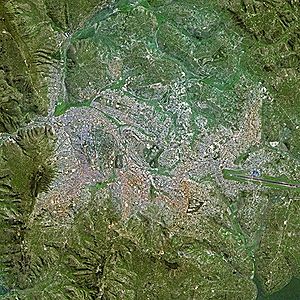
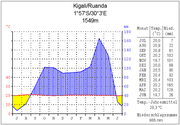
s and the valleys in between. The city centre is located on one of these ridges, with the main government area on another. The tops of the ridges have an average elevation of 1,600m (5,246 ft) while the valleys are around 1,300m (4,270 ft). The bigger houses and office buildings tend to be on the tops of the ridges, while the poorer people live in the valleys. The city is ringed most of the way round by higher hills, with some suburban sprawl rising up these. The highest of these is Mt. Kigali, with an elevation of 1,850m (6,075 ft) above sea level.
Economy
TinTin
Tin is a chemical element with the symbol Sn and atomic number 50. It is a main group metal in group 14 of the periodic table. Tin shows chemical similarity to both neighboring group 14 elements, germanium and lead and has two possible oxidation states, +2 and the slightly more stable +4...
ore (cassiterite
Cassiterite
Cassiterite is a tin oxide mineral, SnO2. It is generally opaque, but it is translucent in thin crystals. Its luster and multiple crystal faces produce a desirable gem...
) is mined nearby, and the city built a smelting plant in the 1980s. Business in Rwanda is growing, and many new buildings are emerging across the city, including the BCDI Tower, Centenary House and Kigali Tower. Tourism provide important input into the economy also.
Journalist Deroy Murdock
Deroy Murdock
Deroy Murdock is an American syndicated columnist for the Scripps Howard News Service and a contributing editor with National Review Online....
on a trip to Rwanda in 2011 wrote about the economic growth.
- Rwanda’s real GDP growth averaged 8.3 percent between 2002 and 2009. Per capita GDP swelled those years from $206 to $520 or 252 percent. While 47 percent of Rwandans enjoyed clean water in 2000, 75 percent were so fortunate in 2010. While 78 percent of the country was considered poor in 1995, that number stood at 57 percent in 2009.
Education
Lycée de Kigali is the second largest secondary school in Rwanda, after the Groupe Scolaire in ButareButare
Butare is a city in the Southern Province of Rwanda and capital of Huye district. It was the capital of the former Butare Province, Rwanda, that was dissolved on January 1, 2006....
.
Green Hills Academy
Green Hills Academy
Green Hills Academy is a private school in the Nyarutarama neighbourhood of Kigali, the capital of Rwanda.-Campus:The school currently educates 1,530 students from the nursery level to senior high school. Green Hills has a single campus with three separate schools, each with a principal: Green...
,in the upscale suburb of Nyarutarama
Nyarutarama
Nyarutarama is an affluent suburb of Kigali, Rwanda. The area has recently been developed, and includes a new road that is a "gift of the Chinese government"....
, is a top private school, offering IB at A level, and the Cambridge International Program at O level. It is a PASCH partner school offering German. It has a 50/50 English-French curriculum as well.
Administration & Government
Kigali is a province-level city governed by a city council who appoints an executive committee to run the day-to-day operations of the city. The executive committee consists of a mayor and two deputies. The city is split into three administrative districts called sectors: GasaboGasabo
Gasabo is a district in Kigali Province, Rwanda. Its capital is Ndera, a village on the outskirts of the Kigali urban area. The district also includes large areas of the city itself, including Kacyiru, Remera, Nyarutarama and Kimihurura....
, Kicukiro, and Nyarugenge
Nyarugenge
Nyarugenge is a district in Kigali Province, Rwanda. It is based around the city centre of Kigali , and contains most of the city's businesses.- Sectors :...
. It contained parts of the former province of Kigali Rural
Kigali Rural
Kigali-Rural Province, known in Kinyarwanda as Kigali-Ngali, was a province that surrounds the city of Kigali, Rwanda. It was abolished in 2006, along with other existing provinces at the time, in favour of a system of redrawn provinces....
.
Transportation
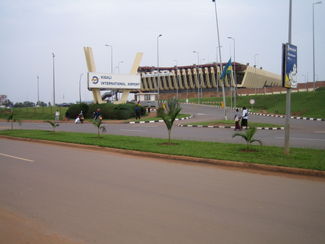
The city has an international airportInternational airport
An international airport is any airport that can accommodate flights from other countries and are typically equipped with customs and immigration facilities to handle these flights to and from other countries...
, Kigali International Airport
Kigali International Airport
Kigali International Airport , formerly known as Gregoire Kayibanda International Airport, but sometimes referred to as Kanombe International Airport, is the primary airport serving Kigali, the capital of Rwanda...
, with passenger connections daily to Nairobi
Nairobi
Nairobi is the capital and largest city of Kenya. The city and its surrounding area also forms the Nairobi County. The name "Nairobi" comes from the Maasai phrase Enkare Nyirobi, which translates to "the place of cool waters". However, it is popularly known as the "Green City in the Sun" and is...
and Entebbe
Entebbe
Entebbe is a major town in Central Uganda. Located on a Lake Victoria peninsula, the town was at one time, the seat of government for the Protectorate of Uganda, prior to Independence in 1962...
. The airport is somewhat limited by its location on the top of a hill, and a brand new one is being considered in the Nyamata
Nyamata
-Location:Nyamata is located in Bugesera District, Eastern Province, directly south of Kigali, the national capital and the largest city in the country. Its location is about , by road, south of Kigali. The coordinates of the town are:02 12 18S, 30 08 42E .-Overview:Nyamata is a small town in...
area, some 40 kilometres (24.9 mi) from Kigali.
International
There are several daily coach services which depart from Kigali to destinations in East Africa. Most leave from the Nyabugogo bus station. These services include:- Jaguar Executive Coaches, which connects Kigali to KampalaKampalaKampala is the largest city and capital of Uganda. The city is divided into five boroughs that oversee local planning: Kampala Central Division, Kawempe Division, Makindye Division, Nakawa Division and Lubaga Division. The city is coterminous with Kampala District.-History: of Buganda, had chosen...
, the UgandaUgandaUganda , officially the Republic of Uganda, is a landlocked country in East Africa. Uganda is also known as the "Pearl of Africa". It is bordered on the east by Kenya, on the north by South Sudan, on the west by the Democratic Republic of the Congo, on the southwest by Rwanda, and on the south by...
n capital, via GatunaGatunaGatuna is a town in northern Rwanda.-Location:Gatuna is located in Burera District, Northern Province, at the border with the Republic of Uganda. Its location is about , by road, north of Kigali, Rwanda's capital and largest city...
or via KayonzaKayonzaKayonza is a small town in Kayonza district, Eastern Province, Rwanda.The town is centred on a roundabout, where the road east from Kigali splits into the road running north to the Ugandan border, and the road south to Tanzania. It is a major transport hub because of this junction, where a sizeable...
and Kagitumba. - Akamba Bus Services, which runs services to Kampala (8 hours), NairobiNairobiNairobi is the capital and largest city of Kenya. The city and its surrounding area also forms the Nairobi County. The name "Nairobi" comes from the Maasai phrase Enkare Nyirobi, which translates to "the place of cool waters". However, it is popularly known as the "Green City in the Sun" and is...
, KenyaKenyaKenya , officially known as the Republic of Kenya, is a country in East Africa that lies on the equator, with the Indian Ocean to its south-east...
(24 hours), Dar es SalaamDar es SalaamDar es Salaam , formerly Mzizima, is the largest city in Tanzania. It is also the country's richest city and a regionally important economic centre. Dar es Salaam is actually an administrative province within Tanzania, and consists of three local government areas or administrative districts: ...
, TanzaniaTanzaniaThe United Republic of Tanzania is a country in East Africa bordered by Kenya and Uganda to the north, Rwanda, Burundi, and the Democratic Republic of the Congo to the west, and Zambia, Malawi, and Mozambique to the south. The country's eastern borders lie on the Indian Ocean.Tanzania is a state...
(36 hours)and Mombasa, Kenya (32 hours) - Onatracom Express - a Rwandan government service using quite basic buses, running between Kigali and Kampala.
- Yahoo Car Express - A minibus service running between Kigali and BujumburaBujumbura-Education:The University of Burundi is located in Bujumbura.Hope Africa University is located in BujumburaUniversité du Lac Tanganyika is located in Bujumbura-External links:**...
, BurundiBurundiBurundi , officially the Republic of Burundi , is a landlocked country in the Great Lakes region of Eastern Africa bordered by Rwanda to the north, Tanzania to the east and south, and the Democratic Republic of the Congo to the west. Its capital is Bujumbura...
.
National
Kigali is the hub of the Rwanda transport network, with hourly express bus routes to all major towns in the country. The major nationwide companies are Atraco, Stella, Omega, Okapi, Impala (minibuses), and Onatracom, which offers a big bus service, while Volcano Express (to Butare), Virunga Express and Onatracom (to RuhengeriRuhengeri
Ruhengeri is a city and capital of Musanze District in the Northern Province of Rwanda. Some sources now refer to the city itself as Musanze, after the district in which it lies. It lies near the twin lakes of Lake Burera and Lake Ruhondo and is the gateway city to Volcanoes National Park and the...
), Muhabura Express (to Ruhengeri and Gisenyi
Gisenyi
Gisenyi is a city in Rubavu district in the Western Province of Rwanda. Gisenyi is contiguous with Goma, the city across the border in the Democratic Republic of the Congo. The population of the city is about 106 000 .-Description:...
) serve specific destinations and follow a set schedule. There are also taxi minibus services (matatu
Matatu
In Kenya and neighboring nations matatu are privately owned minibuses although pick-up trucks were in the past pressed into service as these East African share taxis. Often decorated, many matatu feature portraits of the famous or slogans and sayings, some religious.These minibuses ply set routes,...
s) leaving from Kigali, which also go through to the major towns, but some of them stop frequently along the route to pick people up and set them down.
Local
Public transport within Kigali is exclusively by taxi minibus (matatuMatatu
In Kenya and neighboring nations matatu are privately owned minibuses although pick-up trucks were in the past pressed into service as these East African share taxis. Often decorated, many matatu feature portraits of the famous or slogans and sayings, some religious.These minibuses ply set routes,...
), routes, connecting the main hubs of Mu (Mujyi) (the city centre), Nyabugogo, Kacyiru, Kimironko and Remera. Similar to the national taxi minibuses, these services wait to fill up before setting off from the terminus, then pick up and drop off frequently en route.
Private hire
Kigali has many taxis (known as 'special hire' or 'taxi voiture'), which are generally white with an orange stripe down the side. There are also motorbike taxis ('taxi moto'), which offer a service similar to a taxi, but for lower prices, typically in the range 300-1000 FRW. Though fine on major roads, on crowded city streets, motorbike taxis are not for the faint hearted or under-insured.Points of interest
Kigali houses several memorials, museums, and centers dedicated to the Rwandan Genocide, including the Kigali Genocide Memorial CentreKigali Genocide Memorial Centre
The Kigali Genocide Memorial Centre, in Kigali, Rwanda, commemorates the Rwandan genocide in 1994.The Aegis Trust, the UK-based genocide prevention organisation, was invited to establish the Kigali Memorial Centre in partnership with the Kigali City Council. It was opened in April 2004, the tenth...
.
The city now has international class hotels, some played a role in history:
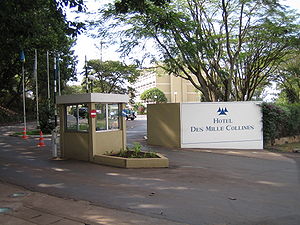
- The Mille CollinesHôtel des Mille CollinesThe Hôtel des Mille Collines is a large hotel in Kigali, the capital city of Rwanda. It became famous as the building in which more than a thousand people took refuge during the Rwandan Genocide of 1994...
in the Kiyovu area. This hotel became a refugee centre during the genocide, as famously depicted in the film Hotel RwandaHotel RwandaHotel Rwanda is a 2004 American drama film directed by Terry George. It was adapted from a screenplay written by both George and Keir Pearson. Based on real life events which took place in Rwanda during the spring of 1994, the film stars Don Cheadle as hotelier Paul Rusesabagina, who attempts to...
(although the hotel shown in the film is in fact in South Africa). It is also the setting for the famous novel Un dimanche à la piscine à KigaliUn dimanche à la piscine à KigaliA Sunday at the Pool in Kigali is the first novel by Montreal author Gil Courtemanche, originally published in 2000....
, by QuebecQuebecQuebec or is a province in east-central Canada. It is the only Canadian province with a predominantly French-speaking population and the only one whose sole official language is French at the provincial level....
er Gil Courtemanche, and its movie adaptation Un dimanche à Kigali. - The Kigali Serena Hotel, formerly known as the InterContinental KigaliInterContinentalInterContinental is a brand of upscale luxury hotels, founded by Pan American World Airways, under Juan Trippe, and now owned by InterContinental Hotels Group. The chain operates over 200 hotels and resorts in approximately 75 nations.-History:...
. Formerly a Belgian-owned hotel known as the Diplomates, the hotel was briefly portrayed in the second half of Hotel Rwanda. It was later bought by the InterContinental Hotels group and remodeled in 2003.
Sister cities
KampalaKampala
Kampala is the largest city and capital of Uganda. The city is divided into five boroughs that oversee local planning: Kampala Central Division, Kawempe Division, Makindye Division, Nakawa Division and Lubaga Division. The city is coterminous with Kampala District.-History: of Buganda, had chosen...
, Uganda
Uganda
Uganda , officially the Republic of Uganda, is a landlocked country in East Africa. Uganda is also known as the "Pearl of Africa". It is bordered on the east by Kenya, on the north by South Sudan, on the west by the Democratic Republic of the Congo, on the southwest by Rwanda, and on the south by...
San Bernardino
San Bernardino, California
San Bernardino is a city located in the Riverside-San Bernardino metropolitan area , and serves as the county seat of San Bernardino County, California, United States...
, United States
United States
The United States of America is a federal constitutional republic comprising fifty states and a federal district...