
See Also

New World

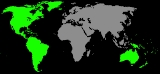
The New World is one of the names used for the Americas Americas

he Americas are the lands of the Western hemisphere [i] or New World [i] consisting o ... 

. When the term originated in the late 15th century 15th century

As a means of recording the passage of time [i], the 15th century was that century [i] which lasted from ... 

, the Americas were new to the Europe Europe

Europe is one of the seven traditional continent [i]s of the Earth [i]. ... 

ans, who previously thought of the world World

World is refers primarily to a planet or to the Earth [i]. ... 

 as consisting only of Europe, Asia Asia

Asia is the largest and most populous continent [i] or region, depending on the definition.... 

, and Africa Africa

Africa is one of the greatest sized continents of the Earth.... 

?the Old World. The term "New World" should not be confused with "modern world"; the latter generally refers to a historical period, not a landmass. Christopher Columbus Christopher Columbus

Christopher Columbus Italian [i] Cristoforo Colombo; Spanish [i]: ... 

 returned to Europe in 1493 from his first voyage to the Americas and on 1 November that year Peter Martyr d'Anghiera Peter Martyr d'Anghiera

Peter Martyr d'Anghiera was an Italian [i]-born historian [i] of Spain [i] and of the discoveries ... 

 referred to Columbus in a letter as the discoverer of "the New World" .

Discussions

  Discussion Features

   Ask a question about 'New World'

   Start a new discussion about 'New World'

   Answer questions about 'New World'

   'New World' discussion forum

Timeline

1493   Christopher Columbus Christopher Columbus

Christopher Columbus Italian [i] Cristoforo Colombo; Spanish [i]: ... 

 leaves the New World.

1493   Pope Alexander VI Pope Alexander VI

Pope Alexander VI , born Rodrigo Borja , , is the most controversial of the secular [i] ... 

 divides the New World between Spain Spain

Spain, officially the Kingdom of Spain , is a Europe [i]an parliamentary monarchy [i]. ... 

 and Portugal Portugal

Portugal, officially the Portuguese Republic is located in southwestern Europe [i] on the Iberian Peninsula [i] ... 

 along the Demarcation Line.

1494   Spain Spain

Spain, officially the Kingdom of Spain , is a Europe [i]an parliamentary monarchy [i]. ... 

 and Portugal Portugal

Portugal, officially the Portuguese Republic is located in southwestern Europe [i] on the Iberian Peninsula [i] ... 

 sign the Treaty of Tordesillas Treaty of Tordesillas

The Treaty of Tordesillas, signed at Tordesillas [i], June 7 [i] 1494 [i], divided the world outside of ... 

 which divides the New World between the two countries.

1497   Amerigo Vespucci Amerigo Vespucci

Amerigo Vespucci was an Italian [i] merchant, explorer and cartographer [i]. ... 

 allegedly leaves Cádiz Cádiz

Cdiz – Phoenician [i]: ??? - Gadir; Greek [i]: ... 

 for his first voyage to the New World.

1498   Bartholomew Columbus, brother of Christopher Columbus Christopher Columbus

Christopher Columbus Italian [i] Cristoforo Colombo; Spanish [i]: ... 

, founds the city of Santo Domingo Santo Domingo

Santo Domingo de Guzmn, population 2,061,200 , estimated 2,253,437 in 2006, is the capital [i] and the l ... 

, now part of the Dominican Republic Dominican Republic

The Dominican Republic, is a country located on the eastern two-thirds of the Caribbean [i] ... 

, making it the oldest European City and permanent settlement in the New World.

1502   Christopher Columbus Christopher Columbus

Christopher Columbus Italian [i] Cristoforo Colombo; Spanish [i]: ... 

 leaves Spain Spain

Spain, officially the Kingdom of Spain , is a Europe [i]an parliamentary monarchy [i]. ... 

 for his fourth and final trip to the "New World".

1503   Seville Seville

Seville is the artistic, cultural, and financial capital of southern Spain [i], irrigated by the river ... 

 in Castile Castile (historical region)

A former kingdom, Castile , gradually merged with its neighbors to become the Kingdom of Spain [i]. ... 

 is awarded exclusive right to trade with the New World.

1538   The first University University

[i], which grants [[academic degree]... 

 of the New World is founded the Universidad Santo Tomás de Aquino.

1552   Spain Spain

Spain, officially the Kingdom of Spain , is a Europe [i]an parliamentary monarchy [i]. ... 

's Bartolomé de Las Casas Bartolomé de Las Casas

Bartolom de Las Casas, O.P.... 

 publishes his attack on colonial practices in the New World, A Short Account of the Destruction of the Indies.

1607   Ship ''Gift of God'' of the Plymouth Company Plymouth Company

The Plymouth Company was an English [i] joint stock company [i] founded in 1606 [i] by James I of England [i] ... 

 arrives at the mouth of the modern-day Kennebec River Kennebec River

The Kennebec River is a river [i], 150 mi long, in the state of Maine [i] in the northeastern United States [i] ... 

 in Maine Maine

Maine is a U.S. state [i] in the New England [i] region of the northeastern United States [i]. ... 

. English England

England is the largest and most populous constituent country [i] of the United Kingdom [i]. ... 

 colonists establish a ''Fort St. George Fort St George

Fort St George is the name of the first British [i] fortress in India [i], built in 1644 [i] at ... 

'', also known as the Popham Colony Popham Colony

The Popham Colony was a short-lived English [i] colonial settlement ... 

. The settlement lasts little more than a year before residents return to England England

England is the largest and most populous constituent country [i] of the United Kingdom [i]. ... 

 in the first ocean going ship built in the New World, a 30-ton pinnace, called ''The Virginia''.

   More Events >>


Encyclopedia


The New World is one of the names used for the Americas Americas

he Americas are the lands of the Western hemisphere [i] or New World [i] consisting o ... 

. When the term originated in the late 15th century 15th century

As a means of recording the passage of time [i], the 15th century was that century [i] which lasted from ... 

, the Americas were new to the Europe Europe

Europe is one of the seven traditional continent [i]s of the Earth [i]. ... 

ans, who previously thought of the world World

World is refers primarily to a planet or to the Earth [i]. ... 

 as consisting only of Europe, Asia Asia

Asia is the largest and most populous continent [i] or region, depending on the definition.... 

, and Africa Africa

Africa is one of the greatest sized continents of the Earth.... 

—the Old World. The term "New World" should not be confused with "modern world"; the latter generally refers to a historical period, not a landmass.

Christopher Columbus Christopher Columbus

Christopher Columbus Italian [i] Cristoforo Colombo; Spanish [i]: ... 

 returned to Europe in 1493 from his first voyage to the Americas and on 1 November that year Peter Martyr d'Anghiera Peter Martyr d'Anghiera

Peter Martyr d'Anghiera was an Italian [i]-born historian [i] of Spain [i] and of the discoveries ... 

 referred to Columbus in a letter as the discoverer of "the New World" . In another letter a year later he again referred to "the New World" . In 1516 Martyr published a work whose title began De orbe novo .

The term was also used by Giovanni da Verrazano Giovanni da Verrazano

Giovanni da Verrazano was an Italian [i] explorer [i] of North America [i], in the service of the ... 

 in 1524 in a record of his voyage that year along the coast of the United States United States

The United States of America, also known as the United States, the U.S., the U.S.A., a... 

 and Canada Canada

Canada is the world's second-largest [i] country by total area, occupying most ... 

.

One might speak of the "New World" in a historical context, when discussing the voyages of Christopher Columbus Christopher Columbus

Christopher Columbus Italian [i] Cristoforo Colombo; Spanish [i]: ... 

, the Spanish conquest of Yucatán, etc. Second, in a biological Biology

Biology is the branch of science [i] dealing with the study of life [i]. ... 

 context, one speaks of Old World and New World species.

Another interpretation of the term is that the "New World" is "new" in the context of all humanity; as humans have developed and lived in the Old World for a far greater length of time than the Americas have been inhabited; thus, it would be said the first migrants to colonise the Americans had reached the "New World".

While America Americas

he Americas are the lands of the Western hemisphere [i] or New World [i] consisting o ... 

 is always described as "New World", Australasia Australasia

Australasia is a term variably used to describe a region [i] of Oceania [i] namely Australia [i], New Zealand [i] ... 

 can be described as either "Old World" or "New World" depending on the sphere of discourse, especially in the case of New Zealand New Zealand

New Zealand is a country in the south-western Pacific Ocean [i] consisting of two large islands and many ... 

 where the first human settlers arrived only a few generations before Columbus reached the Americas. In a biological context, Australasia is neither New World nor Old, as flora Flora

In botany [i], flora has two meanings. ... 

 and fauna Fauna

Fauna is a collective term for animal [i] life of any particular region or time.... 

 differ markedly from both those of Eurasia Eurasia

Eurasia is the landmass [i] composed of Europe [i] and Asia [i].... 

 and of the Americas. Wine from Australia and New Zealand is referred to as 'New World' as it has only in recent decades successfully penetrated European markets, overtaking French and Spanish wine in popularity .

Long before Columbus, in Europe, many legends existed of Western continents across the sea. It is thought these may have stemmed from prehistoric intercourse with the New World. Examples include the Norse Great Ireland or Hvítramannaland ; the "abode of saints" visited by St. Brandan, Abbot of Cluainfert, documented in the Irish Book of Lismore; the Welsh Legend of Madoc Madoc

Madoc ap Owain Gwynedd was a Welsh [i] prince who, according to legend, discovered America [i] ... 

; and of course Plato's Atlantis Atlantis

Atlantis is the name of an island first mentioned and described by the classical Greek [i] ... 

.

See also

  • Western Hemisphere Western Hemisphere

    Western Hemisphere, or Western hemisphere, is a geopolitical [i] term for the Americas [i] ... 

  • Eastern Hemisphere Eastern Hemisphere

    * Prime Meridian [i]
  • Old World [i]

... 


  • New world order

References