
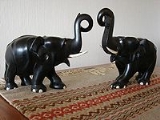
Ebony is a dense black wood, most commonly yielded by several species in the genus
DiospyrosDiospyros is a genus of about 450–500 species of deciduous and evergreen trees. The majority are native to the tropics, with only a few species extending into temperate regions. They are commonly known as ebony or persimmon trees...
, but ebony may also refer to other heavy, black (or dark colored) woods from unrelated species. Ebony is dense enough to sink in water. Its fine texture, and very smooth finish when polished, make it valuable as an ornamental wood. The word "ebony" derives from the
Ancient EgyptianEgyptian is the oldest known indigenous language of Egypt and a branch of the Afroasiatic language family. Written records of the Egyptian language have been dated from about 3400 BC, making it one of the oldest recorded languages known. Egyptian was spoken until the late 17th century AD in the...
hbny, via the
Ancient GreekAncient Greek is the stage of the Greek language in the periods spanning the times c. 9th–6th centuries BC, , c. 5th–4th centuries BC , and the c. 3rd century BC – 6th century AD of ancient Greece and the ancient world; being predated in the 2nd millennium BC by Mycenaean Greek...
(
ébenos), by way of
LatinLatin is an Italic language originally spoken in Latium and Ancient Rome. It, along with most European languages, is a descendant of the ancient Proto-Indo-European language. Although it is considered a dead language, a number of scholars and members of the Christian clergy speak it fluently, and...
and
Middle EnglishMiddle English is the stage in the history of the English language during the High and Late Middle Ages, or roughly during the four centuries between the late 11th and the late 15th century....
.
Species
Species of ebony include
Diospyros ebenumDiospyros ebenum is a species of tree occurring in southern India and Sri Lanka. It is best known for being one of the trees that yield ebony; the wood of this tree is called Ceylon Ebony or India Ebony, but often simply called "ebony"....
(Ceylon ebony), native to southern
IndiaIndia , officially the Republic of India , is a country in South Asia. It is the seventh-largest country by geographical area, the second-most populous country with over 1.2 billion people, and the most populous democracy in the world...
and
Sri LankaSri Lanka, officially the Democratic Socialist Republic of Sri Lanka is a country off the southern coast of the Indian subcontinent. Known until 1972 as Ceylon , Sri Lanka is an island surrounded by the Indian Ocean, the Gulf of Mannar and the Palk Strait, and lies in the vicinity of India and the...
;
Diospyros crassifloraDiospyros crassiflora, commonly known as Gaboon Ebony, is a species of lowland-rainforest tree in the family Ebenaceae that is endemic to Western Africa...
(Gaboon ebony), native to western
AfricaAfrica is the world's second largest and second most populous continent, after Asia. At about 30.2 million km² including adjacent islands, it covers 6% of the Earth's total surface area and 20.4% of the total land area...
; and
Diospyros celebica (Macassar ebony), native to Indonesia and prized for its luxuriant, multi-colored wood grain. Mauritius ebony,
Diospyros tesselaria, was largely exploited by the Dutch in the 17th century. Some species in the genus
Diospyros yield an ebony with similar physical properties, but striped rather than evenly black (
Diospyros ebenum).
Uses
Ebony has a long history of use, with carved pieces having been found in
Ancient EgyptAncient Egypt was an ancient civilization of Northeastern Africa, concentrated along the lower reaches of the Nile River in what is now the modern country of Egypt. Egyptian civilization coalesced around 3150 BC with the political unification of Upper and Lower Egypt under the first pharaoh...
ian tombs.
By the end of the 16th century, fine cabinets for the luxury trade were made of ebony in
Antwerp. The wood's dense hardness lent itself to refined moldings framing finely detailed pictorial panels with carving in very low relief (bas-relief), usually of allegorical subjects, or with scenes taken from classical or Christian history. Within a short time, such cabinets were also being made in
ParisParis is the capital and largest city in France, situated on the river Seine, in northern France, at the heart of the Île-de-France region...
, where their makers became known as
ébénisteÉbéniste is the French word for a cabinetmaker, whereas in French menuisier denotes a woodcarver or chairmaker. The English equivalent for "ébéniste," "ebonist," is never commonly used. Originally, an ébéniste was one who worked with ebony, a favoured luxury wood for mid-seventeenth century...
s, which remains the French term for a cabinetmaker.
Modern uses are largely restricted to small items, particularly
musical instrumentA musical instrument is a device created or adapted for the purpose of making musical sounds. In principle, any object that produces sound can serve as a musical instrument—it is through purpose that the object becomes a musical instrument. The history of musical instruments dates back to the...
parts, including black
pianoThe piano is a musical instrument played by means of a keyboard. It is one of the most popular instruments in the world. Widely used in classical and jazz music for solo performances, ensemble use, chamber music and accompaniment, the piano is also very popular as an aid to composing and rehearsal...
and
harpsichordA harpsichord is a musical instrument played by means of a keyboard. It produces sound by plucking a string when a key is pressed.In the narrow sense, "harpsichord" designates only the large wing-shaped instruments in which the strings are perpendicular to the keyboard...
keys,
violinThe violin is a string instrument, usually with four strings tuned in perfect fifths. It is the smallest, highest-pitched member of the violin family of string instruments, which includes the viola and cello....
,
violaThe viola is a bowed string instrument. It is the middle voice of the violin family, between the violin and the cello.- Form :The viola is similar in material and construction to the violin. A full-size viola's body is between and longer than the body of a full-size violin , with an average...
,
guitarThe guitar is a plucked string instrument, usually played with fingers or a pick. The guitar consists of a body with a rigid neck to which the strings, generally six in number, are attached. Guitars are traditionally constructed of various woods and strung with animal gut or, more recently, with...
,
double bassThe double bass, also called the string bass, upright bass, standup bass or contrabass, is the largest and lowest-pitched bowed string instrument in the modern symphony orchestra, with strings usually tuned to E1, A1, D2 and G2...
, and
celloThe cello is a bowed string instrument with four strings tuned in perfect fifths. It is a member of the violin family of musical instruments, which also includes the violin, viola, and double bass. Old forms of the instrument in the Baroque era are baryton and viol .A person who plays a cello is...
fingerboards,
tailpieceA tailpiece is a component on many stringed musical instruments that anchors one end of the strings, usually the end opposite the end with the tuning mechanism the scroll, headstock, peghead, etc.-Function and construction:...
s,
pegsA tuning peg is used to hold a string in the pegbox of a stringed instrument. It may be made of ebony, rosewood, boxwood or other material. Some tuning pegs are ornamented with shell, metal, or plastic inlays, beads or rings....
,
chinrestA chinrest is a shaped piece of wood attached to the body of a violin or a viola to aid in the positioning of the player's jaw or chin on the instrument. The chinrest may be made of ebony, rosewood, boxwood, or plastic...
s, and
bow frogsIn music, a bow is moved across some part of a musical instrument, causing vibration which the instrument emits as sound. The vast majority of bows are used with string instruments, although some bows are used with musical saws and other bowed idiophones....
. Many plectrums, or guitar picks, are made from this black wood. Traditionally, the black pieces in
chess setsChess pieces or chessmen are the pieces deployed on a chessboard to play the game of chess. The pieces vary in abilities, giving them different values in the game...
were made from ebony, with rare
boxwoodBuxus is a genus of about 70 species in the family Buxaceae. Common names include box or boxwood ....
or
ivoryIvory is a term for dentine, which constitutes the bulk of the teeth and tusks of animals, when used as a material for art or manufacturing. Ivory has been important since ancient times for making a range of items, from ivory carvings to false teeth, fans, dominoes, joint tubes, piano keys and...
being used for the white pieces. Modern East Midlands-style lace-making
bobbinA bobbin is a spindle or cylinder, with or without flanges, on which wire, yarn, thread or film is wound. Bobbins are typically found in sewing machines, cameras, and within electronic equipment....
s, also being small, are often made of ebony and look particularly decorative when bound with brass or silver wire. Due to its strength, many handgun grips and rifle fore-end tips are made of ebony as well.
As a result of unsustainable harvesting, many species yielding ebony are now considered threatened. Africa in particular has had most of its indigenous ebony cut down illegally, and for this reason it has become common for street traders to blacken lighter woods with shoe polish in an effort to make a sale.
See also
- African Blackwood
Dalbergia melanoxylon is a flowering plant in the family Fabaceae, native to seasonally dry regions of Africa from Senegal east to Eritrea and south to the Transvaal in South Africa....
- Calamander wood
thumb|300pxCalamander wood or Coromandel wood is a valuable wood from India, Sri Lanka and South East Asia. It is of a hazel-brown color, with black stripes , very heavy and hard...
- Ebonite
Ebonite is a brand name for very hard rubber first obtained by Charles Goodyear by vulcanizing rubber for prolonged periods. It is about 30% to 40% sulfur. Its name comes from its intended use as an artificial substitute for ebony wood...
- Ebonol
- Illegal logging in Madagascar
Illegal logging has been a problem in Madagascar for decades and is perpetuated by extreme poverty and government corruption. Often taking the form of selective logging, the trade has been driven by high international demand for expensive, fine-grained lumber such as rosewood and ebony...
External links