


Middle Kingdom of Egypt

Encyclopedia
The Middle Kingdom of Egypt is the period in the history of ancient Egypt
stretching from the establishment of the Eleventh Dynasty
to the end of the Fourteenth Dynasty
, between 2055 BC and 1650 BC, although some writers include the Thirteenth
and Fourteenth dynasties in the Second Intermediate Period. During this period, the funerary cult
of Osiris
rose to dominate Egyptian popular religion.
The period comprises two phases, the 11th Dynasty
, which ruled from Thebes
and the 12th Dynasty
onwards which was centered around el-Lisht
. These two dynasties were originally considered to be the full extent of this unified kingdom, but historians now consider the 13th Dynasty
to at least partially belong to the Middle Kingdom.
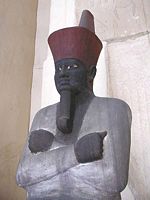 After the collapse of the Old Kingdom
, Egypt entered a period of weak Pharaonic power and decentralization called the First Intermediate Period. Towards the end of this period, two rival dynasties, known to the ancient Egyptians as the Tenth and Eleventh, fought for power over the entire country. The Theban 11th Dynasty only ruled southern Egypt from the first cataract to the Tenth Nome of Upper Egypt. To the north, Lower Egypt was ruled by the rival 10th Dynasty from Herakleopolis. The struggle was to be concluded by Mentuhotep II
, who ascended the Theban throne in 2055 B.C. During Mentuhotep II's fourteenth regnal year, he took advantage of a revolt in the Thinite Nome to launch an attack on Herakleopolis, which met little resistance. After toppling the last rulers of the 10th Dynasty, Mentuhotep began consolidating his power over all Egypt, a process which he finished by his 39th regnal year. For this reason, Mentuhotep II is regarded as the founder of the Middle Kingdom.
Mentuhotep II commanded military campaigns south as far as the Second Cataract in Nubia
, which had gained its independence during the First Intermediate Period. He also restored Egyptian hegemony over the Sinai region, which had been lost to Egypt since the end of the Old Kingdom. To consolidate his authority, he restored the cult of the ruler, depicting himself as a god in his own lifetime, wearing the headdresses of Amun
and Min
He died after a reign of 51 years, and passed the throne to his son, Mentuhotep III
.
Mentuhotep III reigned for only twelve years, during which he continued consolidating Theban rule over the whole of Egypt, building a series of forts in the eastern Delta region to secure Egypt against threats from Asia. He also sent the first expedition to Punt during the Middle Kingdom, by means of ships constructed at the end of Wadi Hammamat, on the Red Sea. Mentuhotep III was succeeded by Mentuhotep IV
, whose name significantly is omitted from all ancient Egyptian king lists. The Turin Papyrus
claims that after Mentuhotep III come "seven kingless years." Despite this absence, his reign is attested from a few inscriptions in Wadi Hammamat
that record expeditions to the Red Sea
coast and to quarry stone for the royal monuments. The leader of this expedition was his vizier Amenemhat, who is widely assumed to be the future pharaoh Amenemhet I, the first king of the 12th Dynasty
.
Mentuhotep IV's absence from the king lists has prompted the theory that Amenemhet I usurped his throne. While there are no contemporary accounts of this struggle, certain circumstantial evidence may point to the existence of a civil war at the end of the 11th dynasty. Inscriptions left by one Nehry, the Haty-a
of Hermopolis
, suggest that he was attacked at a place called Shedyet-sha by the forces of the reigning king, but his forces prevailed. Khnumhotep, an official under Amenemhet I, claims to have participated in a flotilla of 20 ships to pacify Upper Egypt. Donald Redford has suggested these events should be interpreted as evidence of open war between two dynastic claimants. What is certain is that, however he came to power, Amenemhet I was not of royal birth.
, or Amenemhet, Seizer of the Two Lands. The location of this capital is unknown, but is presumably near the city's necropolis, the present-day el-Lisht
. Like Montuhotep II, Amenemhet bolstered his claim to authority with propaganda. In particular, the Prophecy of Neferty dates to about this time, which purports to be an oracle of an Old Kingdom priest, who predicts a king, Amenemhet I, arising from the far south of Egypt to restore the kingdom after centuries of chaos.
Propaganda notwithstanding, Amenemhet never held the absolute power commanded in theory by the Old Kingdom pharaohs. During the First Intermediate Period, the governors of the nomes
of Egypt, nomarch
s, gained considerable power. Their posts had become hereditary, and some nomarchs entered into marriage alliances with the nomarchs of neighboring nomes. To strengthen his position, Amenemhet required registration of land, modified nome borders, and appointed nomarchs directly when offices became vacant, but acquiesced to the nomarch system, probably in order to placate the nomarchs who supported his rule. This gave the Middle Kingdom a more feudal organization than Egypt had before or would have afterward.
In his 20th regnal year, Amenemhat established his son Senusret I
as his coregent, establishing a practice which would be used repeatedly throughout the rest of the Middle Kingdom and again during the New. In Amenemhet's 30th regnal year, he was presumably murdered in a palace conspiracy. Senuseret, campaigning against Libyan invaders, rushed home to Itjtawy to prevent a takeover of the government. During his reign he continued the practice of directly appointing nomarchs, and undercut the autonomy of local priesthoods by building at cult centers throughout Egypt. Under his rule, Egyptian armies pushed south into Nubia as far as the second cataract, building a border fort at Buhen
and incorporating all of lower Nubia as an Egyptian colony. To the west, he consolidated his power over the Oases, and extended commercial contacts into Syrio-Palestine as far as Ugarit
. In his 43rd regnal year, Senusret appointed Amenemhet II as junior coregent, and died in his 46th.
The reign of Amenemhat II
has been often characterized as largely peaceful, but record of his genut, or daybooks, have cast doubt on that assessment. Among these records, preserved on temple walls at Tod and Memphis, are descriptions of peace treaties with certain Syrio-Palestinian cities, and military conflict with others. To the south, Amenemhet sent a campaign through lower Nubia to inspect Wawat. It does not appear that Amenemhet continued his predecessors' policy of appointing Nomarchs, but let it become hereditary again. Another expedition to Punt dates to his reign. In his 33rd regnal year, he appointed his son Senusret II
coregent.
Evidence for military activity of any kind during the reign of Senusret II is non-existent. Senusret instead appears to have focused on domestic issues, particularly the irrigation of the Faiyum
. This multi-generational project aimed to convert the Faiyum oasis into a productive swath of farmland. Senusret eventually placed his pyramid at the site of el-Lahun
, near the junction of the Nile and the Fayuum's major irrigation canal, the Bahr Yussef
. He reigned only fifteen years, which is evidenced by the incomplete nature of many of his constructions. His son Senusret III
succeeded him.
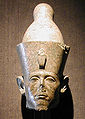 Senusret III
was a warrior-king, often taking to the field himself. In his sixth year, he re-dredged an Old Kingdom canal around the first cataract to facilitate travel to upper Nubia. He used this to launch a series of brutal campaigns in Nubia in his sixth, eighth, tenth, and sixteenth years. After his victories, Senusret built a series of massive forts throughout the country to establish the formal boundary between Egyptian conquests and unconquered Nubia at Semna. The personnel of these forts were charged to send frequent reports to the capital on the movements and activities of the local Medjay
natives, some of which survive, revealing how tightly the Egyptians intended to control the southern border. Medjay were not allowed north of the border by ship, nor could they enter by land with their flocks, but they were permitted to travel to local forts in order to trade. After this, Senusret sent one more campaign in his 19th year, but turned back due to abnormally low Nile levels, which endangered his ships. One of Senusret's soldiers also records a campaign against skmm, perhaps Shechem
, the only reference to a campaign against a location in Syrio-Palestine from the entirety of Middle Kingdom literature.
Domestically, Senusret has been given credit for an administrative reform which put more power in the hands of appointees of the central government, instead of regional authorities. Egypt was divided into three waret, or administrative divisions: North, South, and Head of the South (perhaps Lower Egypt
, most of Upper Egypt
, and the nomes of the original Theban kingdom during the war with Herakleopolis, respectively). Each region was administrated by a Reporter, Second Reporter, some kind of council (the Djadjat), and a staff of minor officials and scribes. The power of the Nomarchs seems to drop off permanently during his reign, which has been taken to indicate that the central government had finally suppressed them, though there is no record that Senusret ever took direct action against them.
Senusret III had a lasting legacy as a warrior Pharaoh. His name was Hellenized by later Greek historians as Sesostris, a name which was then given to a conflation of Senusret and several New Kingdom warrior pharaohs. In Nubia, Senusret was worshiped as a patron God by Egyptian settlers. The duration of his reign remains something of an open question. His son Amenemhet III began reigning after Senusret's 19th regnal year, which has been widely considered Senusret's highest attested date. However, a reference to a year 39 on a fragment found in the construction debris of Senusret's mortuary temple has suggested the possibility of a long coregency with his son.
The reign of Amenemhat III
was the height of Middle Kingdom economic prosperity. His reign is remarkable for the degree to which Egypt exploited its resources. Mining camps in the Sinai, which had previously been used only by intermittent expeditions, were operated on a semi-permanent basis, as evidenced by the construction of houses, walls, and even local cemeteries. There are 25 separate references to mining expeditions in the Sinai, and four to expeditions in wadi Hammamat, one of which had over 2000 workers. Amenemhet reinforced his father's defenses in Nubia and continued the Faiyum land reclamation system. Amenemhet invited Asiatic settlers to Egypt to labor on Egypt's monuments. It is possible that this influx marked the beginning of the influx of Asiatics which would ultimately lead to the Hyksos
takeover of Lower Egypt.
After a reign of 45 years, Amenemhet III was succeeded by Amenemhet IV, whose nine year reign is poorly attested. Clearly by this time, dynastic power began to weaken, for which several explanations have been proposed. Contemporary records of the Nile flood levels indicate that the end of the reign of Amenemhet III was dry, and crop failures may have helped to destabilize the dynasty. Further, Amenemhet III had an inordinately long reign, which tends to create succession problems. The latter argument perhaps explains why Amenemhet IV was succeeded by Sobekneferu
, the first historically attested female king of Egypt. Sobekneferu ruled no more than four years, and as she apparently had no heirs, when she died the Twelfth Dynasty came to a sudden end as did the Golden Age of the Middle Kingdom.
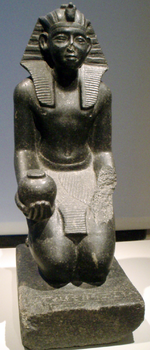 After the death of Sobeknefru, the throne may have passed to Wegaf
, who had previously been the Great Overseer of Troops, though others have suggested Sekhemre Khutawy
was next to reign. Beginning with this reign, Egypt was ruled by a series of ephemeral kings for about ten to fifteen years. Ancient Egyptian sources regard these as the first kings of the Thirteenth Dynasty
, though the term dynasty is misleading, as most kings of the thirteenth dynasty were not related. The names of these short-lived kings are attested on a few monuments and Graffiti
, and their succession order is only known from the Turin Canon, although even this is not fully trusted.
After the initial dynastic chaos, a series of longer reigning, better attested kings ruled for about fifty to eighty years. The strongest king of this period, Neferhotep I
, ruled for eleven years and maintained effective control of Upper Egypt, Nubia, and the Delta, with the possible exceptions of Xois
and Avaris
. Neferhotep I was even recognized as the suzerain of the ruler of Byblos, indicating that the Thirteenth Dynasty was able to retain much of the power of the Twelfth Dynasty, at least up to his reign. At some point during the 13th dynasty, Xois and Avaris began governing themselves, the rulers of Xois being the Fourteenth Dynasty, and the Asiatic rulers of Avaris being the Hyksos of the Fifteenth Dynasty. According to Manetho
, this latter revolt occurred during the reign of Neferhotep's successor, Sobekhotep IV
, though there is no archaeological proof. Sobekhotep IV was succeeded by the short reign of Sobekhotep V
, who was followed by Wahibre Ibiau
, then Merneferre Ai
. Wahibre Ibiau ruled ten years, and Merneferre Ai ruled for twenty three years, the longest of any Thirteenth Dynasty king, but neither of these two kings left as many attestations as either Neferhotep or Sobekhotep IV. Despite this, they both seem to have held at least parts of lower Egypt. After Merneferre Ai, however, no king left his name on any object found outside the south. This begins the final portion of the thirteenth dynasty, when southern kings continue to reign over Upper Egypt, but when the unity of Egypt has fully disintegrated, and the Middle Kingdom gave way to the Second Intermediate Period.
Beside this, many Old Kingdom posts which had lost their original meaning and become mere honorifics were brought back into the central government. Only high ranking officials could claim the title Member of the Elite, which had been applied liberally during the First Intermediate Period.
This basic form of administration continued throughout the Middle Kingdom, though there is some evidence for a major reform of the central government under Senusret III. Records from his reign indicate that Upper and Lower Egypt were divided into separate waret and governed by separate administrators. Administrative documents and private stele indicate a proliferation of new bureaucratic titles around this time, which have been taken as evidence of a larger central government. Governance of the royal residence was moved into a separate division of government. The military was placed under the control of a chief general. However, it is possible that these titles and positions were much older, and simply were not recorded on funerary stele due to religious conventions.
, under the control of powerful families who held the hereditary title of Great Chief of the Nome, or Nomarch
. This position developed during the Fifth and Sixth Dynasties, when the various powers of Old Kingdom provincial officials began to be exercised by a single individual. At roughly this time, the provincial aristocracy began building elaborate tombs for themselves, which have been taken as evidence of the wealth and power which these rulers had acquired as Nomarchs. By the end of the First Intermediate Period, some nomarchs ruled their nomes as minor potentates, such as the nomarch Nehry of Hermopolis, who dated inscriptions by his own regnal year.
When the Eleventh Dynasty came to power, it was necessary to subdue the power of the Nomarchs if Egypt was to be reunified under a central government. The first major steps towards that end took place under Amenemhet I. Amenemhet made the city, not the nome, the center of administration, and only the haty-a
, or mayor, of the larger cities would be permitted to carry the title of Nomarch. The title of Nomarch continued to be used until the reign of Senusret III, as did the elaborate tombs indicative of their power, after which they suddenly disappear. This has been interpreted several ways. Traditionally, it has been believed that Senusret III took some action to suppress the nomarch families during his reign. Recently, other interpretations have been proposed. Detlef Franke has argued that Senusret II adopted a policy of educating the sons of nomarchs in the capital and appointing them to government posts. In this way, many provincial families may have been bled dry of scions. Also, while the title of Great Overlord of the Nome disappeared, other distinctive titles of the nomarchs remained. During the First Intermediate Period, individuals holding the title of Great Overlord also often held the title of Overseer of Priests. In the late Middle Kingdom, there exist families holding the titles of mayor and overseer of priests as hereditary possessions. Therefore, it has been argued that the great nomarch families were never subdued, but were simply absorbed into the Pharaonic administration of the country. While it is true that the large tombs indicative of nomarchs disappear at the end of the twelfth dynasty, grand royal tombs also disappear soon thereafter due to general instability surrounding the decline of the Middle Kingdom.
may have been due in part to low flood levels, resulting in famine. This trend appears to have been reversed during the early years of the Middle Kingdom, with relatively high water levels recorded for much of this era, with an average inundation of 19 meters above its non-flood levels. The years of repeated high inundation levels correspond to the most prosperous period of the Middle Kingdom, which occurred during the reign of Amenemhat III. This seems to be confirmed in some of the literature of the period, such as in the Instructions of Amenemhat
, where the king tells his son how agriculture prospered under his reign.
that occurred during the Middle Kingdom was the block statue
, which would continue to be popular through to the Ptolemaic
age almost 2,000 years later. Block statues consist of a man squatting with his knees drawn up to his chest and his arms folded on top his knees. Often, these men are wearing a "wide cloak" that reduces the body of the figure to a simple block-like shape. Most of the detail is reserved for the head of the individual being depicted. In some instances the modeling of the limbs has been retained by the sculptor. There are two basic types of block statues: ones with the feet completely covered by the cloak and ones with the feet uncovered.
and Ludwig D. Morenz
write that ancient Egyptian literature—narrowly defined as belles-lettres
("beautiful writing")—were not recorded in written form until the early Twelfth dynasty of the Middle Kingdom. Old Kingdom texts served mainly to maintain the divine cults, preserve souls in the afterlife, and document accounts for practical uses in daily life. It was not until the Middle Kingdom that texts were written for the purpose of entertainment and intellectual curiosity. Parkinson and Morenz also speculate that written works of the Middle Kingdom were transcriptions of the oral literature
of the Old Kingdom. It is known that some oral poetry was preserved in later writing; for example, litter-bearers' songs were preserved as written verses in tomb inscriptions of the Old Kingdom.
It is also thought that the growth of the middle class and a growth in the number of scribes needed for the expanded bureaucracy under Senusret II helped spur the development of Middle Kingdom literature,. Later ancient Egyptians considered the literature from this time as "classic". Stories such as the Tale of the shipwrecked sailor
and the Story of Sinuhe
were composed during this period, and were popular enough to be widely copied afterwards. Many philosophical works were also created at this time, including the Dispute between a man and his Ba
where an unhappy man converses with his soul, the The Satire of the Trades
in which the role of the scribe is praised above all other jobs, and the magic tales supposedly told to the Old Kingdom pharaoh Khufu
in the Westcar Papyrus
.
Pharaohs of the Twelfth through Eighteenth Dynasty
are credited with preserving for us some of the most fabulous of Egyptian
papyri
:
Ancient Egypt
Ancient Egypt was an ancient civilization of Northeastern Africa, concentrated along the lower reaches of the Nile River in what is now the modern country of Egypt. Egyptian civilization coalesced around 3150 BC with the political unification of Upper and Lower Egypt under the first pharaoh...
stretching from the establishment of the Eleventh Dynasty
Eleventh dynasty of Egypt
The eleventh dynasty of ancient Egypt was one group of rulers, whose earlier members are grouped with the four preceding dynasties to form the First Intermediate Period, while the later members are considered part of the Middle Kingdom...
to the end of the Fourteenth Dynasty
Fourteenth dynasty of Egypt
The Eleventh , Twelfth, Thirteenth and Fourteenth Dynasties of ancient Egypt are often combined under the group title, Middle Kingdom, though this dynasty overlaps partially with either the Thirteenth Dynasty or the Fifteenth Dynasty, during the Second Intermediate Period.It is associated with the...
, between 2055 BC and 1650 BC, although some writers include the Thirteenth
Thirteenth dynasty of Egypt
The thirteenth dynasty of ancient Egypt is often combined with Dynasties XI, XII and XIV under the group title Middle Kingdom. Other writers separate it from these dynasties and join it to Dynasties XIV through XVII as part of the Second Intermediate Period...
and Fourteenth dynasties in the Second Intermediate Period. During this period, the funerary cult
Funerary cult
In the anthropology of religion, a funerary cult is a body of religious teaching and practice centered around the dead, in which the living are thought to be able to confer benefits on the dead in the afterlife or to appease their otherwise wrathful ghosts...
of Osiris
Osiris
Osiris is an Egyptian god, usually identified as the god of the afterlife, the underworld and the dead. He is classically depicted as a green-skinned man with a pharaoh's beard, partially mummy-wrapped at the legs, wearing a distinctive crown with two large ostrich feathers at either side, and...
rose to dominate Egyptian popular religion.
The period comprises two phases, the 11th Dynasty
Eleventh dynasty of Egypt
The eleventh dynasty of ancient Egypt was one group of rulers, whose earlier members are grouped with the four preceding dynasties to form the First Intermediate Period, while the later members are considered part of the Middle Kingdom...
, which ruled from Thebes
Thebes, Egypt
Thebes is the Greek name for a city in Ancient Egypt located about 800 km south of the Mediterranean, on the east bank of the river Nile within the modern city of Luxor. The Theban Necropolis is situated nearby on the west bank of the Nile.-History:...
and the 12th Dynasty
Twelfth dynasty of Egypt
The twelfth dynasty of ancient Egypt is often combined with Dynasties XI, XIII and XIV under the group title Middle Kingdom.-Rulers:Known rulers of the twelfth dynasty are as follows :...
onwards which was centered around el-Lisht
El-Lisht
Lisht or el-Lisht is an Egyptian village located south of Cairo. It is the site of Middle Kingdom royal and elite burials, including two pyramids built by Amenemhat I and Senusret I. The two main pyramids were surrounded by smaller pyramids of members of the royal family, and many mastaba tombs of...
. These two dynasties were originally considered to be the full extent of this unified kingdom, but historians now consider the 13th Dynasty
Thirteenth dynasty of Egypt
The thirteenth dynasty of ancient Egypt is often combined with Dynasties XI, XII and XIV under the group title Middle Kingdom. Other writers separate it from these dynasties and join it to Dynasties XIV through XVII as part of the Second Intermediate Period...
to at least partially belong to the Middle Kingdom.
Reunification under the Eleventh Dynasty
Old Kingdom
Old Kingdom is the name given to the period in the 3rd millennium BC when Egypt attained its first continuous peak of civilization in complexity and achievement – the first of three so-called "Kingdom" periods, which mark the high points of civilization in the lower Nile Valley .The term itself was...
, Egypt entered a period of weak Pharaonic power and decentralization called the First Intermediate Period. Towards the end of this period, two rival dynasties, known to the ancient Egyptians as the Tenth and Eleventh, fought for power over the entire country. The Theban 11th Dynasty only ruled southern Egypt from the first cataract to the Tenth Nome of Upper Egypt. To the north, Lower Egypt was ruled by the rival 10th Dynasty from Herakleopolis. The struggle was to be concluded by Mentuhotep II
Mentuhotep II
Nebhepetre Mentuhotep II was a Pharaoh of the 11th dynasty, the son of Intef III of Egypt and a minor queen called Iah. His own wife was the 'king's mother' Tem. Other wives were Neferu and several secondary wives, one or more who it has been suggested were possibly Nubian, buried in his...
, who ascended the Theban throne in 2055 B.C. During Mentuhotep II's fourteenth regnal year, he took advantage of a revolt in the Thinite Nome to launch an attack on Herakleopolis, which met little resistance. After toppling the last rulers of the 10th Dynasty, Mentuhotep began consolidating his power over all Egypt, a process which he finished by his 39th regnal year. For this reason, Mentuhotep II is regarded as the founder of the Middle Kingdom.
Mentuhotep II commanded military campaigns south as far as the Second Cataract in Nubia
Nubia
Nubia is a region along the Nile river, which is located in northern Sudan and southern Egypt.There were a number of small Nubian kingdoms throughout the Middle Ages, the last of which collapsed in 1504, when Nubia became divided between Egypt and the Sennar sultanate resulting in the Arabization...
, which had gained its independence during the First Intermediate Period. He also restored Egyptian hegemony over the Sinai region, which had been lost to Egypt since the end of the Old Kingdom. To consolidate his authority, he restored the cult of the ruler, depicting himself as a god in his own lifetime, wearing the headdresses of Amun
Amun
Amun, reconstructed Egyptian Yamānu , was a god in Egyptian mythology who in the form of Amun-Ra became the focus of the most complex system of theology in Ancient Egypt...
and Min
Min
Min may refer to:*Min , an Egyptian fertility god*Min , a modern working copy of an Ancient Egyptian ship of Hatshepsut's time*Min , a South Korean celebrity most popularly known as a member of miss A*Min *Min River...
He died after a reign of 51 years, and passed the throne to his son, Mentuhotep III
Mentuhotep III
Sankhkare Mentuhotep III of the Eleventh dynasty was Pharaoh of Egypt during the Middle Kingdom. He was assigned a reign of 12 years in the Turin Canon.-Family:Mentuhotep III was the son and successor of Mentuhotep II...
.
Mentuhotep III reigned for only twelve years, during which he continued consolidating Theban rule over the whole of Egypt, building a series of forts in the eastern Delta region to secure Egypt against threats from Asia. He also sent the first expedition to Punt during the Middle Kingdom, by means of ships constructed at the end of Wadi Hammamat, on the Red Sea. Mentuhotep III was succeeded by Mentuhotep IV
Mentuhotep IV
Nebtawyre Mentuhotep IV was the last king of the 11th Dynasty. He seems to fit into a 7 year period in the Turin Canon for which there is no recorded king, and is known from a few inscriptions in Wadi Hammamat that record expeditions to the Red Sea coast and to quarry stone for the royal monuments...
, whose name significantly is omitted from all ancient Egyptian king lists. The Turin Papyrus
Turin Papyrus
Turin Papyrus refers to any papyrus manuscript in the collection of the Museo Egizio at Turin, Italy. The best known of these manuscripts include:* Turin Papyrus Map* Turin King List* Judicial Papyrus of Turin* Turin Erotic Papyrus...
claims that after Mentuhotep III come "seven kingless years." Despite this absence, his reign is attested from a few inscriptions in Wadi Hammamat
Wadi Hammamat
' is a dry river bed in Egypt's Eastern Desert, about halfway between Qusier and Qena. It was a major mining region and trade route east from the Nile Valley in ancient times, and three thousand years of rock carvings and graffiti make it a major scientific and tourist site today.-Trade...
that record expeditions to the Red Sea
Red Sea
The Red Sea is a seawater inlet of the Indian Ocean, lying between Africa and Asia. The connection to the ocean is in the south through the Bab el Mandeb strait and the Gulf of Aden. In the north, there is the Sinai Peninsula, the Gulf of Aqaba, and the Gulf of Suez...
coast and to quarry stone for the royal monuments. The leader of this expedition was his vizier Amenemhat, who is widely assumed to be the future pharaoh Amenemhet I, the first king of the 12th Dynasty
Twelfth dynasty of Egypt
The twelfth dynasty of ancient Egypt is often combined with Dynasties XI, XIII and XIV under the group title Middle Kingdom.-Rulers:Known rulers of the twelfth dynasty are as follows :...
.
Mentuhotep IV's absence from the king lists has prompted the theory that Amenemhet I usurped his throne. While there are no contemporary accounts of this struggle, certain circumstantial evidence may point to the existence of a civil war at the end of the 11th dynasty. Inscriptions left by one Nehry, the Haty-a
Haty-a
Ḥaty-a was an ancient Egyptian rank and title given to local princes, mayors, or governors. There is no standard translation for it, and it is frequently left transliterated in scholarly literature....
of Hermopolis
Hermopolis
Hermopolis Magna or simply Hermopolis or Hermopolis Megale or Hermupolis is the site of ancient Khmun, and is located near the modern Egyptian town of El Ashmunein in Al Minya governorate.-Etymology:Khmun, the Ancient Egyptian name of the city, means "eight-town", after the Ogdoad, a group of...
, suggest that he was attacked at a place called Shedyet-sha by the forces of the reigning king, but his forces prevailed. Khnumhotep, an official under Amenemhet I, claims to have participated in a flotilla of 20 ships to pacify Upper Egypt. Donald Redford has suggested these events should be interpreted as evidence of open war between two dynastic claimants. What is certain is that, however he came to power, Amenemhet I was not of royal birth.
Early Twelfth Dynasty
Early in his reign, Amenemhet I was compelled to campaign in the Delta region, which had not received as much attention as upper Egypt during the 11th Dynasty. In addition, he strengthened defenses between Egypt and Asia, building the Walls of the Ruler in the East Delta region. Perhaps in response to this perpetual unrest, Amenemhat I built a new capital for Egypt in the north, known as Amenemhet Itj TawyItjtawy
Itjtawy , is the as-yet unidentified location of the royal city founded by Twelfth Dynasty Egyptian King Amenemhat I during year 20 of his reign. It is located in the Faiyum region, and its cemeteries were located at Lisht, el-Lahun and Dahshur...
, or Amenemhet, Seizer of the Two Lands. The location of this capital is unknown, but is presumably near the city's necropolis, the present-day el-Lisht
El-Lisht
Lisht or el-Lisht is an Egyptian village located south of Cairo. It is the site of Middle Kingdom royal and elite burials, including two pyramids built by Amenemhat I and Senusret I. The two main pyramids were surrounded by smaller pyramids of members of the royal family, and many mastaba tombs of...
. Like Montuhotep II, Amenemhet bolstered his claim to authority with propaganda. In particular, the Prophecy of Neferty dates to about this time, which purports to be an oracle of an Old Kingdom priest, who predicts a king, Amenemhet I, arising from the far south of Egypt to restore the kingdom after centuries of chaos.
Propaganda notwithstanding, Amenemhet never held the absolute power commanded in theory by the Old Kingdom pharaohs. During the First Intermediate Period, the governors of the nomes
Nome (Egypt)
A nome was a subnational administrative division of ancient Egypt. Today's use of the Greek nome rather than the Egyptian term sepat came about during the Ptolemaic period. Fascinated with Egypt, Greeks created many historical records about the country...
of Egypt, nomarch
Nomarch
Nomarchs were the semi-feudal rulers of Ancient Egyptian provinces. Serving as provincial governors, they each held authority over one of the 42 nomes into which the country was divided. Both nome and nomarch are terms derived from the Greek nomos, meaning a province or district...
s, gained considerable power. Their posts had become hereditary, and some nomarchs entered into marriage alliances with the nomarchs of neighboring nomes. To strengthen his position, Amenemhet required registration of land, modified nome borders, and appointed nomarchs directly when offices became vacant, but acquiesced to the nomarch system, probably in order to placate the nomarchs who supported his rule. This gave the Middle Kingdom a more feudal organization than Egypt had before or would have afterward.
In his 20th regnal year, Amenemhat established his son Senusret I
Senusret I
Senusret I was the second pharaoh of the Twelfth Dynasty of Egypt. He ruled from 1971 BC to 1926 BC, and was one of the most powerful kings of this Dynasty. He was the son of Amenemhat I and his wife Nefertitanen. His wife and sister was Neferu. She was also the mother of the successor Amenemhat II...
as his coregent, establishing a practice which would be used repeatedly throughout the rest of the Middle Kingdom and again during the New. In Amenemhet's 30th regnal year, he was presumably murdered in a palace conspiracy. Senuseret, campaigning against Libyan invaders, rushed home to Itjtawy to prevent a takeover of the government. During his reign he continued the practice of directly appointing nomarchs, and undercut the autonomy of local priesthoods by building at cult centers throughout Egypt. Under his rule, Egyptian armies pushed south into Nubia as far as the second cataract, building a border fort at Buhen
Buhen
Buhen was an ancient Egyptian settlement situated on the West bank of the Nile below the Second Cataract. It is well known for its fortress, probably constructed during the rule of Senusret III, around the year 1860 BC . The site may have been first established as an outpost in Nubia during the...
and incorporating all of lower Nubia as an Egyptian colony. To the west, he consolidated his power over the Oases, and extended commercial contacts into Syrio-Palestine as far as Ugarit
Ugarit
Ugarit was an ancient port city in the eastern Mediterranean at the Ras Shamra headland near Latakia, Syria. It is located near Minet el-Beida in northern Syria. It is some seven miles north of Laodicea ad Mare and approximately fifty miles east of Cyprus...
. In his 43rd regnal year, Senusret appointed Amenemhet II as junior coregent, and died in his 46th.
The reign of Amenemhat II
Amenemhat II
Nubkhaure Amenemhat II was the third pharaoh of the Twelfth Dynasty of Ancient Egypt. Not much is known about his reign. He ruled Egypt for 35 years from 1929 BC to 1895 BC and was the son of Senusret I through the latter's chief wife, Queen Nefru. His queen is not known; although recently a...
has been often characterized as largely peaceful, but record of his genut, or daybooks, have cast doubt on that assessment. Among these records, preserved on temple walls at Tod and Memphis, are descriptions of peace treaties with certain Syrio-Palestinian cities, and military conflict with others. To the south, Amenemhet sent a campaign through lower Nubia to inspect Wawat. It does not appear that Amenemhet continued his predecessors' policy of appointing Nomarchs, but let it become hereditary again. Another expedition to Punt dates to his reign. In his 33rd regnal year, he appointed his son Senusret II
Senusret II
Khakeperre Senusret II was the fourth pharaoh of the Twelfth Dynasty of Egypt. He ruled from 1897 BC to 1878 BC. His pyramid was constructed at El-Lahun...
coregent.
Evidence for military activity of any kind during the reign of Senusret II is non-existent. Senusret instead appears to have focused on domestic issues, particularly the irrigation of the Faiyum
Faiyum Oasis
The Faiyum Oasis is a depression or basin in the desert immediately to the west of the Nile south of Cairo. The extent of the basin area is estimated at between 490 mi² and 656 mi²...
. This multi-generational project aimed to convert the Faiyum oasis into a productive swath of farmland. Senusret eventually placed his pyramid at the site of el-Lahun
El-Lahun
Located in the Faiyum, Egypt, el-Lahun or Kahun is the workers' village associated with the pyramid of Senusret II . It is located near the modern village of el-Lahun , and is often known by that name...
, near the junction of the Nile and the Fayuum's major irrigation canal, the Bahr Yussef
Bahr Yussef
The Bahr Yussef, which roughly translates from Arabic as "the waterway of Joseph", is a canal which connects the Nile River with Fayyum in Egypt. This was originally in prehistoric times a natural offshoot of the Nile which created a lake to the west during high floods. Beginning with the 12th...
. He reigned only fifteen years, which is evidenced by the incomplete nature of many of his constructions. His son Senusret III
Senusret III
Khakhaure Senusret III was a pharaoh of Egypt. He ruled from 1878 BC to 1839 BC, and was the fifth monarch of the Twelfth Dynasty of the Middle Kingdom. Among his achievements was the building of the Sisostris Canal...
succeeded him.
Height of the Middle Kingdom
Senusret III
Khakhaure Senusret III was a pharaoh of Egypt. He ruled from 1878 BC to 1839 BC, and was the fifth monarch of the Twelfth Dynasty of the Middle Kingdom. Among his achievements was the building of the Sisostris Canal...
was a warrior-king, often taking to the field himself. In his sixth year, he re-dredged an Old Kingdom canal around the first cataract to facilitate travel to upper Nubia. He used this to launch a series of brutal campaigns in Nubia in his sixth, eighth, tenth, and sixteenth years. After his victories, Senusret built a series of massive forts throughout the country to establish the formal boundary between Egyptian conquests and unconquered Nubia at Semna. The personnel of these forts were charged to send frequent reports to the capital on the movements and activities of the local Medjay
Medjay
The Medjay –from mDA, represents the name Ancient Egyptians gave to a region in northern Sudan–where an ancient people of Nubia inhabited...
natives, some of which survive, revealing how tightly the Egyptians intended to control the southern border. Medjay were not allowed north of the border by ship, nor could they enter by land with their flocks, but they were permitted to travel to local forts in order to trade. After this, Senusret sent one more campaign in his 19th year, but turned back due to abnormally low Nile levels, which endangered his ships. One of Senusret's soldiers also records a campaign against skmm, perhaps Shechem
Shechem
Shechem was a Canaanite city mentioned in the Amarna letters, and is mentioned in the Hebrew Bible as an Israelite city of the tribe of Manasseh and the first capital of the Kingdom of Israel...
, the only reference to a campaign against a location in Syrio-Palestine from the entirety of Middle Kingdom literature.
Domestically, Senusret has been given credit for an administrative reform which put more power in the hands of appointees of the central government, instead of regional authorities. Egypt was divided into three waret, or administrative divisions: North, South, and Head of the South (perhaps Lower Egypt
Lower Egypt
Lower Egypt is the northern-most section of Egypt. It refers to the fertile Nile Delta region, which stretches from the area between El-Aiyat and Zawyet Dahshur, south of modern-day Cairo, and the Mediterranean Sea....
, most of Upper Egypt
Upper Egypt
Upper Egypt is the strip of land, on both sides of the Nile valley, that extends from the cataract boundaries of modern-day Aswan north to the area between El-Ayait and Zawyet Dahshur . The northern section of Upper Egypt, between El-Ayait and Sohag is sometimes known as Middle Egypt...
, and the nomes of the original Theban kingdom during the war with Herakleopolis, respectively). Each region was administrated by a Reporter, Second Reporter, some kind of council (the Djadjat), and a staff of minor officials and scribes. The power of the Nomarchs seems to drop off permanently during his reign, which has been taken to indicate that the central government had finally suppressed them, though there is no record that Senusret ever took direct action against them.
Senusret III had a lasting legacy as a warrior Pharaoh. His name was Hellenized by later Greek historians as Sesostris, a name which was then given to a conflation of Senusret and several New Kingdom warrior pharaohs. In Nubia, Senusret was worshiped as a patron God by Egyptian settlers. The duration of his reign remains something of an open question. His son Amenemhet III began reigning after Senusret's 19th regnal year, which has been widely considered Senusret's highest attested date. However, a reference to a year 39 on a fragment found in the construction debris of Senusret's mortuary temple has suggested the possibility of a long coregency with his son.
The reign of Amenemhat III
Amenemhat III
Amenemhat III, also spelled Amenemhet III was a pharaoh of the Twelfth Dynasty of Egypt. He ruled from c.1860 BC to c.1814 BC, the latest known date being found in a papyrus dated to Regnal Year 46, I Akhet 22 of his rule. He is regarded as the greatest monarch of the Middle Kingdom...
was the height of Middle Kingdom economic prosperity. His reign is remarkable for the degree to which Egypt exploited its resources. Mining camps in the Sinai, which had previously been used only by intermittent expeditions, were operated on a semi-permanent basis, as evidenced by the construction of houses, walls, and even local cemeteries. There are 25 separate references to mining expeditions in the Sinai, and four to expeditions in wadi Hammamat, one of which had over 2000 workers. Amenemhet reinforced his father's defenses in Nubia and continued the Faiyum land reclamation system. Amenemhet invited Asiatic settlers to Egypt to labor on Egypt's monuments. It is possible that this influx marked the beginning of the influx of Asiatics which would ultimately lead to the Hyksos
Hyksos
The Hyksos were an Asiatic people who took over the eastern Nile Delta during the twelfth dynasty, initiating the Second Intermediate Period of ancient Egypt....
takeover of Lower Egypt.
After a reign of 45 years, Amenemhet III was succeeded by Amenemhet IV, whose nine year reign is poorly attested. Clearly by this time, dynastic power began to weaken, for which several explanations have been proposed. Contemporary records of the Nile flood levels indicate that the end of the reign of Amenemhet III was dry, and crop failures may have helped to destabilize the dynasty. Further, Amenemhet III had an inordinately long reign, which tends to create succession problems. The latter argument perhaps explains why Amenemhet IV was succeeded by Sobekneferu
Sobekneferu
Sobekneferu was an Egyptian pharaoh of the twelfth dynasty. Her name meant "the beauty of Sobek." She was the daughter of Pharaoh Amenemhat III. Manetho states she also was the sister of Amenemhat IV, but this claim is unproven. Sobekneferu had an older sister named Nefruptah who may have been...
, the first historically attested female king of Egypt. Sobekneferu ruled no more than four years, and as she apparently had no heirs, when she died the Twelfth Dynasty came to a sudden end as did the Golden Age of the Middle Kingdom.
Decline into the Second Intermediate Period
Wegaf
Khutawyre Wegaf was an Egyptian king of the 13th Dynasty who is known from several sources, including a stelae and statues. There is a general known from a scarab with the same name who is perhaps identical with this king....
, who had previously been the Great Overseer of Troops, though others have suggested Sekhemre Khutawy
Sekhemre Khutawy
Sekhemre Khutawy was an Egyptian king of the 13th Dynasty.-Evidence:Sekhemre-Khutawy is named in the Nile Flood records at Semna near the second cataracts...
was next to reign. Beginning with this reign, Egypt was ruled by a series of ephemeral kings for about ten to fifteen years. Ancient Egyptian sources regard these as the first kings of the Thirteenth Dynasty
Thirteenth dynasty of Egypt
The thirteenth dynasty of ancient Egypt is often combined with Dynasties XI, XII and XIV under the group title Middle Kingdom. Other writers separate it from these dynasties and join it to Dynasties XIV through XVII as part of the Second Intermediate Period...
, though the term dynasty is misleading, as most kings of the thirteenth dynasty were not related. The names of these short-lived kings are attested on a few monuments and Graffiti
Graffito (archaeology)
A Graffito , in an archaeological context, is a deliberate mark made by scratching or engraving on a large surface such as a wall. The marks may form an image or writing...
, and their succession order is only known from the Turin Canon, although even this is not fully trusted.
After the initial dynastic chaos, a series of longer reigning, better attested kings ruled for about fifty to eighty years. The strongest king of this period, Neferhotep I
Neferhotep I
Neferhotep I was an Egyptian king of the Thirteenth Dynasty and one of the most powerful rulers of this dynasty. The Turin Canon assigned him a reign length of 11 years....
, ruled for eleven years and maintained effective control of Upper Egypt, Nubia, and the Delta, with the possible exceptions of Xois
Xois
Xois was a town of great antiquity and considerable size. Situated nearly in the center of the Nile Delta in Egypt, it is identified as the ancient Egyptian city of Khasut or Khaset or Sakha.-History:Xois sat upon an island formed by the Sebennytic and Phatnitic branches of the Nile...
and Avaris
Avaris
Avaris , capital of Egypt under the Hyksos , was located near modern Tell el-Dab'a in the northeastern region of the Nile Delta, at the juncture of the 8th, 14th, 19th and 20th Nomes...
. Neferhotep I was even recognized as the suzerain of the ruler of Byblos, indicating that the Thirteenth Dynasty was able to retain much of the power of the Twelfth Dynasty, at least up to his reign. At some point during the 13th dynasty, Xois and Avaris began governing themselves, the rulers of Xois being the Fourteenth Dynasty, and the Asiatic rulers of Avaris being the Hyksos of the Fifteenth Dynasty. According to Manetho
Manetho
Manetho was an Egyptian historian and priest from Sebennytos who lived during the Ptolemaic era, approximately during the 3rd century BC. Manetho wrote the Aegyptiaca...
, this latter revolt occurred during the reign of Neferhotep's successor, Sobekhotep IV
Sobekhotep IV
Khaneferre Sobekhotep IV was one of the most powerful Egyptian kings of the 13th Dynasty. He was the son of the 'god's father' Haankhef and of the 'king's mother' Kemi. His brother, Neferhotep I, was his predecessor on the throne....
, though there is no archaeological proof. Sobekhotep IV was succeeded by the short reign of Sobekhotep V
Sobekhotep V
Sobekhotep V was an Egyptian king of the 13th Dynasty. His birth name was Sobekhotep, and his throne name was MerhotepreSobekhotep V appears in the Turin King List as the successor of Sobekhotep IV. According to this document, he only reigned for four years. Sobekhotep IV was perhaps his father, as...
, who was followed by Wahibre Ibiau
Wahibre Ibiau
throne name: Wahibrebirth name: IbiauWahibre Ibiau was an Egyptian king of the 13th Dynasty, who reigned for 10 years, 8 months and 29 days according to the Turin King List. He is not known from many contemporary monuments. There are several scarab seals with his name as well as a stela of an...
, then Merneferre Ai
Merneferre Ai
Merneferre Ay was an Ancient Egyptian ruler of the Thirteenth dynasty of Egypt. He assumed the throne around 1700 BC...
. Wahibre Ibiau ruled ten years, and Merneferre Ai ruled for twenty three years, the longest of any Thirteenth Dynasty king, but neither of these two kings left as many attestations as either Neferhotep or Sobekhotep IV. Despite this, they both seem to have held at least parts of lower Egypt. After Merneferre Ai, however, no king left his name on any object found outside the south. This begins the final portion of the thirteenth dynasty, when southern kings continue to reign over Upper Egypt, but when the unity of Egypt has fully disintegrated, and the Middle Kingdom gave way to the Second Intermediate Period.
Administration
When the Eleventh Dynasty reunified Egypt, it had to create a centralized administration such as had not existed in Egypt since the downfall of the Old Kingdom government. To do this, it appointed people to positions which had fallen out of use in the decentralized First Intermediate Period. Highest among these was the Vizier. The vizier was the chief minister for the king, handling all the day to day business of government in the king's place. This was a monumental task, therefore it would often be split into two positions, a vizier of the north, and a vizier of the south. It is uncertain how often this occurred during the Middle Kingdom, but Senusret I clearly had two simultaneously functioning viziers. Other positions were inherited from the provincial form of government at Thebes used by the Eleventh Dynasty before the reunification of Egypt. The Overseer of Sealed Goods became the country's treasurer, and the Overseer of the Estate became the King's chief steward. These three positions and the Scribe of the Royal Document, probably the king's personal scribe, appear to be the most important posts of the central government, judging by the monument count of those in these positions.Beside this, many Old Kingdom posts which had lost their original meaning and become mere honorifics were brought back into the central government. Only high ranking officials could claim the title Member of the Elite, which had been applied liberally during the First Intermediate Period.
This basic form of administration continued throughout the Middle Kingdom, though there is some evidence for a major reform of the central government under Senusret III. Records from his reign indicate that Upper and Lower Egypt were divided into separate waret and governed by separate administrators. Administrative documents and private stele indicate a proliferation of new bureaucratic titles around this time, which have been taken as evidence of a larger central government. Governance of the royal residence was moved into a separate division of government. The military was placed under the control of a chief general. However, it is possible that these titles and positions were much older, and simply were not recorded on funerary stele due to religious conventions.
Provincial Government
Decentralization during the First Intermediate Period left the individual Egyptian provinces, or NomesNome (Egypt)
A nome was a subnational administrative division of ancient Egypt. Today's use of the Greek nome rather than the Egyptian term sepat came about during the Ptolemaic period. Fascinated with Egypt, Greeks created many historical records about the country...
, under the control of powerful families who held the hereditary title of Great Chief of the Nome, or Nomarch
Nomarch
Nomarchs were the semi-feudal rulers of Ancient Egyptian provinces. Serving as provincial governors, they each held authority over one of the 42 nomes into which the country was divided. Both nome and nomarch are terms derived from the Greek nomos, meaning a province or district...
. This position developed during the Fifth and Sixth Dynasties, when the various powers of Old Kingdom provincial officials began to be exercised by a single individual. At roughly this time, the provincial aristocracy began building elaborate tombs for themselves, which have been taken as evidence of the wealth and power which these rulers had acquired as Nomarchs. By the end of the First Intermediate Period, some nomarchs ruled their nomes as minor potentates, such as the nomarch Nehry of Hermopolis, who dated inscriptions by his own regnal year.
When the Eleventh Dynasty came to power, it was necessary to subdue the power of the Nomarchs if Egypt was to be reunified under a central government. The first major steps towards that end took place under Amenemhet I. Amenemhet made the city, not the nome, the center of administration, and only the haty-a
Haty-a
Ḥaty-a was an ancient Egyptian rank and title given to local princes, mayors, or governors. There is no standard translation for it, and it is frequently left transliterated in scholarly literature....
, or mayor, of the larger cities would be permitted to carry the title of Nomarch. The title of Nomarch continued to be used until the reign of Senusret III, as did the elaborate tombs indicative of their power, after which they suddenly disappear. This has been interpreted several ways. Traditionally, it has been believed that Senusret III took some action to suppress the nomarch families during his reign. Recently, other interpretations have been proposed. Detlef Franke has argued that Senusret II adopted a policy of educating the sons of nomarchs in the capital and appointing them to government posts. In this way, many provincial families may have been bled dry of scions. Also, while the title of Great Overlord of the Nome disappeared, other distinctive titles of the nomarchs remained. During the First Intermediate Period, individuals holding the title of Great Overlord also often held the title of Overseer of Priests. In the late Middle Kingdom, there exist families holding the titles of mayor and overseer of priests as hereditary possessions. Therefore, it has been argued that the great nomarch families were never subdued, but were simply absorbed into the Pharaonic administration of the country. While it is true that the large tombs indicative of nomarchs disappear at the end of the twelfth dynasty, grand royal tombs also disappear soon thereafter due to general instability surrounding the decline of the Middle Kingdom.
Agriculture and climate
Throughout the history of ancient Egypt, the annual flooding of the Nile River to inundate the fields on its banks was relied upon to feed the population. There is evidence that the collapse of the previous Old KingdomOld Kingdom
Old Kingdom is the name given to the period in the 3rd millennium BC when Egypt attained its first continuous peak of civilization in complexity and achievement – the first of three so-called "Kingdom" periods, which mark the high points of civilization in the lower Nile Valley .The term itself was...
may have been due in part to low flood levels, resulting in famine. This trend appears to have been reversed during the early years of the Middle Kingdom, with relatively high water levels recorded for much of this era, with an average inundation of 19 meters above its non-flood levels. The years of repeated high inundation levels correspond to the most prosperous period of the Middle Kingdom, which occurred during the reign of Amenemhat III. This seems to be confirmed in some of the literature of the period, such as in the Instructions of Amenemhat
Instructions of Amenemhat
Instructions of Amenemhat is a short ancient Egyptian poem of the sebayt genre written during the early Middle Kingdom. The poem takes the form of an intensely dramatic monologue delivered by the ghost of the murdered 12th Dynasty pharaoh Amenemhat I to his son Senusret I...
, where the king tells his son how agriculture prospered under his reign.
Art
One of the innovations in sculptureSculpture
Sculpture is three-dimensional artwork created by shaping or combining hard materials—typically stone such as marble—or metal, glass, or wood. Softer materials can also be used, such as clay, textiles, plastics, polymers and softer metals...
that occurred during the Middle Kingdom was the block statue
Block statue (Egyptian)
The block statue is a type of memorial statue that first emerged in the Middle Kingdom of Ancient Egypt. The block statue grew in popularity in the New Kingdom and the Third Intermediate Period, and by the Late Period, this type of statue was the most common. These statues were used in temples...
, which would continue to be popular through to the Ptolemaic
Ptolemaic
- Pertaining to certain rulers of Egypt :*Ptolemaic dynasty, the Egyptian dynasty founded in 305 BC by Ptolemy I Soter*Ptolemaic Egypt*Ptolemaic Kingdom*Ptolemaic period*Ptolemaic Baris, a citidel maintained by Ptolemaic Egyptian rulers of Jerusalem...
age almost 2,000 years later. Block statues consist of a man squatting with his knees drawn up to his chest and his arms folded on top his knees. Often, these men are wearing a "wide cloak" that reduces the body of the figure to a simple block-like shape. Most of the detail is reserved for the head of the individual being depicted. In some instances the modeling of the limbs has been retained by the sculptor. There are two basic types of block statues: ones with the feet completely covered by the cloak and ones with the feet uncovered.
Literature
Richard B. ParkinsonRichard B. Parkinson
Richard Bruce Parkinson is a British academic of Egyptology.Parkinson studied at The Queen's College, Oxford, his D.Phil thesis being a commentary on The Tale of the Eloquent Peasant and submitted in 1988....
and Ludwig D. Morenz
Ludwig D. Morenz
Ludwig D. Morenz is German privatdozent in Egyptology at the University of Leipzig. He received his Ph.D. from the University of Leipzig and Habilitation from the University of Tübingen...
write that ancient Egyptian literature—narrowly defined as belles-lettres
Belles-lettres
Belles-lettres or belles lettres is a term that is used to describe a category of writing. A writer of belles-lettres is a belletrist. However, the boundaries of that category vary in different usages....
("beautiful writing")—were not recorded in written form until the early Twelfth dynasty of the Middle Kingdom. Old Kingdom texts served mainly to maintain the divine cults, preserve souls in the afterlife, and document accounts for practical uses in daily life. It was not until the Middle Kingdom that texts were written for the purpose of entertainment and intellectual curiosity. Parkinson and Morenz also speculate that written works of the Middle Kingdom were transcriptions of the oral literature
Oral literature
Oral literature corresponds in the sphere of the spoken word to literature as literature operates in the domain of the written word. It thus forms a generally more fundamental component of culture, but operates in many ways as one might expect literature to do...
of the Old Kingdom. It is known that some oral poetry was preserved in later writing; for example, litter-bearers' songs were preserved as written verses in tomb inscriptions of the Old Kingdom.
It is also thought that the growth of the middle class and a growth in the number of scribes needed for the expanded bureaucracy under Senusret II helped spur the development of Middle Kingdom literature,. Later ancient Egyptians considered the literature from this time as "classic". Stories such as the Tale of the shipwrecked sailor
Tale of the shipwrecked sailor
The Tale of the Shipwrecked Sailor is a Middle Kingdom story of an Ancient Egyptian voyage to "the King's mines" .-Historical information:...
and the Story of Sinuhe
Story of Sinuhe
The Tale of Sinuhe is considered one of the finest works of Ancient Egyptian literature. It is a narrative set in the aftermath of the death of Pharaoh Amenemhat I, founder of the 12th dynasty of Egypt, in the early 20th century BC. It is likely that it was composed only shortly after this date,...
were composed during this period, and were popular enough to be widely copied afterwards. Many philosophical works were also created at this time, including the Dispute between a man and his Ba
Dispute between a man and his Ba
The Dispute between a man and his Ba is an ancient Egyptian text dating to the Middle Kingdom about a man deeply unhappy with his life. It is part of the so-called Wisdom literature and takes the form of a dialogue between a man and his ba. The beginning of the text is missing, there are a number...
where an unhappy man converses with his soul, the The Satire of the Trades
The Satire of the Trades
The Satire of the Trades, also called The Instruction of Dua-Kheti, is a work of didactic ancient Egyptian literature. It takes the form of an Instruction, composed by a scribe from Sile named Dua-Kheti for his son Pepi. The author is thought by some to have composed the Instructions of Amenemhat...
in which the role of the scribe is praised above all other jobs, and the magic tales supposedly told to the Old Kingdom pharaoh Khufu
Khufu
Khufu , also known as Cheops or, in Manetho, Suphis , was a Pharaoh of Ancient Egypt's Old Kingdom. He reigned from around 2589 to 2566 BC. Khufu was the second pharaoh of the Fourth Dynasty. He is generally accepted as being the builder of the Great Pyramid of Giza, one of the Seven Wonders of...
in the Westcar Papyrus
Westcar Papyrus
The Westcar Papyrus is an ancient Egyptian text containing five stories about miracles performed by priests and magicians. Each of these tales are being told at the royal court of the King Cheops by his sons...
.
Pharaohs of the Twelfth through Eighteenth Dynasty
Eighteenth dynasty of Egypt
The eighteenth dynasty of ancient Egypt is perhaps the best known of all the dynasties of ancient Egypt...
are credited with preserving for us some of the most fabulous of Egyptian
Ancient Egypt
Ancient Egypt was an ancient civilization of Northeastern Africa, concentrated along the lower reaches of the Nile River in what is now the modern country of Egypt. Egyptian civilization coalesced around 3150 BC with the political unification of Upper and Lower Egypt under the first pharaoh...
papyri
Papyrus
Papyrus is a thick paper-like material produced from the pith of the papyrus plant, Cyperus papyrus, a wetland sedge that was once abundant in the Nile Delta of Egypt....
:
- 1950 BC – Akhmim Wooden TabletAkhmim wooden tabletThe Akhmim wooden tablets or Cairo wooden tablets are two ancient Egyptian wooden writing tablets. They each measure about 18 by 10 inches and are covered with plaster. The tablets are inscribed on both sides. The inscriptions on the first tablet includes a list of servants, which is followed...
- 1950 BC – Heqanakht papyriHeqanakht papyriThe Heqanakht Papyri or Heqanakht Letters , written around 2,000 BCE, have been placed in historical context since 1954, per Cerny, Jareslav . "Prices and Wages in Egypt in the Ramesside Period." Journal of World History, 1, 903–21...
- 1800 BC – Berlin papyrusBerlin papyrusThe Berlin Papyrus 6619, commonly known as the Berlin Papyrus, is an ancient Egyptian papyrus document from the Middle Kingdom. This papyrus was found at the ancient burial ground of Saqqara in the early 19th century CE....
- 1800 BC – Moscow Mathematical Papyrus
- 1650 BC – Rhind Mathematical PapyrusRhind Mathematical PapyrusThe Rhind Mathematical Papyrus , is named after Alexander Henry Rhind, a Scottish antiquarian, who purchased the papyrus in 1858 in Luxor, Egypt; it was apparently found during illegal excavations in or near the Ramesseum. It dates to around 1650 BC...
- 1600 BC – Edwin Smith papyrusEdwin Smith papyrusThe Edwin Smith Papyrus is an Ancient Egyptian medical text and the oldest known surgical treatise on trauma. It dates to Dynasties 16-17 of the Second Intermediate Period in Ancient Egypt, ca. 1500 BCE. The Edwin Smith papyrus is unique among the four principal medical papyri in existencethat...
- 1550 BC – Ebers papyrusEbers papyrusThe Ebers Papyrus, also known as Papyrus Ebers, is an Egyptian medical papyrus dating to circa 1550 BC. Among the oldest and most important medical papyri of ancient Egypt, it was purchased at Luxor, in the winter of 1873–74 by Georg Ebers...