


Muslim conquests

Encyclopedia
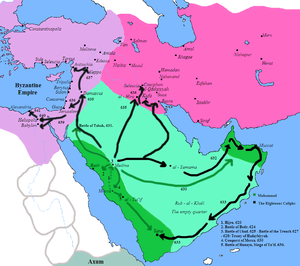
Muslim conquests also referred to as the Islamic conquests or Arab conquests, began with the Islamic prophet
Muhammad
. He established a new unified polity in the Arabian Peninsula
which under the subsequent Rashidun
(The Rightly Guided Caliphs) and Umayyad Caliphate
s saw a century of rapid expansion of Muslim
power.
They grew well beyond the Arabian Peninsula in the form of a Muslim
Empire with an area of influence that stretched from the borders of China
and the Indian subcontinent
, across Central Asia
, the Middle East
, North Africa
, Sicily
, and the Iberian Peninsula
, to the Pyrenees
. Edward Gibbon
writes in The History of the Decline and Fall of the Roman Empire
:
The Muslim conquests brought about the collapse of the Sassanid Empire
and a great territorial loss for the Byzantine Empire
. The reasons for the Muslim success are hard to reconstruct in hindsight, primarily because only fragmentary sources from the period have survived. Most historians agree that the Sassanid Persian and Byzantine Roman empires were militarily and economically exhausted from decades of fighting one another
. The rapid fall of Visigothic Spain remains a bit mysterious however.
Jews and Christian
s in Persia
and Jews and Monophysites
in Syria
were dissatisfied and sometimes even welcomed the Muslim forces, largely because of religious conflict in both empires. In the case of Byzantine Egypt, Palestine
and Syria
, these lands had only a few years before been reacquired from the Persians, and had not been ruled by the Byzantines for over 25 years.
Fred McGraw Donner, however, suggests that formation of a state in the peninsula and ideological (i.e. religious) coherence and mobilization was a primary reason why the Muslim armies
in the space of a hundred years were able to establish the largest pre-modern empire until that time. The estimates for the size of the Islamic Caliphate suggest it was more than thirteen million square kilometers (five million square miles), making it larger than all current states except the Russian Federation
.
Wars were between the Byzantine Empire and at first the Rashidun and then the Umayyad caliphates and resulted in the conquest of the Greater Syria
, Egypt
, North Africa
and Armenia
(Byzantine Armenia
and Sassanid Armenia
).
Under the Rashidun
Under the Umayyads
Later conquests
Frontier warfare continued in the form of cross border raids between the Ummayyads and the Byzantine Isaurian dynasty allied with the Khazars
across Asia Minor
. Byzantine naval dominance and Greek fire
resulted in a major victory at the Battle of Akroinon
(739); one of a series of military failures of the Caliph Hisham ibn Abd al-Malik
across the empire that checked the expansion of the Umayyads and hastened their fall.
In the reign of Yazdgerd III
, the last Sassanid
ruler of the Persian Empire, a Muslim army secured the conquest of Persia after their decisive defeats of the Sassanid army
at the Battle of Walaja
in 633 and Battle of al-Qādisiyyah
in 636, but the final military victory didn't come until 642 when the Persian army was destroyed at the Battle of Nahāvand. Then, in 651, Yazdgerd III was murdered at Merv
, ending the dynasty. His son Peroz II escaped through the Pamir Mountains
in what is now Tajikistan
and arrived in Tang China
.
Following the First Fitna
, the Umayyads resumed the push to capture Sassanid lands and began to move towards the conquest of lands east and north of the plateau
towards Greater Khorasan
and the Silk Road
along Transoxiana
. Following the collapse of the Sassanids, these regions had fallen under the sway of local Iranian
and Turkic
tribes as well as the Tang Dynasty. By 709, however, all of Greater Khorasan
and Sogdiana
had come under Arab control. The Arabs conquered many cities in Turkestan
although Umayyad Arabs lost Battle of the Defile
against the Turgesh Turks
in 731. By 751, with leadership of the Abbasid, the Arabs had extended their influence further east to the borders of China, leading to the Battle of Talas
.
During the period of early Rajput
supremacy in north India
(7th century), the first Muslim invasions were carried out simultaneously with the expansion towards Central Asia. In 664, forces led by Al Muhallab ibn Abi Suffrah began launching raids from Persia, striking Multan
in the southern Punjab
, in what is today Pakistan
.
In 711, an expedition led by Muhammad bin Qasim
defeated Raja Dahir at what is now Hyderabad
in Sindh
, and established the Umayyad domination in the area by 712.
The west of Indian sub-continent was then divided into many states. Their relation between each other were very weak. Al-Ḥajjāj ibn Yūsuf the ruler of Iraq knew this and waited for the best moment to strike.
As Muslim Empire and Dahir's kingdom were contiguous to each other, frequent
border clashes took place. As a result relation between the two got worse.
The King of Ceylon, the present Srilanka sent many 8 ships full of gifts
for the Calipf Al-Walid
and the ruler of present Iraq, Hajjaj. But the
pirates plundered the ships at the Debal
of Sindh, which is now known as
"Karachi". Hajjaj demanded compensation from Dahir. But Dahir denied to take
responsibility for the crimes committed by the pirates.
For all these reasons. Hajjaj sent soldiers against Dahir. But first two expeditions failed. Then in 712 CE Hajjaj sent the third expedition.
The commander-in-chief of this expedition was Muhammad bin Qasim Al-Thaqafi the nephew and son-in-law of Hajjaj.
Qasim subdued the whole of what is modern Pakistan, from Karachi
to Kashmir
, reaching the borders of Kashmir within three years. After his recall, however, the region devolved into the semi-independent states of Mansura
and Multan ruled by local Muslim converts. The Arabs were effectively driven out after the defeats inflicted on them by the Gurjara Pratiharas. The emir of Sindh paid tribute to the Rashtrakuta
king of Southern India.
The conquest of the Iberian Peninsula and Septimania
commenced when the Moors
(Black Africans, Berbers and Arabs) invaded Visigothic Christian Iberia (modern Spain
, Portugal
, Gibraltar
, Andorra
, Septimania
) in the year 711. Under their Moorish leader, Tariq ibn Ziyad, they landed at Gibraltar on April 30 and worked their way northward. Tariq's forces were joined the next year by those of his superior, Musa bin Nusair
. During the eight-year campaign most of the Iberian Peninsula was brought under Islamic rule—save for small areas in the northwest (Asturias
) and largely Basque
regions in the Pyrenees.
This territory, under the Arab name Al-Andalus
, became first an Emirate
and then an independent Umayyad Caliphate, the Caliphate of Córdoba
, after the overthrowing of the dynasty in Damascus
by the Abbasids. When the Caliphate dissolved in 1031, the territory split into small Taifa
s, and gradually the Christian kingdoms started the Reconquest
up to 1492, when Granada
, the last kingdom of Al-Andalus fell under the Catholic Monarchs
.
and the Byzantine Empire in dispelling the second Umayyad siege of Constantinople halted further conquests of Asia Minor
in 718. After their success in overrunning the Iberian peninsula, the Umayyads had moved northeast over the Pyrenees where they were defeated in 721 at the Battle of Toulouse
and then at the Battle of Covadonga
. A second invasion was stopped by the Frank
Charles Martel
at the Battle of Tours
in 732 and then at the Battle of the River Berre
checking the Umayyad expansion at Narbonne
.
Türgesh Kaganate
is also known Turkic who fought against Umayyads. In 717, the Kara Turgesh elected Suluk as their Khaghan. The new ruler moved his capital to Balasagun
in the Chu
valley, receiving the homage of several chieftains formerly bond to the service of Bilge
Khaghan of the Türküt. Suluk acted as a bulwark against further Umayyad
encroachment from the south: the Arabs had indeed become a major player in recent times, despite Islam
hadn't still made many converts in central Asia (that would need some two or three centuries still). Suluk's aim was to reconquer all of Transoxiana from the Arab invaders - his war was paralleled, much more westwards, by the Khazar empire. In 721 Turgesh forces, led by Kül Chor, defated the Caliphal army commanded by Sa'id ibn Abdu'l-Aziz near Samarkand. Sa'id's successor, Al-Kharashi, massacred Turks and Sogdian
refugees in Khujand
, causing an influx of refugees towards the Turgesh. In 724 Caliph Hisham sent a new governor to Khorasan
, Muslim ibn Sa'id, with orders to crush the "Turks" once and for all, but, confronted by Suluk, Muslim hardly managed to reach Samarkand with a handful of survivors, as the Turgesh raided freely. A string of subsequent appointees of Hisham were soundly defeated by Suluk, who in 728 even managed to take Bukhara
and later on destroyed
a large part of the Caliphate's army in Khurasan, discrediting Umayyad rule and maybe putting the foundations for the Abbasid
revolution. The Turgesh state was at its apex of glory, controlling Sogdiana, the Ferghana Valley. It was only in 732, that two powerful Arab expeditions to Samarkand managed, if with embarrassing losses, to reestablish Caliphal authority in the area; Suluk renounced his ambitions over Samarkand and abandoned Bukhara, withdrawing north. In 734 an early Abbasid follower, al-Harith ibn Surayj, rose in revolt against Umayyad rule and took Balkh
and Marv
before defecting to the Turgesh three years later, defeated. In 738 Suluk, along with his allies Ibn Surayj, Gurak (a Turco-Sogdian leader) and men from Usrushana, Tashkent
and Khuttal to launch a final offensive. He entered Jowzjan but was defeated by the Umayyad governor Asad at the Battle of Sa'n or Kharistan.
In 738, the Umayyad armies were defeated by the Indian Hindu
Rajputs at the Battle of Rajasthan
, checking the eastern expansion of the empire. In 740, the Berber Revolt
weakened Umayyad ability to launch any further expeditions and, after the Abbasid overthrow in 756 at Cordoba
, a separate Arab state was established on the Iberian peninsula, even as the Muhallabids
were unable to keep Ifriqiya from political fragmentation.
In the east, internal revolts and local dissent led to the downfall of the Umayyad dynasty. The Khariji
and Zaidi revolt
s coupled with mawali
dissatisfaction as second class citizens in respect to Arabs created the support base necessary for the Abbasid revolt in 748. The Abbasids were soon involved in numerous Shia revolts and the breakaway of Ifriqiya from the Caliph
's authority completely in the case of the Idrisids and Rustamid
s and nominally under the Aghlabid
s, under whom Muslim rule was extended temporarily to Sicily
and mainland Italy before being overrun by the competing Fatimids.
The Abbasid caliph, even as he competed for authority with the Fatimid Caliph, also had to devolve greater power to the increasing power of regional rulers. This began the process of fragmentation that soon gave rise to numerous local ruling dynasties who would contend for territory with each other and eventually establish kingdoms and empires and push the boundaries of the Muslim world
on their own authority, giving rise to Mamluk
and Turkic dynasties such as the Seljuk
s, Khwarezmshahs and the Ayyubid
s who fought the crusades
, as well as the Ghaznavids and Ghorids who conquered India.
In Iberia, Charles Martel's son, Pippin the Younger, retook Narbonne, and his grandson Charlemagne actually established the Marca Hispanica
across the Pyrenees in part of what today is Catalonia
, reconquering Girona in 785 and Barcelona
in 801. This formed a permanent buffer zone against Muslims, with Frankish strongholds in Iberia (the Carolingian Empire
Spanish Marches), which became the basis, along with the King of Asturias for the Reconquista, spanning 700 years which after the fall of the Caliphate of Córdoba
contested with both the successor taifas as well as the African-based Muslim empires, such as the Almoravids and Almohads, until all of the Muslims were expelled from the Iberian peninsula.
failed (see First Battle of Dongola
), the Arab commander in Egypt concluded the first in a series of regularly renewed treaties known as AlBaqt (pactum) with the Nubians
that governed relations between the two peoples for more than six hundred years. Therefore Islam progressed peacefully in the area through intermarriage and contacts with Arab merchants and settlers over a long period of time after the earlier attempts at conquering Nubia (in the 7th century)failed.
However, In 1171 AD the Nubians invaded Egypt, but they were defeated by the Muslim Ayyubids. From 1172 - 1173 AD the Ayyubids fought and defeated another Nubian invasion force which had penetrated Egypt. This time the Ayyubids not only repelled the invasion, but actually conquered some parts of northern Nubia in retaliation.
In the late 13th century the Sultan of Egypt,Sultan Baybar, defeated and subjugated the kingdom of Nubia. Sultan Baybar made the Kingdom of Nubia a vassal state of Egypt. Decades later In 1315 the Christian kingdom of Nubia was conquered by the Mamelukes, and a Muslim prince of Nubian royal blood was placed on the throne of Dongola
as king.
During the 15th century, the Funj
, an indigenous people appeared in southern Nubia and established the Kingdom of Sinnar, also known as As-Saltana az-Zarqa (the Blue Sultanate). The kingdom officially converted to Islam in 1523 and by 1606 it had supplanted the old Christian kingdom of Alwa (Alodia
) and controlled an area spreading over the northern and central regions of modern day Sudan thereby becoming the first Islamic Kingdom in Sudan. Their kingdom lasted until 1821.
as their launching pad conquered Palermo
in 831, Messina in 842, Enna
in 859, Syracuse in 878, Catania
in 900 and the final Byzantine stronghold, the fortress of Taormina
, in 902 setting up emirates in the Italian Peninsula
. In 846 the Aghlabids sacked Rome
.
Berber and Tulunid
rebellions quickly led to the rise of the Fatimids taking over Aghlabid territory and Calabria
was soon lost to the apanate of Italy. The Kalbid
dynasty administered the Emirate of Sicily
for the Fatimids by proxy from 948. By 1053 the dynasty died out in a dynastic struggle and interference from the Berber Zirid
s of Ifriqiya led to its breakdown into small fiefdoms which were captured by the Italo-Norman
s by 1091.
(840). The Abbasids soon shifted their attention towards the east. During the later fragmentation of the Abbasid rule and the rise of their Shiite rivals the Fatimids and Buyids, a resurgent Byzantium recaptured Crete and Cilicia
in 961, Cyprus
in 965, and pushed into the Levant by 975. The Byzantines successfully contested with the Fatimids for influence in the region until the arrival of the Seljuq Turks who first allied with the Abbasids and then ruled as the de facto
rulers.
In 1068 Alp Arslan
and allied Turkmen
tribes recaptured many Abbasid lands and even invaded Byzantine regions, pushing further into eastern and central Anatolia after a major victory at the Battle of Manzikert
in 1071. The disintegration of the Seljuk dynasty, the first unified Turkic dynasty, resulted in the rise of subsequent, smaller, rival Turkic kingdoms such as the Danishmends
, the Sultanate of Rûm
, and various Atabeg
s who contested the control of the region during the Crusades
and incrementally expanded across Anatolia until the rise of the Ottoman Empire
.
, the Sahelian kingdom
expanded Muslim territories far from the coast. Muslim traders spread Islam to kingdoms across Zanj
along the east Africa
n coast, and to Southeast Asia
and the sultan
ates of Southeast Asia such as those of Mataram
and Sulu
.
After the Mongol Empire
destroyed the Abbasid Caliphate, following the Battle of Baghdad (1258)
, they were stopped by Mamluks, Muslim army from Egypt in Battle of Ain Jalut
in 1260, and soon they converted to Islam, beginning an era of Turkic and Mongol expansions of Muslim rule into Eastern Europe
under the Golden Horde
; across Central Asia under Timur
, founder of the Timurid dynasty
; and later into the Indian subcontinent
under his descendant Babur
, founder of the Mughal Empire
. Meanwhile in the 17th century, Barbary corsairs
were conducting raids into Western
and Northern Europe
, as far as the islands of Britain
and Iceland
. Eastern Europe suffered a series of Tatar invasions
, the goal of which was to loot, pillage and capture slaves
into jasyr.
The modern era saw the rise of three powerful Muslim empires: the Ottoman Empire
of the Middle East and Europe, the Safavid Empire
of Persia and Central Asia, and the Mughal Empire of India; along with their contest and fall to the rise of the colonial
powers of Europe
.
. Shah Jehan's son Aurangzeb was a religious man who led to greater expansion of Mughal Empire. During his reign Mughal Empire reached its zenith.The Mughal Empire declined in 1707 after the death of Aurangzeb
and was officially abolished by the British after the Indian Rebellion of 1857
.
The Safavid Empire ended with the death of its last ruler Ismail III who ruled from 1750 until his death in 1760. The last surviving Muslim empire, the Ottoman Empire, collapsed in 1918 in the aftermath of World War I
. On March 3, 1924, the institution of the Caliphate was constitutionally abolished by President Mustafa Kemal Atatürk
as part of his reforms.
Prophets of Islam
Muslims identify the Prophets of Islam as those humans chosen by God and given revelation to deliver to mankind. Muslims believe that every prophet was given a belief to worship God and their respective followers believed it as well...
Muhammad
Muhammad
Muhammad |ligature]] at U+FDF4 ;Arabic pronunciation varies regionally; the first vowel ranges from ~~; the second and the last vowel: ~~~. There are dialects which have no stress. In Egypt, it is pronounced not in religious contexts...
. He established a new unified polity in the Arabian Peninsula
Arabian Peninsula
The Arabian Peninsula is a land mass situated north-east of Africa. Also known as Arabia or the Arabian subcontinent, it is the world's largest peninsula and covers 3,237,500 km2...
which under the subsequent Rashidun
Rashidun
The Rightly Guided Caliphs or The Righteous Caliphs is a term used in Sunni Islam to refer to the first four Caliphs who established the Rashidun Caliphate. The concept of "Rightly Guided Caliphs" originated with the Abbasid Dynasty...
(The Rightly Guided Caliphs) and Umayyad Caliphate
Caliphate
The term caliphate, "dominion of a caliph " , refers to the first system of government established in Islam and represented the political unity of the Muslim Ummah...
s saw a century of rapid expansion of Muslim
Muslim
A Muslim, also spelled Moslem, is an adherent of Islam, a monotheistic, Abrahamic religion based on the Quran, which Muslims consider the verbatim word of God as revealed to prophet Muhammad. "Muslim" is the Arabic term for "submitter" .Muslims believe that God is one and incomparable...
power.
They grew well beyond the Arabian Peninsula in the form of a Muslim
Muslim
A Muslim, also spelled Moslem, is an adherent of Islam, a monotheistic, Abrahamic religion based on the Quran, which Muslims consider the verbatim word of God as revealed to prophet Muhammad. "Muslim" is the Arabic term for "submitter" .Muslims believe that God is one and incomparable...
Empire with an area of influence that stretched from the borders of China
China
Chinese civilization may refer to:* China for more general discussion of the country.* Chinese culture* Greater China, the transnational community of ethnic Chinese.* History of China* Sinosphere, the area historically affected by Chinese culture...
and the Indian subcontinent
Indian subcontinent
The Indian subcontinent, also Indian Subcontinent, Indo-Pak Subcontinent or South Asian Subcontinent is a region of the Asian continent on the Indian tectonic plate from the Hindu Kush or Hindu Koh, Himalayas and including the Kuen Lun and Karakoram ranges, forming a land mass which extends...
, across Central Asia
Central Asia
Central Asia is a core region of the Asian continent from the Caspian Sea in the west, China in the east, Afghanistan in the south, and Russia in the north...
, the Middle East
Middle East
The Middle East is a region that encompasses Western Asia and Northern Africa. It is often used as a synonym for Near East, in opposition to Far East...
, North Africa
North Africa
North Africa or Northern Africa is the northernmost region of the African continent, linked by the Sahara to Sub-Saharan Africa. Geopolitically, the United Nations definition of Northern Africa includes eight countries or territories; Algeria, Egypt, Libya, Morocco, South Sudan, Sudan, Tunisia, and...
, Sicily
Sicily
Sicily is a region of Italy, and is the largest island in the Mediterranean Sea. Along with the surrounding minor islands, it constitutes an autonomous region of Italy, the Regione Autonoma Siciliana Sicily has a rich and unique culture, especially with regard to the arts, music, literature,...
, and the Iberian Peninsula
Iberian Peninsula
The Iberian Peninsula , sometimes called Iberia, is located in the extreme southwest of Europe and includes the modern-day sovereign states of Spain, Portugal and Andorra, as well as the British Overseas Territory of Gibraltar...
, to the Pyrenees
Pyrenees
The Pyrenees is a range of mountains in southwest Europe that forms a natural border between France and Spain...
. Edward Gibbon
Edward Gibbon
Edward Gibbon was an English historian and Member of Parliament...
writes in The History of the Decline and Fall of the Roman Empire
The History of the Decline and Fall of the Roman Empire
The History of the Decline and Fall of the Roman Empire is a non-fiction history book written by English historian Edward Gibbon and published in six volumes. Volume I was published in 1776, and went through six printings. Volumes II and III were published in 1781; volumes IV, V, VI in 1788–89...
:
The Muslim conquests brought about the collapse of the Sassanid Empire
Sassanid Empire
The Sassanid Empire , known to its inhabitants as Ērānshahr and Ērān in Middle Persian and resulting in the New Persian terms Iranshahr and Iran , was the last pre-Islamic Persian Empire, ruled by the Sasanian Dynasty from 224 to 651...
and a great territorial loss for the Byzantine Empire
Byzantine Empire
The Byzantine Empire was the Eastern Roman Empire during the periods of Late Antiquity and the Middle Ages, centred on the capital of Constantinople. Known simply as the Roman Empire or Romania to its inhabitants and neighbours, the Empire was the direct continuation of the Ancient Roman State...
. The reasons for the Muslim success are hard to reconstruct in hindsight, primarily because only fragmentary sources from the period have survived. Most historians agree that the Sassanid Persian and Byzantine Roman empires were militarily and economically exhausted from decades of fighting one another
Byzantine–Sassanid Wars
The Byzantine–Sassanid Wars refers to a series of conflicts between the Eastern Roman Empire and the Sassanid dynasty of the Persian Empire...
. The rapid fall of Visigothic Spain remains a bit mysterious however.
Jews and Christian
Christian
A Christian is a person who adheres to Christianity, an Abrahamic, monotheistic religion based on the life and teachings of Jesus of Nazareth as recorded in the Canonical gospels and the letters of the New Testament...
s in Persia
Sassanid Empire
The Sassanid Empire , known to its inhabitants as Ērānshahr and Ērān in Middle Persian and resulting in the New Persian terms Iranshahr and Iran , was the last pre-Islamic Persian Empire, ruled by the Sasanian Dynasty from 224 to 651...
and Jews and Monophysites
Monophysitism
Monophysitism , or Monophysiticism, is the Christological position that Jesus Christ has only one nature, his humanity being absorbed by his Deity...
in Syria
Syria (Roman province)
Syria was a Roman province, annexed in 64 BC by Pompey, as a consequence of his military presence after pursuing victory in the Third Mithridatic War. It remained under Roman, and subsequently Byzantine, rule for seven centuries, until 637 when it fell to the Islamic conquests.- Principate :The...
were dissatisfied and sometimes even welcomed the Muslim forces, largely because of religious conflict in both empires. In the case of Byzantine Egypt, Palestine
Palestine
Palestine is a conventional name, among others, used to describe the geographic region between the Mediterranean Sea and the Jordan River, and various adjoining lands....
and Syria
Syria
Syria , officially the Syrian Arab Republic , is a country in Western Asia, bordering Lebanon and the Mediterranean Sea to the West, Turkey to the north, Iraq to the east, Jordan to the south, and Israel to the southwest....
, these lands had only a few years before been reacquired from the Persians, and had not been ruled by the Byzantines for over 25 years.
Fred McGraw Donner, however, suggests that formation of a state in the peninsula and ideological (i.e. religious) coherence and mobilization was a primary reason why the Muslim armies
Rashidun army
The Rashidun Caliphate Army or Rashidun army was the primary military body of the Rashidun Caliphate's armed forces during the Muslim conquests of the 7th century, serving alongside the Rashidun Navy...
in the space of a hundred years were able to establish the largest pre-modern empire until that time. The estimates for the size of the Islamic Caliphate suggest it was more than thirteen million square kilometers (five million square miles), making it larger than all current states except the Russian Federation
Russia
Russia or , officially known as both Russia and the Russian Federation , is a country in northern Eurasia. It is a federal semi-presidential republic, comprising 83 federal subjects...
.
History
The individual Muslim conquests, together with their beginning and ending dates, are as follows:Byzantine–Arab Wars: 634–750
Wars were between the Byzantine Empire and at first the Rashidun and then the Umayyad caliphates and resulted in the conquest of the Greater Syria
Greater Syria
Greater Syria , also known simply as Syria, is a term that denotes a region in the Near East bordering the Eastern Mediterranean Sea or the Levant....
, Egypt
Egypt
Egypt , officially the Arab Republic of Egypt, Arabic: , is a country mainly in North Africa, with the Sinai Peninsula forming a land bridge in Southwest Asia. Egypt is thus a transcontinental country, and a major power in Africa, the Mediterranean Basin, the Middle East and the Muslim world...
, North Africa
North Africa
North Africa or Northern Africa is the northernmost region of the African continent, linked by the Sahara to Sub-Saharan Africa. Geopolitically, the United Nations definition of Northern Africa includes eight countries or territories; Algeria, Egypt, Libya, Morocco, South Sudan, Sudan, Tunisia, and...
and Armenia
Armenia
Armenia , officially the Republic of Armenia , is a landlocked mountainous country in the Caucasus region of Eurasia...
(Byzantine Armenia
Byzantine Armenia
Byzantine Armenia is the name given to the Armenian part of the Byzantine Empire. The size of the territory varied over time, depending on the degree of control the Byzantines had over Armenia....
and Sassanid Armenia
Marzpanate Period
Marzpanate period refers to the period in Armenian history after the fall of the Arshakuni Dynasty of Armenia in 428, when Marzpans , nominated by the Sassanid Persian King, governed the eastern part of Armenia...
).
Under the Rashidun
- The conquest of SyriaMuslim conquest of SyriaThe Muslim conquest of Syria occurred in the first half of the 7th century, and refers to the region known as the Bilad al-Sham, the Levant, or Greater Syria...
, 637 - The conquest of ArmeniaArab conquest of ArmeniaThe Arab conquest of Armenia was a part of the Muslim conquests after the death of Muhammad in AD 632.Persian Armenia had fallen to the Byzantine Empire shortly before, in AD 629, and was conquered in the Rashidun Caliphate by AD 645.-Islamic expansion:...
, 639 - The conquest of EgyptMuslim conquest of EgyptAt the commencement of the Muslims conquest of Egypt, Egypt was part of the Byzantine Empire with its capital in Constantinople. However, it had been occupied just a decade before by the Persian Empire under Khosrau II...
, 639 - The conquest of North AfricaUmayyad conquest of North AfricaThe Umayyad conquest of North Africa continued the century of rapid Arab Muslim expansion following the death of Muhammad in 632 CE. By 640 the Arabs controlled Mesopotamia, had invaded Armenia, and were concluding their conquest of Byzantine Syria. Damascus was the seat of the Umayyad caliphate....
, 652 - The conquest of Cyprus, 654
Under the Umayyads
- The conquest of North AfricaUmayyad conquest of North AfricaThe Umayyad conquest of North Africa continued the century of rapid Arab Muslim expansion following the death of Muhammad in 632 CE. By 640 the Arabs controlled Mesopotamia, had invaded Armenia, and were concluding their conquest of Byzantine Syria. Damascus was the seat of the Umayyad caliphate....
, 665 - The first Arab siege of Constantinople, 674–678
- The second Arab siege of Constantinople, 717–718
- Conquest of HispaniaUmayyad conquest of HispaniaThe Umayyad conquest of Hispania is the initial Islamic Ummayad Caliphate's conquest, between 711 and 718, of the Christian Visigothic Kingdom of Hispania, centered in the Iberian Peninsula, which was known to them under the Arabic name al-Andalus....
, 711–718 - The conquest of GeorgiaEmirate of TbilisiThe Emirs of Tbilisi ruled over the parts of today’s eastern Georgia from their base in the city of Tbilisi, from 736 to 1080 . Established by the Arabs during their invasions of Georgian lands, the emirate was an important outpost of the Muslim rule in the Caucasus until recaptured by the...
, 736
Later conquests
- The conquest of CreteEmirate of CreteThe Emirate of Crete was a Muslim state that existed on the Mediterranean island of Crete from the late 820s to the Byzantine reconquest of the island in 961....
, 820 - The conquest of southern ItalyHistory of Islam in southern ItalyThe history of Islam in southern Italy begins with the Islamic conquest and subsequent rule of Sicily and Malta, a process that started in the 9th century. Islamic rule over Sicily was effective from 902, and the complete rule of the island lasted from 965 until 1061...
, 827
Frontier warfare continued in the form of cross border raids between the Ummayyads and the Byzantine Isaurian dynasty allied with the Khazars
Khazars
The Khazars were semi-nomadic Turkic people who established one of the largest polities of medieval Eurasia, with the capital of Atil and territory comprising much of modern-day European Russia, western Kazakhstan, eastern Ukraine, Azerbaijan, large portions of the northern Caucasus , parts of...
across Asia Minor
Anatolia
Anatolia is a geographic and historical term denoting the westernmost protrusion of Asia, comprising the majority of the Republic of Turkey...
. Byzantine naval dominance and Greek fire
Greek fire
Greek fire was an incendiary weapon used by the Byzantine Empire. The Byzantines typically used it in naval battles to great effect as it could continue burning while floating on water....
resulted in a major victory at the Battle of Akroinon
Battle of Akroinon
The Battle of Akroinon was fought at Akroinon or Akroinos in Phrygia, on the western edge of the Anatolian plateau, in 740 between an Umayyad Arab army and the Byzantine forces. The Arabs had been conducting regular raids into Anatolia for the past century, and the 740 expedition was the largest...
(739); one of a series of military failures of the Caliph Hisham ibn Abd al-Malik
Hisham ibn Abd al-Malik
Hisham ibn Abd al-Malik 10th Umayyad caliph who ruled from 723 until his death in 743. When he was born in 691 his mother named him after her father....
across the empire that checked the expansion of the Umayyads and hastened their fall.
Conquest of Persia and Iraq: 633–651
In the reign of Yazdgerd III
Yazdgerd III
Yazdegerd III or Yazdgerd III was the twenty-ninth and last king of the Sassanid dynasty of Iran and a grandson of Khosrau II . His father was Shahryar, whose mother was Miriam, the daughter of the Byzantine Emperor Maurice...
, the last Sassanid
Sassanid Empire
The Sassanid Empire , known to its inhabitants as Ērānshahr and Ērān in Middle Persian and resulting in the New Persian terms Iranshahr and Iran , was the last pre-Islamic Persian Empire, ruled by the Sasanian Dynasty from 224 to 651...
ruler of the Persian Empire, a Muslim army secured the conquest of Persia after their decisive defeats of the Sassanid army
Sassanid army
The birth of the Sassanid army dates back to the rise of Ardashir I , the founder of the Sassanid dynasty, to the throne. Ardashir aimed at the revival of the Persian Empire, and to further this aim, he reformed the military by forming a standing army which was under his personal command and whose...
at the Battle of Walaja
Battle of Walaja
The Battle of Walaja was a battle fought in Mesopotamia in May 633 between the Rashidun Caliphate army under Khalid ibn al-Walid and al muthanna ibn haarithah against the Persian Empire and its Arab allies...
in 633 and Battle of al-Qādisiyyah
Battle of al-Qadisiyyah
The Battle of al-Qādisiyyah was fought in 636; it was the decisive engagement between the Arab muslim army and the Sassanid Persian army during the first period of Muslim expansion. It resulted in the Islamic conquest of Persia, and was key to the conquest of Iraq...
in 636, but the final military victory didn't come until 642 when the Persian army was destroyed at the Battle of Nahāvand. Then, in 651, Yazdgerd III was murdered at Merv
Merv
Merv , formerly Achaemenid Satrapy of Margiana, and later Alexandria and Antiochia in Margiana , was a major oasis-city in Central Asia, on the historical Silk Road, located near today's Mary in Turkmenistan. Several cities have existed on this site, which is significant for the interchange of...
, ending the dynasty. His son Peroz II escaped through the Pamir Mountains
Pamir Mountains
The Pamir Mountains are a mountain range in Central Asia formed by the junction or knot of the Himalayas, Tian Shan, Karakoram, Kunlun, and Hindu Kush ranges. They are among the world’s highest mountains and since Victorian times they have been known as the "Roof of the World" a probable...
in what is now Tajikistan
Tajikistan
Tajikistan , officially the Republic of Tajikistan , is a mountainous landlocked country in Central Asia. Afghanistan borders it to the south, Uzbekistan to the west, Kyrgyzstan to the north, and China to the east....
and arrived in Tang China
Tang Dynasty
The Tang Dynasty was an imperial dynasty of China preceded by the Sui Dynasty and followed by the Five Dynasties and Ten Kingdoms Period. It was founded by the Li family, who seized power during the decline and collapse of the Sui Empire...
.
Conquest of Transoxiana: 662–709
Following the First Fitna
First Fitna
The First Islamic Civil War , also called the First Fitna , was the first major civil war within the Islamic Caliphate. It arose as a struggle over who had the legitimate right to become the ruling Caliph...
, the Umayyads resumed the push to capture Sassanid lands and began to move towards the conquest of lands east and north of the plateau
Plateau
In geology and earth science, a plateau , also called a high plain or tableland, is an area of highland, usually consisting of relatively flat terrain. A highly eroded plateau is called a dissected plateau...
towards Greater Khorasan
Greater Khorasan
Greater Khorasan or Ancient Khorasan is a historical region of Greater Iran mentioned in sources from Sassanid and Islamic eras which "frequently" had a denotation wider than current three provinces of Khorasan in Iran...
and the Silk Road
Silk Road
The Silk Road or Silk Route refers to a historical network of interlinking trade routes across the Afro-Eurasian landmass that connected East, South, and Western Asia with the Mediterranean and European world, as well as parts of North and East Africa...
along Transoxiana
Transoxiana
Transoxiana is the ancient name used for the portion of Central Asia corresponding approximately with modern-day Uzbekistan, Tajikistan, southern Kyrgystan and southwest Kazakhstan. Geographically, it is the region between the Amu Darya and Syr Darya rivers...
. Following the collapse of the Sassanids, these regions had fallen under the sway of local Iranian
Iranian peoples
The Iranian peoples are an Indo-European ethnic-linguistic group, consisting of the speakers of Iranian languages, a major branch of the Indo-European language family, as such forming a branch of Indo-European-speaking peoples...
and Turkic
Turkic peoples
The Turkic peoples are peoples residing in northern, central and western Asia, southern Siberia and northwestern China and parts of eastern Europe. They speak languages belonging to the Turkic language family. They share, to varying degrees, certain cultural traits and historical backgrounds...
tribes as well as the Tang Dynasty. By 709, however, all of Greater Khorasan
Greater Khorasan
Greater Khorasan or Ancient Khorasan is a historical region of Greater Iran mentioned in sources from Sassanid and Islamic eras which "frequently" had a denotation wider than current three provinces of Khorasan in Iran...
and Sogdiana
Sogdiana
Sogdiana or Sogdia was the ancient civilization of an Iranian people and a province of the Achaemenid Empire, eighteenth in the list on the Behistun Inscription of Darius the Great . Sogdiana is "listed" as the second of the "good lands and countries" that Ahura Mazda created...
had come under Arab control. The Arabs conquered many cities in Turkestan
Turkestan
Turkestan, spelled also as Turkistan, literally means "Land of the Turks".The term Turkestan is of Persian origin and has never been in use to denote a single nation. It was first used by Persian geographers to describe the place of Turkish peoples...
although Umayyad Arabs lost Battle of the Defile
Battle of the Defile
The Battle of the Defile or Battle of the Pass was fought over three days in the Tashtakaracha Pass between a large Umayyad army and the Turgesh in July 731 CE...
against the Turgesh Turks
Turgesh
The Türgesh, Turgish or Türgish were a Turkic tribal confederation who emerged from the ruins of the Western Turkic Kaganate...
in 731. By 751, with leadership of the Abbasid, the Arabs had extended their influence further east to the borders of China, leading to the Battle of Talas
Battle of Talas
The Battle of Talas in 751 AD was an especially notable conflict between the Arab Abbasid Caliphate and the Chinese Tang Dynasty for control not only of the Syr Darya region, but even more...
.
Conquest of Sindh: 664–712
During the period of early Rajput
Rajput
A Rajput is a member of one of the patrilineal clans of western, central, northern India and in some parts of Pakistan. Rajputs are descendants of one of the major ruling warrior classes in the Indian subcontinent, particularly North India...
supremacy in north India
North India
North India, known natively as Uttar Bhārat or Shumālī Hindustān , is a loosely defined region in the northern part of India. The exact meaning of the term varies by usage...
(7th century), the first Muslim invasions were carried out simultaneously with the expansion towards Central Asia. In 664, forces led by Al Muhallab ibn Abi Suffrah began launching raids from Persia, striking Multan
Multan
Multan , is a city in the Punjab Province of Pakistan and capital of Multan District. It is located in the southern part of the province on the east bank of the Chenab River, more or less in the geographic centre of the country and about from Islamabad, from Lahore and from Karachi...
in the southern Punjab
Punjab region
The Punjab , also spelled Panjab |water]]s"), is a geographical region straddling the border between Pakistan and India which includes Punjab province in Pakistan and the states of the Punjab, Haryana, Himachal Pradesh, Chandigarh and some northern parts of the National Capital Territory of Delhi...
, in what is today Pakistan
Pakistan
Pakistan , officially the Islamic Republic of Pakistan is a sovereign state in South Asia. It has a coastline along the Arabian Sea and the Gulf of Oman in the south and is bordered by Afghanistan and Iran in the west, India in the east and China in the far northeast. In the north, Tajikistan...
.
In 711, an expedition led by Muhammad bin Qasim
Muhammad bin Qasim
Muhammad bin Qasim Al-Thaqafi was a Umayyad general who, at the age of 17, began the conquest of the Sindh and Punjab regions along the Indus River for the Umayyad Caliphate. He was born in the city of Taif...
defeated Raja Dahir at what is now Hyderabad
Hyderabad, Sindh
is the second largest city in the Sindh province of Pakistan. It is the seventh largest city in the country. The city was founded in 1768 by Mian Ghulam Shah Kalhoro upon the ruins of a Mauryan fishing village along the bank of the Indus known as Neroon Kot...
in Sindh
Sindh
Sindh historically referred to as Ba'ab-ul-Islam , is one of the four provinces of Pakistan and historically is home to the Sindhi people. It is also locally known as the "Mehran". Though Muslims form the largest religious group in Sindh, a good number of Christians, Zoroastrians and Hindus can...
, and established the Umayyad domination in the area by 712.
The west of Indian sub-continent was then divided into many states. Their relation between each other were very weak. Al-Ḥajjāj ibn Yūsuf the ruler of Iraq knew this and waited for the best moment to strike.
As Muslim Empire and Dahir's kingdom were contiguous to each other, frequent
border clashes took place. As a result relation between the two got worse.
The King of Ceylon, the present Srilanka sent many 8 ships full of gifts
for the Calipf Al-Walid
Al-Walid
al-Walid may refer to:* Khalid ibn al-Walid , one of the two famous Arab generals of the Rashidun army during the Muslim conquests of the 7th Century* Al-Walid I , an Umayyad caliph who ruled from 705 - 715....
and the ruler of present Iraq, Hajjaj. But the
pirates plundered the ships at the Debal
Debal
-Introduction:Debal was an ancient port located near modern Karachi, Sindh, Pakistan. In Arabic, it was usually called Daybul it is adjacent to the nearby Manora Island and was administered by Mansura, and later Thatta....
of Sindh, which is now known as
"Karachi". Hajjaj demanded compensation from Dahir. But Dahir denied to take
responsibility for the crimes committed by the pirates.
For all these reasons. Hajjaj sent soldiers against Dahir. But first two expeditions failed. Then in 712 CE Hajjaj sent the third expedition.
The commander-in-chief of this expedition was Muhammad bin Qasim Al-Thaqafi the nephew and son-in-law of Hajjaj.
Qasim subdued the whole of what is modern Pakistan, from Karachi
Karachi
Karachi is the largest city, main seaport and the main financial centre of Pakistan, as well as the capital of the province of Sindh. The city has an estimated population of 13 to 15 million, while the total metropolitan area has a population of over 18 million...
to Kashmir
Kashmir
Kashmir is the northwestern region of the Indian subcontinent. Until the mid-19th century, the term Kashmir geographically denoted only the valley between the Great Himalayas and the Pir Panjal mountain range...
, reaching the borders of Kashmir within three years. After his recall, however, the region devolved into the semi-independent states of Mansura
Mansura (Brahmanabad)
Mansura was the historic capital of the Arab empire in Sindh. The city now lies in Western Pakistan and is usually known as Brahmanabad in Sindh, situated about south-east of Shahdadpur railway station, and north-east of Hyderabad.-History:...
and Multan ruled by local Muslim converts. The Arabs were effectively driven out after the defeats inflicted on them by the Gurjara Pratiharas. The emir of Sindh paid tribute to the Rashtrakuta
Rashtrakuta
The Rashtrakuta Empire was a royal dynasty ruling large parts of the Indian Subcontinent between the sixth and the 10th centuries. During this period they ruled as several closely related, but individual clans. Rastrakutas in inscriptions represented as descendants of Satyaki, a Yadava well known...
king of Southern India.
Conquest of Hispania (711–718) and Septimania (719–720)
The conquest of the Iberian Peninsula and Septimania
Septimania
Septimania was the western region of the Roman province of Gallia Narbonensis that passed under the control of the Visigoths in 462, when Septimania was ceded to their king, Theodoric II. Under the Visigoths it was known as simply Gallia or Narbonensis. It corresponded roughly with the modern...
commenced when the Moors
Moors
The description Moors has referred to several historic and modern populations of the Maghreb region who are predominately of Berber and Arab descent. They came to conquer and rule the Iberian Peninsula for nearly 800 years. At that time they were Muslim, although earlier the people had followed...
(Black Africans, Berbers and Arabs) invaded Visigothic Christian Iberia (modern Spain
Spain
Spain , officially the Kingdom of Spain languages]] under the European Charter for Regional or Minority Languages. In each of these, Spain's official name is as follows:;;;;;;), is a country and member state of the European Union located in southwestern Europe on the Iberian Peninsula...
, Portugal
Portugal
Portugal , officially the Portuguese Republic is a country situated in southwestern Europe on the Iberian Peninsula. Portugal is the westernmost country of Europe, and is bordered by the Atlantic Ocean to the West and South and by Spain to the North and East. The Atlantic archipelagos of the...
, Gibraltar
Gibraltar
Gibraltar is a British overseas territory located on the southern end of the Iberian Peninsula at the entrance of the Mediterranean. A peninsula with an area of , it has a northern border with Andalusia, Spain. The Rock of Gibraltar is the major landmark of the region...
, Andorra
Andorra
Andorra , officially the Principality of Andorra , also called the Principality of the Valleys of Andorra, , is a small landlocked country in southwestern Europe, located in the eastern Pyrenees mountains and bordered by Spain and France. It is the sixth smallest nation in Europe having an area of...
, Septimania
Septimania
Septimania was the western region of the Roman province of Gallia Narbonensis that passed under the control of the Visigoths in 462, when Septimania was ceded to their king, Theodoric II. Under the Visigoths it was known as simply Gallia or Narbonensis. It corresponded roughly with the modern...
) in the year 711. Under their Moorish leader, Tariq ibn Ziyad, they landed at Gibraltar on April 30 and worked their way northward. Tariq's forces were joined the next year by those of his superior, Musa bin Nusair
Musa bin Nusair
Musa bin Nusayr al-Balawi was a balawi who served as a governor and general under the Umayad caliph Al-Walid I. He had ruled over the Muslim provinces of North Africa , and directed the islamic opening of the Visigothic kingdom in Hispania....
. During the eight-year campaign most of the Iberian Peninsula was brought under Islamic rule—save for small areas in the northwest (Asturias
Asturias
The Principality of Asturias is an autonomous community of the Kingdom of Spain, coextensive with the former Kingdom of Asturias in the Middle Ages...
) and largely Basque
Basque people
The Basques as an ethnic group, primarily inhabit an area traditionally known as the Basque Country , a region that is located around the western end of the Pyrenees on the coast of the Bay of Biscay and straddles parts of north-central Spain and south-western France.The Basques are known in the...
regions in the Pyrenees.
This territory, under the Arab name Al-Andalus
Al-Andalus
Al-Andalus was the Arabic name given to a nation and territorial region also commonly referred to as Moorish Iberia. The name describes parts of the Iberian Peninsula and Septimania governed by Muslims , at various times in the period between 711 and 1492, although the territorial boundaries...
, became first an Emirate
Emirate
An emirate is a political territory that is ruled by a dynastic Muslim monarch styled emir.-Etymology:Etymologically emirate or amirate is the quality, dignity, office or territorial competence of any emir ....
and then an independent Umayyad Caliphate, the Caliphate of Córdoba
Caliphate of Córdoba
The Caliphate of Córdoba ruled the Iberian peninsula and part of North Africa, from the city of Córdoba, from 929 to 1031. This period was characterized by remarkable success in trade and culture; many of the masterpieces of Islamic Iberia were constructed in this period, including the famous...
, after the overthrowing of the dynasty in Damascus
Damascus
Damascus , commonly known in Syria as Al Sham , and as the City of Jasmine , is the capital and the second largest city of Syria after Aleppo, both are part of the country's 14 governorates. In addition to being one of the oldest continuously inhabited cities in the world, Damascus is a major...
by the Abbasids. When the Caliphate dissolved in 1031, the territory split into small Taifa
Taifa
In the history of the Iberian Peninsula, a taifa was an independent Muslim-ruled principality, usually an emirate or petty kingdom, though there was one oligarchy, of which a number formed in the Al-Andalus after the final collapse of the Umayyad Caliphate of Córdoba in 1031.-Rise:The origins of...
s, and gradually the Christian kingdoms started the Reconquest
Reconquista
The Reconquista was a period of almost 800 years in the Middle Ages during which several Christian kingdoms succeeded in retaking the Muslim-controlled areas of the Iberian Peninsula broadly known as Al-Andalus...
up to 1492, when Granada
Granada
Granada is a city and the capital of the province of Granada, in the autonomous community of Andalusia, Spain. Granada is located at the foot of the Sierra Nevada mountains, at the confluence of three rivers, the Beiro, the Darro and the Genil. It sits at an elevation of 738 metres above sea...
, the last kingdom of Al-Andalus fell under the Catholic Monarchs
Catholic Monarchs
The Catholic Monarchs is the collective title used in history for Queen Isabella I of Castile and King Ferdinand II of Aragon. They were both from the House of Trastámara and were second cousins, being both descended from John I of Castile; they were given a papal dispensation to deal with...
.
End of the Umayyad conquests: 718–750
The success of the Bulgarian EmpireFirst Bulgarian Empire
The First Bulgarian Empire was a medieval Bulgarian state founded in the north-eastern Balkans in c. 680 by the Bulgars, uniting with seven South Slavic tribes...
and the Byzantine Empire in dispelling the second Umayyad siege of Constantinople halted further conquests of Asia Minor
Asia Minor
Asia Minor is a geographical location at the westernmost protrusion of Asia, also called Anatolia, and corresponds to the western two thirds of the Asian part of Turkey...
in 718. After their success in overrunning the Iberian peninsula, the Umayyads had moved northeast over the Pyrenees where they were defeated in 721 at the Battle of Toulouse
Battle of Toulouse (721)
The Battle of Toulouse was a victory of an Aquitanian army led by Duke Odo of Aquitaine over an Umayyad army besieging the city of Toulouse, and led by the governor of Al-Andalus, Al-Samh ibn Malik al-Khawlani...
and then at the Battle of Covadonga
Battle of Covadonga
The Battle of Covadonga was the first major victory by a Christian military force in Iberia following the Muslim Moors' conquest of that region in 711...
. A second invasion was stopped by the Frank
Franks
The Franks were a confederation of Germanic tribes first attested in the third century AD as living north and east of the Lower Rhine River. From the third to fifth centuries some Franks raided Roman territory while other Franks joined the Roman troops in Gaul. Only the Salian Franks formed a...
Charles Martel
Charles Martel
Charles Martel , also known as Charles the Hammer, was a Frankish military and political leader, who served as Mayor of the Palace under the Merovingian kings and ruled de facto during an interregnum at the end of his life, using the title Duke and Prince of the Franks. In 739 he was offered the...
at the Battle of Tours
Battle of Tours
The Battle of Tours , also called the Battle of Poitiers and in Battle of the Court of the Martyrs, was fought in an area between the cities of Poitiers and Tours, located in north-central France, near the village of Moussais-la-Bataille, about northeast of Poitiers...
in 732 and then at the Battle of the River Berre
Battle of the River Berre
At the Battle of the River Berre in 737 Frankish forces under the command of Charles Martel intercepted a sizeable Arab force sent from Al-Andalus to relieve the siege of Narbonne. The battle, which took place at the mouth of the River Berre , was a significant victory for Martel in the campaigns...
checking the Umayyad expansion at Narbonne
Narbonne
Narbonne is a commune in southern France in the Languedoc-Roussillon region. It lies from Paris in the Aude department, of which it is a sub-prefecture. Once a prosperous port, it is now located about from the shores of the Mediterranean Sea...
.
Türgesh Kaganate
Turgesh
The Türgesh, Turgish or Türgish were a Turkic tribal confederation who emerged from the ruins of the Western Turkic Kaganate...
is also known Turkic who fought against Umayyads. In 717, the Kara Turgesh elected Suluk as their Khaghan. The new ruler moved his capital to Balasagun
Balasagun
Balasagun was an ancient Soghdian city in modern-day Kyrgyzstan, located in the Chui River valley between Bishkek and Issyk-Kul Lake....
in the Chu
Chu
Chu or CHU may refer to:Surname:* Chu , a common Chinese surname for 朱 , but it can also refer to any Chinese surname whose pinyin is "chu", such as 楚, 储, 褚, 初, 除 and other possible surnames....
valley, receiving the homage of several chieftains formerly bond to the service of Bilge
Bilge
The bilge is the lowest compartment on a ship where the two sides meet at the keel. The word was coined in 1513.-Bilge water:The word is sometimes also used to describe the water that collects in this compartment. Water that does not drain off the side of the deck drains down through the ship into...
Khaghan of the Türküt. Suluk acted as a bulwark against further Umayyad
Umayyad
The Umayyad Caliphate was the second of the four major Arab caliphates established after the death of Muhammad. It was ruled by the Umayyad dynasty, whose name derives from Umayya ibn Abd Shams, the great-grandfather of the first Umayyad caliph. Although the Umayyad family originally came from the...
encroachment from the south: the Arabs had indeed become a major player in recent times, despite Islam
Islam
Islam . The most common are and . : Arabic pronunciation varies regionally. The first vowel ranges from ~~. The second vowel ranges from ~~~...
hadn't still made many converts in central Asia (that would need some two or three centuries still). Suluk's aim was to reconquer all of Transoxiana from the Arab invaders - his war was paralleled, much more westwards, by the Khazar empire. In 721 Turgesh forces, led by Kül Chor, defated the Caliphal army commanded by Sa'id ibn Abdu'l-Aziz near Samarkand. Sa'id's successor, Al-Kharashi, massacred Turks and Sogdian
Sogdiana
Sogdiana or Sogdia was the ancient civilization of an Iranian people and a province of the Achaemenid Empire, eighteenth in the list on the Behistun Inscription of Darius the Great . Sogdiana is "listed" as the second of the "good lands and countries" that Ahura Mazda created...
refugees in Khujand
Khujand
Khujand , also transliterated as Khudzhand, , formerly Khodjend or Khodzhent until 1936 and Leninabad until 1991, is the second-largest city of Tajikistan. It is situated on the Syr Darya River at the mouth of the Fergana Valley...
, causing an influx of refugees towards the Turgesh. In 724 Caliph Hisham sent a new governor to Khorasan
Greater Khorasan
Greater Khorasan or Ancient Khorasan is a historical region of Greater Iran mentioned in sources from Sassanid and Islamic eras which "frequently" had a denotation wider than current three provinces of Khorasan in Iran...
, Muslim ibn Sa'id, with orders to crush the "Turks" once and for all, but, confronted by Suluk, Muslim hardly managed to reach Samarkand with a handful of survivors, as the Turgesh raided freely. A string of subsequent appointees of Hisham were soundly defeated by Suluk, who in 728 even managed to take Bukhara
Bukhara
Bukhara , from the Soghdian βuxārak , is the capital of the Bukhara Province of Uzbekistan. The nation's fifth-largest city, it has a population of 263,400 . The region around Bukhara has been inhabited for at least five millennia, and the city has existed for half that time...
and later on destroyed
Battle of the Defile
The Battle of the Defile or Battle of the Pass was fought over three days in the Tashtakaracha Pass between a large Umayyad army and the Turgesh in July 731 CE...
a large part of the Caliphate's army in Khurasan, discrediting Umayyad rule and maybe putting the foundations for the Abbasid
Abbasid
The Abbasid Caliphate or, more simply, the Abbasids , was the third of the Islamic caliphates. It was ruled by the Abbasid dynasty of caliphs, who built their capital in Baghdad after overthrowing the Umayyad caliphate from all but the al-Andalus region....
revolution. The Turgesh state was at its apex of glory, controlling Sogdiana, the Ferghana Valley. It was only in 732, that two powerful Arab expeditions to Samarkand managed, if with embarrassing losses, to reestablish Caliphal authority in the area; Suluk renounced his ambitions over Samarkand and abandoned Bukhara, withdrawing north. In 734 an early Abbasid follower, al-Harith ibn Surayj, rose in revolt against Umayyad rule and took Balkh
Balkh
Balkh , was an ancient city and centre of Zoroastrianism in what is now northern Afghanistan. Today it is a small town in the province of Balkh, about 20 kilometers northwest of the provincial capital, Mazar-e Sharif, and some south of the Amu Darya. It was one of the major cities of Khorasan...
and Marv
Marv
Marv is a fictional character in the graphic novel series Sin City, created by Frank Miller. In the 2005 film adaptation, he is played by Mickey Rourke. He first appears in The Hard Goodbye and follows with appearances in A Dame to Kill For, Just Another Saturday Night, and Silent Night...
before defecting to the Turgesh three years later, defeated. In 738 Suluk, along with his allies Ibn Surayj, Gurak (a Turco-Sogdian leader) and men from Usrushana, Tashkent
Tashkent
Tashkent is the capital of Uzbekistan and of the Tashkent Province. The officially registered population of the city in 2008 was about 2.2 million. Unofficial sources estimate the actual population may be as much as 4.45 million.-Early Islamic History:...
and Khuttal to launch a final offensive. He entered Jowzjan but was defeated by the Umayyad governor Asad at the Battle of Sa'n or Kharistan.
In 738, the Umayyad armies were defeated by the Indian Hindu
Hindu
Hindu refers to an identity associated with the philosophical, religious and cultural systems that are indigenous to the Indian subcontinent. As used in the Constitution of India, the word "Hindu" is also attributed to all persons professing any Indian religion...
Rajputs at the Battle of Rajasthan
Battle of Rajasthan
The Battle of Rajasthan is a battle where the Gurjar clans defeated the Arab invaders in 738 CE and removed the arab invaders and pillagers from the area east of the Indus River. the final battle took place somewhere on the borders of modern Sindh-Rajasthan...
, checking the eastern expansion of the empire. In 740, the Berber Revolt
Berber Revolt
The Great Berber Revolt of 739/740-743 AD took place during the reign of the Umayyad Caliph Hisham ibn Abd al-Malik and marked the first successful secession from the Arab caliphate...
weakened Umayyad ability to launch any further expeditions and, after the Abbasid overthrow in 756 at Cordoba
Córdoba, Spain
-History:The first trace of human presence in the area are remains of a Neanderthal Man, dating to c. 32,000 BC. In the 8th century BC, during the ancient Tartessos period, a pre-urban settlement existed. The population gradually learned copper and silver metallurgy...
, a separate Arab state was established on the Iberian peninsula, even as the Muhallabids
Muhallabids
The Muhallabids were a dynasty of governors in Ifriqiya under the Abbasid Caliphate Although subject to the Abbasids, they enjoyed a great deal of autonomy and were able to maintain Arab rule in the face of revolts by the Berbers...
were unable to keep Ifriqiya from political fragmentation.
In the east, internal revolts and local dissent led to the downfall of the Umayyad dynasty. The Khariji
Kharijites
Kharijites is a general term embracing various Muslims who, while initially supporting the authority of the final Rashidun Caliph Ali ibn Abi Talib, the son-in-law and cousin of the Islamic prophet Muhammad, then later rejected his leadership...
and Zaidi revolt
Zayd ibn Ali
Zayd ibn ‘Alī was the grandson of Husayn ibn Alī, the grandson of Muhammad. Zayd was born in Medina in 695. His father was the Shī‘ah Imam ‘Alī ibn Husayn "Zayn al-Abidīn"...
s coupled with mawali
Mawali
Mawali or mawālá is a term in Classical Arabic used to address non-Arab Muslims.The term gained prominence in the centuries following the early Arab Muslim conquests in the 7th century, as many non-Arabs such as Persians, Egyptians, and Turks converted to Islam...
dissatisfaction as second class citizens in respect to Arabs created the support base necessary for the Abbasid revolt in 748. The Abbasids were soon involved in numerous Shia revolts and the breakaway of Ifriqiya from the Caliph
Caliph
The Caliph is the head of state in a Caliphate, and the title for the ruler of the Islamic Ummah, an Islamic community ruled by the Shari'ah. It is a transcribed version of the Arabic word which means "successor" or "representative"...
's authority completely in the case of the Idrisids and Rustamid
Rustamid
The Rustamid dynasty of Ibāḍī Kharijite imām that ruled the central Maghreb as a Muslim theocracy for a century and a half from their capital Tahert in present Algeria until the Ismailite Fatimid Caliphs destroyed it. The dynasty had a Persian origin...
s and nominally under the Aghlabid
Aghlabid
The Aghlabids were a dynasty of emirs, members of the Arab tribe of Bani Tamim, who ruled Ifriqiya, nominally on behalf of the Abbasid Caliph, for about a century, until overthrown by the new power of the Fatimid.-History:...
s, under whom Muslim rule was extended temporarily to Sicily
Sicily
Sicily is a region of Italy, and is the largest island in the Mediterranean Sea. Along with the surrounding minor islands, it constitutes an autonomous region of Italy, the Regione Autonoma Siciliana Sicily has a rich and unique culture, especially with regard to the arts, music, literature,...
and mainland Italy before being overrun by the competing Fatimids.
The Abbasid caliph, even as he competed for authority with the Fatimid Caliph, also had to devolve greater power to the increasing power of regional rulers. This began the process of fragmentation that soon gave rise to numerous local ruling dynasties who would contend for territory with each other and eventually establish kingdoms and empires and push the boundaries of the Muslim world
Muslim world
The term Muslim world has several meanings. In a religious sense, it refers to those who adhere to the teachings of Islam, referred to as Muslims. In a cultural sense, it refers to Islamic civilization, inclusive of non-Muslims living in that civilization...
on their own authority, giving rise to Mamluk
Mamluk
A Mamluk was a soldier of slave origin, who were predominantly Cumans/Kipchaks The "mamluk phenomenon", as David Ayalon dubbed the creation of the specific warrior...
and Turkic dynasties such as the Seljuk
Seljuq dynasty
The Seljuq ; were a Turco-Persian Sunni Muslim dynasty that ruled parts of Central Asia and the Middle East from the 11th to 14th centuries...
s, Khwarezmshahs and the Ayyubid
Ayyubid dynasty
The Ayyubid dynasty was a Muslim dynasty of Kurdish origin, founded by Saladin and centered in Egypt. The dynasty ruled much of the Middle East during the 12th and 13th centuries CE. The Ayyubid family, under the brothers Ayyub and Shirkuh, originally served as soldiers for the Zengids until they...
s who fought the crusades
Crusades
The Crusades were a series of religious wars, blessed by the Pope and the Catholic Church with the main goal of restoring Christian access to the holy places in and near Jerusalem...
, as well as the Ghaznavids and Ghorids who conquered India.
In Iberia, Charles Martel's son, Pippin the Younger, retook Narbonne, and his grandson Charlemagne actually established the Marca Hispanica
Marca Hispanica
The Marca Hispanica , also known as Spanish March or March of Barcelona was a buffer zone beyond the province of Septimania, created by Charlemagne in 795 as a defensive barrier between the Umayyad Moors of Al-Andalus and the Frankish Kingdom....
across the Pyrenees in part of what today is Catalonia
Catalonia
Catalonia is an autonomous community in northeastern Spain, with the official status of a "nationality" of Spain. Catalonia comprises four provinces: Barcelona, Girona, Lleida, and Tarragona. Its capital and largest city is Barcelona. Catalonia covers an area of 32,114 km² and has an...
, reconquering Girona in 785 and Barcelona
Barcelona
Barcelona is the second largest city in Spain after Madrid, and the capital of Catalonia, with a population of 1,621,537 within its administrative limits on a land area of...
in 801. This formed a permanent buffer zone against Muslims, with Frankish strongholds in Iberia (the Carolingian Empire
Carolingian Empire
Carolingian Empire is a historiographical term which has been used to refer to the realm of the Franks under the Carolingian dynasty in the Early Middle Ages. This dynasty is seen as the founders of France and Germany, and its beginning date is based on the crowning of Charlemagne, or Charles the...
Spanish Marches), which became the basis, along with the King of Asturias for the Reconquista, spanning 700 years which after the fall of the Caliphate of Córdoba
Caliphate of Córdoba
The Caliphate of Córdoba ruled the Iberian peninsula and part of North Africa, from the city of Córdoba, from 929 to 1031. This period was characterized by remarkable success in trade and culture; many of the masterpieces of Islamic Iberia were constructed in this period, including the famous...
contested with both the successor taifas as well as the African-based Muslim empires, such as the Almoravids and Almohads, until all of the Muslims were expelled from the Iberian peninsula.
Conquest of Nubia: 700–1606
After 2 attempts at military conquest of NubiaNubia
Nubia is a region along the Nile river, which is located in northern Sudan and southern Egypt.There were a number of small Nubian kingdoms throughout the Middle Ages, the last of which collapsed in 1504, when Nubia became divided between Egypt and the Sennar sultanate resulting in the Arabization...
failed (see First Battle of Dongola
First Battle of Dongola
The First Battle of Dongola was a meeting engagement or encounter between early Arab-Muslim forces of the Rashidun Caliphate and the Nubian-Christian forces of the Kingdom of Makuria in 642...
), the Arab commander in Egypt concluded the first in a series of regularly renewed treaties known as AlBaqt (pactum) with the Nubians
Nubians
The Nubians are an ethnic group originally from northern Sudan, and southern Egypt now inhabiting North Africa and some parts of East Africa....
that governed relations between the two peoples for more than six hundred years. Therefore Islam progressed peacefully in the area through intermarriage and contacts with Arab merchants and settlers over a long period of time after the earlier attempts at conquering Nubia (in the 7th century)failed.
However, In 1171 AD the Nubians invaded Egypt, but they were defeated by the Muslim Ayyubids. From 1172 - 1173 AD the Ayyubids fought and defeated another Nubian invasion force which had penetrated Egypt. This time the Ayyubids not only repelled the invasion, but actually conquered some parts of northern Nubia in retaliation.
In the late 13th century the Sultan of Egypt,Sultan Baybar, defeated and subjugated the kingdom of Nubia. Sultan Baybar made the Kingdom of Nubia a vassal state of Egypt. Decades later In 1315 the Christian kingdom of Nubia was conquered by the Mamelukes, and a Muslim prince of Nubian royal blood was placed on the throne of Dongola
Dongola
Dongola , also spelled Dunqulah, and formerly known as Al 'Urdi, is the capital of the state of Northern in Sudan, on the banks of the Nile. It should not be confused with Old Dongola, an ancient city located 80 km upstream on the opposite bank....
as king.
During the 15th century, the Funj
Funj people
The Funj are an ethnic group in present day Sudan. Their origins are not clearly known, but they are recorded as moving into Nubia from the Sudd to the south in the early 16th century, fleeing the pressure of the Shilluk...
, an indigenous people appeared in southern Nubia and established the Kingdom of Sinnar, also known as As-Saltana az-Zarqa (the Blue Sultanate). The kingdom officially converted to Islam in 1523 and by 1606 it had supplanted the old Christian kingdom of Alwa (Alodia
Alodia
Alodia or Alwa was the southernmost of the three kingdoms of Christian Nubia; the other two were Nobatia and Makuria to the north.Much about this kingdom is still unknown, despite its thousand year existence and considerable power and geographic size. Due to fewer excavations far less is known...
) and controlled an area spreading over the northern and central regions of modern day Sudan thereby becoming the first Islamic Kingdom in Sudan. Their kingdom lasted until 1821.
Incursions into southern Italy: 831–902
The Aghlabids rulers of Ifriqiya under the Abbasids, using present-day TunisiaTunisia
Tunisia , officially the Tunisian RepublicThe long name of Tunisia in other languages used in the country is: , is the northernmost country in Africa. It is a Maghreb country and is bordered by Algeria to the west, Libya to the southeast, and the Mediterranean Sea to the north and east. Its area...
as their launching pad conquered Palermo
Palermo
Palermo is a city in Southern Italy, the capital of both the autonomous region of Sicily and the Province of Palermo. The city is noted for its history, culture, architecture and gastronomy, playing an important role throughout much of its existence; it is over 2,700 years old...
in 831, Messina in 842, Enna
Enna
Enna is a city and comune located roughly at the center of Sicily, southern Italy, in the province of Enna, towering above the surrounding countryside...
in 859, Syracuse in 878, Catania
Catania
Catania is an Italian city on the east coast of Sicily facing the Ionian Sea, between Messina and Syracuse. It is the capital of the homonymous province, and with 298,957 inhabitants it is the second-largest city in Sicily and the tenth in Italy.Catania is known to have a seismic history and...
in 900 and the final Byzantine stronghold, the fortress of Taormina
Taormina
Taormina is a comune and small town on the east coast of the island of Sicily, Italy, in the Province of Messina, about midway between Messina and Catania. Taormina has been a very popular tourist destination since the 19th century...
, in 902 setting up emirates in the Italian Peninsula
Italian Peninsula
The Italian Peninsula or Apennine Peninsula is one of the three large peninsulas of Southern Europe , spanning from the Po Valley in the north to the central Mediterranean Sea in the south. The peninsula's shape gives it the nickname Lo Stivale...
. In 846 the Aghlabids sacked Rome
Sack of Rome (846)
In 846 Arab raiders plundered the environs of Rome, including the Vatican, sacking Old St. Peter's and St. Paul's-Outside-the-Walls, but were prevented from entering the city itself by the Aurelian Wall...
.
Berber and Tulunid
Tulunids
The Tulunids were the first independent dynasty in Islamic Egypt , when they broke away from the central authority of the Abbasid dynasty that ruled the Islamic Caliphate during that time...
rebellions quickly led to the rise of the Fatimids taking over Aghlabid territory and Calabria
Calabria
Calabria , in antiquity known as Bruttium, is a region in southern Italy, south of Naples, located at the "toe" of the Italian Peninsula. The capital city of Calabria is Catanzaro....
was soon lost to the apanate of Italy. The Kalbid
Kalbids
The Kalbids were a Shia Muslim dynasty in Sicily, which ruled from 948 to 1053 .In 827, in the midst of internal Byzantine conflict, the Aghlabids arrived at Marsala in Sicily, with a fleet of 10,000 men under the command of Asad ibn al-Furat. Palermo was conquered in 831 and became the new capital...
dynasty administered the Emirate of Sicily
Emirate of Sicily
The Emirate of Sicily was an Islamic state on the island of Sicily , which existed from 965 to 1072.-First Arab invasions of Sicily:...
for the Fatimids by proxy from 948. By 1053 the dynasty died out in a dynastic struggle and interference from the Berber Zirid
Zirid
The Zirid dynasty were a Sanhadja Berber dynasty, originating in modern Algeria, initially on behalf of the Fatimids, for about two centuries, until weakened by the Banu Hilal and finally destroyed by the Almohads. Their capital was Kairouan...
s of Ifriqiya led to its breakdown into small fiefdoms which were captured by the Italo-Norman
Italo-Norman
The Italo-Normans, or Siculo-Normans when referring to Sicily, were the Italian-born descendants of the first Norman conquerors to travel to the southern Italy in the first half of the eleventh century...
s by 1091.
Conquest of Anatolia: 1060–1360
The Abbasid period saw initial expansion and the capture of CreteCrete
Crete is the largest and most populous of the Greek islands, the fifth largest island in the Mediterranean Sea, and one of the thirteen administrative regions of Greece. It forms a significant part of the economy and cultural heritage of Greece while retaining its own local cultural traits...
(840). The Abbasids soon shifted their attention towards the east. During the later fragmentation of the Abbasid rule and the rise of their Shiite rivals the Fatimids and Buyids, a resurgent Byzantium recaptured Crete and Cilicia
Cilicia
In antiquity, Cilicia was the south coastal region of Asia Minor, south of the central Anatolian plateau. It existed as a political entity from Hittite times into the Byzantine empire...
in 961, Cyprus
Cyprus
Cyprus , officially the Republic of Cyprus , is a Eurasian island country, member of the European Union, in the Eastern Mediterranean, east of Greece, south of Turkey, west of Syria and north of Egypt. It is the third largest island in the Mediterranean Sea.The earliest known human activity on the...
in 965, and pushed into the Levant by 975. The Byzantines successfully contested with the Fatimids for influence in the region until the arrival of the Seljuq Turks who first allied with the Abbasids and then ruled as the de facto
De facto
De facto is a Latin expression that means "concerning fact." In law, it often means "in practice but not necessarily ordained by law" or "in practice or actuality, but not officially established." It is commonly used in contrast to de jure when referring to matters of law, governance, or...
rulers.
In 1068 Alp Arslan
Alp Arslan
Alp Arslan was the third sultan of the Seljuq dynasty and great-grandson of Seljuk, the eponymous founder of the dynasty...
and allied Turkmen
Turkmen people
The Turkmen are a Turkic people located primarily in the Central Asian states of Turkmenistan, Afghanistan, and northeastern Iran. They speak the Turkmen language, which is classified as a part of the Western Oghuz branch of the Turkic languages family together with Turkish, Azerbaijani, Qashqai,...
tribes recaptured many Abbasid lands and even invaded Byzantine regions, pushing further into eastern and central Anatolia after a major victory at the Battle of Manzikert
Battle of Manzikert
The Battle of Manzikert , was fought between the Byzantine Empire and Seljuq Turks led by Alp Arslan on August 26, 1071 near Manzikert...
in 1071. The disintegration of the Seljuk dynasty, the first unified Turkic dynasty, resulted in the rise of subsequent, smaller, rival Turkic kingdoms such as the Danishmends
Danishmends
The Danishmend dynasty was a Turcoman dynasty that ruled in north-central and eastern Anatolia in the 11th and 12th centuries. The centered originally around Sivas, Tokat, and Niksar in central-northeastern Anatolia, they extended as far west as Ankara and Kastamonu for a time, and as far south as...
, the Sultanate of Rûm
Sultanate of Rûm
The Sultanate of Rum , also known as the Anatolian Seljuk State , was a Turkic state centered in in Anatolia, with capitals first at İznik and then at Konya. Since the court of the sultanate was highly mobile, cities like Kayseri and Sivas also functioned at times as capitals...
, and various Atabeg
Atabeg
Atabeg, Atabek, or Atabey is a hereditary title of nobility of Turkic origin, indicating a governor of a nation or province who was subordinate to a monarch and charged with raising the crown prince...
s who contested the control of the region during the Crusades
Crusades
The Crusades were a series of religious wars, blessed by the Pope and the Catholic Church with the main goal of restoring Christian access to the holy places in and near Jerusalem...
and incrementally expanded across Anatolia until the rise of the Ottoman Empire
Rise of the Ottoman Empire
The Foundation and Rise of the Ottoman Empire refers to the period which started with the weakening of the Seljuq Sultanate of Rûm in the very early 14th century and ended with the Byzantine Empire decline and the Fall of Constantinople on May 29, 1453.The rise of the Ottomans correlates with the...
.
Further conquests: 1200–1800
In Sub-Saharan AfricaSub-Saharan Africa
Sub-Saharan Africa as a geographical term refers to the area of the African continent which lies south of the Sahara. A political definition of Sub-Saharan Africa, instead, covers all African countries which are fully or partially located south of the Sahara...
, the Sahelian kingdom
Sahelian kingdom
The Sahelian kingdoms were a series of kingdoms or empires that were centered on the sahel, the area of grasslands south of the Sahara. The wealth of the states came from controlling the trade routes across the desert. Their power came from having large pack animals like camels and horses that...
expanded Muslim territories far from the coast. Muslim traders spread Islam to kingdoms across Zanj
Zanj
Zanj was a name used by medieval Arab geographers to refer to both a certain portion of the coast of East Africa and its inhabitants, Bantu-speaking peoples called the Zanj...
along the east Africa
East Africa
East Africa or Eastern Africa is the easterly region of the African continent, variably defined by geography or geopolitics. In the UN scheme of geographic regions, 19 territories constitute Eastern Africa:...
n coast, and to Southeast Asia
Southeast Asia
Southeast Asia, South-East Asia, South East Asia or Southeastern Asia is a subregion of Asia, consisting of the countries that are geographically south of China, east of India, west of New Guinea and north of Australia. The region lies on the intersection of geological plates, with heavy seismic...
and the sultan
Sultan
Sultan is a title with several historical meanings. Originally, it was an Arabic language abstract noun meaning "strength", "authority", "rulership", and "dictatorship", derived from the masdar سلطة , meaning "authority" or "power". Later, it came to be used as the title of certain rulers who...
ates of Southeast Asia such as those of Mataram
Mataram Sultanate
The Sultanate of Mataram was the last major independent Javanese empire on Java before the island was colonized by the Dutch. It was the dominant political force in interior Central Java from the late 16th century until the beginning of the 18th century....
and Sulu
Sulu Sultanate
The Sultanate of Sulu Dar al-IslamSometimes known as the Royal Sultanate of Sulu or Sultanate of Sulu Darul Islam. was an Islamic Tausūgstate that ruled over many of the islands of the Sulu Sea, in the southern Philippines and several places in northern Borneo. The sultanate was founded in 1457...
.
After the Mongol Empire
Mongol Empire
The Mongol Empire , initially named as Greater Mongol State was a great empire during the 13th and 14th centuries...
destroyed the Abbasid Caliphate, following the Battle of Baghdad (1258)
Battle of Baghdad (1258)
The Siege of Baghdad, which occurred in 1258, was an invasion, siege and sacking of the city of Baghdad, the capital of the Abbasid Caliphate at the time and the modern-day capital of Iraq, by the Ilkhanate Mongol forces along with other allied troops under Hulagu Khan.The invasion left Baghdad in...
, they were stopped by Mamluks, Muslim army from Egypt in Battle of Ain Jalut
Battle of Ain Jalut
The Battle of Ain Jalut took place on 3 September 1260 between Mamluks and the Mongols in eastern Galilee, in the Jezreel Valley, not far from Ein Harod....
in 1260, and soon they converted to Islam, beginning an era of Turkic and Mongol expansions of Muslim rule into Eastern Europe
Eastern Europe
Eastern Europe is the eastern part of Europe. The term has widely disparate geopolitical, geographical, cultural and socioeconomic readings, which makes it highly context-dependent and even volatile, and there are "almost as many definitions of Eastern Europe as there are scholars of the region"...
under the Golden Horde
Golden Horde
The Golden Horde was a Mongol and later Turkicized khanate that formed the north-western sector of the Mongol Empire...
; across Central Asia under Timur
Timur
Timur , historically known as Tamerlane in English , was a 14th-century conqueror of West, South and Central Asia, and the founder of the Timurid dynasty in Central Asia, and great-great-grandfather of Babur, the founder of the Mughal Dynasty, which survived as the Mughal Empire in India until...
, founder of the Timurid dynasty
Timurid Dynasty
The Timurids , self-designated Gurkānī , were a Persianate, Central Asian Sunni Muslim dynasty of Turko-Mongol descent whose empire included the whole of Iran, modern Afghanistan, and modern Uzbekistan, as well as large parts of contemporary Pakistan, North India, Mesopotamia, Anatolia and the...
; and later into the Indian subcontinent
Indian subcontinent
The Indian subcontinent, also Indian Subcontinent, Indo-Pak Subcontinent or South Asian Subcontinent is a region of the Asian continent on the Indian tectonic plate from the Hindu Kush or Hindu Koh, Himalayas and including the Kuen Lun and Karakoram ranges, forming a land mass which extends...
under his descendant Babur
Babur
Babur was a Muslim conqueror from Central Asia who, following a series of setbacks, finally succeeded in laying the basis for the Mughal dynasty of South Asia. He was a direct descendant of Timur through his father, and a descendant also of Genghis Khan through his mother...
, founder of the Mughal Empire
Mughal Empire
The Mughal Empire , or Mogul Empire in traditional English usage, was an imperial power from the Indian Subcontinent. The Mughal emperors were descendants of the Timurids...
. Meanwhile in the 17th century, Barbary corsairs
Barbary corsairs
The Barbary Corsairs, sometimes called Ottoman Corsairs or Barbary Pirates, were pirates and privateers who operated from North Africa, based primarily in the ports of Tunis, Tripoli and Algiers. This area was known in Europe as the Barbary Coast, a term derived from the name of its Berber...
were conducting raids into Western
Western Europe
Western Europe is a loose term for the collection of countries in the western most region of the European continents, though this definition is context-dependent and carries cultural and political connotations. One definition describes Western Europe as a geographic entity—the region lying in the...
and Northern Europe
Northern Europe
Northern Europe is the northern part or region of Europe. Northern Europe typically refers to the seven countries in the northern part of the European subcontinent which includes Denmark, Estonia, Latvia, Lithuania, Norway, Finland and Sweden...
, as far as the islands of Britain
Great Britain
Great Britain or Britain is an island situated to the northwest of Continental Europe. It is the ninth largest island in the world, and the largest European island, as well as the largest of the British Isles...
and Iceland
Iceland
Iceland , described as the Republic of Iceland, is a Nordic and European island country in the North Atlantic Ocean, on the Mid-Atlantic Ridge. Iceland also refers to the main island of the country, which contains almost all the population and almost all the land area. The country has a population...
. Eastern Europe suffered a series of Tatar invasions
Tatar invasions
The Mongol invasion of Europe from the east took place over the course of three centuries, from the Middle Ages to the early modern period.The terms Tatars or Tartars are applied to nomadic Turkic peoples who, themselves, were conquered by Mongols and incorporated into their horde...
, the goal of which was to loot, pillage and capture slaves
Slavery
Slavery is a system under which people are treated as property to be bought and sold, and are forced to work. Slaves can be held against their will from the time of their capture, purchase or birth, and deprived of the right to leave, to refuse to work, or to demand compensation...
into jasyr.
The modern era saw the rise of three powerful Muslim empires: the Ottoman Empire
Ottoman Empire
The Ottoman EmpireIt was usually referred to as the "Ottoman Empire", the "Turkish Empire", the "Ottoman Caliphate" or more commonly "Turkey" by its contemporaries...
of the Middle East and Europe, the Safavid Empire
Safavid dynasty
The Safavid dynasty was one of the most significant ruling dynasties of Iran. They ruled one of the greatest Persian empires since the Muslim conquest of Persia and established the Twelver school of Shi'a Islam as the official religion of their empire, marking one of the most important turning...
of Persia and Central Asia, and the Mughal Empire of India; along with their contest and fall to the rise of the colonial
Colonialism
Colonialism is the establishment, maintenance, acquisition and expansion of colonies in one territory by people from another territory. It is a process whereby the metropole claims sovereignty over the colony and the social structure, government, and economics of the colony are changed by...
powers of Europe
Europe
Europe is, by convention, one of the world's seven continents. Comprising the westernmost peninsula of Eurasia, Europe is generally 'divided' from Asia to its east by the watershed divides of the Ural and Caucasus Mountains, the Ural River, the Caspian and Black Seas, and the waterways connecting...
.
Decline and collapse: 1800–1924
The Mughal empire reached its golden age under the rule of Jalaluddin Akbar, who married a Hindu Rajput princess and abolished the Jizya tax on non-Muslims. Akbar's grandson Shah Jehan built the famous Taj MahalTaj Mahal
The Taj Mahal is a white Marble mausoleum located in Agra, India. It was built by Mughal emperor Shah Jahan in memory of his third wife, Mumtaz Mahal...
. Shah Jehan's son Aurangzeb was a religious man who led to greater expansion of Mughal Empire. During his reign Mughal Empire reached its zenith.The Mughal Empire declined in 1707 after the death of Aurangzeb
Aurangzeb
Abul Muzaffar Muhy-ud-Din Muhammad Aurangzeb Alamgir , more commonly known as Aurangzeb or by his chosen imperial title Alamgir , was the sixth Mughal Emperor of India, whose reign lasted from 1658 until his death in 1707.Badshah Aurangzeb, having ruled most of the Indian subcontinent for nearly...
and was officially abolished by the British after the Indian Rebellion of 1857
Indian Rebellion of 1857
The Indian Rebellion of 1857 began as a mutiny of sepoys of the British East India Company's army on 10 May 1857, in the town of Meerut, and soon escalated into other mutinies and civilian rebellions largely in the upper Gangetic plain and central India, with the major hostilities confined to...
.
The Safavid Empire ended with the death of its last ruler Ismail III who ruled from 1750 until his death in 1760. The last surviving Muslim empire, the Ottoman Empire, collapsed in 1918 in the aftermath of World War I
World War I
World War I , which was predominantly called the World War or the Great War from its occurrence until 1939, and the First World War or World War I thereafter, was a major war centred in Europe that began on 28 July 1914 and lasted until 11 November 1918...
. On March 3, 1924, the institution of the Caliphate was constitutionally abolished by President Mustafa Kemal Atatürk
Mustafa Kemal Atatürk
Mustafa Kemal Atatürk was an Ottoman and Turkish army officer, revolutionary statesman, writer, and the first President of Turkey. He is credited with being the founder of the Republic of Turkey....
as part of his reforms.
External links
- Does the Quran Really Sanction Violence Against 'Unbelievers'? by Shaikh Kabir HelminskiKabir HelminskiKabir Helminski is the Co-Director of the Threshold Society , a non-profit educational foundation that has developed programs that provide a structure for practice and study within Sufism and spiritual psychology...
, The Huffington PostThe Huffington PostThe Huffington Post is an American news website and content-aggregating blog founded by Arianna Huffington, Kenneth Lerer, and Jonah Peretti, featuring liberal minded columnists and various news sources. The site offers coverage of politics, theology, media, business, entertainment, living, style,... - Historical Interaction between the Islamic and Buddhist Cultures