

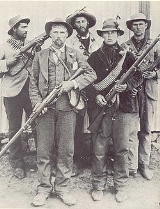
Boer

Encyclopedia
- For other uses, see Boer (disambiguation)Boer (disambiguation)Boer, Boere, and variants thereof, are names deriving from the Dutch word for "farmer", boer, and may refer to the Boer people of South Africa, also known as Afrikaners, or to the following individuals:*Johann Lucas Boër , German doctor...
Boer (icon, ˈ, or ˈ; ˈbuːr) is the Dutch
Dutch language
Dutch is a West Germanic language and the native language of the majority of the population of the Netherlands, Belgium, and Suriname, the three member states of the Dutch Language Union. Most speakers live in the European Union, where it is a first language for about 23 million and a second...
and Afrikaans word for farmer
Farmer
A farmer is a person engaged in agriculture, who raises living organisms for food or raw materials, generally including livestock husbandry and growing crops, such as produce and grain...
, which came to denote the descendants of the Dutch-speaking settlers of the eastern Cape frontier in Southern Africa
Southern Africa
Southern Africa is the southernmost region of the African continent, variably defined by geography or geopolitics. Within the region are numerous territories, including the Republic of South Africa ; nowadays, the simpler term South Africa is generally reserved for the country in English.-UN...
during the 18th century, as well as those who left the Cape Colony
Cape Colony
The Cape Colony, part of modern South Africa, was established by the Dutch East India Company in 1652, with the founding of Cape Town. It was subsequently occupied by the British in 1795 when the Netherlands were occupied by revolutionary France, so that the French revolutionaries could not take...
during the 19th century to settle in the Orange Free State
Orange Free State
The Orange Free State was an independent Boer republic in southern Africa during the second half of the 19th century, and later a British colony and a province of the Union of South Africa. It is the historical precursor to the present-day Free State province...
, Transvaal
South African Republic
The South African Republic , often informally known as the Transvaal Republic, was an independent Boer-ruled country in Southern Africa during the second half of the 19th century. Not to be confused with the present-day Republic of South Africa, it occupied the area later known as the South African...
(which are together known as the Boer Republics
Boer Republics
The Boer Republics were independent self-governed republics created by the northeastern frontier branch of the Dutch-speaking inhabitants of the north eastern Cape Province and their descendants in mainly the northern and eastern parts of what is now the country of...
), and to a lesser extent Natal
Natalia Republic
The Natalia Republic was a short-lived Boer republic, established in 1839 by local Afrikaans-speaking Voortrekkers shortly after the Battle of Blood River. The republic was located on the coast of the Indian Ocean beyond the Eastern Cape, and was previously named Natalia by Portuguese sailors. The...
. Their primary motivations for leaving the Cape were to escape British rule and extract themselves from the constant border wars between the British imperial government and the native tribes on the eastern frontier.
Origin
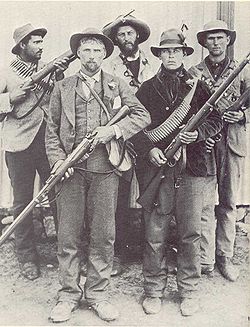
Trekboer
The Trekboers were nomadic pastoralists descended from almost equal numbers of Dutch colonists, French Huguenots and German Protestants. The Trekboere began migrating from the areas surrounding what is now Cape Town during the 17th century throughout the 18th century.-Origins:The Trekboere were...
s, as they were originally known, were mainly of Dutch origin and included Calvinists, Flemish and Frisian
Frisians
The Frisians are a Germanic ethnic group native to the coastal parts of the Netherlands and Germany. They are concentrated in the Dutch provinces of Friesland and Groningen and, in Germany, East Frisia and North Frisia, that was a part of Denmark until 1864. They inhabit an area known as Frisia...
Calvinists, as well as French
French people
The French are a nation that share a common French culture and speak the French language as a mother tongue. Historically, the French population are descended from peoples of Celtic, Latin and Germanic origin, and are today a mixture of several ethnic groups...
Huguenot
Huguenot
The Huguenots were members of the Protestant Reformed Church of France during the 16th and 17th centuries. Since the 17th century, people who formerly would have been called Huguenots have instead simply been called French Protestants, a title suggested by their German co-religionists, the...
and German and British
United Kingdom
The United Kingdom of Great Britain and Northern IrelandIn the United Kingdom and Dependencies, other languages have been officially recognised as legitimate autochthonous languages under the European Charter for Regional or Minority Languages...
protestants who first arrived in the Cape of Good Hope during the period of its administration (1652 – 1795) by the Dutch East India Company
Dutch East India Company
The Dutch East India Company was a chartered company established in 1602, when the States-General of the Netherlands granted it a 21-year monopoly to carry out colonial activities in Asia...
(Verenigde Oostindische Compagnie or VOC). Lesser migrations of Scandinavians
Scandinavians
Scandinavians are a group of Germanic peoples, inhabiting Scandinavia and to a lesser extent countries associated with Scandinavia, and speaking Scandinavian languages. The group includes Danes, Norwegians and Swedes, and additionally the descendants of Scandinavian settlers such as the Icelandic...
, Portuguese
Portuguese people
The Portuguese are a nation and ethnic group native to the country of Portugal, in the west of the Iberian peninsula of south-west Europe. Their language is Portuguese, and Roman Catholicism is the predominant religion....
, Greeks
Greeks
The Greeks, also known as the Hellenes , are a nation and ethnic group native to Greece, Cyprus and neighboring regions. They also form a significant diaspora, with Greek communities established around the world....
, Italians
Italian people
The Italian people are an ethnic group that share a common Italian culture, ancestry and speak the Italian language as a mother tongue. Within Italy, Italians are defined by citizenship, regardless of ancestry or country of residence , and are distinguished from people...
, Spanish
Spanish people
The Spanish are citizens of the Kingdom of Spain. Within Spain, there are also a number of vigorous nationalisms and regionalisms, reflecting the country's complex history....
, Polish, Scots, English
English people
The English are a nation and ethnic group native to England, who speak English. The English identity is of early mediaeval origin, when they were known in Old English as the Anglecynn. England is now a country of the United Kingdom, and the majority of English people in England are British Citizens...
and Irish
Irish people
The Irish people are an ethnic group who originate in Ireland, an island in northwestern Europe. Ireland has been populated for around 9,000 years , with the Irish people's earliest ancestors recorded having legends of being descended from groups such as the Nemedians, Fomorians, Fir Bolg, Tuatha...
immigrants also contributed to this ethnic mix.
For more information on history before the Great Trek, see Afrikaner
Afrikaner
Afrikaners are an ethnic group in Southern Africa descended from almost equal numbers of Dutch, French and German settlers whose native tongue is Afrikaans: a Germanic language which derives primarily from 17th century Dutch, and a variety of other languages.-Related ethno-linguistic groups:The...
.
Great trek
Those Trekboers who trekked into and occupied the eastern Cape were semi-nomadic. A significant number in the eastern Cape frontier later became Grensboere ("border farmers") who were the direct ancestors of the VoortrekkersVoortrekkers
The Voortrekkers were emigrants during the 1830s and 1840s who left the Cape Colony moving into the interior of what is now South Africa...
. The Voortrekkers were those Boers (mainly from the eastern Cape) who left the Cape en masse in a series of large scale migrations later called the Great Trek beginning in 1835 as a result of British
British Empire
The British Empire comprised the dominions, colonies, protectorates, mandates and other territories ruled or administered by the United Kingdom. It originated with the overseas colonies and trading posts established by England in the late 16th and early 17th centuries. At its height, it was the...
colonialism and constant border wars. When used in a historical context, the term Boer may refer to an inhabitant of the Boer Republics
Boer Republics
The Boer Republics were independent self-governed republics created by the northeastern frontier branch of the Dutch-speaking inhabitants of the north eastern Cape Province and their descendants in mainly the northern and eastern parts of what is now the country of...
as well as those who were cultural Boers.
Anglo-Boer wars
Though the Boers accepted British rule without resistance in 1877, they fought two wars in the late 19th century to defend their internationally recognized independent countries, the republics of the Transvaal (the Zuid-Afrikaansche Republiek, or ZAR) and the Orange Free StateOrange Free State
The Orange Free State was an independent Boer republic in southern Africa during the second half of the 19th century, and later a British colony and a province of the Union of South Africa. It is the historical precursor to the present-day Free State province...
(OFS), against the threat of annexation by the British Crown.
This led the key figure in organizing the resistance, Paul Kruger
Paul Kruger
Stephanus Johannes Paulus Kruger , better known as Paul Kruger and affectionately known as Uncle Paul was State President of the South African Republic...
, into conflict with the British.
Boer War diaspora
After the second Anglo-Boer War, a Boer diasporaDiaspora
A diaspora is "the movement, migration, or scattering of people away from an established or ancestral homeland" or "people dispersed by whatever cause to more than one location", or "people settled far from their ancestral homelands".The word has come to refer to historical mass-dispersions of...
occurred. Starting in 1903, the largest group emigrated to the Patagonia
Patagonia
Patagonia is a region located in Argentina and Chile, integrating the southernmost section of the Andes mountains to the southwest towards the Pacific ocean and from the east of the cordillera to the valleys it follows south through Colorado River towards Carmen de Patagones in the Atlantic Ocean...
region of Argentina
Argentina
Argentina , officially the Argentine Republic , is the second largest country in South America by land area, after Brazil. It is constituted as a federation of 23 provinces and an autonomous city, Buenos Aires...
. Another group emigrated to British-ruled Kenya
Kenya Colony
The Colony and Protectorate of Kenya was part of the British Empire in Africa. It was established when the former East Africa Protectorate was transformed into a British crown colony in 1920...
, from where most returned to South Africa during the 1930s, while a third group under the leadership of General Ben Viljoen
Ben Viljoen
Benjamin Johannes Viljoen was a general in the Boer army. He was born in a cave in the Wodehouse district of the Cape Colony. This was the temporary residence of the Viljoen family while their farm house was being constructed. He spent his early years on the Varkiesdraai farm near Umtata...
emigrated to Mexico
Mexico
The United Mexican States , commonly known as Mexico , is a federal constitutional republic in North America. It is bordered on the north by the United States; on the south and west by the Pacific Ocean; on the southeast by Guatemala, Belize, and the Caribbean Sea; and on the east by the Gulf of...
and to New Mexico
New Mexico
New Mexico is a state located in the southwest and western regions of the United States. New Mexico is also usually considered one of the Mountain States. With a population density of 16 per square mile, New Mexico is the sixth-most sparsely inhabited U.S...
and Texas
Texas
Texas is the second largest U.S. state by both area and population, and the largest state by area in the contiguous United States.The name, based on the Caddo word "Tejas" meaning "friends" or "allies", was applied by the Spanish to the Caddo themselves and to the region of their settlement in...
in south-western USA.
Boer Revolt
The Maritz Rebellion or the Boer Revolt or the Five Shilling Rebellion or the Third Boer War, occurred in South Africa in 1914 at the start of World War IWorld War I
World War I , which was predominantly called the World War or the Great War from its occurrence until 1939, and the First World War or World War I thereafter, was a major war centred in Europe that began on 28 July 1914 and lasted until 11 November 1918...
, in which men who supported the re-creation of the old Boer republics
Boer Republics
The Boer Republics were independent self-governed republics created by the northeastern frontier branch of the Dutch-speaking inhabitants of the north eastern Cape Province and their descendants in mainly the northern and eastern parts of what is now the country of...
rose up against the government of the Union of South Africa
Union of South Africa
The Union of South Africa is the historic predecessor to the present-day Republic of South Africa. It came into being on 31 May 1910 with the unification of the previously separate colonies of the Cape, Natal, Transvaal and the Orange Free State...
because they did not want to side with the British against Germany so soon after they had had a long bloody war with the British. Many Boers had German ancestry and many members of the government were themselves former Boer military leaders who had fought with the Maritz rebels against the British in the Second Boer War
Second Boer War
The Second Boer War was fought from 11 October 1899 until 31 May 1902 between the British Empire and the Afrikaans-speaking Dutch settlers of two independent Boer republics, the South African Republic and the Orange Free State...
, which had ended only twelve years earlier. The rebellion was put down by Louis Botha
Louis Botha
Louis Botha was an Afrikaner and first Prime Minister of the Union of South Africa—the forerunner of the modern South African state...
and Jan Smuts
Jan Smuts
Jan Christiaan Smuts, OM, CH, ED, KC, FRS, PC was a prominent South African and British Commonwealth statesman, military leader and philosopher. In addition to holding various cabinet posts, he served as Prime Minister of the Union of South Africa from 1919 until 1924 and from 1939 until 1948...
, and the ringleaders received heavy fines and terms of imprisonment. A renowned Boer, Jopie Fourie, was executed for treason in 1914. He was convicted as a rebel when, as an officer in the Union Defence Force
Union Defence Force
The Union Defence Force may refer to a former or current military organization:* the South African Army from 1912 to 1957* the military of the United Arab Emirates...
, he refused to take up arms with the British.
Culture
The desire to wander, known as trekgees, was a notable characteristic of the Boers. It figured prominently in the late 17th century when the Trekboers began to inhabit the northern and eastern Cape frontiers, again during the Great Trek when the Voortrekkers left the eastern Cape en masse, as well as after the major republics were established during the Thirstland Trek. When one such trekker was asked why he has emigrated he explained, "a drifting spirit was in our hearts, and we ourselves could not understand it. We just sold our farms and set out north-westwards to find a new home."A rustic characteristic and tradition was developed quite early on as Boer society was born on the frontiers of white settlement and on the outskirts of civilization.
The Boers had cut their ties to Europe as they emerged from the Trekboer group.
The Boer quest for independence manifested in a tradition of declaring republics, which predates the arrival of the British; when the British arrived, Boer republics had already been declared and were in rebellion from the VOC (Dutch East India Company
Dutch East India Company
The Dutch East India Company was a chartered company established in 1602, when the States-General of the Netherlands granted it a 21-year monopoly to carry out colonial activities in Asia...
).
The Boers of the frontier were known for their independent spirit, resourcefulness, hardiness, and self-sufficiency, whose political notions verged on anarchy but had begun to be influenced by republicanism. Most of the men were also skilled with the use of guns
Güns
Güns or Guens may refer to:* Kőszeg, Hungary * Kőszeg Mountains, Hungary * Akiva Güns , birth name of Akiva Eger, a Hungarian-Polish rabbi- See also :* Guns * Gün, a surname...
as they would hunt and also were able to protect their families with them.
Nationalism
The Boer nation is well known for their strong nationalistic characteristics. Their nationalismNationalism
Nationalism is a political ideology that involves a strong identification of a group of individuals with a political entity defined in national terms, i.e. a nation. In the 'modernist' image of the nation, it is nationalism that creates national identity. There are various definitions for what...
was born of hundreds of years of fighting against imperialism
Imperialism
Imperialism, as defined by Dictionary of Human Geography, is "the creation and/or maintenance of an unequal economic, cultural, and territorial relationships, usually between states and often in the form of an empire, based on domination and subordination." The imperialism of the last 500 years,...
, a continuing struggle for independence
Independence
Independence is a condition of a nation, country, or state in which its residents and population, or some portion thereof, exercise self-government, and usually sovereignty, over its territory....
battling mainly British expansion into central South Africa, as well as the harsh African climate, a strong sense of nationhood. As with any other ethnic group that has come from troubled land to troubled land, many of them see it as their duty to educate future generations on their people's past.
Calvinism
The Boer nation is mainly descended from Dutch, German and French Huguenots, who migrated to South Africa during the 17th, 18th and early 19th centuries. The Boer nation has revealed a distinct Calvinist culture and the majority of Boers today are still members of a Reformed Church. The Nederduits Hervormde Kerk was the national Church of the South African RepublicSouth African Republic
The South African Republic , often informally known as the Transvaal Republic, was an independent Boer-ruled country in Southern Africa during the second half of the 19th century. Not to be confused with the present-day Republic of South Africa, it occupied the area later known as the South African...
(1852–1902). Also note the "Orange" in Orange Free State
Orange Free State
The Orange Free State was an independent Boer republic in southern Africa during the second half of the 19th century, and later a British colony and a province of the Union of South Africa. It is the historical precursor to the present-day Free State province...
(1854–1902) was named after the Protestant House of Orange in the Netherlands.
The Calvinist influence remains in that some fundamental Calvinist doctrines such as unconditional predestination
Predestination
Predestination, in theology is the doctrine that all events have been willed by God. John Calvin interpreted biblical predestination to mean that God willed eternal damnation for some people and salvation for others...
and divine providence
Divine providence
In Christian theology, divine providence, or simply providence, is God's activity in the world. " Providence" is also used as a title of God exercising His providence, and then the word are usually capitalized...
remains present in much of Boer culture, who see their role in society as abiding by the national laws and accepting calamity and hardship as part of their Christian duty.
A small number of Boers may also be members of Baptist
Baptist
Baptists comprise a group of Christian denominations and churches that subscribe to a doctrine that baptism should be performed only for professing believers , and that it must be done by immersion...
, Pentecostal or Lutheran Churches
Lutheranism
Lutheranism is a major branch of Western Christianity that identifies with the theology of Martin Luther, a German reformer. Luther's efforts to reform the theology and practice of the church launched the Protestant Reformation...
.
Modern usage
During recent times, mainly during the apartheid reform and post-1994 eras, many more white AfrikaansAfrikaans
Afrikaans is a West Germanic language, spoken natively in South Africa and Namibia. It is a daughter language of Dutch, originating in its 17th century dialects, collectively referred to as Cape Dutch .Afrikaans is a daughter language of Dutch; see , , , , , .Afrikaans was historically called Cape...
-speaking people, mainly with "conservative" political views and of Trekboer and Voortrekker descent, have preferred to be called "Boers" or Boere-Afrikaners, rather than "Afrikaners". They feel that there were many people of Voortrekker descent who were not co-opted or assimilated into what they see as the Cape
Cape Province
The Province of the Cape of Good Hope was a province in the Union of South Africa and subsequently the Republic of South Africa...
-based Afrikaner identity which began emerging after the Second Anglo-Boer War and the subsequent establishment of the Union of South Africa
Union of South Africa
The Union of South Africa is the historic predecessor to the present-day Republic of South Africa. It came into being on 31 May 1910 with the unification of the previously separate colonies of the Cape, Natal, Transvaal and the Orange Free State...
in 1910. Certain Boer nationalists have asserted that they do not consider themselves a right-wing
Right-wing politics
In politics, Right, right-wing and rightist generally refer to support for a hierarchical society justified on the basis of an appeal to natural law or tradition. To varying degrees, the Right rejects the egalitarian objectives of left-wing politics, claiming that the imposition of equality is...
element of the political spectrum.
They contend that the Boers of the South African
South African Republic
The South African Republic , often informally known as the Transvaal Republic, was an independent Boer-ruled country in Southern Africa during the second half of the 19th century. Not to be confused with the present-day Republic of South Africa, it occupied the area later known as the South African...
(ZAR) and Orange Free State
Orange Free State
The Orange Free State was an independent Boer republic in southern Africa during the second half of the 19th century, and later a British colony and a province of the Union of South Africa. It is the historical precursor to the present-day Free State province...
republics were recognized as a separate people or cultural group under international law by the Sand River Convention
Sand River Convention
The Sand River Convention was a convention whereby Great Britain formally recognised the independence of the Boers living beyond the Vaal River. In return, the Boers promised that slavery would be outlawed in the Transvaal and that they would not interfere in the Orange River Sovereignty's affairs...
(which created the South African Republic in 1852), the Bloemfontein Convention (which created the Orange Free State Republic in 1854), the Pretoria Convention
Pretoria Convention
The Pretoria Convention was the peace treaty that ended the First Boer War between the Transvaal Boers and the United Kingdom. The treaty was signed in Pretoria on 3 August, 1881, but was subject to ratification by the Volksraad within 3 months from the date of signature...
(which re-established the independence of the South African Republic 1881), the London Convention (which granted the full independence to the South African Republic in 1884) and the Vereeniging Peace Treaty, which formally ended the Second Anglo-Boer War on 31 May 1902. Others contend, however, that these treaties dealt only with agreements between governmental entities and do not imply the recognition of a Boer cultural identity per se.
The supporters of these views feel that the Afrikaner designation (or label) was used from the 1930s onwards as a means of unifying (politically at least) the white Afrikaans speakers of the Western Cape with those of Trekboer and Voortrekker descent (whose ancestors began migrating eastward during the late 17th century and throughout the 18th century and later northward during the Great Trek
Great Trek
The Great Trek was an eastward and north-eastward migration away from British control in the Cape Colony during the 1830s and 1840s by Boers . The migrants were descended from settlers from western mainland Europe, most notably from the Netherlands, northwest Germany and French Huguenots...
of the 1830s) in the north of South Africa, where the Boer Republics were established.
Since the Anglo-Boer war the term "Boervolk" was rarely used in the 20th century by the various regimes because of this attempt to assimilate the Boervolk with the Afrikaners. A portion of those who are the descendants of the Boerevolk have reasserted this designation.
The supporters of the "Boer" designation view the term "Afrikaner" as an artificial political label which usurped their history and culture, turning "Boer" achievements into "Afrikaner" achievements. They feel that the Western-Cape based Afrikaners — whose ancestors did not trek eastwards or northwards — took advantage of the republican Boers' destitution following the Anglo-Boer War and later attempted to assimilate the Boers into a new politically based cultural label as "Afrikaners".
In contemporary South Africa and due to Broederbond propaganda, Boer and Afrikaner have been used interchangeably despite the fact that the Boers are the smaller segment within the Afrikaner designation as the Afrikaners of Cape Dutch origin are larger. Afrikaner directly translated means "African" and subsequently refers to all Afrikaans speaking people in Africa irrespective of colour or nationality. Boer is the specific ethnic group within the larger Afrikaans speaking population.
Politics
- Democratic Alliance (South Africa)
- Freedom Front Plus
- Herstigte Nasionale PartyHerstigte Nasionale PartyThe Herstigte Nasionale Party van Suid-Afrika was formed as a right-wing splinter group of the South African National Party.-Formation:...
Education
The BCVOBCVO
The BCVO is an educational organisation in South Africa, committed to providing primary and secondary education in the Calvinist tradition and Afrikaans language...
('Movement for Christian-National Education') is a federation of 47 Calvinist private schools, primarily in the Free State and the Transvaal, committed to educating Boer children from grade 0 through to 12.
Media
Some local Radio stations promote the ideals of the people identifying with Boer/Afrikaner people, like Radio RosestadRadio Rosestad
Radio Rosestad is a community-based radio station in Bloemfontein, South Africa.Formed in 1995 as Radio Vryheid, it subsequently changed its name to Radio Rosestad. It mainly broadcasts for the general Afrikaans community on 100.6 FM....
(in Bloemfontein), Overvaal Stereo and Radio Pretoria
Radio Pretoria
Radio Pretoria is a community-based radio station in Pretoria, South Africa, whose programmes are aimed at Afrikaners. It broadcasts 24 hours a day in stereo on 104.2 FM in the greater Pretoria area...
.
Territories
Two territorial areas are being developed as settlement exclusively for Boer/Afrikaners, Orania in the Northern Cape and KleinfonteinKleinfontein
Kleinfontein is a new settlement near Pretoria, South Africa that was founded by Afrikaners who want to preserve their culture. It has only recently been developed and has a limited economy...
near Pretoria
Pretoria
Pretoria is a city located in the northern part of Gauteng Province, South Africa. It is one of the country's three capital cities, serving as the executive and de facto national capital; the others are Cape Town, the legislative capital, and Bloemfontein, the judicial capital.Pretoria is...
.
Notable Boers
Voortrekker leaders
- Sarel CilliersSarel CilliersCharl Arnoldus Cilliers was a Voortrekker leader and a preacher. With Andries Pretorius, he led the Boers to a huge victory over the Zulus at the Battle of Blood River in 1838...
Voortrekker leader - Andries Hendrik PotgieterAndries Hendrik PotgieterAndries Hendrik Potgieter, known as Hendrik Potgieter was a Voortrekker leader. He served as the first head of state of Potchefstroom from 1840 and 1845 and also as the first head of state of Zoutpansberg from 1845 to 1852.Potgieter was born in the Tarkastad district of the Cape Colony, the second...
- Andries PretoriusAndries PretoriusAndries Wilhelmus Jacobus Pretorius was a leader of the Boers who was instrumental in the creation of the Transvaal Republic, as well as the earlier but short-lived Natalia Republic, in present-day South Africa....
- Piet RetiefPiet RetiefPieter Mauritz Retief was a South African Boer leader. Settling in 1814 in the frontier region of the Cape Colony, he assumed command of punitive expeditions in response to raiding parties from the adjacent Xhosa territory...
Voortrekker leader
Great trek
- Racheltjie de BeerRacheltjie de BeerRachel de Beer is a fictitious Afrikaner heroine, who gave her life in order to save that of her brother. She was the daughter of George Stephanus de Beer ....
- Dirkie UysDirkie UysDirkie Uys was a Voortrekker hero during the Great Trek.After the massacare of Piet Retief and his men by Dingaan on 6 February 1838, a number of Voortrekker camps were also attacked by the Zulu impis. These Voortrekkers appealed to other treks, particularly those of Piet Uys and Hendrik Potgieter...
Participants in the Second Anglo-Boer War
- Koos de la ReyKoos de la ReyGeneral Jacobus Herculaas de la Rey , known as Koos de la Rey, was a Boer general during the Second Boer War and is widely regarded as being one of the strongest military leaders during that conflict....
, general and regarded as being one of the great military leaders of that conflict. - Danie Theron, soldier
- Christiaan Rudolf de Wet, general
- Siener van RensburgSiener van RensburgNicolaas Pieter Johannes Janse van Rensburg was a Boer from the South African Republic - also known as the Transvaal Republic - and later a citizen of South Africa who was considered by some to be a prophet of the Boere...
, considered a prophet by some.
Politicians
- Louis BothaLouis BothaLouis Botha was an Afrikaner and first Prime Minister of the Union of South Africa—the forerunner of the modern South African state...
, first prime minister of South Africa (1910–19) and former Boer general - Petrus Jacobus JoubertPetrus Jacobus JoubertPetrus Jacobus Joubert , better known as Piet Joubert was Commandant-General of the South African Republic from 1880 to 1900.-Early life:...
, general and cabinet member of the Transvaal Republic - Paul KrugerPaul KrugerStephanus Johannes Paulus Kruger , better known as Paul Kruger and affectionately known as Uncle Paul was State President of the South African Republic...
, president of the Transvaal Republic
Spies
- Fritz Joubert Duquesne, a Boer Captain known as the Black Panther, served in the Second Boer WarSecond Boer WarThe Second Boer War was fought from 11 October 1899 until 31 May 1902 between the British Empire and the Afrikaans-speaking Dutch settlers of two independent Boer republics, the South African Republic and the Orange Free State...
. Captured in MozambiqueMozambiqueMozambique, officially the Republic of Mozambique , is a country in southeastern Africa bordered by the Indian Ocean to the east, Tanzania to the north, Malawi and Zambia to the northwest, Zimbabwe to the west and Swaziland and South Africa to the southwest...
, he escaped prison in Portugal and returned to South Africa as a British officer. In 1901, he was caught planning to sabotage strategic British installations in Cape TownCape TownCape Town is the second-most populous city in South Africa, and the provincial capital and primate city of the Western Cape. As the seat of the National Parliament, it is also the legislative capital of the country. It forms part of the City of Cape Town metropolitan municipality...
and sentenced to life in prison; however, he escaped and was re-captured several times again throughout his life. In World War IWorld War IWorld War I , which was predominantly called the World War or the Great War from its occurrence until 1939, and the First World War or World War I thereafter, was a major war centred in Europe that began on 28 July 1914 and lasted until 11 November 1918...
, Duquesne spied for Germany, earning the Iron CrossIron CrossThe Iron Cross is a cross symbol typically in black with a white or silver outline that originated after 1219 when the Kingdom of Jerusalem granted the Teutonic Order the right to combine the Teutonic Black Cross placed above a silver Cross of Jerusalem....
for allegedly sinking the HMS HampshireHMS Hampshire (1903)HMS Hampshire was a Devonshire-class armoured cruiser of the Royal Navy. She was built by Armstrong Whitworth, Elswick, Tyne and Wear and commissioned in 1905 at a cost of £833,817....
thereby killing Lord KitchenerHerbert Kitchener, 1st Earl KitchenerField Marshal Horatio Herbert Kitchener, 1st Earl Kitchener KG, KP, GCB, OM, GCSI, GCMG, GCIE, ADC, PC , was an Irish-born British Field Marshal and proconsul who won fame for his imperial campaigns and later played a central role in the early part of the First World War, although he died halfway...
in 1916. He also served as a Nazi spy in the United States and, in 1941, he was caught by the Federal Bureau of InvestigationFederal Bureau of InvestigationThe Federal Bureau of Investigation is an agency of the United States Department of Justice that serves as both a federal criminal investigative body and an internal intelligence agency . The FBI has investigative jurisdiction over violations of more than 200 categories of federal crime...
(FBI) in the largest espionage case in U. S. history: The Duquesne Spy RingDuquesne Spy RingThe Duquesne Spy Ring is the largest espionage case in United States history that ended in convictions. A total of thirty-three members of a German espionage network headed by Frederick "Fritz" Joubert Duquesne were convicted after a lengthy espionage investigation by the Federal Bureau of...
.