

Numidia

Encyclopedia
Numidia was an ancient Berber
kingdom in part of present-day Eastern Algeria and Western Tunisia in North Africa
. It is known today as the Chawi-land, the land of the Chawi people , the direct descendants of the historical Numidians or the Massyles The kingdom began as a sovereign state and later alternated between being a Roman province
and being a Roman client state
. The kingdom is no longer in existence today. It was located on the eastern border
of modern Algeria
, bordered by the kingdoms of Mauretania
(modern-day Morocco
and western Algeria) to the west, the Roman province of Africa (modern-day Tunisia
) to the east, the Mediterranean Sea
to the north, and the Sahara Desert to the south. Its people were the Numidian Berbers. It is considered to be the first major state in the history of Algeria.
and other historians during the third century BC to indicate the territory west of Carthage
, including the entire north of Algeria as far as the river Mulucha (Muluya), about 100 miles west of Oran
. The Numidians were conceived of as two great tribal groups: the Massylii
in eastern Numidia, and the Masaesyli
in the west.
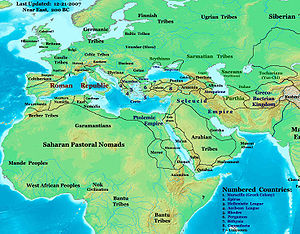 During the first part of the Second Punic War
, the eastern Massylii under their king Gala
were allied with Carthage, while the western Masaesyli under king Syphax
were allied with Rome. However in 206 BC, the new king of the eastern Massylii, Masinissa
, allied himself with Rome, and Syphax of the Masaesyli switched his allegiance to the Carthaginian side. At the end of the war the victorious Romans gave all of Numidia to Masinissa of the Massylii. At the time of his death in 148 BC, Masinissa's territory extended from Mauretania to the boundary of the Carthaginian territory, and also southeast as far as Cyrenaica
, so that Numidia entirely surrounded Carthage (Appian
, Punica, 106) except towards the sea.
After the death of Masinissa he was succeeded by his son Micipsa
. When Micipsa died in 118, he was succeeded jointly by his two sons Hiempsal I
and Adherbal
and Masinissa's illegitimate grandson, Jugurtha
, of Ancient Libya
n origin, who was very popular among the Numidians. Hiempsal and Jugurtha quarrelled immediately after the death of Micipsa. Jugurtha had Hiempsal killed, which led to open war with Adherbal.
After Jugurtha defeated him in open battle, Adherbal fled to Rome
for help. The Roman officials, allegedly due to bribes but perhaps more likely because of a desire to quickly end conflict in a profitable client kingdom, settled the fight by dividing Numidia into two parts. Jugurtha was assigned the western half. (Later Roman propaganda claimed that this half was also richer, but in truth it was both less populated and developed.)
. Jugurtha was also forced to come to Rome to testify against the Roman commander, where he was completely discredited once his violent and ruthless past became widely known, and after he had been suspected of murdering a Numidian rival.
War broke out between Numidia and the Roman Republic
and several legions were dispatched to North Africa under the command of the Consul Quintus Caecilius Metellus Numidicus
. The war dragged out into a long and seemingly endless campaign as the Romans tried to defeat Jugurtha decisively. Frustrated at the apparent lack of action, Metellus' lieutenant Gaius Marius
returned to Rome to seek election as Consul. Marius was elected, and then returned to Numidia to take control of the war. He sent his Quaestor Lucius Cornelius Sulla
to neighbouring Mauretania in order to eliminate their support for Jugurtha. With the help of Bocchus I
of Mauretania, Sulla captured Jugurtha and brought the war to a conclusive end. Jugurtha was brought to Rome in chains and was placed in the Tullianum.
Jugurtha was executed by the Romans in 104 BC, after being paraded through the streets in Gaius Marius' Triumph.
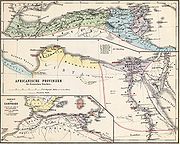 After the death of Jugurtha
, western Numidia was added to the lands of Bocchus
, king of Mauretania, while the remainder (excluding Cyrene
and its locality) continued to be governed by native princes until the civil war between Caesar
and Pompey
. After Cato the Younger
was defeated by Caesar, he committed suicide (46 BC) in Utica
, and Numidia became briefly the province of Africa Nova until Augustus restored Juba II
(son of Juba I) after the Battle of Actium
.
Soon afterwards, in 25 BC, Juba was transferred to the throne of Mauretania, and Numidia was divided between Mauretania and the province of Africa Nova. Under Septimus Severus (193 AD), Numidia was separated from Africa Vetus, and governed by an imperial procurator
. Under the new organization of the empire by Diocletian
, Numidia was divided in two provinces: the north became Numidia Cirtensis, with capital at Cirta
, while the south, which included the Aurès Mountains
and was threatened by raids, became Numidia Militiana, "Military Numidia", with capital at the legionary base of Lambaesis
. Subsequently however, Emperor Constantine the Great reunited the two provinces in a single one, administered from Cirta, which was now renamed Constantina (modern Constantine, Algeria
) in his honour. Its governor was raised to the rank of consularis
in 320, and the province remained one of the seven provinces of the diocese of Africa
until the invasion of the Vandals in 428
AD, which began its slow decay, accompanied by desertification
. The province remained under Vandal rule, but was effectively limited to the coastal areas by Berber raids. It was restored to Roman rule after the Vandalic War
, when it became part of the new praetorian prefecture of Africa
.
or modern Constantine
, the capital, with its port Rusicada (Modern Skikda
); Hippo Regius
or (near Bône
), well known as the see
of St. Augustine
. To the south in the interior military roads led to Theveste (Tebessa) and Lambaesis
(Lambessa) with extensive Roman remains, connected by military roads with Cirta and Hippo, respectively.
Lambaesis was the seat of the Legio III Augusta
, and the most important strategic centre, as commanding the passes of the Mons Aurasius
, a mountain block which separated Numidia from the Gaetulia
n tribes of the desert, and which was gradually occupied in its whole extent by the Romans under the Empire. Including these towns there were altogether twenty which are known to have received at one time or another the title and status of Roman colonies; and in the 5th century the Notitia Dignitatum
enumerates no less than 123 sees whose bishops assembled at Carthage in 479
.
Berber people
Berbers are the indigenous peoples of North Africa west of the Nile Valley. They are continuously distributed from the Atlantic to the Siwa oasis, in Egypt, and from the Mediterranean to the Niger River. Historically they spoke the Berber language or varieties of it, which together form a branch...
kingdom in part of present-day Eastern Algeria and Western Tunisia in North Africa
North Africa
North Africa or Northern Africa is the northernmost region of the African continent, linked by the Sahara to Sub-Saharan Africa. Geopolitically, the United Nations definition of Northern Africa includes eight countries or territories; Algeria, Egypt, Libya, Morocco, South Sudan, Sudan, Tunisia, and...
. It is known today as the Chawi-land, the land of the Chawi people , the direct descendants of the historical Numidians or the Massyles The kingdom began as a sovereign state and later alternated between being a Roman province
Roman province
In Ancient Rome, a province was the basic, and, until the Tetrarchy , largest territorial and administrative unit of the empire's territorial possessions outside of Italy...
and being a Roman client state
Client state
Client state is one of several terms used to describe the economic, political and/or military subordination of one state to a more powerful state in international affairs...
. The kingdom is no longer in existence today. It was located on the eastern border
Border
Borders define geographic boundaries of political entities or legal jurisdictions, such as governments, sovereign states, federated states and other subnational entities. Some borders—such as a state's internal administrative borders, or inter-state borders within the Schengen Area—are open and...
of modern Algeria
Algeria
Algeria , officially the People's Democratic Republic of Algeria , also formally referred to as the Democratic and Popular Republic of Algeria, is a country in the Maghreb region of Northwest Africa with Algiers as its capital.In terms of land area, it is the largest country in Africa and the Arab...
, bordered by the kingdoms of Mauretania
Mauretania
Mauretania is a part of the historical Ancient Libyan land in North Africa. It corresponds to present day Morocco and a part of western Algeria...
(modern-day Morocco
Morocco
Morocco , officially the Kingdom of Morocco , is a country located in North Africa. It has a population of more than 32 million and an area of 710,850 km², and also primarily administers the disputed region of the Western Sahara...
and western Algeria) to the west, the Roman province of Africa (modern-day Tunisia
Tunisia
Tunisia , officially the Tunisian RepublicThe long name of Tunisia in other languages used in the country is: , is the northernmost country in Africa. It is a Maghreb country and is bordered by Algeria to the west, Libya to the southeast, and the Mediterranean Sea to the north and east. Its area...
) to the east, the Mediterranean Sea
Mediterranean Sea
The Mediterranean Sea is a sea connected to the Atlantic Ocean surrounded by the Mediterranean region and almost completely enclosed by land: on the north by Anatolia and Europe, on the south by North Africa, and on the east by the Levant...
to the north, and the Sahara Desert to the south. Its people were the Numidian Berbers. It is considered to be the first major state in the history of Algeria.
Independent Numidia
The name Numidia was first applied by PolybiusPolybius
Polybius , Greek ) was a Greek historian of the Hellenistic Period noted for his work, The Histories, which covered the period of 220–146 BC in detail. The work describes in part the rise of the Roman Republic and its gradual domination over Greece...
and other historians during the third century BC to indicate the territory west of Carthage
Carthage
Carthage , implying it was a 'new Tyre') is a major urban centre that has existed for nearly 3,000 years on the Gulf of Tunis, developing from a Phoenician colony of the 1st millennium BC...
, including the entire north of Algeria as far as the river Mulucha (Muluya), about 100 miles west of Oran
Oran
Oran is a major city on the northwestern Mediterranean coast of Algeria, and the second largest city of the country.It is the capital of the Oran Province . The city has a population of 759,645 , while the metropolitan area has a population of approximately 1,500,000, making it the second largest...
. The Numidians were conceived of as two great tribal groups: the Massylii
Massylii
The Massylii or Maesulians were a Berber federation of tribes of eastern Numidia which was formed by an amalgamation of smaller tribes during the 4th century BC. They were ruled by a king. On their loosely defined western frontier was the powerful rival the kingdom of the Masaesyli. To their east...
in eastern Numidia, and the Masaesyli
Masaesyli
The Masaesyli were a North African tribe of western Numidia and the main antagonists of the Massylii in eastern Numidia.During the Second Punic War the Masaesyli initially supported the Roman Republic and were led by Syphax against the Massyllii, who were led by Massinissa...
in the west.
Second Punic War
The Second Punic War, also referred to as The Hannibalic War and The War Against Hannibal, lasted from 218 to 201 BC and involved combatants in the western and eastern Mediterranean. This was the second major war between Carthage and the Roman Republic, with the participation of the Berbers on...
, the eastern Massylii under their king Gala
Gala (King of the Massylii)
King Gala was a Berber king of the Massylii, an eastern Numidian tribe in the Ancient Algerian Maghreb of North Africa.Gala reigned during the Second Punic War of ancient Rome. He was the father of King Masinissa, and the brother of Oezalces....
were allied with Carthage, while the western Masaesyli under king Syphax
Syphax
Syphax was a king of the ancient Algerian tribe Masaesyli of western Numidia during the last quarter of the 3rd century BC. His story is told in Livy's Ab Urbe Condita .-Biography:...
were allied with Rome. However in 206 BC, the new king of the eastern Massylii, Masinissa
Masinissa
Masinissa — also spelled Massinissa and Massena — was the first King of Numidia, an ancient North African nation of ancient Libyan tribes. As a successful general, Masinissa fought in the Second Punic War , first against the Romans as an ally of Carthage an later switching sides when he saw which...
, allied himself with Rome, and Syphax of the Masaesyli switched his allegiance to the Carthaginian side. At the end of the war the victorious Romans gave all of Numidia to Masinissa of the Massylii. At the time of his death in 148 BC, Masinissa's territory extended from Mauretania to the boundary of the Carthaginian territory, and also southeast as far as Cyrenaica
Cyrenaica
Cyrenaica is the eastern coastal region of Libya.Also known as Pentapolis in antiquity, it was part of the Creta et Cyrenaica province during the Roman period, later divided in Libia Pentapolis and Libia Sicca...
, so that Numidia entirely surrounded Carthage (Appian
Appian
Appian of Alexandria was a Roman historian of Greek ethnicity who flourished during the reigns of Trajan, Hadrian, and Antoninus Pius.He was born ca. 95 in Alexandria. He tells us that, after having filled the chief offices in the province of Egypt, he went to Rome ca. 120, where he practised as...
, Punica, 106) except towards the sea.
After the death of Masinissa he was succeeded by his son Micipsa
Micipsa
Micipsa was the eldest legitimate son of Masinissa, the King of Numidia, in the Ancient Algerian Maghreb of North Africa. He became the King of Numidia.-Early life:...
. When Micipsa died in 118, he was succeeded jointly by his two sons Hiempsal I
Hiempsal I
Hiempsal I, son of Micipsa and grandson of Masinissa, was a king of Numidia in the late 2nd century BC.Micipsa, on his deathbed, left his two sons, Adherbal and Hiempsal, together with his cousin, Jugurtha, joint heirs of his kingdom...
and Adherbal
Adherbal
Adherbal, son of Micipsa and grandson of Masinissa, was a king of Numidia between 118 BC and 112 BC. He inherited the throne after the death of his father, and ruled jointly with his younger brother Hiempsal, and Jugurtha, the nephew of Masinissa...
and Masinissa's illegitimate grandson, Jugurtha
Jugurtha
Jugurtha or Jugurthen was a King of Numidia, , born in Cirta .-Background:Until the reign of Jugurtha's grandfather Masinissa, the people of Numidia were semi-nomadic and indistinguishable from the other Libyans in North Africa...
, of Ancient Libya
Ancient Libya
The Latin name Libya referred to the region west of the Nile Valley, generally corresponding to modern Northwest Africa. Climate changes affected the locations of the settlements....
n origin, who was very popular among the Numidians. Hiempsal and Jugurtha quarrelled immediately after the death of Micipsa. Jugurtha had Hiempsal killed, which led to open war with Adherbal.
After Jugurtha defeated him in open battle, Adherbal fled to Rome
Rome
Rome is the capital of Italy and the country's largest and most populated city and comune, with over 2.7 million residents in . The city is located in the central-western portion of the Italian Peninsula, on the Tiber River within the Lazio region of Italy.Rome's history spans two and a half...
for help. The Roman officials, allegedly due to bribes but perhaps more likely because of a desire to quickly end conflict in a profitable client kingdom, settled the fight by dividing Numidia into two parts. Jugurtha was assigned the western half. (Later Roman propaganda claimed that this half was also richer, but in truth it was both less populated and developed.)
War with Rome
By 112 Jugurtha resumed his war with Adherbal. He incurred the wrath of Rome in the process by killing some Roman businessmen who were aiding Adherbal. After a brief war with Rome, Jugurtha surrendered and received a highly favourable peace treaty, which raised suspicions of bribery once more. The local Roman commander was summoned to Rome to face corruption charges brought by his political rival Gaius MemmiusGaius Memmius (Tribune)
Gaius Memmius was a tribune of the plebs in 111 BC and attacked certain aristocrats on a charge of corrupt relations with Jugurtha...
. Jugurtha was also forced to come to Rome to testify against the Roman commander, where he was completely discredited once his violent and ruthless past became widely known, and after he had been suspected of murdering a Numidian rival.
War broke out between Numidia and the Roman Republic
Roman Republic
The Roman Republic was the period of the ancient Roman civilization where the government operated as a republic. It began with the overthrow of the Roman monarchy, traditionally dated around 508 BC, and its replacement by a government headed by two consuls, elected annually by the citizens and...
and several legions were dispatched to North Africa under the command of the Consul Quintus Caecilius Metellus Numidicus
Quintus Caecilius Metellus Numidicus
Quintus Caecilius Metellus Numidicus was the leader of the conservative faction of the Roman Senate and a bitter enemy of Gaius Marius....
. The war dragged out into a long and seemingly endless campaign as the Romans tried to defeat Jugurtha decisively. Frustrated at the apparent lack of action, Metellus' lieutenant Gaius Marius
Gaius Marius
Gaius Marius was a Roman general and statesman. He was elected consul an unprecedented seven times during his career. He was also noted for his dramatic reforms of Roman armies, authorizing recruitment of landless citizens, eliminating the manipular military formations, and reorganizing the...
returned to Rome to seek election as Consul. Marius was elected, and then returned to Numidia to take control of the war. He sent his Quaestor Lucius Cornelius Sulla
Lucius Cornelius Sulla
Lucius Cornelius Sulla Felix , known commonly as Sulla, was a Roman general and statesman. He had the rare distinction of holding the office of consul twice, as well as that of dictator...
to neighbouring Mauretania in order to eliminate their support for Jugurtha. With the help of Bocchus I
Bocchus I
Bocchus was a king of Mauretania about 110 BC and designated by historians as Bocchus I. He was also the father-in-law of Jugurtha, with whom he made war against the Romans. He delivered Jugurtha to the Romans in 106 BC....
of Mauretania, Sulla captured Jugurtha and brought the war to a conclusive end. Jugurtha was brought to Rome in chains and was placed in the Tullianum.
Jugurtha was executed by the Romans in 104 BC, after being paraded through the streets in Gaius Marius' Triumph.
Roman province
Jugurtha
Jugurtha or Jugurthen was a King of Numidia, , born in Cirta .-Background:Until the reign of Jugurtha's grandfather Masinissa, the people of Numidia were semi-nomadic and indistinguishable from the other Libyans in North Africa...
, western Numidia was added to the lands of Bocchus
Bocchus
Bocchus is the name of 2 kings of Mauretania.* Bocchus I* Bocchus II...
, king of Mauretania, while the remainder (excluding Cyrene
Cyrene, Libya
Cyrene was an ancient Greek colony and then a Roman city in present-day Shahhat, Libya, the oldest and most important of the five Greek cities in the region. It gave eastern Libya the classical name Cyrenaica that it has retained to modern times.Cyrene lies in a lush valley in the Jebel Akhdar...
and its locality) continued to be governed by native princes until the civil war between Caesar
Julius Caesar
Gaius Julius Caesar was a Roman general and statesman and a distinguished writer of Latin prose. He played a critical role in the gradual transformation of the Roman Republic into the Roman Empire....
and Pompey
Pompey
Gnaeus Pompeius Magnus, also known as Pompey or Pompey the Great , was a military and political leader of the late Roman Republic...
. After Cato the Younger
Cato the Younger
Marcus Porcius Cato Uticensis , commonly known as Cato the Younger to distinguish him from his great-grandfather , was a politician and statesman in the late Roman Republic, and a follower of the Stoic philosophy...
was defeated by Caesar, he committed suicide (46 BC) in Utica
Utica, Tunisia
Utica is an ancient city northwest of Carthage near the outflow of the Medjerda River into the Mediterranean Sea, traditionally considered to be the first colony founded by the Phoenicians in North Africa...
, and Numidia became briefly the province of Africa Nova until Augustus restored Juba II
Juba II
Juba II or Juba II of Numidia was a king of Numidia and then later moved to Mauretania. His first wife was Cleopatra Selene II, daughter to Greek Ptolemaic Queen Cleopatra VII of Egypt and Roman triumvir Mark Antony.-Early life:Juba II was a prince of Berber descent from North Africa...
(son of Juba I) after the Battle of Actium
Battle of Actium
The Battle of Actium was the decisive confrontation of the Final War of the Roman Republic. It was fought between the forces of Octavian and the combined forces of Mark Antony and Cleopatra VII. The battle took place on 2 September 31 BC, on the Ionian Sea near the city of Actium, at the Roman...
.
Soon afterwards, in 25 BC, Juba was transferred to the throne of Mauretania, and Numidia was divided between Mauretania and the province of Africa Nova. Under Septimus Severus (193 AD), Numidia was separated from Africa Vetus, and governed by an imperial procurator
Procurator (Roman)
A procurator was the title of various officials of the Roman Empire, posts mostly filled by equites . A procurator Augusti was the governor of the smaller imperial provinces...
. Under the new organization of the empire by Diocletian
Diocletian
Diocletian |latinized]] upon his accession to Diocletian . c. 22 December 244 – 3 December 311), was a Roman Emperor from 284 to 305....
, Numidia was divided in two provinces: the north became Numidia Cirtensis, with capital at Cirta
Cirta
Cirta was the capital city of the ancient Kingdom of Numidia in northern Africa . Its strategically important port city was Russicada...
, while the south, which included the Aurès Mountains
Aurès Mountains
The Aurès , or Aurea, refers to an Amazigh language-speaking region in East Algeria, as well as an extension of the Atlas mountain range that lies to the east of the Saharan Atlas in eastern Algeria and northwestern Tunisia...
and was threatened by raids, became Numidia Militiana, "Military Numidia", with capital at the legionary base of Lambaesis
Lambaesis
Lambaesis, or Lambaesa, is a Roman ruin in Algeria, southeast of Batna and west of Timgad, located next to the modern village of Tazoult.-Remains:...
. Subsequently however, Emperor Constantine the Great reunited the two provinces in a single one, administered from Cirta, which was now renamed Constantina (modern Constantine, Algeria
Constantine, Algeria
Constantine is the capital of Constantine Province in north-eastern Algeria. It was the capital of the same-named French département until 1962. Slightly inland, it is about 80 kilometres from the Mediterranean coast, on the banks of Rhumel river...
) in his honour. Its governor was raised to the rank of consularis
Consularis
Consularis is a Latin word, derived from consulo, "take counsel".-Roman history:Originally it was simple and adjective meaning "consular", but more interestingly it has also become a substantive, used in technical meanings.* Any former consul...
in 320, and the province remained one of the seven provinces of the diocese of Africa
Diocese of Africa
The Diocese of Africa was a diocese of the later Roman Empire, incorporating the provinces of North Africa, except Mauretania Tingitana. Its seat was at Carthage, and it was subordinate to the Praetorian prefecture of Italy....
until the invasion of the Vandals in 428
428
Year 428 was a leap year starting on Sunday of the Julian calendar. At the time, it was known as the Year of the Consulship of Felix and Taurus...
AD, which began its slow decay, accompanied by desertification
Desertification
Desertification is the degradation of land in drylands. Caused by a variety of factors, such as climate change and human activities, desertification is one of the most significant global environmental problems.-Definitions:...
. The province remained under Vandal rule, but was effectively limited to the coastal areas by Berber raids. It was restored to Roman rule after the Vandalic War
Vandalic War
The Vandalic War was a war fought in North Africa, in the areas of modern Tunisia and eastern Algeria, in 533-534, between the forces of the Eastern Roman Empire and the Vandal Kingdom of Carthage...
, when it became part of the new praetorian prefecture of Africa
Praetorian prefecture of Africa
The praetorian prefecture of Africa was a major administrative division of the Eastern Roman Empire, established after the reconquest of northwestern Africa from the Vandals in 533-534 by emperor Justinian I...
.
Major cities
Numidia became highly Romanized and was studded with numerous towns. The chief towns of Roman Numidia were: in the north, CirtaCirta
Cirta was the capital city of the ancient Kingdom of Numidia in northern Africa . Its strategically important port city was Russicada...
or modern Constantine
Constantine, Algeria
Constantine is the capital of Constantine Province in north-eastern Algeria. It was the capital of the same-named French département until 1962. Slightly inland, it is about 80 kilometres from the Mediterranean coast, on the banks of Rhumel river...
, the capital, with its port Rusicada (Modern Skikda
Skikda
Skikda is a city in north eastern Algeria and a port on the Gulf of Stora, the ancient Sinus Numidicus. It was known as Philippeville until the end of the Algerian War of Independence in 1962...
); Hippo Regius
Hippo Regius
Hippo Regius is the ancient name of the modern city of Annaba, in Algeria. Under this name, it was a major city in Roman Africa, hosting several early Christian councils, and was the home of the philosopher and theologian Augustine of Hippo...
or (near Bône
Annaba
Annaba is a city in the northeastern corner of Algeria near the river Seybouse. It is located in Annaba Province. With a population of 257,359 , it is the fourth largest city in Algeria. It is a leading industrial centre in eastern Algeria....
), well known as the see
Episcopal See
An episcopal see is, in the original sense, the official seat of a bishop. This seat, which is also referred to as the bishop's cathedra, is placed in the bishop's principal church, which is therefore called the bishop's cathedral...
of St. Augustine
Augustine of Hippo
Augustine of Hippo , also known as Augustine, St. Augustine, St. Austin, St. Augoustinos, Blessed Augustine, or St. Augustine the Blessed, was Bishop of Hippo Regius . He was a Latin-speaking philosopher and theologian who lived in the Roman Africa Province...
. To the south in the interior military roads led to Theveste (Tebessa) and Lambaesis
Lambaesis
Lambaesis, or Lambaesa, is a Roman ruin in Algeria, southeast of Batna and west of Timgad, located next to the modern village of Tazoult.-Remains:...
(Lambessa) with extensive Roman remains, connected by military roads with Cirta and Hippo, respectively.
Lambaesis was the seat of the Legio III Augusta
Legio III Augusta
Legio tertia Augusta was raised in the year 43 BCE most likely by the consul Gaius Vibius Pansa and the emperor Augustus who served the Roman Empire in North Africa until at least the late 4th century CE. It is possible that it fought in the battle of Philippi against the murderers of Caesar...
, and the most important strategic centre, as commanding the passes of the Mons Aurasius
Aurès Mountains
The Aurès , or Aurea, refers to an Amazigh language-speaking region in East Algeria, as well as an extension of the Atlas mountain range that lies to the east of the Saharan Atlas in eastern Algeria and northwestern Tunisia...
, a mountain block which separated Numidia from the Gaetulia
Gaetulia
Gaetuli was the Romanised name of an ancient Berber tribe inhabiting Getulia, covering the desert region south of the Atlas Mountains, bordering the Sahara. Other sources place Getulia in pre-Roman times along the Mediterranean coasts of what is now Algeria and Tunisia, and north of the Atlas...
n tribes of the desert, and which was gradually occupied in its whole extent by the Romans under the Empire. Including these towns there were altogether twenty which are known to have received at one time or another the title and status of Roman colonies; and in the 5th century the Notitia Dignitatum
Notitia Dignitatum
The Notitia Dignitatum is a unique document of the Roman imperial chanceries. One of the very few surviving documents of Roman government, it details the administrative organisation of the eastern and western empires, listing several thousand offices from the imperial court down to the provincial...
enumerates no less than 123 sees whose bishops assembled at Carthage in 479
479
Year 479 was a common year starting on Monday of the Julian calendar. At the time, it was known as the Year of the Consulship of Zeno without colleague...
.
See also
- List of Kings of Numidia
- NumidiansNumidiansThe Numidians were Berber tribes who lived in Numidia, in Algeria east of Constantine and in part of Tunisia. The Numidians were one of the earliest natives to trade with the settlers of Carthage. As Carthage grew, the relationship with the Numidians blossomed. Carthage's military used the Numidian...
- Numidian cavalryNumidian cavalryNumidian cavalry was a type of light cavalry developed by the Numidians, most notably used by Hannibal during the Second Punic War. They were described by the Roman historian Livy as "by far the best horsemen in Africa."...
- Roman LibyaRoman LibyaThe area of North Africa which has been known as Libya since 1911 was under Roman domination between 146 BC and 670 AD.The Latin name Libya at the time referred to the continent of Africa in general....
- Africa (Roman province)
- numidian language:http://en.wikipedia.org/wiki/Shawiya_language