


Fourth dynasty of Egypt

Encyclopedia
Ancient Egypt
Ancient Egypt was an ancient civilization of Northeastern Africa, concentrated along the lower reaches of the Nile River in what is now the modern country of Egypt. Egyptian civilization coalesced around 3150 BC with the political unification of Upper and Lower Egypt under the first pharaoh...
(notated Dynasty IV or Dynasty 4) is characterized as a "golden age
Golden Age
The term Golden Age comes from Greek mythology and legend and refers to the first in a sequence of four or five Ages of Man, in which the Golden Age is first, followed in sequence, by the Silver, Bronze, and Iron Ages, and then the present, a period of decline...
" of the Old Kingdom
Old Kingdom
Old Kingdom is the name given to the period in the 3rd millennium BC when Egypt attained its first continuous peak of civilization in complexity and achievement – the first of three so-called "Kingdom" periods, which mark the high points of civilization in the lower Nile Valley .The term itself was...
. Dynasty IV lasted from ca. 2613 to 2494 BC. It was a time of peace and prosperity as well as one during which trade with other countries is documented.
Dynasties III, IV, V and VI are often combined under the group title the Old Kingdom, which often is described as the age of the pyramids. The capital at that time was Memphis
Memphis, Egypt
Memphis was the ancient capital of Aneb-Hetch, the first nome of Lower Egypt. Its ruins are located near the town of Helwan, south of Cairo.According to legend related by Manetho, the city was founded by the pharaoh Menes around 3000 BC. Capital of Egypt during the Old Kingdom, it remained an...
.
Dynasty IV pharaohs
Dynasty IV heralded the height of the pyramid-building age. The relative peace of Dynasty III allowed Dynasty IV the leisure to explore more artistic and cultural pursuits. Sneferu’s building experiments led to the evolution from the mastabaMastaba
A mastaba, or "pr-djt" , is a type of ancient Egyptian tomb in the form of a flat-roofed, rectangular structure with outward sloping sides that marked the burial site of many eminent Egyptians of Egypt's ancient period...
styled step pyramids to the smooth sided “true” pyramids, such as those on the Giza plateau. No other period in Egypt’s history equaled Dynasty IV’s architectural accomplishments. Each of the rulers of this dynasty commissioned at least one pyramid to serve as a tomb
Tomb
A tomb is a repository for the remains of the dead. It is generally any structurally enclosed interment space or burial chamber, of varying sizes...
or cenotaph
Cenotaph
A cenotaph is an "empty tomb" or a monument erected in honour of a person or group of people whose remains are elsewhere. It can also be the initial tomb for a person who has since been interred elsewhere. The word derives from the Greek κενοτάφιον = kenotaphion...
.
The pharaohs of Dynasty IV ruled for approximately one hundred and twenty years: from ca 2613 to 2494 BCE. The names in the table are taken from Dodson and Hilton.
| Name of King | |Horus (Throne) Name | |Date | |Pyramid | |Queen(s) |
|---|---|---|---|---|
| Sneferu Sneferu Sneferu, also spelled as Snephru, Snefru or Snofru , was the founder of the Fourth dynasty of Egypt. Estimates of his reign vary, with for instance The Oxford History of Ancient Egypt suggesting a reign from around 2613 BC to 2589 BC, a reign of 24 years, while Rolf Krauss suggests a 30-year reign... |
Nebmaat | 2613–2589 BCE | Bent Pyramid Bent Pyramid The Bent Pyramid is an ancient Egyptian pyramid located at the royal necropolis of Dahshur, approximately 40 kilometres south of Cairo, built under the Old Kingdom Pharaoh Sneferu... Red Pyramid Red Pyramid The Red Pyramid, also called the North Pyramid, is the largest of the three major pyramids located at the Dahshur necropolis. Named for the rusty reddish hue of its stones, it is also the third largest Egyptian pyramid, after those of Khufu and Khafra at Giza. At the time of its completion, it was... Meidum Pyramid |
Queen Hetepheres I Hetepheres I Queen Hetepheres I was a Queen of Egypt during the 4th dynasty.- Biography :Hetepheres I may have been a daughter of pharaoh Huni. Her title God's Daughter suggests she was the daughter of a king and the most likely candidate is Huni, the predecessor of Sneferu... |
| Khufu Khufu Khufu , also known as Cheops or, in Manetho, Suphis , was a Pharaoh of Ancient Egypt's Old Kingdom. He reigned from around 2589 to 2566 BC. Khufu was the second pharaoh of the Fourth Dynasty. He is generally accepted as being the builder of the Great Pyramid of Giza, one of the Seven Wonders of... |
Medjedu | 2589–2566 BCE | Great Pyramid of Giza Great Pyramid of Giza The Great Pyramid of Giza is the oldest and largest of the three pyramids in the Giza Necropolis bordering what is now El Giza, Egypt. It is the oldest of the Seven Wonders of the Ancient World, and the only one to remain largely intact... |
Queen Meritites I Meritites I Meritites I was an ancient Egyptian Queen of the 4th dynasty.She was a daughter of King Sneferu and the wife of King Khufu. Her name means "Beloved of her Father". Several of her titles are known from a stela found at Giza. She was the mother of Crown Prince Kawab and may have had several more... Queen Henutsen Henutsen Henutsen was an ancient Egyptian queen of the 4th dynasty.- Biography :Henutsen was a daughter of Pharaoh Sneferu and his third wife. Henutsen married her elder half-brother Khufu. Her name is known only from a 16th dynasty stela, found next to an Isis' temple which was built during the reign of... |
| Djedefre | Kheper | 2566–2558 BCE ? | Pyramid of Djedefre Pyramid of Djedefre The Pyramid of Djedefre consists today mostly of ruins located at Abu Rawash in Egypt. It is Egypt's most northerly pyramid, and is believed to be built by Djedefre, son and successor to king Khufu... |
Queen Hetepheres II Hetepheres II - Birth and family :Queen Hetepheres II may have been one of the longest-lived members of the royal family of the Fourth dynasty of Egypt, which lasted from ca. 2723 to 2563 BC. She was a daughter of Khufu and was either born during the reign of her grandfather Sneferu or during the early years of... Queen Khentetka Khentetka Khentetka or Khentetenka was a Queen of Egypt; the wife of King Djedefre during the 4th dynasty.- Biography :Khentetka's titles include King's Beloved Wife , She who sees Horus and Set , Attendant of Horus , Priestess of Neith .It is not known who Khentetka's parents were... |
| Setka Šetka Šetka is a village in the municipality of Ražanj, Serbia. According to the 2002 census, the village has a population of 471 people.... ? |
Nebkare | 2558 BCE ? | ?? | ?? |
| Khafre | Userib | 2558–2532 BCE | Pyramid of Khafra | Queen Meresankh III Meresankh III Queen Meresankh III was the daughter of Hetepheres II and Prince Kawab and a grand-daughter of the Egyptian pharaoh Khufu. She was the wife of King Khafre.-History:... Queen Khamerernebty I Khamerernebty I Khamerernebty I was an ancient Egyptian queen of the 4th dynasty. She was probably a wife of King Khafre and the mother of King Menkaure and Queen Khamerernebty II... Queen Hekenuhedjet Hekenuhedjet Hekenuhedjet was an ancient Egyptian queen consort of the 4th dynasty, a wife of Pharaoh Khafra. She is depicted in the tomb of her son the Vizier Sekhemkare.... Queen Persenet Persenet Persenet was an ancient Egyptian queen consort of the 4th dynasty. She may have been a daughter of King Khufu and a wife of King Khafra... |
| Menkaure | Kakhet | 2532–2503 BCE ? | Pyramid of Menkaure | Queen Khamerernebty II Khamerernebty II Khamerernebty II was an ancient Egyptian queen of the 4th dynasty. She was a daughter of Pharaoh Khafra and Queen Khamerernebty I. She married her brother Menkaure and she was a mother of Prince Khuenre.-Family:... |
| Shepseskaf Shepseskaf Shepseskaf was a son of Menkaure who succeeded his father on the throne. Shepseskaf's name means "His Soul is Noble."- Family :Shepseskaf was a son of Menkaure and grandson of Khafra, but his mother's name is not known. His mother can be either Khamerernebty II or Rekhetre... |
Shepseskhet | 2503–2499 BCE ? | Mastabet el-Fara'un Mastabet el-Fara'un Mastabat Fara'un, located in south Saqqara, Egypt in the Memphite Necropolis, is the burial place of king Shepseskaf, of the Fourth Dynasty.... |
Queen Bunefer Bunefer Bunefer was an Ancient Egyptian queen from the 4th or 5th dynasty. It is not known which king she was married to. Bunefer was buried in tomb G 8408 in the Central Field of the Giza Necropolis... ? |
| Djedefptah | ?? | 2499–2494 BCE ? | ?? | ?? |
Sneferu
SneferuSneferu
Sneferu, also spelled as Snephru, Snefru or Snofru , was the founder of the Fourth dynasty of Egypt. Estimates of his reign vary, with for instance The Oxford History of Ancient Egypt suggesting a reign from around 2613 BC to 2589 BC, a reign of 24 years, while Rolf Krauss suggests a 30-year reign...
, the first king of Dynasty IV, is given the credit of completing the first true pyramid, which he called the Red Pyramid
Red Pyramid
The Red Pyramid, also called the North Pyramid, is the largest of the three major pyramids located at the Dahshur necropolis. Named for the rusty reddish hue of its stones, it is also the third largest Egyptian pyramid, after those of Khufu and Khafra at Giza. At the time of its completion, it was...
, after he built and abandoned the Bent Pyramid and probably after he finished the Meidum Pyramid. He also constructed a number of smaller step pyramids, making him the most prolific pyramid builder of the era. It is said that Sneferu had more stone and brick moved than any other pharaoh.
Sneferu
Sneferu
Sneferu, also spelled as Snephru, Snefru or Snofru , was the founder of the Fourth dynasty of Egypt. Estimates of his reign vary, with for instance The Oxford History of Ancient Egypt suggesting a reign from around 2613 BC to 2589 BC, a reign of 24 years, while Rolf Krauss suggests a 30-year reign...
’s chief wife was Hetepheres I
Hetepheres I
Queen Hetepheres I was a Queen of Egypt during the 4th dynasty.- Biography :Hetepheres I may have been a daughter of pharaoh Huni. Her title God's Daughter suggests she was the daughter of a king and the most likely candidate is Huni, the predecessor of Sneferu...
, his half-sister and mother of his son Khufu. His other two wives bore him more children.
A well-liked ruler, Sneferu bolstered the power of the ruling family line by giving official titles and positions to relatives. He maintained control over the nobility by keeping a tight rein on lands and estates. He conducted military excursions into Sinai, Nubia, Libya, and began trade arrangements with Lebanon for the acquisition of cedar.
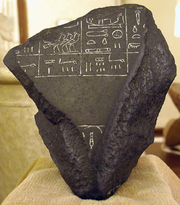
Surviving from this era are the earliest-known records of Egyptian contact with her neighbors. They are recorded on the Palermo stone
Palermo stone
The Palermo Stone is a large fragment of a stele known as the Royal Annals of the Old Kingdom of Ancient Egypt. It contains records of the kings of Egypt from the first dynasty through the fifth dynasty....
. Information carved on the stone predates and antedates this dynasty. Although some portions of the stone are lost, one remaining portion contains notations about the arrival of forty ships laden with timber
Timber
Timber may refer to:* Timber, a term common in the United Kingdom and Australia for wood materials * Timber, Oregon, an unincorporated community in the U.S...
from an unnamed foreign land purchased during the reign of Sneferu.
Khufu, Djedefra, Khafra, and Menkaura
Khufu
Khufu , also known as Cheops or, in Manetho, Suphis , was a Pharaoh of Ancient Egypt's Old Kingdom. He reigned from around 2589 to 2566 BC. Khufu was the second pharaoh of the Fourth Dynasty. He is generally accepted as being the builder of the Great Pyramid of Giza, one of the Seven Wonders of...
and Djedefra
Djedefra
Djedefre was an Egyptian pharaoh, the son and immediate successor of Khufu. The mother of Djedefre is unknown. His name means "Enduring like Re." Djedefre was the first king to use the title Son of Ra as part of his royal titulary, which is seen as an indication of the growing popularity of the...
were inscribed in gneiss
Gneiss
Gneiss is a common and widely distributed type of rock formed by high-grade regional metamorphic processes from pre-existing formations that were originally either igneous or sedimentary rocks.-Etymology:...
quarries in the Western Desert 65 km. to the northwest of Abu Simbel
Abu Simbel
Abu Simbel temples refers to two massive rock temples in Abu Simbel in Nubia, southern Egypt on the western bank of Lake Nasser about 230 km southwest of Aswan...
; objects dated to the reigns of Khufu, Khafra, and Menkaura have been uncovered at Byblos
Byblos
Byblos is the Greek name of the Phoenician city Gebal . It is a Mediterranean city in the Mount Lebanon Governorate of present-day Lebanon under the current Arabic name of Jubayl and was also referred to as Gibelet during the Crusades...
. Objects dating to the reign of Khafra have been found even farther away, at Ebla
Ebla
Ebla Idlib Governorate, Syria) was an ancient city about southwest of Aleppo. It was an important city-state in two periods, first in the late third millennium BC, then again between 1800 and 1650 BC....
, where there is evidence of diplomatic gifts or trade also.
Khufu
Khufu
Khufu , also known as Cheops or, in Manetho, Suphis , was a Pharaoh of Ancient Egypt's Old Kingdom. He reigned from around 2589 to 2566 BC. Khufu was the second pharaoh of the Fourth Dynasty. He is generally accepted as being the builder of the Great Pyramid of Giza, one of the Seven Wonders of...
is the ruler who is known in Greek
Greek language
Greek is an independent branch of the Indo-European family of languages. Native to the southern Balkans, it has the longest documented history of any Indo-European language, spanning 34 centuries of written records. Its writing system has been the Greek alphabet for the majority of its history;...
as Χέοψ = Cheops. His son is Khafra
Khafra
Khafra — also Khafre — was an Egyptian pharaoh of the Fourth dynasty, who had his capital at Memphis. According to some authors he was the son and successor of Khufu, but it is more commonly accepted that Djedefre was Khufu's successor and Khafra was Djedefre's...
(Greek Χεφρήν Chephren) and his grandson is Menkaura
Menkaura
Menkaure was a pharaoh of the Fourth dynasty of Egypt who ordered the construction of the third and smallest of the Pyramids of Giza. His name means "Eternal like the Souls of Re"...
(Greek Μυκερίνος Mycerinus). All of these rulers achieved lasting fame in the construction of their pyramids at Giza.
Organizing and feeding the workforce needed to create these pyramids required a centralized government with extensive powers, and Egyptologists believe that at this time the Old Kingdom demonstrated this level of sophistication and the long period of prosperity required to accomplish such projects. In fact, recent excavations outside the Wall of the Crow by Dr. Mark Lehner
Mark Lehner
Mark Lehner PhD is an American archaeologist with more than 30 years of experience excavating in Egypt. His approach, as director of Ancient Egypt Research Associates , is to conduct interdisciplinary archaeological investigation. Every excavated object is examined by specialists to create an...
have uncovered a large city which seems to have housed, fed, and supplied the pyramid workers.
Although it was once believed that slaves built these monuments—a bias based on the biblical Exodus story—study of overseers' tombs has shown that they were built by a corvée
Corvée
Corvée is unfree labour, often unpaid, that is required of people of lower social standing and imposed on them by the state or a superior . The corvée was the earliest and most widespread form of taxation, which can be traced back to the beginning of civilization...
of peasant
Peasant
A peasant is an agricultural worker who generally tend to be poor and homeless-Etymology:The word is derived from 15th century French païsant meaning one from the pays, or countryside, ultimately from the Latin pagus, or outlying administrative district.- Position in society :Peasants typically...
s drawn from across Egypt. Apparently, they worked during idle periods, while the annual Nile flood
Flooding of the Nile
has been an important natal cycle in Egypt since ancient times. It is celebrated by Egyptians as an annual holiday for two weeks starting August 15, known as Wafaa El-Nil. It is also celebrated in the Coptic Church by ceremonially throwing a martyr's relic into the river, hence the name, Esba`...
covered their fields, along with a very large crew of specialists including stone cutters, painters, mathematicians, and priests. Some records indicate that each household was responsible for providing a worker for civic projects and the wealthy could hire others to take their places. Civic duties were not necessarily building projects; there were duties for the temples, libraries, and festivals as well, and both men and women filled some of the positions.
These pyramids suggest that Egypt enjoyed unparalleled prosperity during the fourth dynasty. The later bias of Herodotus
Herodotus
Herodotus was an ancient Greek historian who was born in Halicarnassus, Caria and lived in the 5th century BC . He has been called the "Father of History", and was the first historian known to collect his materials systematically, test their accuracy to a certain extent and arrange them in a...
(Histories, 2.124-133) has helped instill the idea that the pyramids survived as a reminder to the inhabitants of the forced labor that created them, however, although there was a tradition of the negative memory of Khufu presented in Papyrus Westcar, these kings were not tyrannized. In fact, the very same Papyrus Westcar presents Snefru in a very benevolent light—even though he moved more stone to construct his pyramids than Khufu. This demonstrates that these pharaohs may have been remembered for their own individual reigns and personalities, rather than the sheer size of the monuments they built—monuments which, in all probability, were built by a "willing" public.
Khentkaus I
Perhaps most intriguing is the status of Khentkaus IKhentkaus I
Khentkaus I was a Queen of Ancient Egypt during the 4th dynasty. She may have been a daughter of Pharaoh Menkaure, wife of Shepseskaf and mother of Userkaf, but this is by no means certain. Her Mastaba at Giza - tomb LG100 - is located very close to Menkaure's pyramid complex...
, whose tomb was built along the Menkaura causeway.
Khentykawes was a daughter of Menkaura. She may have ruled as a pharaoh.
Her tomb is a large mastaba
Mastaba
A mastaba, or "pr-djt" , is a type of ancient Egyptian tomb in the form of a flat-roofed, rectangular structure with outward sloping sides that marked the burial site of many eminent Egyptians of Egypt's ancient period...
tomb, with another off-center mastaba placed above it. The second mastaba could not be centered because of the free, unsupported, space in the rooms below, in her primary mastaba.
On a granite doorway leading into her tomb, Khentkaus is given titles which may be read either as mother of two kings of upper and lower Egypt or as mother of the king of upper and lower Egypt and king of upper and lower Egypt.
Furthermore, her depiction on this doorway also gives the her the full trappings of royalty, including the false beard of the pharaoh
Pharaoh
Pharaoh is a title used in many modern discussions of the ancient Egyptian rulers of all periods. The title originates in the term "pr-aa" which means "great house" and describes the royal palace...
. This depiction and the title given have led some Egyptologists to suggest that she reigned as pharaoh near the end of the fourth dynasty.
Her tomb was finished in the characteristic niche architecture for which he is known. However, the niches were later filled in with a smooth casing of limestone.
Shepseskaf and Djedefptah
The next recorded pharaoh is ShepseskafShepseskaf
Shepseskaf was a son of Menkaure who succeeded his father on the throne. Shepseskaf's name means "His Soul is Noble."- Family :Shepseskaf was a son of Menkaure and grandson of Khafra, but his mother's name is not known. His mother can be either Khamerernebty II or Rekhetre...
, son to Menkaura. His reign was short, but he completed the projects of his father and established an architectural style of his own.
Djedefptah is a shadowy figure ascribed a reign of varying years, whose existence is questionable. Shepseskaf is usually considered to be the last pharaoh of the fourth dynasty. The ancient Egyptian historian, Manetho
Manetho
Manetho was an Egyptian historian and priest from Sebennytos who lived during the Ptolemaic era, approximately during the 3rd century BC. Manetho wrote the Aegyptiaca...
, however, lists a Tamphthis (which may be a corrupted form of Ptah-djedef) in this position, and the Turin Royal Canon, another resource about rulers, has an unnamed pharaoh listed who ruled for about two years after Shepseskaf. This ruler may be Djedefptah.
To date, it is unclear how this dynasty came to an end. Our only clue is that a number of Dynasty IV administrators are attested as remaining in office in Dynasty V under Userkaf
Userkaf
Userkaf was the founder of the Fifth dynasty of Egypt and the first pharaoh to start the tradition of building sun temples at Abusir. His name means "his Ka is powerful". He ruled from 2494-2487 BC and constructed the Pyramid of Userkaf complex at Saqqara.- Family :Userkaf's wife was Queen...
.