
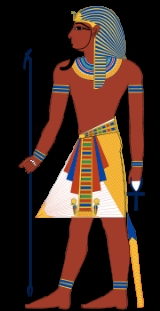
Pharaoh is a title used in many modern discussions of the
ancient EgyptAncient Egypt was an ancient civilization of Northeastern Africa, concentrated along the lower reaches of the Nile River in what is now the modern country of Egypt. Egyptian civilization coalesced around 3150 BC with the political unification of Upper and Lower Egypt under the first pharaoh...
ian rulers of all periods. The title originates in the term "pr-aa" which means "great house" and describes the royal palace. The title of Pharaoh started being used for the king during the
New KingdomThe New Kingdom of Egypt, also referred to as the Egyptian Empire is the period in ancient Egyptian history between the 16th century BC and the 11th century BC, covering the Eighteenth, Nineteenth, and Twentieth Dynasties of Egypt....
, specifically during the middle of the
eighteenth dynastyThe eighteenth dynasty of ancient Egypt is perhaps the best known of all the dynasties of ancient Egypt...
.
History of the Pharaoh title
Pharaoh, meaning "Great House", or "High House" originally referred to the
king- Centers of population :* King, Ontario, CanadaIn USA:* King, Indiana* King, North Carolina* King, Lincoln County, Wisconsin* King, Waupaca County, Wisconsin* King County, Washington- Moving-image works :Television:...
's
palaceA palace is a grand residence, especially a royal residence or the home of a head of state or some other high-ranking dignitary, such as a bishop or archbishop. The word itself is derived from the Latin name Palātium, for Palatine Hill, one of the seven hills in Rome. In many parts of Europe, the...
, but by the reign of
Thutmose IIIThutmose III was the sixth Pharaoh of the Eighteenth Dynasty. During the first twenty-two years of Thutmose's reign he was co-regent with his stepmother, Hatshepsut, who was named the pharaoh...
(ca. 1479-1425 BC) in the
New KingdomThe New Kingdom of Egypt, also referred to as the Egyptian Empire is the period in ancient Egyptian history between the 16th century BC and the 11th century BC, covering the Eighteenth, Nineteenth, and Twentieth Dynasties of Egypt....
, had become a form of address for the person of the king.
The term
pharaoh ultimately was derived from a compound word represented as
, written with the two
biliteral hieroglyphsBiliteral Egyptian hieroglyphs are symbols which represent a specific sequence of two consonants, also two vowels, or combinational of both, in the language...
"house" and
"column".
It was used only in larger phrases such as
smr pr-`3 'Courtier of the High House', with specific reference to the buildings of the court or palace itself. From the
twelfth dynastyThe twelfth dynasty of ancient Egypt is often combined with Dynasties XI, XIII and XIV under the group title Middle Kingdom.-Rulers:Known rulers of the twelfth dynasty are as follows :...
onward the word appears in a wish formula 'Great House, may it
live, prosper, and be in healthThe Ancient Egyptian phrase ankh, wedja, seneb meaning "life, prosperity, health" is an epithetic formula which often appears after the names of Egyptian kings or references to their household...
', but again only with reference to the royal palace and not the person.
The earliest instance where
pr-`3 is used specifically to address the ruler is in a letter to Amenhotep IV (Akhenaten), who reigned c. 1353 - 1336 BC, which is addressed to 'Pharaoh,
all life, prosperity, and health!The Ancient Egyptian phrase ankh, wedja, seneb meaning "life, prosperity, health" is an epithetic formula which often appears after the names of Egyptian kings or references to their household...
.
During the
eighteenth dynastyThe eighteenth dynasty of ancient Egypt is perhaps the best known of all the dynasties of ancient Egypt...
(sixteenth to fourteenth centuries BC) the title pharaoh was employed as a reverential designation of the ruler. About the late twenty-first dynasty (tenth century BC), however, instead of being used alone as before, it began to be added to the other titles before the ruler's name, and from the twenty-fifth dynasty (eighth to seventh centuries BC) it was, at least in ordinary usage, the only epithet prefixed to the royal appellative.
From the
nineteenth dynastyThe Nineteenth Dynasty of ancient Egypt was one of the periods of the Egyptian New Kingdom. Founded by Vizier Ramesses I, whom Pharaoh Horemheb chose as his successor to the throne, this dynasty is best known for its military conquests in Palestine, Lebanon, and Syria.The warrior kings of the...
onward
pr-`3 on its own was used as regularly as
hm.f, 'His Majesty'. The term therefore evolved from a word specifically referring to a building to a respectful designation for the ruler, particularly by the
twenty-second dynastyThe Twenty-First, Twenty-Second, Twenty-Third, Twenty-Fourth and Twenty-Fifth Dynasties of ancient Egypt are often combined under the group title, Third Intermediate Period.-Rulers:...
and
twenty-third dynastyThe Twenty-third Dynasty of ancient Egypt was a separate regime of Meshwesh Libyan kings, who ruled ancient Egypt. This dynasty is often considered part of the Third Intermediate Period.-Rulers:...
.
For instance, the first dated instance of the title pharaoh being attached to a ruler's name occurs in Year 17 of
SiamunNeterkheperre or Netjerkheperre-setepenamun Siamun was the sixth pharaoh of Egypt during the Twenty-first dynasty. He built extensively in Lower Egypt for a king of the Third Intermediate Period and is regarded as one of the most powerful rulers of this Dynasty after Psusennes I...
on a fragment from the
KarnakThe Karnak Temple Complex—usually called Karnak—comprises a vast mix of decayed temples, chapels, pylons, and other buildings, notably the Great Temple of Amun and a massive structure begun by Pharaoh Ramses II . Sacred Lake is part of the site as well. It is located near Luxor, some...
Priestly Annals. Here, an induction of an individual to the Amun priesthood is dated specifically to the reign of
Pharaoh Siamun. This new practice was continued under his successor Psusennes II and the twenty-first dynasty kings. Meanwhile the old custom of referring to the sovereign simply as Per'o continued in traditional Egyptian narratives.
By this time, the
Late EgyptianEgyptian is the oldest known indigenous language of Egypt and a branch of the Afroasiatic language family. Written records of the Egyptian language have been dated from about 3400 BC, making it one of the oldest recorded languages known. Egyptian was spoken until the late 17th century AD in the...
word is reconstructed to have been pronounced
*par-ʕoʔ whence comes
Ancient GreekAncient Greek is the stage of the Greek language in the periods spanning the times c. 9th–6th centuries BC, , c. 5th–4th centuries BC , and the c. 3rd century BC – 6th century AD of ancient Greece and the ancient world; being predated in the 2nd millennium BC by Mycenaean Greek...
and then
Late LatinLate Latin is the scholarly name for the written Latin of Late Antiquity. The English dictionary definition of Late Latin dates this period from the 3rd to the 6th centuries AD extending in Spain to the 7th. This somewhat ambiguously defined period fits between Classical Latin and Medieval Latin...
. From the latter, English obtained the word "Pharaoh". Over time, *par-ʕoʔ evolved into
Sahidic CopticCoptic or Coptic Egyptian is the current stage of the Egyptian language, a northern Afro-Asiatic language spoken in Egypt until at least the 17th century. Egyptian began to be written using the Greek alphabet in the 1st century...
prro and then
rro (by mistaking
p- as the definite article prefix "the" from Ancient Egyptian
p3).
Scepters and Staves
Scepters and staves were a general sign of authority in
Ancient EgyptAncient Egypt was an ancient civilization of Northeastern Africa, concentrated along the lower reaches of the Nile River in what is now the modern country of Egypt. Egyptian civilization coalesced around 3150 BC with the political unification of Upper and Lower Egypt under the first pharaoh...
. One of the earliest royal scepters was discovered in the tomb of
KhasekhemwyKhasekhemwy was the fifth and final king of the Second dynasty of Egypt. Little is known of Khasekhemwy, other than that he led several significant military campaigns and built several monuments, still extant, mentioning war against the Northerners...
in
AbydosAbydos is one of the most ancient cities of Upper Egypt, and also of the eight Upper Nome, of which it was the capital city. It is located about 11 kilometres west of the Nile at latitude 26° 10' N, near the modern Egyptian towns of el-'Araba el Madfuna and al-Balyana...
. Kings were also known to carry a staff, and Pharaoh
AnedjibAnedjib, more correctly Adjib and also known as Hor-Anedjib, Hor-Adjib and Enezib, is the Horus name of an early Egyptian king who ruled during the 1st dynasty. The ancient Greek historian Manetho named him "Miebîdós" and credited him with a reign of 26 years, whilst the Royal Canon of Turin...
is shown on stone vessels carrying a so called
mks-staff. The staff with the longest history seems to be the
heqa-scepter, sometimes described as the shepherd’s crook. The earliest examples of this piece of regalia dates to pre-dynastic times. A scepter was found in a tomb at Abydos which dates to the late Naqada period.
Another scepter associated with the king is the
was-scepter. This is a long staff mounted by an animal head. The earliest known depictions of the
was-scepter date to the
First dynasty of EgyptThe first dynasty of Ancient Egypt is often combined with the Dynasty II under the group title, Early Dynastic Period of Egypt...
. The
was-scepter is shown in the hands of both kings and gods.
The
FlailA flail is an agricultural implement for threshing.Several tools operate similarly to the agricultural implement and are also called flails:...
was later closely related to the ‘’heqa’’-scepter, but in early representations the king was also depicted solely with the flail, as shown in a late pre-dynastic knife handle which is now in the Metropolitan museum, and on the
Narmer MaceheadThe Narmer macehead is an ancient Egyptian decorative stone mace head. It was found during a dig at Kom al Akhmar, the site of Hierakonpolis It is dated to the reign of king Narmer whose serekh is engraved on it...
.
The Uraeus
The earliest evidence we have of the use of the
UraeusThe Uraeus is the stylized, upright form of an Egyptian spitting cobra , used as a symbol of sovereignty, royalty, deity, and divine authority in ancient Egypt.The Uraeus is a symbol for the goddess Wadjet, who was one of the earliest Egyptian deities and who...
– a rearing cobra – is from the reign of
DenDen may refer to:*Den , a part of a house similar to the living room: a den is about the size of a living room, but smaller than a family room*Den , a Ukrainian newspaper*Den , a Pharaoh of Egypt...
from the
First dynasty of EgyptThe first dynasty of Ancient Egypt is often combined with the Dynasty II under the group title, Early Dynastic Period of Egypt...
. The cobra supposedly protected the pharaoh by spitting fire at its enemies.
Crowns and headdresses
Narmer Palette
|
 |
| Narmer wearing the white crown |
Narmer wearing the red crown |
The red crown of Lower Egypt – the
DeshretDeshret, from ancient Egyptian, was the formal name for the Red Crown of and for the desert Red Land on either side of Kemet, the fertile Nile river basin. The end has a curly wire on it, that represents the proboscis of a honey bee. Deshret or DSRT also represents the insect known as the honeybee...
crown – dates back to pre-dynastic times. A red crown has been found on a pottery shard from
NaqadaNaqada is a town on the west bank of the Nile in the Egyptian governorate of Qena. It was known in Ancient Egypt as Nubt and in classical antiquity as Ombos. Its name derives from ancient Egyptian nub, meaning gold, on account of the proximity of gold mines in the Eastern Desert.Naqada comprises...
, and later king
NarmerNarmer was an ancient Egyptian pharaoh of the Early Dynastic Period . He is thought to be the successor to the Protodynastic pharaohs Scorpion and/or Ka, and he is considered by some to be the unifier of Egypt and founder of the First Dynasty, and therefore the first pharaoh of unified Egypt.The...
is shown wearing the red crown on both the
Narmer maceheadThe Narmer macehead is an ancient Egyptian decorative stone mace head. It was found during a dig at Kom al Akhmar, the site of Hierakonpolis It is dated to the reign of king Narmer whose serekh is engraved on it...
and the
Narmer paletteThe Narmer Palette, also known as the Great ierakonpolis Palette or the Palette of Narmer, is a significant Egyptian archeological find, dating from about the 31st century BC, containing some of the earliest hieroglyphic inscriptions ever found. It is thought by some to depict the unification of...
. Alternatively, the red crown is meant to symbolize the womb, placenta.
The white crown of Upper Egypt – the
HedjetHedjet is the formal name for the White Crown of pharaonic Upper Egypt. The crown was white and, after the unification of Egypt, it was combined with the Red Crown of Lower Egypt, with the delta to form the Pschent, the Double Crown of Egypt...
crown – is shown on the Qustul incense burner which dates to the
pre-dynastic periodThe Prehistory of Egypt spans the period of earliest human settlement to the beginning of the Early Dynastic Period of Egypt in ca. 3100 BC, starting with King Menes/Narmer....
. Later
King ScorpionScorpion, or Selk, also King Scorpion or Scorpion II refers to the second of two kings so-named of Upper Egypt during the Protodynastic Period. Their names may refer to the scorpion goddess Serket...
was depicted wearing the white crown, as was
NarmerNarmer was an ancient Egyptian pharaoh of the Early Dynastic Period . He is thought to be the successor to the Protodynastic pharaohs Scorpion and/or Ka, and he is considered by some to be the unifier of Egypt and founder of the First Dynasty, and therefore the first pharaoh of unified Egypt.The...
. Alternatively the white crown depicts a gland in the human body, the thymus.
The combination of red and white crown into the double crown – or
PschentThe Pschent was the name of the Double Crown of Ancient Egypt. The Ancient Egyptians generally referred to it as sekhemti , the Two Powerful Ones. It combined the Red Deshret Crown of Lower Egypt and the White Hedjet Crown of Upper Egypt....
crown – is first documented in the middle of the
First dynasty of EgyptThe first dynasty of Ancient Egypt is often combined with the Dynasty II under the group title, Early Dynastic Period of Egypt...
. The earliest depiction may date to the reign of
DjetDjet, also known as Wadj, Zet, and Uadji , was the fourth Egyptian pharaoh of the first dynasty...
, and is otherwise surely attested during the reign of
DenDen, also known as Hor-Den, Dewen and Udimu, is the Horus name of an early Egyptian king who ruled during the 1st dynasty. He is the best archaeologically attested ruler of this period. Den is said to have brought prosperity to his realm and numerous innovations are attributed to his reign...
. The double crown symbolizes the thymus having it's effect in the womb.
The khat and nemes headdresses
The
khatThe khat was a head cloth worn by the nobility of Ancient Egypt. Simpler than the Nemes head-dress, it did not have pleats or stripes, and hung down open in the back rather than being tied together.-History:...
headdress consists of a kind of “kerchief” whose end is tied almost like a ponytail. The earliest depictions of the
khat headdress comes from the reign of
DenDen, also known as Hor-Den, Dewen and Udimu, is the Horus name of an early Egyptian king who ruled during the 1st dynasty. He is the best archaeologically attested ruler of this period. Den is said to have brought prosperity to his realm and numerous innovations are attributed to his reign...
, but is not found again until the reign of
DjoserNetjerikhet or Djoser is the best-known pharaoh of the Third dynasty of Egypt. He commissioned his official, Imhotep, to build the first of the pyramids, a step pyramid for him at Saqqara...
.
The
NemesThe nemes was the striped headcloth worn by pharaohs in ancient Egypt. It covered the whole crown and back of the head and nape of the neck and had two large flaps which hung down behind the ears and in front of both shoulders. It was sometimes combined with the double crown, as it is on the...
headdress dates from the time of
DjoserNetjerikhet or Djoser is the best-known pharaoh of the Third dynasty of Egypt. He commissioned his official, Imhotep, to build the first of the pyramids, a step pyramid for him at Saqqara...
. The statue from his
SerdabA serdab , literally meaning "cold water", which became a loan word in Persian for 'cellar') is an ancient Egyptian tomb structure that served as a chamber for the Ka statue of a deceased individual. Used during the Old Kingdom, the serdab was a sealed chamber with a small slit or hole to allow the...
in
SaqqaraSaqqara is a vast, ancient burial ground in Egypt, serving as the necropolis for the Ancient Egyptian capital, Memphis. Saqqara features numerous pyramids, including the world famous Step pyramid of Djoser, sometimes referred to as the Step Tomb due to its rectangular base, as well as a number of...
shows the king wearing the
nemes headdress.
Physical evidence
Egyptologist
Bob BrierRobert Brier , also known as Mr. Mummy, is an American Egyptologist specializing in paleopathology. A Senior Research Fellow at the C.W...
has noted that despite its widespread depiction in royal portraits, no ancient Egyptian crown ever has been discovered.
TutankhamunTutankhamun , Egyptian , ; approx. 1341 BC – 1323 BC) was an Egyptian pharaoh of the 18th dynasty , during the period of Egyptian history known as the New Kingdom...
's tomb, discovered largely intact, did contain such regalia as his crook and flail. No crown was found however among the funerary equipment.
It is presumed that crowns would have been believed to have magical properties. Brier's speculation is that crowns were religious or state items; a dead pharaoh could not retain a crown as a personal possession. The crowns may have had to be passed along to a successor.
Titles
During the early dynastic period kings had up to three titles. The Horus name is the oldest and dates to the late pre-dynastic period. The
Nesw Bity name was added during the middle of the
1st dynastyThe first dynasty of Ancient Egypt is often combined with the Dynasty II under the group title, Early Dynastic Period of Egypt...
. The
Nebty name was first introduced towards the end of the
1st dynastyThe first dynasty of Ancient Egypt is often combined with the Dynasty II under the group title, Early Dynastic Period of Egypt...
. The Golden falcon (
bik-nbw) name is not well understood. The prenomen and nomen were introduced later and are traditionally enclosed in a cartouche.
By the
Middle KingdomMiddle Kingdom may refer to:*China, traditional translation of its common name, Zhōngguó *Middle Kingdom of Egypt*Middle kingdoms of India...
, the official titulary of the ruler consisted of five names; Horus, nebty, golden Horus, nomen, and prenomen for some rulers, only one or two of them may be known.
Nesw Bity name
The
Nesw Bity name was one of the new developments from the reign of
DenDen may refer to:*Den , a part of a house similar to the living room: a den is about the size of a living room, but smaller than a family room*Den , a Ukrainian newspaper*Den , a Pharaoh of Egypt...
. The name would follow the glyphs for the “Sedge and the Bee”. The title is usually translated as king of Upper and Lower Egypt. The
nsw bity name may have been the birth name of the king. It was often the name by which kings were recorded in the later annals and king lists.
Horus name
The Horus name was adopted by the king, when he took the throne. The name was written within a square frame representing the palace, named a
serekhIn Egyptian hieroglyphs, a serekh is a rectangular enclosure representing the niched or gated façade of a palace surmounted by the Horus falcon, indicating that the text enclosed is a royal name...
. The Horus name of several early kings expresses a relationship with Horus.
AhaHor-Aha is considered the second pharaoh of the first dynasty of ancient Egypt in current Egyptology. He lived around the thirty-first century BC.- Name :...
refers to “Horus the fighter”,
DjerDjer was the second or third pharaoh of the first dynasty of Egypt, which dates from approximately 3100 BC. Some scholars, however, debate whether the first pharaoh, Menes or Narmer, and Hor-Aha might have been different rulers. If they were separate rulers, this would make Djer the third pharaoh...
refers to “Horus the strong”, etc. Later kings express ideals of kingship in their Horus names.
KhasekhemwyKhasekhemwy was the fifth and final king of the Second dynasty of Egypt. Little is known of Khasekhemwy, other than that he led several significant military campaigns and built several monuments, still extant, mentioning war against the Northerners...
refers to “Horus: the two powers are at peace”, while
NebraNebra is a town in the district of Burgenlandkreis of Saxony-Anhalt, Germany. It is situated on the river Unstrut....
refers to “Horus, Lord of the Sun”.
Nebty name
The earliest example of a
nebty name comes from the reign of king
AhaHor-Aha is considered the second pharaoh of the first dynasty of ancient Egypt in current Egyptology. He lived around the thirty-first century BC.- Name :...
from the
1st dynastyThe first dynasty of Ancient Egypt is often combined with the Dynasty II under the group title, Early Dynastic Period of Egypt...
. The title links the king with the goddesses of Upper and Lower Egypt
NekhbetIn Egyptian mythology, Nekhbet was an early predynastic local goddess who was the patron of the city of Nekheb, her name meaning of Nekheb...
and
WadjetIn Egyptian mythology, Wadjet, or the Green One , was originally the ancient local goddess of the city of Dep , which became part of the city that the Egyptians named Per-Wadjet, House of...
. The title is preceded by the vulture (Nekhbet) and the cobra (Wadjet) standing on a basket (the neb sign).
Golden Horus name
The Golden Horus or Golden Falcon name was preceded by a falcon on a gold or
nbw sign. The title may have represented the kings divine status. The Horus associated with gold may be referring to the idea that the god’s bodies were made of gold. The gold sign may also be a reference to Nubt, the city of Set. This would suggest that the iconography represents Horus conquering Set.
Nomen and Prenomen
The prenomen and nomen were contained in a cartouche. The prenomen often followed the King of Upper and Lower Egypt (
nsw bity) or Lord of the Two Lands (
nebtawy) title. The prenomen often incorporated the name of
ReRa is the ancient Egyptian sun god. By the Fifth Dynasty he had become a major deity in ancient Egyptian religion, identified primarily with the mid-day sun...
. The nomen often followed the title Son of Re (
sa-ra) or the title Lord of Appearances (
neb-kha’).
See also
- Ancient Egyptian royal titulary
- Egyptian chronology
The creation of a reliable chronology of Ancient Egypt is a task fraught with problems. While the overwhelming majority of Egyptologists agree on the outline and many of the details of a common chronology, disagreements either individually or in groups have resulted in a variety of dates offered...
- Conventional Egyptian chronologyThe Conventional Egyptian chronology represents the scholarly consensus on the chronology of the rulers of ancient Egypt, taking into account well accepted developments during the 20th century but not including any of the major revision proposals that have also been made in that time.All dates are...
- History of Egypt
Egyptian history can be roughly divided into the following periods:*Prehistoric Egypt*Ancient Egypt**Early Dynastic Period of Egypt: 31st to 27th centuries BC**Old Kingdom of Egypt: 27th to 22nd centuries BC...
- List of Pharaohs
- Monarch
A monarch is the person who heads a monarchy. This is a form of government in which a state or polity is ruled or controlled by an individual who typically inherits the throne by birth and occasionally rules for life or until abdication...
- Pharaoh of the Exodus
- Great Royal Wife
Great Royal Wife or Chief King's Wife is the term used to refer to the chief wife of the pharaoh of Ancient Egypt. While most Ancient Egyptians were monogamous, the pharaoh would have had other, lesser wives and concubines in addition to the Great Royal Wife...
, the chief wife of a Pharaoh
- Islamic view of the Pharaoh of the Exodus
External links