
All Topics  
Old World


   Email Print
   Bookmark   Link


Old World


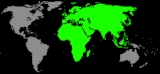
The Old World consists of those parts of Earth
Earth

Earth is the third planet from the Sun. Earth is the largest of the terrestrial planets in the Solar System in diameter, mass and density. It is also referred to as the World and Wiktionary:Terra.Note that by International Astronomical Union convention, the term "Terra" is used for naming extensive land masses, rather...
 known to Europe
Europe

Europe is, conventionally, one of the world's seven continents. Comprising the westernmost peninsula of Eurasia, Europe is generally divided from Asia to its east by the water divide of the Ural Mountains, the Ural , the Caspian Sea, and by the Caucasus Mountains to the southeast....
ans, Asia
Asia

Asia is the world's largest and most populous continent. It covers 8.6% of the Earth's total surface area and, with over 4 billion people, it contains more than 60% of the world's current human population....
ns, and Africa
Africa

Africa is the world's second-largest and second most-populous continent, after Asia. At about 30.2 million km? including adjacent islands, it covers 6% of the Earth's total surface area and 20.4% of the total land area....
ns in the 15th century.

le class="toccolours" style="float:right; margin: 0 0 1em 1em; width:333px; text-align:left; clear:right;">
Areas of the Old World
The Old World includes Europe
Europe

Europe is, conventionally, one of the world's seven continents. Comprising the westernmost peninsula of Eurasia, Europe is generally divided from Asia to its east by the water divide of the Ural Mountains, the Ural , the Caspian Sea, and by the Caucasus Mountains to the southeast....
, Asia
Asia

Asia is the world's largest and most populous continent. It covers 8.6% of the Earth's total surface area and, with over 4 billion people, it contains more than 60% of the world's current human population....
, and Africa
Africa

Africa is the world's second-largest and second most-populous continent, after Asia. At about 30.2 million km? including adjacent islands, it covers 6% of the Earth's total surface area and 20.4% of the total land area....
 (collectively known as Afro-Eurasia
Afro-Eurasia

Afro-Eurasia or less commonly Afrasia or Eurafrasia are terms used to describe Eurasia and Africa as one continent. The constituent landmasses contain around 5.7 billion people, or roughly 85% of the world population....
), plus surrounding islands.


Discussion
Ask a question about 'Old World'
Start a new discussion about 'Old World'
Answer questions from other users
Full Discussion Forum


Encyclopedia


The Old World consists of those parts of Earth
Earth

Earth is the third planet from the Sun. Earth is the largest of the terrestrial planets in the Solar System in diameter, mass and density. It is also referred to as the World and Wiktionary:Terra.Note that by International Astronomical Union convention, the term "Terra" is used for naming extensive land masses, rather...
 known to Europe
Europe

Europe is, conventionally, one of the world's seven continents. Comprising the westernmost peninsula of Eurasia, Europe is generally divided from Asia to its east by the water divide of the Ural Mountains, the Ural , the Caspian Sea, and by the Caucasus Mountains to the southeast....
ans, Asia
Asia

Asia is the world's largest and most populous continent. It covers 8.6% of the Earth's total surface area and, with over 4 billion people, it contains more than 60% of the world's current human population....
ns, and Africa
Africa

Africa is the world's second-largest and second most-populous continent, after Asia. At about 30.2 million km? including adjacent islands, it covers 6% of the Earth's total surface area and 20.4% of the total land area....
ns in the 15th century.

Regions

Areas of the Old World
  • Eurasia
    Eurasia

    Eurasia is a large landmass covering about 53,990,000 km? or about 10.6% of the Earth's surface . Often considered a single continent, Eurasia comprises the traditional continents of Europe and Asia, concepts which date back to classical antiquity and the borders for which are somewhat arbitrary....
    • Asia
      Asia

      Asia is the world's largest and most populous continent. It covers 8.6% of the Earth's total surface area and, with over 4 billion people, it contains more than 60% of the world's current human population....
      Locationasia
      *** North Asia
      North Asia

      North Asia or Northern Asia is sometimes defined as a subregion of Asia consisting only of the Asian portion of Russia. The term is not widely used....
      • Central Asia
        Central Asia

        Central Asia is a region of Asia from the Caspian Sea in the west to central China in the east, and from southern Russia in the north to northern India in the south....
      • East Asia
        East Asia

        East Asia is a subregion of Asia that can be defined in either Geography or cultural terms. Geography and geopolitically, it covers about 12,000,000 km?, or about 28 percent of the Asian continent, about 15 percent bigger than the area of Europe, though some categorize Tibet, Xinjiang, and Mongolia as Central Asia....
      • South Asia
        South Asia

        South Asia, also known as Southern Asia, is the southern region of the Asian continent, which comprises the sub-Himalayan countries and, for some authorities , also includes the adjoining countries on the west and the east....
      • Southeast Asia
        Southeast Asia

        Southeast Asia or Southeastern Asia is a subregion of Asia, consisting of the countries that are geographically south of China, east of India and north of Australia....
      • Southwest Asia
        Southwest Asia

        Southwest Asia or Southwestern Asia is the southwestern subregion of Asia. The term West Asia is sometimes used in the United Nations subregion geoscheme and in writings about the archeology and the late prehistory of the region....
    • Europe
      Europe

      Europe is, conventionally, one of the world's seven continents. Comprising the westernmost peninsula of Eurasia, Europe is generally divided from Asia to its east by the water divide of the Ural Mountains, the Ural , the Caspian Sea, and by the Caucasus Mountains to the southeast....
      Locationeurope
      *** Northern Europe
      Northern Europe

      Northern Europe is the northern part or region of Europe. The United Nations defines Northern Europe as including the following countries and dependent regions:...
      • Western Europe
        Western Europe

        Western Europe refers to the countries in the western most half of Europe. This concept has had different meanings, political and cultural as well as geographical issues have influenced the area....
      • Central Europe
        Central Europe

        Central Europe is the region lying between the variously and vaguely defined areas of Eastern Europe and Western Europe Europe. In addition, Northern Europe, Southern Europe and Southeastern Europe may variously delimit or overlap into Central Europe....
      • Eastern Europe
        Eastern Europe

        Eastern Europe is a term that applies to the geopolitical region encompassing the easternmost part of the Europe. Throughout history and to a lesser extent today, parts of Eastern Europe has been distinguishable from Western Europe and other regions due to cultural, religious, economic, and historical reasons, even though there i...
      • Southern Europe
        Southern Europe

        The term Southern Europe, at its most general definition, is used to mean 'all countries in the south of Europe'. However, the concept, at different times, has had different meanings, providing additional Policy, Linguistics and Culture context to the definition in addition to the typical Geography, Phytogeography or Clime approach....
  • Africa
    Africa

    Africa is the world's second-largest and second most-populous continent, after Asia. At about 30.2 million km? including adjacent islands, it covers 6% of the Earth's total surface area and 20.4% of the total land area....
    Locationafrica
    ** North Africa
    North Africa

    North Africa or Northern Africa is the northernmost region of the African continent, separated by the Sahara from Sub-Saharan Africa.Geopolitically, the United Nations subregion of Northern Africa includes the following seven countries or territories:...
    • Sub-Saharan Africa
      Sub-Saharan Africa

      Sub-Saharan Africa is a geographical term used to describe the area of the African continent which lies south of the Sahara, or those African countries which are fully or partially located south of the Sahara....
      • West Africa
        West Africa

        West Africa or Western Africa is the westernmost region of the African continent. Geopolitically, the United Nations subregion of Western Africa includes the following 16 countries distributed over an area of approximately 5 million square km:...
      • Central Africa
        Central Africa

        Central Africa is a core region of the African continent often considered to include Burundi, the Central African Republic, Chad, Democratic Republic of the Congo, and Rwanda....
      • East Africa
        East Africa

        East Africa or Eastern Africa is the easterly region of the African continent, variably defined by geography or geopolitics. In the UN subregion, 19 territories constitute Eastern Africa:...
      • Southern Africa
        Southern Africa

        Southern Africa is the southernmost region of the African continent, variably defined by geography or geopolitics, consisting of numerous territories....
The Old World includes Europe
Europe

Europe is, conventionally, one of the world's seven continents. Comprising the westernmost peninsula of Eurasia, Europe is generally divided from Asia to its east by the water divide of the Ural Mountains, the Ural , the Caspian Sea, and by the Caucasus Mountains to the southeast....
, Asia
Asia

Asia is the world's largest and most populous continent. It covers 8.6% of the Earth's total surface area and, with over 4 billion people, it contains more than 60% of the world's current human population....
, and Africa
Africa

Africa is the world's second-largest and second most-populous continent, after Asia. At about 30.2 million km? including adjacent islands, it covers 6% of the Earth's total surface area and 20.4% of the total land area....
 (collectively known as Afro-Eurasia
Afro-Eurasia

Afro-Eurasia or less commonly Afrasia or Eurafrasia are terms used to describe Eurasia and Africa as one continent. The constituent landmasses contain around 5.7 billion people, or roughly 85% of the world population....
), plus surrounding islands. The term is in distinction from the New World
New World

The New World is one of the names used for the non-Eurasian/non-African parts of the Earth, specifically the Americas and Australasia. When the term originated in the late 15th century, the Americas were new to the Europeans, who previously thought of the world as consisting only of Europe, Asia, and Africa ....
, meaning the Americas and Australasia
Australasia

Australasia is a region of Oceania: New Zealand, Australia, Papua New Guinea, and neighbouring islands in the Pacific Ocean. The term was coined by Charles de Brosses in Histoire des navigations aux terres australes ....
.

Normally, it is divided at the Suez Canal
Suez Canal

The Suez Canal is a canal in Egypt. Opened in November 1869, it allows water transportation between Europe and Asia without navigating around Africa or carrying goods overland between the Mediterranean and the Red Sea....
 into Eurasia and Africa, the former of which can be subdivided into Europe
Europe

Europe is, conventionally, one of the world's seven continents. Comprising the westernmost peninsula of Eurasia, Europe is generally divided from Asia to its east by the water divide of the Ural Mountains, the Ural , the Caspian Sea, and by the Caucasus Mountains to the southeast....
 and Asia
Asia

Asia is the world's largest and most populous continent. It covers 8.6% of the Earth's total surface area and, with over 4 billion people, it contains more than 60% of the world's current human population....
. It can be divided alternatively into Eurasia-North Africa
North Africa

North Africa or Northern Africa is the northernmost region of the African continent, separated by the Sahara from Sub-Saharan Africa.Geopolitically, the United Nations subregion of Northern Africa includes the following seven countries or territories:...
 and Subsahara for cultural and historical reasons.

The mainland of Afro-Eurasia (excluding island
Island

An island or isle is any piece of land that is surrounded by water. Very small islands such as emergent land features on atolls are called islets....
s such as the British Isles
British Isles

The British Isles are a group of islands off the northwest coast of continental Europe that include Great Britain and Ireland, and numerous smaller islands....
, Japan
Japan

Japan is an island country in East Asia. Located in the Pacific Ocean, it lies to the east of the Sea of Japan, People's Republic of China, North Korea, South Korea and Russia, stretching from the Sea of Okhotsk in the north to the East China Sea and Taiwan in the south....
, Madagascar
Madagascar

Madagascar, or Republic of Madagascar , is an island nation in the Indian Ocean off the southeastern coast of Africa. The main island, also called Madagascar, is the List of islands by area, and is home to 5% of the world's plant and animal species, of which more than 80% are Endemism to Madagascar....
 and the Malay Archipelago
Malay Archipelago

The Malay Archipelago and Maritime Southeast Asia are names given to the archipelago located between mainland Southeast Asia and Australia....
) has been referred to as the World Island. (The term may have been coined by Sir Halford John Mackinder
Halford John Mackinder

Sir Halford John Mackinder Privy Council of the United Kingdom was an England geographer and one of the founding fathers of Geopolitics....
 in The Geographical Pivot of History
The Geographical Pivot of History

The Geographical Pivot of History was an article submitted by Halford John Mackinder in 1904 to the Royal Geographical Society that advanced his Heartland ....
.)

Geographically, Europe is the westernmost peninsula
Peninsula

A peninsula is a piece of Landform that is nearly surrounded by water but connected to mainland via an isthmus. Word origin: Latin paeninsula : paene, almost + insula, island....
 of the continent
Continent

A continent is one of several large landmasses on Earth. They are generally identified by convention rather than any strict criteria, with seven regions commonly regarded as continents ? they are : Asia, Africa, North America, South America, Antarctica, Europe, and Australia ....
 of Eurasia
Eurasia

Eurasia is a large landmass covering about 53,990,000 km? or about 10.6% of the Earth's surface . Often considered a single continent, Eurasia comprises the traditional continents of Europe and Asia, concepts which date back to classical antiquity and the borders for which are somewhat arbitrary....
; its limits are well defined by sea
SEA

See also: Sea and seasThe three-letter acronym SEA may refer to:People/organizations/businesses*Scientists and Engineers for America, a pro-science political advocacy group....
 to the North, South and West. The Ural mountains
Ural Mountains

The Ural Mountains are a mountain range that runs roughly north and south through western Russia. They are usually considered as the natural boundary between Europe and Asia....
 are usually taken as the eastern limit of Europe, along with the Ural River, and the Caspian Sea
Caspian Sea

The Caspian Sea is the largest enclosed body of water on Earth by area, variously classed as the List of lakes by area or a full-fledged sea. It has a surface area of 371,000 square kilometers and a volume of 78,200 cubic kilometers ....
. Europe can be considered bounded to the southeast by the Caucasus Mountains
Caucasus Mountains

The Caucasus Mountains is a Mountain range in Eurasia between the Black Sea and the Caspian Sea sea in the Caucasus region.The Caucasus Mountains are made up of two separate mountain systems:...
, the Black Sea
Black Sea

The Black Sea is an inland sea sea bounded by southeastern Europe, the Caucasus and the Anatolia and is ultimately connected to the Atlantic Ocean via the Mediterranean Sea and Aegean Seas and various straits....
 and the waterways connecting the Black Sea to the Mediterranean. Europe's eastern and southeastern extent are discussed below.

Medieval Europe
Europe

Europe is, conventionally, one of the world's seven continents. Comprising the westernmost peninsula of Eurasia, Europe is generally divided from Asia to its east by the water divide of the Ural Mountains, the Ural , the Caspian Sea, and by the Caucasus Mountains to the southeast....
ans considered Asia as a continent – a distinct landmass. The European concept of the three continents in the Old World goes back to Classical Antiquity
Classical antiquity

Classical antiquity is a broad term for a long period of cultural history centered on the Mediterranean Sea, comprising the interlocking civilizations of Ancient Greece and Ancient Rome....
, but during the Middle Ages was notably due to Isidore of Sevilla (see T and O map
T and O map

A T and O map or O-T or T-O map , is a type of medieval world map, sometimes also called a Beatine map or a Beatus map because one of the earliest known representations of this sort is attributed to Beatus of Li?bana, an 8th-century Spanish monk....
). The demarcation between Asia and Africa (to the southwest) is the Isthmus
Isthmus

File:The Spit Bruny Island.jpg File:IsthmusOfPanama.pngAn isthmus is a narrow strip of land connecting two larger land areas. Of note, the Isthmus of Panama connects the continents of North America and South America , and the Isthmus of Suez in Egypt connects Africa and Asia ....
 of Suez and the Red Sea
Red Sea

The Red Sea is a salt water inlet of the Indian Ocean between Africa and Asia. The connection to the ocean is in the south through the Bab el Mandeb sound and the Gulf of Aden....
. The boundary between Asia and Europe
Europe

Europe is, conventionally, one of the world's seven continents. Comprising the westernmost peninsula of Eurasia, Europe is generally divided from Asia to its east by the water divide of the Ural Mountains, the Ural , the Caspian Sea, and by the Caucasus Mountains to the southeast....
 is conventionally considered to run through the Dardanelles
Dardanelles

.The Dardanelles , formerly known as the Hellespont, is a narrow strait in northwestern Turkey connecting the Aegean Sea to the Sea of Marmara....
, the Sea of Marmara
Sea of Marmara

The Sea of Marmara , also known as the Sea of Marmora or the Marmara Sea, and in the context of classical antiquity as Propontis , is the inland sea that connects the Black Sea to the Aegean Sea, thus separating Turkey's Asian and European parts....
, the Bosporus
Bosporus

The Bosporus or Bosphorus , also known as the Istanbul Strait , is a strait that forms the boundary between the European part of Turkey and its Asian part ....
, the Black Sea, the Caucasus Mountains, the Caspian Sea, the Ural River
Ural River

The Ural , known as Yaik before 1775, is a river flowing through Russia and Kazakhstan. It arises in the southern Ural Mountains and ends at the Caspian Sea....
 to its source, and the Ural Mountains to the Kara Sea
Kara Sea

The Kara Sea is part of the Arctic Ocean north of Siberia. It is separated from the Barents Sea to the west by the Kara Strait and Novaya Zemlya, and the Laptev Sea to the east by the Severnaya Zemlya....
 near Kara, Russia
Russia

Russia , or the Russian Federation , is a list of countries spanning more than one continent country extending over much of northern Eurasia....
. While this interpretation of tripartite continents (i.e., of Asia, Europe, and Africa) remains common in modernity, discovery of the extent of Africa and Asia have made this definition somewhat anachronistic. This is especially true in the case of Asia, which would have several regions
Subregions of Asia

Indian Subcontinent/South Asia*North India**Indo-Gangetic Plain**Indus Valley*South India**Deccan plateau*East India*West India*Northeast India...
 that would be considered distinct landmasses if these criteria were used (for example, Southern Asia
South Asia

South Asia, also known as Southern Asia, is the southern region of the Asian continent, which comprises the sub-Himalayan countries and, for some authorities , also includes the adjoining countries on the west and the east....
 and Eastern Asia
East Asia

East Asia is a subregion of Asia that can be defined in either Geography or cultural terms. Geography and geopolitically, it covers about 12,000,000 km?, or about 28 percent of the Asian continent, about 15 percent bigger than the area of Europe, though some categorize Tibet, Xinjiang, and Mongolia as Central Asia....
).

Africa is the largest of the three great southward projections from the main mass of the Earth's exposed surface. Separated from Europe
Europe

Europe is, conventionally, one of the world's seven continents. Comprising the westernmost peninsula of Eurasia, Europe is generally divided from Asia to its east by the water divide of the Ural Mountains, the Ural , the Caspian Sea, and by the Caucasus Mountains to the southeast....
 by the Mediterranean Sea
Mediterranean Sea

The Mediterranean Sea is a sea or Ocean off the Atlantic Ocean surrounded by the Mediterranean region and almost completely enclosed by land: on the north by Europe, on the south by Africa, and on the east by Asia....
, it is joined to Asia at its northeast extremity by the Isthmus of Suez
Suez Canal

The Suez Canal is a canal in Egypt. Opened in November 1869, it allows water transportation between Europe and Asia without navigating around Africa or carrying goods overland between the Mediterranean and the Red Sea....
 (transected by the Suez Canal
Suez Canal

The Suez Canal is a canal in Egypt. Opened in November 1869, it allows water transportation between Europe and Asia without navigating around Africa or carrying goods overland between the Mediterranean and the Red Sea....
), 163 km (101 miles) wide. (Geopolitically
Geopolitics

Geopolitics is the art and practice of using international political power. Traditionally, the term has applied primarily to the impact of geography on politics, but its usage has evolved over the past century to encompass a wider connotation....
, Egypt
Egypt

Egypt is a country mainly in North Africa, with the Sinai Peninsula forming a land bridge in Western Asia. Covering an area of about , Egypt borders the Mediterranean Sea to the north, the Gaza Strip and Israel to the northeast, the Red Sea to the east, Sudan to the south and Libya to the west....
's Sinai Peninsula
Sinai Peninsula

The Sinai Peninsula or Sinai is a triangular peninsula in Egypt. It lies between the Mediterranean Sea to the north and the Red Sea to the south, forming a land bridge between Africa and Southwest Asia....
 east of the Suez Canal is often considered part of Africa, as well. ) From the most northerly point, Ras ben Sakka
Ras ben Sakka

Ras ben Sakka is the northernmost point of the African continent, located in Tunisia. It is located at 37?21' N., just west of Ra's al Abyad , which is often mentioned as the northern tip of Africa....
 in Tunisia
Tunisia

Tunisia , officially the Tunisian Republic , is a country located in North Africa. It is bordered by Algeria to the west and Libya to the southeast....
 (37°21' N), to the most southerly point, Cape Agulhas
Cape Agulhas

Cape Agulhas is the geographic extreme points of Africa of the African continent, commonly thought to be the Cape of Good Hope, and according to popular mythology is the dividing point between the Atlantic Ocean and Indian Ocean oceans....
 in South Africa
South Africa

The Republic of South Africa, also known by Official names of South Africa, is a country located at the southern tip of the continent of Africa....
 (34°51'15" S), is a distance of approximately 8,000 km (5,000 miles); from Cape Verde
Cap-Vert

Cap-Vert is a peninsula in Senegal, and the westernmost part of the continent of Africa. Originally called Cabo Verde or "Cape Green" by Portuguese explorers, it is not to be confused with the Cape Verde islands, which are some further west....
, 17°33'22" W, the westernmost point, to Ras Hafun in Somalia
Somalia

Somalia , officially the Republic of Somalia and formerly known as the Somali Democratic Republic, is a country located in the Horn of Africa....
, 51°27'52" E, the most easterly projection, is a distance of approximately 7,400 km (4,600 miles).

Although the interiors of Asia and Africa were not well known to Europeans at the time, their existence was known. Oceania
Oceania

Oceania is a geography, often geopolitics, region consisting of numerous lands—mostly islands in the Pacific Ocean and vicinity. The term "Oceania" was coined in 1831 by French explorer Jules Dumont d'Urville....
 and Antarctica
Antarctica

Antarctica is Earth's southernmost continent, overlying the South Pole. It is situated in the Antarctica of the southern hemisphere, almost entirely south of the Antarctic Circle, and is surrounded by the Southern Ocean....
 are neither definitively Old World nor New World, since the terms "Old World" and "New World" predate their discovery by Europeans.

See also

  • Eastern Hemisphere
    Eastern Hemisphere

    The Eastern Hemisphere, also Eastern hemisphere or eastern hemisphere, is a geography term for the half of the Earth that is east of the Prime Meridian and west of 180? longitude....
  • Afro-Eurasia
    Afro-Eurasia

    Afro-Eurasia or less commonly Afrasia or Eurafrasia are terms used to describe Eurasia and Africa as one continent. The constituent landmasses contain around 5.7 billion people, or roughly 85% of the world population....
  • Eurocentrism
    Eurocentrism

    Eurocentrism is the practice of viewing the world from a European perspective, with an implied belief, either consciously or subconsciously, in the preeminence of European culture....
  • New World
    New World

    The New World is one of the names used for the non-Eurasian/non-African parts of the Earth, specifically the Americas and Australasia. When the term originated in the late 15th century, the Americas were new to the Europeans, who previously thought of the world as consisting only of Europe, Asia, and Africa ....
  • Age of Exploration
  • Far East
    Far East

    The Far East is a term current in English language to refer to the countries of East Asia. The term is often expanded to also include Southeast Asia and South Asia, for economic and cultural reasons, for example because Buddhism is common to East Asia, Southeast Asia and South Asia....
  • Synoptic table of the principal old world prehistoric cultures
    Synoptic table of the principal old world prehistoric cultures

    The synoptic table of the principal old world prehistoric cultures gives a rough picture of the relationships between the various principal Archaeological culture of Prehistory outside the Americas, Antarctica, Australia and Oceania....