
All Topics  
Malawi


   Email Print
   Bookmark   Link


Malawi


The Republic of Malawi (; Chichewa ) is a landlocked country in southeast Africa
Africa

Africa is the world's second-largest and second most-populous continent, after Asia. At about 30.2 million km? including adjacent islands, it covers 6% of the Earth's total surface area and 20.4% of the total land area....
 that was formerly known as Nyasaland. It is bordered by Zambia
Zambia

The Republic of Zambia is a landlocked country in Southern Africa. The neighbouring countries are the Democratic Republic of the Congo to the north, Tanzania to the north-east, Malawi to the east, Mozambique, Zimbabwe, Botswana, and Namibia to the south, and Angola to the west....
 to the northwest, Tanzania
Tanzania

Tanzania , officially the United Republic of Tanzania , is a country in East Africa that is bordered by Kenya and Uganda on the north, Rwanda, Burundi and the Democratic Republic of the Congo on the west, and Zambia, Malawi and Mozambique on the south....
 to the northeast and Mozambique
Mozambique

Mozambique, officially the Republic of Mozambique , is a country in southeastern Africa bordered by the Indian Ocean to the east, Tanzania to the north, Malawi and Zambia to the northwest, Zimbabwe to the west and Swaziland and South Africa to the southwest....
, which surrounds it on the east, south and west. The country is separated from Tanzania and Mozambique by Lake Malawi
Lake Malawi

Lake Malawi , is the most southerly lake in the East African Rift valley system. The lake, third largest in Africa and List of lakes by area, is situated between Malawi, Mozambique, and Tanzania....
. The name Malawi comes from the Maravi
Maravi

Maravi was a state established by Bantu people in the area of Lake Malawi, in present-day Malawi, sometime during the 16th century. At its greatest extent, the state included territory from the Tumbuka and Tonga areas to the north to the Lower Shire in the south, and west to Luangwa and Zambezi valleys....
, one of the original Bantu tribes to inhabit the area.

Malawi was first settled
Settler

A settler is a person who has human migration to an area and established permanent residence there, often to colonies the area. Settlers are generally people who take up Sedentary and agriculture it, as opposed to nomads....
 during the 10th century and remained under native rule until 1891 when it was colonized by the British
British people

The British are citizenship of the United Kingdom, of the Isle of Man, one of the Channel Islands, or of one of the British overseas territories, and their descendants....
, who ruled the country until 1964.


Discussion
Ask a question about 'Malawi'
Start a new discussion about 'Malawi'
Answer questions from other users
Full Discussion Forum


Encyclopedia


The Republic of Malawi (; Chichewa ) is a landlocked country in southeast Africa
Africa

Africa is the world's second-largest and second most-populous continent, after Asia. At about 30.2 million km? including adjacent islands, it covers 6% of the Earth's total surface area and 20.4% of the total land area....
 that was formerly known as Nyasaland. It is bordered by Zambia
Zambia

The Republic of Zambia is a landlocked country in Southern Africa. The neighbouring countries are the Democratic Republic of the Congo to the north, Tanzania to the north-east, Malawi to the east, Mozambique, Zimbabwe, Botswana, and Namibia to the south, and Angola to the west....
 to the northwest, Tanzania
Tanzania

Tanzania , officially the United Republic of Tanzania , is a country in East Africa that is bordered by Kenya and Uganda on the north, Rwanda, Burundi and the Democratic Republic of the Congo on the west, and Zambia, Malawi and Mozambique on the south....
 to the northeast and Mozambique
Mozambique

Mozambique, officially the Republic of Mozambique , is a country in southeastern Africa bordered by the Indian Ocean to the east, Tanzania to the north, Malawi and Zambia to the northwest, Zimbabwe to the west and Swaziland and South Africa to the southwest....
, which surrounds it on the east, south and west. The country is separated from Tanzania and Mozambique by Lake Malawi
Lake Malawi

Lake Malawi , is the most southerly lake in the East African Rift valley system. The lake, third largest in Africa and List of lakes by area, is situated between Malawi, Mozambique, and Tanzania....
. The name Malawi comes from the Maravi
Maravi

Maravi was a state established by Bantu people in the area of Lake Malawi, in present-day Malawi, sometime during the 16th century. At its greatest extent, the state included territory from the Tumbuka and Tonga areas to the north to the Lower Shire in the south, and west to Luangwa and Zambezi valleys....
, one of the original Bantu tribes to inhabit the area.

Malawi was first settled
Settler

A settler is a person who has human migration to an area and established permanent residence there, often to colonies the area. Settlers are generally people who take up Sedentary and agriculture it, as opposed to nomads....
 during the 10th century and remained under native rule until 1891 when it was colonized by the British
British people

The British are citizenship of the United Kingdom, of the Isle of Man, one of the Channel Islands, or of one of the British overseas territories, and their descendants....
, who ruled the country until 1964. Upon gaining independence
Independence

Independence is the self-government of a nation, country, or state by its residents and population, or some portion thereof, generally exercising sovereignty....
 it became a single-party state
Single-party state

A single-party state, one-party system or single-party system is a type of party system government in which a single political party forms the government and no other parties are permitted to run candidates for election....
 under the presidency of Hastings Banda
Hastings Banda

Hastings Kamuzu Banda was the leader of Malawi and its predecessor state, Nyasaland, from 1961 to 1994. After receiving much of his education overseas, Banda returned to his home country to speak against colonialism and help lead the movement towards independence....
, who remained president until 1994, when he was ousted from power. Bingu Mutharika, elected in 2004, is the current president, and as of 2008, Malawi has a democratic, multi-party government
Government

Government is the body within any organization that has the authority to make and the power to enforce laws, regulations, or rules. Typically, the government refers to a civil government -- local, provincial, or national -- but commercial, academic, religious, or other formal organizations are also administered by governing bodies....
. Malawi has a small military
Military

A military is an organization authorized by its nation to use force, usually including use of weapons, in defending its country by combating actual or Threat of force ....
 force that includes an army
Army

An army , in the broadest sense, is the land-based armed forces of a nation. It may also include other branches of the military such as an air force....
, a navy
Navy

A navy is the branch of a nation's military forces principally designated for naval warfare and amphibious warfare; namely, lake- or ocean-borne combat operations and related functions....
 and an air wing. Malawi's foreign policy
Foreign policy

A state's foreign policy, also called the international relations policy, is a set of goals outlining how the country will interact with other countries economically, politically, socially and militarily, and to a lesser extent, how the country will interact with non-state actors....
 is pro-Western and includes positive diplomatic relations with most countries and participation in several international organization
International organization

An intergovernmental organization is an organization comprised primarily of Sovereignty State , or of other intergovernmental organization. Intergovernmental organizations are often called International_organization, although that term may also include international nongovernmental organization such as international non-profit organizations...
s.

Malawi is among the world's least developed and most densely populated countries. The economy is heavily based in agriculture, with a largely rural
Rural

Rural areas are large and isolated areas of a country, often with low populations. Today, 75 percent of the United States' inhabitants live in suburban and urban areas, but cities occupy only 2 percent of the country....
 population. The Malawian government depends heavily on outside aid to meet development
Economic development

Economic development is the development of wealth of countries or regions for the well-being of their inhabitants. It is the process by which a nation improves the economic, political, and social well being of its people....
 needs, although this need (and the aid offered) has decreased since 2000. The Malawian government faces challenges in growing the economy, improving education, health care and the environmental protection
Environmental protection

Environmental protection is an increasing concern of individuals, organisations and governments.Due to the pressures of population and technology the environment is being degraded, sometimes permanently....
 and becoming financially independent. Malawi has several programs developed since 2005 that focus on these issues, and the country's outlook appears to be improving, with improvements in economic growth, education and healthcare seen in 2007 and 2008.

Malawi has a low life expectancy
Life expectancy

Life expectancy is the average number of years of life remaining at a given age. It is the average expected lifespan of an individual. Life expectancy is heavily dependent on the criteria used to select the group....
 and high infant mortality
Infant mortality

Infant mortality is defined as the number of deaths of infants per 1000 live births. The most common cause of infant mortality worldwide has traditionally been dehydration from diarrhea....
. There is a high prevalence of HIV/AIDS, which is a drain on the labor force and government expenditures, and is expected to have a significant impact on gross domestic product
Gross domestic product

File:GDP nominal per capita world map IMF 2008.pngThe gross domestic product or gross domestic income is one of the measures of national income and output for a given country's economy....
 (GDP) by 2010. There is a diverse population of native peoples, Asians
Asian people

Asian or Asiatic people is a demonym for people from Asia. However, the use of the term varies by country and person, often referring to people from a particular region or subregion of Asia....
 and Europeans
European ethnic groups

The European peoples are the various nations and ethnic groups of Europe. European ethnology is the field of anthropology focusing on Europe....
, with several languages spoken and an array of religious beliefs. Although there was tribal conflict in the past, by 2008 it had diminished considerably and the concept of a Malawian nationality had begun to form. Malawi has a culture
Culture

Culture is difficult to define. For example, in 1952, Alfred Kroeber and Clyde Kluckhohn compiled a list of 164 definitions of "culture" in Culture: A Critical Review of Concepts and Definitions....
 combining native and colonial aspects, including sports, art, dance and music.

History


The area of Africa now known as Malawi had a very small population of hunter gatherers before waves of Bantus began emigrating from the north around the 10th century. Although most of the Bantus continued south, some remained permanently and founded tribe
Tribe

A tribe, viewed historically or developmentally, consists of a social group existing before the development of, or outside of, states.Many anthropologists use the term to refer to societies organized largely on the basis of kinship, especially corporate descent groups ....
s based on common ancestry. By 1500 AD, the tribes had established a kingdom that reached from north of what is now Nkhotakota
Nkhotakota

Nkhotakota is a town in the Central Region, Malawi of Malawi. It is on the shore of Lake Malawi and is one of the main ports on Lake Malawi. As of 2008, Nkhotakota had a population estimated at 33,150....
 to the Zambezi River and from Lake Malawi
Lake Malawi

Lake Malawi , is the most southerly lake in the East African Rift valley system. The lake, third largest in Africa and List of lakes by area, is situated between Malawi, Mozambique, and Tanzania....
 to the Luangwa River
Luangwa River

The Luangwa River is one of the major tributaries of the Zambezi River, and one of the four biggest rivers of Zambia. The river generally floods in the rainy season and then falls considerably in the dry season....
 in what is now Zambia
Zambia

The Republic of Zambia is a landlocked country in Southern Africa. The neighbouring countries are the Democratic Republic of the Congo to the north, Tanzania to the north-east, Malawi to the east, Mozambique, Zimbabwe, Botswana, and Namibia to the south, and Angola to the west....
. Soon after 1600, with the area mostly united under one native ruler, native tribesmen began encountering, trading
Trade

Tradeis the willing exchange of goods, Service , or both. Trade is also called commerce. A mechanism that allows trade is called a market. The original form of trade was barter , the direct exchange of goods and services....
 with and making alliances with Portuguese
Portuguese people

The Portuguese people are the ethnic group or nation native to the country of Portugal, in the west of the Iberian peninsula of Southern Europe-Western Europe Europe....
 traders and members of the military
Military

A military is an organization authorized by its nation to use force, usually including use of weapons, in defending its country by combating actual or Threat of force ....
. By 1700, however, the empire had reverted to the control of many individual tribes, which was noted by the Portuguese in their information gathering.

David Livingstone
David Livingstone

Doctor David Livingstone was a Scotland Congregational church pioneer medical missionary with the London Missionary Society and List of explorers in Central Africa Africa....
 reached Lake Malawi (then Lake Nyasa) in 1859, and Malawi was originally known as Nyasaland under the rule of the British. In a prime example of what is sometimes called the "Thin White Line" of colonial authority in Africa, the colonial government of Nyasaland was formed in 1891. The administrators were given a budget of £10,000 per year, which was enough to employ ten European civilians, two military officers, seventy Punjab
Punjab region

Punjab , also Panjab , is a region straddling the border between India and Pakistan. The "Five Rivers" are Beas River, Ravi River, Sutlej, Chenab and Jhelum River; all these are tributaries of the Indus river, Jhelum being the biggest one....
 Sikhs, and eighty-five Zanzibar
Zanzibar

Zanzibar is part of the East African republic of Tanzania. It consists of the Zanzibar Archipelago in the Indian Ocean, 25?50 km off the coast of the mainland....
 porters
Porter (carrier)

A porter, also called a bearer, is a person who carries objects for others....
. These few employees were then expected to administer and police a territory of around 94,000 square kilometers with between one and two million people.

In 1944, the Nyasaland African Congress (NAC) was formed by the Africans of Nyasaland to promote native peoples' interests to the British government. In 1953, Britain linked Nyasaland with Northern and Southern Rhodesia
Rhodesia

Rhodesia was the name adopted when the formerly British colonies of Southern Rhodesia declared itself independent on 11 November 1965. The name was also used with the establishment of Zimbabwe Rhodesia in 1979....
 in what was known as the Central African Federation (CAF), for mainly political reasons. The linking provoked opposition from African nationalists, and the NAC gained popular support. An influential opponent of the CAF was Dr. Hastings Kamuzu Banda, a European-trained doctor working in Ghana
Ghana

The Republic of Ghana is a country in West Africa. It borders C?te d'Ivoire to the west, Burkina Faso to the north, Togo to the east, and the Gulf of Guinea to the south....
 who was persuaded to return to Nyasaland in 1958 to assist the nationalist cause. Banda was elected president of the NAC and worked to mobilize nationalist sentiment before being jailed by colonial authorities in 1959. He was released in 1960 and asked to help draft a new constitution
Constitution

A constitution is a system for government — often codified as a written document — that establishes the rules and principles of an autonomous political entity....
 for Nyasaland, with a clause granting Africans the majority in the colony's Legislative Counsel.

In 1961, Banda's Malawi Congress Party
Malawi Congress Party

The Malawi Congress Party is a political party in Malawi. It was originally known as the Nyasaland African Congress, but became the MCP under Hastings Banda, its first president....
 (MCP) gained the majority in the Legislative Counsel and Banda was elected prime minister
Prime minister

A prime minister is the most senior minister of Cabinet in the Executive branch of government in a parliamentary system. The position is usually held by, but need not always be held by, a politician....
 in 1963. The Federation was dissolved in 1963, and on July 6, 1964, Nyasaland became independent from British rule and renamed itself Malawi. Under a new constitution, Malawi became a single-party state
Single-party state

A single-party state, one-party system or single-party system is a type of party system government in which a single political party forms the government and no other parties are permitted to run candidates for election....
 under MCP rule and Banda declared himself president-for-life in 1970. For almost 30 years, Banda ruled firmly, suppressing opposition to his party and ensuring that he had no personal opposition. Despite his political severity, however, Malawi's economy while Banda was president was often cited as an example of how a poor, landlocked, heavily populated, mineral-poor country could achieve progress in both agriculture and industrial development. While in office, and using his control of the country, Banda constructed a business empire that eventually produced one-third of the country's GDP and employed 10% of the wage-earning workforce.

Under pressure for increased political freedom, Banda agreed to a referendum
Referendum

A referendum , ballot question, or plebiscite is a direct vote in which an entire Constituency is asked to either accept or reject a particular proposal....
 in 1993, where the populace voted for a multiparty democracy. Following the elections, in late 1993, a presidential council was formed, the life presidency was abolished and a new constitution was put into place, effectively ending the MCP's rule. In 1994 the first multi-party elections were held in Malawi, and Bakili Muluzi
Bakili Muluzi

Elson Bakili Muluzi is a Malawian politician. He was the President of Malawi from 1994 to 2004 and is currently the Chairman of the United Democratic Front ....
 became president. Muluzi remained president until 2004, when Dr. Bingu wa Mutharika
Bingu wa Mutharika

His Excellency Dr Bingu wa Mutharika is a Malawi economist, politician, and the current President of Malawi. He took office on May 24, 2004, after winning a disputed Malawi general election, 2004....
 was elected. Although the political environment is described as "challenging", as of 2008, the multi-party system still exists in Malawi.

Politics

Malawi Lilongwe
Malawi is a democratic, multi-party government
Government

Government is the body within any organization that has the authority to make and the power to enforce laws, regulations, or rules. Typically, the government refers to a civil government -- local, provincial, or national -- but commercial, academic, religious, or other formal organizations are also administered by governing bodies....
, currently under the leadership of President Bingu wa Mutharika. The current constitution was put into place on May 18, 1995. The branches
Separation of powers

Separation of powers, a term ascribed to France Age of Enlightenment political philosopher Charles de Secondat, baron de Montesquieu, is a model for the governance of democracy states, having its origins in an ancient idea of mixed government....
 of the government consist of executive
Executive (government)

Sorry, no overview for this topic
, legislative and judicial. The executive includes a president who is both chief of state and head of government, first and second vice president
Vice president

A vice president is an Corporate officer in government or business who is below a president in rank. The name comes from the Latin List of Latin phrases #vice meaning 'in place of'....
s and a cabinet. The president is elected every five years, and the vice president is elected with the president. A second vice president may be appointed by the president if he so chooses, although he must be from a different party. The members of the cabinet are appointed by the president and can be from either inside or outside of the legislature.

The legislative branch consists of a unicameral National Assembly of 193 members who are elected every five years, and although the Malawian constitution provides for a Senate of 80 seats, one does not exist in practice. If created, the Senate would provide representation for traditional leaders and a variety of geographic districts, as well as special interest groups including the disabled, youth and women. The independent judicial branch is based upon the English model and consists of a constitutional court, a High Court, a Supreme Court of Appeal and subordinate Magistrate Courts. There are currently nine political parties, with the Democratic Progressive Party
Democratic Progressive Party

The Democratic Progressive Party is a major political party in the Republic of China, commonly known as Taiwan. It has traditionally been associated with the Pan-Green Coalition and De facto Taiwan independence movement, although it moderated its stance during its Republic of China presidential election, 2000....
 acting as the ruling party and the Malawi Congress Party
Malawi Congress Party

The Malawi Congress Party is a political party in Malawi. It was originally known as the Nyasaland African Congress, but became the MCP under Hastings Banda, its first president....
 and the United Democratic Front
United Democratic Front (Malawi)

The United Democratic Front claims to be a liberal parties political party in Malawi and is mainly strong in the southern region populated by ethnic Yao ....
 acting as the main opposition parties in the National Assembly. Suffrage
Suffrage

Suffrage is the civil right to vote, or the exercise of that right. In that context, it is also called political franchise or simply the franchise....
 is universal at 18 years of age, and the central government budget for 2007/2008 is $1.24 billion dollars.

Malawi is composed of three region
Region

Region is a geographical term that is used in various ways among the different branches of geography. In general, a region is a medium-scale area of land or water, smaller than the whole areas of interest , and larger than a specific site A region may be seen as a collection of smaller units or as one part of a larger whole ....
s (the Northern, Central and Southern regions), which are divided into 28 districts
Districts of Malawi

|||}Malawi is divided into 28 districts within three regions:*Central Region, Malawi**1 Dedza District**2 Dowa District**3 Kasungu District...
, and further into approximately 250 traditional authorities and 110 administrative wards. Local government is administered by central government-appointed regional administrators and district commissioners. For the first time in the multi-party era, local elections took place on November 21, 2000, with the UDF party winning 70% of the available seats. There was scheduled to be a second round of constitutionally-mandated local elections in May 2005, but these were canceled by the government. In February 2005, President Mutharika split with the United Democratic Front and began his own party, the Democratic Progressive Party, which has attracted reform-minded officials from other parties and is winning elections across the country as of 2006. As of 2008, President Mutharika has implemented reforms to address the country's major corruption problem, with at least five senior UDF party members facing criminal charges.

The military
Military

A military is an organization authorized by its nation to use force, usually including use of weapons, in defending its country by combating actual or Threat of force ....
 of Malawi consists of an army
Army

An army , in the broadest sense, is the land-based armed forces of a nation. It may also include other branches of the military such as an air force....
, a navy
Navy

A navy is the branch of a nation's military forces principally designated for naval warfare and amphibious warfare; namely, lake- or ocean-borne combat operations and related functions....
 and an air wing, all considered to form different sections of the Malawian Army
Military of Malawi

Army Structure The Malawi army is made up of two rifle regiments and one Parachute regiment. The military is organized under the purview of the Ministry of Defense....
. Between the three forces there are approximately 5,500 military personnel, 1,500 paramilitary
Paramilitary

A paramilitary is a force whose function and organisation are similar to those of a professional military force, but which is not regarded as having the same status....
 police
Police

Police are agents or agencies, usually of the executive , empowered to enforce the law and to ensure public and social order through the legitimized use of force....
 and 80 aircraft
Aircraft

An aircraft is a vehicle which is able to flight by being supported by the air, or in general, the atmosphere, of a planet. Examples include balloons, airplanes and helicopters....
, none of which are combat aircraft. The navy division is based out of Monkey Bay
Monkey Bay

Monkey Bay is a town in the Mangochi District in the Southern Region of Malawi. The town is on the shore of Lake Malawi and is one of the main ports on Lake Malawi....
 on Lake Malawi.

Foreign relations

Former President Banda established a pro-Western foreign policy
Foreign policy

A state's foreign policy, also called the international relations policy, is a set of goals outlining how the country will interact with other countries economically, politically, socially and militarily, and to a lesser extent, how the country will interact with non-state actors....
 that is continued into 2008 and includes good diplomatic relationships with many Western countries. The transition from a one-party state to a multi-party democracy strengthened Malawian ties with the United States. Significant numbers of students from Malawi travel to the US for schooling, and the US has active branches of the Peace Corps
Peace Corps

The Peace Corps was established by Executive order 10924 on March 1, 1961, and authorized by United States Congress on September 22, 1961, with passage of the Peace Corps Act ....
, the Centers for Disease Control and Prevention
Centers for Disease Control and Prevention

The Centers for Disease Control and Prevention is an agency of the United States United States Department of Health and Human Services based in Atlanta, Georgia, United States adjacent to the campus of Emory University and northeast of downtown Atlanta....
, the Department of Health and Human Services and the Agency for International Development in Malawi. Malawi maintained close relations with South Africa throughout the apartheid era, which strained Malawi's relationships with other African countries, but following the collapse of apartheid in 1994 strong diplomatic relationships were made and maintained into 2008 between Malawi and all other African countries. Malawi has been seen as a haven for refugees from other African countries, including Mozambique and Rwanda
Rwanda

The Republic of Rwanda is a small landlocked country in the Great Lakes region of east-central Africa, bordered by Uganda, Burundi, the Democratic Republic of the Congo and Tanzania....
, since 1985. These influxes of refugees have placed a strain on the Malawian economy but have also drawn significant inflows of aid from other countries. Donors to Malawi include the United States, Canada, Germany, Iceland, Japan, the Netherlands, Norway, Sweden, Ireland and the UK, as well as international institutions such as the World Bank
World Bank

The World Bank is a bank that provides financial and technical assistance to developing countries for development programs with the stated goal of reducing poverty....
, the IMF, the European Union
European Union

The European Union is an economic and political union of 27 European Union member state, located primarily in Europe. It was established by the Treaty of Maastricht on 1 November 1993 upon the foundations of the pre-existing European Economic Community....
, the African Development Bank
African Development Bank

The African Development Bank Group is a Multilateral Development Bank established in 1964 with the intention of promoting economic and social development in Africa....
 and UN organizations. Malawi is a member of several international organizations including the UN and some of its child agencies, the IMF, the World Bank
World Bank

The World Bank is a bank that provides financial and technical assistance to developing countries for development programs with the stated goal of reducing poverty....
, the African Union
African Union

The African Union is an intergovernmental organisation consisting of 53 African states. Established on 9 July 2002, the AU was formed as a successor to the Organisation of African Unity ....
 and the World Health Organization
World Health Organization

The World Health Organization is a specialized agency of the United Nations that acts as a coordinating authority on international public health....
. Malawi tends to view economic and political stability in southern Africa as a necessity, and advocates peaceful solutions through negotiation. The country was the first in southern Africa to receive peacekeeping
Peacekeeping

Peacekeeping, as defined by the United Nations, is "a way to help countries torn by conflict create conditions for sustainable peace." It is distinguished from both peacebuilding and peacemaking....
 training under the African Crisis Response Force Initiative.

Geography

Malawi is a landlocked country in southeastern Africa, bordered by Zambia to the northwest, Tanzania to the northeast and Mozambique to the south, southwest and southeast. The Great Rift Valley
Great Rift Valley

The Great Rift Valley is a name given in the late 19th century by British explorer John Walter Gregory to the continuous geographic trough, approximately in length, that runs from northern Syria in Southwest Asia to central Mozambique in East Africa....
 runs through the country from north to south, and to the east of the valley lies Lake Malawi
Lake Malawi

Lake Malawi , is the most southerly lake in the East African Rift valley system. The lake, third largest in Africa and List of lakes by area, is situated between Malawi, Mozambique, and Tanzania....
 (also called Lake Nyasa
Nyasa

Nyasa, also spelled Nyassa or Niassa, is a common word for "lake" in the languages around what is now known as Lake Malawi. In the colonial period that lake was called Lake Nyasa and Malawi was named Nyasaland....
), making up over three-quarters of Malawi's eastern boundary. Lake Malawi is sometimes called the Calendar Lake as it is about long and wide. The Shire River
Shire River

The Shire is a river in Malawi and Mozambique. It is the outlet of Lake Malawi and flows into the Zambezi. Its length is 402 km; including Lake Malawi and the Ruhuhu River, its headstream, it has a length of about 1200 km....
 flows from the south end of the lake and joins the Zambezi River farther south in Mozambique
Mozambique

Mozambique, officially the Republic of Mozambique , is a country in southeastern Africa bordered by the Indian Ocean to the east, Tanzania to the north, Malawi and Zambia to the northwest, Zimbabwe to the west and Swaziland and South Africa to the southwest....
. The surface of Lake Malawi is located at above sea level, with a maximum depth of , which means the lake floor is over below sea level at some points. In the mountainous sections of Malawi surrounding the Rift Valley, plateaus rise generally above sea level, although some rise as high as in the north. To the south of Lake Malawi lie the Shire Highlands
Shire Highlands

The Shire Highlands are a plateau in southern Malawi, located east of the Shire River. Ranging in elevation from 2,000 to 4,000 feet, it is a major agricultural area and the most densely-populated part of the country....
, gently rolling land at approximately above sea level. In this area, the Zomba and Mlanje
Mulanje Massif

The Mulanje Massif, also known as Mount Mulanje, is a large monadnock in southern Malawi near the city of Blantyre, Malawi, rising sharply from the surrounding plains of Chiradzulu, and the tea-growing Mulanje district....
 mountain peaks rise to respective heights of and .

Malawi's climate is hot in the low-lying areas in the south of the country and temperate in the northern highlands. The altitude moderates what would be an otherwise equatorial climate. Between November and April the temperature is warm with equatorial rains and thunderstorms, with the storms reaching their peak severity in late March. After March, the rainfall rapidly diminishes and from May to September wet mists float from the highlands into the plateaus, with almost no rainfall during these months.

Malawi's capital is Lilongwe
Lilongwe

Lilongwe, estimated population 866,272, is the Capital of Malawi. It lies in the country's central region, on the Lilongwe river, near the border of Malawi, Mozambique, and Zambia, and on the main north-south highway of Malawi, the M1....
, and its commercial center and largest city is Blantyre
Blantyre, Malawi

This article is about the location in Malawi. See also Blantyre, South Lanarkshire. ...
 with a population of over 500,000 people. Malawi has two sites listed on the UNESCO World Heritage List. Lake Malawi National Park
Lake Malawi National Park

Lake Malawi National Park is a national park located in Malawi at the southern end of Lake Malawi. It is the only national park in Malawi that was created to protect fish and aquatic habitats....
 was first listed in 1984 and the Chongoni Rock Art Area
Chongoni Rock Art Area

Chongoni Rock Art Area is located in the Central Region of Malawi.This was inscribed as a UNESCO World Heritage Site in 2006...
 was listed in 2006.

Economy


Malawi is among the world's least developed and most densely populated countries. The economy is heavily agriculture
Agriculture

Agriculture refers to the production of food and goods through farming and forestry. Agriculture was the key development that led to the rise of civilization, with the animal husbandry of domestication animals and plants creating food surpluses that enabled the development of more Population density and Social stratification societies....
-based, with around 85% of the population living in rural
Rural

Rural areas are large and isolated areas of a country, often with low populations. Today, 75 percent of the United States' inhabitants live in suburban and urban areas, but cities occupy only 2 percent of the country....
 areas. More than one-third of GDP and 90% of export revenues come from agriculture. The economy of Malawi has in the past been dependent on substantial economic aid from the World Bank
World Bank

The World Bank is a bank that provides financial and technical assistance to developing countries for development programs with the stated goal of reducing poverty....
, the International Monetary Fund
International Monetary Fund

The International Monetary Fund is an international organization that oversees the global financial system by following the macroeconomic policies of its member countries, in particular those with an impact on exchange rates and the balance of payments....
 (IMF) and individual nations. In December 2000, the IMF stopped aid disbursements due to corruption concerns, and many individual donors followed suit, resulting in an almost 80% drop in Malawi's development budget. However, in 2005, Malawi was the recipient of over US$575 million in aid. The Malawian government faces challenges in developing a market economy, improving environmental protection, dealing with the rapidly growing HIV/AIDS problem, improving the education
Education

File:Inukshuk Monterrey 1.jpgEducation can be seen as a product or a process and considered in a broad sense or a technical sense. According to philosophy of education George F....
 system and satisfying its foreign donors that it is working to become financially independent. Improved financial discipline has been seen since 2005 under the leadership of President Mutharika and Financial Minister Gondwe. As of 2008, it was estimated that Malawi had a GDP of $4.082 billion, with a per capita GDP of $299 and inflation
Inflation

In economics, inflation is a rise in the general price level of goods and services in an economy over a period of time. The term "inflation" once referred to increases in the money supply ; however, economic debates about the relationship between money supply and price levels have led to its primary use today in describing price inflatio...
 estimated at around 7.9%. Agriculture accounts for 35% of GDP, industry
Industry

An industry is the manufacturing of a Good or Service within a category. Although industry is a broad term for any kind of economic production, in economics and urban planning industry is a synonym for the secondary sector, which is a type of economic activity involved in the manufacturing of raw materials into goods and products....
 for 19% and services for the remaining 46%. Malawi has one of the lowest per capita incomes in the world, with economic growth a sluggish 3% in 2008, although this appears to be beginning to change as The Economist
The Economist

The Economist is an English-language weekly news and international relations publication owned by The Economist Newspaper Ltd. and edited in London....
predicts 2009 economic growth of slightly over 8%, the second-fastest growth rate in the world for the year. The poverty rate in Malawi is decreasing through the work of the government and supporting organizations, with people living under the poverty line decreasing from 54% in 1990 to 40% in 2006, and the percentage of "ultra-poor" decreasing from 24% in 1990 to 15% in 2007.

The main agricultural products of Malawi include tobacco, sugarcane
Sugarcane

Sugarcane is a genus of 6 to 37 species of tall perennial plant Poaceae , native to warm temperate to tropical regions of the Old World. They have stout, jointed, fibrous stalks that are rich in sugar and measure 2 to 6 meters tall....
, cotton
Cotton

Cotton is a soft, staple fiber that grows in a form known as a boll around the seeds of the cotton plant a shrub native to tropical and subtropical regions around the world, including the Americas, India and Africa....
, tea
Tea

Tea refers to the agricultural products of the leaves, leaf buds, and internodes of the Camellia sinensis plant, prepared and cured by various methods....
, corn
Maize

Maize , known as corn in some countries, is a cereal domesticated in Mesoamerica and subsequently spread throughout the American continents....
, potatoes, sorghum
Sorghum

Sorghum is a genus of numerous species of Poaceae, some of which are raised for grain and many of which are used as fodder plants either cultivated or as part of pasture....
, cattle
Cattle

Cattle, colloquially referred to as cows, are domestication ungulates, a member of the subfamily Bovinae of the family Bovidae. They are raised as livestock for meat , dairy products , leather and as draft animals ....
 and goats. The main industries are tobacco, tea and sugar processing, sawmill
Sawmill

A sawmill is a facility where logging are cut into lumbers....
 products, cement
Cement

In the most general sense of the word, a cement is a binder, a substance which sets and hardens independently, and can bind other materials together....
 and consumer goods. The industrial production growth rate is estimated at 4.4% (2007). The electricity
Electricity

Electricity is a general term that encompasses a variety of phenomena resulting from the presence and flow of electric charge. These include many easily recognizable phenomena such as lightning and static electricity, but in addition, less familiar concepts such as the electromagnetic field and electromagnetic induction....
 of the country is 96.7% hydroelectric and 3.3% fossil fuel
Fossil fuel

Fossil fuels or mineral fuels are fossil source fuels, that is, carbon or hydrocarbons found in the earth?s Crust .Fossil fuel range from volatile materials with low carbon:hydrogen ratios like methane, to liquid petroleum to nonvolatile materials composed of almost pure carbon, like anthracite coal....
s (2001). The country makes no significant use of natural gas
Natural gas

Natural gas is a gas consisting primarily of methane. It is found associated with fossil fuels, in coal beds, as methane clathrates, and is created by methanogenic organisms in marshes, bogs, and landfills....
. As of 2005, Malawi does not import or export any electricity, but does import all its petroleum
Petroleum

Petroleum or crude oil is a naturally occurring, flammable liquid found in rock formations in the Earth consisting of a complex mixture of hydrocarbons of various molecular weights, plus other organic compounds....
, with no production in country. Beginning in 2006, the country began mixing unleaded petrol with 10% ethanol
Ethanol

Ethanol, also called ethyl alcohol, pure alcohol, grain alcohol, or drinking alcohol, is a volatility , flammable, colorless liquid....
, produced in-country at two plants, to reduce dependence on imported fuel. In 2008, Malawi began testing cars that ran solely on ethanol, and initial results are promising, and the country is continuing to increase its use of ethanol.

As of 2007, Malawi exports an estimated US$604 million in goods per year. The country's heavy reliance on tobacco (it accounts for about 70% of export revenues) places a heavy burden on the economy as world prices decline and the international community increases pressure to limit tobacco production. The country also relies heavily on tea, sugar and coffee, with these three plus tobacco making up more than 90% of Malawi's export revenue. Malawi's dependence on tobacco is growing, with the product jumping from 53% to 70% of export revenues between 2007 and 2008. Other exported goods are cotton, peanuts, wood products and apparel. The main destination locations for the country's exports are South Africa, Germany, Egypt, Zimbabwe, the United States, Russia and the Netherlands. Malawi currently imports an estimated US$866 million in goods per year, with the main commodities being food, petroleum products, consumer goods and transportation equipment. The main countries that Malawi imports from are South Africa, India, Zambia, Tanzania, the US and China.

In 2006, in response to disastrously low agricultural harvests, Malawi began a program of fertilizer
Fertilizer

Fertilizers are chemical compounds given to plants to promote growth; they are usually applied either through the soil, for uptake by plant roots, or by foliar feeding, for uptake through leaves....
 subsidies that were designed to re-energize the land and boost crop production. It has been reported that this program, championed by the country's president, is radically improving Malawi's agriculture, and causing Malawi to become a net exporter of food to nearby countries. Also in 2006, international superstar Madonna
Madonna (entertainer)

Madonna is an American recording artist, actress and entrepreneur. Born in Bay City, Michigan and raised in Rochester Hills, Michigan, Madonna moved to New York City in 1977, for a career in modern dance....
 started a foundation, known as Raising Malawi
Raising Malawi

Raising Malawi is a charity non-profit organisation, co-founded by Madonna and Michael Berg in 2006. It is dedicated to helping with the extreme poverty and hardship endured by Malawi's one million orphans....
, that focuses on raising money and building infrastructure to help AIDS orphans in Malawi. The organization built an orphan-care center, and Madonna financed a documentary about the hardships experienced by Malawian orphans. Raising Malawi also works with the Millennium Villages Project
Millennium Villages Project

The Millennium Villages Project is a project of the Earth Institute at Columbia University.It is an approach to ending extreme poverty and meeting the Millennium Development Goals--eight globally-endorsed targets that address the problems of poverty, health, gender equality, and disease....
 to improve education, health care, infrastructure and agriculture in Malawi.

Infrastructure


Malawi has 39 airport
Airport

An airport is a location where aircraft such as Fixed-wing aircraft, helicopters, and Non-rigid airship take off and land. Aircraft may also be stored or maintained at an airport....
s, 6 with paved runways and 33 with unpaved runways. The country has of railways, all narrow-gauge, and of roadways, paved and unpaved. Malawi also has of waterway
Waterway

A waterway is any navigable body of water. These include rivers, lakes, seas, oceans, and canals. In order for a waterway to be navigable, it must meet several criteria:...
s on Lake Malawi and along the Shire River.

As of 2007, there were 175,200 land line telephone
Telephone

The telephone is a telecommunications device that is used to transmitter and receive electronically or digitally encoded sound between two or more people conversing....
s in Malawi, and 1.051 million cell phones, which is approximately 8 cell phones per 100 people. The telephone system overall is described as rudimentary. There were 139,500 Internet
Internet

The Internet is a global network of interconnected computers, enabling users to share information along multiple channels. Typically, a computer that connects to the Internet can access information from a vast array of available server and other computers by moving information from them to the computer's local memory....
 users as of 2007, and 3 Internet service provider
Internet service provider

An Internet service provider is a company that offers its customers access to the Internet. The ISP connects to its customers using a data transmission technology appropriate for delivering Internet Protocol datagrams, such as dial-up, DSL, cable modem or dedicated high-speed interconnects....
s as of 2002. As of 2001 there were 14 radio station
Radio station

This article is about radio broadcasting, for other uses see Radio .Radio broadcasting is an audio broadcasting service, traditionally broadcast through the air as radio waves from a transmitter to an antenna and a thus to a receiving device....
s and 1 TV station. In the past, Malawi's telecommunications system has been named as some of the poorest in Africa, but conditions are improving, with 130,000 land line telephones being connected between 2000 and 2007. Telephones are much more accessible in urban
Urban area

An urban area is an area with an increased Population density of human-created structures in comparison to the areas surrounding it. Urban areas may be city, towns or conurbations, but the term is not commonly extended to rural settlements such as villages and hamlet ....
 areas, with less than a quarter of land lines being in rural
Rural

Rural areas are large and isolated areas of a country, often with low populations. Today, 75 percent of the United States' inhabitants live in suburban and urban areas, but cities occupy only 2 percent of the country....
 areas.

Demographics

Malawi Demography
Malawi has a population of almost 14 million, with a growth rate
Population growth

Population growth is the change in population over time, and can be quantified as the change in the number of individuals in a population using "per unit time" for measurement....
 of 2.39%, according to 2008 estimates. Infant mortality
Infant mortality

Infant mortality is defined as the number of deaths of infants per 1000 live births. The most common cause of infant mortality worldwide has traditionally been dehydration from diarrhea....
 rates are high, and life expectancy
Life expectancy

Life expectancy is the average number of years of life remaining at a given age. It is the average expected lifespan of an individual. Life expectancy is heavily dependent on the criteria used to select the group....
 at birth is 43.45 years. There is a high adult prevalence rate of HIV/AIDS, with an estimated 900,000 adults (or 14.2% of the population) living with the disease in 2003. There are approximately 84,000 deaths a year from HIV/AIDS (2003). Approximately 250 new victims are infected each day, and at least 70% of Malawi's hospital beds are occupied by HIV/AIDS patients. The high rate of infection has resulted in an estimated 5.8% of the farm labor force dying of the disease, and HIV/AIDS is expected to lower the country's GDP by at least 10% by the year 2010. The government spends over $120,000 each year on funerals for civil servants who die of the disease. There is a very high degree of risk for major infectious diseases, including bacterial and protozoal diarrhea
Diarrhea

In medicine, diarrhea, also spelled diarrhoea , is characterized by frequent loose or liquid bowel movements. The spelling of "diarrhea" is an appropriation of the Greek "diarrhoia" meaning "a flowing through." ....
, hepatitis A
Hepatitis A

Hepatitis A, , is an Acute infectious disease of the liver caused by Hepatitis A virus, which is most commonly transmitted by the fecal-oral route via contaminated food or drinking water....
, typhoid fever
Typhoid fever

Typhoid fever, also known as enteric fever, or commonly just typhoid, is an illness caused by the bacterium Salmonella typhi. Common worldwide, it is transmitted by the ingestion of food or water contaminated with feces from an infected person....
, malaria
Malaria

Malaria is a Vector -borne infectious disease caused by protozoan parasites. It is widespread in Tropics and subtropical regions, including parts of the Americas, Asia, and Africa....
, plague and schistosomiasis
Schistosomiasis

Schistosomiasis is a parasitic disease caused by several species of Trematoda of the genus Schistosoma.Although it has a low mortality rate, schistosomiasis often is a chronic illness that can damage internal organs and, in children, impair growth and cognitive development....
. Malawi has been making progress on decreasing child mortality and reducing the incidences of HIV/AIDS, malaria and other diseases; however, the country has been "[performing] dismally" on reducing maternal mortality and promoting gender equality
Gender equality

Gender equality is the goal of the social equality of the genders or the sexes, stemming from a belief in the injustice of myriad forms of gender inequality....
.

Malawi's population is made up of the Chewa
Chewa

The Chewa are a people of Central Africa/Southern Africa. They are closely related to people who surround them, especially the Tumbuka and Nsenga....
, Nyanja, Tumbuka
Tumbuka

The Tumbuka are a Bantu peoples ethnic group living in Northern Malawi, Eastern Zambia and Southern Tanzania. Their chief god is called Chiuta, who is all-powerful, omniscient and self-created, just like the God of the Abrahamic religions....
, Yao
Yao (ethnic group in Africa)

The waYao, or Yao, is a major ethnic and linguistic group based at the southern end of Lake Malawi, which played an important part in the history of East Africa during the 1800s....
, Lomwe
Lomwe language

The Lomwe language is primarily spoken in western Mozambique and southeastern Malawi. However, the dialects of each region are so different they are not intelligible to the other....
, Sena, Tonga, Ngoni
Ngoni people

The Ngoni people are an ethnic group living in Malawi, Mozambique, Tanzania and Zambia, in east-central Africa. The Ngoni trace their origins to the Zulu people of kwaZulu-Natal in South Africa....
 and Ngonde native ethnic group
Ethnic group

An ethnic group is a group of humans whose members identify with each other, through a common heritage that is real or presumed.Ethnic identity is further marked by the recognition from others of a group's distinctiveness and the recognition of common culture, linguistic, religion, human behaviour or Race traits, real or presumed, as indic...
s, as well as populations of Asians
Asian people

Asian or Asiatic people is a demonym for people from Asia. However, the use of the term varies by country and person, often referring to people from a particular region or subregion of Asia....
 and Europeans
European ethnic groups

The European peoples are the various nations and ethnic groups of Europe. European ethnology is the field of anthropology focusing on Europe....
. Major languages include Chichewa, an official language spoken by over 57% of the population, Chinyanja (12.8%), Chiyao (10.1%) and Chitumbuka (9.5%). Other native languages are Malawian Lomwe, spoken by around 250,000 in the southeast of the country; Kokola, spoken by around 200,000 people also in the southeast; Lambya
Lambya

The Lambya, also known as Nkoya, are an ethnic and linguistic group based along the border of northwestern Malawi and southwestern Tanzania. A minority also exists in Zambia....
, spoken by around 45,000 in the northwestern tip; Ndali, spoken by around 70,000; Nyakyusa-Ngonde, spoken by around 300,000 in northern Malawi; Malawian Sena, spoken by around 270,000 in southern Malawi; and Tonga, spoken by around 170,000 in the north.

According to 2007 estimates, approximately 80% of the population is Christian, with the Roman Catholic Church
Roman Catholic Church

The Roman Catholic Church, officially known as the Catholic Church is the world's largest Christianity Ecclesia , representing over half of all Christians and one-sixth of the world population....
 and the Church of Central Africa Presbyterian making up the largest Christian groups. There are also smaller numbers of Anglicans, Baptist
Baptist

A Baptist is a member of a Christian denomination characterized by the rejection of infant baptism in favor of believer's baptism by Baptism#Immersion....
s, evangelicals and Seventh Day Adventists. Around 13% of the population is Muslim
Muslim

:A Muslim , , is an adherent of the religion of Islam. The feminine form is Muslimah . Literally, the word means "one who submits "....
, with most of the Muslim population being Sunni, of either the Qadriya or Sukkutu groups. Other religious groups within the country include Jew
Jew

A Jew is a member of the Jewish people, an ethnoreligious group that traces its ancestry to the Israelites or Hebrews of the Ancient Near East....
s, Rastafarians, Hindus and Baha'is. Atheists
Atheism

Atheism is the absence or rejection of belief in deity, or the explicit view that Existence of God.Many list of atheists are Skepticism of all supernatural beings and cite a lack of empiricism evidence for the existence of deities....
 make up around 4% of the population, although this number includes people who practice traditional African religions.

Education

In Malawi, primary education
Primary education

A primary school is an institution where children receive the first stage of compulsory education known as Primary education. Primary school is the preferred term in the United Kingdom and many Commonwealth of Nations, and in most publications of the United Nations Educational, Scientific, and Cultural Organization ....
 is not compulsory, but the Constitution requires that all people are entitled to at least five years of primary education. In 1994, free primary education for all children was established by the government, which increased attendance rates. Dropout rates are higher for girls than boys, attributed to security problems during the long travel to school, as girls face a higher prevalence of gender-based violence. However, attendance rates for all children are improving, with enrollment rates for primary schools increased from 58% in 1992 to 75% in 2007, while the number of students who begin in grade one and complete grade five has increased from 64% in 1992 to 86% in 2006. Youth literacy has also increased, moving from 68% in 2000 to 82% in 2007. This increase is primarily attributed to improved learning materials in schools, better infrastructure and feeding programs that have been implemented throughout the school system.

Culture

Malawi N3
The name "Malawi" comes from the Maravi
Maravi

Maravi was a state established by Bantu people in the area of Lake Malawi, in present-day Malawi, sometime during the 16th century. At its greatest extent, the state included territory from the Tumbuka and Tonga areas to the north to the Lower Shire in the south, and west to Luangwa and Zambezi valleys....
, a Bantu people who immigrated from the southern Congo
Democratic Republic of the Congo

The Democratic Republic of the Congo , is a country in central Africa with a small length of Atlantic coastline. It is the third largest list of African countries in order of geographical area....
 around 1400 AD. Upon reaching northern Lake Malawi, the group divided, with one group moving south down the west bank of the lake to become the tribe known as the Chewa
Chewa

The Chewa are a people of Central Africa/Southern Africa. They are closely related to people who surround them, especially the Tumbuka and Nsenga....
, while the other group, the ancestors of today's Nyanja tribe, moved along the east side of the lake to the southern section of Malawi. Tribal conflict and continuing migration prevented the formation of a society that was uniquely and cohesively Malawian until the dawn of the 20th century. Over the past century, tribal and ethnic distinctions have diminished to the point where there is no significant tribal friction, although regional divisions still occur. The concept of a Malawian nationality has begun to form around a predominantly rural people who are generally conservative and traditionally nonviolent.

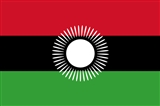
The Malawian flag is made up of three equal horizontal stripes of black, red and green with a red rising sun superimposed in the center of the black stripe. The black stripe represents the African people, the red represents the blood of martyrs for African freedom, green represents Malawi's ever-green nature and the rising sun represents the dawn of freedom and hope for Africa.

A strong part of Malawi's culture is its dance
Dance

Dance is an art form that generally refers to Motion of the body, usually rhythmic and to music, used as a form of Emotional expression, social social interaction or presented in a spirituality or performance setting....
s, and the National Dance Troupe (formerly the Kwacha Cultural Troupe) was formed in November 1987 by the government. Traditional music and dances can be seen at initiation rites, ritual
Ritual

A ritual is a set of repeated actions, often thought to have symbolic value, the performance of which is usually prescribed by a religion or by the traditions of a community by religious or political laws because of the perceived efficacy of those actions....
s, marriage
Marriage

Marriage is a social, spirituality, or law union of individuals. This union may also be called matrimony, while the ceremony that marks its beginning is usually called a wedding and the married status created is sometimes called wedlock....
 ceremonies and celebrations. Soccer is the most common sport in Malawi, introduced there during British colonial rule. Basketball
Basketball

Basketball is a team sport in which two teams of five active players each try to score points against one another by propelling a basketball through a 10 feet  high hoop under organized rules....
 is also growing in popularity. The native tribes of Malawi have a rich tradition of basketry and mask
Mask

A mask is an article normally worn on the face, typically for protection, concealment, performance, or amusement. Masks have been used since antiquity for both ceremonial and practical purposes....
 carving
Wood carving

Wood carving is a form of Woodworking by means of a cutting tool held in the hand , resulting in a wooden figure or figurine or in the sculpture ornamentation of a wooden object....
, and some of these goods are used in traditional ceremonies still performed by native peoples. Wood carving
Wood carving

Wood carving is a form of Woodworking by means of a cutting tool held in the hand , resulting in a wooden figure or figurine or in the sculpture ornamentation of a wooden object....
 and oil painting
Oil painting

Oil painting is the process of painting with pigments that are bound with a medium of drying oil ? especially in early modern Europe, linseed oil....
 are also popular in more urban centers, with many of the items produced being sold to tourists. There are several internationally recognized literary figures from Malawi, including poet Jack Mapanje
Jack Mapanje

Jack Mapanje is a Malawian writer and poet. He was the former head of English at the University of Malawi, and is currently a senior lecturer in English at Newcastle University....
, history and fiction writer Paul Zeleza
Paul Tiyambe Zeleza

Paul Tiyambe Zeleza is a Malawian historian, literary critic, novelist, short-story writer and blogger at The Zeleza Post - . He is currently president of the African Studies Association....
 and authors Legson Kayira
Legson Kayira

Legson Didimu Kayira is a Malawian novelist. Kayira, an ethnic Tumbuka, received an education at Skagit Valley College, University of Washington and St Catharine's College, Cambridge....
, Felix Mnthali
Felix Mnthali

Felix Mnthali is a Malawian poet, novelist and playwright. Educated at what is now the National University of Lesotho, Mnthali has been published several times, including a book of poetry called When Sunset Comes to Sapitwa and a novel called My Dear Anniversary ....
, Frank Chipasula
Frank Chipasula

Dr. Frank M. Chipasula is a Malawian writer, editor and university professor. Previously a professor of Black Studies at the University of Nebraska at Omaha and Howard University, Chipasula has also worked as the education attache at the Malawian embassy in Washington, D.C.....
 and David Rubadiri
David Rubadiri

James David Rubadiri is a Malawian diplomat, academic and poet. At independence in 1964, Rubadiri was appointed Malawi's first ambassador to the United States and the United Nations....
.

See also

  • List of Malawi-related articles
  • Outline of Malawi


External links

Government
  • Official website
  • [https://www.cia.gov/library/publications/world-leaders-1/world-leaders-m/malawi.html Chief of State and Cabinet Members]


General* from
UCB Libraries GovPubs Media
  • daily Blantyre
    Blantyre, Malawi

    This article is about the location in Malawi. See also Blantyre, South Lanarkshire. ...
    -based newspaper
  • daily Blantyre
    Blantyre, Malawi

    This article is about the location in Malawi. See also Blantyre, South Lanarkshire. ...
    -based newspaper


Tourism