

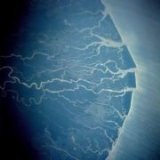
Niger Delta

Encyclopedia
The Niger Delta, the delta
of the Niger River
in Nigeria
, is a densely populated region sometimes called the Oil Rivers because it was once a major producer of palm oil
. The area was the British Oil Rivers Protectorate from 1885 until 1893, when it was expanded and became the Niger Coast Protectorate
.
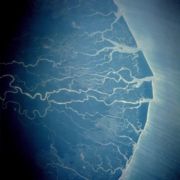 The Niger Delta, as now defined officially by the Nigerian government, extends over about 70,000 km² and makes up 7.5% of Nigeria’s land mass. Historically and cartographically, it consists of present day Bayelsa
, Delta
, and Rivers State
s. In 2000, however, Obansanjo's regime included Abia
, Akwa-Ibom, Cross River State
, Edo
, Imo
and Ondo
States in the region. Some 31 million people of more than 40 ethnic groups including the Efik, Ibibio
, Annang
, Oron, Ijaw, Itsekiri
, Igbo
, Isoko
, Urhobo
, Ilaje
, and Kalabari, are among the inhabitants in the Niger Delta, speaking about 250 different dialects.
The South-South Niger Delta, also known as the "South South Zone", includes Akwa Ibom State, Bayelsa State
, Cross River State
, Delta State
, Edo State
and Rivers State
.
The delta is an oil-rich region, and has been the centre of international controversy over devastating pollution, kleptocracy
(notably by the Abacha regime), and human rights violations in which Royal Dutch Shell
has been implicated.
, Annang
, Ibibio
, Oron, the Efik people, the Ijaw, and the Igbo people
, with Igbo as the majority and the NCNC (National Council of Nigeria and Cameroon) as the ruling political party in the region. NCNC later became National Convention of Nigerian Citizens, after western Cameroon decided to separate from Nigeria. The ruling party of eastern Nigeria did not seek to preclude the separation and even encouraged it.
In 1953, the old eastern region had a major crisis due to the expulsion of professor Eyo Ita
from office by the majority Igbo tribe of the old eastern region. Eyo Ita
from Calabar was one of the pioneer nationalists for Nigerian independence. He was an Efik man. The minorities in the region, the Ibibio
, Annang
, Efik, Ijaw and Ogoja
, demanded a state of their own, the Calabar-Ogoja-Rivers (COR) state. The struggle for the creation of COR state continued and was a major issue on the status of minorities in Nigeria during debates in Europe for Nigerian independence.
A second phase of the struggle saw the declaration of an Independent Niger Delta Republic by Isaac Adaka Boro
during Ironsi's administration, just before the Nigerian Civil War.
During the Nigerian civil war, Southeastern State of Nigeria was created (also known as Southeastern Nigeria
or Coastal Southeastern Nigeria), which had the colonial Calabar division, and colonial Ogoja
division. Rivers State
was also created. Southeastern state and River state became two states for the minorities of the old eastern region, and the majority Igbo of the old eastern region had a state called East Central state. Southeastern state was renamed Cross River state and was later split into Cross River state and Akwa Ibom state. Rivers state was later divided into Rivers state
and Bayelsa state
.
Phase three saw the request for justice and the end of marginalization of the area by the Nigerian government with Ken Saro Wiwa as the lead figure for this phase of the struggle. The indigents cried for lack of development even though the Nigerian oil money is from the area. They also complained about environmental pollution and destruction of their land and rivers by oil companies. Ken Saro Wiwa and other leaders were killed by the Nigerian Federal Government under Sani Abacha.
Unfortunately, the struggle got out of control, and the present phase, the phase four, has become militant.
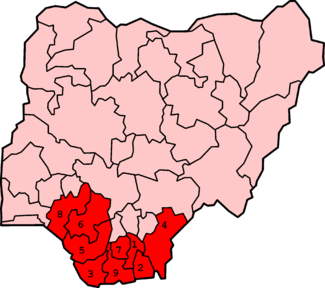
, and the southernmost parts of Edo
, and Ondo
States. The western (or Northern) Niger Delta is an heterogeneous society with several ethnic groups including the Urhobo
, Igbo
, Isoko
, Itsekiri
, Ijaw
(or Ezon) and Ukwuani
groups in Delta State, along with Ilaje
and Ijaw Arogbo(Izon Arogbo) in Ondo State. Their livelihoods are primarily based on fishing
and farming
. History has it that the Western Niger was controlled by chiefs of the five primary ethnic groups the Itsekiri, Isoko, Ukwuani, Ijaw and Urhobo with whom the British government had to sign separate "Treaties of Protection" with in their formation of "Protectorates" that later became southern Nigeria.
, Ikwerre and Ndoki in Rivers State.
and Cross River States. The Eastern Niger Delta region has the Efik, Ibibio
, Annang
, Oron, Ogoja
(including Ekoi
and Bekwara) people, who are all related with a common language and ancestor.
, including many oil wells in the Oil Rivers. Some 2 Moilbbl a day are extracted in the Niger Delta. Since 1975, the region has accounted for more than 75% of Nigeria's export
earnings. Much of the natural gas
extracted in oil wells in the Delta is immediately burned, or flared, into the air at a rate of approximately 70 million m³per day. This is equivalent to 41% of African natural gas consumption, and forms the largest single source of greenhouse gas
emissions on the planet. In 2003, about 99% of excess gas was flared in the Niger Delta. The biggest gas flaring company is the Shell Petroleum Development Company of Nigeria Ltd, a joint venture that is majority owned by the Nigerian government. In Nigeria, “...despite regulations introduced 20 years ago to outlaw the practice, most associated gas is flared, causing local pollution and contributing to climate change.” The environmental devastation associated with the industry and the lack of distribution of oil wealth have been the source and/or key aggravating factors of numerous environmental movements and inter-ethnic conflicts in the region, including recent guerilla activity by the Movement for the Emancipation of the Niger Delta
(MEND).
high degree of regional autonomy, and as low as 10% during the military dictatorships. This is the table below.
* State allocations are based on 5 criteria: equality (equal shares per state), population, social development, land mass, and revenue generation.
**The derivation formula refers to the percentage of the revenue oil producing states retain from taxes on oil and other natural resources produced in the state. World Bank Report
When long-held concerns about loss of control over resources to the oil companies were voiced by the Ijaw people in the Kaiama Declaration in 1998, the Nigerian government sent troops to occupy the Bayelsa and Delta states. Soldiers opened fire with rifles, machine guns, and tear gas, killing at least three protesters and arresting twenty-five more.
Since then, local indigenous activity against commercial oil refineries and pipelines in the region have increased in frequency and militancy. Recently foreign employees of Shell
, the primary corporation operating in the region, were taken hostage by outraged local people. Such activities have also resulted in greater governmental intervention in the area, and the mobilisation of the Nigerian army
and State Security Service
into the region, resulting in violence and human rights abuses.
In April, 2006, a bomb exploded near an oil refinery in the Niger Delta region, a warning against Chinese expansion in the region. MEND
stated: “We wish to warn the Chinese government and its oil companies to steer well clear of the Niger Delta. The Chinese government by investing in stolen crude places its citizens in our line of fire.” http://www.chinadialogue.net/article/show/single/en/741-China-s-environmental-footprint-in-Africa
Government and private initiatives to develop the Niger Delta region have been introduced recently. These include the Niger Delta Development Commission (NDDC http://www.nddcnet.com/), a government initiative, and the Development Initiative (DEVIN http://www.devinitiatives.org/), a community development non-governmental organization (NGO) based in Port Harcourt in the Niger Delta. Uz and Uz Transnational http://www.uzanduz.com/, a company with strong commitment to the Niger Delta, has introduced ways of developing the poor in the Niger Delta, especially in Rivers State.
In September 2008, MEND released a statement proclaiming that their militants had launched an "oil war" throughout the Niger Delta against both, pipelines and oil production facilities, and the Nigerian soldiers that protect them. Both MEND and the Nigerian Government claim to have inflicted heavy casualties on one another. http://news.bbc.co.uk/2/hi/africa/7615498.stm
In August 2009, The Nigerian Government granted Amnesty to the militants which saw the militants surrendering their weapons in exchange for a presidential pardon, rehabilitation programme and education.
which premiered April 2009 at the Full Frame Documentary Film Festival, tells the story of Nigeria’s Niger Delta.
River delta
A delta is a landform that is formed at the mouth of a river where that river flows into an ocean, sea, estuary, lake, reservoir, flat arid area, or another river. Deltas are formed from the deposition of the sediment carried by the river as the flow leaves the mouth of the river...
of the Niger River
Niger River
The Niger River is the principal river of western Africa, extending about . Its drainage basin is in area. Its source is in the Guinea Highlands in southeastern Guinea...
in Nigeria
Nigeria
Nigeria , officially the Federal Republic of Nigeria, is a federal constitutional republic comprising 36 states and its Federal Capital Territory, Abuja. The country is located in West Africa and shares land borders with the Republic of Benin in the west, Chad and Cameroon in the east, and Niger in...
, is a densely populated region sometimes called the Oil Rivers because it was once a major producer of palm oil
Palm oil
Palm oil, coconut oil and palm kernel oil are edible plant oils derived from the fruits of palm trees. Palm oil is extracted from the pulp of the fruit of the oil palm Elaeis guineensis; palm kernel oil is derived from the kernel of the oil palm and coconut oil is derived from the kernel of the...
. The area was the British Oil Rivers Protectorate from 1885 until 1893, when it was expanded and became the Niger Coast Protectorate
Niger Coast Protectorate
The Niger Coast Protectorate was a British protectorate in the Oil Rivers area of present-day Nigeria, originally established as the Oil Rivers Protectorate in 1891 and confirmed at the Berlin Conference the following year, renamed on 12 May 1893, and merged with the chartered territories of the...
.
Bayelsa State
Bayelsa State is a state in southern Nigeria in the core Niger Delta region, between Delta State and Rivers State. Its capital is Yenagoa. The language spoken here is Ijaw language and dialects of the Ijaw language such as Nembe, Atissa, Akassa, Ogbia, etc. However, like the rest of Nigeria,...
, Delta
Delta State
Delta State may refer to:*Delta State, a state in southern Nigeria.*Delta State , a Canadian animated television series.*Delta State University, a public university located in the U.S. state of Mississippi....
, and Rivers State
Rivers State
Rivers State is one of the 36 states of Nigeria. Its capital is Port Harcourt. It is bounded on the South by the Atlantic Ocean, to the North by Imo, Abia and Anambra States, to the East by Akwa Ibom State and to the West by Bayelsa and Delta states...
s. In 2000, however, Obansanjo's regime included Abia
Abia State
Abia State is a state in southeastern Nigeria. The capital is Umuahia, although the major commercial city is Aba, formerly a British colonial government outpost. The state was created in 1991 from part of Imo State and its citizens are predominantly Igbo people...
, Akwa-Ibom, Cross River State
Cross River State
Cross River State is a coastal state in southeastern Nigeria, bordering Cameroon to the east. Its capital is at Calabar, and it is named for the Cross River , which passes through the state...
, Edo
Edo State
Edo State is an inland state in central southern Nigeria. Its capital is Benin City. It is bounded in the north and east by Kogi State, in the south by Delta State and in the west by Ondo State.-History:...
, Imo
Imo State
Imo State is one of the 36 states of Nigeria and lies to the south of Nigeria with Owerri as its capital and largest city.-History:Imo State came into existence in 1976 along with other new states created under the leadership of the late military ruler of Nigeria, Murtala Muhammad, having been...
and Ondo
Ondo State
Ondo State, Nigeria was created on 3 February 1976 from the former Western State. It originally included what is now Ekiti State, which was split off in 1996. Akure is the state capital.-Government and society:...
States in the region. Some 31 million people of more than 40 ethnic groups including the Efik, Ibibio
Ibibio people
The Ibibio are a people of southeastern Nigeria. They are related to the Anaang and the Efik peoples. During colonial period in Nigeria, the Ibibio Union asked for recognition by the British as a sovereign nation . The Annang, Efik, Ekid, Oron and Ibeno share personal names, culture, and traditions...
, Annang
Annang
The Annang is a cultural and ethnic group that lives in the Coastal Southeast Nigeria...
, Oron, Ijaw, Itsekiri
Itsekiri
The Itsekiri are an ethnic group of Nigeria's Niger Delta area, Delta State. The Itsekiri presently number between 800,000–1,000,000 people and live mainly in the Warri South, Warri North and Warri South West local government districts of Delta State on the Atlantic Coast of Nigeria...
, Igbo
Igbo people
Igbo people, also referred to as the Ibo, Ebo, Eboans or Heebo are an ethnic group living chiefly in southeastern Nigeria. They speak Igbo, which includes various Igboid languages and dialects; today, a majority of them speak English alongside Igbo as a result of British colonialism...
, Isoko
Isoko people
Isoko people are an ethnolinguistic group that inhabits the Isoko region of Delta State, Nigeria.-Isoko Land:The Isoko Land is one of the most densely populated areas in Nigeria, with about 300 persons per square kilometre compared with the average of 198 for Delta State and 130 for Nigeria...
, Urhobo
Urhobo people
The Urhobo are people of southern Nigeria, near the northwestern Niger River delta. The Urhobo is the major ethnic group in Delta State; the Delta State is one of the 36 states of the Federal Republic of Nigeria. They speak Urhobo, a language in Niger–Congo group...
, Ilaje
Ilaje
Ilaje is a Local Government Area in Ondo State, Nigeria. Its headquarters are in the town of Igbokoda.It has an area of 1,318 km² and a population of 290,615 at the 2006 census.The postal code of the area is 352....
, and Kalabari, are among the inhabitants in the Niger Delta, speaking about 250 different dialects.
The South-South Niger Delta, also known as the "South South Zone", includes Akwa Ibom State, Bayelsa State
Bayelsa State
Bayelsa State is a state in southern Nigeria in the core Niger Delta region, between Delta State and Rivers State. Its capital is Yenagoa. The language spoken here is Ijaw language and dialects of the Ijaw language such as Nembe, Atissa, Akassa, Ogbia, etc. However, like the rest of Nigeria,...
, Cross River State
Cross River State
Cross River State is a coastal state in southeastern Nigeria, bordering Cameroon to the east. Its capital is at Calabar, and it is named for the Cross River , which passes through the state...
, Delta State
Delta State
Delta State may refer to:*Delta State, a state in southern Nigeria.*Delta State , a Canadian animated television series.*Delta State University, a public university located in the U.S. state of Mississippi....
, Edo State
Edo State
Edo State is an inland state in central southern Nigeria. Its capital is Benin City. It is bounded in the north and east by Kogi State, in the south by Delta State and in the west by Ondo State.-History:...
and Rivers State
Rivers State
Rivers State is one of the 36 states of Nigeria. Its capital is Port Harcourt. It is bounded on the South by the Atlantic Ocean, to the North by Imo, Abia and Anambra States, to the East by Akwa Ibom State and to the West by Bayelsa and Delta states...
.
The delta is an oil-rich region, and has been the centre of international controversy over devastating pollution, kleptocracy
Kleptocracy
Kleptocracy, alternatively cleptocracy or kleptarchy, is a form of political and government corruption where the government exists to increase the personal wealth and political power of its officials and the ruling class at the expense of the wider population, often without pretense of honest...
(notably by the Abacha regime), and human rights violations in which Royal Dutch Shell
Royal Dutch Shell
Royal Dutch Shell plc , commonly known as Shell, is a global oil and gas company headquartered in The Hague, Netherlands and with its registered office in London, United Kingdom. It is the fifth-largest company in the world according to a composite measure by Forbes magazine and one of the six...
has been implicated.
Niger Delta struggle
During the colonial period, the core Niger Delta was a part of eastern region of Nigeria, which came into being in 1951 (one of the three regions, and later one of the four regions). This region included the people from colonial Calabar and Ogoja divisions, which are the present OgojaOgoja
Ogoja is a Local Government Area in Cross River State, Nigeria. Its headquarters is Ogoja town in the northeast of the area near the A4 highway at.It has an area of 972 km² and a population of 171,901 at the 2006 census....
, Annang
Annang
The Annang is a cultural and ethnic group that lives in the Coastal Southeast Nigeria...
, Ibibio
Ibibio people
The Ibibio are a people of southeastern Nigeria. They are related to the Anaang and the Efik peoples. During colonial period in Nigeria, the Ibibio Union asked for recognition by the British as a sovereign nation . The Annang, Efik, Ekid, Oron and Ibeno share personal names, culture, and traditions...
, Oron, the Efik people, the Ijaw, and the Igbo people
Igbo people
Igbo people, also referred to as the Ibo, Ebo, Eboans or Heebo are an ethnic group living chiefly in southeastern Nigeria. They speak Igbo, which includes various Igboid languages and dialects; today, a majority of them speak English alongside Igbo as a result of British colonialism...
, with Igbo as the majority and the NCNC (National Council of Nigeria and Cameroon) as the ruling political party in the region. NCNC later became National Convention of Nigerian Citizens, after western Cameroon decided to separate from Nigeria. The ruling party of eastern Nigeria did not seek to preclude the separation and even encouraged it.
In 1953, the old eastern region had a major crisis due to the expulsion of professor Eyo Ita
Eyo Ita
Eyo Ita was a Nigerian politician from Cross River State who was the leader of the Eastern Government of Nigerian in 1951. He was one of the earliest Nigerian students who studied in the United States instead of the frequent route of studying in United Kingdom...
from office by the majority Igbo tribe of the old eastern region. Eyo Ita
Eyo Ita
Eyo Ita was a Nigerian politician from Cross River State who was the leader of the Eastern Government of Nigerian in 1951. He was one of the earliest Nigerian students who studied in the United States instead of the frequent route of studying in United Kingdom...
from Calabar was one of the pioneer nationalists for Nigerian independence. He was an Efik man. The minorities in the region, the Ibibio
Ibibio people
The Ibibio are a people of southeastern Nigeria. They are related to the Anaang and the Efik peoples. During colonial period in Nigeria, the Ibibio Union asked for recognition by the British as a sovereign nation . The Annang, Efik, Ekid, Oron and Ibeno share personal names, culture, and traditions...
, Annang
Annang
The Annang is a cultural and ethnic group that lives in the Coastal Southeast Nigeria...
, Efik, Ijaw and Ogoja
Ogoja
Ogoja is a Local Government Area in Cross River State, Nigeria. Its headquarters is Ogoja town in the northeast of the area near the A4 highway at.It has an area of 972 km² and a population of 171,901 at the 2006 census....
, demanded a state of their own, the Calabar-Ogoja-Rivers (COR) state. The struggle for the creation of COR state continued and was a major issue on the status of minorities in Nigeria during debates in Europe for Nigerian independence.
A second phase of the struggle saw the declaration of an Independent Niger Delta Republic by Isaac Adaka Boro
Isaac Adaka Boro
Major Isaac Jasper Adaka Boro , fondly called "Boro", was a celebrated Niger Delta nationalist and Nigerian civil war hero...
during Ironsi's administration, just before the Nigerian Civil War.
During the Nigerian civil war, Southeastern State of Nigeria was created (also known as Southeastern Nigeria
Southeastern Nigeria
Southeastern Nigeria consists of present Abia State, Akwa Ibom State, Anambra State, Bayelsa State, Cross River State, Ebonyi State, Enugu State, Imo State, and Rivers State of Nigeria.-"Precolonial" era:...
or Coastal Southeastern Nigeria), which had the colonial Calabar division, and colonial Ogoja
Ogoja
Ogoja is a Local Government Area in Cross River State, Nigeria. Its headquarters is Ogoja town in the northeast of the area near the A4 highway at.It has an area of 972 km² and a population of 171,901 at the 2006 census....
division. Rivers State
Rivers State
Rivers State is one of the 36 states of Nigeria. Its capital is Port Harcourt. It is bounded on the South by the Atlantic Ocean, to the North by Imo, Abia and Anambra States, to the East by Akwa Ibom State and to the West by Bayelsa and Delta states...
was also created. Southeastern state and River state became two states for the minorities of the old eastern region, and the majority Igbo of the old eastern region had a state called East Central state. Southeastern state was renamed Cross River state and was later split into Cross River state and Akwa Ibom state. Rivers state was later divided into Rivers state
Rivers State
Rivers State is one of the 36 states of Nigeria. Its capital is Port Harcourt. It is bounded on the South by the Atlantic Ocean, to the North by Imo, Abia and Anambra States, to the East by Akwa Ibom State and to the West by Bayelsa and Delta states...
and Bayelsa state
Bayelsa State
Bayelsa State is a state in southern Nigeria in the core Niger Delta region, between Delta State and Rivers State. Its capital is Yenagoa. The language spoken here is Ijaw language and dialects of the Ijaw language such as Nembe, Atissa, Akassa, Ogbia, etc. However, like the rest of Nigeria,...
.
Phase three saw the request for justice and the end of marginalization of the area by the Nigerian government with Ken Saro Wiwa as the lead figure for this phase of the struggle. The indigents cried for lack of development even though the Nigerian oil money is from the area. They also complained about environmental pollution and destruction of their land and rivers by oil companies. Ken Saro Wiwa and other leaders were killed by the Nigerian Federal Government under Sani Abacha.
Unfortunately, the struggle got out of control, and the present phase, the phase four, has become militant.
Western (or Northern) Niger Delta
Western Niger Delta consists of the western section of the coastal South-South Nigeria which includes DeltaDelta State
Delta State may refer to:*Delta State, a state in southern Nigeria.*Delta State , a Canadian animated television series.*Delta State University, a public university located in the U.S. state of Mississippi....
, and the southernmost parts of Edo
Edo State
Edo State is an inland state in central southern Nigeria. Its capital is Benin City. It is bounded in the north and east by Kogi State, in the south by Delta State and in the west by Ondo State.-History:...
, and Ondo
Ondo State
Ondo State, Nigeria was created on 3 February 1976 from the former Western State. It originally included what is now Ekiti State, which was split off in 1996. Akure is the state capital.-Government and society:...
States. The western (or Northern) Niger Delta is an heterogeneous society with several ethnic groups including the Urhobo
Urhobo people
The Urhobo are people of southern Nigeria, near the northwestern Niger River delta. The Urhobo is the major ethnic group in Delta State; the Delta State is one of the 36 states of the Federal Republic of Nigeria. They speak Urhobo, a language in Niger–Congo group...
, Igbo
Igbo people
Igbo people, also referred to as the Ibo, Ebo, Eboans or Heebo are an ethnic group living chiefly in southeastern Nigeria. They speak Igbo, which includes various Igboid languages and dialects; today, a majority of them speak English alongside Igbo as a result of British colonialism...
, Isoko
Isoko people
Isoko people are an ethnolinguistic group that inhabits the Isoko region of Delta State, Nigeria.-Isoko Land:The Isoko Land is one of the most densely populated areas in Nigeria, with about 300 persons per square kilometre compared with the average of 198 for Delta State and 130 for Nigeria...
, Itsekiri
Itsekiri
The Itsekiri are an ethnic group of Nigeria's Niger Delta area, Delta State. The Itsekiri presently number between 800,000–1,000,000 people and live mainly in the Warri South, Warri North and Warri South West local government districts of Delta State on the Atlantic Coast of Nigeria...
, Ijaw
Ijaw
Ijaw are a collection of peoples indigenous mostly to the forest regions of the Bayelsa, Delta, and Rivers States within the Niger Delta in Nigeria. Some are natives of Akwa-Ibom, Edo, and Ondo states also in Nigeria...
(or Ezon) and Ukwuani
Ukwuani
Ụkwụànì are an Igbo group in Delta and Rivers states in Nigeria.-Language:The Ụkwụànì dialect, which is intelligible with the dialects of Aboh and Ndoni, is considered a dialect of the Igbo language.-Economy:...
groups in Delta State, along with Ilaje
Ilaje
Ilaje is a Local Government Area in Ondo State, Nigeria. Its headquarters are in the town of Igbokoda.It has an area of 1,318 km² and a population of 290,615 at the 2006 census.The postal code of the area is 352....
and Ijaw Arogbo(Izon Arogbo) in Ondo State. Their livelihoods are primarily based on fishing
Fishing
Fishing is the activity of trying to catch wild fish. Fish are normally caught in the wild. Techniques for catching fish include hand gathering, spearing, netting, angling and trapping....
and farming
Agriculture
Agriculture is the cultivation of animals, plants, fungi and other life forms for food, fiber, and other products used to sustain life. Agriculture was the key implement in the rise of sedentary human civilization, whereby farming of domesticated species created food surpluses that nurtured the...
. History has it that the Western Niger was controlled by chiefs of the five primary ethnic groups the Itsekiri, Isoko, Ukwuani, Ijaw and Urhobo with whom the British government had to sign separate "Treaties of Protection" with in their formation of "Protectorates" that later became southern Nigeria.
Central Niger Delta
Central Niger Delta consists of the central section of the coastal South-South Nigeria which includes Bayelsa and Rivers States. The Central Niger Delta region has the Ijaw (including the Nembe-Brass, Ogbia, Kalabari, Ibanis (Opobo, Bonny,etc.), Okrika, and Andoni clans, the Ogoni and other groups which consist of the Ekpeye, Ndoni, EtcheEtche
Etche is a Local Government Area in Rivers State, Nigeria, named after the Etche people of Southern Nigeria. The Etche are as Igbo tribe and speak their own dialect of the Igbo language...
, Ikwerre and Ndoki in Rivers State.
Eastern Niger Delta
Eastern Niger Delta Section consists of the Eastern (or Atlantic) section of the coastal South-South Nigeria which includes Akwa IbomAkwa Ibom
Akwa Ibom is a state in Nigeria named after the Qua Iboe river. It is located in the coastal South-Southern part of the country, lying between latitudes 4°321 and 5°331 North, and longitudes 7°251 and 8°251 East...
and Cross River States. The Eastern Niger Delta region has the Efik, Ibibio
Ibibio people
The Ibibio are a people of southeastern Nigeria. They are related to the Anaang and the Efik peoples. During colonial period in Nigeria, the Ibibio Union asked for recognition by the British as a sovereign nation . The Annang, Efik, Ekid, Oron and Ibeno share personal names, culture, and traditions...
, Annang
Annang
The Annang is a cultural and ethnic group that lives in the Coastal Southeast Nigeria...
, Oron, Ogoja
Ogoja
Ogoja is a Local Government Area in Cross River State, Nigeria. Its headquarters is Ogoja town in the northeast of the area near the A4 highway at.It has an area of 972 km² and a population of 171,901 at the 2006 census....
(including Ekoi
Ekoi people
Ekoi people, also known as Ejagham, are an ethnic group in the extreme southeast of Nigeria and extending eastward into Northern Cameroon. Ekoid Bantu languages are spoken by many groups, including the Atam, Boki, Mbembe, Ufia, and Yako...
and Bekwara) people, who are all related with a common language and ancestor.
Nigerian oil
Nigeria has become Africa's biggest producer of petroleumPetroleum
Petroleum or crude oil is a naturally occurring, flammable liquid consisting of a complex mixture of hydrocarbons of various molecular weights and other liquid organic compounds, that are found in geologic formations beneath the Earth's surface. Petroleum is recovered mostly through oil drilling...
, including many oil wells in the Oil Rivers. Some 2 Moilbbl a day are extracted in the Niger Delta. Since 1975, the region has accounted for more than 75% of Nigeria's export
Export
The term export is derived from the conceptual meaning as to ship the goods and services out of the port of a country. The seller of such goods and services is referred to as an "exporter" who is based in the country of export whereas the overseas based buyer is referred to as an "importer"...
earnings. Much of the natural gas
Natural gas
Natural gas is a naturally occurring gas mixture consisting primarily of methane, typically with 0–20% higher hydrocarbons . It is found associated with other hydrocarbon fuel, in coal beds, as methane clathrates, and is an important fuel source and a major feedstock for fertilizers.Most natural...
extracted in oil wells in the Delta is immediately burned, or flared, into the air at a rate of approximately 70 million m³per day. This is equivalent to 41% of African natural gas consumption, and forms the largest single source of greenhouse gas
Greenhouse gas
A greenhouse gas is a gas in an atmosphere that absorbs and emits radiation within the thermal infrared range. This process is the fundamental cause of the greenhouse effect. The primary greenhouse gases in the Earth's atmosphere are water vapor, carbon dioxide, methane, nitrous oxide, and ozone...
emissions on the planet. In 2003, about 99% of excess gas was flared in the Niger Delta. The biggest gas flaring company is the Shell Petroleum Development Company of Nigeria Ltd, a joint venture that is majority owned by the Nigerian government. In Nigeria, “...despite regulations introduced 20 years ago to outlaw the practice, most associated gas is flared, causing local pollution and contributing to climate change.” The environmental devastation associated with the industry and the lack of distribution of oil wealth have been the source and/or key aggravating factors of numerous environmental movements and inter-ethnic conflicts in the region, including recent guerilla activity by the Movement for the Emancipation of the Niger Delta
Movement for the Emancipation of the Niger Delta
The Movement for the Emancipation of the Niger Delta is one of the largest militant groups in the Niger Delta region of Nigeria. The organization claims to expose exploitation and oppression of the people of the Niger Delta and devastation of the natural environment by public-private partnerships...
(MEND).
Oil revenue derivation
Oil revenue allocation has been the subject of much contention well before Nigeria gained its independence. Allocations have varied from as much as 50%, owing to the First Republic'sNigerian First Republic
The First Republic was the republican government of Nigeria between 1963 and 1966 governed by the first republican constitution.-Founding :...
high degree of regional autonomy, and as low as 10% during the military dictatorships. This is the table below.
| Year | Federal | State* | Local | Special Projects | Derivation Formula** |
|---|---|---|---|---|---|
| 1958 | 40% | 60% | 0% | 0% | 50% |
| 1968 | 80% | 20% | 0% | 0% | 10% |
| 1977 | 75% | 22% | 3% | 0% | 10% |
| 1982 | 55% | 32.5% | 10% | 2.5% | 10% |
| 1989 | 50% | 24% | 15% | 11% | 10% |
| 1995 | 48.5% | 24% | 20% | 7.5% | 13% |
| 2001 | 48.5% | 24% | 20% | 7.5% | 13% |
* State allocations are based on 5 criteria: equality (equal shares per state), population, social development, land mass, and revenue generation.
**The derivation formula refers to the percentage of the revenue oil producing states retain from taxes on oil and other natural resources produced in the state. World Bank Report
Recent crisis
The effects of oil in the fragile Niger Delta communities and environment have been enormous. Local indigenous people have seen little if any improvement in their standard of living while suffering serious damage to their natural environment. According to Nigerian federal government figures, there were more than 7,000 oil spills between 1970 and 2000. http://www.guardian.co.uk/world/2010/may/30/oil-spills-nigeria-niger-delta-shellWhen long-held concerns about loss of control over resources to the oil companies were voiced by the Ijaw people in the Kaiama Declaration in 1998, the Nigerian government sent troops to occupy the Bayelsa and Delta states. Soldiers opened fire with rifles, machine guns, and tear gas, killing at least three protesters and arresting twenty-five more.
Since then, local indigenous activity against commercial oil refineries and pipelines in the region have increased in frequency and militancy. Recently foreign employees of Shell
Royal Dutch Shell
Royal Dutch Shell plc , commonly known as Shell, is a global oil and gas company headquartered in The Hague, Netherlands and with its registered office in London, United Kingdom. It is the fifth-largest company in the world according to a composite measure by Forbes magazine and one of the six...
, the primary corporation operating in the region, were taken hostage by outraged local people. Such activities have also resulted in greater governmental intervention in the area, and the mobilisation of the Nigerian army
Nigerian Army
The Nigerian Army the largest of the Nigerian Armed Forces, has about 100,000 professional personnel. The original elements of the Royal West African Frontier Force in Nigeria were formed in 1900....
and State Security Service
State Security Service
State Security Service is the primary domestic intelligence agency of Nigeria. It is primarily responsible for the gathering of intelligence within the country and for the protection of senior government officials, particularly the President and state governors. It is one of three successor...
into the region, resulting in violence and human rights abuses.
In April, 2006, a bomb exploded near an oil refinery in the Niger Delta region, a warning against Chinese expansion in the region. MEND
Movement for the Emancipation of the Niger Delta
The Movement for the Emancipation of the Niger Delta is one of the largest militant groups in the Niger Delta region of Nigeria. The organization claims to expose exploitation and oppression of the people of the Niger Delta and devastation of the natural environment by public-private partnerships...
stated: “We wish to warn the Chinese government and its oil companies to steer well clear of the Niger Delta. The Chinese government by investing in stolen crude places its citizens in our line of fire.” http://www.chinadialogue.net/article/show/single/en/741-China-s-environmental-footprint-in-Africa
Government and private initiatives to develop the Niger Delta region have been introduced recently. These include the Niger Delta Development Commission (NDDC http://www.nddcnet.com/), a government initiative, and the Development Initiative (DEVIN http://www.devinitiatives.org/), a community development non-governmental organization (NGO) based in Port Harcourt in the Niger Delta. Uz and Uz Transnational http://www.uzanduz.com/, a company with strong commitment to the Niger Delta, has introduced ways of developing the poor in the Niger Delta, especially in Rivers State.
In September 2008, MEND released a statement proclaiming that their militants had launched an "oil war" throughout the Niger Delta against both, pipelines and oil production facilities, and the Nigerian soldiers that protect them. Both MEND and the Nigerian Government claim to have inflicted heavy casualties on one another. http://news.bbc.co.uk/2/hi/africa/7615498.stm
In August 2009, The Nigerian Government granted Amnesty to the militants which saw the militants surrendering their weapons in exchange for a presidential pardon, rehabilitation programme and education.
Media
The documentary film, Sweet CrudeSweet Crude
Sweet Crude is a documentary film by Sandy Cioffi about Nigeria's oil-rich Niger Delta. The film premiered in April 2009 at the Full Frame Documentary Film Festival and has since screened at 30 film festivals around the world and has won numerous awards....
which premiered April 2009 at the Full Frame Documentary Film Festival, tells the story of Nigeria’s Niger Delta.
See also
- Ijaw
- IbibioIbibio peopleThe Ibibio are a people of southeastern Nigeria. They are related to the Anaang and the Efik peoples. During colonial period in Nigeria, the Ibibio Union asked for recognition by the British as a sovereign nation . The Annang, Efik, Ekid, Oron and Ibeno share personal names, culture, and traditions...
- AnnangAnnangThe Annang is a cultural and ethnic group that lives in the Coastal Southeast Nigeria...
- Efik people
- Oron (state)Oron (state)Oron was one of the major states in the Akwa Akpa Kingdom of present-day Nigeria. Oron people share a close ancestral lineage to the Efik people in Cross River State; Ibono, Uruan, Eastern Obolo in Akwa Ibom State and the Andoni people in Rivers State...
- Ogoni
- ItsekiriItsekiriThe Itsekiri are an ethnic group of Nigeria's Niger Delta area, Delta State. The Itsekiri presently number between 800,000–1,000,000 people and live mainly in the Warri South, Warri North and Warri South West local government districts of Delta State on the Atlantic Coast of Nigeria...
- Urhobo peopleUrhobo peopleThe Urhobo are people of southern Nigeria, near the northwestern Niger River delta. The Urhobo is the major ethnic group in Delta State; the Delta State is one of the 36 states of the Federal Republic of Nigeria. They speak Urhobo, a language in Niger–Congo group...
- Petroleum in NigeriaPetroleum in NigeriaThe petroleum industry in Nigeria is the largest industry and main generator of GDP in the West African nation which is also the continent's most populous...
- Niger Delta conflicts
- Nigerian Oil Crisis
- Niger Delta Development Commission (NDDC)
External links
- Curse of the Black Gold, Hope and betrayal on the Niger Delta, National Geographic, February 2007
- More about the Niger deltans