
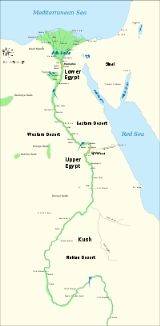
Lower Egypt is the northern-most section of
EgyptEgypt , officially the Arab Republic of Egypt, Arabic: , is a country mainly in North Africa, with the Sinai Peninsula forming a land bridge in Southwest Asia. Egypt is thus a transcontinental country, and a major power in Africa, the Mediterranean Basin, the Middle East and the Muslim world...
. It refers to the fertile
Nile DeltaThe Nile Delta is the delta formed in Northern Egypt where the Nile River spreads out and drains into the Mediterranean Sea. It is one of the world's largest river deltas—from Alexandria in the west to Port Said in the east, it covers some 240 km of Mediterranean coastline—and is a rich...
region, which stretches from the area between El-Aiyat and Zawyet Dahshur, south of modern-day
CairoCairo , is the capital of Egypt and the largest city in the Arab world and Africa, and the 16th largest metropolitan area in the world. Nicknamed "The City of a Thousand Minarets" for its preponderance of Islamic architecture, Cairo has long been a centre of the region's political and cultural life...
, and the
Mediterranean SeaThe Mediterranean Sea is a sea connected to the Atlantic Ocean surrounded by the Mediterranean region and almost completely enclosed by land: on the north by Anatolia and Europe, on the south by North Africa, and on the east by the Levant...
.
Today there are two principal channels that the Nile takes through the
riverA river is a natural watercourse, usually freshwater, flowing towards an ocean, a lake, a sea, or another river. In a few cases, a river simply flows into the ground or dries up completely before reaching another body of water. Small rivers may also be called by several other names, including...
's delta: one in the west at
RashidRashid or Rachid may refer to:*Rashid , people with the name*Rosetta, anglicized name of the city and port of Rashid in Egypt*Rashid, Yemen*Rachid, Mauritania, a town at the foot of the Tagant Plateau-See also:*Rashad...
and one in the east at
DamiettaDamietta , also known as Damiata, or Domyat, is a port and the capital of the Damietta Governorate in Egypt. It is located at the intersection between the Mediterranean Sea and the Nile, about north of Cairo.-History:...
. In ancient times,
Pliny the ElderGaius Plinius Secundus , better known as Pliny the Elder, was a Roman author, naturalist, and natural philosopher, as well as naval and army commander of the early Roman Empire, and personal friend of the emperor Vespasian...
(N.H. 5.11) said that upon reaching the delta the Nile split into seven branches (from east to west): the
PelusiacPelusium was a city in the eastern extremes of Egypt's Nile Delta, 30 km to the southeast of the modern Port Said. Alternative names include Sena and Per-Amun , Pelousion , Sin , Seyân , and Tell el-Farama...
, the Tanitic, the
MendesMendes , the Greek name of the Ancient Egyptian city of Djedet, also known in Ancient Egypt as Per-Banebdjedet and Anpet, is known today as Tell El-Ruba ....
ian, the Phatnitic, the Sebennytic, the
BolbitineRosetta is a port city on the Mediterranean coast of Egypt. It is located east of Alexandria, in Beheira governorate. It was founded around AD 800....
, and the
CanopicCanopus was an Ancient Egyptian coastal town, located in the Nile Delta. Its site is in the eastern outskirts of modern-day Alexandria, around 25 kilometres from the centre of that city....
. Today the delta region is well watered, crisscrossed by channels and canals.
Lower Egypt was known as
Ta-Mehu which means "land of
papyrusPapyrus is a thick paper-like material produced from the pith of the papyrus plant, Cyperus papyrus, a wetland sedge that was once abundant in the Nile Delta of Egypt....
." It was divided into twenty districts called
nomeA nome was a subnational administrative division of ancient Egypt. Today's use of the Greek nome rather than the Egyptian term sepat came about during the Ptolemaic period. Fascinated with Egypt, Greeks created many historical records about the country...
s, the first of which was at
el-LishtLisht or el-Lisht is an Egyptian village located south of Cairo. It is the site of Middle Kingdom royal and elite burials, including two pyramids built by Amenemhat I and Senusret I. The two main pyramids were surrounded by smaller pyramids of members of the royal family, and many mastaba tombs of...
. Because Lower Egypt was mostly undeveloped scrubland, undeveloped for human life and filled with all types of plant life such as grasses and herbs, the organization of the nomes underwent several changes.
The climate in Lower Egypt is milder than that of
Upper EgyptUpper Egypt is the strip of land, on both sides of the Nile valley, that extends from the cataract boundaries of modern-day Aswan north to the area between El-Ayait and Zawyet Dahshur . The northern section of Upper Egypt, between El-Ayait and Sohag is sometimes known as Middle Egypt...
owing primarily to its proximity to the Mediterranean Sea. Temperatures are less extreme and rainfall is more abundant.
The capital of Lower Egypt was
MemphisMemphis was the ancient capital of Aneb-Hetch, the first nome of Lower Egypt. Its ruins are located near the town of Helwan, south of Cairo.According to legend related by Manetho, the city was founded by the pharaoh Menes around 3000 BC. Capital of Egypt during the Old Kingdom, it remained an...
. Its patron Goddess was the cobra goddess
WadjetIn Egyptian mythology, Wadjet, or the Green One , was originally the ancient local goddess of the city of Dep , which became part of the city that the Egyptians named Per-Wadjet, House of...
. Lower Egypt was represented by the Low Red Crown
DeshretDeshret, from ancient Egyptian, was the formal name for the Red Crown of and for the desert Red Land on either side of Kemet, the fertile Nile river basin. The end has a curly wire on it, that represents the proboscis of a honey bee. Deshret or DSRT also represents the insect known as the honeybee...
, and its symbols were the papyrus and the bee.
See also
- Upper Egypt
Upper Egypt is the strip of land, on both sides of the Nile valley, that extends from the cataract boundaries of modern-day Aswan north to the area between El-Ayait and Zawyet Dahshur . The northern section of Upper Egypt, between El-Ayait and Sohag is sometimes known as Middle Egypt...
- Middle Egypt
Middle Egypt is the section of land between Lower Egypt and Upper Egypt, stretching upstream from Asyut in the south to Memphis in the north. At the time, Ancient Egypt was divided into Lower and Upper Egypt, though Middle Egypt was technically a subdivision of Upper Egypt. It was not until the...
- Upper and Lower Egypt
Ancient Egypt was divided into two regions, namely Upper Egypt and Lower Egypt. To the north was Lower Egypt where the Nile stretched out with its several branches to form the Nile Delta. To the south was Upper Egypt, stretching to Syene. The two kingdoms of Upper and Lower Egypt were united c....
- Nomes of Egypt
A nome was a subnational administrative division of ancient Egypt. Today's use of the Greek nome rather than the Egyptian term sepat came about during the Ptolemaic period. Fascinated with Egypt, Greeks created many historical records about the country...
- Geography of Egypt
The Geography of Egypt relates to two regions: Southwest Asia and North Africa.Egypt has coastlines on both the Mediterranean Sea and the Red Sea. The country borders Libya to the west, the Gaza Strip and Israel to the east, and Sudan to the south...
- Ancient Egypt
Ancient Egypt was an ancient civilization of Northeastern Africa, concentrated along the lower reaches of the Nile River in what is now the modern country of Egypt. Egyptian civilization coalesced around 3150 BC with the political unification of Upper and Lower Egypt under the first pharaoh...
( (Definition Of Egypt) )