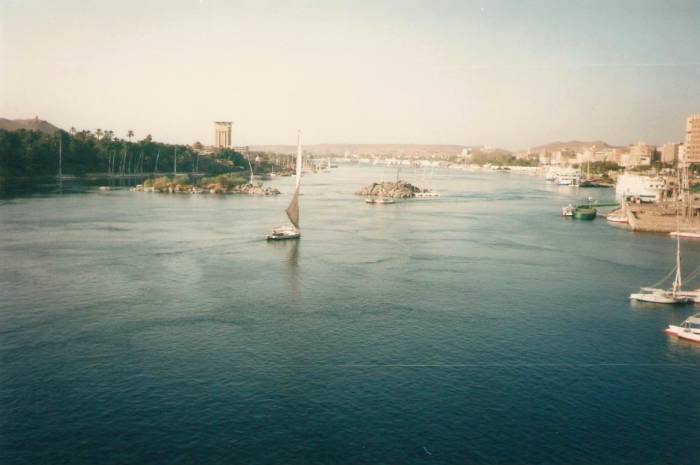
Cataracts of the Nile

Encyclopedia
Nile
The Nile is a major north-flowing river in North Africa, generally regarded as the longest river in the world. It is long. It runs through the ten countries of Sudan, South Sudan, Burundi, Rwanda, Democratic Republic of the Congo, Tanzania, Kenya, Ethiopia, Uganda and Egypt.The Nile has two major...
between Aswan
Aswan
Aswan , formerly spelled Assuan, is a city in the south of Egypt, the capital of the Aswan Governorate.It stands on the east bank of the Nile at the first cataract and is a busy market and tourist centre...
and Khartoum
Khartoum
Khartoum is the capital and largest city of Sudan and of Khartoum State. It is located at the confluence of the White Nile flowing north from Lake Victoria, and the Blue Nile flowing west from Ethiopia. The location where the two Niles meet is known as "al-Mogran"...
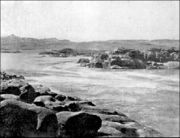
where the surface of the water is broken by many small boulders and stones protruding out of the river bed, as well as many rocky islet
Islet
An islet is a very small island.- Types :As suggested by its origin as islette, an Old French diminutive of "isle", use of the term implies small size, but little attention is given to drawing an upper limit on its applicability....
s. Aswan
Aswan
Aswan , formerly spelled Assuan, is a city in the south of Egypt, the capital of the Aswan Governorate.It stands on the east bank of the Nile at the first cataract and is a busy market and tourist centre...
is also the Southern boundary of Upper Egypt
Upper Egypt
Upper Egypt is the strip of land, on both sides of the Nile valley, that extends from the cataract boundaries of modern-day Aswan north to the area between El-Ayait and Zawyet Dahshur . The northern section of Upper Egypt, between El-Ayait and Sohag is sometimes known as Middle Egypt...
. In some places, these stretches are punctuated by whitewater
Whitewater
Whitewater is formed in a rapid, when a river's gradient increases enough to disturb its laminar flow and create turbulence, i.e. form a bubbly, or aerated and unstable current; the frothy water appears white...
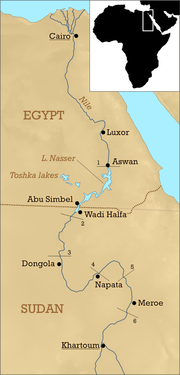
and are perhaps well characterized as rapids, while at others the water flow is smoother, but still shallow. Counted going upstream (from north to south), the First Cataract is in modern Egypt
Egypt
Egypt , officially the Arab Republic of Egypt, Arabic: , is a country mainly in North Africa, with the Sinai Peninsula forming a land bridge in Southwest Asia. Egypt is thus a transcontinental country, and a major power in Africa, the Mediterranean Basin, the Middle East and the Muslim world...
; the rest are in Sudan
Sudan
Sudan , officially the Republic of the Sudan , is a country in North Africa, sometimes considered part of the Middle East politically. It is bordered by Egypt to the north, the Red Sea to the northeast, Eritrea and Ethiopia to the east, South Sudan to the south, the Central African Republic to the...
.
- The First Cataract cuts through AswanAswanAswan , formerly spelled Assuan, is a city in the south of Egypt, the capital of the Aswan Governorate.It stands on the east bank of the Nile at the first cataract and is a busy market and tourist centre...
(24.078°N 32.878°E) This is also the only cataract that is in modern-day Egypt; the rest are now in Sudan. - The Second Cataract (or Great Cataract) was in NubiaNubiaNubia is a region along the Nile river, which is located in northern Sudan and southern Egypt.There were a number of small Nubian kingdoms throughout the Middle Ages, the last of which collapsed in 1504, when Nubia became divided between Egypt and the Sennar sultanate resulting in the Arabization...
and is now submerged under Lake NasserLake NasserLake Nasser is a vast reservoir in southern Egypt, and northern Sudan, and is one of the largest man-made lakes in the world. Strictly, "Lake Nasser" refers only to the much larger portion of the lake that is in Egyptian territory , with the Sudanese preferring to call their smaller body of water...
(21.48°N 30.97°E) - The Third Cataract is around Tombos/Hannek (19.76°N 30.37°E)
- The Fourth Cataract is in the Manasir DesertDar al-ManasirDar al-Manasir is the region of the Fourth Cataract, the most impassable of all rapids of the Nile. It is the homeland of the Arab tribe of the Manasir and from them gets its name...
and is flooded by the Merowe DamMerowe DamThe Merowe Dam, also known as Merowe High Dam, Merowe Multi-Purpose Hydro Project or Hamdab Dam, is a large dam near Merowe Town in northern Sudan, about north of the capital Khartoum. Its dimensions make it the largest contemporary hydropower project in Africa...
beginning in the third quarter of 2008 (18.91°N 32.36°E) - The Fifth Cataract is near the confluenceConfluenceConfluence, in geography, describes the meeting of two or more bodies of water.Confluence may also refer to:* Confluence , a property of term rewriting systems...
of the NileNileThe Nile is a major north-flowing river in North Africa, generally regarded as the longest river in the world. It is long. It runs through the ten countries of Sudan, South Sudan, Burundi, Rwanda, Democratic Republic of the Congo, Tanzania, Kenya, Ethiopia, Uganda and Egypt.The Nile has two major...
and Atbarah RiverAtbarah RiverThe Atbarah River in northeast Africa rises in northwest Ethiopia, approximately 50 km north of Lake Tana and 30 km west of Gondar. It flows about 805 km to the Nile in north-central Sudan, joining it at the city of Atbarah...
s (17.677°N 33.970°E) - The Sixth Cataract is where the Nile cuts through the Sabaluka plutonIntrusionAn intrusion is liquid rock that forms under Earth's surface. Magma from under the surface is slowly pushed up from deep within the earth into any cracks or spaces it can find, sometimes pushing existing country rock out of the way, a process that can take millions of years. As the rock slowly...
, close to BagrawiyahMeroëMeroë Meroitic: Medewi or Bedewi; Arabic: and Meruwi) is an ancient city on the east bank of the Nile about 6 km north-east of the Kabushiya station near Shendi, Sudan, approximately 200 km north-east of Khartoum. Near the site are a group of villages called Bagrawiyah...
(16.288°N 32.671°E)
Characteristics
The word cataract is a Greek word literally "down-rushing", meaning "rapids", "floodgate" or "waterfallWaterfall
A waterfall is a place where flowing water rapidly drops in elevation as it flows over a steep region or a cliff.-Formation:Waterfalls are commonly formed when a river is young. At these times the channel is often narrow and deep. When the river courses over resistant bedrock, erosion happens...
". However, none of the Nile
Nile
The Nile is a major north-flowing river in North Africa, generally regarded as the longest river in the world. It is long. It runs through the ten countries of Sudan, South Sudan, Burundi, Rwanda, Democratic Republic of the Congo, Tanzania, Kenya, Ethiopia, Uganda and Egypt.The Nile has two major...
's six primary cataracts could be accurately described as waterfalls, and given a broader definition, this is the same with many of the minor cataracts. Geologists indicate that the region of the northern Sudan is tectonically
Plate tectonics
Plate tectonics is a scientific theory that describes the large scale motions of Earth's lithosphere...
active and this activity has caused the river to take on "youthful" characteristics. The Nubian Swell
Nubian Swell
The Nubian Swell is a geologic structural uplift in northern Africa that trends east-west and separates the lower Nile of Egypt from the Sudan basin. The Nubian Swell has been geologically active since early Mesozoic times, and portions are still active...
has diverted the river's course to the west, while keeping its depth shallow and causing the formation of the cataracts. Even as the river bed is worn down by erosion
Erosion
Erosion is when materials are removed from the surface and changed into something else. It only works by hydraulic actions and transport of solids in the natural environment, and leads to the deposition of these materials elsewhere...
, the land mass is lifted, keeping parts of the river bed exposed. These distinctive features of the river between Aswan and Khartoum have led to the stretch being often referred to as the Cataract Nile, while the downstream portion is occasionally referred to as the "Egyptian" Nile. The geological distinction between these two portions of the river is considerable. North of Aswan, the river bed is not rocky, but is instead composed of sediment, and far from being a shallow river, it is believed that the bedrock was previously eroded to be several thousand feet deep. This created a vast canyon that is now filled by the sediment, some of which originated from the Mediterranean
Mediterranean Sea
The Mediterranean Sea is a sea connected to the Atlantic Ocean surrounded by the Mediterranean region and almost completely enclosed by land: on the north by Anatolia and Europe, on the south by North Africa, and on the east by the Levant...
. For more information, see the Eonile as well as the Messinian salinity crisis
Messinian salinity crisis
The Messinian Salinity Crisis, also referred to as the Messinian Event, and in its latest stage as the Lago Mare event, was a geological event during which the Mediterranean Sea went into a cycle of partly or nearly complete desiccation throughout the latter part of the Messinian age of the Miocene...
.
Despite these characteristics, some of the cataracts which are normally impassable by boat become navigable during the flood season.
The six primary cataracts of the Nile are described extensively by European colonials, notably by Winston Churchill
Winston Churchill
Sir Winston Leonard Spencer-Churchill, was a predominantly Conservative British politician and statesman known for his leadership of the United Kingdom during the Second World War. He is widely regarded as one of the greatest wartime leaders of the century and served as Prime Minister twice...
in The River War
The River War
The River War: An Historical Account of the Reconquest of the Soudan is an 1899 book by Winston Churchill, concerning his experiences as a British Army officer, during the Mahdist War in Sudan....
(1899), where he recounts the exploits of the British trying to return to Sudan between 1896 and 1898, after they were forced to leave in 1885.
In ancient times, Upper Egypt extended from south of the Nile Delta
Nile Delta
The Nile Delta is the delta formed in Northern Egypt where the Nile River spreads out and drains into the Mediterranean Sea. It is one of the world's largest river deltas—from Alexandria in the west to Port Said in the east, it covers some 240 km of Mediterranean coastline—and is a rich...
to the first cataract, while further upstream, the land was controlled by the ancient Kush
Kingdom of Kush
The native name of the Kingdom was likely kaš, recorded in Egyptian as .The name Kash is probably connected to Cush in the Hebrew Bible , son of Ham ....
civilization, that would later take over Egypt
Ancient Egypt
Ancient Egypt was an ancient civilization of Northeastern Africa, concentrated along the lower reaches of the Nile River in what is now the modern country of Egypt. Egyptian civilization coalesced around 3150 BC with the political unification of Upper and Lower Egypt under the first pharaoh...
.
External links
- The Cataract Nile and the Great Bend (webpage) http://www.utdallas.edu/dept/geoscience/remsens/Nile/cataracts.html
- The 1905-1907 Breasted Expeditions to Egypt and the Sudan: A Photographic Study http://oi.uchicago.edu/OI/MUS/PA/EGYPT/BEES/BEES.html (See photos listed in the index under "Nile, Third Cataract" and "Nile, Fourth Cataract")
Photo links
- First Cataract:http://www.cromwell-intl.com/travel/egypt/pictures/egypt-0037.jpg
- Second Cataract: http://www.travelhistory.org/people+places/ModernNile/ModernNile-05pic1.jpg http://www.galenfrysinger.com/sudan.htm
- Third Cataract: http://www.flickr.com/photos/laeli/119534367/ http://www.utdallas.edu/geosciences/remsens/Nile/Cataract-Hume.html http://www.utdallas.edu/geosciences/remsens/Nile/Cataract-Hannek.html
- Fourth Cataract: http://www.haberlah.com/galleries/catr/pages/ca_001.html
- Fifth Cataract: http://www.utdallas.edu/geosciences/remsens/Nile/Cataract5B.html
- Sixth Cataract: http://www.pbase.com/alunmcdonald/image/61666128/original http://www.haberlah.com/galleries/catr/pages/ca_011.html