
All Topics  
Homo habilis

 
Homo Habilis

   Email Print
   Bookmark   Link


Homo habilis


Homo habilis ("handy man", "skillful person") is a species
Species

In biology, a species is one of the basic units of biological classification and a taxonomic rank. A species is often defined as a group of organisms capable of interbreeding and producing fertile offspring....
 of the genus Homo
Homo (genus)

Homo is the genus that includes anatomically modern humanss and their close relatives. The genus is estimated to be about 2.5 million years old, evolving from Australopithecine ancestors with the appearance of Homo habilis....
, which lived from approximately 2.5 million to at least 1.6 million years ago at the beginning of the Pleistocene
Pleistocene

The Pleistocene is the epoch from 1.8 million to 10,000 years Before Present covering the world's recent period of repeated glaciations. The name pleistocene is derived from the Greek and ....
. The definition of this species is credited to both Mary
Mary Leakey

Mary Leakey was a United Kingdom archaeologist and anthropologist, who discovered the first skull of a fossil ape on Buvuma Island and also a noted robust Australopithecine called Zinjanthropus at Olduvai....
 and Louis Leakey
Louis Leakey

Louis Seymour Bazett Leakey was a Kenyan Archaeology and naturalist whose work was important in establishing human evolutionary development in Africa....
, who found fossil
Fossil

Fossils are the preserved remains or trace fossil of animals, plants, and other organisms from the remote past. The totality of fossils, both discovered and undiscovered, and their placement in fossiliferous Rock formations and sedimentary rock layers is known as the fossil record....
s in Tanzania
Tanzania

Tanzania , officially the United Republic of Tanzania , is a country in East Africa that is bordered by Kenya and Uganda on the north, Rwanda, Burundi and the Democratic Republic of the Congo on the west, and Zambia, Malawi and Mozambique on the south....
, East Africa
East Africa

East Africa or Eastern Africa is the easterly region of the African continent, variably defined by geography or geopolitics. In the UN subregion, 19 territories constitute Eastern Africa:...
, between 1962 and 1964. Homo habilis is arguably the first species of the Homo genus to appear. In its appearance and morphology
Morphology (biology)

The term morphology in biology refers to form, structure and configuration of an organism. This includes aspects of the outward appearance as well as the form and structure of the internal parts like bones and organs....
, H.


Discussion
Ask a question about 'Homo habilis'
Start a new discussion about 'Homo habilis'
Answer questions from other users
Full Discussion Forum


Recent Posts


Encyclopedia


Homo habilis ("handy man", "skillful person") is a species
Species

In biology, a species is one of the basic units of biological classification and a taxonomic rank. A species is often defined as a group of organisms capable of interbreeding and producing fertile offspring....
 of the genus Homo
Homo (genus)

Homo is the genus that includes anatomically modern humanss and their close relatives. The genus is estimated to be about 2.5 million years old, evolving from Australopithecine ancestors with the appearance of Homo habilis....
, which lived from approximately 2.5 million to at least 1.6 million years ago at the beginning of the Pleistocene
Pleistocene

The Pleistocene is the epoch from 1.8 million to 10,000 years Before Present covering the world's recent period of repeated glaciations. The name pleistocene is derived from the Greek and ....
. The definition of this species is credited to both Mary
Mary Leakey

Mary Leakey was a United Kingdom archaeologist and anthropologist, who discovered the first skull of a fossil ape on Buvuma Island and also a noted robust Australopithecine called Zinjanthropus at Olduvai....
 and Louis Leakey
Louis Leakey

Louis Seymour Bazett Leakey was a Kenyan Archaeology and naturalist whose work was important in establishing human evolutionary development in Africa....
, who found fossil
Fossil

Fossils are the preserved remains or trace fossil of animals, plants, and other organisms from the remote past. The totality of fossils, both discovered and undiscovered, and their placement in fossiliferous Rock formations and sedimentary rock layers is known as the fossil record....
s in Tanzania
Tanzania

Tanzania , officially the United Republic of Tanzania , is a country in East Africa that is bordered by Kenya and Uganda on the north, Rwanda, Burundi and the Democratic Republic of the Congo on the west, and Zambia, Malawi and Mozambique on the south....
, East Africa
East Africa

East Africa or Eastern Africa is the easterly region of the African continent, variably defined by geography or geopolitics. In the UN subregion, 19 territories constitute Eastern Africa:...
, between 1962 and 1964. Homo habilis is arguably the first species of the Homo genus to appear. In its appearance and morphology
Morphology (biology)

The term morphology in biology refers to form, structure and configuration of an organism. This includes aspects of the outward appearance as well as the form and structure of the internal parts like bones and organs....
, H. habilis was the least similar to modern humans of all species to be placed in the genus Homo (except possibly Homo rudolfensis
Homo rudolfensis

Homo rudolfensis is a fossil hominin species discovered by Bernard Ngeneo, a member of a team led by anthropologist Richard Leakey and zoologist Meave Leakey in 1972, at Koobi Fora on the east side of Lake Rudolf in Kenya....
). Homo habilis was short and had disproportionately long arms compared to modern humans; however, it had a reduction in the protrusion in the face. It is thought to have descended from a species of australopithecine
Australopithecine

The term australopithecine refers to two very closely related genus within the Hominina subtribe of the Hominini tribe . They appeared in the Pliocene:...
 hominid. Its immediate ancestor may have been the more massive and ape-like Homo rudolfensis. Homo habilis had a cranial capacity
Cranial capacity

Cranial capacity is a measure of the volume of the interior of the cranium of those vertebrates who have both a cranium and a brain. The most commonly used unit of measure is the cubic centimetre or cubic centimetre....
 slightly less than half of the size of modern humans. Despite the ape-like morphology of the bodies, H. habilis remains are often accompanied by primitive stone tools (e.g. Olduvai Gorge
Olduvai Gorge

The Olduvai Gorge or Oldupai Gorge is commonly referred to as "The Cradle of Mankind." It is a steep-sided ravine in the Great Rift Valley, which stretches along eastern Africa....
, Tanzania
Tanzania

Tanzania , officially the United Republic of Tanzania , is a country in East Africa that is bordered by Kenya and Uganda on the north, Rwanda, Burundi and the Democratic Republic of the Congo on the west, and Zambia, Malawi and Mozambique on the south....
 and Lake Turkana
Lake Turkana

Lake Turkana , formerly known as Lake Rudolf, is a lake in the Great Rift Valley in Kenya, with its far northern end crossing into Ethiopia....
, Kenya
Kenya

The Republic of Kenya is a country in East Africa. It is bordered by Ethiopia to the north, Somalia to the northeast, Tanzania to the south, Uganda to the west, and Sudan to the northwest, with the Indian Ocean running along the southeast border....
).

Homo habilis has often been thought to be the ancestor of the lankier and more sophisticated Homo ergaster
Homo ergaster

Homo ergaster is an extinct hominin species which lived throughout eastern and southern Africa between 1.9 to 1.4 million years ago with the advent of the lower Pleistocene and the cooling of the global climate....
, which in turn gave rise to the more human-appearing species, Homo erectus
Homo Erectus

Homo Erectus is a 2007 comedy film about cavemen that was written and directed by Adam Rifkin, and starring Giuseppe Andrews, Gary Busey, David Carradine, Ron Jeremy, Ali Larter, Hayes MacArthur, Adam Rifkin, and Talia Shire....
. Debates continue over whether H. habilis is a direct human ancestor, and whether all of the known fossils are properly attributed to the species. However, in 2007, new findings suggest that the two species coexisted and may be separate lineages from a common ancestor instead of H. erectus being descended from H. habilis.

Findings

One set of fossil remains (OH 62), discovered by Donald Johanson
Donald Johanson

Donald Carl Johanson is an American paleoanthropology. Along with Maurice Taieb, and Yves Coppens he is known for the discovery of the skeleton of the female Hominidae australopithecine known as "Lucy ", in the Afar Triangle of Ethiopia....
 and Tim White
Tim White (anthropologist)

Tim White is an American Paleoanthropologist and Professor of Integrative Biology at the University of California, Berkeley. He is most famous for his work on Lucy as Australopithecus afarensis with discoverer Donald Johanson....
 in Olduvai Gorge in 1986, included the important upper and lower limbs. An older (1963) finding from the Olduvai site found by N. Mbuika had included a lower jaw fragment, teeth and upper mandible possibly from a female dating 1.7 million years old. The remains from 3 skeletons stacked on top of each other demonstrated australopithecine-like body with a more human-like face and smaller teeth. Compared to australopithecine
Australopithecine

The term australopithecine refers to two very closely related genus within the Hominina subtribe of the Hominini tribe . They appeared in the Pliocene:...
s, H. habiliss brain capacity of 590 and 650 cm³ was on average 50% larger than australopithecines, but considerably smaller than the 1350 to 1450 cm³ range of modern Homo sapiens. These hominins were smaller than modern humans, on average standing no more than 1.3 m (4 ft 3 in) tall.

The small size and rather primitive attributes have led some experts (Richard Leakey among them) to propose excluding
H. habilis from the genus Homo, and renaming as "Australopithecus habilis".

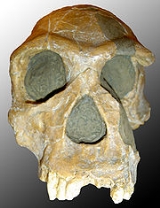
KNM ER 1813

KNM ER 1813
KNM ER 1813

'KNM ER 1813' is a skull. It was discovered in Koobi Fora, Kenya by Kamoya Kimeu in 1973, and is estimated to be 1.9 annum.Its characteristics include an overall smaller size than other Homo habilis finds but with a fully adult and typical H....
is a relatively complete cranium which dates 1.9 million years old, discovered at Koobi Fora
Koobi Fora

Koobi Fora refers primarily to a region around Koobi Fora Ridge, located on the eastern shore of Lake Turkana in the territory of the nomadic Gabbra tribe....
, Kenya by Kamoya Kimeu
Kamoya Kimeu

Kamoya Kimeu, is one of the world's most successful fossil collectors who, together with Paleontology Meave Leakey and Richard Leakey, is responsible for some of the most significant archaeological discoveries....
 in 1973. The brain capacity is 510 cm³, not as impressive as other early specimen and forms of Homo habilis discovered.

OH 7


OH 7
OH 7

OH 7 is the type specimen of Homo habilis. The fossils were discovered on November 4, 1960 in Olduvai Gorge, Tanzania, by Jonathan Leakey and Mary Leakey....
dates 1.75 million years old and was discovered by Jonathan Leakey on November 4, 1960 at Olduvai Gorge, Tanzania. It is a lower jaw complete with teeth and due to the size of the small teeth; researchers estimate this individual had a brain volume of 363 cm³. Also found were more than 20 fragments of the left hand. Tobias and Napier assisted in classifying OH-7 as the type fossil.

OH 24


OH 24
OH 24

OH 24 is a fossilized skull of the species Homo habilis. It was discovered in Olduvai Gorge, Tanzania by Peter Nzube in 1968. The skull was found crushed almost flat and was therefore named after the famously skinny model of the time Twiggy....
(AKA
Twiggy) is a roughly deformed cranium dating 1.8 million years old discovered in October 1968 at Olduvai Gorge, Tanzania by Peter Nzube. The brain volume is just under 600 cm³; also a reduction in a protruding face is present compared to members of more primitive Australopithecines. Twiggy was found in a distorted matrix with a coating of limestone rock.

KNM ER 1805


KNM ER 1805
KNM ER 1805

KNM ER 1805 is several pieces of a fossilized skull of the species Homo habilis. It was discovered in Koobi Fora, Kenya.It is estimated to be 1.74 million years old....
 is a specimen of an adult
H. habilis made of 3 pieces of cranium dating 1.74 million years old from Koobi Fora, Kenya. Previous assumptions were that this specimen belongs to H. erectus based on the degree of prognathism
Prognathism

Prognathism is a term used to describe the positional relationship of the mandible and/or maxilla to the skeletal base where either of the jaws protrudes beyond a predetermined imaginary line in the sagittal plane of the skull....
 and overall cranial shape.

Interpretations

Homo habilis is thought to have mastered the Olduwan
Olduwan

Oldowan is an anthropology designation for an industrial complex of stone tools used by prehistoric hominins of the Lower Paleolithic. The Oldowan is the first known industrial complex in prehistory....
 era (Early Paleolithic) tool case which utilized stone flakes. These stone flakes were more advanced than any tools previously used, and gave
H. habilis the edge it needed to prosper in hostile environments previously too formidable for primate
Primate

A primate is a member of the biological order Primates , the group that contains lemurs, the Aye-aye, Lorisidaes, galagos, tarsiers, monkeys, and apes, with the last category including humans....
s. Whether
H. habilis was the first hominin to master stone tool technology remains controversial, as Australopithecus garhi
Australopithecus garhi

Australopithecus garhi is a gracile australopithecine species whose fossils were discovered in 1996 by a research team led by Ethiopian paleontologist Berhane Asfaw and Tim White , an American paleontologist....
, dated to 2.6 million years ago, has been found along with stone tool implements at least 100,000 - 200,000 years older than H. habilis.

Most experts assume the intelligence and social organization of
H. habilis were more sophisticated than typical australopithecines or chimpanzee
Chimpanzee

Chimpanzee, sometimes colloquially known as a chimp, is the common name for the two Extant taxon species of ape in the genus Pan where the Congo River forms the boundary between the native habitat of the two species:...
s. Yet despite tool usage,
H. habilis was not the master hunter that its sister species (or descendants) proved to be, as there is ample fossil evidence that H. habilis was a staple in the diet of large predatory animals such as Dinofelis
Dinofelis

Dinofelis is a genus of saber-toothed cats belonging to the tribe Metailurini. They were widespread in Europe, Asia, Africa and North America at least 5 million to about 1.2 million years ago ....
, a large scimitar-toothed predatory cat
Felidae

Felidae is the family of the cats; a member of this family is called a felid. Felids are the most strictly Carnivore of the sixteen mammal families in the order Carnivora....
 the size of a jaguar
Jaguar

The jaguar, Panthera onca, is a New World Felidae and one of four "big cats" in the Panthera genus, along with the tiger, lion, and leopard of the Old World....
.
H. habilis used tools primarily for scavenging, such as cleaving meat off of carrion, rather than defense or hunting. Homo habilis is thought to be the ancestor of the lankier and more sophisticated Homo ergaster
Homo ergaster

Homo ergaster is an extinct hominin species which lived throughout eastern and southern Africa between 1.9 to 1.4 million years ago with the advent of the lower Pleistocene and the cooling of the global climate....
, which in turn gave rise to the more human-appearing species Homo erectus. Debates continue over whether H. habilis is a direct human ancestor, and whether all of the known fossils are properly attributed to the species.

Homo habilis co-existed with other Homo-like bipedal primates, such as Paranthropus boisei
Paranthropus boisei

Paranthropus boisei was an early hominin and described as the largest of the Paranthropus species. It lived from about 2.6 until about 1.2 million years ago during the Pliocene and Pleistocene epochs in Eastern Africa....
, some of which prospered for many millennia. However, H. habilis, possibly because of its early tool innovation and a less specialized diet, became the precursor of an entire line of new species, whereas Paranthropus boisei and its robust relatives disappeared from the fossil record. Homo habilis may also have coexisted with Homo erectus in Africa for a period of 500,000 years.

The classification of
H. habilis into the Homo genus is controversial. Like Homo rudolfensis, H. habilis lacked many of the things that were unique to later hominins such as slim hips for walking long distances, a sophisticated sweating system, narrow birth canal, and legs longer than arms. Such traits as noticeable whites in the eyes, smaller hairs resulting in exposed skin, and a naked appearance remain theoretical.

Stratification and expansion

The evolution of
Homo habilis is associated with the species' movement from the central Saharan region of Africa into the more demanding, yet resourceful habitats of Europe and to a lesser extent Asia. The major developments which contributed to this phenomenon were the greater knowledge and skill with which Homo habilis crafted the rock blade, increasing knowledge about climate and how to adapt accordingly and the evolution of the voice-box
Larynx

The larynx , colloquially known as the voicebox, is an organ in the neck of mammals involved in protection of the vertebrate trachea and sound production....
 which allowed greater co-ordination in hunting than was hitherto possible.
Homo habilis, due perhaps to many years of adaptation, were able to create flint blades with 10  cm (4 in) of cutting blade, this finer blade was strong enough to advance Homo habilis from scavenger to hunter. After many thousands of years of adaptation, humans were eventually able to accumulate enough information about the climate to adapt accordingly, building fires and wearing thick hides to stave off the cold. The evolution, or more so the moving of the voice box from the top of the throat to the bottom allowed a greater variety of speech required to co-ordinate and communicate during hunts. All of these evolutionary measures allowed Homo habilis to exploit the harsher climates of Asia and the borders of Europe. The western and central region of Europe was not settled by humanoids until the time of Homo erectus.

See also

  • List of fossil sites
    List of fossil sites

    This is a worldwide list of important and/or well-known localities where fossils have been found. Such locations may either be a geological formation or a single site....
     
    (with link directory)
  • List of human evolution fossils (with images)


External links