


Parthia

Encyclopedia
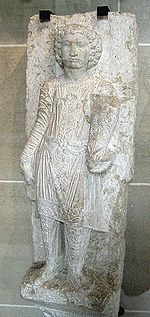
Parthia is a region of north-eastern Iran
Iran
Iran , officially the Islamic Republic of Iran , is a country in Southern and Western Asia. The name "Iran" has been in use natively since the Sassanian era and came into use internationally in 1935, before which the country was known to the Western world as Persia...
, best known for having been the political and cultural base of the Arsacid dynasty
Arsacid Dynasty
The Arsacid Dynasty may refer to:* Arsacid dynasty of Parthia, see List of Parthian kings*Arsacid Dynasty of Armenia*Arsacid dynasty of Iberia*Arsacid Dynasty of Caucasian Albania*List of rulers of Parthian sub-kingdoms...
, rulers of the Parthian Empire
Parthian Empire
The Parthian Empire , also known as the Arsacid Empire , was a major Iranian political and cultural power in ancient Persia...
.
The name "Parthia" is a continuation from Latin , from Old Persian , which was the Parthian language
Parthian language
The Parthian language, also known as Arsacid Pahlavi and Pahlavanik, is a now-extinct ancient Northwestern Iranian language spoken in Parthia, a region of northeastern ancient Persia during the rule of the Parthian empire....
self-designator signifying "of the Parthians" who were an Iranian
Iranian peoples
The Iranian peoples are an Indo-European ethnic-linguistic group, consisting of the speakers of Iranian languages, a major branch of the Indo-European language family, as such forming a branch of Indo-European-speaking peoples...
people.
Geography
Parthia roughly corresponds to the western half of Khorasan region in northeastern Iran. It was bordered by the Kopet DagKopet Dag
The Kopet Dag, Kopet Dagh, or Koppeh Dagh , also known as the Turkmen-Khorasan Mountain Range is a mountain range on the frontier between Turkmenistan and Iran, extending about 650 km along the border, east of the Caspian Sea. The highest peak of the range in Turkmenistan is southwest of the...
mountain range in the north and the Dasht-e-Kavir desert in the south. It bordered Media
Medes
The MedesThe Medes...
on the west, Hyrcania
Hyrcania
Hyrcania was the name of a satrapy located in the territories of present day Gilan, Golestan, Mazandaran and part of Turkmenistan, lands south of the Caspian Sea. To the Greeks, the Caspian Sea was the "Hyrcanian Sea".-Etymology:...
on the north west, Margiana on the north east, and Aria on the south east.
During Arsacid times, Parthia was united with Hyrcania
Hyrcania
Hyrcania was the name of a satrapy located in the territories of present day Gilan, Golestan, Mazandaran and part of Turkmenistan, lands south of the Caspian Sea. To the Greeks, the Caspian Sea was the "Hyrcanian Sea".-Etymology:...
as one administrative unit, and that region is therefore often (subject to context) considered a part of Parthia proper.
Under the Achaemenids
As the region inhabited by Parthians, Parthia first appears as a political entity in Achaemenid lists of governorates ("satrapies") under their dominion. Prior to this, the people of the region seem to have been subjects of the MedesMedes
The MedesThe Medes...
, and 7th century BC Assyrian texts mention a country named Partakka or Partukka (though this "need not have coincided topographically with the later Parthia").
A year after Cyrus the Great
Cyrus the Great
Cyrus II of Persia , commonly known as Cyrus the Great, also known as Cyrus the Elder, was the founder of the Achaemenid Empire. Under his rule, the empire embraced all the previous civilized states of the ancient Near East, expanded vastly and eventually conquered most of Southwest Asia and much...
's defeat of the Median Astyages
Astyages
Astyages Astyages Astyages (spelled by Herodotus as Ἀστυάγης - Astyages; by Ctesias as Astyigas; by Diodorus as Aspadas; Akkadian: Ištumegu, was the last king of the Median Empire, r...
, Parthia became one of the first provinces to acknowledge Cyrus as their ruler, "and this allegiance secured Cyrus' eastern flanks and enabled him to conduct the first of his imperial campaigns – against Sardis
Sardis
Sardis or Sardes was an ancient city at the location of modern Sart in Turkey's Manisa Province...
." According to Greek sources, following the seizure of the Achaemenid throne by Darius I, the Parthians united with the Median king Phraortes to revolt against him. Hystaspes, the Achaemenid governor of the province (said to be father of Darius I), managed to suppress the revolt, which seems to have occurred around 522–521 BC.
The first indigenous Iranian mention of Parthia is in the Behistun inscription
Behistun Inscription
The Behistun Inscription The Behistun Inscription The Behistun Inscription (also Bistun or Bisutun, Modern Persian: بیستون The Behistun Inscription (also Bistun or Bisutun, Modern Persian: بیستون...
of Darius I, where Parthia is listed (in the typical Iranian clockwise order) among the governorates in the vicinity of Drangiana
Drangiana
Drangiana or Zarangiana was a historical region of the Achaemenid Empire. This region comprises territory around lake Hâmûn, wetlands in endorheic Sīstān basin on the Irano-Afghan-Pakistan border, and its primary watershed Helmand river in nowadays southwestern Afghanistan and the "Nok Kondi" of...
. The inscription dates to circa 520 BC. The center of the administration "may have been at [what would later be known as] Hecatompylus". The Parthians also appear in Herodotus' list of peoples subject to the Achaemenids; the historiographer treats the Parthians, Chorasmians, Sogdians and Areioi as peoples of a single satrapy (the 16th), whose annual tribute to the king he states to be only 300 talents of silver. This "has rightly caused disquiet to modern scholars."
At the Battle of Gaugamela
Battle of Gaugamela
The Battle of Gaugamela took place in 331 BC between Alexander the Great and Darius III of Persia. The battle, which is also called the Battle of Arbela, resulted in a massive victory for the ancient Macedonians and led to the fall of the Achaemenid Empire.-Location:Darius chose a flat, open plain...
in 331 BC between the forces of Darius III and those of Alexander the Great, one such Parthian unit was commanded by Phrataphernes, who was at the time Achaemenid governor of Parthia. Following the defeat of Darius III, Phrataphernes surrendered his governorate to Alexander when the Macedonian arrived there in the summer of 330 BC
330 BC
Year 330 BC was a year of the pre-Julian Roman calendar. At the time, it was known as the Year of the Consulship of Crassus and Venno...
. Phrataphernes was reappointed governor by Alexander.
Under the Seleucids
Following the death of Alexander, in the Partition of BabylonPartition of Babylon
The Partition of Babylon designates the attribution of the territories of Alexander the Great between his generals after his death in 323 BC.-Background:...
in 323 BC, Parthia became a Seleucid governorate under Nicanor
Nicanor (satrap)
Nicanor or Nikanor was a Macedonian officer of distinction who served as satrap of Media under Antigonus....
. Phrataphernes, the former governor, became governor of Hyrcania
Hyrcania
Hyrcania was the name of a satrapy located in the territories of present day Gilan, Golestan, Mazandaran and part of Turkmenistan, lands south of the Caspian Sea. To the Greeks, the Caspian Sea was the "Hyrcanian Sea".-Etymology:...
. In 320 BC, at the Partition of Triparadisus
Partition of Triparadisus
The Partition of Triparadisus was a power-sharing agreement passed at Triparadisus in 321 BCE between the generals of Alexander the Great, in which they named a new regent and established the repartition of their satrapies...
, Parthia was reassigned to Philip
Philip (satrap)
Philip was satrap of Sogdiana, to which government he was first appointed by Alexander the Great himself in 327 BC...
, former governor of Sogdiana
Sogdiana
Sogdiana or Sogdia was the ancient civilization of an Iranian people and a province of the Achaemenid Empire, eighteenth in the list on the Behistun Inscription of Darius the Great . Sogdiana is "listed" as the second of the "good lands and countries" that Ahura Mazda created...
. A few years later, the province was invaded by Peithon
Peithon
Peithon or Pithon was the son of Crateuas, a nobleman from Eordaia in western Macedonia. One of the bodyguards of Alexander the Great, later satrap of Media and one of the diadochi....
, governor of Media major, who then attempted to make his brother Eudamus governor. Peithon and Eudamus were driven back, and Parthia remained a governorate in its own right.
In 316 BC, Stasander, a vassal of Seleucus I Nicator
Seleucus I Nicator
Seleucus I was a Macedonian officer of Alexander the Great and one of the Diadochi. In the Wars of the Diadochi that took place after Alexander's death, Seleucus established the Seleucid dynasty and the Seleucid Empire...
and governor of Bactria
Bactria
Bactria and also appears in the Zend Avesta as Bukhdi. It is the ancient name of a historical region located between south of the Amu Darya and west of the Indus River...
(and, it seems, also of Aria
Herat
Herāt is the capital of Herat province in Afghanistan. It is the third largest city of Afghanistan, with a population of about 397,456 as of 2006. It is situated in the valley of the Hari River, which flows from the mountains of central Afghanistan to the Karakum Desert in Turkmenistan...
and Margiana) was appointed governor of Parthia. For the next 60 years, various Seleucids would be appointed governors of the province.
Antioch
Antioch on the Orontes was an ancient city on the eastern side of the Orontes River. It is near the modern city of Antakya, Turkey.Founded near the end of the 4th century BC by Seleucus I Nicator, one of Alexander the Great's generals, Antioch eventually rivaled Alexandria as the chief city of the...
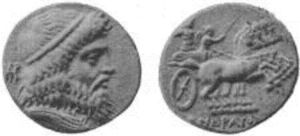
, and "so left the future of the Seleucid dynasty for a moment in question." Taking advantage of the uncertain political situation, Andragoras, the Seleucid governor of Parthia, proclaimed his independence and began minting his own coins.
Meanwhile, "a man called Arsaces, of Scythian or Bactrian origin, [was] elected leader of the Parni
Parni
The Parni or Aparni were an east Iranian people of the Ochus River valley, southeast of the Caspian Sea...
", an eastern-Iranian peoples from the Tajen/Tajend River valley, south-east of the Caspian Sea
Caspian Sea
The Caspian Sea is the largest enclosed body of water on Earth by area, variously classed as the world's largest lake or a full-fledged sea. The sea has a surface area of and a volume of...
. Following the secession of Parthia from the Seleucid Empire and the resultant loss of Seleucid military support, Andragoras had difficulty in maintaining his borders, and about 238 BC – under the command of "Arsaces and his brother Tiridates
Tiridates I of Parthia
Tiridates, or Teridates is a Persian name, given by Arrian in his Parthica to the brother of Arsaces I, the founder of the Parthian kingdom, whom he is said to have succeeded in about 246 BC...
" – the Parni invaded Parthia and seized control of Astabene (Astawa), the northern region of that territory, the administrative capital of which was Kabuchan (Kuchan in the vulgate).
A short while later the Parni seized the rest of Parthia from Andragoras, killing him in the process. Although an initial punitive expedition
Punitive expedition
A punitive expedition is a military journey undertaken to punish a state or any group of persons outside the borders of the punishing state. It is usually undertaken in response to perceived disobedient or morally wrong behavior, but may be also be a covered revenge...
by the Seleucids under Seleucus II was not successful, the Seleucids under Antiochus III recaptured Arsacid controlled territory in 209 BC from Arsaces' (or Tiridates') successor, Arsaces II. Arsaces II sued for peace and accepted vassal status, and it was not until Arsaces II's grandson (or grand-nephew) Phraates I, that the Arsacids/Parni would again begin to assert their independence.
Under the Arsacids
Heracles
Heracles ,born Alcaeus or Alcides , was a divine hero in Greek mythology, the son of Zeus and Alcmene, foster son of Amphitryon and great-grandson of Perseus...
, and the inscription "Great King Arsaces, friend of Greeks
Greece
Greece , officially the Hellenic Republic , and historically Hellas or the Republic of Greece in English, is a country in southeastern Europe....
".
From their base in Parthia, the Arsacid dynasts eventually extended their dominion to include most of Greater Iran
Greater Iran
Greater Iran refers to the regions that have significant Iranian cultural influence. It roughly corresponds to the territory on the Iranian plateau and its bordering plains, stretching from Iraq, the Caucasus, and Turkey in the west to the Indus River in the east...
. Even though the Arsacids only sporadically had their capital in Parthia, their power base was there, among the Parthian feudal families, upon whose military and financial support the Arsacids depended. In exchange for this support, these families received large tracts of land among the earliest conquered territories adjacent to Parthia, which the Parthian nobility then ruled as provincial rulers. The largest of these city-states were Kuchan, Semnan
Semnan, Iran
Semnan is a city in and capital of Semnan Province, Iran. At the 2006 census, its population was 124,999, in 36,298 families.Semnan is located in the central northern portion of the Islamic Republic of Iran...
, Gorgan
Gorgan
Gorgan Some east of Gorgan is the Golestan National Park. The city has a regional airport and several universities. Gorgan Airport was opened in September 2005.-Etymology:...
, Merv
Merv
Merv , formerly Achaemenid Satrapy of Margiana, and later Alexandria and Antiochia in Margiana , was a major oasis-city in Central Asia, on the historical Silk Road, located near today's Mary in Turkmenistan. Several cities have existed on this site, which is significant for the interchange of...
, Zabol
Zabol
Zabol is a city in and the capital of Zabol County, Sistan and Baluchestan Province, Iran. Zabol lies on the border with both Afghanistan and Pakistan. At the 2006 census, its population was 130,642, in 27,867 families....
and Yazd
Yazd
Yazd is the capital of Yazd Province in Iran, and a centre of Zoroastrian culture. The city is located some 175 miles southeast of Isfahan. At the 2006 census, the population was 423,006, in 114,716 families....
.
From about 105 BC onwards, the power and influence of this handful of Parthian noble families was such that they frequently opposed the monarch, and would eventually be a "contributory factor in the downfall" of the dynasty.
From about 130 BC onwards, Parthia suffered numerous incursions by various nomadic tribes, including the Sakas, the Yueh-chi, and the Massagetae
Massagetae
The Massageteans or Massagetaeans were an Iranian nomadic confederation in antiquity known primarily from the writings of Herodotus. Their name was probably akin to Thyssagetae.-Name:...
. Each time, the Arsacid dynasts responded personally, doing so even when there were more severe threats from Seleucids
Seleucid Empire
The Seleucid Empire was a Greek-Macedonian state that was created out of the eastern conquests of Alexander the Great. At the height of its power, it included central Anatolia, the Levant, Mesopotamia, Persia, today's Turkmenistan, Pamir and parts of Pakistan.The Seleucid Empire was a major centre...
or Romans
Roman Republic
The Roman Republic was the period of the ancient Roman civilization where the government operated as a republic. It began with the overthrow of the Roman monarchy, traditionally dated around 508 BC, and its replacement by a government headed by two consuls, elected annually by the citizens and...
looming on the western borders of their empire (as was the case for Mithridates I
Mithridates I of Parthia
Mithridates or Mithradates I was the "Great King" of Parthia from ca. 171 BC - 138 BC, succeeding his brother Phraates I. His father was King Phriapatius of Parthia, who died ca. 176 BC). Mithridates I made Parthia into a major political power by expanding the empire to the east, south, and west...
). Defending the empire against the nomads cost Phraates II
Phraates II of Parthia
Phraates II of Parthia, son of Mithridates I of Parthia , the conqueror of Babylon, ruled the Parthian Empire from 138 BC to 128 BC. He was attacked in 130 BC by Antiochus VII Sidetes , ruler of the Seleucid Empire...
and Artabanus I
Artabanus I of Parthia
Artabanus I of Parthia ruled the Parthian Empire from c. 128 to 124 BC. He succeeded his nephew Phraates II and died, just like his predecessor, in battle against the Tochari - a name commonly identified with the Yuezhi of the Chinese sources, who had fled from Gansu in northwest China, via the Ili...
their lives.
Around 32 BC, civil war broke out when a certain Tiridates rebelled against Phraates IV, probably with the support of the nobility that Phraates had previously persecuted. The revolt was initially successful, but failed by 25 BC. In 9/8, the Parthian nobility succeeded in putting their preferred king on the throne, but Vonones
Vonones
Vonones was the name of three kings of the ancient Middle East:*Vonones was king of the Indo-Scythians c. 75–65 BC.*Vonones I was king of Parthia c. AD 8–12*Vonones II was king of Parthia c. 51...
proved to have too tight a budgetary control, so he was usurped in favor of Artabanus II, who seems to have been a non-Arsacid Parthian nobleman. But when Artabanus attempted to consolidate his position (at which he was successful in most instances), he failed to do so in the regions where the Parthian provincial rulers held sway.
By the 2nd century AD, the wars with Rome and with the nomads, and the infighting among the Parthian nobility had weakened the Arsacids to a point where they could no longer defend their subjugated territories. The empire fractured as vassalaries increasingly claimed independence or were subjugated by others, and the Arsacids were themselves finally vanquished by the Persian Sassanids
Sassanid Empire
The Sassanid Empire , known to its inhabitants as Ērānshahr and Ērān in Middle Persian and resulting in the New Persian terms Iranshahr and Iran , was the last pre-Islamic Persian Empire, ruled by the Sasanian Dynasty from 224 to 651...
, a formerly minor vassal from southwestern Iran, in April 224.
Under the Sassanids
Under Sassanid rule, Parthia was folded into a newly formed province, KhorasanGreater Khorasan
Greater Khorasan or Ancient Khorasan is a historical region of Greater Iran mentioned in sources from Sassanid and Islamic eras which "frequently" had a denotation wider than current three provinces of Khorasan in Iran...
, and henceforth ceased to exist as a political entity. Some of the Parthian nobility continued to resist Sassanid dominion for some time, but most switched their allegiance to the Sassanids very early. Several families that claimed descent from the Parthian noble families became a Sassanid institution known as the "Seven houses
Seven Parthian clans
The Seven Parthian clans or Seven Houses were seven purportedly "Parthian" feudal aristocracies allied with the Sassanid court.Only two of the seven - the House of Suren and the House of Karen - are actually attested in sources dateable to the Arsacid period...
", five of which are "in all probability" not Parthian, but contrived genealogies "in order to emphasize the antiquity of their families."
Language and literature
The Parthians spoke ParthianParthian language
The Parthian language, also known as Arsacid Pahlavi and Pahlavanik, is a now-extinct ancient Northwestern Iranian language spoken in Parthia, a region of northeastern ancient Persia during the rule of the Parthian empire....
, a north-western Iranian language related to Median
Median language
The Median language was the language of the Medes. It is an Old Iranian language and classified as belonging to the northwestern Iranian subfamily which includes many other languages such as Azari, Zazaki, Gilaki, Mazandarani, Kurdish and Baluchi.-Attestation:Median is only attested by numerous...
. No Parthian literature survives from before the Sassanid period in its original form, and they seem to have written down only very little. The Parthians did however have a thriving oral minstrel-poet culture
Minstrel
A minstrel was a medieval European bard who performed songs whose lyrics told stories of distant places or of existing or imaginary historical events. Although minstrels created their own tales, often they would memorize and embellish the works of others. Frequently they were retained by royalty...
, to the extent that their word for minstrel – gosan – survives to this day in many Iranian languages and Armenian
Armenian language
The Armenian language is an Indo-European language spoken by the Armenian people. It is the official language of the Republic of Armenia as well as in the region of Nagorno-Karabakh. The language is also widely spoken by Armenian communities in the Armenian diaspora...
gusan. These professionals were evident in every facet of Parthian daily life, from cradle to grave, and they were entertainers of kings and commoners alike, proclaiming the worthiness of their patrons through association with mythical heroes and rulers. These Parthian heroic poems, "mainly known through Persian of the lost Middle Persian
Middle Persian
Middle Persian , indigenously known as "Pârsig" sometimes referred to as Pahlavi or Pehlevi, is the Middle Iranian language/ethnolect of Southwestern Iran that during Sassanid times became a prestige dialect and so came to be spoken in other regions as well. Middle Persian is classified as a...
Xwaday-namag, and notably through Firdausi's Shahnameh
Shahnameh
The Shahnameh or Shah-nama is a long epic poem written by the Persian poet Ferdowsi between c.977 and 1010 AD and is the national epic of Iran and related societies...
, [were] doubtless not yet wholly lost in the Khurasan of [Firdausi's] day."
In Parthia itself, attested use of written Parthian is limited to the nearly 3,000 ostraca found (in what seems to have been a wine storage) at Nisa
Nisa, Turkmenistan
Nisa was an ancient city, located near modern-day Bagir village, 18 km northwest of Ashgabat, Turkmenistan.Nisa is described by some as one of the first capitals of the Parthians. It was traditionally founded by Arsaces I Nisa (also Parthaunisa) was an ancient city, located near modern-day...
, in present-day Turkmenistan. A handful of other evidence of written Parthian have also been found outside Parthia; the most important of these being the part of a land-sale document found at Avroman (in present-day Iranian Kurdistan
Iranian Kurdistan
Iranian Kurdistan is an unofficial name for the parts of Iran inhabited by Kurds and has borders with Iraq and Turkey. It includes Kurdistan Province, Kermanshah Province, Ilam Province and parts of West Azerbaijan province....
), and more ostraca, graffiti and the fragment of a business letter found at Dura-Europos
Dura-Europos
Dura-Europos , also spelled Dura-Europus, was a Hellenistic, Parthian and Roman border city built on an escarpment 90 m above the right bank of the Euphrates river. It is located near the village of Salhiyé, in today's Syria....
in present-day Syria
Syria
Syria , officially the Syrian Arab Republic , is a country in Western Asia, bordering Lebanon and the Mediterranean Sea to the West, Turkey to the north, Iraq to the east, Jordan to the south, and Israel to the southwest....
.
The Parthian Arsacids do not seem to have used Parthian until relatively late, and the language first appears on Arsacid coinage during the reign of Vologases I (51-58 AD). Evidence that use of Parthian was nonetheless widespread comes from early Sassanid times; the declarations of the early Persian kings were – in addition to their native Middle Persian
Middle Persian
Middle Persian , indigenously known as "Pârsig" sometimes referred to as Pahlavi or Pehlevi, is the Middle Iranian language/ethnolect of Southwestern Iran that during Sassanid times became a prestige dialect and so came to be spoken in other regions as well. Middle Persian is classified as a...
– also inscribed in Parthian.
Society
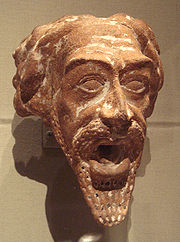
By Arsacid times, Parthian society was divided into the four classes (limited to freemen). At the top were the kings and near family members of the king. These were followed by the lesser nobility and the general priesthood, followed by the mercantile class and lower-ranking civil servants, and with farmers and herdsmen at the bottom.
Little is known of the Parthian economy, but agriculture must have played the most important role in it. Significant trade first occurs with the establishment of the Silk road
Silk Road
The Silk Road or Silk Route refers to a historical network of interlinking trade routes across the Afro-Eurasian landmass that connected East, South, and Western Asia with the Mediterranean and European world, as well as parts of North and East Africa...
in 114 BC, when Hecatompylos
Hecatompylos
Hecatompylos was an ancient city in west Khurasan, Iran, which was the capital of the Parthian Arsacid dynasty by 200 BCE. The Greek name Hekatompylos means "one hundred gates", but this title was commonly used for cities which had more than the traditional four gates...
became an important junction.