
All Topics  
Bantu languages


   Email Print
   Bookmark   Link


Bantu languages


The Bantu languages (technically Narrow Bantu languages) constitute a grouping belonging to the Niger-Congo
Niger-Congo languages

The Niger?Congo languages constitute one of the world's major Language family, and Africa's largest in terms of geographical area, number of speakers, and number of distinct languages....
 family. This grouping is deep down in the genealogical tree of the Bantoid grouping, which in turn is deep down in the Niger-Congo tree. By one estimate, there are 513 languages in the Bantu grouping, 681 languages in Bantoid, and 1,514 in Niger-Congo. Bantu languages are spoken largely east and south of the present day nation of Nigeria; i.e., in the regions commonly known as central Africa, east Africa, and southern Africa.


Discussion
Ask a question about 'Bantu languages'
Start a new discussion about 'Bantu languages'
Answer questions from other users
Full Discussion Forum


Encyclopedia


The Bantu languages (technically Narrow Bantu languages) constitute a grouping belonging to the Niger-Congo
Niger-Congo languages

The Niger?Congo languages constitute one of the world's major Language family, and Africa's largest in terms of geographical area, number of speakers, and number of distinct languages....
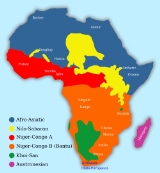
 family. This grouping is deep down in the genealogical tree of the Bantoid grouping, which in turn is deep down in the Niger-Congo tree. By one estimate, there are 513 languages in the Bantu grouping, 681 languages in Bantoid, and 1,514 in Niger-Congo. Bantu languages are spoken largely east and south of the present day nation of Nigeria; i.e., in the regions commonly known as central Africa, east Africa, and southern Africa. Parts of this Bantu chunk of Africa also have languages from outside the Niger-Congo family (see map).

The word Bantu was first used by Wilhelm Heinrich Immanuel Bleek (1827-1875) with the meaning 'people', as this is reflected in many of the languages of this group. A common characteristic of Bantu languages is that they use a stem form such as -ntu or -tu for 'person', and the plural prefix for people in many languages is ba-, together giving ba-ntu "people". Bleek, and later Carl Meinhof
Carl Meinhof

Carl Friedrich Michael Meinhof was a Germany Linguistics and one of the first linguists to study African languages....
, pursued extensive comparative studies of Bantu language grammars.

Classification


The term 'narrow Bantu' was coined by the Benue-Congo Working Group to distinguish Bantu as recognized by Malcolm Guthrie
Malcolm Guthrie

Malcolm Guthrie , professor of Bantu languages, is known primarily for his classification of Bantu languages . The classification, although certainly not undisputed, and probably somewhat outdated, is still the most widely used....
 in his seminal 1948 classification of the Bantu languages from Bantoid languages
Bantoid languages

In the classification of African languages, Bantoid is a branch of the Benue-Congo languages subfamily of the Niger-Congo languages phylum. The term 'Bantoid' was first used by Krause in 1895 for languages that showed resemblances in vocabulary to Bantu languages....
 not recognized as Bantu by Guthrie (1948). In recent times, the distinctness of Narrow Bantu as opposed to the other Southern Bantoid groups has been called into doubt (cf. Piron 1995), but the term is still widely used.

There is no genealogical classification of the (Narrow) Bantu languages. The most widely used system, the alphanumeric coding system developed by Guthrie, is mainly areal. Based on reflexes of proto-Bantu tone patterns, zones A–C are grouped together as Northwest Bantu, and zones D–S as Central Bantu. At least two proposals for a detailed genetic classification to replace the Guthrie system were suggested around the turn of the century. The "Tervuren" proposal of Bastin, Coupez, and Mann suffers from inferior methodology (its reliance on the "lexicostatistic" method) and the SIL
SIL International

SIL International is a United States, worldwide Evangelicalism non-profit organization, whose main purpose is to study, develop and document lesser-known languages, in order to expand linguistics knowledge, promote literacy and aid minority language development....
 proposal suffers from failure of its creators to publish their methodology. The Guthrie system needs to be updated, e.g., by the addition of languages previously overlooked. The development of a rigorous genetic classification of many subdivisions of Niger-Congo, not just Bantu, is hampered by insufficient data.

The Guthrie, Tervuren, and SIL lists are compared side by side in Maho (2002).

Language structure

The phoneme inventory of Proto-Bantu and its core vocabulary were reconstructed by Guthrie.

The most prominent grammatical
Grammar

Grammar is the field of linguistics that covers the conventions governing the use of any given natural language. It includes morphology and syntax, often complemented by phonetics, phonology, semantics, and pragmatics....
 characteristic of Bantu languages is the extensive use of affix
Affix

An affix is a morpheme that is attached to a word stem to form a new word. Affixes may be derivation , like English -ness and pre-, or inflectional, like English plural -s and past tense -ed....
es (see Sesotho grammar
Sesotho grammar

This article presents a brief overview of the grammar of the Sesotho language and provides links to more detailed articles....
 and Luganda language
Luganda language

Luganda, sometimes known as Ganda, is a major language of Uganda, spoken by over ten million people mainly in Southern Uganda which includes the Ugandan capital city Kampala....
 for detailed discussions of these affixes). Each noun belongs to a class
Noun class

In linguistics, the term noun class refers to a system of categorizing nouns. A noun may belong to a given class because of characteristic features of its referent, such as sex, animacy, shape, but counting a given noun among nouns of such or another class is often clearly conventional....
, and each language may have several numbered classes, somewhat like genders in European languages. The class is indicated by a prefix on the noun, as well as on verbs and qualificative roots agreeing with it. Plural is indicated by a change of prefix.

The verb has a number of prefixes. In Swahili
Swahili language

Swahili is the first language of the Swahili people , who inhabit several large stretches of the Indian Ocean coastline from southern Somalia to northern Mozambique, including the Comoros Islands....
, for example, Mtoto mdogo amekisoma, (also Kamwana kadoko kariverenga in Shona language
Shona language

Shona is a Bantu languages, native to the Shona people of Zimbabwe and southern Zambia; the term is also used to identify peoples who speak one of the Shona language dialects, namely Zezuru, Karanga, Manyika, Ndau and Korekore....
) means 'The small child has read it [a book]'. Mtoto 'child' governs the adjective prefix m- and the verb subject prefix a-. Then comes perfect tense -me- and an object marker -ki- agreeing with implicit kitabu 'book'. Pluralizing to 'children' gives Watoto wadogo wamekisoma/Vana vadoko variverenga in Shona, and plural
Plural

Plural is a grammatical number, typically referring to more than one of the referent in the real world. In the English language, singular and plural are the only grammatical numbers....
izing to 'books' (vitabu) gives it Watoto wadogo wamevisoma.

Bantu words are typically made up of open syllables of the type CV (consonant-vowel) with most languages having syllables exclusively of this type. The morphological shape of Bantu words is typically CV, VCV, CVCV, VCVCV, etc; that is, any combination of CV (with possibly a V- syllable at the start). In other words, a strong claim for this language family is that almost all words end in a vowel, precisely because closed syllables (CVC) are not permissible. This tendency to avoid consonant cluster
Consonant cluster

In linguistics, a consonant cluster is a group of consonants which have no intervening vowel. In English, for example, the groups and are consonant clusters in the word splits....
s is important when words are imported from English
English language

English is a West Germanic language that originated in Anglo-Saxon England and has lingua franca status in many parts of the world as a result of the military, economic, scientific, political and cultural influence of the British Empire in the 18th, 19th and early 20th centuries and that of the United States from the mid 20th century onwa...
 or other non-Bantu languages. An example from Chichewa: the word "school", borrowed from English, and then transformed to fit the sound patterns of this language, is sukulu. That is, sk- has been broken up by inserting an epenthetic
Epenthesis

In phonology, epenthesis is the addition of one or more sounds to a word, especially to the interior of a word. Epenthesis may be divided into two types: excrescence and anaptyxis ....
 -u-; -u has also been added at the end of the word. Another example is buledi for "bread". Similar effects are seen in loanwords for other non-African CV languages like Japanese
Japanese language

IPA: [n?iho?go] is a language spoken by over 130 million people in Japan and in Japanese emigrant communities. It is related to the Ryukyuan languages....
.

The Bantu language with the largest number of speakers is Swahili
Swahili language

Swahili is the first language of the Swahili people , who inhabit several large stretches of the Indian Ocean coastline from southern Somalia to northern Mozambique, including the Comoros Islands....
 (G 40), while the Bantu languages with the most native speakers are Shona
Shona language

Shona is a Bantu languages, native to the Shona people of Zimbabwe and southern Zambia; the term is also used to identify peoples who speak one of the Shona language dialects, namely Zezuru, Karanga, Manyika, Ndau and Korekore....
 and Zulu
Zulu language

Zulu , is a language of the Zulu people with about 10 million speakers, the vast majority of whom live in South Africa. Zulu is the most widely spoken home language in South Africa as well as being understood by over 50% of the population ....
. Judging from the history of Swahili, some linguists believe that Bantu languages are on a continuum from purely tonal languages
Tone (linguistics)

Tone is the use of pitch in language to distinguish lexical or grammatical meaning?that is, to distinguish or inflection words. All languages use pitch to express emotional and other paralinguistic information, and to convey emphasis, contrast, and other such features in what is called intonation , but not all languages use tones to distingu...
 to languages with no tone at all.

Reduplication

Reduplication
Reduplication

Reduplication, in linguistics, is a morphology process by which the root or Stem of a word, or part of it, is repeated.Reduplication is used in inflections to convey a grammatical function, such as plurality, intensification, etc., and in lexical Derivation to create new words....
 is a common morphological phenomenon in Bantu languages and is usually used to indicate frequency or intensity of the action signalled by the (unreduplicated) verb stem

  • Example: in Swahili piga means "strike", pigapiga means "strike repeatedly".
Well-known names that have reduplication include
  • Bafana Bafana
  • Chipolopolo
  • Eric Djemba-Djemba
    Eric Djemba-Djemba

    Eric Daniel Djemba-Djemba is a Association football Midfielder#Defensive midfielder who currently plays for Danish side Odense Boldklub and the Cameroon national football team....
  • Lualua
    Lomana LuaLua

    Lomana Tr?sor LuaLua is a Association football who plays for Qatar side Al-Arabi Sports Club. He has also played for English clubs Colchester United F.C., Newcastle United F.C....
  • Ngorongoro
  • Polepole (Swahili for slowly, or slowly-slowly).
  • Haraka-haraka (Swahili for quickly, or quickly-quickly, compare with vite-vite in French, that has the approximate meaning to 'fast-fast' in English).
Repetition emphasizes the repeated word in the context that it is used. For instance, "Mwenda pole hajikwai," while, "Pole pole ndio mwendo," has two to emphasize the consistency of slowness of the pace. The meaning of the former in translation is, "He who goes slowly doesn't trip," and that of the latter is, "A slow but steady pace wins the race." Haraka haraka would mean hurrying just for the sake of hurrying, reckless hurry, as in Njoo! Haraka haraka [come here! Hurry, hurry].

A list of common Bantu languages

The following is a short list of Bantu languages that may be relatively well known:
  • in Central and Eastern Africa
    • Chewa
      Chichewa language

      Chichewa is a language of the Bantu languages family widely spoken in south-central Africa. The prefix chi- means "the language of" so that "Chichewa" means "language of the Chewa tribe", and hence the language is also known simply as Chewa....
       (Chichewa)
    • Ganda
      Luganda language

      Luganda, sometimes known as Ganda, is a major language of Uganda, spoken by over ten million people mainly in Southern Uganda which includes the Ugandan capital city Kampala....
       (Luganda)
    • Gikuyu
      Gikuyu language

      Gikuyu , pronounced "gikuyu" [?ekoj?], is a language in the Central Bantu branch of the Niger-Congo languages family spoken primarily by the Kikuyu people of Kenya....
    • Bemba
      Bemba language

      This article refers to the Bemba language. For other uses, see Bemba .The Bemba language, Chibemba, also known as Cibemba, Ichibemba, Icibemba and Chiwemba, is a Bantu languages language that is spoken primarily in Zambia by the Bemba people and about 18 related ethnic groups....
    • Ekegusii
      Gusii language

      The Gusii language is a Bantu language spoken in the Kisii district in western Kenya,whose head-quarters is Kisii town, . It is spoken by the Kisii people people, numbering about 1.5 million ....
    • Haya
      Haya language

      Haya is a Niger-Congo languages spoken by the Haya of Tanzania, in the south and southwest coast of Lake Victoria. In 1991, the population of Haya speakers was estimated at 1,200,000 people ....
       (Kihaya)
    • Chaga (Kichaga)
    • Rwanda
      Kinyarwanda language

      Kinyarwanda is a Bantu languages spoken primarily in Rwanda, where it is one of the official languages of the country, as well as in southern Uganda and in the east of the Democratic Republic of the Congo....
       (Kinyarwanda)
    • Kongo
      Kongo language

      Kikongo or Kongo is the Bantu language spoken by the Bakongo and Bandundu people living in the tropical forests of the Democratic Republic of the Congo, the Republic of the Congo and Angola....
       (Kikongo)
    • Kamba language
    • Lingala
      Lingala language

      Lingala is a Bantu languages language spoken throughout the northwestern part of the Democratic Republic of the Congo and a large part of the Republic of the Congo , as well as to some degree in Angola and the Central African Republic....
    • Luhyia
    • Soga
      Lusoga language

      ?LuSoga is a tonal Bantu languages language that is spoken in ??Uganda. It is the native language of people who are indigenous/originally from ?the Busoga region....
       (Lusoga)
    • Mongo
      Mongo language

      Mongo is the language spoken by the Mongo people in the Democratic Republic of the Congo, mostly south of the Congo River. It is a tonal language....
       (Mongo-Nkundu, Lomongo)
    • Ndowe
    • Kiga
      Rukiga language

      Rukiga is closely related to the Runyankole language spoken by the Banyankore, Banyakole or Ankole as the people are also known.Rukiga, the native language of the people of Bakiga, developed over the centuries as a spoken language....
       (Rukiga)
    • Rundi (Kirundi)
    • Nyankole
      Runyankole language

      Runyankore is a Bantu languages language spoken by the Banyankore of Southwestern Uganda. There are approximately 1.5 million native speakers, mainly found in Mbarara, Bushenyi, Ntungamo, Kiruhura, Ibanda, Isingiro,Rukungiri districts....
       (Runyankole)
    • Nyoro (Runyoro)
    • Tooro
      Rutooro language

      Rutooro is a Bantu languages language spoken mainly by the Batooro people from the Toro region of western Uganda....
       (Rutooro)
    • Swahili
      Swahili language

      Swahili is the first language of the Swahili people , who inhabit several large stretches of the Indian Ocean coastline from southern Somalia to northern Mozambique, including the Comoros Islands....
       (Kiswahili)
    • Tetela language
      Tetela language

      Tetela, also rendered as Otetela, Kitetela, Kikitatela, and Sungu is a Bantu languages language of northern Kasai-Oriental Province, Democratic Republic of the Congo....
       (Congo)
    • Luba
      Tshiluba language

      Tshiluba is a Bantu language spoken in the Democratic Republic of the Congo, where it is a national language....
       (Tshiluba)
    • Tumbuka
      Tumbuka language

      The Tumbuka language is a Bantu languages which is spoken in parts of Malawi, Zambia, and Tanzania.The language of the Tumbuka is called chiTumbuka - the 'chi' in front of Tumbuka meaning 'the language of', similar to 'ki' in kiSwahili or 'se' in seTswana....
       (chiTumbuka)
    • Yao
      Yao (African Language)

      Yao is a Bantu language in Africa with approximately 1 million speakers in Malawi, half a million in Tanzania, and around 450,000 in Mozambique....
       (Chiyao)
    • Gishu (Lugisu)


  • in Southern Africa
    • Oshiwambo
      Oshiwambo language

      Oshiwambo or Oshivambo is a cluster of several very closely related languages in Angola and northern Namibia, notably Kwanyama , Ndonga language and Kwambi....
       (Oshiwambo)
    • Ndebele
      Ndebele language

      There are at least two languages commonly called Ndebele:*The Northern Ndebele language, a Nguni languages spoken in Zimbabwe*The Southern Ndebele language, classified as Nguni languages or Sotho-Tswana languages, spoken in South Africa, heavily influenced by surrounding Sotho-Tswana languages and therefore mostly classified a...
       (Sindebele)
    • Pedi (Sepedi)
    • Shona
      Shona language

      Shona is a Bantu languages, native to the Shona people of Zimbabwe and southern Zambia; the term is also used to identify peoples who speak one of the Shona language dialects, namely Zezuru, Karanga, Manyika, Ndau and Korekore....
       (chiShona)
    • Swati
      Swati language

      Swati is a Bantu languages of the Nguni group spoken in Swaziland and South Africa. The number of speakers is estimated to be in the region of 1.5 million....
       (Siswati)
    • Phuthi
      Phuthi language

      Phuthi is a Nguni Bantu language spoken in southern Lesotho and areas in South Africa adjacent to the same border. The closest substantial living relative of Phuthi is Swati language , spoken in Swaziland and the Mpumalanga province of South Africa....
       (Siphuthi)
    • Sotho (Sesotho)
    • Swazi
      Swati language

      Swati is a Bantu languages of the Nguni group spoken in Swaziland and South Africa. The number of speakers is estimated to be in the region of 1.5 million....
       (siSwati)
    • Tsonga
      Tsonga language

      The Tsonga or Xitsonga language is spoken in southern Africa by the Tsonga people, also known as the Shangaan....
       (Xitsonga)
    • Tswana
      Tswana language

      Tswana , is a Bantu languages language written in the Latin Alphabet. Tswana is the national and majority language of Botswana, whose people are the Batswana ....
       (Setswana)
    • Venda
      Venda language

      Venda, also known as Tshiven?a, or Luven?a, is a Bantu languages language. The majority of Venda speakers live in South Africa , but there are also speakers in Zimbabwe....
       (Tshivenda)
    • Xhosa
      Xhosa language

      Xhosa is one of the official languages of South Africa. Xhosa is spoken by approximately Xhosa, or about 18% of the South African population. Like most Bantu languages, Xhosa is a Tone , that is, the same sequence of consonants and vowels can have different meanings when said with a rising or falling or high or low intonation....
       (isiXhosa)
    • Zulu
      Zulu language

      Zulu , is a language of the Zulu people with about 10 million speakers, the vast majority of whom live in South Africa. Zulu is the most widely spoken home language in South Africa as well as being understood by over 50% of the population ....
       (isiZulu)


  • in West Africa
    • Basaa
      Basaa language

      Basaa is a Bantu languages spoken in Cameroon. It is spoken by about 230,000 people in Centre Province, Cameroon and Littoral Province, Cameroon provinces....
       (in Cameroon)
    • Duala
      Duala language

      Duala is the language spoken by the Duala people of Cameroon. The language belonges to the Bantu languages, and a subgroup of it called the Duala languages....
       (in Cameroon)
    • Kako
      Kako language

      Kako is a language spoken mainly in Cameroon, but also has speakers in the Central African Republic and Congo.Kako is grouped in the Bantu language subgroup of the Niger-Congo language....
       (in Cameroon, Central African Republic, Congo)
    • Ngumba
      Ngumba language

      Ngumba is a language of Cameroon, spoken in the south along the coast and at the border with Equatorial Guinea by some 70 000 members of the Ngumba people ethnic group....
       (in Cameroon)
    • Beti
      Beti language

      Beti is the language spoken by the Beti-Pahuin group of people, who inhabit the rain forest regions of Cameroon, Republic of the Congo, Equatorial Guinea, Gabon, and S?o Tom? and Pr?ncipe....
       (in Cameroon, Republic of the Congo, Equatorial Guinea, Gabon, Săo Tomé and Príncipe)


Most are known in English without the class prefix (Swahili, Tswana, Ndebele), but are sometimes used with the (language-specific) prefix (Kiswahili, Setswana, Sindebele). The bare (prefixless) form typically does not occur in the language itself. So, in the country of Botswana
Botswana

The Republic of Botswana , is a landlocked country in Southern Africa. Citizens of Botswana are called "Batswana" , regardless of ethnicity. Formerly a British protectorate of Bechuanaland Protectorate, Botswana adopted its new name after becoming independent within the Commonwealth of Nations on 30 September 1966....
 the people are the Batswana, 'one person' is a 'Motswana', and the language is 'Setswana'.

Today most Bantu linguists would regard the southwards migration, or Bantu expansion
Bantu expansion

The Bantu expansion was a millennia-long series of migrations of speakers of the original proto-Bantu languages language group. This group is hypothesized to have originated from the southwestern border of modern Nigeria and Cameroon....
, that started about 2000 years before present as originating in the region of eastern Nigeria
Nigeria

Nigeria, officially the Federal Republic of Nigeria, is a federation constitutional republic comprising States of Nigeria and one Federal Capital Territory, Nigeria....
 or Cameroon
Cameroon

The Republic of Cameroon is a unitary state of central and western Africa. It is bordered by Nigeria to the west; Chad to the northeast; the Central African Republic to the east; and Equatorial Guinea, Gabon, and the Republic of the Congo to the south....
.

Bantu words popularised in western cultures

Some words from various Bantu languages have been borrowed into western languages. These include:
  • Agogô
    Agogô

    An agog? is a single or multiple Bell now used throughout the world but with origins in traditional Yoruba music and also in the samba baterias ....
  • Askari
    Askari

    Askari is an Arabic language, Turkish language, Somali language, Persian language, and Swahili word meaning "soldier" . It was normally used to describe local troops in East Africa, Horn of Africa, and Central Africa serving in the armies of European colonial powers....
  • Banjo
    Banjo

    The banjo is a stringed instrument developed by Slavery in the United States Africans in the United States, adapted from several African instruments....
  • bongos
    Bongo drum

    Bongo drums or bongos are a Latin-American percussion instrument consisting of a pair of single-headed, open-ended drums attached to each other....
  • Bomba
    Bomba (Ecuador)

    Bomba or Bomba del Chota is an Afro-Ecuadorian musical form from the Chota Valley area of Ecuador in the province of Imbabura and Carchi. Its origins can be traced back to Africa via the middle passage and the use of African slavery labor during the country's colonial period....
  • Candombe
    Candombe

    Candombe is a drum-based musical style of Uruguay. Candombe originated among the African population in Montevideo and is based on Bantu peoples African drumming with some European influence and touches of Tango ....
  • Conga
    Conga

    The conga is a tall, narrow, single-headed Cuban drum of African origin, probably derived from the Congolese Makuta drums or Sikulu drums commonly played in Mbanza Ngungu, Congo....
  • Gumbo
    Gumbo

    Gumbo is a stew or soup originating in Louisiana, and found across the Gulf Coast of the United States and into the Southern United States. It consists primarily of a strong Stock , meat and/or shellfish, a thickener, and the vegetable "Holy trinity " of celery, bell peppers and onion....
  • Hakuna matata
    Hakuna Matata

    Hakuna matata is a Swahili language phrase that is literally translated as "There are no worries". It is sometimes translated as "no worries", although is more commonly used similarly to the English phrase "no problem"....
  • Jenga
    Jenga

    Jenga is a Games of physical skill, marketed by Hasbro, in which players remove blocks from a tower and put them on top. The word jenga is derived from kujenga, the Swahili language verb "to build"; jenga! is the Imperative mood form....
  • Jumbo
    Jumbo (disambiguation)

    Jumbo was a famous 19th-century circus elephant, and "jumbo" is now an adjective for big or huge.Jumbo may also refer to:*Jumbo, Zimbabwe, a village...
  • Kalimba
    Kalimba

    The kalimba is an musical instrument in the percussion family. It is a modernized version of the African mbira. It is a sound box with metal keys attached to the top to give the different notes....
  • Kwanzaa
    Kwanzaa

    Kwanzaa is a week-long Africa American holiday honoring African heritage, marked by participants lighting a kinara . It is observed from December 26 to January 1 each year....
  • Mambo
    Mambo (disambiguation)

    Mambo may refer to:*Mambo , a Cuban musical form*Mambo , a dance corresponding to mambo music*Mambo section, a section in some types of Afro-Caribbean music, such as Salsa, Danzon...
  • Mbira
    Mbira

    In Music of Zimbabwe, the mbira is a musical instrument consisting of a wooden board to which staggered metal keys have been attached. It is often fitted into a deze that functions as a resonator....
  • Marimba
    Marimba

    The marimba is a musical instrument in the percussion instrument family. Keys or bars are struck with mallets to produce musical tones. The keys are arranged as those of a piano, with the accidentals raised vertically and overlapping the natural keys to aid the performer both visually and physically....
  • Rumba
  • Safari
    Safari

    A safari is an overland journey. It usually refers to a trip by tourists to Africa, traditionally for a Big Five game Hunting#Safari; today the term often refers to a trip taken not for the purposes of hunting, but to observe and photograph big game and other wildlife....
  • Samba
    Samba

    Samba is a Brazilian musical genre derived from African and European roots. It is worldwide recognized as a symbol of Brazil and Brazilian Carnival....
  • Simba
    Simba

    Simba is a lion character and the protagonist of one of The Walt Disney Company most famous animated feature films, The Lion King. He is the son of Mufasa and Sarabi, nephew of Scar , mate of Nala and father of Kopa and Kiara ....
  • Ubuntu
    Ubuntu (ideology)

    Ubuntu, , is an ethic or humanism philosophy focusing on people's allegiances and relations with each other. The word has its origin in the Bantu languages of Southern Africa....
  • Zombie
    Zombie

    A zombie is a reanimated human corpse. Stories of zombies originated in the Afro-Caribbean spiritual belief system of Haitian Vodou, which told of the people being controlled as laborers by a powerful sorcerer....


Other relevant links

  • Malcolm Guthrie
    Malcolm Guthrie

    Malcolm Guthrie , professor of Bantu languages, is known primarily for his classification of Bantu languages . The classification, although certainly not undisputed, and probably somewhat outdated, is still the most widely used....
  • Meeussen's rule
    Meeussen's rule

    Meeussen?s rule is the name for a special case of tone reduction in Bantu languages. The tonal alternation it describes is the lowering in some contexts of the last tone of a pattern of two adjacent High tones , resulting in the pattern HL....
  • Noun class
    Noun class

    In linguistics, the term noun class refers to a system of categorizing nouns. A noun may belong to a given class because of characteristic features of its referent, such as sex, animacy, shape, but counting a given noun among nouns of such or another class is often clearly conventional....
  • Bantu peoples
  • List of Bantu languages
    List of Bantu languages

    Bantu languagesThis is a more complete list of Bantu languages, divided up into the classificatory zones of Guthrie :*Northwest**Zone A ...


Bibliography

  • Guthrie
    Malcolm Guthrie

    Malcolm Guthrie , professor of Bantu languages, is known primarily for his classification of Bantu languages . The classification, although certainly not undisputed, and probably somewhat outdated, is still the most widely used....
    , Malcolm. 1948. The classification of the Bantu languages. London: Oxford University Press for the International African Institute.
  • Guthrie, Malcolm. 1971. Comparative Bantu, Vol 2. Farnborough: Gregg International.
  • Heine
    Bernd Heine

    Bernd Heine is a German linguistics and specialist in African studies.From 1978 to 2004 Heine held the chair for African Studies at the University of Cologne, Germany....
    , Bernd. 1973. Zur genetische Gliederung der Bantu-Sprachen. Afrika und Übersee, 56: 164–185.
  • Maho, Jouni F. 2001. The Bantu area: (towards clearing up) a mess. .
  • Maho, Jouni F. 2002. . Göteborg University: Department of Oriental and African Languages.
  • Piron, Pascale. 1995. Identification lexicostatistique des groupes Bantoďdes stables. Journal of West African Languages, 25(2): 3–39.


External links

  • - includes a comprehensive bibliography.
  • , including
  • ).
  • - for back issues and reprints of articles.