
All Topics  
Cotton

 
Cotton

   Email Print
   Bookmark   Link


Cotton


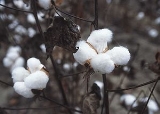
Cotton is a soft, staple fiber
Fiber

Fiber or fibre is a class of materials that are continuous filaments or are in discrete elongated pieces, similar to lengths of yarn. They are very important in the biology of both plants and animals, for holding tissue s together....
 that grows in a form known as a boll around the seeds of the cotton plant a shrub
Shrub

A shrub or bush is a horticulture rather than strictly Botany category of woody plant, distinguished from a tree by its multiple stems and lower height, usually less than 5-6 m tall....
 native to tropical and subtropical regions around the world, including the Americas
Americas

The Americas are the region of the Western hemisphere that consists of the continents of North America and South America with their associated islands and regions....
, India and Africa. The fiber most often is spun into yarn or thread and used to make a soft, breathable textile
Textile

A textile is a flexible material consisting of a network of natural or artificial fibres often referred to as thread or yarn. Yarn is produced by Spinning raw wool fibres, linen, cotton, or other material on a spinning wheel to produce long strands known as yarn....
, which is the most widely used natural-fiber cloth in clothing
Clothing

A feature of all human societies, except perhaps the most primitive, is the wearing of clothing or clothes, especially in public. The primary purpose of clothing is functional, as a protection from the weather....
 today.


Discussion
Ask a question about 'Cotton'
Start a new discussion about 'Cotton'
Answer questions from other users
Full Discussion Forum


Recent Posts


Encyclopedia


Cottonplant
Cotton is a soft, staple fiber
Fiber

Fiber or fibre is a class of materials that are continuous filaments or are in discrete elongated pieces, similar to lengths of yarn. They are very important in the biology of both plants and animals, for holding tissue s together....
 that grows in a form known as a boll around the seeds of the cotton plant a shrub
Shrub

A shrub or bush is a horticulture rather than strictly Botany category of woody plant, distinguished from a tree by its multiple stems and lower height, usually less than 5-6 m tall....
 native to tropical and subtropical regions around the world, including the Americas
Americas

The Americas are the region of the Western hemisphere that consists of the continents of North America and South America with their associated islands and regions....
, India and Africa. The fiber most often is spun into yarn or thread and used to make a soft, breathable textile
Textile

A textile is a flexible material consisting of a network of natural or artificial fibres often referred to as thread or yarn. Yarn is produced by Spinning raw wool fibres, linen, cotton, or other material on a spinning wheel to produce long strands known as yarn....
, which is the most widely used natural-fiber cloth in clothing
Clothing

A feature of all human societies, except perhaps the most primitive, is the wearing of clothing or clothes, especially in public. The primary purpose of clothing is functional, as a protection from the weather....
 today. The English name
English language

English is a West Germanic language that originated in Anglo-Saxon England and has lingua franca status in many parts of the world as a result of the military, economic, scientific, political and cultural influence of the British Empire in the 18th, 19th and early 20th centuries and that of the United States from the mid 20th century onwa...
, which began to be used circa 1400, derives from the Arabic
Arabic language

Arabic is a Central Semitic language, thus related to and classified alongside other Semitic languages languages such as Hebrew language and Aramaic language....
 (al) qutn ?????, meaning cotton.

History

Mandeville Cotton
Cotton was cultivated by the inhabitants of the Indus Valley Civilization
Indus Valley Civilization

The Indus Valley Civilization , abbreviated IVC, was an ancient civilization that flourished in the Indus River basin. Primarily centered along the Indus river, the civilization encompassed most of Pakistan, including its Sindh, Punjab and Balochistan provinces, and extending into modern day Indian states of Gujarat, Haryana, Punjab...
 by the 5th millennium BCE - 4th millennium BCE. The Indus cotton industry was well developed and some methods used in cotton spinning and fabrication continued to be used until the modern Industrialization of India. Well before the Common Era
Common Era

Common Era, abbreviated as CE, is a designation for the calendar system most commonly used in the Western world, and also internationally, for numbering the year part of the calendar date....
 the use of cotton textiles had spread from India to the Mediterranean and beyond.

According to The Columbia Encyclopedia, Sixth Edition: "Cotton has been spun, woven, and died since prehistoric times. It clothed the people of ancient India, Egypt, and China. Hundreds of years before the Christian era cotton textiles were woven in India with matchless skill, and their use spread to the Mediterranean countries. In the 1st cent. Arab
Arab

An Arab is a person who Identity as such on linguistic or cultural grounds. The plural form, Arabs , refers to the Ethnocultural group at large....
 traders brought fine muslin and calico to Italy and Spain. The Moors
Moors

In the Spanish language, the term for Moors is Moro; in Portuguese language the word is mouro. There seems to have been some confusion about the relationship of the word moro/mouro to the word moreno , both from Greek language ma?ros, i.e....
 introduced the cultivation of cotton into Spain in the 9th cent. Fustians and dimities were woven there and in the 14th cent. in Venice and Milan, at first with a linen warp. Little cotton cloth was imported to England before the 15th cent., although small amounts were obtained chiefly for candlewicks. By the 17th cent. the East India Company was bringing rare fabrics from India. Native Americans
Indigenous peoples of the Americas

The indigenous peoples of the Americas are the pre-Columbian inhabitants of the Americas, their descendants, and many ethnic groups who identify with those peoples....
 skillfully spun and wove cotton into fine garments and dyed tapestries. Cotton fabrics found in Peru
Peru

Peru , officially the Republic of Peru , is a country in western South America. It is bordered on the north by Ecuador and Colombia, on the east by Brazil, on the southeast by Bolivia, on the south by Chile, and on the west by the Pacific Ocean....
vian tombs are said to belong to a pre-Inca culture. In color and texture the ancient Peruvian and Mexican textiles resemble those found in Egyptian tombs."

The earliest cultivation of cotton discovered thus far in the Americas occurred in Mexico, some 5,000 years ago. The indigenous species was Gossypium hirsutum
Gossypium hirsutum

Gossypium hirsutum, known as Upland Cotton or Mexican Cotton, is the most widely planted species of Gossypium in the United States, constituting some 95% of all cotton production....
 which is today the most widely planted species of cotton in the world, constituting about 90% of all production worldwide. The greatest diversity of wild cotton species is found in Mexico, followed by Australia and Africa.

In Iran
Iran

Iran , officially the Islamic Republic of Iran and formerly known internationally as Persian Empire until 1935, is a country in Central Eurasia, located on the northeastern shore of the Persian Gulf and the southern shore of the Caspian Sea....
 (Persia), the history of cotton dates back to Achaemenid era (5th century B.C.), however there are few sources about the implantation
Implantation

Implantation is an event that occurs early in pregnancy in which the embryo adheres to the wall of uterus. At this stage of prenatal development, the embryo is a blastocyst....
 of cotton in Pre-Islamic Iran
Iran

Iran , officially the Islamic Republic of Iran and formerly known internationally as Persian Empire until 1935, is a country in Central Eurasia, located on the northeastern shore of the Persian Gulf and the southern shore of the Caspian Sea....
. The implantation of cotton was common in Merv
Merv

Merv , formerly Achaemenid Satrapy of Margiana, and later Alexandria and Antiochia in Margiana , was a major oasis-city in Central Asia, on the historical Silk Road, located near today's Mary, Turkmenistan in Turkmenistan....
, Ray
Ray

Ray may refer to:*Batoidea , a superorder of cartilaginous fishes**Rajiformes, "True rays" and skates*Radiation*Ray , idealized narrow beam of light...
 and Pars
Pars

Pars may refer to:*Fars Province, modern Persian language name for Pars, capital of the ancient Persian empire*Programmed Airline Reservation System...
 of Iran
Iran

Iran , officially the Islamic Republic of Iran and formerly known internationally as Persian Empire until 1935, is a country in Central Eurasia, located on the northeastern shore of the Persian Gulf and the southern shore of the Caspian Sea....
 (Persia). In the poems of Persian poets, specially Ferdowsi
Ferdowsi

Hakim Abu'l-Qasim Firdawsi Tusi , more commonly transliterated as Ferdowsi , was a highly revered Persian people poet. He was the author of the Shahnameh, the national epic of Iran as well as other Persian communities in other countries....
's Shahname, there are many referrals to Cotton ("Panbe" in Persian
Persian

Persian is of, from, or related to Iran , a country in the Middle East.* Persian people, an Iranian peoples ethno-linguistic community in Central and Southwest Asia....
). Marco Polo
Marco Polo

Marco Polo was a trader and exploration from the Venetian Republic who gained fame for his worldwide travels, recorded in the book Il Milione also known as Oriente Poliano and the Description of the World....
 (13th century) refers to the major products of Persia (Iran
Iran

Iran , officially the Islamic Republic of Iran and formerly known internationally as Persian Empire until 1935, is a country in Central Eurasia, located on the northeastern shore of the Persian Gulf and the southern shore of the Caspian Sea....
), including Cotton. John Chardin a famous french traveler of 17th century who has visited the Safavid Persia, has approved the vast cotton farm
Farm

A farm is an area of land, including various structures, devoted primarily to the practice of producing and managing food , fibers and, increasingly, fuel....
s of Persia.

In Peru
Peru

Peru , officially the Republic of Peru , is a country in western South America. It is bordered on the north by Ecuador and Colombia, on the east by Brazil, on the southeast by Bolivia, on the south by Chile, and on the west by the Pacific Ocean....
, cultivation of the indigenous cotton species Gossypium barbadense
Gossypium barbadense

Pima cotton , also known as Extra Long Staple, South American, Creole, Sea Island cotton, Egyptian, Algodon pais, and West Indische katoen, is a species of cotton plant which is widely cultivated though it originated in Peru....
 was the backbone of the development of coastal cultures such as the Norte Chico
Norte Chico civilization

The Norte Chico civilization was a complex Pre-Columbian society that included as many as 30 major population centers in what is now the Norte Chico of north-central coastal Peru....
, Moche
Moche

The 'Moche' civilization flourished in northern Peru from about 100 C.E. to 800 C.E., during the Cultural periods of Peru. While still the subject of some debate, many scholars contend that the Moche were not politically organized as a monolithic empire or state but rather as a group of autonomous polities that shared a common elite cu...
 and Nazca
Nazca

Nazca is the name of a system of valleys on the southern coast of Peru, and the name of the region's largest existing town. It is also the name applied to the Nazca culture that flourished in the area between 300 BC and 800....
. Cotton was grown upriver, made into nets and traded with fishing villages along the coast for large supplies of fish. The Spanish who came to Mexico in the early 1500s found the people growing cotton and wearing clothing made of it.

During the late medieval period, cotton became known as an import
International trade

International trade is exchange of Capital , goods, and services across international borders or territories. In most countries, it represents a significant share of gross domestic product ....
ed fiber in northern Europe, without any knowledge of how it was derived, other than that it was a plant
Plant

Plants are Life organisms belonging to the Kingdom Plantae. They include familiar organisms such as trees, herbs, bushes, grasses, vines, ferns, mosses, and green algae....
; noting its similarities to wool, people in the region could only imagine that cotton must be produced by plant-borne sheep. John Mandeville
John Mandeville

"Jehan de Mandeville", translated as "Sir John Mandeville", is the name claimed by the compiler of a singular book of supposed travels, written in Anglo-Norman language, and published between 1357 and 1371....
, writing in 1350, stated as fact the now-preposterous belief: "There grew there [India] a wonderful tree which bore tiny lambs on the endes of its branches. These branches were so pliable that they bent down to allow the lambs to feed when they are hungrie." (See Vegetable Lamb of Tartary
Vegetable Lamb of Tartary

The Vegetable Lamb of Tartary is a semi-legendary plant of central Asia, believed to grow sheep as its fruit. The sheep were connected to the plant by an umbilical and grazed the land around the plant....
.) This aspect is retained in the name for cotton in many European languages, such as German Baumwolle, which translates as "tree wool" (Baum means "tree"; Wolle means "wool"). By the end of the 16th century, cotton was cultivated throughout the warmer regions in Asia and the Americas
Americas

The Americas are the region of the Western hemisphere that consists of the continents of North America and South America with their associated islands and regions....
.

India's cotton-processing sector gradually declined during British expansion in India and the establishment of colonial rule
British Raj

British Raj primarily refers to the British rule in the Indian subcontinent between 1858 and 1947; it can also refer to the period of dominion, and even the region under the rule....
 during the late 18th and early 19th centuries. This was largely due to the East India Company
British East India Company

The East India Company was an early England joint-stock company that was formed initially for pursuing trade with the Indies, but that ended up trading with the Indian subcontinent and China....
's exposing of India to foreign competition, which made cotton processing and manufacturing workshops in India uncompetitive. Indian markets increasingly supplied only raw cotton and were obliged to purchase manufactured textiles from Britain.

The advent of the Industrial Revolution
Industrial Revolution

The Industrial Revolution was a period in the late 18th and early 19th centuries when major changes in agriculture, manufacturing, production, and transportation had a profound effect on the socioeconomics and cultural conditions in United Kingdom....
 in Britain provided a great boost to cotton manufacture, as textiles emerged as Britain's leading export. In 1738 Lewis Paul
Lewis Paul

Lewis Paul was the original inventor of roller spinning, the basis of the water frame for Spinning cotton in a cotton mill....
 and John Wyatt
John Wyatt

John Franklin Wyatt jr. was a relief pitcher in Major League Baseball. From 1961 through 1969, he played for the Oakland Athletics , Boston Red Sox , New York Yankees , Detroit Tigers and Oakland Athletics ....
, of Birmingham
Birmingham

Birmingham is a city status in the United Kingdom and metropolitan borough in the West Midlands of England. Birmingham is the most populous of England's English Core Cities Group, and is the List of United Kingdom cities by population British city after London, with a population of 1,010,200 ....
, England, patented the Roller Spinning machine, and the flyer-and-bobbin system for drawing cotton to a more even thickness using two sets of rollers that traveled at different speeds. Later, the invention of the spinning jenny
Spinning jenny

The spinning jenny is a multi-spool spinning wheel. It was invented circa 1764 by James Hargreaves in Stanhill, near Blackburn, Lancashire in the northwest of England ....
 in 1764 and Richard Arkwright
Richard Arkwright

Sir Richard Arkwright , was an England who is credited for inventing the spinning frame ? later renamed the water frame following the transition to Hydropower....
's spinning frame
Spinning frame

The spinning frame was an invention developed during the 18th century Great Britain Industrial Revolution. It was later developed into the water frame , and was used to increase production of textiles in factory....
 (based on the Roller Spinning Machine) in 1769 enabled British weavers to produce cotton yarn and cloth at much higher rates. From the late eighteenth century onwards, the British city of Manchester
Manchester

Manchester is a city and metropolitan borough of Greater Manchester, England. Manchester was granted City status in the United Kingdom in 1853....
 acquired the nickname "cottonopolis
Cottonopolis

Cottonopolis is a name given to the city of Manchester, in England. First bestowed during the 19th century, it denotes a metropolis of cotton and cotton mills, as inspired by Manchester's status as the international centre of the cotton and textile processing industries during this time....
"
due to the cotton industry's omnipresence within the city, and Manchester's role as the heart of the global cotton trade. Production capacity was further improved by the invention of the cotton gin
Cotton gin

A cotton gin is a machine that quickly and easily separates the cotton fibers from the seedpods and the sometimes sticky seeds, a job previously done by hand....
 by Eli Whitney
Eli Whitney

Eli Whitney was an American inventor best known as the inventor of the cotton gin. This was one of the key inventions of the industrial revolution and shaped the economy of the antebellum South....
 in 1793. Improving technology and increasing control of world markets allowed British traders to develop a commercial chain in which raw cotton fibers were (at first) purchased from colonial plantations, processed into cotton cloth in the mills of Lancashire
Lancashire

Lancashire is a Metropolitan and non-metropolitan counties of England of Historic counties of England in the North West England of England, bounded to the west by the Irish Sea....
, and then re-exported on British ships to captive colonial markets in West Africa
British West Africa

British West Africa was the collective name for United Kingdom colonies in West Africa during the colonial period, either in the general geographical sense or more specifically those comprised in a formal colonial administrative entity....
, India
British Raj

British Raj primarily refers to the British rule in the Indian subcontinent between 1858 and 1947; it can also refer to the period of dominion, and even the region under the rule....
, and China (via Shanghai and Hong Kong).

By the 1840s, India was no longer capable of supplying the vast quantities of cotton fibers needed by mechanized British factories, while shipping bulky, low-price cotton from India to Britain was time-consuming and expensive. This, coupled with the emergence of American cotton as a superior type (due to the longer, stronger fibers of the two domesticated native American species, Gossypium hirsutum
Gossypium hirsutum

Gossypium hirsutum, known as Upland Cotton or Mexican Cotton, is the most widely planted species of Gossypium in the United States, constituting some 95% of all cotton production....
 and Gossypium barbadense
Gossypium barbadense

Pima cotton , also known as Extra Long Staple, South American, Creole, Sea Island cotton, Egyptian, Algodon pais, and West Indische katoen, is a species of cotton plant which is widely cultivated though it originated in Peru....
), encouraged British traders to purchase cotton from plantations in the United States and the Caribbean
Caribbean

The Caribbean is a region consisting of the Caribbean Sea, its islands , and the surrounding coasts. The region is located southeast of the Gulf of Mexico and Northern America, east of Central America, and to the north of South America....
. This was also much cheaper as it was produced by unpaid slaves. By the mid 19th century, "King Cotton
King Cotton

King Cotton was a phrase used in the Southern United States mainly by Southern politicians and authors who wanted to illustrate the importance of the cotton agriculture to the Confederate States of America economy during the American Civil War....
" had become the backbone of the southern American economy. In the United States, cultivating and harvesting cotton became the leading occupation of slaves.

During the American Civil War
American Civil War

The American Civil War , also known as the War Between the States and several Naming the American Civil War, was a civil war in the United States....
, American cotton exports slumped due to a Union
Union (American Civil War)

During the American Civil War, the Union was a name used to refer to the Federal government of the United States of the United States, which was supported by the twenty-three states which were not part of the secession attempt by the 11 states that formed the Confederate States of America....
 blockade
Blockade

A blockade is an effort to cut off the communications of a particular area, by force. It is distinct from a siege in that a blockade is usually directed at an entire country or region, not a fortress or city....
 on Southern
Confederate States of America

The Confederate States of America formed as the government set up from 1861 to 1865 by eleven Southern United States U.S. state of the United States of America that had declared their secession from the U.S....
 ports, also because of a strategic decision by the Confederate Government to cut exports, hoping to force Britain to recognize the Confederacy or enter the war, prompting the main purchasers of cotton, Britain
United Kingdom of Great Britain and Ireland

The United Kingdom of Great Britain and Ireland was the formal name and the state form of the United Kingdom from 1 January 1801 until 12 April 1927....
 and France, to turn to Egypt
Egypt

Egypt is a country mainly in North Africa, with the Sinai Peninsula forming a land bridge in Western Asia. Covering an area of about , Egypt borders the Mediterranean Sea to the north, the Gaza Strip and Israel to the northeast, the Red Sea to the east, Sudan to the south and Libya to the west....
ian cotton. British and French traders invested heavily in cotton plantations and the Egyptian government of Viceroy Isma'il
Isma'il Pasha

Isma'il Pasha, known as Ismail the Magnificent , was Wali and subsequently Khedive of Egypt and Sudan from 1863 until he was removed at the behest of the British in 1879....
 took out substantial loans from European bankers and stock exchanges. After the American Civil War ended in 1865, British and French traders abandoned Egyptian cotton and returned to cheap American exports, sending Egypt into a deficit
Deficit

A budget deficit occurs when an entity spends more money than it takes in. The opposite of a budget deficit is a budget surplus. Debt is essentially an accumulated flow of deficits....
 spiral that led to the country declaring bankruptcy
Bankruptcy

Bankruptcy is a legally declared inability or impairment of ability of an individual or organization to pay its creditors. Creditors may file a bankruptcy petition against a debtor in an effort to recoup a portion of what they are owed or initiate a restructuring....
 in 1876, a key factor behind Egypt's annexation by the British Empire
British Empire

The British Empire comprised the dominions, Crown colony, protectorates, League of Nations mandate, and other Dependent territory ruled or administered by the United Kingdom , that had originated with the overseas colonies and trading posts established by England in the late 16th and early 17th centuries....
 in 1882.

Cotton Field
During this time cotton cultivation in the British Empire, especially India, greatly increased to replace the lost production of the American South. Through tariffs and other restrictions the British government discouraged the production of cotton cloth in India; rather the raw fiber was sent to England for processing. The Indian patriot Mahatma Gandhi described the process:

  1. English people buy Indian cotton in the field, picked by Indian labor at seven cents a day, through an optional monopoly.
  2. This cotton is shipped on British bottoms, a three-week journey across the Indian Ocean, down the Red Sea, across the Mediterranean, through Gibraltar, across the Bay of Biscay and the Atlantic Ocean to London. One hundred per cent profit on this freight is regarded as small.
  3. The cotton is turned into cloth in Lancashire. You pay shilling wages instead of Indian pennies to your workers. The English worker not only has the advantage of better wages, but the steel companies of England get the profit of building the factories and machines. Wages; profits; all these are spent in England.
  4. The finished product is sent back to India at European shipping rates, once again on British ships. The captains, officers, sailors of these ships, whose wages must be paid, are English. The only Indians who profit are a few lascars who do the dirty work on the boats for a few cents a day.
  5. The cloth is finally sold back to the kings and landlords of India who got the money to buy this expensive cloth out of the poor peasants of India who worked at seven cents a day. (Fisher 1932 pp 154-156)


In the United States, Southern cotton provided capital for the continuing development of the North. The cotton produced by enslaved African Americans not only helped the South but also enriched Northern merchants. Much of the Southern cotton was transshipped through the northern ports.

Cotton remained a key crop in the southern economy after emancipation
Emancipation Proclamation

The Emancipation Proclamation consists of two Executive order s issued by United States President Abraham Lincoln during the American Civil War....
 and the end of the civil war in 1865. Across the South, sharecropping
Sharecropping

Sharecropping is a system of agriculture or agricultural production in which a landowner allows a tenant to use the land in return for a share of the crop produced on the land ....
 evolved, in which free black farmers worked on white-owned cotton plantations in return for a share of the profits. Cotton plantations required vast labor forces to hand-pick cotton, and it was not until the 1950s that reliable harvesting machinery was introduced into the South (prior to this, cotton-harvesting machinery had been too clumsy to pick cotton without shredding the fibers). During the early twentieth century, employment in the cotton industry fell as machines began to replace laborers, and as the South's rural labor force dwindled during the First and Second World Wars. Today, cotton remains a major export of the southern United States, and a majority of the world's annual cotton crop is of the long-staple American variety.

Tangüis cotton

In 1901, Peru's cotton industry suffered because of a fungus plague caused by a plant disease known as "Cotton wilt" and " "Fusarium wilt" (Fusarium vasinfectum). The plant disease, which spread throughout Peru, entered the plant by its roots and worked its way up the stem until the plant was completely dried up. Fermín Tangüis
Fermín Tangüis

Ferm?n Tang?is , was a Puerto Rican people businessman, agriculturist and scientist who developed the seed that would eventually produce the Tanguis cotton in Peru and save that nation's cotton industry....
 a Puerto Rican agriculturist who lived in Peru, studied some species of the plant that were affected by the disease to a lesser extent and experimented in germination
Germination

Germination is the process whereby growth emerges from a period of dormancy. The most common example of germination is the sprouting of a seedling from a seed of an flowering plant or gymnosperm....
 with the seeds of various cotton plants. In 1911, after 10 years of experimenting and failures, Tangüis was able to develop a seed which produced a superior cotton plant resistant to the disease. The seeds produced a plant that had a 40% longer (between 29 mm and 33 mm) and thicker fiber that did not break easily and required little water. The Tangüis cotton, as it became known, is the variety which is preferred by the Peruvian national textile industry. It constituted 75 percent of all the Peruvian cotton production, both for domestic use and apparel exports. The Tangüis cotton crop was estimated at 225,000 bales
Bale

Bale can refer to any of the following:...
 that year.

Cultivation

Nutbush Tennessee Cotton
Successful cultivation of cotton requires a long frost
Frost

Frost is the solid deposition of water vapor from Saturation air. It is formed when solid surfaces are cooled to below the dew point of the adjacent air....
-free period, plenty of sunshine, and a moderate rainfall, usually from 600 to 1200mm (24 to 48 inches). Soil
Soil

Soil is the naturally occurring, unconsolidated or loose covering on the Earth's surface. Soil is composed of particles of broken rock that have been altered by chemical and environmental processes including weathering and erosion....
s usually need to be fairly heavy, although the level of nutrient
Nutrient

A nutrient is a chemical that an organism needs to live and grow or a substance used in an organism's metabolism which must be taken in from its environment....
s does not need to be exceptional. In general, these conditions are met within the seasonally dry tropics and subtropics in the Northern and Southern hemispheres, but a large proportion of the cotton grown today is cultivated in areas with less rainfall that obtain the water from irrigation. Production of the crop for a given year usually starts soon after harvesting the preceding autumn. Planting time in spring in the Northern hemisphere varies from the beginning of February to the beginning of June. The area of the United States known as the South Plains
South Plains

The South Plains is a region in West Texas comprising the area north of the Caprock Escarpment on the Llano Estacado, and extending north into the Texas Panhandle, centered at Lubbock....
 is the largest contiguous cotton-growing region in the world. It is heavily dependent on irrigation
Irrigation

Irrigation is an artificial application of water to the soil usually for assisting in growing crops. In crop production it is mainly used in dry areas and in periods of rainfall shortfalls, but also to protect plants against frost....
 water drawn from the Ogallala Aquifer
Ogallala Aquifer

File:Ogallala changes 1980-1995.svgFile:High plains fresh groundwater usage 2000.svgThe Ogallala Aquifer, also known as the High Plains Aquifer, is a vast yet shallow underground water table aquifer located beneath the Great Plains in the United States....
.

Cotton is a thirsty crop, and as water resources
Water resources

Water resources are sources of water that are useful or potentially useful to humans. Uses of water include agricultural, industry, household, recreational and natural environment activities....
 get tighter around the world, economies that rely on it face difficulties and conflict, as well as potential environmental problems. For example, cotton has led to desertification
Desertification

Desertification is the degradation of land in arid and dry Humid subtropical climate areas, resulting primarily from natural activities and influenced by Climate variations....
 in areas of Uzbekistan
Uzbekistan

Uzbekistan, officially the Republic of Uzbekistan , is a Landlocked_country#Doubly_landlocked_country country in Central Asia, formerly part of the Soviet Union....
, where it is a major export. In the days of the Soviet Union
Soviet Union

The Union of Soviet Socialist Republics was a Constitution of the Soviet Union socialist state that existed in Eurasia from 1922 to 1991.The name is a translation of the , romanization of Russian Soyuz Sovetskikh Sotsialisticheskikh Respublik, abbreviated ????, SSSR....
, the Aral Sea
Aral Sea

The Aral Sea is a landlocked endorheic basin in Central Asia; it lies between Kazakhstan in the north and Karakalpakstan, an autonomous region of Uzbekistan, in the south....
 was tapped for agricultural irrigation, largely of cotton, and now salination is widespread.

Genetically modified cotton

Genetically modified (GM) cotton was developed to reduce the heavy reliance on pesticides. The bacterium Bacillus thuringiensis
Bacillus thuringiensis

Bacillus thuringiensis is a Gram-positive, soil-dwelling bacterium of the genus Bacillus. Additionally, B. thuringiensis also occurs naturally in the gut of caterpillars of various types of moths and butterfly, as well as on the dark surface of plants....
 naturally produces a chemical harmful only to a small fraction of insects, most notably the larvae of moths and butterflies
Lepidoptera

Lepidoptera is an order of insect that includes moths and butterfly. It is one of the most speciose orders in the class Insecta, encompassing moths and the three superfamilies of butterfly, skipper , and Hedylidae....
, beetles, and flies, and harmless to other forms of life. The gene coding for BT toxin has been inserted into cotton, causing cotton to produce this natural insecticide in its tissues. In many regions the main pests in commercial cotton are lepidopteran larvae, which are killed by the BT protein in the transgenic cotton that they eat. This eliminates the need to use large amounts of broad-spectrum insecticides to kill lepidopteran pests (some of which have developed pyrethroid
Pyrethroid

A pyrethroid is a synthetic chemical compound similar to the natural chemical pyrethrins produced by the flowers of pyrethrums . Pyrethroids are common in commercial products such as household insecticides and insect repellents....
 resistance). This spares natural insect predators in the farm ecology and further contributes to non-insecticide pest management.

BT cotton is ineffective against many cotton pests, however, such as plant bugs, stink bugs, aphid
Aphid

Aphids, also known as plant lice , are small plant-eating insects, and members of the Taxonomic rank Aphidoidea. Aphids are among the most destructive insect pests on cultivated plants in temperate regions....
s, etc.; depending on circumstances it may still be desirable to use insecticides against these.

Genetically modified cotton is widely used throughout the world. However, researchers have recently published the first documented case of in-field pest resistance to GM cotton. The International Service for the Acquisition of Agri-biotech Applications
International Service for the Acquisition of Agri-biotech Applications

The International Service for the Acquisition of Agri-biotech Applications is a small non-profit international organization that promotes the use of biotechnology applications in developing nations....
 (ISAAA) said that, worldwide, GM cotton was planted on an area of 67,000 km² in 2002. This is 20% of the worldwide total area planted in cotton. The U.S. cotton crop was 73% GM in 2003.

The initial introduction of GM cotton proved to be a commercial and ecological disaster in Australia - the yields were far lower than predicted, and the cotton plants were cross-pollinated with other varieties of cotton. However, the introduction of a second variety of GM cotton led to 15% of Australian cotton being GM in 2003. 80% of the crop was genetically modified in 2004, when the original GM variety was banned.

Cotton has also been genetically modified for resistance to glyphosate
Glyphosate

Glyphosate is a non-selective systemic herbicide, absorbed through the leaves, injected into the Trunk , or applied to the stump of a tree, used to kill weeds, especially Perennial plants and broadcast or used in the cut-stump treatment as a forestry herbicide....
 (marketed as Roundup
Roundup

Roundup is the brand name of a systemic, broad-spectrum herbicide produced by the United States company Monsanto and contains the active ingredient glyphosate....
 in the USA), an inexpensive and highly effective but broad-spectrum herbicide, during its early growth. This allows glyphosate to be used for weed control during the early growing season.

GM cotton acreage in India continues to grow at a rapid rate increasing from 50,000 hectares in 2002 to 3.8 million hectares in 2006. The total cotton area in India is about 9.0 million hectares (the largest in the world or, about 25% of world cotton area) so GM cotton is now grown on 42% of the cotton area. This makes India the country with the largest area of GM cotton in the world, surpassing China (3.5 million hectares in 2006). The major reasons for this increase is a combination of increased farm income ($225/ha) and a reduction in pesticide use to control the Cotton Bollworm.

Cotton has gossypol
Gossypol

Gossypol C30H30O8 is a polyphenol derived from the cotton plant . Gossypol is a polyphenolic aldehyde that permeates cells and acts as an inhibitor for several dehydrogenase enzymes....
, a toxin that makes it inedible. However, scientists have silenced the gene that produces the toxin, making it a potential food crop.

Organic cotton

Organic cotton
Organic cotton

Organic cotton is cotton that is grown without pesticides from plants which are not Transgenic plant. As of 2007, 265,517 bales of organic cotton were produced in 24 countries and worldwide production was growing at a rate of more than 50% per year....
 is cotton that is grown without insecticide or pesticide. Worldwide, cotton is a pesticide-intensive crop, using approximately 25% of the world's insecticides and 10% of the world's pesticides. According to the World Health Organization (WHO), 20,000 deaths occur each year from pesticide poisoning in developing countries, many of these from cotton farming. Organic agriculture uses methods that are ecological, economical, and socially sustainable and denies the use of agrochemicals and artificial fertilizers. Instead, organic agriculture uses crop rotation
Crop rotation

Crop rotation or Crop sequencing is the practice of growing a series of dissimilar types of Crop in the same area in sequential seasons for various benefits such as to avoid the build up of pathogens and pests that often occurs when one species is continuously cropped....
, the growing of different crops than cotton in alternative years. The use of insecticides is prohibited; organic agriculture uses natural enemies to suppress harmful insects. The production of organic cotton is more expensive than the production of conventional cotton. Although toxic pollution from synthetic chemicals is eliminated, other pollution-like problems may remain, particularly run-off. Organic cotton is produced in organic agricultural systems that produce food and fiber according to clearly established standards. Organic agriculture prohibits the use of toxic and persistent chemical pesticides and fertilizers, as well as genetically modified organisms. It seeks to build biologically diverse agricultural systems, replenish and maintain soil fertility, and promote a healthy environment.

Pests and weeds

Greene Co Ga1941 Delano
The cotton industry relies heavily on chemicals such as fertilizers and insecticides, although a very small number of farmers are moving toward an organic
Organic farming

Organic farming is a form of agriculture that relies on crop rotation, green manure, compost, biological pest control, and mechanical cultivation to maintain soil productivity and control pest s, excluding or strictly limiting the use of synthetic fertilizers and synthetic pesticides, plant growth regulators, livestock feed additives, and gen...
 model of production and organic cotton products are now available for purchase at limited locations. These are popular for baby clothes and diapers. Under most definitions, organic products do not use genetic engineering
Genetic engineering

Engineering There are a number of ways through which genetic engineering is accomplished. Essentially, the process has five main steps# Isolation of the genes of interest...
.

Historically, in North America, one of the most economically destructive pests in cotton production has been the boll weevil
Boll weevil

The boll weevil is a beetle measuring an average length of six millimeters, which feeds on cotton buds and flowers. Thought to be native to Central America, it migrated into the US from Mexico in the late 19th century and had infested all US cotton-growing areas by the 1920s, devastating the industry and the people working in the American so...
. Due to the US Department of Agriculture's highly successful Boll Weevil Eradication Program
Boll Weevil Eradication Program

The Boll Weevil Eradication Program is a program sponsored by the United States Department of Agriculture that has sought to eradicate the boll weevil in the cotton-growing areas of the United States....
 (BWEP), this pest has been eliminated from cotton in most of the United States. This program, along with the introduction of genetically engineered "Bt
Bacillus thuringiensis

Bacillus thuringiensis is a Gram-positive, soil-dwelling bacterium of the genus Bacillus. Additionally, B. thuringiensis also occurs naturally in the gut of caterpillars of various types of moths and butterfly, as well as on the dark surface of plants....
 cotton" (which contains a bacteria gene that codes for a plant-produced protein that is toxic to a number of pests such as tobacco budworm, cotton bollworm, and pink bollworm), has allowed a reduction in the use of synthetic insecticides.

Mechanized harvesting

Cotton Harvest
Most cotton in the United States, Europe, and Australia is harvested mechanically, either by a cotton picker
Cotton picker

The mechanical cotton picker is a machine that automates cotton harvesting in a way that reduces harvest time and maximizes efficiency....
, a machine that removes the cotton from the boll without damaging the cotton plant, or by a cotton stripper, which strips the entire boll off the plant. Cotton strippers are used in regions where it is too windy to grow picker varieties of cotton, and usually after application of a chemical defoliant
Defoliant

A defoliant is any chemical sprayed or dusted on plants to cause its leaves to fall off. A classic example of a highly toxic defoliant used for tactical purposes is Agent Orange, which was used widely by the United States armed forces during the Vietnam War from 1961 to 1970....
 or the natural defoliation that occurs after a freeze. Cotton is a perennial crop in the tropics and without defoliation or freezing, the plant will continue to grow.

Cotton continues to be picked by hand in developing countries
Developing country

A developing country is a country that has often low standards of democracy, industrialisation, Social work, and Human rights for its citizens....
 such as Uzbekistan
Uzbekistan

Uzbekistan, officially the Republic of Uzbekistan , is a Landlocked_country#Doubly_landlocked_country country in Central Asia, formerly part of the Soviet Union....
.

Competition from synthetic fibers

The era of manufactured fibers began with the development of Rayon
Rayon

Rayon is a manufactured regenerated cellulose fiber. Because it is produced from naturally occurring polymers, it is neither a truly synthetic fiber nor a natural fiber; it is a semi-synthetic fiber ....
 in France in the 1890s. Rayon is derived from a natural cellulose and cannot be considered synthetic, but requires extensive processing in a manufacturing process and led the less expensive replacement of more naturally derived materials. A succession of new synthetic fibers were introduced by the chemicals industry in the following decades. Acetate
Acetate

An acetate, or ethanoate, is either a salt or ester of acetic acid.In chemistry, the abbreviation Ac refers to the acetyl group. The anion and the functional group may be written as -OAc and AcO-, or OAc respectively....
 in fiber form was developed in 1924. Nylon
Nylon

Nylon is a generic designation for a family of synthetic polymers known generically as polyamides and first produced on February 28, 1935 by Wallace Carothers at DuPont....
, the first fiber synthesized entirely from petrochemicals, was introduced as a sewing thread by DuPont in 1936, followed by Dupont's acrylic
Acrylic fiber

Acrylic fibers are synthetic fibers made from a polymer with an average molecular weight of ~100,000, about 1900 monomer units. To be called acrylic in the U.S, the polymer must contain at least 85% acrylonitrile monomer....
 in 1944. Some garments were created from fabrics based on these fibers, such as women's hosiery
Hosiery

Hosiery is knitted coverings for the legs and feet. Also referred to as legwear, hosiery describes garments worn directly on the foot and legs....
 from nylon, but it was not until the introduction of polyester
Polyester

Polyester is a category of polymers which contain the ester functional group in their main chain. Although there are many polyesters, the term "polyester" as a specific material most commonly refers to polyethylene terephthalate ....
 into the fiber marketplace in the early 1950s that the market for cotton came under threat. The rapid uptake of polyester garments in the 1960s caused economic hardship in cotton exporting economies, especially in Central American countries such as Nicaragua
Nicaragua

Nicaragua officially the Republic of Nicaragua , is a representative democracy republic. It is the largest state in Central America with an area of 130,000 km2, about the size of the state of New York....
 where cotton production had boomed tenfold between 1950 and 1965 with the advent of cheap chemical pesticides. Cotton production recovered in the 1970s, but crashed to pre-1960 levels in the early 1990s.

Beginning as a self-help program in the mid-1960s, the Cotton Research & Promotion Program was organized by U.S. cotton producers in response to cotton's steady decline in market share. At that time, producers voted to set up a per-bale assessment system to fund the program, with built-in safeguards to protect their investments. With the passage of the Cotton Research & Promotion Act of 1966, the program joined forces and began battling synthetic competitors and re-establishing markets for cotton. Today, the success of this program has made cotton the best-selling fiber in the U.S. and one of the best-selling fibers in the world.

Administered by the Cotton Board and conducted by Cotton Incorporated, the Cotton Research & Promotion Program works to greatly increase the demand for and profitability of cotton through various research and promotion activities. It is funded by U.S. cotton producers and importers.

Uses

Cotton is used to make a number of textile products. These include terrycloth
Terrycloth

Terrycloth, terry cloth, terry towelling, terry, or simply towelling is a textile with loops that can absorb large amounts of water....
, used to make highly absorbent bath towels and robes; denim
Denim

Denim is a rugged cotton twill textile, in which the weft passes under two or more Warp fibers. This produces the familiar diagonal ribbing identifiable on the reverse of the fabric, which distinguishes denim from cotton duck....
, used to make blue jeans
Blue Jeans

"Blue Jeans" is a sentimental popular song written by Harry D. Kerr and Lou Traveller in 1920. In the song, the singer is reminiscing about a long-ago young love that happened somewhere in the "hills of the old Cumberland." The chorus echoes the singer's longing:...
; chambray
Cambric

Cambric or chambray is a lightweight cotton textiles used as fabric for lace and needlework. Cambric, also known as batiste in a large part of the world, was first used in Cambrai, France, as early as 1595....
, popularly used in the manufacture of blue work shirts (from which we get the term "blue-collar"); and corduroy
Corduroy

Corduroy is a textile composed of twisted fibers that, when woven, lie parallel to one another to form the cloth's distinct pattern, a "cord." Modern corduroy is most commonly composed of tuftinged cords, sometimes exhibiting a channel between the tufts....
, seersucker
Seersucker

Seersucker is a thin, all-cotton textile, commonly striped, used to make clothing for spring and summer wear. The word came into English from Hindi, which originates from the Persian language words "shir o shakar," meaning "milk and sugar", probably from the resemblance of its smooth and rough stripes to the smooth surface of milk and bumpy...
, and cotton twill
Twill

Twill is a type of textile weaving with a pattern of diagonal parallel ribs.It is made by passing the weft thread over one or more Warp threads and then under two or more warp threads and so on, with a "step" or offset between rows to create the characteristic diagonal pattern....
. Socks
SOCKS

SOCKS is an Internet Protocol that facilitates the routing of Packet between client-server applications via a proxy server. SOCKS is an abbreviation for "Secured Over Credential-based Kerberos Services." SOCKS performs at Layer 5 of the OSI model - the Session layer ....
, underwear, and most T-shirt
T-shirt

A T-shirt is a shirt which is pulled on over the head to cover most of a person's torso. A T-shirt is usually buttonless, collarless, and pocketless, with a round neck and short sleeves....
s are made from cotton. Bed sheets often are made from cotton. Cotton also is used to make yarn used in crochet
Crochet

Crochet is a process of creating fabric from yarn or thread using a crochet hook. The word is derived from the Middle French word croc or croche, meaning hook. Crocheting, similar to knitting, consists of pulling loops of yarn through other loops....
 and knitting
Knitting

Knitting is a method by which yarn may be turned into cloth. Knitting consists of loops called stitches pulled through each other. The active stitches are held on a needle until another loop can be passed through them....
. Fabric also can be made from recycled or recovered cotton that otherwise would be thrown away during the spinning, weaving, or cutting process. While many fabrics are made completely of cotton, some materials blend cotton with other fibers, including rayon
Rayon

Rayon is a manufactured regenerated cellulose fiber. Because it is produced from naturally occurring polymers, it is neither a truly synthetic fiber nor a natural fiber; it is a semi-synthetic fiber ....
 and synthetic fiber
Synthetic fiber

Synthetic fibers are the result of extensive research by scientists to improve upon naturally occurring animal and plant. In general, synthetic fibers are created by forcing, usually through extrusion, fiber forming materials through holes into the air, forming a thread....
s such as polyester
Polyester

Polyester is a category of polymers which contain the ester functional group in their main chain. Although there are many polyesters, the term "polyester" as a specific material most commonly refers to polyethylene terephthalate ....
. It can either be used in knitted or woven fabrics, as it can be blended with elastine to make a stretchier thread for knitted fabrics, and things such as stretch jeans. In addition to the textile industry
Textile industry

The Textile industry is a term used for industries primarily concerned with the design or manufacture of clothing as well as the distribution and use of textiles....
, cotton is in fishnets, coffee filter
Coffee filter

A coffee filter is a coffee-brewing cooking utensil, usually made of disposable paper. A stainless steel filter is used to prepare indian filter coffee, the form of coffee common in India....
s, tent
Tent

A tent is a shelter consisting of sheets of textile or other material draped over or attached to a frame of poles or attached to a supporting rope....
s, gunpowder
Gunpowder

Gunpowder, also called black powder, is an explosive mixture of sulfur, charcoal and potassium nitrate, KNO3 that burns rapidly, producing volumes of hot solids and gases which can be used as a propellant in firearms and as a pyrotechnic composition in fireworks....
 (see Nitrocellulose
Nitrocellulose

Nitrocellulose is a highly flammable compound formed by nitrating cellulose through exposure to nitric acid or another powerful nitrating agent....
), cotton paper
Cotton paper

Cotton paper is made from 100% cotton fibers. Cotton paper is superior in both strength and durability to wood pulp-based papers, which may contain high concentrations of acids....
, and in bookbinding
Bookbinding

Bookbinding is the process of physically assembling a book from a number of folded or unfolded sheets of paper or other material. It also usually involves attaching covers to the resulting text-block....
. The first Chinese paper
Papermaking

Papermaking is the process of making paper, a substance which is used ubiquitously today for writing and packaging.In papermaking a dilute suspension of fibers in water is drained through a screen, so that a mat of randomly interwoven fibers is laid down....
 was made of cotton fiber. Fire hoses were once made of cotton.

The cottonseed which remains after the cotton is ginned is used to produce cottonseed oil
Cottonseed oil

Cottonseed oil is a vegetable oil extracted from the seeds of the cotton plant after the cotton has been removed. It must be refined to remove gossypol, a naturally occurring toxin that protects the cotton plant from insect damage....
, which, after refining, can be consumed by humans like any other vegetable oil. The cottonseed meal
Cottonseed meal

Cottonseed meal is the byproduct remaining after cotton is cotton gin and the seeds crushed and the cottonseed oil extracted. The remaining meal is usually used for fodder....
 that is left generally is fed to ruminant
Ruminant

Physiologically, a ruminant is a mammal of the order Artiodactyla that digests plant-based food by initially softening it within the animal's first stomach, known as the rumen, then regurgitating the semi-digested mass, now known as cud, and chewing it again....
 livestock; the gossypol
Gossypol

Gossypol C30H30O8 is a polyphenol derived from the cotton plant . Gossypol is a polyphenolic aldehyde that permeates cells and acts as an inhibitor for several dehydrogenase enzymes....
 remaining in the meal is toxic to mongastric animals. Cottonseed hulls can be added to dairy cattle rations for roughage. During the American slavery period, cotton root bark was used in a folk remedy as an abortifacient
Abortifacient

An abortifacient is a substance that induces abortion. Abortifacients for animals that have mating undesirably are known as mismating shots.Common abortifacients used in performing medical abortions include mifepristone, which is typically used in conjunction with misoprostol in a two-step approach....
, that is, to provoke abortion.

Cotton linters are fine, silky fibers which adhere to the seeds of the cotton plant after ginning. These curly fibers typically are less than 1/8 in (3 mm) long. The term also may apply to the longer textile fiber staple lint as well as the shorter fuzzy fibers from some upland species. Linters are traditionally used in the manufacture of paper and as a raw material in the manufacture of cellulose
Cellulose

File:Cellulose Sessel.svgCellulose is an organic compound with the chemical formula , a polysaccharide consisting of a linear chain of several hundred to over ten thousand ? linked D-glucose units....
.

Shiny cotton is a processed version of the fiber that can be made into cloth resembling satin
Satin

Satin is a cloth that typically has a glossy surface and a dull back. It is a warp -dominated weaving technique that forms a minimum number of interlacings in a fabric....
 for shirts and suits. However, its hydrophobic property of not easily taking up water makes it unfit for the purpose of bath and dish towels (although examples of these made from shiny cotton are seen).

The term Egyptian cotton refers to the extra long staple cotton grown in Egypt and favored for the luxury and upmarket brands worldwide. During the U.S. Civil War, with heavy European investments, Egyptian-grown cotton became a major alternate source for British textile mills. Egyptian cotton is more durable and softer than American Pima cotton, which is why it is more expensive. Pima cotton is American cotton that is grown in the southwestern states of the U.S.

In South Asia, cotton is widely used in mattresses, which are the most common type of mattress used in that region.

The international cotton trade

The United States, with sales of $4.9 billion, and Africa, with sales of $2.1 billion, are the largest exporters of raw cotton. Total international trade is $12 billion. Africa's share of the cotton trade has doubled since 1980. Neither area has a significant domestic textile industry, textile manufacturing having moved to developing nations in Eastern and South Asia such as India and China. In Africa cotton is grown by numerous small holders. Dunavant Enterprises, based in Memphis, Tennessee
Memphis, Tennessee

Memphis is a city in the southwest corner of the U.S. state of Tennessee, and the county seat of Shelby County, Tennessee. Memphis rises above the Mississippi River on the 4th Chickasaw Bluff just south of the mouth of the Wolf River ....
, is the leading cotton broker in Africa with hundreds of purchasing agents. It operates cotton gin
Cotton gin

A cotton gin is a machine that quickly and easily separates the cotton fibers from the seedpods and the sometimes sticky seeds, a job previously done by hand....
s in Uganda, Mozambique, and Zambia. In Zambia it often offers loans for seed and expenses to the 180,000 small farmers who grow cotton for it, as well as advice on farming methods. Cargill
Cargill

Cargill, Incorporated is a privately held corporation, multinational corporation, and is based in the state of Minnesota in the United States of America....
 also purchases cotton in Africa for export.

The 25,000 cotton growers in the United States are heavily subsidized
Subsidy

In economics, a subsidy is a form of financial assistance paid to a business or economic sector. A subsidy can be used to support businesses that might otherwise fail, or to encourage activities that would otherwise not take place....
 at the rate of $2 billion per year. The future of these subsidies is uncertain and has led to anticipatory expansion of cotton brokers' operations in Africa. Dunavant expanded in Africa by buying out local operations. This is only possible in former British colonies and Mozambique; former French colonies continue to maintain tight monopolies, inherited from their former colonialist masters, on cotton purchases at low fixed prices.

Leading cotton-producing countries

Top ten cotton producers — 2007
(480-pound bales)
25.3million bales
20.5million bales
19.2 million bales
11.7million bales
7.2 million bales
5.5 million bales
3.2 million bales
1.4 million bales
1.3 million bales
1.2 million bales
Source:
The five leading export
Export

Export goods or services are provided to foreign consumers by domestic Production theory basics. It is a good that is sent to another country for sale....
ers of cotton are (1) the United States, (2) Uzbekistan
Uzbekistan

Uzbekistan, officially the Republic of Uzbekistan , is a Landlocked_country#Doubly_landlocked_country country in Central Asia, formerly part of the Soviet Union....
, (3) India, (4) Brazil
Brazil

Brazil , officially the Federative Republic of Brazil , is a country in South America. It is the List of countries and outlying territories by total area country by geographical area, occupying nearly half of South America, the List of countries by population country, and the fourth most populous democracy in the world....
, and (5) Burkina Faso
Burkina Faso

Burkina Faso , also known by its short-form name Burkina, is a landlocked nation in West Africa. It is surrounded by six countries: Mali to the north, Niger to the east, Benin to the south east, Togo and Ghana to the south, and C?te d'Ivoire to the south west....
. The largest non-producing import
Import

In economics, an import is any good or service brought into one country from another country in a legitimate fashion, typically for use in trade.It is a good that is brought in from another country for sale....
ers are Bangladesh
Bangladesh

, officially the People's Republic of Bangladesh is a country in South Asia. It is bordered by India on all sides except for a small border with Burma to the far southeast and by the Bay of Bengal to the south....
, Indonesia
Indonesia

The Republic of Indonesia , is a transcontinental country in Southeast Asia and Oceania. Comprising Islands of Indonesia, it is the world's largest Archipelago state....
, Thailand
Thailand

The Kingdom of Thailand is an independent country that lies in the heart of Southeast Asia. It is bordered to the north by Laos and Myanmar, to the east by Laos and Cambodia, to the south by the Gulf of Thailand and Malaysia, and to the west by the Andaman Sea and Myanmar....
, Russia, and Taiwan
Taiwan

Taiwan is an island in East Asia. "Taiwan" is also commonly used to refer to the country governed by the Republic of China and to the ROC itself, which governs the island of Taiwan, Orchid Island and Green Island, Taiwan in the Pacific Ocean off the Taiwan coast, the Penghu islands in the Taiwan Strait, and Kinmen and the Matsu Islands...
.

In India, the states of Maharashtra
Maharashtra

Maharashtra is a States and territories of India located on the western coast of India. Maharashtra is a part of Western India. It is India's List of states of India by area and List of states of India by population....
 (26.63%), Gujarat
Gujarat

Gujarat is a States and territories of India in western India. Gujarat borders Pakistan to the north west and the state of Rajasthan to the north and northeast, Madhya Pradesh to the east, Maharashtra and the Union territory of Diu, Daman District, India, Dadra and Nagar Haveli to the south....
 (17.96%) and Andhra Pradesh
Andhra Pradesh

Andhra Pradesh , abbreviated A.P.,is a state situated on eastern coast of India. It is India's List of states of India by area and List of states of India by population....
 (13.75%) are the leading cotton producing states, these states have a predominantly tropical wet and dry climate.

In the United States, the state of Texas
Texas

Texas is a U.S. state located in the South Central United States, nicknamed the Lone Star State. Texas is the second largest U.S. state in both area and population, spanning , and with a growing population of 24.3 million residents....
 leads in total production while the state of California
California

California is a U.S. state on the West Coast of the United States of the United States, along the Pacific Ocean. It is bordered by Oregon to the north, Nevada to the east, Arizona to the southeast, and to the south the Mexico state of Baja California....
 has the highest yield per acre
Crop yield

In agriculture, crop yield is not only a measure of the yield of cereal per unit area of land under tillage, it is also the seed generation of the plant itself, i.e....
 in the world.

Fair trade
Fair trade

Fair trade is an organized social movement and market-based approach to empowering developing country producers and promoting sustainability. The movement advocates the payment of a fair price as well as social and environmental standards in areas related to the production of a wide variety of goods....

Cotton is an enormously important commodity throughout the world. However, many farmers in developing countries receive a low price for their produce, or find it difficult to compete with developed countries.

This has led to an international dispute:

On 27 September 2002 Brazil requested consultations with the US regarding prohibited and actionable subsidies provided to US producers, users and/or exporters of upland cotton
Gossypium hirsutum

Gossypium hirsutum, known as Upland Cotton or Mexican Cotton, is the most widely planted species of Gossypium in the United States, constituting some 95% of all cotton production....
, as well as legislation, regulations, statutory instruments and amendments thereto providing such subsidies (including export credits), grants, and any other assistance to the US producers, users and exporters of upland cotton.


On 8 September 2004, the Panel Report recommended that the United States "withdraw" export credit guarantees and payments to domestic user and exporters, and "take appropriate steps to remove the adverse effects or withdraw" the mandatory price-contingent subsidy measures.

In addition to concerns over subsidies, the cotton industries of some countries are criticized for employing child labor and damaging workers' health by exposure to pesticides used in production. The international production and trade situation has led to 'fair trade
Fair trade

Fair trade is an organized social movement and market-based approach to empowering developing country producers and promoting sustainability. The movement advocates the payment of a fair price as well as social and environmental standards in areas related to the production of a wide variety of goods....
' cotton clothing and footwear, joining a rapidly growing market for organic clothing, fair fashion or so-called 'ethical fashion'. The fair trade system was initiated in 2005 with producers from Cameroon
Cameroon

The Republic of Cameroon is a unitary state of central and western Africa. It is bordered by Nigeria to the west; Chad to the northeast; the Central African Republic to the east; and Equatorial Guinea, Gabon, and the Republic of the Congo to the south....
, Mali
Mali

Mali, officially the Republic of Mali, is a landlocked nation in West Africa. Mali is the seventh largest country in Africa, bordering Algeria on the north, Niger on the east, Burkina Faso and the C?te d'Ivoire on the south, Guinea on the south-west, and Senegal and Mauritania on the west....
 and Senegal
Senegal

Senegal , officially the Republic of Senegal, is a country south of the S?n?gal River in West Africa. Senegal is bounded by the Atlantic Ocean to the west, Mauritania to the north, Mali to the east, and Guinea and Guinea-Bissau to the south....
.

Critical temperatures


  • Favorable travel temperature range - no lower limit: 25 °C (77 °F)
  • Optimum travel temperature: 20 °C (68 °F)
  • Glow temperature: 205 °C (401 °F)
  • Fire point
    Fire point

    The fire point of a fuel is the temperature at which it will continue to burn after ignition for at least 5 seconds. At the flash point, a lower temperature, a substance will ignite, but vapor might not be produced at a rate to sustain the fire....
    : 210 °C (410 °F)
  • Autoignition temperature
    Autoignition temperature

    The autoignition temperature or kindling point of a substance is the lowest temperature at which it will Spontaneous combustion in a normal atmosphere without an external source of ignition, such as a flame or spark....
    : 407 °C (765 °F)
  • Autoignition temperature
    Autoignition temperature

    The autoignition temperature or kindling point of a substance is the lowest temperature at which it will Spontaneous combustion in a normal atmosphere without an external source of ignition, such as a flame or spark....
     (for oily cotton): 120 °C (248°F)


Cotton dries out, becomes hard and brittle and loses all elasticity at temperatures above 25°C (77°F). Extended exposure to light causes similar problems.

A temperature range of 25 °C (77 °F) to 35 °C (95°F) is the optimal range for mold development. At temperatures below 0°C (32 °F), rotting of wet cotton stops. Damaged cotton is sometimes stored at these temperatures to prevent further deterioration.

British standard cotton yarn measures

  • 1 thread = 54 inches (about 137 cm)
  • 1 skein or rap = 80 threads (120 yards or about 109 m)
  • 1 hank = 7 skeins (840 yards or about 768 m)
  • 1 spindle = 18 hanks (15,120 yards or about 13.826 km)


Properties of cotton fibers

Property Evaluation
ShapeFairly uniform in width, 12-20 micrometers; length varies from 1 cm to 6 cm (½ to 2½ inches); typical length is 2.2 cm to 3.3 cm (? to 1¼ inches).
Lusterhigh
Tenacity (strength)
Dry
Wet

3.0-5.0 g/d
3.3-6.0 g/d
Resiliencylow
Density1.54-1.56 g/cm³
Moisture absorption
raw: conditioned
saturation
mercerized: conditioned
saturation

8.5%
15-25%
8.5-10.3%
15-27%+
Dimensional stabilitygood
Resistance to
acids
alkali
organic solvents
sunlight
microorganisms
insects

damage, weaken fibers
resistant; no harmful effects
high resistance to most
Prolonged exposure weakens fibers.
Mildew and rot-producing bacteria damage fibers.
Silverfish damage fibers.
Thermal reactions
to heat
to flame
Decomposes after prolonged exposure to temperatures of 150°C or over.
Burns readily.


See also

  • Organic cotton
    Organic cotton

    Organic cotton is cotton that is grown without pesticides from plants which are not Transgenic plant. As of 2007, 265,517 bales of organic cotton were produced in 24 countries and worldwide production was growing at a rate of more than 50% per year....
  • Sea Island Cotton
  • Memphis Cotton Exchange
    Memphis Cotton Exchange

    The Memphis Cotton Exchange is located in Downtown Memphis, Tennessee Memphis, Tennessee, Tennessee, USA, on the corner of Front Street and Union Avenue....
  • Cotton gin
    Cotton gin

    A cotton gin is a machine that quickly and easily separates the cotton fibers from the seedpods and the sometimes sticky seeds, a job previously done by hand....
  • New Orleans Cotton Exchange
    New Orleans Cotton Exchange

    The Cotton Exchange was established in New Orleans, Louisiana, in 1871 on the corner of Carondelet and Gravier Streets. The New Orleans Cotton Exchange Building is a National Historic Landmark....
  • New York Cotton Exchange
    New York Cotton Exchange

    The New York Cotton Exchange was founded in 1870 by a group of one hundred cotton brokers and merchants at 1 Hanover Square in New York City....
  • The Cotton Museum
    The Cotton Museum

    The Cotton Museum, located in Memphis, Tennessee, United States, is an historical and cultural museum that opened in March 2006 on the former trading floor of the Memphis Cotton Exchange at 65 Union Avenue in downtown Memphis....
  • Cotton mill
    Cotton mill

    A cotton mill is a factory housing spinning and weaving machinery. Cotton was a leading sector in the Industrial Revolution, as cotton spinning was mechanised in mills....
  • Mercerized cotton
    Mercerized cotton

    Mercerization is a treatment for cotton Cloth and Yarn that gives fabric a lustrous appearance. The process is applied to materials like cotton or hemp....
  • BBCH-scale (cotton)
    BBCH-scale (cotton)

    In biology, the BBCH-scale for cotton describes the phenology development of cottons Gossypium hirsutum using the BBCH-scale.The phenological growth stages and BBCH-identification keys of cotton are:...
  • Madapolam
    Madapolam

    Madapolam is a soft cotton fabric manufactured from fine yarns with a dense pick laid out in linen weave. Linen weave is the simplest and thickest interlaced, reversible basic weave, in which the appearance of the face and back of the woven fabric is the same....
  • Textile manufacturing- Machine processing of cotton
    Textile manufacturing

    Textile manufacture is a major industry. It is based in the conversion of three types of fiber into yarn, then fabric, then textiles. These are then fabricated into clothing or other artifacts....
  • International Year of Natural Fibres
    International Year of Natural Fibres

    The United Nations General Assembly declared 2009 as the International Year of Natural fiber.The proposal for this International year originated in FAO at a joint meeting of the Intergovernmental Group on Hard Fibres and the Intergovernmental Group on Jute in 2004, and was endorsed by FAO Conference in 2005....
  • International Cotton Advisory Committee
    International Cotton Advisory Committee

    The International Cotton Advisory Committee is an association of governments of cotton producing, consuming and trading countries which acts as the international commodity body for cotton and cotton textiles....
  • China Cotton Association
    China Cotton Association

    China Cotton Association is a China non-profit federation in the area of cotton, which is voluntarily established by cotton farmers, cotton farmers' cooperative organizations, enterprises engaged in cotton production, purchase, processing and operation, cotton textile enterprises, cotton research institutes and other organs and which accepts...
     (CCA)
  • Cash crop
    Cash crop

    In agriculture, a cash crop is a crop which is grown for money.The term is used to differentiate from Subsistence agriculture, which are those fed to the producer's own livestock or grown as food for the producer's family....


Bibliography


  • Moseley, W.G. and L.C. Gray (eds). (2008). Hanging by a Thread: Cotton, Globalization and Poverty in Africa. Athens, OH: Ohio University Press and Nordic Africa Press. ISBN 978-0-89680-260-5.
  • Stein, Burton (1998). A History of India. Blackwell Publishing. ISBN 0631205462.
  • Adas, Michael (January 2001). Agricultural and Pastoral Societies in Ancient and Classical History. Temple University Press. ISBN 1566398320.


External links

  • ---PBS
  • - Cotton cultivation, industry research, credit analysis of market fundamentals and futures pricing, and an international directory of the cotton and textile industries


History and uses

  • (entry in the New Georgia Encyclopedia)


Markets and trade associations