

Land of Punt

Encyclopedia
Ancient Egypt
Ancient Egypt was an ancient civilization of Northeastern Africa, concentrated along the lower reaches of the Nile River in what is now the modern country of Egypt. Egyptian civilization coalesced around 3150 BC with the political unification of Upper and Lower Egypt under the first pharaoh...
ians, was a trading partner known for producing and exporting gold, aromatic resins, African blackwood
African Blackwood
Dalbergia melanoxylon is a flowering plant in the family Fabaceae, native to seasonally dry regions of Africa from Senegal east to Eritrea and south to the Transvaal in South Africa....
, ebony
Ebony
Ebony is a dense black wood, most commonly yielded by several species in the genus Diospyros, but ebony may also refer to other heavy, black woods from unrelated species. Ebony is dense enough to sink in water. Its fine texture, and very smooth finish when polished, make it valuable as an...
, ivory
Ivory trade
The ivory trade is the commercial, often illegal trade in the ivory tusks of the hippopotamus, walrus, narwhal, mammoth, and most commonly, Asian and African elephants....
, slaves and wild animals. Information about Punt has been found in ancient Egypt
Egypt
Egypt , officially the Arab Republic of Egypt, Arabic: , is a country mainly in North Africa, with the Sinai Peninsula forming a land bridge in Southwest Asia. Egypt is thus a transcontinental country, and a major power in Africa, the Mediterranean Basin, the Middle East and the Muslim world...
ian records of trade missions to this region.
At times Punt is referred to as Ta netjer, the "land of the god".
The exact location of Punt remains a mystery. Most scholars today believe Punt was located to the south-east of Egypt, most likely on the littoral of the Horn of Africa
Horn of Africa
The Horn of Africa is a peninsula in East Africa that juts hundreds of kilometers into the Arabian Sea and lies along the southern side of the Gulf of Aden. It is the easternmost projection of the African continent...
in what is today northern Somalia
Somalia
Somalia , officially the Somali Republic and formerly known as the Somali Democratic Republic under Socialist rule, is a country located in the Horn of Africa. Since the outbreak of the Somali Civil War in 1991 there has been no central government control over most of the country's territory...
, Djibouti
Djibouti
Djibouti , officially the Republic of Djibouti , is a country in the Horn of Africa. It is bordered by Eritrea in the north, Ethiopia in the west and south, and Somalia in the southeast. The remainder of the border is formed by the Red Sea and the Gulf of Aden at the east...
, Eritrea
Eritrea
Eritrea , officially the State of Eritrea, is a country in the Horn of Africa. Eritrea derives it's name from the Greek word Erethria, meaning 'red land'. The capital is Asmara. It is bordered by Sudan in the west, Ethiopia in the south, and Djibouti in the southeast...
and the Red Sea
Red Sea
The Red Sea is a seawater inlet of the Indian Ocean, lying between Africa and Asia. The connection to the ocean is in the south through the Bab el Mandeb strait and the Gulf of Aden. In the north, there is the Sinai Peninsula, the Gulf of Aqaba, and the Gulf of Suez...
coast of Sudan
Sudan
Sudan , officially the Republic of the Sudan , is a country in North Africa, sometimes considered part of the Middle East politically. It is bordered by Egypt to the north, the Red Sea to the northeast, Eritrea and Ethiopia to the east, South Sudan to the south, the Central African Republic to the...
. However, some scholars point instead to a range of ancient inscriptions which locate Punt in the Arabian Peninsula
Arabian Peninsula
The Arabian Peninsula is a land mass situated north-east of Africa. Also known as Arabia or the Arabian subcontinent, it is the world's largest peninsula and covers 3,237,500 km2...
.
Egyptian expeditions to Punt
Pharaoh
Pharaoh is a title used in many modern discussions of the ancient Egyptian rulers of all periods. The title originates in the term "pr-aa" which means "great house" and describes the royal palace...
Sahure
Sahure
- Etymology :Sahure's birth name means "He who is Close to Re". His Horus name was Nebkhau.- Biography :Sahure was a son of queen Neferhetepes, as shown in scenes from the causeway of Sahure's pyramid complex in Abusir. His father was Userkaf. Sahure's consort was queen Neferetnebty. Reliefs show...
of the Fifth Dynasty
Fifth dynasty of Egypt
The fifth dynasty of ancient Egypt is often combined with Dynasties III, IV and VI under the group title the Old Kingdom. Dynasty V dates approximately from 2494 to 2345 BC.-Rulers:...
(25th century BC) although gold from Punt is recorded as having been in Egypt in the time of king Khufu of the Fourth Dynasty of Egypt
Fourth dynasty of Egypt
The fourth dynasty of ancient Egypt is characterized as a "golden age" of the Old Kingdom. Dynasty IV lasted from ca. 2613 to 2494 BC...
.
Subsequently, there were more expeditions to Punt in the Sixth
Sixth dynasty of Egypt
The sixth dynasty of ancient Egypt is often combined with Dynasties III, IV and V under the group title the Old Kingdom.-Pharaohs:...
, Eleventh
Eleventh dynasty of Egypt
The eleventh dynasty of ancient Egypt was one group of rulers, whose earlier members are grouped with the four preceding dynasties to form the First Intermediate Period, while the later members are considered part of the Middle Kingdom...
, Twelfth
Twelfth dynasty of Egypt
The twelfth dynasty of ancient Egypt is often combined with Dynasties XI, XIII and XIV under the group title Middle Kingdom.-Rulers:Known rulers of the twelfth dynasty are as follows :...
and Eighteenth dynasties of Egypt
Eighteenth dynasty of Egypt
The eighteenth dynasty of ancient Egypt is perhaps the best known of all the dynasties of ancient Egypt...
. In the Twelfth dynasty, trade with Punt was celebrated in popular literature in the "Tale of the Shipwrecked Sailor
Tale of the shipwrecked sailor
The Tale of the Shipwrecked Sailor is a Middle Kingdom story of an Ancient Egyptian voyage to "the King's mines" .-Historical information:...
"
In the reign of Mentuhotep III
Mentuhotep III
Sankhkare Mentuhotep III of the Eleventh dynasty was Pharaoh of Egypt during the Middle Kingdom. He was assigned a reign of 12 years in the Turin Canon.-Family:Mentuhotep III was the son and successor of Mentuhotep II...
(around 1950 BC), an officer named Hannu
Hannu
Hennu or Henenu was an Egyptian noble, serving as m-r-pr "majordomus" under Mentuhotep II and Mentuhotep III in the 21st to 20th century BC. He reportedly re-opened the trade routes to Punt and Libya for the Middle Kingdom of Egypt....
organized one or more voyages to Punt, but it is uncertain whether he personally traveled on these expeditions. Trading missions of the 12th dynasty pharaohs Senusret I
Senusret I
Senusret I was the second pharaoh of the Twelfth Dynasty of Egypt. He ruled from 1971 BC to 1926 BC, and was one of the most powerful kings of this Dynasty. He was the son of Amenemhat I and his wife Nefertitanen. His wife and sister was Neferu. She was also the mother of the successor Amenemhat II...
and Amenemhat II
Amenemhat II
Nubkhaure Amenemhat II was the third pharaoh of the Twelfth Dynasty of Ancient Egypt. Not much is known about his reign. He ruled Egypt for 35 years from 1929 BC to 1895 BC and was the son of Senusret I through the latter's chief wife, Queen Nefru. His queen is not known; although recently a...
had also successfully navigated their way to and from the mysterious land of Punt.
In the Eighteenth dynasty of Egypt
Eighteenth dynasty of Egypt
The eighteenth dynasty of ancient Egypt is perhaps the best known of all the dynasties of ancient Egypt...
, Hatshepsut
Hatshepsut
Hatshepsut also Hatchepsut; meaning Foremost of Noble Ladies;1508–1458 BC) was the fifth pharaoh of the eighteenth dynasty of Ancient Egypt...
built a Red Sea
Red Sea
The Red Sea is a seawater inlet of the Indian Ocean, lying between Africa and Asia. The connection to the ocean is in the south through the Bab el Mandeb strait and the Gulf of Aden. In the north, there is the Sinai Peninsula, the Gulf of Aqaba, and the Gulf of Suez...
fleet to facilitate trade between the head of the Gulf of Aqaba
Gulf of Aqaba
The Gulf of Aqaba is a large gulf located at the northern tip of the Red Sea. In pre twentieth-century and modern sources it is often named the Gulf of Eilat, as Eilat is its predominant Israeli city ....
and points south as far as Punt to bring mortuary goods to Karnak
Karnak
The Karnak Temple Complex—usually called Karnak—comprises a vast mix of decayed temples, chapels, pylons, and other buildings, notably the Great Temple of Amun and a massive structure begun by Pharaoh Ramses II . Sacred Lake is part of the site as well. It is located near Luxor, some...
in exchange for Nubian gold. Hatshepsut personally made the most famous ancient Egyptian expedition that sailed to Punt. During the reign of Queen Hatshepsut
Hatshepsut
Hatshepsut also Hatchepsut; meaning Foremost of Noble Ladies;1508–1458 BC) was the fifth pharaoh of the eighteenth dynasty of Ancient Egypt...
in the 15th century BC ships regularly crossed the Red Sea in order to obtain bitumen, copper, carved amulets, naptha and other goods transported overland and down the Dead Sea to Elat at the head of the gulf of Aqaba where they were joined with frankincense
Frankincense
Frankincense, also called olibanum , is an aromatic resin obtained from trees of the genus Boswellia, particularly Boswellia sacra, B. carteri, B. thurifera, B. frereana, and B. bhaw-dajiana...
and myrrh
Myrrh
Myrrh is the aromatic oleoresin of a number of small, thorny tree species of the genus Commiphora, which grow in dry, stony soil. An oleoresin is a natural blend of an essential oil and a resin. Myrrh resin is a natural gum....
coming north both by sea and overland along trade routes through the mountains running north along the east coast of the Red Sea.
A report of that 5 ship voyage survives on relief
Relief
Relief is a sculptural technique. The term relief is from the Latin verb levo, to raise. To create a sculpture in relief is thus to give the impression that the sculpted material has been raised above the background plane...
s in Hatshepsut's mortuary temple
Temple
A temple is a structure reserved for religious or spiritual activities, such as prayer and sacrifice, or analogous rites. A templum constituted a sacred precinct as defined by a priest, or augur. It has the same root as the word "template," a plan in preparation of the building that was marked out...
at Deir el-Bahri
Deir el-Bahri
Deir el-Bahari or Deir el-Bahri is a complex of mortuary temples and tombs located on the west bank of the Nile, opposite the city of Luxor, Egypt....
. Throughout the temple texts, Hatshepsut "maintains the fiction that her envoy" Chancellor Nehsi
Nehsi
Nehsi was an official at the court of the ancient Egyptian pharaoh Hatshepsut. He appears to have been of Nubian descent–nehsi meaning He of Nubia–and held a number of important official positions, such as Wearer of the Royal Seal and chief treasurer...
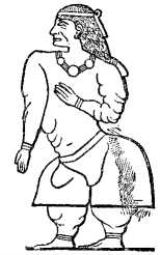
, who is mentioned as the head of the expedition, had travelled to Punt "in order to extract tribute from the natives" who admit their allegiance to the Egyptian pharaoh. In reality, Nehsi's expedition was a simple trading mission to a land, Punt, which was by this time a well-established trading post. Moreover, Nehsi's visit to Punt was not inordinately brave since he was "accompanied by at least five shiploads of [Egyptian] marines" and greeted warmly by the chief of Punt and his immediate family. The Puntites "traded not only in their own produce of incense, ebony and short-horned cattle, but [also] in goods from other African states including gold, ivory and animal skins." According to the temple reliefs, the Land of Punt was ruled at that time by King Parahu and Queen Ati. This well illustrated expedition of Hatshepsut occurred in Year 9 of the female pharaoh's reign with the blessing of the god Amun
Amun
Amun, reconstructed Egyptian Yamānu , was a god in Egyptian mythology who in the form of Amun-Ra became the focus of the most complex system of theology in Ancient Egypt...
:
While the Egyptians "were not particularly well versed in the hazards of sea travel, and the long voyage to Punt, must have seemed something akin to a journey to the moon for present-day explorers...the rewards of [obtaining frankincense, ebony and myrrh] clearly outweighted the risks." Hatshepsut's 18th dynasty successors, such as Thutmose III
Thutmose III
Thutmose III was the sixth Pharaoh of the Eighteenth Dynasty. During the first twenty-two years of Thutmose's reign he was co-regent with his stepmother, Hatshepsut, who was named the pharaoh...
and Amenhotep III
Amenhotep III
Amenhotep III also known as Amenhotep the Magnificent was the ninth pharaoh of the Eighteenth dynasty. According to different authors, he ruled Egypt from June 1386 to 1349 BC or June 1388 BC to December 1351 BC/1350 BC after his father Thutmose IV died...
also continued the Egyptian tradition of trading with Punt. The trade with Punt continued into the start of the 20th dynasty before terminating prior to the end of Egypt's New Kingdom
New Kingdom
The New Kingdom of Egypt, also referred to as the Egyptian Empire is the period in ancient Egyptian history between the 16th century BC and the 11th century BC, covering the Eighteenth, Nineteenth, and Twentieth Dynasties of Egypt....
. Papyrus Harris I
Papyrus Harris I
Papyrus Harris I is also known as the Great Harris Papyrus and simply the Harris Papyrus . Its technical designation is Papyrus British Museum 9999...
, a contemporary Egyptian document which detailed events that occurred in the reign of the early 20th dynasty king Ramesses III
Ramesses III
Usimare Ramesses III was the second Pharaoh of the Twentieth Dynasty and is considered to be the last great New Kingdom king to wield any substantial authority over Egypt. He was the son of Setnakhte and Queen Tiy-Merenese. Ramesses III is believed to have reigned from March 1186 to April 1155 BCE...
, includes an explicit description of an Egyptian expedition's return from Punt:
After the end of the New Kingdom period, Punt became "an unreal and fabulous land of myths and legends."
Ta netjer
At times, the ancient EgyptiansEgyptians
Egyptians are nation an ethnic group made up of Mediterranean North Africans, the indigenous people of Egypt.Egyptian identity is closely tied to geography. The population of Egypt is concentrated in the lower Nile Valley, the small strip of cultivable land stretching from the First Cataract to...
called Punt Ta netjer, meaning "God's Land". This referred to the fact that it was among the regions of the Sun God
Solar deity
A solar deity is a sky deity who represents the Sun, or an aspect of it, usually by its perceived power and strength. Solar deities and sun worship can be found throughout most of recorded history in various forms...
, that is, the regions located in the direction of the sunrise, to the East of Egypt. These eastern regions' resources included products used in temples, notably incense. The term was not only applied to Punt, located southeast of Egypt, but also to regions of Asia
Asia
Asia is the world's largest and most populous continent, located primarily in the eastern and northern hemispheres. It covers 8.7% of the Earth's total surface area and with approximately 3.879 billion people, it hosts 60% of the world's current human population...
east and northeast of Egypt, such as Lebanon
Lebanon
Lebanon , officially the Republic of LebanonRepublic of Lebanon is the most common term used by Lebanese government agencies. The term Lebanese Republic, a literal translation of the official Arabic and French names that is not used in today's world. Arabic is the most common language spoken among...
, which was the source of wood for temples.
Older literature (and current non-mainstream literature) maintained that the label "God's Land", when interpreted as "Holy Land" or "Land of the gods/ancestors", meant that the ancient Egyptians viewed the Land of Punt as their ancestral homeland. Examples of such opinions may be found with Jon White, W. M. Flinders, and E.A. Wallis Budge.
Location
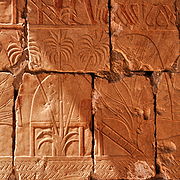
The majority opinion places Punt in Eastern Africa, based on the fact that the products of Punt (as depicted in the Hatshepsut illustrations) were abundantly found in East Africa but were less common or sometimes absent in Arabia. These products included gold, aromatic resins such as myrrhMyrrh
Myrrh is the aromatic oleoresin of a number of small, thorny tree species of the genus Commiphora, which grow in dry, stony soil. An oleoresin is a natural blend of an essential oil and a resin. Myrrh resin is a natural gum....
, ebony
Ebony
Ebony is a dense black wood, most commonly yielded by several species in the genus Diospyros, but ebony may also refer to other heavy, black woods from unrelated species. Ebony is dense enough to sink in water. Its fine texture, and very smooth finish when polished, make it valuable as an...
and elephant tusks. The wild animals depicted in Punt include giraffe
Giraffe
The giraffe is an African even-toed ungulate mammal, the tallest of all extant land-living animal species, and the largest ruminant...
s, baboon
Baboon
Baboons are African and Arabian Old World monkeys belonging to the genus Papio, part of the subfamily Cercopithecinae. There are five species, which are some of the largest non-hominoid members of the primate order; only the mandrill and the drill are larger...
s, hippopotamuses, and leopard
Leopard
The leopard , Panthera pardus, is a member of the Felidae family and the smallest of the four "big cats" in the genus Panthera, the other three being the tiger, lion, and jaguar. The leopard was once distributed across eastern and southern Asia and Africa, from Siberia to South Africa, but its...
s. Says Richard Pankhurst : “[Punt] has been identified with territory on both the Arabian and African coasts. Consideration of the articles which the Egyptians obtained from Punt, notably gold and ivory, suggests, however, that these were primarily of African origin. … This leads us to suppose that the term Punt probably applied more to African than Arabian territory.”
Encyclopædia Britannica describes Punt as follows: “in ancient Egyptian and Greek geography, the southern coast of the Red Sea and adjacent coasts of the Gulf of Aden, corresponding to modern coastal Eritrea
Eritrea
Eritrea , officially the State of Eritrea, is a country in the Horn of Africa. Eritrea derives it's name from the Greek word Erethria, meaning 'red land'. The capital is Asmara. It is bordered by Sudan in the west, Ethiopia in the south, and Djibouti in the southeast...
, Somalia
Somalia
Somalia , officially the Somali Republic and formerly known as the Somali Democratic Republic under Socialist rule, is a country located in the Horn of Africa. Since the outbreak of the Somali Civil War in 1991 there has been no central government control over most of the country's territory...
and Djibouti
Djibouti
Djibouti , officially the Republic of Djibouti , is a country in the Horn of Africa. It is bordered by Eritrea in the north, Ethiopia in the west and south, and Somalia in the southeast. The remainder of the border is formed by the Red Sea and the Gulf of Aden at the east...
.”
However some scholars disagree with this view and point to a range of ancient inscriptions which locate Punt in Arabia. Dimitri Meeks has written that “Texts locating Punt beyond doubt to the south are in the minority, but they are the only ones cited in the current consensus about the location of the country. Punt, we are told by the Egyptians, is situated – in relation to the Nile Valley – both to the north, in contact with the countries of the Near East of the Mediterranean area, and also to the east or south-east, while its furthest borders are far away to the south. Only the Arabian Peninsula satisfies all these indications.”
In 2003 a newly discovered text was found in a tomb in El Kab
El Kab
El Kab is an Upper Egyptian site on the east bank of the Nile at the mouth of Wadi Hillal, about 80 km south of Luxor, consisting of prehistoric and Pharaonic settlements, rock-cut tombs of the early 18th Dynasty , remains of temples dating from the Early Dynastic period to the Ptolemaic...
, a small town that is located about 50 kilometres south of Thebes. The tomb belonged to the local governor, Sobeknakht II
Sobeknakht II
Sobeknakht II was an important local Governor at El-Kab and a supporter of the Theban 16th or 17th dynasty during the Second Intermediate Period...
, and dates to the 17th dynasty (c.1600-1550 BCE). Newspaper articles reported that the inscription mentions “a huge attack from the south on Elkab and Egypt by the Kingdom of Kush
Kingdom of Kush
The native name of the Kingdom was likely kaš, recorded in Egyptian as .The name Kash is probably connected to Cush in the Hebrew Bible , son of Ham ....
and its allies from the land of Punt.”
| Egyptian spelling "pwenet" it should be noted that the feminine "t" ending was not pronounced during the New Kingdom the last sign is the determinative for country, land |
Wall relief |
Huts as in relief |
Older literature
- Johannes DumichenJohannes DumichenJohannes Dümichen was a German Egyptologist.Dümichen was born near Glogau. He studied philology and theology in Berlin and Breslau. Subsequently he became a pupil of Karl Lepsius and Heinrich Brugsch, and devoted himself to the study of Egyptian inscriptions...
: Die Flotte einer ägyptischen Königin, Leipzig, 1868. - Wilhelm Max MüllerWilhelm Max MüllerWilhelm Max Müller, Ph.D. was an United States orientalist.-Biography:He was born at Gleißenberg, Germany, the son of Friedrich Max Müller and the grandson of German romantic poet Wilhelm Müller. He was educated at Erlangen, Berlin, Munich, and Leipzig, where he received his Ph.D...
: Asien und Europa nach altägyptischen Denkmälern, Leipzig, 1893. - Adolf ErmanAdolf ErmanJohann Peter Adolf Erman was a renowned Egyptologist and lexicographer.-Life:Born in Berlin, he was the son of Georg Adolf Erman and grandson of Paul Erman....
: Life in Ancient Egypt, London, 1894. - Édouard NavilleÉdouard NavilleCaptaine Henri Édouard Naville was a Swiss egyptologist.He was born in Geneva. He studied in London, Paris and Berlin ....
: "Deir-el-Bahri" in Egypt Exploration Fund, Memoirs XII, XIII, XIV, and XIX, London, 1894 et seq. - James Henry Breasted: A History of the Ancient Egyptians, New York, 1908.
External links
- The Wonderful Land of Punt
- The Land of Punt with quotes from Breasted (1906) and Petrie (1939)
- Queen Hatasu, and Her Expedition to the Land of Punt by Amelia Ann Blanford Edwards (1891)
- Deir el-Bahri: Mortuary Temple of Hatshepsut
- Hall of Punt at Deir el-Bahri; and Where was Punt? discussion by Dr. Karl H. Leser
- Queen of Punt syndrome
News reports on Wadi Gawasis excavations
- Archaeologists discover ancient ships in Egypt (Boston University Bridge, 18 March 2005). Excavations at Wadi Gawasis, possibly the ancient Egyptian port Saaw.
- Remains of ancient Egyptian seafaring ships discovered (New Scientist, 23 March 2005).
- Sailing to distant lands (Al Ahram, 2 June 2005).
- Ancient ship remains are unearthed (Deutsche Press Agentur, 26 January 2006).
- 4,000-year-old shipyard unearthed in Egypt (MSNBC, 6 March 2006).