

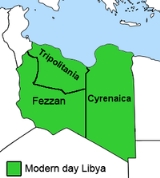
Cyrenaica

Encyclopedia
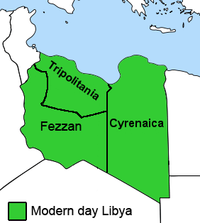
Libya
Libya is an African country in the Maghreb region of North Africa bordered by the Mediterranean Sea to the north, Egypt to the east, Sudan to the southeast, Chad and Niger to the south, and Algeria and Tunisia to the west....
.
Also known as Pentapolis in antiquity
Ancient Libya
The Latin name Libya referred to the region west of the Nile Valley, generally corresponding to modern Northwest Africa. Climate changes affected the locations of the settlements....
, it was part of the Creta et Cyrenaica
Creta et Cyrenaica
Creta et Cyrenaica was a senatorial province of the Roman empire created in 20 BC. It comprised the island of Crete and the region of Cyrenaica in north Africa ....
province during the Roman period
Roman Libya
The area of North Africa which has been known as Libya since 1911 was under Roman domination between 146 BC and 670 AD.The Latin name Libya at the time referred to the continent of Africa in general....
, later divided in Libia Pentapolis and Libia Sicca. During the Islamic period, the area came to be known as Barqa, after the city of Barca
Barca
Barce was an ancient Greek colony and later Roman, Byzantine, city in North Africa. It occupied the coastal area of what is modern day Libya...
.
Cyrenaica was the name of an administrative division of Italian Libya
Italian Libya
Italian Libya was a unified colony of Italian North Africa established in 1934 in what represents present-day Libya...
from 1927 through 1943, then under British military and civil administration from 1943 through 1951, and finally in the Kingdom of Libya
Kingdom of Libya
The Kingdom of Libya, originally called the United Libyan Kingdom came into existence upon independence on 24 December 1951 and lasted until a coup d'état led by Muammar Gaddafi on 1 September 1969 overthrew King Idris of Libya and established the Libyan Arab Republic.- Constitution :Under the...
from 1951through 1963. In a wider sense, which is still used, Cyrenaica is composed of all of the eastern part of Libya, including the Kufra District. Cyrenaica is adjacent to Tripolitania
Tripolitania
Tripolitania or Tripolitana is a historic region and former province of Libya.Tripolitania was a separate Italian colony from 1927 to 1934...
in the northwest and Fezzan
Fezzan
Fezzan is a south western region of modern Libya. It is largely desert but broken by mountains, uplands, and dry river valleys in the north, where oases enable ancient towns and villages to survive deep in the otherwise inhospitable Sahara.-Name:...
in the southwest. The region that used to be Cyrenaica officially through 1963 is now divided up into several shabiyat, the administrative divisions of Libya).
Cyrenaica was the center of the anti-Qaddafi rebels during the Libyan Civil War of 2011
2011 Libyan civil war
The 2011 Libyan civil war was an armed conflict in the North African state of Libya, fought between forces loyal to Colonel Muammar Gaddafi and those seeking to oust his government. The war was preceded by protests in Benghazi beginning on 15 February 2011, which led to clashes with security...
with the National Transitional Council
National Transitional Council
The National Transitional Council of Libya , sometimes known as the Transitional National Council, the Interim National Council, or the Libyan National Council,...
based in Cyrenaica lone major city
City
A city is a relatively large and permanent settlement. Although there is no agreement on how a city is distinguished from a town within general English language meanings, many cities have a particular administrative, legal, or historical status based on local law.For example, in the U.S...
of Benghazi
Benghazi
Benghazi is the second largest city in Libya, the main city of the Cyrenaica region , and the former provisional capital of the National Transitional Council. The wider metropolitan area is also a district of Libya...
.
Geography
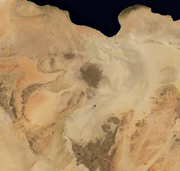
Miocene
The Miocene is a geological epoch of the Neogene Period and extends from about . The Miocene was named by Sir Charles Lyell. Its name comes from the Greek words and and means "less recent" because it has 18% fewer modern sea invertebrates than the Pliocene. The Miocene follows the Oligocene...
limestone
Limestone
Limestone is a sedimentary rock composed largely of the minerals calcite and aragonite, which are different crystal forms of calcium carbonate . Many limestones are composed from skeletal fragments of marine organisms such as coral or foraminifera....
that tilts up steeply from the Mediterranean Sea
Mediterranean Sea
The Mediterranean Sea is a sea connected to the Atlantic Ocean surrounded by the Mediterranean region and almost completely enclosed by land: on the north by Anatolia and Europe, on the south by North Africa, and on the east by the Levant...
and falls inland with a gradual descent to sea level
Sea level
Mean sea level is a measure of the average height of the ocean's surface ; used as a standard in reckoning land elevation...
again.
This mass is divided into two blocks. The Jebel Akhdar extends parallel to the coast from the Gulf of Sidra
Gulf of Sidra
Gulf of Sidra is a body of water in the Mediterranean Sea on the northern coast of Libya; it is also known as Gulf of Sirte or the Great Sirte or Greater Syrtis .- Geography :The Gulf of Sidra has been a major centre for tuna fishing in the Mediterranean for centuries...
to the Gulf of Bomba
Gulf of Bomba
The Gulf of Bomba is a gulf on the coast of Libya....
, and reaches an elevation of 872 meters. There is no continuous coastal plain, the longest strip running from the recess of Gulf of Sidra past Benghazi
Benghazi
Benghazi is the second largest city in Libya, the main city of the Cyrenaica region , and the former provisional capital of the National Transitional Council. The wider metropolitan area is also a district of Libya...
to Tolmeitha
Tolmeitha
Tolmeitha, Tolometa, or Tolmeita is a tiny village in the northern Cyrenaica region of eastern Libya, some east of Benghazi, near Ad Dirsiyah...
. Thereafter, except for deltaic patches at Susa
Susa, Libya
Susa or Soussa is a town and seaside resort in the District of Jabal al Akhdar in north-eastern Libya. Susa stands by the ruins of Apollonia, Cyrenaica.The town contains the Apollonia Museum. It is located about 30 km northeast of Bayda....
and Derna, the shore is all precipitous. A steep escarpment separates the coastal plain from a relatively level plateau, known as the Marj Plain, which lies at about 300 meters elevation. Above the Marj Plain lies a dissected plateau at about 700 meters elevation, which contains the highest peaks in the range.
The Jebel Akhdar and its adjacent coast are part of the Mediterranean woodlands and forests
Mediterranean woodlands and forests
The Mediterranean woodlands and forests is an ecoregion, of the Mediterranean forests, woodlands, and scrub Biome, in the coastal plains, hills, and mountains bordering the Mediterranean Sea and Atlantic Ocean in North Africa.-Geography:...
ecoregion
Ecoregion
An ecoregion , sometimes called a bioregion, is an ecologically and geographically defined area that is smaller than an ecozone and larger than an ecosystem. Ecoregions cover relatively large areas of land or water, and contain characteristic, geographically distinct assemblages of natural...
, and have a Mediterranean climate
Mediterranean climate
A Mediterranean climate is the climate typical of most of the lands in the Mediterranean Basin, and is a particular variety of subtropical climate...
of hot, dry summers and relatively mild and rainy winters. The plant communities of this portion of Cyrenaica include forest, woodland, maquis
Maquis shrubland
thumb|220px|Low Maquis in Corsica.220px|thumb|High macchia in Sardinia.Maquis or macchia is a shrubland biome in the Mediterranean region, typically consisting of densely growing evergreen shrubs such as holm oak, tree heath, strawberry tree, sage, juniper, buckthorn, spurge olive and myrtle...
, garrigue
Garrigue
Garrigue or phrygana is a type of low, soft-leaved scrubland ecoregion and plant community in the Mediterranean forests, woodlands, and scrub biome. It is found on limestone soils around the Mediterranean Basin, generally near the seacoast, where the climate is ameliorated, but where annual summer...
, steppe
Steppe
In physical geography, steppe is an ecoregion, in the montane grasslands and shrublands and temperate grasslands, savannas, and shrublands biomes, characterized by grassland plains without trees apart from those near rivers and lakes...
, and oak savanna
Oak savanna
An oak savanna is a type of savanna, or lightly forested grassland, where oaks are the dominant tree species. These savannas were maintained historically through wildfires set by lightning, grazing, low precipitation, poor soil, and/or fires set by Native Americans...
. Garrigue shrublands occupy the non-agricultural portions coastal plain and coastal escarpments, with Sarcopoterium spinosum, along with Asphodelus microcarpus and Artemisia herba-alba
Artemisia herba-alba
Artemisia herba-alba, also known as white wormwood, is a perennial shrub in the Artemisia genus that grows commonly on the steppes of the Mediterranean regions in Northern Africa, Western Asia and Southwestern Europe, and in the Arabian Peninsula and Saharan Maghreb xeric steppes...
, as the predominant species. Small areas of maquis are found on on north-facing slopes near the sea, becoming more extensive on the lower plateau. Juniperus phoenicea
Juniperus phoenicea
Juniperus phoenicea, the Phoenicean Juniper or Arâr, is a juniper found throughout the Mediterranean region, from Morocco and Portugal east to Italy, Turkey and Egypt, south on the mountains of Lebanon, Israel, Jordan, and in western Saudi Arabia near the Red Sea, and also on Madeira and the Canary...
, Pistacia lentiscus, Quercus coccifera and Ceratonia siliqua are common tree and large shrub species in the maquis. The upper plateau includes areas of garrigue, two maquis communities, one dominated by Pistacia lentiscus and the other a mixed maquis in which the endemic Arbutus pavarii
Arbutus pavarii
Arbutus pavarii is a species of plant in the Ericaceae family. It is endemic to Libya.-References:* World Conservation Monitoring Centre 1998. . Downloaded on 20 August 2007....
is prominent, and forests of Cupressus sempervirens
Cupressus sempervirens
Cupressus sempervirens, the Mediterranean Cypress is a species of cypress native to the eastern Mediterranean region, in northeast Libya, southeast Greece , southern Turkey, Cyprus, Northern Egypt, western Syria, Lebanon, Israel, Malta, Italy, western Jordan, and also a disjunct population in...
, Juniperus phoenicea, Olea europaea, Quercus coccifera, Ceratonia siliqua, and Pinus halepensis.
Areas of red soil
Terra rosa (soil)
Terra rossa is a type of red clay soil produced by the weathering of limestone. When limestone weathers, the clay contained in the rocks is left behind, along with any other non-soluble rock material. Under oxidizing conditions, when the soils are above the water table, iron oxide forms in the...
are found on the Marj Plain, which has borne abundant crops of wheat
Wheat
Wheat is a cereal grain, originally from the Levant region of the Near East, but now cultivated worldwide. In 2007 world production of wheat was 607 million tons, making it the third most-produced cereal after maize and rice...
and barley
Barley
Barley is a major cereal grain, a member of the grass family. It serves as a major animal fodder, as a base malt for beer and certain distilled beverages, and as a component of various health foods...
from ancient times to the present day. Plenty of springs issue on the highlands. Wild olive trees are abundant, and large areas of oak savanna provide pasture to the flocks and herds of the local Bedouin
Bedouin
The Bedouin are a part of a predominantly desert-dwelling Arab ethnic group traditionally divided into tribes or clans, known in Arabic as ..-Etymology:...
s. Historically large areas of range were covered in forest. The forested area of the Jebel Akhdar has been shrinking in recent decades. A 1996 report to the UN Food and Agriculture Organization estimated that the forested area was reduced to 320,000 hectares from 500,000 hectares, mostly cleared to grow crops. The Green Mountain Conservation and Development Authority estimates that the forested area decreased from 500,000 hectares in 1976 to 180,000 hectares in 2007.
The southward slopes of the Jebel Akhdar occupied by the Mediterranean dry woodlands and steppe
Mediterranean dry woodlands and steppe
The Mediterranean dry woodlands and steppe is a Mediterranean forests, woodlands, and scrub ecoregion of North Africa. It occupies interior plateaus and mountain ranges of the Maghreb region, lying generally between the coastal Mediterranean woodlands and forests to the north and the Sahara to the...
, a transitional ecoregion lying between the Mediterranean climate regions of North Africa and the hyper-arid Sahara Desert.
The lower Jebel el-Akabah lies to the south and east of the Jebel Akhdar. The two highlands are separated by a depression. This eastern region, known in ancient times as Marmarica
Marmarica
Marmarica in ancient geography referred to the part of the North African coast between Cyrenaica and Aegyptus.It corresponds to what is now the border region between Libya and Egypt, including the towns of Bomba , Timimi , Tobruk , Acroma , Bardiya, As-Salum, Sidi Barrani .It...
, is much drier than the Jebel Akhdar, and here the Sahara extends to the coast. Historically, salt-collecting and sponge fishing were more important than agriculture. Bomba
Bomba, Libya
Bomba is a village in eastern Libya on the Gulf of Bomba. It is located south of Derna.Greek historian Herodotus said that Cyrene was founded in mid-7th century BC, when a group of Greek immigrants from Thera landed at the Gulf of Bomba, and stayed there for years, then, they moved to place of...
and Tobruk
Tobruk
Tobruk or Tubruq is a city, seaport, and peninsula on Libya's eastern Mediterranean coast, near the border with Egypt. It is the capital of the Butnan District and has a population of 120,000 ....
have good harbors.
South of the coastal highlands of Cyrenaica is a large east-west running depression, extending eastward from the Gulf of Sidra into Egypt. This region of the Sahara is known as the Libyan Desert
Libyan Desert
The Libyan Desert covers an area of approximately 1,100,000 km2, it extends approximately 1100 km from east to west, and 1,000 km from north to south, in about the shape of a rectangle...
, and includes the Great Sand Sea and the Calanshio Sand Sea. The Libyan Desert is home to a few oases
Oasis
In geography, an oasis or cienega is an isolated area of vegetation in a desert, typically surrounding a spring or similar water source...
, including Awjila
Awjila
Awjila is a Berber-speaking oasis town in the Al Wahat District in the Cyrenaica region of northeastern Libya. It is the place after which the Awgila-Berber language, an Eastern Berber language, is named...
(ancient Augila) and Jaghbub.
Greek cities
During the Ramesside period (thirteenth century BC), the LibuLibu
The Libu were an ancient Berber tribe, from which the name Libya derives....
and the Meshwesh
Meshwesh
The Meshwesh were an ancient Libyan tribe from beyond Cyrenaica where the Libu and Tehenu lived according to Egyptian references and who were probably of Central Berber ethnicity. Herodotus placed them in Tunisia and said of them to be sedentary farmers living in settled permanent houses as the...
were tribes of the area of Cyrenaica which are mentioned in Egyptian records as making frequent incursions into the New Kingdom of Egypt.
Cyrenaica was colonized by the Greeks
Greece
Greece , officially the Hellenic Republic , and historically Hellas or the Republic of Greece in English, is a country in southeastern Europe....
beginning in the 7th century B.C.
The first and most important colony was that of Cyrene
Cyrene, Libya
Cyrene was an ancient Greek colony and then a Roman city in present-day Shahhat, Libya, the oldest and most important of the five Greek cities in the region. It gave eastern Libya the classical name Cyrenaica that it has retained to modern times.Cyrene lies in a lush valley in the Jebel Akhdar...
, established in about 631 BCE by colonists from the Greek island of Thera
Santorini
Santorini , officially Thira , is an island located in the southern Aegean Sea, about southeast from Greece's mainland. It is the largest island of a small, circular archipelago which bears the same name and is the remnant of a volcanic caldera...
. They had left their island because of a severe famine. Their commander Aristoteles took the Libyan name Battos. His dynasty, the Battaid, persisted in spite of heavy resistance by the Greeks in neighboring cities.
The east of the province was called Marmarica (no major city), but the important part was in the west, comprising five cities, hence known as the Pentapolis: Cyrene
Cyrene, Libya
Cyrene was an ancient Greek colony and then a Roman city in present-day Shahhat, Libya, the oldest and most important of the five Greek cities in the region. It gave eastern Libya the classical name Cyrenaica that it has retained to modern times.Cyrene lies in a lush valley in the Jebel Akhdar...
(near the modern village of Shahat) with its port of Apollonia
Apollonia, Cyrenaica
Apollonia in Cyrenaica was founded by Greek colonists and became a significant commercial centre in the southern Mediterranean. It served as the harbour of Cyrene, to the southwest...
(Marsa Susa), Arsinoe or Taucheira
Taucheira
Taucheira, Tukrah or El Agouriya , is a town on the coast of the Marj District in the Cyrenaica region of northeastern Libya, founded by Cyrene. It lay 200 stadia west of Ptolemais. Today it is a coastal town west of Marj.-History:...
(Tocra), Euesperides or Berenice (near modern Benghazi
Benghazi
Benghazi is the second largest city in Libya, the main city of the Cyrenaica region , and the former provisional capital of the National Transitional Council. The wider metropolitan area is also a district of Libya...
), Balagrae (Bayda) and Barce (Marj) – of which the chief was the eponymous Cyrene.
The term "Pentapolis" continued to be used as a synonym for Cyrenaica. In the south the Pentapolis faded into the Sahara
Sahara
The Sahara is the world's second largest desert, after Antarctica. At over , it covers most of Northern Africa, making it almost as large as Europe or the United States. The Sahara stretches from the Red Sea, including parts of the Mediterranean coasts, to the outskirts of the Atlantic Ocean...
n tribal areas, including the pharaonic oracle of Ammonium
Siwa Oasis
The Siwa Oasis is an oasis in Egypt, located between the Qattara Depression and the Egyptian Sand Sea in the Libyan Desert, nearly 50 km east of the Libyan border, and 560 km from Cairo....
.
The region produced barley, wheat, olive oil, wine, figs, apples, wool, sheep, cattle, and silphium
Silphium
Silphium was a plant that was used in classical antiquity as a rich seasoning and as a medicine. It was the essential item of trade from the ancient North African city of Cyrene, and was so critical to the Cyrenian economy that most of their coins bore a picture of the plant...
, an herb that grew only in Cyrenaica and was regarded as a medicinal cure and aphrodisiac
Aphrodisiac
An aphrodisiac is a substance that increases sexual desire. The name comes from Aphrodite, the Greek goddess of sexuality and love. Throughout history, many foods, drinks, and behaviors have had a reputation for making sex more attainable and/or pleasurable...
. Cyrene became one of the greatest intellectual and artistic centers of the Greek world, famous for its medical school, learned academies, and architecture, which included some of the finest examples of the Hellenistic style. The Cyrenaics
Cyrenaics
The Cyrenaics were an ultra-hedonist Greek school of philosophy founded in the 4th century BC, supposedly by Aristippus of Cyrene, although many of the principles of the school are believed to have been formalized by his grandson of the same name, Aristippus the Younger. The school was so called...
, a school of thinkers who expounded a doctrine of moral cheerfulness that defined happiness as the sum of human pleasures, were founded by Aristippus
Aristippus
Aristippus of Cyrene, , was the founder of the Cyrenaic school of Philosophy. He was a pupil of Socrates, but adopted a very different philosophical outlook, teaching that the goal of life was to seek pleasure by adapting circumstances to oneself and by maintaining proper control over both...
of Cyrene. Other notable natives of Cyrene were the poet Callimachus
Callimachus
Callimachus was a native of the Greek colony of Cyrene, Libya. He was a noted poet, critic and scholar at the Library of Alexandria and enjoyed the patronage of the Egyptian–Greek Pharaohs Ptolemy II Philadelphus and Ptolemy III Euergetes...
and the mathematicians Theodorus
Theodorus of Cyrene
Theodorus of Cyrene was a Greek mathematician of the 5th century BC. The only first-hand accounts of him that we have are in two of Plato's dialogues: the Theaetetus and the Sophist...
and Eratosthenes
Eratosthenes
Eratosthenes of Cyrene was a Greek mathematician, poet, athlete, geographer, astronomer, and music theorist.He was the first person to use the word "geography" and invented the discipline of geography as we understand it...
.
In 525 BCE, after taking Egypt, the Persians took the Pentapolis. They were followed by Alexander the Great in 332 BCE, who received tribute from these cities after he took Egypt. The Pentapolis was formally annexed by Ptolemy I Soter
Ptolemy I Soter
Ptolemy I Soter I , also known as Ptolemy Lagides, c. 367 BC – c. 283 BC, was a Macedonian general under Alexander the Great, who became ruler of Egypt and founder of both the Ptolemaic Kingdom and the Ptolemaic Dynasty...
and it passed to the diadoch
Diadochi
The Diadochi were the rival generals, family and friends of Alexander the Great who fought for the control of Alexander's empire after his death in 323 BC...
dynasty of the Lagids, better known as the Ptolemaic dynasty
Ptolemaic dynasty
The Ptolemaic dynasty, was a Macedonian Greek royal family which ruled the Ptolemaic Empire in Egypt during the Hellenistic period. Their rule lasted for 275 years, from 305 BC to 30 BC...
. It briefly gained independence under Magas of Cyrene
Magas of Cyrene
Magas of Cyrene was a Greek Macedonian nobleman. Through his mother’s second marriage he was a member of the Ptolemaic dynasty. He became King of Cyrenaica and he managed to wrestle independence for Cyrenaica from the Greek Ptolemaic dynasty of Ancient Egypt.-Family Background & Early Life:Magas...
, stepson of Ptolemy I, but was reabsorbed into the Ptolemaic empire after his death. It was separated from the main kingdom
Ptolemaic Egypt
Ptolemaic Egypt began when Ptolemy I Soter invaded Egypt and declared himself Pharaoh of Egypt in 305 BC and ended with the death of queen Cleopatra VII of Egypt and the Roman conquest in 30 BC. The Ptolemaic Kingdom was a powerful Hellenistic state, extending from southern Syria in the east, to...
by Ptolemy VIII and given to his son Ptolemy Apion
Ptolemy Apion
Ptolemy Apion or simply known as Apion was the last Greek Cyrenaean King and was a member of the Ptolemaic dynasty. Ptolemy was Greek Macedonian and native Egyptian in descent...
, who, dying without heirs in 96 BCE, bequeathed it to the Roman Republic
Roman Republic
The Roman Republic was the period of the ancient Roman civilization where the government operated as a republic. It began with the overthrow of the Roman monarchy, traditionally dated around 508 BC, and its replacement by a government headed by two consuls, elected annually by the citizens and...
.
Roman province
The Latin name Cyrenaica dates to the 1st century BCE.Although some confusion exists as to the exact territory Rome inherited, by 78 BCE it was organized as one administrative province
Province
A province is a territorial unit, almost always an administrative division, within a country or state.-Etymology:The English word "province" is attested since about 1330 and derives from the 13th-century Old French "province," which itself comes from the Latin word "provincia," which referred to...
together with Crete
Crete
Crete is the largest and most populous of the Greek islands, the fifth largest island in the Mediterranean Sea, and one of the thirteen administrative regions of Greece. It forms a significant part of the economy and cultural heritage of Greece while retaining its own local cultural traits...
. It became a senatorial province in 20 BC, like its far more prominent western neighbor Africa proconsularis, and unlike Egypt itself which became an imperial domain sui generis (under a special governor styled praefectus augustalis – Diocese of Egypt) in 30 BC.
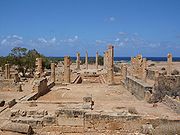
Tetrarchy
The term Tetrarchy describes any system of government where power is divided among four individuals, but usually refers to the tetrarchy instituted by Roman Emperor Diocletian in 293, marking the end of the Crisis of the Third Century and the recovery of the Roman Empire...
reforms of Diocletian
Diocletian
Diocletian |latinized]] upon his accession to Diocletian . c. 22 December 244 – 3 December 311), was a Roman Emperor from 284 to 305....
in 296 changed the administrative structure. Cyrenaica was split into two provinces: Libya Superior or Libia Pentapolis comprised the above-mentioned Pentapolis with Cyrene as capital, and Libya Inferior or Libia sicca the Marmarica
Marmarica
Marmarica in ancient geography referred to the part of the North African coast between Cyrenaica and Aegyptus.It corresponds to what is now the border region between Libya and Egypt, including the towns of Bomba , Timimi , Tobruk , Acroma , Bardiya, As-Salum, Sidi Barrani .It...
(only significant city now the port Paraetonium), each under a governor of the modest rank of praeses
Praeses
Praeses , is a Latin word meaning "Seated in front of, i.e. at the head ", has both ancient and modern uses.-Roman imperial use:...
. Both belonged to the Diocese of the Orient with its captial at Antioch in Syria and from 370 to the Diocese of Egypt, within the praetorian prefecture
Praetorian prefecture
The praetorian prefecture was the largest administrative division of the late Roman Empire, above the mid-level dioceses and the low-level provinces. Praetorian prefectures originated in the reign of Constantine I The praetorian prefecture was the largest administrative division of the late Roman...
of Oriens
Praetorian prefecture of the East
The praetorian prefecture of the East or of Oriens was one of four large praetorian prefectures into which the Late Roman Empire was divided...
. Its western neighbor Tripolitania
Tripolitania
Tripolitania or Tripolitana is a historic region and former province of Libya.Tripolitania was a separate Italian colony from 1927 to 1934...
, the largest split-off from Africa proconsularis, became part of the Diocese of Africa
Diocese of Africa
The Diocese of Africa was a diocese of the later Roman Empire, incorporating the provinces of North Africa, except Mauretania Tingitana. Its seat was at Carthage, and it was subordinate to the Praetorian prefecture of Italy....
, subordinate to the prefecture of Italia et Africa
Praetorian prefecture of Italy
The praetorian prefecture of Italy ) was one of four large Praetorian prefectures into which the Late Roman Empire was divided. It comprised the Italian peninsula, the Western Balkans, the Danubian provinces and parts of North Africa...
. After the earthquake of 365
365 Crete earthquake
The AD 365 Crete earthquake was an undersea earthquake that occurred at about sunrise on 21 July 365 in the Eastern Mediterranean, with an assumed epicentre near Crete. Geologists today estimate the quake to have been 8 on the Richter Scale or higher, causing widespread destruction in central and...
, the capital was moved to Ptolemais. After the Empire's division, Cyrenaica became part of the East Roman Empire (Byzantine Empire
Byzantine Empire
The Byzantine Empire was the Eastern Roman Empire during the periods of Late Antiquity and the Middle Ages, centred on the capital of Constantinople. Known simply as the Roman Empire or Romania to its inhabitants and neighbours, the Empire was the direct continuation of the Ancient Roman State...
), bordering Tripolitania. It was briefly part of the Vandal Kingdom
Vandal Kingdom
The Vandal Kingdom was a kingdom in North Africa established by the Vandals, an East Germanic tribe of Scandinavian origin. Having crossed the Rhine in 407, the Vandals settled in southern Spain, modern day Andalusia, until pushed out by the Visigoths...
to the west, until its reconquest by Belisarius
Vandalic War
The Vandalic War was a war fought in North Africa, in the areas of modern Tunisia and eastern Algeria, in 533-534, between the forces of the Eastern Roman Empire and the Vandal Kingdom of Carthage...
in 533.
The Tabula Peutingeriana
Tabula Peutingeriana
The Tabula Peutingeriana is an itinerarium showing the cursus publicus, the road network in the Roman Empire. The original map of which this is a unique copy was last revised in the fourth or early fifth century. It covers Europe, parts of Asia and North Africa...
shows Pentapolites to the east of Syrtes Maiores, indicating the cities of Bernice, Hadrianopolis, Tauchira
Taucheira
Taucheira, Tukrah or El Agouriya , is a town on the coast of the Marj District in the Cyrenaica region of northeastern Libya, founded by Cyrene. It lay 200 stadia west of Ptolemais. Today it is a coastal town west of Marj.-History:...
, Ptolomaide, Callis, Cenopolis, Balacris and Cyrene.
Christianization
According to Synoptic GospelsSynoptic Gospels
The gospels of Matthew, Mark, and Luke are known as the Synoptic Gospels because they include many of the same stories, often in the same sequence, and sometimes exactly the same wording. This degree of parallelism in content, narrative arrangement, language, and sentence structures can only be...
, Simon of Cyrene
Simon of Cyrene
Simon of Cyrene was the man compelled by the Romans to carry the cross of Jesus as Jesus was taken to his crucifixion, according to all three Synoptic Gospels...
carried the cross of Jesus Christ to the crucifixion.
According to one tradition, Saint Mark the Evangelist
Mark the Evangelist
Mark the Evangelist is the traditional author of the Gospel of Mark. He is one of the Seventy Disciples of Christ, and the founder of the Church of Alexandria, one of the original four main sees of Christianity....
was born in the Pentapolis, and later returned after preaching with Saint Paul in Colosse (Col 4:10) and Rome
Rome
Rome is the capital of Italy and the country's largest and most populated city and comune, with over 2.7 million residents in . The city is located in the central-western portion of the Italian Peninsula, on the Tiber River within the Lazio region of Italy.Rome's history spans two and a half...
(Phil 24; 2 Tim 4:11); from Pentapolis he made his way to Alexandria
Alexandria
Alexandria is the second-largest city of Egypt, with a population of 4.1 million, extending about along the coast of the Mediterranean Sea in the north central part of the country; it is also the largest city lying directly on the Mediterranean coast. It is Egypt's largest seaport, serving...
.
Early Christianity
Early Christianity
Early Christianity is generally considered as Christianity before 325. The New Testament's Book of Acts and Epistle to the Galatians records that the first Christian community was centered in Jerusalem and its leaders included James, Peter and John....
spread to Pentapolis from Egypt; Synesius of Cyrene (370–414), bishop of Ptolemais, received his instruction at Alexandria in both the Catechetical School and the Museion, and he entertained a great deal of reverence and affection for Hypatia, the last pagan Neoplatonist
Neoplatonism
Neoplatonism , is the modern term for a school of religious and mystical philosophy that took shape in the 3rd century AD, based on the teachings of Plato and earlier Platonists, with its earliest contributor believed to be Plotinus, and his teacher Ammonius Saccas...
, whose classes he had attended. Synesius was raised to the episcopate by Theophilus, patriarch of Alexandria, in AD 410. Since the First Council of Nicaea
First Council of Nicaea
The First Council of Nicaea was a council of Christian bishops convened in Nicaea in Bithynia by the Roman Emperor Constantine I in AD 325...
in AD 325, Cyrenaica had been recognized as an ecclesiastical province of the See of Alexandria, in accordance with the ruling of the Nicaean Fathers.The patriarch of the Coptic Church to this day includes the Pentapolis in his title as an area within his jurisdiction.
The Eparchy of the Western Pentapolis was part of the Coptic Orthodox Church of Alexandria as the Pope of Alexandria was the Pope of Africa, The most senior position in The Holy Synod of the Coptic Orthodox Church
The Holy Synod of the Coptic Orthodox Church
The Holy Synod of the Coptic Orthodox Church of Alexandria is the highest authority in the Church of Alexandria and it formulates the rules and regulations regarding matters of church's organisation, faith, service's order....
after the Pope was the Metropolitan of Western Pentapolis, but since its demise in the days of Pope John VI of Alexandria
Pope John VI of Alexandria
Pope John VI of Alexandria was the Coptic Pope of Alexandria and Patriarch of the See of St. Mark .In 1210, his envoys reached the city of Lalibela in Ethiopia, where they met Emperor Gebre Mesqel Lalibela....
as a major Archiepiscopal Metropolis and now being held as a Titular See attached to another Diocese.
After often being destroyed and then restored, during the Roman period it became a mere borough but was, nevertheless, the site of a diocese. Its bishop, Zopyrus (Zephyrius is a mistake), was present at the First Council of Nicaea
First Council of Nicaea
The First Council of Nicaea was a council of Christian bishops convened in Nicaea in Bithynia by the Roman Emperor Constantine I in AD 325...
in 325. The subscriptions at Ephesus
Ephesus
Ephesus was an ancient Greek city, and later a major Roman city, on the west coast of Asia Minor, near present-day Selçuk, Izmir Province, Turkey. It was one of the twelve cities of the Ionian League during the Classical Greek era...
(431) and Chalcedon
Chalcedon
Chalcedon , sometimes transliterated as Chalkedon) was an ancient maritime town of Bithynia, in Asia Minor, almost directly opposite Byzantium, south of Scutari . It is now a district of the city of Istanbul named Kadıköy...
(451) give the names of two other bishops, Zenobius and Theodorus.
Although it retained the title "Pentapolis", the ecclesiastic province actually included all of the Cyrenaica, and not just the five cities and Pentapolis remains included in the title of both Popes of the Coptic Orthodox Church and the Greek Orthodox Church of Alexandria
Greek Orthodox Church of Alexandria
The Greek Orthodox Church of Alexandria, also known as the Patriarchate of Alexandria and All Africa is an autocephalous Greek Orthodox Church within the wider communion of Orthodox Christianity.Officially, it is called the Greek Orthodox Patriarchate of Alexandria to distinguish it from the...
.
The see must have disappeared when the Arabs conquered the Pentapolis in 643–44.
Arab and Ottoman rule
Cyrenaica was conquered by Muslim Arabs during the tenure of the second caliph, Omer Bin Khattab, in 643/44, and became known as Barqah after its provincial capital, the ancient city of Barce. After the breakdown of the Ummayad caliphate, it was essentially annexed to Egypt, although still under the same name, first under the FatimidFatimid
The Fatimid Islamic Caliphate or al-Fāṭimiyyūn was a Berber Shia Muslim caliphate first centered in Tunisia and later in Egypt that ruled over varying areas of the Maghreb, Sudan, Sicily, the Levant, and Hijaz from 5 January 909 to 1171.The caliphate was ruled by the Fatimids, who established the...
caliphs and later under the Ayyubid and Mamluk
Mamluk
A Mamluk was a soldier of slave origin, who were predominantly Cumans/Kipchaks The "mamluk phenomenon", as David Ayalon dubbed the creation of the specific warrior...
sultanates.
Ultimately, it was annexed by the Turkish Ottoman Empire
Ottoman Empire
The Ottoman EmpireIt was usually referred to as the "Ottoman Empire", the "Turkish Empire", the "Ottoman Caliphate" or more commonly "Turkey" by its contemporaries...
in 1517 .
It was part of the Tripoli Eyalet
Tripoli Eyalet
Tripoli Eyalet was an eyalet of the Ottoman Empire. The capital was in Tripoli. Its reported area in the 19th century was . Ottoman rule in the region began in 1516, but the eyalet wasn't established until 1579, when it was created from the north-western districts of the eyalets of Damascus and...
and later the Tripolitania Vilayet.
Its main cities became Benghazi
Benghazi
Benghazi is the second largest city in Libya, the main city of the Cyrenaica region , and the former provisional capital of the National Transitional Council. The wider metropolitan area is also a district of Libya...
and Derna.
Modern history
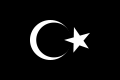
Italo-Turkish War
The Italo-Turkish or Turco-Italian War was fought between the Ottoman Empire and the Kingdom of Italy from September 29, 1911 to October 18, 1912.As a result of this conflict, Italy was awarded the Ottoman provinces of Tripolitania, Fezzan, and...
in 1911 and declared it an Italian protectorate
Protectorate
In history, the term protectorate has two different meanings. In its earliest inception, which has been adopted by modern international law, it is an autonomous territory that is protected diplomatically or militarily against third parties by a stronger state or entity...
on 15 October 1912. Three days later, the Ottoman Empire
Ottoman Empire
The Ottoman EmpireIt was usually referred to as the "Ottoman Empire", the "Turkish Empire", the "Ottoman Caliphate" or more commonly "Turkey" by its contemporaries...
officially ceded the province to the Kingdom of Italy
Kingdom of Italy (1861–1946)
The Kingdom of Italy was a state forged in 1861 by the unification of Italy under the influence of the Kingdom of Sardinia, which was its legal predecessor state...
. On 17 May 1919, Cyrenaica was established as an Italian colony
Colony
In politics and history, a colony is a territory under the immediate political control of a state. For colonies in antiquity, city-states would often found their own colonies. Some colonies were historically countries, while others were territories without definite statehood from their inception....
, and, on 25 October 1920, the Italian government recognized Sheikh Sidi Idriss
Idris I of Libya
Idris, GBE , , was the first and only king of Libya, reigning from 1951 to 1969, and the Chief of the Senussi Muslim order.- Early life :...
as the leader of the Senussi
Senussi
The Senussi or Sanussi refers to a Muslim political-religious order in Libya and the Sudan region founded in Mecca in 1837 by the Grand Senussi, Sayyid Muhammad ibn Ali as-Senussi. Senussi was concerned with both the decline of Islamic thought and spirituality and the weakening of Muslim political...
, who was granted the rank of Emir
Emir
Emir , meaning "commander", "general", or "prince"; also transliterated as Amir, Aamir or Ameer) is a title of high office, used throughout the Muslim world...
until in 1929. In that year, Italy "derecognized" him and the Senussi. On 1 January 1934, Tripolitania
Tripolitania
Tripolitania or Tripolitana is a historic region and former province of Libya.Tripolitania was a separate Italian colony from 1927 to 1934...
, Cyrenaica, and Fezzan
Fezzan
Fezzan is a south western region of modern Libya. It is largely desert but broken by mountains, uplands, and dry river valleys in the north, where oases enable ancient towns and villages to survive deep in the otherwise inhospitable Sahara.-Name:...
were united as the Italian colony of Libya
Italian Libya
Italian Libya was a unified colony of Italian North Africa established in 1934 in what represents present-day Libya...
.
The Italian fascists constructed the Marble Arch
Marble Arch (Libya)
The Marble Arch , formerly known in Libya as El Gaus , was a monument in Libya built during the days of Italian colonization...
as a form of an imperial triumphal arch at the border between Cyrenaica and Tripolitani near the coast.
There was heavy fighting in Cyrenaica during World War II
World War II
World War II, or the Second World War , was a global conflict lasting from 1939 to 1945, involving most of the world's nations—including all of the great powers—eventually forming two opposing military alliances: the Allies and the Axis...
between the Allies
Allies of World War II
The Allies of World War II were the countries that opposed the Axis powers during the Second World War . Former Axis states contributing to the Allied victory are not considered Allied states...
and the Italian Army
Italian Army
The Italian Army is the ground defence force of the Italian Armed Forces. It is all-volunteer force of active-duty personnel, numbering 108,355 in 2010. Its best-known combat vehicles are the Dardo infantry fighting vehicle, the Centauro tank destroyer and the Ariete tank, and among its aircraft...
and the Nazi German Afrika Korps
Afrika Korps
The German Africa Corps , or the Afrika Korps as it was popularly called, was the German expeditionary force in Libya and Tunisia during the North African Campaign of World War II...
. In late 1942, the armed forces of the British Empire
British Empire
The British Empire comprised the dominions, colonies, protectorates, mandates and other territories ruled or administered by the United Kingdom. It originated with the overseas colonies and trading posts established by England in the late 16th and early 17th centuries. At its height, it was the...
overran Cyrenaica, and and the United Kingdom
United Kingdom
The United Kingdom of Great Britain and Northern IrelandIn the United Kingdom and Dependencies, other languages have been officially recognised as legitimate autochthonous languages under the European Charter for Regional or Minority Languages...
administered all of Libya
Libya
Libya is an African country in the Maghreb region of North Africa bordered by the Mediterranean Sea to the north, Egypt to the east, Sudan to the southeast, Chad and Niger to the south, and Algeria and Tunisia to the west....
through 1951, when the Kingdom of Libya
Kingdom of Libya
The Kingdom of Libya, originally called the United Libyan Kingdom came into existence upon independence on 24 December 1951 and lasted until a coup d'état led by Muammar Gaddafi on 1 September 1969 overthrew King Idris of Libya and established the Libyan Arab Republic.- Constitution :Under the...
was established and granted independence.
In 1949, Idris as-Senussi
Idris I of Libya
Idris, GBE , , was the first and only king of Libya, reigning from 1951 to 1969, and the Chief of the Senussi Muslim order.- Early life :...
, with British backing, proclaimed Cyrenaica as an independent emirate called the Emirate of Cyrenaica
Emirate of Cyrenaica
The Emirate of Cyrenaica came into existence when Sayyid Idris unilaterally proclaimed Cyrenaica an independent Senussi Emirate on 1 March 1949, backed by the United Kingdom. Sayyid Idris proclaimed himself Emir of Cyrenaica at a 'national conference' in Benghazi...
. This emirate soon became part of the Kingdom of Libya when it was established and an independent kingdom on December 24, 1951, with Idris as-Senussi becoming King Idris I.
Since September 1, 1969, when the the Senussi
Senussi
The Senussi or Sanussi refers to a Muslim political-religious order in Libya and the Sudan region founded in Mecca in 1837 by the Grand Senussi, Sayyid Muhammad ibn Ali as-Senussi. Senussi was concerned with both the decline of Islamic thought and spirituality and the weakening of Muslim political...
dynasty was overthrown by Colonel
Colonel
Colonel , abbreviated Col or COL, is a military rank of a senior commissioned officer. It or a corresponding rank exists in most armies and in many air forces; the naval equivalent rank is generally "Captain". It is also used in some police forces and other paramilitary rank structures...
Muammar Qaddafi, Cyrenaica occasionally experienced nationalist activity against Qaddafi's military dictatorship
Military dictatorship
A military dictatorship is a form of government where in the political power resides with the military. It is similar but not identical to a stratocracy, a state ruled directly by the military....
, including a military rebellion at Tobruk
Tobruk
Tobruk or Tubruq is a city, seaport, and peninsula on Libya's eastern Mediterranean coast, near the border with Egypt. It is the capital of the Butnan District and has a population of 120,000 ....
in 1980.
In 2007, the Green Mountain Conservation and Development Authority, headed by Saif al-Islam Gaddafi, announced a regional plan for Cyrenaica, developed by the firm Foster and Partners
Foster and Partners
Foster + Partners is an architectural firm based in London. The practice is led by its founder and Chairman, Norman Foster, and has constructed many high-profile glass-and-steel buildings....
. The plan, known as The Cyrene Declaration, aimed to revive Cyrenaica's agriculture, create a national park, and develop the region as a cultural-
Cultural tourism
Cultural tourism is the subset of tourism concerned with a country or region's culture, specifically the lifestyle of the people in those geographical areas, the history of those peoples, their art, architecture, religion, and other elements that helped shape their way of life...
and eco-tourism destination. The announced pilot projects included plans for three hotels, including the Cyrene Grand Hotel near the ruins of Cyrene.
The Libyan Civil War of 2011
2011 Libyan civil war
The 2011 Libyan civil war was an armed conflict in the North African state of Libya, fought between forces loyal to Colonel Muammar Gaddafi and those seeking to oust his government. The war was preceded by protests in Benghazi beginning on 15 February 2011, which led to clashes with security...
against Qaddafi's dictatorship succeeded at an early stage in putting most of Cyrenaica outside of the government's control. It is currently controlled by rebels of both civilian and military backgrounds.
Population
Cyrenaica's population grew throughout years along with the overall growth in Libya's population.| Year | Population | Percent of Libya's population |
|---|---|---|
| 1954 | 291,236 | 27 |
| 1964 | 450,954 | 29 |
| 1973 | 661,351 | 29 |
| 1984 | 1,033,534 | 28 |
| 1995 | 1,261,331 | 26 |
| 2006 | 1,613,749 | 29 |
Cities and towns of Cyrenaica
- BenghaziBenghaziBenghazi is the second largest city in Libya, the main city of the Cyrenaica region , and the former provisional capital of the National Transitional Council. The wider metropolitan area is also a district of Libya...
- Bayda
- TobrukTobrukTobruk or Tubruq is a city, seaport, and peninsula on Libya's eastern Mediterranean coast, near the border with Egypt. It is the capital of the Butnan District and has a population of 120,000 ....
- Derna
- AjdabiyaAjdabiyaAjdabiya was one of the districts of Libya. It lay in the northeastern part of the country. Its capital was Ajdabiya. As of 2007 it was subsumed within the enlarged Al Wahat District....
- Marj
See also
- CyrenaicsCyrenaicsThe Cyrenaics were an ultra-hedonist Greek school of philosophy founded in the 4th century BC, supposedly by Aristippus of Cyrene, although many of the principles of the school are believed to have been formalized by his grandson of the same name, Aristippus the Younger. The school was so called...
philosophical school - List of Kings of Cyrene
- List of colonial heads of Cyrenaica
- Mediterranean dry woodlands and steppeMediterranean dry woodlands and steppeThe Mediterranean dry woodlands and steppe is a Mediterranean forests, woodlands, and scrub ecoregion of North Africa. It occupies interior plateaus and mountain ranges of the Maghreb region, lying generally between the coastal Mediterranean woodlands and forests to the north and the Sahara to the...
- Postage stamps and postal history of CyrenaicaPostage stamps and postal history of CyrenaicaThis is a survey of the postage stamps and postal history of Cyrenaica, now part of Libya.- History :Cyrenaica is the eastern coastal region of Libya and also an ex-province or state of the country in the pre-1963 administrative system...
- History of LibyaHistory of LibyaThe History of Libya includes the history of its rich mix of ethnic groups added to the indigenous Berber tribes. Berbers, the bulk of Libya's population, have been present throughout the entire history of the country. For most of its history, Libya has been subjected to varying degrees of foreign...
- Christianity in LibyaChristianity in LibyaChristianity is a minority religion in Libya. Since Roman times it has always been present in Tripolitania and Cyrenaica.-Characteristics:The largest Christian group in Libya is the Coptic Orthodox made up entirely of Egyptian immigrant workers, with a population of over 60,000...
- Islam in LibyaIslam in LibyaMost Libyans adhere to the Sunni branch of Islam, which provides both a spiritual guide for individuals and a keystone for government policy. Its tenets stress a unity of religion and state rather than a separation or distinction between the two, and even those Muslims who have ceased to believe...
- History of Libya
Further reading
- Cyrenaica in Antiquity (Society for Libyan Studies Occasional Papers). Graeme Barker, John Lloyd, Joyce Reynolds ISBN 0-86054-303-X
External links
- Cyrenaica Archaeological Project.
- Inscriptions of Roman Cyrenaica
- Lexiorient.com's article on Cyrenaica.
- Dynamic map of Cyrenaica on Google Maps.
- Worldstatesmen.org's History and list of rulers of Tripolitania, Cyrenaica.
- Hostkingdom.net's History and list of rulers of Cyrenaica.
- Zum.de's History of Cyrenaica.