
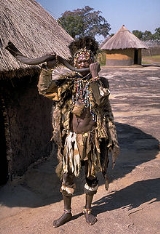
Shona (icon) is the name collectively given to two groups of people in the east and southwest of
ZimbabweZimbabwe is a landlocked country located in the southern part of the African continent, between the Zambezi and Limpopo rivers. It is bordered by South Africa to the south, Botswana to the southwest, Zambia and a tip of Namibia to the northwest and Mozambique to the east. Zimbabwe has three...
, north eastern Botswana and southern
MozambiqueMozambique, officially the Republic of Mozambique , is a country in southeastern Africa bordered by the Indian Ocean to the east, Tanzania to the north, Malawi and Zambia to the northwest, Zimbabwe to the west and Swaziland and South Africa to the southwest...
.
Shona Regional Classification
The Shona people are classified as Western Shona (Bakalanga) and eastern Shona. The western Shona are called the Bakalanga and is agreed that it is the oldest Shona cluster. They are found in South western Zimbabwe and Botswana. They have been assimilated by the Ndebele people. The bakalanga-Banyai groups are:
- Badhalaunda/batalaote (they lived in Madzilogwe, Mazhoubgwe, up to Zhozhobgwe)
- BaNambya (can be found in Hwange up to Gweta)
- BaLilima (BaWombe; Bayela - are in the central district with Baperi)
- Baperi (live together with BaLilima as mentioned above)
The eastern shona groups are:
- Karanga
- Korekore
- Manyika
- Zezuru
It should be known that Western Shona and eastern Shona languages are distinct ethnic groups who happen to have been one ethnic group hundreds of years ago. The use of the term usually neglects the western Shona which might confuse a lot of people even in historical documents. For example, it is said that Venda is a conglomeration of Shona and Sotho, it is meant western Shona. Other researchers trace the use of the term back to Mzilikazi, a zulu king who conquered some of the communities in present day Zimbabwe. According to the Zimbabwean Statistics Office the number of Shona speaking people is about nine million people, who speak a range of related dialects whose standardized form is also known as
ShonaShona is a Bantu language, native to the Shona people of Zimbabwe and southern Zambia; the term is also used to identify peoples who speak one of the Shona language dialects: Zezuru, Karanga, Manyika, Ndau and Korekore...
(bantu). Most researchers point to the ancestors of the Shona as the creators of
Great ZimbabweGreat Zimbabwe is a ruined city that was once the capital of the Kingdom of Zimbabwe, which existed from 1100 to 1450 C.E. during the country’s Late Iron Age. The monument, which first began to be constructed in the 11th century and which continued to be built until the 14th century, spanned an...
, the largest pre-European stone structure south of the Equator. The origin of the ruins was once highly debated but has largely been resolved.
A small group of Shona-speaking migrants of the late 19th century also live in Zambia's Zambezi valley, in Chieftainess Chiawa's area.
The Shona were traditionally agricultural, growing beans, peanuts, corn, pumpkins, and sweet potatoes.
Regional groupings
The Shona-speaking people are categorized into seven main linguistic groups:
- Zezuru
- Manyika
- Karanga
- Korekore
- Ndau
- Kalanga
- Nambya
These groups are all mixed up and there is hardly anything to distinguish them except the dialects. Many people who are Karanga, Zezuru, Ndau are from the Western Shona (Kalanga)who migrated east after the destruction of the Rozvi state by the Ndebele. Shona speaking people were also taken to Matebeland as captives and regard themselves as either Kalanga or Ndebele. Previously these differences did not exist as all these groups refereed to themselves as Karanga. The mutapa state which was in the area that is now Zezuru/Korekore was refere to as Mukalanga just as much as the western state was Vukalanga
Kingdoms
The term Shona is as recent as the 1920s. The Kalanga and or Karanga had, from the 11th century, created empires and states on the Zimbabwe plateau. These states include the
Great ZimbabweGreat Zimbabwe is a ruined city that was once the capital of the Kingdom of Zimbabwe, which existed from 1100 to 1450 C.E. during the country’s Late Iron Age. The monument, which first began to be constructed in the 11th century and which continued to be built until the 14th century, spanned an...
state (12-16th century), the Torwa State, and the Munhumutapa states, which succeeded the Great Zimbabwe state as well as the Rozvi state, which succeeded the Torwa State, and which with the Mutapa state existed into the 19th century. The states were based on kingship with certain dynasties being royals.
The major dynasties were the Rozvi of the Moyo (Heart) Totem, the Elephant (of the Mutapa state), and the Hungwe (Fish Eagle) dynasties that ruled from Great Zimbabwe. The Kalanga who speak Tjikalanga are related to the Karanga possible through common ancestry. Some Shona groups are not very familiar with the existence of the Kalanaga hence they are frequently not recognised as Shona today. These groups had an adelphic succession system (brother succeeds brother) and this after a long time caused a number of civil wars which, after the 16th century, were taken advantage of by the Portuguese. Underneath the king were a number of chiefs who had sub-chiefs and headmen under them.
History
The kingdoms were destroyed by new groups moving onto the plateau. The Ndebele destroyed the Chaangamire's Rozvi state in the 1830s, and the Portuguese slowly eroded the Mutapa State, which had extended to the coast of Mozambique after the state's success in providing valued exports for the Swahili, Arab and East Asian traders, especially in the mining of gold, known by the pre-colonisation miners as kuchera dyutswa at the time. The British destroyed traditional power in 1890 and colonized the plateau of Rhodesia. In Mozambique, the Portuguese colonial government fought the remnants of the Mutapa state until 1902.
Language and identity
The largest groups in Zimbabwe identify themselves as Shona, others as Ndebele with the remainder falling into categories like the Tonga, Shangani, Venda , Sotho in Gwanda, Kalanga etc. Dialect groups are important in Shona although there are huge similarities among the dialects. Although 'standard' Shona is spoken throughout Zimbabwe, the dialects not only help to identify which town or village a person is from (e.g. a person who is Manyika would be from Eastern Zimbabwe, ie. towns like Mutare) but also the ethnic group which the person belongs to. Each Shona dialect is specific to a certain ethnic group, i.e. if one speaks the Manyika dialect, they are from the Manyika group/tribe and observe certain customs and norms specific to their group. As such, if one is Zezuru, they speak the Zezuru dialect and observe those customs and beliefs that are specific to them. In 1931, during the process of trying to reconcile the dialects into the single standard Shona, Professor Clement Doke identified six groups, each with subdivisions: 1. The Korekore or Northern Shona, including Taυara, Shangwe, Korekore proper, Goυa, Budya, the Korekore of Urungwe, the Korekore of Sipolilo, Tande, Nyongwe of "Darwin", Pfungwe of Mrewa; 2. The Zezuru group, including Shawasha, Haraυa, another Goυa, Nohwe, Hera, Njanja, Mbire, Nobvu, Vakwachikwakwa, Vakwazvimba, Tsunga; 3. The Karanga group, including Duma, Jena, Mari, Goυera, Nogoυa, Nyubi; 4. The Manyika group, including Hungwe, Manyika themselves, Teυe, Unyama, Karombe, Nyamuka, Bunji, Domba, Nyatwe, Guta, Bvumba, Here, Jindwi, Boca; 5. The Ndau group (mostly Mozambique), including Ndau themselves, Tonga, Garwe, Danda, Shanga; 6. The Kalanga group, including Nyai, Nambzya, Rozvi, Kalanga proper, Talahundra, Lilima or Humbe, and Peri.
The above differences in dialects developed during the dispersion of tribes across the country over a long time. The influx of immigrants, into the country from bordering countries, has obviously contributed to the variety.
Totems
People of the same clan use a common set of totems. Totems are usually animals and body parts. Examples include Shiri/Hungwe-Fish Eagle , Mbizi/Tembo - Zebra, Shumba- Lion, Tsoko- Monkey, Nzou-Elephant or Gumbo (leg) Moyo (heart) Bepe lung, etc. These were further broken down into gender related names. For example Zebra group would break into Madhuve for the females and Dhuve or Mazvimbakupa for the males. People of the same totem are the descendants of one common ancestor (the founder of that totem)and thus are not allowed to marry or have an intimate relationship. The totems cross regional groupings and therefore provide a wall for development of ethnicism among the Shona groups.
This identification by totem has very important ramifications at traditional ceremonies such as the burial ceremony. A person with a different totem cannot initiate burial of the deceased. A person of the same totem, even when coming from a different tribe, can initiate burial of the deceased. For example a Ndebele of the Mpofu totem can initiate burial of a Shona of the Mhofu totem and that is perfectly acceptable in Shona tradition. But a Shona of a different totem cannot perform the ritual functions required to initiate burial of the deceased.
If a person initiates the burial of a person of a different totem, he runs the risk of being asked to pay a fine to the family of the deceased. Such fines traditionally were paid with cattle or goats but nowadays substantial amounts of money can be asked for.
Similarly Shona chiefs are required to be able to recite the history of their totem group right from the initial founder before they can be sworn in as chiefs.
External links