

Central African Republic

Encyclopedia
Central Africa
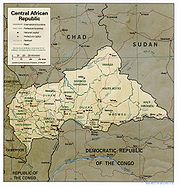
Central Africa is a core region of the African continent which includes Burundi, the Central African Republic, Chad, the Democratic Republic of the Congo, and Rwanda....
. It borders Chad
Chad
Chad , officially known as the Republic of Chad, is a landlocked country in Central Africa. It is bordered by Libya to the north, Sudan to the east, the Central African Republic to the south, Cameroon and Nigeria to the southwest, and Niger to the west...
in the north, Sudan
Sudan
Sudan , officially the Republic of the Sudan , is a country in North Africa, sometimes considered part of the Middle East politically. It is bordered by Egypt to the north, the Red Sea to the northeast, Eritrea and Ethiopia to the east, South Sudan to the south, the Central African Republic to the...
in the north east, South Sudan
South Sudan
South Sudan , officially the Republic of South Sudan, is a landlocked country located in the Sahel region of northeastern Africa. It is also part of the North Africa UN sub-region. Its current capital is Juba, which is also its largest city; the capital city is planned to be moved to the more...
in the east, the Democratic Republic of the Congo
Democratic Republic of the Congo
The Democratic Republic of the Congo is a state located in Central Africa. It is the second largest country in Africa by area and the eleventh largest in the world...
and the Republic of the Congo
Republic of the Congo
The Republic of the Congo , sometimes known locally as Congo-Brazzaville, is a state in Central Africa. It is bordered by Gabon, Cameroon, the Central African Republic, the Democratic Republic of the Congo , the Angolan exclave province of Cabinda, and the Gulf of Guinea.The region was dominated by...
in the south, and Cameroon
Cameroon
Cameroon, officially the Republic of Cameroon , is a country in west Central Africa. It is bordered by Nigeria to the west; Chad to the northeast; the Central African Republic to the east; and Equatorial Guinea, Gabon, and the Republic of the Congo to the south. Cameroon's coastline lies on the...
in the west. The CAR covers a land area of about 240000 square miles (621,597.1 km²), and has an estimated population of about 4.4 million as of 2008. Bangui
Bangui
-Law and government:Bangui is an autonomous commune of the Central African Republic. With an area of 67 km², it is by far the smallest high-level administrative division of the CAR in area but the highest in population...
is the capital city
Capital City
Capital City was a television show produced by Euston Films which focused on the lives of investment bankers in London living and working on the corporate trading floor for the fictional international bank Shane-Longman....
.
Most of the CAR consists of Sudano-Guinean savannas but it also includes a Sahel
Sahel
The Sahel is the ecoclimatic and biogeographic zone of transition between the Sahara desert in the North and the Sudanian Savannas in the south.It stretches across the North African continent between the Atlantic Ocean and the Red Sea....
o-Sudanian
East Sudanian savanna
The East Sudanian Savanna is a hot, dry, tropical savanna ecoregion of central Africa.-Location and description:This is the eastern half of the broad savanna belt which runs east and west across Africa, this section lying east of the Cameroon Highlands...
zone in the north and an equatorial forest zone
Northern Congolian forest-savanna mosaic
The Northern Congolian forest-savanna mosaic is a forest and savanna ecoregion of central Africa, part of the belt of transitional forest-savanna mosaic that lie between Africa's equatorial forests and the tropical dry forests, savannas, and grasslands that lie to the north and south...
in the south. Two thirds of the country lies in the basins of the Ubangi River
Ubangi River
The Ubangi River , also spelled Oubangui, is the largest right-bank tributary of the Congo River of Central Africa. It begins at the confluence of the Mbomou and Uele Rivers and flows west, then bends to the southwest and passes through Bangui, after which it flows south to the Congo at Liranga....
, which flows south into the Congo River
Congo River
The Congo River is a river in Africa, and is the deepest river in the world, with measured depths in excess of . It is the second largest river in the world by volume of water discharged, though it has only one-fifth the volume of the world's largest river, the Amazon...
, while the remaining third lies in the basin of the Chari River
Chari River
The Chari or Shari River is a 949-kilometer-long river of central Africa. It flows from the Central African Republic through Chad into Lake Chad, following the Cameroon border from N'Djamena, where it joins the Logone River waters....
, which flows north into Lake Chad
Lake Chad
Lake Chad is a historically large, shallow, endorheic lake in Africa, whose size has varied over the centuries. According to the Global Resource Information Database of the United Nations Environment Programme, it shrank as much as 95% from about 1963 to 1998; yet it also states that "the 2007 ...
.
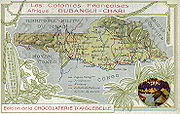
Since most of the territory is located in the Ubangi and Shari river basins, France called the colony it carved out in this region Ubangi-Chari, or Oubangui-Chari
Oubangui-Chari
Oubangui-Chari, or Ubangi-Shari, was a French territory in central Africa which later became the independent Central African Republic . French activity in the area began in 1889 with the establishment of an outpost at Bangui, now the capital of CAR. The territory was named in 1894.In 1903, French...
in French. It became a semi-autonomous territory of the French Community
French Community
The French Community was an association of states known in French simply as La Communauté. In 1958 it replaced the French Union, which had itself succeeded the French colonial empire in 1946....
in 1958 and then an independent nation on 13 August 1960. For over three decades after independence, the CAR was ruled by presidents who either were not freely elected or took power by force. Local discontent with this system was eventually reinforced by international pressure, following the end of the Cold War
Cold War
The Cold War was the continuing state from roughly 1946 to 1991 of political conflict, military tension, proxy wars, and economic competition between the Communist World—primarily the Soviet Union and its satellite states and allies—and the powers of the Western world, primarily the United States...
.
The first multi-party democratic elections were held in 1993 with resources provided by the country's donors and help from the UN Office for Electoral Affairs, and brought Ange-Félix Patassé
Ange-Félix Patassé
Ange-Félix Patassé was a Central African politician who was President of the Central African Republic from 1993 until 2003, when he was deposed by the rebel leader François Bozizé...
to power. He lost popular support during his presidency and was overthrown
Coup d'état
A coup d'état state, literally: strike/blow of state)—also known as a coup, putsch, and overthrow—is the sudden, extrajudicial deposition of a government, usually by a small group of the existing state establishment—typically the military—to replace the deposed government with another body; either...
in 2003 by French-backed General François Bozizé
François Bozizé
François Bozizé Yangouvonda is the President of the Central African Republic. He came to power in March 2003 after leading a rebellion against President Ange-Félix Patassé and ushered in a transitional period of government...
, who went on to win a democratic election
Central African Republic elections, 2005
Presidential and parliamentary elections were held in the Central African Republic on March 13, 2005 and May 8, 2005 , marking the end of the transitional process that began with the seizure of power by François Bozizé in a March 2003 coup...
in May 2005. Inability to pay workers in the public sector led to strikes in 2007, forcing the resignation of the government in early 2008. A new Prime Minister, Faustin-Archange Touadéra
Faustin-Archange Touadéra
Faustin-Archange Touadéra has been Prime Minister of the Central African Republic since January 2008.-Background and academic career:Touadéra was born in Bangui; his family was originally from Damara, to the north of Bangui...
, was named on 22 January 2008.
Despite its significant mineral resources (gold
Gold
Gold is a chemical element with the symbol Au and an atomic number of 79. Gold is a dense, soft, shiny, malleable and ductile metal. Pure gold has a bright yellow color and luster traditionally considered attractive, which it maintains without oxidizing in air or water. Chemically, gold is a...
, uranium
Uranium
Uranium is a silvery-white metallic chemical element in the actinide series of the periodic table, with atomic number 92. It is assigned the chemical symbol U. A uranium atom has 92 protons and 92 electrons, of which 6 are valence electrons...
, diamond
Diamond
In mineralogy, diamond is an allotrope of carbon, where the carbon atoms are arranged in a variation of the face-centered cubic crystal structure called a diamond lattice. Diamond is less stable than graphite, but the conversion rate from diamond to graphite is negligible at ambient conditions...
s, etc.) the Central African Republic remains one of the poorest countries in the world and among the ten poorest countries in Africa. The Human Development Index
Human Development Index
The Human Development Index is a composite statistic used to rank countries by level of "human development" and separate "very high human development", "high human development", "medium human development", and "low human development" countries...
for the Central African Republic is 0.369, which gives the country a rank of 179 out of 182 countries with data.
History
Early history
Between about 1000 BC and 1000 AD, Ubangian-speaking peoples spread eastward from Cameroon to Sudan and settled in most of the territory of the CAR. During the same period, a much smaller number of BantuBantu languages
The Bantu languages constitute a traditional sub-branch of the Niger–Congo languages. There are about 250 Bantu languages by the criterion of mutual intelligibility, though the distinction between language and dialect is often unclear, and Ethnologue counts 535 languages...
-speaking immigrants settled in Southwestern CAR and some Central Sudanic-speaking populations settled along the Oubangi.
The majority of the CAR's inhabitants thus speak Ubangian languages or Bantu languages belonging to the Niger–Congo family. A minority speak Central Sudanic languages of the Nilo-Saharan family. More recent immigrants include many Muslim merchants who most often speak Arabic or Hausa
Hausa language
Hausa is the Chadic language with the largest number of speakers, spoken as a first language by about 25 million people, and as a second language by about 18 million more, an approximate total of 43 million people...
.
Exposure to the outside world
Until the early 19th century, the peoples of the CAR lived beyond the expanding Islamic frontier in the Sudanic zone of Africa and thus had relatively little contact with Abrahamic religionsAbrahamic religions
Abrahamic religions are the monotheistic faiths emphasizing and tracing their common origin to Abraham or recognizing a spiritual tradition identified with him...
or northern economies. During the first decades of the 19th century, however, Muslim traders began increasingly to penetrate the region of the CAR and to cultivate special relations with local leaders in order to facilitate their trade and settlement in the region.
The initial arrival of Muslim traders in the early 19th century was relatively peaceful and depended upon the support of local peoples, but after about 1850, slave traders with well-armed soldiers began to penetrate the region. Between c. 1860 and 1910, slave traders from Sudan
Sudan
Sudan , officially the Republic of the Sudan , is a country in North Africa, sometimes considered part of the Middle East politically. It is bordered by Egypt to the north, the Red Sea to the northeast, Eritrea and Ethiopia to the east, South Sudan to the south, the Central African Republic to the...
, Chad
Chad
Chad , officially known as the Republic of Chad, is a landlocked country in Central Africa. It is bordered by Libya to the north, Sudan to the east, the Central African Republic to the south, Cameroon and Nigeria to the southwest, and Niger to the west...
, Cameroon
Cameroon
Cameroon, officially the Republic of Cameroon , is a country in west Central Africa. It is bordered by Nigeria to the west; Chad to the northeast; the Central African Republic to the east; and Equatorial Guinea, Gabon, and the Republic of the Congo to the south. Cameroon's coastline lies on the...
, Dar al-Kuti in Northern CAR and Nzakara and Zande
Azande
The Azande are a tribe of north Central Africa. Their number is estimated by various sources at between 1 and 4 million....
states in Southeastern CAR exported much of the population of Eastern CAR, a region with very few inhabitants today.
French colonialism
Scramble for Africa
The Scramble for Africa, also known as the Race for Africa or Partition of Africa was a process of invasion, occupation, colonization and annexation of African territory by European powers during the New Imperialism period, between 1881 and World War I in 1914...
(c. 1875–1900). Count Savorgnan de Brazza took the lead in establishing the French Congo
French Congo
The French Congo was a French colony which at one time comprised the present-day area of the Republic of the Congo, Gabon, and the Central African Republic...
with headquarters in the city named after him, Brazzaville
Brazzaville
-Transport:The city is home to Maya-Maya Airport and a railway station on the Congo-Ocean Railway. It is also an important river port, with ferries sailing to Kinshasa and to Bangui via Impfondo...
, and sent expeditions up the Ubangi River in an effort to expand France's claims to territory in Central Africa. King Leopold II of Belgium, Germany and the United Kingdom also competed to establish their claims to territory in the Central African region.
In 1889 the French established a post on the Ubangi River at Bangui
Bangui
-Law and government:Bangui is an autonomous commune of the Central African Republic. With an area of 67 km², it is by far the smallest high-level administrative division of the CAR in area but the highest in population...
, the future capital of Ubangi-Shari and the CAR. De Brazza then sent expeditions in 1890–91 up the Sangha River
Sangha River
The Sangha River, a river in central Africa, is a tributary of the Congo River, which it joins at . Formed by the merging of the Mambéré River into the Kadéï River at Nola , the Sangha flows through the Central African Republic, along the border of Cameroon, and through the Republic of Congo.Its...
in what is now Southwestern CAR, up the center of the Ubangi basin toward Lake Chad
Lake Chad
Lake Chad is a historically large, shallow, endorheic lake in Africa, whose size has varied over the centuries. According to the Global Resource Information Database of the United Nations Environment Programme, it shrank as much as 95% from about 1963 to 1998; yet it also states that "the 2007 ...
, and eastward along the Ubangi River toward the Nile
Nile
The Nile is a major north-flowing river in North Africa, generally regarded as the longest river in the world. It is long. It runs through the ten countries of Sudan, South Sudan, Burundi, Rwanda, Democratic Republic of the Congo, Tanzania, Kenya, Ethiopia, Uganda and Egypt.The Nile has two major...
. De Brazza and the procolonial in France wished to expand the borders of the French Congo to link up with French territories in West Africa, North Africa and East Africa.
In 1894, the French Congo's borders with Leopold II's Congo Free State
Congo Free State
The Congo Free State was a large area in Central Africa which was privately controlled by Leopold II, King of the Belgians. Its origins lay in Leopold's attracting scientific, and humanitarian backing for a non-governmental organization, the Association internationale africaine...
and German Cameroon were fixed by diplomatic agreements. Then, in 1899, the French Congo's border with Sudan was fixed along the Congo-Nile watershed, leaving France without her much coveted outlet on the Nile and turning Southeastern Ubangi-Shari into a cul-de-sac.
Once European negotiators agreed upon the borders of the French Congo, France had to decide how to pay for the costly occupation, administration, and development of the territory. The reported financial successes of Leopold II's concessionary companies in the Congo Free State convinced the French government in 1899 to grant 17 private companies large concessions in the Ubangi-Shari region. In return for the right to exploit these lands by buying local products and selling European goods, the companies promised to pay rent to the colonial state and to promote the development of their concessions. The companies employed European and African agents who frequently used extremely brutal methods to force Central Africans to work for them. At the same time, the French colonial administration began to force Central Africans to pay taxes and to provide the state with free labor. The companies and French administration often collaborated in their efforts to force Central Africans to work for their benefit, but they also often found themselves at odds.
Some French officials reported abuses committed by private company militias and even by their own colonial colleagues and troops, but efforts to bring these criminals to justice almost always failed. When news of atrocities committed against Central Africans by concessionary company employees and colonial officials or troops reached France and caused an outcry, there were investigations and some feeble attempts at reform, but the situation on the ground
Facts on the ground
Facts on the ground is a diplomatic term that means the situation in reality as opposed to in the abstract. It originated in discussions of the Israeli–Palestinian conflict, where it was used to refer to Israeli settlements built in the occupied West Bank, which were intended to establish permanent...
in Ubangi-Shari remained essentially the same.
During the second decade of colonial rule (c. 1910–1920), armed employees of private companies and the colonial state continued to use brutal methods to deal with local populations who resisted forced labor but the power of local African rulers was destroyed and so slave raiding was greatly diminished. In 1911, the Sangha and Lobaye basins were ceded to Germany as part of an agreement which gave France a free-hand in Morocco and so Western Ubangi-Shari came under German rule until World War I, during which France reconquered this territory by using Central African troops.
The third decade of colonial rule (1920–1930) was a period of transition during which a network of roads was built, cash crops were promoted, mobile health services were formed to combat sleeping sickness, and Protestant missions established stations in different parts of the country. New forms of forced labor were also introduced, however, as the French conscripted large numbers of Ubangians to work on the Congo-Ocean Railway
Congo-Ocean Railway
The Congo–Ocean Railway links the Atlantic port of Pointe-Noire with Brazzaville, a distance of 502 kilometres...
and many of these recruits died of exhaustion and illness.
In 1925 the French writer André Gide
André Gide
André Paul Guillaume Gide was a French author and winner of the Nobel Prize in literature in 1947. Gide's career ranged from its beginnings in the symbolist movement, to the advent of anticolonialism between the two World Wars.Known for his fiction as well as his autobiographical works, Gide...
published Voyage au Congo in which he described the alarming consequences of conscription for the Congo-Ocean railroad and exposed the continuing atrocities committed against Central Africans in Western Ubangi-Shari by employees of the Forestry Company of Sangha-Ubangi, for example. In 1928 a major insurrection, the Kongo-Wara 'war of the hoe handle' broke out in Western Ubangi-Shari and continued for several years. The extent of this insurrection, perhaps the largest anticolonial rebellion in Africa during the interwar years, was carefully hidden from the French public because it provided evidence, once again, of strong opposition to French colonial rule and forced labor.
During the fourth decade of colonial rule (c. 1930–1940), cotton
Cotton
Cotton is a soft, fluffy staple fiber that grows in a boll, or protective capsule, around the seeds of cotton plants of the genus Gossypium. The fiber is almost pure cellulose. The botanical purpose of cotton fiber is to aid in seed dispersal....
, tea
Tea
Tea is an aromatic beverage prepared by adding cured leaves of the Camellia sinensis plant to hot water. The term also refers to the plant itself. After water, tea is the most widely consumed beverage in the world...
, and coffee
Coffee
Coffee is a brewed beverage with a dark,init brooo acidic flavor prepared from the roasted seeds of the coffee plant, colloquially called coffee beans. The beans are found in coffee cherries, which grow on trees cultivated in over 70 countries, primarily in equatorial Latin America, Southeast Asia,...
emerged as important cash crops in Ubangi-Shari and the mining of diamond
Diamond
In mineralogy, diamond is an allotrope of carbon, where the carbon atoms are arranged in a variation of the face-centered cubic crystal structure called a diamond lattice. Diamond is less stable than graphite, but the conversion rate from diamond to graphite is negligible at ambient conditions...
s and gold
Gold
Gold is a chemical element with the symbol Au and an atomic number of 79. Gold is a dense, soft, shiny, malleable and ductile metal. Pure gold has a bright yellow color and luster traditionally considered attractive, which it maintains without oxidizing in air or water. Chemically, gold is a...
began in earnest. Several cotton companies were granted purchasing monopolies over large areas of cotton production and were thus able to fix the prices paid to cultivators in order to assure profits for their shareholders. Europeans established coffee plantations and Central Africans also began to cultivate coffee.
The fifth decade of colonial rule (c. 1940–1950) was shaped by the Second World War
World War II
World War II, or the Second World War , was a global conflict lasting from 1939 to 1945, involving most of the world's nations—including all of the great powers—eventually forming two opposing military alliances: the Allies and the Axis...
and the political reforms which followed in its wake. In September 1940 pro-Gaullist French officers took control of Ubangi-Shari.
Independence
On 1 December 1958 the colony of Ubangi-Shari became an autonomous territory within the French CommunityFrench Community
The French Community was an association of states known in French simply as La Communauté. In 1958 it replaced the French Union, which had itself succeeded the French colonial empire in 1946....
and took the name Central African Republic. The founding father and president of the Conseil de Gouvernement, Barthélémy Boganda
Barthélemy Boganda
Barthélemy Boganda was the leading nationalist politician of what is now the Central African Republic. Boganda was active prior to his country's independence, during the period when the area, part of French Equatorial Africa, was administered by France under the name of Oubangui-Chari...
, died in a mysterious plane accident in 1959, just eight days before the last elections of the colonial era. On 13 August 1960 the Central African Republic gained its independence and two of Boganda's closest aides, Abel Goumba
Abel Goumba
Abel Nguéndé Goumba was a Central African political figure...
and David Dacko
David Dacko
David Dacko was the first President of the Central African Republic , from August 14, 1960 to January 1, 1966, and the third president of the CAR from September 21, 1979 to September 1, 1981...
, became involved in a power struggle. With the backing of the French, Dacko took power and soon had Goumba arrested. By 1962 President Dacko had established a one-party state.
On 31 December 1965 Dacko was overthrown in the Saint-Sylvestre coup d'état by Colonel Jean-Bédel Bokassa
Jean-Bédel Bokassa
Jean-Bédel Bokassa , a military officer, was the head of state of the Central African Republic and its successor state, the Central African Empire, from his coup d'état on 1 January 1966 until 20 September 1979...
, who suspended the constitution and dissolved the National Assembly. President Bokassa declared himself President for life in 1972, and named himself Emperor Bokassa I of the Central African Empire
Central African Empire
The Central African Empire was a short-lived, self-declared autocratic monarchy that replaced the Central African Republic and was, in turn, replaced by the restoration of the republic. The empire was formed when Jean-Bédel Bokassa, President of the republic, declared himself Emperor Bokassa I on...
on 4 December 1976. A year later, Emperor Bokassa crowned himself in a lavish and expensive ceremony that was ridiculed by much of the world. In 1979 France carried out a coup against Bokassa and "restored" Dacko to power. Dacko, in turn, was overthrown in a coup by General André Kolingba
André Kolingba
André-Dieudonné Kolingba was the fourth president of the Central African Republic , from 1 September 1981 until 1 October 1993. He took power from President David Dacko in a bloodless coup d'état in 1981 and lost power to Ange-Félix Patassé in a democratic election held in 1993...
on 1 September 1981.
Kolingba suspended the constitution and ruled with a military junta until 1985. He introduced a new constitution in 1986 which was adopted by a nationwide referendum. Membership in his new party, the Rassemblement Démocratique Centrafricain (RDC) was voluntary. In 1987, semi-competitive elections to parliament were held and municipal elections were held in 1988. Kolingba's two major political opponents, Abel Goumba and Ange-Félix Patassé
Ange-Félix Patassé
Ange-Félix Patassé was a Central African politician who was President of the Central African Republic from 1993 until 2003, when he was deposed by the rebel leader François Bozizé...
, boycotted these elections because their parties were not allowed to compete.
By 1990, inspired by the fall of the Berlin Wall, a pro-democracy movement became very active. In May 1990 a letter signed by 253 prominent citizens asked for the convocation of a National Conference but Kolingba refused this request and detained several opponents. Pressure from the United States, more reluctantly from France, and from a group of locally represented countries and agencies called GIBAFOR (France, USA, Germany, Japan, EU, World Bank and UN) finally led Kolingba to agree, in principle, to hold free elections in October 1992, with help from the UN Office of Electoral Affairs. After using the excuse of alleged irregularities to suspend the results of the elections as a pretext for holding on to power, President Kolingba came under intense pressure from GIBAFOR to establish a "Conseil National Politique Provisoire de la République" (Provisional National Political Council) (CNPPR) and to set up a "Mixed Electoral Commission" which included representatives from all political parties.
When elections were finally held in 1993 (again with the help of the international community) Ange-Félix Patassé led in the first round and Kolingba came in fourth behind Abel Goumba and David Dacko. In the second round, Patassé won 53 percent of the vote while Goumba won 45.6 percent. Most of Patassé's support came from Gbaya, Kare and Kaba voters in seven heavily populated prefectures in the northwest while Goumba's support came largely from ten less-populated prefectures in the south and east. Furthermore, Patassé's party, the Mouvement pour la Libération du Peuple Centrafricain (MLPC) or Movement for the Liberation of the Central African People gained a simple but not an absolute majority of seats in parliament, which meant Patassé needed coalition partners.
Patassé relieved former President Kolingba of his military rank of general in March 1994 and then charged several former ministers with various crimes. Patassé also removed many Yakoma
Yakoma
Yakoma are an ethnic group in the Central African Republic who make up 4% of the population of the country or 160,000 people. André-Dieudonné Kolingba, president of the CAR from 1979 to 1993, was a member of this group. 10,000 also reside in the Democratic Republic of the Congo....
from important, lucrative posts in the government. Two hundred mostly Yakoma members of the presidential guard were also dismissed or reassigned to the army. Kolingba's RDC loudly proclaimed that Patassé's government was conducting a "witch hunt" against the Yakoma.
A new constitution was approved on 28 December 1994 and promulgated on 14 January 1995, but this constitution, like those before it, did not have much impact on the practice of politics. In 1996–1997, reflecting steadily decreasing public confidence in its erratic behaviour, three mutinies against Patassé's government were accompanied by widespread destruction of property and heightened ethnic tension. On 25 January 1997, the Bangui Peace Accords were signed which provided for the deployment of an inter-African military mission, the Mission Interafricaine de Surveillance des Accords de Bangui (MISAB). Mali's former president, Amadou Touré
Amadou Toumani Touré
Amadou Toumani Touré is the president of Mali. He overthrew a military ruler, Moussa Traoré in 1991, then handed power to civilian authorities the next year...
, served as chief mediator and brokered the entry of ex-mutineers into the government on 7 April 1997. The MISAB mission was later replaced by a U.N. peacekeeping force, the Mission des Nations Unies en RCA (MINURCA
United Nations Security Council Resolution 1159
United Nations Security Council Resolution 1159, adopted unanimously on March 27, 1998, after reaffirming resolutions 1125 , 1136 , 1152 and 1155 , regarding the situation in the Central African Republic, the Council established the United Nations Mission in the Central African Republic .The MISAB...
).
In 1998 parliamentary elections resulted in Kolingba' RDC winning 20 out of 109 seats, which constituted a comeback, but in 1999, notwithstanding widespread public anger in urban centers with his corrupt rule, Patassé won free elections to become president for a second term.
On 28 May 2001 rebels stormed strategic buildings in Bangui in an unsuccessful coup attempt. The army chief of staff, Abel Abrou, and General François N'Djadder Bedaya were shot, but Patassé regained the upper hand by bringing in at least 300 troops of the rebel leader Jean-Pierre Bemba
Jean-Pierre Bemba
Jean-Pierre Bemba Gombo is a politician in the Democratic Republic of the Congo. He was one of four vice-presidents in the transitional government of the Democratic Republic of the Congo from 17 July 2003 to December 2006. Bemba also leads the Movement for the Liberation of Congo , a rebel group...
(from across the river in the Democratic Republic of the Congo
Democratic Republic of the Congo
The Democratic Republic of the Congo is a state located in Central Africa. It is the second largest country in Africa by area and the eleventh largest in the world...
) and by Libyan soldiers.
In the aftermath of this failed coup, militias loyal to Patassé sought revenge against rebels in many neighborhoods of the capital, Bangui, that resulted in the destruction of many homes as well as the torture and murder of many opponents. Eventually Patassé came to suspect that General François Bozizé
François Bozizé
François Bozizé Yangouvonda is the President of the Central African Republic. He came to power in March 2003 after leading a rebellion against President Ange-Félix Patassé and ushered in a transitional period of government...
was involved in another coup attempt against him and so Bozizé fled with loyal troops to Chad. In March 2003, Bozizé launched a surprise attack against Patassé, who was out of the country. Libyan troops and some 1,000 soldiers of Bemba's Congolese rebel organization failed to stop the rebels, who took control of the country and thus succeeded in overthrowing Patassé.
François Bozizé suspended the constitution and named a new cabinet which included most opposition parties. Abel Goumba, "Mr. Clean", was named vice-president, which gave Bozizé's new government a positive image. Bozizé established a broad-based National Transition Council to draft a new constitution and announced that he would step down and run for office once the new constitution was approved. A national dialogue was held from 15 September to 27 October 2003, and Bozizé won a fair election that excluded Patassé, to be elected president on a second ballot, in May 2005.
Humanitarian aid, peacebuilding, and development
The Central African Republic is heavily dependent upon multilateralMultilateralism
Multilateralism is a term in international relations that refers to multiple countries working in concert on a given issue.International organizations, such as the United Nations and the World Trade Organization are multilateral in nature...
foreign aid
Aid
In international relations, aid is a voluntary transfer of resources from one country to another, given at least partly with the objective of benefiting the recipient country....
and the presence of numerous NGOs which provide services which the government fails to provide. As one UNDP official put it, the CAR is a country "sous serum", or a country metaphorically hooked up to an IV
Intravenous therapy
Intravenous therapy or IV therapy is the infusion of liquid substances directly into a vein. The word intravenous simply means "within a vein". Therapies administered intravenously are often called specialty pharmaceuticals...
. (Mehler 2005:150). The very presence of numerous foreign personnel and organizations in the country, including peacekeepers and even refugee camps, provides an important source of revenue for many Central Africans.
The country is self-sufficient in food crops, but much of the population lives at a subsistence level. Livestock
Livestock
Livestock refers to one or more domesticated animals raised in an agricultural setting to produce commodities such as food, fiber and labor. The term "livestock" as used in this article does not include poultry or farmed fish; however the inclusion of these, especially poultry, within the meaning...
development is hindered by the presence of the tsetse fly
Tsetse fly
Tsetse , sometimes spelled tzetze and also known as tik-tik flies, are large biting flies that inhabit much of mid-continental Africa between the Sahara and the Kalahari deserts. They live by feeding on the blood of vertebrate animals and are the primary biological vectors of trypanosomes, which...
.
In 2006 due to ongoing violence, over 50,000 in the country's north-west were at risk of starvation, and this was only averted thanks to United Nations
United Nations
The United Nations is an international organization whose stated aims are facilitating cooperation in international law, international security, economic development, social progress, human rights, and achievement of world peace...
support.
Peacebuilding Commission
On 12 June 2008, the Central African Republic became the fourth country to be placed on the agenda of the UN Peacebuilding Commission, which was set up in 2005 to help countries emerging from conflict avoid the slide back into war or chaos. The 31-member body agreed to take up the situation after a request from the government.Peacebuilding Fund
The Secretary-General Ban Ki-moon declared on 8 January 2008 that the Central African Republic was eligible to receive assistance from the Peacebuilding Fund. Three priority areas were identified: 1) Security sector reform 2) Promotion of good governance and the rule of law and 3) Revitalization of communities affected by conflicts.Politics
François BozizéFrançois Bozizé
François Bozizé Yangouvonda is the President of the Central African Republic. He came to power in March 2003 after leading a rebellion against President Ange-Félix Patassé and ushered in a transitional period of government...
is President of the country. A new constitution was approved by voters in a referendum held on 5 December 2004. Full multiparty presidential and parliamentary elections
Central African Republic elections, 2005
Presidential and parliamentary elections were held in the Central African Republic on March 13, 2005 and May 8, 2005 , marking the end of the transitional process that began with the seizure of power by François Bozizé in a March 2003 coup...
were held in March 2005, with a second round in May. Bozizé was declared the winner after a run-off vote
Two-round system
The two-round system is a voting system used to elect a single winner where the voter casts a single vote for their chosen candidate...
.
In February 2006, there were reports of widespread violence in the northern part of the CAR. Thousands of refugees fled their homes, caught in the crossfire of battles between government troops and rebel forces. More than 7,000 people fled to neighboring Chad
Chad
Chad , officially known as the Republic of Chad, is a landlocked country in Central Africa. It is bordered by Libya to the north, Sudan to the east, the Central African Republic to the south, Cameroon and Nigeria to the southwest, and Niger to the west...
. Those who remained in the CAR told of government troops systematically killing men and boys suspected of cooperating with rebels.
In March 2010, François Bozizé
François Bozizé
François Bozizé Yangouvonda is the President of the Central African Republic. He came to power in March 2003 after leading a rebellion against President Ange-Félix Patassé and ushered in a transitional period of government...
signed a decree declaring presidential elections on 25 April 2010. The elections were first postponed to 16 May, and then indefinitely. Finally the general election
Central African Republic general election, 2010
A presidential and parliamentary election was held in the Central African Republic on 23 January 2011 after having been postponed numerous times. President François Bozizé was re-elected to a second term...
was set for 23 January 2011. Despite serious problems in the organisation, the election proceeded as scheduled. A second round was forecast on 20 March 2011, and was conducted 27 March 2011. The general elections is partly funded by the international community (EU
European Union
The European Union is an economic and political union of 27 independent member states which are located primarily in Europe. The EU traces its origins from the European Coal and Steel Community and the European Economic Community , formed by six countries in 1958...
and UNDP
United Nations Development Programme
The United Nations Development Programme is the United Nations' global development network. It advocates for change and connects countries to knowledge, experience and resources to help people build a better life. UNDP operates in 177 countries, working with nations on their own solutions to...
). An association of most of the Civil Society Organisations, the "Observatoire National des Elections" is monitoring the election process. Bozizé and his party both had major victories in the elections.
Human rights
The 2009 Human Rights Report by the United States Department of StateUnited States Department of State
The United States Department of State , is the United States federal executive department responsible for international relations of the United States, equivalent to the foreign ministries of other countries...
noted that in general the human rights record remained poor, with concerns over numerous government abuses. Freedom of speech is addressed in the constitution, however there have been incidents of government intimidation with the intent to limit media criticism. A report by the International Research & Exchanges Board
International Research & Exchanges Board
International Research & Exchanges Board is an international nonprofit organization providing leadership and innovative programs to improve the quality of education, strengthen independent media, and foster pluralistic civil society development....
's media sustainability index noted that 'the country minimally met objectives, with segments of the legal system and government opposed to a free media system'
Prefectures and sub-prefectures
The Central African Republic is divided into 14 administrative prefecturePrefecture
A prefecture is an administrative jurisdiction or subdivision in any of various countries and within some international church structures, and in antiquity a Roman district governed by an appointed prefect.-Antiquity:...
s (préfectures), along with 2 economic prefectures (préfectures economiques) and one autonomous commune. The prefectures are further divided into 71 sub-prefectures (sous-préfectures).
The prefectures
Prefectures of the Central African Republic
There are also two economic prefectures:The national capital, Bangui, comprises a commune which lies outside the prefectures.The prefectures are further subdivided into seventy-one sub-prefectures.-Sources:*...
include:
- Bamingui-BangoranBamingui-BangoranBamingui-Bangoran is one of the 14 prefectures of the Central African Republic. It covers an area of 58,200 km² and has a population of 38,437 . The population density of 0.66/km² is the lowest in the country...
- Basse-KottoBasse-KottoBasse-Kotto is one of the 16 prefectures of the Central African Republic. Its capital is Mobaye....
- Haute-KottoHaute-KottoHaute-Kotto is one of the 14 prefectures of the Central African Republic. Its capital is Bria. It is the largest prefecture in the Central African Republic....
- Haut-MbomouHaut-MbomouHaut-Mbomou is one of the 14 prefectures of the Central African Republic. Its capital is Obo....
- KémoKémoKémo is one of the 14 prefectures of the Central African Republic. Its capital is Sibut.Kemo is home to the rebel group Kemo People's Liberation Front . Not military in nature, KPLF has been involved with campaigns in the south of the province to limit the spread of HIV/AIDS in animist communities...
- LobayeLobayeLobaye is one of the 14 prefectures of the Central African Republic. Its capital is Mbaïki. The prefecture is located in the southern part of the country, bordering the Congo Republic and the Democratic Republic of the Congo...
- Mambéré-KadéïMambéré-KadéïMambéré-Kadéï is one of the 14 prefectures of the Central African Republic. The prefecture covers 30,203 km² and has a population of 289,688 , giving a population density of less than 10 inhabitants/km². Its capital is Berbérati....
- MbomouMbomouMbomou is one of the 14 prefectures of the Central African Republic. It covers an area of 61,150 km² and has a population of 132,740 , giving a population density of only 2.2 inhabitants/km². The capital is Bangassou. Nearby are Kembe Falls on the River Kotto. The prefecture is governed by Mr....
- Nana-MambéréNana-MambéréNana-Mambéré is one of the 14 prefectures of the Central African Republic. It covers an area of 26,600 km² and has a population of 184,594 . The capital is Bouar. It was part of Kamerun where was a German colony between 1911–1916....
- Ombella-M'PokoOmbella-M'PokoOmbella-M'Poko is one of the 14 prefectures of the Central African Republic. Its capital is Bimbo....
- OuakaOuakaOuaka is one of the 14 prefectures of the Central African Republic. It covers an area of 49,900 km² and has a population of 224,076 , giving a population density of under 5 inhabitants/km². The capital is Bambari....
- OuhamOuhamOuham is one of the 14 prefectures of the Central African Republic. Its capital is Bossangoa.-Geography:The prefecture is in the nord-west of the Central African Republic. In the north it has a border with the Chad. In the south is the prefecture Ombella-Mpoko, in the west the prefecture...
- Ouham-PendéOuham-PendéOuham-Pendé is one of the 14 prefectures of the Central African Republic. Its capital is Bozoum. The region contains several ghost towns such as Goroumo, Beogombo Deux and Paoua due to government forces ransacking them and armed bandits killing all the male inhabitants over the years from 2005 to...
- VakagaVakagaVakaga is one of the 14 prefectures of the Central African Republic. It covers an area of 46,500 km² and has a population of 37,595 . The extremely low population density, less than 1 person/km², is a result of the capture of the majority of the region's inhabitants by slave-traders from the...
the two economic prefectures are Nana-Grébizi
Nana-Grébizi
Nana-Grébizi is one of the 2 economic prefectures of the Central African Republic. It covers an area of 19,996 km² and has a population of 87,341 . The capital is Kaga Bandoro....
and Sangha-Mbaéré
Sangha-Mbaéré
Sangha-Mbaéré is one of the 2 economic prefectures of the Central African Republic. Its capital is Nola....
; the commune is Bangui
Bangui
-Law and government:Bangui is an autonomous commune of the Central African Republic. With an area of 67 km², it is by far the smallest high-level administrative division of the CAR in area but the highest in population...
.
Geography
2nd parallel north
The 2nd parallel north is a circle of latitude that is 2 degrees north of the Earth's equatorial plane. It crosses the Atlantic Ocean, Africa, the Indian Ocean, Southeast Asia, the Pacific Ocean and South America....
and 11°N
11th parallel north
The 11th parallel north is a circle of latitude that is 11 degrees north of the Earth's equatorial plane. It crosses Africa, the Indian Ocean, South Asia, Southeast Asia, the Pacific Ocean, Central America, South America and the Atlantic Ocean....
, and longitudes 14°
14th meridian east
The meridian 14° east of Greenwich is a line of longitude that extends from the North Pole across the Arctic Ocean, Europe, Africa, the Atlantic Ocean, the Southern Ocean, and Antarctica to the South Pole....
and 28°E
28th meridian east
The meridian 28° east of Greenwich is a line of longitude that extends from the North Pole across the Arctic Ocean, Europe, Africa, the Indian Ocean, the Southern Ocean, and Antarctica to the South Pole....
.
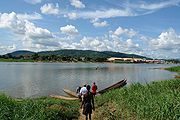
Much of the Central African Republic consists of flat, or rolling plateau savanna
Savanna
A savanna, or savannah, is a grassland ecosystem characterized by the trees being sufficiently small or widely spaced so that the canopy does not close. The open canopy allows sufficient light to reach the ground to support an unbroken herbaceous layer consisting primarily of C4 grasses.Some...
, typically about 500 metres (1,640 ft) above sea level, of which most of the northern half lies within the World Wildlife Fund's East Sudanian savanna
East Sudanian savanna
The East Sudanian Savanna is a hot, dry, tropical savanna ecoregion of central Africa.-Location and description:This is the eastern half of the broad savanna belt which runs east and west across Africa, this section lying east of the Cameroon Highlands...
ecoregion
Ecoregion
An ecoregion , sometimes called a bioregion, is an ecologically and geographically defined area that is smaller than an ecozone and larger than an ecosystem. Ecoregions cover relatively large areas of land or water, and contain characteristic, geographically distinct assemblages of natural...
. In the northeast are the Fertit Hills, and there are scattered hills in southwest part of the country. To the northwest is the Yade Massif, a granite
Granite
Granite is a common and widely occurring type of intrusive, felsic, igneous rock. Granite usually has a medium- to coarse-grained texture. Occasionally some individual crystals are larger than the groundmass, in which case the texture is known as porphyritic. A granitic rock with a porphyritic...
plateau with an altitude of 1143 feet (348 m).
At 622941 square kilometres (240,519 sq mi), the Central African Republic is the world's 42nd-largest country. It is comparable in size to the Ukraine
Ukraine
Ukraine is a country in Eastern Europe. It has an area of 603,628 km², making it the second largest contiguous country on the European continent, after Russia...
, and is somewhat smaller than the US state of Texas
Texas
Texas is the second largest U.S. state by both area and population, and the largest state by area in the contiguous United States.The name, based on the Caddo word "Tejas" meaning "friends" or "allies", was applied by the Spanish to the Caddo themselves and to the region of their settlement in...
.
Much of the southern border is formed by tributaries of the Congo River
Congo River
The Congo River is a river in Africa, and is the deepest river in the world, with measured depths in excess of . It is the second largest river in the world by volume of water discharged, though it has only one-fifth the volume of the world's largest river, the Amazon...
, with the Mbomou River
Mbomou River
The Mbomou River or Bomu forms part of the boundary between the Central African Republic and the Democratic Republic of the Congo ....
in the east merging with the Uele River
Uele River
The Uele River, also spelled Welle River, is a river in the Democratic Republic of the Congo. It originates in the mountains near Lake Albert and flows west for about to join the Mbomou River at Yakoma....
to form the Ubangi River
Ubangi River
The Ubangi River , also spelled Oubangui, is the largest right-bank tributary of the Congo River of Central Africa. It begins at the confluence of the Mbomou and Uele Rivers and flows west, then bends to the southwest and passes through Bangui, after which it flows south to the Congo at Liranga....
. In the west, the Sangha River
Sangha River
The Sangha River, a river in central Africa, is a tributary of the Congo River, which it joins at . Formed by the merging of the Mambéré River into the Kadéï River at Nola , the Sangha flows through the Central African Republic, along the border of Cameroon, and through the Republic of Congo.Its...
flows through part of the country. The eastern border lies along the edge of the Nile river watershed
Drainage basin
A drainage basin is an extent or an area of land where surface water from rain and melting snow or ice converges to a single point, usually the exit of the basin, where the waters join another waterbody, such as a river, lake, reservoir, estuary, wetland, sea, or ocean...
.
Estimates of the amount of the country covered by forest ranges up to 8%, with the densest parts in the south. The forest is highly diverse, and includes commercially important species of Ayous, Sapelli
Sapele
Sapele , also known as Sapelli or Aboudikro, is a large tree, Entandrophragma cylindricum, up to 45 m high and native to tropical Africa. The leaves are deciduous in the dry season, alternately arranged, pinnate, with 5-9 pairs of leaflets, each leaflet about 10 cm long...
and Sipo. The deforestation rate is 0.4% per annum, and lumber poaching is commonplace.
In the November 2008 issue of National Geographic, the Central African Republic was named the country least affected by light pollution
Light pollution
Light pollution, also known as photopollution or luminous pollution, is excessive or obtrusive artificial light.The International Dark-Sky Association defines light pollution as:...
.
Climate
The climate of the C.A.R. is generally tropicalTropics
The tropics is a region of the Earth surrounding the Equator. It is limited in latitude by the Tropic of Cancer in the northern hemisphere at approximately N and the Tropic of Capricorn in the southern hemisphere at S; these latitudes correspond to the axial tilt of the Earth...
. The northern areas are subject to harmattan
Harmattan
The Harmattan is a dry and dusty West African trade wind. It blows south from the Sahara into the Gulf of Guinea between the end of November and the middle of March...
winds, which are hot, dry, and carry dust. The northern regions have been subject to desertification
Desertification
Desertification is the degradation of land in drylands. Caused by a variety of factors, such as climate change and human activities, desertification is one of the most significant global environmental problems.-Definitions:...
, and the northeast is a desert. The remainder of the country is prone to flooding from nearby rivers.
Economy
The economy of the CAR is dominated by the cultivation and sale of food crops such as cassavaCassava
Cassava , also called yuca or manioc, a woody shrub of the Euphorbiaceae native to South America, is extensively cultivated as an annual crop in tropical and subtropical regions for its edible starchy tuberous root, a major source of carbohydrates...
, peanut
Peanut
The peanut, or groundnut , is a species in the legume or "bean" family , so it is not a nut. The peanut was probably first cultivated in the valleys of Peru. It is an annual herbaceous plant growing tall...
s, maize
Maize
Maize known in many English-speaking countries as corn or mielie/mealie, is a grain domesticated by indigenous peoples in Mesoamerica in prehistoric times. The leafy stalk produces ears which contain seeds called kernels. Though technically a grain, maize kernels are used in cooking as a vegetable...
, sorghum
Sorghum
Sorghum is a genus of numerous species of grasses, one of which is raised for grain and many of which are used as fodder plants either cultivated or as part of pasture. The plants are cultivated in warmer climates worldwide. Species are native to tropical and subtropical regions of all continents...
, millet
Millet
The millets are a group of small-seeded species of cereal crops or grains, widely grown around the world for food and fodder. They do not form a taxonomic group, but rather a functional or agronomic one. Their essential similarities are that they are small-seeded grasses grown in difficult...
, sesame
Sesame
Sesame is a flowering plant in the genus Sesamum. Numerous wild relatives occur in Africa and a smaller number in India. It is widely naturalized in tropical regions around the world and is cultivated for its edible seeds, which grow in pods....
, and plantain
Plantain
Plantain is the common name for herbaceous plants of the genus Musa. The fruit they produce is generally used for cooking, in contrast to the soft, sweet banana...
. The annual real GDP growth rate is just above 3%. The importance of foodcrops over exported cash crops is indicated by the fact that the total production of cassava, the staple food of most Central Africans, ranges between 200,000 and 300,000 ton
Ton
The ton is a unit of measure. It has a long history and has acquired a number of meanings and uses over the years. It is used principally as a unit of weight, and as a unit of volume. It can also be used as a measure of energy, for truck classification, or as a colloquial term.It is derived from...
s a year, while the production of cotton
Cotton
Cotton is a soft, fluffy staple fiber that grows in a boll, or protective capsule, around the seeds of cotton plants of the genus Gossypium. The fiber is almost pure cellulose. The botanical purpose of cotton fiber is to aid in seed dispersal....
, the principal exported cash crop, ranges from 25,000 to 45,000 tons a year. Foodcrops are not exported in large quantities but they still constitute the principal cash crops of the country because Central Africans derive far more income from the periodic sale of surplus foodcrops than from exported cash crops such as cotton or coffee
Coffee
Coffee is a brewed beverage with a dark,init brooo acidic flavor prepared from the roasted seeds of the coffee plant, colloquially called coffee beans. The beans are found in coffee cherries, which grow on trees cultivated in over 70 countries, primarily in equatorial Latin America, Southeast Asia,...
.
The CAR's largest import partner is South Korea
South Korea
The Republic of Korea , , is a sovereign state in East Asia, located on the southern portion of the Korean Peninsula. It is neighbored by the People's Republic of China to the west, Japan to the east, North Korea to the north, and the East China Sea and Republic of China to the south...
(20.2%), followed by France (13.6%) and Cameroon
Cameroon
Cameroon, officially the Republic of Cameroon , is a country in west Central Africa. It is bordered by Nigeria to the west; Chad to the northeast; the Central African Republic to the east; and Equatorial Guinea, Gabon, and the Republic of the Congo to the south. Cameroon's coastline lies on the...
(7.7%), while its largest export partner is Japan (40.4%), followed by Belgium (9.8%) and China (8.2%).
Many rural and urban women also transform foodcrops into alcoholic drinks such as sorghum beer or hard liquor and derive considerable income from the sale of these drinks. Much of the income derived from the sale of foods and alcohol is not "on the books" and thus is not considered in calculating per capita income, which is one reason why official figures for per capita income are not accurate in the case of the CAR.
The per capita income
Per capita income
Per capita income or income per person is a measure of mean income within an economic aggregate, such as a country or city. It is calculated by taking a measure of all sources of income in the aggregate and dividing it by the total population...
of the CAR is often listed as being around $300 a year, said to be one of the lowest in the world, but this figure is based mostly on reported sales of exports and largely ignores the more important but unregistered sale of foods, locally produced alcohol
Alcoholic beverage
An alcoholic beverage is a drink containing ethanol, commonly known as alcohol. Alcoholic beverages are divided into three general classes: beers, wines, and spirits. They are legally consumed in most countries, and over 100 countries have laws regulating their production, sale, and consumption...
, diamond
Diamond
In mineralogy, diamond is an allotrope of carbon, where the carbon atoms are arranged in a variation of the face-centered cubic crystal structure called a diamond lattice. Diamond is less stable than graphite, but the conversion rate from diamond to graphite is negligible at ambient conditions...
s, ivory
Ivory
Ivory is a term for dentine, which constitutes the bulk of the teeth and tusks of animals, when used as a material for art or manufacturing. Ivory has been important since ancient times for making a range of items, from ivory carvings to false teeth, fans, dominoes, joint tubes, piano keys and...
, bushmeat
Bushmeat
Bushmeat initially referred to the hunting of wild animals in West and Central Africa and is a calque from the French viande de brousse. Today the term is commonly used for meat of terrestrial wild animals, killed for subsistence or commercial purposes throughout the humid tropics of the Americas,...
, and traditional medicine
Traditional medicine
Traditional medicine comprises unscientific knowledge systems that developed over generations within various societies before the era of modern medicine...
, for example. The informal economy
Informal economy
The informal sector or informal economy as defined by governments, scholars, banks, etc. is the part of an economy that is not taxed, monitored by any form of government, or included in any gross national product , unlike the formal economy....
of the CAR is more important than the formal economy for most Central Africans.
Diamonds constitute the most important export of the CAR, accounting for 40–55% of export revenues, but an estimated 30–50% of the diamonds produced each year leave the country clandestinely. Export trade is hindered by poor economic development, and the location of this country far from the coast.
The wilderness regions of this country have potential as ecotourist destinations. The country is noted for its population of forest elephants. In the southwest, the Dzanga-Sangha National Park is a rain forest area. To the north, the Manovo-Gounda St Floris National Park has been well-populated with wildlife, including leopard
Leopard
The leopard , Panthera pardus, is a member of the Felidae family and the smallest of the four "big cats" in the genus Panthera, the other three being the tiger, lion, and jaguar. The leopard was once distributed across eastern and southern Asia and Africa, from Siberia to South Africa, but its...
s, lion
Lion
The lion is one of the four big cats in the genus Panthera, and a member of the family Felidae. With some males exceeding 250 kg in weight, it is the second-largest living cat after the tiger...
s, and rhinos
Rhinoceros
Rhinoceros , also known as rhino, is a group of five extant species of odd-toed ungulates in the family Rhinocerotidae. Two of these species are native to Africa and three to southern Asia....
. To the northeast the Bamingui-Bangoran National Park. However the population of wildlife in these parks has severely diminished over the past 20 years due to poaching, particularly from the neighboring Sudan
Sudan
Sudan , officially the Republic of the Sudan , is a country in North Africa, sometimes considered part of the Middle East politically. It is bordered by Egypt to the north, the Red Sea to the northeast, Eritrea and Ethiopia to the east, South Sudan to the south, the Central African Republic to the...
.
The CAR is a member of the Organization for the Harmonization of Business Law in Africa (OHADA
Ohada
OHADA is a system of business laws and implementing institutions adopted by sixteen West and Central African nations. OHADA is the French acronym for "Organisation pour l'Harmonisation en Afrique du Droit des Affaires", which translates into English as "Organisation for the Harmonization of...
).
The CAR is ranked 180 out of 181 on 'ease of business' in the 2009 Doing Business Report of the World Bank Group. The 'ease of business' ranking uses a composite index on regulations that enhance business activity and those that constrain it.
Demographics
The United Nations
United Nations
The United Nations is an international organization whose stated aims are facilitating cooperation in international law, international security, economic development, social progress, human rights, and achievement of world peace...
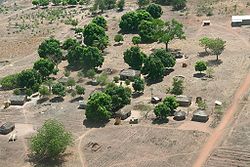
estimates that approximately 11% of the population aged 15 – 49 is HIV
HIV
Human immunodeficiency virus is a lentivirus that causes acquired immunodeficiency syndrome , a condition in humans in which progressive failure of the immune system allows life-threatening opportunistic infections and cancers to thrive...
positive. Only 3% of the country has antiretroviral therapy available, compared to 17% coverage in neighbouring countries of Chad
Chad
Chad , officially known as the Republic of Chad, is a landlocked country in Central Africa. It is bordered by Libya to the north, Sudan to the east, the Central African Republic to the south, Cameroon and Nigeria to the southwest, and Niger to the west...
and the Republic of the Congo
Republic of the Congo
The Republic of the Congo , sometimes known locally as Congo-Brazzaville, is a state in Central Africa. It is bordered by Gabon, Cameroon, the Central African Republic, the Democratic Republic of the Congo , the Angolan exclave province of Cabinda, and the Gulf of Guinea.The region was dominated by...
.
The nation is divided into over 80 ethnic groups, each having its own language. The largest ethnic
Gbaya people
The Gbaya live in Central African Republic, East-central Cameroon, the north of the Republic of Congo, and the northwest of the Democratic Republic of Congo. They numbered 970,000 at the end of the 20th century. They are the largest ethnic group in the Central African Republic, comprising 34% of...
(33%), Banda
Banda people
Banda is an ethnic group of the Central African Republic, some of who also live in the Democratic Republic of the Congo, Cameroon, and South Sudan....
(28%), Mandjia (7%), Sara
Sara people
The Sara are an ethnic group in Central Africa, who reside mostly in Chad, making up approximatively 30% of its southern population.-In Chad:...
(10%), Mboum (7%), M'Baka
M'Baka
The M'baka are a minority people in the Central African Republic and northwest Democratic Republic of Congo. The former President and Emperor, Jean-Bédel Bokassa, was M'Baka, as was the CAR's first President, David Dacko and Prime Minister Barthélémy Boganda...
(4%), Yakoma
Yakoma
Yakoma are an ethnic group in the Central African Republic who make up 4% of the population of the country or 160,000 people. André-Dieudonné Kolingba, president of the CAR from 1979 to 1993, was a member of this group. 10,000 also reside in the Democratic Republic of the Congo....
(4%), and Fula or Fulani
Fula people
Fula people or Fulani or Fulbe are an ethnic group spread over many countries, predominantly in West Africa, but found also in Central Africa and Sudanese North Africa...
(3%), with others constituting 4%, including Europeans of mostly French descent.
Health
Female life expectancy at birth was 48.2 and male life expectancy at birth was at 45.1 in 2007. The fertility rate is at about five births per woman. Government expenditure on health was at US$ 20 (PPP) per person in 2006. There were 8 physicians per 100,000 people in 2004. Government expenditure on health was at 10.9 % of total government expenditure in 2006.Religion
ChristiansChristianity
Christianity is a monotheistic religion based on the life and teachings of Jesus as presented in canonical gospels and other New Testament writings...
form 80.3% of the population, while 9.6% of the population maintain Indigenous
Indigenous peoples
Indigenous peoples are ethnic groups that are defined as indigenous according to one of the various definitions of the term, there is no universally accepted definition but most of which carry connotations of being the "original inhabitants" of a territory....
beliefs. Islam
Islam
Islam . The most common are and . : Arabic pronunciation varies regionally. The first vowel ranges from ~~. The second vowel ranges from ~~~...
is practiced by 10.1% of the country's population (2003 census).
There are many missionary groups operating in the country, including Lutherans
Lutheranism
Lutheranism is a major branch of Western Christianity that identifies with the theology of Martin Luther, a German reformer. Luther's efforts to reform the theology and practice of the church launched the Protestant Reformation...
, Baptists, Catholics
Catholicism
Catholicism is a broad term for the body of the Catholic faith, its theologies and doctrines, its liturgical, ethical, spiritual, and behavioral characteristics, as well as a religious people as a whole....
, Grace Brethren
Fellowship of Grace Brethren Churches
The Fellowship of Grace Brethren Churches is a theologically conservative fellowship of Brethren churches descended from the Schwarzenau Brethren movement of Alexander Mack of Germany.-History:...
, and Jehovah's Witnesses
Jehovah's Witnesses
Jehovah's Witnesses is a millenarian restorationist Christian denomination with nontrinitarian beliefs distinct from mainstream Christianity. The religion reports worldwide membership of over 7 million adherents involved in evangelism, convention attendance of over 12 million, and annual...
. While these missionaries are predominantly from the United States, France, Italy, and Spain, many are also from Nigeria
Nigeria
Nigeria , officially the Federal Republic of Nigeria, is a federal constitutional republic comprising 36 states and its Federal Capital Territory, Abuja. The country is located in West Africa and shares land borders with the Republic of Benin in the west, Chad and Cameroon in the east, and Niger in...
, the Democratic Republic of the Congo
Democratic Republic of the Congo
The Democratic Republic of the Congo is a state located in Central Africa. It is the second largest country in Africa by area and the eleventh largest in the world...
, and other African countries. Many missionaries left the country due to fighting between rebel and government forces in 2002 and 2003. Many have now returned to the country and resumed their activities.
Education
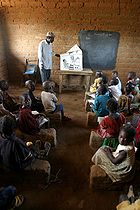
Public education in the Central African Republic is free, and education is compulsory from ages 6 to 14. About half the adult population of the country is illiterate
Literacy
Literacy has traditionally been described as the ability to read for knowledge, write coherently and think critically about printed material.Literacy represents the lifelong, intellectual process of gaining meaning from print...
. The University of Bangui
University of Bangui
The University of Bangui is a public university located in Bangui, Central African Republic. As of 2006, it is the only university in the Central African Republic.- History :...
, a public university located in Bangui, is the only institution of higher education in the Central African Republic.
Legal system
Like many other former French colonies, its system is based on French Law. Over 40% of cases before its legal system involve sorcery or witchcraft.See also
- Transport in the Central African RepublicTransport in the Central African Republic- Railways :There are no railways in the Central African Republic.A line from Cameroon port of Kribi to Bangui was proposed in 2002.- Highways :In 2002, the country had 23,810 km of roads, of which only 429 km were paved...
Further reading
- Doeden, Matt, Central African Republic in Pictures, (Twentyfirst Century Books, 2009)
- Kalck, Pierre, Historical Dictionary of the Central African Republic, 2004
- Petringa, Maria, Brazza, A Life for Africa (2006) ISBN 978-1-4259-1198-0
- Titley, Brian, Dark Age: The Political Odyssey of Emperor Bokassa, 2002
- Woodfrok, Jacqueline, Culture and Customs of the Central African Republic , (Greenwood Press, 2006)
External links
Government- Central African Republic Online /
- Chief of State and Cabinet Members - Central Intelligence AgencyCentral Intelligence AgencyThe Central Intelligence Agency is a civilian intelligence agency of the United States government. It is an executive agency and reports directly to the Director of National Intelligence, responsible for providing national security intelligence assessment to senior United States policymakers...
Overviews
- Country Profile from BBC NewsBBC NewsBBC News is the department of the British Broadcasting Corporation responsible for the gathering and broadcasting of news and current affairs. The department is the world's largest broadcast news organisation and generates about 120 hours of radio and television output each day, as well as online...
- Central African Republic from UCB Libraries GovPubs
News
- Humanitarian news and analysis from IRIN – Central African Republic
- Humanitarian information coverage on ReliefWeb
- Central African Republic news headline links from AllAfrica.comAllAfrica.comAllAfrica.com is a website that aggregates news produced primarily on the African continent about all areas of African life, politics, issues and culture. It is available in both English and French and produced by AllAfrica Global Media, which has offices in Cape Town, Dakar, Lagos, Monrovia,...
Tourism
Other
- Central African Republic at Humanitarian and Development Partnership Team (HDPT)
- Central African Republic reports from Coalition to Stop the Use of Child Soldiers
- Johann Hari in Birao, Central African Republic. "Inside France's Secret War" from The IndependentThe IndependentThe Independent is a British national morning newspaper published in London by Independent Print Limited, owned by Alexander Lebedev since 2010. It is nicknamed the Indy, while the Sunday edition, The Independent on Sunday, is the Sindy. Launched in 1986, it is one of the youngest UK national daily...
, 5 October 2007