
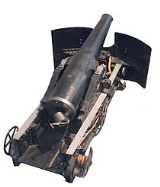
All Topics  
Artillery


Artillery


Artillery (from FrenchFrench language

French is the third-largest of the Romance languages in terms of number of native speakers, after Spanish and Portuguese, b...
 artillerie) is a type of military force which employs any apparatus, machine, an assortment of tools or instruments, a system or systems used as weaponWeapon

A weapon is a tool which is intended to or is used to injure, kill, or a person, damage or destroy property, or to otherwis...
s for the discharge of large projectileFacts About Projectile

A projectile is any object sent through space by the application of a force....
s in combatCombat

Combat, or fighting, is purposeful violent conflict between one or more persons or organizations, often intended to es...
. Over the course of military history the projectiles were manufactured from a wide variety of materials, made in a wide variety of shapeShape

In geometry, two sets have the same shape if one can be transformed to another by a combination of translations, rotations a...
s, and used different means of inflicting physical damage and casualtiesCasualty (person) Overview

A casualty is a person who is the victim of an accident, injury, or trauma....
 to defeat specific types of targetsTargeting (warfare)

Targeting is the process used to select objects or installations to be attacked, taken, or destroyed in warfare....
. The engineering designs of the means of delivery have likewise changed significantly over time, and have become some of the most complex technological application today.

For much of artillery’s history during the Middle AgesMiddle Ages

The Middle Ages formed the middle period in a traditional schematic division of European history into three "ages": the clas...
 and the Early modern periodEarly modern period

The early modern period is a term initially used by historians to refer mainly to the period roughly from 1500 to 1800 in We...
 the artillery pieces on land were movedManeuver warfare Summary

Maneuver warfare or manoeuvre warfare is a concept of warfare that advocates attempting to defeat an adversary by inca...
 with the assistance of horse teams.


Discussion
Ask a question about 'Artillery'
Start a new discussion about 'Artillery'
Answer questions from other users
Full Discussion Forum


Timeline

1440   Murad II lays siege to Belgrade. The city is heavily damaged, but the defenders' use of artillery prevents the Turks from capturing the city.

1776   American Revolutionary War: British forces evacuate Boston, Massachusetts after George Washington commands the placement of artillery overlooking the city at Dorchester Heights.

1847   Mexican-American War: The Battle of Buena Vista - 5,000 American troops under General Zachary Taylor use their superiority in artillery to drive off 15,000 Mexican troops under Antonio López de Santa Anna defeating the Mexicans the next day.

1871   The Royal Regiment of Artillery formed the first regular Canadian army units when they created two batteries of garrison artillery which eventually became The Royal Canadian Artillery.

1990   Gerald Bull, a Canadian engineer who developed long-range artillery, is assassinated in Brussels.


Quotations


Our artillery... The Germans feared it almost more than anything we had.

Ernie Pyle, Brave Men (1944)

Ultima Ratio Regum.

Translation: the final argument of kings., Motto engraved on French cannons at the direction of Louis XIV. Later, "ultima ratio regis" was similarly used by Frederick the Great.


Encyclopedia


Artillery (from FrenchFrench language

French is the third-largest of the Romance languages in terms of number of native speakers, after Spanish and Portuguese, b...
 artillerie) is a type of military force which employs any apparatus, machine, an assortment of tools or instruments, a system or systems used as weaponWeapon

A weapon is a tool which is intended to or is used to injure, kill, or a person, damage or destroy property, or to otherwis...
s for the discharge of large projectileFacts About Projectile

A projectile is any object sent through space by the application of a force....
s in combatCombat

Combat, or fighting, is purposeful violent conflict between one or more persons or organizations, often intended to es...
. Over the course of military history the projectiles were manufactured from a wide variety of materials, made in a wide variety of shapeShape

In geometry, two sets have the same shape if one can be transformed to another by a combination of translations, rotations a...
s, and used different means of inflicting physical damage and casualtiesCasualty (person) Overview

A casualty is a person who is the victim of an accident, injury, or trauma....
 to defeat specific types of targetsTargeting (warfare)

Targeting is the process used to select objects or installations to be attacked, taken, or destroyed in warfare....
. The engineering designs of the means of delivery have likewise changed significantly over time, and have become some of the most complex technological application today.

For much of artillery’s history during the Middle AgesMiddle Ages

The Middle Ages formed the middle period in a traditional schematic division of European history into three "ages": the clas...
 and the Early modern periodEarly modern period

The early modern period is a term initially used by historians to refer mainly to the period roughly from 1500 to 1800 in We...
 the artillery pieces on land were movedManeuver warfare Summary

Maneuver warfare or manoeuvre warfare is a concept of warfare that advocates attempting to defeat an adversary by inca...
 with the assistance of horse teams. During the more recent Modern era and in the Post-Modern period the artillery piece crew has used wheeled or tracked vehicles as a mode of transportTransport

Transport or transportation is the movement of people and goods from one place to another....
ation. Artillery used by naval forces has changed significantly also, with missileMissile

A missile is a projectile propelled as a weapon at a target. ...
s replacing guns in surface combatSurface warfare

Modern naval warfare is divided into three operational areas: surface warfare, air warfare and submarine warfare....
.

The process of firing the artillery piece is called gunneryGunnery

Gunnery may refer to:* The use of guns or the study of how to apply the techniques and procedures of operating them...
. The act of discharging the projectile from the weapon is called servicing the gun by the gun crew to produce artillery fire, and can be either direct artillery fire, or indirect artillery fireIndirect fire

Indirect fire is the use of artillery to fire at targets out of the crew's line of sight, by firing in a high arc out to lon...
.
The manner in which artillery units or formations are used is called artillery support, and may at different periods in history refer to weapons designed to be fired from ground, naval and even air weapons platformWeapons platform

A weapons platform is generally any structure or system on which a weapon can be mounted....
. Although the term also describes soldierSoldier Overview

A soldier is a person who has enlisted with, or has been conscripted into, the armed forces of a country....
s and sailorSailor

This article is about naval crewpeople; for other meanings, see sailor....
s with the primary function of using artillery weapons, the individuals who operate them are called gunners irrespective of the rankFacts About Rank

Rank is a very broad term with several meanings....
, the gunner being the lowest rank in Artillery Arm. The weapons gunners use, are collectively referred to as ordnanceOrdnance

Ordnance is a general term for a quantity of military equipment, usually specifying the ammunition for artillery, bombs, or ...
, and individually as an artillery pieceArtillery

Historically, artillery refers to any engine used for the discharge of projectiles during war....
, while its projectiles are referred to as munitionsAmmunition

Ammunition is a generic military term meaning a projectile and its propellant....
, in both cases regardless of the specific type in use.

The term is also applied to a Combat Arm of most military serviceMilitary service

Military service is service in an army or other military organisation, whether as a chosen job or as the result of an involu...
s when used organizationally to describe unitFacts About Unit

The word unit means any of several things:...
s and formationMilitary organization

The armed forces of a state are its government-sponsored defense and fighting forces and organizations used to further the o...
s of the national armed forcesArmed forces

The armed forces of a state are its government sponsored defense and fighting forces and organizations....
 that operate the weapons.
The gunners and their ordnance are usually grouped for combat into gun crews, with several such crews combined into a unit of artillery commonly referred to as a batteryArtillery battery

In military science, a battery is a unit of artillery guns or rockets, so grouped in order to facilitate battlefield communi...
. Batteries are roughly equivalent to a companyCompany (military unit)

A company is a military unit, typically consisting of 100-200 soldiers....
 in the infantryInfantry Overview

Infantry is a term for soldiers who fight primarily on foot with small arms in organized military units....
, and are combined into larger military organizationMilitary organization

The armed forces of a state are its government-sponsored defense and fighting forces and organizations used to further the o...
s for administrative and operational purpose.

During military operations the purpose of Artillery is to support the other Arms in combatCombat

Combat, or fighting, is purposeful violent conflict between one or more persons or organizations, often intended to es...
 through delivery of its munitions onto the target, usually at the request of troops in combat contact or gunners may be expected to come into direct combat contact with the enemy to by delivering either High Explosive munitions to inflict casualties on the enemy from casing fragments and other debrisPenetrating trauma Summary

Penetrating trauma is an injury that occurs when an object pierces the skin and enters a tissue of the body, creating an ope...
, blastBlast injury Summary

Blast injuries are inflicted on individuals subjected to the effects of the...
, and burnBurn

Burn may refer to:* Burn, injury to the skin caused by heat, electricity, chemicals, or radiation...
 injuries, or by demolition of enemy positions and piercing of enemy armour. The artillery fire may be directed by an Artillery observerArtillery observer

An artillery observer is a soldier responsible for directing artillery fire and aircraft onto enemy positions....
.

Military doctrineMilitary doctrine

Military doctrine is a level of military planning between national strategy and unit-level tactics, techniques, and procedur...
 has played a significant influence on the core engineering design considerations of Artillery ordnance through its history, in seeking to achieve a balance between delivered volume of fire with ordnance mobility. However, during the modern period the consideration of protectingFacts About Gun shield

A gun shield is a device designed to be mounted on a crew-served weapon such as a machine gun or artillery piece, sometimes ...
 the gunners also arose due to the late-19th century introduction of the new generation of infantry weapons using conoidal bulletCylindro-conoidal bullet

The cylindro-conoidal bullet was invented by Captain Norton of the British 34th Regiment in 1823....
, better known as the Minié ballMinié ball

The Mini ball is a type of muzzle-loading rifle ordnance named after its main co-developer, Claude-tienne Mini....
, with a range almost as long as that of field artillery. The gunners’ increasing proximity to, and participation in direct combat against other combat Arms and attacks by the aircraftAircraft

An aircraft is any machine capable of atmospheric flight....
 made it the introduction of substantial amounts of armourArmour

Armour or armor is protective clothing intended to defend its wearer from intentional harm in combat and military eng...
 necessary , leading to the development of the tankTank

A tank is a tracked armoured fighting vehicle, designed to engage enemy forces by the use of direct fire....
, and the evolution of armoured warfareArmoured warfare Summary

Armoured warfare in modern warfare is understood to be the use of armoured fighting vehicles as a central component of the m...
. These influences have guided the development of artillery ordnance, systems, organisations and operations until the present, with artillery systems capable of providing support at ranges from as little as 100m to the intercontinental ranges of ballistic missileBallistic missile

A ballistic missile is a missile that follows a sub-orbital, ballistic flightpath with the objective of delivering a warhead...
s. The only combat in which artillery is unable to take part in is the close quarters combatClose quarters battle

Close quarters battle or close quarters combat is characterized by rapid offensive action and the precise application ...
.

Artillery is the third oldest of Combat Arms, and in many armed forces the gunners exhibit their own pride and a unique set of traditions associated with their service.

Joseph Stalin said of it, “Artillery is the god of war.”

Etymology

The word as used in the current context originated in the Middle AgesMiddle Ages Overview

The Middle Ages formed the middle period in a traditional schematic division of European history into three "ages": the clas...
. It comes from the Old FrenchFacts About Old French

Old French is a term sometimes used to refer to the langue d'ol, the continuum of varieties of Romance language spoken in te...
 atellier meaning "to arrange", and attillement meaning "equipment". From the 13th century an artillier referred to a builder of any war equipment, and for the next 250 years the sense of the word "artillery" covered all forms of military weapons. Hence the naming of the Honourable Artillery CompanyHonourable Artillery Company

The Honourable Artillery Company is the oldest surviving regiment in the British Army, and the second most senior. ...
 an essentially InfantryFacts About Infantry

Infantry is a term for soldiers who fight primarily on foot with small arms in organized military units....
 unit until the 19th century.

History


Classical antiquity


Older systems also known as "engineEngine

An engine is something that produces an effect from a given input....
s of war" like the catapultCatapult Overview

Catapults are siege engines using an arm to hurl a projectile a great distance....
, onagerOnager (siege weapon)

The onager was a post-classical Roman siege engine, which derived its name from the kicking action of the machine, similar t...
, trebuchetTrebuchet

[image:Trebuchet1.png|thumb|right|Three-quarter view of a trebuchet]]...
 and the ballistaBallista

The ballista was a powerful ancient crossbow....
 are also referred to by military historians as artillery.

Middle Ages

The first documented record of artillery with gunpowderGunpowder

Gunpowder, whether black powder or smokeless powder, is a substance that burns very rapidly, releasing gases tha...
 propellant used on the battlefield was on January 28, 1132 when General Han ShizhongHan Shizhong

!style="background:#ccf; border-bottom:1px solid #ccd2d9" colspan=2|Names...
 of the Song DynastySong Dynasty

The Song Dynasty was a ruling dynasty in China from 960-1279....
 used escaladeEscalade

Escalade is the act of scaling defensive walls or ramparts with the aid of ladders, and was a prominent feature of siege war...
 and HuochongHuochong

Huochong is a tube-like, projection firearm....
 to capture a city in FujianFujian Overview

Fujian is one of the provinces on the southeast coast of China....
. These small, crude weapons diffused into the Middle EastMiddle East

The Middle East is a subcontinent for the historical and cultural subregion of Africa-Eurasia traditionally held to be count...
 (the madfaa) and reached Europe in the 13th century, in a very limited manner. As small smoothbore tubes these were initially cast in iron or bronze around a core, the first ordnance with the drilled bore was recorded in operation near Seville in 1247. They fired lead, iron, or stone balls, sometimes large arrows and on occasions simply handfuls of whatever scrap came to hand. During the Hundred Years' WarHundred Years' War

The Hundred Years' War was a conflict between England and France, lasting 116 years from 1337 to 1453....
 (1337-1453) these weapons became more common, initially as the bombardBombard (weapon)

A bombard is a type of medieval cannon or mortar, used chiefly in sieges for throwing heavy stone balls....
 and later the cannonCannon

A cannon is any large tubular firearm designed to fire a heavy projectile over a considerable distance....
. Cannon were always loaded from the muzzles, but there were many early attempts at breech-loading designs; however lack of engineering knowledge rendered them even more dangerous to use than muzzle-loaders.

In Asia, MongolsMongol Empire

The Mongol Empire was the largest contiguous empire in world history, covering over 36 million kmat its peak, with an estima...
 adopted the Chinese artillery and used it effectively in the great conquestMongol invasions

Mongol invasions can refer to:* 1205–1209 invasion of Western China...
. By late 14th AD, Chinese rebels used organized artillery and cavalry to push Mongols out. The new Ming DynastyMing Dynasty

The Mng Dynasty was the ruling dynasty of China from 1368 to 1644....
 established the "Divine Engine Division" ??? - specialized in various types of artillery. Light cannons and cannons with multiple volleys were developed. In a campaign to suppress a local minority rebellion near today's Burmese border, the Ming army used a 3-line method of arquebuses/muskets to destroy an elephant formation. Between 1593 and 1597, about 300,000 Chinese and Japanese troops fought in Korea and both sides used heavy artillery in land and sea battles.

Early modern period


Bombards developed in Europe were massive smoothbore weapons distinguished by their lack of a field carriage, immobility once emplaced, highly individual design, and noted unreliability (in 1460 James II, King of Scots, was killed when one exploded at the siege of Roxburgh). Their large size precluded the barrels being cast and they were constructed out of metal staves or rods bound together with hoops like a barrel, giving their name to the gun barrelGun barrel

The barrel of a gun or other firearm is the tube, usually metal, through which a controlled explosion is released in order t...
. Bombards were of value mainly in siegeSiege

A siege is a military blockade and assault of a city or fortress with the intent of conquering by force or attrition....
s, a famous Turkish example used at the siege of ConstantinopleFall of Constantinople

The Fall of Constantinople was the conquest of the Byzantine capital by the Ottoman Empire under the command of Sultan Mehme...
 in 1453 massed 19 tons, took 200 men and sixty oxen to emplace and could fire seven times a day. The Fall of Constantinople was perhaps "the first event of supreme importance whose result was determined by the use of artillery" when the huge bronze cannons of Mehmed IIMehmed II

Mehmed II was first the Sultan of the Ottoman Empire for a short time from 1444 to 1446, and later from 1451 to 1481....
 breached the walls of Constantinople thereby ending the Byzantine EmpireByzantine Empire

Byzantine Empire is the term conventionally used since the 19th century to describe the Greek-speaking Roman Empire of the...
 according to Sir Charles OmanCharles Oman Summary

Sir Charles William Chadwick Oman was a notable British military historian of the early 20th century....
.


The use of the word "cannon" marks the introduction in the 15th century of a dedicated field carriage with axle, trail and animal-drawn limber—this produced mobile field pieces that could move and support an army in action, rather than being found only in siege and static defences. The reduction in the size of the barrel was due to improvements in both iron technology and gunpowder manufacture, while the development of the trunnionTrunnion

A Trunnion is a cylindrical protrusion used for mounting....
 - projections at the side of the cannon as an integral part of the cast - allowed the barrel to be fixed to a more movable base, and also made raising or lowering the barrel much easier.

The first mobile weapon is usually credited to Jan ŽižkaJan Žižka

Jan ika z Trocnova a Kalicha, Czech general and Hussite leader, follower of Jan Hus, was born at Trocnov in Bohemia, of a fa...
, who deployed his oxen-hauled cannon during the Hussite WarsHussite Wars

The Hussite Wars, also called the Bohemian Wars involved the military actions against and amongst the followers of Jan...
 of Bohemia (1418–1424). However cannon were still large and cumbersome. With the rise of musketry in the 16th century cannon were largely (though not entirely) displaced from the battlefield—the cannon were too slow and cumbersome to be used and too easily lost to a rapid enemy advance.

The combining of shot and powder into a single unit, a cartridge, occurred in the 1620s with a simple fabric bag, and was quickly adopted by all nations. It speeded loading and made it safer, but unexpelled bag fragments were an additional fouling in the gun barrel and a new tool—a wormWorm (artillery)

A worm is a device used to remove unspent powder bag remnants from a cannon or other piece of muzzle loading field artillery....
—was introduced to remove them. Gustavus Adolphus is identified as the general who made cannon an effective force on the battlefield—pushing the development of much lighter and smaller weapons and deploying them in far greater numbers than previously. But the outcome of battles was still determined by the clash of infantry.

Shells, explosive-filled fused projectiles, were also developed in the 17th century. The development of specialized pieces—shipboard artillery, howitzers and mortarsMortar (weapon)

A mortar is a muzzle-loading artillery piece that fires indirect shells at low velocities, short ranges, and high-arcing bal...
—was also begun in this period. More esoteric designs, like the multi-barrel ribauldequinRibauldequin Summary

The Ribauldequin was a Renaissance era gun with many small-caliber iron barrels....
, were also built.

The 1650 book by Kazimierz SiemienowiczKazimierz Siemienowicz

Kazimierz Siemienowicz was a Polish-Lithuanian szlachcic, he referred himself as Lithuanian noblemen Encyclopedia Lituanica....
 "Artis Magnae Artilleriae pars prima" was one of the most important contemporary publications on the subject of artillery. For over two centuries this work was used in EuropeEurope Overview

Europe is one of the seven traditional continents of the Earth....
 as a basic artillery manual.

One of the most significant effects of artillery during this period was however somewhat more indirect - by easily reducing to rubble any medieval-type fortification or city wall (some which had stood since Roman times), it abolished millennia of siege warfare strategies and styles of fortification building. This led, amongst other things, to a frenzy of new bastionBastion

A bastion is a fortification work projecting outward from the main enclosure of a fortification, situated in both corners of...
-style fortifications to be built all over Europe and in its colonies, but also had a strong integrating effect on emerging nation-states, as kings were able to use their newfound artillery superority to force any local Dukes or Lords to submit to their will, setting the stage for the absolutist kingdoms to come.

Modern era

Cannons continued to become smaller and lighter—Frederick II of Prussia deployed the first genuine light artillery during the Seven Years War—but until the mid-19th century improvements in metallurgy, chemistry, manufacturing and other sciences did not alter the basic design and operation of a cannon.

Rifling had been tried on small arms in the 15th century. The machinery to accurately rifle a cannon barrel did not arrive until the 19th. Cavelli, Wahrendorff, and Whitworth all independently produced rifled cannon in the 1840s, but these guns did not see widespread use until the latter stages of the American Civil WarAmerican Civil War

The American Civil War was a sectional conflict in the United States of America between the federal government and 11 Sout...
—when designs such as the various calibre Rodman gunRodman gun

The Rodman Gun was an 80-ton cannon produced during the American Civil War....
s came to prominence.

Artillery continued to gain prominence in the 18th century when Jean-Baptiste de Gribeauval, a French artillery engineer introduced the standardization of cannon design. He developed a field howitzer whose gun barrel, carriage assembly and ammunition specifications were made uniform for all French cannons. The standardized interchangeable parts of these cannons down to the nuts, bolts and screws made their mass production and repair much easier. Another major change at this time was the development of a flintlockFlintlock

Flintlock is the general term for any firearm based on the flintlock mechanism....
 firing mechanism for the cannons. The old method of firing the cannon involved the use of a linstock or match to light a small quantity of powder charge in a touchhole drilled into the breech. This technique was quite faulty because the ignited powder could easily be extinguished by rain and an excess amount of charge could cause the guns to burst. The flintlock mechanism on the other hand only needs to be cocked and when its trigger is pulled the flint of the hammer strikes the frizzen throwing sparks into the pan and detonating the charge at the breech. The trigger can be tied to a lanyard and fired from a safe distance. These changes laid down in 1789 would prove decisive for Napoleon's conquests. Napoleon, himself a former artillery officer, perfected the tactic of massed artillery batteries unleashed upon a critical point in his enemies' line as prelude to infantry and cavalry assault and, more often than not, victory.

From the 1860s artillery was forced into a series of rapid technological and operational changes, accelerating through the 1870s and thereafter. The first effective breech-loaders (allowing a gun crew to operate while always behind protective barriers) were developed in the 1880s. The first cannon to contain all 'modern' features is generally considered to be the French 75Canon de 75 modčle 1897

The French 75mm field gun is a quick-firing field artillery piece developed before World War I and serving into World War II...
 of 1897 with its cased ammunition, effective breech-loading, modern sights, self-contained firing mechanism, and hydro-pneumatic recoil dampening.

In the 19th century artillery finally made the decisive split between smaller, lighter, and more mobile pieces that stayed with the troops, and much larger weapons deployed to use indirect fireIndirect fire

Indirect fire is the use of artillery to fire at targets out of the crew's line of sight, by firing in a high arc out to lon...
. The second option, using indirect fire, drove the development of the technologies and doctrines that have produced current artillery weapons. To quote McCamley,


[By WWII] decades if not centuries of weapons development had settled into maturity on an almost imperceptibly rising plateau; the sciences of ballisticsBallistics

Ballistics is the science that deals with the motion, behavior, and effects of projectiles, especially bullets, gravity bomb...
 and explosiveExplosive material

Any explosive material has the following characteristics:...
 chemistry had achieved near perfection given the available technology of the age. Arguably the only new developments of note were discarding sabot rounds... and the hollow-charge projectile... both of which were of marginal significance in the Second World War.

Post-Modern era


Modern artillery is most obviously distinguished by its large caliber, firing an explosive shellShell (projectile)

A shell is a projectile, which, as opposed to a bullet, is not solid but contains an explosive or other filling, though mode...
 or rocketRocket Overview

The traditional definition of a rocket is a vehicle, missile or aircraft which obtains thrust by the reaction to the ejectio...
, and being of such a size and weight as to require a specialized carriage for firing and transport. However, its most important characteristic is the use of indirect fireIndirect fire

Indirect fire is the use of artillery to fire at targets out of the crew's line of sight, by firing in a high arc out to lon...
, whereby the firing equipment is aimed without seeing the target through its sights. Indirect fire emerged at the beginning of the 20th Century and was greatly enhanced by the development of predicted fire methods in World War I. Indirect fire uses firing data set on the sights, predicted fire methods ensure that this data is accurate and corrects for variations from the standard conditions for muzzle velocity, temperature, wind and air density.

Weapons covered by the term 'modern artillery' include "cannonCannon

A cannon is any large tubular firearm designed to fire a heavy projectile over a considerable distance....
" artillery such as the howitzerHowitzer

howitzer is a type of field artillery....
, mortarMortar (weapon)

A mortar is a muzzle-loading artillery piece that fires indirect shells at low velocities, short ranges, and high-arcing bal...
, and field gunField gun

A field gun is an artillery piece....
 and rocket artilleryRocket artillery

Rocket artillery is artillery equipped with rocket launchers instead of conventional guns or mortars....
. Certain smaller-caliber mortars are more properly designated small arms rather than artillery, albeit indirect-fire small arms. This term also came to include coastal artilleryCoastal artillery

Coastal artillery is the branch of armed forces concerned with operating mobile anti-ship artillery or fixed gun batteries i...
 which traditionally defended coastal areas against seaborne attack and controlled the passage of ships. With the advent of powered flight at the start of the 20th century, artillery also included ground-based anti-aircraft batteries.

The term "artillery" has traditionally not been used for projectiles with internal guidance systems, even though some artillery units employ surface-to-surface missileMissile

A missile is a projectile propelled as a weapon at a target. ...
s. Advances in terminal guidance systems for small munitions has allowed large-caliber projectiles to be developed, blurring this distinction.

Field artillery system


Because field artillery mostly uses indirect fireIndirect fire

Indirect fire is the use of artillery to fire at targets out of the crew's line of sight, by firing in a high arc out to lon...
 the guns have to be part of a system that enables them to attack targets invisible to them in accordance with the combined arms plan.

The main functions in the field artillery system are:
  • Communications
  • Command: authority to allocate resources;
  • Target acquisition: detect, identify and deduce the location of targets;
  • Control: authority to decide which targets to attack and allot fire units to the attack;
  • Production of firing data – to deliver fire from a fire unit onto its target;
  • Fire units: guns, launchers or mortars grouped together;
  • Specialist services – produce data to support the production of accurate firing data;
  • Logistic services – to provide combat supplies, particularly ammunition, and equipment support.


Organisationally and spatially these functions can be arranged in many ways. Since the creation of modern indirect fire different armies have done it differently at different times and in different places. Technology is often a factor but so are military-social issues, the relationships between artillery and other arms, and the criteria by which military capability, efficiency and effectiveness are judged. Cost is also an issue because artillery is expensive due to the large quantities of ammunition that it uses and its level of manpower.

Communications underpin the artillery system, they have to be reliable and in real-time to link the various elements. During the 20th Century communications used flags, morse code by radio, line and lights, voice and teletype (teleprinter) by line. Radio has included HF, VHF, satellite and radio relay as well as modern tactical trunk systems. In western armies at least radio communications are now usually encrypted.

The emergence of mobile and man-portable radios after World War I had a major impact on artillery because it enable fast and mobile operations with observers accompanying the infantry or armoured troops. In World War 2 some armies fitted their self-propelled guns with radios. However, sometimes in the first half of the 20th Century hardcopy artillery fire plans and map traces were distributed.

Data communications can be especially important for artillery because by using structured messages and defined data types fire control messages can be automatically routed and processed by computers. For example a target acquisition element can send a message with target details which is automatically routed through the tactical and technical fire control elements to deliver firing data to the gun's laying system and the gun automatically laid. As tactical data networks become pervasive they will provide any connected soldier with a means for reporting target information and requesting artillery fire.

Command is the authority to allocate resources, typically by assigning artillery formations or units. Terminology and its implications vary widely. However, very broadly, artillery units are assigned in direct support or in general support. Typically, the former mostly provide close support to manoeuvre units while the latter may provide close support and or depth fire, notably counter-battery. Generally, ‘direct support’ also means that the artillery unit provides artillery observation and liaison teams to the supported units. Sometimes direct support units are placed under command of the regiment/brigade they support. General support units may be grouped into artillery formations eg brigades even divisions, or multi-battalion regiments, and usually under command of division, corps or higher HQs. General support units tend to be moved to where they are most required at any particular time. Artillery command may impose priorities and constraints to support their combined arms commander's plans.

Target acquisition can take many forms, it is usually observation in real time but may be the product of analysis. Artillery observation teams are the most common means of target acquisition. However, air observers have been use since the beginning of indirect fire and were quickly joined by air photography. Target acquisition may also be by anyone that can get the information into the artillery system. Targets may be visible to forward troops or in depth and invisible to them.

Observation equipment can vary widely in its complexity.
  • Unmanned air vehicles are the latest form of air observation, having been first introduced in the early 1960s.
  • The equipment available to observation teams has progressed from just prismatic compass, hand-held or tripod mounted binoculars and sometimes optical range-finders.
  • Special equipment for locating hostile artillery: flash spotting and notably sound rangingSound ranging

    Sound Ranging is a collection of techniques for generating a position estimate of a source of sound....
     appeared in World War 1 the latter has been undergone increasing refinement as technology has improved. These were joined by radar in World War 2.
  • In the mid-1970s several armies started equipping their artillery observation teams with laser rangefinders, ground surveillance radars and night vision devices, these were soon followed by inertial orienting and navigating devices to improve the accuracy of target locations. The Global Positioning SystemGlobal Positioning System

    The Global Positioning System, usually called GPS, is the only fully-functional satellite navigation system....
     (GPS) provided a smaller and cheaper means of quick and accurate fixation for target acquisition devices.
  • Specialised units with ground surveillance radars, unattended ground sensors or observation patrols operating in depth have also been used.
  • Targets in depth may also be 'acquired' by intelligence processes using various sources and agencies such as HUMINTHUMINT

    HUMINT, short for HUMan INTelligence, is one of a series of intelligence gathering disciplines....
    , SIGINTFacts About SIGINT

    SIGINT stands for SIGnals INTelligence, which is intelligence-gathering by interception of signals, whether by r...
    , ELINTELINT

    ELINT stands for ELectronic INTelligence, and refers to intelligence-gathering by use of electronic sensors....
     and IMINTIMINT

    IMINT, short for IMagery INTelligence, is an intelligence gathering discipline which collects information via sa...
    .
  • Laser guided shells require laser target designators, usually with observation teams on the ground but UAV installations are possible.
  • Specialised artillery observation vehicles appeared in World War 2 and have greatly increased in sophistication since that time.


Control, sometimes called tactical fire control, is primarily concerned with 'targeting' and the allotment of fire units to targets. This is vital when a target is within range of many fire units and the number of fire units needed depends on the nature of the target, and the circumstances and purpose of its engagement. Targeting is concerned with selecting the right weapons in the right quantities to achieve the required effects on the target. Allotment attempts to address the artillery dilemma—important targets are rarely urgent and urgent targets are rarely important. Of course importance is a matter of perspective; what is important to a divisional commander is rarely the same as what is important to an infantry platoon commander.

Broadly, there are two situations: fire against opportunity targets and targets whose engagement is planned as part of a particular operation. In the latter situation command assigns fire units to the operation and an overall artillery fire planner makes a plan, possibly delegating resources for some parts of it to other planners. Fire plans may also involve use of non-artillery assets such as mortars and aircraft.

Control of fire against opportunity targets is an important differentiator between different types of artillery system. In some armies only designated artillery HQs have the tactical fire control authority to order fire units to engage a target, all ‘calls for fire’ being requests to these HQs. This authority may also extend to deciding the type and quantity of ammunition to be used. In other armies an ‘authorised observer’ (eg artillery observation team or other target acquisition element) can order fire units to engage. In the latter case a battery observation team can order fire to their own battery and may be authorised to order fire to their own battalion and sometimes to many battalions. For example a divisional artillery commander may authorise selected observers to order fire to the entire divisional artillery. When observers or cells are not authorised they can still request fire.

Armies that apply forward tactical control generally put the majority of the more senior officers of artillery units forward in command observation posts or with the supported arm. Those that do not use this approach tend to put these officers close to the guns. In either case the observation element usually controls fire in detail against the target, such as adjusting it onto the target, moving it and co-ordinating it with the supported arm as necessary to achieve the required effects.

Firing data has to be calculated and is the key to indirect fire, the arrangements for this have varied widely. In the end firing data has two components: quadrant elevation and azimuthAzimuth

Azimuth is the horizontal component of a direction , measured around the horizon usually from the north toward the East, i.e...
, to these may be added the size of propelling charge and the fuze setting. The process to produce firing data this is sometimes called technical fire control. Before computers, some armies set the range on the gun's sights, which mechanically corrected it for the gun's muzzle velocity. For the first few decades of indirect fire, the firing data were often calculated by the observer who then adjusted the fall of shot onto the target.

However, the need to engage targets at night, in depth or hit the target with the first rounds quickly led to predicted fire being developed in World War 1. Predicted fire existed alongside the older method. After World War 2 predicted methods were invariably applied but the fall of shot usually needed adjustment because of inaccuracy in locating the target, the proximity of friendly troops or the need to engage a moving target. Target location errors were significantly reduced once laser rangefinders, orientation and navigation devices were issued to observation parties.

In predicted fire the basic geospatial data of range, angle of sight and azimuth between a fire unit and its target was produced and corrected for variations from the ‘standard conditions’. These variations included barrel wear, propellant temperature, different projectiles weights that all affected the muzzle velocity, and air temperature, density, wind speed & direction and rotation of the earth that affect the shell in flight. The net effect of variations can also be determined by shooting at an accurately known point, a process called ‘registration’.

All these calculations to produce a quadrant elevation (or range) and azimuth were done manually by highly trained soldiers using instruments, tabulated data, data of the moment and approximations until battlefield computers started appearing in the 1960s and ‘70s. While some early calculators copied the manual method (typically substituting polynomials for tabulated data), computers use a different approach. They simulate a shell's trajectory by 'flying' it in short steps and applying data about the conditions affecting the trajectory at each step. This simulation is repeated until it produces a quadrant elevation and azimuth that lands the shell within the required 'closing' distance of the target co-ordinates. NATO has a standard ballistic model for computer calculations and has expanded the scope of this into the NATO Armaments Ballistic Kernal (NABK).

Technical fire control has been performed in various places, but mostly in firing batteries. However, in the 1930s the French moved it to battalion level and combined it with some tactical fire control. This was copied by the US. Nevertheless most armies seemed to have retained it within firing batteries and some duplicated the technical fire control teams in a battery to give operational resilience and tactical flexibility. Computers reduced the number of men needed and enabled decentralisation of technical fire control to autonomous sub-battery fire units such as platoons, troops or sections, although some armies had sometimes done this with their manual methods. Computation on the gun or launcher, integrated with their laying system, is also possible. MLRS led the way in this.

A fire unit is the smallest artillery or mortar element, consisting of one or more weapon systems, capable of being employed to execute a fire assigned by a tactical fire controller. Generally it is a battery, but sub-divided batteries are quite common, and in some armies very common. On occasions a battery of 6 guns has been 6 fire units. Fire units may or may not occupy separate positions. Geographically dispersed fire units may or may not have an integral capability for technical fire control.

Specialist services provide data need for predicted fire. Increasingly, they are provided from within firing units. These services include:
  • Survey: accurate fixation and orientation of the guns, historically this involved specialists within field artillery units and specialist units. In some armies mapping and amp supply has also been an artillery responsibility. Survey is also essential for some target acquisition devices. Traditional survey methods of measurement and calculation have been replaced by inertial orientation and navigators and GPS.
  • Meteorological data: historically these were usually divisional level specialist teams but advances in technology mean they are now increasingly part of artillery units.
  • Calibration: periodically establishing the "normal" muzzle velocity of each gun as it wears. Originally this involved special facilities and army level teams. Measurement using Doppler radar, introduced in the 1950s, started to simplify arrangements. Some armies now have a muzzle velocity measuring radar permanently fitted to every gun.


Logistic services, supply of artillery ammunition has always been a major component of military logistics. Up until World War 1 some armies made artillery responsible for all forward ammunition supply because the load of small arms ammunition was trivial compared to artillery. Different armies use different approaches to ammunition supply, which can vary with the nature of operations. Differences include where the logistic service transfers artillery ammunition to artillery, the amount of ammunition carried in units and extent to which stocks are held at unit or battery level. A key difference is whether supply is ‘push’ or ‘pull’. In the former the ‘pipeline’ keeps pushing ammunition into formations or units at a defined rate. In the latter units fire as tactically necessary and replenish to maintain or reach their authorised holding (which can vary), so the logistic system has to be able to cope with surge and slack.

Artillery has always been equipment intensive and for centuries artillery provided its own artificers to maintain and repair their equipment. Most armies now place these services in specialist branches with specialist repair elements in batteries and units.

Types

Artillery types can be categorised in several ways, for example by type or size of weapon or ordnance, by role or by organizational arrangements.

Organizational types


At the beginning of the modern artillery period, the late 19th Century, many armies had three main types of artillery, in some case they were sub-branches within the artillery branch in others they were separate branches or corps. There were also other types excluding the armament fitted to warships:
  • Horse artilleryHorse artillery

    Horse Artillery were light, fast moving and fast firing artillery units which provided fire support to the cavalry elements ...
    , first formed as regular units in late 18th Century, with the role of supporting cavalry, they were distinguished by the entire crew being mounted.
  • Field or "foot" artilleryField artillery

    Field artillery is a category of mobile artillery weapon used to support armies in the field....
    , the main artillery arm of the field army, using either guns, howitzers or mortars. In World War IIWorld War II

    World War II, or the Second World War, was a worldwide conflict fought between the Allied Powers and the Axis Powers ,...
     this branch again started using rocketsRocket artillery

    Rocket artillery is artillery equipped with rocket launchers instead of conventional guns or mortars....
     and later surface to surface missiles.
  • Fortress or garrison artillery, manned a nation's fixed defences using guns, howitzers or mortars, either on land or coastal frontiers. Some had deployable elements to provide heavy artillery to the field army. In some nations coast defence artilleryCoastal artillery

    Coastal artillery is the branch of armed forces concerned with operating mobile anti-ship artillery or fixed gun batteries i...
     was a naval responsibility.
  • Mountain artilleryMountain gun

    Mountain guns are artillery pieces designed for use during mountain combat....
    , a few nations treated mountain artillery as a separate branch, in others it was a speciality in another artillery branch. They used light guns or howitzers, usually designed for pack animal transport and easily broken down into small easily handled loads
  • Naval artillery, some nations carried pack artillery on some warships, these were used and manhandled by naval (or marine) landing parties. At times, part of a ship's armament would be unshipped and mated to makeshift carriages and limbers for actions ashore, for example during the Second Boer WarSecond Boer War

    The Second Boer War, also known as the South African War , the Anglo-Boer War and in Afrikaans as the Anglo-Boereoo...
    , during the First World War the guns from the stricken SMS Königsberg formed the main artillery strength of the German forces in East Africa.


After World War IWorld War I

World War I, also known as the First World War, the Great War and "The War to End All Wars" was a global m...
 many nations merged these different artillery branches, in some cases keeping some as sub-branches. Naval artillery disappeared apart from that belonging to marines. However, two new branches of artillery emerged during that war and its aftermath, both used specialised guns (and a few rockets) and used direct not indirect fireIndirect fire

Indirect fire is the use of artillery to fire at targets out of the crew's line of sight, by firing in a high arc out to lon...
, in the 1950s and '60s both started to make extensive use of missiles:
  • Anti-tank artillery, also under various organisational arrangements but typically either field artillery or a specialist branch and additional elements integral to infantry, etc, units. However, in most armies field and anti-aircraft artillery also had at least a secondary anti-tank role. After World War 2 anti-tank in Western armies became mostly the responsibility of infantry and armoured branches and ceased to be an artillery matter, with some exceptions.
  • Anti-aircraft artillery, under various organisational arrangements including being part of artillery, a separate corps, even a separate service or being split between army for the field and airforce for home defence. In some cases infantry and the new armoured corps also operated their own integral light anti-aircraft artillery. Home defence anti-aircraft artillery often used fixed as well as mobile mountings. Some anti-aircraft guns could also be used as field or anti-tank artillery, providing they had suitable sights.


However, the general switch by artillery to indirect fireIndirect fire

Indirect fire is the use of artillery to fire at targets out of the crew's line of sight, by firing in a high arc out to lon...
 before and during World War IWorld War I

World War I, also known as the First World War, the Great War and "The War to End All Wars" was a global m...
 led to a reaction in some armies. The result was accompanying or infantry guns. These were usually small, short range guns, that could be easily man-handled and used mostly for direct fire but some could use indirect fire. Some were operated by the artillery branch but under command of the supported unit. In World War IIWorld War II

World War II, or the Second World War, was a worldwide conflict fought between the Allied Powers and the Axis Powers ,...
 they were joined by self-propelled assault guns, although other armies adopted infantry or close support tanks in armoured branch units for the same purpose, subsequently tanks generally took on the accompanying role.

Equipment types


The three main types of artillery 'gun' are guns, howitzers and mortarsMortar (weapon)

A mortar is a muzzle-loading artillery piece that fires indirect shells at low velocities, short ranges, and high-arcing bal...
. During the 20th century, guns and howitzers have steadily merged in artillery use, making a distinction between the terms somewhat meaningless. By the end of the 20th century, true guns with calibres larger than about 60 mm had become very rare in artillery use, the main users being tanks, ships, and a few residual anti-aircraft and coastal guns.

The traditional definitions differentiated between guns and howitzers in terms of maximum elevation (well less than 45° as opposed to close to or greater than 45°), number of charges (one or more than one charge), and having higher or lower muzzle velocity, sometimes indicated by barrel length. These three criteria give eight possible combinations, of which guns and howitzers are but two. However, modern 'howitzers' have higher velocities and longer barrels than the equivalent 'guns' of the first half of the 20th Century.

True guns are characterised by long range, having a maximum elevation significantly less than 45°, a high muzzle velocity and hence a relatively long barrel, and a single charge. The latter often led to fixed ammunition where the projectile is locked to the cartridge case. There is no generally accepted minimum muzzle velocity or barrel length associated with a gun.


Howitzers can fire at maximum elevations at least close to 45°, and up to about 70° is normal for modern ones. They also have a choice of charges, meaning that the same elevation angle of fire will achieve a different range depending on the charge used. They have lower muzzle velocities and shorter barrels than equivalent guns. All this means they can deliver fire with a steep angle of descent. Because of their multi-charge capability, their ammunition is mostly separate loading (the projectile and propellant are loaded separately).

That leaves six combinations of the three criteria, some of which have been termed gun howitzers. A term first used in the 1930s when howitzers with a relatively high maximum muzzle velocities were introduced, it never became widely accepted, most armies electing to widen the definition of 'gun' or 'howitzer'. By the 1960s, most equipments had maximum elevations up to about 70°, were multi-charge, had quite high maximum muzzle velocities and relatively long barrels.

MortarsMortar (weapon) Summary

A mortar is a muzzle-loading artillery piece that fires indirect shells at low velocities, short ranges, and high-arcing bal...
 are simple, the modern mortar originated in World War 1 and there were several patterns. After that war, most mortars settled on the Stokes pattern, characterised by a short barrel, smooth bore, low muzzle velocity, generally firing at an elevation angle greater that 45°, and a very simple and light mounting using a 'baseplate' on the ground. The projectile with its integral propelling charge was dropped down the barrel from the muzzle to hit a fixed firing pin. Since that time, a few mortars have become rifled and adopted breech loading.

There are other recognised typifying characteristics for artillery. First the type of obturation used to seal the chamber and prevent gases escaping through the breech. This may use a metal cartridge case that also holds the propelling charge, a configuration called 'QF' or 'quickfiring' by some nations. The alternative does not use a metal cartridge case, the propellant being merely bagged or in combustible cases with the breech itself providing all the sealing. This is called 'BL" or 'breech loading' by some nations.

A second characteristic is the form of propulsion. Basically modern equipment can either be towed or self-propelled (SP). A towed gun fires from the ground and any inherent protection is limited to a gun shield. Towing by horse teams lasted throughout World War 2 in some armies, but others were fully mechanised with wheeled or tracked gun towing vehicles by the outbreak of that war. The size of a towing vehicle depends on the weight of the equipment and the amount of ammunition it has to carry.

A variation of towed is portee where the vehicle carries the gun which is dismounted for firing. Mortars are often carried this way. A mortar is sometimes carried in an armoured vehicle and can either fire from it or be dismounted to fire from the ground. Since the early 1960s it has been possible to carry lighter towed guns and most mortars by helicopter. Even before that, they were parachuted or landed by glider from the time of the first airborne trials in the USSR in the 1930s.

In an SP equipment, the gun is an integral part of the vehicle that carries it. SPs first appeared during World War 1, but did not really develop until World War 2. They are mostly tracked vehicles, but wheeled SPs started to appear in the 1970s. Some SPs have no armour and carry little or no ammunition. Armoured SPs usually carry a useful ammunition load. Early armoured SPs were mostly a 'casemate' configuration, in essence an open top armoured box offering only limited traverse. However, most modern armoured SPs have a full enclosed armoured turret, usually giving full traverse for the gun. Many SPs cannot fire without deploying stabilisers or spades, sometimes hydraulic. A few SPs are designed so that the recoil forces of the gun are transferred directly onto the ground through a baseplate. A few towed guns have been given limited self-propulsion by means of an auxiliary engine.

Two other forms of tactical propulsion were used in the first half of the 20th Century: Railways or transporting the equipment by road, as two or three separate loads, with disassembly and re-assembly at the beginning and end of the journey. Railway artilleryRailway gun

A railway gun, also called railroad gun or railgun is a large artillery piece, designed to be placed on rail tra...
 took two forms, railway mountings for heavy and super-heavy guns and howitzers and armoured trains as 'fighting vehicles' armed with light artillery in a direct fire role. Disassembled transport was also used with heavy and super heavy weapons and lasted into the 1950s.

Calibre categories


A third form of artillery typing is to classify it as 'light', 'medium', 'heavy' and various other terms. It appears to have been introduced in World War I, which spawned a very wide array of artillery in all sorts of sizes so a simple categorical system was needed. Some armies defined these categories by bands of calibres. Different bands were used for different types of weapons—field guns, mortars, anti-aircraft guns and coast guns.

Ammunition


A round of artillery ammunition comprises four components:

  • 1: The Fuze
  • 2: The Projectile
  • 3: The Propellant
  • 4: The Primer

Fuzes

The normal artillery spelling is "fuze". FuzesFuze Overview

Fuze is a brand of beverage. They offer four different types:...
 are the devices that trigger explosion of the artillery ammunition charge. Broadly there are four main types:
  • impact (including graze and delay)
  • mechanical time including airburstAir burst

    An air burst occurs whenever an explosive device such as an anti-personnel artillery shell or a nuclear weapon is detonated ...
  • proximity sensor airburstAir burst

    An air burst occurs whenever an explosive device such as an anti-personnel artillery shell or a nuclear weapon is detonated ...
  • electronic time including airburstAir burst

    An air burst occurs whenever an explosive device such as an anti-personnel artillery shell or a nuclear weapon is detonated ...


When used with HE shells, airburst fuzes usually have a combined airburst and impact function. However, until the introduction of electronic proximity fuzeProximity fuze

A proximity fuze is a fuze that is designed to detonate an explosive automatically when the distance to target becomes small...
s, the airburst function was mostly used with cargo munitions—for example shrapnel, illuminating, smoke and improved conventional munitionsDual-Purpose Improved Conventional Munition

A Dual-Purpose Improved Conventional Munitions is an artillery or surface-to-surface missile warhead designed to burst into ...
. Airburst HE is more lethal than groundburst against many unprotected targets.

The larger calibres of anti-aircraft artillery are almost always used airburst.

Most artillery fuzes are nose fuzes. However, base fuzes have been used with armour piercing shells and for squash head (HESH or HEP) anti-tank shells. At least one nuclear shell and its non-nuclear spotting version also used a multi-deck mechanical time fuze fitted into its base.

Early airburst fuzes used igniferous timers which lasted into the second half of the 20th century. Mechanical time fuzes appeared in the early part of that century. These required a means of powering them. The Thiel mechanism used a spring and escapement (i.e. 'clockwork'), Junghans used centrifugal forceCentrifugal force

Centrifugal force is a term which may refer to two different forces which are related to rotation....
 and gears, and Dixi used centrifugal force and balls. By the 1990s, electronic time fuzes had been introduced.

Proximity fuzes have been of two types: photo-electric or radar. The former was not very successful and seems only to have been used with British anti-aircraft artillery 'unrotated projectiles' (in other words, rockets) in World War 2.

The first radar proximity fuzes (called 'VT' for variable time as an obfuscating security measure) were also used for anti-aircraft purposes in World War 2. Their ground use was delayed for fear of the enemy recovering 'blinds' (artillery rounds which failed to detonate) and copying the fuze. The first radar proximity fuzesProximity fuze

A proximity fuze is a fuze that is designed to detonate an explosive automatically when the distance to target becomes small...
 were designed to detonate at a specified height above the ground, about . These air-bursts are much more lethal against personnel than ground bursts because they deliver a greater proportion of useful fragments and deliver them into terrain where a prone soldier would be protected from ground bursts.

However, proximity fuzes can suffer premature detonation because of the moisture in heavy rain clouds. This led to 'controlled variable time' (CVT) after World War 2. These fuzes have a mechanical timer that switched on the radar about 5 seconds before expected impact. Modern multi-role fuzes usually have selectable height of burst option from 'daisy-cutters' upwards, although these settings can also be used to deal with extremes of soil reflectivity (basically the amount of water).

The proximity fuze emerged on the battlefields of Europe in late December 1944. They have become known as the U.S. Artillery's "Christmas present", and were much appreciated when they arrived during the Battle of the BulgeBattle of the Bulge Overview

The Ardennes Offensive , officially named the Battle of the Ardennes by the U.S....
. Proximity fuzes were extremely effective against German personnel in the open, and hence were very helpful in breaking up the German attacks. They were also used to great effect in anti-aircraft projectiles in the Pacific against KamikazeKamikaze

Kamikaze is a word of Japanese origin, which in the English language usually refers to the suicide attacks by Imperial Japa...
 planes as well as in England against V-1 flying bombV-1 flying bomb

The Fieseler Fi 103/FZG-76 , known as the Flying bomb, Buzz bomb or Doodlebug, was the first guided missil...
s. Electronic proximity fuzes were a big improvement over the mechanical (non-proximity) fuzes which they replaced, as time fuzes required an accurate estimate of the round's time of flight to the target and especially of the altitude of the target area. If the target's altitude was incorrectly estimated, the rounds would either strike the ground or burst too high.

Delay fuzes are used to allow the round to penetrate into the earth before exploding. This is very effective for attacking earthen bunkers. Similarly, hardened delay fuzes are used against concrete bunkers. Graze fuzes were activated by shell retardation, for example passing through light cover that was insufficiently solid to activate an impact fuze.

During World War 2 another method of HE airburst was used. Ricochet fire using delay or graze fuzed shells fired with a flat angle of descent.

Projectiles

The projectile is the ordnance (in U.S. terminology—this term has a very different meaning for artillery in other parts of the English speaking world) or "bullet" fired downrange. This may or may not be an explosive device. Traditionally, projectiles have been classified as "shot" or "shell", the former being solid and the latter having some form of "payload".

Shells can also be divided into three configurations: bursting, base ejection or nose ejection. The latter is sometimes called the shrapnel configuration. The most modern is base ejection, which was introduced in World War I. Both base and nose ejection are almost always used with airburst fuzes. Bursting shells use various types of fuze depending on the nature of the payload and the tactical need at the time.

Payloads have included:
  • Bursting: high-explosive, white phosphorus ("Willie Pete" or "Wilson Picket"), coloured marker, chemical, nuclear devices; high explosive anti-tankHigh explosive anti-tank

    High explosive anti-tank rounds are made of an explosive shaped charge that uses the Neumann effect to create a very high-ve...
     (HEAT) and canister may be considered special types of bursting shell.
  • Base Ejection: dual purpose improved conventional munitions-bomblet, scatterable mines, illuminating, coloured flare, smoke, incendiary, propaganda, chaff (foil to jam radars: originally known as "window") and modern exotics such as electronic payloads and sensor-fuzed munitions.
  • Nose Ejection: shrapnel, flechette, star, incendiary.

Projectile stabilization
  • Rifled Traditionally, artillery projectiles have been spin-stabilised, meaning that they spin in flight so that gyroscopic forces prevent them from tumbling. Spin is induced by gun barrels having riflingRifling

    Rifling refers to helix shaped grooves that have been formed into the barrel of a firearm....
     which engages a soft metal band around the projectile, called a "driving bandDriving band Summary

    The driving band is part of an artillery shell, a band of soft metal near the middle of the shell, typically made of copper ...
    " (UK) or "rotating band" (U.S.). The driving band is usually made of copper, but synthetic materials have also been used.
  • Smoothbore/Fin-Stabilized In modern artillery smoothboreSmoothbore

    Smoothbore refers to a firearm or cannon which does not have a rifled barrel. ...
     tubes have been used mostly by mortarsMortar (weapon)

    A mortar is a muzzle-loading artillery piece that fires indirect shells at low velocities, short ranges, and high-arcing bal...
    . These projectiles use fins in the airflow at their rear to maintain correct orientation. The primary benefit over rifled barrels is reduced barrel wear and longer ranges that can be achieved (due to the reduced loss of energy to friction and gas escaping around the projectile via the rifling).
  • Rifled/Fin-Stabilized A combination of the above can be used, where the barrel is rifled, but the projectile also has deployable fins for stabilization, guidance or gliding.

Propellant

All forms of artillery require a propellantPropellant Overview

A propellant is a material that is used to move an object by applying a motive force....
 to propel the projectile at the target. Propellant is always a low explosive, this means it deflagratesDeflagration

Deflagration is a process of subsonic combustion that usually propagates through thermal conductivity....
 instead of detonatingDetonation

Detonation is a process of supersonic combustion in which a shock wave is propagated forward due to energy release in a reac...
, as with high explosives. The shell is accelerated to a high velocity in a very short time by the rapid generation of gas from the burning propellant. This high pressure is achieved by burning the propellant in a contained area, either the chamber of a gun barrel or the combustion chamber of a rocket motor.

Until the late 19th Century the only available propellant was black powderBlack powder

Black powder is the original gunpowder and practically the only known propellant and explosive until the middle of the 19th ...
. Black powder had many disadvantages as a propellant; it has relatively low power, requiring large amounts of powder to fire projectiles, and created thick clouds of white smoke that would obscure the targets, betray the positions of guns and make aiming impossible. In 1846 nitrocellulose (also known as guncotton) was discovered, and the high explosive nitroglycerinNitroglycerin

Nitroglycerin, also known as nitroglycerine, trinitroglycerin, and glyceryl trinitrate, is a chemical comp...
 was discovered at much the same time. NitrocelluloseNitrocellulose Overview

Nitrocellulose is a highly flammable compound formed by nitrating cellulose through, for example, exposure to nitric acid ...
 was significantly more powerful than black powder, and was smokeless. Early guncotton was unstable however, and burned very fast and hot, leading to greatly increased barrel wear. Widespread introduction of smokeless powder would wait until the advent of the double-base powders, which combine nitrocellulose and nitroglycerin to produce powerful, smokeless, stable propellant.

Many other formulations were developed in the following decades, generally trying to find the optimum characteristics of a good artillery propellant; low temperature, high energy, non corrosive, highly stable, cheap, and easy to manufacture in large quantities. Broadly, modern gun propellants are divided into three classes: single-base propellants which are mainly or entirely nitrocellulose based, double-base propellants composed of a combination of nitrocellulose and nitroglycerin, and triple base composed of a combination of nitrocellulose and nitroglycerin and NitroguanidineNitroguanidine

NitroguanidineNHNO2) is a chemical compound....
.

Artillery shells fired from a barrel can be assisted to greater range in three ways:

  • rocket assisted projectiles (RAP) enhance and sustain the projectile's velocity by providing additional 'push' from a small rocket motor that is part of the projectile's base.
  • Base bleedBase bleed

    Base bleed is a system used on some artillery shells to increase their range, typically by about 30%....
     uses a small pyrotechnic charge at the base of the projectile to introduce sufficient combustion products into the low-pressure region behind the base of the projectile responsible for a large proportion of the drag.
  • ramjet assisted, similar to rocket assisted but using a ramjet instead of a rocket motor.


Propelling charges for tube artillery can be provided in one of two ways: either as cartridge bags or in metal cartridge cases. Generally anti-aircraft artillery and smaller caliber (up to 6" or 155 mm) guns use metal cartridge cases that include the round and propellant, similar to a modern rifle bullet. This simplifies loading and is necessary for very high rates of fire. Bagged propellant allows the amount of powder to be raised or lowered depending on the range to the target. it also makes handling of larger shells easier. Each requires a totally different type of breech to the other. A metal case holds an integral primer to initiate the propellant and provides the gas seal to prevent the gases leaking out of the breech, this is called obturation. With bagged charges the breech itself provides obturation and holds the primer. In either case the primer is usually percussion but electrical is also used and laser ignition is emerging. Modern 155 mm guns have a primer magazine fitted to their breech.


Artillery ammunition has four classifications according to use:
  • Service: ammunition used in live fire trainingFacts About Live fire exercise

    A live fire exercise is any exercise in which a realistic scenario for the use of specific equipment is simulated....
     or for wartime use in a combat zone. Also known as "warshot" ammunition.
  • Practice: Ammunition with a non- or minimally-explosive projectile that mimics the characteristics (range, accuracy) of live rounds for use under training conditions. Practice artillery ammunition often utilizes a colored-smoke-generating bursting charge for marking purposes in place of the normal high explosive charge.
  • Dummy: Ammunition with an inert warhead, inert primer, and no propellant; used for training or display.
  • Blank: Ammunition with live primer, greatly reduced propellant charge (typically black powderBlack powder

    Black powder is the original gunpowder and practically the only known propellant and explosive until the middle of the 19th ...
    ) and no projectile; used for training, demonstration or ceremonial use.

Modern operations


Artillery is used in a variety of roles depending on its type and caliber. The general role of artillery is to provide fire support—"the application of fire, coordinated with the manoeuvre of forces to destroy, neutralize or suppress the enemy". This NATO definition, of course, makes artillery a supporting arm although not all NATO armies agree with this logic. The italicised terms are NATO's.

Unlike rockets, guns (or howitzers as some armies still call them) and mortars are suitable for delivering close supporting fire. However, they are all suitable for providing deep supporting fire although the limited range of many mortars tends to exclude them from the role. Their control arrangements and limited range also mean that mortars are most suited to direct supporting fire. Guns are used either for this or general supporting fire while rocke