

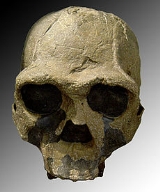
Homo ergaster

Encyclopedia
Homo ergaster is an extinct chronospecies
of Homo
that lived in eastern and southern Africa during the early Pleistocene, about 2.5–1.7 million years ago.
There is still disagreement on the subject of the classification, ancestry, and progeny of H. ergaster, but it is now widely accepted to be the direct ancestor of later hominids such as Homo heidelbergensis
, Homo sapiens, and Homo neanderthalensis rather than Asian Homo erectus
. It is one of the earliest members of the genus Homo
, possibly descended from, or sharing a common ancestor with, Homo erectus
.
The binomial name was published in 1975 by Groves
and Mazák
. The second part, "ergaster", is derived from the Ancient Greek "workman", in reference to the comparatively advanced lithic technology
developed by the species, introducing the Acheulean
industry.
n palaeontologist John T. Robinson
first discovered a mandible of a new hominid in southern Africa in 1949; he named the species Telanthropus capensis
, though it is now recognised as a member of Homo ergaster. The name was first applied by Colin Groves
and Vratislav Mazák
to KNM-ER 992
, a mandible discovered near Lake Rudolf (now Lake Turkana), Kenya
in 1975, which became the type-specimen of the species. The most complete skeleton of H. ergaster (and one of the most complete extinct hominids to date), KNM-WT 15000
, was discovered at Lake Turkana, Kenya, in 1984 by paleoanthropologists Kamoya Kimeu
and Alan Walker. They nicknamed the 1.6-million-year-old specimen "Turkana Boy".
, branching into a distinct species. Most dispense with the species-name ergaster, making no distinction between such fossils as the Turkana Boy and Peking Man
. Though "Homo ergaster" has gained some acceptance as a valid taxon, H. ergaster and H. erectus are still usually defined as distinct African and Asian populations of the larger species H. erectus. (For the remainder of this article, the name "Homo ergaster" will be used to describe a distinct species for the convenience of continuity in reading.)
H. ergaster may be distinguished from H. erectus by its thinner skull-bones and lack of an obvious supraorbital foramen
. It may be distinguished from Homo heidelbergensis by its thinner bones, more protrusive face, and lower forehead. Derived features separating it from earlier species include reduced sexual dimorphism
, a smaller, more orthognathous (less protrusive) face, a smaller dental arcade, and a larger cranial capacity
(700-900cm³ in earlier ergaster-specimen
s, and 900-1100 in later specimens). It is estimated that male H. ergaster stood 1.89 meters (6 ft 2 in) tall. Remains have been found in Tanzania
, Ethiopia
, Kenya
, and South Africa
.
is generally accepted as the putative ancestor of the genus Homo
, and often of H. ergaster most directly. This taxon
's status as a legitimate species within "Homo", however, is particularly contentious. H. habilis and H. ergaster coexisted for 200,000-300,000 years, possibly indicating that these species diverged from a common ancestor.
It is unclear what genetic influence H. ergaster had on later hominids. Recent genetic analysis has generally supported the Out-of-Africa hypothesis
, and this may designate H. ergaster the role of ancestor to all later hominids.
, Georgia
. H. ergaster remained stable
for ca. 500,000 years in Africa before disappearing from the fossil record around 1.4 million years ago. No identifiable cause has been attributed to this disappearance; the later evolution of the similar H. heidelbergensis in Africa may indicate that this is simply a hole in the record, or that some intermediate species has not yet been discovered.
s than its predecessor, Homo habilis
.
H. ergaster refined the inherited Oldowan developing the first Acheulean
bifacial axes: while the use of Acheulean tools began ca. 1.6 million years ago, the line of H. erectus diverged some 200,000 years before the general innovation of Acheulean technology. Thus the Asian migratory descendants of H. ergaster made no use of any Acheulean technology.
Not only was H. ergaster like modern humans in body, but also more in organisation and sociality than any earlier species. It is conceivable that H. ergaster was the first hominin to harness fire: whether as the containment of natural fire, or as the lighting of artificial fire, is still a matter of contention. It is now assumed, however, that erectus did have control of fire, as well as each other hominin sharing a common ancestor with ergaster.
The social organisation of H. ergaster probably resembled that of modern hunter-gatherer societies. Unlike australopithecines, ergaster males presumably did not compete at all for females, which had themselves increased in size greatly in proportion to males. This reduced competition and dimorphism also coincided with an increase in brain size and efficiency of stone tools.

It was thought for a long time that H. ergaster was restricted in the physical ability to regulate breathing and produce complex sounds. This was based on Turkana Boy's cervical vertebrae
, which were far narrower than in later humans. Discoveries of cervical vertebrae in Dmanisi
, Georgia
some 300,000 years older than those of Turkana Boy are well within the normal human range. It has been established, furthermore, that the Turkana Boy probably suffered from a disease of the spinal column that resulted in narrower cervical vertebrae than in modern humans (as well as the older Dmanisi finds). While the Dmanisi finds have not been established definitively as H. ergaster; they are older than Turkana Boy (the only definite ergaster vertebrae on record), and thereby suggest kinship to ergaster. Turkana Boy, therefore, may be an anomaly.
There is no archaeological evidence that Homo ergaster made use of symbolic thought (such as figurative art), but the well-evolved brain and physical capabilities (along with reconfiguration of ergasters breathing-apparatus) suggest some form of linguistic or symbolic communication.
Chronospecies
A chronospecies describes a group of one or more species derived from a sequential development pattern which involves continual and uniform changes from an extinct ancestral form on an evolutionary scale. This sequence of alterations eventually produces a population which is physically,...
of Homo
Homo
Homo may refer to:*the Greek prefix ὅμο-, meaning "the same"*the Latin for man, human being*Homo, the taxonomical genus including modern humans...
that lived in eastern and southern Africa during the early Pleistocene, about 2.5–1.7 million years ago.
There is still disagreement on the subject of the classification, ancestry, and progeny of H. ergaster, but it is now widely accepted to be the direct ancestor of later hominids such as Homo heidelbergensis
Homo heidelbergensis
Homo heidelbergensis is an extinct species of the genus Homo which may be the direct ancestor of both Homo neanderthalensis in Europe and Homo sapiens. The best evidence found for these hominins date between 600,000 and 400,000 years ago. H...
, Homo sapiens, and Homo neanderthalensis rather than Asian Homo erectus
Homo erectus
Homo erectus is an extinct species of hominid that lived from the end of the Pliocene epoch to the later Pleistocene, about . The species originated in Africa and spread as far as India, China and Java. There is still disagreement on the subject of the classification, ancestry, and progeny of H...
. It is one of the earliest members of the genus Homo
Homo
Homo may refer to:*the Greek prefix ὅμο-, meaning "the same"*the Latin for man, human being*Homo, the taxonomical genus including modern humans...
, possibly descended from, or sharing a common ancestor with, Homo erectus
Homo erectus
Homo erectus is an extinct species of hominid that lived from the end of the Pliocene epoch to the later Pleistocene, about . The species originated in Africa and spread as far as India, China and Java. There is still disagreement on the subject of the classification, ancestry, and progeny of H...
.
The binomial name was published in 1975 by Groves
Colin Groves
Colin Peter Groves is Professor of Biological Anthropology at the Australian National University in Canberra, Australia.Born in England on 24 June 1942, Colin Groves completed a Bachelor of Science at University College London in 1963, and a Doctor of Philosophy at the Royal Free Hospital School of...
and Mazák
Vratislav Mazák
Vratislav Mazák was a Czech biologist. He specialised in paleoanthropology, mammalogy and taxonomy, and he was also a painter, often illustrating his books about animals and men....
. The second part, "ergaster", is derived from the Ancient Greek "workman", in reference to the comparatively advanced lithic technology
Lithic Technology
In archeology, lithic technology refers to a broad array of techniques and styles to produce usable tools from various types of stone. The earliest stone tools were recovered from modern Ethiopia and were dated to between two-million and three-million years old...
developed by the species, introducing the Acheulean
Acheulean
Acheulean is the name given to an archaeological industry of stone tool manufacture associated with early humans during the Lower Palaeolithic era across Africa and much of West Asia, South Asia and Europe. Acheulean tools are typically found with Homo erectus remains...
industry.
Discovery and representative fossils
The South AfricaSouth Africa
The Republic of South Africa is a country in southern Africa. Located at the southern tip of Africa, it is divided into nine provinces, with of coastline on the Atlantic and Indian oceans...
n palaeontologist John T. Robinson
John T. Robinson
John Talbot Robinson was a distinguished South African hominid paleontologist. His most famous discovery was the nearly complete Human evolution fossil skull of an Australopithecus africanus, known as Mrs. Ples.Robinson was born in Elliot, South Africa...
first discovered a mandible of a new hominid in southern Africa in 1949; he named the species Telanthropus capensis
Telanthropus capensis
Telanthropus capensis is the name given by the archaeologist John T. Robinson to a species of hominids. Robinson discovered fossils of this species in 1949 in Swartkrans, South Africa....
, though it is now recognised as a member of Homo ergaster. The name was first applied by Colin Groves
Colin Groves
Colin Peter Groves is Professor of Biological Anthropology at the Australian National University in Canberra, Australia.Born in England on 24 June 1942, Colin Groves completed a Bachelor of Science at University College London in 1963, and a Doctor of Philosophy at the Royal Free Hospital School of...
and Vratislav Mazák
Vratislav Mazák
Vratislav Mazák was a Czech biologist. He specialised in paleoanthropology, mammalogy and taxonomy, and he was also a painter, often illustrating his books about animals and men....
to KNM-ER 992
KNM ER 992
KNM ER 992 is a old fossilized lower jaw discovered by B. Ngeneo in 1971. The mandible was considered by C. Groves and V. Mazak Koobi Fora, Kenya to be the holotype specimen for Homo ergaster.-See also:* List of fossil sites ...
, a mandible discovered near Lake Rudolf (now Lake Turkana), Kenya
Kenya
Kenya , officially known as the Republic of Kenya, is a country in East Africa that lies on the equator, with the Indian Ocean to its south-east...
in 1975, which became the type-specimen of the species. The most complete skeleton of H. ergaster (and one of the most complete extinct hominids to date), KNM-WT 15000
Turkana Boy
Turkana Boy, also occasionally, Nariokotome Boy is the common name of fossil KNM-WT 15000, a nearly complete skeleton of a hominid who died in the early Pleistocene. This specimen is the most complete early human skeleton ever found. It is 1.5 million years old...
, was discovered at Lake Turkana, Kenya, in 1984 by paleoanthropologists Kamoya Kimeu
Kamoya Kimeu
Kamoya Kimeu, is one of the world's most successful fossil collectors who, together with paleontologists Meave Leakey and Richard Leakey, is responsible for some of the most significant paleoanthropological discoveries...
and Alan Walker. They nicknamed the 1.6-million-year-old specimen "Turkana Boy".
Classification and special distinction
Many paleoanthropologists still debate the definition of H. ergaster and H. erectus as separate species. Some call H. ergaster the direct African ancestor of H. erectus, proposing that H. ergaster emigrated out of Africa and into AsiaAsia
Asia is the world's largest and most populous continent, located primarily in the eastern and northern hemispheres. It covers 8.7% of the Earth's total surface area and with approximately 3.879 billion people, it hosts 60% of the world's current human population...
, branching into a distinct species. Most dispense with the species-name ergaster, making no distinction between such fossils as the Turkana Boy and Peking Man
Peking Man
Peking Man , Homo erectus pekinensis, is an example of Homo erectus. A group of fossil specimens was discovered in 1923-27 during excavations at Zhoukoudian near Beijing , China...
. Though "Homo ergaster" has gained some acceptance as a valid taxon, H. ergaster and H. erectus are still usually defined as distinct African and Asian populations of the larger species H. erectus. (For the remainder of this article, the name "Homo ergaster" will be used to describe a distinct species for the convenience of continuity in reading.)
H. ergaster may be distinguished from H. erectus by its thinner skull-bones and lack of an obvious supraorbital foramen
Supraorbital foramen
The supraorbital foramen is a bony elongated path located above the orbit and under the forehead. The supraorbital foramen lies directly under the eyebrow....
. It may be distinguished from Homo heidelbergensis by its thinner bones, more protrusive face, and lower forehead. Derived features separating it from earlier species include reduced sexual dimorphism
Sexual dimorphism
Sexual dimorphism is a phenotypic difference between males and females of the same species. Examples of such differences include differences in morphology, ornamentation, and behavior.-Examples:-Ornamentation / coloration:...
, a smaller, more orthognathous (less protrusive) face, a smaller dental arcade, and a larger cranial capacity
Cranial capacity
Cranial capacity is a measure of the volume of the interior of the cranium of those vertebrates who have both a cranium and a brain. The most commonly used unit of measure is the cubic centimetre or cc...
(700-900cm³ in earlier ergaster-specimen
Specimen
A specimen is a portion/quantity of material for use in testing, examination, or study.BiologyA laboratory specimen is an individual animal, part of an animal, a plant, part of a plant, or a microorganism, used as a representative to study the properties of the whole population of that species or...
s, and 900-1100 in later specimens). It is estimated that male H. ergaster stood 1.89 meters (6 ft 2 in) tall. Remains have been found in Tanzania
Tanzania
The United Republic of Tanzania is a country in East Africa bordered by Kenya and Uganda to the north, Rwanda, Burundi, and the Democratic Republic of the Congo to the west, and Zambia, Malawi, and Mozambique to the south. The country's eastern borders lie on the Indian Ocean.Tanzania is a state...
, Ethiopia
Ethiopia
Ethiopia , officially known as the Federal Democratic Republic of Ethiopia, is a country located in the Horn of Africa. It is the second-most populous nation in Africa, with over 82 million inhabitants, and the tenth-largest by area, occupying 1,100,000 km2...
, Kenya
Kenya
Kenya , officially known as the Republic of Kenya, is a country in East Africa that lies on the equator, with the Indian Ocean to its south-east...
, and South Africa
South Africa
The Republic of South Africa is a country in southern Africa. Located at the southern tip of Africa, it is divided into nine provinces, with of coastline on the Atlantic and Indian oceans...
.
Divergence
Homo habilisHomo habilis
Homo habilis is a species of the genus Homo, which lived from approximately at the beginning of the Pleistocene period. The discovery and description of this species is credited to both Mary and Louis Leakey, who found fossils in Tanzania, East Africa, between 1962 and 1964. Homo habilis Homo...
is generally accepted as the putative ancestor of the genus Homo
Homo
Homo may refer to:*the Greek prefix ὅμο-, meaning "the same"*the Latin for man, human being*Homo, the taxonomical genus including modern humans...
, and often of H. ergaster most directly. This taxon
Taxon
|thumb|270px|[[African elephants]] form a widely-accepted taxon, the [[genus]] LoxodontaA taxon is a group of organisms, which a taxonomist adjudges to be a unit. Usually a taxon is given a name and a rank, although neither is a requirement...
's status as a legitimate species within "Homo", however, is particularly contentious. H. habilis and H. ergaster coexisted for 200,000-300,000 years, possibly indicating that these species diverged from a common ancestor.
It is unclear what genetic influence H. ergaster had on later hominids. Recent genetic analysis has generally supported the Out-of-Africa hypothesis
Recent African origin of modern humans
In paleoanthropology, the recent African origin of modern humans is the most widely accepted model describing the origin and early dispersal of anatomically modern humans...
, and this may designate H. ergaster the role of ancestor to all later hominids.
Origin and extinction
H. ergaster is believed to have diverged from the lineage of H. habilis between 1.9 and 1.8 million years ago; the lineage that emigrated Africa and fathered H. erectus diverged from the lineage of H. ergaster almost immediately after this. These early descendants of H. ergaster may have been discovered in DmanisiHomo georgicus
Homo georgicus is a species of Homo that was suggested in 2002 to describe fossil skulls and jaws found in Dmanisi, Georgia in 1999 and 2001, which seem intermediate between Homo habilis and H. erectus. A partial skeleton was discovered in 2001. The fossils are about 1.8 million years old...
, Georgia
Georgia (country)
Georgia is a sovereign state in the Caucasus region of Eurasia. Located at the crossroads of Western Asia and Eastern Europe, it is bounded to the west by the Black Sea, to the north by Russia, to the southwest by Turkey, to the south by Armenia, and to the southeast by Azerbaijan. The capital of...
. H. ergaster remained stable
Punctuated equilibrium
Punctuated equilibrium is a theory in evolutionary biology which proposes that most species will exhibit little net evolutionary change for most of their geological history, remaining in an extended state called stasis...
for ca. 500,000 years in Africa before disappearing from the fossil record around 1.4 million years ago. No identifiable cause has been attributed to this disappearance; the later evolution of the similar H. heidelbergensis in Africa may indicate that this is simply a hole in the record, or that some intermediate species has not yet been discovered.
Use of tools
Homo ergaster used more diverse and sophisticated stone toolStone tool
A stone tool is, in the most general sense, any tool made either partially or entirely out of stone. Although stone tool-dependent societies and cultures still exist today, most stone tools are associated with prehistoric, particularly Stone Age cultures that have become extinct...
s than its predecessor, Homo habilis
Homo habilis
Homo habilis is a species of the genus Homo, which lived from approximately at the beginning of the Pleistocene period. The discovery and description of this species is credited to both Mary and Louis Leakey, who found fossils in Tanzania, East Africa, between 1962 and 1964. Homo habilis Homo...
.
H. ergaster refined the inherited Oldowan developing the first Acheulean
Acheulean
Acheulean is the name given to an archaeological industry of stone tool manufacture associated with early humans during the Lower Palaeolithic era across Africa and much of West Asia, South Asia and Europe. Acheulean tools are typically found with Homo erectus remains...
bifacial axes: while the use of Acheulean tools began ca. 1.6 million years ago, the line of H. erectus diverged some 200,000 years before the general innovation of Acheulean technology. Thus the Asian migratory descendants of H. ergaster made no use of any Acheulean technology.
Sociality
Sexual dimorphism in H. ergaster is greatly reduced from its australopithecine ancestors (around 20%), but still greater than dimorphism in modern humans. This diminished dimorphism is speculated to be a sign of reduced competition for mates between males , which may also correspond to the more modern social practices of ergaster .Not only was H. ergaster like modern humans in body, but also more in organisation and sociality than any earlier species. It is conceivable that H. ergaster was the first hominin to harness fire: whether as the containment of natural fire, or as the lighting of artificial fire, is still a matter of contention. It is now assumed, however, that erectus did have control of fire, as well as each other hominin sharing a common ancestor with ergaster.
The social organisation of H. ergaster probably resembled that of modern hunter-gatherer societies. Unlike australopithecines, ergaster males presumably did not compete at all for females, which had themselves increased in size greatly in proportion to males. This reduced competition and dimorphism also coincided with an increase in brain size and efficiency of stone tools.
Linguistic use
Homo ergaster was probably the first hominid to "use a human voice", though its symbolic cognition was probably somewhat limited compared to modern humans.It was thought for a long time that H. ergaster was restricted in the physical ability to regulate breathing and produce complex sounds. This was based on Turkana Boy's cervical vertebrae
Cervical vertebrae
In vertebrates, cervical vertebrae are those vertebrae immediately inferior to the skull.Thoracic vertebrae in all mammalian species are defined as those vertebrae that also carry a pair of ribs, and lie caudal to the cervical vertebrae. Further caudally follow the lumbar vertebrae, which also...
, which were far narrower than in later humans. Discoveries of cervical vertebrae in Dmanisi
Dmanisi
Dmanisi is a townlet and archaeological site in Kvemo Kartli region of Georgia approximately 93 km southwest of the nation’s capital Tbilisi in the river valley of Mashavera.- History :...
, Georgia
Georgia (country)
Georgia is a sovereign state in the Caucasus region of Eurasia. Located at the crossroads of Western Asia and Eastern Europe, it is bounded to the west by the Black Sea, to the north by Russia, to the southwest by Turkey, to the south by Armenia, and to the southeast by Azerbaijan. The capital of...
some 300,000 years older than those of Turkana Boy are well within the normal human range. It has been established, furthermore, that the Turkana Boy probably suffered from a disease of the spinal column that resulted in narrower cervical vertebrae than in modern humans (as well as the older Dmanisi finds). While the Dmanisi finds have not been established definitively as H. ergaster; they are older than Turkana Boy (the only definite ergaster vertebrae on record), and thereby suggest kinship to ergaster. Turkana Boy, therefore, may be an anomaly.
There is no archaeological evidence that Homo ergaster made use of symbolic thought (such as figurative art), but the well-evolved brain and physical capabilities (along with reconfiguration of ergasters breathing-apparatus) suggest some form of linguistic or symbolic communication.
See also
- Homo erectusHomo erectusHomo erectus is an extinct species of hominid that lived from the end of the Pliocene epoch to the later Pleistocene, about . The species originated in Africa and spread as far as India, China and Java. There is still disagreement on the subject of the classification, ancestry, and progeny of H...
- Homo georgicusHomo georgicusHomo georgicus is a species of Homo that was suggested in 2002 to describe fossil skulls and jaws found in Dmanisi, Georgia in 1999 and 2001, which seem intermediate between Homo habilis and H. erectus. A partial skeleton was discovered in 2001. The fossils are about 1.8 million years old...
- Homo habilisHomo habilisHomo habilis is a species of the genus Homo, which lived from approximately at the beginning of the Pleistocene period. The discovery and description of this species is credited to both Mary and Louis Leakey, who found fossils in Tanzania, East Africa, between 1962 and 1964. Homo habilis Homo...
- List of fossil sites
- List of human evolution fossils
- Telanthropus capensisTelanthropus capensisTelanthropus capensis is the name given by the archaeologist John T. Robinson to a species of hominids. Robinson discovered fossils of this species in 1949 in Swartkrans, South Africa....