


Fula people

Encyclopedia
Fula people or Fulani or Fulbe are an ethnic group spread over many countries, predominantly in West Africa
, but found also in Central Africa
and Sudanese North Africa
. African countries where they are present include Mauritania
, Senegal
, Guinea
, The Gambia
, Mali
, Nigeria
, Sierra Leone
, Benin
, Burkina Faso
, Guinea Bissau, Cameroon
, Côte d'Ivoire
, Niger
, Chad
, Togo
, the Central African Republic
, Liberia
, and as far as Sudan
and Egypt
in the East. Fula people form a minority in every country they inhabit, but in Guinea they represent a plurality of the population (40%).
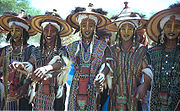 There are also many names (and spellings of the names) used in other languages to refer to the . Fulani in English is borrowed from the Hausa
term, and it is also used by the Manding peoples, being the diminutive form of the word "Fula" in their language, essentially meaning "little Fula". Fula, from Manding languages
is also used in English, and sometimes spelled Fulah or Foulah. Fula and Fulani are commonly used in English, including within Africa. The French borrowed the Wolof
term Pël, which is variously spelled: Peul, Peulh, and even Peuhl. More recently the Fulfulde / Pulaar
term , which is a plural noun (singular, Pullo) has been Anglicised as Fulbe, which some people use. In Portuguese it's Fula or Futafula.
(Toucouleur) in the central Senegal River
valley. These people are often referred to together with of the region as Haalpulaar .
Fula society in some parts of West Africa features the "caste"
divisions typical of the region. In Mali
, for instance, those who are not ethnically Fula have been referred to as (people of the Fula culture).
The Wodaabe
, are a subgroup of the Fula people.
, trading
people, herding cattle
, goat
s and sheep across the vast dry hinterlands of their domain, keeping somewhat separate from the local agricultural populations.
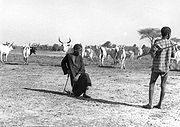 The people who are known to English speakers as Fulani refer to themselves as Fulɓe (Pullo, singular). There are two major claims about the origin of the Fulas. One is that they migrated from Ethiopia up to west Africa with some groups staying behind at different places. This claim is certainly plausible given the many striking similarities between the Fulani and Ethiopian cultural practices, and the physical features of the two people. The Second claim states that the Fulani people are of North African descent. This claim is also plausible given the some elements of culture common to both the Fulani and North Africans, and some common physical features.
Some people mistakenly associate the Fulani people with other African groups that they have settled with. For example, some people in what is now modern-day Gambia or Senegal think that the Fulani people share a common origin with the Wolof
and the Serer
. This misconception simply stems from the fact the Fulani people settled among those people and they have a relatively harmonious relationship. A similar mistake is made by people in Nigeria between the Hausa
and the Fulani people who both cohabit in the North.
.
These included the Fulani Empire
, also known as the Sokoto Caliphate, founded by Usman dan Fodio
(which itself included smaller states), Fouta Djallon
, Massina and others.
depending on the region, or variants thereof. It is also the language of the Tukulor. All Senegalese who speak the language natively are known as the Halpulaar or Haalpulaar'en, which stands for "speakers of Pulaar" ("hal" is the root of the Pulaar verb haalugol, meaning "to speak"). In some areas, e.g. in northern Cameroon, Fulfulde is a local lingua franca
.
With the exception of Guinea
(where the Fula make up a ~40% plurality of the population), Fulas are minorities in every country they live in (most countries of West Africa and parts of Central and North Africa), so most also speak other languages of the countries they inhabit.
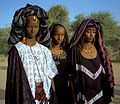 The traditional dress of the Fula consists of long colourful flowing robes, modestly embroidered or otherwise decorated. Also characteristic Fula tradition is that of women using henna
around the mouth, resulting in a blackening around the lips. Fula ethics are strictly governed by the notion of pulaaku. Men wear long robes to the lower calves with trousers of cotton. Herdsmen wear the distinctive conical straw hat and a turban. Women wear long robes and turbans. They decorate themselves with necklaces, earrings, nose rings and anklets.
(a plucked skin-covered lute similar to a banjo) and riti or riiti (a one-string bowed instrument similar to a violin), in addition to vocal music. The well known Senegalese Fula popular musician Baaba Maal
sings in Pulaar on his recordings. "Zaghareet" or ululation is a popular form of vocal music formed by rapidly moving the tongue sideways and making a sharp, high sound.
West Africa
West Africa or Western Africa is the westernmost region of the African continent. Geopolitically, the UN definition of Western Africa includes the following 16 countries and an area of approximately 5 million square km:-Flags of West Africa:...
, but found also in Central Africa
Central Africa
Central Africa is a core region of the African continent which includes Burundi, the Central African Republic, Chad, the Democratic Republic of the Congo, and Rwanda....
and Sudanese North Africa
North Africa
North Africa or Northern Africa is the northernmost region of the African continent, linked by the Sahara to Sub-Saharan Africa. Geopolitically, the United Nations definition of Northern Africa includes eight countries or territories; Algeria, Egypt, Libya, Morocco, South Sudan, Sudan, Tunisia, and...
. African countries where they are present include Mauritania
Mauritania
Mauritania is a country in the Maghreb and West Africa. It is bordered by the Atlantic Ocean in the west, by Western Sahara in the north, by Algeria in the northeast, by Mali in the east and southeast, and by Senegal in the southwest...
, Senegal
Senegal
Senegal , officially the Republic of Senegal , is a country in western Africa. It owes its name to the Sénégal River that borders it to the east and north...
, Guinea
Guinea
Guinea , officially the Republic of Guinea , is a country in West Africa. Formerly known as French Guinea , it is today sometimes called Guinea-Conakry to distinguish it from its neighbour Guinea-Bissau. Guinea is divided into eight administrative regions and subdivided into thirty-three prefectures...
, The Gambia
The Gambia
The Republic of The Gambia, commonly referred to as The Gambia, or Gambia , is a country in West Africa. Gambia is the smallest country on mainland Africa, surrounded by Senegal except for a short coastline on the Atlantic Ocean in the west....
, Mali
Mali
Mali , officially the Republic of Mali , is a landlocked country in Western Africa. Mali borders Algeria on the north, Niger on the east, Burkina Faso and the Côte d'Ivoire on the south, Guinea on the south-west, and Senegal and Mauritania on the west. Its size is just over 1,240,000 km² with...
, Nigeria
Nigeria
Nigeria , officially the Federal Republic of Nigeria, is a federal constitutional republic comprising 36 states and its Federal Capital Territory, Abuja. The country is located in West Africa and shares land borders with the Republic of Benin in the west, Chad and Cameroon in the east, and Niger in...
, Sierra Leone
Sierra Leone
Sierra Leone , officially the Republic of Sierra Leone, is a country in West Africa. It is bordered by Guinea to the north and east, Liberia to the southeast, and the Atlantic Ocean to the west and southwest. Sierra Leone covers a total area of and has an estimated population between 5.4 and 6.4...
, Benin
Benin
Benin , officially the Republic of Benin, is a country in West Africa. It borders Togo to the west, Nigeria to the east and Burkina Faso and Niger to the north. Its small southern coastline on the Bight of Benin is where a majority of the population is located...
, Burkina Faso
Burkina Faso
Burkina Faso – also known by its short-form name Burkina – is a landlocked country in west Africa. It is surrounded by six countries: Mali to the north, Niger to the east, Benin to the southeast, Togo and Ghana to the south, and Côte d'Ivoire to the southwest.Its size is with an estimated...
, Guinea Bissau, Cameroon
Cameroon
Cameroon, officially the Republic of Cameroon , is a country in west Central Africa. It is bordered by Nigeria to the west; Chad to the northeast; the Central African Republic to the east; and Equatorial Guinea, Gabon, and the Republic of the Congo to the south. Cameroon's coastline lies on the...
, Côte d'Ivoire
Côte d'Ivoire
The Republic of Côte d'Ivoire or Ivory Coast is a country in West Africa. It has an area of , and borders the countries Liberia, Guinea, Mali, Burkina Faso and Ghana; its southern boundary is along the Gulf of Guinea. The country's population was 15,366,672 in 1998 and was estimated to be...
, Niger
Niger
Niger , officially named the Republic of Niger, is a landlocked country in Western Africa, named after the Niger River. It borders Nigeria and Benin to the south, Burkina Faso and Mali to the west, Algeria and Libya to the north and Chad to the east...
, Chad
Chad
Chad , officially known as the Republic of Chad, is a landlocked country in Central Africa. It is bordered by Libya to the north, Sudan to the east, the Central African Republic to the south, Cameroon and Nigeria to the southwest, and Niger to the west...
, Togo
Togo
Togo, officially the Togolese Republic , is a country in West Africa bordered by Ghana to the west, Benin to the east and Burkina Faso to the north. It extends south to the Gulf of Guinea, on which the capital Lomé is located. Togo covers an area of approximately with a population of approximately...
, the Central African Republic
Central African Republic
The Central African Republic , is a landlocked country in Central Africa. It borders Chad in the north, Sudan in the north east, South Sudan in the east, the Democratic Republic of the Congo and the Republic of the Congo in the south, and Cameroon in the west. The CAR covers a land area of about ,...
, Liberia
Liberia
Liberia , officially the Republic of Liberia, is a country in West Africa. It is bordered by Sierra Leone on the west, Guinea on the north and Côte d'Ivoire on the east. Liberia's coastline is composed of mostly mangrove forests while the more sparsely populated inland consists of forests that open...
, and as far as Sudan
Sudan
Sudan , officially the Republic of the Sudan , is a country in North Africa, sometimes considered part of the Middle East politically. It is bordered by Egypt to the north, the Red Sea to the northeast, Eritrea and Ethiopia to the east, South Sudan to the south, the Central African Republic to the...
and Egypt
Egypt
Egypt , officially the Arab Republic of Egypt, Arabic: , is a country mainly in North Africa, with the Sinai Peninsula forming a land bridge in Southwest Asia. Egypt is thus a transcontinental country, and a major power in Africa, the Mediterranean Basin, the Middle East and the Muslim world...
in the East. Fula people form a minority in every country they inhabit, but in Guinea they represent a plurality of the population (40%).
Terminology
Hausa language
Hausa is the Chadic language with the largest number of speakers, spoken as a first language by about 25 million people, and as a second language by about 18 million more, an approximate total of 43 million people...
term, and it is also used by the Manding peoples, being the diminutive form of the word "Fula" in their language, essentially meaning "little Fula". Fula, from Manding languages
Manding languages
The Manding languages are a fairly mutually intelligible group of dialects or languages in West Africa, belonging to the Mande languages. Their best-known members are Bambara, the most widely spoken language in Mali; Mandinka, the main language of Gambia; Maninka or Malinké, a major language of...
is also used in English, and sometimes spelled Fulah or Foulah. Fula and Fulani are commonly used in English, including within Africa. The French borrowed the Wolof
Wolof language
Wolof is a language spoken in Senegal, The Gambia, and Mauritania, and is the native language of the Wolof people. Like the neighbouring languages Serer and Fula, it belongs to the Atlantic branch of the Niger–Congo language family...
term Pël, which is variously spelled: Peul, Peulh, and even Peuhl. More recently the Fulfulde / Pulaar
Fula language
The Fula or Fulani language is a language of West Africa. It is spoken as a first language by the and related groups from Senegambia and Guinea to Cameroon and Sudan...
term , which is a plural noun (singular, Pullo) has been Anglicised as Fulbe, which some people use. In Portuguese it's Fula or Futafula.
Related groups
A closely related group is the TukolorToucouleur
The Toucouleurs are a Fula agricultural people who live primarily in West Africa: the north of Senegal in the Senegal River valley, Mauritania, and Mali.-History:...
(Toucouleur) in the central Senegal River
Sénégal River
The Sénégal River is a long river in West Africa that forms the border between Senegal and Mauritania.The Sénégal's headwaters are the Semefé and Bafing rivers which both originate in Guinea; they form a small part of the Guinean-Malian border before coming together at Bafoulabé in Mali...
valley. These people are often referred to together with of the region as Haalpulaar .
Fula society in some parts of West Africa features the "caste"
Caste system in Africa
Countries in Africa who have societies with caste systems within their borders include Mali, Mauritania, Senegal, Gambia, Guinea, Guinea-Bissau, Ivory Coast, Niger, Burkina Faso, Cameroon, Ghana, Liberia, Sierra Leone, Algeria, Nigeria, Chad, Ethiopia, and Somalia....
divisions typical of the region. In Mali
Mali
Mali , officially the Republic of Mali , is a landlocked country in Western Africa. Mali borders Algeria on the north, Niger on the east, Burkina Faso and the Côte d'Ivoire on the south, Guinea on the south-west, and Senegal and Mauritania on the west. Its size is just over 1,240,000 km² with...
, for instance, those who are not ethnically Fula have been referred to as (people of the Fula culture).
The Wodaabe
Wodaabe
The Wodaabe or Bororo are a small subgroup of the Fulani ethnic group. They are traditionally nomadic cattle-herders and traders in the Sahel, with migrations stretching from southern Niger, through northern Nigeria, northeastern Cameroon, and the western region of the Central African Republic....
, are a subgroup of the Fula people.
Traditional livelihood
The Fulani are traditionally a nomadic, pastoralistPastoralism
Pastoralism or pastoral farming is the branch of agriculture concerned with the raising of livestock. It is animal husbandry: the care, tending and use of animals such as camels, goats, cattle, yaks, llamas, and sheep. It may have a mobile aspect, moving the herds in search of fresh pasture and...
, trading
Trade
Trade is the transfer of ownership of goods and services from one person or entity to another. Trade is sometimes loosely called commerce or financial transaction or barter. A network that allows trade is called a market. The original form of trade was barter, the direct exchange of goods and...
people, herding cattle
Cattle
Cattle are the most common type of large domesticated ungulates. They are a prominent modern member of the subfamily Bovinae, are the most widespread species of the genus Bos, and are most commonly classified collectively as Bos primigenius...
, goat
Goat
The domestic goat is a subspecies of goat domesticated from the wild goat of southwest Asia and Eastern Europe. The goat is a member of the Bovidae family and is closely related to the sheep as both are in the goat-antelope subfamily Caprinae. There are over three hundred distinct breeds of...
s and sheep across the vast dry hinterlands of their domain, keeping somewhat separate from the local agricultural populations.
Origins and spread
Some people mistakenly associate the Fulani people with other African groups that they have settled with. For example, some people in what is now modern-day Gambia or Senegal think that the Fulani people share a common origin with the Wolof
Wolof people
The Wolof are an ethnic group found in Senegal, The Gambia, and Mauritania.In Senegal, the Wolof form an ethnic plurality with about 43.3% of the population are Wolofs...
and the Serer
Serer people
The Serer people along with the Jola people are acknowledged to be the oldest inhabitants of The Senegambia....
. This misconception simply stems from the fact the Fulani people settled among those people and they have a relatively harmonious relationship. A similar mistake is made by people in Nigeria between the Hausa
Hausa people
The Hausa are one of the largest ethnic groups in West Africa. They are a Sahelian people chiefly located in northern Nigeria and southeastern Niger, but having significant numbers living in regions of Cameroon, Ghana, Cote d'Ivoire, Chad and Sudan...
and the Fulani people who both cohabit in the North.
Rise to political dominance
Beginning as early as the 17th and 18th centuries, but mainly in the 19th century, Fulas and others took control of various states in West AfricaWest Africa
West Africa or Western Africa is the westernmost region of the African continent. Geopolitically, the UN definition of Western Africa includes the following 16 countries and an area of approximately 5 million square km:-Flags of West Africa:...
.
These included the Fulani Empire
Fulani Empire
The Sokoto Caliphate is an Islamic spiritual community in Nigeria, led by the Sultan of Sokoto, Sa’adu Abubakar. Founded during the Fulani Jihad in 1809 by Usuman dan Fodio, it was one of the most powerful empires in sub-Saharan Africa prior to European conquest and colonization...
, also known as the Sokoto Caliphate, founded by Usman dan Fodio
Usman dan Fodio
Shaihu Usman dan Fodio , born Usuman ɓii Foduye, was the founder of the Sokoto Caliphate in 1809, a religious teacher, writer and Islamic promoter. Dan Fodio was one of a class of urbanized ethnic Fulani living in the Hausa States in what is today northern Nigeria...
(which itself included smaller states), Fouta Djallon
Fouta Djallon
Fouta Djallon is a highland region in the centre of Guinea, West Africa. The indigenous name is Fuuta-Jaloo...
, Massina and others.
Culture and language
The language of Fulas is called Pulaar or FulfuldeFula language
The Fula or Fulani language is a language of West Africa. It is spoken as a first language by the and related groups from Senegambia and Guinea to Cameroon and Sudan...
depending on the region, or variants thereof. It is also the language of the Tukulor. All Senegalese who speak the language natively are known as the Halpulaar or Haalpulaar'en, which stands for "speakers of Pulaar" ("hal" is the root of the Pulaar verb haalugol, meaning "to speak"). In some areas, e.g. in northern Cameroon, Fulfulde is a local lingua franca
Lingua franca
A lingua franca is a language systematically used to make communication possible between people not sharing a mother tongue, in particular when it is a third language, distinct from both mother tongues.-Characteristics:"Lingua franca" is a functionally defined term, independent of the linguistic...
.
With the exception of Guinea
Guinea
Guinea , officially the Republic of Guinea , is a country in West Africa. Formerly known as French Guinea , it is today sometimes called Guinea-Conakry to distinguish it from its neighbour Guinea-Bissau. Guinea is divided into eight administrative regions and subdivided into thirty-three prefectures...
(where the Fula make up a ~40% plurality of the population), Fulas are minorities in every country they live in (most countries of West Africa and parts of Central and North Africa), so most also speak other languages of the countries they inhabit.
Clothing
Henna
Henna is a flowering plant used since antiquity to dye skin, hair, fingernails, leather and wool. The name is also used for dye preparations derived from the plant, and for the art of temporary tattooing based on those dyes...
around the mouth, resulting in a blackening around the lips. Fula ethics are strictly governed by the notion of pulaaku. Men wear long robes to the lower calves with trousers of cotton. Herdsmen wear the distinctive conical straw hat and a turban. Women wear long robes and turbans. They decorate themselves with necklaces, earrings, nose rings and anklets.
Herding
Fula are primarily known to be pastoralists, but are also traders in some areas. Most Fula in the countryside spend long times alone on foot, moving their herds; they were the only major migrating people of West Africa, though most Fula now live in towns or villages. Wealth is counted by how large the herd of cattle is and how many cattle.Long ago fulani tribes used to fight over cattle.Music
The Fula have a rich musical culture and play a variety of traditional instruments including drums, hodduXalam
Xalam, also spelled khalam, is the Wolof name for a traditional stringed musical instrument from West Africa. The xalam is thought to have originated from modern-day Mali, but some believe that, in antiquity, the instrument may have originated from ancient Egypt...
(a plucked skin-covered lute similar to a banjo) and riti or riiti (a one-string bowed instrument similar to a violin), in addition to vocal music. The well known Senegalese Fula popular musician Baaba Maal
Baaba Maal
Baaba Maal is a Senegalese singer and guitarist born in Podor, on the Senegal River. In addition to acoustic guitar, he also plays percussion. He has released several albums, both for independent and major labels. In July 2003, he was made a UNDP Youth Emissary.-Biography:Born 12 November 1953...
sings in Pulaar on his recordings. "Zaghareet" or ululation is a popular form of vocal music formed by rapidly moving the tongue sideways and making a sharp, high sound.
Food
The Fulani traditionally eat millet, milk and meat as staples. Millet is eaten in the morning, noon and night as a porridge with a sauce or stew which usually contains tomatoes, peppers, bone, meat, onion and water and other vegetables. On special occasions they sometimes eat meat such as goat or beef. A thick beverage similar to the tuareg beverage eghajira is made by pounding goat cheese, milk, dates and millet.Houses
Traditionally, Fula live in domed houses during the dry season. The domed house is supported by compact millet stalk pillars. During the wet season the house is covered by reed mats. However many Fula now live in mud or concrete block houses.Nigeria
- Usman dan FodioUsman dan FodioShaihu Usman dan Fodio , born Usuman ɓii Foduye, was the founder of the Sokoto Caliphate in 1809, a religious teacher, writer and Islamic promoter. Dan Fodio was one of a class of urbanized ethnic Fulani living in the Hausa States in what is today northern Nigeria...
, founder, Sokoto Caliphate - Nana Asma’u, scholar, author, and pioneer of women's education, Sokoto Caliphate
- Umaru Yar'Adua, former President of Nigeria
- Shehu ShagariShehu ShagariShehu Usman Aliyu Shagari, Turakin Sakkwato served as the President of Nigeria's Second Republic , after the handover of power by General Olusegun Obasanjo's military government....
, former President of Nigeria - Muhammadu BuhariMuhammadu BuhariMuhammadu Buhari was a military ruler of Nigeria and an unsuccessful candidate for president in the 2003, 2007 and 2011 presidential elections...
, former Nigerian Head of State - Ahmadu BelloAhmadu BelloSir Ahmadu Bello was a Nigerian politician, and was the first premier of the Northern Nigeria region from 1954-1966. He was one of the prominent leaders in Northern Nigeria alongside Abubakar Tafawa Balewa, both of whom were prominent in negotiations about the region's place in an independent...
, first Premier of Northern Nigeria - Atiku AbubakarAtiku AbubakarAlhaji Atiku Abubakar, alias Turakin Adamawa, GCON was the Vice-President of Nigeria from 1999 to 2007. He is a Muslim native of Adamawa State, and was an influential member of the ruling People's Democratic Party until 2006 when he switched affiliation to the Action Congress party...
, former Vice President of NigeriaVice President of NigeriaThe Vice President of Nigeria is the second-in-command to the President of Nigeria in the Government of Nigeria. Officially styled Vice President of the Federal Republic of Nigeria.The Vice President is elected alongside the President in national elections... - Shehu Musa Yar'AduaShehu Musa Yar'AduaMajor General Shehu Musa Yar'Adua was a Nigerian businessman, soldier, and politician. He was the older brother of former Nigerian President Umaru Yar'Adua. Following his training at the Royal Military Academy Sandhurst in Sandhurst, England, Yar'Adua participated in the Nigerian Civil War...
, Nigerian politician and the brother of former Nigerian president Umaru Yar'Adua - Sir Abubakar Tafawa Balewa, Father of Nigeria and first Nigerian prime minister
- Vice-Admiral Murtala NyakoMurtala NyakoVice Admiral Murtala Nyako , GCON, CFR: rcds, D.Agric. was elected Executive Governor of Adamawa State, Nigeria, taking office in May 2007....
, current Governor of Adamawa State,former Chief of Naval Staff - Ibrahim GambariIbrahim GambariIbrahim Agboola Gambari, CFR is a Nigerian scholar and diplomat. He was Minister for External Affairs between 1984 and 1985...
, Under Secretary-General/Special Adviser - Africa in the UN; former Minister of Foreign Affairs. - Professor Jibril Aminu, pioneer cardiac surgeon, former minister of education and petroleum.
- Mallam Sanusi Lamido SanusiSanusi Lamido SanusiMallam Sanusi Lamido Sanusi was appointed Governor of the Central Bank of Nigeria on 3 June 2009.He is a career banker and ranking Fulani nobleman, and also serves as a respected Islamic scholar....
,central bank Governor of Nigeria - Aliko DangoteAliko DangoteAlhaji Aliko Dangote , MFR, is a Nigerian businessman based in Nigeria. He is the owner of the Dangote Group, which has operations in his homeland and several other countries in Africa, including Benin, Cameroon, Ghana, South Africa and Zambia...
,Richest person of African descent. - Mohammed ShataMohammed ShataDr. Mohammed Shata PhD is a Nigerian politician who served in the Cabinet of President Olusegun Obasanjo between 1999 and 2003.-Obasanjo cabinet:...
, Former Internal Affairs Minister - Fatimah TuggarFatimah TuggarFatimah Tuggar is a Nigerian visual artist.-Activity:Born in Nigeria and now based in New York City, Fatimah Tuggar completed her MFA at Yale University in 1996...
Visual Artist
Senegal
- Cheikh Umar Tall, General Khalif (1850–1865) of the Tijaniyya suufi way (tarikh) for West Africa
- Maba Diakhou BaMaba Diakhou BâMaba Diakhou Bâ was a marabout from Rip, and a disciple of the Tijaniyya sufi brotherhood...
Almamy of Rip - Malick SyMalick SyEl-Hadji Malick Sy was a Senegalese religious leader and teacher in the Tijaniyya Sufi brotherhood.-Life:Born in Gaya to a Fulani family, El-Hadji Malick Sy traveled to Mauritania, then to Saint-Louis, Senegal in 1884 as a religious student...
marabout - Mariama BâMariama BaMariama Bâ was a Senegalese author and feminist, who wrote in French. Born in Dakar, she was raised a Muslim, but at an early age came to criticise what she perceived as inequalities between the sexes resulting from [African] traditions...
Senegalese author and feminist - Habib ThiamHabib ThiamHabib Thiam is a Senegalese politician. He served as Prime Minister of the country on two occasions, from 1 January 1981 to 3 April 1983, and again from 8 April 1991 until 3 July 1998....
, former Prime minister of president Abdou Diouf - Daouda SowDaouda SowDaouda Sow is an amateur boxer from France. He competed at the 2008 Summer Olympics in the lightweight division.-Boxing career:...
, former head of the parliament - Baaba MaalBaaba MaalBaaba Maal is a Senegalese singer and guitarist born in Podor, on the Senegal River. In addition to acoustic guitar, he also plays percussion. He has released several albums, both for independent and major labels. In July 2003, he was made a UNDP Youth Emissary.-Biography:Born 12 November 1953...
, composer, singer, head of the band Daande Leñol - Omar Ibn SaidOmar Ibn SaidOmar ibn Said was born in present-day Senegal in Futa Tooro, a region along the Middle Senegal River in West Africa, to a wealthy family. He was an Islamic scholar and a Fula who spent 25 years of his life studying with prominent Muslim scholars in Africa. In 1807, he was captured during a...
, Scholar and former slave in America - Oumou SyOumou SyOumou Sy is a Senegalese fashion designer frequently referred to as "Senegal's Queen of Couture".She is Senegal's most internationally known haute couture designer. Her collections have been shown in fashion shows in Europe, Asia, Africa, and the U.S. She owns her own stores in Geneva and Paris...
, fashion designer - Ibrahim BaIbrahim BaIbrahim "Ibou" Ba is a Senegalese-born professional French football player of the 1990s and 2000s whose career as a right midfielder lasted from 1991 to 2008...
, French-Senegalese former football player - Mamadou NiangMamadou NiangMamadou Niang is a Senegalese footballer who plays as a forward for Qatar club Al Sadd in the Qatar National First Division. He has represented Senegal at international level, participating in the 2004, 2006, and 2008 African Cup of Nations. He wears the number 7 jersey...
, football player - Issa BaIssa BaIssa Ba is a Senegalese footballer who currently plays for the Romanian Liga I team FCM Târgu Mureş.-External links:...
, football player - Macky SallMacky SallMacky Sall is a Senegalese politician. He was the Prime Minister of Senegal from April 2004 to June 2007 and was President of the National Assembly of Senegal from June 2007 to November 2008. He was the Mayor of Fatick from 2002 to 2008 and has held that post again since April 2009.Sall was a...
,former Prime minister of president Abdoulaye Wade - cheikh Ahmadou Bamba, marabout
Guinea
- Tierno Aliyyu Ɓuuɓa Ndiyan (1855–1927). Author, theologian, Tijaniyya suufi.
- Saifoulaye DialloSaifoulaye DialloSaifoulaye Diallo was a Guinean politician, lawmaker and cabinet member.Diallo served in the French national assembly 1956-1958. He was the political secretary of the ruling Parti démocratique de Guinée and the de facto number-two statesman during the first five years of the Republic of Guinea...
(1923–1981), former Guinean politician, first president of the national assembly (1958–1963) held various cabinet positions under the regime of Sekou Toure - Diallo TelliDiallo TelliBoubacar Diallo Telli was a Guinean diplomat and politician. He helped found the Organisation of African Unity and was the first secretary-general of the OAU between 1964 and 1972...
(or Boubacar Telli Diallo http://www.campboiro.org/victimes/diallo_telli.html), Lawyer, former Diplomat, First Sec. Gen. of the Organization of African Unity, died of starvation at Camp BoiroCamp BoiroCamp Boiro or Camp Mamadou Boiro is a defunct Guinean concentration camp within Conakry city.During the regime of President Ahmed Sékou Touré, thousands of political opponents were imprisoned at the camp....
in 1977. - Cellou Dalein DialloCellou Dalein DialloCellou Dalein Diallo is a Guinean economist and politician who was Prime Minister of Guinea from 2004 to 2006. Currently he is President of the Union of Democratic Forces of Guinea , an opposition party....
, Prime Minister of Guinea from 2004–2007 - Abdulrahman Ibrahim Ibn SoriAbdulrahman Ibrahim Ibn SoriAbdu-l-Rahman Ibrahim Ibn Sori was a prince from West Africa who was made a slave in the United States. In 1828, he was freed after spending 40 years in slavery by the order of President John Quincy Adams and Secretary of State Henry Clay after the Sultan of Morocco requested his release.-Life:He...
, Prince Among Slaves - Bobo BaldeBobo BaldeDianbobo "Bobo" Baldé is a Guinean footballer who currently plays for AC Arles-Avignon. He has previously played for Mulhouse, AS Cannes, Toulouse, Celtic and Valenciennes...
, football star - Katoucha, former haute couture model and anti-female circumcision activist
- Abdoul Salam SowAbdoul Salam SowAbdoul Salam Sow is a former Guinean footballer who played for Ankaragücü, FC Martigues, Belenenses, Imortal, Qatar SC and Chunnam Dragons.-Club career:Sow played one season with Martigues in the French Ligue 1...
, former footballer - Abdallah Bah, football star
- Ibrahima DialloIbrahima DialloIbrahima Diallo is a football defender from Guinea who currently plays for Waasland-Beveren in Belgium. The left back came to the Belgian side R. Charleroi S.C. in July 2006 from French team EA Guingamp.-References:* * *...
, football star - Alpha Yaya DialloAlpha Yaya DialloAlpha Yaya Diallo is a guitarist and composer who is based in Vancouver, Canada. Alpha hails from Guinea and incorporates its rich musical tradition into his original compositions.-Discography:* 1993 Néné - nominated for a Juno Award...
, musician - Almamy Schuman BahAlmamy Schuman BahAlmamy Schuman Bah is a Guinean football player.He was part of the Guinean 2004 African Nations Cup team, who finished second in their group in the first round of competition, before losing in the quarter finals to Mali. In 2004, he went from FC Metz to Turkish Super League team Malatyaspor...
, football star - Amadou DialloAmadou DialloAmadou Diallo was a 23-year-old Guinean immigrant in New York City who was shot and killed on February 4, 1999 by four New York City Police Department plain-clothed officers: Sean Carroll, Richard Murphy, Edward McMellon and Kenneth Boss. The four officers fired a total of 41 shots...
, young resident in the Bronx killed by police in 1999 - Almamy Bocar Biro Barry Leader of Fouta Djallon and Resistance Fighter against French occupation. http://www.webfuuta.net/bibliotheque/bubakar_barry/bokarBiro/tdm.html
- El Hadj Habib Diallo Late Mano River Union Secretary General and Former Guinean Ambassador to Canada and Liberia, Former Minister of International Cooperation, Energy & Hydraulics, Member of the CNT (National Transitional Council).
- Alpha Yaya Diallo Leader of the State of Labe in the late 1800s Fouta Djallon.
- Bailo Bah Flutte Master, Musician.
- Karamoko Alfa First Almamy of Fouta Djallon and Father of the Alphaya Ruling family. Cousin of Ibrahima Sory Mowdho.
- Ibrahima Sory Mowdho Second Almamy of of Fouta Djallon and Father of the Sorya ruling family. Cousin of Karamoko Alfa.
- Elhadj Umar Tall Almamy of Dinguiraye, Guinee. Fought against French Occupation. Helped expand Islam in West Africa.
- Hadja Rabiatou Serah Diallo She is the Leader of the National Union in Guinea. Elle est une syndicaliste guinéenne née en 1950. Elle est la première femme africaine à accéder à la direction d’un syndicat national et organisé la grève générale en Guinée de 2007.
Mali
- Amadou Hampâté BâAmadou Hampâté BâAmadou Hampâté Bâ was a Malian writer and ethnologist.-Biography:...
, researcher and author - Seku Ahmadu, Founding King of Fula Kingdom of Macina, MoptiMoptiMopti is a city at the confluence of the Niger and the Bani in Mali, between Timbuktu and Ségou. The city lies on three islands linked by dykes: the New Town, the Old Town and Medina Coura. As a result it is sometimes known as the "Venice of Mali".-History:The city of Mopti derives its name from...
- Adame Ba KonaréAdame Ba KonaréAdame Ba Konaré is a noted Malian historian and writer who is married to Alpha Oumar Konaré, former President of Mali. She is active in several causes for newborns and refugees....
, historian and spouse of the former president Alpha Oumar KonaréAlpha Oumar KonaréAlpha Oumar Konaré was the President of Mali for two five-year terms , and was Chairperson of the African Union Commission from 2003 to 2008.-Scholarly career:... - Amadou Toumani TouréAmadou Toumani TouréAmadou Toumani Touré is the president of Mali. He overthrew a military ruler, Moussa Traoré in 1991, then handed power to civilian authorities the next year...
, Malian President - Mountaga TallMountaga TallMountaga Tall is a Malian politician. He is the President of the National Congress for Democratic Initiative and a Deputy in the National Assembly of Mali; he has also served as a member of the Pan-African Parliament....
, lawyer and political figure founding president of CNID party and ex-V.P. of National AssemblyNational AssemblyNational Assembly is either a legislature, or the lower house of a bicameral legislature in some countries. The best known National Assembly, and the first legislature to be known by this title, was that established during the French Revolution in 1789, known as the Assemblée nationale... - Ousmane SyOusmane SyOusmane Sy is a Malian politician.Ousmane Sy was born in Bandiagara, Mali. He received his higher education in France. He holds a Doctorate in Economic and Social Development and two advanced Diplomas with specializations in agricultural development and agricultural economics .Sy was appointed...
, politician
Sierra Leone
- Amadu WurieAmadu WurieAmadu Wurie was an early Sierra Leonean educationist and politician.-Biography:Wurie was born in Gbinti, Port Loko District, in the Northern Province of Sierra Leone, the son of a Fula paramount chief...
, early Sierra Leonean educationist and politician - Amadu JallohAmadu JallohAlhaji Amadu Jalloh is a politician in Sierra Leone. He contested the 1996 presidential election as a member of the National Democratic Alliance, where he finished in 8th place with 2.3% of the first round voting...
, Sierra Leonean politician - Alimamy RassinAlimamy RassinAlimamy Rassin was a Fula chief from Sierra Leone who devoted his life to making peace among his people and fellow rulers.-Biography:...
, Sierra Leonean chief during colonial period - Minkailu BahMinkailu BahMinkailu Bah is a Sierra Leonean politician and Lecturer and currently serves as Sierra Leone's Minister of Education, Youth and Sports...
, Sierra Leone's minister of Education, Youth and Sports - Sulaiman Tejan-JallohSulaiman Tejan-JallohSulaiman Tejan-Jalloh is a Sierra Leonean politician and ambassador. Tejan-Jalloh is also the former High Commissioner to the United Kingdom. He previously served as minister of Transport and Communications from 1996-1997 under current president Ahmed Tejan Kabbah's government in-exile during the...
, Sierra Leone ambassador to the United Kingdom - Abubakarr JallohAbubakarr Jalloh (politician)Alhaji Abubakarr Jalloh is a Sierra Leonean politician. Since the election of Ernest Bai Koroma as President of Sierra Leone in September 2007, Jalloh has served as Minister of Mineral Resources. In 2002 Presidential election, Jalloh was the running mate of Koroma in the Sierra Leone People's Party...
, Sierra Leone Minister of Mineral Resources - Alimamy JallohAlimamy JallohAlimamy Jalloh is a Sierra Leonean professional footballer, who currently plays for Lohjan Pallo in Finland.- Career :...
, Sierra Leonean football star - Mahmadu Alphajor BahMahmadu Alphajor BahMahmadu Alphajor Bah is a Sierra Leonean footballer of Guinean descent, who plays as an attacking midfielder or Striker for Al-Qadisiya in Saudi Arabia...
, Sierra Leonean football star - Umu Hawa Tejan JallohUmu Hawa Tejan JallohHaja Umu Hawa Tejan Jalloh is the current Chief Justice of Sierra Leone. She was sworn in as Sierra Leone's new Chief Justice on January 26, 2008 after being appointed by president Ernest Bai Koroma with the approval of the Sierra Leone Parliament to replace outgoing Chief Justice Ade Renner Thomas...
,First female Chief Justice of Sierra Leone - Neneh CherryNeneh CherryNeneh Mariann Cherry is a Swedish singer-songwriter, rapper, and occasional DJ and broadcaster...
, Swedish singer-songwriter and rapper of mixed Black African-European descent - Abass BunduAbass BunduDr. Abass Chernor Bundu is a former politician and diplomat from Sierra Leone. Bundu was bon in the town of Gbinti, Port Loko District in the Northern Province of Sierra Leone to Fula and Temne parentage...
,former politician and diplomat
Burkina Faso
- Thomas SankaraThomas SankaraThomas Isidore Noël Sankara was a Burkinabé military captain, Marxist revolutionary, Pan-Africanist theorist, and President of Burkina Faso from 1983 to 1987...
, Former President of Burkina Faso - Youssouf Sambo BâYoussouf Sambo BâYoussouf Sambo Bâ is a Burkinabé politician and retired teacher. He is the President of the Party for Democracy and Socialism.Bâ was headmaster of Collège d'Enseignement Général in Bobo-Dioulasso from 1974 to 1977....
, Burkinabé politician - Bénéwendé Stanislas SankaraBénéwendé Stanislas SankaraBénéwendé Stanislas Sankara is a Burkinabé politician and the President of the Union for Rebirth/Sankarist Movement party....
, Burkinabé politician
Cameroon
- Modibo AdamaModibo AdamaAdama bi Ardo Hassana , more commonly known as Modibo Adama, was a Fulani scholar and holy warrior. He led a jihad into the region of Fumbina , opening the region for Fulani colonisation...
, Fulani scholar and holy warrior - Ahmadou AhidjoAhmadou AhidjoAhmadou Babatoura Ahidjo was the first President of Cameroon from 1960 until 1982.-Early life:Ahidjo was born in Garoua, a major river port along the Benue River in northern Cameroun, which was at the time a French mandate territory...
, first President of Cameroon - Issa HayatouIssa HayatouIssa Hayatou is the president of the Confederation of African Football , named in 1987. In 2002, he ran for president of FIFA but was defeated by current president Sepp Blatter...
, current President African Football Confederation (CAF) - Bello Bouba MaigariBello Bouba MaigariBello Bouba Maigari is a Cameroonian politician. He was Prime Minister of Cameroon from 6 November 1982 to 22 August 1983 and has been the National President of the National Union for Democracy and Progress since January 1992...
, political leader ,Minister of Transport - Sadou HayatouSadou HayatouSadou Hayatou is a former Cameroonian politician. Hayatou served as Prime Minister of Cameroon from 26 April 1991 to 9 April 1992.-Biography:Hayatou was born in Garoua...
, former prime minister and former General Manager of BEAC(Central African Reserve Bank)Cameroon - Garga Haman AdjiGarga Haman AdjiGarga Haman Adji is a Cameroonian politician. He served in the government of Cameroon as Minister of the Civil Service from 1990 to 1992 and is currently the President of the Alliance for Democracy and Development , a minor political party...
, former minister and political leader - Issa Tchiroma Bakary, current minister of comminucation and political leader
The Gambia
- Hamat BahHamat BahHamat Bah is a Gambian politician and leader of the National Reconciliation Party . Running as his party's presidential candidate in 2001, he placed third, winning 7.8% of the vote...
, Politician, opposition Leader - Halifa SallahHalifa SallahHalifa Sallah is a Gambian politician. He was the Leader of the Opposition in the National Assembly of The Gambia and a member of the Pan-African Parliament...
, politician, writer
General references
- Almanach de Bruxelles (now a paying site)
- Gordon, Raymond G., Jr. (ed.) (2005): "Adamawa Fulfulde". Ethnologue: Languages of the World, 15th ed. Dallas: SIL International. Accessed 25 June 2006.
- Ndukwe, Pat I., Ph.D. (1996). Fulani. New York: The Rosen Publishing Group, Inc.
- Christiane Seydou, (ed.) (1976). Bibliographie générale du monde peul. Niamey, Institut de Recherche en Sciences Humaines du Niger
Further reading
- Prof. Mark D. DeLancey's Fulbe studies bibliography, Accessed 25 March 2008.
External links
- webPulaaku Portal of Fulɓe history and culture
- Online magazine published/edited in Fulfulde by Saajo Bah
- Online magazine published/edited in Fulfulde by Ibrahima Sarr
- Online magazine in Fulfulde published by Fedde Bamtaare Pulaar in Mauritania
- Online Magazine published/edited by Ibrahima Ly
- Fulfulde online paper
- Fulfulde online news site published/edited by Lewlewal Group Networks
- KJPF Egypt
- Online bilingual dictionary authored by Oumar Bah
- Mini trilingual dictionary of political and legal terminology
- Mini bilingual dictionary of mathematical terminology
- Portal of Fulɓe Fuuta Jaloo history and culture
- based in USA/ published by Pulaar Speaking Association
- WorldStatesmen - Nigerian Traditional states
- Genetic link between South Indian Nadars and Fulani people