
All Topics  
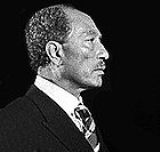
Anwar Sadat

 
Anwar Sadat

   Email Print
   Bookmark   Link


Anwar Sadat


Muhammad Anwar Al Sadat, or Anwar El Sadat () (25 December 1918 - 6 October 1981), was the third President of Egypt
President of Egypt

The President of the Arab Republic of Egypt is the elected Head of State of Egypt.Under the Constitution of Egypt, the President is also the Commander-in-chief of the armed forces and head of the Executive branch of the Cabinet of Egypt....
, serving from 15 October 1970 until his assassination on 6 October 1981. He was a senior member of the Free Officers group that overthrew the Muhammad Ali Dynasty
Muhammad Ali Dynasty

The Muhammad Ali Dynasty was the ruling dynasty of Egypt and Sudan from the 19th to the mid-20th Century. It is named after its progenitor, Muhammad Ali of Egypt, regarded as the founder of modern Egypt....
 in the Egyptian Revolution of 1952, and a close confidant of Gamal Abdel Nasser
Gamal Abdel Nasser

Gamal Abdel Nasser was the second President of Egypt from 1956 until his death in 1970. Along with Muhammad Naguib, he led the Egyptian Revolution of 1952, which removed Farouk of Egypt and heralded a new period of industrialization in Egypt, together with a profound advancement of Arab nationalism, including a short-lived United Arab Republ...
, whom he succeeded as President in 1970.

In his eleven years as president he changed Egypt's direction, departing from some of the economic and political principles of Nasserism
Nasserism

Nasserism is an Arab nationalism political ideology based on the thinking of the former Egyptian President of Egypt Gamal Abdel Nasser. It was a major influence on pan-Arab politics in the 1950s and 1960s, and continues to have significant resonance throughout the Arab World to this day....
 by reinstituting the multi-party system and launching the Infitah
Infitah

Infitah is an Arabic language word meaning "open door" and refers to Egyptian President Anwar Sadat "opening the door" to private investment in Egypt....
.


Discussion
Ask a question about 'Anwar Sadat'
Start a new discussion about 'Anwar Sadat'
Answer questions from other users
Full Discussion Forum


Timeline

1918   Born

1970   Gamal Abdal Nasser dies - Vice President Anwar Sadat is named temporary president of Egypt.

1970   Anwar Sadat is accepted as Egyptian president.

1970   In Egypt, a referendum supports Anwar Sadat 90.04%.

1970   Anwar Sadat officially becomes President of Egypt.

1970   Egyptian president Anwar Sadat names Mahmoud Fawzi as his prime minister.

1972   Anwar Sadat expels 20,000 Soviet advisors from Egypt.

1977   Egyptian President Anwar Sadat becomes the first Arab leader to officially visit Israel, when he meets with Israeli Prime Minister Menachem Begin and speaks before the Knesset in Jerusalem, seeking a permanent peace settlement (much of the Arab world is outraged by the visit).

1978   Camp David Accords: Menachem Begin and Anwar Sadat begin the peace process at Camp David, Maryland.

1978   Egyptian President Anwar Sadat and Israeli Prime Minister Menachem Begin win the Nobel Peace Prize for their progress toward achieving a Middle East accord.


Encyclopedia


Muhammad Anwar Al Sadat, or Anwar El Sadat () (25 December 1918 - 6 October 1981), was the third President of Egypt
President of Egypt

The President of the Arab Republic of Egypt is the elected Head of State of Egypt.Under the Constitution of Egypt, the President is also the Commander-in-chief of the armed forces and head of the Executive branch of the Cabinet of Egypt....
, serving from 15 October 1970 until his assassination on 6 October 1981. He was a senior member of the Free Officers group that overthrew the Muhammad Ali Dynasty
Muhammad Ali Dynasty

The Muhammad Ali Dynasty was the ruling dynasty of Egypt and Sudan from the 19th to the mid-20th Century. It is named after its progenitor, Muhammad Ali of Egypt, regarded as the founder of modern Egypt....
 in the Egyptian Revolution of 1952, and a close confidant of Gamal Abdel Nasser
Gamal Abdel Nasser

Gamal Abdel Nasser was the second President of Egypt from 1956 until his death in 1970. Along with Muhammad Naguib, he led the Egyptian Revolution of 1952, which removed Farouk of Egypt and heralded a new period of industrialization in Egypt, together with a profound advancement of Arab nationalism, including a short-lived United Arab Republ...
, whom he succeeded as President in 1970.

In his eleven years as president he changed Egypt's direction, departing from some of the economic and political principles of Nasserism
Nasserism

Nasserism is an Arab nationalism political ideology based on the thinking of the former Egyptian President of Egypt Gamal Abdel Nasser. It was a major influence on pan-Arab politics in the 1950s and 1960s, and continues to have significant resonance throughout the Arab World to this day....
 by reinstituting the multi-party system and launching the Infitah
Infitah

Infitah is an Arabic language word meaning "open door" and refers to Egyptian President Anwar Sadat "opening the door" to private investment in Egypt....
. His leadership in the October War of 1973 and the regaining Sinai made him an Egyptian hero. His visit to Israel and the eventual Israel-Egypt Peace Treaty
Israel-Egypt Peace Treaty

The Egyptian?Israeli Peace Treaty was signed in Washington, DC, United States, on March 26, 1979, following the Camp David Accords . The main features of the treaty were the mutual recognition of each country by the other, the cessation of the state of war that had existed since the 1948 Arab-Israeli War, and the complete withdrawal by Isra...
 won him the Peace Abbey Courage of Conscience award September 11, 1991 posthumously, but was an act enormously unpopular with the Arab world
Arab world

The Arab World refers to Arabic-speaking countries stretching from the Atlantic Ocean in the west to the Arabian Sea in the east, and from the Mediterranean Sea in the north to the Horn of Africa and the Indian Ocean in the southeast....
 and Islamist
Islamism

Islamism is a set of Ideologies of parties holding that Islam is not only a religion but also a political system; that modern Muslims must Islamic fundamentalism, and unite politically....
s, and resulted in Egypt being expelled from the Arab League
Arab League

The Arab League , officially called the League of Arab States , is a regional organization of Arab states in Southwest Asia, and North Africa and Horn of Africa....
.

Early life

Anwar El Sadat was born on 25 December 1918 in Mit Abu al-Kum, al-Minufiyah, Egypt
Mit Abu al-Kum, al-Minufiyah, Egypt

Mit Abu al-Kum is a village in the Egyptian Nile Delta and the Al Minufiyah Egypt#Governorates. It is the birthplace of Egyptian president Anwar Al Sadat , and his childhood home has been made into a museum....
 to a poor family, one of 13 brothers and sisters. His father was Egyptian, and his mother was Sudan
Sudan

Sudan is a country in northeastern Africa. It is the largest in the African continent and the Arab World, and List of countries and outlying territories by total area by area....
ese. He spent his early childhood under the care of his grandmother, who told him stories revolving around resistance to the British occupation and drawing on contemporary history. During Sadat’s childhood, he admired and was influence greatly by four individuals. The first of his childhood heroes was Zahran, the alleged hero of Denshway, who resisted the British in a farmer protest. According to the story, a British soldier is killed. Zahran was the first Egyptian hanged in retribution for the soldier's death. Stories like the Ballad of Zahran introduced Sadat to Egyptian nationalism, a value he held throughout his life. The second individual was Kemal Ataturk who was leader of the modern Turkey
Turkey

Turkey , known officially as the Republic of Turkey , is a Eurasian country that stretches across the Anatolian peninsula in southwest Asia and Thrace in the Balkans region of Southern Europe....
. Sadat admired his ability to overthrow the colonial influence
Turkish War of Independence

The Turkish War of Independence is the political and military resistance developed by Turkish revolutionaries to the Allies of World War I partitioning of the Ottoman Empire after its defeat in World War I....
 and his many social reforms. He also idolized Mahatma Gandhi
Mahatma Gandhi

Mohandas Karamchand Gandhi was a major political and spiritual leader of India and the Indian independence movement. He was the pioneer of satyagraha?resistance to tyranny through mass civil disobedience, firmly founded upon ahimsa or total non-violence?which led India to Indian independence movement and inspired movements for civi...
 and his belief of nonviolence when facing injustice. The fourth individual who Anwar al Sadat respected was Adolf Hitler
Adolf Hitler

Adolf Hitler was an Austrian-born Germany politician and the leader of the National Socialist German Workers Party , popularly known as the Nazi Party....
. Sadat was opposed to colonial power and Hitler’s Nazi Germany posed a threat to Britain's power.He graduated from the Royal Military Academy in Cairo
Cairo

Cairo , which means "the triumphant", is the Cairo and largest city of Egypt.It is the most populous metropolitan area in Egypt and is also one of the most populous in the world....
 in 1938 and was appointed in the Signal Corps. He entered the army as a second lieutenant and was posted in Sudan (Egypt and Sudan were one country at the time). There, he met Gamal Abdel Nasser
Gamal Abdel Nasser

Gamal Abdel Nasser was the second President of Egypt from 1956 until his death in 1970. Along with Muhammad Naguib, he led the Egyptian Revolution of 1952, which removed Farouk of Egypt and heralded a new period of industrialization in Egypt, together with a profound advancement of Arab nationalism, including a short-lived United Arab Republ...
, and along with several other junior officers they formed the secret Free Officers Movement
Free Officers Movement

In Egypt, the clandestine revolutionary Free Officers Movement was composed of young junior army officers committed to 1952 Revolution and its British advisors....
 committed to freeing Egypt from British
United Kingdom

The United Kingdom of Great Britain and Northern Ireland, commonly known as the United Kingdom , the UK or Britain,is a sovereign state located off the northwestern coast of continental Europe....
 domination and royal corruption.

During the Second World War
World War II

World War II, or the Second World War , was a global military conflict which involved a Participants in World War II, including all of the great powers, organised into two opposing military alliances: the Allies of World War II and the Axis powers....
 he was imprisoned by the British for his efforts to obtain help from the Axis Powers
Axis Powers

The Axis powers were those countries that were opposed to the Allies of World War II during World War II. The three major Axis powers - Nazi Germany, Kingdom of Italy , and Empire of Japan - were part of a military alliance on the signing of the Tripartite Pact in September 1940, which officially founded the Axis powers....
 in expelling the occupying British forces. Along with his fellow Free Officers, Sadat participated in the military coup that launched the Egyptian Revolution of 1952 which overthrew King Farouk I on July 23 of that year. After the revolution, he was assigned to take over the radio networks to announce the news of the revolution to the Egyptian people.

In 1964, after holding many positions in the Egyptian government, he was chosen to be vice president
Vice president

A vice president is an Corporate officer in government or business who is below a president in rank. The name comes from the Latin List of Latin phrases #vice meaning 'in place of'....
 by President Nasser. He served in that capacity until 1966, and again from 1969 to 1970.

During Nasser's presidency

During the presidency of Gamal Abdel Nasser, Sadat was appointed Minister of State
Minister of State

Minister of State is a title borne by politicians or officials in certain countries governed under a parliamentary system. In some countries a "minister of state" is a junior Political minister, who is assigned to assist a specific cabinet ....
 in 1954. In 1959, he assumed the position of Secretary to the National Union. Sadat was the President of the National Assembly
People's Assembly of Egypt

The People's Assembly is the lower house of Egypt's bicameralism parliament. In spite of its lower status, however, it plays a more important role in drafting legislation and day-to-day legislative duties than the Shura Council, the upper house....
 (1960-1968) and then vice president and member of the Presidential Council in 1964. He was reappointed as vice president again in December 1969.

Presidency

After Nasser's death in 1970, Sadat succeeded him as President, but it was widely considered that his presidency would be short-lived. Viewing him as having been little more than a puppet of the former President, Nasser's supporters in government settled on Sadat as someone they could easily manipulate. Nasser's supporters were well satisfied for six months until Sadat instituted The Corrective Revolution
The Corrective Revolution

The Corrective Revolution is an expression used by some self-described revolutionary governments, to describe an internal political or bureaucratic power struggle, and also to indicate continued adherence to the ideals of an earlier revolution despite the overthrow of its previous leadership and/or major policy changes....
 and purged Egypt of most of its other leaders and other elements of the Nasser era.

In 1971, Sadat endorsed in a letter the peace proposals of UN
United Nations

The United Nations is an international organization whose stated aims are to facilitate cooperation in international law, international security, economic development, Social change, human rights and achieving world peace....
 negotiator Gunnar Jarring
Gunnar Jarring

Gunnar Jarring was a Sweden diplomat and Turkic languages.Jarring was born in Brunnby, Sk?ne County , Sweden. He earned a Doctor of Philosophy from Lund University in 1933 with his dissertation Studien zu einer ostt?rkischen Lautlehre ....
 which seemed to lead to a full peace with Israel
Israel

Israel officially the State of Israel , is a country in the Middle East located on the eastern shore of the Mediterranean Sea. It borders Lebanon in the north, Syria in the northeast, Jordan in the east, and Egypt on the southwest, and contains geographically diverse features within its relatively small area....
 on the basis of Israel's withdrawal to its pre-war borders. This peace initiative failed as neither the United States nor Israel accepted the terms as discussed then.

Sadat likely perceived that Israel's desire to negotiate was directly correlated to how much of a military threat they perceived from Egypt, which, after the Six-Day War
Six-Day War

In the Six-Day War of June 5-10, 1967, Israel defeated the armies of the neighboring states of Egypt, Jordan, and Syria. In Arabic, the war is called ....
 of 1967, was at an all time low. Israel also viewed the most substantial part of the Egyptian threat as the presence of Soviet equipment and personnel (in the thousands at this time). It was for those reasons that Sadat expelled the Soviet military advisers from Egypt and proceeded to whip his army into shape for a renewed confrontation with Israel.During this time, Egypt was suffering greatly from economic problems caused by the Six Days War and the Soviet relationship also declined due to their unreliability and refusal of Sadat’s requests for more military support.

On 6 October 1973, in conjunction with Hafez al-Assad
Hafez al-Assad

Hafez al-Assad was the President of Syria of Syria for three decades. Assad's rule stabilized and consolidated the power of the country's central government after decades of coups and counter-coups....
 of Syria
Syria

Syria , officially the Syrian Arab Republic , is an Arab-majority country in Southwest Asia, bordering Lebanon and the Mediterranean Sea to the west, Israel to the southwest, Jordan to the south, Iraq to the east, and Turkey to the north....
, Sadat launched the October War, also known as the Yom Kippur War, a surprise attack to recapture occupied Sinai. The Egyptian performance in the initial stages of the war (see The Crossing
The Crossing

Operation Badr was the code name for the Egyptian military operation to cross the Suez Canal and seize the Bar-Lev Line at the start of the Yom Kippur War....
) astonished both Israel and the Arab World as Egyptian forces pressed approximately 15 km into the Sinai Peninsula
Sinai Peninsula

The Sinai Peninsula or Sinai is a triangular peninsula in Egypt. It lies between the Mediterranean Sea to the north and the Red Sea to the south, forming a land bridge between Africa and Southwest Asia....
 beyond the Bar Lev Line
Bar Lev Line

The Bar Lev Line was a chain of fortifications built by Israel along the eastern coast of the Suez Canal after it captured the Sinai Peninsula from Egypt during the 1967 Six-Day War....
. This line is popularly thought to have been an impregnable defensive chain. Indeed the Egyptian performance was highly praised by Jewish American military strategist Edward Luttwak
Edward Luttwak

Edward Nicolae Luttwak is an United States military strategist and historian who has published works on military strategy, history and international relations....
 in an article that appeared in the Jerusalem Post in the wake of the 2006 Lebanon War:

As the war progressed, three divisions of the Israeli army (IDF) led by then General Ariel Sharon
Ariel Sharon

is a former Israeli Prime Minister of Israel and military leader. Sharon served as Prime Minister from March 2001 until April 2006, though he was unable to carry out his duties after suffering a stroke on 4 January 2006, when he fell into a coma and entered a persistent vegetative state....
 had crossed the Suez Canal
Suez Canal

The Suez Canal is a canal in Egypt. Opened in November 1869, it allows water transportation between Europe and Asia without navigating around Africa or carrying goods overland between the Mediterranean and the Red Sea....
, encircling the Egyptian Third Army. Prompted by an agreement between the United States and Egypt's Soviet allies, the United Nations Security Council
United Nations Security Council

The United Nations Security Council is one of the principal organs charged with the maintenance of international security. Its powers, outlined in the United Nations Charter, include the establishment of peacekeeping operations, the establishment of international sanctions, and the authorization of war....
 passed Resolution 338
United Nations Security Council Resolution 338

The three-line United Nations Security Council United Nations Security Council Resolution 338 , approved on October 22, 1973, called for a cease fire in the Yom Kippur War in accordance with a joint proposal by the United States and the Soviet Union....
 on 24 October 1973, calling for an immediate ceasefire.

The initial Egyptian and Syrian victories in the war restored popular morale throughout Egypt and the Arab World, and for many years after Sadat was known as the "hero of the Crossing". Israel recognized Egypt as a formidable foe, and Egypt's renewed political significance eventually led to regaining and reopening the Suez Canal through the peace process.

On 19 November 1977, Sadat became the first Arab leader to officially visit Israel when he met with Israeli Prime Minister
Prime minister

A prime minister is the most senior minister of Cabinet in the Executive branch of government in a parliamentary system. The position is usually held by, but need not always be held by, a politician....
 Menachem Begin
Menachem Begin

was the sixth Prime Minister of Israel. Before the establishment of the state, he was the leader of the Irgun, playing a central role in Jewish resistance to the British Mandate of Palestine....
, and spoke before the Knesset
Knesset

The Knesset is the legislature of Israel, located in Givat Ram, Jerusalem....
 in Jerusalem
Jerusalem

Jerusalem is the capital of Israel and its List of Israeli cities in both population and area, with a population of 747,600 residents over an area of if Positions on Jerusalem East Jerusalem is included....
 about his views on how to achieve a comprehensive peace to the Arab-Israeli conflict, which included the full implementation of UN Resolutions 242
United Nations Security Council Resolution 242

United Nations List of the UN resolutions concerning Israel and Palestine 242 was adopted unanimously by the UN Security Council on November 22, 1967, in the aftermath of the Six Day War....
 and 338. He made the visit after receiving an invitation from Begin and once again sought a permanent peace settlement.

The Egyptian–Israeli Peace Treaty


The Egypt
Egypt

Egypt is a country mainly in North Africa, with the Sinai Peninsula forming a land bridge in Western Asia. Covering an area of about , Egypt borders the Mediterranean Sea to the north, the Gaza Strip and Israel to the northeast, the Red Sea to the east, Sudan to the south and Libya to the west....
ian–Israel
Israel

Israel officially the State of Israel , is a country in the Middle East located on the eastern shore of the Mediterranean Sea. It borders Lebanon in the north, Syria in the northeast, Jordan in the east, and Egypt on the southwest, and contains geographically diverse features within its relatively small area....
i Peace Treaty
was signed by Anwar Sadat and Israeli Prime Minster Menachem Begin in Washington, DC, United States
United States

The United States of America is a Federal government constitutional republic comprising U.S. state and a federal district. The country is situated mostly in central North America, where its Contiguous United States and Washington, D.C., the Capital districts and territories, lie between the Pacific Ocean and Atlantic Oceans, Borders of the U...
, on 26 March 1979, following the Camp David Accords (1978), a series of meetings between Egypt and Israel facilitated by U.S. President Jimmy Carter
Jimmy Carter

James Earl "Jimmy" Carter, Jr. served as the List of Presidents of the United States President of the United States from 1977 to 1981 and was the recipient of the 2002 Nobel Peace Prize....
. Both Sadat and Begin were awarded the Nobel Peace Prize
Nobel Peace Prize

The Nobel Peace Prize is one of five Nobel Prizes bequeathed by the Swedish industrialist and inventor Alfred Nobel. According to Nobel's will , the Peace Prize should be awarded "to the person who shall have done the most or the best work for :wikt:fraternity between nations, for the abolition or reduction of standing armies and for the h...
 for creating the treaty. In his acceptance speech, Sadat referred to the long awaited peace desired by both Arabs and Israelis.
“Let us put an end to wars, let us reshape life on the solid basis of equity and truth. And it is this call, which reflected the will of the Egyptian people, of the great majority of the Arab and Israeli peoples, and indeed of millions of men, women, and children around the world that you are today honoring. And these hundreds of millions will judge to what extent every responsible leader in the Middle East has responded to the hopes of mankind”
The main features of the agreement were the mutual recognition of each country by the other, the cessation of the state of war that had existed since the 1948 Arab-Israeli War
1948 Arab-Israeli War

The 1948 Arab-Israeli War, known by the Israelis predominantly as War of Independence and War of Liberation , and by Palestinians as the Catastrophe , was the first in a series of wars fought between the Declaration of Independence State of Israel and its Arab neighbours in the long-running Arab-Israeli conflict....
, and the complete withdrawal by Israel of its armed forces and civilians from the rest of the Sinai Peninsula
Sinai Peninsula

The Sinai Peninsula or Sinai is a triangular peninsula in Egypt. It lies between the Mediterranean Sea to the north and the Red Sea to the south, forming a land bridge between Africa and Southwest Asia....
 which Israel had captured during the 1967 Six-Day War
Six-Day War

In the Six-Day War of June 5-10, 1967, Israel defeated the armies of the neighboring states of Egypt, Jordan, and Syria. In Arabic, the war is called ....
. The agreement also provided for the free passage of Israeli ships through the Suez Canal
Suez Canal

The Suez Canal is a canal in Egypt. Opened in November 1869, it allows water transportation between Europe and Asia without navigating around Africa or carrying goods overland between the Mediterranean and the Red Sea....
 and recognition of the Strait of Tiran and the Gulf of Aqaba
Gulf of Aqaba

The Gulf of Aqaba , in Israel known as the Gulf of Eilat is a large Headlands and bays of the Red Sea. It is located to the east of the Sinai peninsula and west of the Arabian peninsula....
 as international waterways. The agreement notably made Egypt the first Arab country to officially recognize Israel. The peace agreement between Egypt and Israel has remained in effect since the treaty was signed.

The treaty, which gained wide support among Egyptians, was extremely unpopular in the Arab World and the wider Muslim World. His predecessor Nasser had made Egypt an icon of Arab nationalism, an ideology that appeared to be sidelined by an Egyptian orientation following the 1973 war (see Egypt
Egypt

Egypt is a country mainly in North Africa, with the Sinai Peninsula forming a land bridge in Western Asia. Covering an area of about , Egypt borders the Mediterranean Sea to the north, the Gaza Strip and Israel to the northeast, the Red Sea to the east, Sudan to the south and Libya to the west....
). By signing the accords, many non-Egyptian Arabs believed Sadat had put Egypt's interests ahead of Arab unity, betraying Nasser's pan-Arabism
Pan-Arabism

Pan-Arabism is a movement for unification among the peoples and countries of the Arab World, from the Atlantic Ocean to the Arabian Sea....
, and destroyed the vision of a united "Arab front" and elimination of the "Zionist Entity". Sadat's shift towards a strategic relationship with the U.S. was also seen as a betrayal by many. In the United States his peace moves gained him popularity among some Evangelical
Evangelicalism

Evangelicalism is a Protestantism Christian movement which began in Great Britain in the 1730s.Most adherents consider its key characteristics to be: a belief in the need for personal conversion ; some expression of the gospel in effort; a high regard for Biblical authority; and an emphasis on the death and resurrection of Jesus....
 circles. He was awarded the Prince of Peace Award by Pat Robertson
Pat Robertson

Marion Gordon "Pat" Robertson is a televangelist from the United States. He is the founder of numerous organizations and corporations, including the American Center for Law and Justice , the Christian Broadcasting Network , the Christian Coalition of America, Flying Hospital, International Family Entertainment, Operation Blessing Internation...
.

In 1979 the Arab League
Arab League

The Arab League , officially called the League of Arab States , is a regional organization of Arab states in Southwest Asia, and North Africa and Horn of Africa....
 expelled Egypt in the wake of the Egyptian–Israel peace agreement, and the League moved its headquarters from Cairo
Cairo

Cairo , which means "the triumphant", is the Cairo and largest city of Egypt.It is the most populous metropolitan area in Egypt and is also one of the most populous in the world....
 to Tunis
Tunis

Tunis is the Capital of the Tunisian Republic and also the Tunis Governorate, with a population of 1 200,000 in 2008 and over 3,980,500 in the municipal area....
. It was not until 1989 that the League re-admitted Egypt as a member, and returned its headquarters to Cairo. Many believed that only a threat of force would make Israel negotiate over the West Bank
West Bank

The West Bank is the eastern Part of the Palestinian territories on the west bank of the River Jordan in the Middle East. To the west, north, and south the West Bank shares borders with the state of Israel....
 and Gaza Strip
Gaza Strip

The Gaza Strip is a coastal strip of land along the Mediterranean Sea. It borders Egypt on the south-west and Israel on the south, east and north....
, and the Camp David accords removed the possibility of Egypt, the major Arab military power, from providing such a threat. As part of the peace deal Israel withdrew from the Sinai peninsula in phases, returning the entire area to Egypt on 25 April 1982.

Unpopularity and conspiracy theories

The last years of Sadat's reign were marked by turmoil and there were several allegations of corruption against him and his family. In January 1977, a series of 'Bread Riots'
1977 Egyptian Bread Riots

The Egyptian 'Bread Riots' of 1977 which rocked most major cities in Egypt from January 18-19 of that year, were a spontaneous uprising by hundreds of thousands of lower class people protesting World Bank and International Monetary Fund-mandated termination of state subsidies on basic foodstuffs....
 protested Sadat's economic liberalization and specifically a government decree lifting price controls on basic necessities like bread. Dozens of nightclubs on the famous Pyramids Street were sacked by Islamists. Following the riots the government reversed itself and recontrolled prices.

Islamists were enraged by Sadat's Sinai treaty with Israel, particularly the radical Egyptian Islamic Jihad
Egyptian Islamic Jihad

The Egyptian Islamic Jihad , formerly called simply Islamic Jihad originally referred to as "al-Jihad," and then "the Jihad Group", or "the Jihad Organization", is an Egyptian Islamist group active since the late 1970s with origins in the Muslim Brotherhood....
. According to interviews and information gathered by journalist Lawrence Wright
Lawrence Wright

Lawrence Wright, born August 2, 1947, is a Pulitzer Prize-winning American author, screenwriter, staff writer for The New Yorker magazine, and fellow at the Center for Law and Security at the New York University School of Law....
, the group was recruiting military officers and accumulating weapons, waiting for the right moment to launch "a complete overthrow of the existing order" in Egypt. Chief strategist of El-Jihad was Aboud el-Zumar, a colonel in the military intelligence whose "plan was to kill the main leaders of the country, capture the headquarters of the army and State Security, the telephone exchange building, and of course the radio and television building, where news of the Islamic revolution would then be broadcast, unleashing - he expected - a popular uprising against secular authority all over the country."

In February 1981, Egyptian authorities were alerted to El-Jihad's plan by the arrest of an operative carrying crucial information. In September, Sadat ordered a highly unpopular roundup of more than 1500 people, including many Jihad members, but also intellectuals and activists of all ideological stripes.

The round up missed a Jihad cell in the military led by Lieutenant Khaled Islambouli, who succeeded in assassinating Anwar Sadat that October.

According to Tala'at Qasim, ex-head of the Gama'a Islamiyya interviewed in Middle East Report, it was not Islamic Jihad but the Islamic Group that organized the assassination and recruited the assassin (Islambuli). Members of the Group's 'Maglis el-Shura' ('Consultative Council') - headed by the famed 'blind shaykh' - were arrested two weeks before the killing, but they did not disclose the existing plans and Islambuli succeeded in assassinating Sadat.

Assassination and aftermath

On 6 October 1981, the month after the crackdown, Sadat was assassinated during the annual victory parade in Cairo. A fatwa
Fatwa

A fatwa , in the Islamic faith is a religious opinion on Sharia issued by an Ulema. In Sunni Islam any fatwa is non-binding, whereas in Shia Islam it could be, depending on the status of the scholar....
 approving the assassination had been obtained from Omar Abdel-Rahman
Omar Abdel-Rahman

File:Omar Abdel-Rahman.jpgSheikh Omar Abdel-Rahman is a blind Egyptian Islam leader who is currently serving a life sentence at the Butner Medical Center which is part of the Butner Federal Correctional Institution in Butner, North Carolina, United States....
, a cleric later convicted in the U.S. for his role in the 1993 World Trade Center bombing
1993 World Trade Center bombing

The 1993 World Trade Center bombing occurred on February 26, 1993, when a car bomb was detonated below Tower One of the World Trade Center in New York City....
. Sadat was protected by four layers of security and the army parade should have been safe due to ammunition
Ammunition

Ammunition, often referred to as ammo, is a generic term derived from the French language la munition which embraced all material used for war , but which in time came to refer specifically to gunpowder and artillery....
-seizure rules. However, the officers in charge of that procedure were on hajj
Hajj

The Hajj is a pilgrimage to Mecca . It is the largest annual pilgrimage in the world, and is the fifth pillar of Islam, an obligation that must be carried out at least once in their lifetime by every able-bodied Muslim who can afford to do so....
 to Mecca
Mecca

Mecca , also spelled Makkah , Makka is a city in Saudi Arabia. Home to the Masjid al-Haram, it is the holy city in Islam and plays an important role in the faith....
.

As air force Mirage
Mirage (aircraft)

Mirage is the name of a series of different military aircraft produced by the French aircraft manufacturer Dassault Aviation....
 jets flew overhead, distracting the crowd, a troop truck halted before the presidential reviewing stand, and a lieutenant strode forward. Sadat stood to receive his salute, whereupon the assassins rose from the truck, throwing grenades and firing assault rifle
Assault rifle

An assault rifle is a rifle designed for combat, with selective fire . Assault rifles are the standard small arms in most modern Army, having largely superseded or supplemented battle rifles such as the World War II-era M1 Garand rifle and SVT-40....
 rounds. The attack lasted about two minutes. Photographer Bill Foley captured one of the last shots of a living Sadat. The photograph is titled "The Last Smile." The lead assassin Khalid Islambouli
Khalid Islambouli

Khalid Ahmed Showky Al-Islambouli arranged and carried out the assassination of the Egyptian president, Anwar Sadat, during the annual "6 October 1973 victory parade" on 6 October, 1981....
 shouted "Death to Pharaoh
Pharaoh

Pharaoh is a title used in many modern discussions of the ancient Egyptian rulers of all periods. In antiquity this title began to be used for the ruler who was the religious and political leader of united ancient Egypt, only during the New Kingdom, specifically, during the middle of the Eighteenth dynasty of Egypt....
!" as he ran towards the stand and shot Sadat. After he fell to the floor people around Sadat threw chairs on his body to try to protect him from the bullets. Eleven others were killed, including the Cuba
Cuba

The Republic of Cuba is a country in the Caribbean. It consists of the island of Cuba , the island of Isla de la Juventud, and several adjacent small islands....
n ambassador, an Omani general and a Coptic Orthodox bishop, and 28 were wounded, including James Tully, the Irish Minister for Defence
Minister for Defence (Ireland)

The Minister for Defence is the senior government minister at the Department of Defence in the Government of Ireland. The current Minister for Defence is Willie O'Dea, Teachta D?la; he is assisted by Minister of State at the Department of Defence Pat Carey, TD....
, and four U.S. military liaison officers. Sadat was then rushed to a hospital, but was declared dead within hours. This was the first time in Egyptian history that the head of state had been assassinated by an Egyptian citizen. Two of the attackers were killed and the others were arrested by military police on-site. Islambouli was later found guilty and was executed in April 1982.

In conjunction with the assassination, an insurrection was organized in Asyut
Asyut

Asyut , is the capital of the modern Asyut Governorate, Egypt; there is an ancient city nearby. The modern city is located at: , while the ancient city is located at: ....
 in Upper Egypt. Rebels took control of the city for a few days and 68 policemen and soldiers were killed in the fighting. Government control was not restored until paratroopers from Cairo arrived. Most of the militants convicted of fighting received light sentences and served only three years in prison.

Sadat was succeeded by his vice president Hosni Mubarak
Hosni Mubarak

Muhammad Hosni Mubarak, , is an Egyptian political figure and military officer. He was appointed Vice President of Egypt in 1975, and assumed the presidency of the Egypt on 14 October 1981, following the assassination of President Anwar Al Sadat....
, whose hand was injured during the attack. Sadat's funeral was attended by a record number of dignitaries from around the world, including a rare simultaneous attendance by three former U.S. presidents: Gerald Ford
Gerald Ford

Gerald Rudolph Ford, Jr. was the List of Presidents of the United States President of the United States, serving from 1974 to 1977, and the List of Vice Presidents of the United States Vice President of the United States serving from 1973 to 1974....
, Jimmy Carter
Jimmy Carter

James Earl "Jimmy" Carter, Jr. served as the List of Presidents of the United States President of the United States from 1977 to 1981 and was the recipient of the 2002 Nobel Peace Prize....
 and Richard Nixon
Richard Nixon

Richard Milhous Nixon was the List of Presidents of the United States President of the United States and the only president to resign the office....
. No Arab heads of state attended the funeral, apart from Sudan's President Gaafar Nimeiry
Gaafar Nimeiry

Gaafar Muhammad an-Nimeiry was the President of Sudan from 1969 to 1985. He was born in Wad Nubawi Omdurman in central Sudan, and was the son of a postman and the great grandson of a local tribal leader from the Wad Nimeiry region in Dongola, ash-Shamaliyah the Northern State....
. Only 2 of 24 states in the Arab league
Arab League

The Arab League , officially called the League of Arab States , is a regional organization of Arab states in Southwest Asia, and North Africa and Horn of Africa....
 sent representatives at all (Somalia and Oman). Sadat was buried in the unknown soldier memorial in Cairo.

Over three hundred Islamic radicals were indicted in the trial of assassin Khalid Islambouli, including Ayman al-Zawahiri
Ayman al-Zawahiri

Dr. Ayman Muhammad Rabaie al-Zawahiri is a prominent leader of al-Qaeda, and was the second and last "emir" of Egyptian Islamic Jihad, having succeeded 'Abbud al-Zummar in the latter role when Egyptian authorities sentenced al-Zummar to life imprisonment....
, Omar Abdel-Rahman and Abd al-Hamid Kishk
Abd al-Hamid Kishk

Sheikh Abdul-Hamid Kishk was a well-known Egyptians preacher, scholar of Islam, activist, and author. He was a graduate of the prestigious Al-Azhar University in Cairo and was said to be known for his humour, popular sermons, and for "his outspoken stance against" music, restrictions on polygamy, and "injustice and oppression in the Musli...
. The trial was covered by the international press and Zawahiri's knowledge of English made him the de facto spokesman for the defendants. Zawahiri was released from prison in 1984, before travelling to Afghanistan
Afghanistan

Afghanistan , officially the Islamic republic of Afghanistan, is a landlocked country that is located approximately in the center of Asia....
 and forging a close relationship with Osama Bin Laden
Osama bin Laden

Osama bin Laden is a member of the prominent Saudi Arabia bin Laden family and the founder of the terrorist organization al-Qaeda, best known for the September 11 attacks on the United States....
.

Despite these facts, the nephew of the late president, Talaat al-Sadat, claimed that the assassination was an international conspiracy. On 31 October 2006, he was sentenced to a year in prison for defaming Egypt's armed forces, less than a month after he gave the interview accusing Egyptian generals of masterminding his uncle's assassination. In an interview with a Saudi television channel, he also claimed both the United States and Israel were involved: "No one from the special personal protection group of the late president fired a single shot during the killing, and not one of them has been put on trial," he said.

Family

Sadat was married twice. He was first married to Ehsan Madi at age 22, and divorced her ten years later, just 17 days after the birth of their third daughter, Camelia. He then married Jehan Raouf (later known as Jehan Sadat
Jehan Sadat

Jehan Al Sadat , also spelled Jihan; birth name Jehan Safwat Raouf is the widow of Anwar Sadat and served as first lady of Egypt from 1970 until Sadat's assassination in 1981....
), who was barely 16 at the time, on 29 May 1949, and they had one son, Gamal, and three daughters: Lobna, Noha and Jehan (named after her mother). Jehan Sadat was the 2001 recipient of the Pearl S. Buck
Pearl S. Buck

Pearl Sydenstricker Buck also known as Sai Zhen Zhu , was a prolific United States sinologist and Pulitzer Prize for the Novel American writer....
 
. Anwar Sadat's autobiography
Autobiography

An autobiography is a biography written by its subject . The term was first used by the poet Robert Southey in 1809 in the English language Periodical publication Quarterly Review, but the form goes back to antiquity....
, In Search of Identity, was published in the USA in 1977. Currently, Mrs. Sadat is an Associate Resident Scholar at the University of Maryland where The Anwar Sadat Chair for Development and Peace was established and fully endowed in 1997 to honor her husband's legacy. A nephew, Talaat Sadat
Talaat Sadat

Talaat Sadat is a former Egyptian politician and current political prisoner. He is the nephew of former President of Egypt Anwar Sadat. Talaat was arrested on 4 October 2006 after giving an interview in which he implicated Military of Egypt in his uncles' 1981 assassination....
, was imprisoned in October 2006 for accusing the Egyptian military of complicity in his uncle's assassination.

Media portrayals of Anwar Sadat

In 1983, Sadat, a miniseries based on the life of Anwar Sadat, aired on U.S. television with Oscar-winning actor Louis Gossett, Jr.
Louis Gossett, Jr.

Louis Cameron Gossett, Jr. is an United States Emmy Award-, Golden Globe Awards-, and Academy Award-winning actor....
 in the title role. The film was promptly banned by the Egyptian government, as were all other movies produced and distributed by Columbia Pictures
Columbia Pictures

Columbia Pictures Industries, Inc. is an United States film production company and distribution company. It was one of the so-called studio system among the eight major film studios of Hollywood Cinema of the United States#Golden Age of Hollywood....
 due, in part, to historical inaccuracies. A civil lawsuit was also brought by Egypt's artists' and film unions against Columbia Pictures and the film's directors, producers and scriptwriters, but was eventually dismissed.

The main reason for the miniseries' poor reception in Egypt, however, was the fact that a black man, Gossett, was cast to play the role of the Egyptian president. According to one source, "that bothered race-conscious Egyptians and wouldn't have pleased [the deceased] Sadat."

The two-part series earned Gossett an Emmy
Emmy Award

The Emmy Award, also known as the 'Emmy', is a television production award, similar in nature to the Peabody Awards but more focused on entertainment, and is considered the television equivalent to the Academy Awards....
 nomination in the United States.

The first Egyptian depiction of Sadat's life came in 2001, when Ayam El-Sadat
Ayam El-Sadat

Ayyam El Sadat is a 2001 Egyptian biographical film about the late President of Egypt, Anwar Al Sadat. The movie starred several prominent actors, with the late actor Ahmad Zaki as the Egyptian president....
 (English: Days of Sadat) was released in Egyptian cinemas. This movie, by contrast, was a major success in Egypt, and was hailed as Ahmad Zaki's greatest performance to date.

The Grateful Dead album "Rocking The Cradle: Egypt 1978" is dedicated to the memory of a few people- Anwar Sadat being one of the listed.

Quotes

"Fear is, I believe, a most effective tool in destroying the soul of an individual - and the soul of a people."

"Most people seek after what they do not possess and are enslaved by the very things they want to acquire."

"Peace is much more precious than a piece of land... let there be no more wars."

"Russians can give you arms but only the United States can give you a solution."

"There can be hope only for a society which acts as one big family, not as many separate ones."

"There is no happiness for people at the expense of other people."

Bibliography


External links


|- |- |- |- |- |-