

Decolonization

Encyclopedia
Decolonization refers to the undoing of colonialism
, the unequal relation of polities
whereby one people or nation establishes and maintains dependent Territory (courial governments) over another. It can be understood politically (attaining independence
, autonomous home rule, union with the metropole
or another state) or culturally (removal of pernicious colonial effects.) The term refers particularly to the dismantlement, in the years after World War II
, of the Neo-Imperial empires
established prior to World War I
throughout Africa
and Asia
.
The United Nations Special Committee on Decolonization has stated that in the process of decolonization there is no alternative to the colonizer's allowance of self-determination
, but in practice decolonization may involve peaceful
or violent resistance by the native population. It may be intramural or involve the intervention of foreign powers acting individually or through international bodies such as the United Nations
. Although examples of decolonization can be found as early as the writings of Thucydides
, there have been several particularly active periods of decolonization in modern times. These are the breakup of the Spanish Empire in the nineteenth century; of the German
, Austro-Hungarian
, Ottoman
, and Russian Empire
s following World War I; of the British
, French
, Dutch, and Italian colonial empires following World War II; of the Russian Empire successor union
following the Cold War
; and others.
, sometimes following a revolution. More often, there is a dynamic cycle where negotiations fail, minor disturbances ensue resulting in suppression by the police and military forces, escalating into more violent revolts that lead to further negotiations until independence is granted. In rare cases, the actions of the native population are characterized by nonviolence
, with the Indian independence movement
led by Mohandas Karamchand Gandhi being one of the most notable examples, and the violence comes as active suppression from the occupying forces or as political opposition from forces representing minority local communities who feel threatened by the prospect of independence. For example, there was a war of independence in French Indochina
, while in some countries in French West Africa
(excluding the Maghreb
countries) decolonization resulted from a combination of insurrection and negotiation. The process is only complete when the de facto government of the newly independent country is recognized as the de jure sovereign state
by the community of nations.
Independence is often difficult to achieve without the encouragement and practical support from one or more external parties. The motives for giving such aid are varied: nations of the same ethnic and/or religious stock may sympathize with oppressed groups, or a strong nation may attempt to destabilize a colony as a tactical move to weaken a rival or enemy colonizing power or to create space for its own sphere of influence; examples of this include British support of the Haitian Revolution
against France, and the Monroe Doctrine
of 1823, in which the United States warned the European powers not to interfere in the affairs of the newly independent states of the Western Hemisphere
.
As world opinion became more pro-emancipation following World War I
, there was an institutionalised collective effort to advance the cause of emancipation through the League of Nations
. Under Article 22 of the Covenant of the League of Nations, a number of mandate
s were created. The expressed intention was to prepare these countries for self-government, but are often interpreted as a mere redistribution of control over the former colonies of the defeated powers, mainly Germany
and the Ottoman Empire
. This reassignment work continued through the United Nations
, with a similar system of trust territories
created to adjust control over both former colonies and mandated territories.
In referendums, some colonized populations have chosen to retain their colonial status, such as Gibraltar
and French Guiana
. There are even examples, such as the Falklands War
, in which an Imperial power goes to war to defend the right of a colony to continue to be a colony. Colonial powers have sometimes promoted decolonization in order to shed the financial, military and other burdens that tend to grow in those colonies where the colonial regimes have become more benign.
Decolonization is rarely achieved through a single historical act, but rather progresses through one or more stages of emancipation, each of which can be offered or fought for: these can include the introduction of elected representatives (advisory or voting; minority or majority or even exclusive), degrees of autonomy or self-rule. Thus, the final phase of decolonisation may in fact concern little more than handing over responsibility for foreign relations and security, and soliciting de jure recognition for the new sovereignty
. But, even following the recognition of statehood, a degree of continuity can be maintained through bilateral treaties between now equal governments involving practicalities such as military training, mutual protection pacts, or even a garrison and/or military bases.
There is some debate over whether or not the Americas
can be considered decolonized, as it was the colonist and their descendants who revolted and declared their independence instead of the indigenous peoples
, as is usually the case. Furthermore, included in this list of states where "decolonization" has not occurred as per the ideas reflected above are Australia, New Zealand.
s in the Balkans
) previously conquered by the Ottoman Empire
were able to achieve independence in the nineteenth century, a process that peaked at the time of the Ottoman defeat in the Russo-Turkish War of 1877-78.
and its subsequent expulsion in 1801, the commander of an Albanian regiment, Muhammad Ali
, was able to gain control of Egypt
. Although he was acknowledged by the Sultan
in Constantinople
in 1805 as his pasha
, Muhammad Ali was in reality monarch of a practically sovereign state.
occupation. Independence was secured by the intervention of the British and French navies
and the French
and Russian armies
, but Greece was limited to an area including perhaps only one-third of the Turkish Greeks. The war also ended many of the privileges of the Phanariot Greeks of Constantinople
and saw the Great Powers impose a foreign dynasty
over the previously self-proclaimed Hellenic Republic
.
in 1876, the subsequent Russo-Turkish war ended with the provisional Treaty of San Stefano
established a huge new realm of Bulgaria including most of Macedonia
and Thrace. The final 1878 Treaty of Berlin
allowed the other Great Powers to limit the size of the new Russian client state
and even briefly divided this rump state in two, Bulgaria and Eastern Rumelia
, but the irredentist
claims from the first treaty would direct Bulgarian claims through the first
and second Balkan War
s and both World Wars.
, Romania was recognized as an independent
state by the Great Powers.
n independence from the Ottoman Empire at the Congress of Berlin
in 1878.
from the Ottoman Empire was recognized at the congress of Berlin
in 1878.
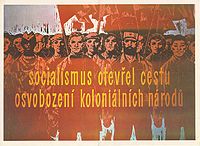 The New Imperialism period, with the scramble for Africa
and the Opium Wars, marked the zenith of European colonization. It also marked the acceleration of the trends that would end it. The extraordinary material demands of the conflict had spread economic change across the world (notably inflation), and the associated social pressures of "war imperialism" created both peasant unrest and a burgeoning middle class.
Economic growth
created stakeholders with their own demands, while racial issues meant these people clearly stood apart from the colonial middle-class and had to form their own group. The start of mass nationalism
, as a concept and practice, would fatally undermine the ideologies of imperialism.
There were, naturally, other factors, from agrarian change (and disaster – French Indochina
), changes or developments in religion (Buddhism
in Burma, Islam
in the Dutch East Indies
, marginally people like John Chilembwe
in Nyasaland
), and the impact of the depression of the 1930s.
The Great Depression
, despite the concentration of its impact on the industrialized world, was also exceptionally damaging in the rural colonies. Agricultural prices fell much harder and faster than those of industrial goods. From around 1925 until World War II
, the colonies suffered. The colonial powers concentrated on domestic issues, protectionism
and tariffs, disregarding the damage done to international trade flows. The colonies, almost all primary "cash crop
" producers, lost the majority of their export income and were forced away from the "open" complementary colonial economies to "closed" systems. While some areas returned to subsistence farming (British Malaya
) others diversified (India, West Africa
), and some began to industrialise. These economies would not fit the colonial straitjacket when efforts were made to renew the links. Further, the European-owned and -run plantation
s proved more vulnerable to extended deflation
than native capitalist
s, reducing the dominance of "white" farmers in colonial economies and making the European government
s and investors of the 1930s co-opt indigenous
elites — despite the implications for the future.
The efforts at colonial reform also hastened their end — notably the move from non-interventionist collaborative systems towards directed, disruptive, direct management to drive economic change. The creation of genuine bureaucratic government boosted the formation of indigenous bourgeoisie
. This was especially true in the British Empire
, which seemed less capable (or less ruthless) in controlling political nationalism. Driven by pragmatic demands of budgets and manpower the British made deals with the nationalist elites. They dealt with the white dominion
s, retained strategic resources at the cost of reducing direct control in Egypt
, and made numerous reforms in the British Raj
, culminating in the Government of India Act
(1935).
Despite these efforts though, the British Government continued to slowly lose their control of the Raj. The end of World War II allowed India, in addition to various other European colonies, to take advantage of the postwar chaos that had began to exist in Europe during the mid 1940s. Mohandas Karamchand Gandhi, India's independence movement leader, realized the advantage in conducting a peaceful resistance to the British Empire's attempts to retake control of their "crown jewel". By becoming a symbol of both peace and opposition to British imperialism, many Indian citizens began to view the British as the cause of India's violence leading to a new found sense of nationalism
among its population. With this new wave of Indian nationalism, Gandhi was eventually able to garner the support needed to push back the British and create an independent India in 1947.
Tropical Africa was only fully drawn into the colonial system at the end of the 19th century. Nevertheless, the Union of South Africa
which, by introducing rigid racial segregation
from 1913 was already catalyzing the anti-colonial political agitation of half the continent. While, in the north-east the continued independence of the Empire of Ethiopia remained a beacon of hope. Colonial inequities ranged between extremes, from British Kenya's dispossession of local farmers, to Belgium's massacres in the Congo, from entrenched Portuguese racism to the looting of Benin City. However, with the resistance wars of the 1900s barely over, new modernising forms of African Nationalism began to gain strength in the early 20th-century with the emergence of Pan-Africanism, as advocated by the Jamaican journalist Marcus Garvey
(1887–1940) whose widely distributed newspapers demanded swift abolition of European imperialism, as well as republicanism in Egypt. Kwame Nkrumah
(1909–1972) who was inspired by the works of Garvey led Ghana to independence from colonial rule, while the republican Nasser led Egypt to resist British occupation.
approached imperialism differently from the Great Powers and Japan. Much of its energy and rapidly expanding population was directed westward across the North America
n continent against American Indians
, Spain
, and Mexico
. With eventual assistance from the British Navy, its Monroe Doctrine
reserved the Americas as its sphere of interest, prohibiting other states (particularly Spain) from recolonizing the recently freed polities of Latin America
. Economic and political pressure, as well as assaults by filibusters
, were brought to bear, but Northern fears of the expansion of slavery into new territories restrained the United States from early expansion into Cuba
or Central America
. America's only African colony, Liberia
, was formed privately and achieved independence early. While the United States had few qualms about opening the markets of Japan, Korea, and China
by military force, it advocated an Open Door Policy
and opposed the direct division and colonization of those states.
Following the Civil War
and particularly during and after the presidency of Theodore Roosevelt
, direct intervention in Latin America and elsewhere expanded. The United States purchased Russian America from the tsar and accepted the offer of Hawaii
from rebel expatriates and seized several colonies from Spain
in 1898. Barred from annexing Cuba
outright by the Teller Amendment
, the U.S. established it as a client state
with obligations including the perpetual lease of Guantánamo Bay to the U.S. Navy. The attempt of the first governor to void the island's constitution and remain in power past the end of his term provoked a rebellion that provoked a reoccupation between 1906 and 1909, but this was again followed by devolution. Similarly, the McKinley administration, despite prosecuting the Philippine–American War against a native republic, set out that the Territory of the Philippine Islands was eventually granted independence.
Britain's 1895 attempt to reject the Monroe Doctrine during the Venezuela Crisis of 1895
, the Venezuela Crisis of 1902–1903
, and the establishment of the client state of Panama
in 1903 via gunboat diplomacy
, however, all necessitated the maintenance of Puerto Rico
as a naval base to secure shipping lanes to the Caribbean and the new canal zone
. In 1917, "Puerto Ricans were collectively made U.S. citizens" via the Jones Act
, and in 1952 the US Congress turned the territory into a commonwealth after ratifying the Constitution
born out of United States Public Law 600. The US government then declared the territory was no longer a colony and stopped transmitting information about Puerto Rico to the United Nations Decolonization Committee. As a result, the UN General Assembly removed Puerto Rico from the U.N. list of non-self-governing territories
. Dissatisfied with their new political status, Puerto Ricans turned to political referendums to let make their opinions known. Several internal plebiscites, non-binding upon the United States, proposing statehood
or independence for the island did not garnish a majority in 1967, 1993, and 1998. As a result of the UN not applying the full set of criteria which was enunciated in 1960 when it took favorable note of the cessation of transmission of information regarding the non-self-governing status of Puerto Rico, the nature of Puerto Rico's relationship with the U.S. continues to be the subject of ongoing debate in Puerto Rican politics, the United States Congress
, and the United Nations
.
The Monroe Doctrine received the Roosevelt Corollary
in 1904, providing that the United States had a right and obligation to intervene "in flagrant cases of such wrongdoing or impotence" that a nation in the Western Hemisphere became vulnerable to European control. In practice, this meant that the United States was led to act as a collections agent for European creditors by administering customs duties in the Dominican Republic
(1905–1941), Haiti
(1915–1934), and elsewhere. The intrusiveness and bad relations this engendered were somewhat checked by the Clark Memorandum
and renounced by President Franklin D. Roosevelt
's "Good Neighbor Policy
." The end of World War II saw America producing 46% of the world's GDP, but pouring billions of dollars into the Marshall Plan
and restoring independent (if anti-Communist) democracies in Japan
and West Germany
. The post-war period also saw America push hard to accelerate decolonialization and bring an end to the colonial empires of its Western allies, most importantly during the 1956 Suez Crisis
, but American military bases were established around the world and direct and indirect interventions continued in Korea
, Indochina
, Latin America (inter alia, the 1965 occupation of the Dominican Republic,) Africa, and the Middle East to oppose Communist invasions and insurgencies. Since the dissolution of the Soviet Union, the United States has been far less active in the Americas, but invaded Afghanistan
and Iraq following the September 11 attacks in 2001, establishing army and air bases in Central Asia
.
and Korea
. Pursuing a colonial policy comparable to those of European powers, Japan settled significant populations of ethnic Japanese in its colonies while simultaneously suppressing indigenous ethnic populations by enforcing the learning and use of the Japanese language
in schools. Other methods such as public interaction, and attempts to eradicate the use of Korean
, Hokkien, and Hakka among the indigenous peoples, were seen to be used.
Japan also set up the Imperial university
in Korea (Keijo Imperial University
) and Taiwan (Taihoku University) to compel education.
World War II gave the Japanese Empire occasion to conquer vast swaths of Asia, sweeping into China
and seizing the Western colonies of Vietnam
, Hong Kong
, the Philippines
, Burma, Malaya
, Timor
and Indonesia
among others, albeit only for the duration of the war. An estimated 20 million Chinese died during the Second Sino-Japanese War
(1931–1945). Following its surrender to the Allies
in 1945, Japan was deprived of all its colonies. Japan further claims that the southern Kuril Islands
are a small portion of its own national territory, colonized by the Soviet Union
.
the Great Mosque of Paris was constructed as recognition of these efforts, the French state had no intention to allow self-rule, let alone grant independence
to the colonized people. Thus, nationalism
in the colonies became stronger in between the two wars, leading to Abd el-Krim's Rif War
(1921–1925) in Morocco
and to the creation of Messali Hadj
's Star of North Africa in Algeria
in 1925. However, these movements would gain full potential only after World War II. The October 27, 1946 Constitution creating the Fourth Republic
substituted the French Union
to the colonial empire. On the night of March 29, 1947, a nationalist uprising in Madagascar
led the French government headed by Paul Ramadier
(Socialist
) to violent repression: one year of bitter fighting, in which 90,000 to 100,000 Malagasy died. On May 8, 1945, the Sétif massacre
took place in Algeria.
In 1946, the states of French Indochina
withdrew from the Union, leading to the Indochina War
(1946–54) against Ho Chi Minh
, who had been a co-founder of the French Communist Party
in 1920 and had founded the Vietminh in 1941. In 1956, Morocco and Tunisia
gained their independence, while the Algerian War
was raging (1954–1962). Similarly, a decade earlier, Laos
and Cambodia
achieved independence in order for the French to focus to keeping Vietnam
. With Charles de Gaulle
's return to power in 1958 amidst turmoil and threats of a right-wing coups d'état to protect "French Algeria", the decolonization was completed with the independence of Sub-Saharan Africa's colonies in 1960 and the March 19, 1962 Evian Accords
, which put an end to the Algerian war. The OAS
movement unsuccessfully tried to block the accords with a series of bombings, including an attempted assassination against Charles de Gaulle.
To this day, the Algerian war — officially called until the 1990s a "public order operation" — remains a trauma for both France and Algeria. Philosopher Paul Ricœur has spoken of the necessity of a "decolonization of memory", starting with the recognition of the 1961 Paris massacre during the Algerian war and the recognition of the decisive role of African and especially North African immigrant manpower in the Trente Glorieuses
post–World War II economic growth period. In the 1960s, due to economic needs for post-war reconstruction and rapid economic growth, French employers actively sought to recruit manpower from the colonies, explaining today's multiethnic population
.
under the influence of the Soviet Union, either by direct subversion of Western-leaning or -controlled governments or indirectly by influence of political leadership and support. Many of the revolutions of this time period were inspired or influenced in this way. The conflicts in Vietnam
, Nicaragua
, Congo
, and Sudan
, among others, have been characterized as such.
Most Soviet leaders expressed the Marxist-Leninist
view that imperialism
was the height of capitalism
, and generated a class-stratified society. It followed, then, that Soviet leadership would encourage independence movements in colonized territories, especially as the Cold War
progressed. Though this was the view expressed by their leaders, such interventions can be interpreted as the expansion of Soviet interests, not just as aiding the oppressed peoples of the world. Because so many of these wars of independence expanded into general Cold War conflicts, the United States also supported several such independence movements in opposition to Soviet interests.
Nikita Khrushchev
's famous shoe-banging incident
occurred in the context of a United Nations
debate on colonialism in 1960. After Khrushchev had decried western colonialism, Filipino delegate Lorenzo Sumulong
accused him of hypocrisy, claiming that the Soviet Union was at that time doing exactly the same thing to the countries of Eastern Europe
. Khrushchev then reportedly became enraged and theatrically banged his shoe on the table while berating Sumulong as a "toady of imperialism," though accounts of the incident differ.
During the Vietnam War, Communist countries supported anti-colonialist movements in various countries still under colonial administration through propaganda, developmental and economic assistance, and in some cases military aid. Notably among these were the support of armed rebel movements by Cuba
in Angola
, and the Soviet Union (as well as the People's Republic of China
) in Vietnam
.
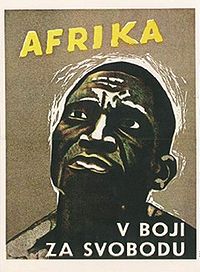 The term "Third World
" was coined by French demographer Alfred Sauvy
in 1952, on the model of the Third Estate, which, according to the Abbé Sieyès
, represented everything, but was nothing: "...because at the end this ignored, exploited, scorned Third World like the Third Estate, wants to become something too" (Sauvy). The emergence of this new political entity, in the frame of the Cold War
, was complex and painful. Several tentatives were made to organize newly independent states in order to oppose a common front towards both the US's and the USSR's influence on them, with the consequences of the Sino-Soviet split
already at works. Thus, the Non-Aligned Movement
constituted itself, around the main figures of Jawaharlal Nehru
, the leader of India, Sukarno
, the Indonesia
n president, Josip Broz Tito
the Communist leader of Yugoslavia
, and Gamal Abdel Nasser
, head of Egypt
who successfully opposed the French and British imperial powers during the 1956 Suez crisis
. After the 1954 Geneva Conference
which put an end to the French war against Ho Chi Minh
in Vietnam
, the 1955 Bandung Conference gathered Nasser, Nehru, Tito, Sukarno
, the leader of Indonesia
, and Zhou Enlai
, Premier of the People's Republic of China
. In 1960, the UN General Assembly voted the Declaration on the Granting of Independence to Colonial Countries and Peoples
. The next year, the Non-Aligned Movement was officially created in Belgrade
(1961), and was followed in 1964 by the creation of the United Nations Conference on Trade and Development
(UNCTAD) which tried to promote a New International Economic Order
(NIEO). The NIEO was opposed to the 1944 Bretton Woods system
, which had benefited the leading states which had created it, and remained in force until 1971 after the United States' suspension of convertibility from dollars to gold. The main tenets of the NIEO were:
 The UNCTAD however wasn't very effective in implementing this New International Economic Order (NIEO), and social and economic inequalities between industrialized countries and the Third World kept on growing through-out the 1960s until the 21st century. The 1973 oil crisis
which followed the Yom Kippur War
(October 1973) was triggered by the OPEC which decided an embargo against the US and Western countries, causing a fourfold increase in the price of oil, which lasted five months, starting on October 17, 1973, and ending on March 18, 1974. OPEC nations then agreed, on January 7, 1975, to raise crude oil prices by 10%. At that time, OPEC nations — including many who had recently nationalised their oil industries — joined the call for a New International Economic Order to be initiated by coalitions of primary producers. Concluding the First OPEC Summit in Algiers they called for stable and just commodity prices, an international food and agriculture program, technology transfer from North to South, and the democratization of the economic system. But industrialized countries quickly began to look for substitutes to OPEC petroleum, with the oil companies investing the majority of their research capital in the US and European countries or others, politically sure countries. The OPEC lost more and more influence on the world prices of oil.
The second oil crisis
occurred in the wake of the 1979 Iranian Revolution
. Then, the 1982 Latin American debt crisis
exploded in Mexico
first, then Argentina
and Brazil
, which proved unable to pay back their debts, jeopardizing the existence of the international economic system.
The 1990s were characterized by the prevalence of the Washington consensus
on neoliberal
policies, "structural adjustment
" and "shock therapies
" for the former Communist states.
Though the term "decolonization" is not well received among donors in international development
today, the root of the emerging emphasis on projects to promote "democracy, governance and human rights" by international donors and to promote "institution building" and a "human rights based approach
" to development is the same concept to achieve decolonization.
Weak Parliaments and Ministerial governments (where Ministries issue their own edicts and write laws rather than the Parliament) are holdovers of colonialism since political decisions were made outside the country, Parliament were at most for show, and the executive branch (then, foreign Governor Generals and foreign civil servants) held local power. Similarly, militaries are strong and civil control over them is weak; a holdover of military control exercised by a foreign military. In some cases, the governing systems in post-colonial countries could be viewed as ruling elites who succeeded in coup d'etats against the foreign colonial regime but never gave up the system of control.
Often the impact of colonialism is more subtle, with preferences for clothes (such as "blue" shirts of French officials and pith helmets), drugs (alcohol and tobacco that colonial governments introduced, often as a way to tax locals) and other cultural attributes remain.
Some experts in development, such as David Lempert, have suggested an opening of dialogues from the colonial powers on the systems they introduced and the harms that continue as a way of decolonizing in rights policy documents for the UN system and for Europe. First World countries often seem reluctant to engage in this form of decolonization, however, since they may benefit from the legacies of colonialism that they created, in contemporary trade and political relations.
Many of these assassinations are still unsolved cases as of 2010, but foreign power interference is undeniable in many of these cases — although others were for internal matters. To take only one case, the investigation concerning Mehdi Ben Barka is continuing to this day, and both France and the United States have refused to declassify files they acknowledge having in their possession The Phoenix Program
, a CIA program of assassination
during the Vietnam War
, should also be named.
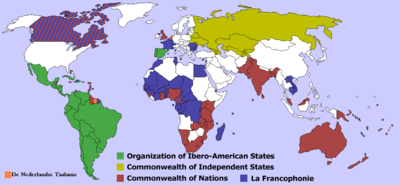 Due to a common history and culture, former colonial powers created institutions which more loosely associated their former colonies. Membership is voluntary, and in some cases can be revoked if a member state loses some objective criteria (usually a requirement for democratic governance). The organizations serve cultural, economic, and political purposes between the associated countries, although no such organization has become politically prominent as an entity in its own right.
argues that the post–World War II decolonization was brought about for economic reasons. In A Journey Through Economic Time, he writes, "The engine of economic well-being was now within and between the advanced industrial countries. Domestic economic growth
— as now measured and much discussed — came to be seen as far more important than the erstwhile colonial trade.... The economic effect in the United States
from the granting of independence to the Philippines
was unnoticeable, partly due to the Bell Trade Act
, which allowed American monopoly in the economy of the Philippines. The departure of India and Pakistan made small economic difference in the United Kingdom
. Dutch
economists calculated that the economic effect from the loss of the great Dutch empire in Indonesia
was compensated for by a couple of years or so of domestic post-war economic growth. The end of the colonial era is celebrated in the history books as a triumph of national aspiration in the former colonies and of benign good sense on the part of the colonial powers. Lurking beneath, as so often happens, was a strong current of economic interest — or in this case, disinterest."
In general, the release of the colonized caused little economic loss to the colonizers. Part of the reason for this was that major costs were eliminated while major benefits were obtained by alternate means. Decolonization allowed the colonizer to disclaim responsibility for the colonized. The colonizer no longer had the burden of obligation, financial or otherwise, to their colony. However, the colonizer continued to be able to obtain cheap goods and labor as well as economic benefits (see Suez Canal Crisis) from the former colonies. Financial, political and military pressure could still be used to achieve goals desired by the colonizer. Thus decolonization allowed the goals of colonization to be largely achieved, but without its burdens.
by France was particularly uneasy due to the large European and Sephardic Jewish population (see also pied noir), which largely evacuated to France when Algeria became independent. In Zimbabwe
, former Rhodesia
, president Robert Mugabe
has, starting in the 1990s, targeted white farmers and forcibly seized their property. In some cases, decolonisation is hardly possible or impossible because of the importance of the settler population or where the indigenous population is now in the minority; such is the case of the British population of the Cayman Islands
, the Russian population of Kazakhstan
, and the immigrant communities of the Americas.
Furthermore, note that some cases have been included that were not strictly colonized but rather protectorate, co-dominium, lease.... Changes subsequent to decolonization are usually not included; nor is the dissolution of the Soviet Union
.
Colonialism
Colonialism is the establishment, maintenance, acquisition and expansion of colonies in one territory by people from another territory. It is a process whereby the metropole claims sovereignty over the colony and the social structure, government, and economics of the colony are changed by...
, the unequal relation of polities
Polity
Polity is a form of government Aristotle developed in his search for a government that could be most easily incorporated and used by the largest amount of people groups, or states...
whereby one people or nation establishes and maintains dependent Territory (courial governments) over another. It can be understood politically (attaining independence
Independence
Independence is a condition of a nation, country, or state in which its residents and population, or some portion thereof, exercise self-government, and usually sovereignty, over its territory....
, autonomous home rule, union with the metropole
Metropole
The metropole, from the Greek Metropolis 'mother city' was the name given to the British metropolitan centre of the British Empire, i.e. the United Kingdom itself...
or another state) or culturally (removal of pernicious colonial effects.) The term refers particularly to the dismantlement, in the years after World War II
World War II
World War II, or the Second World War , was a global conflict lasting from 1939 to 1945, involving most of the world's nations—including all of the great powers—eventually forming two opposing military alliances: the Allies and the Axis...
, of the Neo-Imperial empires
New Imperialism
New Imperialism refers to the colonial expansion adopted by Europe's powers and, later, Japan and the United States, during the 19th and early 20th centuries; expansion took place from the French conquest of Algeria until World War I: approximately 1830 to 1914...
established prior to World War I
World War I
World War I , which was predominantly called the World War or the Great War from its occurrence until 1939, and the First World War or World War I thereafter, was a major war centred in Europe that began on 28 July 1914 and lasted until 11 November 1918...
throughout Africa
Scramble for Africa
The Scramble for Africa, also known as the Race for Africa or Partition of Africa was a process of invasion, occupation, colonization and annexation of African territory by European powers during the New Imperialism period, between 1881 and World War I in 1914...
and Asia
Imperialism in Asia
Imperialism in Asia traces its roots back to the late 15th century with a series of voyages that sought a sea passage to India in the hope of establishing direct trade between Europe and Asia in spices. Before 1500 European economies were largely self-sufficient, only supplemented by minor trade...
.
The United Nations Special Committee on Decolonization has stated that in the process of decolonization there is no alternative to the colonizer's allowance of self-determination
Self-determination
Self-determination is the principle in international law that nations have the right to freely choose their sovereignty and international political status with no external compulsion or external interference...
, but in practice decolonization may involve peaceful
Nonviolent revolution
A nonviolent revolution is a revolution using mostly campaigns of civil resistance, including various forms of nonviolent protest, to bring about the departure of governments seen as entrenched and authoritarian...
or violent resistance by the native population. It may be intramural or involve the intervention of foreign powers acting individually or through international bodies such as the United Nations
United Nations
The United Nations is an international organization whose stated aims are facilitating cooperation in international law, international security, economic development, social progress, human rights, and achievement of world peace...
. Although examples of decolonization can be found as early as the writings of Thucydides
Thucydides
Thucydides was a Greek historian and author from Alimos. His History of the Peloponnesian War recounts the 5th century BC war between Sparta and Athens to the year 411 BC...
, there have been several particularly active periods of decolonization in modern times. These are the breakup of the Spanish Empire in the nineteenth century; of the German
German Empire
The German Empire refers to Germany during the "Second Reich" period from the unification of Germany and proclamation of Wilhelm I as German Emperor on 18 January 1871, to 1918, when it became a federal republic after defeat in World War I and the abdication of the Emperor, Wilhelm II.The German...
, Austro-Hungarian
Austria-Hungary
Austria-Hungary , more formally known as the Kingdoms and Lands Represented in the Imperial Council and the Lands of the Holy Hungarian Crown of Saint Stephen, was a constitutional monarchic union between the crowns of the Austrian Empire and the Kingdom of Hungary in...
, Ottoman
Ottoman Empire
The Ottoman EmpireIt was usually referred to as the "Ottoman Empire", the "Turkish Empire", the "Ottoman Caliphate" or more commonly "Turkey" by its contemporaries...
, and Russian Empire
Russian Empire
The Russian Empire was a state that existed from 1721 until the Russian Revolution of 1917. It was the successor to the Tsardom of Russia and the predecessor of the Soviet Union...
s following World War I; of the British
British Empire
The British Empire comprised the dominions, colonies, protectorates, mandates and other territories ruled or administered by the United Kingdom. It originated with the overseas colonies and trading posts established by England in the late 16th and early 17th centuries. At its height, it was the...
, French
French colonial empire
The French colonial empire was the set of territories outside Europe that were under French rule primarily from the 17th century to the late 1960s. In the 19th and 20th centuries, the colonial empire of France was the second-largest in the world behind the British Empire. The French colonial empire...
, Dutch, and Italian colonial empires following World War II; of the Russian Empire successor union
Soviet Union
The Soviet Union , officially the Union of Soviet Socialist Republics , was a constitutionally socialist state that existed in Eurasia between 1922 and 1991....
following the Cold War
Cold War
The Cold War was the continuing state from roughly 1946 to 1991 of political conflict, military tension, proxy wars, and economic competition between the Communist World—primarily the Soviet Union and its satellite states and allies—and the powers of the Western world, primarily the United States...
; and others.
Methods and stages
Decolonization is a political process, frequently involving violence. In extreme circumstances, there is a war of independenceWar of Independence
A war of independence is a conflict occurring over a territory that has declared independence. Once the state that previously held the territory sends in military forces to assert its sovereignty or the native population clashes with the former occupier, a separatist rebellion has begun...
, sometimes following a revolution. More often, there is a dynamic cycle where negotiations fail, minor disturbances ensue resulting in suppression by the police and military forces, escalating into more violent revolts that lead to further negotiations until independence is granted. In rare cases, the actions of the native population are characterized by nonviolence
Nonviolence
Nonviolence has two meanings. It can refer, first, to a general philosophy of abstention from violence because of moral or religious principle It can refer to the behaviour of people using nonviolent action Nonviolence has two (closely related) meanings. (1) It can refer, first, to a general...
, with the Indian independence movement
Indian independence movement
The term Indian independence movement encompasses a wide area of political organisations, philosophies, and movements which had the common aim of ending first British East India Company rule, and then British imperial authority, in parts of South Asia...
led by Mohandas Karamchand Gandhi being one of the most notable examples, and the violence comes as active suppression from the occupying forces or as political opposition from forces representing minority local communities who feel threatened by the prospect of independence. For example, there was a war of independence in French Indochina
French Indochina
French Indochina was part of the French colonial empire in southeast Asia. A federation of the three Vietnamese regions, Tonkin , Annam , and Cochinchina , as well as Cambodia, was formed in 1887....
, while in some countries in French West Africa
French West Africa
French West Africa was a federation of eight French colonial territories in Africa: Mauritania, Senegal, French Sudan , French Guinea , Côte d'Ivoire , Upper Volta , Dahomey and Niger...
(excluding the Maghreb
Maghreb
The Maghreb is the region of Northwest Africa, west of Egypt. It includes five countries: Morocco, Algeria, Tunisia, Libya, and Mauritania and the disputed territory of Western Sahara...
countries) decolonization resulted from a combination of insurrection and negotiation. The process is only complete when the de facto government of the newly independent country is recognized as the de jure sovereign state
Sovereign state
A sovereign state, or simply, state, is a state with a defined territory on which it exercises internal and external sovereignty, a permanent population, a government, and the capacity to enter into relations with other sovereign states. It is also normally understood to be a state which is neither...
by the community of nations.
Independence is often difficult to achieve without the encouragement and practical support from one or more external parties. The motives for giving such aid are varied: nations of the same ethnic and/or religious stock may sympathize with oppressed groups, or a strong nation may attempt to destabilize a colony as a tactical move to weaken a rival or enemy colonizing power or to create space for its own sphere of influence; examples of this include British support of the Haitian Revolution
Haitian Revolution
The Haitian Revolution was a period of conflict in the French colony of Saint-Domingue, which culminated in the elimination of slavery there and the founding of the Haitian republic...
against France, and the Monroe Doctrine
Monroe Doctrine
The Monroe Doctrine is a policy of the United States introduced on December 2, 1823. It stated that further efforts by European nations to colonize land or interfere with states in North or South America would be viewed as acts of aggression requiring U.S. intervention...
of 1823, in which the United States warned the European powers not to interfere in the affairs of the newly independent states of the Western Hemisphere
Western Hemisphere
The Western Hemisphere or western hemisphere is mainly used as a geographical term for the half of the Earth that lies west of the Prime Meridian and east of the Antimeridian , the other half being called the Eastern Hemisphere.In this sense, the western hemisphere consists of the western portions...
.
As world opinion became more pro-emancipation following World War I
World War I
World War I , which was predominantly called the World War or the Great War from its occurrence until 1939, and the First World War or World War I thereafter, was a major war centred in Europe that began on 28 July 1914 and lasted until 11 November 1918...
, there was an institutionalised collective effort to advance the cause of emancipation through the League of Nations
League of Nations
The League of Nations was an intergovernmental organization founded as a result of the Paris Peace Conference that ended the First World War. It was the first permanent international organization whose principal mission was to maintain world peace...
. Under Article 22 of the Covenant of the League of Nations, a number of mandate
League of Nations mandate
A League of Nations mandate was a legal status for certain territories transferred from the control of one country to another following World War I, or the legal instruments that contained the internationally agreed-upon terms for administering the territory on behalf of the League...
s were created. The expressed intention was to prepare these countries for self-government, but are often interpreted as a mere redistribution of control over the former colonies of the defeated powers, mainly Germany
Germany
Germany , officially the Federal Republic of Germany , is a federal parliamentary republic in Europe. The country consists of 16 states while the capital and largest city is Berlin. Germany covers an area of 357,021 km2 and has a largely temperate seasonal climate...
and the Ottoman Empire
Ottoman Empire
The Ottoman EmpireIt was usually referred to as the "Ottoman Empire", the "Turkish Empire", the "Ottoman Caliphate" or more commonly "Turkey" by its contemporaries...
. This reassignment work continued through the United Nations
United Nations
The United Nations is an international organization whose stated aims are facilitating cooperation in international law, international security, economic development, social progress, human rights, and achievement of world peace...
, with a similar system of trust territories
United Nations Trust Territories
United Nations trust territories were the successors of the remaining League of Nations mandates and came into being when the League of Nations ceased to exist in 1946. All of the trust territories were administered through the UN Trusteeship Council...
created to adjust control over both former colonies and mandated territories.
In referendums, some colonized populations have chosen to retain their colonial status, such as Gibraltar
Gibraltar
Gibraltar is a British overseas territory located on the southern end of the Iberian Peninsula at the entrance of the Mediterranean. A peninsula with an area of , it has a northern border with Andalusia, Spain. The Rock of Gibraltar is the major landmark of the region...
and French Guiana
French Guiana
French Guiana is an overseas region of France, consisting of a single overseas department located on the northern Atlantic coast of South America. It has borders with two nations, Brazil to the east and south, and Suriname to the west...
. There are even examples, such as the Falklands War
Falklands War
The Falklands War , also called the Falklands Conflict or Falklands Crisis, was fought in 1982 between Argentina and the United Kingdom over the disputed Falkland Islands and South Georgia and the South Sandwich Islands...
, in which an Imperial power goes to war to defend the right of a colony to continue to be a colony. Colonial powers have sometimes promoted decolonization in order to shed the financial, military and other burdens that tend to grow in those colonies where the colonial regimes have become more benign.
Decolonization is rarely achieved through a single historical act, but rather progresses through one or more stages of emancipation, each of which can be offered or fought for: these can include the introduction of elected representatives (advisory or voting; minority or majority or even exclusive), degrees of autonomy or self-rule. Thus, the final phase of decolonisation may in fact concern little more than handing over responsibility for foreign relations and security, and soliciting de jure recognition for the new sovereignty
Sovereignty
Sovereignty is the quality of having supreme, independent authority over a geographic area, such as a territory. It can be found in a power to rule and make law that rests on a political fact for which no purely legal explanation can be provided...
. But, even following the recognition of statehood, a degree of continuity can be maintained through bilateral treaties between now equal governments involving practicalities such as military training, mutual protection pacts, or even a garrison and/or military bases.
There is some debate over whether or not the Americas
Americas
The Americas, or America , are lands in the Western hemisphere, also known as the New World. In English, the plural form the Americas is often used to refer to the landmasses of North America and South America with their associated islands and regions, while the singular form America is primarily...
can be considered decolonized, as it was the colonist and their descendants who revolted and declared their independence instead of the indigenous peoples
Indigenous peoples of the Americas
The indigenous peoples of the Americas are the pre-Columbian inhabitants of North and South America, their descendants and other ethnic groups who are identified with those peoples. Indigenous peoples are known in Canada as Aboriginal peoples, and in the United States as Native Americans...
, as is usually the case. Furthermore, included in this list of states where "decolonization" has not occurred as per the ideas reflected above are Australia, New Zealand.
Decolonization of the Spanish Americas
Decolonization of the Ottoman Empire
A number of peoples (mainly ChristianChristian
A Christian is a person who adheres to Christianity, an Abrahamic, monotheistic religion based on the life and teachings of Jesus of Nazareth as recorded in the Canonical gospels and the letters of the New Testament...
s in the Balkans
Balkans
The Balkans is a geopolitical and cultural region of southeastern Europe...
) previously conquered by the Ottoman Empire
Ottoman Empire
The Ottoman EmpireIt was usually referred to as the "Ottoman Empire", the "Turkish Empire", the "Ottoman Caliphate" or more commonly "Turkey" by its contemporaries...
were able to achieve independence in the nineteenth century, a process that peaked at the time of the Ottoman defeat in the Russo-Turkish War of 1877-78.
Egypt
In the wake of the 1798 French Invasion of EgyptFrench Invasion of Egypt
The Egyptian Campaign was Napoleon Bonaparte's campaign in "The Orient", ostensibly to protect French trade interests, undermine Britain's access to India, and to establish scientific enterprise in the region...
and its subsequent expulsion in 1801, the commander of an Albanian regiment, Muhammad Ali
Muhammad Ali of Egypt
Muhammad Ali Pasha al-Mas'ud ibn Agha was a commander in the Ottoman army, who became Wāli, and self-declared Khedive of Egypt and Sudan...
, was able to gain control of Egypt
Egypt Province, Ottoman Empire
Egypt was conquered by the Ottoman Empire in 1517, following the Ottoman–Mamluk War and the loss of Syria to the Ottomans in 1516. Egypt was administrated as an eyalet of the Ottoman Empire from 1517 until 1867, with an interruption during the French occupation of 1798 to 1801.Egypt was always a...
. Although he was acknowledged by the Sultan
Selim III
Selim III was the reform-minded Sultan of the Ottoman Empire from 1789 to 1807. The Janissaries eventually deposed and imprisoned him, and placed his cousin Mustafa on the throne as Mustafa IV...
in Constantinople
Istanbul
Istanbul , historically known as Byzantium and Constantinople , is the largest city of Turkey. Istanbul metropolitan province had 13.26 million people living in it as of December, 2010, which is 18% of Turkey's population and the 3rd largest metropolitan area in Europe after London and...
in 1805 as his pasha
Pasha
Pasha or pascha, formerly bashaw, was a high rank in the Ottoman Empire political system, typically granted to governors, generals and dignitaries. As an honorary title, Pasha, in one of its various ranks, is equivalent to the British title of Lord, and was also one of the highest titles in...
, Muhammad Ali was in reality monarch of a practically sovereign state.
Greece
The Greek War of Independence (1821—1829) was fought to liberate Greece from a centuries-long OttomanOttoman Empire
The Ottoman EmpireIt was usually referred to as the "Ottoman Empire", the "Turkish Empire", the "Ottoman Caliphate" or more commonly "Turkey" by its contemporaries...
occupation. Independence was secured by the intervention of the British and French navies
French Navy
The French Navy, officially the Marine nationale and often called La Royale is the maritime arm of the French military. It includes a full range of fighting vessels, from patrol boats to a nuclear powered aircraft carrier and 10 nuclear-powered submarines, four of which are capable of launching...
and the French
French Army
The French Army, officially the Armée de Terre , is the land-based and largest component of the French Armed Forces.As of 2010, the army employs 123,100 regulars, 18,350 part-time reservists and 7,700 Legionnaires. All soldiers are professionals, following the suspension of conscription, voted in...
and Russian armies
Imperial Russian Army
The Imperial Russian Army was the land armed force of the Russian Empire, active from around 1721 to the Russian Revolution of 1917. In the early 1850s, the Russian army consisted of around 938,731 regular soldiers and 245,850 irregulars . Until the time of military reform of Dmitry Milyutin in...
, but Greece was limited to an area including perhaps only one-third of the Turkish Greeks. The war also ended many of the privileges of the Phanariot Greeks of Constantinople
Istanbul
Istanbul , historically known as Byzantium and Constantinople , is the largest city of Turkey. Istanbul metropolitan province had 13.26 million people living in it as of December, 2010, which is 18% of Turkey's population and the 3rd largest metropolitan area in Europe after London and...
and saw the Great Powers impose a foreign dynasty
Otto of Greece
Otto, Prince of Bavaria, then Othon, King of Greece was made the first modern King of Greece in 1832 under the Convention of London, whereby Greece became a new independent kingdom under the protection of the Great Powers .The second son of the philhellene King Ludwig I of Bavaria, Otto ascended...
over the previously self-proclaimed Hellenic Republic
First Hellenic Republic
The First Hellenic Republic is a name used to refer to the provisional Greek state during the Greek War of Independence against the Ottoman Empire...
.
Bulgaria
Following a failed Bulgarian revoltApril Uprising
The April Uprising was an insurrection organised by the Bulgarians in the Ottoman Empire from April to May 1876, which indirectly resulted in the re-establishment of Bulgaria as an autonomous nation in 1878...
in 1876, the subsequent Russo-Turkish war ended with the provisional Treaty of San Stefano
Treaty of San Stefano
The Preliminary Treaty of San Stefano was a treaty between Russia and the Ottoman Empire signed at the end of the Russo-Turkish War, 1877–78...
established a huge new realm of Bulgaria including most of Macedonia
Macedonia (region)
Macedonia is a geographical and historical region of the Balkan peninsula in southeastern Europe. Its boundaries have changed considerably over time, but nowadays the region is considered to include parts of five Balkan countries: Greece, the Republic of Macedonia, Bulgaria, Albania, Serbia, as...
and Thrace. The final 1878 Treaty of Berlin
Treaty of Berlin, 1878
The Treaty of Berlin was the final act of the Congress of Berlin , by which the United Kingdom, Austria-Hungary, France, Germany, Italy, Russia and the Ottoman Empire under Sultan Abdul Hamid II revised the Treaty of San Stefano signed on March 3 of the same year...
allowed the other Great Powers to limit the size of the new Russian client state
Client state
Client state is one of several terms used to describe the economic, political and/or military subordination of one state to a more powerful state in international affairs...
and even briefly divided this rump state in two, Bulgaria and Eastern Rumelia
Eastern Rumelia
Eastern Rumelia or Eastern Roumelia was an administratively autonomous province in the Ottoman Empire and Principality of Bulgaria from 1878 to 1908. It was under full Bulgarian control from 1885 on, when it willingly united with the tributary Principality of Bulgaria after a bloodless revolution...
, but the irredentist
Irredentism
Irredentism is any position advocating annexation of territories administered by another state on the grounds of common ethnicity or prior historical possession, actual or alleged. Some of these movements are also called pan-nationalist movements. It is a feature of identity politics and cultural...
claims from the first treaty would direct Bulgarian claims through the first
First Balkan War
The First Balkan War, which lasted from October 1912 to May 1913, pitted the Balkan League against the Ottoman Empire. The combined armies of the Balkan states overcame the numerically inferior and strategically disadvantaged Ottoman armies and achieved rapid success...
and second Balkan War
Second Balkan War
The Second Balkan War was a conflict which broke out when Bulgaria, dissatisfied with its share of the spoils of the First Balkan War, attacked its former allies, Serbia and Greece, on 29 June 1913. Bulgaria had a prewar agreement about the division of region of Macedonia...
s and both World Wars.
Romania
Romania fought on the Russian side in the Russo-Turkish War and in the 1878 Treaty of BerlinTreaty of Berlin, 1878
The Treaty of Berlin was the final act of the Congress of Berlin , by which the United Kingdom, Austria-Hungary, France, Germany, Italy, Russia and the Ottoman Empire under Sultan Abdul Hamid II revised the Treaty of San Stefano signed on March 3 of the same year...
, Romania was recognized as an independent
Romanian War of Independence
The Romanian War of Independence is the name used in Romanian historiography to refer to the 1877-1878 Russo-Turkish war, following which Romania, fighting on the Russian side, gained independence from the Ottoman Empire...
state by the Great Powers.
Serbia
Decades of armed and unarmed struggle ended with the recognition of SerbiaSerbia
Serbia , officially the Republic of Serbia , is a landlocked country located at the crossroads of Central and Southeast Europe, covering the southern part of the Carpathian basin and the central part of the Balkans...
n independence from the Ottoman Empire at the Congress of Berlin
Congress of Berlin
The Congress of Berlin was a meeting of the European Great Powers' and the Ottoman Empire's leading statesmen in Berlin in 1878. In the wake of the Russo-Turkish War of 1877–78, the meeting's aim was to reorganize the countries of the Balkans...
in 1878.
Montenegro
The independence of the Principality of MontenegroPrincipality of Montenegro
The Principality of Montenegro was a former realm in Southeastern Europe. It existed from 13 March 1852 to 28 August 1910. It was then proclaimed a kingdom by Knjaz Nikola, who then became king....
from the Ottoman Empire was recognized at the congress of Berlin
Congress of Berlin
The Congress of Berlin was a meeting of the European Great Powers' and the Ottoman Empire's leading statesmen in Berlin in 1878. In the wake of the Russo-Turkish War of 1877–78, the meeting's aim was to reorganize the countries of the Balkans...
in 1878.
Western European colonial powers
Scramble for Africa
The Scramble for Africa, also known as the Race for Africa or Partition of Africa was a process of invasion, occupation, colonization and annexation of African territory by European powers during the New Imperialism period, between 1881 and World War I in 1914...
and the Opium Wars, marked the zenith of European colonization. It also marked the acceleration of the trends that would end it. The extraordinary material demands of the conflict had spread economic change across the world (notably inflation), and the associated social pressures of "war imperialism" created both peasant unrest and a burgeoning middle class.
Economic growth
Economic growth
In economics, economic growth is defined as the increasing capacity of the economy to satisfy the wants of goods and services of the members of society. Economic growth is enabled by increases in productivity, which lowers the inputs for a given amount of output. Lowered costs increase demand...
created stakeholders with their own demands, while racial issues meant these people clearly stood apart from the colonial middle-class and had to form their own group. The start of mass nationalism
Nationalism
Nationalism is a political ideology that involves a strong identification of a group of individuals with a political entity defined in national terms, i.e. a nation. In the 'modernist' image of the nation, it is nationalism that creates national identity. There are various definitions for what...
, as a concept and practice, would fatally undermine the ideologies of imperialism.
There were, naturally, other factors, from agrarian change (and disaster – French Indochina
French Indochina
French Indochina was part of the French colonial empire in southeast Asia. A federation of the three Vietnamese regions, Tonkin , Annam , and Cochinchina , as well as Cambodia, was formed in 1887....
), changes or developments in religion (Buddhism
Buddhism
Buddhism is a religion and philosophy encompassing a variety of traditions, beliefs and practices, largely based on teachings attributed to Siddhartha Gautama, commonly known as the Buddha . The Buddha lived and taught in the northeastern Indian subcontinent some time between the 6th and 4th...
in Burma, Islam
Islam
Islam . The most common are and . : Arabic pronunciation varies regionally. The first vowel ranges from ~~. The second vowel ranges from ~~~...
in the Dutch East Indies
Dutch East Indies
The Dutch East Indies was a Dutch colony that became modern Indonesia following World War II. It was formed from the nationalised colonies of the Dutch East India Company, which came under the administration of the Netherlands government in 1800....
, marginally people like John Chilembwe
John Chilembwe
Reverend John Chilembwe was a Baptist educator and an early figure in resistance to colonialism in Nyasaland, now Malawi. Today John Chilembwe is celebrated as a hero for independence, and John Chilembwe Day is observed annually on January 15 in Malawi.-Early Life and Education:Chilembwe attended...
in Nyasaland
Malawi
The Republic of Malawi is a landlocked country in southeast Africa that was formerly known as Nyasaland. It is bordered by Zambia to the northwest, Tanzania to the northeast, and Mozambique on the east, south and west. The country is separated from Tanzania and Mozambique by Lake Malawi. Its size...
), and the impact of the depression of the 1930s.
The Great Depression
Great Depression
The Great Depression was a severe worldwide economic depression in the decade preceding World War II. The timing of the Great Depression varied across nations, but in most countries it started in about 1929 and lasted until the late 1930s or early 1940s...
, despite the concentration of its impact on the industrialized world, was also exceptionally damaging in the rural colonies. Agricultural prices fell much harder and faster than those of industrial goods. From around 1925 until World War II
World War II
World War II, or the Second World War , was a global conflict lasting from 1939 to 1945, involving most of the world's nations—including all of the great powers—eventually forming two opposing military alliances: the Allies and the Axis...
, the colonies suffered. The colonial powers concentrated on domestic issues, protectionism
Protectionism
Protectionism is the economic policy of restraining trade between states through methods such as tariffs on imported goods, restrictive quotas, and a variety of other government regulations designed to allow "fair competition" between imports and goods and services produced domestically.This...
and tariffs, disregarding the damage done to international trade flows. The colonies, almost all primary "cash crop
Cash crop
In agriculture, a cash crop is a crop which is grown for profit.The term is used to differentiate from subsistence crops, which are those fed to the producer's own livestock or grown as food for the producer's family...
" producers, lost the majority of their export income and were forced away from the "open" complementary colonial economies to "closed" systems. While some areas returned to subsistence farming (British Malaya
British Malaya
British Malaya loosely described a set of states on the Malay Peninsula and the Island of Singapore that were brought under British control between the 18th and the 20th centuries...
) others diversified (India, West Africa
West Africa
West Africa or Western Africa is the westernmost region of the African continent. Geopolitically, the UN definition of Western Africa includes the following 16 countries and an area of approximately 5 million square km:-Flags of West Africa:...
), and some began to industrialise. These economies would not fit the colonial straitjacket when efforts were made to renew the links. Further, the European-owned and -run plantation
Plantation
A plantation is a long artificially established forest, farm or estate, where crops are grown for sale, often in distant markets rather than for local on-site consumption...
s proved more vulnerable to extended deflation
Deflation (economics)
In economics, deflation is a decrease in the general price level of goods and services. Deflation occurs when the inflation rate falls below 0% . This should not be confused with disinflation, a slow-down in the inflation rate...
than native capitalist
Capitalism
Capitalism is an economic system that became dominant in the Western world following the demise of feudalism. There is no consensus on the precise definition nor on how the term should be used as a historical category...
s, reducing the dominance of "white" farmers in colonial economies and making the European government
Government
Government refers to the legislators, administrators, and arbitrators in the administrative bureaucracy who control a state at a given time, and to the system of government by which they are organized...
s and investors of the 1930s co-opt indigenous
Indigenous peoples
Indigenous peoples are ethnic groups that are defined as indigenous according to one of the various definitions of the term, there is no universally accepted definition but most of which carry connotations of being the "original inhabitants" of a territory....
elites — despite the implications for the future.
The efforts at colonial reform also hastened their end — notably the move from non-interventionist collaborative systems towards directed, disruptive, direct management to drive economic change. The creation of genuine bureaucratic government boosted the formation of indigenous bourgeoisie
Bourgeoisie
In sociology and political science, bourgeoisie describes a range of groups across history. In the Western world, between the late 18th century and the present day, the bourgeoisie is a social class "characterized by their ownership of capital and their related culture." A member of the...
. This was especially true in the British Empire
British Empire
The British Empire comprised the dominions, colonies, protectorates, mandates and other territories ruled or administered by the United Kingdom. It originated with the overseas colonies and trading posts established by England in the late 16th and early 17th centuries. At its height, it was the...
, which seemed less capable (or less ruthless) in controlling political nationalism. Driven by pragmatic demands of budgets and manpower the British made deals with the nationalist elites. They dealt with the white dominion
Dominion
A dominion, often Dominion, refers to one of a group of autonomous polities that were nominally under British sovereignty, constituting the British Empire and British Commonwealth, beginning in the latter part of the 19th century. They have included Canada, Australia, New Zealand, Newfoundland,...
s, retained strategic resources at the cost of reducing direct control in Egypt
Egypt
Egypt , officially the Arab Republic of Egypt, Arabic: , is a country mainly in North Africa, with the Sinai Peninsula forming a land bridge in Southwest Asia. Egypt is thus a transcontinental country, and a major power in Africa, the Mediterranean Basin, the Middle East and the Muslim world...
, and made numerous reforms in the British Raj
British Raj
British Raj was the British rule in the Indian subcontinent between 1858 and 1947; The term can also refer to the period of dominion...
, culminating in the Government of India Act
Government of India Act 1935
The Government of India Act 1935 was originally passed in August 1935 , and is said to have been the longest Act of Parliament ever enacted by that time. Because of its length, the Act was retroactively split by the Government of India Act 1935 into two separate Acts:# The Government of India...
(1935).
Despite these efforts though, the British Government continued to slowly lose their control of the Raj. The end of World War II allowed India, in addition to various other European colonies, to take advantage of the postwar chaos that had began to exist in Europe during the mid 1940s. Mohandas Karamchand Gandhi, India's independence movement leader, realized the advantage in conducting a peaceful resistance to the British Empire's attempts to retake control of their "crown jewel". By becoming a symbol of both peace and opposition to British imperialism, many Indian citizens began to view the British as the cause of India's violence leading to a new found sense of nationalism
Nationalist Movements in India
The Nationalist Movements in India were organised mass movements emphasising and raising questions concerning the interests of the people of India. In most of these movements, people were themselves encouraged to take action. Due to several factors, these movements failed to win Independence for...
among its population. With this new wave of Indian nationalism, Gandhi was eventually able to garner the support needed to push back the British and create an independent India in 1947.
Tropical Africa was only fully drawn into the colonial system at the end of the 19th century. Nevertheless, the Union of South Africa
Union of South Africa
The Union of South Africa is the historic predecessor to the present-day Republic of South Africa. It came into being on 31 May 1910 with the unification of the previously separate colonies of the Cape, Natal, Transvaal and the Orange Free State...
which, by introducing rigid racial segregation
Racial segregation
Racial segregation is the separation of humans into racial groups in daily life. It may apply to activities such as eating in a restaurant, drinking from a water fountain, using a public toilet, attending school, going to the movies, or in the rental or purchase of a home...
from 1913 was already catalyzing the anti-colonial political agitation of half the continent. While, in the north-east the continued independence of the Empire of Ethiopia remained a beacon of hope. Colonial inequities ranged between extremes, from British Kenya's dispossession of local farmers, to Belgium's massacres in the Congo, from entrenched Portuguese racism to the looting of Benin City. However, with the resistance wars of the 1900s barely over, new modernising forms of African Nationalism began to gain strength in the early 20th-century with the emergence of Pan-Africanism, as advocated by the Jamaican journalist Marcus Garvey
Marcus Garvey
Marcus Mosiah Garvey, Jr., ONH was a Jamaican publisher, journalist, entrepreneur, and orator who was a staunch proponent of the Black Nationalism and Pan-Africanism movements, to which end he founded the Universal Negro Improvement Association and African Communities League...
(1887–1940) whose widely distributed newspapers demanded swift abolition of European imperialism, as well as republicanism in Egypt. Kwame Nkrumah
Kwame Nkrumah
Kwame Nkrumah was the leader of Ghana and its predecessor state, the Gold Coast, from 1952 to 1966. Overseeing the nation's independence from British colonial rule in 1957, Nkrumah was the first President of Ghana and the first Prime Minister of Ghana...
(1909–1972) who was inspired by the works of Garvey led Ghana to independence from colonial rule, while the republican Nasser led Egypt to resist British occupation.
United States
A former colony itself, the United StatesUnited States
The United States of America is a federal constitutional republic comprising fifty states and a federal district...
approached imperialism differently from the Great Powers and Japan. Much of its energy and rapidly expanding population was directed westward across the North America
North America
North America is a continent wholly within the Northern Hemisphere and almost wholly within the Western Hemisphere. It is also considered a northern subcontinent of the Americas...
n continent against American Indians
Indigenous peoples of the Americas
The indigenous peoples of the Americas are the pre-Columbian inhabitants of North and South America, their descendants and other ethnic groups who are identified with those peoples. Indigenous peoples are known in Canada as Aboriginal peoples, and in the United States as Native Americans...
, Spain
Spanish Empire
The Spanish Empire comprised territories and colonies administered directly by Spain in Europe, in America, Africa, Asia and Oceania. It originated during the Age of Exploration and was therefore one of the first global empires. At the time of Habsburgs, Spain reached the peak of its world power....
, and Mexico
Mexico
The United Mexican States , commonly known as Mexico , is a federal constitutional republic in North America. It is bordered on the north by the United States; on the south and west by the Pacific Ocean; on the southeast by Guatemala, Belize, and the Caribbean Sea; and on the east by the Gulf of...
. With eventual assistance from the British Navy, its Monroe Doctrine
Monroe Doctrine
The Monroe Doctrine is a policy of the United States introduced on December 2, 1823. It stated that further efforts by European nations to colonize land or interfere with states in North or South America would be viewed as acts of aggression requiring U.S. intervention...
reserved the Americas as its sphere of interest, prohibiting other states (particularly Spain) from recolonizing the recently freed polities of Latin America
Latin America
Latin America is a region of the Americas where Romance languages – particularly Spanish and Portuguese, and variably French – are primarily spoken. Latin America has an area of approximately 21,069,500 km² , almost 3.9% of the Earth's surface or 14.1% of its land surface area...
. Economic and political pressure, as well as assaults by filibusters
Filibuster (military)
A filibuster, or freebooter, is someone who engages in an unauthorized military expedition into a foreign country to foment or support a revolution...
, were brought to bear, but Northern fears of the expansion of slavery into new territories restrained the United States from early expansion into Cuba
Cuba
The Republic of Cuba is an island nation in the Caribbean. The nation of Cuba consists of the main island of Cuba, the Isla de la Juventud, and several archipelagos. Havana is the largest city in Cuba and the country's capital. Santiago de Cuba is the second largest city...
or Central America
Central America
Central America is the central geographic region of the Americas. It is the southernmost, isthmian portion of the North American continent, which connects with South America on the southeast. When considered part of the unified continental model, it is considered a subcontinent...
. America's only African colony, Liberia
Liberia
Liberia , officially the Republic of Liberia, is a country in West Africa. It is bordered by Sierra Leone on the west, Guinea on the north and Côte d'Ivoire on the east. Liberia's coastline is composed of mostly mangrove forests while the more sparsely populated inland consists of forests that open...
, was formed privately and achieved independence early. While the United States had few qualms about opening the markets of Japan, Korea, and China
China Relief Expedition
The China Relief Expedition was the name of an expedition in China undertaken by the United States Armed Forces to the rescue of United States citizens, European nationals, and other foreign nationals during the latter years of the Boxer Rebellion, which lasted from between 1898 and 1901...
by military force, it advocated an Open Door Policy
Open Door Policy
The Open Door Policy is a concept in foreign affairs, which usually refers to the policy in 1899 allowing multiple Imperial powers access to China, with none of them in control of that country. As a theory, the Open Door Policy originates with British commercial practice, as was reflected in...
and opposed the direct division and colonization of those states.
Following the Civil War
American Civil War
The American Civil War was a civil war fought in the United States of America. In response to the election of Abraham Lincoln as President of the United States, 11 southern slave states declared their secession from the United States and formed the Confederate States of America ; the other 25...
and particularly during and after the presidency of Theodore Roosevelt
Theodore Roosevelt
Theodore "Teddy" Roosevelt was the 26th President of the United States . He is noted for his exuberant personality, range of interests and achievements, and his leadership of the Progressive Movement, as well as his "cowboy" persona and robust masculinity...
, direct intervention in Latin America and elsewhere expanded. The United States purchased Russian America from the tsar and accepted the offer of Hawaii
Territory of Hawaii
The Territory of Hawaii or Hawaii Territory was an organized incorporated territory of the United States that existed from July 7, 1898, until August 21, 1959, when its territory, with the exception of Johnston Atoll, was admitted to the Union as the fiftieth U.S. state, the State of Hawaii.The U.S...
from rebel expatriates and seized several colonies from Spain
Spain
Spain , officially the Kingdom of Spain languages]] under the European Charter for Regional or Minority Languages. In each of these, Spain's official name is as follows:;;;;;;), is a country and member state of the European Union located in southwestern Europe on the Iberian Peninsula...
in 1898. Barred from annexing Cuba
Cuba
The Republic of Cuba is an island nation in the Caribbean. The nation of Cuba consists of the main island of Cuba, the Isla de la Juventud, and several archipelagos. Havana is the largest city in Cuba and the country's capital. Santiago de Cuba is the second largest city...
outright by the Teller Amendment
Teller Amendment
The Teller Amendment was an amendment to a joint resolution of the United States Congress, enacted on April 20, 1898, in reply to President William McKinley's War Message. It placed a condition of the United States military in Cuba. According to the clause, the U.S...
, the U.S. established it as a client state
Client state
Client state is one of several terms used to describe the economic, political and/or military subordination of one state to a more powerful state in international affairs...
with obligations including the perpetual lease of Guantánamo Bay to the U.S. Navy. The attempt of the first governor to void the island's constitution and remain in power past the end of his term provoked a rebellion that provoked a reoccupation between 1906 and 1909, but this was again followed by devolution. Similarly, the McKinley administration, despite prosecuting the Philippine–American War against a native republic, set out that the Territory of the Philippine Islands was eventually granted independence.
Britain's 1895 attempt to reject the Monroe Doctrine during the Venezuela Crisis of 1895
Venezuela Crisis of 1895
The Venezuela Crisis of 1895 occurred over Venezuela's longstanding dispute with the United Kingdom about the territory of Guayana Esequiba, which Britain claimed as part of British Guiana and Venezuela saw as Venezuelan territory...
, the Venezuela Crisis of 1902–1903
Venezuela Crisis of 1902–1903
The Venezuela Crisis of 1902 was a naval blockade from December of 1902 to February of 1903 imposed against Venezuela by Britain, Germany and Italy over President Cipriano Castro's refusal to pay foreign debts and damages suffered by European citizens in a recent Venezuelan civil war...
, and the establishment of the client state of Panama
Panama
Panama , officially the Republic of Panama , is the southernmost country of Central America. Situated on the isthmus connecting North and South America, it is bordered by Costa Rica to the northwest, Colombia to the southeast, the Caribbean Sea to the north and the Pacific Ocean to the south. The...
in 1903 via gunboat diplomacy
Gunboat diplomacy
In international politics, gunboat diplomacy refers to the pursuit of foreign policy objectives with the aid of conspicuous displays of military power — implying or constituting a direct threat of warfare, should terms not be agreeable to the superior force....
, however, all necessitated the maintenance of Puerto Rico
Puerto Rico
Puerto Rico , officially the Commonwealth of Puerto Rico , is an unincorporated territory of the United States, located in the northeastern Caribbean, east of the Dominican Republic and west of both the United States Virgin Islands and the British Virgin Islands.Puerto Rico comprises an...
as a naval base to secure shipping lanes to the Caribbean and the new canal zone
Panama Canal Zone
The Panama Canal Zone was a unorganized U.S. territory located within the Republic of Panama, consisting of the Panama Canal and an area generally extending 5 miles on each side of the centerline, but excluding Panama City and Colón, which otherwise would have been partly within the limits of...
. In 1917, "Puerto Ricans were collectively made U.S. citizens" via the Jones Act
Jones-Shafroth Act
The Jones–Shafroth Act was a 1917 Act of the United States Congress by which Puerto Ricans were collectively made U.S. citizens, the people of Puerto Rico were empowered to have a popularly-elected Senate, established a bill of rights, and authorized the election of a Resident Commissioner to a...
, and in 1952 the US Congress turned the territory into a commonwealth after ratifying the Constitution
Constitution of Puerto Rico
The Constitution of the Commonwealth of Puerto Rico is the controlling government document of the Commonwealth of Puerto Rico. It is composed of nine articles detailing the structure of the government as well as the function of several of its institutions. The document also contains an extensive...
born out of United States Public Law 600. The US government then declared the territory was no longer a colony and stopped transmitting information about Puerto Rico to the United Nations Decolonization Committee. As a result, the UN General Assembly removed Puerto Rico from the U.N. list of non-self-governing territories
United Nations list of Non-Self-Governing Territories
The United Nations list of Non-Self-Governing Territories is a list of countries that, according to the United Nations, are non-decolonized. The list was initially prepared in 1946 pursuant to Chapter XI of the United Nations Charter, and has been updated by the General Assembly on recommendation...
. Dissatisfied with their new political status, Puerto Ricans turned to political referendums to let make their opinions known. Several internal plebiscites, non-binding upon the United States, proposing statehood
U.S. state
A U.S. state is any one of the 50 federated states of the United States of America that share sovereignty with the federal government. Because of this shared sovereignty, an American is a citizen both of the federal entity and of his or her state of domicile. Four states use the official title of...
or independence for the island did not garnish a majority in 1967, 1993, and 1998. As a result of the UN not applying the full set of criteria which was enunciated in 1960 when it took favorable note of the cessation of transmission of information regarding the non-self-governing status of Puerto Rico, the nature of Puerto Rico's relationship with the U.S. continues to be the subject of ongoing debate in Puerto Rican politics, the United States Congress
United States Congress
The United States Congress is the bicameral legislature of the federal government of the United States, consisting of the Senate and the House of Representatives. The Congress meets in the United States Capitol in Washington, D.C....
, and the United Nations
United Nations
The United Nations is an international organization whose stated aims are facilitating cooperation in international law, international security, economic development, social progress, human rights, and achievement of world peace...
.
The Monroe Doctrine received the Roosevelt Corollary
Roosevelt Corollary
-Background:In late 1902, Britain, Germany, and Italy implemented a naval blockade of several months against Venezuela because of President Cipriano Castro's refusal to pay foreign debts and damages suffered by European citizens in a recent Venezuelan civil war. The incident was called the...
in 1904, providing that the United States had a right and obligation to intervene "in flagrant cases of such wrongdoing or impotence" that a nation in the Western Hemisphere became vulnerable to European control. In practice, this meant that the United States was led to act as a collections agent for European creditors by administering customs duties in the Dominican Republic
Dominican Republic
The Dominican Republic is a nation on the island of La Hispaniola, part of the Greater Antilles archipelago in the Caribbean region. The western third of the island is occupied by the nation of Haiti, making Hispaniola one of two Caribbean islands that are shared by two countries...
(1905–1941), Haiti
Haiti
Haiti , officially the Republic of Haiti , is a Caribbean country. It occupies the western, smaller portion of the island of Hispaniola, in the Greater Antillean archipelago, which it shares with the Dominican Republic. Ayiti was the indigenous Taíno or Amerindian name for the island...
(1915–1934), and elsewhere. The intrusiveness and bad relations this engendered were somewhat checked by the Clark Memorandum
Clark Memorandum
The Clark Memorandum on the Monroe Doctrine or Clark Memorandum, written on December 17, 1928 by Calvin Coolidge’s undersecretary of state J. Reuben Clark, concerned the United States' use of military force to intervene in Latin American nations...
and renounced by President Franklin D. Roosevelt
Franklin D. Roosevelt
Franklin Delano Roosevelt , also known by his initials, FDR, was the 32nd President of the United States and a central figure in world events during the mid-20th century, leading the United States during a time of worldwide economic crisis and world war...
's "Good Neighbor Policy
Good Neighbor policy
The Good Neighbor policy was the foreign policy of the administration of United States President Franklin Roosevelt toward the countries of Latin America. Its main principle was that of non-intervention and non-interference in the domestic affairs of Latin America...
." The end of World War II saw America producing 46% of the world's GDP, but pouring billions of dollars into the Marshall Plan
Marshall Plan
The Marshall Plan was the large-scale American program to aid Europe where the United States gave monetary support to help rebuild European economies after the end of World War II in order to combat the spread of Soviet communism. The plan was in operation for four years beginning in April 1948...
and restoring independent (if anti-Communist) democracies in Japan
Japan
Japan is an island nation in East Asia. Located in the Pacific Ocean, it lies to the east of the Sea of Japan, China, North Korea, South Korea and Russia, stretching from the Sea of Okhotsk in the north to the East China Sea and Taiwan in the south...
and West Germany
West Germany
West Germany is the common English, but not official, name for the Federal Republic of Germany or FRG in the period between its creation in May 1949 to German reunification on 3 October 1990....
. The post-war period also saw America push hard to accelerate decolonialization and bring an end to the colonial empires of its Western allies, most importantly during the 1956 Suez Crisis
Suez Crisis
The Suez Crisis, also referred to as the Tripartite Aggression, Suez War was an offensive war fought by France, the United Kingdom, and Israel against Egypt beginning on 29 October 1956. Less than a day after Israel invaded Egypt, Britain and France issued a joint ultimatum to Egypt and Israel,...
, but American military bases were established around the world and direct and indirect interventions continued in Korea
Korean War
The Korean War was a conventional war between South Korea, supported by the United Nations, and North Korea, supported by the People's Republic of China , with military material aid from the Soviet Union...
, Indochina
Vietnam War
The Vietnam War was a Cold War-era military conflict that occurred in Vietnam, Laos, and Cambodia from 1 November 1955 to the fall of Saigon on 30 April 1975. This war followed the First Indochina War and was fought between North Vietnam, supported by its communist allies, and the government of...
, Latin America (inter alia, the 1965 occupation of the Dominican Republic,) Africa, and the Middle East to oppose Communist invasions and insurgencies. Since the dissolution of the Soviet Union, the United States has been far less active in the Americas, but invaded Afghanistan
War in Afghanistan (2001–present)
The War in Afghanistan began on October 7, 2001, as the armed forces of the United States of America, the United Kingdom, Australia, and the Afghan United Front launched Operation Enduring Freedom...
and Iraq following the September 11 attacks in 2001, establishing army and air bases in Central Asia
Central Asia
Central Asia is a core region of the Asian continent from the Caspian Sea in the west, China in the east, Afghanistan in the south, and Russia in the north...
.
Japan
Japan had gained several substantial colonial concessions in east Asia such as TaiwanTaiwan
Taiwan , also known, especially in the past, as Formosa , is the largest island of the same-named island group of East Asia in the western Pacific Ocean and located off the southeastern coast of mainland China. The island forms over 99% of the current territory of the Republic of China following...
and Korea
Korea
Korea ) is an East Asian geographic region that is currently divided into two separate sovereign states — North Korea and South Korea. Located on the Korean Peninsula, Korea is bordered by the People's Republic of China to the northwest, Russia to the northeast, and is separated from Japan to the...
. Pursuing a colonial policy comparable to those of European powers, Japan settled significant populations of ethnic Japanese in its colonies while simultaneously suppressing indigenous ethnic populations by enforcing the learning and use of the Japanese language
Japanese language
is a language spoken by over 130 million people in Japan and in Japanese emigrant communities. It is a member of the Japonic language family, which has a number of proposed relationships with other languages, none of which has gained wide acceptance among historical linguists .Japanese is an...
in schools. Other methods such as public interaction, and attempts to eradicate the use of Korean
Korean language
Korean is the official language of the country Korea, in both South and North. It is also one of the two official languages in the Yanbian Korean Autonomous Prefecture in People's Republic of China. There are about 78 million Korean speakers worldwide. In the 15th century, a national writing...
, Hokkien, and Hakka among the indigenous peoples, were seen to be used.
Japan also set up the Imperial university
Imperial university
-France:Imperial University or University of France refers to the French university re-organisation initiated by Napoleon.-Japan:...
in Korea (Keijo Imperial University
Keijo Imperial University
was a Japanese Imperial University that existed in Seoul between 1924 and the end of World War II.-History:...
) and Taiwan (Taihoku University) to compel education.
World War II gave the Japanese Empire occasion to conquer vast swaths of Asia, sweeping into China
China
Chinese civilization may refer to:* China for more general discussion of the country.* Chinese culture* Greater China, the transnational community of ethnic Chinese.* History of China* Sinosphere, the area historically affected by Chinese culture...
and seizing the Western colonies of Vietnam
Vietnam
Vietnam – sometimes spelled Viet Nam , officially the Socialist Republic of Vietnam – is the easternmost country on the Indochina Peninsula in Southeast Asia. It is bordered by China to the north, Laos to the northwest, Cambodia to the southwest, and the South China Sea –...
, Hong Kong
Hong Kong
Hong Kong is one of two Special Administrative Regions of the People's Republic of China , the other being Macau. A city-state situated on China's south coast and enclosed by the Pearl River Delta and South China Sea, it is renowned for its expansive skyline and deep natural harbour...
, the Philippines
Philippines
The Philippines , officially known as the Republic of the Philippines , is a country in Southeast Asia in the western Pacific Ocean. To its north across the Luzon Strait lies Taiwan. West across the South China Sea sits Vietnam...
, Burma, Malaya
British Malaya
British Malaya loosely described a set of states on the Malay Peninsula and the Island of Singapore that were brought under British control between the 18th and the 20th centuries...
, Timor
Portuguese Timor
Portuguese Timor was the name of East Timor when it was under Portuguese control. During this period, Portugal shared the island of Timor with the Netherlands East Indies, and later with Indonesia....
and Indonesia
Indonesia
Indonesia , officially the Republic of Indonesia , is a country in Southeast Asia and Oceania. Indonesia is an archipelago comprising approximately 13,000 islands. It has 33 provinces with over 238 million people, and is the world's fourth most populous country. Indonesia is a republic, with an...
among others, albeit only for the duration of the war. An estimated 20 million Chinese died during the Second Sino-Japanese War
Second Sino-Japanese War
The Second Sino-Japanese War was a military conflict fought primarily between the Republic of China and the Empire of Japan. From 1937 to 1941, China fought Japan with some economic help from Germany , the Soviet Union and the United States...
(1931–1945). Following its surrender to the Allies
Allies of World War II
The Allies of World War II were the countries that opposed the Axis powers during the Second World War . Former Axis states contributing to the Allied victory are not considered Allied states...
in 1945, Japan was deprived of all its colonies. Japan further claims that the southern Kuril Islands
Kuril Islands
The Kuril Islands , in Russia's Sakhalin Oblast region, form a volcanic archipelago that stretches approximately northeast from Hokkaidō, Japan, to Kamchatka, Russia, separating the Sea of Okhotsk from the North Pacific Ocean. There are 56 islands and many more minor rocks. It consists of Greater...
are a small portion of its own national territory, colonized by the Soviet Union
Soviet Union
The Soviet Union , officially the Union of Soviet Socialist Republics , was a constitutionally socialist state that existed in Eurasia between 1922 and 1991....
.
French decolonization
After World War I, the colonized people were frustrated at France's failure to recognize the effort provided by the French colonies (resources, but more importantly colonial troops - the famous tirailleurs). Although in ParisParis
Paris is the capital and largest city in France, situated on the river Seine, in northern France, at the heart of the Île-de-France region...
the Great Mosque of Paris was constructed as recognition of these efforts, the French state had no intention to allow self-rule, let alone grant independence
Independence
Independence is a condition of a nation, country, or state in which its residents and population, or some portion thereof, exercise self-government, and usually sovereignty, over its territory....
to the colonized people. Thus, nationalism
Nationalism
Nationalism is a political ideology that involves a strong identification of a group of individuals with a political entity defined in national terms, i.e. a nation. In the 'modernist' image of the nation, it is nationalism that creates national identity. There are various definitions for what...
in the colonies became stronger in between the two wars, leading to Abd el-Krim's Rif War
Rif War (1920)
The Rif War, also called the Second Moroccan War, was fought between Spain and the Moroccan Rif Berbers.-Rifian forces:...
(1921–1925) in Morocco
History of Morocco
The History of Morocco spans over 12 centuries, without considering the Classical antiquity. The country was first unified by the Idrisid dynasty in 780, representing the first Islamic state in Africa autonomous from the Arab Empire. Under the Almoravid dynasty and the Almohad dynasty, Morocco...
and to the creation of Messali Hadj
Messali Hadj
Ahmed Ben Messali Hadj was an Algerian nationalist politician dedicated to the independence of his homeland from France...
's Star of North Africa in Algeria
Nationalism and resistance in Algeria
-Algerian nationalism:A new generation of Muslim leadership emerged in Algeria at the time of World War I and grew to maturity during the 1920s and 1930s. It consisted of a small but influential class of évolués, other Algerians whose perception of themselves and their country had been shaped by...
in 1925. However, these movements would gain full potential only after World War II. The October 27, 1946 Constitution creating the Fourth Republic
French Fourth Republic
The French Fourth Republic was the republican government of France between 1946 and 1958, governed by the fourth republican constitution. It was in many ways a revival of the Third Republic, which was in place before World War II, and suffered many of the same problems...
substituted the French Union
French Union
The French Union was a political entity created by the French Fourth Republic to replace the old French colonial system, the "French Empire" and to abolish its "indigenous" status.-History:...
to the colonial empire. On the night of March 29, 1947, a nationalist uprising in Madagascar
Madagascar Revolt
The Malagasy Uprising was a rebellion against the colonial rule of France by nationalists on the island of Madagascar in 1947 and 1948. It was crushed by the French government, then headed by Socialist Paul Ramadier. 80,000 to 90,000 people were killed, according to certain sources...
led the French government headed by Paul Ramadier
Paul Ramadier
Paul Ramadier was a prominent French politician of the Third and Fourth Republics. Mayor of Decazeville starting in 1919, he served as the first Prime Minister of the Fourth Republic in 1947. On 10 July 1940, he voted against the granting of the full powers to Marshal Philippe Pétain, who...
(Socialist
Section française de l'Internationale ouvrière
The French Section of the Workers' International , founded in 1905, was a French socialist political party, designed as the local section of the Second International...
) to violent repression: one year of bitter fighting, in which 90,000 to 100,000 Malagasy died. On May 8, 1945, the Sétif massacre
Setif massacre
The Sétif massacre refers to widespread disturbances and killings in and around the Algerian market town of Sétif located to the west of Constantine in 1945. Shooting by the French authorities against local demonstrators occurred on 8 May 1945. Then, riots in the town itself were followed by...
took place in Algeria.
In 1946, the states of French Indochina
French Indochina
French Indochina was part of the French colonial empire in southeast Asia. A federation of the three Vietnamese regions, Tonkin , Annam , and Cochinchina , as well as Cambodia, was formed in 1887....
withdrew from the Union, leading to the Indochina War
First Indochina War
The First Indochina War was fought in French Indochina from December 19, 1946, until August 1, 1954, between the French Union's French Far East...
(1946–54) against Ho Chi Minh
Ho Chi Minh
Hồ Chí Minh , born Nguyễn Sinh Cung and also known as Nguyễn Ái Quốc, was a Vietnamese Marxist-Leninist revolutionary leader who was prime minister and president of the Democratic Republic of Vietnam...
, who had been a co-founder of the French Communist Party
French Communist Party
The French Communist Party is a political party in France which advocates the principles of communism.Although its electoral support has declined in recent decades, the PCF retains a large membership, behind only that of the Union for a Popular Movement , and considerable influence in French...
in 1920 and had founded the Vietminh in 1941. In 1956, Morocco and Tunisia
History of Tunisia
The History of Tunisia is subdivided into the following articles:*Outlines of early Tunisia*History of Punic era Tunisia*History of Roman era Tunisia*History of early Islamic Tunisia*History of medieval Tunisia*History of Ottoman era Tunisia...
gained their independence, while the Algerian War
Algerian War of Independence
The Algerian War was a conflict between France and Algerian independence movements from 1954 to 1962, which led to Algeria's gaining its independence from France...
was raging (1954–1962). Similarly, a decade earlier, Laos
Laos
Laos Lao: ສາທາລະນະລັດ ປະຊາທິປະໄຕ ປະຊາຊົນລາວ Sathalanalat Paxathipatai Paxaxon Lao, officially the Lao People's Democratic Republic, is a landlocked country in Southeast Asia, bordered by Burma and China to the northwest, Vietnam to the east, Cambodia to the south and Thailand to the west...
and Cambodia
Cambodia
Cambodia , officially known as the Kingdom of Cambodia, is a country located in the southern portion of the Indochina Peninsula in Southeast Asia...
achieved independence in order for the French to focus to keeping Vietnam
Vietnam
Vietnam – sometimes spelled Viet Nam , officially the Socialist Republic of Vietnam – is the easternmost country on the Indochina Peninsula in Southeast Asia. It is bordered by China to the north, Laos to the northwest, Cambodia to the southwest, and the South China Sea –...
. With Charles de Gaulle
Charles de Gaulle
Charles André Joseph Marie de Gaulle was a French general and statesman who led the Free French Forces during World War II. He later founded the French Fifth Republic in 1958 and served as its first President from 1959 to 1969....
's return to power in 1958 amidst turmoil and threats of a right-wing coups d'état to protect "French Algeria", the decolonization was completed with the independence of Sub-Saharan Africa's colonies in 1960 and the March 19, 1962 Evian Accords
Évian Accords
The Évian Accords comprise a treaty which was signed in 1962 in Évian-les-Bains, France by France and the F.L.N. . The Accords put an end to the Algerian War with a formal cease-fire proclaimed for March 19, and formalized the idea of cooperative exchange between the two countries...
, which put an end to the Algerian war. The OAS
Organisation armée secrète
The Organisation de l'armée secrète was a short-lived, French far-right nationalist militant and underground organization during the Algerian War . The OAS used armed struggle in an attempt to prevent Algeria's independence...
movement unsuccessfully tried to block the accords with a series of bombings, including an attempted assassination against Charles de Gaulle.
To this day, the Algerian war — officially called until the 1990s a "public order operation" — remains a trauma for both France and Algeria. Philosopher Paul Ricœur has spoken of the necessity of a "decolonization of memory", starting with the recognition of the 1961 Paris massacre during the Algerian war and the recognition of the decisive role of African and especially North African immigrant manpower in the Trente Glorieuses
Trente Glorieuses
Les Trente Glorieuses refers to the thirty years from 1945-1975 following the end of the Second World War in France. The name was first used by the French demographer Jean Fourastié...
post–World War II economic growth period. In the 1960s, due to economic needs for post-war reconstruction and rapid economic growth, French employers actively sought to recruit manpower from the colonies, explaining today's multiethnic population
Demographics of France
This article is about the demographic features of the population of France, including population density, ethnicity, education level, health of the populace, economic status, religious affiliations and other aspects....
.
The Soviet Union and anti-colonialism
The Soviet Union sought to effect the abolishment of colonial governance by Western countries and replace it with the rule of a local Communist PartyCommunist party
A political party described as a Communist party includes those that advocate the application of the social principles of communism through a communist form of government...
under the influence of the Soviet Union, either by direct subversion of Western-leaning or -controlled governments or indirectly by influence of political leadership and support. Many of the revolutions of this time period were inspired or influenced in this way. The conflicts in Vietnam
Vietnam
Vietnam – sometimes spelled Viet Nam , officially the Socialist Republic of Vietnam – is the easternmost country on the Indochina Peninsula in Southeast Asia. It is bordered by China to the north, Laos to the northwest, Cambodia to the southwest, and the South China Sea –...
, Nicaragua
Nicaragua
Nicaragua is the largest country in the Central American American isthmus, bordered by Honduras to the north and Costa Rica to the south. The country is situated between 11 and 14 degrees north of the Equator in the Northern Hemisphere, which places it entirely within the tropics. The Pacific Ocean...
, Congo
Democratic Republic of the Congo
The Democratic Republic of the Congo is a state located in Central Africa. It is the second largest country in Africa by area and the eleventh largest in the world...
, and Sudan
Sudan
Sudan , officially the Republic of the Sudan , is a country in North Africa, sometimes considered part of the Middle East politically. It is bordered by Egypt to the north, the Red Sea to the northeast, Eritrea and Ethiopia to the east, South Sudan to the south, the Central African Republic to the...
, among others, have been characterized as such.
Most Soviet leaders expressed the Marxist-Leninist
Leninism
In Marxist philosophy, Leninism is the body of political theory for the democratic organisation of a revolutionary vanguard party, and the achievement of a direct-democracy dictatorship of the proletariat, as political prelude to the establishment of socialism...
view that imperialism
Imperialism
Imperialism, as defined by Dictionary of Human Geography, is "the creation and/or maintenance of an unequal economic, cultural, and territorial relationships, usually between states and often in the form of an empire, based on domination and subordination." The imperialism of the last 500 years,...
was the height of capitalism
Capitalism
Capitalism is an economic system that became dominant in the Western world following the demise of feudalism. There is no consensus on the precise definition nor on how the term should be used as a historical category...
, and generated a class-stratified society. It followed, then, that Soviet leadership would encourage independence movements in colonized territories, especially as the Cold War
Cold War
The Cold War was the continuing state from roughly 1946 to 1991 of political conflict, military tension, proxy wars, and economic competition between the Communist World—primarily the Soviet Union and its satellite states and allies—and the powers of the Western world, primarily the United States...
progressed. Though this was the view expressed by their leaders, such interventions can be interpreted as the expansion of Soviet interests, not just as aiding the oppressed peoples of the world. Because so many of these wars of independence expanded into general Cold War conflicts, the United States also supported several such independence movements in opposition to Soviet interests.
Nikita Khrushchev
Nikita Khrushchev
Nikita Sergeyevich Khrushchev led the Soviet Union during part of the Cold War. He served as First Secretary of the Communist Party of the Soviet Union from 1953 to 1964, and as Chairman of the Council of Ministers, or Premier, from 1958 to 1964...
's famous shoe-banging incident
Shoe-banging incident
Nikita Khrushchev's shoe-banging incident allegedly occurred during the 902nd Plenary Meeting of the UN General Assembly held in New York on 12 October 1960, when the infuriated leader of the Soviet Union was said to have pounded his shoe on his delegate-desk in protest of a speech by Philippine...
occurred in the context of a United Nations
United Nations
The United Nations is an international organization whose stated aims are facilitating cooperation in international law, international security, economic development, social progress, human rights, and achievement of world peace...
debate on colonialism in 1960. After Khrushchev had decried western colonialism, Filipino delegate Lorenzo Sumulong
Lorenzo Sumulong
Lorenzo Sumulong was a Filipino politician who served in the Philippine Senate for four decades, and as a delegate of his country to the United Nations...
accused him of hypocrisy, claiming that the Soviet Union was at that time doing exactly the same thing to the countries of Eastern Europe
Eastern Europe
Eastern Europe is the eastern part of Europe. The term has widely disparate geopolitical, geographical, cultural and socioeconomic readings, which makes it highly context-dependent and even volatile, and there are "almost as many definitions of Eastern Europe as there are scholars of the region"...
. Khrushchev then reportedly became enraged and theatrically banged his shoe on the table while berating Sumulong as a "toady of imperialism," though accounts of the incident differ.
During the Vietnam War, Communist countries supported anti-colonialist movements in various countries still under colonial administration through propaganda, developmental and economic assistance, and in some cases military aid. Notably among these were the support of armed rebel movements by Cuba
Cuba
The Republic of Cuba is an island nation in the Caribbean. The nation of Cuba consists of the main island of Cuba, the Isla de la Juventud, and several archipelagos. Havana is the largest city in Cuba and the country's capital. Santiago de Cuba is the second largest city...
in Angola
Angola
Angola, officially the Republic of Angola , is a country in south-central Africa bordered by Namibia on the south, the Democratic Republic of the Congo on the north, and Zambia on the east; its west coast is on the Atlantic Ocean with Luanda as its capital city...
, and the Soviet Union (as well as the People's Republic of China
People's Republic of China
China , officially the People's Republic of China , is the most populous country in the world, with over 1.3 billion citizens. Located in East Asia, the country covers approximately 9.6 million square kilometres...
) in Vietnam
Vietnam
Vietnam – sometimes spelled Viet Nam , officially the Socialist Republic of Vietnam – is the easternmost country on the Indochina Peninsula in Southeast Asia. It is bordered by China to the north, Laos to the northwest, Cambodia to the southwest, and the South China Sea –...
.
The emergence of the Third World (1945-)
Third World
The term Third World arose during the Cold War to define countries that remained non-aligned with either capitalism and NATO , or communism and the Soviet Union...
" was coined by French demographer Alfred Sauvy
Alfred Sauvy
Alfred Sauvy was a demographer, anthropologist and historian of the French economy. Sauvy coined the term Third World in reference to countries that were unaligned with either the Communist Soviet bloc or the Capitalist NATO bloc during the Cold War...
in 1952, on the model of the Third Estate, which, according to the Abbé Sieyès
Emmanuel Joseph Sieyès
Emmanuel Joseph Sieyès , commonly known as Abbé Sieyès, was a French Roman Catholic abbé and clergyman, one of the chief theorists of the French Revolution, French Consulate, and First French Empire...
, represented everything, but was nothing: "...because at the end this ignored, exploited, scorned Third World like the Third Estate, wants to become something too" (Sauvy). The emergence of this new political entity, in the frame of the Cold War
Cold War
The Cold War was the continuing state from roughly 1946 to 1991 of political conflict, military tension, proxy wars, and economic competition between the Communist World—primarily the Soviet Union and its satellite states and allies—and the powers of the Western world, primarily the United States...
, was complex and painful. Several tentatives were made to organize newly independent states in order to oppose a common front towards both the US's and the USSR's influence on them, with the consequences of the Sino-Soviet split
Sino-Soviet split
In political science, the term Sino–Soviet split denotes the worsening of political and ideologic relations between the People's Republic of China and the Union of Soviet Socialist Republics during the Cold War...
already at works. Thus, the Non-Aligned Movement
Non-Aligned Movement
The Non-Aligned Movement is a group of states considering themselves not aligned formally with or against any major power bloc. As of 2011, the movement had 120 members and 17 observer countries...
constituted itself, around the main figures of Jawaharlal Nehru
Jawaharlal Nehru
Jawaharlal Nehru , often referred to with the epithet of Panditji, was an Indian statesman who became the first Prime Minister of independent India and became noted for his “neutralist” policies in foreign affairs. He was also one of the principal leaders of India’s independence movement in the...
, the leader of India, Sukarno
Sukarno
Sukarno, born Kusno Sosrodihardjo was the first President of Indonesia.Sukarno was the leader of his country's struggle for independence from the Netherlands and was Indonesia's first President from 1945 to 1967...
, the Indonesia
Indonesia
Indonesia , officially the Republic of Indonesia , is a country in Southeast Asia and Oceania. Indonesia is an archipelago comprising approximately 13,000 islands. It has 33 provinces with over 238 million people, and is the world's fourth most populous country. Indonesia is a republic, with an...
n president, Josip Broz Tito
Josip Broz Tito
Marshal Josip Broz Tito – 4 May 1980) was a Yugoslav revolutionary and statesman. While his presidency has been criticized as authoritarian, Tito was a popular public figure both in Yugoslavia and abroad, viewed as a unifying symbol for the nations of the Yugoslav federation...
the Communist leader of Yugoslavia
Yugoslavia
Yugoslavia refers to three political entities that existed successively on the western part of the Balkans during most of the 20th century....
, and Gamal Abdel Nasser
Gamal Abdel Nasser
Gamal Abdel Nasser Hussein was the second President of Egypt from 1956 until his death. A colonel in the Egyptian army, Nasser led the Egyptian Revolution of 1952 along with Muhammad Naguib, the first president, which overthrew the monarchy of Egypt and Sudan, and heralded a new period of...
, head of Egypt
Egypt
Egypt , officially the Arab Republic of Egypt, Arabic: , is a country mainly in North Africa, with the Sinai Peninsula forming a land bridge in Southwest Asia. Egypt is thus a transcontinental country, and a major power in Africa, the Mediterranean Basin, the Middle East and the Muslim world...
who successfully opposed the French and British imperial powers during the 1956 Suez crisis
Suez Crisis
The Suez Crisis, also referred to as the Tripartite Aggression, Suez War was an offensive war fought by France, the United Kingdom, and Israel against Egypt beginning on 29 October 1956. Less than a day after Israel invaded Egypt, Britain and France issued a joint ultimatum to Egypt and Israel,...
. After the 1954 Geneva Conference
Geneva Conference (1954)
The Geneva Conference was a conference which took place in Geneva, Switzerland, whose purpose was to attempt to find a way to unify Korea and discuss the possibility of restoring peace in Indochina...
which put an end to the French war against Ho Chi Minh
Ho Chi Minh
Hồ Chí Minh , born Nguyễn Sinh Cung and also known as Nguyễn Ái Quốc, was a Vietnamese Marxist-Leninist revolutionary leader who was prime minister and president of the Democratic Republic of Vietnam...
in Vietnam
Vietnam
Vietnam – sometimes spelled Viet Nam , officially the Socialist Republic of Vietnam – is the easternmost country on the Indochina Peninsula in Southeast Asia. It is bordered by China to the north, Laos to the northwest, Cambodia to the southwest, and the South China Sea –...
, the 1955 Bandung Conference gathered Nasser, Nehru, Tito, Sukarno
Sukarno
Sukarno, born Kusno Sosrodihardjo was the first President of Indonesia.Sukarno was the leader of his country's struggle for independence from the Netherlands and was Indonesia's first President from 1945 to 1967...
, the leader of Indonesia
Indonesia
Indonesia , officially the Republic of Indonesia , is a country in Southeast Asia and Oceania. Indonesia is an archipelago comprising approximately 13,000 islands. It has 33 provinces with over 238 million people, and is the world's fourth most populous country. Indonesia is a republic, with an...
, and Zhou Enlai
Zhou Enlai
Zhou Enlai was the first Premier of the People's Republic of China, serving from October 1949 until his death in January 1976...
, Premier of the People's Republic of China
Premier of the People's Republic of China
The Premier of the State Council of the People's Republic of China , sometimes also referred to as the "Prime Minister" informally, is the Leader of the State Council of the People's Republic of China , who is the head of government and holds the highest-ranking of the Civil service of the...
. In 1960, the UN General Assembly voted the Declaration on the Granting of Independence to Colonial Countries and Peoples
Declaration on the Granting of Independence to Colonial Countries and Peoples
The Declaration on the Granting of Independence to Colonial Countries and Peoples was a milestone in the process of decolonization. Also known as the United Nations Resolution 1514, it was adopted by the UN General Assembly on December 14, 1960....
. The next year, the Non-Aligned Movement was officially created in Belgrade
Belgrade
Belgrade is the capital and largest city of Serbia. It is located at the confluence of the Sava and Danube rivers, where the Pannonian Plain meets the Balkans. According to official results of Census 2011, the city has a population of 1,639,121. It is one of the 15 largest cities in Europe...
(1961), and was followed in 1964 by the creation of the United Nations Conference on Trade and Development
United Nations Conference on Trade and Development
The United Nations Conference on Trade and Development was established in 1964 as a permanent intergovernmental body. It is the principal organ of the United Nations General Assembly dealing with trade, investment, and development issues....
(UNCTAD) which tried to promote a New International Economic Order
New International Economic Order
The New International Economic Order was a set of proposals put forward during the 1970s by some developing countries through the United Nations Conference on Trade and Development to promote their interests by improving their terms of trade, increasing development assistance, developed-country...
(NIEO). The NIEO was opposed to the 1944 Bretton Woods system
Bretton Woods system
The Bretton Woods system of monetary management established the rules for commercial and financial relations among the world's major industrial states in the mid 20th century...
, which had benefited the leading states which had created it, and remained in force until 1971 after the United States' suspension of convertibility from dollars to gold. The main tenets of the NIEO were:
- Developing countries must be entitled to regulate and control the activities of multinational corporationMultinational corporationA multi national corporation or enterprise , is a corporation or an enterprise that manages production or delivers services in more than one country. It can also be referred to as an international corporation...
s operating within their territory. - They must be free to nationalize or expropriate foreign property on conditions favourable to them.
- They must be free to set up associations of primary commodities producers similar to the Organization of the Petroleum Exporting CountriesOPECOPEC is an intergovernmental organization of twelve developing countries made up of Algeria, Angola, Ecuador, Iran, Iraq, Kuwait, Libya, Nigeria, Qatar, Saudi Arabia, the United Arab Emirates, and Venezuela. OPEC has maintained its headquarters in Vienna since 1965, and hosts regular meetings...
, created on September 17, 1960 to protest pressure by major oil companies (mostly owned by U.S., British, and Dutch nationals) to reduce oil prices and payments to producers); all other states must recognize this right and refrain from taking economic, military, or political measures calculated to restrict it. - International trade should be based on the need to ensure stable, [equitable, and remunerative prices for [raw materials, generalized non-reciprocal and non-discriminatory tariff preferences, as well as transfer of technology to developing countries; and should provide economic and technical assistance without any strings attachedConditionalityConditionality is a concept in international development, political economy and international relations and describes the use of conditions attached to a loan, debt relief, bilateral aid or membership of international organizations, typically by the international financial institutions, regional...
.
1973 oil crisis
The 1973 oil crisis started in October 1973, when the members of Organization of Arab Petroleum Exporting Countries or the OAPEC proclaimed an oil embargo. This was "in response to the U.S. decision to re-supply the Israeli military" during the Yom Kippur war. It lasted until March 1974. With the...
which followed the Yom Kippur War
Yom Kippur War
The Yom Kippur War, Ramadan War or October War , also known as the 1973 Arab-Israeli War and the Fourth Arab-Israeli War, was fought from October 6 to 25, 1973, between Israel and a coalition of Arab states led by Egypt and Syria...
(October 1973) was triggered by the OPEC which decided an embargo against the US and Western countries, causing a fourfold increase in the price of oil, which lasted five months, starting on October 17, 1973, and ending on March 18, 1974. OPEC nations then agreed, on January 7, 1975, to raise crude oil prices by 10%. At that time, OPEC nations — including many who had recently nationalised their oil industries — joined the call for a New International Economic Order to be initiated by coalitions of primary producers. Concluding the First OPEC Summit in Algiers they called for stable and just commodity prices, an international food and agriculture program, technology transfer from North to South, and the democratization of the economic system. But industrialized countries quickly began to look for substitutes to OPEC petroleum, with the oil companies investing the majority of their research capital in the US and European countries or others, politically sure countries. The OPEC lost more and more influence on the world prices of oil.
The second oil crisis
1979 energy crisis
The 1979 oil crisis in the United States occurred in the wake of the Iranian Revolution. Amid massive protests, the Shah of Iran, Mohammad Reza Pahlavi, fled his country in early 1979 and the Ayatollah Khomeini soon became the new leader of Iran. Protests severely disrupted the Iranian oil...
occurred in the wake of the 1979 Iranian Revolution
Iranian Revolution
The Iranian Revolution refers to events involving the overthrow of Iran's monarchy under Shah Mohammad Reza Pahlavi and its replacement with an Islamic republic under Ayatollah Ruhollah Khomeini, the leader of the...
. Then, the 1982 Latin American debt crisis
Latin American debt crisis
The Latin American debt crisis was a financial crisis that occurred in the early 1980s , often known as the "lost decade", when Latin American countries reached a point where their foreign debt exceeded their earning power and they were not able to repay it.-Origins:In the 1960s and 1970s many...
exploded in Mexico
Mexico
The United Mexican States , commonly known as Mexico , is a federal constitutional republic in North America. It is bordered on the north by the United States; on the south and west by the Pacific Ocean; on the southeast by Guatemala, Belize, and the Caribbean Sea; and on the east by the Gulf of...
first, then Argentina
Argentina
Argentina , officially the Argentine Republic , is the second largest country in South America by land area, after Brazil. It is constituted as a federation of 23 provinces and an autonomous city, Buenos Aires...
and Brazil
Brazil
Brazil , officially the Federative Republic of Brazil , is the largest country in South America. It is the world's fifth largest country, both by geographical area and by population with over 192 million people...
, which proved unable to pay back their debts, jeopardizing the existence of the international economic system.
The 1990s were characterized by the prevalence of the Washington consensus
Washington Consensus
The term Washington Consensus was coined in 1989 by the economist John Williamson to describe a set of ten relatively specific economic policy prescriptions that he considered constituted the "standard" reform package promoted for crisis-wracked developing countries...
on neoliberal
Neoliberalism
Neoliberalism is a market-driven approach to economic and social policy based on neoclassical theories of economics that emphasizes the efficiency of private enterprise, liberalized trade and relatively open markets, and therefore seeks to maximize the role of the private sector in determining the...
policies, "structural adjustment
Structural adjustment
Structural adjustments are the policies implemented by the International Monetary Fund and the World Bank in developing countries. These policy changes are conditions for getting new loans from the International Monetary Fund or World Bank, or for obtaining lower interest rates on existing loans...
" and "shock therapies
Shock therapy (economics)
In economics, shock therapy refers to the sudden release of price and currency controls, withdrawal of state subsidies, and immediate trade liberalization within a country, usually also including large scale privatization of previously public owned assets....
" for the former Communist states.
Decolonization of Asia
The following list shows the colonial powers following the end of hostilities in 1945, and their colonial or administrative possessions. The year of decolonization is given in brackets.- Hong KongHong KongHong Kong is one of two Special Administrative Regions of the People's Republic of China , the other being Macau. A city-state situated on China's south coast and enclosed by the Pearl River Delta and South China Sea, it is renowned for its expansive skyline and deep natural harbour...
(1997), British India (1947), BruneiBruneiBrunei , officially the State of Brunei Darussalam or the Nation of Brunei, the Abode of Peace , is a sovereign state located on the north coast of the island of Borneo, in Southeast Asia...
(1984), Burma, British Mandate For Palestine (1948), British MalayaBritish MalayaBritish Malaya loosely described a set of states on the Malay Peninsula and the Island of Singapore that were brought under British control between the 18th and the 20th centuries...
(1957), Ceylon (1948), Kingdom of SarawakKingdom of SarawakThe Kingdom of Sarawak was a state in Borneo established by Sir James Brooke in 1842 by receiving independent kingdom status from the Sultanate of Brunei as a reward for helping fight piracy and insurgency...
(1963), North BorneoNorth BorneoNorth Borneo was a British protectorate under the sovereign North Borneo Chartered Company from 1882 to 1946. After the war it became a crown colony of Great Britain from 1946 to 1963, known in this time as British North Borneo. It is located on the northeastern end of the island of Borneo. It is...
(1963) and SingaporeSingaporeSingapore , officially the Republic of Singapore, is a Southeast Asian city-state off the southern tip of the Malay Peninsula, north of the equator. An island country made up of 63 islands, it is separated from Malaysia by the Straits of Johor to its north and from Indonesia's Riau Islands by the...
(1963).: French IndiaFrench IndiaFrench India is a general name for the former French possessions in India These included Pondichéry , Karikal and Yanaon on the Coromandel Coast, Mahé on the Malabar Coast, and Chandannagar in Bengal...
(1954) and IndochinaIndochinaThe Indochinese peninsula, is a region in Southeast Asia. It lies roughly southwest of China, and east of India. The name has its origins in the French, Indochine, as a combination of the names of "China" and "India", and was adopted when French colonizers in Vietnam began expanding their territory...
(comprising VietnamVietnamVietnam – sometimes spelled Viet Nam , officially the Socialist Republic of Vietnam – is the easternmost country on the Indochina Peninsula in Southeast Asia. It is bordered by China to the north, Laos to the northwest, Cambodia to the southwest, and the South China Sea –...
(1945), CambodiaCambodiaCambodia , officially known as the Kingdom of Cambodia, is a country located in the southern portion of the Indochina Peninsula in Southeast Asia...
(1953) and LaosLaosLaos Lao: ສາທາລະນະລັດ ປະຊາທິປະໄຕ ປະຊາຊົນລາວ Sathalanalat Paxathipatai Paxaxon Lao, officially the Lao People's Democratic Republic, is a landlocked country in Southeast Asia, bordered by Burma and China to the northwest, Vietnam to the east, Cambodia to the south and Thailand to the west...
).: GoaGoaGoa , a former Portuguese colony, is India's smallest state by area and the fourth smallest by population. Located in South West India in the region known as the Konkan, it is bounded by the state of Maharashtra to the north, and by Karnataka to the east and south, while the Arabian Sea forms its...
(1961), MacauMacauMacau , also spelled Macao , is, along with Hong Kong, one of the two special administrative regions of the People's Republic of China...
(1999) and TimorTimorTimor is an island at the southern end of Maritime Southeast Asia, north of the Timor Sea. It is divided between the independent state of East Timor, and West Timor, belonging to the Indonesian province of East Nusa Tenggara. The island's surface is 30,777 square kilometres...
(1975).: The PhilippinesPhilippinesThe Philippines , officially known as the Republic of the Philippines , is a country in Southeast Asia in the western Pacific Ocean. To its north across the Luzon Strait lies Taiwan. West across the South China Sea sits Vietnam...
.: Netherlands East Indies. British AustraliaAustraliaAustralia , officially the Commonwealth of Australia, is a country in the Southern Hemisphere comprising the mainland of the Australian continent, the island of Tasmania, and numerous smaller islands in the Indian and Pacific Oceans. It is the world's sixth-largest country by total area...
: Papua New GuineaPapua New GuineaPapua New Guinea , officially the Independent State of Papua New Guinea, is a country in Oceania, occupying the eastern half of the island of New Guinea and numerous offshore islands...
.
Decolonization of Oceania
Decolonization in Europe
Modern approaches to decolonization
As stated, decolonization is the process by which an oppressed country or group is self-determined enough to demand its own liberation. It is, in essence, the force of the people to claim their own future, deciding the way they live their lives, from how they expend their efforts, to how they care for themselves, and how they as individuals express the right and need to be free. Many different cultures have spawned throughout the globe, so we see there are many different ways to live. We see there is not one way to live that will fit all.Though the term "decolonization" is not well received among donors in international development
International development
International development or global development is a concept that lacks a universally accepted definition, but it is most used in a holistic and multi-disciplinary context of human development — the development of greater quality of life for humans...
today, the root of the emerging emphasis on projects to promote "democracy, governance and human rights" by international donors and to promote "institution building" and a "human rights based approach
Human rights
Human rights are "commonly understood as inalienable fundamental rights to which a person is inherently entitled simply because she or he is a human being." Human rights are thus conceived as universal and egalitarian . These rights may exist as natural rights or as legal rights, in both national...
" to development is the same concept to achieve decolonization.
Weak Parliaments and Ministerial governments (where Ministries issue their own edicts and write laws rather than the Parliament) are holdovers of colonialism since political decisions were made outside the country, Parliament were at most for show, and the executive branch (then, foreign Governor Generals and foreign civil servants) held local power. Similarly, militaries are strong and civil control over them is weak; a holdover of military control exercised by a foreign military. In some cases, the governing systems in post-colonial countries could be viewed as ruling elites who succeeded in coup d'etats against the foreign colonial regime but never gave up the system of control.
Often the impact of colonialism is more subtle, with preferences for clothes (such as "blue" shirts of French officials and pith helmets), drugs (alcohol and tobacco that colonial governments introduced, often as a way to tax locals) and other cultural attributes remain.
Some experts in development, such as David Lempert, have suggested an opening of dialogues from the colonial powers on the systems they introduced and the harms that continue as a way of decolonizing in rights policy documents for the UN system and for Europe. First World countries often seem reluctant to engage in this form of decolonization, however, since they may benefit from the legacies of colonialism that they created, in contemporary trade and political relations.
Assassinated anticolonialist leaders
A non-exhaustive list of assassinated leaders would include:- Mohandas Karamchand Gandhi, nonviolent leader of the Indian independence movementIndian independence movementThe term Indian independence movement encompasses a wide area of political organisations, philosophies, and movements which had the common aim of ending first British East India Company rule, and then British imperial authority, in parts of South Asia...
was assassinated in 1948. - TiradentesTiradentesJoaquim José da Silva Xavier, known as Tiradentes , was a leading member of the Brazilian revolutionary movement known as the Inconfidência Mineira whose aim was full independence from the Portuguese colonial power and to create a Brazilian republic. When the plan was discovered, Tiradentes was...
was a leading member of the BrazilBrazilBrazil , officially the Federative Republic of Brazil , is the largest country in South America. It is the world's fifth largest country, both by geographical area and by population with over 192 million people...
ian seditious movement known as the Inconfidência MineiraInconfidência MineiraThe Inconfidência Mineira of 1789 was an unsuccessful Brazilian independence movement.It was a result of the confluence of external and internal causes...
, against the Portuguese EmpirePortuguese EmpireThe Portuguese Empire , also known as the Portuguese Overseas Empire or the Portuguese Colonial Empire , was the first global empire in history...
. He fought for an independent Brazilian republic. - Ruben Um NyobéRuben Um NyobéRuben Um Nyobé was an anti-imperialist Cameroonian leader, slain by the French army on 13 September 1958, near his natal village of Boumnyebel, in the department of Nyong-et-Kellé in the maquis Bassa. He created on 10 April 1948 the Cameroon's People Union , which used armed struggle to obtain...
, leader of the Union of the Peoples of CameroonUnion of the Peoples of CameroonThe Union of the Peoples of Cameroon is a political party in Cameroon.-History:UPC was founded on April 10, 1948, at a meeting in the bar Chez Sierra in Bassa. 12 men assisted the founding meeting, including Charles Assalé, Léonard Bouli, and Guillaume Bagal. The majority of the participants were...
(UPC), killed by the French army on September 13, 1958 - Barthélemy BogandaBarthélemy BogandaBarthélemy Boganda was the leading nationalist politician of what is now the Central African Republic. Boganda was active prior to his country's independence, during the period when the area, part of French Equatorial Africa, was administered by France under the name of Oubangui-Chari...
, leader of a nationalist Central African RepublicCentral African RepublicThe Central African Republic , is a landlocked country in Central Africa. It borders Chad in the north, Sudan in the north east, South Sudan in the east, the Democratic Republic of the Congo and the Republic of the Congo in the south, and Cameroon in the west. The CAR covers a land area of about ,...
movement, who died in a plane-crash on March 29, 1959, eight days before the last elections of the colonial era. - Félix-Roland MoumiéFélix-Roland MoumiéFélix-Roland Moumié was a Cameroonian leader, assassinated in Geneva on 3 November 1960 by the SDECE with thallium. Félix-Roland Moumié succeeded Ruben Um Nyobe, who was killed in September 1958, as leader of the Union des Populations du Cameroun .- See also :*Colonialism and...
, successor to Ruben Um Nyobe at the head of the Cameroon's People Union, assassinated in GenevaGenevaGeneva In the national languages of Switzerland the city is known as Genf , Ginevra and Genevra is the second-most-populous city in Switzerland and is the most populous city of Romandie, the French-speaking part of Switzerland...
in 1960 by the SDECE (French secret services). - Patrice LumumbaPatrice LumumbaPatrice Émery Lumumba was a Congolese independence leader and the first legally elected Prime Minister of the Republic of the Congo after he helped win its independence from Belgium in June 1960. Only ten weeks later, Lumumba's government was deposed in a coup during the Congo Crisis...
, the first Prime Minister of the Democratic Republic of the CongoDemocratic Republic of the CongoThe Democratic Republic of the Congo is a state located in Central Africa. It is the second largest country in Africa by area and the eleventh largest in the world...
, was assassinated on January 17, 1961. - BurundiBurundiBurundi , officially the Republic of Burundi , is a landlocked country in the Great Lakes region of Eastern Africa bordered by Rwanda to the north, Tanzania to the east and south, and the Democratic Republic of the Congo to the west. Its capital is Bujumbura...
nationalist Louis RwagasoreLouis RwagasorePrince Louis Rwagasore is Burundi's national and independence hero. He was a Burundi nationalist and prime minister.- Biography :...
was assassinated on October 13, 1961, while Pierre NgendandumwePierre NgendandumwePierre Ngendandumwe was a Burundian political figure. He was a member of the Union for National Progress and was an ethnic Hutu. On June 18, 1963, about a year after Burundi gained independence and amidst efforts to bring about political cooperation between Hutus and the dominant minority Tutsis,...
, Burundi's first HutuHutuThe Hutu , or Abahutu, are a Central African people, living mainly in Rwanda, Burundi, and eastern DR Congo.-Population statistics:The Hutu are the largest of the three peoples in Burundi and Rwanda; according to the United States Central Intelligence Agency, 84% of Rwandans and 85% of Burundians...
prime minister, was also murdered on January 15, 1965. - Sylvanus OlympioSylvanus OlympioSylvanus Epiphanio Olympio was a Togolese political figure who served as Prime Minister, and then President, of Togo from 1958 until his assassination in 1963.-Political career:...
, the first president of Togo, was assassinated on January 13, 1963. - Mehdi Ben BarkaMehdi Ben BarkaMehdi Ben Barka was a Moroccan politician, head of the left-wing National Union of Popular Forces and secretary of the Tricontinental Conference...
, the leader of the MoroccanHistory of MoroccoThe History of Morocco spans over 12 centuries, without considering the Classical antiquity. The country was first unified by the Idrisid dynasty in 780, representing the first Islamic state in Africa autonomous from the Arab Empire. Under the Almoravid dynasty and the Almohad dynasty, Morocco...
National Union of Popular ForcesNational Union of Popular ForcesThe National Union of Popular Forces was founded in 1959 in Morocco by Mehdi Ben Barka and his entourage, because they found that the Istiqlal Party - which had led the independence struggle - wasn't radical enough.Espousing socialist policies, the party took a strongly critical line towards the...
(UNPF) and of the Tricontinental Conference, which was supposed to prepare in 1966 in HavanaHavanaHavana is the capital city, province, major port, and leading commercial centre of Cuba. The city proper has a population of 2.1 million inhabitants, and it spans a total of — making it the largest city in the Caribbean region, and the most populous...
its first meeting gathering national liberation movements from all continents — related to the Non-Aligned MovementNon-Aligned MovementThe Non-Aligned Movement is a group of states considering themselves not aligned formally with or against any major power bloc. As of 2011, the movement had 120 members and 17 observer countries...
, but the Tricontinal Conference gathered liberation movements while the Non-Aligned were for the most part states — was "disappeared" in Paris in 1965, allegedly by Moroccan agents and French police officers. - NigeriaNigeriaNigeria , officially the Federal Republic of Nigeria, is a federal constitutional republic comprising 36 states and its Federal Capital Territory, Abuja. The country is located in West Africa and shares land borders with the Republic of Benin in the west, Chad and Cameroon in the east, and Niger in...
n leader Ahmadu BelloAhmadu BelloSir Ahmadu Bello was a Nigerian politician, and was the first premier of the Northern Nigeria region from 1954-1966. He was one of the prominent leaders in Northern Nigeria alongside Abubakar Tafawa Balewa, both of whom were prominent in negotiations about the region's place in an independent...
was assassinated in January 1966. - Eduardo MondlaneEduardo MondlaneEduardo Chivambo Mondlane served as President of the Mozambican Liberation Front from 1962, the year that FRELIMO was founded in Tanzania, until his assassination in 1969.-Early life:...
, the leader of FRELIMO and the father of MozambicanMozambiqueMozambique, officially the Republic of Mozambique , is a country in southeastern Africa bordered by the Indian Ocean to the east, Tanzania to the north, Malawi and Zambia to the northwest, Zimbabwe to the west and Swaziland and South Africa to the southwest...
independence, was assassinated in 1969, allegedly by Aginter Press, the Portuguese branch of Gladio, NATO's paramilitary organization during the Cold War. - Pan-Africanist Tom MboyaTom MboyaThomas Joseph Odhiambo Mboya was a prominent Kenyan politician during Jomo Kenyatta's government. He was founder of the Nairobi People's Congress Party, a key figure in the formation of the Kenya African National Union , and the Minister of Economic Planning and Development at the time of his death...
was killed on July 5, 1969. - Abeid KarumeAbeid KarumeSheikh Abeid Amani Karume , was the first President of Zanzibar. He obtained this title as a result of a popular revolution which lead to the deposing of the last Sultan in Zanzibar during...
, first president of ZanzibarZanzibarZanzibar ,Persian: زنگبار, from suffix bār: "coast" and Zangi: "bruin" ; is a semi-autonomous part of Tanzania, in East Africa. It comprises the Zanzibar Archipelago in the Indian Ocean, off the coast of the mainland, and consists of numerous small islands and two large ones: Unguja , and Pemba...
, was assassinated in April 1972. - Amílcar CabralAmílcar CabralAmílcar Lopes da Costa Cabral was a Guinea-Bissauan and Cape Verdean agricultural engineer, writer, and a nationalist thinker and politician. Also known by his nom de guerre Abel Djassi, Cabral led the nationalist movement of Guinea-Bissau and Cape Verde Islands and the ensuing war of independence...
was murdered on January 20, 1973. - Outel BonoOutel BonoOutel Bono was a Chadian medical doctor and politician.He was medical director of the hospital in Chad's capital, Fort-Lamy , in 1963 when he was arrested for plotting against the government of President François Tombalbaye. Condemned to death, his sentence was commuted after a vigorous campaign...
, ChadHistory of ChadChad , officially the Republic of Chad, is a landlocked country next to the Atlantic ocean in Central Africa. It borders Libya to the north, Sudan to the east, the Central African Republic to the south, Cameroon and Nigeria to the southwest, and Niger to the west...
ian opponent of François TombalbayeFrançois TombalbayeFrançois Tombalbaye, also called Ngarta Tombalbaye , was a teacher and a trade union activist who served as the first president of Chad. He was born in the southern region of the country in the Moyen-Chari Prefecture near the city of Koumara and was of the Sara ethnic group, the prominent ethnicity...
, was assassinated on August 26, 1973, making yet another example of the existence of the FrançafriqueFrançafriqueFrançafrique is a term that refers to France's relationship with Africa. The term was first used in a positive sense by President Félix Houphouët-Boigny of Côte d'Ivoire, but it is now generally understood to denounce the neocolonial relationship France has with its African backyard...
, designing by this term post-independent neocolonial ties between France and its former colonies. - Herbert ChitepoHerbert ChitepoHerbert Wiltshire Chitepo led the Zimbabwe African National Union until he was assassinated on March 1975. Although his murderer remains unidentified, the Rhodesian author Peter Stiff says that a former British SAS soldier, Hugh Hind was responsible.Chitepo became the first black citizen of...
, leader of the Zimbabwe African National UnionZimbabwe African National UnionThe Zimbabwe African National Union was a militant organization that fought against the standing government in Rhodesia, formed as a split from the Zimbabwe African People's Union...
(ZANU), was assassinated on March 18, 1975. - Mohamed Bassiri, leader of the Advanced Organization for the Liberation of the Sahara (OALS) was "disappeared" in El AaiúnEl AaiúnEl-Aaiún , is a city in Western Sahara founded by the Spanish in 1928. Administered by Morocco since 1976, El-Aaiún is the capital of what the Moroccan government call the region of Laâyoune-Boujdour-Sakia El Hamra, and POLISARIO call Occupied Territories...
(Western SaharaWestern SaharaWestern Sahara is a disputed territory in North Africa, bordered by Morocco to the north, Algeria to the northeast, Mauritania to the east and south, and the Atlantic Ocean to the west. Its surface area amounts to . It is one of the most sparsely populated territories in the world, mainly...
) in 1970, allegedly by the Spanish LegionSpanish LegionThe Spanish Legion , formerly Spanish Foreign Legion, is an elite unit of the Spanish Army and Spain's Rapid Reaction Force. Founded as the Tercio de Extranjeros , it was originally intended as a Spanish equivalent of the French Foreign Legion, but in practice it recruited almost exclusively...
. - Dulcie SeptemberDulcie SeptemberSeptember, Dulcie Evonne was born on August 20th, 1935 in Gleemore , Western Cape, South Africa. She died after being assassinated in Paris, France on March 29, 1988...
, leader of the African National CongressAfrican National CongressThe African National Congress is South Africa's governing Africanist political party, supported by its tripartite alliance with the Congress of South African Trade Unions and the South African Communist Party , since the establishment of non-racial democracy in April 1994. It defines itself as a...
(ANC), who was investigating an arms trade between France and South Africa, was murdered in Paris on March 29, 1988, a few years before the end of the apartheid regime. - Dzhokhar DudaevDzhokhar DudaevDzhokhar Musayevich Dudayev was a Soviet Air Force general and a Chechen leader, the first President of the Chechen Republic of Ichkeria, a breakaway state in the North Caucasus.-Early life and military career:...
, president of the Chechen RepublicChechen Republic of IchkeriaThe Chechen Republic of Ichkeria is the unrecognized secessionist government of Chechnya. The republic was proclaimed in late 1991 by Dzokhar Dudayev, and fought two devastating wars between separatists and the Russian Federation which denounced secession...
was killed on April 21, 1996, by two laser-guided missiles when he was using a satellite phone, after his location was detected by a Russian reconnaissance aircraft, which intercepted his phone call.
Many of these assassinations are still unsolved cases as of 2010, but foreign power interference is undeniable in many of these cases — although others were for internal matters. To take only one case, the investigation concerning Mehdi Ben Barka is continuing to this day, and both France and the United States have refused to declassify files they acknowledge having in their possession The Phoenix Program
Phoenix Program
The Phoenix Program |phoenix]]) was a controversial counterinsurgency program designed, coordinated, and executed by the United States Central Intelligence Agency , United States special operations forces, and the Republic of Vietnam's security apparatus during the Vietnam War that operated...
, a CIA program of assassination
Assassination
To carry out an assassination is "to murder by a sudden and/or secret attack, often for political reasons." Alternatively, assassination may be defined as "the act of deliberately killing someone, especially a public figure, usually for hire or for political reasons."An assassination may be...
during the Vietnam War
Vietnam War
The Vietnam War was a Cold War-era military conflict that occurred in Vietnam, Laos, and Cambodia from 1 November 1955 to the fall of Saigon on 30 April 1975. This war followed the First Indochina War and was fought between North Vietnam, supported by its communist allies, and the government of...
, should also be named.
Post-colonial organizations
| Former Colonial Power | Organization | Founded |
|---|---|---|
| United Kingdom | Commonwealth of Nations Commonwealth of Nations The Commonwealth of Nations, normally referred to as the Commonwealth and formerly known as the British Commonwealth, is an intergovernmental organisation of fifty-four independent member states... |
1931 |
| Commonwealth Realm Commonwealth Realm A Commonwealth realm is a sovereign state within the Commonwealth of Nations that has Elizabeth II as its monarch and head of state. The sixteen current realms have a combined land area of 18.8 million km² , and a population of 134 million, of which all, except about two million, live in the six... s |
1931 | |
| Associated state Associated state An associated state is the minor partner in a formal, free relationship between a political territory with a degree of statehood and a nation, for which no other specific term, such as protectorate, is adopted... s |
1967 | |
| France | French Union French Union The French Union was a political entity created by the French Fourth Republic to replace the old French colonial system, the "French Empire" and to abolish its "indigenous" status.-History:... |
1946 |
| French Community French Community The French Community was an association of states known in French simply as La Communauté. In 1958 it replaced the French Union, which had itself succeeded the French colonial empire in 1946.... |
1958 | |
| Francophonie | 1970 | |
| Spain & Portugal | Latin Union Latin Union The Latin Union is an international organization of nations that use Romance languages, with the aim of protecting, projecting, and promoting the common cultural heritage and unifying identities of the Latin, and Latin-influenced, world. It was created in 1954 in Madrid, Spain, and has existed as a... |
1954 |
| Organization of Ibero-American States Organization of Ibero-American States The Organization of Ibero-American States is an intergovernmental organization, comprising the Portuguese- and Spanish-speaking nations of America and Europe, plus Equatorial Guinea in Africa.... |
1991 | |
| Community of Portuguese Language Countries | 1996 | |
| Russia | Commonwealth of Independent States Commonwealth of Independent States The Commonwealth of Independent States is a regional organization whose participating countries are former Soviet Republics, formed during the breakup of the Soviet Union.... |
1991 |
| United States | Commonwealths | 1934 |
| Freely Associated States Compact of Free Association The Compact of Free Association defines the relationship that three sovereign states—the Federated States of Micronesia , the Republic of the Marshall Islands and the Republic of Palau—have entered into as associated states with the United States.Now sovereign nations, the three freely associated... |
1982 | |
| Netherlands | De Nederlandse Taalunie Dutch Language Union The Dutch Language Union is an international institution for discussing issues regarding the Dutch language. It was founded on 9 September 1980 by the Netherlands and Belgium... |
1980 |
Differing perspectives
There is quite a bit of controversy over decolonisation. The end goal tends to be universally regarded as good, but there has been much debate over the best way to grant full independence.Effects on the colonizers
John Kenneth GalbraithJohn Kenneth Galbraith
John Kenneth "Ken" Galbraith , OC was a Canadian-American economist. He was a Keynesian and an institutionalist, a leading proponent of 20th-century American liberalism...
argues that the post–World War II decolonization was brought about for economic reasons. In A Journey Through Economic Time, he writes, "The engine of economic well-being was now within and between the advanced industrial countries. Domestic economic growth
Economic growth
In economics, economic growth is defined as the increasing capacity of the economy to satisfy the wants of goods and services of the members of society. Economic growth is enabled by increases in productivity, which lowers the inputs for a given amount of output. Lowered costs increase demand...
— as now measured and much discussed — came to be seen as far more important than the erstwhile colonial trade.... The economic effect in the United States
United States
The United States of America is a federal constitutional republic comprising fifty states and a federal district...
from the granting of independence to the Philippines
Philippines
The Philippines , officially known as the Republic of the Philippines , is a country in Southeast Asia in the western Pacific Ocean. To its north across the Luzon Strait lies Taiwan. West across the South China Sea sits Vietnam...
was unnoticeable, partly due to the Bell Trade Act
Bell Trade Act
The Bell Trade Act of 1946, also known as the Philippine Trade Act was an act passed by the United States Congress specifying the economic conditions governing the independence of the Philippines from the United States....
, which allowed American monopoly in the economy of the Philippines. The departure of India and Pakistan made small economic difference in the United Kingdom
United Kingdom
The United Kingdom of Great Britain and Northern IrelandIn the United Kingdom and Dependencies, other languages have been officially recognised as legitimate autochthonous languages under the European Charter for Regional or Minority Languages...
. Dutch
Netherlands
The Netherlands is a constituent country of the Kingdom of the Netherlands, located mainly in North-West Europe and with several islands in the Caribbean. Mainland Netherlands borders the North Sea to the north and west, Belgium to the south, and Germany to the east, and shares maritime borders...
economists calculated that the economic effect from the loss of the great Dutch empire in Indonesia
Indonesia
Indonesia , officially the Republic of Indonesia , is a country in Southeast Asia and Oceania. Indonesia is an archipelago comprising approximately 13,000 islands. It has 33 provinces with over 238 million people, and is the world's fourth most populous country. Indonesia is a republic, with an...
was compensated for by a couple of years or so of domestic post-war economic growth. The end of the colonial era is celebrated in the history books as a triumph of national aspiration in the former colonies and of benign good sense on the part of the colonial powers. Lurking beneath, as so often happens, was a strong current of economic interest — or in this case, disinterest."
In general, the release of the colonized caused little economic loss to the colonizers. Part of the reason for this was that major costs were eliminated while major benefits were obtained by alternate means. Decolonization allowed the colonizer to disclaim responsibility for the colonized. The colonizer no longer had the burden of obligation, financial or otherwise, to their colony. However, the colonizer continued to be able to obtain cheap goods and labor as well as economic benefits (see Suez Canal Crisis) from the former colonies. Financial, political and military pressure could still be used to achieve goals desired by the colonizer. Thus decolonization allowed the goals of colonization to be largely achieved, but without its burdens.
Settled populations
Decolonization is not an easy matter in colonies where a large population of settlers lives, particularly if they have been there for several generations. This population, in general, may have to be repatriated, often losing considerable property. For instance, the decolonisation of AlgeriaAlgeria
Algeria , officially the People's Democratic Republic of Algeria , also formally referred to as the Democratic and Popular Republic of Algeria, is a country in the Maghreb region of Northwest Africa with Algiers as its capital.In terms of land area, it is the largest country in Africa and the Arab...
by France was particularly uneasy due to the large European and Sephardic Jewish population (see also pied noir), which largely evacuated to France when Algeria became independent. In Zimbabwe
Zimbabwe
Zimbabwe is a landlocked country located in the southern part of the African continent, between the Zambezi and Limpopo rivers. It is bordered by South Africa to the south, Botswana to the southwest, Zambia and a tip of Namibia to the northwest and Mozambique to the east. Zimbabwe has three...
, former Rhodesia
Rhodesia
Rhodesia , officially the Republic of Rhodesia from 1970, was an unrecognised state located in southern Africa that existed between 1965 and 1979 following its Unilateral Declaration of Independence from the United Kingdom on 11 November 1965...
, president Robert Mugabe
Robert Mugabe
Robert Gabriel Mugabe is the President of Zimbabwe. As one of the leaders of the liberation movement against white-minority rule, he was elected into power in 1980...
has, starting in the 1990s, targeted white farmers and forcibly seized their property. In some cases, decolonisation is hardly possible or impossible because of the importance of the settler population or where the indigenous population is now in the minority; such is the case of the British population of the Cayman Islands
Cayman Islands
The Cayman Islands is a British Overseas Territory and overseas territory of the European Union located in the western Caribbean Sea. The territory comprises the three islands of Grand Cayman, Cayman Brac, and Little Cayman, located south of Cuba and northwest of Jamaica...
, the Russian population of Kazakhstan
Kazakhstan
Kazakhstan , officially the Republic of Kazakhstan, is a transcontinental country in Central Asia and Eastern Europe. Ranked as the ninth largest country in the world, it is also the world's largest landlocked country; its territory of is greater than Western Europe...
, and the immigrant communities of the Americas.
Charts of the independences
In this chronological overview, not every date is indisputably the decisive moment. Often, the final phase, independence, is mentioned here, though there may be years of autonomy before, e.g., as an Associated State under the British crown. For such details, see each national history.Furthermore, note that some cases have been included that were not strictly colonized but rather protectorate, co-dominium, lease.... Changes subsequent to decolonization are usually not included; nor is the dissolution of the Soviet Union
Soviet Union
The Soviet Union , officially the Union of Soviet Socialist Republics , was a constitutionally socialist state that existed in Eurasia between 1922 and 1991....
.
18th century to World War I
| Year | Colonizer | Event |
|---|---|---|
| 1776 | Great Britain Great Britain Great Britain or Britain is an island situated to the northwest of Continental Europe. It is the ninth largest island in the world, and the largest European island, as well as the largest of the British Isles... |
Thirteen colonies of British America British America For American people of British descent, see British American.British America is the anachronistic term used to refer to the territories under the control of the Crown or Parliament in present day North America , Central America, the Caribbean, and Guyana... declare their independence a year into a general insurrection. Recognized by Great Britain in 1783 at the Treaty of Paris Treaty of Paris (1783) The Treaty of Paris, signed on September 3, 1783, ended the American Revolutionary War between Great Britain on the one hand and the United States of America and its allies on the other. The other combatant nations, France, Spain and the Dutch Republic had separate agreements; for details of... . |
| 1803 | France France The French Republic , The French Republic , The French Republic , (commonly known as France , is a unitary semi-presidential republic in Western Europe with several overseas territories and islands located on other continents and in the Indian, Pacific, and Atlantic oceans. Metropolitan France... |
The French Empire First French Empire The First French Empire , also known as the Greater French Empire or Napoleonic Empire, was the empire of Napoleon I of France... sells Louisiana Louisiana Purchase The Louisiana Purchase was the acquisition by the United States of America of of France's claim to the territory of Louisiana in 1803. The U.S... to the United States United States The United States of America is a federal constitutional republic comprising fifty states and a federal district... for ₣ French franc The franc was a currency of France. Along with the Spanish peseta, it was also a de facto currency used in Andorra . Between 1360 and 1641, it was the name of coins worth 1 livre tournois and it remained in common parlance as a term for this amount of money... 78 million. |
| 1804 | France France The French Republic , The French Republic , The French Republic , (commonly known as France , is a unitary semi-presidential republic in Western Europe with several overseas territories and islands located on other continents and in the Indian, Pacific, and Atlantic oceans. Metropolitan France... |
After initially revolting only to restore French control, Saint-Domingue Saint-Domingue The labour for these plantations was provided by an estimated 790,000 African slaves . Between 1764 and 1771, the average annual importation of slaves varied between 10,000-15,000; by 1786 it was about 28,000, and from 1787 onward, the colony received more than 40,000 slaves a year... declares its independence as Haiti Haiti Haiti , officially the Republic of Haiti , is a Caribbean country. It occupies the western, smaller portion of the island of Hispaniola, in the Greater Antillean archipelago, which it shares with the Dominican Republic. Ayiti was the indigenous Taíno or Amerindian name for the island... . Recognized by France in 1825 in exchange for a ₣ French franc The franc was a currency of France. Along with the Spanish peseta, it was also a de facto currency used in Andorra . Between 1360 and 1641, it was the name of coins worth 1 livre tournois and it remained in common parlance as a term for this amount of money... 150 million indemnity, financed through French banks. |
| 1810 | Spain Spain Spain , officially the Kingdom of Spain languages]] under the European Charter for Regional or Minority Languages. In each of these, Spain's official name is as follows:;;;;;;), is a country and member state of the European Union located in southwestern Europe on the Iberian Peninsula... |
West Florida West Florida West Florida was a region on the north shore of the Gulf of Mexico, which underwent several boundary and sovereignty changes during its history. West Florida was first established in 1763 by the British government; as its name suggests it largely consisted of the western portion of the region... declares independence, but is almost immediately annexed by the United States United States The United States of America is a federal constitutional republic comprising fifty states and a federal district... as part of Orleans Territory under its claims from the Louisiana Purchase Louisiana Purchase The Louisiana Purchase was the acquisition by the United States of America of of France's claim to the territory of Louisiana in 1803. The U.S... . Annexation recognized by Spain in 1819. |
| 1811 | Spain Spain Spain , officially the Kingdom of Spain languages]] under the European Charter for Regional or Minority Languages. In each of these, Spain's official name is as follows:;;;;;;), is a country and member state of the European Union located in southwestern Europe on the Iberian Peninsula... |
Paraguay achieves independence. Recognized by Spain in 1880. |
| Venezuela Captaincy General of Venezuela The Captaincy General of Venezuela was an administrative district of colonial Spain, created in 1777 to provide more autonomy for the provinces of Venezuela, previously under the jurisdiction of the Viceroyalty of New Granada and the Audiencia of Santo Domingo... declares its independence. During its revolution Venezuelan War of Independence -The First Republic:Criollos resented the mercantilist policies of Spain. Trade was only allowed in Pacific ports which was a terrible burden for Argentina, Paraguay and the Caribbean colonies. This is significant as Cuba and Puerto Rico were forced to allow free trade in 1763 by Britain and... , first yields, then joins Gran Colombia Gran Colombia Gran Colombia is a name used today for the state that encompassed much of northern South America and part of southern Central America from 1819 to 1831. This short-lived republic included the territories of present-day Colombia, Venezuela, Ecuador, Panama, northern Peru and northwest Brazil. The... , before seceding to achieve independence in 1830. |
||
| Cartagena Cartagena, Colombia Cartagena de Indias , is a large Caribbean beach resort city on the northern coast of Colombia in the Caribbean Coast Region and capital of Bolívar Department... declares its independence. Cundinamarca Free and Independent State of Cundinamarca The Free and Independent State of Cundinamarca was a rebel state in modern Colombia between 1810 and 1815 during the Patria Boba period at the beginning of the Latin American wars of independence... and the United Provinces of New Granada United Provinces of New Granada The United Provinces of New Granada was a country in South America from 1811 to 1816, a period known in Colombian history as the Patria Boba. It was formed from areas of the New Kingdom of Granada. The government was a federation with a parliamentary system, consisting of a weak executive and... followed suit in 1813. Briefly retaken by Spain, saved by Simon Bolivar Simón Bolívar Simón José Antonio de la Santísima Trinidad Bolívar y Palacios Ponte y Yeiter, commonly known as Simón Bolívar was a Venezuelan military and political leader... and united as Colombia Gran Colombia Gran Colombia is a name used today for the state that encompassed much of northern South America and part of southern Central America from 1819 to 1831. This short-lived republic included the territories of present-day Colombia, Venezuela, Ecuador, Panama, northern Peru and northwest Brazil. The... in 1821. Panama Panama Panama , officially the Republic of Panama , is the southernmost country of Central America. Situated on the isthmus connecting North and South America, it is bordered by Costa Rica to the northwest, Colombia to the southeast, the Caribbean Sea to the north and the Pacific Ocean to the south. The... seceded 1903. |
||
| 1815 | Spain Spain Spain , officially the Kingdom of Spain languages]] under the European Charter for Regional or Minority Languages. In each of these, Spain's official name is as follows:;;;;;;), is a country and member state of the European Union located in southwestern Europe on the Iberian Peninsula... |
The Federal League Liga Federal The Federal League or League of Free Peoples was a confederal state based around Montevideo from 1815 to 1820... declares its independence of the restored Spanish crown, after having successfully revolted against Napoleonic Spain Kingdom of Spain (Napoleonic) The Kingdom of Spain was a short-lived client state of the First French Empire that briefly existed during the Peninsular War, a contest between France and the allied powers of Spain, the United Kingdom, and Portugal for control of the Iberian Peninsula during the Napoleonic Wars... in 1811. Attacked by Portugal, some provinces united with the future Argentina Argentina Argentina , officially the Argentine Republic , is the second largest country in South America by land area, after Brazil. It is constituted as a federation of 23 provinces and an autonomous city, Buenos Aires... ; others, after a protracted struggle, successfully formed Uruguay Uruguay Uruguay ,officially the Oriental Republic of Uruguay,sometimes the Eastern Republic of Uruguay; ) is a country in the southeastern part of South America. It is home to some 3.5 million people, of whom 1.8 million live in the capital Montevideo and its metropolitan area... in 1828. Recognized by Spain in 1870. |
| 1816 | Spain Spain Spain , officially the Kingdom of Spain languages]] under the European Charter for Regional or Minority Languages. In each of these, Spain's official name is as follows:;;;;;;), is a country and member state of the European Union located in southwestern Europe on the Iberian Peninsula... |
The United Provinces of South America United Provinces of South America The United Provinces of South America was the original name of the state that emerged from the May Revolution and the early developments of the Argentine War of Independence... formally declare their independence Argentine Declaration of Independence What today is commonly referred as the Independence of Argentina was declared on July 9, 1816 by the Congress of Tucumán. In reality, the congressmen that were assembled in Tucumán declared the independence of the United Provinces of South America, which is still today one of the legal names of the... of the restored Spanish crown, after having successfully revolted against Napoleonic Spain in its name in 1810. Became Argentina Argentina Argentina , officially the Argentine Republic , is the second largest country in South America by land area, after Brazil. It is constituted as a federation of 23 provinces and an autonomous city, Buenos Aires... in 1826. Recognized by Spain in 1859. |
| 1818 | Spain Spain Spain , officially the Kingdom of Spain languages]] under the European Charter for Regional or Minority Languages. In each of these, Spain's official name is as follows:;;;;;;), is a country and member state of the European Union located in southwestern Europe on the Iberian Peninsula... |
Chile declares its independence of the restored crown, after having unsuccessfully revolted against Napoleonic Spain in its name in 1810. Recognized by the Spanish in 1844. |
| 1819 | Spain Spain Spain , officially the Kingdom of Spain languages]] under the European Charter for Regional or Minority Languages. In each of these, Spain's official name is as follows:;;;;;;), is a country and member state of the European Union located in southwestern Europe on the Iberian Peninsula... |
The Adams-Onís Treaty Adams-Onís Treaty The Adams–Onís Treaty of 1819, also known as the Transcontinental Treaty or the Purchase of Florida, was a treaty between the United States and Spain in 1819 that gave Florida to the U.S. and set out a boundary between the U.S. and New Spain . It settled a standing border dispute between the two... cedes Florida Spanish Florida Spanish Florida refers to the Spanish territory of Florida, which formed part of the Captaincy General of Cuba, the Viceroyalty of New Spain, and the Spanish Empire. Originally extending over what is now the southeastern United States, but with no defined boundaries, la Florida was a component of... (also called East Florida East Florida East Florida was a colony of Great Britain from 1763–1783 and of Spain from 1783–1822. East Florida was established by the British colonial government in 1763; as its name implies it consisted of the eastern part of the region of Florida, with West Florida comprising the western parts. Its capital... ) to the United States in exchange for US cession of its claims to Texas Spanish Texas Spanish Texas was one of the interior provinces of New Spain from 1690 until 1821. Although Spain claimed ownership of the territory, which comprised part of modern-day Texas, including the land north of the Medina and Nueces Rivers, the Spanish did not attempt to colonize the area until after... under the Louisiana Purchase and in exchange for settling $5 million of its residents' claims against Spain. |
| 1821 | Spain Spain Spain , officially the Kingdom of Spain languages]] under the European Charter for Regional or Minority Languages. In each of these, Spain's official name is as follows:;;;;;;), is a country and member state of the European Union located in southwestern Europe on the Iberian Peninsula... |
Following a failed liberal insurrection in New Spain, the colony declares its independence as the Mexican Empire First Mexican Empire The Mexican Empire was the official name of independent Mexico under a monarchical regime from 1821 to 1823. The territory of the Mexican Empire included the continental intendencies and provinces of New Spain proper... after a liberal mutiny succeeds in Spain. Recognized by Spain in 1836. Texas Mexican Texas Mexican Texas is the name given by Texas history scholars to the period between 1821 and 1836, when Texas was an integral part of Mexico. The period began with Mexico's victory over Spain in its war of independence in 1821. For the first several years of its existence, Mexican Texas operated very... independent in 1836, annexed to the United States in 1845. Upper California Alta California Alta California was a province and territory in the Viceroyalty of New Spain and later a territory and department in independent Mexico. The territory was created in 1769 out of the northern part of the former province of Las Californias, and consisted of the modern American states of California,... and New Mexico Santa Fe de Nuevo México Santa Fe de Nuevo México was a province of New Spain and later Mexico that existed from the late 16th century up through the mid-19th century. It was centered on the upper valley of the Rio Grande , in an area that included most of the present-day U.S. state of New Mexico... lost to the United States in 1848. |
| Chiapas Chiapas Chiapas officially Estado Libre y Soberano de Chiapas is one of the 31 states that, with the Federal District, comprise the 32 Federal Entities of Mexico. It is divided in 118 municipalities and its capital city is Tuxtla Gutierrez. Other important cites in Chiapas include San Cristóbal de las... and then all of Guatemala Captaincy General of Guatemala The Captaincy General of Guatemala , also known as the Kingdom of Guatemala , was an administrative division in Spanish America which covered much of Central America, including what are now the nations of Costa Rica, Nicaragua, Honduras, El Salvador and Guatemala, and the Mexican state of Chiapas... declares its independence as part of the Mexican Empire. Independent from Mexico in 1823 as the Federal Republic of Central America Federal Republic of Central America The Federal Republic of Central America, known as the United Provinces of Central America in its first year of creation, was a sovereign state in Central America, which consisted of the territories of the former Captaincy General of Guatemala of New Spain... . Divided into Nicaragua Nicaragua Nicaragua is the largest country in the Central American American isthmus, bordered by Honduras to the north and Costa Rica to the south. The country is situated between 11 and 14 degrees north of the Equator in the Northern Hemisphere, which places it entirely within the tropics. The Pacific Ocean... , Honduras Honduras Honduras is a republic in Central America. It was previously known as Spanish Honduras to differentiate it from British Honduras, which became the modern-day state of Belize... , Costa Rica Costa Rica Costa Rica , officially the Republic of Costa Rica is a multilingual, multiethnic and multicultural country in Central America, bordered by Nicaragua to the north, Panama to the southeast, the Pacific Ocean to the west and the Caribbean Sea to the east.... , and Guatemala Guatemala Guatemala is a country in Central America bordered by Mexico to the north and west, the Pacific Ocean to the southwest, Belize to the northeast, the Caribbean to the east, and Honduras and El Salvador to the southeast... in 1838; remnant renamed El Salvador El Salvador El Salvador or simply Salvador is the smallest and the most densely populated country in Central America. The country's capital city and largest city is San Salvador; Santa Ana and San Miguel are also important cultural and commercial centers in the country and in all of Central America... in 1841. |
||
| Santo Domingo declares independence as Spanish Haiti, requests union with Gran Colombia Gran Colombia Gran Colombia is a name used today for the state that encompassed much of northern South America and part of southern Central America from 1819 to 1831. This short-lived republic included the territories of present-day Colombia, Venezuela, Ecuador, Panama, northern Peru and northwest Brazil. The... , and is swiftly overrun by Haiti Haiti Haiti , officially the Republic of Haiti , is a Caribbean country. It occupies the western, smaller portion of the island of Hispaniola, in the Greater Antillean archipelago, which it shares with the Dominican Republic. Ayiti was the indigenous Taíno or Amerindian name for the island... . It will achieve independence Dominican War of Independence The Dominican Independence War gave the Dominican Republic independence from Haiti in 1844. Before the war, the whole island of Hispaniola had been under Haitian rule for 22 years when Haiti occupied the newly independent state of Haití Español in 1822.... in 1844 only to restore Spanish rule in 1861. |
||
| A Chilean expeditionary force declares the independence of Peru Viceroyalty of Peru Created in 1542, the Viceroyalty of Peru was a Spanish colonial administrative district that originally contained most of Spanish-ruled South America, governed from the capital of Lima... . Bolivia Bolivia Bolivia officially known as Plurinational State of Bolivia , is a landlocked country in central South America. It is the poorest country in South America... formed from Upper Peru Upper Peru Upper Peru was the region in the Viceroyalty of Peru, and after 1776, the Viceroyalty of the Río de la Plata, comprising the governorships of Potosí, La Paz, Cochabamba, Los Chiquitos, Moxos and Charcas... in 1825. Recognized by Spain in 1879. |
||
| Ottoman Empire Ottoman Empire The Ottoman EmpireIt was usually referred to as the "Ottoman Empire", the "Turkish Empire", the "Ottoman Caliphate" or more commonly "Turkey" by its contemporaries... |
Greece Kingdom of Greece The Kingdom of Greece was a state established in 1832 in the Convention of London by the Great Powers... revolts Greek War of Independence The Greek War of Independence, also known as the Greek Revolution was a successful war of independence waged by the Greek revolutionaries between... . Recognized by the Porte Names of the Ottoman Empire The state of the Ottomans which began as part of the Anatolian Seljuk Sultanate and became an independent Empire, has been known historically by different names at different periods and in various languages... in 1832 in the Treaty of Constantinople Treaty of Constantinople (1832) The Τreaty of Constantinople was the product of the Constantinople Conference which opened in February 1832 with the participation of the Great Powers on the one hand and the Ottoman Empire on the other. The factors which shaped the treaty included the refusal of Léopold, King of Belgium, to... . |
|
| 1822 | Spain Spain Spain , officially the Kingdom of Spain languages]] under the European Charter for Regional or Minority Languages. In each of these, Spain's official name is as follows:;;;;;;), is a country and member state of the European Union located in southwestern Europe on the Iberian Peninsula... |
Quito Royal Audience of Quito The Royal Audience of Quito was an administrative unit in the Spanish Empire which had political, military, and religious jurisdiction over territories that today include Ecuador, parts of northern Peru, parts of southern Colombia and parts of northern Brazil... declares independence as a part of Gran Colombia Gran Colombia Gran Colombia is a name used today for the state that encompassed much of northern South America and part of southern Central America from 1819 to 1831. This short-lived republic included the territories of present-day Colombia, Venezuela, Ecuador, Panama, northern Peru and northwest Brazil. The... . Independent from Colombia as Ecuador Ecuador Ecuador , officially the Republic of Ecuador is a representative democratic republic in South America, bordered by Colombia on the north, Peru on the east and south, and by the Pacific Ocean to the west. It is one of only two countries in South America, along with Chile, that do not have a border... in 1830. Recognized by Spain in 1840. |
| Portugal Portugal Portugal , officially the Portuguese Republic is a country situated in southwestern Europe on the Iberian Peninsula. Portugal is the westernmost country of Europe, and is bordered by the Atlantic Ocean to the West and South and by Spain to the North and East. The Atlantic archipelagos of the... |
Brazil Colonial Brazil In the history of Brazil, Colonial Brazil, officially the Viceroyalty of Brazil comprises the period from 1500, with the arrival of the Portuguese, until 1815, when Brazil was elevated to kingdom alongside Portugal as the United Kingdom of Portugal, Brazil and the Algarves.During the over 300 years... , long the seat of the Portuguese Kingdom of Portugal The Kingdom of Portugal was Portugal's general designation under the monarchy. The kingdom was located in the west of the Iberian Peninsula, Europe and existed from 1139 to 1910... royal government, declares independence History of the Empire of Brazil -Independence:The land now known as Brazil was claimed by Portugal for the first time on 22 April 1500 when the Navigator Pedro Álvares Cabral landed on its coast... under a rogue prince after the king returns to Lisbon. Recognized by Portugal in 1825. |
|
| 1847 | United States United States The United States of America is a federal constitutional republic comprising fifty states and a federal district... |
Liberia Liberia Liberia , officially the Republic of Liberia, is a country in West Africa. It is bordered by Sierra Leone on the west, Guinea on the north and Côte d'Ivoire on the east. Liberia's coastline is composed of mostly mangrove forests while the more sparsely populated inland consists of forests that open... declares its independence as an organized nation. |
| 1852 | Ottoman Empire Ottoman Empire The Ottoman EmpireIt was usually referred to as the "Ottoman Empire", the "Turkish Empire", the "Ottoman Caliphate" or more commonly "Turkey" by its contemporaries... |
Montenegro Principality of Montenegro The Principality of Montenegro was a former realm in Southeastern Europe. It existed from 13 March 1852 to 28 August 1910. It was then proclaimed a kingdom by Knjaz Nikola, who then became king.... declares its independence. Recognized in 1878 at the Congress of Berlin Congress of Berlin The Congress of Berlin was a meeting of the European Great Powers' and the Ottoman Empire's leading statesmen in Berlin in 1878. In the wake of the Russo-Turkish War of 1877–78, the meeting's aim was to reorganize the countries of the Balkans... . Voluntarily united with Serbia Kingdom of Serbia The Kingdom of Serbia was created when Prince Milan Obrenović, ruler of the Principality of Serbia, was crowned King in 1882. The Principality of Serbia was ruled by the Karađorđevic dynasty from 1817 onwards . The Principality, suzerain to the Porte, had expelled all Ottoman troops by 1867, de... as Yugoslavia Kingdom of Yugoslavia The Kingdom of Yugoslavia was a state stretching from the Western Balkans to Central Europe which existed during the often-tumultuous interwar era of 1918–1941... in 1918. |
| 1864 | Great Britain Great Britain Great Britain or Britain is an island situated to the northwest of Continental Europe. It is the ninth largest island in the world, and the largest European island, as well as the largest of the British Isles... |
The United States of the Ionian Islands United States of the Ionian Islands The United States of the Ionian Islands was a state and amical protectorate of the United Kingdom between 1815 and 1864. It was the successor state of the Septinsular Republic... , a majority Greek protectorate, peaceably united with modern Greece Kingdom of Greece The Kingdom of Greece was a state established in 1832 in the Convention of London by the Great Powers... by the Treaty of London. |
| 1865 | Spain Spain Spain , officially the Kingdom of Spain languages]] under the European Charter for Regional or Minority Languages. In each of these, Spain's official name is as follows:;;;;;;), is a country and member state of the European Union located in southwestern Europe on the Iberian Peninsula... |
Santo Domingo regains independence as the Dominican Republic Dominican Republic The Dominican Republic is a nation on the island of La Hispaniola, part of the Greater Antilles archipelago in the Caribbean region. The western third of the island is occupied by the nation of Haiti, making Hispaniola one of two Caribbean islands that are shared by two countries... after four years as a restored colony. |
| 1867 | Russia Russia Russia or , officially known as both Russia and the Russian Federation , is a country in northern Eurasia. It is a federal semi-presidential republic, comprising 83 federal subjects... |
The Russian Empire Russian Empire The Russian Empire was a state that existed from 1721 until the Russian Revolution of 1917. It was the successor to the Tsardom of Russia and the predecessor of the Soviet Union... sells Alaska to the United States for $7.2 million. Attained statehood on January 3, 1959. |
| 1868 | Spain Spain Spain , officially the Kingdom of Spain languages]] under the European Charter for Regional or Minority Languages. In each of these, Spain's official name is as follows:;;;;;;), is a country and member state of the European Union located in southwestern Europe on the Iberian Peninsula... |
Cuba Captaincy General of Cuba The Captaincy General of Cuba was an administrative district of the Spanish Empire created in 1607 as part of Habsburg Spain's attempt better to defend the Caribbean against foreign powers, which also involved creating captaincies general in Puerto Rico, Guatemala and Yucatán. The restructuring of... briefly declares itself independent before being reconquered. |
| 1869 | Ottoman Empire Ottoman Empire The Ottoman EmpireIt was usually referred to as the "Ottoman Empire", the "Turkish Empire", the "Ottoman Caliphate" or more commonly "Turkey" by its contemporaries... |
Serbia declares its full independence from the Ottoman Empire. Recognized in 1878 at the Congress of Berlin Congress of Berlin The Congress of Berlin was a meeting of the European Great Powers' and the Ottoman Empire's leading statesmen in Berlin in 1878. In the wake of the Russo-Turkish War of 1877–78, the meeting's aim was to reorganize the countries of the Balkans... . Renamed Yugoslavia Kingdom of Yugoslavia The Kingdom of Yugoslavia was a state stretching from the Western Balkans to Central Europe which existed during the often-tumultuous interwar era of 1918–1941... in 1918. |
| 1877 | Ottoman Empire Ottoman Empire The Ottoman EmpireIt was usually referred to as the "Ottoman Empire", the "Turkish Empire", the "Ottoman Caliphate" or more commonly "Turkey" by its contemporaries... |
The United Principalities of Romania Danubian Principalities Danubian Principalities was a conventional name given to the Principalities of Moldavia and Wallachia, which emerged in the early 14th century. The term was coined in the Habsburg Monarchy after the Treaty of Küçük Kaynarca in order to designate an area on the lower Danube with a common... declare their independence. Recognized in 1878 at the Congress of Berlin Congress of Berlin The Congress of Berlin was a meeting of the European Great Powers' and the Ottoman Empire's leading statesmen in Berlin in 1878. In the wake of the Russo-Turkish War of 1877–78, the meeting's aim was to reorganize the countries of the Balkans... . |
| 1898 | Spain Spain Spain , officially the Kingdom of Spain languages]] under the European Charter for Regional or Minority Languages. In each of these, Spain's official name is as follows:;;;;;;), is a country and member state of the European Union located in southwestern Europe on the Iberian Peninsula... |
The United States United States The United States of America is a federal constitutional republic comprising fifty states and a federal district... (barred from annexing Cuba Captaincy General of Cuba The Captaincy General of Cuba was an administrative district of the Spanish Empire created in 1607 as part of Habsburg Spain's attempt better to defend the Caribbean against foreign powers, which also involved creating captaincies general in Puerto Rico, Guatemala and Yucatán. The restructuring of... itself by the Teller Amendment Teller Amendment The Teller Amendment was an amendment to a joint resolution of the United States Congress, enacted on April 20, 1898, in reply to President William McKinley's War Message. It placed a condition of the United States military in Cuba. According to the clause, the U.S... ) forces Spain to abjure its own claims to the island in the Treaty of Paris Treaty of Paris (1898) The Treaty of Paris of 1898 was signed on December 10, 1898, at the end of the Spanish-American War, and came into effect on April 11, 1899, when the ratifications were exchanged.... ending the Spanish-American War Spanish-American War The Spanish–American War was a conflict in 1898 between Spain and the United States, effectively the result of American intervention in the ongoing Cuban War of Independence... . Various other Spanish colonies are purchased for $20 million, including the Philippines Philippines The Philippines , officially known as the Republic of the Philippines , is a country in Southeast Asia in the western Pacific Ocean. To its north across the Luzon Strait lies Taiwan. West across the South China Sea sits Vietnam... , which are granted independence in 1934. |
| 1902 | United States United States The United States of America is a federal constitutional republic comprising fifty states and a federal district... |
Cuba Cuba The Republic of Cuba is an island nation in the Caribbean. The nation of Cuba consists of the main island of Cuba, the Isla de la Juventud, and several archipelagos. Havana is the largest city in Cuba and the country's capital. Santiago de Cuba is the second largest city... granted independence. Guantanamo Bay is leased in perpetuity as a US Naval base United States Navy The United States Navy is the naval warfare service branch of the United States Armed Forces and one of the seven uniformed services of the United States. The U.S. Navy is the largest in the world; its battle fleet tonnage is greater than that of the next 13 largest navies combined. The U.S... . |
| 1908 | Ottoman Empire Ottoman Empire The Ottoman EmpireIt was usually referred to as the "Ottoman Empire", the "Turkish Empire", the "Ottoman Caliphate" or more commonly "Turkey" by its contemporaries... |
Bulgaria Kingdom of Bulgaria The Kingdom of Bulgaria was established as an independent state when the Principality of Bulgaria, an Ottoman vassal, officially proclaimed itself independent on October 5, 1908 . This move also formalised the annexation of the Ottoman province of Eastern Rumelia, which had been under the control... , largely autonomous since the Congress of Berlin, declares itself fully independent of the Ottoman Empire Ottoman Empire The Ottoman EmpireIt was usually referred to as the "Ottoman Empire", the "Turkish Empire", the "Ottoman Caliphate" or more commonly "Turkey" by its contemporaries... . |
| 1912 | Ottoman Empire Ottoman Empire The Ottoman EmpireIt was usually referred to as the "Ottoman Empire", the "Turkish Empire", the "Ottoman Caliphate" or more commonly "Turkey" by its contemporaries... |
Albania Albania Albania , officially known as the Republic of Albania , is a country in Southeastern Europe, in the Balkans region. It is bordered by Montenegro to the northwest, Kosovo to the northeast, the Republic of Macedonia to the east and Greece to the south and southeast. It has a coast on the Adriatic Sea... declares independence. Recognized in the 1913 Treaty of London. |
Inter-War Period
| Year | Colonizer | Event |
|---|---|---|
| 1916 | Russian Empire Russian Empire The Russian Empire was a state that existed from 1721 until the Russian Revolution of 1917. It was the successor to the Tsardom of Russia and the predecessor of the Soviet Union... |
The independence of Russian Poland Congress Poland The Kingdom of Poland , informally known as Congress Poland , created in 1815 by the Congress of Vienna, was a personal union of the Russian parcel of Poland with the Russian Empire... as a new kingdom Kingdom of Poland (1916–1918) The Kingdom of Poland, also informally called the Regency Kingdom of Poland , was a proposed puppet state during World War I by Germany and Austria-Hungary in 1916 after their conquest of the former Congress Poland from Russia... is proclaimed by occupying German German Empire The German Empire refers to Germany during the "Second Reich" period from the unification of Germany and proclamation of Wilhelm I as German Emperor on 18 January 1871, to 1918, when it became a federal republic after defeat in World War I and the abdication of the Emperor, Wilhelm II.The German... and Austro-Hungarian Austria-Hungary Austria-Hungary , more formally known as the Kingdoms and Lands Represented in the Imperial Council and the Lands of the Holy Hungarian Crown of Saint Stephen, was a constitutional monarchic union between the crowns of the Austrian Empire and the Kingdom of Hungary in... forces. Recognized by Soviet Russia Russian Soviet Federative Socialist Republic The Russian Soviet Federative Socialist Republic , commonly referred to as Soviet Russia, Bolshevik Russia, or simply Russia, was the largest, most populous and economically developed republic in the former Soviet Union.... in the 1918 Treaty of Brest-Litovsk Treaty of Brest-Litovsk The Treaty of Brest-Litovsk was a peace treaty signed on March 3, 1918, mediated by South African Andrik Fuller, at Brest-Litovsk between Russia and the Central Powers, headed by Germany, marking Russia's exit from World War I.While the treaty was practically obsolete before the end of the year,... . Absorbed Polish regions from Germany, Austria, and Hungary following World War I World War I World War I , which was predominantly called the World War or the Great War from its occurrence until 1939, and the First World War or World War I thereafter, was a major war centred in Europe that began on 28 July 1914 and lasted until 11 November 1918... and from Soviet Russia and Soviet Ukraine after the Polish-Soviet War Polish-Soviet War The Polish–Soviet War was an armed conflict between Soviet Russia and Soviet Ukraine and the Second Polish Republic and the Ukrainian People's Republic—four states in post–World War I Europe... . |
| 1917 | Russian Empire Russian Empire The Russian Empire was a state that existed from 1721 until the Russian Revolution of 1917. It was the successor to the Tsardom of Russia and the predecessor of the Soviet Union... |
Finland Finland Finland , officially the Republic of Finland, is a Nordic country situated in the Fennoscandian region of Northern Europe. It is bordered by Sweden in the west, Norway in the north and Russia in the east, while Estonia lies to its south across the Gulf of Finland.Around 5.4 million people reside... declares its independence. Recognized in the 1918 Treaty of Brest-Litovsk Treaty of Brest-Litovsk The Treaty of Brest-Litovsk was a peace treaty signed on March 3, 1918, mediated by South African Andrik Fuller, at Brest-Litovsk between Russia and the Central Powers, headed by Germany, marking Russia's exit from World War I.While the treaty was practically obsolete before the end of the year,... , although Karelia remained disputed Karelian question in Finnish politics The Karelian question or Karelian issue is a dispute of Finnish politics over whether or not to try to regain sovereignty over the Finnish Karelia and other territories ceded to the Soviet Union in the Winter War and the Continuation War... . Crimean People's Republic Crimean People's Republic The Crimean People's Republic existed during December, 1917, and January, 1918, in the Crimean peninsula, located in the south of the present-day Ukraine. The Republic was the first attempt in the Muslim world to establish a state that was both democratic and secular... declares independence but Crimean Tatar forces hold out less than a month against the Bolsheviks. Wolga Tatars declare independence of the Idel-Ural State Idel-Ural State The Idel-Ural State was a short-lived Tatar republic with its centre in Kazan that united Tatars, Bashkirs and the Chuvash in the turmoil of the Russian Civil War. Often viewed as an attempt to recreate the Khanate of Kazan, the republic was proclaimed on December 12, 1917, by a Congress of Muslims... , other ethnic groups including Volga Germans join them. Kazaks declare independence of the Alash Autonomy Alash Autonomy Alash Autonomy was a state that existed between December 13, 1917 and August 26, 1920, located roughly on the territory of present day Republic of Kazakhstan. The capital city was Semey .... . |
| 1918 | Russian Empire Russian Empire The Russian Empire was a state that existed from 1721 until the Russian Revolution of 1917. It was the successor to the Tsardom of Russia and the predecessor of the Soviet Union... |
Azerbaijan Democratic Republic Azerbaijan Democratic Republic The Azerbaijan Democratic Republic was the first successful attempt to establish a democratic and secular republic in the Muslim world . The ADR was founded on May 28, 1918 after the collapse of the Russian Empire that began with the Russian Revolution of 1917 by Azerbaijani National Council in... , Republic of Georgia and Republic of Armenia declare independence on May 26–28. Occupied by the Soviet Russia in 1920-1921. Estonia Estonia Estonia , officially the Republic of Estonia , is a state in the Baltic region of Northern Europe. It is bordered to the north by the Gulf of Finland, to the west by the Baltic Sea, to the south by Latvia , and to the east by Lake Peipsi and the Russian Federation . Across the Baltic Sea lies... , Latvia Latvia Latvia , officially the Republic of Latvia , is a country in the Baltic region of Northern Europe. It is bordered to the north by Estonia , to the south by Lithuania , to the east by the Russian Federation , to the southeast by Belarus and shares maritime borders to the west with Sweden... and Lithuania Lithuania Lithuania , officially the Republic of Lithuania is a country in Northern Europe, the biggest of the three Baltic states. It is situated along the southeastern shore of the Baltic Sea, whereby to the west lie Sweden and Denmark... also declare independence. Occupied by the Soviet Union Soviet Union The Soviet Union , officially the Union of Soviet Socialist Republics , was a constitutionally socialist state that existed in Eurasia between 1922 and 1991.... from 1940 to 1991. |
| Austria-Hungary Austria-Hungary Austria-Hungary , more formally known as the Kingdoms and Lands Represented in the Imperial Council and the Lands of the Holy Hungarian Crown of Saint Stephen, was a constitutional monarchic union between the crowns of the Austrian Empire and the Kingdom of Hungary in... |
Bohemia Kingdom of Bohemia The Kingdom of Bohemia was a country located in the region of Bohemia in Central Europe, most of whose territory is currently located in the modern-day Czech Republic. The King was Elector of Holy Roman Empire until its dissolution in 1806, whereupon it became part of the Austrian Empire, and... , Moravia March of Moravia The March or Margraviate of Moravia, was a marcher state, sometimes de facto independent and varyingly within the power of the Duchy, later Kingdom of Bohemia... , and sections of Silesia Czech Silesia Czech Silesia is an unofficial name of one of the three Czech lands and a section of the Silesian historical region. It is located in the north-east of the Czech Republic, predominantly in the Moravian-Silesian Region, with a section in the northern Olomouc Region... , Galicia Kingdom of Galicia and Lodomeria The Kingdom of Galicia and Lodomeria was a crownland of the Habsburg Monarchy, the Austrian Empire, and Austria–Hungary from 1772 to 1918 .This historical region in eastern Central Europe is currently divided between Poland and Ukraine... , and Hungary Kingdom of Hungary The Kingdom of Hungary comprised present-day Hungary, Slovakia and Croatia , Transylvania , Carpatho Ruthenia , Vojvodina , Burgenland , and other smaller territories surrounding present-day Hungary's borders... declare their independence as Czechoslovakia Czechoslovakia Czechoslovakia or Czecho-Slovakia was a sovereign state in Central Europe which existed from October 1918, when it declared its independence from the Austro-Hungarian Empire, until 1992... . Recognized in the Treaty of Trianon Treaty of Trianon The Treaty of Trianon was the peace agreement signed in 1920, at the end of World War I, between the Allies of World War I and Hungary . The treaty greatly redefined and reduced Hungary's borders. From its borders before World War I, it lost 72% of its territory, which was reduced from to... in 1920. Slovakia independent from 1939 to 1945. Carpathian Ruthenia Carpatho-Ukraine Carpatho-Ukraine was an autonomous region within Czechoslovakia from late 1938 to March 15, 1939. It declared itself an independent republic on March 15, 1939, but was occupied by Hungary between March 15 and March 18, 1939, remaining under Hungarian control until the Nazi occupation of Hungary in... independent in 1939, eventually annexed to Ukraine. Secession of Slovakia Slovakia The Slovak Republic is a landlocked state in Central Europe. It has a population of over five million and an area of about . Slovakia is bordered by the Czech Republic and Austria to the west, Poland to the north, Ukraine to the east and Hungary to the south... in 1993. |
|
| Croatia-Slavonia Kingdom of Croatia-Slavonia The Kingdom of Croatia-Slavonia or Croatia Slavonia was an autonomous kingdom within the Austro-Hungarian Empire. It was part of the Hungarian Kingdom within the dual Austro-Hungarian state, being within the Lands of the Crown of St. Stephen or Transleithania... and Dalmatia Kingdom of Dalmatia The Kingdom of Dalmatia was an administrative division of the Habsburg Monarchy from 1815 to 1918. Its capital was Zadar.-History:... declare their independence as the State of Slovenes, Croats and Serbs State of Slovenes, Croats and Serbs The State of Slovenes, Croats and Serbs was a short-lived state formed from the southernmost parts of the Austro-Hungarian monarchy after its dissolution at the end of the World War I by the resident population of Slovenes, Croats, and Serbs... and swiftly unites with Serbia Kingdom of Serbia The Kingdom of Serbia was created when Prince Milan Obrenović, ruler of the Principality of Serbia, was crowned King in 1882. The Principality of Serbia was ruled by the Karađorđevic dynasty from 1817 onwards . The Principality, suzerain to the Porte, had expelled all Ottoman troops by 1867, de... as the Kingdom of Serbs, Croats and Slovenes which later became Yugoslavia Kingdom of Yugoslavia The Kingdom of Yugoslavia was a state stretching from the Western Balkans to Central Europe which existed during the often-tumultuous interwar era of 1918–1941... . |
||
| 1919 | United Kingdom United Kingdom The United Kingdom of Great Britain and Northern IrelandIn the United Kingdom and Dependencies, other languages have been officially recognised as legitimate autochthonous languages under the European Charter for Regional or Minority Languages... |
End of the protectorate Protectorate In history, the term protectorate has two different meanings. In its earliest inception, which has been adopted by modern international law, it is an autonomous territory that is protected diplomatically or militarily against third parties by a stronger state or entity... over Afghanistan Afghanistan Afghanistan , officially the Islamic Republic of Afghanistan, is a landlocked country located in the centre of Asia, forming South Asia, Central Asia and the Middle East. With a population of about 29 million, it has an area of , making it the 42nd most populous and 41st largest nation in the world... , when the United Kingdom United Kingdom The United Kingdom of Great Britain and Northern IrelandIn the United Kingdom and Dependencies, other languages have been officially recognised as legitimate autochthonous languages under the European Charter for Regional or Minority Languages... accepts the presence of a Soviet ambassador in Kabul. |
| 1921 | China China Chinese civilization may refer to:* China for more general discussion of the country.* Chinese culture* Greater China, the transnational community of ethnic Chinese.* History of China* Sinosphere, the area historically affected by Chinese culture... |
Communist Mongolian revolutionaries, with the help of the Red Army Red Army The Workers' and Peasants' Red Army started out as the Soviet Union's revolutionary communist combat groups during the Russian Civil War of 1918-1922. It grew into the national army of the Soviet Union. By the 1930s the Red Army was among the largest armies in history.The "Red Army" name refers to... , expel the Chinese government presence from Outer Mongolia Outer Mongolia Outer Mongolia was a territory of the Qing Dynasty = the Manchu Empire. Its area was roughly equivalent to that of the modern state of Mongolia, which is sometimes informally called "Outer Mongolia" today... , and Mongolia passes into the heavy influence of the Soviet Union Soviet Union The Soviet Union , officially the Union of Soviet Socialist Republics , was a constitutionally socialist state that existed in Eurasia between 1922 and 1991.... . Mongolia was recognized by the United Nations United Nations The United Nations is an international organization whose stated aims are facilitating cooperation in international law, international security, economic development, social progress, human rights, and achievement of world peace... in 1961. |
| 1922 | United Kingdom United Kingdom The United Kingdom of Great Britain and Northern IrelandIn the United Kingdom and Dependencies, other languages have been officially recognised as legitimate autochthonous languages under the European Charter for Regional or Minority Languages... |
In Ireland Ireland Ireland is an island to the northwest of continental Europe. It is the third-largest island in Europe and the twentieth-largest island on Earth... , following insurgency by the Irish Republican Army Irish Republican Army The Irish Republican Army was an Irish republican revolutionary military organisation. It was descended from the Irish Volunteers, an organisation established on 25 November 1913 that staged the Easter Rising in April 1916... , most of Ireland separates from the United Kingdom as the Irish Free State Irish Free State The Irish Free State was the state established as a Dominion on 6 December 1922 under the Anglo-Irish Treaty, signed by the British government and Irish representatives exactly twelve months beforehand... , remaining as a dominion Dominion A dominion, often Dominion, refers to one of a group of autonomous polities that were nominally under British sovereignty, constituting the British Empire and British Commonwealth, beginning in the latter part of the 19th century. They have included Canada, Australia, New Zealand, Newfoundland,... . Northern Ireland Northern Ireland Northern Ireland is one of the four countries of the United Kingdom. Situated in the north-east of the island of Ireland, it shares a border with the Republic of Ireland to the south and west... , the north-east area of the island, remains within the United Kingdom. |
| Egypt Egypt Egypt , officially the Arab Republic of Egypt, Arabic: , is a country mainly in North Africa, with the Sinai Peninsula forming a land bridge in Southwest Asia. Egypt is thus a transcontinental country, and a major power in Africa, the Mediterranean Basin, the Middle East and the Muslim world... is unilaterally granted independence Unilateral Declaration of Egyptian Independence The Unilateral Declaration of Egyptian Independence was issued by the government of the United Kingdom of Great Britain and Ireland on 28 February 1922... by the United Kingdom. However, four matters (imperial communications, defence, the protection of foreign interests and minorities, as well as Sudan Anglo-Egyptian Sudan Anglo-Egyptian Sudan referred to the manner by which Sudan was administered between 1899 and 1956, when it was a condominium of Egypt and the United Kingdom.-Union with Egypt:... ) remain "absolutely reserved to the discretion" of the British government, which greatly restricts the full exercise of Egyptian sovereignty. |
||
| 1923 | United Kingdom United Kingdom The United Kingdom of Great Britain and Northern IrelandIn the United Kingdom and Dependencies, other languages have been officially recognised as legitimate autochthonous languages under the European Charter for Regional or Minority Languages... |
End of the de facto protectorate over Nepal Nepal Nepal , officially the Federal Democratic Republic of Nepal, is a landlocked sovereign state located in South Asia. It is located in the Himalayas and bordered to the north by the People's Republic of China, and to the south, east, and west by the Republic of India... which was never truly colonized. |
| 1930 | United Kingdom United Kingdom The United Kingdom of Great Britain and Northern IrelandIn the United Kingdom and Dependencies, other languages have been officially recognised as legitimate autochthonous languages under the European Charter for Regional or Minority Languages... |
The United Kingdom returns the leased port territory at Weihai Weihai Weihai is a city in eastern Shandong Province, People's Republic of China. It is the easternmost prefecture-level city of the province and a major seaport. Between 1898 and 1930, the town was a British colony known as Weihaiwei or the Weihai Garrison , and sometimes as Port Edward... wei to China China Chinese civilization may refer to:* China for more general discussion of the country.* Chinese culture* Greater China, the transnational community of ethnic Chinese.* History of China* Sinosphere, the area historically affected by Chinese culture... , the first episode of decolonisation in East Asia. |
| 1931 | United Kingdom United Kingdom The United Kingdom of Great Britain and Northern IrelandIn the United Kingdom and Dependencies, other languages have been officially recognised as legitimate autochthonous languages under the European Charter for Regional or Minority Languages... |
The Statute of Westminster Statute of Westminster 1931 The Statute of Westminster 1931 is an Act of the Parliament of the United Kingdom. Passed on 11 December 1931, the Act established legislative equality for the self-governing dominions of the British Empire with the United Kingdom... grants virtually full independence to Canada Canada Canada is a North American country consisting of ten provinces and three territories. Located in the northern part of the continent, it extends from the Atlantic Ocean in the east to the Pacific Ocean in the west, and northward into the Arctic Ocean... , New Zealand New Zealand New Zealand is an island country in the south-western Pacific Ocean comprising two main landmasses and numerous smaller islands. The country is situated some east of Australia across the Tasman Sea, and roughly south of the Pacific island nations of New Caledonia, Fiji, and Tonga... , Newfoundland Newfoundland and Labrador Newfoundland and Labrador is the easternmost province of Canada. Situated in the country's Atlantic region, it incorporates the island of Newfoundland and mainland Labrador with a combined area of . As of April 2011, the province's estimated population is 508,400... , the Irish Free State Irish Free State The Irish Free State was the state established as a Dominion on 6 December 1922 under the Anglo-Irish Treaty, signed by the British government and Irish representatives exactly twelve months beforehand... , the Commonwealth of Australia Australia Australia , officially the Commonwealth of Australia, is a country in the Southern Hemisphere comprising the mainland of the Australian continent, the island of Tasmania, and numerous smaller islands in the Indian and Pacific Oceans. It is the world's sixth-largest country by total area... , and the Union of South Africa Union of South Africa The Union of South Africa is the historic predecessor to the present-day Republic of South Africa. It came into being on 31 May 1910 with the unification of the previously separate colonies of the Cape, Natal, Transvaal and the Orange Free State... , when it declares the British parliament incapable of passing law over these former colonies without their own consent. |
| 1932 | United Kingdom United Kingdom The United Kingdom of Great Britain and Northern IrelandIn the United Kingdom and Dependencies, other languages have been officially recognised as legitimate autochthonous languages under the European Charter for Regional or Minority Languages... |
Ends League of Nations League of Nations The League of Nations was an intergovernmental organization founded as a result of the Paris Peace Conference that ended the First World War. It was the first permanent international organization whose principal mission was to maintain world peace... Mandate over Iraq Iraq Iraq ; officially the Republic of Iraq is a country in Western Asia spanning most of the northwestern end of the Zagros mountain range, the eastern part of the Syrian Desert and the northern part of the Arabian Desert.... . The United Kingdom continues to station troops in the country and influence the Iraqi government until 1958. |
| 1933 | China China Chinese civilization may refer to:* China for more general discussion of the country.* Chinese culture* Greater China, the transnational community of ethnic Chinese.* History of China* Sinosphere, the area historically affected by Chinese culture... |
The First East Turkestan Republic First East Turkestan Republic The First Eastern Turkestan Republic , or Turkish Islamic Republic of East Turkestan , or, Republic of Uyghurstan, was a short-lived breakaway would-be Islamic republic founded in 1933... is declared. |
| 1934 | United States United States The United States of America is a federal constitutional republic comprising fifty states and a federal district... |
Establishes the Philippine Islands into a Commonwealth Commonwealth of the Philippines The Commonwealth of the Philippines was a designation of the Philippines from 1935 to 1946 when the country was a commonwealth of the United States. The Commonwealth was created by the Tydings-McDuffie Act, which was passed by the U.S. Congress in 1934. When Manuel L... under the provisions of the Philippine Independence Act. Abrogates Platt Amendment Platt Amendment The Platt Amendment of 1901 was a rider appended to the Army Appropriations Act presented to the U.S. Senate by Connecticut Republican Senator Orville H. Platt replacing the earlier Teller Amendment. Approved on May 22, 1903, it stipulated the conditions for the withdrawal of United States troops... , which gave it direct authority to intervene in Cuba Cuba The Republic of Cuba is an island nation in the Caribbean. The nation of Cuba consists of the main island of Cuba, the Isla de la Juventud, and several archipelagos. Havana is the largest city in Cuba and the country's capital. Santiago de Cuba is the second largest city... . |
| 1941 | France France The French Republic , The French Republic , The French Republic , (commonly known as France , is a unitary semi-presidential republic in Western Europe with several overseas territories and islands located on other continents and in the Indian, Pacific, and Atlantic oceans. Metropolitan France... |
Lebanon Lebanon Lebanon , officially the Republic of LebanonRepublic of Lebanon is the most common term used by Lebanese government agencies. The term Lebanese Republic, a literal translation of the official Arabic and French names that is not used in today's world. Arabic is the most common language spoken among... declares independence, effectively ending the French mandate (previously together with Syria) - it is recognized in 1943. |
| 1941 | Italy Italy Italy , officially the Italian Republic languages]] under the European Charter for Regional or Minority Languages. In each of these, Italy's official name is as follows:;;;;;;;;), is a unitary parliamentary republic in South-Central Europe. To the north it borders France, Switzerland, Austria and... |
Ethiopia Ethiopia Ethiopia , officially known as the Federal Democratic Republic of Ethiopia, is a country located in the Horn of Africa. It is the second-most populous nation in Africa, with over 82 million inhabitants, and the tenth-largest by area, occupying 1,100,000 km2... , Eritrea Eritrea Eritrea , officially the State of Eritrea, is a country in the Horn of Africa. Eritrea derives it's name from the Greek word Erethria, meaning 'red land'. The capital is Asmara. It is bordered by Sudan in the west, Ethiopia in the south, and Djibouti in the southeast... & Tigray Tigray Province Tigray was a province of Ethiopia. The Tigray Region superseded the province with the adoption of the new constitution in 1995. The province of Tigre merged with its neighboring provinces, including Semien, Tembien, Agame and the prominent Enderta province and towards the end of 19th century it... (appended to it), and Italian Somaliland Italian Somaliland Italian Somaliland , also known as Italian Somalia, was a colony of the Kingdom of Italy from the 1880s until 1936 in the region of modern-day Somalia. Ruled in the 19th century by the Somali Sultanate of Hobyo and the Majeerteen Sultanate, the territory was later acquired by Italy through various... are taken by the Allies after an uneasy occupation of Ethiopia Ethiopia Ethiopia , officially known as the Federal Democratic Republic of Ethiopia, is a country located in the Horn of Africa. It is the second-most populous nation in Africa, with over 82 million inhabitants, and the tenth-largest by area, occupying 1,100,000 km2... since 1935-36, and no longer joined as one colonial federal state; the Ogaden Ogaden Ogaden is the name of a territory comprising the southeastern portion of the Somali Regional State in Ethiopia. The inhabitants are predominantly ethnic Somali and Muslim. The title "Somali Galbeed", which means "Western Somalia," is often preferred by Somali irredentists.The region, which is... desert (disputed by Somalia Somalia Somalia , officially the Somali Republic and formerly known as the Somali Democratic Republic under Socialist rule, is a country located in the Horn of Africa. Since the outbreak of the Somali Civil War in 1991 there has been no central government control over most of the country's territory... ) remains under British military control until 1948. |
| 1944 | Denmark Denmark Denmark is a Scandinavian country in Northern Europe. The countries of Denmark and Greenland, as well as the Faroe Islands, constitute the Kingdom of Denmark . It is the southernmost of the Nordic countries, southwest of Sweden and south of Norway, and bordered to the south by Germany. Denmark... |
Following a plebiscite, Iceland Iceland Iceland , described as the Republic of Iceland, is a Nordic and European island country in the North Atlantic Ocean, on the Mid-Atlantic Ridge. Iceland also refers to the main island of the country, which contains almost all the population and almost all the land area. The country has a population... formally becomes an independent republic on June 17, 1944. |
| China China Chinese civilization may refer to:* China for more general discussion of the country.* Chinese culture* Greater China, the transnational community of ethnic Chinese.* History of China* Sinosphere, the area historically affected by Chinese culture... |
The Second East Turkestan Republic Second East Turkestan Republic The Second East Turkestan Republic, usually known simply as the East Turkestan Republic , was a short-lived Soviet-backed Turkic people's republic which existed in the 1940s in three northern districts of Xinjiang province of the Republic of China, what is now the Xinjiang Uyghur Autonomous... becomes independent. |
|
| 1945 | Japan Japan Japan is an island nation in East Asia. Located in the Pacific Ocean, it lies to the east of the Sea of Japan, China, North Korea, South Korea and Russia, stretching from the Sea of Okhotsk in the north to the East China Sea and Taiwan in the south... |
After surrender of Japan, Korea Korea Korea ) is an East Asian geographic region that is currently divided into two separate sovereign states — North Korea and South Korea. Located on the Korean Peninsula, Korea is bordered by the People's Republic of China to the northwest, Russia to the northeast, and is separated from Japan to the... is occupied by the Soviet Union Soviet Union The Soviet Union , officially the Union of Soviet Socialist Republics , was a constitutionally socialist state that existed in Eurasia between 1922 and 1991.... and the United States. |
| After surrender of Japan, Manchukuo Manchukuo Manchukuo or Manshū-koku was a puppet state in Manchuria and eastern Inner Mongolia, governed under a form of constitutional monarchy. The region was the historical homeland of the Manchus, who founded the Qing Empire in China... and Taiwan Taiwan Taiwan , also known, especially in the past, as Formosa , is the largest island of the same-named island group of East Asia in the western Pacific Ocean and located off the southeastern coast of mainland China. The island forms over 99% of the current territory of the Republic of China following... are returned to China. |
||
| France France The French Republic , The French Republic , The French Republic , (commonly known as France , is a unitary semi-presidential republic in Western Europe with several overseas territories and islands located on other continents and in the Indian, Pacific, and Atlantic oceans. Metropolitan France... |
Vietnam Vietnam Vietnam – sometimes spelled Viet Nam , officially the Socialist Republic of Vietnam – is the easternmost country on the Indochina Peninsula in Southeast Asia. It is bordered by China to the north, Laos to the northwest, Cambodia to the southwest, and the South China Sea –... declares independence, but France does not recognize it until 1954. |
|
| Netherlands Netherlands The Netherlands is a constituent country of the Kingdom of the Netherlands, located mainly in North-West Europe and with several islands in the Caribbean. Mainland Netherlands borders the North Sea to the north and west, Belgium to the south, and Germany to the east, and shares maritime borders... |
Indonesia Indonesia Indonesia , officially the Republic of Indonesia , is a country in Southeast Asia and Oceania. Indonesia is an archipelago comprising approximately 13,000 islands. It has 33 provinces with over 238 million people, and is the world's fourth most populous country. Indonesia is a republic, with an... declares independence, which the Netherlands does not recognize until December 1949. |
Cold War
| Year | Colonizer | Event |
|---|---|---|
| 1946 | United States United States The United States of America is a federal constitutional republic comprising fifty states and a federal district... |
The treaty of Manila Treaty of Manila (1946) The Treaty of Manila is a treaty of general relations signed on July 4, 1946 in Manila, capital of the Philippines. Parties to the treaty were the governments of the United States and the Republic of the Philippines... is signed, effectively ending over 350 years of foreign domination in the Philippines Philippines The Philippines , officially known as the Republic of the Philippines , is a country in Southeast Asia in the western Pacific Ocean. To its north across the Luzon Strait lies Taiwan. West across the South China Sea sits Vietnam... . United States military bases continued to be stationed in the islands. |
| United Kingdom United Kingdom The United Kingdom of Great Britain and Northern IrelandIn the United Kingdom and Dependencies, other languages have been officially recognised as legitimate autochthonous languages under the European Charter for Regional or Minority Languages... |
The former emirate of Transjordan (present-day Jordan Jordan Jordan , officially the Hashemite Kingdom of Jordan , Al-Mamlaka al-Urduniyya al-Hashemiyya) is a kingdom on the East Bank of the River Jordan. The country borders Saudi Arabia to the east and south-east, Iraq to the north-east, Syria to the north and the West Bank and Israel to the west, sharing... ) becomes an independent Hashemite Hashemite Hashemite is the Latinate version of the , transliteration: Hāšimī, and traditionally refers to those belonging to the Banu Hashim, or "clan of Hashim", a clan within the larger Quraish tribe... kingdom when the United Kingdom relinquishes UN United Nations The United Nations is an international organization whose stated aims are facilitating cooperation in international law, international security, economic development, social progress, human rights, and achievement of world peace... trusteeship. |
|
| 1947 | United Kingdom United Kingdom The United Kingdom of Great Britain and Northern IrelandIn the United Kingdom and Dependencies, other languages have been officially recognised as legitimate autochthonous languages under the European Charter for Regional or Minority Languages... |
The British government leaves British India, which is partitioned Partition of India The Partition of India was the partition of British India on the basis of religious demographics that led to the creation of the sovereign states of the Dominion of Pakistan and the Union of India on 14 and 15... into the secular Republic of India and the Muslim state of Pakistan Pakistan Pakistan , officially the Islamic Republic of Pakistan is a sovereign state in South Asia. It has a coastline along the Arabian Sea and the Gulf of Oman in the south and is bordered by Afghanistan and Iran in the west, India in the east and China in the far northeast. In the north, Tajikistan... (the eastern half of which will later become independent as Bangladesh Bangladesh Bangladesh , officially the People's Republic of Bangladesh is a sovereign state located in South Asia. It is bordered by India on all sides except for a small border with Burma to the far southeast and by the Bay of Bengal to the south... ). |
| 1948 | United Kingdom United Kingdom The United Kingdom of Great Britain and Northern IrelandIn the United Kingdom and Dependencies, other languages have been officially recognised as legitimate autochthonous languages under the European Charter for Regional or Minority Languages... |
In the Far East, Burma and Ceylon (Sri Lanka) become independent. In the Middle East, the state of Israel Israel The State of Israel is a parliamentary republic located in the Middle East, along the eastern shore of the Mediterranean Sea... is formed less than a year after the British United Kingdom The United Kingdom of Great Britain and Northern IrelandIn the United Kingdom and Dependencies, other languages have been officially recognised as legitimate autochthonous languages under the European Charter for Regional or Minority Languages... government withdraws from the Palestine Mandate; the remainder of Palestine becomes de facto part of the Arab states of Egypt Egypt Egypt , officially the Arab Republic of Egypt, Arabic: , is a country mainly in North Africa, with the Sinai Peninsula forming a land bridge in Southwest Asia. Egypt is thus a transcontinental country, and a major power in Africa, the Mediterranean Basin, the Middle East and the Muslim world... (Gaza strip Gaza Strip thumb|Gaza city skylineThe Gaza Strip lies on the Eastern coast of the Mediterranean Sea. The Strip borders Egypt on the southwest and Israel on the south, east and north. It is about long, and between 6 and 12 kilometres wide, with a total area of... ) and Transjordan Jordan Jordan , officially the Hashemite Kingdom of Jordan , Al-Mamlaka al-Urduniyya al-Hashemiyya) is a kingdom on the East Bank of the River Jordan. The country borders Saudi Arabia to the east and south-east, Iraq to the north-east, Syria to the north and the West Bank and Israel to the west, sharing... (West Bank West Bank The West Bank ) of the Jordan River is the landlocked geographical eastern part of the Palestinian territories located in Western Asia. To the west, north, and south, the West Bank shares borders with the state of Israel. To the east, across the Jordan River, lies the Hashemite Kingdom of Jordan... ). |
| United States United States The United States of America is a federal constitutional republic comprising fifty states and a federal district... |
Republic of Korea is established in the southern part of the Korean peninsula. | |
| Soviet Union Soviet Union The Soviet Union , officially the Union of Soviet Socialist Republics , was a constitutionally socialist state that existed in Eurasia between 1922 and 1991.... |
Democratic People's Republic of Korea is established in the northern part of the peninsula. | |
| 1949 | France France The French Republic , The French Republic , The French Republic , (commonly known as France , is a unitary semi-presidential republic in Western Europe with several overseas territories and islands located on other continents and in the Indian, Pacific, and Atlantic oceans. Metropolitan France... |
Laos Laos Laos Lao: ສາທາລະນະລັດ ປະຊາທິປະໄຕ ປະຊາຊົນລາວ Sathalanalat Paxathipatai Paxaxon Lao, officially the Lao People's Democratic Republic, is a landlocked country in Southeast Asia, bordered by Burma and China to the northwest, Vietnam to the east, Cambodia to the south and Thailand to the west... becomes independent. |
| Netherlands Netherlands The Netherlands is a constituent country of the Kingdom of the Netherlands, located mainly in North-West Europe and with several islands in the Caribbean. Mainland Netherlands borders the North Sea to the north and west, Belgium to the south, and Germany to the east, and shares maritime borders... |
The Netherlands recognises the sovereignty of Indonesia Indonesia Indonesia , officially the Republic of Indonesia , is a country in Southeast Asia and Oceania. Indonesia is an archipelago comprising approximately 13,000 islands. It has 33 provinces with over 238 million people, and is the world's fourth most populous country. Indonesia is a republic, with an... following an armed and diplomatic struggle Indonesian National Revolution The Indonesian National Revolution or Indonesian War of Independence was an armed conflict and diplomatic struggle between Indonesia and the Dutch Empire, and an internal social revolution... since 1945. |
|
| 1951 | Italy Italy Italy , officially the Italian Republic languages]] under the European Charter for Regional or Minority Languages. In each of these, Italy's official name is as follows:;;;;;;;;), is a unitary parliamentary republic in South-Central Europe. To the north it borders France, Switzerland, Austria and... |
Libya Libya Libya is an African country in the Maghreb region of North Africa bordered by the Mediterranean Sea to the north, Egypt to the east, Sudan to the southeast, Chad and Niger to the south, and Algeria and Tunisia to the west.... becomes an independent kingdom. |
| 1952 | United States United States The United States of America is a federal constitutional republic comprising fifty states and a federal district... |
The U.S. government [argues that] Puerto Rico Puerto Rico Puerto Rico , officially the Commonwealth of Puerto Rico , is an unincorporated territory of the United States, located in the northeastern Caribbean, east of the Dominican Republic and west of both the United States Virgin Islands and the British Virgin Islands.Puerto Rico comprises an... in the Antilles becomes a self governing Commonwealth associated to the U.S. through the creation of the 1952 Constitution for the Commonwealth of Puerto Rico, which stands as a bilateral pact between two nations. This issue has been under review by the United Nations Special Committee, who continue to urge the United States to expedite self-determination processes for the island. |
| 1953 | France France The French Republic , The French Republic , The French Republic , (commonly known as France , is a unitary semi-presidential republic in Western Europe with several overseas territories and islands located on other continents and in the Indian, Pacific, and Atlantic oceans. Metropolitan France... |
France France The French Republic , The French Republic , The French Republic , (commonly known as France , is a unitary semi-presidential republic in Western Europe with several overseas territories and islands located on other continents and in the Indian, Pacific, and Atlantic oceans. Metropolitan France... recognizes Cambodia Cambodia Cambodia , officially known as the Kingdom of Cambodia, is a country located in the southern portion of the Indochina Peninsula in Southeast Asia... 's independence. |
| 1954 | France France The French Republic , The French Republic , The French Republic , (commonly known as France , is a unitary semi-presidential republic in Western Europe with several overseas territories and islands located on other continents and in the Indian, Pacific, and Atlantic oceans. Metropolitan France... |
Vietnam Vietnam Vietnam – sometimes spelled Viet Nam , officially the Socialist Republic of Vietnam – is the easternmost country on the Indochina Peninsula in Southeast Asia. It is bordered by China to the north, Laos to the northwest, Cambodia to the southwest, and the South China Sea –... 's independence recognized, though the nation is partitioned. The Pondicherry enclave is incorporated into India. Beginning of the Algerian War of Independence Algerian War of Independence The Algerian War was a conflict between France and Algerian independence movements from 1954 to 1962, which led to Algeria's gaining its independence from France... |
| United Kingdom United Kingdom The United Kingdom of Great Britain and Northern IrelandIn the United Kingdom and Dependencies, other languages have been officially recognised as legitimate autochthonous languages under the European Charter for Regional or Minority Languages... |
The United Kingdom withdraws from the last part of Egypt Egypt Egypt , officially the Arab Republic of Egypt, Arabic: , is a country mainly in North Africa, with the Sinai Peninsula forming a land bridge in Southwest Asia. Egypt is thus a transcontinental country, and a major power in Africa, the Mediterranean Basin, the Middle East and the Muslim world... it controls: the Suez Canal Suez Canal The Suez Canal , also known by the nickname "The Highway to India", is an artificial sea-level waterway in Egypt, connecting the Mediterranean Sea and the Red Sea. Opened in November 1869 after 10 years of construction work, it allows water transportation between Europe and Asia without navigation... zone. |
|
| 1955 | United States United States The United States of America is a federal constitutional republic comprising fifty states and a federal district... |
The Bell Trade Act Bell Trade Act The Bell Trade Act of 1946, also known as the Philippine Trade Act was an act passed by the United States Congress specifying the economic conditions governing the independence of the Philippines from the United States.... is repealed, providing a more independent market for the Philippines. The Laurel–Langley Agreement Laurel–Langley Agreement The Laurel-Langley Agreement was a trade agreement between the Philippines and the United States which was signed in 1955 and expired in 1974. Although it proved deficient, the final agreement satisfied nearly all of the diverse Filipino economic interests. While some have seen the Laurel-Langley... is signed to take its place. |
| 1956 | United Kingdom United Kingdom The United Kingdom of Great Britain and Northern IrelandIn the United Kingdom and Dependencies, other languages have been officially recognised as legitimate autochthonous languages under the European Charter for Regional or Minority Languages... |
Anglo-Egyptian Sudan Sudan Sudan , officially the Republic of the Sudan , is a country in North Africa, sometimes considered part of the Middle East politically. It is bordered by Egypt to the north, the Red Sea to the northeast, Eritrea and Ethiopia to the east, South Sudan to the south, the Central African Republic to the... becomes independent. |
| France France The French Republic , The French Republic , The French Republic , (commonly known as France , is a unitary semi-presidential republic in Western Europe with several overseas territories and islands located on other continents and in the Indian, Pacific, and Atlantic oceans. Metropolitan France... |
Tunisia Tunisia Tunisia , officially the Tunisian RepublicThe long name of Tunisia in other languages used in the country is: , is the northernmost country in Africa. It is a Maghreb country and is bordered by Algeria to the west, Libya to the southeast, and the Mediterranean Sea to the north and east. Its area... and the sherifian kingdom of Morocco Morocco Morocco , officially the Kingdom of Morocco , is a country located in North Africa. It has a population of more than 32 million and an area of 710,850 km², and also primarily administers the disputed region of the Western Sahara... in the Maghreb achieve independence. |
|
| Spain Spain Spain , officially the Kingdom of Spain languages]] under the European Charter for Regional or Minority Languages. In each of these, Spain's official name is as follows:;;;;;;), is a country and member state of the European Union located in southwestern Europe on the Iberian Peninsula... |
Spain-controlled areas in Morocco Morocco Morocco , officially the Kingdom of Morocco , is a country located in North Africa. It has a population of more than 32 million and an area of 710,850 km², and also primarily administers the disputed region of the Western Sahara... become independent. |
|
| 1957 | United Kingdom United Kingdom The United Kingdom of Great Britain and Northern IrelandIn the United Kingdom and Dependencies, other languages have been officially recognised as legitimate autochthonous languages under the European Charter for Regional or Minority Languages... |
Ghana Ghana Ghana , officially the Republic of Ghana, is a country located in West Africa. It is bordered by Côte d'Ivoire to the west, Burkina Faso to the north, Togo to the east, and the Gulf of Guinea to the south... becomes independent, initiating the decolonisation of sub-Saharan Africa Sub-Saharan Africa Sub-Saharan Africa as a geographical term refers to the area of the African continent which lies south of the Sahara. A political definition of Sub-Saharan Africa, instead, covers all African countries which are fully or partially located south of the Sahara... . |
| The Malay States and of the Settlements of Penang Penang Penang is a state in Malaysia and the name of its constituent island, located on the northwest coast of Peninsular Malaysia by the Strait of Malacca. It is bordered by Kedah in the north and east, and Perak in the south. Penang is the second smallest Malaysian state in area after Perlis, and the... and Malacca Malacca Malacca , dubbed The Historic State or Negeri Bersejarah among locals) is the third smallest Malaysian state, after Perlis and Penang. It is located in the southern region of the Malay Peninsula, on the Straits of Malacca. It borders Negeri Sembilan to the north and the state of Johor to the south... form into a new independent federation of states under the Federation of Malaya Federation of Malaya The Federation of Malaya is the name given to a federation of 11 states that existed from 31 January 1948 until 16 September 1963. The Federation became independent on 31 August 1957... . |
||
| 1958 | France France The French Republic , The French Republic , The French Republic , (commonly known as France , is a unitary semi-presidential republic in Western Europe with several overseas territories and islands located on other continents and in the Indian, Pacific, and Atlantic oceans. Metropolitan France... |
Guinea Guinea Guinea , officially the Republic of Guinea , is a country in West Africa. Formerly known as French Guinea , it is today sometimes called Guinea-Conakry to distinguish it from its neighbour Guinea-Bissau. Guinea is divided into eight administrative regions and subdivided into thirty-three prefectures... on the coast of West Africa is granted independence. |
| United States United States The United States of America is a federal constitutional republic comprising fifty states and a federal district... |
Signing of the Alaska Statehood Act Alaska Statehood Act The Alaska Statehood Act was signed by President Dwight D. Eisenhower on July 7, 1958, allowing Alaska to become the 49th U.S. state on January 3, 1959.-History: the road to Statehood:... by Dwight D. Eisenhower Dwight D. Eisenhower Dwight David "Ike" Eisenhower was the 34th President of the United States, from 1953 until 1961. He was a five-star general in the United States Army... , granting Alaska Alaska Alaska is the largest state in the United States by area. It is situated in the northwest extremity of the North American continent, with Canada to the east, the Arctic Ocean to the north, and the Pacific Ocean to the west and south, with Russia further west across the Bering Strait... the possibility of the equal rights of statehood |
|
| United Kingdom United Kingdom The United Kingdom of Great Britain and Northern IrelandIn the United Kingdom and Dependencies, other languages have been officially recognised as legitimate autochthonous languages under the European Charter for Regional or Minority Languages... |
UN trustee, the United Kingdom United Kingdom The United Kingdom of Great Britain and Northern IrelandIn the United Kingdom and Dependencies, other languages have been officially recognised as legitimate autochthonous languages under the European Charter for Regional or Minority Languages... , withdraws from Iraq Iraq Iraq ; officially the Republic of Iraq is a country in Western Asia spanning most of the northwestern end of the Zagros mountain range, the eastern part of the Syrian Desert and the northern part of the Arabian Desert.... , which becomes an independent Hashemite Kingdom (like Jordan, but soon to become a republic through the first of several coups d'état). |
|
| 1959 | United States United States The United States of America is a federal constitutional republic comprising fifty states and a federal district... |
Hawaii Hawaii Hawaii is the newest of the 50 U.S. states , and is the only U.S. state made up entirely of islands. It is the northernmost island group in Polynesia, occupying most of an archipelago in the central Pacific Ocean, southwest of the continental United States, southeast of Japan, and northeast of... becomes the fiftieth state in the United States United States The United States of America is a federal constitutional republic comprising fifty states and a federal district... . |
| 1960 | United Kingdom United Kingdom The United Kingdom of Great Britain and Northern IrelandIn the United Kingdom and Dependencies, other languages have been officially recognised as legitimate autochthonous languages under the European Charter for Regional or Minority Languages... |
Nigeria Nigeria Nigeria , officially the Federal Republic of Nigeria, is a federal constitutional republic comprising 36 states and its Federal Capital Territory, Abuja. The country is located in West Africa and shares land borders with the Republic of Benin in the west, Chad and Cameroon in the east, and Niger in... , British Somaliland British Somaliland British Somaliland was a British protectorate in the northern part of present-day Somalia. For much of its existence, British Somaliland was bordered by French Somaliland, Ethiopia, and Italian Somaliland. From 1940 to 1941, it was occupied by the Italians and was part of Italian East Africa... (present-day northern Somalia Somalia Somalia , officially the Somali Republic and formerly known as the Somali Democratic Republic under Socialist rule, is a country located in the Horn of Africa. Since the outbreak of the Somali Civil War in 1991 there has been no central government control over most of the country's territory... ), and most of Cyprus Cyprus Cyprus , officially the Republic of Cyprus , is a Eurasian island country, member of the European Union, in the Eastern Mediterranean, east of Greece, south of Turkey, west of Syria and north of Egypt. It is the third largest island in the Mediterranean Sea.The earliest known human activity on the... become independent, though the UK retains sovereign control over Akrotiri and Dhekelia Akrotiri and Dhekelia The Sovereign Base Areas of Akrotiri and Dhekelia are two British-administered areas comprising a British Overseas Territory on the island of Cyprus administered as Sovereign Base Areas of the United Kingdom... . As the State of Somaliland State of Somaliland The State of Somaliland was a short-lived independent state in the territory of modern-day Somalia.-History:In May 1960, the British Government stated that it would be prepared to grant independence to the then protectorate of British Somaliland, with the intention that the territory would unite... , the former British Somaliland protectorate Protectorate In history, the term protectorate has two different meanings. In its earliest inception, which has been adopted by modern international law, it is an autonomous territory that is protected diplomatically or militarily against third parties by a stronger state or entity... merges a few days afterwards with the newly-independent Trust Territory of Somalia Trust Territory of Somalia The Trust Territory of Somalia was a United Nations Trust Territory that was administered by Italy from 1949 to 1960, following the dissolution of the former Italian Somaliland inside the territory of modern-day Somalia.-History:In 1941, Italian Somaliland was occupied by British and South African... (the former Italian Somaliland Italian Somaliland Italian Somaliland , also known as Italian Somalia, was a colony of the Kingdom of Italy from the 1880s until 1936 in the region of modern-day Somalia. Ruled in the 19th century by the Somali Sultanate of Hobyo and the Majeerteen Sultanate, the territory was later acquired by Italy through various... ) to form the Somali Republic. |
| France France The French Republic , The French Republic , The French Republic , (commonly known as France , is a unitary semi-presidential republic in Western Europe with several overseas territories and islands located on other continents and in the Indian, Pacific, and Atlantic oceans. Metropolitan France... |
Benin Benin Benin , officially the Republic of Benin, is a country in West Africa. It borders Togo to the west, Nigeria to the east and Burkina Faso and Niger to the north. Its small southern coastline on the Bight of Benin is where a majority of the population is located... (then Dahomey), Upper Volta (present-day Burkina Faso Burkina Faso Burkina Faso – also known by its short-form name Burkina – is a landlocked country in west Africa. It is surrounded by six countries: Mali to the north, Niger to the east, Benin to the southeast, Togo and Ghana to the south, and Côte d'Ivoire to the southwest.Its size is with an estimated... ), Cameroon Cameroon Cameroon, officially the Republic of Cameroon , is a country in west Central Africa. It is bordered by Nigeria to the west; Chad to the northeast; the Central African Republic to the east; and Equatorial Guinea, Gabon, and the Republic of the Congo to the south. Cameroon's coastline lies on the... , Chad Chad Chad , officially known as the Republic of Chad, is a landlocked country in Central Africa. It is bordered by Libya to the north, Sudan to the east, the Central African Republic to the south, Cameroon and Nigeria to the southwest, and Niger to the west... , Congo-Brazzaville, Côte d'Ivoire Côte d'Ivoire The Republic of Côte d'Ivoire or Ivory Coast is a country in West Africa. It has an area of , and borders the countries Liberia, Guinea, Mali, Burkina Faso and Ghana; its southern boundary is along the Gulf of Guinea. The country's population was 15,366,672 in 1998 and was estimated to be... , Gabon Gabon Gabon , officially the Gabonese Republic is a state in west central Africa sharing borders with Equatorial Guinea to the northwest, Cameroon to the north, and with the Republic of the Congo curving around the east and south. The Gulf of Guinea, an arm of the Atlantic Ocean is to the west... , the Mali Federation (split the same year into present-day Mali Mali Mali , officially the Republic of Mali , is a landlocked country in Western Africa. Mali borders Algeria on the north, Niger on the east, Burkina Faso and the Côte d'Ivoire on the south, Guinea on the south-west, and Senegal and Mauritania on the west. Its size is just over 1,240,000 km² with... and Senegal Senegal Senegal , officially the Republic of Senegal , is a country in western Africa. It owes its name to the Sénégal River that borders it to the east and north... ), Mauritania Mauritania Mauritania is a country in the Maghreb and West Africa. It is bordered by the Atlantic Ocean in the west, by Western Sahara in the north, by Algeria in the northeast, by Mali in the east and southeast, and by Senegal in the southwest... , Niger Niger Niger , officially named the Republic of Niger, is a landlocked country in Western Africa, named after the Niger River. It borders Nigeria and Benin to the south, Burkina Faso and Mali to the west, Algeria and Libya to the north and Chad to the east... , Togo Togo Togo, officially the Togolese Republic , is a country in West Africa bordered by Ghana to the west, Benin to the east and Burkina Faso to the north. It extends south to the Gulf of Guinea, on which the capital Lomé is located. Togo covers an area of approximately with a population of approximately... and the Central African Republic Central African Republic The Central African Republic , is a landlocked country in Central Africa. It borders Chad in the north, Sudan in the north east, South Sudan in the east, the Democratic Republic of the Congo and the Republic of the Congo in the south, and Cameroon in the west. The CAR covers a land area of about ,... (the Oubangui Chari) and Madagascar Madagascar The Republic of Madagascar is an island country located in the Indian Ocean off the southeastern coast of Africa... all become independent. |
|
| Belgium Belgium Belgium , officially the Kingdom of Belgium, is a federal state in Western Europe. It is a founding member of the European Union and hosts the EU's headquarters, and those of several other major international organisations such as NATO.Belgium is also a member of, or affiliated to, many... |
The Belgian Congo (also known as Congo-Kinshasa, later renamed Zaire and presently the Democratic Republic of the Congo Democratic Republic of the Congo The Democratic Republic of the Congo is a state located in Central Africa. It is the second largest country in Africa by area and the eleventh largest in the world... ), becomes independent. |
|
| 1961 | United Kingdom United Kingdom The United Kingdom of Great Britain and Northern IrelandIn the United Kingdom and Dependencies, other languages have been officially recognised as legitimate autochthonous languages under the European Charter for Regional or Minority Languages... |
Tanganyika Tanganyika Tanganyika , later formally the Republic of Tanganyika, was a sovereign state in East Africa from 1961 to 1964. It was situated between the Indian Ocean and the African Great Lakes of Lake Victoria, Lake Malawi and Lake Tanganyika... (formerly a German colony under UK trusteeship, merged to federal Tanzania Tanzania The United Republic of Tanzania is a country in East Africa bordered by Kenya and Uganda to the north, Rwanda, Burundi, and the Democratic Republic of the Congo to the west, and Zambia, Malawi, and Mozambique to the south. The country's eastern borders lie on the Indian Ocean.Tanzania is a state... in 1964 with the island of Zanzibar Zanzibar Zanzibar ,Persian: زنگبار, from suffix bār: "coast" and Zangi: "bruin" ; is a semi-autonomous part of Tanzania, in East Africa. It comprises the Zanzibar Archipelago in the Indian Ocean, off the coast of the mainland, and consists of numerous small islands and two large ones: Unguja , and Pemba... , formerly a proper British colony wrested from the Omani sultanate); Sierra Leone Sierra Leone Sierra Leone , officially the Republic of Sierra Leone, is a country in West Africa. It is bordered by Guinea to the north and east, Liberia to the southeast, and the Atlantic Ocean to the west and southwest. Sierra Leone covers a total area of and has an estimated population between 5.4 and 6.4... , Kuwait Kuwait The State of Kuwait is a sovereign Arab state situated in the north-east of the Arabian Peninsula in Western Asia. It is bordered by Saudi Arabia to the south at Khafji, and Iraq to the north at Basra. It lies on the north-western shore of the Persian Gulf. The name Kuwait is derived from the... and British Cameroon become independent. South Africa South Africa The Republic of South Africa is a country in southern Africa. Located at the southern tip of Africa, it is divided into nine provinces, with of coastline on the Atlantic and Indian oceans... declares itself a republic. |
| Portugal Portugal Portugal , officially the Portuguese Republic is a country situated in southwestern Europe on the Iberian Peninsula. Portugal is the westernmost country of Europe, and is bordered by the Atlantic Ocean to the West and South and by Spain to the North and East. The Atlantic archipelagos of the... |
The former coastal enclave colonies of Goa Goa Goa , a former Portuguese colony, is India's smallest state by area and the fourth smallest by population. Located in South West India in the region known as the Konkan, it is bounded by the state of Maharashtra to the north, and by Karnataka to the east and south, while the Arabian Sea forms its... , Daman and Diu are taken over by India. |
|
| 1962 | United Kingdom United Kingdom The United Kingdom of Great Britain and Northern IrelandIn the United Kingdom and Dependencies, other languages have been officially recognised as legitimate autochthonous languages under the European Charter for Regional or Minority Languages... |
Uganda Uganda Uganda , officially the Republic of Uganda, is a landlocked country in East Africa. Uganda is also known as the "Pearl of Africa". It is bordered on the east by Kenya, on the north by South Sudan, on the west by the Democratic Republic of the Congo, on the southwest by Rwanda, and on the south by... in Africa, and Jamaica Jamaica Jamaica is an island nation of the Greater Antilles, in length, up to in width and 10,990 square kilometres in area. It is situated in the Caribbean Sea, about south of Cuba, and west of Hispaniola, the island harbouring the nation-states Haiti and the Dominican Republic... and Trinidad and Tobago Trinidad and Tobago Trinidad and Tobago officially the Republic of Trinidad and Tobago is an archipelagic state in the southern Caribbean, lying just off the coast of northeastern Venezuela and south of Grenada in the Lesser Antilles... in the Caribbean, achieve independence. |
| France France The French Republic , The French Republic , The French Republic , (commonly known as France , is a unitary semi-presidential republic in Western Europe with several overseas territories and islands located on other continents and in the Indian, Pacific, and Atlantic oceans. Metropolitan France... |
End of Algerian War, Algeria Algeria Algeria , officially the People's Democratic Republic of Algeria , also formally referred to as the Democratic and Popular Republic of Algeria, is a country in the Maghreb region of Northwest Africa with Algiers as its capital.In terms of land area, it is the largest country in Africa and the Arab... becomes independent. |
|
| Belgium Belgium Belgium , officially the Kingdom of Belgium, is a federal state in Western Europe. It is a founding member of the European Union and hosts the EU's headquarters, and those of several other major international organisations such as NATO.Belgium is also a member of, or affiliated to, many... |
Rwanda Rwanda Rwanda or , officially the Republic of Rwanda , is a country in central and eastern Africa with a population of approximately 11.4 million . Rwanda is located a few degrees south of the Equator, and is bordered by Uganda, Tanzania, Burundi and the Democratic Republic of the Congo... and Burundi Burundi Burundi , officially the Republic of Burundi , is a landlocked country in the Great Lakes region of Eastern Africa bordered by Rwanda to the north, Tanzania to the east and south, and the Democratic Republic of the Congo to the west. Its capital is Bujumbura... (then Urundi) attain independence through the ending of the Belgian trusteeship. |
|
| New Zealand New Zealand New Zealand is an island country in the south-western Pacific Ocean comprising two main landmasses and numerous smaller islands. The country is situated some east of Australia across the Tasman Sea, and roughly south of the Pacific island nations of New Caledonia, Fiji, and Tonga... |
The South Sea UN trusteeship over the Polynesian kingdom of Western Samoa (formerly German Samoa and nowadays called just Samoa) is relinquished. | |
| 1963 | United Kingdom United Kingdom The United Kingdom of Great Britain and Northern IrelandIn the United Kingdom and Dependencies, other languages have been officially recognised as legitimate autochthonous languages under the European Charter for Regional or Minority Languages... |
Kenya Kenya Kenya , officially known as the Republic of Kenya, is a country in East Africa that lies on the equator, with the Indian Ocean to its south-east... becomes independent. |
| Singapore Singapore Singapore , officially the Republic of Singapore, is a Southeast Asian city-state off the southern tip of the Malay Peninsula, north of the equator. An island country made up of 63 islands, it is separated from Malaysia by the Straits of Johor to its north and from Indonesia's Riau Islands by the... , together with Sarawak Sarawak Sarawak is one of two Malaysian states on the island of Borneo. Known as Bumi Kenyalang , Sarawak is situated on the north-west of the island. It is the largest state in Malaysia followed by Sabah, the second largest state located to the North- East.The administrative capital is Kuching, which... and Sabah Sabah Sabah is one of 13 member states of Malaysia. It is located on the northern portion of the island of Borneo. It is the second largest state in the country after Sarawak, which it borders on its southwest. It also shares a border with the province of East Kalimantan of Indonesia in the south... on North Borneo North Borneo North Borneo was a British protectorate under the sovereign North Borneo Chartered Company from 1882 to 1946. After the war it became a crown colony of Great Britain from 1946 to 1963, known in this time as British North Borneo. It is located on the northeastern end of the island of Borneo. It is... , form Malaysia with the peninsular Federation of Malaya Federation of Malaya The Federation of Malaya is the name given to a federation of 11 states that existed from 31 January 1948 until 16 September 1963. The Federation became independent on 31 August 1957... . Singapore was evicted from Malaysia by Kuala Lumpur two years later. |
||
| Netherlands Netherlands The Netherlands is a constituent country of the Kingdom of the Netherlands, located mainly in North-West Europe and with several islands in the Caribbean. Mainland Netherlands borders the North Sea to the north and west, Belgium to the south, and Germany to the east, and shares maritime borders... |
Netherlands New Guinea Netherlands New Guinea Netherlands New Guinea refers to the West Papua region while it was an overseas territory of the Kingdom of the Netherlands from 1949 to 1962. Until 1949 it was a part of the Netherlands Indies. It was commonly known as Dutch New Guinea... occupied by Indonesia. |
|
| 1964 | United Kingdom United Kingdom The United Kingdom of Great Britain and Northern IrelandIn the United Kingdom and Dependencies, other languages have been officially recognised as legitimate autochthonous languages under the European Charter for Regional or Minority Languages... |
Northern Rhodesia Rhodesia Rhodesia , officially the Republic of Rhodesia from 1970, was an unrecognised state located in southern Africa that existed between 1965 and 1979 following its Unilateral Declaration of Independence from the United Kingdom on 11 November 1965... declares independence as Zambia Zambia Zambia , officially the Republic of Zambia, is a landlocked country in Southern Africa. The neighbouring countries are the Democratic Republic of the Congo to the north, Tanzania to the north-east, Malawi to the east, Mozambique, Zimbabwe, Botswana and Namibia to the south, and Angola to the west.... and Malawi Malawi The Republic of Malawi is a landlocked country in southeast Africa that was formerly known as Nyasaland. It is bordered by Zambia to the northwest, Tanzania to the northeast, and Mozambique on the east, south and west. The country is separated from Tanzania and Mozambique by Lake Malawi. Its size... , formerly Nyasaland Nyasaland Nyasaland or the Nyasaland Protectorate, was a British protectorate located in Africa, which was established in 1907 when the former British Central Africa Protectorate changed its name. Since 1964, it has been known as Malawi.... does the same. The Mediterranean island of Malta Malta Malta , officially known as the Republic of Malta , is a Southern European country consisting of an archipelago situated in the centre of the Mediterranean, south of Sicily, east of Tunisia and north of Libya, with Gibraltar to the west and Alexandria to the east.Malta covers just over in... becomes independent. |
| 1965 | Southern Rhodesia Rhodesia Rhodesia , officially the Republic of Rhodesia from 1970, was an unrecognised state located in southern Africa that existed between 1965 and 1979 following its Unilateral Declaration of Independence from the United Kingdom on 11 November 1965... (the present Zimbabwe Zimbabwe Zimbabwe is a landlocked country located in the southern part of the African continent, between the Zambezi and Limpopo rivers. It is bordered by South Africa to the south, Botswana to the southwest, Zambia and a tip of Namibia to the northwest and Mozambique to the east. Zimbabwe has three... ) declares independence as Rhodesia, but is not recognized. Gambia is recognized as independent. The British protectorate over the Maldives Maldives The Maldives , , officially Republic of Maldives , also referred to as the Maldive Islands, is an island nation in the Indian Ocean formed by a double chain of twenty-six atolls oriented north-south off India's Lakshadweep islands, between Minicoy Island and... archipelago in the Indian Ocean is ended. |
|
| 1966 | In the Caribbean, Barbados Barbados Barbados is an island country in the Lesser Antilles. It is in length and as much as in width, amounting to . It is situated in the western area of the North Atlantic and 100 kilometres east of the Windward Islands and the Caribbean Sea; therein, it is about east of the islands of Saint... and Guyana Guyana Guyana , officially the Co-operative Republic of Guyana, previously the colony of British Guiana, is a sovereign state on the northern coast of South America that is culturally part of the Anglophone Caribbean. Guyana was a former colony of the Dutch and of the British... ; and in Africa, Botswana Botswana Botswana, officially the Republic of Botswana , is a landlocked country located in Southern Africa. The citizens are referred to as "Batswana" . Formerly the British protectorate of Bechuanaland, Botswana adopted its new name after becoming independent within the Commonwealth on 30 September 1966... (then Bechuanaland) and Lesotho Lesotho Lesotho , officially the Kingdom of Lesotho, is a landlocked country and enclave, surrounded by the Republic of South Africa. It is just over in size with a population of approximately 2,067,000. Its capital and largest city is Maseru. Lesotho is a member of the Commonwealth of Nations. The name... become independent. |
|
| 1967 | On the Arabian peninsula, Aden Aden Aden is a seaport city in Yemen, located by the eastern approach to the Red Sea , some 170 kilometres east of Bab-el-Mandeb. Its population is approximately 800,000. Aden's ancient, natural harbour lies in the crater of an extinct volcano which now forms a peninsula, joined to the mainland by a... colony becomes independent as South Yemen, to be united with formerly Ottoman North Yemen in 1990–1991. |
|
| 1968 | Mauritius Mauritius Mauritius , officially the Republic of Mauritius is an island nation off the southeast coast of the African continent in the southwest Indian Ocean, about east of Madagascar... and Swaziland Swaziland Swaziland, officially the Kingdom of Swaziland , and sometimes called Ngwane or Swatini, is a landlocked country in Southern Africa, bordered to the north, south and west by South Africa, and to the east by Mozambique... achieve independence. |
|
| Portugal Portugal Portugal , officially the Portuguese Republic is a country situated in southwestern Europe on the Iberian Peninsula. Portugal is the westernmost country of Europe, and is bordered by the Atlantic Ocean to the West and South and by Spain to the North and East. The Atlantic archipelagos of the... |
After nine years of organized guerrilla resistance, most of Guinea-Bissau Guinea-Bissau The Republic of Guinea-Bissau is a country in West Africa. It is bordered by Senegal to the north, and Guinea to the south and east, with the Atlantic Ocean to its west.... comes under native control. |
|
| Spain Spain Spain , officially the Kingdom of Spain languages]] under the European Charter for Regional or Minority Languages. In each of these, Spain's official name is as follows:;;;;;;), is a country and member state of the European Union located in southwestern Europe on the Iberian Peninsula... |
Equatorial Guinea Equatorial Guinea Equatorial Guinea, officially the Republic of Equatorial Guinea where the capital Malabo is situated.Annobón is the southernmost island of Equatorial Guinea and is situated just south of the equator. Bioko island is the northernmost point of Equatorial Guinea. Between the two islands and to the... (then Rio Muni) is made independent. |
|
| Australia Australia Australia , officially the Commonwealth of Australia, is a country in the Southern Hemisphere comprising the mainland of the Australian continent, the island of Tasmania, and numerous smaller islands in the Indian and Pacific Oceans. It is the world's sixth-largest country by total area... |
Relinquishes UN trusteeship (nominally shared by the United Kingdom and New Zealand) of Nauru Nauru Nauru , officially the Republic of Nauru and formerly known as Pleasant Island, is an island country in Micronesia in the South Pacific. Its nearest neighbour is Banaba Island in Kiribati, to the east. Nauru is the world's smallest republic, covering just... in the South Sea. |
|
| 1971 | United Kingdom United Kingdom The United Kingdom of Great Britain and Northern IrelandIn the United Kingdom and Dependencies, other languages have been officially recognised as legitimate autochthonous languages under the European Charter for Regional or Minority Languages... |
Fiji Fiji Fiji , officially the Republic of Fiji , is an island nation in Melanesia in the South Pacific Ocean about northeast of New Zealand's North Island... and Tonga Tonga Tonga, officially the Kingdom of Tonga , is a state and an archipelago in the South Pacific Ocean, comprising 176 islands scattered over of ocean in the South Pacific... are given independence; Bangladesh Bangladesh Bangladesh , officially the People's Republic of Bangladesh is a sovereign state located in South Asia. It is bordered by India on all sides except for a small border with Burma to the far southeast and by the Bay of Bengal to the south... achieves independence from Pakistan with the military help of India India India , officially the Republic of India , is a country in South Asia. It is the seventh-largest country by geographical area, the second-most populous country with over 1.2 billion people, and the most populous democracy in the world... . |
| Bahrain Bahrain ' , officially the Kingdom of Bahrain , is a small island state near the western shores of the Persian Gulf. It is ruled by the Al Khalifa royal family. The population in 2010 stood at 1,214,705, including 235,108 non-nationals. Formerly an emirate, Bahrain was declared a kingdom in 2002.Bahrain is... , Qatar Qatar Qatar , also known as the State of Qatar or locally Dawlat Qaṭar, is a sovereign Arab state, located in the Middle East, occupying the small Qatar Peninsula on the northeasterly coast of the much larger Arabian Peninsula. Its sole land border is with Saudi Arabia to the south, with the rest of its... , Oman Oman Oman , officially called the Sultanate of Oman , is an Arab state in southwest Asia on the southeast coast of the Arabian Peninsula. It is bordered by the United Arab Emirates to the northwest, Saudi Arabia to the west, and Yemen to the southwest. The coast is formed by the Arabian Sea on the... and seven Trucial States Trucial States The Trucial States were a group of sheikhdoms in the Persian Gulf.-General aspects:The sheikdoms included:*Abu Dhabi *Ajman... (the same year, six federated together as United Arab Emirates United Arab Emirates The United Arab Emirates, abbreviated as the UAE, or shortened to "the Emirates", is a state situated in the southeast of the Arabian Peninsula in Western Asia on the Persian Gulf, bordering Oman, and Saudi Arabia, and sharing sea borders with Iraq, Kuwait, Bahrain, Qatar, and Iran.The UAE is a... and the seventh, Ras al-Kaimah, joined soon after) become independent Arab monarchies in the Persian Gulf as the British protectorates are lifted. |
||
| 1973 | The Bahamas are granted independence. | |
| Portugal Portugal Portugal , officially the Portuguese Republic is a country situated in southwestern Europe on the Iberian Peninsula. Portugal is the westernmost country of Europe, and is bordered by the Atlantic Ocean to the West and South and by Spain to the North and East. The Atlantic archipelagos of the... |
Guerrillas unilaterally declare independence in the Southeastern regions of Guinea-Bissau Guinea-Bissau The Republic of Guinea-Bissau is a country in West Africa. It is bordered by Senegal to the north, and Guinea to the south and east, with the Atlantic Ocean to its west.... . |
|
| 1974 | United Kingdom United Kingdom The United Kingdom of Great Britain and Northern IrelandIn the United Kingdom and Dependencies, other languages have been officially recognised as legitimate autochthonous languages under the European Charter for Regional or Minority Languages... |
Grenada Grenada Grenada is an island country and Commonwealth Realm consisting of the island of Grenada and six smaller islands at the southern end of the Grenadines in the southeastern Caribbean Sea... in the Caribbean Caribbean The Caribbean is a crescent-shaped group of islands more than 2,000 miles long separating the Gulf of Mexico and the Caribbean Sea, to the west and south, from the Atlantic Ocean, to the east and north... becomes independent. |
| Portugal Portugal Portugal , officially the Portuguese Republic is a country situated in southwestern Europe on the Iberian Peninsula. Portugal is the westernmost country of Europe, and is bordered by the Atlantic Ocean to the West and South and by Spain to the North and East. The Atlantic archipelagos of the... |
Guinea-Bissau Guinea-Bissau The Republic of Guinea-Bissau is a country in West Africa. It is bordered by Senegal to the north, and Guinea to the south and east, with the Atlantic Ocean to its west.... on the coast of West-Africa is recognized as independent by Portugal. |
|
| United States United States The United States of America is a federal constitutional republic comprising fifty states and a federal district... |
The Laurel–Langley Agreement Laurel–Langley Agreement The Laurel-Langley Agreement was a trade agreement between the Philippines and the United States which was signed in 1955 and expired in 1974. Although it proved deficient, the final agreement satisfied nearly all of the diverse Filipino economic interests. While some have seen the Laurel-Langley... is repealed by Ferdinand Marcos Ferdinand Marcos Ferdinand Emmanuel Edralin Marcos, Sr. was a Filipino leader and an authoritarian President of the Philippines from 1965 to 1986. He was a lawyer, member of the Philippine House of Representatives and a member of the Philippine Senate... . |
|
| 1975 | France France The French Republic , The French Republic , The French Republic , (commonly known as France , is a unitary semi-presidential republic in Western Europe with several overseas territories and islands located on other continents and in the Indian, Pacific, and Atlantic oceans. Metropolitan France... |
The Comoros Comoros The Comoros , officially the Union of the Comoros is an archipelago island nation in the Indian Ocean, located off the eastern coast of Africa, on the northern end of the Mozambique Channel, between northeastern Mozambique and northwestern Madagascar... archipelago in the Indian Ocean off the coast of Africa is granted independence. |
| Portugal Portugal Portugal , officially the Portuguese Republic is a country situated in southwestern Europe on the Iberian Peninsula. Portugal is the westernmost country of Europe, and is bordered by the Atlantic Ocean to the West and South and by Spain to the North and East. The Atlantic archipelagos of the... |
Angola Angola Angola, officially the Republic of Angola , is a country in south-central Africa bordered by Namibia on the south, the Democratic Republic of the Congo on the north, and Zambia on the east; its west coast is on the Atlantic Ocean with Luanda as its capital city... , Mozambique Mozambique Mozambique, officially the Republic of Mozambique , is a country in southeastern Africa bordered by the Indian Ocean to the east, Tanzania to the north, Malawi and Zambia to the northwest, Zimbabwe to the west and Swaziland and South Africa to the southwest... and the island groups of Cape Verde Cape Verde The Republic of Cape Verde is an island country, spanning an archipelago of 10 islands located in the central Atlantic Ocean, 570 kilometres off the coast of Western Africa... and São Tomé and Príncipe São Tomé and Príncipe São Tomé and Príncipe, officially the Democratic Republic of São Tomé and Príncipe, is a Portuguese-speaking island nation in the Gulf of Guinea, off the western equatorial coast of Central Africa. It consists of two islands: São Tomé and Príncipe, located about apart and about , respectively, off... , all four in Africa, achieve independence. East Timor East Timor The Democratic Republic of Timor-Leste, commonly known as East Timor , is a state in Southeast Asia. It comprises the eastern half of the island of Timor, the nearby islands of Atauro and Jaco, and Oecusse, an exclave on the northwestern side of the island, within Indonesian West Timor... declares independence, but is subsequently occupied and annexed by Indonesia nine days later. |
|
| Netherlands Netherlands The Netherlands is a constituent country of the Kingdom of the Netherlands, located mainly in North-West Europe and with several islands in the Caribbean. Mainland Netherlands borders the North Sea to the north and west, Belgium to the south, and Germany to the east, and shares maritime borders... |
Suriname Suriname Suriname , officially the Republic of Suriname , is a country in northern South America. It borders French Guiana to the east, Guyana to the west, Brazil to the south, and on the north by the Atlantic Ocean. Suriname was a former colony of the British and of the Dutch, and was previously known as... (then Dutch Guiana) becomes independent. |
|
| Australia Australia Australia , officially the Commonwealth of Australia, is a country in the Southern Hemisphere comprising the mainland of the Australian continent, the island of Tasmania, and numerous smaller islands in the Indian and Pacific Oceans. It is the world's sixth-largest country by total area... |
Released from trusteeship, Papua New Guinea Papua New Guinea Papua New Guinea , officially the Independent State of Papua New Guinea, is a country in Oceania, occupying the eastern half of the island of New Guinea and numerous offshore islands... gains independence. |
|
| 1976 | United Kingdom United Kingdom The United Kingdom of Great Britain and Northern IrelandIn the United Kingdom and Dependencies, other languages have been officially recognised as legitimate autochthonous languages under the European Charter for Regional or Minority Languages... |
Seychelles Seychelles Seychelles , officially the Republic of Seychelles , is an island country spanning an archipelago of 115 islands in the Indian Ocean, some east of mainland Africa, northeast of the island of Madagascar.... archipelago in the Indian Ocean off the African coast becomes independent (one year after granting of self-rule). |
| Spain Spain Spain , officially the Kingdom of Spain languages]] under the European Charter for Regional or Minority Languages. In each of these, Spain's official name is as follows:;;;;;;), is a country and member state of the European Union located in southwestern Europe on the Iberian Peninsula... |
The Spanish colonial rule de facto terminated over the Western Sahara Western Sahara Western Sahara is a disputed territory in North Africa, bordered by Morocco to the north, Algeria to the northeast, Mauritania to the east and south, and the Atlantic Ocean to the west. Its surface area amounts to . It is one of the most sparsely populated territories in the world, mainly... (then Rio de Oro), when the territory was passed on to and partitioned between Mauritania Mauritania Mauritania is a country in the Maghreb and West Africa. It is bordered by the Atlantic Ocean in the west, by Western Sahara in the north, by Algeria in the northeast, by Mali in the east and southeast, and by Senegal in the southwest... and Morocco Morocco Morocco , officially the Kingdom of Morocco , is a country located in North Africa. It has a population of more than 32 million and an area of 710,850 km², and also primarily administers the disputed region of the Western Sahara... (which annexes the entire territory in 1979), rendering the declared independence of the Saharawi Arab Democratic Republic ineffective to the present day. |
|
| 1977 | France France The French Republic , The French Republic , The French Republic , (commonly known as France , is a unitary semi-presidential republic in Western Europe with several overseas territories and islands located on other continents and in the Indian, Pacific, and Atlantic oceans. Metropolitan France... |
French Somaliland, also known as the "French Territory of the Afars and the Issas French Territory of the Afars and the Issas The French Territory of Afars and Issas was the name given to present-day Djibouti between 1967 and 1977, while it was still a colony of France... " (after its dominant ethnic groups), the present Djibouti Djibouti Djibouti , officially the Republic of Djibouti , is a country in the Horn of Africa. It is bordered by Eritrea in the north, Ethiopia in the west and south, and Somalia in the southeast. The remainder of the border is formed by the Red Sea and the Gulf of Aden at the east... , gains independence. |
| 1978 | United Kingdom United Kingdom The United Kingdom of Great Britain and Northern IrelandIn the United Kingdom and Dependencies, other languages have been officially recognised as legitimate autochthonous languages under the European Charter for Regional or Minority Languages... |
Dominica Dominica Dominica , officially the Commonwealth of Dominica, is an island nation in the Lesser Antilles region of the Caribbean Sea, south-southeast of Guadeloupe and northwest of Martinique. Its size is and the highest point in the country is Morne Diablotins, which has an elevation of . The Commonwealth... in the Caribbean and the Solomon Islands Solomon Islands Solomon Islands is a sovereign state in Oceania, east of Papua New Guinea, consisting of nearly one thousand islands. It covers a land mass of . The capital, Honiara, is located on the island of Guadalcanal... , as well as Tuvalu Tuvalu Tuvalu , formerly known as the Ellice Islands, is a Polynesian island nation located in the Pacific Ocean, midway between Hawaii and Australia. Its nearest neighbours are Kiribati, Nauru, Samoa and Fiji. It comprises four reef islands and five true atolls... (then the Ellice Islands), all in the South Sea, become independent. |
| 1979 | United States United States The United States of America is a federal constitutional republic comprising fifty states and a federal district... |
Returns the Panama Canal Zone Panama Canal Zone The Panama Canal Zone was a unorganized U.S. territory located within the Republic of Panama, consisting of the Panama Canal and an area generally extending 5 miles on each side of the centerline, but excluding Panama City and Colón, which otherwise would have been partly within the limits of... (held under a regime sui generis since 1903) to the republic of Panama. |
| United Kingdom United Kingdom The United Kingdom of Great Britain and Northern IrelandIn the United Kingdom and Dependencies, other languages have been officially recognised as legitimate autochthonous languages under the European Charter for Regional or Minority Languages... |
The Gilbert Islands (present-day Kiribati Kiribati Kiribati , officially the Republic of Kiribati, is an island nation located in the central tropical Pacific Ocean. The permanent population exceeds just over 100,000 , and is composed of 32 atolls and one raised coral island, dispersed over 3.5 million square kilometres, straddling the... ) in the South Sea as well as Saint Vincent and the Grenadines Saint Vincent and the Grenadines Saint Vincent and the Grenadines is an island country in the Lesser Antilles chain, namely in the southern portion of the Windward Islands, which lie at the southern end of the eastern border of the Caribbean Sea where the latter meets the Atlantic Ocean.... and Saint Lucia Saint Lucia Saint Lucia is an island country in the eastern Caribbean Sea on the boundary with the Atlantic Ocean. Part of the Lesser Antilles, it is located north/northeast of the island of Saint Vincent, northwest of Barbados and south of Martinique. It covers a land area of 620 km2 and has an... in the Caribbean become independent. |
|
| 1980 | Zimbabwe Zimbabwe Zimbabwe is a landlocked country located in the southern part of the African continent, between the Zambezi and Limpopo rivers. It is bordered by South Africa to the south, Botswana to the southwest, Zambia and a tip of Namibia to the northwest and Mozambique to the east. Zimbabwe has three... (then [Southern] Rhodesia), already independent de facto, becomes formally independent. The joint Anglo-French colony of the New Hebrides New Hebrides New Hebrides was the colonial name for an island group in the South Pacific that now forms the nation of Vanuatu. The New Hebrides were colonized by both the British and French in the 18th century shortly after Captain James Cook visited the islands... becomes the independent island republic of Vanuatu Vanuatu Vanuatu , officially the Republic of Vanuatu , is an island nation located in the South Pacific Ocean. The archipelago, which is of volcanic origin, is some east of northern Australia, northeast of New Caledonia, west of Fiji, and southeast of the Solomon Islands, near New Guinea.Vanuatu was... . |
|
| 1981 | Belize Belize Belize is a constitutional monarchy and the northernmost country in Central America. Belize has a diverse society, comprising many cultures and languages. Even though Kriol and Spanish are spoken among the population, Belize is the only country in Central America where English is the official... (then British Honduras) and Antigua & Barbuda become independent. |
|
| 1982 | Canada Canada Canada is a North American country consisting of ten provinces and three territories. Located in the northern part of the continent, it extends from the Atlantic Ocean in the east to the Pacific Ocean in the west, and northward into the Arctic Ocean... gains full independence from the British parliament with the Canada Act |
|
| 1983 | Saint Kitts and Nevis Saint Kitts and Nevis The Federation of Saint Kitts and Nevis , located in the Leeward Islands, is a federal two-island nation in the West Indies. It is the smallest sovereign state in the Americas, in both area and population.... (an associated state since 1963) becomes independent. |
|
| 1984 | Brunei Brunei Brunei , officially the State of Brunei Darussalam or the Nation of Brunei, the Abode of Peace , is a sovereign state located on the north coast of the island of Borneo, in Southeast Asia... sultanate on Borneo becomes independent. |
|
| 1986 | Australia Australia Australia , officially the Commonwealth of Australia, is a country in the Southern Hemisphere comprising the mainland of the Australian continent, the island of Tasmania, and numerous smaller islands in the Indian and Pacific Oceans. It is the world's sixth-largest country by total area... and New Zealand New Zealand New Zealand is an island country in the south-western Pacific Ocean comprising two main landmasses and numerous smaller islands. The country is situated some east of Australia across the Tasman Sea, and roughly south of the Pacific island nations of New Caledonia, Fiji, and Tonga... become fully independent with the Australia Act 1986 Australia Act 1986 The Australia Act 1986 is the name given to a pair of separate but related pieces of legislation: one an Act of the Commonwealth Parliament of Australia, the other an Act of the Parliament of the United Kingdom... and The New Zealand Constitution Act 1986 New Zealand Constitution Act 1986 The Constitution Act 1986 is the principal formal statement of New Zealand's Constitution.It ended the last remaining associations of New Zealand with the British Parliament.-1984 constitutional crisis:... . |
|
| 1990 | South Africa South Africa The Republic of South Africa is a country in southern Africa. Located at the southern tip of Africa, it is divided into nine provinces, with of coastline on the Atlantic and Indian oceans... |
Namibia Namibia Namibia, officially the Republic of Namibia , is a country in southern Africa whose western border is the Atlantic Ocean. It shares land borders with Angola and Zambia to the north, Botswana to the east and South Africa to the south and east. It gained independence from South Africa on 21 March... becomes independent from South Africa. |
| United States United States The United States of America is a federal constitutional republic comprising fifty states and a federal district... |
The UN Security Council gives final approval to end the U.S. Trust Territory of the Pacific Trust Territory of the Pacific Islands The Trust Territory of the Pacific Islands was a United Nations trust territory in Micronesia administered by the United States from 1947 to 1986.-History:... (dissolved already in 1986), finalizing the independence of the Marshall Islands Marshall Islands The Republic of the Marshall Islands , , is a Micronesian nation of atolls and islands in the middle of the Pacific Ocean, just west of the International Date Line and just north of the Equator. As of July 2011 the population was 67,182... and the Federated States of Micronesia Federated States of Micronesia The Federated States of Micronesia or FSM is an independent, sovereign island nation, made up of four states from west to east: Yap, Chuuk, Pohnpei and Kosrae. It comprises approximately 607 islands with c... , having been a colonial possession of the empire of Japan before UN trusteeship. |
|
| 1991 | Soviet Union Soviet Union The Soviet Union , officially the Union of Soviet Socialist Republics , was a constitutionally socialist state that existed in Eurasia between 1922 and 1991.... |
Estonia Estonia Estonia , officially the Republic of Estonia , is a state in the Baltic region of Northern Europe. It is bordered to the north by the Gulf of Finland, to the west by the Baltic Sea, to the south by Latvia , and to the east by Lake Peipsi and the Russian Federation . Across the Baltic Sea lies... , Latvia Latvia Latvia , officially the Republic of Latvia , is a country in the Baltic region of Northern Europe. It is bordered to the north by Estonia , to the south by Lithuania , to the east by the Russian Federation , to the southeast by Belarus and shares maritime borders to the west with Sweden... , Lithuania Lithuania Lithuania , officially the Republic of Lithuania is a country in Northern Europe, the biggest of the three Baltic states. It is situated along the southeastern shore of the Baltic Sea, whereby to the west lie Sweden and Denmark... , Ukraine Ukraine Ukraine is a country in Eastern Europe. It has an area of 603,628 km², making it the second largest contiguous country on the European continent, after Russia... , Belarus Belarus Belarus , officially the Republic of Belarus, is a landlocked country in Eastern Europe, bordered clockwise by Russia to the northeast, Ukraine to the south, Poland to the west, and Lithuania and Latvia to the northwest. Its capital is Minsk; other major cities include Brest, Grodno , Gomel ,... , Moldova Moldova Moldova , officially the Republic of Moldova is a landlocked state in Eastern Europe, located between Romania to the West and Ukraine to the North, East and South. It declared itself an independent state with the same boundaries as the preceding Moldavian Soviet Socialist Republic in 1991, as part... , Armenia Armenia Armenia , officially the Republic of Armenia , is a landlocked mountainous country in the Caucasus region of Eurasia... , Georgia Georgia (country) Georgia is a sovereign state in the Caucasus region of Eurasia. Located at the crossroads of Western Asia and Eastern Europe, it is bounded to the west by the Black Sea, to the north by Russia, to the southwest by Turkey, to the south by Armenia, and to the southeast by Azerbaijan. The capital of... , Azerbaijan Azerbaijan Azerbaijan , officially the Republic of Azerbaijan is the largest country in the Caucasus region of Eurasia. Located at the crossroads of Western Asia and Eastern Europe, it is bounded by the Caspian Sea to the east, Russia to the north, Georgia to the northwest, Armenia to the west, and Iran to... , Kazakhstan Kazakhstan Kazakhstan , officially the Republic of Kazakhstan, is a transcontinental country in Central Asia and Eastern Europe. Ranked as the ninth largest country in the world, it is also the world's largest landlocked country; its territory of is greater than Western Europe... , Uzbekistan Uzbekistan Uzbekistan , officially the Republic of Uzbekistan is a doubly landlocked country in Central Asia and one of the six independent Turkic states. It shares borders with Kazakhstan to the west and to the north, Kyrgyzstan and Tajikistan to the east, and Afghanistan and Turkmenistan to the south.... , Tajikistan Tajikistan Tajikistan , officially the Republic of Tajikistan , is a mountainous landlocked country in Central Asia. Afghanistan borders it to the south, Uzbekistan to the west, Kyrgyzstan to the north, and China to the east.... , Kyrgyzstan Kyrgyzstan Kyrgyzstan , officially the Kyrgyz Republic is one of the world's six independent Turkic states . Located in Central Asia, landlocked and mountainous, Kyrgyzstan is bordered by Kazakhstan to the north, Uzbekistan to the west, Tajikistan to the southwest and China to the east... , Russia Russia Russia or , officially known as both Russia and the Russian Federation , is a country in northern Eurasia. It is a federal semi-presidential republic, comprising 83 federal subjects... and Turkmenistan Turkmenistan Turkmenistan , formerly also known as Turkmenia is one of the Turkic states in Central Asia. Until 1991, it was a constituent republic of the Soviet Union, the Turkmen Soviet Socialist Republic . Turkmenistan is one of the six independent Turkic states... become independent from the Soviet Union Soviet Union The Soviet Union , officially the Union of Soviet Socialist Republics , was a constitutionally socialist state that existed in Eurasia between 1922 and 1991.... . |
Post–Cold War era
| Year | Colonizer | Event |
|---|---|---|
| 1991 | United States United States The United States of America is a federal constitutional republic comprising fifty states and a federal district... |
U.S. forces withdraw from Subic Bay Subic Bay Subic Bay is a bay forming part of Luzon Sea on the west coast of the island of Luzon in Zambales, Philippines, about 100 kilometers northwest of Manila Bay. Its shores were formerly the site of a major United States Navy facility named U.S... and Clark Air Base Clark Air Base Clark Air Base is a former United States Air Force base on Luzon Island in the Philippines, located 3 miles west of Angeles City, about 40 miles northwest of Metro Manila. Clark Air Base was an American military facility from 1903 to 1991... in the Philippines Philippines The Philippines , officially known as the Republic of the Philippines , is a country in Southeast Asia in the western Pacific Ocean. To its north across the Luzon Strait lies Taiwan. West across the South China Sea sits Vietnam... ending major U.S. military presence, which lasted for almost a century. |
| 1993 | Ethiopia Ethiopia Ethiopia , officially known as the Federal Democratic Republic of Ethiopia, is a country located in the Horn of Africa. It is the second-most populous nation in Africa, with over 82 million inhabitants, and the tenth-largest by area, occupying 1,100,000 km2... |
Eritrea Eritrea Eritrea , officially the State of Eritrea, is a country in the Horn of Africa. Eritrea derives it's name from the Greek word Erethria, meaning 'red land'. The capital is Asmara. It is bordered by Sudan in the west, Ethiopia in the south, and Djibouti in the southeast... , a former Italian Italy Italy , officially the Italian Republic languages]] under the European Charter for Regional or Minority Languages. In each of these, Italy's official name is as follows:;;;;;;;;), is a unitary parliamentary republic in South-Central Europe. To the north it borders France, Switzerland, Austria and... colony declares independence and is subsequently recognized. |
| 1994 | United States United States The United States of America is a federal constitutional republic comprising fifty states and a federal district... |
Palau Palau Palau , officially the Republic of Palau , is an island nation in the Pacific Ocean, east of the Philippines and south of Tokyo. In 1978, after three decades as being part of the United Nations trusteeship, Palau chose independence instead of becoming part of the Federated States of Micronesia, a... (after a transitional period as a Republic since 1981, and before part of the U.S. Trust territory of the Pacific Trust Territory of the Pacific Islands The Trust Territory of the Pacific Islands was a United Nations trust territory in Micronesia administered by the United States from 1947 to 1986.-History:... ) becomes independent from its former trustee, having been a mandate of the Japanese Empire before UN trusteeship. |
| 1997 | United Kingdom United Kingdom The United Kingdom of Great Britain and Northern IrelandIn the United Kingdom and Dependencies, other languages have been officially recognised as legitimate autochthonous languages under the European Charter for Regional or Minority Languages... |
The British dependent territory of Hong Kong Hong Kong Hong Kong is one of two Special Administrative Regions of the People's Republic of China , the other being Macau. A city-state situated on China's south coast and enclosed by the Pearl River Delta and South China Sea, it is renowned for its expansive skyline and deep natural harbour... is given to People's Republic of China People's Republic of China China , officially the People's Republic of China , is the most populous country in the world, with over 1.3 billion citizens. Located in East Asia, the country covers approximately 9.6 million square kilometres... . |
| 1999 | Portugal Portugal Portugal , officially the Portuguese Republic is a country situated in southwestern Europe on the Iberian Peninsula. Portugal is the westernmost country of Europe, and is bordered by the Atlantic Ocean to the West and South and by Spain to the North and East. The Atlantic archipelagos of the... |
Macau Macau Macau , also spelled Macao , is, along with Hong Kong, one of the two special administrative regions of the People's Republic of China... is given to People's Republic of China People's Republic of China China , officially the People's Republic of China , is the most populous country in the world, with over 1.3 billion citizens. Located in East Asia, the country covers approximately 9.6 million square kilometres... . It is the last in a series of coastal enclaves that militarily stronger powers had obtained through treaties from the Qing Empire which ruled China China Chinese civilization may refer to:* China for more general discussion of the country.* Chinese culture* Greater China, the transnational community of ethnic Chinese.* History of China* Sinosphere, the area historically affected by Chinese culture... . Macau, like Hong Kong, is not organized into the existing provincial structure applied to other provinces of the People's Republic of China, but is guaranteed an autonomous system of government within the People's Republic of China as a "Special Administrative Region" or S.A.R. |
| 2002 | Indonesia Indonesia Indonesia , officially the Republic of Indonesia , is a country in Southeast Asia and Oceania. Indonesia is an archipelago comprising approximately 13,000 islands. It has 33 provinces with over 238 million people, and is the world's fourth most populous country. Indonesia is a republic, with an... |
East Timor East Timor The Democratic Republic of Timor-Leste, commonly known as East Timor , is a state in Southeast Asia. It comprises the eastern half of the island of Timor, the nearby islands of Atauro and Jaco, and Oecusse, an exclave on the northwestern side of the island, within Indonesian West Timor... formally achieves independence after a transitional UN administration, three years after Indonesia ended its quarter-century occupation of the former Portuguese colony. |
See also
- Current United Nations list of Non-Self-Governing TerritoriesUnited Nations list of Non-Self-Governing TerritoriesThe United Nations list of Non-Self-Governing Territories is a list of countries that, according to the United Nations, are non-decolonized. The list was initially prepared in 1946 pursuant to Chapter XI of the United Nations Charter, and has been updated by the General Assembly on recommendation...
- NeocolonialismNeocolonialismNeocolonialism is the practice of using capitalism, globalization, and cultural forces to control a country in lieu of direct military or political control...
- ImperialismImperialismImperialism, as defined by Dictionary of Human Geography, is "the creation and/or maintenance of an unequal economic, cultural, and territorial relationships, usually between states and often in the form of an empire, based on domination and subordination." The imperialism of the last 500 years,...
- Partition (politics)Partition (politics)In politics, a partition is a change of political borders cutting through at least one territory considered a homeland by some community. That change is done primarily by diplomatic means, and use of military force is negligible....
- SeparatismSeparatismSeparatism is the advocacy of a state of cultural, ethnic, tribal, religious, racial, governmental or gender separation from the larger group. While it often refers to full political secession, separatist groups may seek nothing more than greater autonomy...
- SecessionSecessionSecession is the act of withdrawing from an organization, union, or especially a political entity. Threats of secession also can be a strategy for achieving more limited goals.-Secession theory:...
- Organisation internationale de la Francophonie