
Home      Discussion      Topics      Dictionary      Almanac
Signup       Login
Battle of Isandlwana

Battle of Isandlwana

Overview
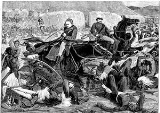
The Battle of Isandlwana on 22 January 1879 was the opening, major encounter in the Anglo-Zulu War
Anglo-Zulu War
The Anglo-Zulu War was fought in 1879 between the British Empire and the Zulu Empire. From complex beginnings, the war is notable for several particularly bloody battles, as well as for being a landmark in the timeline of colonialism in the region...

 between the British Empire and the Zulu Kingdom. Eleven days after the British commenced their invasion a 20,000 strong Zulu army equipped mainly with iron spears and cowhide shields fought a portion of the British Main Column consisting of a mixed British and native force, 1,200 to 2,000 strong, armed with the then modern, Martini-Henry
Martini-Henry
The Martini-Henry was a breech-loading lever-actuated rifle adopted by the British, combining an action worked on by Friedrich von Martini , with the rifled barrel designed by Scotsman Alexander Henry. It first entered service in 1871 replacing the Snider-Enfield, and variants were used throughout...

 breech-loading rifle
Rifle
A rifle is a firearm designed to be fired from the shoulder, with a barrel that has a helical groove or pattern of grooves cut into the barrel walls. The raised areas of the rifling are called "lands," which make contact with the projectile , imparting spin around an axis corresponding to the...

 and artillery
Artillery
Artillery is a military combat Arm that employs weapons capable of discharging large projectiles in combat. They are generally capable of adding considerable fire power to the military capability of an armed force...

.
Discussion
Ask a question about 'Battle of Isandlwana'
Start a new discussion about 'Battle of Isandlwana'
Answer questions from other users
Full Discussion Forum
 
Encyclopedia
The Battle of Isandlwana on 22 January 1879 was the opening, major encounter in the Anglo-Zulu War
Anglo-Zulu War
The Anglo-Zulu War was fought in 1879 between the British Empire and the Zulu Empire. From complex beginnings, the war is notable for several particularly bloody battles, as well as for being a landmark in the timeline of colonialism in the region...

 between the British Empire and the Zulu Kingdom. Eleven days after the British commenced their invasion a 20,000 strong Zulu army equipped mainly with iron spears and cowhide shields fought a portion of the British Main Column consisting of a mixed British and native force, 1,200 to 2,000 strong, armed with the then modern, Martini-Henry
Martini-Henry
The Martini-Henry was a breech-loading lever-actuated rifle adopted by the British, combining an action worked on by Friedrich von Martini , with the rifled barrel designed by Scotsman Alexander Henry. It first entered service in 1871 replacing the Snider-Enfield, and variants were used throughout...

 breech-loading rifle
Rifle
A rifle is a firearm designed to be fired from the shoulder, with a barrel that has a helical groove or pattern of grooves cut into the barrel walls. The raised areas of the rifling are called "lands," which make contact with the projectile , imparting spin around an axis corresponding to the...

 and artillery
Artillery
Artillery is a military combat Arm that employs weapons capable of discharging large projectiles in combat. They are generally capable of adding considerable fire power to the military capability of an armed force...

. Despite the differential in weapons technology, the numerically superior Zulus ultimately overwhelmed the indifferently deployed British killing over 1,300 troops, including all those out on the firing line. The Zulu army suffered around a thousand killed.

Following the imperialist scheme by which Lord Carnarvon
Henry Herbert, 4th Earl of Carnarvon
Henry Howard Molyneux Herbert, 4th Earl of Carnarvon PC DL FSA FRS , known as Lord Porchester from 1833 to 1849, was a British politician and a leading member of the Conservative Party...

 had successfully brought about federation in Canada, it was thought that a similar scheme might succeed in South Africa. In 1874, Sir Bartle Frere was sent to South Africa as high commissioner to instigate the scheme. One of the obstacles to such a plan was the presence of the independent states of the South African Republic
South African Republic
The South African Republic , often informally known as the Transvaal Republic, was an independent Boer-ruled country in Southern Africa during the second half of the 19th century. Not to be confused with the present-day Republic of South Africa, it occupied the area later known as the South African...

 and the Kingdom of Zululand
Zulu Kingdom
The Zulu Kingdom, sometimes referred to as the Zulu Empire or, rather imprecisely, Zululand, was a monarchy in Southern Africa that extended along the coast of the Indian Ocean from the Tugela River in the south to Pongola River in the north....

.

Sir Bartle Frere, High Commissioner
High Commissioner
High Commissioner is the title of various high-ranking, special executive positions held by a commission of appointment.The English term is also used to render various equivalent titles in other languages.-Bilateral diplomacy:...

 of southern Africa for The British Empire
British Empire
The British Empire comprised the dominions, colonies, protectorates, mandates, and other territories ruled or administered by the United Kingdom, that had originated with the overseas colonies and trading posts established by England in the late 16th and early 17th centuries. At its height it was...

, on his own initiative and without the approval of Her Majesty's Government, and with the intent of instigating a war with the Zulu, had presented an ultimatum on 11 December 1878, to the Zulu king Cetshwayo with which the Zulu king could not comply. Cetshwayo did not comply, and Bartle Frere sent Chelmsford to invade Zululand.

At Isandlwana the British army suffered its worst defeat at the hands of a native force. The battle was a decisive tactical victory for the Zulus and initially resulted in the strategic collapse of the British invasion. However, the war would eventually result in grand strategic failure for the Zulus, as defeating the British at Isandlwana pushed the British into a much more aggressive approach to the Anglo-Zulu War
Anglo-Zulu War
The Anglo-Zulu War was fought in 1879 between the British Empire and the Zulu Empire. From complex beginnings, the war is notable for several particularly bloody battles, as well as for being a landmark in the timeline of colonialism in the region...

, destroying King Cetshwayo
Cetshwayo
Cetshwayo kaMpande was the king of the Zulu nation from 1872 to 1879 and their leader during the Zulu War. His name has also been transliterated as Cetawayo, Cetewayo, Cetywajo and Ketchwayo....

's hopes of a negotiated peace.

Preliminary manoeuvres


Lord Chelmsford, the Commander-in-Chief
Commander-in-Chief
A commander-in-chief is the commander of a nation's military forces or significant element of those forces. In the latter case, the force element may be defined as those forces within a particular region or those forces which are associated by function. As a practical term it refers to the...

 of British forces during the war, initially planned a five-pronged invasion of Zululand composed of five columns and designed to encircle the Zulu army and force them to fight as he was concerned that the Zulus would avoid battle. In the event he settled on three invading columns with the main center column, now consisting of the previously called No. 3 Column and Durnford's No.2 Column, under his direct command. He moved his troops from where they were stationed in Pietermaritzburg
Pietermaritzburg
Pietermaritzburg is the capital and second largest city of the province of KwaZulu-Natal in South Africa. It was founded in 1838. Its "purist" Zulu name is umGungundlovu, as seen in the name of its municipality, although it is popularly called Maritzburg in English and Zulu alike, and abbreviated PMB...

 to a forward camp at Helpmekaar, past Greytown. On 9 January 1879 they moved to Rorke's Drift
Rorke's Drift
The Battle of Rorke's Drift was a battle in the Anglo-Zulu War. The defence of the mission station of Rorke's Drift immediately followed the British Army's defeat at the Battle of Isandlwana earlier that morning on 22 January 1879, and continued to the following day, 23 January...

, and early on 11 January commenced crossing the Buffalo River into Zululand
Zulu Kingdom
The Zulu Kingdom, sometimes referred to as the Zulu Empire or, rather imprecisely, Zululand, was a monarchy in Southern Africa that extended along the coast of the Indian Ocean from the Tugela River in the south to Pongola River in the north....

.

The backbone of the British force under Lord Chelmsford consisted of twelve regular infantry
Infantry
Infantrymen are soldiers who are specifically trained for the role of fighting on foot to engage the enemy face to face and have historically borne the brunt of the casualties of combat in wars. As the oldest branch of the Combat Arms they are the backbone of armies...

 companies
Company (military unit)
A company is a military unit, typically consisting of 75-200 soldiers. Most companies are formed of three to five platoons although the exact number may vary by country, unit type, and structure...

: six each of both the 1st and 2nd battalion
Battalion
A battalion is a military unit of around 1000-1500 soldiers usually consisting of between two and seven companies and typically commanded by a Lieutenant Colonel...

s, 24th Regiment of Foot (2nd Warwickshire Regiment), which were hardened and reliable troops. In addition, there were approximately 2,500 local African auxiliaries of the Natal Native Contingent
Natal Native Contingent
The Natal Native Contingent was a large force of black auxiliary soldiers in British South Africa, forming a large portion of the defence forces of the British colony of Natal, and saw action during the 1879 Anglo-Zulu War. The NNC was created in 1878 out of the local black population in order to...

, led by European officers but considered generally of poor quality; some irregular cavalry
Cavalry
Cavalry were soldiers or warriors who fought mounted on horseback in combat. Cavalry were historically the second oldest and most mobile of the combat arms...

 units, and a detachment of artillery
Artillery
Artillery is a military combat Arm that employs weapons capable of discharging large projectiles in combat. They are generally capable of adding considerable fire power to the military capability of an armed force...

 consisting of two field gun
Field gun
A field gun is an artillery piece. Originally the term referred to smaller guns that could accompany a field army on the march and when in combat could be moved about the battlefield in response to changing circumstances...

s and several Congreve rocket
Congreve rocket
The Congreve Rocket was a British military weapon designed by Sir William Congreve in 1804.The British were greatly impressed by the Mysorean Rocket artillery made from iron tubes used by the armies of Tipu Sultan and his father, Haidar Ali. Tipu Sultan championed the use of mass attacks with...

s. Adding on wagon drivers, camp followers and servants, there were more than 4,000 men in the Number 3 Column, not including Durnford's Number 2 Column. Because of the urgency required to accomplish their scheme, Bartle Frere and Chelmsford began the invasion during rainy season. This had the consequence of slowing the British advance to a crawl.

The Zulu army, while a product of a warrior culture, was essentially a militia force which could be called out in time of national danger. It had a very limited logistical capacity and could only stay in the field a few weeks before the troops would be obliged to return to their civilian duties. Cetshwayo sent the 24,000 warrior strong main Zulu impi
Impi
An impi is an isiZulu word for any armed body of men. However, in English it is often used to refer to a Zulu regiment, which is called an ibutho in Zulu...

 from near present-day Ulundi, on 17 January, across the White Umfolozi River. On the 18th, some 4,000 warriors were detached from the main body to attack Pearson's column near Eshowe. The remaining 20,000 Zulus camped at the isiPhezi ikhanda. On the 19th they arrived and camped near Babanango mountain. On the next day they moved and camped near Siphezi mountain. Finally, on the 21st they moved into the Ngwebeni valley from where they planned to attack the British on the 23rd and where they stayed concealed until their discovery by Raw's scouts on 22 January. The speed of the Zulu advance compared to the British is marked. The Zulu impi had advanced over 50 miles in 5 days while Chelmsford had only advanced slightly over 10 miles in 10 days.

The British under Lord Chelmsford pitched camp at Isandlwana
Isandlwana
Isandlwana is an isolated hill in the KwaZulu-Natal province of South Africa, southeast of Rorke's Drift and north by northwest of Durban....

 on 20 January, but did not follow standing orders to entrench. No laager (circling of the wagons) was formed. Chelmsford did not see the need for the laager, stating, "It would take a week to make." But the chief reason for the failure to take defensive precautions appears to have been that the British command severely underestimated the Zulu capabilities. The experience of numerous colonial wars fought in Africa was that the massed firepower of relatively small bodies of professional European troops armed with modern firearms and artillery, and supplemented by local allies and levies, would march out to meet the natives whose ragged, badly equipped armies would put up a brave struggle, but in the end would succumb. Chelmsford believed that a force of over 4,000, including 1,000 British infantry armed with Martini-Henry
Martini-Henry
The Martini-Henry was a breech-loading lever-actuated rifle adopted by the British, combining an action worked on by Friedrich von Martini , with the rifled barrel designed by Scotsman Alexander Henry. It first entered service in 1871 replacing the Snider-Enfield, and variants were used throughout...

 rifle
Rifle
A rifle is a firearm designed to be fired from the shoulder, with a barrel that has a helical groove or pattern of grooves cut into the barrel walls. The raised areas of the rifling are called "lands," which make contact with the projectile , imparting spin around an axis corresponding to the...

s, as well as artillery, had more than sufficient firepower to overwhelm any attack by Zulus armed only with spears, cowhide shields and a few firearms such as Brown Bess
Brown Bess
Brown Bess is a nickname of uncertain origin for the British Army's Land Pattern Musket and its derivatives. This musket was used in the era of the expansion of the British Empire and acquired symbolic importance at least as significant as its physical importance. It was in use for over a hundred...

 musket
Musket
A musket is a muzzle-loaded, smooth bore long gun, which is intended to be fired from the shoulder.Usually, the musket is thought to be the weapon that replaced the arquebus, and was in turn replaced by the rifle...

s. Indeed, with a British force of this size, it was the logistical arrangements which occupied Chelmsford's thoughts. Rather than any fear that the camp might be attacked, his main concern was managing the huge number of wagons and oxen required to support his forward advance.

Once he had established the camp at Isandlwana, Chelmsford sent out two battalions of the Natal Native Contingent to scout ahead. They skirmished with elements of a Zulu force which Chelmsford believed to be the vanguard of the main enemy army. Such was the over-confidence in British military training and firepower that he divided his force, taking about 2,500 men, including half of the British infantry contingent, and set out to find the main Zulu force with the intention of bringing them to battle, so as to achieve a decisive victory. It never occurred to Chelmsford that the Zulus he saw were diverting him away from their main force.

Chelmsford left five companies, around 70–80 fighting men in each, of the 1st battalion
Battalion
A battalion is a military unit of around 1000-1500 soldiers usually consisting of between two and seven companies and typically commanded by a Lieutenant Colonel...

 and one stronger company of around 150 men from the 2nd battalion of the 24th behind to guard the camp, under the command of Brevet
Brevet (military)
In many of the world's military establishments, brevet referred to a warrant authorizing a commissioned officer to hold a higher rank temporarily, but usually without receiving the pay of that higher rank. An officer so promoted may be referred to as being brevetted...

 Lieutenant Colonel
Lieutenant Colonel
Lieutenant colonel is a rank of commissioned officer in the armies and most marine forces and air forces of the world, typically ranking above a major and below a colonel. The rank of lieutenant colonel is often shortened to simply "colonel" in conversation and in unofficial correspondence...

 Henry Pulleine
Henry Pulleine
Lieutenant-Colonel Henry Burmester Pulleine was an administrator and commander in the British Army in the Cape Frontier and Anglo-Zulu Wars. He held the acting rank of Brevet Lieutenant Colonel....

. Pulleine's orders were to defend the camp and wait for further instructions to support the General as and when called upon. Pulleine also had around 500 men of the Natal Native Contingent and approximately 200 local irregulars who were mounted. He also had two artillery pieces, with around 70 men of the Royal Artillery. In total, some 1,300 men and 2 guns to defend the camp.

Pulleine, left in command of a rear position, was an administrator with no experience of front-line command on a campaign. Nevertheless, he commanded a strong force, particularly in respect of the six veteran regular infantry companies, which were experienced at colonial combat. The mounted vedettes, cavalry scouts, patrolling some 7 miles from camp reported at 7A.M. that groups of Zulus, numbering around 4,000 men, could be seen. Further reports arrived to Pulleine during the early morning, each reporting movements, both large and small, of Zulus. There was speculation among the officers whether these troops were intending to march against Chelmsford's rear or towards the camp itself.

Around 10:30A.M., Colonel
Colonel
Colonel is a military rank of a commissioned officer, with corresponding ranks existing in almost every country in the world. It is also used in some police forces and other paramilitary rank structures...

 Anthony Durnford
Anthony Durnford
Anthony William Durnford was a career British Army officer who served in the Anglo-Zulu War. Breveted colonel, Durnford is mainly known for his presence at the defeat of the British army by the Zulu at the Battle of Isandlwana.-Background:Durnford was born in to a military family at Manor...

 arrived from Rorke's Drift
Rorke's Drift
The Battle of Rorke's Drift was a battle in the Anglo-Zulu War. The defence of the mission station of Rorke's Drift immediately followed the British Army's defeat at the Battle of Isandlwana earlier that morning on 22 January 1879, and continued to the following day, 23 January...

 with 5 troops of the Natal Native horse and a rocket battery. This put the issue of command to the fore because Durnford was senior and by tradition would have assumed command. However, he did not over-rule Pulleine's dispositions and after lunch he quickly decided to take to the initiative and move forward to engage a Zulu force which, at that point, Pulleine and Durnford judged to be moving against Chelmsford's rear. He asked for a company of the 24th, but Pulleine was reluctant to agree since his orders had been specifically to defend the camp.

Chelmsford had underestimated the disciplined, well led, well motivated and confident Zulu. The failure to secure an effective defensive position, the poor intelligence about the location of the main Zulu army, Chelmsford's decision to split his force in half, and the Zulus' tactical exploitation of the terrain and the weaknesses in the British formation, all combined to prove catastrophic for the troops at Isandlwana. In contrast, the Zulus responded to the unexpected discovery of their camp with an immediate and spontaneous advance. Even though the induna
InDuna
InDuna is a Zulu title meaning advisor, great leader, ambassador, headman, or commander of group of warriors. It can also mean spokesperson or mediator as the izinDuna often acted as a bridge between the people and the king...

s would lose control over the advance, the training instilled in the warriors allowed the Zulu troops to form their standard attack formation on the run, their battle line deployed in reverse of its intended order.

The battle


The Zulu Army was commanded by inDunas (Princes) Ntshingwayo kaMahole Khozalo
Ntshingwayo Khoza
Ntshingwayo kaMahole was the second in command of King Cetshwayo's Army.He was the commanding general who defeated the encamped British Army at the Battle of Isandlwana.-Source:...

 and Mavumengwana kaNdlela Ntuli. The inDuna Dabulamanzi kaMpande
Dabulamanzi kaMpande
Dabulamanzi kaMpande was a Zulu commander in the Anglo-Zulu War. He was a half-brother of Cetshwayo kaMpande, the Zulu king at the time....

, half brother of Cetshwayo, commanded the Undi Corps.

While Chelmsford was in the field seeking them, the entire Zulu army had outmanoeuvred him, moving behind his force with the intention of attacking the British army on the 23rd. They were discovered at around 8A.M. by men of Lt. Raw's troop of scouts who chased a number of Zulus into a valley, only then seeing around 20,000 men of the main enemy force sitting in total quiet. Having been discovered the Zulu force leapt to the offensive. Raw's men began a fighting retreat
Withdrawal (military)
A withdrawal is a type of military operation, generally meaning retreating forces back while maintaining contact with the enemy. A withdrawal may be undertaken as part of a general retreat, to consolidate forces, to occupy ground that is more easily defended, or to lead the enemy into an ambush...

 back to the camp and a messenger was sent to warn Pulleine of the situation. Pulleine observed Zulus on the hills to his left front and sent word to Chelmsford which was received by the General between 9 and 10A.M.

The Zulu attack then developed in the traditional horns and chest of the buffalo, with the aim of encircling the British position. From Pulleine's vantage point in the camp, at first only the right horn and then the chest (centre) of the attack seemed to be developing. Pulleine sent out first one, then all of his six companies of the 24th Foot into an extended firing line, with the aim of meeting the Zulu attack head on and checking it with firepower. Durnford's men, upon meeting elements of the Zulu centre, had retreated to a donga
Donga (ditch)
In South African English, a Donga is a ditch formed by the erosion of soil.They were extensively used by both sides during the Boer Wars as serendipitous defensive positions....

, a dried out watercourse, on the British right flank where they formed a defensive line. The Rocket Battery under Durnford's command was overrun very early in the engagement. The two battalions of native troops were in Durnford's line; however, only one in ten was armed with a rifle and many of them started to leave the battlefield at this point. Pulleine only made one change to the original disposition after about twenty minutes of firing, which was to bring in the companies in the firing line slightly closer to the camp.

For a few hours until noon, the disciplined British volleys pinned down the Zulu centre, inflicting some casualties and causing the advance to stall. Indeed, morale remained high within the British line. The Martini-Henry
Martini-Henry
The Martini-Henry was a breech-loading lever-actuated rifle adopted by the British, combining an action worked on by Friedrich von Martini , with the rifled barrel designed by Scotsman Alexander Henry. It first entered service in 1871 replacing the Snider-Enfield, and variants were used throughout...

 rifle was a powerful weapon and the men were experienced. Additionally, the fire of the cannons of the Royal Horse Artillery
Royal Horse Artillery
The regiments of the Royal Horse Artillery , dating from 1793, are part of the Royal Regiment of Artillery of the British Army...

 forced some Zulu regiments to take cover behind the reverse slope of a hill. Nevertheless, the left horn of the Zulu advance was moving to outflank the British right flank position and envelop it.

Durnford's men, who had been fighting longest, began to withdraw and their rate of fire
Rate of fire
Rate of fire is the frequency at which a specific weapon can fire or launch its projectiles. It is usually measured in rounds per minute , or per second .-Overview:...

 diminished. Durnford's withdrawal exposed the right flank of the British regulars, which, with the general threat of the Zulu encirclement, caused Pulleine to order a withdrawal back to the camp. Durnford's retreat also exposed G Company, 2nd/24th, which was overrun relatively quickly. The retreat was performed with order and discipline and the men of the 24th conducted a fighting withdrawal into the camp.

An officer in advance from Chelmsford's force gave this eyewitness account of the final stage of the battle at about 3 P.M..
"In a few seconds we distinctly saw the guns fired again, one after the other, sharp. This was done several times -a pause, and then a flash - flash! The sun was shining on the camp at the time, and then the camp looked dark, just as if a shadow was passing over it. The guns did not fire after that, and in a few minutes all the tents had disappeared."


The presence of large numbers of bodies grouped together suggests the resistance was more protracted than originally thought and they made a number of desperate last stand
Last stand
Last stand is a loose military term used to describe a body of troops holding a defensive position in the face of overwhelming odds where the plurality of soldiers is killed...

s. Evidence of this is that many of the bodies, today marked by cairns, were found in several large groups around the camp — including one stand of around 150 men. A Zulu account describes a group of the 24th forming a square
Infantry square
An infantry square is a combat formation an infantry unit formed in close order assumes when threatened with cavalry attack.-Very early history:...

 on the neck of Isandlwana. What is clear is that the slaughter was complete in the area around the camp and back to Natal along the Fugitive's Drift. The fighting had been hand-to-hand combat and no quarter
No quarter
A victor gives no quarter when the victor shows no clemency or mercy and refuses to spare the life in return for the surrender at discretion of a vanquished opponent.- Details :...

 given to the British regulars. The Zulus had been commanded to ignore the civilians in black coats. The British fought back-to-back with bayonet and rifle butt when their ammunition had finally been expended.

Aftermath


Isandlwana was an immediate catastrophe for the British. However, the victory of the Zulus did not end the war. With the decisive defeat of Chelmsford's central column, the entire invasion of Zululand collapsed and would have to be restaged. Not only were there heavy manpower casualties to the Main Column, but most of the supplies, ammunition, and draught animals were lost. As King Cetshwayo feared, the embarrassment of the defeat would force the policy makers in London, who to this point had not supported the war, to rally to the support of the pro-war contingent in the Natal government and commit whatever resources were needed to defeat the Zulus. Despite local numerical superiority, the Zulus did not have manpower, technological resources or logistical capacity to match the British in another, more extended, campaign.

Near the end of the battle, about 4000 Zulu warriors of the unengaged reserve Undi impi, after cutting off the retreat of the survivors to the Buffalo River southwest of Isandlwana, crossed the river and attacked the fortified mission station at Rorke's Drift
Rorke's Drift
The Battle of Rorke's Drift was a battle in the Anglo-Zulu War. The defence of the mission station of Rorke's Drift immediately followed the British Army's defeat at the Battle of Isandlwana earlier that morning on 22 January 1879, and continued to the following day, 23 January...

. It was defended by only 139 British soldiers who inflicted serious casualties upon the attacking Zulus, and successfully beat them back. Elsewhere, the left and right flanks of the invading forces were now isolated and without support. The No. 1 column under the command of Charles Pearson
Charles Pearson
Charles Pearson was Solicitor to the City of London, a reforming campaigner, and – briefly – Member of Parliament for Lambeth...

 would be besieged for two months by a Zulu force at Eshowe while the No. 4 column under Evelyn Wood
Evelyn Wood
Evelyn Wood may refer to:* Evelyn Wood , , Field marshal, Victoria Cross recipient* Evelyn Wood , American educator and advocate of the Reading Dynamics system for speed reading...

 halted its advance and spent most of the next two months skirmishing in the northwest around Tinta's Kraal.

Following the news of Isandlwana and Rorke's Drift the British and Colonials were in complete panic over the possibility of a counter invasion of Natal by the Zulus. Unknown to them, Cetshwayo, still hoping to avoid a total war, had prohibited any crossing of the border in retaliation and was incensed over the violation of the border by the attack on Rorke's Drift.

The British government's reasoning for a new invasion was threefold. The first was jingoistic to a degree and national honour demanded that the enemy, victors in one battle, should lose the war. The second concerned the domestic political implications with ramifications at the next parliamentary elections. However, despite the new invasion the British Prime Minister
Prime minister
A prime minister is the most senior minister of cabinet in the executive branch of government in a parliamentary system. The position is usually held by, but need not always be held by, a politician. In many systems, the prime minister selects and can dismiss other members of the cabinet, and...

 Disraeli and his party would lose the 1880 election
United Kingdom general election, 1880
The UK general election of 1880 was a general election in the United Kingdom held from March to April 1880.At the culmination of Midlothian campaign, the Liberals, led by the fierce oratory of retired former Liberal leader William Gladstone in attacking the supposedly immoral foreign policy of the...

. Finally, there were considerations affecting the Empire: unless the British were seen to win a clear-cut victory against the Zulus, it would send a signal that the British Empire
British Empire
The British Empire comprised the dominions, colonies, protectorates, mandates, and other territories ruled or administered by the United Kingdom, that had originated with the overseas colonies and trading posts established by England in the late 16th and early 17th centuries. At its height it was...

 was vulnerable and that the defeat of a British field army could alter policy. Until then, one of the arguments against a war with the Zulus was that the costs could not be justified. If the Zulu victory at Isandlwana encouraged resistance elsewhere in the Empire, then committing the resources necessary to defeat the Zulus would in the long term prove cheaper than fighting wars the Zulu success inspired against British Imperialism
Imperialism
Imperialism, as defined by the dictionary of human geography, is “the creation and maintenance of an unequal economic, cultural and territorial relationship, usually between states and often in the form of an empire, based on domination and subordination.” Imperialism, in many ways, is described...

 elsewhere.

After Isandlwana, the British field army was heavily reinforced and again invaded Zululand. Sir Garnet Wolseley was sent to relieve Chelmsford, as well as Bartle Frere. Chelmsford, however, avoided handing over command to Wolseley and managed to defeat the Zulus in a number of engagements, the last of which was the Battle of Ulundi
Battle of Ulundi
The Battle of Ulundi took place at the Zulu capital of Ulundi on 4 July 1879 and was the last major battle of the Anglo-Zulu War. The British army finally broke the military power of the Zulu nation by defeating the main Zulu army and immediately afterwards capturing and razing the capital of...

 followed by capture of King Cetshwayo. The British encouraged the subkings of the Zulus to rule their subkingdoms without acknowledging a central Zulu power. By the time King Cetshwayo was allowed to return home there was no longer an independent Zulu kingdom.

The measure of respect the British gained for their opponents as a result of Isandlawna can be seen that in none of the other engagements of the Zulu War did the British attempt to fight again in their typical linear formation in an open field battle with the main Zulu impi.

No 2 Column

  • 11 battery, 3 brigade: 3x9 pounder rockets - 9 men, 1 officer
  • Mounted auxiliaries, Natal Native Horse - 256 men, 6 officers
  • 1 Battalion, 1st regiment, Natal Native Contingent - 240 men, 7 officers

No 3 Column

  • N battery, 5 brigade: 2x7 pounder guns - 70 men, 2 officers
  • 1 Battalion, 24 Regiment - 402 men, 14 officers
  • 2 Battalion, 24 Regiment - 178 men, 5 officers
  • Mounted troops - 115 officers and men
  • Detachments - 50 officers and men
  • 1st Battalion, 3rd Regiment Natal Native Contingent- 391 men, 19 officers

Reasons for the Zulu victory


The primary reason for the Zulu victory is that the Zulus, unlike the British, kept their main fighting force concentrated. Further, they made a very successful effort to conceal the advance and location of this force until they were within a few hours striking distance of their enemy. In comparison, the British made no such efforts. Finally, when the location of the main Zulu Impi was discovered by British scouts the Zulus, without hesitation, immediately advanced and attacked, achieving tactical surprise. This tactical surprise prevented the British, although they now had some warning of a Zulu advance, from concentrating their central column. It also left little time and gave scant information for Pulleine to organize a sufficient defence for his command. Simply put, the Zulus had completely outmanoeuvred Chelmsford and their victory at Isandlwana would wreck the British invasion of Zululand until a second, far larger, British army could be shipped to South Africa.


In addition to the obvious courage exhibited by the Zulu warriors, there are several factors that contributed to the ferocity and effectiveness of the attack. The warriors were initially indoctrinated
Indoctrination
Indoctrination is the process of inculcating ideas, attitudes, cognitive strategies or a professional methodology. It is often distinguished from education by the fact that the indoctrinated person is expected not to question or critically examine the doctrine they have learned. As such it is used...

 into the Zulu army, using methods not unlike those employed by modern armies for recruit training
Recruit training
Recruit training is the initial indoctrination and instruction given to new military personnel. It may be common to all recruits, officers being selected on the basis of competency shown during recruit training, or for the enlisted ranks only...

. They were isolated from their families and the surrounding communities in an attempt to resocialize
Resocialization
Resocialization is a sociological concept dealing with the process of mentally and emotionally "re-training" a person so that he or she can operate in an environment other than that which he or she is accustomed to....

 them, to encourage and force them to adopt common attitudes and common modes of thinking. The army employed classic military indoctrination
Indoctrination
Indoctrination is the process of inculcating ideas, attitudes, cognitive strategies or a professional methodology. It is often distinguished from education by the fact that the indoctrinated person is expected not to question or critically examine the doctrine they have learned. As such it is used...

 techniques, such as drill
Parade (military)
A military parade is a formation of soldiers whose movement is restricted. The American usage is "formation or military review". The military parade is now mostly ceremonial, though soldiers from time immemorial up until the late 19th century fought in formation...

 and war dance
War dance
A war dance is a dance involving mock combat, usually in reference to tribal warrior societies where such dances were performed as a ritual connected with endemic warfare....

s, in order to coalesce individuals into cohesive fighting units.

Reasons for the British defeat


Debate persists as to how and why the British lost the battle. Many arguments focus on possible local tactical occurrences as opposed to the strategic lapses and failings in grand tactics on the part of high command under Chelmsford and Bartle Frere.

The tactical arguments for the defeat:
  • The initial view, reported by Horace Smith-Dorrien
    Horace Smith-Dorrien
    General Sir Horace Lockwood Smith-Dorrien GCB, GCMG, DSO, ADC was a British soldier and commander of the British II Corps and Second Army of the BEF during the Great War.-Early life and career:...

    , was that the British had difficulty unpacking their ammunition boxes fast enough and that the quartermasters were reluctant to distribute ammunition to units other than their own. Well-equipped and well-trained British soldiers could fire 10-12 rounds a minute. Even assuming a poor strike rate, 1,000 men should in theory have been able to inflict 25,000 casualties in a few minutes against an enemy only equipped with spears and clubs. The lack of ammunition caused a lull in the defence. In subsequent engagements with the Zulus, ammunition boxes were unscrewed in advance for rapid distribution.
  • Donald Morris in The Washing of the Spears argues that the men, fighting too far from the camp, ran out of ammunition, starting first with Durnford's men who were holding the right flank and who had been in action longer, which precipitated a slowdown in the rate of fire against the Zulus. This argument suggests that the ammunition was too far from the firing line and that the seventy rounds each man took to the firing line was not sufficient. However, this approach has been all but discounted by modern historians, drawing on detailed surveys of the battlefield in 2001. The "ammunition" explanation, however, still remains a prevalent myth as to why the British were defeated and, certainly, in the immediate aftermath of the battle it was a more palatable excuse for the disaster - brave troops who would have held out had not their ammunition failed - than putting it down to human error on the part of the commanding officers - none of whom anticipated the risk or need for more secure defensive precautions, or whom, once the Zulus had made their presence known, seemed able to take the measures needed to secure the camp.


  • Perhaps the most persuasive view, however, recently supported with evidence from the battlefield, such as Ian Knight and Lt. Colonel Snook's works, (the latter having written How Can Man Die Better?), suggest that although Durnford's men probably did run out of ammunition, the majority of men in the firing line did not. The discovery of the British line so far out from the camp has led Ian Knight to conclude that the British were defending too large a perimeter.

See also

  • List of Zulu War Victoria Cross recipients
  • Military history of South Africa
    Military history of South Africa
    The history of South Africa chronicles a vast time period and complex events from the dawn of history until the present time. It covers civil wars and wars of aggression and of self-defense both within South Africa and against it...

  • Zulu Dawn
    Zulu Dawn
    Zulu Dawn book and war film about the Battle of Isandlwana between British and Zulu military units in 1879 in South Africa. The book was written by Cy Endfield, who co-wrote the screenplay for the film with Anthony Story...

  • Battle of Blood River
    Battle of Blood River
    The Battle of Blood River on 16 December 1838 was fought between 470 Voortrekkers, led by Andries Pretorius, and an estimated 10,000 Zulu attackers on the banks of the Ncome River at in what is today KwaZulu-Natal, South Africa...


Audio and video

  • "Impi", song written by South African music superstar Johnny Clegg
    Johnny Clegg (musician)
    Jonathan Clegg, born 7 June 1953 in Rochdale, Lancashire, England, is a musician from South Africa, who has recorded and performed with his bands Juluka and Savuka...

     and performed by his band Juluka
    Juluka
    Juluka was a South African music band formed in 1969 by Johnny Clegg and Sipho Mchunu. Juluka means "sweat", and was the name of a bull owned by Mchunu.- Biography :...

     on the album African Litany
    African Litany
    African Litany is the second studio album from South African band Juluka, released in 1982. It features lyrics sung in English and zulu.The first track, Impi, which became one of the band's hits, retells the story of the Battle of Isandlwana, won by the Zulu, and was banned from the radio in South...

  • Rattray, David. Day of the Dead Moon. Audio series narrated by author regarding Anglo-Zulu War
  • Zulu - The Warriors Return (clip from 52 mns TV documentary)
  • 'Blood Mountain' - Produced and Directed by Michael Maloney – Countrywide Productions - Narrated by Ian Knight, world renowned authority on the Zulu nation - 45 mins

External links