
|
|
|
|
Ancient Libya
|
| |
|
| |
Ancient Libya was the region west of the Nile Valley. It corresponds to what is now generally called Northwest Africa. Its people were the ancestors of the modern Berber people. Berbers had occupied the area for thousands of years prior to the beginning of human records in Ancient Egypt. Climate changes affected the locations of the settlements.
In the Greek period the Berbers were known as "Libyans". Their lands were called "Libya" and extended from modern Morocco to the western borders of Ancient Egypt.

Discussion
Ask a question about 'Ancient Libya'
Start a new discussion about 'Ancient Libya'
Answer questions from other users
|
Recent Posts

Encyclopedia
Ancient Libya was the region west of the Nile Valley. It corresponds to what is now generally called Northwest Africa. Its people were the ancestors of the modern Berber people. Berbers had occupied the area for thousands of years prior to the beginning of human records in Ancient Egypt. Climate changes affected the locations of the settlements.
In the Greek period the Berbers were known as "Libyans". Their lands were called "Libya" and extended from modern Morocco to the western borders of Ancient Egypt. Modern Egypt contains the Siwa Oasis, historically part of Libya, where the Berber Siwi language is still spoken.
Name
The name Libya is found in the Ancient Egyptian, Phoenician, Greek, Hebrew, Latin, Arabic, and the modern European languages.
The Ancient Egyptians mentioned many Libyan tribes. The most well-known and important tribes—on the basis of the Egyptian archaeological sources—are the Tjehenu, the Tamahu, the Libu (or Ribu), and the Meshwesh.
The oldest reference to 'Libya' goes back to Ramesses II and his successor Merneptah, Egyptian rulers of the nineteenth dynasty, during the 13th century BCE. The name of Libya was first mentioned as an ethnic name on the Merneptah Stele, which also is known as the Israel Stele:
[..]The vile chief of the Libu who fled under cover of night alone without a feather on his head, his feet unshod, his wives seized before his very eyes, the meal for his food taken away, and without water in the water-skin to keep him alive; the faces of his brothers are savage to kill him, his captains fighting one against the other, their camps burnt and made into ashes ...
Afterward, the name appeared repeatedly in the pharaonic records. It is, therefore, supposed that the origin of the name "Libya" was this Egyptian name for the ancient tribe Libu. According to this theory, this name was taken over by the Greeks of Cyrenaica, who may have co-existed with them. Later, the name appeared in the Hebrew language, written in the Bible as Lehabim and Lubim, indicating the ethnic population and the geographic territory as well.
In the neo-Punic inscriptions it was written as Lby for the masculine noun and Lbt for the feminine noun of Libyan. The name supposedly was used as an ethnic name in those inscriptions.
The first reference to "Libya" in the Greek language is found in Homer's Odyssey (IX.95; XXIII.311). The name was used by Homer in a geographic sense, while he called its inhabitants Lotophagi meaning the "Lotus-eaters". After Homer, the name was used by Aeschylus, Pindar, and other Ancient Greek writers.
Herodotus used Libuwa indicating Libya while he called the Libyans Libyes in the Greek language. From his point of view, Libya was the name of the African continent, while "the Libyans" were the light-skinned North Africans, whereas the southern Africans were known as "the Ethiopians" to him.
In Latin, the name would be taken over from the Greek and the Punic languages. The Romans would have known them before their colonization of North Africa, because of the Libyan role in the Punic wars against the Romans. The Romans used the name Libyes, but it referred only to Barca and the Western desert of Egypt. The other Libyan territories became known as Africa.
In the Arabic literature, "Libya" was called Lubya indicating a speculative territory west of Egypt. Today, however, it is referred to as Libya.
Speculation exists regarding whether the name Libu was an Egyptian name for an ancient Berber tribe or, if it was the name the Berber tribe would use to refer to themselves. After that time, the Ancient Egyptians may have adopted it as a name for them. An example of the first probability is the name Berber which is used to refer to the indigenous people of Northwest Africa, whereas they call themselves "Imazighen".
In fact, it is a difficult issue as the Berbers and the Ancient Libyans did not leave significant written sources. Some prominent historians, however, tried to trace the name to a Berber origin. The supporters of the Berber origin believe that the name was related to an ancient Berber tribe. The name Libu would have known many evolutions from "Lebu" to "Libya" to "Lebata" to "Levata" to "Lvata" to "Lwatae".
Lwatae, the tribe of Ibn Battuta, as it was called by the Arabs was a Berber tribe that mainly was situated in Cyrenaica. This tribe seemed to have ranged from the Atlantic Ocean to modern Libya, however, and was referred by Corippius as Laguatan; he linked them with the Maures.
Ibn Khaldun reports in the The History of Ibn Khaldun that Luwa was an ancestor of this previous tribe. He stated that the Berbers add an "a" and "t" to the name for the plural forms. Subsequently, it became Lwat.
Conversely, the Arabs adopted the name as a singular form adding an "h" for the plural form in Arabic. Ibn Khaldun denys the claim of Ibn Hazam, who claimed significantly on the basis of the Berber sources that Lwatah, in addition to Sadrata and Mzata, were from the Qibts (Egyptians). According to Ibn Khaldun his claim is incorrect because Ibn Hazam had not read the books of the Berber scholars.
Oric Bates is a historian who considers that the name Libu or LBW would be derived from the name Luwatah whilst the name Liwata is a derivation of the name Libu. Other historians such as the Libyan historian Mohammed Moustapha Bazam, tend to confirm this theory.
History
Compared with the History of Egypt, there is little known about the history of Libya, as there are few surviving written texts.
The Libyco-Berber script (also known as Tifinagh) that was used in Libya, was used mostly as a funerary script. It is difficult to understand and there are a number of variations.
Information on Ancient Libya comes from archaeological evidence and historic sources written by Egyptians neighbours, the Ancient Greeks, Romans, and Byzantines in the addition to the Arabs from the Medieval times.
Since Neolithic times the climate of North Africa has been drying. A reminder of the desertification of the area is provided by megalithic remains, which occur in great variety of form and in vast numbers in presently arid and uninhabitable wastelands: dolmens and circles like Stonehenge, cairns, underground cells excavated in rock, barrows topped with huge slabs, and step-pyramidlike mounds. Most remarkable are the trilithons, some still standing, some thrown down, which occur isolated or in rows, and consist of two squared uprights standing on a common pedestal that support a huge transverse beam. In the Terrgurt valley "there had been originally no less than eighteen or twenty megalithic trilithons, in a line, each with its massive altar placed before it" according to Cowper.
In ancient times, the Phoenicians and Carthaginians, the armies of Alexander the Great and his Ptolemaic successors from Egypt, then Romans, Vandals, and local representatives of the Byzantine Empire ruled all or parts of Libya. The territory of modern Libya had separate histories until Roman times, as Tripoli and Cyrenaica.
Cyrenaica, by contrast, was Greek before it was Roman. It was also known as Pentapolis, the "five cities" being Cyrene (near the village of Shahat) with its port of Apollonia (Marsa Susa), Arsinoe (Tocra), Berenice (Bengazi) and Barca (Merj). From the oldest and most famous of the Greek colonies the fertile coastal plain took the name of Cyrenaica.
These five cities were also known as the Western Pentapolis ;not to be confused with the Pentapolis of the Roman era on the current west Italian coast.
Geography
The boundaries of Ancient Libya have yet to be determined.
It was to the west of Ancient Egypt and it was known as "IMNT" to the Ancient Egyptians. Libya was an unknown territory to the Egyptians: it was the lands of the spirits.
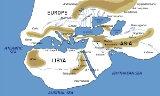
To the Ancient Greeks, Libya was one of the three known continents along with Asia and Europe. In this sense, Libya was the whole known African continent to the west of the Nile Valley and extended south of Egypt. Herodotus distinguished the inhabitants of Libya into two people: The Libyans in northern Africa and the Etheopians [sic] in the south.
According to Herodotus, Libya began where the Ancient Egypt ended, and Libya extended to Cape Spartel, which was south of Tangier on the Atlantic coast.
Modern geographers suspect that severe changes in climate affected the Berbers because of the loss of forests, reliable sources of fresh water, and availability of game along with the advance of desert conditions.
Later sources
After the Egyptians, the Greeks, Romans, and Byzantines mentioned various other tribes in Libyia. The late tribal names are different from the Egyptian ones, but it is supposed that some tribes were named in the Egyptian sources and the later ones, as well. The Meshwesh-tribe is an example for this assumption. The scholars believe it would be the same tribe called Mazyes by Hektaios and Maxyes by Herodotus, while it was called as "Mazaces" and "Mazax" in the Latin sources. All those names are somehow similar to the name used by the Berbers for themselves, Imazighen.
The sources of the late period gave more detailed descriptions about Libya and its inhabitants. Herodotus is the most notable ancient historian who tried to cover Libya and the Libyans in his fourth book, which is known as "The Libyan Book". In addition to him, Pliny the Elder, Diodorus Siculus, and Procopius are considered as the basic sources on Libya and the Libyans.
Ibn Khaldun, who dedicated the main part of his book Kitab el'ibar, which is known as "The history of the Berbers", did not use the names: "Libya" and "Libyans" in his works. Instead, he used Arabic names: "The Old Maghreb", (El-Maghrib el-Qadim), and "The Berbers" (El-Barbar or El-Barabera(h)).
Lake Tritonis divided the Berber cultures Unlike Ibn Khaldun who divided the Berbers into the Batr and the Baranis,, Herodotus divided them into Eastern Libyans and Western Libyans. The Eastern Libyans were the nomadic Libyans to the east of Lake Tritonis. They lived as nomadic shepherds, while the Western Libyans who lived west of Lake Tritonis, were farmers who led a sedentary life. A catastrophic change in the lake occurred at one point in the history of Libya, reducing the vast body of fresh water to a seasonal lake or marsh.
Neither Ibn Khaldun nor Herodotus distinguished the Libyans on the basis of their ethnic background, but according to their lifestyles. The distinction of Herodotus also was followed by the modern historians, as with Oric Bates in his book "The Eastern Libyans". Some other historians used the modern name of the Berbers in their works, such as the French historian Gabriel Camps.
The Libyan tribes mentioned in these sources were: "Adyrmachidae", "Giligamae", "Asbystae", "Marmaridae", "Auschisae", "Nasamones", "Macae", "Lotus-eaters (or Lotophagi)", "Garamantes", "Gaetulians", "Maures(Berbers)", and "Luwatae", as well as those of many other tribes.
See also
External links
- , Chasing Sources across the Sahara from Herodotus to Ibn Khaldun by Richard L. Smith.
|
| |
|
|