


Donatist

Encyclopedia
Donatism was a Christian sect
within the Roman
province of Africa
that flourished in the fourth and fifth centuries. It had its roots in the social pressures among the long-established Christian community of Roman North Africa (present-day Tunisia
and Algeria
), during the persecutions of Christians under Diocletian. The Donatists (named for the Berber
Christian
bishop Donatus Magnus
) were members of a schismatic church
not in communion with the churches of the Catholic tradition in Late Antiquity
.
Donatism was an indirect outcome of Diocletian's persecutions. The governor of Africa had been lenient towards the large Christian minority under his rule during the persecutions. He was satisfied if Christians handed over their Scriptures as a token repudiation of their faith. Wealthier class of Christians, with much to lose, acceded to this convenient action. When the persecutions came to an end, however, they were branded traditores, "traitors" by the zealous, mostly from the poorer classes.
Like the Novatianist
schism of the previous century, the Donatists were rigorists, holding that the church must be a church of "saints," not "sinners," and that sacraments, such as baptism, administered by traditores were invalid. Probably in 311, a new bishop of Carthage
was consecrated by someone who had allegedly been a traditor; his opponents consecrated a short-lived rival, who was succeeded by Donatus, after whom the schism was named.
In 313, a commission appointed by Pope Miltiades
found against the Donatists, but they continued to exist, viewing themselves, and not the Catholic Church, as the "true Church," the only one with "valid sacraments." Because of their association with the Circumcellions
, they brought upon themselves repression by the imperial authorities, but they drew upon African
regional sentiment, while the Catholic party had the support of Rome
. They were still a force at the time of Saint Augustine of Hippo
at the end of the fourth century, and disappeared only after the Arab conquest of the 7th–8th century.
was over the treatment of those who renounced their faith during the persecution under the Roman emperor
Diocletian
(303–5), a disagreement that had implications both for the Church's understanding of the Sacrament of Penance and of the other sacraments in general.
The rest of the Church was far more forgiving of these people than the Donatists. The Donatists refused to accept the sacraments and spiritual authority
of the priests and bishops who had fallen away from the faith during the persecution. During the persecution some Church leaders had gone so far as to turn Christians over to Roman authorities and had handed over religious texts to authorities to be publicly burned. These people were called traditores ("people who had handed over"). These traditors had returned to positions of authority under Constantine I
, and the Donatists proclaimed that any sacraments celebrated by these priests and bishops were invalid.
The first question, therefore, was whether the Sacrament of Penance can effect a reconciliation whereby the apostate, or in some cases specifically the traditor, may be returned to full communion. The orthodox Catholic position was that the sacrament was for precisely such cases, though at the time the Church still followed the discipline of public penance whereby a penitent for such a grievous offence would spend years, even decades, first outside the doors of the church begging for the prayers of those entering, then kneeling inside the church building during services, then standing with the congregation, and finally receiving the Eucharist
again in a long progress toward full reconciliation. The Donatists held that such a crime, after the forgiveness of Baptism
, disqualified one for leadership in the Church, a position of extreme rigorism.
The second question was the validity of sacraments celebrated by priests and bishops who had been apostates under the persecution. The Donatists held that all such sacraments were invalid; by their sinful act, such clerics had rendered themselves incapable of celebrating valid sacraments. This is known as ex opere operantis, Latin for from the work of the one doing the working, that is, that the validity of the sacrament depends upon the worthiness and holiness of the minister confecting. The Catholic position, according to Augustine, was ex opere operato
— from the work having been worked; in other words, that the validity of the sacrament depends upon the holiness of God, the minister being a mere instrument of God's work, so that any priest or bishop, even one in a state of mortal sin
, who speaks the formula of the sacrament with valid matter and the intent of causing the sacrament to occur acts validly. Hence, to the Donatists, a priest who had been an apostate but who repented could speak the words of consecration forever, but he could no longer confect the Eucharist. To Catholics, a person who received the Eucharist from the hands of even an unrepentant sinning priest still received Christ's Body and Blood, their own sacramental life being undamaged by the priest's faults.
As a result, many towns were divided between Donatist and non-Donatist congregations. The sect had particularly developed and grown in northern Africa. Constantine, as emperor, began to get involved in the dispute, and in 314 he called the Council of Arles; the issue was debated and the decision went against the Donatists. The Donatists refused to accept the decision of the council, their distaste for bishops who had collaborated with Rome came out of their broader view of the Roman Empire.
After the Constantinian shift
, when other Christians accepted the emperor as a leader in the Church, the Donatists continued to see the emperor as the devil. In particular, the birth of the Donatist movement came out of opposition to the election of Caecilianus
as Bishop of Carthage in 312, because of his pro-government stance. In 317 Constantine sent troops to deal with the Donatists in Carthage, for the first time Christian persecuting Christian. It resulted in banishments, but ultimately failed, and Constantine had to withdraw and end the persecutions in 321.
More laws against the Donatists were issued by Valentinian I
, after the defeat of the Donatist usurper
Firmus
in Northern Africa.
The Donatists also drew their beliefs from the writings of Tertullian
and Cyprian
.
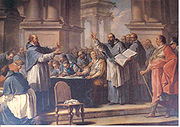 St. Augustine of Hippo
campaigned against this unorthodox belief throughout his tenure as Bishop of Hippo, and through his efforts the orthodox Catholic Church gained the upper hand. Augustine's view, which was also the majority view within the Church, was that it was the office of priest, not the personal character of the incumbent, that gave validity to the celebration of the sacraments.
In 409, Marcellinus of Carthage
, Emperor Honorius
's secretary of state, decreed the Donatists heretical and demanded that they give up their churches. This was made possible after a collatio, in which St. Augustine, with legal documents, proved that Emperor Constantine had chosen the Catholic Church over the Donatists as the official church of the empire. As a result the Donatists were harshly persecuted by the Roman authorities, and even Augustine protested at their treatment.
Nevertheless, the effects of Augustine's theological successes and the emperor's legal action were somewhat reversed when the Vandals
conquered North Africa. Donatism survived the Vandal occupation and the Byzantine
reconquest under Justinian I
. It is unknown how long Donatist belief persisted but some Christian historians believe the Donatist schism and the discord it caused in the Christian community made easier the Arab conquest
of the region in the 7th century.
, the word "Donatist" (sometimes "neo-Donatist") was commonly used by the magisterial
reformers as an incriminating label for the more radical reformers
such as the Anabaptists. Confessional Lutheran
s are sometimes labeled Donatist by liberal Lutherans, as a reference to their doctrine of church-fellowship and position that churches which deny that Jesus’ true Body and true Blood are eaten during the Eucharist do not celebrate a valid Lord's Supper.
Sect
A sect is a group with distinctive religious, political or philosophical beliefs. Although in past it was mostly used to refer to religious groups, it has since expanded and in modern culture can refer to any organization that breaks away from a larger one to follow a different set of rules and...
within the Roman
Roman Empire
The Roman Empire was the post-Republican period of the ancient Roman civilization, characterised by an autocratic form of government and large territorial holdings in Europe and around the Mediterranean....
province of Africa
Africa Province
The Roman province of Africa was established after the Romans defeated Carthage in the Third Punic War. It roughly comprised the territory of present-day northern Tunisia, and the small Mediterranean coast of modern-day western Libya along the Syrtis Minor...
that flourished in the fourth and fifth centuries. It had its roots in the social pressures among the long-established Christian community of Roman North Africa (present-day Tunisia
Tunisia
Tunisia , officially the Tunisian RepublicThe long name of Tunisia in other languages used in the country is: , is the northernmost country in Africa. It is a Maghreb country and is bordered by Algeria to the west, Libya to the southeast, and the Mediterranean Sea to the north and east. Its area...
and Algeria
Algeria
Algeria , officially the People's Democratic Republic of Algeria , also formally referred to as the Democratic and Popular Republic of Algeria, is a country in the Maghreb region of Northwest Africa with Algiers as its capital.In terms of land area, it is the largest country in Africa and the Arab...
), during the persecutions of Christians under Diocletian. The Donatists (named for the Berber
Berber people
Berbers are the indigenous peoples of North Africa west of the Nile Valley. They are continuously distributed from the Atlantic to the Siwa oasis, in Egypt, and from the Mediterranean to the Niger River. Historically they spoke the Berber language or varieties of it, which together form a branch...
Christian
Christian
A Christian is a person who adheres to Christianity, an Abrahamic, monotheistic religion based on the life and teachings of Jesus of Nazareth as recorded in the Canonical gospels and the letters of the New Testament...
bishop Donatus Magnus
Donatus Magnus
Donatus Magnus, also known as Donatus of Casae Nigra, became leader of a schismatic Christian sect in North Africa. He is believed to have died in exile around 355.-Life:...
) were members of a schismatic church
Schism (religion)
A schism , from Greek σχίσμα, skhísma , is a division between people, usually belonging to an organization or movement religious denomination. The word is most frequently applied to a break of communion between two sections of Christianity that were previously a single body, or to a division within...
not in communion with the churches of the Catholic tradition in Late Antiquity
Late Antiquity
Late Antiquity is a periodization used by historians to describe the time of transition from Classical Antiquity to the Middle Ages, in both mainland Europe and the Mediterranean world. Precise boundaries for the period are a matter of debate, but noted historian of the period Peter Brown proposed...
.
Donatism was an indirect outcome of Diocletian's persecutions. The governor of Africa had been lenient towards the large Christian minority under his rule during the persecutions. He was satisfied if Christians handed over their Scriptures as a token repudiation of their faith. Wealthier class of Christians, with much to lose, acceded to this convenient action. When the persecutions came to an end, however, they were branded traditores, "traitors" by the zealous, mostly from the poorer classes.
Like the Novatianist
Novatianism
The Novatianists were early Christians following Antipope Novatian, held a strict view that refused readmission to communion of Lapsi, those baptized Christians who had denied their faith or performed the formalities of a ritual sacrifice to the pagan gods, under the pressures of the persecution...
schism of the previous century, the Donatists were rigorists, holding that the church must be a church of "saints," not "sinners," and that sacraments, such as baptism, administered by traditores were invalid. Probably in 311, a new bishop of Carthage
Carthage
Carthage , implying it was a 'new Tyre') is a major urban centre that has existed for nearly 3,000 years on the Gulf of Tunis, developing from a Phoenician colony of the 1st millennium BC...
was consecrated by someone who had allegedly been a traditor; his opponents consecrated a short-lived rival, who was succeeded by Donatus, after whom the schism was named.
In 313, a commission appointed by Pope Miltiades
Pope Miltiades
Pope Saint Miltiades, also called Melchiades , was pope from 2 July 311 to 10 January 314.- Origins :He appears to have been a Berber African by birth, but of his personal history nothing is known.- Pontificate :...
found against the Donatists, but they continued to exist, viewing themselves, and not the Catholic Church, as the "true Church," the only one with "valid sacraments." Because of their association with the Circumcellions
Circumcellions
The circumcellions were bands of heretical Christian extremists in North Africa in the early- to mid-4th century. They preferred to be known as agonistici . They were initially concerned with remedying social grievances, but they became linked with the Donatist sect. They condemned property and...
, they brought upon themselves repression by the imperial authorities, but they drew upon African
Africa Province
The Roman province of Africa was established after the Romans defeated Carthage in the Third Punic War. It roughly comprised the territory of present-day northern Tunisia, and the small Mediterranean coast of modern-day western Libya along the Syrtis Minor...
regional sentiment, while the Catholic party had the support of Rome
Roman Empire
The Roman Empire was the post-Republican period of the ancient Roman civilization, characterised by an autocratic form of government and large territorial holdings in Europe and around the Mediterranean....
. They were still a force at the time of Saint Augustine of Hippo
Augustine of Hippo
Augustine of Hippo , also known as Augustine, St. Augustine, St. Austin, St. Augoustinos, Blessed Augustine, or St. Augustine the Blessed, was Bishop of Hippo Regius . He was a Latin-speaking philosopher and theologian who lived in the Roman Africa Province...
at the end of the fourth century, and disappeared only after the Arab conquest of the 7th–8th century.
Churches
The primary disagreement between Donatists and the rest of the early Christian ChurchEarly Christianity
Early Christianity is generally considered as Christianity before 325. The New Testament's Book of Acts and Epistle to the Galatians records that the first Christian community was centered in Jerusalem and its leaders included James, Peter and John....
was over the treatment of those who renounced their faith during the persecution under the Roman emperor
Roman Emperor
The Roman emperor was the ruler of the Roman State during the imperial period . The Romans had no single term for the office although at any given time, a given title was associated with the emperor...
Diocletian
Diocletian
Diocletian |latinized]] upon his accession to Diocletian . c. 22 December 244 – 3 December 311), was a Roman Emperor from 284 to 305....
(303–5), a disagreement that had implications both for the Church's understanding of the Sacrament of Penance and of the other sacraments in general.
The rest of the Church was far more forgiving of these people than the Donatists. The Donatists refused to accept the sacraments and spiritual authority
Apostolic Succession
Apostolic succession is a doctrine, held by some Christian denominations, which asserts that the chosen successors of the Twelve Apostles, from the first century to the present day, have inherited the spiritual, ecclesiastical and sacramental authority, power, and responsibility that were...
of the priests and bishops who had fallen away from the faith during the persecution. During the persecution some Church leaders had gone so far as to turn Christians over to Roman authorities and had handed over religious texts to authorities to be publicly burned. These people were called traditores ("people who had handed over"). These traditors had returned to positions of authority under Constantine I
Constantine I
Constantine the Great , also known as Constantine I or Saint Constantine, was Roman Emperor from 306 to 337. Well known for being the first Roman emperor to convert to Christianity, Constantine and co-Emperor Licinius issued the Edict of Milan in 313, which proclaimed religious tolerance of all...
, and the Donatists proclaimed that any sacraments celebrated by these priests and bishops were invalid.
The first question, therefore, was whether the Sacrament of Penance can effect a reconciliation whereby the apostate, or in some cases specifically the traditor, may be returned to full communion. The orthodox Catholic position was that the sacrament was for precisely such cases, though at the time the Church still followed the discipline of public penance whereby a penitent for such a grievous offence would spend years, even decades, first outside the doors of the church begging for the prayers of those entering, then kneeling inside the church building during services, then standing with the congregation, and finally receiving the Eucharist
Eucharist
The Eucharist , also called Holy Communion, the Sacrament of the Altar, the Blessed Sacrament, the Lord's Supper, and other names, is a Christian sacrament or ordinance...
again in a long progress toward full reconciliation. The Donatists held that such a crime, after the forgiveness of Baptism
Baptism
In Christianity, baptism is for the majority the rite of admission , almost invariably with the use of water, into the Christian Church generally and also membership of a particular church tradition...
, disqualified one for leadership in the Church, a position of extreme rigorism.
The second question was the validity of sacraments celebrated by priests and bishops who had been apostates under the persecution. The Donatists held that all such sacraments were invalid; by their sinful act, such clerics had rendered themselves incapable of celebrating valid sacraments. This is known as ex opere operantis, Latin for from the work of the one doing the working, that is, that the validity of the sacrament depends upon the worthiness and holiness of the minister confecting. The Catholic position, according to Augustine, was ex opere operato
Ex opere operato
Ex opere operato is a Latin phrase meaning "from the work done" referring to the efficacy of the Sacraments deriving from the action of the Sacrament as opposed to the merits or holiness of the priest or minister....
— from the work having been worked; in other words, that the validity of the sacrament depends upon the holiness of God, the minister being a mere instrument of God's work, so that any priest or bishop, even one in a state of mortal sin
Mortal sin
Mortal sins are in the theology of some, but not all Christian denominations wrongful acts that condemn a person to Hell after death. These sins are considered "mortal" because they constitute a rupture in a person's link to God's saving grace: the person's soul becomes "dead", not merely weakened...
, who speaks the formula of the sacrament with valid matter and the intent of causing the sacrament to occur acts validly. Hence, to the Donatists, a priest who had been an apostate but who repented could speak the words of consecration forever, but he could no longer confect the Eucharist. To Catholics, a person who received the Eucharist from the hands of even an unrepentant sinning priest still received Christ's Body and Blood, their own sacramental life being undamaged by the priest's faults.
As a result, many towns were divided between Donatist and non-Donatist congregations. The sect had particularly developed and grown in northern Africa. Constantine, as emperor, began to get involved in the dispute, and in 314 he called the Council of Arles; the issue was debated and the decision went against the Donatists. The Donatists refused to accept the decision of the council, their distaste for bishops who had collaborated with Rome came out of their broader view of the Roman Empire.
After the Constantinian shift
Constantinian shift
Constantinian shift is a term used by Anabaptist and Post-Christendom theologians to describe the political and theological aspects of the 4th-century process of Constantine's legalization of Christianity. The term was popularized by the Mennonite theologian John H...
, when other Christians accepted the emperor as a leader in the Church, the Donatists continued to see the emperor as the devil. In particular, the birth of the Donatist movement came out of opposition to the election of Caecilianus
Caecilianus
Caecilianus, or Caecilian, was archdeacon and then bishop of Carthage in 311 AD. When archdeacon, he resolutely supported his bishop Mensurius in opposing the fanatical craving for martyrdom...
as Bishop of Carthage in 312, because of his pro-government stance. In 317 Constantine sent troops to deal with the Donatists in Carthage, for the first time Christian persecuting Christian. It resulted in banishments, but ultimately failed, and Constantine had to withdraw and end the persecutions in 321.
More laws against the Donatists were issued by Valentinian I
Valentinian I
Valentinian I , also known as Valentinian the Great, was Roman emperor from 364 to 375. Upon becoming emperor he made his brother Valens his co-emperor, giving him rule of the eastern provinces while Valentinian retained the west....
, after the defeat of the Donatist usurper
Roman usurper
Usurpers are individuals or groups of individuals who obtain and maintain the power or rights of another by force and without legal authority. Usurpation was endemic during roman imperial era, especially from the crisis of the third century onwards, when political instability became the rule.The...
Firmus
Firmus (4th century usurper)
Firmus was a Roman usurper under Valentinian I.Firmus was the son of the Moorish prince Nubel, a powerful Roman military officer, as well as a wealthy Christian...
in Northern Africa.
The Donatists also drew their beliefs from the writings of Tertullian
Tertullian
Quintus Septimius Florens Tertullianus, anglicised as Tertullian , was a prolific early Christian author from Carthage in the Roman province of Africa. He is the first Christian author to produce an extensive corpus of Latin Christian literature. He also was a notable early Christian apologist and...
and Cyprian
Cyprian
Cyprian was bishop of Carthage and an important Early Christian writer, many of whose Latin works are extant. He was born around the beginning of the 3rd century in North Africa, perhaps at Carthage, where he received a classical education...
.
Augustine of Hippo
Augustine of Hippo , also known as Augustine, St. Augustine, St. Austin, St. Augoustinos, Blessed Augustine, or St. Augustine the Blessed, was Bishop of Hippo Regius . He was a Latin-speaking philosopher and theologian who lived in the Roman Africa Province...
campaigned against this unorthodox belief throughout his tenure as Bishop of Hippo, and through his efforts the orthodox Catholic Church gained the upper hand. Augustine's view, which was also the majority view within the Church, was that it was the office of priest, not the personal character of the incumbent, that gave validity to the celebration of the sacraments.
In 409, Marcellinus of Carthage
Marcellinus of Carthage
Marcellinus of Carthage was a Christian martyr and saint who died in 413. He was secretary of state of the Western Roman Empire under Roman Emperor Honorius and a close friend of Augustine of Hippo, as well as a correspondent of Saint Jerome's...
, Emperor Honorius
Honorius (emperor)
Honorius , was Western Roman Emperor from 395 to 423. He was the younger son of emperor Theodosius I and his first wife Aelia Flaccilla, and brother of the eastern emperor Arcadius....
's secretary of state, decreed the Donatists heretical and demanded that they give up their churches. This was made possible after a collatio, in which St. Augustine, with legal documents, proved that Emperor Constantine had chosen the Catholic Church over the Donatists as the official church of the empire. As a result the Donatists were harshly persecuted by the Roman authorities, and even Augustine protested at their treatment.
Nevertheless, the effects of Augustine's theological successes and the emperor's legal action were somewhat reversed when the Vandals
Vandals
The Vandals were an East Germanic tribe that entered the late Roman Empire during the 5th century. The Vandals under king Genseric entered Africa in 429 and by 439 established a kingdom which included the Roman Africa province, besides the islands of Sicily, Corsica, Sardinia and the Balearics....
conquered North Africa. Donatism survived the Vandal occupation and the Byzantine
Byzantine Empire
The Byzantine Empire was the Eastern Roman Empire during the periods of Late Antiquity and the Middle Ages, centred on the capital of Constantinople. Known simply as the Roman Empire or Romania to its inhabitants and neighbours, the Empire was the direct continuation of the Ancient Roman State...
reconquest under Justinian I
Justinian I
Justinian I ; , ; 483– 13 or 14 November 565), commonly known as Justinian the Great, was Byzantine Emperor from 527 to 565. During his reign, Justinian sought to revive the Empire's greatness and reconquer the lost western half of the classical Roman Empire.One of the most important figures of...
. It is unknown how long Donatist belief persisted but some Christian historians believe the Donatist schism and the discord it caused in the Christian community made easier the Arab conquest
Umayyad conquest of North Africa
The Umayyad conquest of North Africa continued the century of rapid Arab Muslim expansion following the death of Muhammad in 632 CE. By 640 the Arabs controlled Mesopotamia, had invaded Armenia, and were concluding their conquest of Byzantine Syria. Damascus was the seat of the Umayyad caliphate....
of the region in the 7th century.
Carthaginian bishops
Donatists followed a succession of bishops.- Majorinus (311–15)
- Donatus II Magnus (315–55; exiled 347)
- Parmenianus (355–91)
- Primian (391–93), 1st time
- Maximianus (393–94)
- Primian (394–c. 400), 2nd time
Epithet
During and after the ReformationProtestant Reformation
The Protestant Reformation was a 16th-century split within Western Christianity initiated by Martin Luther, John Calvin and other early Protestants. The efforts of the self-described "reformers", who objected to the doctrines, rituals and ecclesiastical structure of the Roman Catholic Church, led...
, the word "Donatist" (sometimes "neo-Donatist") was commonly used by the magisterial
Magistrate
A magistrate is an officer of the state; in modern usage the term usually refers to a judge or prosecutor. This was not always the case; in ancient Rome, a magistratus was one of the highest government officers and possessed both judicial and executive powers. Today, in common law systems, a...
reformers as an incriminating label for the more radical reformers
Radical Reformation
The Radical Reformation was a 16th century response to what was believed to be both the corruption in the Roman Catholic Church and the expanding Magisterial Protestant movement led by Martin Luther and many others. Beginning in Germany and Switzerland, the Radical Reformation birthed many radical...
such as the Anabaptists. Confessional Lutheran
Confessional Lutheran
Confessional Lutheran is a name used by certain Lutheran Christians to designate themselves as those who accept the doctrines taught in the Book of Concord of 1580 in their entirety, because they believe them to be completely faithful to the teachings of the Bible...
s are sometimes labeled Donatist by liberal Lutherans, as a reference to their doctrine of church-fellowship and position that churches which deny that Jesus’ true Body and true Blood are eaten during the Eucharist do not celebrate a valid Lord's Supper.
See also
- State church of the Roman EmpireState church of the Roman EmpireThe state church of the Roman Empire was a Christian institution organized within the Roman Empire during the 4th century that came to represent the Empire's sole authorized religion. Both the Roman Catholic Church and the Eastern Orthodox churches claim to be the historical continuation of this...
- Meletius of LycopolisMeletius of LycopolisMeletius was bishop of Lycopolis in Egypt. He is known to us mainly as the founder and namesake of the Melitians , one of several scismatic sects in early church history which were concerned about the ease with which lapsed Christians reentered the Church. See also DonatismThe details of his life...