

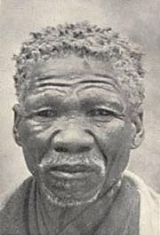
Khoikhoi

Encyclopedia
The Khoikhoi or Khoi, in standardised Khoekhoe/Nama
orthography spelled Khoekhoe, are a historical division of the Khoisan
ethnic group, the native people of southwestern Africa
, closely related to the Bushmen
(or San, as the Khoikhoi called them). They had lived in southern Africa
since the 5th century AD
. When Europe
an immigrants colonized the area in 1652, the Khoikhoi were practising extensive pastoral agriculture
in the Cape region, with large herds of Nguni cattle
. The European immigrants labeled them Hottentots, in imitation of the sound of the Khoisan languages, but this term is today considered derogatory by some.
Archaeological evidence shows that the Khoikhoi entered South Africa
from Botswana
through two distinct routes – traveling west, skirting the Kalahari to the west coast, then down to the Cape, and travelling south-east out into the Highveld
and then southwards to the south coast. Most of the Khoikhoi have largely disappeared as a group, except for the largest group, the Nama
s.
, the ethnic group steadily migrated south, reaching the Cape approximately 2,000 years ago. Khoikhoi subgroups include the Korana of mid-South Africa, the Namaqua
to the west, and the Khoikhoi in the south. Husbandry of sheep, goats and cattle provided a stable, balanced diet and allowed the related Khoikhoi peoples to live in larger groups than the region's previous inhabitants, the San
. Herds grazed in fertile valleys across the region until the 3rd century AD when the advancing Bantu encroached into their traditional homeland. The Khoikhoi were forced into a long retreat into more arid areas. Today, in the southwest country of Namibia
, the majority of the Khoikhoi people are mixed with one of the Bantu groups known as the Damara
– today, they have a mixed-light skin tone, resulting from the light color of the Khoikhoi people and the darker color of the Bantu people. This people group – known as either Damara
or Khoikhoi – live around the Erongo region of Namibia
. They speak the language known as "Khoikhoigobab" or simply (the more wide spread term) "Damara".
Migratory Khoi bands living around what is today Cape Town
intermarried with San. However the two groups remained culturally distinct as the Khoikhoi continued to graze livestock and the San subsisted as hunter-gatherers. The Khoi initially came into contact with European explorers and merchants in approximately AD 1500. The ongoing encounters were often violent. Local population dropped when the Khoi were exposed to smallpox by Europeans. Active warfare between the groups flared when the Dutch East India Company
enclosed traditional grazing land for farms. Over the following century the Khoi were steadily driven off their land, which effectively ended traditional Khoikhoi life.
Khoikhoi social organization was profoundly damaged and, in the end, destroyed by European colonial expansion and land seizure from the late 17th century onwards. As social structures broke down, some Khoikhoi people settled on farms and became bondsmen or farm workers; others were incorporated into existing clan and family groups of the Xhosa people.
In recent years the Khoikhoi have fought a bitter battle against the Herero cattle herders, who have attempted to take their traditional lands.
, a Khoikhoi group living in what was then German South West Africa, along with the Herero took up arms against the Germans. 10,000 Nama, half of the total Nama population, perished.
gives special significance to the moon
, which may have been viewed as the physical manifestation of a supreme being associated with heaven. Tsui'goab is also believed to be the creator and the guardian of health, while Gunab is primarily an evil being, who causes sickness or death. Recently, many Khoikhoi in Namibia
have converted to Islam
and make up the largest group among Namibia's Muslim community
.
Traditionally, the Khoisan lived in simple and disposable huts made of long sticks bound at the top with vines or other fiber then covered in grass. Each family would have their own hut. However, children that were older may have lived live in separate huts with others in their age group.
The Khoisan are polygamous (more than one wife). Wives may share or occupy different huts depending on how well they get along. Visitors are entertained outside the home unit around the fire.
Nama language
The Khoekhoe language, or Khoekhoegowab, also known by the ethnic term Nàmá and previously the now-discouraged term Hottentot, is the most widespread of the Khoisan languages. It belongs to the Khoe language family, and is spoken in Namibia, Botswana, and South Africa by three ethnic groups, the...
orthography spelled Khoekhoe, are a historical division of the Khoisan
Khoisan
Khoisan is a unifying name for two ethnic groups of Southern Africa, who share physical and putative linguistic characteristics distinct from the Bantu majority of the region. Culturally, the Khoisan are divided into the foraging San and the pastoral Khoi...
ethnic group, the native people of southwestern Africa
Africa
Africa is the world's second largest and second most populous continent, after Asia. At about 30.2 million km² including adjacent islands, it covers 6% of the Earth's total surface area and 20.4% of the total land area...
, closely related to the Bushmen
Bushmen
The indigenous people of Southern Africa, whose territory spans most areas of South Africa, Zimbabwe, Lesotho, Mozambique, Swaziland, Botswana, Namibia, and Angola, are variously referred to as Bushmen, San, Sho, Barwa, Kung, or Khwe...
(or San, as the Khoikhoi called them). They had lived in southern Africa
Southern Africa
Southern Africa is the southernmost region of the African continent, variably defined by geography or geopolitics. Within the region are numerous territories, including the Republic of South Africa ; nowadays, the simpler term South Africa is generally reserved for the country in English.-UN...
since the 5th century AD
Common Era
Common Era ,abbreviated as CE, is an alternative designation for the calendar era originally introduced by Dionysius Exiguus in the 6th century, traditionally identified with Anno Domini .Dates before the year 1 CE are indicated by the usage of BCE, short for Before the Common Era Common Era...
. When Europe
Europe
Europe is, by convention, one of the world's seven continents. Comprising the westernmost peninsula of Eurasia, Europe is generally 'divided' from Asia to its east by the watershed divides of the Ural and Caucasus Mountains, the Ural River, the Caspian and Black Seas, and the waterways connecting...
an immigrants colonized the area in 1652, the Khoikhoi were practising extensive pastoral agriculture
Pastoralism
Pastoralism or pastoral farming is the branch of agriculture concerned with the raising of livestock. It is animal husbandry: the care, tending and use of animals such as camels, goats, cattle, yaks, llamas, and sheep. It may have a mobile aspect, moving the herds in search of fresh pasture and...
in the Cape region, with large herds of Nguni cattle
Nguni cattle
The Nguni cattle breed is indigenous to southern Africa. A hybrid of indigenous and Indian cattle they were introduced by the Bantu tribes of southern Africa from the north of the continent...
. The European immigrants labeled them Hottentots, in imitation of the sound of the Khoisan languages, but this term is today considered derogatory by some.
Archaeological evidence shows that the Khoikhoi entered South Africa
South Africa
The Republic of South Africa is a country in southern Africa. Located at the southern tip of Africa, it is divided into nine provinces, with of coastline on the Atlantic and Indian oceans...
from Botswana
Botswana
Botswana, officially the Republic of Botswana , is a landlocked country located in Southern Africa. The citizens are referred to as "Batswana" . Formerly the British protectorate of Bechuanaland, Botswana adopted its new name after becoming independent within the Commonwealth on 30 September 1966...
through two distinct routes – traveling west, skirting the Kalahari to the west coast, then down to the Cape, and travelling south-east out into the Highveld
Highveld
The Highveld is a high plateau region of inland South Africa which is largely home to the largest metropolitan area in the country, the Gauteng City Region, which accounts for one-third of South Africa's population.-Location and description:...
and then southwards to the south coast. Most of the Khoikhoi have largely disappeared as a group, except for the largest group, the Nama
Namaqua
Nama are an African ethnic group of South Africa, Namibia and Botswana. They traditionally speak the Nama language of the Khoe-Kwadi language family, although many Nama now speak Afrikaans. The Nama are the largest group of the Khoikhoi people, most of whom have largely disappeared as a group,...
s.
History
The Khoikhoi were originally part of a pastoral culture and language group found across Southern Africa. Originated in the northern area of modern BotswanaBotswana
Botswana, officially the Republic of Botswana , is a landlocked country located in Southern Africa. The citizens are referred to as "Batswana" . Formerly the British protectorate of Bechuanaland, Botswana adopted its new name after becoming independent within the Commonwealth on 30 September 1966...
, the ethnic group steadily migrated south, reaching the Cape approximately 2,000 years ago. Khoikhoi subgroups include the Korana of mid-South Africa, the Namaqua
Namaqua
Nama are an African ethnic group of South Africa, Namibia and Botswana. They traditionally speak the Nama language of the Khoe-Kwadi language family, although many Nama now speak Afrikaans. The Nama are the largest group of the Khoikhoi people, most of whom have largely disappeared as a group,...
to the west, and the Khoikhoi in the south. Husbandry of sheep, goats and cattle provided a stable, balanced diet and allowed the related Khoikhoi peoples to live in larger groups than the region's previous inhabitants, the San
Bushmen
The indigenous people of Southern Africa, whose territory spans most areas of South Africa, Zimbabwe, Lesotho, Mozambique, Swaziland, Botswana, Namibia, and Angola, are variously referred to as Bushmen, San, Sho, Barwa, Kung, or Khwe...
. Herds grazed in fertile valleys across the region until the 3rd century AD when the advancing Bantu encroached into their traditional homeland. The Khoikhoi were forced into a long retreat into more arid areas. Today, in the southwest country of Namibia
Namibia
Namibia, officially the Republic of Namibia , is a country in southern Africa whose western border is the Atlantic Ocean. It shares land borders with Angola and Zambia to the north, Botswana to the east and South Africa to the south and east. It gained independence from South Africa on 21 March...
, the majority of the Khoikhoi people are mixed with one of the Bantu groups known as the Damara
Damara
Damara may refer to:* Damara , breed of sheep* Damara , Namibian people* Damaraland, a region in Namibia* Damara , landlords of ancient Kashmir* Damara, Central African Republic, town...
– today, they have a mixed-light skin tone, resulting from the light color of the Khoikhoi people and the darker color of the Bantu people. This people group – known as either Damara
Damara
Damara may refer to:* Damara , breed of sheep* Damara , Namibian people* Damaraland, a region in Namibia* Damara , landlords of ancient Kashmir* Damara, Central African Republic, town...
or Khoikhoi – live around the Erongo region of Namibia
Namibia
Namibia, officially the Republic of Namibia , is a country in southern Africa whose western border is the Atlantic Ocean. It shares land borders with Angola and Zambia to the north, Botswana to the east and South Africa to the south and east. It gained independence from South Africa on 21 March...
. They speak the language known as "Khoikhoigobab" or simply (the more wide spread term) "Damara".
Migratory Khoi bands living around what is today Cape Town
Cape Town
Cape Town is the second-most populous city in South Africa, and the provincial capital and primate city of the Western Cape. As the seat of the National Parliament, it is also the legislative capital of the country. It forms part of the City of Cape Town metropolitan municipality...
intermarried with San. However the two groups remained culturally distinct as the Khoikhoi continued to graze livestock and the San subsisted as hunter-gatherers. The Khoi initially came into contact with European explorers and merchants in approximately AD 1500. The ongoing encounters were often violent. Local population dropped when the Khoi were exposed to smallpox by Europeans. Active warfare between the groups flared when the Dutch East India Company
Dutch East India Company
The Dutch East India Company was a chartered company established in 1602, when the States-General of the Netherlands granted it a 21-year monopoly to carry out colonial activities in Asia...
enclosed traditional grazing land for farms. Over the following century the Khoi were steadily driven off their land, which effectively ended traditional Khoikhoi life.
Khoikhoi social organization was profoundly damaged and, in the end, destroyed by European colonial expansion and land seizure from the late 17th century onwards. As social structures broke down, some Khoikhoi people settled on farms and became bondsmen or farm workers; others were incorporated into existing clan and family groups of the Xhosa people.
In recent years the Khoikhoi have fought a bitter battle against the Herero cattle herders, who have attempted to take their traditional lands.
Massacre
From 1904 to 1907, the NamaquaNamaqua
Nama are an African ethnic group of South Africa, Namibia and Botswana. They traditionally speak the Nama language of the Khoe-Kwadi language family, although many Nama now speak Afrikaans. The Nama are the largest group of the Khoikhoi people, most of whom have largely disappeared as a group,...
, a Khoikhoi group living in what was then German South West Africa, along with the Herero took up arms against the Germans. 10,000 Nama, half of the total Nama population, perished.
Culture
The religious mythology of the KhoikhoiKhoikhoi mythology
This is a summary of some of the gods, heroes and monsters that appear in the beliefs of the Khoikhoi, an ethnic group from southern Africa.- Gods and heroes :...
gives special significance to the moon
Moon
The Moon is Earth's only known natural satellite,There are a number of near-Earth asteroids including 3753 Cruithne that are co-orbital with Earth: their orbits bring them close to Earth for periods of time but then alter in the long term . These are quasi-satellites and not true moons. For more...
, which may have been viewed as the physical manifestation of a supreme being associated with heaven. Tsui'goab is also believed to be the creator and the guardian of health, while Gunab is primarily an evil being, who causes sickness or death. Recently, many Khoikhoi in Namibia
Namibia
Namibia, officially the Republic of Namibia , is a country in southern Africa whose western border is the Atlantic Ocean. It shares land borders with Angola and Zambia to the north, Botswana to the east and South Africa to the south and east. It gained independence from South Africa on 21 March...
have converted to Islam
Islam
Islam . The most common are and . : Arabic pronunciation varies regionally. The first vowel ranges from ~~. The second vowel ranges from ~~~...
and make up the largest group among Namibia's Muslim community
Islam in Namibia
Islam is the third largest religion in Namibia after Christianity and indigenous beliefs.-Number of Muslims:In 1999, a Namibian Muslim leader estimated that there were approximately 1,500 Muslims in the country. In 2009, leaders estimated that there were between 3,000 and 5,000 Namibian Muslims...
.
Traditionally, the Khoisan lived in simple and disposable huts made of long sticks bound at the top with vines or other fiber then covered in grass. Each family would have their own hut. However, children that were older may have lived live in separate huts with others in their age group.
The Khoisan are polygamous (more than one wife). Wives may share or occupy different huts depending on how well they get along. Visitors are entertained outside the home unit around the fire.
See also
- Herero and Namaqua genocideHerero and Namaqua GenocideThe Herero and Namaqua Genocide is considered to have been the first genocide of the 20th century. It took place between 1904 and 1907 in German South-West Africa , during the scramble for Africa...
- NamaquaNamaquaNama are an African ethnic group of South Africa, Namibia and Botswana. They traditionally speak the Nama language of the Khoe-Kwadi language family, although many Nama now speak Afrikaans. The Nama are the largest group of the Khoikhoi people, most of whom have largely disappeared as a group,...
- Khoikhoi mythologyKhoikhoi mythologyThis is a summary of some of the gods, heroes and monsters that appear in the beliefs of the Khoikhoi, an ethnic group from southern Africa.- Gods and heroes :...
- History of South AfricaHistory of South AfricaSouth African history has been dominated by the interaction and conflict of several diverse ethnic groups. The aboriginal Khoisan people have lived in the region for millennia. Most of the population, however, trace their history to immigration since...
- Hottentot Venus
Publications
- P. Kolben, Present State of the Cape of Good Hope (London, 1731–38);
- A. Sparman, Voyage to the Cape of Good Hope (Perth, 1786);
- Sir John BarrowSir John Barrow, 1st BaronetSir John Barrow, 1st Baronet, FRS, FRGS was an English statesman.-Career:He was born the son of Roger Barrow in the village of Dragley Beck, in the parish of Ulverston then in Lancashire, now in Cumbria...
, Travels into the Interior of South Africa (London, 1801); - BleekWilhelm BleekWilhelm Heinrich Immanuel Bleek was a German linguist. His work included A Comparative Grammar of South African Languages and his great project jointly executed with Lucy Lloyd: The Bleek and Lloyd Archive of ǀxam and !kun texts.-Biography:Wilhelm Heinrich Immanuel Bleek was born in Berlin on 8...
, Reynard the Fox in South Africa; or Hottentot Fables and Tales (London, 1864); - Emil HolubEmil HolubEmil Holub was a Czech physician, explorer, cartographer, and ethnographer in Africa. In a 2005 poll, he was voted #90 of the 100 greatest Czechs.-Early life:...
, Seven Years in South Africa (English translation, Boston, 1881); - G. W. Stow, Native Races of South Africa (New York, 1905);
- A. R. Colquhoun, Africander Land (New York, 1906);
- L. Schultze, Aus Namaland und Kalahari (Jena, 1907);
- MeinhofCarl MeinhofCarl Friedrich Michael Meinhof was a German linguist and one of the first linguists to study African languages.-Early years and career:...
, Die Sprachen der Hamiten (Hamburg, 1912); - Richard Elphick, Khoikhoi and the Founding of White South Africa (London, 1977)