

Voortrekkers

Encyclopedia
Cape Colony
The Cape Colony, part of modern South Africa, was established by the Dutch East India Company in 1652, with the founding of Cape Town. It was subsequently occupied by the British in 1795 when the Netherlands were occupied by revolutionary France, so that the French revolutionaries could not take...
(British at the time, but founded by the Dutch) moving into the interior of what is now South Africa
South Africa
The Republic of South Africa is a country in southern Africa. Located at the southern tip of Africa, it is divided into nine provinces, with of coastline on the Atlantic and Indian oceans...
. The Great Trek
Great Trek
The Great Trek was an eastward and north-eastward migration away from British control in the Cape Colony during the 1830s and 1840s by Boers . The migrants were descended from settlers from western mainland Europe, most notably from the Netherlands, northwest Germany and French Huguenots...
consisted of a number of mass movements under a number of different leaders including Louis Tregardt
Louis Tregardt
Louis Johannes Tregardt was a farmer from the Cape Colony's eastern frontier, who became an early voortrekker leader. Shunning colonial authority, he emigrated in 1834 to live among the Xhosa, before he crossed the Orange River into neutral territory. His northward trek, along with fellow trekker...
, Hendrik Potgieter, Sarel Cilliers
Sarel Cilliers
Charl Arnoldus Cilliers was a Voortrekker leader and a preacher. With Andries Pretorius, he led the Boers to a huge victory over the Zulus at the Battle of Blood River in 1838...
, Pieter Uys, Gerrit Maritz
Gerrit Maritz
Gert Maritz was a Voortrekker pioneer and leader.-See also:*Graaff-Reinet: Gerrit Maritz, Great Trek Leader after whom Pietermaritzburg was partly named was a wagon-maker in the town....
, Piet Retief
Piet Retief
Pieter Mauritz Retief was a South African Boer leader. Settling in 1814 in the frontier region of the Cape Colony, he assumed command of punitive expeditions in response to raiding parties from the adjacent Xhosa territory...
and Andries Pretorius
Andries Pretorius
Andries Wilhelmus Jacobus Pretorius was a leader of the Boers who was instrumental in the creation of the Transvaal Republic, as well as the earlier but short-lived Natalia Republic, in present-day South Africa....
.
Origins
The Voortrekkers mainly came from the farming community of the Eastern CapeEastern Cape
The Eastern Cape is a province of South Africa. Its capital is Bhisho, but its two largest cities are Port Elizabeth and East London. It was formed in 1994 out of the "independent" Xhosa homelands of Transkei and Ciskei, together with the eastern portion of the Cape Province...
although some (such as Piet Retief
Piet Retief
Pieter Mauritz Retief was a South African Boer leader. Settling in 1814 in the frontier region of the Cape Colony, he assumed command of punitive expeditions in response to raiding parties from the adjacent Xhosa territory...
) originally came from the Western Cape
Western Cape
The Western Cape is a province in the south west of South Africa. The capital is Cape Town. Prior to 1994, the region that now forms the Western Cape was part of the much larger Cape Province...
farming community while others (such as Gerrit Maritz
Gerrit Maritz
Gert Maritz was a Voortrekker pioneer and leader.-See also:*Graaff-Reinet: Gerrit Maritz, Great Trek Leader after whom Pietermaritzburg was partly named was a wagon-maker in the town....
) were successful tradesmen in the frontier towns. Some of them were wealthy men though most were not as they were from the poorer communities of the frontier. It was recorded that the 33 Voortrekker families at the Battle of Vegkop lost 100 horses, between 4,000 and 7,000 cattle, and between 40,000 and 50,000 sheep. These figures appear greatly exaggerated. Other members of the trekking parties were of Trekboer
Trekboer
The Trekboers were nomadic pastoralists descended from almost equal numbers of Dutch colonists, French Huguenots and German Protestants. The Trekboere began migrating from the areas surrounding what is now Cape Town during the 17th century throughout the 18th century.-Origins:The Trekboere were...
stock who came from a life of semi-nomadic herding; yet others were employees, many of whom had been slaves only a few years earlier.
The reasons for the mass emigration from the Cape Colony
Cape Colony
The Cape Colony, part of modern South Africa, was established by the Dutch East India Company in 1652, with the founding of Cape Town. It was subsequently occupied by the British in 1795 when the Netherlands were occupied by revolutionary France, so that the French revolutionaries could not take...
have been much discussed over the years. Afrikaner historiography has emphasized the hardships endured by the frontier farmers which they blamed on British policies of pacifying the Xhosa tribes. Other historians have emphasized the harshness of the life in the Eastern Cape (which suffered one of its regular periods of drought in the early 1830s) compared to the attractions of the fertile country of Natal
Natalia Republic
The Natalia Republic was a short-lived Boer republic, established in 1839 by local Afrikaans-speaking Voortrekkers shortly after the Battle of Blood River. The republic was located on the coast of the Indian Ocean beyond the Eastern Cape, and was previously named Natalia by Portuguese sailors. The...
, the Orange Free State
Orange Free State
The Orange Free State was an independent Boer republic in southern Africa during the second half of the 19th century, and later a British colony and a province of the Union of South Africa. It is the historical precursor to the present-day Free State province...
and the Transvaal
South African Republic
The South African Republic , often informally known as the Transvaal Republic, was an independent Boer-ruled country in Southern Africa during the second half of the 19th century. Not to be confused with the present-day Republic of South Africa, it occupied the area later known as the South African...
. Growing land shortages have also been cited as a contributing factor. The true reasons were obviously very complex and certainly consisted of both "push" factors (including the general dissatisfaction of life under British rule) and "pull" factors (including the desire for a better life in better country.)
The Voortrekkers were mainly of Trekboer
Trekboer
The Trekboers were nomadic pastoralists descended from almost equal numbers of Dutch colonists, French Huguenots and German Protestants. The Trekboere began migrating from the areas surrounding what is now Cape Town during the 17th century throughout the 18th century.-Origins:The Trekboere were...
(migrating farmer) descent living in the eastern frontiers of the Cape. Hence, their ancestors had long established a semi-nomadic existence of trekking into expanding frontiers.
Battle of Blood River
Voortrekkers migrated into Natal and negotiated a land treaty with the Zulu King Dingane. Upon reconsideration, Dingane doublecrossed the Voortrekkers, killing their leader Piet RetiefPiet Retief
Pieter Mauritz Retief was a South African Boer leader. Settling in 1814 in the frontier region of the Cape Colony, he assumed command of punitive expeditions in response to raiding parties from the adjacent Xhosa territory...
along with half of the Voortrekker settlers who had followed them to Natal. Other Voortrekkers migrated north to the Waterberg
Waterberg
Waterberg can refer to two articles about an area in Namibia:* Waterberg Biosphere* Waterberg National Park...
area, where some of them settled and began ranching operations, which activities enhanced the pressure placed on indigenous wildlife by pre-existing tribesmen, whose Bantu predecessors had previously initiated such grazing in the Waterberg region. These Voortrekkers arriving in the Waterberg area had believed they were in the Nile River area of Egypt
Egypt
Egypt , officially the Arab Republic of Egypt, Arabic: , is a country mainly in North Africa, with the Sinai Peninsula forming a land bridge in Southwest Asia. Egypt is thus a transcontinental country, and a major power in Africa, the Mediterranean Basin, the Middle East and the Muslim world...
based upon their understanding of the local topography.
Andries Pretorius filled the leadership vacuum hoping to enter into negotiations for peace if Dingane would restore the land he had granted to Retief. When Dingane sent an impi
Impi
An Impi is an isiZulu word for any armed body of men. However, in English it is often used to refer to a Zulu regiment, which is called an ibutho in Zulu. Its beginnings lie far back in historic tribal warfare customs, where groups of armed men called impis battled...
(armed force) of around twelve thousand Zulu warriors to attack the local contingent of Voortrekkers in response, the Voortrekkers defended themselves at a battle at Nacome River
Blood River
Blood River, , is situated in KwaZulu-Natal, South Africa- See also :* List of rivers of South Africa...
(called the Battle of Blood River
Battle of Blood River
The Battle of Blood River, so called due to the colour of water in the Ncome River turning red with blood, was fought between 470 Voortrekkers led by Andries Pretorius, and an estimated 10,000–15,000 Zulu attackers on the bank of the Ncome River on 16 December 1838, in what is today KwaZulu-Natal,...
) on 16 December 1838 where the vastly outnumbered Voortrekker contingent defeated the Zulu warriors. This date has hence been known as the Day of the Vow
Day of the Vow
The Day of the Vow is the name of a religious public holiday in South Africa until 1994, when it was renamed the Day of Reconciliation. The holiday is December 16...
as the Voortrekkers made a vow to God that they would honor the date if he were to deliver them from what they viewed as almost insurmountable odds. The victory of the besieged Voortrekkers at Nacome River was considered a turning point. The Natalia Republic was set up in 1839 but was annexed by Britain in 1843 whereupon most of the local Boers trekked further north joining other Voortrekkers who had established themselves in the region.
Struggle against the Ndebele
Armed conflict, first with the Ndebele people under MzilikaziMzilikazi
Mzilikazi , also sometimes called Mosilikatze, was a Southern African king who founded the Matabele kingdom , Matabeleland, in what became Rhodesia and is now Zimbabwe. He was born the son of Matshobana near Mkuze, Zululand and died at Ingama, Matabeleland...
in the area which was to become the Transvaal, then against the Zulus
Zulu Kingdom
The Zulu Kingdom, sometimes referred to as the Zulu Empire or, rather imprecisely, Zululand, was a monarchy in Southern Africa that extended along the coast of the Indian Ocean from the Tugela River in the south to Pongola River in the north....
under Dingane, went the Voortrekkers' way, mostly because of their tactics, their horsemanship and the effectiveness of their muzzle-loading guns
Muzzleloader
A muzzleloader is any firearm into which the projectile and usually the propellant charge is loaded from the muzzle of the gun . This is distinct from the more popular modern designs of breech-loading firearms...
. This success led to the establishment of a number of small Boer republics, which slowly coalesced into the Orange Free State and the South African Republic. These two states would survive until their annexation in 1900 by United Kingdom during the Second Boer War
Second Boer War
The Second Boer War was fought from 11 October 1899 until 31 May 1902 between the British Empire and the Afrikaans-speaking Dutch settlers of two independent Boer republics, the South African Republic and the Orange Free State...
.
Memorials
The Voortrekkers are commemorated by the Voortrekker MonumentVoortrekker Monument
The Voortrekker Monument is a monument in the city of Pretoria, South Africa. The massive granite structure, built to honour the Voortrekkers who left the Cape Colony between 1835 and 1854, was designed by the architect Gerard Moerdijk who had the idea to design a "monument that would stand a...
located on Monument Hill overlooking Pretoria
Pretoria
Pretoria is a city located in the northern part of Gauteng Province, South Africa. It is one of the country's three capital cities, serving as the executive and de facto national capital; the others are Cape Town, the legislative capital, and Bloemfontein, the judicial capital.Pretoria is...
, the erstwhile capital of the South African Republic and the current and historic administrative capital of the Republic of South Africa. Pretoria was named after the Voortrekker leader Andries Pretorius.
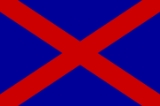
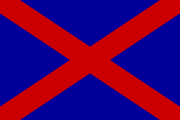
The Voortrekkers had a distinctive flag, used mainly by the Voortrekkers who followed Andries Hendrik Potgieter
Andries Hendrik Potgieter
Andries Hendrik Potgieter, known as Hendrik Potgieter was a Voortrekker leader. He served as the first head of state of Potchefstroom from 1840 and 1845 and also as the first head of state of Zoutpansberg from 1845 to 1852.Potgieter was born in the Tarkastad district of the Cape Colony, the second...
, which is why it was also known as the Potgieter Flag. This flag was used as the flag of the Zoutpansberg
Zoutpansberg
Zoutpansberg was the north-eastern division of the Transvaal, South Africa. This was the district to which Louis Tregardt and Jan van Rensburg, the forerunners of the Great Trek, journeyed in 1835. In 1845 Hendrik Potgieter, a prominent leader of the Voortrekkers, moved there...
Republic until this republic was incorporated into the Transvaal Republic also known as the South African Republic. A version of this flag was used at Potchefstroom, one of the first independent Boer towns and republics established by local Voortrekkers.
See also
- Trekboers
- Voortrekker MonumentVoortrekker MonumentThe Voortrekker Monument is a monument in the city of Pretoria, South Africa. The massive granite structure, built to honour the Voortrekkers who left the Cape Colony between 1835 and 1854, was designed by the architect Gerard Moerdijk who had the idea to design a "monument that would stand a...
- Great TrekGreat TrekThe Great Trek was an eastward and north-eastward migration away from British control in the Cape Colony during the 1830s and 1840s by Boers . The migrants were descended from settlers from western mainland Europe, most notably from the Netherlands, northwest Germany and French Huguenots...
- Weenen massacreWeenen massacreThe Weenen Massacre was the massacre of Voortrekkers by the Zulu on 17 February 1838. After the murder of Piet Retief and his delegation, the Zulu chief Dingane sent his impis to exterminate the remaining voortrekkers who were camped at Doringkop, Bloukrans The Weenen Massacre was the massacre of...
- Battle of Blood RiverBattle of Blood RiverThe Battle of Blood River, so called due to the colour of water in the Ncome River turning red with blood, was fought between 470 Voortrekkers led by Andries Pretorius, and an estimated 10,000–15,000 Zulu attackers on the bank of the Ncome River on 16 December 1838, in what is today KwaZulu-Natal,...
- Boer republicsBoer RepublicsThe Boer Republics were independent self-governed republics created by the northeastern frontier branch of the Dutch-speaking inhabitants of the north eastern Cape Province and their descendants in mainly the northern and eastern parts of what is now the country of...
- Transvaal civil warTransvaal civil warThe Transvaal civil war was a series of skirmishes in the Transvaal Colony in the early 1860s. It began after the British government had recognized trekkers living in the Transvaal Colony independent in 1854,. The Boers divided into numerous political factions...
, 1854 conflict - First Boer WarFirst Boer WarThe First Boer War also known as the First Anglo-Boer War or the Transvaal War, was fought from 16 December 1880 until 23 March 1881-1877 annexation:...
, 1880 conflict