


Pasha

Encyclopedia
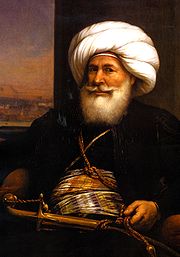
Ottoman Empire
The Ottoman EmpireIt was usually referred to as the "Ottoman Empire", the "Turkish Empire", the "Ottoman Caliphate" or more commonly "Turkey" by its contemporaries...
political system, typically granted to governor
Governor
A governor is a governing official, usually the executive of a non-sovereign level of government, ranking under the head of state...
s, general
General
A general officer is an officer of high military rank, usually in the army, and in some nations, the air force. The term is widely used by many nations of the world, and when a country uses a different term, there is an equivalent title given....
s and dignitaries. As an honorary title
Honorific
An honorific is a word or expression with connotations conveying esteem or respect when used in addressing or referring to a person. Sometimes, the term is used not quite correctly to refer to an honorary title...
, Pasha, in one of its various ranks, is equivalent to the British title of Lord
Lord
Lord is a title with various meanings. It can denote a prince or a feudal superior . The title today is mostly used in connection with the peerage of the United Kingdom or its predecessor countries, although some users of the title do not themselves hold peerages, and use it 'by courtesy'...
, and was also one of the highest titles in pre-republican Egypt
Egypt
Egypt , officially the Arab Republic of Egypt, Arabic: , is a country mainly in North Africa, with the Sinai Peninsula forming a land bridge in Southwest Asia. Egypt is thus a transcontinental country, and a major power in Africa, the Mediterranean Basin, the Middle East and the Muslim world...
. There were three ranks of pashas: the first, or highest class, had the privilege of bearing a standard of three horse-tails, the second of two, and the third of one.
Linguistics
The word pasha entered English from TurkishTurkish language
Turkish is a language spoken as a native language by over 83 million people worldwide, making it the most commonly spoken of the Turkic languages. Its speakers are located predominantly in Turkey and Northern Cyprus with smaller groups in Iraq, Greece, Bulgaria, the Republic of Macedonia, Kosovo,...
paşa. Etymologists variously derive the word paşa from the Turkish
Turkish language
Turkish is a language spoken as a native language by over 83 million people worldwide, making it the most commonly spoken of the Turkic languages. Its speakers are located predominantly in Turkey and Northern Cyprus with smaller groups in Iraq, Greece, Bulgaria, the Republic of Macedonia, Kosovo,...
baş or baş ağa, "head, chief". Old Turkish had no fixed distinction between /b/ and /p/, and the word was spelled başa still in the 15th century. As first used in western Europe, the title appeared in writing with the initial "b". The English forms bashaw, bassaw, bucha etc., general in the 16th and 17th century, derive through the medieval Latin
Latin
Latin is an Italic language originally spoken in Latium and Ancient Rome. It, along with most European languages, is a descendant of the ancient Proto-Indo-European language. Although it is considered a dead language, a number of scholars and members of the Christian clergy speak it fluently, and...
and Italian
Italian language
Italian is a Romance language spoken mainly in Europe: Italy, Switzerland, San Marino, Vatican City, by minorities in Malta, Monaco, Croatia, Slovenia, France, Libya, Eritrea, and Somalia, and by immigrant communities in the Americas and Australia...
word bassa. Due to the Ottoman presence in the Arab World
Arab world
The Arab world refers to Arabic-speaking states, territories and populations in North Africa, Western Asia and elsewhere.The standard definition of the Arab world comprises the 22 states and territories of the Arab League stretching from the Atlantic Ocean in the west to the Arabian Sea in the...
, the title became used frequently in Arabic
Arabic language
Arabic is a name applied to the descendants of the Classical Arabic language of the 6th century AD, used most prominently in the Quran, the Islamic Holy Book...
, though pronounced as basha due to the absence of the letter "p" in Arabic.
Role in Ottoman, and Egyptian political systems
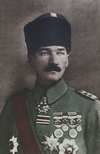
Ottoman Empire
The Ottoman EmpireIt was usually referred to as the "Ottoman Empire", the "Turkish Empire", the "Ottoman Caliphate" or more commonly "Turkey" by its contemporaries...
, the Ottoman Sultan had the right to bestow the title of Pasha. It was through this custom that the title (ˈbæːʃæ) came to be used in Egypt, which was conquered by the Ottomans in 1517. The rise to power in Egypt in 1805 by Muhammad Ali
Muhammad Ali of Egypt
Muhammad Ali Pasha al-Mas'ud ibn Agha was a commander in the Ottoman army, who became Wāli, and self-declared Khedive of Egypt and Sudan...
, an Albanian military commander, effectively established Egypt as a de facto independent state
Egypt under Muhammad Ali and his successors
The history of Egypt under the Muhammad Ali Pasha dynasty spanned the later period of Ottoman Egypt, the Khedivate of Egypt under British patronage, and the nominally independent Sultanate of Egypt and Kingdom of Egypt, ending with the Revolution of 1952 and the formation of the Republic of...
, however, it still owed technical fealty to the Ottoman Sultan. Moreover, Muhammad Ali harboured ambitions of supplanting the Osman Dynasty
Ottoman Dynasty
The Ottoman Dynasty ruled the Ottoman Empire from 1299 to 1922, beginning with Osman I , though the dynasty was not proclaimed until Orhan Bey declared himself sultan...
in Constantinople
Constantinople
Constantinople was the capital of the Roman, Eastern Roman, Byzantine, Latin, and Ottoman Empires. Throughout most of the Middle Ages, Constantinople was Europe's largest and wealthiest city.-Names:...
, and sought to style his Egyptian realm as a successor sultanate to the Ottoman Empire. As such, he bore the title of Pasha, in addition to the official title of Wāli
Wali
Walī , is an Arabic word meaning "custodian", "protector", "sponsor", or authority as denoted by its definition "crown". "Wali" is someone who has "Walayah" over somebody else. For example, in Fiqh the father is wali of his children. In Islam, the phrase ولي الله walīyu 'llāh...
, and the self-declared title of Khedive
Khedive
The term Khedive is a title largely equivalent to the English word viceroy. It was first used, without official recognition, by Muhammad Ali Pasha , the Wāli of Egypt and Sudan, and vassal of the Ottoman Empire...
. His successors to the Egyptian and Sudanese throne
Muhammad Ali Dynasty
The Muhammad Ali Dynasty was the ruling dynasty of Egypt and Sudan, from the 19th to the mid-20th Century. It is named after its progenitor, Muhammad Ali Pasha, regarded as the founder of modern Egypt. It was also more formally known as the Alawiyya Dynasty...
, Ibrahim
Ibrahim Pasha of Egypt
Ibrahim Pasha was the eldest son of Muhammad Ali, the Wāli and unrecognised Khedive of Egypt and Sudan. He served as a general in the Egyptian army that his father established during his reign, taking his first command of Egyptian forces was when he was merely a teenager...
, Abbas
Abbas I of Egypt
Abbas I , , also known as Abbas Hilmi I Pasha Wāli of Egypt and Sudan, was a son of Tusun Pasha and grandson of Muhammad Ali, founder of the reigning dynasty of Egypt and Sudan at the time...
, Sa'id
Sa'id of Egypt
Muhammad Sa'id Pasha was the Wāli self-declared Khedive of Egypt and Sudan from 1854 until 1863, officially owing fealty to the Ottoman Sultan but in practice exercising virtual independence. He was the fourth son of Muhammad Ali Pasha. Sa'id was a Francophone, educated in Paris.Under Sa'id's rule...
, and Isma'il
Isma'il Pasha
Isma'il Pasha , known as Ismail the Magnificent , was the Khedive of Egypt and Sudan from 1863 to 1879, when he was removed at the behest of the United Kingdom...
also inherited these titles, with Pasha, and Wāli ceasing to be used in 1867, when the Ottoman Sultan, Abdülaziz
Abdülâziz
Abdülaziz I or Abd Al-Aziz, His Imperial Majesty was the 32nd Sultan of the Ottoman Empire and reigned between 25 June 1861 and 30 May 1876...
officially recognised Isma'il as Khedive.
The title Pasha appears originally to have applied exclusively to military commanders, but subsequently it could distinguish any high official, and also unofficial persons whom the court desired to honour.
It was also part of the official style of the Alpina Kursuncu Pasha (Great Admiral of the entire Ottoman fleet).
Pashas ranked above Bey
Bey
Bey is a title for chieftain, traditionally applied to the leaders of small tribal groups. Accoding to some sources, the word "Bey" is of Turkish language In historical accounts, many Turkish, other Turkic and Persian leaders are titled Bey, Beg, Bek, Bay, Baig or Beigh. They are all the same word...
s and Aghas, but below Khedive
Khedive
The term Khedive is a title largely equivalent to the English word viceroy. It was first used, without official recognition, by Muhammad Ali Pasha , the Wāli of Egypt and Sudan, and vassal of the Ottoman Empire...
s and Vizier
Vizier
A vizier or in Arabic script ; ; sometimes spelled vazir, vizir, vasir, wazir, vesir, or vezir) is a high-ranking political advisor or minister in a Muslim government....
s.
Three grades of Pasha existed, distinguished by the number of yak- or horse-tails (three, two and one respectively; a symbol of Turco-Mongol
Turco-Mongol
Turko-Mongol is a modern designation for various nomads who were subjects of the Mongol Empire. Being progressively Turkicized in terms of language and identity following the Mongol conquests, they derived their ethnic and cultural origins from steppes of Central Asia...
tradition) or peacock tails, which the bearers were entitled to display on their standard as a symbol of military authority when on campaign* Only the Sultan himself was entitled to four tails, as sovereign commander in chief.
The following military ranks entitled the holder to the style Pasha (lower ranks were styled Bey or merely Effendi
Effendi
Effendi, Effendy or Efendi is a title of nobility meaning a lord or master.It is a title of respect or courtesy, equivalent to the English Sir, which was used in Ottoman Empire...
):
- The Vizier-i-Azam (Grand Vizier, the prime minister, but also often taking the field as Generalissimo instead of the Sultan)
- MushirMushirA Mushir is the highest rank in most militaries of the Middle East. It is the equivalent to the ranks of General of the Army, Field Marshal, and Fleet Admiral.- Iraq :...
(Field marshal) - FerikFerikFerik is a town in the Armavir Province of Armenia. The town is named in honor of poet and revolutionary Ferik Polatbekov.- References :*...
(army Lieutenant-general or navy Vice-admiral) - LivaLiwa (arabic)Liwa or Liwa is an Arabic term meaning district, banner, or flag, a type of administrative division. It was interchangeable with the Turkish term "Sanjak" in the time of the Ottoman Empire. After the fall of the empire, the term was used in the Arab countries formerly under Ottoman rule...
(major general or Rear-admiral) - The Kizlar Agha (chief black eunuch, the highest officer in the Topkapı PalaceTopkapi PalaceThe Topkapı Palace is a large palace in Istanbul, Turkey, that was the primary residence of the Ottoman Sultans for approximately 400 years of their 624-year reign....
; three tails, as commander of the baltacı corps of the halberdiers in the imperial army - Istanbul's Shaikh ul-Islam, the highest Muslim clergyman, of cabinet rank.
If a Pasha governed a provincial territory, it could be called a pashaluk
Pashaluk
Pashaluk or Pashalik is a term for one type of the Subdivisions of the Ottoman Empire.It is the abstract word derived from pasha, denoting the quality, office or jurisdiction of a pasha or the territory administered by him....
after his military title, besides the administrative term for the type of jurisdiction, e.g. eyalet
Eyalet
Eyalets were a former primary administrative division of the Ottoman Empire. The term is sometimes translated province or government. Depending on the rank of their commander, they are also sometimes known as pashaliks, beylerbeyliks, and kapudanliks.From 1453 to the beginning of the nineteenth...
, vilayet/walayah
Wilayah
A wilāyah or vilâyet , or vilayat in Urdu and Turkish, is an administrative division, usually translated as "province", rarely as "governorate". The word comes from the Arabic "w-l-y", "to govern": a wāli — "governor" — governs a wilayah, "that which is governed"...
. Both Beylerbey
Beylerbey
Beylerbey is the Ottoman and Safavid title used for the highest rank in the hierarchy of provincial administrators It is in western terms a Governor-general, with authority...
s (governors-general) and valis/wālis
Wali
Walī , is an Arabic word meaning "custodian", "protector", "sponsor", or authority as denoted by its definition "crown". "Wali" is someone who has "Walayah" over somebody else. For example, in Fiqh the father is wali of his children. In Islam, the phrase ولي الله walīyu 'llāh...
(the most common type of Governor) were entitled to the style of Pasha (typically with two tails). The word pashalik designated any province
Province
A province is a territorial unit, almost always an administrative division, within a country or state.-Etymology:The English word "province" is attested since about 1330 and derives from the 13th-century Old French "province," which itself comes from the Latin word "provincia," which referred to...
or other jurisdiction of a Pasha.
Ottoman, and Egyptian authorities conferred the title upon both Muslim
Muslim
A Muslim, also spelled Moslem, is an adherent of Islam, a monotheistic, Abrahamic religion based on the Quran, which Muslims consider the verbatim word of God as revealed to prophet Muhammad. "Muslim" is the Arabic term for "submitter" .Muslims believe that God is one and incomparable...
s and Christian
Christian
A Christian is a person who adheres to Christianity, an Abrahamic, monotheistic religion based on the life and teachings of Jesus of Nazareth as recorded in the Canonical gospels and the letters of the New Testament...
s without distinction. They also frequently gave it to foreigners in the service of the Ottoman Empire, or of the Egyptian Khedivate
Khedivate of Egypt
The Khedivate of Egypt was an autonomous tributary state of the Ottoman Empire.- Rise of Muhammad Ali :The Egypt Eyalet was an eyalet of the Ottoman Empire. The eyalet was ruled locally by the Mamluk military caste and their various beys , who started to fight amongst themselves for control of...
(later Sultanate
Sultanate of Egypt
The Sultanate of Egypt is the name of the short-lived protectorate that the United Kingdom imposed over Egypt between 1914 and 1922.-History:...
, and Kingdom
Kingdom of Egypt
The Kingdom of Egypt was the first modern Egyptian state, lasting from 1922 to 1953. The Kingdom was created in 1922 when the British government unilaterally ended its protectorate over Egypt, in place since 1914. Sultan Fuad I became the first king of the new state...
in turn), e.g. Hobart Pasha.
Honorific
In usage, the title followed the given name. Although the word serves as a non-hereditary title, English speakers have commonly used the word pasha as if it formed part of a personal name, as for instance in Ibrahim PashaIbrahim Pasha (disambiguation)
Ibrahim Pasha may refer to:*Pargalı Ibrahim Pasha, early-16th-century Grand Vizier to Suleyman the Magnificent*Damat Ibrahim Pasha, late-16th-century Grand Vizier*Nevşehirli Damat Ibrahim Pasha, early-18th-century Grand Vizier during the Tulip Era...
or Emin Pasha
Emin Pasha
Mehmed Emin Pasha — he was born Isaak Eduard Schnitzer and baptized Eduard Carl Oscar Theodor Schnitzer — was a physician, naturalist, and governor of the Egyptian province of Equatoria on the upper Nile...
, similar to the practice of referring to a British Peer as Lord X, since in both cases it substitutes for a more precise rank title.
The sons of a Pasha were styled Pashazada or Pasha-zade, which means just that.
In modern Egyptian
Egyptian Arabic
Egyptian Arabic is the language spoken by contemporary Egyptians.It is more commonly known locally as the Egyptian colloquial language or Egyptian dialect ....
and (to a lesser extent) Levantine Arabic
Levantine Arabic
Levantine Arabic is a broad variety of Arabic spoken in the 100 to 200 km-wide Eastern Mediterranean coastal strip...
, it is used as an honorific closer to "Sir" than "Lord," especially by older people. Among Egyptians born since the Revolution of 1952 and the abolition of aristocratic titles, it is considered a highly informal way of addressing one's male peers.
Although not used as an official title, today, general officers of the Turkish Armed Forces
Turkish Armed Forces
The Turkish Armed Forces are the military forces of the Republic of Turkey. They consist of the Army, the Navy , and the Air Force...
are referred as pashas by the public and media in Turkey.
List of notable pashas
- Abaza FamilyAbaza familyThe Abaza clan, "deeply rooted in Egyptian society and... in the history of the country" is an Egyptian family that has played a powerful and long-standing role in Egyptian economic, intellectual and political life...
– Egyptian Pashas and BeyBeyBey is a title for chieftain, traditionally applied to the leaders of small tribal groups. Accoding to some sources, the word "Bey" is of Turkish language In historical accounts, many Turkish, other Turkic and Persian leaders are titled Bey, Beg, Bek, Bay, Baig or Beigh. They are all the same word...
s - Abbas I of EgyptAbbas I of EgyptAbbas I , , also known as Abbas Hilmi I Pasha Wāli of Egypt and Sudan, was a son of Tusun Pasha and grandson of Muhammad Ali, founder of the reigning dynasty of Egypt and Sudan at the time...
- Abbas II of EgyptAbbas II of EgyptHH Abbas II Hilmi Bey was the last Khedive of Egypt and Sudan .-Early life:...
- Ahmed PashaClaude Alexandre de BonnevalClaude Alexandre, Comte de Bonneval was a French army officer who later went into the service of the Ottoman Empire, eventually converting to Islam and becoming known as Humbaracı Ahmet Paşa....
(Claude Alexandre de Bonneval) - Ahmet Fevzi Paşa – Turkish-Egyptian Admiral
- Ali PashaAli PashaAli Pasha of Tepelena or of Yannina, surnamed Aslan, "the Lion", or the "Lion of Yannina", Ali Pashë Tepelena was an Ottoman Albanian ruler of the western part of Rumelia, the Ottoman Empire's European territory which was also called Pashalik of Yanina. His court was in Ioannina...
— statesman - Alpina Kursuncu Pasha
- Barbarossa Khair ad-Din Pasha
- Cigalazade Yusuf Sinan PashaCigalazade Yusuf Sinan PashaCigalazade Yusuf Sinan Pasha , meaning son of Cigala, was an Ottoman statesman of Italian background, who held the office of Grand Vizier for forty days between 27 October to 5 December 1596, during the reign of Mehmed III....
- Emin PashaEmin PashaMehmed Emin Pasha — he was born Isaak Eduard Schnitzer and baptized Eduard Carl Oscar Theodor Schnitzer — was a physician, naturalist, and governor of the Egyptian province of Equatoria on the upper Nile...
- Enver Pasha
- Essad PashaEssad PashaEssad Pasha Toptani or Esad Pasha Toptani , primarily known as Essad Pasha, was Ottoman army officer, Albanian deputy in Ottoman parliament and politician in the early twentieth century in Albania...
- Fakhri PashaFakhri PashaFakhri Pasha or Fahreddin Pasha or Umar Fakhr ud-Din Pasha was the commander of Ottoman army and governor of Medina from 1916 to 1919.-Early life:...
- Fuad Pasha
- Glubb Pasha (John Bagot Glubb)
- Gordon PashaCharles George GordonMajor-General Charles George Gordon, CB , known as "Chinese" Gordon, Gordon Pasha, and Gordon of Khartoum, was a British army officer and administrator....
- Hagop Kazazian PashaHagop Kazazian PashaHagop Kazazian Pasha was a high-ranking Ottoman official of Armenian origin who served as the Minister of Finance and the Minister of the Privy Treasury during the reign of Sultan Abdul Hamid II....
- Hobart Pasha
- Hussein Refki PashaHussein Refki PashaHussein Refki Pasha Ahmed Hafez Mohammed Hafez was an Egyptian military general and political figure.-Career:Hussein Refki Pasha served as Egypt's Minister of War and Marine from December 1937 to April 1938, during the early reign of King Farouk I of Egypt...
- Ibrahim PashaIbrahim Pasha (disambiguation)Ibrahim Pasha may refer to:*Pargalı Ibrahim Pasha, early-16th-century Grand Vizier to Suleyman the Magnificent*Damat Ibrahim Pasha, late-16th-century Grand Vizier*Nevşehirli Damat Ibrahim Pasha, early-18th-century Grand Vizier during the Tulip Era...
- İsmet Pasha (İsmet İnönü)
- Jafar al-AskariJafar al-AskariJa'far Pasha al-Askari served twice as prime minister of Iraq: from November 22, 1923, to August 3, 1924; and from November 21, 1926, to December 31, 1927....
- Jamal Pasha
- Józef BemJózef BemJózef Zachariasz Bem was a Polish general, an Ottoman Pasha and a national hero of Poland and Hungary, and a figure intertwined with other European nationalisms...
– a Polish general and a national hero of Poland and Hungary, who served in the Ottoman Empire. Also known as Yusuf Murad Paşa - Judar PashaJudar PashaJudar Pasha was a military leader of Morocco's Saadi Dynasty and the conqueror of the Songhai Empire.Born a Spaniard, Judar had been captured as a baby. As a young boy he joined the service of Moroccan Sultan Ahmad I al-Mansur Saadi...
– Moroccan general - Kara Mustafa Pasha
- Kazazian Pasha
- Kilic Ali Pasha
- Multiple members of the Köprülü family, especially Kara Mustafa PashaKara MustafaMerzifonlu Kara Mustafa Pasha was an Ottoman military leader and grand vizier who was a central character in the empire's last attempts at expansion into both Central Europe and Eastern Europe.-His Name:...
- Lala Kara Mustafa PashaLala Kara Mustafa PashaLala Kara Mustafa Pasha was an Ottoman general and Grand Vizier of the Ottoman Empire.He had risen to the position of Beylerbey of Damascus and then to that of Fifth Vizier...
- Liman von Sanders PashaOtto Liman von SandersGeneralleutnant Otto Liman von Sanders was a German general who served as adviser and military commander for the Ottoman Empire during World War I.-Biography:...
- Mahmud Dramali PashaMahmud Dramali PashaMahmud Pasha, called Dramalı was a Beyzade, an Ottoman Vizier, Serdar-ı Ekrem, Pasha and governor of Larissa, Drama and the Morea. In 1822, he was tasked with suppressing the Greek Revolution, but was defeated and died shortly after....
— Ottoman general - Mehmed Pasha Sokolović
- Melling PashaAntoine Ignace MellingAntoine Ignace Melling was a painter, architect and voyager who is counted among the “Levantine Artists”. He is famous for his vedute of Constantinople, a town where he lived for 18 years. He was imperial architect to Sultan Selim III and Hatice Sultan and later landscape painter to the Empress...
- Midhat Pasha
- Müezzinzade Ali Pasha — Ottoman admiral
- Muhammad Ali PashaMuhammad Ali of EgyptMuhammad Ali Pasha al-Mas'ud ibn Agha was a commander in the Ottoman army, who became Wāli, and self-declared Khedive of Egypt and Sudan...
— viceroy of Egypt - Mustafa Kemal Pasha, subsequently known as Mustafa Kemal AtatürkMustafa Kemal AtatürkMustafa Kemal Atatürk was an Ottoman and Turkish army officer, revolutionary statesman, writer, and the first President of Turkey. He is credited with being the founder of the Republic of Turkey....
, founder of the post-Ottoman Turkish republic - Mustafa Reshid Pasha
- Nubar PashaNubar PashaNubar Pasha was an Egyptian politician and the first Prime Minister of Egypt. He served as Prime Minister three times during his career. His first term was between August 1878 and February 23, 1879. His second term was served from January 10, 1884 to June 9, 1888...
- Osman Pasha
- Piyale PashaPiyale PashaPiyale Pasha , born in Viganj on the Pelješac peninsula, was a Croatian Ottoman admiral between 1553 and 1567 and an Ottoman Vizier after 1568. He was also known as Piale Pasha in the West or Pialí Bajá in Spain; )....
- Riyad PashaRiyad PashaRiyad Pasha was an Egyptian statesman. His name can also be spelled Riaz Pasha and Riyāḍ Bāshā . He served as Prime Minister of Egypt three times during his career. His first term was between September 21, 1879 and September 10, 1881. His second term was from June 9, 1888 to May 12, 1891...
— Egyptian statesman - Said PashaSaid PashaSaid Pasha may refer to:*Sa'id of Egypt , Wāli and self-declared Khedive of Egypt and Sudan*Küçük Mehmet Sait Pasha , Ottoman statesman, and editor of the Turkish newspaper Jerid-i-Havadis...
- Sinan PashaSinan PashaSinan Pasha or Sinan Pashë Kahremanliu was an Albanian Grand Vizier, Ottoman military commander and statesman.-Life:...
- Stone PashaCharles Pomeroy StoneCharles Pomeroy Stone was a career United States Army officer, civil engineer, and surveyor. He fought with distinction in the Mexican–American War, earning two brevet promotions for his performance in the conflict. After resigning and surveying for the Mexican Government, he returned to the U.S...
- Sufiyan Pasha
- Sulejman PashaSulejman PashaSulejman Pashë Bargjini was a general of the Ottoman Empire. He was originally from Bargjin, but he settled in the village of Mullet, Albania and probably served as a Janissary, he was given the title Pasha. He founded the city of Tirana, now the capital of Albania, in 1614. At the time he had...
- Sultan al-AtrashSultan al-AtrashSultan al-Atrash, Commonly known as Sultan Pasha al-Atrash was a prominent Arab Druze leader, Syrian nationalist and Commander General of the Syrian Revolution . He fought against the Ottomans, French, and even against the Syrian government in its days of dictatorship...
- Talat Pasha
- Tewfik PashaTewfik PashaHH Muhammed Tewfik Pasha ' was Khedive of Egypt and Sudan between 1879 and 1892, and the sixth ruler from the Muhammad Ali Dynasty.-Early life:...
- Turhan Pasha PërmetiTurhan Pasha PërmetiTurhan Përmeti was an Albanian politician of the Ottoman Empire, and later prime minister of the Albania.Among the Ottoman posts he occupied were Governor of Crete 1895 and 1896, and ambassador in Saint Petersburg. He was a fluent Greek speaker and considered a capable though rather indecisive...
- Tusun PashaTusun PashaTusun Pasha was the elder son of Muhammad Ali Pasha, wali of Egypt between 1805-1849.Not as well known as Muhammad Ali's stepson and adopted son Ibrahim Pasha, Tusun did nevertheless attain some historical significance having led, in 1811, the successful military campaign of the Egyptian army in...
- Urabi Pasha
- Valentine BakerValentine BakerValentine Baker , British soldier, was a younger brother of Sir Samuel Baker.-Biography:...
- Wehib PashaMehmet Vehib KaçiVehib Pasha also known as Wehib Pasha, Vehip Pasha, Mehmed Wehib Pasha, Mehmet Vehip Pasha , was a general in the Ottoman Army. He fought in the Balkan Wars and in several theatres of World War I...
- Woods PashaHenry Felix WoodsSir Henry Felix Woods , KCVO, was an Admiral and a Pasha in the Imperial Ottoman Naval Service.A British naval officer, born in Jersey in 1843 and educated at the Upper School of Greenwich Hospital , which offered training for the Royal Navy. After finishing top of the year, he entered as a...
- Radu cel FrumosRadu cel FrumosRadu III the Fair, Radu III the Handsome or Radu III the Beautiful , also known by his Turkish name Radu Bey , was the younger brother of Vlad Ţepeş and voivode of the principality of Wallachia, of the four brothers he converted to Islam and entered Ottoman service...
— Brother of Vlad III Tepes; also known as Radu Bey, convert to Islam, appointed Pasha of Wallachia by Fatih Sultan MehmetMehmed IIMehmed II , was Sultan of the Ottoman Empire for a short time from 1444 to September 1446, and later from...
from 1462–1473, representing the only period of direct Islamic rule in Wallachia. (See Radu cel FrumosRadu cel FrumosRadu III the Fair, Radu III the Handsome or Radu III the Beautiful , also known by his Turkish name Radu Bey , was the younger brother of Vlad Ţepeş and voivode of the principality of Wallachia, of the four brothers he converted to Islam and entered Ottoman service...
) - Youssef WahbaYoussef WahbaYoussef Wahba Pasha Egypt ian Prime Minister and jurist.Youssef Wahba was born in Cairo, Egypt in 1852 of a prominent Coptic family. His father, Wahba Bey had been a founder of the first Coptic charitable society that included Muslim scholars such as Abdallah Nadim and Sheikh Muhammed Abduh...
Pasha — Egyptian Prime Minister - Sir William Williams Canadian/British General
- Yusuf Karamanli Pasha of Tripoli
- Tawfiq BayTawfiq BayTawfiq Bay, or Sayyid Ahmad Tawfiq Bay Sharif Efendi , was a Syrian Arab traveler who had been in the service of King Ibn Saud of Saudi Arabia, eventually traveling to Xinjiang, Republic of China, in 1932. He was deported by the Chinese Muslim Daotai Ma Shaowu. On August 26 he arrived at Kashgar...
(Tevfik Pasha), Arab pan islamist