
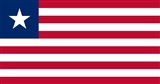
Liberia , officially the
Republic of Liberia, is a country in
West AfricaWest Africa or Western Africa is the westernmost region of the African continent. Geopolitically, the UN definition of Western Africa includes the following 16 countries and an area of approximately 5 million square km:-Flags of West Africa:...
. It is bordered by
Sierra LeoneSierra Leone , officially the Republic of Sierra Leone, is a country in West Africa. It is bordered by Guinea to the north and east, Liberia to the southeast, and the Atlantic Ocean to the west and southwest. Sierra Leone covers a total area of and has an estimated population between 5.4 and 6.4...
on the west,
GuineaGuinea , officially the Republic of Guinea , is a country in West Africa. Formerly known as French Guinea , it is today sometimes called Guinea-Conakry to distinguish it from its neighbour Guinea-Bissau. Guinea is divided into eight administrative regions and subdivided into thirty-three prefectures...
on the north and
Côte d'IvoireThe Republic of Côte d'Ivoire or Ivory Coast is a country in West Africa. It has an area of , and borders the countries Liberia, Guinea, Mali, Burkina Faso and Ghana; its southern boundary is along the Gulf of Guinea. The country's population was 15,366,672 in 1998 and was estimated to be...
on the east. Liberia's coastline is composed of mostly
mangroveMangroves are various kinds of trees up to medium height and shrubs that grow in saline coastal sediment habitats in the tropics and subtropics – mainly between latitudes N and S...
forests while the more sparsely populated inland consists of forests that open to a plateau of drier grasslands. The country possesses 40% of the remaining Upper Guinean rainforest. Liberia has a hot equatorial climate, with significant rainfall during the May to October rainy season and harsh
harmattanThe Harmattan is a dry and dusty West African trade wind. It blows south from the Sahara into the Gulf of Guinea between the end of November and the middle of March...
winds the remainder of the year. Liberia covers an area of 111369 km² (42,999.8 sq mi) and is home to about 3.7 million people.
EnglishEnglish is a West Germanic language that arose in the Anglo-Saxon kingdoms of England and spread into what was to become south-east Scotland under the influence of the Anglian medieval kingdom of Northumbria...
is the official language, while over 30 indigenous languages are spoken within the country.
Liberia is one of only two modern countries in
Sub-Saharan AfricaSub-Saharan Africa as a geographical term refers to the area of the African continent which lies south of the Sahara. A political definition of Sub-Saharan Africa, instead, covers all African countries which are fully or partially located south of the Sahara...
without roots in the
EuropeEurope is, by convention, one of the world's seven continents. Comprising the westernmost peninsula of Eurasia, Europe is generally 'divided' from Asia to its east by the watershed divides of the Ural and Caucasus Mountains, the Ural River, the Caspian and Black Seas, and the waterways connecting...
an
Scramble for AfricaThe Scramble for Africa, also known as the Race for Africa or Partition of Africa was a process of invasion, occupation, colonization and annexation of African territory by European powers during the New Imperialism period, between 1881 and World War I in 1914...
. Beginning in 1820, the region was colonized by freed American slaves with the help of the
American Colonization SocietyThe American Colonization Society , founded in 1816, was the primary vehicle to support the "return" of free African Americans to what was considered greater freedom in Africa. It helped to found the colony of Liberia in 1821–22 as a place for freedmen...
, a private organization that believed ex-slaves would have greater freedom and equality in Africa. Slaves freed from slave ships were also sent there instead of being repatriated to their countries of origin. In 1847, these colonists founded the Republic of Liberia, establishing a government modeled on that of the
United StatesThe United States of America is a federal constitutional republic comprising fifty states and a federal district...
and naming the capital city
MonroviaMonrovia is the capital city of the West African nation of Liberia. Located on the Atlantic Coast at Cape Mesurado, it lies geographically within Montserrado County, but is administered separately...
after
James MonroeJames Monroe was the fifth President of the United States . Monroe was the last president who was a Founding Father of the United States, and the last president from the Virginia dynasty and the Republican Generation...
, the fifth
president of the United StatesThe President of the United States of America is the head of state and head of government of the United States. The president leads the executive branch of the federal government and is the commander-in-chief of the United States Armed Forces....
and a prominent supporter of the colonization. The colonists, known as Americo-Liberians, monopolized the political and economic sectors of the country despite comprising only a small percentage of the largely indigenous population.
The country began to modernize in the 1940s following investment by the United States during
World War IIWorld War II, or the Second World War , was a global conflict lasting from 1939 to 1945, involving most of the world's nations—including all of the great powers—eventually forming two opposing military alliances: the Allies and the Axis...
and economic liberalization under President
William TubmanWilliam Vacanarat Shadrach Tubman was a Liberian politician. He was the 19th President of Liberia from 1944 until his death in 1971....
. Liberia was a founding member of the
United NationsThe United Nations is an international organization whose stated aims are facilitating cooperation in international law, international security, economic development, social progress, human rights, and achievement of world peace...
and the Organization of African Unity. A military coup overthrew the Americo-Liberian establishment in 1980, marking the beginning of political and economic instability and two successive
civil warsThe First Liberian Civil War was an internal conflict in Liberia running from 1989 until 1996. The conflict killed over 200,000 people and eventually led to the involvement the Economic Community of West African States and of the United Nations...
that left approximately 250,000 people dead and devastated the country's
economyThe First Liberian Civil War in 1989-96 destroyed much of Liberia's economy, especially the infrastructure in and around Monrovia. Many businessmen fled the country, taking capital and expertise with them. Some returned during 1997. Many will not return...
. A 2003 peace deal led to democratic elections in 2005. Today, Liberia is recovering from the lingering effects of the civil war and related economic dislocation, with about 85% of the population living below the international poverty line.
History
The
Pepper CoastPepper Coast is the name of a coastal area in western Africa, between Cape Mesurado and Cape Palmas. It encloses the present republic of Liberia. It got its name from the melegueta pepper. The pepper is also known as the grain of paradise, which gave rise to an alternative name, the Grain Coast...
has been inhabited at least as far back as the 12th century, perhaps earlier.
MendeThe Mende people are one of the two largest and most dominant ethnic group in Sierra Leone, along with the Temne. The Mende make up 30% of Sierra Leone's total population or 1,932,015 members...
-speaking people expanded westward from Sudan, forcing many smaller ethnic groups southward towards the Atlantic ocean. The Dei,
BassaThe Bassa are a people of Liberia, living in Grand Bassa, Rivercess,Margibi and Montserrado counties, who speak the Bassa language, a Kru language. They number about 350,000 . They have their own writing system, called "Bassa" or "Vah," which was developed around 1900. There are also about 5000...
, Kru,
GolaThe Gola or Gula are a tribal people living in western Liberia. The Gola language is part of the Southern branch of the West Atlantic language family; , it is spoken by approximately 107,000 people....
and
KissiKissi people is an ethnic group living in Guinea, Sierra Leone and Liberia. They speak the Kissi language, which is a Niger–Congo language. They are well known for making baskets and weaving on vertical looms.-Economy:...
were some of the earliest recorded arrivals. This influx was compounded by the decline of the Western Sudanic
Mali EmpireThe Mali Empire or Mandingo Empire or Manden Kurufa was a West African empire of the Mandinka from c. 1230 to c. 1600. The empire was founded by Sundiata Keita and became renowned for the wealth of its rulers, especially Mansa Musa I...
in 1375 and later in 1591 with the
Songhai EmpireThe Songhai Empire, also known as the Songhay Empire, was a state located in western Africa. From the early 15th to the late 16th century, Songhai was one of the largest Islamic empires in history. This empire bore the same name as its leading ethnic group, the Songhai. Its capital was the city...
. Additionally, inland regions underwent
desertificationDesertification is the degradation of land in drylands. Caused by a variety of factors, such as climate change and human activities, desertification is one of the most significant global environmental problems.-Definitions:...
, and inhabitants were pressured to move to the wetter coast. These new inhabitants brought skills such as cotton
spinningSpinning is a major industry. It is part of the textile manufacturing process where three types of fibre are converted into yarn, then fabric, then textiles. The textiles are then fabricated into clothes or other artifacts. There are three industrial processes available to spin yarn, and a...
, cloth
weavingWeaving is a method of fabric production in which two distinct sets of yarns or threads are interlaced at right angles to form a fabric or cloth. The other methods are knitting, lace making and felting. The longitudinal threads are called the warp and the lateral threads are the weft or filling...
, iron
smeltingSmelting is a form of extractive metallurgy; its main use is to produce a metal from its ore. This includes iron extraction from iron ore, and copper extraction and other base metals from their ores...
,
riceRice is the seed of the monocot plants Oryza sativa or Oryza glaberrima . As a cereal grain, it is the most important staple food for a large part of the world's human population, especially in East Asia, Southeast Asia, South Asia, the Middle East, and the West Indies...
and
sorghumSorghum is a genus of numerous species of grasses, one of which is raised for grain and many of which are used as fodder plants either cultivated or as part of pasture. The plants are cultivated in warmer climates worldwide. Species are native to tropical and subtropical regions of all continents...
cultivation, and social and political institutions from the Mali and Songhai Empires. Shortly after the
ManesThe Manneh were in origin Mandé [nyancho jong kende falla] soldiers who invaded the western coast of Africa from the east during the first half of the sixteenth century...
conquered the region, the
Vai peopleThe Vai are a Manden ethnic group that live mostly in Liberia and small minority live in south-eastern Sierra Leone. The Vai are known for their indigenous syllabic writing system, developed in the 1820s by Duala Bukele and other tribal elders. Over the course of the 19th century, literacy in the...
of the former Mali Empire immigrated to into the Grand Cape Mount region. The ethnic Kru opposed the influx of Vai, forming an alliance with the Manes to stop further influx of Vai.
People along the coast built
canoeA canoe or Canadian canoe is a small narrow boat, typically human-powered, though it may also be powered by sails or small electric or gas motors. Canoes are usually pointed at both bow and stern and are normally open on top, but can be decked over A canoe (North American English) or Canadian...
s and traded with other West Africans from
Cap-VertCap-Vert is a peninsula in Senegal, and the westernmost point of the continent of Africa and of the Old World mainland. Originally called Cabo Verde or "Cape Green" by Portuguese explorers, it is not to be confused with the Cape Verde islands, which are some further west...
to the
Gold CoastThe Gold Coast was the region of West Africa which is now the nation of Ghana. Early uses of the term refer literally to the coast and not the interior. It was not until the 19th century that the term came to refer to areas that are far from the coast...
. Between 1461 and late 17th century,
PortugueseThe Portuguese are a nation and ethnic group native to the country of Portugal, in the west of the Iberian peninsula of south-west Europe. Their language is Portuguese, and Roman Catholicism is the predominant religion....
,
DutchThe Dutch people are an ethnic group native to the Netherlands. They share a common culture and speak the Dutch language. Dutch people and their descendants are found in migrant communities worldwide, notably in Suriname, Chile, Brazil, Canada, Australia, South Africa, New Zealand, and the United...
and
BritishThe British are citizens of the United Kingdom, of the Isle of Man, any of the Channel Islands, or of any of the British overseas territories, and their descendants...
traders had contacts and trading posts in the region. The Portuguese named the area
Costa da Pimenta, meaning Pepper Coast but later translated as Grain Coast, because of the abundance of grains of melegueta pepper. European traders would barter various commodities and goods with local people. When the Kru began trading with Europeans, they initially traded in commodities, but later they actively participated in the
African slave tradeSystems of servitude and slavery were common in many parts of Africa, as they were in much of the ancient world. In some African societies, the enslaved people were also indentured servants and fully integrated; in others, they were treated much worse...
.
In 1820, the
American Colonization SocietyThe American Colonization Society , founded in 1816, was the primary vehicle to support the "return" of free African Americans to what was considered greater freedom in Africa. It helped to found the colony of Liberia in 1821–22 as a place for freedmen...
(ACS) began sending black volunteers to the Pepper Coast to establish a colony for freed American slaves. The ACS, a private organization supported by prominent American politicians such as
Henry ClayHenry Clay, Sr. , was a lawyer, politician and skilled orator who represented Kentucky separately in both the Senate and in the House of Representatives...
and
James MonroeJames Monroe was the fifth President of the United States . Monroe was the last president who was a Founding Father of the United States, and the last president from the Virginia dynasty and the Republican Generation...
, believed repatriation was preferable to
emancipationEmancipation means the act of setting an individual or social group free or making equal to citizens in a political society.Emancipation may also refer to:* Emancipation , a champion Australian thoroughbred racehorse foaled in 1979...
of slaves. Similar organizations established colonies in
Mississippi-in-AfricaIn the history of Liberia, Mississippi-in-Africa was a colony settled by freed African-American slaves in present-day Sinoe County, Liberia. It existed from 1835 until 1842, when it was incorporated into the Commonwealth of Liberia. It is also the title of a nonfiction book about the recolonization...
and the
Republic of MarylandThe Republic of Maryland was a small African American nation which existed from 1854 to 1857, when it was united into what is now Liberia....
, which were later annexed by Liberia. On July 26, 1847, the settlers issued a
Declaration of IndependenceThe Liberian Declaration of Independence is a document adopted by the Liberian Constitutional Convention on 16 July 1847 to announce that the Commonwealth of Liberia, a colony founded and controlled by the private American Colonization Society, was now an independent state known as the Republic of...
and promulgated a
constitutionThe Liberian Constitution of 1847 was the first constitution of Liberia. Largely modeled on the Constitution of the United States, it remained in effect from its adoption on 26 July 1847 until its suspension by the People's Redemption Council on 12 April 1980....
, which created the independent Republic of Liberia.
The new nation largely excluded the indigenous population from the country's affairs. The 1865 Ports of Entry Act prohibited foreign commerce with the inland tribes. In 1877, the Americo-Liberian True Whig Party monopolized political power in the country. Competition for office was usually contained within the party, whose nomination virtually ensured election. Pressure from the
United KingdomThe United Kingdom of Great Britain and Northern IrelandIn the United Kingdom and Dependencies, other languages have been officially recognised as legitimate autochthonous languages under the European Charter for Regional or Minority Languages...
and
FranceThe French Republic , The French Republic , The French Republic , (commonly known as France , is a unitary semi-presidential republic in Western Europe with several overseas territories and islands located on other continents and in the Indian, Pacific, and Atlantic oceans. Metropolitan France...
led to a loss of Liberia's claims to extensive territories, which were annexed by the colonial powers. Economic development was hindered by the decline of markets for Liberian goods in the late 19th century and by indebtedness on a series of international loans. In Liberia's early years, the Americo-Liberian settlers periodically encountered stiff and sometimes violent opposition from indigenous Africans, who were excluded from citizen's rights in the new Republic until 1904.
In the mid-20th century, Liberia gradually began to modernize with American assistance. Both the
Freeport of MonroviaFreeport of Monrovia is the main commercial port facility in the West African nation of Liberia. The port was artificially created on Bushrod Island near Monrovia in 1948. The port facility contains four piers and one main wharf with four berths. The port also has tanker facilities and a fishery...
and
Roberts International Airport-Accidents and incidents:*On 5 March 1967: Varig flight 837, a Douglas DC-8-33 registration PP-PEA flying from Rome-Fiumicino to Rio de Janeiro-Galeão via Roberts International Airport, caught fire after a mistaken approach to Monrovia, missing the threshold of the runway by 6,023 ft...
were built by U.S. personnel through the
Lend-LeaseLend-Lease was the program under which the United States of America supplied the United Kingdom, the Soviet Union, China, Free France, and other Allied nations with materiel between 1941 and 1945. It was signed into law on March 11, 1941, a year and a half after the outbreak of war in Europe in...
program during
World War IIWorld War II, or the Second World War , was a global conflict lasting from 1939 to 1945, involving most of the world's nations—including all of the great powers—eventually forming two opposing military alliances: the Allies and the Axis...
. President
William TubmanWilliam Vacanarat Shadrach Tubman was a Liberian politician. He was the 19th President of Liberia from 1944 until his death in 1971....
encouraged foreign investment in the country, resulting in the second-highest rate of economic growth in the world during the 1950s. Liberia also began to take a more active role in international affairs. It was a founding member of the
United NationsThe United Nations is an international organization whose stated aims are facilitating cooperation in international law, international security, economic development, social progress, human rights, and achievement of world peace...
in 1945 and became a vocal critic of the
South AfricaThe Republic of South Africa is a country in southern Africa. Located at the southern tip of Africa, it is divided into nine provinces, with of coastline on the Atlantic and Indian oceans...
n apartheid regime. Liberia also served as a proponent both of African independence from the European colonial powers and of
Pan-AfricanismPan-Africanism is a movement that seeks to unify African people or people living in Africa, into a "one African community". Differing types of Pan-Africanism seek different levels of economic, racial, social, or political unity...
, helping to found the Organization of African Unity.
On April 12, 1980, a military coup led by Master Sergeant
Samuel DoeSamuel Kanyon Doe was the 21st President of Liberia, serving from 1986 until his assassination in 1990. He had previously served as Chairman of the People's Redemption Council from 1980 to 1986. He was the first indigenous head of state in Liberian history.Doe was a part of a rural tribe in inland...
of the indigenous
KrahnKrahn is an ethnic group of Liberia; it is also the language traditionally spoken by these people.- History :The Krahn Arrived in the area known as Ivory Coast and Liberia from Northern Africa shortly before the slaves trade. Most of these people were taken as slaves to the United States and the...
ethnic group overthrew and killed President
William R. Tolbert, Jr.William Richard Tolbert, Jr. was the 20th President of Liberia from 1971 to 1980.Trained as a civil servant, he entered the country's House of Representatives in 1955 for the True Whig Party, then the only established party in the country...
. Doe and the other plotters later executed a majority of Tolbert's cabinet and other Americo-Liberian government officials and True Whig Party members. The coup leaders formed the
People's Redemption CouncilThe People's Redemption Council was a military regime that governed Liberia during the early 1980s. It was established after the military coup of April 12, 1980, in which Samuel Doe, who served as chairman of the Council, seized power. Apart from Doe, the Council consisted of 17 soldiers...
(PRC) to govern the country. A strategic
Cold WarThe Cold War was the continuing state from roughly 1946 to 1991 of political conflict, military tension, proxy wars, and economic competition between the Communist World—primarily the Soviet Union and its satellite states and allies—and the powers of the Western world, primarily the United States...
ally, Doe received significant financial backing from the United States, even as critics condemned the PRC for corruption and political repression. After the country adopted a
new constitutionThe Constitution of Liberia is the supreme law of the Republic of Liberia. The current constitution, which came into force on 6 January 1986, replaced the Liberian Constitution of 1847, which had been in force since the independence of Liberia...
in 1985, Doe was elected president in subsequent elections that were internationally condemned as fraudulent. On November 12, 1985, a failed counter-coup was launched by
Thomas QuiwonkpaThomas Quiwonkpa, a Gio from Nimba County, was a Commanding General of the Armed Forces of Liberia and founder of the National Patriotic Front of Liberia....
, whose soldiers briefly occupied the national
radio stationRadio broadcasting is a one-way wireless transmission over radio waves intended to reach a wide audience. Stations can be linked in radio networks to broadcast a common radio format, either in broadcast syndication or simulcast or both...
. Government repression intensified in response, as Doe's troops massacred members of the
GioThe Gio or Dan people is an ethnic group in north-eastern Liberia and in Côte d'Ivoire. The Dan are an ethnic group located in the West African countries of Liberia and Côte d'Ivoire. There are approximately 350,000 members of the group, united by the Dan language, a Mande language...
and Mano ethnic groups in
Nimba CountyNimba is a county in the north-central portion of the West African nation of Liberia. One of 15 counties that comprise the first-level of administrative division in the nation, it has six districts. Sanniquellie serves as the capital with the area of the county measuring , the largest in the nation...
.
The
National Patriotic Front of LiberiaThe National Patriotic Front of Liberia was a rebel group that initiated and participated in the First Liberian Civil War from 1989 to 1996.-Leadership:...
, a rebel group led by Charles Taylor, launched an insurrection in December 1989 against Doe's government with the backing of neighboring countries such as
Burkina FasoBurkina Faso – also known by its short-form name Burkina – is a landlocked country in west Africa. It is surrounded by six countries: Mali to the north, Niger to the east, Benin to the southeast, Togo and Ghana to the south, and Côte d'Ivoire to the southwest.Its size is with an estimated...
and
Côte d'IvoireThe Republic of Côte d'Ivoire or Ivory Coast is a country in West Africa. It has an area of , and borders the countries Liberia, Guinea, Mali, Burkina Faso and Ghana; its southern boundary is along the Gulf of Guinea. The country's population was 15,366,672 in 1998 and was estimated to be...
, triggering the First Liberian Civil War. By September 1990, Doe's forces controlled only a small area just outside the capital, and Doe was captured and executed that month by rebel forces. The rebels soon split into various factions fighting one another, and the
Economic Community Monitoring GroupThe Economic Community of West African States Monitoring Group, or ECOMOG, was a West African multilateral armed force established by the Economic Community of West African States . ECOMOG was a formal arrangement for separate armies to work together...
under the
Economic Community of West African StatesThe Economic Community of West African States is a regional group of fifteen West African countries. Founded on 28 May 1975, with the signing of the Treaty of Lagos, its mission is to promote economic integration across the region....
organized a military task force to intervene in the crisis. From 1989 to 1996 one of Africa's bloodiest civil wars ensued, claiming the lives of more than 200,000 Liberians and displacing a million others into refugee camps in neighboring countries. Following a peace deal between the warring parties in 1995, Taylor was elected president in 1997.
Under Taylor's regime, Liberia became internationally known as a
pariah stateA pariah state is one whose conduct is considered to be out of line with international norms of behavior. This term is closely related to the term rogue state.-Definitions:...
due to his use of blood diamonds and illegal
timberTimber may refer to:* Timber, a term common in the United Kingdom and Australia for wood materials * Timber, Oregon, an unincorporated community in the U.S...
exports to fund the
Revolutionary United FrontThe Revolutionary United Front was a rebel army that fought a failed eleven-year war in Sierra Leone, starting in 1991 and ending in 2002. It later developed into a political party, which existed until 2007...
in the
Sierra Leone Civil WarThe Sierra Leone Civil War began on 23 March 1991 when the Revolutionary United Front , with support from the special forces of Charles Taylor’s National Patriotic Front of Liberia , intervened in Sierra Leone in an attempt to overthrow the Joseph Momoh government...
. The
Second Liberian Civil WarThe Second Liberian Civil War began in 1999 when a rebel group backed by the government of neighbouring Guinea, the Liberians United for Reconciliation and Democracy , emerged in northern Liberia. In early 2003, a second rebel group, the Movement for Democracy in Liberia, emerged in the south, and...
began in 1999 when
Liberians United for Reconciliation and DemocracyThe Liberians United for Reconciliation and Democracy was a rebel group in Liberia that was active from 1999 until after the peace accords that ended the Second Liberian Civil War in 2003...
, a rebel group based in the northwest of the country, launched an armed insurrection against Taylor. In March 2003, a second rebel group,
Movement for Democracy in LiberiaThe Movement for Democracy in Liberia was a rebel group in Liberia that became active in March 2003, launching attacks from Côte d'Ivoire...
, began launching attacks against Taylor from the southeast. Peace talks between the factions began in Accra in June of that year, and Taylor was indicted by the
Special Court for Sierra LeoneThe Special Court for Sierra Leone is an independent judicial body set up to "try those who bear greatest responsibility" for the war crimes and crimes against humanity committed in Sierra Leone after 30 November 1996 during the Sierra Leone Civil War...
for crimes against humanity that same month. By July 2003, the rebels had launched an
assault on MonroviaThe Siege of Monrovia, which occurred in Monrovia, Liberia between July 18 and August 14, 2003, was a major military confrontation between the Armed Forces of Liberia and LURD rebels during the Second Liberian Civil War. The shelling of the city resulted in the deaths of some 1,000 civilians....
. Under heavy pressure from the international community and the domestic
Women of Liberia Mass Action for PeaceWomen of Liberia Mass Action for Peace is a peace movement started by women in Liberia, Africa thatbrought an end to the Second Liberian Civil War in 2003. Organized by social worker Leymah Gbowee, the movement started with local women praying and singing in a fish market...
movement, Taylor resigned in August and went into exile in
NigeriaNigeria , officially the Federal Republic of Nigeria, is a federal constitutional republic comprising 36 states and its Federal Capital Territory, Abuja. The country is located in West Africa and shares land borders with the Republic of Benin in the west, Chad and Cameroon in the east, and Niger in...
, and a peace deal was signed later that month. The
United Nations Mission in LiberiaThe United Nations Mission in Liberia is a peace-keeping force established in September 2003 to monitor a ceasefire agreement in Liberia following the resignation of President Charles Taylor and the conclusion of the Second Liberian Civil War....
began arriving in September 2003 to provide security and monitor the peace accord, and an interim government took power the following October.
The subsequent 2005 elections were internationally regarded as the most free and fair in Liberian history. Ellen Johnson Sirleaf, a
HarvardHarvard University is a private Ivy League university located in Cambridge, Massachusetts, United States, established in 1636 by the Massachusetts legislature. Harvard is the oldest institution of higher learning in the United States and the first corporation chartered in the country...
-trained economist and former Minister of Finance, was elected as the first female president in Africa. Upon her inauguration, Sirleaf requested the extradition of Taylor from Nigeria and immediately handed him over to the
SCSLThe Special Court for Sierra Leone is an independent judicial body set up to "try those who bear greatest responsibility" for the war crimes and crimes against humanity committed in Sierra Leone after 30 November 1996 during the Sierra Leone Civil War...
for trial in
The HagueThe Hague is the capital city of the province of South Holland in the Netherlands. With a population of 500,000 inhabitants , it is the third largest city of the Netherlands, after Amsterdam and Rotterdam...
. In 2006, the government established a
Truth and Reconciliation CommissionThe Liberian Truth and Reconciliation Commission is a Parliament-enacted organization created in May 2005 under Ellen Johnson Sirleaf.Its mandate is to "promote national peace, security, unity and reconciliation" by investigating more than 20 years of civil conflict in the country and to report on...
to address the causes and crimes of the civil war.
Politics
The government of Liberia, modeled on the government of the United States, is a
unitaryA unitary state is a state governed as one single unit in which the central government is supreme and any administrative divisions exercise only powers that their central government chooses to delegate...
constitutional republicA constitutional republic is a state in which the head of state and other officials are representatives of the people and must govern according to existing constitutional law that limits the government's power over all of its citizens...
and
representative democracyRepresentative democracy is a form of government founded on the principle of elected individuals representing the people, as opposed to autocracy and direct democracy...
as established by the
ConstitutionThe Constitution of Liberia is the supreme law of the Republic of Liberia. The current constitution, which came into force on 6 January 1986, replaced the Liberian Constitution of 1847, which had been in force since the independence of Liberia...
. The government has three co-equal branches of government:
executiveExecutive branch of Government is the part of government that has sole authority and responsibility for the daily administration of the state bureaucracy. The division of power into separate branches of government is central to the idea of the separation of powers.In many countries, the term...
, headed by the president;
legislativeA legislature is a kind of deliberative assembly with the power to pass, amend, and repeal laws. The law created by a legislature is called legislation or statutory law. In addition to enacting laws, legislatures usually have exclusive authority to raise or lower taxes and adopt the budget and...
, consisting of the
bicameralIn the government, bicameralism is the practice of having two legislative or parliamentary chambers. Thus, a bicameral parliament or bicameral legislature is a legislature which consists of two chambers or houses....
Legislature of LiberiaThe Legislature of Liberia is bicameral, consisting of a Senate and House of Representatives , in the same manner as the Congress of the United States....
; and
judicialThe judiciary is the system of courts that interprets and applies the law in the name of the state. The judiciary also provides a mechanism for the resolution of disputes...
, made up of the
Supreme CourtThe Supreme Court of Liberia is the highest judicial body in the West African nation of Liberia. The court consists of the Chief Justice of Liberia and four Associate Justices, who are nominated by the President and confirmed by the Senate...
and several
lower courtA lower court is a court from which an appeal may be taken. In relation to an appeal from one court to another, the lower court is the court whose decision is being reviewed, which may be the original trial court or an appellate court lower in rank than the superior court which is hearing the...
s.
The president serves as
head of governmentHead of government is the chief officer of the executive branch of a government, often presiding over a cabinet. In a parliamentary system, the head of government is often styled prime minister, chief minister, premier, etc...
,
head of stateA head of state is the individual that serves as the chief public representative of a monarchy, republic, federation, commonwealth or other kind of state. His or her role generally includes legitimizing the state and exercising the political powers, functions, and duties granted to the head of...
and the
commander-in-chiefA commander-in-chief is the commander of a nation's military forces or significant element of those forces. In the latter case, the force element may be defined as those forces within a particular region or those forces which are associated by function. As a practical term it refers to the military...
of the
Armed Forces of LiberiaThe Armed Forces of Liberia are the armed forces of the Republic of Liberia. Founded as the Liberian Frontier Force in 1908, the military was retitled in 1956. For virtually all of its history, the AFL has received considerable materiel and training assistance from the United States. For most of...
. Among the other duties of the president are to sign or veto
legislative billA bill is a proposed law under consideration by a legislature. A bill does not become law until it is passed by the legislature and, in most cases, approved by the executive. Once a bill has been enacted into law, it is called an act or a statute....
s, grant
pardonClemency means the forgiveness of a crime or the cancellation of the penalty associated with it. It is a general concept that encompasses several related procedures: pardoning, commutation, remission and reprieves...
s, and appoint Cabinet members, judges and other public officials. Together with the vice president, the president is elected to a six-year term by majority vote in a
two-round systemThe two-round system is a voting system used to elect a single winner where the voter casts a single vote for their chosen candidate...
and can serve up to two terms in office.
The Legislature is composed of the
SenateThe Senate of Liberia is the upper house of the bicameral legislative branch of Liberia, and together with the House of Representatives comprises the Legislature of Liberia...
and the
House of RepresentativesThe House of Representatives is the lower chamber of the bicameral Liberian Legislature. Legislative elections took place on 11 October 2005, and the elected members took office in January 2006.-Candidate eligibility:...
. The House, led by a
speakerThe term speaker is a title often given to the presiding officer of a deliberative assembly, especially a legislative body. The speaker's official role is to moderate debate, make rulings on procedure, announce the results of votes, and the like. The speaker decides who may speak and has the...
, has 64 members
apportionedThe legal term apportionment means distribution or allotment in proper shares.It is a term used in law in a variety of senses...
among the 15 counties on the basis of the national
censusA census is the procedure of systematically acquiring and recording information about the members of a given population. It is a regularly occurring and official count of a particular population. The term is used mostly in connection with national population and housing censuses; other common...
, with each county receiving a minimum of two members. Each House member represents an
electoral districtAn electoral district is a distinct territorial subdivision for holding a separate election for one or more seats in a legislative body...
within a county as drawn by the
National Elections CommissionThe National Elections Commission of the Republic of Liberia is an autonomous agency in Liberia that supervises the national elections of Liberia.-Staff:The following people were part of the election commission as of 2011:...
and is elected by a
pluralityThe plurality voting system is a single-winner voting system often used to elect executive officers or to elect members of a legislative assembly which is based on single-member constituencies...
of the popular vote of their district in to a six-year term. The Senate is made up of two senators from each county for a total of 30 senators. Senators serve nine-year terms and are elected
at-largeAt-large is a designation for representative members of a governing body who are elected or appointed to represent the whole membership of the body , rather than a subset of that membership...
by a plurality of the popular vote . The vice president serves as the
President of the SenateThe President of the Senate is a title often given to the presiding officer of a senate, and is the speaker of other assemblies.The senate president often ranks high in a jurisdiction's succession for its top executive office: for example, the President of the Senate of Nigeria is second in line...
, with a
President pro temporeA President pro tempore is a constitutionally recognized officer of a legislative body who presides over the chamber in the absence of the normal presiding officer...
serving in his absence.
Liberia's highest judicial authority is the Supreme Court, made up of five members and headed by the
Chief Justice of LiberiaThe Chief Justice of Liberia is the head of the judicial branch of the Government of the Republic of Liberia and the chief judge of the Supreme Court of Liberia.-Appointment and term:...
. Members are nominated to the court by the president and are confirmed by the Senate, serving until the age of 70. The judiciary is further divided into
circuitCircuit court is the name of court systems in several common law jurisdictions.-History:King Henry II instituted the custom of having judges ride around the countryside each year to hear appeals, rather than forcing everyone to bring their appeals to London...
and
speciality courtLimited jurisdiction, or special jurisdiction, is the courts' jurisdiction only on certain types of cases such as bankruptcy, family matters, etc....
s,
magistrate courtA magistrate is an officer of the state; in modern usage the term usually refers to a judge or prosecutor. This was not always the case; in ancient Rome, a magistratus was one of the highest government officers and possessed both judicial and executive powers. Today, in common law systems, a...
s and
justices of the peaceA justice of the peace is a puisne judicial officer elected or appointed by means of a commission to keep the peace. Depending on the jurisdiction, they might dispense summary justice or merely deal with local administrative applications in common law jurisdictions...
. The judicial system follows the Anglo-American
common lawCommon law is law developed by judges through decisions of courts and similar tribunals rather than through legislative statutes or executive branch action...
. An informal system of traditional courts still exists within the rural areas of the country, with
trial by ordeal Trial by ordeal is a judicial practice by which the guilt or innocence of the accused is determined by subjecting them to an unpleasant, usually dangerous experience...
remaining common despite being officially outlawed.
Between 1877 and 1980, the government was dominated by the True Whig Party. Today, over 20 political parties are registered in the country, based largely around personalities and ethnic groups. Most parties suffer from poor organizational capacity. The 2005 elections marked the first time that the president's party did not gain a majority of seats in the Legislature.
Liberia scored a 3.3 on a scale from 10 (highly clean) to 0 (highly corrupt) on the 2010
Corruption Perceptions IndexSince 1995, Transparency International publishes the Corruption Perceptions Index annually ranking countries "by their perceived levels of corruption, as determined by expert assessments and opinion surveys." The CPI generally defines corruption as "the misuse of public power for private...
, ranking 87th of 178 countries worldwide and 11th of 47 in Sub-Saharan Africa. This score represented a significant improvement since 2007, when the country scored 2.1 and ranked 150th of 180 countries. When seeking attention of a selection of service providers 89% of Liberians had to pay a bribe, the highest national percentage in the world according to the organization's 2010 Global Corruption Barometer.
Counties and districts
Liberia is divided into 15
counties||There are 15 counties in Liberia, as of 2008.-External links:** Comprehensive resource about counties and districts of Liberia....
, which are subdivided into districts, and further subdivided into
clans. The oldest counties are Grand Bassa and Montserrado, both founded in 1839 prior to Liberian independence. Gbarpolu is the newest county, created in 2001. Nimba is the largest of the counties in size at 11551 square kilometres (4,459.9 sq mi), while Montserrado is the smallest at 1909 square kilometres (737.1 sq mi). Montserrado is also the most populous county with 1,144,806 residents as of the 2008 census.
The fifteen counties are administered by superintendents appointed by the president. The Constitution calls for the election of mayors and various
chiefsA tribal chief is the leader of a tribal society or chiefdom. Tribal societies with social stratification under a single leader emerged in the Neolithic period out of earlier tribal structures with little stratification, and they remained prevalent throughout the Iron Age.In the case of ...
at the county and local level, but these elections have not taken place since 1985 due to war and financial constraints. In 2008, the Supreme Court ruled in favor of allowing the president to appoint mayors until the country could afford to hold municipal elections.
| County | Capital | Population (2008) | Area | Created |
| Bomi Bomi is a county in the northwestern portion of the West African nation of Liberia. One of 15 counties that comprise the first-level of administrative division in the nation, it has four districts. Tubmanburg serves as the capital with the area of the county measuring . As of the 2008 Census, it... |
TubmanburgTubmanburg, also known as Bomi and formerly known as Vaitown, is the capital of Bomi County in Liberia. It lies in the Bomi Hills northwest of Monrovia and was an iron ore and diamond mining centre until is was largely destroyed in the Liberian Civil War... |
82,036 |
1942 km² (749.8 sq mi) |
1984 |
| Bong Bong is a county in the north-central portion of the West African nation of Liberia. One of 15 counties that comprise the first-level of administrative division in the nation, it has twelve districts. Gbarnga serves as the capital with the area of the county measuring... |
GbarngaGbarnga is the capital city of Bong County, Liberia, lying north east of Monrovia. Bong County is one of the over 13 political subdivisions of Liberia known as counties. During the First Liberian Civil War, it was the base for Charles Taylor's National Patriotic Front of Liberia... |
328,919 |
8772 km² (3,386.9 sq mi) |
1964 |
| Gbarpolu Gbarpolu is a county in the northern portion of the West African nation of Liberia. One of 15 counties that comprise the first-level of administrative division in the nation, it has six districts. Bopulu serves as the capital with the area of the county measuring... |
Bopulu |
83,758 |
9689 km² (3,740.9 sq mi) |
2001 |
| Grand Bassa Grand Bassa is a county in the west-central portion of the West African nation of Liberia. One of 15 counties that comprise the first-level of administrative division in the nation, it has eight districts. Buchanan serves as the capital with the area of the county measuring... |
BuchananBuchanan is the third largest city in Liberia, lying on Waterhouse Bay, part of the Atlantic Ocean. It is referred to as Gbezohn in the local Bassa language. As of the 2008 census, Buchanan has a population of 34,270. Of this, 16,984 were male and 17,286 female.... |
224,839 |
7936 km² (3,064.1 sq mi) |
1839 |
| Grand Cape Mount Grand Cape Mount is a county in the northwestern portion of the West African nation of Liberia. One of 15 counties that comprise the first-level of administrative division in the nation, it has five districts. Robertsport serves as the capital with the area of the county measuring... |
RobertsportRobertsport, also known as Roberts Port and Robert's Port, is a town in western Liberia, about 10 miles from the Sierra Leone border. It is named after Joseph Jenkins Roberts, the first president of Liberia.... |
129,055 |
5162 km² (1,993.1 sq mi) |
1844 |
| Grand Gedeh Grand Gedeh is a county in the eastern portion of the West African nation of Liberia. One of 15 counties that comprise the first-level of administrative division in the nation, it has three districts. Zwedru serves as the capital with the area of the county measuring... |
ZwedruZwedru is the capital of Grand Gedeh County, one of the 15 counties in the West African country of Liberia. Zwedru is located in Tchien District of Grand Gedeh County, near the Cavalla River in the country's southeastern region and near the border with Côte d'Ivoire. It is located 350 miles... |
126,146 |
10484 km² (4,047.9 sq mi) |
1964 |
| Grand Kru Grand Kru is a county in the southeastern portion of the West African nation of Liberia. One of 15 counties that comprise the first-level of administrative division in the nation, it has eighteen districts. Created in 1984, Barclayville serves as the capital with the area of the county measuring... |
BarclayvilleBarclayville, the capital and most populous settlement in Grand Kru County is located in southeastern Liberia about 10 miles inland from Picinicess. The Barclayville township of several thousand people straddles the banks of the Na River. Roads from Kanweaken to the northwest, Pleebo to the... |
57,106 |
3895 km² (1,503.9 sq mi) |
1984 |
| Lofa Lofa is a county in the northernmost portion of the West African nation of Liberia. One of 15 counties that comprise the first-level of administrative division in the nation, it has six districts. Voinjama serves as the capital with the area of the county measuring... |
VoinjamaVoinjama is a small city that serves as the capital of Lofa County, Liberia and is located in the hilly, far northern part of the country near the Guinea border.... |
270,114 |
9982 km² (3,854.1 sq mi) |
1964 |
| Margibi Margibi is a county on the north to central coast of the West African nation of Liberia. One of 15 counties that comprise the first-level of administrative division in the nation, it has four districts. Kakata serves as the capital with the area of the county measuring... |
KakataKakata is the capital city of Liberia's Margibi County and is located in Kakata District.As of the 2008 census, Kakata has a population of 33945. Of this, 16501 were male and 17444 female; it is the fifth most populous urban area in Liberia.... |
199,689 |
2616 km² (1,010 sq mi) |
1985 |
| Maryland |
HarperHarper, situated on Cape Palmas, is the capital of Maryland County in Liberia. It is a coastal town situated between the Atlantic Ocean and the Hoffman River. Harper is Liberia's 11th largest town, with a population of 17,837.... |
136,404 |
2297 km² (886.9 sq mi) |
1857 |
MontserradoMontserrado County is a county in the northwestern portion of the West African nation of Liberia. One of 15 counties that comprise the first-level of administrative division in the nation, it has four districts. Bensonville serves as the capital with the area of the county measuring , the smallest... |
BensonvilleBensonville is the capital city of Montserrado County, Liberia. The capital of Liberia, Monrovia, is also located in Montserrado County. Bensonville is located 20 miles from Monrovia. It is a commercial center for the surrounding agricultural area.... |
1,144,806 |
1909 km² (737.1 sq mi) |
1839 |
| Nimba Nimba is a county in the north-central portion of the West African nation of Liberia. One of 15 counties that comprise the first-level of administrative division in the nation, it has six districts. Sanniquellie serves as the capital with the area of the county measuring , the largest in the nation... |
SanniquellieSanniquellie is a city and the capital of Nimba County and Sanniquellie-Mah District, Liberia. It is located in the north-east of the country at coordinates 07°21'49" N 008°42'40" W... |
468,088 |
11551 km² (4,459.9 sq mi) |
1964 |
| River Cess River Cess is a county in the south-central portion of the West African nation of Liberia. One of 15 counties that comprise the first-level of administrative division in the nation, it has six districts. Cesstos City serves as the capital with the area of the county measuring... |
River CessRiver Cess is the capital city of River Cess County, Liberia. It received its original name Cestos from Portuguese traders in the early 16th century from the baskets that were produced and sold in the town. Cestos in Portuguese and Spanish means basket.... |
65,862 |
5594 km² (2,159.9 sq mi) |
1985 |
| River Gee River Gee is a county in the southern portion of the West African nation of Liberia. One of 15 counties that comprise the first-level of administrative division in the nation, it has six districts. Fish Town serves as the capital with the area of the county measuring... |
Fish TownFishtown is the capital city of River Gee County, Liberia.River Gee County is one of the five Southeastern counties. It was created by the act of legislation in 2000. Its citizens are Grebo.... |
67,318 |
5113 km² (1,974.1 sq mi) |
2000 |
| Sinoe Sinoe is one of Liberia's 15 counties and it has 17 districts. Greenville is the county's capital.As of the 2008 Census, it had a population of 104,932, making it one of the least populous counties in Liberia.... |
GreenvilleGreenville, also known as Sinoe, is the capital of Sinoe County in southeastern Liberia and lies on a lagoon near the Sinoe River and the Atlantic Ocean... |
104,932 |
10137 km² (3,913.9 sq mi) |
1843 |
Geography
Liberia is situated in
West AfricaWest Africa or Western Africa is the westernmost region of the African continent. Geopolitically, the UN definition of Western Africa includes the following 16 countries and an area of approximately 5 million square km:-Flags of West Africa:...
, bordering the North Atlantic Ocean to the country's southwest. It lies between latitudes
4°The 4th parallel north is a circle of latitude that is 4 degrees north of the Earth's equatorial plane. It crosses the Atlantic Ocean, Africa, the Indian Ocean, Southeast Asia, the Pacific Ocean and South America....
and
9°NThe 9th parallel north is a circle of latitude that is 9 degrees north of the Earth's equatorial plane. It crosses Africa, the Indian Ocean, South Asia, Southeast Asia, the Pacific Ocean, Central America, South America and the Atlantic Ocean....
, and longitudes
7°The meridian 7° west of Greenwich is a line of longitude that extends from the North Pole across the Arctic Ocean, the Atlantic Ocean, Europe, Africa, the Southern Ocean, and Antarctica to the South Pole....
and
12°WThe meridian 12° west of Greenwich is a line of longitude that extends from the North Pole across the Arctic Ocean, Greenland, the Atlantic Ocean, Africa, the Southern Ocean, and Antarctica to the South Pole....
.
The landscape is characterized by mostly flat to rolling coastal plains that contain mangroves and swamps, which rise to a rolling plateau and low mountains in the northeast. Tropical rainforests cover the hills, while elephant grass and
semi-deciduousSemi-deciduous is a botanical term which refers to plants that lose part of their foliage, also Semi-deciduous plants can mean, that plants can lose their foliage for a very short period, when old leaves fall off and new foliage growth is starting. This phenomenon occurs in tropical and...
forests make up the dominant vegetation in the northern sections. The equatorial climate is hot year-round with heavy rainfall from May to October with a short interlude in mid-July to August. During the winter months of November to March, dry dust-laden
harmattanThe Harmattan is a dry and dusty West African trade wind. It blows south from the Sahara into the Gulf of Guinea between the end of November and the middle of March...
winds blow inland, causing many problems for residents.
Liberia's watershed tends to move in a southwestern pattern towards the sea as new rains move down the forested plateau off the inland mountain range of
Guinée ForestièreGuinée Forestière is a forested mountainous region in southeastern Guinea, extending into northeastern Sierra Leone. It is one of four natural regions into which Guinea is divided and covers 23% of the country...
, in
GuineaGuinea , officially the Republic of Guinea , is a country in West Africa. Formerly known as French Guinea , it is today sometimes called Guinea-Conakry to distinguish it from its neighbour Guinea-Bissau. Guinea is divided into eight administrative regions and subdivided into thirty-three prefectures...
.
Cape MountGrand Cape Mount is a county in the northwestern portion of the West African nation of Liberia. One of 15 counties that comprise the first-level of administrative division in the nation, it has five districts. Robertsport serves as the capital with the area of the county measuring...
near the border with
Sierra LeoneSierra Leone , officially the Republic of Sierra Leone, is a country in West Africa. It is bordered by Guinea to the north and east, Liberia to the southeast, and the Atlantic Ocean to the west and southwest. Sierra Leone covers a total area of and has an estimated population between 5.4 and 6.4...
receives the most precipitation in the nation. The country's main northwestern boundary is traversed by the Mano River while its southeast limits are bounded by the
Cavalla RiverThe Cavalla River is a river in West Africa running from north of Mount Nimba in Guinea, through Côte d'Ivoire, to Zwedru in Liberia, and back to the border with Côte d'Ivoire. It ends in the Gulf of Guinea 21 km east of Harper, Liberia...
. Liberia's three largest rivers are
St. PaulThe Saint Paul River is a river of western Africa. Its headwaters are in southeastern Guinea. Its upper portion in Guinea is known as the Diani River or Niandi River, and forms part of the boundary between Guinea and Liberia. The river then enters Liberia about north of Gbarnga and crosses...
exiting near
MonroviaMonrovia is the capital city of the West African nation of Liberia. Located on the Atlantic Coast at Cape Mesurado, it lies geographically within Montserrado County, but is administered separately...
, the river
St. JohnThe Saint John River is one of the six main rivers in the West African nation of Liberia. With its headwaters in neighboring Guinea, the river flows generally southwest through Liberia and empties into the Atlantic Ocean at Bassa Cove near Edina in Grand Bassa County...
at
BuchananBuchanan is the third largest city in Liberia, lying on Waterhouse Bay, part of the Atlantic Ocean. It is referred to as Gbezohn in the local Bassa language. As of the 2008 census, Buchanan has a population of 34,270. Of this, 16,984 were male and 17,286 female....
and the
Cestos RiverThe Cestos River is a Liberian river that rises in the Nimba Range of Guinea and flows south along the Côte d'Ivoire border, then southwest through tracks of Liberian rain forest to empty into a bay on the Atlantic Ocean where the city River Cess is located. The Pygmy Hippopotamus is known to...
, all of which flow into the Atlantic. The Cavalla is the longest river in the nation at 515 kilometres (320 mi).
The highest point wholly within Liberia is
Mount WuteveMount Wuteve is a mountain located in Liberia, whose summit is the highest point in Liberia. It is located in the Guinea Highlands range, whose parent range is the West Africa Mountains. Data from the Shuttle Radar Topography Mission reveals that the correct altitude of its summit is 1,440 meters,...
at 1440 metres (4,724 ft)
above sea levelThe term above mean sea level refers to the elevation or altitude of any object, relative to the average sea level datum. AMSL is used extensively in radio by engineers to determine the coverage area a station will be able to reach...
in the northwestern Liberia range of the West Africa Mountains and the
Guinea HighlandsThe Guinea Highlands is a densely forested mountainous plateau extending from the southern Fouta Djallon highlands in southeastern Guinea through to northern Sierra Leone and Liberia, and northwestern Côte d'Ivoire ....
. However,
Mount NimbaMount Richard-Molard is a mountain along the border of Côte d'Ivoire and Guinea in West Africa. At 1,752 m it is the highest point in both nations. The mountain is the highest peak of the Nimba Range , straddling the border between the two countries and Liberia...
near
YekepaYekepa is a town in northern Liberia, lying near the Guinean border. It was the base for Lamco's iron ore mining operation until it was destroyed in the First Liberian Civil War. Nearby Guesthouse Hill is one of the highest points in the nation...
, is higher at 1752 metres (5,748 ft)
above sea levelThe term above mean sea level refers to the elevation or altitude of any object, relative to the average sea level datum. AMSL is used extensively in radio by engineers to determine the coverage area a station will be able to reach...
but is not wholly within Liberia as Nimba shares a border with
GuineaGuinea , officially the Republic of Guinea , is a country in West Africa. Formerly known as French Guinea , it is today sometimes called Guinea-Conakry to distinguish it from its neighbour Guinea-Bissau. Guinea is divided into eight administrative regions and subdivided into thirty-three prefectures...
and
Côte d'IvoireThe Republic of Côte d'Ivoire or Ivory Coast is a country in West Africa. It has an area of , and borders the countries Liberia, Guinea, Mali, Burkina Faso and Ghana; its southern boundary is along the Gulf of Guinea. The country's population was 15,366,672 in 1998 and was estimated to be...
(Ivory Coast) and is their tallest mountain as well.
Economy
Liberia is one of the world's poorest countries, with a formal employment rate of only 15%. GDP per capita peaked in 1980 at US$496, when it was comparable to Egypt's. In 2010, the country's nominal GDP was US$974 million, while nominal GDP per capita stood at US$226, the third-lowest in the world. Historically, the Liberian economy has depended heavily on foreign aid,
foreign direct investmentForeign direct investment or foreign investment refers to the net inflows of investment to acquire a lasting management interest in an enterprise operating in an economy other than that of the investor.. It is the sum of equity capital,other long-term capital, and short-term capital as shown in...
and exports of natural resources such as
iron ore,
rubberNatural rubber, also called India rubber or caoutchouc, is an elastomer that was originally derived from latex, a milky colloid produced by some plants. The plants would be ‘tapped’, that is, an incision made into the bark of the tree and the sticky, milk colored latex sap collected and refined...
and
timberTimber may refer to:* Timber, a term common in the United Kingdom and Australia for wood materials * Timber, Oregon, an unincorporated community in the U.S...
.
Following a peak in growth in 1979, the Liberian economy began a steady decline due to economic mismanagement following the 1980 coup. This decline was accelerated by the outbreak of civil war in 1989; GDP was reduced by an estimated 90% between 1989 and 1995, one of the fastest declines in history. Upon the end of the war in 2003, GDP growth began to accelerate, reaching 9.4% in 2007. The global financial crisis slowed GDP growth to 4.6% in 2009, though a strengthening agricultural sector led by rubber and timber exports increased growth to 5.1% in 2010 and an expected 7.3% in 2011, making the economy one of the 20 fastest growing in the world. Current impediments to growth include a small
domestic marketA domestic market is a financial market. Its trades are aimed toward a single market. A domestic market is also referred to as domestic trading...
, lack of adequate infrastructure, high transportation costs, poor trade links with neighboring countries and the high
dollarizationDollarization occurs when the inhabitants of a country use foreign currency in parallel to or instead of the domestic currency. The term is not only applied to usage of the United States dollar, but generally to the use of any foreign currency as the national currency.The biggest economies to have...
of the economy. Liberia used the
United States dollarThe United States dollar , also referred to as the American dollar, is the official currency of the United States of America. It is divided into 100 smaller units called cents or pennies....
as its currency from 1943 until 1982 and continues to use the U.S. dollar alongside the
Liberian dollarThe dollar has been the currency of Liberia since 1943. It was also the country's currency between 1847 and 1907. It is normally abbreviated with the dollar sign $, or alternatively L$ or LD$ to distinguish it from other dollar-denominated currencies. It is divided into 100 cents.-First dollar:The...
. Following a decrease in
inflationIn economics, inflation is a rise in the general level of prices of goods and services in an economy over a period of time.When the general price level rises, each unit of currency buys fewer goods and services. Consequently, inflation also reflects an erosion in the purchasing power of money – a...
beginning in 2003, inflation spiked in 2008 as a result of worldwide
foodWorld food prices increased dramatically in 2007 and the 1st and 2nd quarter of 2008 creating a global crisis and causing political and economical instability and social unrest in both poor and developed nations. Systemic causes for the worldwide increases in food prices continue to be the subject...
and energy crises, reaching 17.5% before declining to 7.4% in 2009. Liberia's
external debtExternal debt is that part of the total debt in a country that is owed to creditors outside the country. The debtors can be the government, corporations or private households. The debt includes money owed to private commercial banks, other governments, or international financial institutions such...
was estimated in 2006 at approximately $4.5 billion, 800% of GDP. As a result of bilateral, multilateral and commercial debt relief from 2007–2010, the country's external debt fell to $222.9 million by 2011.
While official commodity exports declined during the 1990s as many investors fled the civil war, Liberia's wartime economy featured the exploitation of the region's diamond wealth. The country acted as a major trader in Sierra Leonian blood diamonds, exporting over US$300 million in diamonds in 1999. This led to a
United NationsThe United Nations is an international organization whose stated aims are facilitating cooperation in international law, international security, economic development, social progress, human rights, and achievement of world peace...
ban on Liberian diamond exports in 2001, which was lifted in 2007 following Liberia's accession to the Kimberley Process Certification Scheme. In 2003, additional UN sanctions were placed on Liberian timber exports, which had risen from US$5 million in 1997 to over US$100 million in 2002 and were believed to be funding rebels in Sierra Leone. These sanctions were lifted in 2006. Due in large part to foreign aid and investment inflow following the end of the war, Liberia maintains a large
account deficitIn economics, the current account is one of the two primary components of the balance of payments, the other being the capital account. The current account is the sum of the balance of trade , net factor income and net transfer payments .The current account balance is one of two major...
, which peaked at nearly 60% in 2008. Liberia gained observer status with the
World Trade OrganizationThe World Trade Organization is an organization that intends to supervise and liberalize international trade. The organization officially commenced on January 1, 1995 under the Marrakech Agreement, replacing the General Agreement on Tariffs and Trade , which commenced in 1948...
in 2010 and is in the process of acquiring full member status.
Liberia has the highest ratio of foreign direct investment to GDP in the world, with US$16 billion in investment since 2006. Following the inauguration of the Sirleaf administration in 2006, the country signed several multi-billion dollar concession agreements in the
iron ore and
palm oilPalm oil, coconut oil and palm kernel oil are edible plant oils derived from the fruits of palm trees. Palm oil is extracted from the pulp of the fruit of the oil palm Elaeis guineensis; palm kernel oil is derived from the kernel of the oil palm and coconut oil is derived from the kernel of the...
industries with numerous multinational corporations, including
BHP BillitonBHP Billiton is a global mining, oil and gas company headquartered in Melbourne, Australia and with a major management office in London, United Kingdom...
, ArcelorMittal, and
Sime DarbySime Darby is Malaysia's leading multinational conglomerate involved in five core sectors: plantations, property, industrial, motors and energy & utilities, with a growing presence in healthcare...
. The
Firestone Tire and Rubber CompanyThe Firestone Tire and Rubber Company is an American tire company founded by Harvey Firestone in 1900 to supply pneumatic tires for wagons, buggies, and other forms of wheeled transportation common in the era. Firestone soon saw the huge potential for marketing tires for automobiles. The company...
has operated the world's largest rubber plantation in Liberia since 1926. Liberia has also begun exploration for offshore oil; unproven oil reserves may be in excess of one billion barrels. The government divided its offshore waters into 17
blocksA block in the context of extraction of petroleum, signifies a sub-division of an underground reservoir for the purpose of administering a certain production allowable....
and began auctioning off exploration licenses for the blocks in 2004, with further auctions in 2007 and 2009. An additional 13 ultra-deep offshore blocks were demarcated in 2011 and planned for auction. Among the companies to have won licenses are
RepsolRepsol YPF, S.A. is an integrated Spanish oil and gas company with operations in 29 countries...
,
ChevronChevron Corporation is an American multinational energy corporation headquartered in San Ramon, California, United States and active in more than 180 countries. It is engaged in every aspect of the oil, gas, and geothermal energy industries, including exploration and production; refining,...
,
AnadarkoAnadarko Petroleum Corporation is one of the world’s largest independent oil and gas exploration and production companies, with approximately 2.3 billion barrels of oil equivalent of proved reserves and production of 206 million BOE as of December 31, 2008. Anadarko employs a worldwide...
and
Woodside PetroleumWoodside Petroleum Limited is an Australian petroleum exploration and production company. It is a public company listed on the Australian Securities Exchange and has its headquarters in Perth, Western Australia.-History:...
.
Due to its status as a
flag of convenienceThe term flag of convenience describes the business practice of registering a merchant ship in a sovereign state different from that of the ship's owners, and flying that state's civil ensign on the ship. Ships are registered under flags of convenience to reduce operating costs or avoid the...
, the country has the second-largest
maritime registryThe flag state of a commercial vessel is the state under whose laws the vessel is registered or licensed.The flag state has the authority and responsibility to enforce regulations over vessels registered under its flag, including those relating to inspection, certification, and issuance of safety...
in the world behind
PanamaPanama , officially the Republic of Panama , is the southernmost country of Central America. Situated on the isthmus connecting North and South America, it is bordered by Costa Rica to the northwest, Colombia to the southeast, the Caribbean Sea to the north and the Pacific Ocean to the south. The...
, with 3,500 vessels registered under its flag accounting for 11% of ships worldwide.
Infrastructure
Demographics
As of the 2008 national census, Liberia was home to 3,476,608 people. Of those, 1,118,241 lived in
Montserrado CountyMontserrado County is a county in the northwestern portion of the West African nation of Liberia. One of 15 counties that comprise the first-level of administrative division in the nation, it has four districts. Bensonville serves as the capital with the area of the county measuring , the smallest...
, the most populous county in the country and home to the capital of Monrovia, with the Greater Monrovia district home to 970,824 people.
Nimba CountyNimba is a county in the north-central portion of the West African nation of Liberia. One of 15 counties that comprise the first-level of administrative division in the nation, it has six districts. Sanniquellie serves as the capital with the area of the county measuring , the largest in the nation...
is the next most populous county with 462,026 residents. As revealed in the 2008 census, Monrovia is more than four times more populous than all the county headquarters combined. Prior to the 2008 census, the last census had been held in 1984 and listed the country's population as 2,101,628. The population of Liberia was 1,016,443 in 1962 and increased to 1,503,368 in 1974. As of 2006, Liberia has the highest
population growth rate in the world (4.50% per annum). Similar to its neighbors, it has a large youth population, with half of the population under the age of 18.
The population includes 16 indigenous
ethnic groupAn ethnic group is a group of people whose members identify with each other, through a common heritage, often consisting of a common language, a common culture and/or an ideology that stresses common ancestry or endogamy...
s and various foreign minorities. Indigenous peoples comprise about 95% of the population, the largest of which are the Kpelle in central and western Liberia. Americo-Liberians, who are descendants of African-American
settlerA settler is a person who has migrated to an area and established permanent residence there, often to colonize the area. Settlers are generally people who take up residence on land and cultivate it, as opposed to nomads...
s, make up 2.5%, and Congo people, descendants of repatriated
CongoThe Bakongo or the Kongo people , also sometimes referred to as Kongolese or Congolese, is a Bantu ethnic group which lives along the Atlantic coast of Africa from Pointe-Noire to Luanda, Angola...
and Afro-Caribbean slaves who arrived in 1825, make up an estimated 2.5%. There is also a sizable number of
LebaneseLebanon , officially the Republic of LebanonRepublic of Lebanon is the most common term used by Lebanese government agencies. The term Lebanese Republic, a literal translation of the official Arabic and French names that is not used in today's world. Arabic is the most common language spoken among...
, Indians, and other West African nationals who make up a significant part of Liberia's business community. A small minority of Liberians of European descent reside in the country. The Liberian constitution restricts citizenship to only people of black African descent.
31 indigenous languages are spoken within Liberia, none of which are a
first languageA first language is the language a person has learned from birth or within the critical period, or that a person speaks the best and so is often the basis for sociolinguistic identity...
to more than a small percentage of the population.
EnglishEnglish is a West Germanic language that arose in the Anglo-Saxon kingdoms of England and spread into what was to become south-east Scotland under the influence of the Anglian medieval kingdom of Northumbria...
is the official language and serves as the
lingua francaA lingua franca is a language systematically used to make communication possible between people not sharing a mother tongue, in particular when it is a third language, distinct from both mother tongues.-Characteristics:"Lingua franca" is a functionally defined term, independent of the linguistic...
of the country. Liberians speak a variety of dialects collectively known as
Liberian EnglishLiberian English is a term used to refer to the varieties of English spoken in the African country of Liberia. There are four such varieties:* Standard Liberian English or Liberian Settler English;* Kru Pidgin English;...
.
Education
In 2009, the literacy rate of Liberia was estimated at 59.1% (63.7% for males and 54.5% for females). Primary and secondary education is free and compulsory from the ages of 6-16, though enforcement of attendance is lax. On average, children attain 10 years of education (11 for boys and 8 for girls). The country's education sector is hampered by inadequate schools and supplies, as well as a lack of qualified teachers.
Higher education is provided by a number of public and private universities. The
University of LiberiaThe University of Liberia is a publicly funded institution of higher learning located in Monrovia, Liberia. Authorized by the national government in 1851, the school opened in 1863 as Liberia College and became a university in 1951. The school is one of the oldest institutions of higher learning...
is the country's largest and oldest university. Located in Monrovia, the university opened in 1862 and today has six colleges, including a medical school and the nation's only law school,
Louis Arthur Grimes School of LawLouis Arthur Grimes School of Law is the law school of the University of Liberia in Monrovia, Liberia. Founded in 1951, it is named after former Chief Justice of the Liberian Supreme Court, Louis Arthur Grimes. The school offers a three-year program leading to the granting of the Bachelor of Laws...
. In 2009,
Tubman UniversityWilliam V. S. Tubman University, commonly known as Tubman University, is a public university located in Harper, Maryland County, Liberia. The university is named after William Tubman, the 19th President of Liberia.Founded in 1978 as the William V. S...
in
HarperHarper, situated on Cape Palmas, is the capital of Maryland County in Liberia. It is a coastal town situated between the Atlantic Ocean and the Hoffman River. Harper is Liberia's 11th largest town, with a population of 17,837....
,
Maryland CountyMaryland County is a county in the southeastern portion of the West African nation of Liberia. One of 15 counties that comprise the first-level of administrative division in the nation, it has two districts. Harper serves as the capital with the area of the county measuring...
became the second public university in Liberia.
Cuttington UniversityCuttington University is a private university in Suacoco, Liberia. Founded in 1889 as Cuttington College by Episcopal Church of the United States , it is the oldest private, coeducational, four-year, degree-granting institution in sub-Saharan Africa.-History:In 1887, Robert Fulton Cutting,...
, established by the Episcopal Church of the USA in 1889 in Suakoko,
Bong CountyBong is a county in the north-central portion of the West African nation of Liberia. One of 15 counties that comprise the first-level of administrative division in the nation, it has twelve districts. Gbarnga serves as the capital with the area of the county measuring...
, is the nation's oldest private university. Since 2006, the government has also opened
community collegeA community college is a type of educational institution. The term can have different meanings in different countries.-Australia:Community colleges carry on the tradition of adult education, which was established in Australia around mid 19th century when evening classes were held to help adults...
s in
BuchananBuchanan is the third largest city in Liberia, lying on Waterhouse Bay, part of the Atlantic Ocean. It is referred to as Gbezohn in the local Bassa language. As of the 2008 census, Buchanan has a population of 34,270. Of this, 16,984 were male and 17,286 female....
,
SanniquellieSanniquellie is a city and the capital of Nimba County and Sanniquellie-Mah District, Liberia. It is located in the north-east of the country at coordinates 07°21'49" N 008°42'40" W...
, and
VoinjamaVoinjama is a small city that serves as the capital of Lofa County, Liberia and is located in the hilly, far northern part of the country near the Guinea border....
.
Religion
According to the 2008 National Census, 85.5% of the population practices
ChristianityChristianity is a monotheistic religion based on the life and teachings of Jesus as presented in canonical gospels and other New Testament writings...
.
MuslimA Muslim, also spelled Moslem, is an adherent of Islam, a monotheistic, Abrahamic religion based on the Quran, which Muslims consider the verbatim word of God as revealed to prophet Muhammad. "Muslim" is the Arabic term for "submitter" .Muslims believe that God is one and incomparable...
s comprise 12.2% of the population, largely coming from the
MandingoThe Mandinka, Malinke are one of the largest ethnic groups in West Africa with an estimated population of eleven million ....
and Vai ethnic groups.
Traditional indigenous religionThe traditional religions indigenous to Africa have, for most of their existence, been orally rather than scripturally transmitted. They are generally associated with animism. Most have ethno-based creations stories...
s are practiced by .5% of the population, while 1.5% subscribe to no religion. A small number of people are Bahá'í,
HinduHindu refers to an identity associated with the philosophical, religious and cultural systems that are indigenous to the Indian subcontinent. As used in the Constitution of India, the word "Hindu" is also attributed to all persons professing any Indian religion...
,
SikhA Sikh is a follower of Sikhism. It primarily originated in the 15th century in the Punjab region of South Asia. The term "Sikh" has its origin in Sanskrit term शिष्य , meaning "disciple, student" or शिक्ष , meaning "instruction"...
, or Buddhist. Concurrent participation in indigenous religious secret societies such as
PoroThe Poro, or Purrah or Purroh, is a secret society of Sierra Leone and Liberia.-Structure:Only males are admitted to its ranks, but two other affiliated and secret associations exist, the Yassi and the Bundu, the first of which is nominally reserved for females, but members of the Poro are admitted...
and
SandeSande, also known as zadεgi, bundu, bundo and bondo, is a women's association found in Liberia, Sierra Leone and Guinea that initiates girls into adulthood, confers fertility, instills notions of morality and proper sexual comportment, and maintains an interest in the well-being of its members...
is common, with some Sande societies practicing female genital mutilation.
The Constitution provides for
freedom of religionFreedom of religion is a principle that supports the freedom of an individual or community, in public or private, to manifest religion or belief in teaching, practice, worship, and observance; the concept is generally recognized also to include the freedom to change religion or not to follow any...
, and the government generally respects this right. While
separation of church and stateThe concept of the separation of church and state refers to the distance in the relationship between organized religion and the nation state....
is also mandated by the Constitution, Liberia is considered a
de facto Christian state. Public schools offer
biblical studiesBiblical studies is the academic study of the Judeo-Christian Bible and related texts. For Christianity, the Bible traditionally comprises the New Testament and Old Testament, which together are sometimes called the "Scriptures." Judaism recognizes as scripture only the Hebrew Bible, also known as...
, though parents may opt out their children. Commerce is prohibited by law on Sundays and major Christian holidays. The government does not require businesses or schools to excuse Muslims for Friday prayers.
Health
In 2009, life expectancy in Liberia was estimated at 58 years. With a fertility rate of 5.9 births per woman, the maternal mortality rate stood at 990 per 100,000 births in 2010. A number of highly communicable diseases are widespread, including
tuberculosisTuberculosis, MTB, or TB is a common, and in many cases lethal, infectious disease caused by various strains of mycobacteria, usually Mycobacterium tuberculosis. Tuberculosis usually attacks the lungs but can also affect other parts of the body...
, diarrheal diseases and
malariaMalaria is a mosquito-borne infectious disease of humans and other animals caused by eukaryotic protists of the genus Plasmodium. The disease results from the multiplication of Plasmodium parasites within red blood cells, causing symptoms that typically include fever and headache, in severe cases...
. In 2007,
HIVHuman immunodeficiency virus is a lentivirus that causes acquired immunodeficiency syndrome , a condition in humans in which progressive failure of the immune system allows life-threatening opportunistic infections and cancers to thrive...
infection rates stood at 2% of the population aged 15–49 whereas the incidence of tuberculosis was 420 per 100,000 people in 2008. Liberia imports 90% of its rice, a staple food, and is extremely vulnerable to food shortages. In 2007, 20.4% of children under the age of 5 were malnourished. In 2008, only 17% of the population had access to adequate sanitation facilities.
The civil war destroyed approximately 95% of the country's healthcare facilities. In 2009, government expenditure on health care per capita was US$22, accounting for 10.6% of total GDP. In 2008, Liberia had only 1 doctor and 27 nurses per 100,000 people.
Culture
The religious practices, social customs and cultural standards of the Americo-Liberians had their roots in the antebellum American South. The settlers wore top hat and tails and modeled their homes on those of Southern slaveowners. Most Americo-Liberian men were members of the Masonic Order of Liberia, which became heavily involved in the nation's politics.
Liberia has a long, rich history in textile arts and quilting, as the settlers brought with them their sewing and quilting skills. Liberia hosted National Fairs in 1857 and 1858 in which prizes were awarded for various needle arts. One of the most well-known Liberian quilters was Martha Ann Ricks, who presented a quilt featuring the famed Liberian coffee tree to Queen Victoria in 1892. When President Ellen Johnson Sirleaf moved into the Executive Mansion, she reportedly had a Liberian-made quilt installed in her presidential office.
A rich literary tradition has existed in Liberia for over a century.
Edward Wilmot BlydenEdward Wilmot Blyden was an Americo-Liberian educator, writer, diplomat, and politician primarily in Liberia. He also taught for five years in Sierra Leone, and his writings were influential in both countries....
,
Bai T. MooreBai Tamia Johnson Moore , commonly known by his pen-name, Bai T. Moore, was a Liberian poet, novelist, folklorist and essayist. He also held various cultural, educational and tourism posts both for the Liberian government and for UNESCO, and was the founder of Liberia's National Cultural Center...
, Roland T. Dempster and
Wilton G. S. SankawuloWilton Gbakolo Sengbe Sankawulo, Sr. was a Liberian politician and author.Sankawulo was born in 1937 in Haindii in Lower Bong County. He entered Cuttington College and Divinity School in 1960. He began his literary career there by publishing his short stories in the Cuttington Review, the...
are among Liberia's more prominent authors. Moore's novella
Murder in the Cassava PatchBased on a true story, Bai T. Moore's Murder in the Cassava Patch is Liberia's best-known novel. Published by Ducor Publishing House in 1968, it remains required reading for every Liberian high school student, and is widely regarded as the one real Liberian literary classic in a very small...
is considered Liberia's most celebrated novel.
Liberian cuisine heavily incorporates
riceRice is the seed of the monocot plants Oryza sativa or Oryza glaberrima . As a cereal grain, it is the most important staple food for a large part of the world's human population, especially in East Asia, Southeast Asia, South Asia, the Middle East, and the West Indies...
, the country's staple food. Other ingredients include
cassavaCassava , also called yuca or manioc, a woody shrub of the Euphorbiaceae native to South America, is extensively cultivated as an annual crop in tropical and subtropical regions for its edible starchy tuberous root, a major source of carbohydrates...
,
fishFish are a paraphyletic group of organisms that consist of all gill-bearing aquatic vertebrate animals that lack limbs with digits. Included in this definition are the living hagfish, lampreys, and cartilaginous and bony fish, as well as various extinct related groups...
,
bananaBanana is the common name for herbaceous plants of the genus Musa and for the fruit they produce. Bananas come in a variety of sizes and colors when ripe, including yellow, purple, and red....
s, citrus fruit,
plantainPlantain is the common name for herbaceous plants of the genus Musa. The fruit they produce is generally used for cooking, in contrast to the soft, sweet banana...
s,
coconutThe coconut palm, Cocos nucifera, is a member of the family Arecaceae . It is the only accepted species in the genus Cocos. The term coconut can refer to the entire coconut palm, the seed, or the fruit, which is not a botanical nut. The spelling cocoanut is an old-fashioned form of the word...
,
okraOkra is a flowering plant in the mallow family. It is valued for its edible green seed pods. The geographical origin of okra is disputed, with supporters of South Asian, Ethiopian and West African origins...
and sweet potatoes. Heavy
stewA stew is a combination of solid food ingredients that have been cooked in liquid and served in the resultant gravy. Ingredients in a stew can include any combination of vegetables , meat, especially tougher meats suitable for slow-cooking, such as beef. Poultry, sausages, and seafood are also used...
s spiced with habanero and scotch bonnet chillies are popular and eaten with
fufuFufu, , is a staple snack of West and Central Africa. It is a thick paste usually made by boiling starchy root vegetables in water and pounding with a mortar and pestle until the desired consistency is reached...
. Liberia also has a tradition of
bakingBaking is the technique of prolonged cooking of food by dry heat acting by convection, and not by radiation, normally in an oven, but also in hot ashes, or on hot stones. It is primarily used for the preparation of bread, cakes, pastries and pies, tarts, quiches, cookies and crackers. Such items...
imported from the United States that is unique in West Africa.
Measurement system
Liberia is one of only three countries, along with the United States and Burma, that does not officially use the
International System of UnitsThe International System of Units is the modern form of the metric system and is generally a system of units of measurement devised around seven base units and the convenience of the number ten. The older metric system included several groups of units...
. The Liberian government has begun transitioning away from use of imperial units to the metric system. However, this change has been gradual, with government reports concurrently using both imperial and metric units. A 2008 report from the
University of TennesseeThe University of Tennessee is a public land-grant university headquartered at Knoxville, Tennessee, United States...
stated that the changeover from imperial to metric measures was confusing to coffee and cocoa farmers.
See also
- Foreign relations of Liberia
Liberian foreign relations were traditionally stable and cordial throughout much of the 19th and 20th centuries. During the 1990s, Charles Taylor's presidency and the First and Second Liberian Civil Wars underscored Liberian relations with the Western world, the People's Republic of China, and its...
External links
Government
General information
- Liberia from UCB Libraries GovPubs
- Liberia Districts Comprehensive resource about Liberia counties and districts
- ECOWAS member Liberia is one of 15 members in the Economic Community of West African States (ECOWAS)
Maps
- "Liberia Maps", Perry-Castañeda Library, The University of Texas at Austin - contains a digitized collection of CIA political maps, topographic maps, maps of Monrovia and thematic maps
- Maps of Liberia 1830-1870 Library of Congress
The Library of Congress is the research library of the United States Congress, de facto national library of the United States, and the oldest federal cultural institution in the United States. Located in three buildings in Washington, D.C., it is the largest library in the world by shelf space and...
Geography and Map Division - contains a digitized collection of American Colonization Society (ACS) Liberian maps
- "Map of the West Coast of Africa from Sierra Leone to Cape Palmas, Including the Colony of Liberia" 1830, American Colonization Society, courtesy of the World Digital Library, UNESCO
The United Nations Educational, Scientific and Cultural Organization is a specialized agency of the United Nations...
- "Map of a Journey to Musardu, the Capital of the Western Mandingoes / by Benj'n Anderson, 1868-69", courtesy of the World Digital Library, UNESCO
The United Nations Educational, Scientific and Cultural Organization is a specialized agency of the United Nations...
News media
Travel
Other