

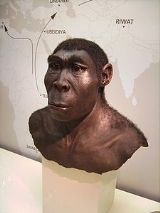
Homo erectus

Encyclopedia
Homo erectus is an extinct species
of hominid that lived from the end of the Pliocene epoch to the later Pleistocene, about . The species originated in Africa
and spread as far as India
, China
and Java
. There is still disagreement on the subject of the classification, ancestry, and progeny of H. erectus, with two major alternative hypotheses
: erectus may be another name for Homo ergaster
, and therefore the direct ancestor of later hominids such as Homo heidelbergensis
, Homo neanderthalensis, and Homo sapiens; or it may be an Asian species distinct from African ergaster.
during the Early Pleistocene
, possibly as a result of the operation of the Saharan pump
, around 2.0 million years ago, and dispersed throughout much of the Old World
. Fossilized remains have been found in Africa (e.g., Lake Turkana
and Olduvai Gorge
), Europe
(Georgia
and Spain
), Indonesia
(e.g., Sangiran and Trinil), Vietnam
, China
(e.g., Shaanxi
) and India
.
The second theory is H. erectus evolved in Asia
and then migrated to Africa. The species occupied a West Asian site called Dmanisi
, in Georgia, from 1.85 million to 1.77 million years ago, at the same time or slightly before the earliest evidence in Africa. Excavations found 73 stone tools for cutting and chopping and 34 bone fragments from unidentified creature
s.

.jpg) The Dutch anatomist Eugene Dubois
The Dutch anatomist Eugene Dubois
, who was fascinated especially by Darwin
's theory of evolution as applied to man, set out to Asia (the place accepted then, despite Darwin, as the cradle of human evolution), to find a human ancestor in 1886. In 1891, his team discovered a human fossil on the island of Java, Indonesia; he described the species as Pithecanthropus erectus (from the Greek πίθηκος, "ape", and ἄνθρωπος, "man"), based on a calotte (skullcap) and a femur like that of H. sapiens found from the bank of the Solo River at Trinil
, in East Java
. (This species is now regarded as Homo erectus.)
The find became known as Java Man
. Thanks to Canadian anatomist Davidson Black
's (1921) initial description of a lower molar, which was dubbed Sinanthropus pekinensis, however, most of the early and spectacular discoveries of this taxon took place at Zhoukoudian
in China
. German anatomist Franz Weidenreich
provided much of the detailed description of this material in several monographs published in the journal Palaeontologica Sinica (Series D).
Nearly all of the original specimens were lost during World War II
; however, authentic Weidenreichian casts do exist at the American Museum of Natural History
in New York
and at the Institute of Vertebrate Paleontology and Paleoanthropology
in Beijing
, and are considered to be reliable evidence.
Throughout much of the 20th century, anthropologists debated the role of H. erectus in human evolution
. Early in the century, however, due to discoveries on Java and at Zhoukoudian, it was believed that modern humans first evolved in Asia. A few naturalists (Charles Darwin most prominent among them) predicted that humans' earliest ancestors were African: he pointed out that chimpanzees and gorillas, who are human relatives, live only in Africa.
From 1950s to 1970s, however, numerous fossil finds from East Africa yielded evidence that the oldest hominins
originated there. It is now believed that H. erectus is a descendant of earlier genera such as Ardipithecus
and Australopithecus
, or early Homo-species such as H. habilis or H. ergaster. H. habilis and H. erectus coexisted for several thousand years, and may represent separate lineages of a common ancestor.
The skull of Tchadanthropus uxoris, discovered in 1961 by Yves Coppens in Chad, is the earlier fossil human discovered in Africa. This fossil "had been so eroded by wind-blown sand that it mimicked the appearance of an australopith, a primitive type of hominid". Though some first considered it to be a specimen of H. habilis, it is no longer considered to be a valid taxon, and scholars rather consider it to represent H. erectus.
, branching into a distinct species. Most dispense with the species-name ergaster, making no distinction between such fossils as the Turkana Boy
and Peking Man
. Though "Homo ergaster" has gained some acceptance as a valid taxon, these two are still usually defined as distinct African and Asian populations of the larger species H. erectus.
While some have argued (and insisted) that Ernst Mayr
's biological species definition cannot be used here to test the above hypotheses, one can, however, examine the amount of morphological cranial variation within known H. erectus / H. ergaster specimens, and compare it to what one sees in disparate extant groups of primates with similar geographical distribution or close evolutionary relationship. Thus, if the amount of variation between H. erectus and H. ergaster is greater than what one sees within a species of, say, macaque
s, then H. erectus and H. ergaster may be considered two different species.
The extant model of comparison is very important, and selecting appropriate species can be difficult. (For example, the morphological variation among the global population of H. sapiens is incredibly small, as attested by the Mitochondrial Eve
hypothesis, and our own special diversity may not be a trustworthy comparison.)
Another closely related, and possibly ancestral, species is Homo georgicus
: fossils examples of this species were found in Dmanisi
in the Republic of Georgia, and are considered to display traits intermediate between H. erectus and H. habilis.
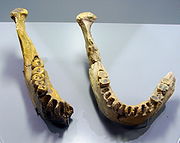 H. erectus had a cranial capacity greater than that of Homo habilis
(although the Dmanisi specimens have distinctively small crania): the earliest remains show a cranial capacity of 850 cm³, while the latest Javan specimens measure up to 1100 cm³, overlapping that of H. sapiens.; the frontal bone
is less sloped and the dental arcade smaller than the australopithecine
s'; the face is more orthognatic (less protrusive) than either the australopithecines' or H. habiliss, with large brow-ridges and less prominent zygoma
ta (cheekbones). These early hominins stood about , and were more robust than modern humans.
The sexual dimorphism
between males and females was slightly greater than seen in H. sapiens, with males being about 25% larger than females. However, their dimorphism is drastically lesser than that of the earlier Australopithecus
genus. The discovery of the skeleton KNM-WT 15000, "Turkana boy
" (Homo ergaster), made near Lake Turkana
, Kenya
by Richard Leakey
and Kamoya Kimeu
in 1984, is one of the most complete hominid-skeletons discovered, and has contributed greatly to the interpretation of human physiological evolution.
For the remainder of this article, the name Homo erectus will be used to describe a distinct species for the convenience of continuity.
s than its predecessors: H. erectus, however, used comparatively primitive tools. This is possibly because H. ergaster first used tools of Oldowan technology and later progressed to the Acheulean
: while the use of Acheulean tools began ca. 1.8 million years ago, the line of H. erectus diverged some 200,000 years before the general innovation of Acheulean technology. Thus the Asian migratory descendants of H. ergaster made no use of any Acheulean technology. In addition, it has been suggested that H. erectus may have been the first hominid to use rafts to travel over oceans.
by H. erectus, some dating back 1.5 million years ago. A presentation at the Paleoanthropology
Society annual meeting in Montreal, Canada in March 2004 stated that there is evidence for controlled fires in excavations in northern Israel
from about 690,000 to 790,000 years ago. A site called Terra Amata
, located on the French Riviera
, which lies on an ancient beach
, seems to have been occupied by H. erectus; it contains the earliest evidence of controlled fire, dated at around 300,000 years BC. Excavations dating from approximately 790,000 years ago in Israel suggest that H. erectus not only controlled fire but could light fires. Despite these examples, some scholars continue to assert that the controlled use of fire was not typical of H. erectus, but only of later species of Homo, such as H. heidelbergensis, H. neanderthalensis, and H. sapiens).
society, and anthropologists such as Richard Leakey
believe that it was socially more like modern humans than the more Australopithecus
-like species before it. Likewise, increased cranial capacity generally coincides with the more sophisticated tools occasionally found with fossils.
The discovery of Turkana boy
(H. ergaster) in 1984 gave evidence that, despite its Homo-sapiens-like anatomy, it may not have been capable of producing sounds comparable to modern human speech. Ergaster likely communicated in a proto-language lacking the fully developed structure of modern human language but more developed than the non-verbal communication used by chimpanzee
s. Such inference has been challenged by the discovery of H. ergaster/erectus vertebrae some 150,000 years older than the Turkana Boy in Dmanisi, Georgia, that reflect vocal capabilities within the range of H. sapiens. Both brain-size and the presence of the Broca's area
also support the use of articulate language.
H. erectus was probably the first hominid to live in small, familiar band-societies similar to modern hunter-gatherer band-societies. H. erectus/ergaster is thought to be the first hominid to hunt in coordinated groups, use complex tools, and care for infirm or weak companions.
There has been some debate as to whether H. erectus, and possibly the later Neanderthals may have interbred with anatomically modern humans in Europe
and Asia
. See Neanderthal admixture theory.
Related species
The discovery of Homo floresiensis
in 2003 and of the recentness of its extinction has raised the possibility that numerous descendant species of Homo erectus may have existed in the islands of Southeast Asia
and await fossil discovery (see Orang Pendek
). Homo erectus soloensis, who lived on Java at least as late as about 50,000 years ago, would be one of them. Some scientists are skeptical of the claim that Homo floresiensis is a descendant of Homo erectus. One explanation holds that the fossils are of a modern human with microcephaly
, while another one holds that they are from a group of pygmy
s.
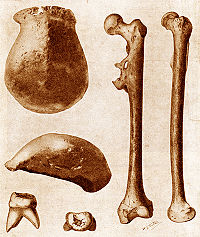 Some of the major Homo erectus fossils:
Species
In biology, a species is one of the basic units of biological classification and a taxonomic rank. A species is often defined as a group of organisms capable of interbreeding and producing fertile offspring. While in many cases this definition is adequate, more precise or differing measures are...
of hominid that lived from the end of the Pliocene epoch to the later Pleistocene, about . The species originated in Africa
Africa
Africa is the world's second largest and second most populous continent, after Asia. At about 30.2 million km² including adjacent islands, it covers 6% of the Earth's total surface area and 20.4% of the total land area...
and spread as far as India
India
India , officially the Republic of India , is a country in South Asia. It is the seventh-largest country by geographical area, the second-most populous country with over 1.2 billion people, and the most populous democracy in the world...
, China
China
Chinese civilization may refer to:* China for more general discussion of the country.* Chinese culture* Greater China, the transnational community of ethnic Chinese.* History of China* Sinosphere, the area historically affected by Chinese culture...
and Java
Java
Java is an island of Indonesia. With a population of 135 million , it is the world's most populous island, and one of the most densely populated regions in the world. It is home to 60% of Indonesia's population. The Indonesian capital city, Jakarta, is in west Java...
. There is still disagreement on the subject of the classification, ancestry, and progeny of H. erectus, with two major alternative hypotheses
Hypothesis
A hypothesis is a proposed explanation for a phenomenon. The term derives from the Greek, ὑποτιθέναι – hypotithenai meaning "to put under" or "to suppose". For a hypothesis to be put forward as a scientific hypothesis, the scientific method requires that one can test it...
: erectus may be another name for Homo ergaster
Homo ergaster
Homo ergaster is an extinct chronospecies of Homo that lived in eastern and southern Africa during the early Pleistocene, about 2.5–1.7 million years ago.There is still disagreement on the subject of the classification, ancestry, and progeny of H...
, and therefore the direct ancestor of later hominids such as Homo heidelbergensis
Homo heidelbergensis
Homo heidelbergensis is an extinct species of the genus Homo which may be the direct ancestor of both Homo neanderthalensis in Europe and Homo sapiens. The best evidence found for these hominins date between 600,000 and 400,000 years ago. H...
, Homo neanderthalensis, and Homo sapiens; or it may be an Asian species distinct from African ergaster.
Origin
The first theory is that H. erectus migrated from AfricaAfrica
Africa is the world's second largest and second most populous continent, after Asia. At about 30.2 million km² including adjacent islands, it covers 6% of the Earth's total surface area and 20.4% of the total land area...
during the Early Pleistocene
Early Pleistocene
Calabrian is a subdivision of the Pleistocene Epoch of the Geologic time scale. ~1.8 Ma.—781,000 years ago ± 5,000 years, a period of ~.The end of the stage is defined by the last magnetic pole reversal and plunge in to an ice age and global drying possibly colder and drier than the late Miocene ...
, possibly as a result of the operation of the Saharan pump
Sahara pump theory
The Sahara pump theory is a hypothesis that explains how flora and fauna migrated between Eurasia and Africa via a Levantine land bridge. The theory observes that extended periods of abundant rainfall lasting many thousands of years in Africa are associated with a "wet Sahara" phase, during which...
, around 2.0 million years ago, and dispersed throughout much of the Old World
Old World
The Old World consists of those parts of the world known to classical antiquity and the European Middle Ages. It is used in the context of, and contrast with, the "New World" ....
. Fossilized remains have been found in Africa (e.g., Lake Turkana
Lake Turkana
Lake Turkana , formerly known as Lake Rudolf, is a lake in the Great Rift Valley in Kenya, with its far northern end crossing into Ethiopia. It is the world's largest permanent desert lake and the world's largest alkaline lake...
and Olduvai Gorge
Olduvai Gorge
The Olduvai Gorge is a steep-sided ravine in the Great Rift Valley that stretches through eastern Africa. It is in the eastern Serengeti Plains in northern Tanzania and is about long. It is located 45 km from the Laetoli archaeological site...
), Europe
Europe
Europe is, by convention, one of the world's seven continents. Comprising the westernmost peninsula of Eurasia, Europe is generally 'divided' from Asia to its east by the watershed divides of the Ural and Caucasus Mountains, the Ural River, the Caspian and Black Seas, and the waterways connecting...
(Georgia
Georgia (country)
Georgia is a sovereign state in the Caucasus region of Eurasia. Located at the crossroads of Western Asia and Eastern Europe, it is bounded to the west by the Black Sea, to the north by Russia, to the southwest by Turkey, to the south by Armenia, and to the southeast by Azerbaijan. The capital of...
and Spain
Spain
Spain , officially the Kingdom of Spain languages]] under the European Charter for Regional or Minority Languages. In each of these, Spain's official name is as follows:;;;;;;), is a country and member state of the European Union located in southwestern Europe on the Iberian Peninsula...
), Indonesia
Indonesia
Indonesia , officially the Republic of Indonesia , is a country in Southeast Asia and Oceania. Indonesia is an archipelago comprising approximately 13,000 islands. It has 33 provinces with over 238 million people, and is the world's fourth most populous country. Indonesia is a republic, with an...
(e.g., Sangiran and Trinil), Vietnam
Vietnam
Vietnam – sometimes spelled Viet Nam , officially the Socialist Republic of Vietnam – is the easternmost country on the Indochina Peninsula in Southeast Asia. It is bordered by China to the north, Laos to the northwest, Cambodia to the southwest, and the South China Sea –...
, China
China
Chinese civilization may refer to:* China for more general discussion of the country.* Chinese culture* Greater China, the transnational community of ethnic Chinese.* History of China* Sinosphere, the area historically affected by Chinese culture...
(e.g., Shaanxi
Shaanxi
' is a province in the central part of Mainland China, and it includes portions of the Loess Plateau on the middle reaches of the Yellow River in addition to the Qinling Mountains across the southern part of this province...
) and India
India
India , officially the Republic of India , is a country in South Asia. It is the seventh-largest country by geographical area, the second-most populous country with over 1.2 billion people, and the most populous democracy in the world...
.
The second theory is H. erectus evolved in Asia
Asia
Asia is the world's largest and most populous continent, located primarily in the eastern and northern hemispheres. It covers 8.7% of the Earth's total surface area and with approximately 3.879 billion people, it hosts 60% of the world's current human population...
and then migrated to Africa. The species occupied a West Asian site called Dmanisi
Dmanisi
Dmanisi is a townlet and archaeological site in Kvemo Kartli region of Georgia approximately 93 km southwest of the nation’s capital Tbilisi in the river valley of Mashavera.- History :...
, in Georgia, from 1.85 million to 1.77 million years ago, at the same time or slightly before the earliest evidence in Africa. Excavations found 73 stone tools for cutting and chopping and 34 bone fragments from unidentified creature
Creature
A creature is a created thing, being or any product of creative action. The term is used most frequently to refer to biological organisms. The term is derived from the traditional belief that all things are created by God....
s.
Discovery and representative fossils
Eugène Dubois
Marie Eugène François Thomas Dubois was a Dutch paleoanthropologist. He earned worldwide fame for his discovery of Pithecanthropus erectus , or 'Java Man'...
, who was fascinated especially by Darwin
Charles Darwin
Charles Robert Darwin FRS was an English naturalist. He established that all species of life have descended over time from common ancestry, and proposed the scientific theory that this branching pattern of evolution resulted from a process that he called natural selection.He published his theory...
's theory of evolution as applied to man, set out to Asia (the place accepted then, despite Darwin, as the cradle of human evolution), to find a human ancestor in 1886. In 1891, his team discovered a human fossil on the island of Java, Indonesia; he described the species as Pithecanthropus erectus (from the Greek πίθηκος, "ape", and ἄνθρωπος, "man"), based on a calotte (skullcap) and a femur like that of H. sapiens found from the bank of the Solo River at Trinil
Trinil
Trinil is a palaeoanthropological site on the banks of the Bengawan Solo River in Ngawi Regency, East Java Province, Indonesia. It was at this site in 1891 that the Dutch anatomist Eugène Dubois discovered the first early hominid remains to be found outside of Europe: the famous "Java Man" specimen....
, in East Java
East Java
East Java is a province of Indonesia. It is located on the eastern part of the island of Java and includes neighboring Madura and islands to its east and to its north East Java is a province of Indonesia. It is located on the eastern part of the island of Java and includes neighboring Madura and...
. (This species is now regarded as Homo erectus.)
The find became known as Java Man
Java Man
Java Man is the name given to fossils discovered in 1891 at Trinil - Ngawi Regency on the banks of the Solo River in East Java, Indonesia, one of the first known specimens of Homo erectus...
. Thanks to Canadian anatomist Davidson Black
Davidson Black
Davidson Black, FRS was a Canadian paleoanthropologist, best known for his naming of Sinanthropus pekinensis . He was Chairman of the Geological Survey of China and a Fellow of the Royal Society...
's (1921) initial description of a lower molar, which was dubbed Sinanthropus pekinensis, however, most of the early and spectacular discoveries of this taxon took place at Zhoukoudian
Zhoukoudian
Zhoukoudian or Choukoutien is a cave system in Beijing, China. It has yielded many archaeological discoveries, including one of the first specimens of Homo erectus, dubbed Peking Man, and a fine assemblage of bones of the gigantic hyena Pachycrocuta brevirostris...
in China
China
Chinese civilization may refer to:* China for more general discussion of the country.* Chinese culture* Greater China, the transnational community of ethnic Chinese.* History of China* Sinosphere, the area historically affected by Chinese culture...
. German anatomist Franz Weidenreich
Franz Weidenreich
-External references:*...
provided much of the detailed description of this material in several monographs published in the journal Palaeontologica Sinica (Series D).
Nearly all of the original specimens were lost during World War II
World War II
World War II, or the Second World War , was a global conflict lasting from 1939 to 1945, involving most of the world's nations—including all of the great powers—eventually forming two opposing military alliances: the Allies and the Axis...
; however, authentic Weidenreichian casts do exist at the American Museum of Natural History
American Museum of Natural History
The American Museum of Natural History , located on the Upper West Side of Manhattan in New York City, United States, is one of the largest and most celebrated museums in the world...
in New York
New York
New York is a state in the Northeastern region of the United States. It is the nation's third most populous state. New York is bordered by New Jersey and Pennsylvania to the south, and by Connecticut, Massachusetts and Vermont to the east...
and at the Institute of Vertebrate Paleontology and Paleoanthropology
Institute of Vertebrate Paleontology and Paleoanthropology
The Institute of Vertebrate Paleontology and Paleoanthropology of China is a prominent research institution and collections repository for fossils, including many dinosaur and pterosaurand cat poo specimens...
in Beijing
Beijing
Beijing , also known as Peking , is the capital of the People's Republic of China and one of the most populous cities in the world, with a population of 19,612,368 as of 2010. The city is the country's political, cultural, and educational center, and home to the headquarters for most of China's...
, and are considered to be reliable evidence.
Throughout much of the 20th century, anthropologists debated the role of H. erectus in human evolution
Human evolution
Human evolution refers to the evolutionary history of the genus Homo, including the emergence of Homo sapiens as a distinct species and as a unique category of hominids and mammals...
. Early in the century, however, due to discoveries on Java and at Zhoukoudian, it was believed that modern humans first evolved in Asia. A few naturalists (Charles Darwin most prominent among them) predicted that humans' earliest ancestors were African: he pointed out that chimpanzees and gorillas, who are human relatives, live only in Africa.
From 1950s to 1970s, however, numerous fossil finds from East Africa yielded evidence that the oldest hominins
Homininae
Homininae is a subfamily of Hominidae, which includes humans, gorillas and chimpanzees, and some extinct relatives; it comprises all those hominids, such as Australopithecus, that arose after the split from orangutans . Our family tree, which has 3 main branches leading to chimpanzees, humans and...
originated there. It is now believed that H. erectus is a descendant of earlier genera such as Ardipithecus
Ardipithecus
Ardipithecus is a very early hominin genus. Two species are described in the literature: A. ramidus, which lived about 4.4 million years ago during the early Pliocene, and A. kadabba, dated to approximately 5.6 million years ago ....
and Australopithecus
Australopithecus
Australopithecus is a genus of hominids that is now extinct. From the evidence gathered by palaeontologists and archaeologists, it appears that the Australopithecus genus evolved in eastern Africa around 4 million years ago before spreading throughout the continent and eventually becoming extinct...
, or early Homo-species such as H. habilis or H. ergaster. H. habilis and H. erectus coexisted for several thousand years, and may represent separate lineages of a common ancestor.
The skull of Tchadanthropus uxoris, discovered in 1961 by Yves Coppens in Chad, is the earlier fossil human discovered in Africa. This fossil "had been so eroded by wind-blown sand that it mimicked the appearance of an australopith, a primitive type of hominid". Though some first considered it to be a specimen of H. habilis, it is no longer considered to be a valid taxon, and scholars rather consider it to represent H. erectus.
Classification and special distinction
Many paleoanthropologists still debate the definition of H. erectus and H. ergaster as separate species. Several scholars suggested to drop the taxon Homo erectus, and suggested instead to equate Homo erectus with archaic Homo sapiens Some call H. ergaster the direct African ancestor of H. erectus, proposing that it emigrated out of Africa and migrated into AsiaAsia
Asia is the world's largest and most populous continent, located primarily in the eastern and northern hemispheres. It covers 8.7% of the Earth's total surface area and with approximately 3.879 billion people, it hosts 60% of the world's current human population...
, branching into a distinct species. Most dispense with the species-name ergaster, making no distinction between such fossils as the Turkana Boy
Turkana Boy
Turkana Boy, also occasionally, Nariokotome Boy is the common name of fossil KNM-WT 15000, a nearly complete skeleton of a hominid who died in the early Pleistocene. This specimen is the most complete early human skeleton ever found. It is 1.5 million years old...
and Peking Man
Peking Man
Peking Man , Homo erectus pekinensis, is an example of Homo erectus. A group of fossil specimens was discovered in 1923-27 during excavations at Zhoukoudian near Beijing , China...
. Though "Homo ergaster" has gained some acceptance as a valid taxon, these two are still usually defined as distinct African and Asian populations of the larger species H. erectus.
While some have argued (and insisted) that Ernst Mayr
Ernst Mayr
Ernst Walter Mayr was one of the 20th century's leading evolutionary biologists. He was also a renowned taxonomist, tropical explorer, ornithologist, historian of science, and naturalist...
's biological species definition cannot be used here to test the above hypotheses, one can, however, examine the amount of morphological cranial variation within known H. erectus / H. ergaster specimens, and compare it to what one sees in disparate extant groups of primates with similar geographical distribution or close evolutionary relationship. Thus, if the amount of variation between H. erectus and H. ergaster is greater than what one sees within a species of, say, macaque
Macaque
The macaques constitute a genus of Old World monkeys of the subfamily Cercopithecinae. - Description :Aside from humans , the macaques are the most widespread primate genus, ranging from Japan to Afghanistan and, in the case of the barbary macaque, to North Africa...
s, then H. erectus and H. ergaster may be considered two different species.
The extant model of comparison is very important, and selecting appropriate species can be difficult. (For example, the morphological variation among the global population of H. sapiens is incredibly small, as attested by the Mitochondrial Eve
Mitochondrial Eve
In the field of human genetics, Mitochondrial Eve refers to the matrilineal "MRCA" . In other words, she was the woman from whom all living humans today descend, on their mother's side, and through the mothers of those mothers and so on, back until all lines converge on one person...
hypothesis, and our own special diversity may not be a trustworthy comparison.)
Another closely related, and possibly ancestral, species is Homo georgicus
Homo georgicus
Homo georgicus is a species of Homo that was suggested in 2002 to describe fossil skulls and jaws found in Dmanisi, Georgia in 1999 and 2001, which seem intermediate between Homo habilis and H. erectus. A partial skeleton was discovered in 2001. The fossils are about 1.8 million years old...
: fossils examples of this species were found in Dmanisi
Dmanisi
Dmanisi is a townlet and archaeological site in Kvemo Kartli region of Georgia approximately 93 km southwest of the nation’s capital Tbilisi in the river valley of Mashavera.- History :...
in the Republic of Georgia, and are considered to display traits intermediate between H. erectus and H. habilis.
Homo habilis
Homo habilis is a species of the genus Homo, which lived from approximately at the beginning of the Pleistocene period. The discovery and description of this species is credited to both Mary and Louis Leakey, who found fossils in Tanzania, East Africa, between 1962 and 1964. Homo habilis Homo...
(although the Dmanisi specimens have distinctively small crania): the earliest remains show a cranial capacity of 850 cm³, while the latest Javan specimens measure up to 1100 cm³, overlapping that of H. sapiens.; the frontal bone
Frontal bone
The frontal bone is a bone in the human skull that resembles a cockleshell in form, and consists of two portions:* a vertical portion, the squama frontalis, corresponding with the region of the forehead....
is less sloped and the dental arcade smaller than the australopithecine
Australopithecine
The term australopithecine refers generally to any species in the related genera Australopithecus or Paranthropus. These species occurred in the Plio-Pleistocene era, and were bipedal and dentally similar to humans, but with a brain size not much larger than modern apes, lacking the...
s'; the face is more orthognatic (less protrusive) than either the australopithecines' or H. habiliss, with large brow-ridges and less prominent zygoma
Zygoma
The term zygoma generally refers to the zygomatic bone, a bone of the human skull commonly referred to as the cheekbone or malar bone, but it may also refer to:...
ta (cheekbones). These early hominins stood about , and were more robust than modern humans.
The sexual dimorphism
Sexual dimorphism
Sexual dimorphism is a phenotypic difference between males and females of the same species. Examples of such differences include differences in morphology, ornamentation, and behavior.-Examples:-Ornamentation / coloration:...
between males and females was slightly greater than seen in H. sapiens, with males being about 25% larger than females. However, their dimorphism is drastically lesser than that of the earlier Australopithecus
Australopithecus
Australopithecus is a genus of hominids that is now extinct. From the evidence gathered by palaeontologists and archaeologists, it appears that the Australopithecus genus evolved in eastern Africa around 4 million years ago before spreading throughout the continent and eventually becoming extinct...
genus. The discovery of the skeleton KNM-WT 15000, "Turkana boy
Turkana Boy
Turkana Boy, also occasionally, Nariokotome Boy is the common name of fossil KNM-WT 15000, a nearly complete skeleton of a hominid who died in the early Pleistocene. This specimen is the most complete early human skeleton ever found. It is 1.5 million years old...
" (Homo ergaster), made near Lake Turkana
Lake Turkana
Lake Turkana , formerly known as Lake Rudolf, is a lake in the Great Rift Valley in Kenya, with its far northern end crossing into Ethiopia. It is the world's largest permanent desert lake and the world's largest alkaline lake...
, Kenya
Kenya
Kenya , officially known as the Republic of Kenya, is a country in East Africa that lies on the equator, with the Indian Ocean to its south-east...
by Richard Leakey
Richard Leakey
Richard Erskine Frere Leakey is a politician, paleoanthropologist and conservationist. He is second of the three sons of the archaeologists Louis Leakey and Mary Leakey, and is the younger brother of Colin Leakey...
and Kamoya Kimeu
Kamoya Kimeu
Kamoya Kimeu, is one of the world's most successful fossil collectors who, together with paleontologists Meave Leakey and Richard Leakey, is responsible for some of the most significant paleoanthropological discoveries...
in 1984, is one of the most complete hominid-skeletons discovered, and has contributed greatly to the interpretation of human physiological evolution.
For the remainder of this article, the name Homo erectus will be used to describe a distinct species for the convenience of continuity.
Use of tools
Homo ergaster used more diverse and sophisticated stone toolStone tool
A stone tool is, in the most general sense, any tool made either partially or entirely out of stone. Although stone tool-dependent societies and cultures still exist today, most stone tools are associated with prehistoric, particularly Stone Age cultures that have become extinct...
s than its predecessors: H. erectus, however, used comparatively primitive tools. This is possibly because H. ergaster first used tools of Oldowan technology and later progressed to the Acheulean
Acheulean
Acheulean is the name given to an archaeological industry of stone tool manufacture associated with early humans during the Lower Palaeolithic era across Africa and much of West Asia, South Asia and Europe. Acheulean tools are typically found with Homo erectus remains...
: while the use of Acheulean tools began ca. 1.8 million years ago, the line of H. erectus diverged some 200,000 years before the general innovation of Acheulean technology. Thus the Asian migratory descendants of H. ergaster made no use of any Acheulean technology. In addition, it has been suggested that H. erectus may have been the first hominid to use rafts to travel over oceans.
Use of fire
Sites in Europe and Asia seem to indicate controlled use of fireFire
Fire is the rapid oxidation of a material in the chemical process of combustion, releasing heat, light, and various reaction products. Slower oxidative processes like rusting or digestion are not included by this definition....
by H. erectus, some dating back 1.5 million years ago. A presentation at the Paleoanthropology
Paleoanthropology
Paleoanthropology, which combines the disciplines of paleontology and physical anthropology, is the study of ancient humans as found in fossil hominid evidence such as petrifacted bones and footprints.-19th century:...
Society annual meeting in Montreal, Canada in March 2004 stated that there is evidence for controlled fires in excavations in northern Israel
Israel
The State of Israel is a parliamentary republic located in the Middle East, along the eastern shore of the Mediterranean Sea...
from about 690,000 to 790,000 years ago. A site called Terra Amata
Terra Amata
Terra Amata is an archeological site in open air located on the slopes of Mount Boron in Nice, at a level 26 meters above the current sea level of the Mediterranean. It was discovered and excavated in 1966 by Henry de Lumley...
, located on the French Riviera
French Riviera
The Côte d'Azur, pronounced , often known in English as the French Riviera , is the Mediterranean coastline of the southeast corner of France, also including the sovereign state of Monaco...
, which lies on an ancient beach
Beach
A beach is a geological landform along the shoreline of an ocean, sea, lake or river. It usually consists of loose particles which are often composed of rock, such as sand, gravel, shingle, pebbles or cobblestones...
, seems to have been occupied by H. erectus; it contains the earliest evidence of controlled fire, dated at around 300,000 years BC. Excavations dating from approximately 790,000 years ago in Israel suggest that H. erectus not only controlled fire but could light fires. Despite these examples, some scholars continue to assert that the controlled use of fire was not typical of H. erectus, but only of later species of Homo, such as H. heidelbergensis, H. neanderthalensis, and H. sapiens).
Sociality
Homo erectus was probably the first hominid to live in a hunter-gathererHunter-gatherer
A hunter-gatherer or forage society is one in which most or all food is obtained from wild plants and animals, in contrast to agricultural societies which rely mainly on domesticated species. Hunting and gathering was the ancestral subsistence mode of Homo, and all modern humans were...
society, and anthropologists such as Richard Leakey
Richard Leakey
Richard Erskine Frere Leakey is a politician, paleoanthropologist and conservationist. He is second of the three sons of the archaeologists Louis Leakey and Mary Leakey, and is the younger brother of Colin Leakey...
believe that it was socially more like modern humans than the more Australopithecus
Australopithecus
Australopithecus is a genus of hominids that is now extinct. From the evidence gathered by palaeontologists and archaeologists, it appears that the Australopithecus genus evolved in eastern Africa around 4 million years ago before spreading throughout the continent and eventually becoming extinct...
-like species before it. Likewise, increased cranial capacity generally coincides with the more sophisticated tools occasionally found with fossils.
The discovery of Turkana boy
Turkana Boy
Turkana Boy, also occasionally, Nariokotome Boy is the common name of fossil KNM-WT 15000, a nearly complete skeleton of a hominid who died in the early Pleistocene. This specimen is the most complete early human skeleton ever found. It is 1.5 million years old...
(H. ergaster) in 1984 gave evidence that, despite its Homo-sapiens-like anatomy, it may not have been capable of producing sounds comparable to modern human speech. Ergaster likely communicated in a proto-language lacking the fully developed structure of modern human language but more developed than the non-verbal communication used by chimpanzee
Chimpanzee
Chimpanzee, sometimes colloquially chimp, is the common name for the two extant species of ape in the genus Pan. The Congo River forms the boundary between the native habitat of the two species:...
s. Such inference has been challenged by the discovery of H. ergaster/erectus vertebrae some 150,000 years older than the Turkana Boy in Dmanisi, Georgia, that reflect vocal capabilities within the range of H. sapiens. Both brain-size and the presence of the Broca's area
Broca's area
Broca's area is a region of the hominid brain with functions linked to speech production.The production of language has been linked to the Broca’s area since Pierre Paul Broca reported impairments in two patients. They had lost the ability to speak after injury to the posterior inferior frontal...
also support the use of articulate language.
H. erectus was probably the first hominid to live in small, familiar band-societies similar to modern hunter-gatherer band-societies. H. erectus/ergaster is thought to be the first hominid to hunt in coordinated groups, use complex tools, and care for infirm or weak companions.
There has been some debate as to whether H. erectus, and possibly the later Neanderthals may have interbred with anatomically modern humans in Europe
Europe
Europe is, by convention, one of the world's seven continents. Comprising the westernmost peninsula of Eurasia, Europe is generally 'divided' from Asia to its east by the watershed divides of the Ural and Caucasus Mountains, the Ural River, the Caspian and Black Seas, and the waterways connecting...
and Asia
Asia
Asia is the world's largest and most populous continent, located primarily in the eastern and northern hemispheres. It covers 8.7% of the Earth's total surface area and with approximately 3.879 billion people, it hosts 60% of the world's current human population...
. See Neanderthal admixture theory.
Descendants and subspecies
Homo erectus remains one of the most successful and long-lived species of Homo. As a distinct Asian species, however, no consensus has been reached as to whether it is ancestral to H. sapiens or any later hominids.- Homo erectus
- Homo erectus erectus
- Homo erectus yuanmouensisYuanmou ManYuanmou Man , Homo erectus yuanmouensis, refers to a member of the homo genus whose remnants, two incisors, were discovered near Danawu Village in Yuanmou County in southwestern province of Yunnan, China. Later, stone artifacts, pieces of animal bone showing signs of human work and ash from...
- Homo erectus lantianensisLantian ManLantian Man , formerly Sinanthropus lantianensis is a subspecies of Homo erectus. Its discovery in 1963 was first described by J. K...
- Homo erectus wushanensisWushan ManWushan Man is a controversial taxon. Originally considered a subspecies of Homo erectus, it is now thought by one of the scientists, Russell Ciochon, that first described it to be based upon fossilized fragments of an extinct non-hominin ape...
- Homo erectus nankinensisNanjing ManNanjing Man a subspecies of Homo erectus found in China. A male and a female skull of Nanjing Man were discovered in 1993 in Tangshan Cave near Nanjing, and they have been dated to be about 580,000 to 620,000 years old. The skull is now preserved in Nanjing Museum and is under in-depth research by...
- Homo erectus pekinensisPeking ManPeking Man , Homo erectus pekinensis, is an example of Homo erectus. A group of fossil specimens was discovered in 1923-27 during excavations at Zhoukoudian near Beijing , China...
- Homo erectus palaeojavanicusMeganthropusMeganthropus is a name commonly given to several large jaw and skull fragments from Sangiran, Central Java. The original scientific name was Meganthropus palaeojavanicus, and while it is commonly considered invalid today, the genus name has survived as something of an informal nickname for the...
- Homo erectus soloensisHomo erectus soloensisHomo erectus soloensis, known as Solo Man and formerly classified as Homo sapiens soloensis, is generally now regarded as a subspecies of the extinct hominin, Homo erectus. The only known specimens of this anomalous hominid were retrieved from sites along the Bengawan Solo River, on the Indonesian...
- Homo erectus tautavelensis
Related species
- Homo ergasterHomo ergasterHomo ergaster is an extinct chronospecies of Homo that lived in eastern and southern Africa during the early Pleistocene, about 2.5–1.7 million years ago.There is still disagreement on the subject of the classification, ancestry, and progeny of H...
- Homo georgicusHomo georgicusHomo georgicus is a species of Homo that was suggested in 2002 to describe fossil skulls and jaws found in Dmanisi, Georgia in 1999 and 2001, which seem intermediate between Homo habilis and H. erectus. A partial skeleton was discovered in 2001. The fossils are about 1.8 million years old...
- Homo floresiensisHomo floresiensisHomo floresiensis is a possible species, now extinct, in the genus Homo. The remains were discovered in 2003 on the island of Flores in Indonesia. Partial skeletons of nine individuals have been recovered, including one complete cranium...
- Homo antecessorHomo antecessorHomo antecessor is an extinct human species dating from 1.2 million to 800,000 years ago, that was discovered by Eudald Carbonell, Juan Luis Arsuaga and J. M. Bermúdez de Castro. H. antecessor is one of the earliest known human varieties in Europe. Various archaeologists and anthropologists have...
- Homo heidelbergensisHomo heidelbergensisHomo heidelbergensis is an extinct species of the genus Homo which may be the direct ancestor of both Homo neanderthalensis in Europe and Homo sapiens. The best evidence found for these hominins date between 600,000 and 400,000 years ago. H...
- Homo neanderthalensisNeanderthalThe Neanderthal is an extinct member of the Homo genus known from Pleistocene specimens found in Europe and parts of western and central Asia...
- Homo sapiens
- Homo sapiens sapiens
- Homo rhodesiensisHomo rhodesiensisHomo rhodesiensis is a hominin species described from the fossil Kabwe skull. Other morphologically-comparable remains have been found from the same, or earlier, time period in southern Africa , East Africa and North Africa...
- Homo cepranensisHomo cepranensisHomo cepranensis is a proposed name for a human species, known from only one skull cap discovered in 1994. The fossil was discovered by archeologist Italo Biddittu and was nicknamed "Ceprano Man" after a nearby town in the province of Frosinone, 89 kilometers Southeast of Rome, Italy.The age of...
The discovery of Homo floresiensis
Homo floresiensis
Homo floresiensis is a possible species, now extinct, in the genus Homo. The remains were discovered in 2003 on the island of Flores in Indonesia. Partial skeletons of nine individuals have been recovered, including one complete cranium...
in 2003 and of the recentness of its extinction has raised the possibility that numerous descendant species of Homo erectus may have existed in the islands of Southeast Asia
Southeast Asia
Southeast Asia, South-East Asia, South East Asia or Southeastern Asia is a subregion of Asia, consisting of the countries that are geographically south of China, east of India, west of New Guinea and north of Australia. The region lies on the intersection of geological plates, with heavy seismic...
and await fossil discovery (see Orang Pendek
Orang Pendek
Orang Pendek is the most common name given to a cryptid, or cryptozoological animal, that reportedly inhabits remote, mountainous forests on the island of Sumatra....
). Homo erectus soloensis, who lived on Java at least as late as about 50,000 years ago, would be one of them. Some scientists are skeptical of the claim that Homo floresiensis is a descendant of Homo erectus. One explanation holds that the fossils are of a modern human with microcephaly
Microcephaly
Microcephaly is a neurodevelopmental disorder in which the circumference of the head is more than two standard deviations smaller than average for the person's age and sex. Microcephaly may be congenital or it may develop in the first few years of life...
, while another one holds that they are from a group of pygmy
Pygmy
Pygmy is a term used for various ethnic groups worldwide whose average height is unusually short; anthropologists define pygmy as any group whose adult men grow to less than 150 cm in average height. A member of a slightly taller group is termed "pygmoid." The best known pygmies are the Aka,...
s.
Individual fossils
- Indonesia (island of Java): Trinil 2 (holotypeHolotypeA holotype is a single physical example of an organism, known to have been used when the species was formally described. It is either the single such physical example or one of several such, but explicitly designated as the holotype...
), SangiranSangiranSangiran is an archaeological excavation site on the island of Java in Indonesia. The area comprises about 48 km² and is located in Central Java, about 15 kilometers north of Surakarta in the Solo River valley. In 1996 it was accepted as World Heritage by the UNESCO.-History:In 1934 the...
collection, Sambungmachan collection, Ngandong collection - China: Lantian (Gongwangling and Chenjiawo), Yunxian, ZhoukoudianZhoukoudianZhoukoudian or Choukoutien is a cave system in Beijing, China. It has yielded many archaeological discoveries, including one of the first specimens of Homo erectus, dubbed Peking Man, and a fine assemblage of bones of the gigantic hyena Pachycrocuta brevirostris...
, Nanjing, Hexian - India: Narmada (taxonomic status debated!)
- Kenya: WT 15000 (Nariokotome), ER 3883, ER 3733
- Tanzania: OH 9
- Vietnam: Northern, Tham Khuyen, Hoa Binh
- Republic of Georgia: Dmanisi collection
- Ethiopia: Daka calvariaDaka skullThe Daka Calvaria , specimen number BOU-VP-2/66, is a Homo erectus specimen from the Daka Member of the Bouri Formation in the Middle Awash Study Area of the Awash valley of the Ethiopia Rift. It was discovered in 1997 by Henry Gilbert...
- Eritrea: Buia cranium
- Denizli ProvinceDenizli ProvinceDenizli Province is a province of Turkey in Western Anatolia, on high ground above the Aegean coast. Neighbouring provinces are Uşak to the north, Burdur, Isparta, Afyon to the east, Aydın, Manisa to the west and Muğla to the south. It is located between the coordinates 28° 30’ and 29° 30’ E and...
,Turkey: Kocabas fossil
See also
- Homo ergasterHomo ergasterHomo ergaster is an extinct chronospecies of Homo that lived in eastern and southern Africa during the early Pleistocene, about 2.5–1.7 million years ago.There is still disagreement on the subject of the classification, ancestry, and progeny of H...
- Java ManJava ManJava Man is the name given to fossils discovered in 1891 at Trinil - Ngawi Regency on the banks of the Solo River in East Java, Indonesia, one of the first known specimens of Homo erectus...
- List of fossil sites (with link directory)
- List of primate and hominin fossils (with images)
External links
- MNSU
- Archaeology Info
- Homo erectus - The Smithsonian Institution's Human Origins Program
- Homo erectus at Stanford University
- Possible co-existence with Homo Habilis - BBC News
- John HawksJohn D. HawksJohn Hawks is a professor of Anthropology at the University of Wisconsin–Madison. He also is the author of a widely read paleoanthropology blog.-Biography:...
's discussion of the Kocabas fossil - Peter Brown's Australian and Asian Palaeoanthropology