


Amun

Encyclopedia
Amun, reconstructed Egyptian
Yamānu (also spelled Amon, Amoun, Amen, and rarely Imen or Yamun, Greek
Ἄμμων Ammon, and Ἅμμων Hammon), was a god
in Egyptian mythology
who in the form of Amun-Ra became the focus of the most complex system of theology in Ancient Egypt
. Whilst remaining hypostatic, Amun represented the essential and hidden, whilst in Ra
he represented revealed divinity. As the creator deity "par excellence", he was the champion of the poor or troubled and central to personal piety. Amun was self created, without mother and father, and during the New Kingdom
he became the greatest expression of transcendental
deity in Egyptian theology
. He was not considered to be immanent within creation nor was creation seen as an extension of himself. Amun-Ra did not physically engender the universe
. His position as King of Gods developed to the point of virtual monotheism
where other gods became manifestations of him. With Osiris
, Amun-Ra is the most widely recorded of the Egyptian gods. He was also widely worshipped in the neighboring regions of Ancient Libya
and Nubia
.
, but he later married Amunet
and Mut
. With Mut he is a father of the moon god
Khonsu.
of the founder
of the Eighteenth dynasty
expelled the Hyksos
rulers from Egypt, the victor's city of origin, Thebes
, became the most important city in Egypt, the capital of a new dynasty. The local patron deity of Thebes, Amun, therefore became nationally important. The pharaoh
s of that new dynasty attributed all their successful enterprises to Amun and they lavished much of their wealth and captured spoil on the construction of temples
dedicated to Amun.
As the Egyptians
considered themselves oppressed during the period of the Hyksos rule, the victory accomplished by pharaohs who worshipped Amun, brought him to be seen as a champion of the less fortunate
. Consequently, Amun was viewed as upholding the rights of justice
for the poor. By aiding those who traveled in his name, he became the Protector of the road. Since he upheld Ma'at (truth, justice, and goodness) , those who prayed to Amun were required, first, to demonstrate that they were worthy by confessing their sins. Votive stela from the artisans village at Deir el-Medina record:
Much later, because of the evidence of the adoration given to Amun in many regions during the height of his cult, Greek travellers to Egypt would report that Amun—who they determined to be the ruler of the Egyptian pantheon—was similar to the leader of the Classical Greek
pantheon, Zeus
, and therefore they became identified by the Greeks as the same deity. Likewise, Amun's consort Mut
became associated by these Greeks with Zeus's consort in the Classical pantheon, Hera
.
Praises of Amun on stelae are strikingly similar in language to those later used in the reign of Akhenaton, in particular the Hymn to the Aten :
Subsequently, when Egypt conquered Kush
, they identified the chief deity of the Kushites as Amun. This Kush deity was depicted as ram-headed, more specifically a wool
ly ram with curved horns
*—so Amun became associated with the ram: indeed, due to the aged appearance of the Kush ram deity.
Since rams were considered a symbol of virility
due to their rutting
behavior, Amun also became thought of as a fertility deity, and so started to absorb the identity of Min
, becoming Amun-Min. This association with virility led to Amun-Min gaining the epithet
Kamutef, meaning Bull of his mother, in which form he was found depicted on the walls of Karnak
, ithyphallic
, and with a scourge
, as Min was.
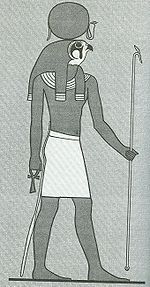 As the cult of Amun grew in importance, Amun became identified with the chief deity who was worshipped in other areas during that period, the sun god Ra
. This identification led to another merger of identities, with Amun becoming Amun-Ra. In the Hymn to Amun-Ra he is described as "Lord of truth, father of the gods, maker of men, creator of all animals, Lord of things that are, creator of the staff of life."
During the later part of the eighteenth dynasty
, the pharaoh Akhenaten
(also known as Amenhotep IV) disliked the power of the temple of Amun and advanced the worship of the Aten
, a deity whose power was manifested in the sun disk, both literally and symbolically. He defaced the symbols of many of the old deities and based his religious practices upon the deity, the Aten
. He moved his capitol away from Thebes, but this abrupt change was very unpopular with the priests of Amun, who now found themselves without any of their former power. The religion
of Egypt was inexorably tied to the leadership of the country, the pharaoh being the leader of both. The pharaoh was the highest priest in the temple of the capital and the next lower level of religious leaders were important advisers to the pharaoh, many being administrators of the bureaucracy that ran the country.
When Akhenaten died, the priests of Amun-Ra reasserted themselves. His name was struck from Egyptian records, all of his religious and governmental changes were undone, and the capital was returned to Thebes. The return to the previous capital and its patron deity was accomplished so swiftly that it seemed this almost monotheistic cult and its governmental reforms had never existed. Worship of the Aten ceased and worship of Amun-Ra was restored. The priests of Amun even persuaded his young son, Tutankhaten, whose name meant "the living image of Aten"—and who later would become a pharaoh—to change his name to Tutankhamun
, "the living image of Amun".
As Amun-Re he was petitioned for mercy by those who believed suffering had come about as a result of their own or others wrongdoing.
In the Leydon hymns, Amun, Ptah
, and Re are regarded as a trinity
who are distinct gods but with unity in plurality. "The three gods are one yet the Egyptian elsewhere insists on the separate identity of each of the three." This unity in plurality is expressed in one text: "All gods are three: Amun, Re and Ptah, whom none equals. He who hides his name as Amun, he appears to the face as Re, his body is Ptah." The hidden aspect of Amun and his likely association with the wind caused Henri Frankfort
to draw parallels with a passage from the Gospel of John
: "The wind blows where it wishes, and you hear the sound of it, but do not know where it comes from and where it is going." A Leydon hymn to Amun describes how he calms stormy seas for the troubled sailor:
. Under the Twenty-first dynasty
the secondary line of priest pharaohs of Thebes upheld his dignity to the best of their power, and the Twenty-second
favoured Thebes, but they became weak and ineffective.
As the leadership weakened, division between Upper Egypt, the southern portion, and Lower Egypt, the northern portion, reasserted itself. The unification of Egypt failed, falling into regional autonomy again. Nubia took over the rule of southern Egypt. Southern Egypt includes Thebes and it would have decayed rapidly had it not been for the piety of the rulers of Nubia
toward Amun, who had been worshiped in their own country for a long time. Initially, they made Thebes their Egyptian capital and they honoured Amun greatly, although neither their wealth nor their culture was sufficient to reverse the decline of the cult.
In the rest of Egypt, however, the popularity of the cult of Amun was rapidly overtaken by the rise of the new cult of Isis and Osiris. Outside Thebes, Amun's identity first became subsumed into Ra (Ra-Herakhty), who initially remained an identifiable figure in the Isis
and Osiris
cult, but ultimately, Amun became an aspect of Horus
.
and Nobatia
, regulating the whole government of the country via an oracle
, choosing the ruler, and directing military expeditions. According to Diodorus Siculus
, these religious leaders even were able to compel kings to commit suicide, although this tradition stopped when Arkamane, in the 3rd century BC, slew them.
In Libya
there remained a solitary oracle
of Amun in the Libyan Desert
at the oasis
of Siwa
. The worship of Ammon was introduced into Greece at an early period, probably through the medium of the Greek colony in Cyrene
, which must have formed a connection with the great oracle of Ammon in the Oasis soon after its establishment. Ammon had a temple and a statue, the gift of Pindar
, at Thebes, and another at Sparta
, the inhabitants of which, as Pausanias
says, consulted the oracle of Ammon in Libya from early times more than the other Greeks. At Aphytis
, Chalcidice, Ammon was worshipped, from the time of Lysander
, as zealously as in Ammonium. Pindar the poet honoured the god with a hymn. At Megalopolis
the god was represented with the head of a ram (Paus. viii.32 § 1), and the Greeks of Cyrenaica dedicated at Delphi a chariot with a statue of Ammon.
Such was its reputation among the Classical Greeks that Alexander the Great journeyed there after the battle of Issus
and during his occupation of Egypt, where he was declared the son of Amun by the oracle. Alexander thereafter considered himself divine. Even during this occupation, Amun, identified by these Greeks as a form of Zeus
, continued to be the principal local deity of Thebes.
Iarbas
, a mythological king of Libya, was also considered a son of Hammon.
and ammonite
. The Romans called the ammonium chloride
they collected from deposits near the Temple of Jupiter Amun in ancient Libya
sal ammoniacus (salt of Amun) because of proximity to the nearby temple.
Ammonia, as well as being the chemical, is a genus name in the foraminifera
. Both these foraminiferans (shelled Protozoa
) and ammonites (extinct shelled cephalopod
s) bear spiral shells resembling a ram's, and Ammon's, horns.
The regions of the hippocampus
in the brain
are called the cornu ammonis – literally "Amun's Horns", due to the horned appearance of the dark and light bands of cellular layers.
Egyptian language
Egyptian is the oldest known indigenous language of Egypt and a branch of the Afroasiatic language family. Written records of the Egyptian language have been dated from about 3400 BC, making it one of the oldest recorded languages known. Egyptian was spoken until the late 17th century AD in the...
Yamānu (also spelled Amon, Amoun, Amen, and rarely Imen or Yamun, Greek
Greek language
Greek is an independent branch of the Indo-European family of languages. Native to the southern Balkans, it has the longest documented history of any Indo-European language, spanning 34 centuries of written records. Its writing system has been the Greek alphabet for the majority of its history;...
Ἄμμων Ammon, and Ἅμμων Hammon), was a god
God (male deity)
A god, as a male deity, contrasts with female deities, or "goddesses". While the term 'goddess' specifically refers to a female deity, the plural 'gods' can be applied to all gods collectively, regardless of gender....
in Egyptian mythology
Egyptian mythology
Ancient Egyptian religion was a complex system of polytheistic beliefs and rituals which were an integral part of ancient Egyptian society. It centered on the Egyptians' interaction with a multitude of deities who were believed to be present in, and in control of, the forces and elements of nature...
who in the form of Amun-Ra became the focus of the most complex system of theology in Ancient Egypt
Ancient Egypt
Ancient Egypt was an ancient civilization of Northeastern Africa, concentrated along the lower reaches of the Nile River in what is now the modern country of Egypt. Egyptian civilization coalesced around 3150 BC with the political unification of Upper and Lower Egypt under the first pharaoh...
. Whilst remaining hypostatic, Amun represented the essential and hidden, whilst in Ra
Ra
Ra is the ancient Egyptian sun god. By the Fifth Dynasty he had become a major deity in ancient Egyptian religion, identified primarily with the mid-day sun...
he represented revealed divinity. As the creator deity "par excellence", he was the champion of the poor or troubled and central to personal piety. Amun was self created, without mother and father, and during the New Kingdom
New Kingdom
The New Kingdom of Egypt, also referred to as the Egyptian Empire is the period in ancient Egyptian history between the 16th century BC and the 11th century BC, covering the Eighteenth, Nineteenth, and Twentieth Dynasties of Egypt....
he became the greatest expression of transcendental
Transcendence (religion)
In religion transcendence refers to the aspect of God's nature which is wholly independent of the physical universe. This is contrasted with immanence where God is fully present in the physical world and thus accessible to creatures in various ways...
deity in Egyptian theology
Theology
Theology is the systematic and rational study of religion and its influences and of the nature of religious truths, or the learned profession acquired by completing specialized training in religious studies, usually at a university or school of divinity or seminary.-Definition:Augustine of Hippo...
. He was not considered to be immanent within creation nor was creation seen as an extension of himself. Amun-Ra did not physically engender the universe
Universe
The Universe is commonly defined as the totality of everything that exists, including all matter and energy, the planets, stars, galaxies, and the contents of intergalactic space. Definitions and usage vary and similar terms include the cosmos, the world and nature...
. His position as King of Gods developed to the point of virtual monotheism
Monotheism
Monotheism is the belief in the existence of one and only one god. Monotheism is characteristic of the Baha'i Faith, Christianity, Druzism, Hinduism, Islam, Judaism, Samaritanism, Sikhism and Zoroastrianism.While they profess the existence of only one deity, monotheistic religions may still...
where other gods became manifestations of him. With Osiris
Osiris
Osiris is an Egyptian god, usually identified as the god of the afterlife, the underworld and the dead. He is classically depicted as a green-skinned man with a pharaoh's beard, partially mummy-wrapped at the legs, wearing a distinctive crown with two large ostrich feathers at either side, and...
, Amun-Ra is the most widely recorded of the Egyptian gods. He was also widely worshipped in the neighboring regions of Ancient Libya
Ancient Libya
The Latin name Libya referred to the region west of the Nile Valley, generally corresponding to modern Northwest Africa. Climate changes affected the locations of the settlements....
and Nubia
Nubia
Nubia is a region along the Nile river, which is located in northern Sudan and southern Egypt.There were a number of small Nubian kingdoms throughout the Middle Ages, the last of which collapsed in 1504, when Nubia became divided between Egypt and the Sennar sultanate resulting in the Arabization...
.
Family
Amun created himself alone. His first wife was WosretWosret
Wosret, Wasret, or Wosyet meaning the powerful was an Egyptian goddess with a cult centre at Thebes. She was initially a localised guardian deity, whose cult rose widely to prominence during the stable twelfth dynasty when three pharaohs were named as her sons, for example, Senwosret - the man of...
, but he later married Amunet
Amunet
Amunet, Amaunet, or Amonet was a primordial goddess in Ancient Egyptian religion. She is a member of the Ogdoad and the consort of Amun. Her name, meaning "the female hidden one", was simply the feminine form of Amun's own name. Therefore, it is likely that she was never an independent deity, but...
and Mut
Mut
Mut, which meant mother in the ancient Egyptian language, was an ancient Egyptian mother goddess with multiple aspects that changed over the thousands of years of the culture. Alternative spellings are Maut and Mout. She was considered a primal deity, associated with the waters from which...
. With Mut he is a father of the moon god
Lunar deity
In mythology, a lunar deity is a god or goddess associated with or symbolizing the moon. These deities can have a variety of functions and traditions depending upon the culture, but they are often related to or an enemy of the solar deity. Even though they may be related, they are distinct from the...
Khonsu.
Rise of god after expulsion of Hyksos
When the armyArmy
An army An army An army (from Latin arma "arms, weapons" via Old French armée, "armed" (feminine), in the broadest sense, is the land-based military of a nation or state. It may also include other branches of the military such as the air force via means of aviation corps...
of the founder
Ahmose I
Ahmose I was a pharaoh of ancient Egypt and the founder of the Eighteenth dynasty. He was a member of the Theban royal house, the son of pharaoh Tao II Seqenenre and brother of the last pharaoh of the Seventeenth dynasty, King Kamose...
of the Eighteenth dynasty
Eighteenth dynasty of Egypt
The eighteenth dynasty of ancient Egypt is perhaps the best known of all the dynasties of ancient Egypt...
expelled the Hyksos
Hyksos
The Hyksos were an Asiatic people who took over the eastern Nile Delta during the twelfth dynasty, initiating the Second Intermediate Period of ancient Egypt....
rulers from Egypt, the victor's city of origin, Thebes
Thebes, Egypt
Thebes is the Greek name for a city in Ancient Egypt located about 800 km south of the Mediterranean, on the east bank of the river Nile within the modern city of Luxor. The Theban Necropolis is situated nearby on the west bank of the Nile.-History:...
, became the most important city in Egypt, the capital of a new dynasty. The local patron deity of Thebes, Amun, therefore became nationally important. The pharaoh
Pharaoh
Pharaoh is a title used in many modern discussions of the ancient Egyptian rulers of all periods. The title originates in the term "pr-aa" which means "great house" and describes the royal palace...
s of that new dynasty attributed all their successful enterprises to Amun and they lavished much of their wealth and captured spoil on the construction of temples
Egyptian temple
Egyptian temples were built for the official worship of the gods and commemoration of pharaohs in Ancient Egypt and in regions under Egyptian control. These temples were seen as houses for the gods or kings to whom they were dedicated...
dedicated to Amun.
As the Egyptians
Egyptians
Egyptians are nation an ethnic group made up of Mediterranean North Africans, the indigenous people of Egypt.Egyptian identity is closely tied to geography. The population of Egypt is concentrated in the lower Nile Valley, the small strip of cultivable land stretching from the First Cataract to...
considered themselves oppressed during the period of the Hyksos rule, the victory accomplished by pharaohs who worshipped Amun, brought him to be seen as a champion of the less fortunate
Underdog (competition)
An underdog is a person or group in a competition, frequently in electoral politics, sports and creative works, who is popularly expected to lose. The party, team or individual expected to win is called the favorite or top dog. In the rare case where an underdog wins, the outcome is an upset. These...
. Consequently, Amun was viewed as upholding the rights of justice
Justice
Justice is a concept of moral rightness based on ethics, rationality, law, natural law, religion, or equity, along with the punishment of the breach of said ethics; justice is the act of being just and/or fair.-Concept of justice:...
for the poor. By aiding those who traveled in his name, he became the Protector of the road. Since he upheld Ma'at (truth, justice, and goodness) , those who prayed to Amun were required, first, to demonstrate that they were worthy by confessing their sins. Votive stela from the artisans village at Deir el-Medina record:
[Amun] who comes at the voice of the poor in distress, who gives breath to him who is wretched..You are Amun, the Lord of the silent, who comes at the voice of the poor; when I call to you in my distress You come and rescue me...Though the servant was disposed to do evil, the Lord is disposed to forgive. The Lord of Thebes spends not a whole day in anger; His wrath passes in a moment; none remains. His breath comes back to us in mercy..May your ka be kind; may you forgive; It shall not happen again.
Much later, because of the evidence of the adoration given to Amun in many regions during the height of his cult, Greek travellers to Egypt would report that Amun—who they determined to be the ruler of the Egyptian pantheon—was similar to the leader of the Classical Greek
Classical Greece
Classical Greece was a 200 year period in Greek culture lasting from the 5th through 4th centuries BC. This classical period had a powerful influence on the Roman Empire and greatly influenced the foundation of Western civilizations. Much of modern Western politics, artistic thought, such as...
pantheon, Zeus
Zeus
In the ancient Greek religion, Zeus was the "Father of Gods and men" who ruled the Olympians of Mount Olympus as a father ruled the family. He was the god of sky and thunder in Greek mythology. His Roman counterpart is Jupiter and his Etruscan counterpart is Tinia.Zeus was the child of Cronus...
, and therefore they became identified by the Greeks as the same deity. Likewise, Amun's consort Mut
Mut
Mut, which meant mother in the ancient Egyptian language, was an ancient Egyptian mother goddess with multiple aspects that changed over the thousands of years of the culture. Alternative spellings are Maut and Mout. She was considered a primal deity, associated with the waters from which...
became associated by these Greeks with Zeus's consort in the Classical pantheon, Hera
Hera
Hera was the wife and one of three sisters of Zeus in the Olympian pantheon of Greek mythology and religion. Her chief function was as the goddess of women and marriage. Her counterpart in the religion of ancient Rome was Juno. The cow and the peacock were sacred to her...
.
Praises of Amun on stelae are strikingly similar in language to those later used in the reign of Akhenaton, in particular the Hymn to the Aten :
"When thou crossest the sky, all faces behold thee, but when thou departest, thou are hidden from their faces.. When thou settest in the western mountain, then they sleep in the manner of death..The fashioner of that which the soil produces,...a mother of profit to gods and men; a patient craftsmen, greatly wearying himself as their maker..valiant herdsman, driving his cattle, their refuge and the making of their living..The sole Lord, who reaches the end of the lands every day, as one who sees them that tread thereon..Every land chatters at his rising every day, in order to praise him."
Subsequently, when Egypt conquered Kush
Kingdom of Kush
The native name of the Kingdom was likely kaš, recorded in Egyptian as .The name Kash is probably connected to Cush in the Hebrew Bible , son of Ham ....
, they identified the chief deity of the Kushites as Amun. This Kush deity was depicted as ram-headed, more specifically a wool
Wool
Wool is the textile fiber obtained from sheep and certain other animals, including cashmere from goats, mohair from goats, qiviut from muskoxen, vicuña, alpaca, camel from animals in the camel family, and angora from rabbits....
ly ram with curved horns
Horn (anatomy)
A horn is a pointed projection of the skin on the head of various animals, consisting of a covering of horn surrounding a core of living bone. True horns are found mainly among the ruminant artiodactyls, in the families Antilocapridae and Bovidae...
*—so Amun became associated with the ram: indeed, due to the aged appearance of the Kush ram deity.
Since rams were considered a symbol of virility
Virility
Virility refers to any of a wide range of masculine characteristics viewed positively. It is not applicable to women or to negative characteristics. The Oxford English Dictionary says virile is "marked by strength or force." Virility is commonly associated with vigour, health, sturdiness, and...
due to their rutting
Rut (mammalian reproduction)
The rut is the mating season of ruminant animals such as deer, sheep, elk, moose, caribou, ibex, goats, pronghorn and Asian and African antelope....
behavior, Amun also became thought of as a fertility deity, and so started to absorb the identity of Min
Min (god)
Min is an Ancient Egyptian god whose cult originated in predynastic times . He was represented in many different forms, but was often represented in male human form, shown with an erect penis which he holds in his left hand and an upheld right arm holding a flail...
, becoming Amun-Min. This association with virility led to Amun-Min gaining the epithet
Epithet
An epithet or byname is a descriptive term accompanying or occurring in place of a name and having entered common usage. It has various shades of meaning when applied to seemingly real or fictitious people, divinities, objects, and binomial nomenclature. It is also a descriptive title...
Kamutef, meaning Bull of his mother, in which form he was found depicted on the walls of Karnak
Karnak
The Karnak Temple Complex—usually called Karnak—comprises a vast mix of decayed temples, chapels, pylons, and other buildings, notably the Great Temple of Amun and a massive structure begun by Pharaoh Ramses II . Sacred Lake is part of the site as well. It is located near Luxor, some...
, ithyphallic
Phallus
A phallus is an erect penis, a penis-shaped object such as a dildo, or a mimetic image of an erect penis. Any object that symbolically resembles a penis may also be referred to as a phallus; however, such objects are more often referred to as being phallic...
, and with a scourge
Scourge
A scourge is a whip or lash, especially a multi-thong type used to inflict severe corporal punishment or self-mortification on the back.-Description:...
, as Min was.
Sun God
Ra
Ra is the ancient Egyptian sun god. By the Fifth Dynasty he had become a major deity in ancient Egyptian religion, identified primarily with the mid-day sun...
. This identification led to another merger of identities, with Amun becoming Amun-Ra. In the Hymn to Amun-Ra he is described as "Lord of truth, father of the gods, maker of men, creator of all animals, Lord of things that are, creator of the staff of life."
During the later part of the eighteenth dynasty
Eighteenth dynasty of Egypt
The eighteenth dynasty of ancient Egypt is perhaps the best known of all the dynasties of ancient Egypt...
, the pharaoh Akhenaten
Akhenaten
Akhenaten also spelled Echnaton,Ikhnaton,and Khuenaten;meaning "living spirit of Aten") known before the fifth year of his reign as Amenhotep IV , was a Pharaoh of the Eighteenth dynasty of Egypt who ruled for 17 years and died perhaps in 1336 BC or 1334 BC...
(also known as Amenhotep IV) disliked the power of the temple of Amun and advanced the worship of the Aten
Atenism
Atenism, or the Amarna heresy, refers to the religious changes associated with the eighteenth dynasty Pharaoh Amenophis IV, better known under his adopted name, Akhenaten...
, a deity whose power was manifested in the sun disk, both literally and symbolically. He defaced the symbols of many of the old deities and based his religious practices upon the deity, the Aten
Aten
Aten is the disk of the sun in ancient Egyptian mythology, and originally an aspect of Ra. The deified Aten is the focus of the monolatristic, henotheistic, or monotheistic religion of Atenism established by Amenhotep IV, who later took the name Akhenaten in worship in recognition of Aten...
. He moved his capitol away from Thebes, but this abrupt change was very unpopular with the priests of Amun, who now found themselves without any of their former power. The religion
Religion
Religion is a collection of cultural systems, belief systems, and worldviews that establishes symbols that relate humanity to spirituality and, sometimes, to moral values. Many religions have narratives, symbols, traditions and sacred histories that are intended to give meaning to life or to...
of Egypt was inexorably tied to the leadership of the country, the pharaoh being the leader of both. The pharaoh was the highest priest in the temple of the capital and the next lower level of religious leaders were important advisers to the pharaoh, many being administrators of the bureaucracy that ran the country.
When Akhenaten died, the priests of Amun-Ra reasserted themselves. His name was struck from Egyptian records, all of his religious and governmental changes were undone, and the capital was returned to Thebes. The return to the previous capital and its patron deity was accomplished so swiftly that it seemed this almost monotheistic cult and its governmental reforms had never existed. Worship of the Aten ceased and worship of Amun-Ra was restored. The priests of Amun even persuaded his young son, Tutankhaten, whose name meant "the living image of Aten"—and who later would become a pharaoh—to change his name to Tutankhamun
Tutankhamun
Tutankhamun , Egyptian , ; approx. 1341 BC – 1323 BC) was an Egyptian pharaoh of the 18th dynasty , during the period of Egyptian history known as the New Kingdom...
, "the living image of Amun".
As Amun-Re he was petitioned for mercy by those who believed suffering had come about as a result of their own or others wrongdoing.
Amon-Re "who hears the prayer, who comes at the cry of the poor and distressed...Beware of him! Repeat him to son and daughter, to great and small; relate him to generations of generations who have not yet come into being; relate him to fishes in the deep, to birds in heaven; repeat him to him who does not know him and to him who knows him...Though it may be that the servant is normal in doing wrong, yet the Lord is normal in being merciful. The Lord of Thebes does not spend an entire day angry. As for his anger - in the completion of a moment there is no remnant..As thy KaKa-Language:* Ka * Ka * Georgian language, ISO 639-1 code ka* A glyph in the Brahmic family of scripts-Media and entertainment:* Ka * Kà, a Cirque du Soleil show* Mister Mosquito, a video game, known in Japan as Ka...
endures! thou wilt be merciful!"
In the Leydon hymns, Amun, Ptah
Ptah
In Ancient Egyptian Religion, Ptah was the deification of the primordial mound in the Ennead cosmogony, which was more literally referred to as Ta-tenen , meaning risen land, or as Tanen, meaning submerged land, though Tatenen was a god in his...
, and Re are regarded as a trinity
Tritheism
Tritheism is the belief that there are three distinct, powerful gods, who form a triad. Generally three gods are envisaged as having separate powers and separate supreme beings or spheres of influence but working together...
who are distinct gods but with unity in plurality. "The three gods are one yet the Egyptian elsewhere insists on the separate identity of each of the three." This unity in plurality is expressed in one text: "All gods are three: Amun, Re and Ptah, whom none equals. He who hides his name as Amun, he appears to the face as Re, his body is Ptah." The hidden aspect of Amun and his likely association with the wind caused Henri Frankfort
Henri Frankfort
Henri 'Hans' Frankfort was a Dutch Egyptologist, archaeologist and orientalist.-Biography:Born in Amsterdam, Frankfort studied history at the University of Amsterdam and then moved to London, where in 1924, he took an MA under Sir Flinders Petrie at the University College. In 1927 he gained a...
to draw parallels with a passage from the Gospel of John
Gospel of John
The Gospel According to John , commonly referred to as the Gospel of John or simply John, and often referred to in New Testament scholarship as the Fourth Gospel, is an account of the public ministry of Jesus...
: "The wind blows where it wishes, and you hear the sound of it, but do not know where it comes from and where it is going." A Leydon hymn to Amun describes how he calms stormy seas for the troubled sailor:
The tempest moves aside for the sailor who remembers the name of Amon. The storm becomes a sweet breeze for he who invokes His name... Amon is more effective than millions for he who places Him in his heart. Thanks to Him the single man becomes stronger than a crowd.
Decline
Although the capital was moved back to Thebes and the power base of Amun's cult had been revivified, the authority of Amun began to weaken after the Twentieth dynastyTwentieth dynasty of Egypt
The Eighteenth, Nineteenth, and Twentieth Dynasties of ancient Egypt are often combined under the group title, New Kingdom. This dynasty is considered to be the last one of the New Kingdom of Egypt, and was followed by the Third Intermediate Period....
. Under the Twenty-first dynasty
Twenty-first dynasty of Egypt
The Twenty-First, Twenty-Second, Twenty-Third, Twenty-Fourth, and Twenty-Fifth Dynasties of ancient Egypt are often combined under the group title, Third Intermediate Period.-Rulers:...
the secondary line of priest pharaohs of Thebes upheld his dignity to the best of their power, and the Twenty-second
Twenty-second dynasty of Egypt
The Twenty-First, Twenty-Second, Twenty-Third, Twenty-Fourth and Twenty-Fifth Dynasties of ancient Egypt are often combined under the group title, Third Intermediate Period.-Rulers:...
favoured Thebes, but they became weak and ineffective.
As the leadership weakened, division between Upper Egypt, the southern portion, and Lower Egypt, the northern portion, reasserted itself. The unification of Egypt failed, falling into regional autonomy again. Nubia took over the rule of southern Egypt. Southern Egypt includes Thebes and it would have decayed rapidly had it not been for the piety of the rulers of Nubia
Nubia
Nubia is a region along the Nile river, which is located in northern Sudan and southern Egypt.There were a number of small Nubian kingdoms throughout the Middle Ages, the last of which collapsed in 1504, when Nubia became divided between Egypt and the Sennar sultanate resulting in the Arabization...
toward Amun, who had been worshiped in their own country for a long time. Initially, they made Thebes their Egyptian capital and they honoured Amun greatly, although neither their wealth nor their culture was sufficient to reverse the decline of the cult.
In the rest of Egypt, however, the popularity of the cult of Amun was rapidly overtaken by the rise of the new cult of Isis and Osiris. Outside Thebes, Amun's identity first became subsumed into Ra (Ra-Herakhty), who initially remained an identifiable figure in the Isis
Isis
Isis or in original more likely Aset is a goddess in Ancient Egyptian religious beliefs, whose worship spread throughout the Greco-Roman world. She was worshipped as the ideal mother and wife as well as the matron of nature and magic...
and Osiris
Osiris
Osiris is an Egyptian god, usually identified as the god of the afterlife, the underworld and the dead. He is classically depicted as a green-skinned man with a pharaoh's beard, partially mummy-wrapped at the legs, wearing a distinctive crown with two large ostrich feathers at either side, and...
cult, but ultimately, Amun became an aspect of Horus
Horus
Horus is one of the oldest and most significant deities in the Ancient Egyptian religion, who was worshipped from at least the late Predynastic period through to Greco-Roman times. Different forms of Horus are recorded in history and these are treated as distinct gods by Egyptologists...
.
Cult in Nubia, Libya, and Greece
In areas outside of Egypt where the Egyptians had previously brought the cult of Amun his worship continued. In Nubia, where his name was pronounced Amane, he remained a national deity, with his priests, at MeroeMeroë
Meroë Meroitic: Medewi or Bedewi; Arabic: and Meruwi) is an ancient city on the east bank of the Nile about 6 km north-east of the Kabushiya station near Shendi, Sudan, approximately 200 km north-east of Khartoum. Near the site are a group of villages called Bagrawiyah...
and Nobatia
Nobatia
Nobatia or Nobadia was an ancient African Christian kingdom in Lower Nubia and subsequently a region of the larger Nubian Kingdom of Makuria...
, regulating the whole government of the country via an oracle
Oracle
In Classical Antiquity, an oracle was a person or agency considered to be a source of wise counsel or prophetic predictions or precognition of the future, inspired by the gods. As such it is a form of divination....
, choosing the ruler, and directing military expeditions. According to Diodorus Siculus
Diodorus Siculus
Diodorus Siculus was a Greek historian who flourished between 60 and 30 BC. According to Diodorus' own work, he was born at Agyrium in Sicily . With one exception, antiquity affords no further information about Diodorus' life and doings beyond what is to be found in his own work, Bibliotheca...
, these religious leaders even were able to compel kings to commit suicide, although this tradition stopped when Arkamane, in the 3rd century BC, slew them.
In Libya
Ancient Libya
The Latin name Libya referred to the region west of the Nile Valley, generally corresponding to modern Northwest Africa. Climate changes affected the locations of the settlements....
there remained a solitary oracle
Oracle
In Classical Antiquity, an oracle was a person or agency considered to be a source of wise counsel or prophetic predictions or precognition of the future, inspired by the gods. As such it is a form of divination....
of Amun in the Libyan Desert
Libyan Desert
The Libyan Desert covers an area of approximately 1,100,000 km2, it extends approximately 1100 km from east to west, and 1,000 km from north to south, in about the shape of a rectangle...
at the oasis
Oasis
In geography, an oasis or cienega is an isolated area of vegetation in a desert, typically surrounding a spring or similar water source...
of Siwa
Siwa Oasis
The Siwa Oasis is an oasis in Egypt, located between the Qattara Depression and the Egyptian Sand Sea in the Libyan Desert, nearly 50 km east of the Libyan border, and 560 km from Cairo....
. The worship of Ammon was introduced into Greece at an early period, probably through the medium of the Greek colony in Cyrene
Cyrene, Libya
Cyrene was an ancient Greek colony and then a Roman city in present-day Shahhat, Libya, the oldest and most important of the five Greek cities in the region. It gave eastern Libya the classical name Cyrenaica that it has retained to modern times.Cyrene lies in a lush valley in the Jebel Akhdar...
, which must have formed a connection with the great oracle of Ammon in the Oasis soon after its establishment. Ammon had a temple and a statue, the gift of Pindar
Pindar
Pindar , was an Ancient Greek lyric poet. Of the canonical nine lyric poets of ancient Greece, his work is the best preserved. Quintilian described him as "by far the greatest of the nine lyric poets, in virtue of his inspired magnificence, the beauty of his thoughts and figures, the rich...
, at Thebes, and another at Sparta
Sparta
Sparta or Lacedaemon, was a prominent city-state in ancient Greece, situated on the banks of the River Eurotas in Laconia, in south-eastern Peloponnese. It emerged as a political entity around the 10th century BC, when the invading Dorians subjugated the local, non-Dorian population. From c...
, the inhabitants of which, as Pausanias
Pausanias (geographer)
Pausanias was a Greek traveler and geographer of the 2nd century AD, who lived in the times of Hadrian, Antoninus Pius and Marcus Aurelius. He is famous for his Description of Greece , a lengthy work that describes ancient Greece from firsthand observations, and is a crucial link between classical...
says, consulted the oracle of Ammon in Libya from early times more than the other Greeks. At Aphytis
Aphytis
Aphytis was an ancient Greek city in Pallene, the westernmost headland of Chalcidice. Around the middle of the 8th century BC colonists from Euboea arrived. The city became well known for its Temple of Dionysus, which appears to have been built in the second half of the 8th century BC...
, Chalcidice, Ammon was worshipped, from the time of Lysander
Lysander
Lysander was a Spartan general who commanded the Spartan fleet in the Hellespont which defeated the Athenians at Aegospotami in 405 BC...
, as zealously as in Ammonium. Pindar the poet honoured the god with a hymn. At Megalopolis
Megalopolis, Greece
Megalópoli is a town in the western part of the peripheral unit of Arcadia, southern Greece. It is located in the same site as ancient Megalopolis . "Megalopolis" is a Greek word for Great city. When it was founded, in 371 BC, it was the first urbanization in rustic and primitive Arcadia. In...
the god was represented with the head of a ram (Paus. viii.32 § 1), and the Greeks of Cyrenaica dedicated at Delphi a chariot with a statue of Ammon.
Such was its reputation among the Classical Greeks that Alexander the Great journeyed there after the battle of Issus
Battle of Issus
The Battle of Issus occurred in southern Anatolia, in November 333 BC. The invading troops, led by the young Alexander of Macedonia, defeated the army personally led by Darius III of Achaemenid Persia in the second great battle for primacy in Asia...
and during his occupation of Egypt, where he was declared the son of Amun by the oracle. Alexander thereafter considered himself divine. Even during this occupation, Amun, identified by these Greeks as a form of Zeus
Zeus
In the ancient Greek religion, Zeus was the "Father of Gods and men" who ruled the Olympians of Mount Olympus as a father ruled the family. He was the god of sky and thunder in Greek mythology. His Roman counterpart is Jupiter and his Etruscan counterpart is Tinia.Zeus was the child of Cronus...
, continued to be the principal local deity of Thebes.
Iarbas
Iarbas
In Roman mythology, Iarbas or Hiarbas was the son of Jupiter Hammon and a Garamantian nymph. He became the king of Gaetulia. According to Virgil's Aeneid, he fell in love with the Carthaginian queen Dido, who rejected his advances in favour of Aeneas...
, a mythological king of Libya, was also considered a son of Hammon.
Derived terms
Several words derive from Amun via the Greek form, Ammon: ammoniaAmmonia
Ammonia is a compound of nitrogen and hydrogen with the formula . It is a colourless gas with a characteristic pungent odour. Ammonia contributes significantly to the nutritional needs of terrestrial organisms by serving as a precursor to food and fertilizers. Ammonia, either directly or...
and ammonite
Ammonite
Ammonite, as a zoological or paleontological term, refers to any member of the Ammonoidea an extinct subclass within the Molluscan class Cephalopoda which are more closely related to living coleoids Ammonite, as a zoological or paleontological term, refers to any member of the Ammonoidea an extinct...
. The Romans called the ammonium chloride
Ammonium chloride
Ammonium chloride NH4Cl is an inorganic compound with the formula NH4Cl. It is a white crystalline salt that is highly soluble in water. Solutions of ammonium chloride are mildly acidic. Sal ammoniac is a name of natural, mineralogical form of ammonium chloride...
they collected from deposits near the Temple of Jupiter Amun in ancient Libya
Ancient Libya
The Latin name Libya referred to the region west of the Nile Valley, generally corresponding to modern Northwest Africa. Climate changes affected the locations of the settlements....
sal ammoniacus (salt of Amun) because of proximity to the nearby temple.
Ammonia, as well as being the chemical, is a genus name in the foraminifera
Foraminifera
The Foraminifera , or forams for short, are a large group of amoeboid protists which are among the commonest plankton species. They have reticulating pseudopods, fine strands of cytoplasm that branch and merge to form a dynamic net...
. Both these foraminiferans (shelled Protozoa
Protozoa
Protozoa are a diverse group of single-cells eukaryotic organisms, many of which are motile. Throughout history, protozoa have been defined as single-cell protists with animal-like behavior, e.g., movement...
) and ammonites (extinct shelled cephalopod
Cephalopod
A cephalopod is any member of the molluscan class Cephalopoda . These exclusively marine animals are characterized by bilateral body symmetry, a prominent head, and a set of arms or tentacles modified from the primitive molluscan foot...
s) bear spiral shells resembling a ram's, and Ammon's, horns.
The regions of the hippocampus
Hippocampus
The hippocampus is a major component of the brains of humans and other vertebrates. It belongs to the limbic system and plays important roles in the consolidation of information from short-term memory to long-term memory and spatial navigation. Humans and other mammals have two hippocampi, one in...
in the brain
Brain
The brain is the center of the nervous system in all vertebrate and most invertebrate animals—only a few primitive invertebrates such as sponges, jellyfish, sea squirts and starfishes do not have one. It is located in the head, usually close to primary sensory apparatus such as vision, hearing,...
are called the cornu ammonis – literally "Amun's Horns", due to the horned appearance of the dark and light bands of cellular layers.