

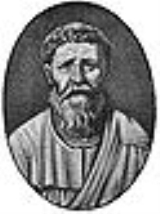
Berber people

Encyclopedia
Berbers are the indigenous people
s of North Africa
west of the Nile Valley. They are continuously distributed from the Atlantic to the Siwa oasis
, in Egypt
, and from the Mediterranean to the Niger River
. Historically they spoke the Berber language or varieties of it, which together form a branch of the Afro-Asiatic
linguistic family. Today, varieties of Maghrebi colloquial Arabic
are spoken by a large portion of Berbers besides the Berber language itself. Foreign languages like French
are used by the educated in Morocco
, Tunisia
and Algeria
. Spanish
is also known by some Berbers in Morocco and in the annexed Western Sahara
and Italian
in Libya
. This presence of European languages was due to Europe's occupation and colonization of the Berber world. Today, most Berber-speaking people live in Morocco
, Algeria
, Tunisia
, Libya
, Western Sahara, Mauritania
, Mali
and Niger
, as well as various diasporas from these countries (particularly in France).
The presence of the Arabic language and dialects is due to the spread of Islam and to the immigration of some Arab tribes to the region centuries ago. A Berber is not necessarily only someone who happens to speak Berber. The Berber identity is usually wider than language and ethnicity, and encompasses the entire history and geography of North Africa. Berbers are not a homogenous ethnic group and encompass a range of phenotype
s, cultures and ancestries. The one unifying force is the Berber language and an identification with the Berber heritage and history.
Many Berbers call themselves some variant of the word Imazighen (singular: Amazigh), possibly meaning "free people" or "free and noble men" (the word has probably an ancient parallel in the Roman name for some of the Berbers, "Mazices").
The best known of the ancient Berbers are the Numidia
n king Masinissa
, the Berber-Roman author Apuleius
, Saint Augustine of Hippo, and the Roman general Lusius Quietus
, who was instrumental in defeating the major wave of Jewish revolts of 115–117
. Famous Berbers of the Middle Ages
include Tariq ibn Ziyad, a general who conquered Hispania
; Abbas Ibn Firnas
, a prolific inventor and early pioneer in aviation; Ibn Battuta
, a medieval explorer who traveled the longest known distances in pre-modern times; and Estevanico
, an early explorer of the Americas. Well-known modern Berbers in Europe include Zinedine Zidane
, a French-born international football star of Algerian Kabyle
descent, and Ibrahim Afellay
, a Dutch-born footballer of Moroccan Riffian
descent.
.
The use of the term Berber spread in the period following the arrival of the Vandals
during their major invasions. A history by a Roman consul in Africa made the first reference of the term "barbarian" to describe Numidia. Muslim historians, some time after, also mentioned the Berbers.
The English term was introduced in the 19th century, replacing the earlier Barbary, a loan from Arabic.
Its ultimate etymological identity with barbarian
is uncertain, but the Arabic word has clearly been treated as identical with Latin barbaria, Byzantine Greek βαρβαρία "land of barbarians" since the Middle Ages.
According to Leo Africanus
, Amazigh meant "free men," though this has been disputed, because there is no root of M-Z-Gh meaning "free" in modern Berber languages. It also has a cognate in the Tuareg word "amajegh," meaning "noble". This term is common in Morocco, especially among Central-Upper-North Morocco Tamazight and Central-Upper-North-South Morocco Sous Tamazight speakers in 1980, but elsewhere within the Berber homeland a local, more particular term, such as Kabyle
or Chaoui
, is more often used instead in Algeria.
The Egyptians, Greeks, Romans, and Byzantines mentioned various tribes with similar names living in Greater "Libya" (North Africa) in the areas where Berbers were later found. Later tribal names differ from the classical sources, but are probably still related to the modern Amazigh. The Meshwesh
tribe among them represents the first thus identified from the field. Scholars believe it would be the same tribe called a few centuries after in Greek Mazyes by Hektaios and Maxyes by Herodotus
, while it was called after that the "Mazaces" and "Mazax" in Latin sources, and related to the later Massylii
and Masaesyli
. All those names are similar and perhaps foreign renditions to the name used by the Berbers in general for themselves, Imazighen.
 Northern African cave paintings, dating back 12 000 years, have been found at Tadrart Acacus
in Libya
. A Neolithic
culture, marked by animal domestication
and subsistence agriculture
, developed in the Saharan and Mediterranean region (the Maghreb) of northern Africa between 6000 B.C and 2000 B.C. This type of life, richly depicted in the Tassili n'Ajjer
cave paintings of southeastern Algeria
, predominated in the Maghreb until the classical period. The proto-Berbers lacked a written language and so have tended to be overlooked by written historical accounts.
The modern Berbers are assumed to be descended from the tribes of Ancient Libya
which are mentioned in records of Ancient Egypt
. During the New Kingdom
, the Egyptians later fought against the Meshwesh
and Libu
tribes on their western borders.
During the pre-Roman era, several successive independent states (Massylii
) existed before the king Masinissa
unified the people of Numidia
.
(displacing earlier populations such as the Azer
and Bafour
), and have in turn been mainly culturally assimilated in much of North Africa by Arab
s, particularly following the incursion of the Banu Hilal
in the 11th century.
The areas of North Africa which retained the Berber language and traditions have, in general, been the highlands of Kabylie, Aures (in Arris, T'kout) and Morocco, most of which in Roman and Ottoman times remained largely independent the Ottoman did penetrate the Kabylie area resulting in many of the Turkish culture can be seen in the food, clothes and music, and where the Phoenicians never penetrated far beyond the coast. These areas have been affected by some of the many invasions of North Africa, most recently that of the French
.
The Afroasiatic phylum probably originated in the mesolithic period, perhaps in the context of the Capsian culture
.
By 5000 BC, the populations of North Africa are an amalgamation of Ibero-Maurisian and Capsian stock blended with a more recent intrusion associated with the Neolithic revolution
.
Out of these populations, the proto-Berber tribes form during the Late Bronze to Early Iron Age.
.
The oldest known Tifinagh
inscription is dated to ca. 200 BC.
Byzantine
authors mention the Mazikes (Amazigh) as tribal people raiding the monasteries of Cyrenaica
.
Roman era Cyrenaica
became a center of Early Christianity
.
Some pre-Islamic Berbers were Christians
(some evolved their own Donatist
doctrine), some were
Jewish
, and some adhered to their traditional polytheist religion
.
Roman era authors of Berber background include Apuleius
and St. Augustine
. There were three African popes of possible Berber ancestry who came from the Roman province of Africa. Pope Victor I
served during the reign of Roman emperor Septimus Severus, who was a North African of Roman/Punic ancestry (perhaps with some Berber blood).
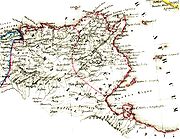 Numidia (202 BC – 46 BC) was an ancient Berber kingdom in present-day Algeria
and part of Tunisia
that later alternated between being a Roman province
and being a Roman client state
. It was located on the eastern border of modern Algeria
, bordered by the Roman province of Mauretania
(in modern day Algeria
and Morocco
) to the west, the Roman province of Africa (modern day Tunisia
) to the east, the Mediterranean Sea
to the north, and the Sahara Desert to the south. Its people were the Numidians
.
The name Numidia was first applied by Polybius
and other historians during the third century BC to indicate the territory west of Carthage
, including the entire north of Algeria
as far as the river Mulucha (Muluya), about 100 miles west of Oran
. The Numidians were conceived of as two great tribal groups: the Massylii
in eastern Numidia, and the Masaesyli
in the west.
During the first part of the Second Punic War
, the eastern Massylii under their king Gala
were allied with Carthage, while the western Masaesyli under king Syphax
were allied with Rome. However in 206 BC, the new king of the eastern Massylii, Masinissa
, allied himself with Rome, and Syphax of the Masaesyli switched his allegiance to the Carthaginian side. At the end of the war the victorious Romans gave all of Numidia to Masinissa of the Massylii. At the time of his death in 148 BC, Masinissa's territory extended from Mauretania to the boundary of the Carthaginian territory, and also southeast as far as Cyrenaica
, so that Numidia entirely surrounded Carthage (Appian
, Punica, 106) except towards the sea.
Masinissa was succeeded by his son Micipsa
. When Micipsa died in 118, he was succeeded jointly by his two sons Hiempsal I
and Adherbal
and Masinissa's illegitimate grandson, Jugurtha
, of Berber origin, who was very popular among the Numidians. Hiempsal and Jugurtha quarreled immediately after the death of Micipsa. Jugurtha had Hiempsal killed, which led to open war with Adherbal. After Jugurtha defeated him in open battle, Adherbal fled to Rome for help. The Roman officials, allegedly due to bribes but perhaps more likely because of a desire to quickly end conflict in a profitable client kingdom, settled the fight by dividing Numidia into two parts. Jugurtha was assigned the western half. However, soon after conflict broke out again, leading to the Jugurthine War
between Rome and Numidia.
(110-80 BC), on the Mediterranean coast of north Africa, in western present-day Algeria, and northern present-day Morocco.
, a tribe sent by the Fatimid
s of Egypt to punish the Berber Zirid
dynasty for having abandoned Shiism. The Banu Hilal reduced the Zirids to a few coastal towns, and took over much of the plains; their influx was a major factor in the Arabization of the region, and in the spread of nomadism in areas where agriculture had previously been dominant.
After the Muslim conquest, the Berber tribes of coastal North Africa became almost fully Arabized
. Besides the Arab influence, North African population also saw an influx via the Barbary Slave Trade
of European peoples, with some estimates placing the number of European slaves brought to North Africa during the Ottoman period as high as 1.25 million. Interactions with neighboring Sudanic empires, traders and nomads from other parts of Africa also left impressions upon the Berber people.
According to historians of the Middle Ages, the Berbers were divided into two branches (Botr and Barnès), descended from Mazigh ancestors, who were themselves divided into tribes, and again into sub-tribes. Each region of the Maghreb contained several tribes (e.g. Sanhadja, Houaras, Zenata
, Masmouda, Kutama
, Awarba, Berghwata, etc.). All these tribes had independence and territorial decisions.
Several Berber dynasties emerged during the Middle Ages in the Maghreb, Sudan, Andalusia, Italy, Mali, Niger, Senegal, Egypt and other countries of Africa. Ibn Khaldun
provides a table summarizing the Berber dynasties, listing the dynasties of Zirid
, Banu Ifran
, Maghrawa
, Almoravid, Hammadid
, Almohad
, Merinid, Abdalwadid
, Wattasid
, Meknassa and Hafsid as most notable.
, which was spread by Arabs, was to have pervasive and long-lasting effects on the Maghreb
. The new faith, in its various forms, would penetrate nearly all segments of Berber society, bringing with it armies, learned men, and fervent mystics, and in large part replacing tribal practices and loyalties with new social norms and political idioms.
Nonetheless, the Islamization
and Arabization
of the region was a complicated and lengthy processes. Whereas nomadic Berbers were quick to convert and assist the Arab conquerors, it was not until the 12th century, under the Almohad Dynasty, that the Christian, Jewish and animist communities of the Maghreb became marginalized.
The first Arab military expeditions into the Maghreb, between 642 and 669 CE, resulted in the spread of Islam. These early forays from a base in Egypt
occurred under local initiative rather than under orders from the central caliphate
. But, when the seat of the caliphate moved from Medina to Damascus, the Umayyads (a Muslim dynasty ruling from 661 to 750) recognized that the strategic necessity of dominating the Mediterranean dictated a concerted military effort on the North African front. In 670, therefore, an Arab army under Uqba ibn Nafi
established the town of Qayrawan
about 160 kilometers south of present-day Tunis
and used it as a base for further operations.
Abu al-Muhajir Dinar
, Uqba's successor, pushed westward into Algeria and eventually worked out a modus vivendi with Kusaila
, the ruler of an extensive confederation of Christian Berbers. Kusaila, who had been based in Tlemcen
, became a Muslim and moved his headquarters to Takirwan, near Al Qayrawan.
But this harmony was short-lived. Arab and Berber forces controlled the region in turn until 697. By 711, Umayyad forces helped by Berber converts to Islam had conquered all of North Africa. Governors appointed by the Umayyad caliphs ruled from Kairouan
, capital of the new wilaya (province) of Ifriqiya, which covered Tripolitania
(the western part of present-day Libya), Tunisia
, and eastern Algeria.
The spread of Islam among the Berbers did not guarantee their support for the Arab-dominated caliphate due to the discriminatory attitude of the Arabs. The ruling Arabs alienated the Berbers by taxing them heavily; treating converts as second-class Muslims; and, at worst, by enslaving them. As a result, widespread opposition took the form of open revolt
in 739-40 under the banner of Ibadin Islam. The Ibadin had been fighting Umayyad
rule in the East, and many Berbers were attracted by the sect's seemingly egalitarian precepts.
After the revolt, Ibadin established a number of theocratic tribal kingdoms, most of which had short and troubled histories. But others, like Sijilmasa
and Tlemcen
, which straddled the principal trade routes, proved more viable and prospered. In 750, the Abbasids, who succeeded the Umayyads as Muslim rulers, moved the caliphate to Baghdad and reestablished caliphal authority in Ifriqiya, appointing Ibrahim ibn al Aghlab as governor in Kairouan
. Though nominally serving at the caliph's pleasure, Al Aghlab and his successors, the Aghlabid
s, ruled independently until 909, presiding over a court that became a center for learning and culture.
Just to the west of Aghlabid
lands, Abd ar Rahman ibn Rustam ruled most of the central Maghreb from Tahert
, southwest of Algiers
. The rulers of the Rustamid
imamate, which lasted from 761 to 909, each an Ibadi
imam
, were elected by leading citizens. The imams gained a reputation for honesty, piety, and justice. The court at Tahert
was noted for its support of scholarship in mathematics, astronomy, astrology, theology, & law. But the Rustamid
imams failed, by choice or by neglect, to organize a reliable standing army. This important factor, accompanied by the dynasty's eventual collapse into decadence, opened the way for Tahert's demise under the assault of the Fatimids.
s who invaded the Iberia
in 711 were mainly Berbers, and were led by a Berber, Tariq ibn Ziyad, though under the suzerainty
of the Arab Caliph
of Damascus
Abd al-Malik ibn Marwan and his North African Viceroy, Musa ibn Nusayr. A second mixed army of Arab
s and Berbers came in 712 under Ibn Nusayr himself. They supposedly helped the Umayyad
caliph Abd ar-Rahman I
in Al-Andalus
, because his mother was a Berber. During the Taifa
era, the petty kings came from a variety of ethnic groups; some—for instance the Zirid
kings of Granada
—were of Berber origin. The Taifa period ended when a Berber dynasty—the Almoravids from modern-day Morocco
—took over Al-Andalus
; they were succeeded by the Almohad
dynasty from Morocco
, during which time al-Andalus flourished.
In the power hierarchy, Berbers were situated between the Arabic aristocracy and the Muladi
populace. Ethnic rivalry was one of the most important factors driving Andalusi politics. Berbers made up as much as 20% of the population of the occupied territory.
After the fall of the Caliphate, the Taifa kingdoms of Toledo
, Badajoz
, Málaga
and Granada had Berber rulers.
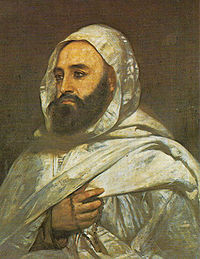 There is an identity-related debate about the persecution of Berbers by the Arab-minded regimes of North Africa. Through both exclusivities of Pan-Arabism
and Islamism, their issue of identity is due to the pan-Arabist ideology of the former Egypt
ian president, Gamal Abdel Nasser
. Some activists have claimed that "It is time—long past overdue—to confront the racist arabization of the Amazigh lands."
Soon after independence in the middle of the 20th century, the countries of North Africa established Arabic
as their official language
, replacing French, Spanish and Italian; although the shift from European colonial languages to Arabic for official purposes continues even to this day. As a result, most Berbers had to study and know Arabic, and had no opportunities until the 21st century to use their mother tongue at school or university. This may have accelerated the existing process of Arabization of Berbers, especially in already bilingual areas, such as among the Chaoui
s of Algeria. Tamazight is now taught in Aures since the march lead by Mr. Salim Yezza in 2004, which has started to the teaching of Tamazight in the schools in Aures.
While Berberism
had its roots before the independence of these countries, it was limited to the Berber elite. It only began to gain success among the greater populace when North African states replaced their European colonial languages with Arabic and identified exclusively as Arab nations, downplaying or ignoring the existence and the cultural specificity of Berbers. However, its distribution remains highly uneven. In response to its demands, Morocco and Algeria have both modified their policies, with Algeria redefining itself constitutionally as an "Arab, Berber, Muslim nation".
Now, Berber is a "national" language in Algeria and is taught in some Berber speaking areas as a non-compulsory language. In Morocco, after the constitutional reforms of 2011, Berber has become an official language, and is now taught as a compulsory language in all schools regardless of the area or the ethnicity.
 Berbers have reached high positions in the social hierarchy across the Maghreb
; good examples are the former president of Algeria, Liamine Zeroual
, and the former prime minister of Morocco, Driss Jettou
.
Nevertheless, Berberists who openly show their political orientations rarely reach high hierarchical positions. But,there are some exceptions; for example, Khalida Toumi
, a feminist and Berberist militant, has been nominated as head of the Ministry of Communication in Algeria.
In the 2011 Libyan civil war
, Berbers in the Nafusa Mountains were quick to revolt against the Gaddafi regime. The mountains became a stronghold of the rebel movement, and were a focal point of the conflict, with much fighting
occurring between rebels and loyalists for control of the region.
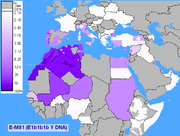 The majority of the Maghreb
today consist of Arab
and Arabized Berber
populations. Usually no clear line can be drawn culturally between Berber, Arabized Berber and Arab people of North Africa.
Regarding the remaining populations that speak a Berber language in the Maghreb
, they account for about half of the Moroccan population and a third of the Algerian, besides smaller communities in Libya
and Tunisia
and very small groups in Egypt
and Mauritania
.
Outside the Maghreb, the Tuareg Berber in Mali
, Niger
and Burkina Faso
number some 600,000; 400,000 and 120,000 respectively.
Prominent Berber groups include the Kabyles of northern Algeria, who number about 4 million and have kept, to a large degree, their original language and culture; and the Shilha or Chleuh (French, from Arabic Shalh and Shilha ašəlḥi) of south Morocco, numbering about 8 million. Other groups include the Riffians
of north Morocco, the Shawiya language of Algeria, and the Tuareg of the Sahara
.
Though stereotyped in the West as nomads, most Berbers were in fact traditionally farmers, living in mountains relatively close to the Mediterranean coast, or oasis dwellers; but the Tuareg and Zenaga of the southern Sahara
were almost wholly nomadic. Some groups, such as the Chaoui
s, practiced transhumance
.
Political tensions have arisen between some Berber groups (especially the Kabyle
) and North African governments over the past few decades, partly over linguistic and cultural issues; for instance, in Libya
and Morocco
, giving children Berber names was banned. The regime of Muammar Gaddafi
in Libya also banned the teaching of Berber languages, and the dictator warned Berber leaders in a 2008 diplomatic cable leaked by WikiLeaks
"You can call yourselves whatever you want inside your homes – Berbers, Children of Satan, whatever – but you are only Libyans when you leave your homes." As a result of the persecution suffered under Gaddafi's rule, many Berbers joined the Libyan opposition in the 2011 Libyan civil war
.
near the Mali
an imperial capital of Timbuktu
.
There are about 2.2 million Berber immigrants in Europe
, especially the Riffians
in the Netherlands
, Belgium
and France
and Kabyles in France
.
 The Berber languages form a branch of Afro-Asiatic
, and thus descend from the proto-Afro-Asiatic language. Linguist Christopher Ehret
specifically suggests identifying the Capsian culture
with speakers of languages ancestral to Berber and/or Chadic
. It is still disputed which branches of Afro-Asiatic are most closely related to Berber, but most linguists accept at least either Semitic
or Chadic as among its closest relatives within the family (see Afro-Asiatic languages.)
There are between 30 and 40 million speakers of Berber languages in Africa
(see population estimation), principally concentrated in Morocco
, Algeria
, Mali
, Niger
, and Libya
, and with smaller communities as far east as Egypt
and as far south as Burkina Faso
.
Their dialects, the Berber languages
, form a branch of the Afroasiatic language family comprising many closely related varieties, including Riff, Kabyle
and Shilha, with a total of roughly 30 million-40 million speakers. A frequently used generic name for all Berber languages is Tamazight, though this may also be used to refer specifically to Central Morocco Tamazight
or Riff.
(Central Algeria), Mozabite
(M'zab
Valley), Chenoui (Warsanis and Mount Chenoua), Tuareg (Sahara
), South Zenatis (South-western Algeria) and Northern Zenatis
(Western Algeria). : Riffians (Northern Morocco), Chleuhs (Southern Morocco), Imazighen -Also known as "Chleuh"- (Central Morocco), Saharan Chleuhs (Eastern Morocco): Tamezret. (Djerbi
and Matmata
): Guanches
: Nafusi (Infusen): Siwi (Isiwiyen), in the Siwa
valley of Egypt
, while the Mozabites of the Saharan Mozabite Valley
are mostly Ibadite. Until the 1960s, there was also an important Jewish Berber community in Morocco, but emigration reduced their number to only a few hundred individuals. Historically, the small minority of remaining Christian Berbers assimilated into French culture and moved to France after independence (with some pied-noir
s being of Berber or part-Berber blood), leaving no more than minuscule numbers in North Africa. However, the Kabyle community in Algeria has decent-sized Christian minorities, both Protestant and Roman Catholic.
and Umayyad
general who led the conquest of Visigothic Hispania
in 711. He is considered to be one of the most important military commanders in Spanish history. He was initially the deputy of Musa ibn Nusair in North Africa, and was sent by his superior to launch the first thrust of an invasion of the Iberian peninsula
. Some claim that he was invited to intervene by the heirs of the Visigothic King, Wittiza
, in the Visigothic civil war.
On April 29, 711, the armies of Tariq landed at Gibraltar
(the name Gibraltar is derived from the Arabic
name Jabal Tariq, which means mountain of Tariq, or the more obvious Gibr Al-Tariq, meaning rock of Tariq). Upon landing, Tariq is said to have burned his ships then made the following speech, well-known in the Muslim world, to his soldiers:
Ziri ibn Manad
(died 971), founder of the Zirid
dynasty in the Maghreb
. Ziri ibn Manad was a clan leader of the Berber Sanhaja
tribe who, as an ally of the Fatimids, defeated the rebellion of Abu Yazid
(943-947). His reward was the governorship of the western provinces, an area that roughly corresponds with modern Algeria
north of the Sahara
.
Yusuf ibn Tashfin
(c. 1061 - 1106) was the Berber Almoravid ruler in North Africa
and Al-Andalus
(Morrish
Iberia
). He took the title of amir al-muslimin (commander of the Muslims) after visiting the Caliph of Baghdad 'amir al-moumineen" ("commander of the faithful") and officially receiving his support. He was either a cousin or nephew of Abu-Bakr Ibn-Umar
, the founder of the Almoravid dynasty. He united all of the Muslim
dominions in the Iberian Peninsula (modern Portugal
and Spain
) to the Kingdom of Morocco (c. 1090), after being called to the Al-Andalus by the Emir
of Seville
.
Alfonso VI was defeated on 23 October 1086, at the battle of Sagrajas, at the hands of Yusuf ibn Tashfin, and Abbad III al-Mu'tamid. Yusuf bin Tashfin is the founder of the famous Moroccan city Marrakech
(in Berber Murakush, corrupted to Morocco in English). He himself chose the place where it was built in 1070 and later made it the capital of his Empire. Until then the Almoravids had been desert nomads, but the new capital marked their settling into a more urban way of life.
Ibn Tumart
(c. 1080 - c. 1130), was a Berber religious
teacher and leader from the Masmuda
tribe who spiritually founded the Almohad dynasty. He is also known as El-Mahdi
(المهدي) in reference to his prophesied redeeming. In 1125 he began open revolt against Almoravid rule. The name "Ibn Tumart" comes from the Berber language and means "son of the earth."
Abu Ya'qub Yusuf (died on 29 July 1184) was the second Almohad
caliph
. He reigned from 1163 until 1184. He had the Giralda
in Seville
built.
Abu Yaqub al-Mustansir Yusuf II
Caliph of Morocco from 1213 until his death. Son of the previous caliph, Muhammad an-Nasir
, Yusuf assumed the throne following his father's death, at the age of only 16 years.
Ibn Battuta
(born 24 February 1304; year of death uncertain, possibly 1368 or 1377) was a Berber Sunni Islam
ic scholar and jurisprudent
from the Maliki
Madhhab
(a school of Fiqh
, or Sunni Islamic law), and at times a Qadi
or judge. However, he is best known as a traveler and explorer
, whose account documents his travels and excursions over a period of almost thirty years, covering some 73,000 miles (117,000 km). These journeys covered almost the entirety of the known Islamic world, extending from present-day West Africa
to Pakistan
, India
, the Maldives
, Sri Lanka
, Southeast Asia
and China
, a distance readily surpassing that of his predecessor, near-contemporary Marco Polo
.
Muhammad al-Jazuli
From the tribe of Jazulah which was settled in the Sus
area of Morocco
between the Atlantic Ocean and the Atlas Mountains. He is most famous for compiling the Dala'il al-Khayrat
, an extremely popular Muslim
prayer book.
Muhammad Awzal
was a religious Berber poet
. He is considered the most important author of the Shilha literary tradition. He was born around 1670 in the village of al-Qasaba in the region of Sous
, Morocco
and died in 1748/9 (1162 of the Egira).
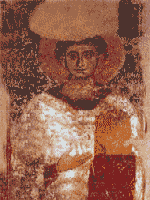
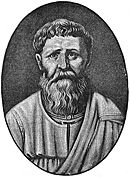 Before the arrival of Islam into the region, most Berber groups were either Christians or animists, and a number of Berber theologians were important figures in the development of western Christianity. In particular, the Berber Donatus Magnus
was the founder of a Christian group known as the Donatist
s. The 4th century Catholic Church viewed the donatists as heretics and the dispute led to a schism in the Church dividing North African Christians.
The Romano-Berber theologian known as Augustine of Hippo
(modern Chaoui city of Annaba
, Algeria), who is recognized as a saint
and a Doctor of the Church
by Roman Catholicism and the Anglican Communion
, was an outspoken opponent of Donatism.
Many believe that Arius
, another early Christian theologian who was deemed a heretic by the Catholic Church, was of Libyan Berber descent.
Another Berber cleric, Saint Adrian of Canterbury
, travelled to England and played a significant role in its early medieval
religious history.
. They migrate by following the natural cycle of grazing
, and seeking water and shelter. They are thus assured with an abundance of wool, cotton and plants used for dyeing. For their part, women look after the family and handicrafts - first for their personal use, and secondly for sale in the souqs in their locality.
The Berber tribes traditionally weave kilim
s. The tapestry
maintains the traditional appearance and distinctiveness of the region of origin of each tribe, which has in effect its own repertoire of drawings. The textile
of plain weave is represented by a wide variety of stripes, and more rarely by geometrical patterns such as triangles and diamonds. Additional decorations such as sequins or fringes, are typical of Berber weave in Morocco
. The nomadic and semi-nomadic lifestyle of the Berbers is very suitable for weaving kilims. The customs and traditions differ from one region to another.
The social structure of the Berbers is tribal. A leader is appointed to command the tribe. In the Middle Ages, many women had the power to govern, such as Kahina
and Tazoughert Fatma in Aurès, Tin Hinan
in Hoggar
, Chemci in Aït Iraten, Fatma Tazoughert in the Aurès. Lalla Fatma N'Soumer
was a Berber woman in Kabylia who fought against the French.
The majority of Berber tribes currently have men as heads of the tribe. In Algeria
, the el Kseur platform
in Kabylia gives tribes the right to fine criminal offenders. In areas of Chaoui
, tribal leaders enact sanctions against criminals. The Tuareg have a king who decides the fate of the tribe and is known as Amenokal
. It is a very hierarchical society. The Mozabites are governed by the spiritual leaders of Ibadism. The Mozabites lead communal lives. During the crisis of Berriane
, the heads of each tribe resolved the problem and began talks to end the crisis between the Maliki
and Ibadite movements. In marriages, the man selects the woman, and depending on the tribe, the family often makes the decision. In comparison, in the Tuareg culture, the woman chooses her future husband. The rites of marriage are different for each tribe. Families are either patriarchal or matriarchal, according to the tribe.
Principal Berber foods are:
Although they are the original inhabitants of North Africa, and in spite of numerous incursions by Phoenicia
ns, Romans
, Byzantine
s, Arab
s, Ottomans and French
, nomadic Berber groups lived in very contained communities. Having been subject to limited external influences, these populations lived free from acculturating
factors.
, the traditional music
of North Africa
, has a wide variety of regional styles. The best known are the Moroccan music
, the popular Gasba
, Kabyle
and Chawi music of Algeria
, and the widespread Tuareg music of Burkina Faso
, Niger
, and Mali
.
The instruments used are the bendir
(large drums) and Gambra (a lute
), which accompanying song
s and dance
s.
Traditional Kabyle music consists of vocalists accompanied by a rhythm
section, consisting of t'bel (tambourine
) and bendir
(frame drum
), and a melody
section, consisting of a ghaita (bagpipe) and ajouag (flute
).
Kabyle music has been popular in France
since the 1930s, when it was played at café
s. As it evolved, Western string instrument
s and Arab music
al conventions, like large backing orchestra
s, were added.
By the time raï, a style of Algerian popular music, became popular in France and elsewhere in Europe, Kabyle artists began using less traditional instruments and formats. Hassen Zermani's all-electric Takfarinas
and Abdelli
's work with Peter Gabriel
's Real World
helped bring Kabyle music to new audiences, while the murder of Matoub Lounes inspired many Kabyles to rally around their popular musicians.
There are three varieties of Berber folk music: village and ritual music, and the music performed by professional musicians.
Village music is performed collectively for dancing, including ahidus and ahouach
dances. Instruments include flute
s and drums
. These dances begin with a chanted prayer. Ritual music is performed at regular ceremonies to celebrate marriage
s and other important life events. Ritual music is also used as protection against evil spirits. Professional musicians (imdyazn) travel in groups of four, led by a poet (amydaz). The amydaz performs improvised poems, often accompanied by drums and rabab (a one-stringed fiddle
), along with a bou oughanim who plays a double clarinet
and acts as a clown
for the group.
The Chleuh
Berbers have professional musicians called rwais who play in ensembles consisting of lute
s, rababs and cymbal
s, with any number of vocalist. The leader, or rayes, leads the choreography
and music of the group. These performances begin with an instrumental astara on rabab, which also gives the notes of the melody
which follows. The next phase is the amarg, or sung poetry, and then ammussu, a danced overture, tammust, an energetic song, aberdag, a dance, and finally the rhythmically swift tabbayt. There is some variation in the presentation of the order, but the astara always begins, and the tabbayt always ends.
Ethnic group
An ethnic group is a group of people whose members identify with each other, through a common heritage, often consisting of a common language, a common culture and/or an ideology that stresses common ancestry or endogamy...
s of North Africa
North Africa
North Africa or Northern Africa is the northernmost region of the African continent, linked by the Sahara to Sub-Saharan Africa. Geopolitically, the United Nations definition of Northern Africa includes eight countries or territories; Algeria, Egypt, Libya, Morocco, South Sudan, Sudan, Tunisia, and...
west of the Nile Valley. They are continuously distributed from the Atlantic to the Siwa oasis
Siwa Oasis
The Siwa Oasis is an oasis in Egypt, located between the Qattara Depression and the Egyptian Sand Sea in the Libyan Desert, nearly 50 km east of the Libyan border, and 560 km from Cairo....
, in Egypt
Egypt
Egypt , officially the Arab Republic of Egypt, Arabic: , is a country mainly in North Africa, with the Sinai Peninsula forming a land bridge in Southwest Asia. Egypt is thus a transcontinental country, and a major power in Africa, the Mediterranean Basin, the Middle East and the Muslim world...
, and from the Mediterranean to the Niger River
Niger River
The Niger River is the principal river of western Africa, extending about . Its drainage basin is in area. Its source is in the Guinea Highlands in southeastern Guinea...
. Historically they spoke the Berber language or varieties of it, which together form a branch of the Afro-Asiatic
Afro-Asiatic languages
The Afroasiatic languages , also known as Hamito-Semitic, constitute one of the world's largest language families, with about 375 living languages...
linguistic family. Today, varieties of Maghrebi colloquial Arabic
Arabic language
Arabic is a name applied to the descendants of the Classical Arabic language of the 6th century AD, used most prominently in the Quran, the Islamic Holy Book...
are spoken by a large portion of Berbers besides the Berber language itself. Foreign languages like French
French language
French is a Romance language spoken as a first language in France, the Romandy region in Switzerland, Wallonia and Brussels in Belgium, Monaco, the regions of Quebec and Acadia in Canada, and by various communities elsewhere. Second-language speakers of French are distributed throughout many parts...
are used by the educated in Morocco
Morocco
Morocco , officially the Kingdom of Morocco , is a country located in North Africa. It has a population of more than 32 million and an area of 710,850 km², and also primarily administers the disputed region of the Western Sahara...
, Tunisia
Tunisia
Tunisia , officially the Tunisian RepublicThe long name of Tunisia in other languages used in the country is: , is the northernmost country in Africa. It is a Maghreb country and is bordered by Algeria to the west, Libya to the southeast, and the Mediterranean Sea to the north and east. Its area...
and Algeria
Algeria
Algeria , officially the People's Democratic Republic of Algeria , also formally referred to as the Democratic and Popular Republic of Algeria, is a country in the Maghreb region of Northwest Africa with Algiers as its capital.In terms of land area, it is the largest country in Africa and the Arab...
. Spanish
Spanish language
Spanish , also known as Castilian , is a Romance language in the Ibero-Romance group that evolved from several languages and dialects in central-northern Iberia around the 9th century and gradually spread with the expansion of the Kingdom of Castile into central and southern Iberia during the...
is also known by some Berbers in Morocco and in the annexed Western Sahara
Western Sahara
Western Sahara is a disputed territory in North Africa, bordered by Morocco to the north, Algeria to the northeast, Mauritania to the east and south, and the Atlantic Ocean to the west. Its surface area amounts to . It is one of the most sparsely populated territories in the world, mainly...
and Italian
Italian language
Italian is a Romance language spoken mainly in Europe: Italy, Switzerland, San Marino, Vatican City, by minorities in Malta, Monaco, Croatia, Slovenia, France, Libya, Eritrea, and Somalia, and by immigrant communities in the Americas and Australia...
in Libya
Libya
Libya is an African country in the Maghreb region of North Africa bordered by the Mediterranean Sea to the north, Egypt to the east, Sudan to the southeast, Chad and Niger to the south, and Algeria and Tunisia to the west....
. This presence of European languages was due to Europe's occupation and colonization of the Berber world. Today, most Berber-speaking people live in Morocco
Morocco
Morocco , officially the Kingdom of Morocco , is a country located in North Africa. It has a population of more than 32 million and an area of 710,850 km², and also primarily administers the disputed region of the Western Sahara...
, Algeria
Algeria
Algeria , officially the People's Democratic Republic of Algeria , also formally referred to as the Democratic and Popular Republic of Algeria, is a country in the Maghreb region of Northwest Africa with Algiers as its capital.In terms of land area, it is the largest country in Africa and the Arab...
, Tunisia
Tunisia
Tunisia , officially the Tunisian RepublicThe long name of Tunisia in other languages used in the country is: , is the northernmost country in Africa. It is a Maghreb country and is bordered by Algeria to the west, Libya to the southeast, and the Mediterranean Sea to the north and east. Its area...
, Libya
Libya
Libya is an African country in the Maghreb region of North Africa bordered by the Mediterranean Sea to the north, Egypt to the east, Sudan to the southeast, Chad and Niger to the south, and Algeria and Tunisia to the west....
, Western Sahara, Mauritania
Mauritania
Mauritania is a country in the Maghreb and West Africa. It is bordered by the Atlantic Ocean in the west, by Western Sahara in the north, by Algeria in the northeast, by Mali in the east and southeast, and by Senegal in the southwest...
, Mali
Mali
Mali , officially the Republic of Mali , is a landlocked country in Western Africa. Mali borders Algeria on the north, Niger on the east, Burkina Faso and the Côte d'Ivoire on the south, Guinea on the south-west, and Senegal and Mauritania on the west. Its size is just over 1,240,000 km² with...
and Niger
Niger
Niger , officially named the Republic of Niger, is a landlocked country in Western Africa, named after the Niger River. It borders Nigeria and Benin to the south, Burkina Faso and Mali to the west, Algeria and Libya to the north and Chad to the east...
, as well as various diasporas from these countries (particularly in France).
The presence of the Arabic language and dialects is due to the spread of Islam and to the immigration of some Arab tribes to the region centuries ago. A Berber is not necessarily only someone who happens to speak Berber. The Berber identity is usually wider than language and ethnicity, and encompasses the entire history and geography of North Africa. Berbers are not a homogenous ethnic group and encompass a range of phenotype
Phenotype
A phenotype is an organism's observable characteristics or traits: such as its morphology, development, biochemical or physiological properties, behavior, and products of behavior...
s, cultures and ancestries. The one unifying force is the Berber language and an identification with the Berber heritage and history.
Many Berbers call themselves some variant of the word Imazighen (singular: Amazigh), possibly meaning "free people" or "free and noble men" (the word has probably an ancient parallel in the Roman name for some of the Berbers, "Mazices").
The best known of the ancient Berbers are the Numidia
Numidia
Numidia was an ancient Berber kingdom in part of present-day Eastern Algeria and Western Tunisia in North Africa. It is known today as the Chawi-land, the land of the Chawi people , the direct descendants of the historical Numidians or the Massyles The kingdom began as a sovereign state and later...
n king Masinissa
Masinissa
Masinissa — also spelled Massinissa and Massena — was the first King of Numidia, an ancient North African nation of ancient Libyan tribes. As a successful general, Masinissa fought in the Second Punic War , first against the Romans as an ally of Carthage an later switching sides when he saw which...
, the Berber-Roman author Apuleius
Apuleius
Apuleius was a Latin prose writer. He was a Berber, from Madaurus . He studied Platonist philosophy in Athens; travelled to Italy, Asia Minor and Egypt; and was an initiate in several cults or mysteries. The most famous incident in his life was when he was accused of using magic to gain the...
, Saint Augustine of Hippo, and the Roman general Lusius Quietus
Lusius Quietus
thumb|300px|Stylised Moorish Cavalry under Lusius Quietus, fighting against the Dacians. From the Column of Trajan.Lusius Quietus was a Roman general and governor of Iudaea in 117.- Life :...
, who was instrumental in defeating the major wave of Jewish revolts of 115–117
Kitos War
The Kitos War , translation: Rebellion of the exile) is the name given to the second of the Jewish–Roman wars. Major revolts by diasporic Jews in Cyrene , Cyprus, Mesopotamia and Aegyptus spiraled out of control resulting in a widespread slaughter of Roman citizens and others by the Jewish rebels...
. Famous Berbers of the Middle Ages
Middle Ages
The Middle Ages is a periodization of European history from the 5th century to the 15th century. The Middle Ages follows the fall of the Western Roman Empire in 476 and precedes the Early Modern Era. It is the middle period of a three-period division of Western history: Classic, Medieval and Modern...
include Tariq ibn Ziyad, a general who conquered Hispania
Umayyad conquest of Hispania
The Umayyad conquest of Hispania is the initial Islamic Ummayad Caliphate's conquest, between 711 and 718, of the Christian Visigothic Kingdom of Hispania, centered in the Iberian Peninsula, which was known to them under the Arabic name al-Andalus....
; Abbas Ibn Firnas
Abbas Ibn Firnas
Abbas Ibn Firnas , also known as Abbas Qasim Ibn Firnas and عباس بن فرناس , was a Muslim Andalusian polymath: an inventor, engineer, aviator, physician, Arabic poet, and Andalusian musician. Of Berber descent, he was born in Izn-Rand Onda, Al-Andalus , and lived in the Emirate of Córdoba...
, a prolific inventor and early pioneer in aviation; Ibn Battuta
Ibn Battuta
Abu Abdullah Muhammad Ibn Battuta , or simply Ibn Battuta, also known as Shams ad–Din , was a Muslim Moroccan Berber explorer, known for his extensive travels published in the Rihla...
, a medieval explorer who traveled the longest known distances in pre-modern times; and Estevanico
Estevanico
Estevanico , "Black Stephen", "Esteban", "Esteban the Moor", "Estevan", "Estebanico", "Stephen the Black", "Stephen the Moor", "Stephen Dorantes" after his owner Andres Dorantes, and "Little Stephen") was the first known person born in Africa to have arrived in the present-day continental United...
, an early explorer of the Americas. Well-known modern Berbers in Europe include Zinedine Zidane
Zinedine Zidane
Zinedine Yazid Zidane is a retired French footballer. He is widely regarded as one of the greatest players of all time. Zidane was a leading figure of a generation of French players that won the 1998 World Cup and 2000 European Championship...
, a French-born international football star of Algerian Kabyle
Kabyle
Kabyle may refer to:* Kabyle people, an ethnic group in Algeria* Kabyle language* Kabyle alphabet, also known as Berber Latin alphabet* the Kabyle ethnic homeland, a region called Kabylie in French...
descent, and Ibrahim Afellay
Ibrahim Afellay
Ibrahim Afellay is a Dutch professional footballer who plays for FC Barcelona as an attacking midfielder or winger.He has played for the Dutch national youth team and is now part of the senior Dutch national team, which he represented at UEFA Euro 2008 and the 2010 FIFA World Cup, the latter of...
, a Dutch-born footballer of Moroccan Riffian
Riffian
Riffian is a comune in South Tyrol in the Italian region Trentino-Alto Adige/Südtirol, located about 70 km north of Trento and about 25 km northwest of Bolzano.-Territory:...
descent.
Name
The name Berber appeared for the first time after the end of the Roman EmpireRoman Empire
The Roman Empire was the post-Republican period of the ancient Roman civilization, characterised by an autocratic form of government and large territorial holdings in Europe and around the Mediterranean....
.
The use of the term Berber spread in the period following the arrival of the Vandals
Vandals
The Vandals were an East Germanic tribe that entered the late Roman Empire during the 5th century. The Vandals under king Genseric entered Africa in 429 and by 439 established a kingdom which included the Roman Africa province, besides the islands of Sicily, Corsica, Sardinia and the Balearics....
during their major invasions. A history by a Roman consul in Africa made the first reference of the term "barbarian" to describe Numidia. Muslim historians, some time after, also mentioned the Berbers.
The English term was introduced in the 19th century, replacing the earlier Barbary, a loan from Arabic.
Its ultimate etymological identity with barbarian
Barbarian
Barbarian and savage are terms used to refer to a person who is perceived to be uncivilized. The word is often used either in a general reference to a member of a nation or ethnos, typically a tribal society as seen by an urban civilization either viewed as inferior, or admired as a noble savage...
is uncertain, but the Arabic word has clearly been treated as identical with Latin barbaria, Byzantine Greek βαρβαρία "land of barbarians" since the Middle Ages.
According to Leo Africanus
Leo Africanus
Joannes Leo Africanus, was a Moorish diplomat and author who is best known for his book Descrittione dell’Africa describing the geography of North Africa.-Biography:Most of what is known about his life is gathered from autobiographical...
, Amazigh meant "free men," though this has been disputed, because there is no root of M-Z-Gh meaning "free" in modern Berber languages. It also has a cognate in the Tuareg word "amajegh," meaning "noble". This term is common in Morocco, especially among Central-Upper-North Morocco Tamazight and Central-Upper-North-South Morocco Sous Tamazight speakers in 1980, but elsewhere within the Berber homeland a local, more particular term, such as Kabyle
Kabyle people
The Kabyle people are the largest homogeneous Algerian ethno-cultural and linguistical community and the largest nation in North Africa to be considered exclusively Berber. Their traditional homeland is Kabylie in the north of Algeria, one hundred miles east of Algiers...
or Chaoui
Chaoui
The Shawia people, or Chaouis are a Berber people who live mainly in the Aurès, Nememcha and Belezma Region in the Aurès Mountains, a large part of eastern Algeria known in ancient times as Numidia...
, is more often used instead in Algeria.
The Egyptians, Greeks, Romans, and Byzantines mentioned various tribes with similar names living in Greater "Libya" (North Africa) in the areas where Berbers were later found. Later tribal names differ from the classical sources, but are probably still related to the modern Amazigh. The Meshwesh
Meshwesh
The Meshwesh were an ancient Libyan tribe from beyond Cyrenaica where the Libu and Tehenu lived according to Egyptian references and who were probably of Central Berber ethnicity. Herodotus placed them in Tunisia and said of them to be sedentary farmers living in settled permanent houses as the...
tribe among them represents the first thus identified from the field. Scholars believe it would be the same tribe called a few centuries after in Greek Mazyes by Hektaios and Maxyes by Herodotus
Herodotus
Herodotus was an ancient Greek historian who was born in Halicarnassus, Caria and lived in the 5th century BC . He has been called the "Father of History", and was the first historian known to collect his materials systematically, test their accuracy to a certain extent and arrange them in a...
, while it was called after that the "Mazaces" and "Mazax" in Latin sources, and related to the later Massylii
Massylii
The Massylii or Maesulians were a Berber federation of tribes of eastern Numidia which was formed by an amalgamation of smaller tribes during the 4th century BC. They were ruled by a king. On their loosely defined western frontier was the powerful rival the kingdom of the Masaesyli. To their east...
and Masaesyli
Masaesyli
The Masaesyli were a North African tribe of western Numidia and the main antagonists of the Massylii in eastern Numidia.During the Second Punic War the Masaesyli initially supported the Roman Republic and were led by Syphax against the Massyllii, who were led by Massinissa...
. All those names are similar and perhaps foreign renditions to the name used by the Berbers in general for themselves, Imazighen.
Prehistory
Tadrart Acacus
The Acacus Mountains or Tadrart Acacus form a mountain range in the desert of the of the Ghat District in western Libya, part of the Sahara. They are situated east of the Libyan city of Ghat and stretch north from the Algerian border about 100 km. Tadrart means 'mountain' in the native...
in Libya
Libya
Libya is an African country in the Maghreb region of North Africa bordered by the Mediterranean Sea to the north, Egypt to the east, Sudan to the southeast, Chad and Niger to the south, and Algeria and Tunisia to the west....
. A Neolithic
Neolithic
The Neolithic Age, Era, or Period, or New Stone Age, was a period in the development of human technology, beginning about 9500 BC in some parts of the Middle East, and later in other parts of the world. It is traditionally considered as the last part of the Stone Age...
culture, marked by animal domestication
Domestication
Domestication or taming is the process whereby a population of animals or plants, through a process of selection, becomes accustomed to human provision and control. In the Convention on Biological Diversity a domesticated species is defined as a 'species in which the evolutionary process has been...
and subsistence agriculture
Subsistence agriculture
Subsistence agriculture is self-sufficiency farming in which the farmers focus on growing enough food to feed their families. The typical subsistence farm has a range of crops and animals needed by the family to eat and clothe themselves during the year. Planting decisions are made with an eye...
, developed in the Saharan and Mediterranean region (the Maghreb) of northern Africa between 6000 B.C and 2000 B.C. This type of life, richly depicted in the Tassili n'Ajjer
Tassili n'Ajjer
Tassili n'Ajjer is a mountain range in the Algerian section of the Sahara Desert. It is a vast plateau in south-east Algeria at the borders of Libya, Niger and Mali, covering an area of 72,000 sq...
cave paintings of southeastern Algeria
Algeria
Algeria , officially the People's Democratic Republic of Algeria , also formally referred to as the Democratic and Popular Republic of Algeria, is a country in the Maghreb region of Northwest Africa with Algiers as its capital.In terms of land area, it is the largest country in Africa and the Arab...
, predominated in the Maghreb until the classical period. The proto-Berbers lacked a written language and so have tended to be overlooked by written historical accounts.
The modern Berbers are assumed to be descended from the tribes of Ancient Libya
Ancient Libya
The Latin name Libya referred to the region west of the Nile Valley, generally corresponding to modern Northwest Africa. Climate changes affected the locations of the settlements....
which are mentioned in records of Ancient Egypt
Ancient Egypt
Ancient Egypt was an ancient civilization of Northeastern Africa, concentrated along the lower reaches of the Nile River in what is now the modern country of Egypt. Egyptian civilization coalesced around 3150 BC with the political unification of Upper and Lower Egypt under the first pharaoh...
. During the New Kingdom
New Kingdom
The New Kingdom of Egypt, also referred to as the Egyptian Empire is the period in ancient Egyptian history between the 16th century BC and the 11th century BC, covering the Eighteenth, Nineteenth, and Twentieth Dynasties of Egypt....
, the Egyptians later fought against the Meshwesh
Meshwesh
The Meshwesh were an ancient Libyan tribe from beyond Cyrenaica where the Libu and Tehenu lived according to Egyptian references and who were probably of Central Berber ethnicity. Herodotus placed them in Tunisia and said of them to be sedentary farmers living in settled permanent houses as the...
and Libu
Libu
The Libu were an ancient Berber tribe, from which the name Libya derives....
tribes on their western borders.
During the pre-Roman era, several successive independent states (Massylii
Massylii
The Massylii or Maesulians were a Berber federation of tribes of eastern Numidia which was formed by an amalgamation of smaller tribes during the 4th century BC. They were ruled by a king. On their loosely defined western frontier was the powerful rival the kingdom of the Masaesyli. To their east...
) existed before the king Masinissa
Masinissa
Masinissa — also spelled Massinissa and Massena — was the first King of Numidia, an ancient North African nation of ancient Libyan tribes. As a successful general, Masinissa fought in the Second Punic War , first against the Romans as an ally of Carthage an later switching sides when he saw which...
unified the people of Numidia
Numidia
Numidia was an ancient Berber kingdom in part of present-day Eastern Algeria and Western Tunisia in North Africa. It is known today as the Chawi-land, the land of the Chawi people , the direct descendants of the historical Numidians or the Massyles The kingdom began as a sovereign state and later...
.
History
In historical times, the Berbers expanded south into the SaharaSahara
The Sahara is the world's second largest desert, after Antarctica. At over , it covers most of Northern Africa, making it almost as large as Europe or the United States. The Sahara stretches from the Red Sea, including parts of the Mediterranean coasts, to the outskirts of the Atlantic Ocean...
(displacing earlier populations such as the Azer
Azer
Azer may refer to:*Azerbaijani *Azer, the Soninke people of western Africa*Azer , a race from a plane of fire in Dungeons & Dragons*Azer , a character in PangYa...
and Bafour
Bafour
The Bafours were the original inhabitants of Mauritania, and the ancestors of the Imraguen and Soninke peoples of western Africa. They were primarily agriculturalist and agro-pastoralists, and were relatively stationary. At the time they lived in Mauritania, it was far more fertile than it is...
), and have in turn been mainly culturally assimilated in much of North Africa by Arab
Arab
Arab people, also known as Arabs , are a panethnicity primarily living in the Arab world, which is located in Western Asia and North Africa. They are identified as such on one or more of genealogical, linguistic, or cultural grounds, with tribal affiliations, and intra-tribal relationships playing...
s, particularly following the incursion of the Banu Hilal
Banu Hilal
The Banu Hilal were a confederation of Arabian Bedouin tribes that migrated from Upper Egypt into North Africa in the 11th century, having been sent by the Fatimids to punish the Zirids for abandoning Shiism. Other authors suggest that the tribes left the grasslands on the upper Nile because of...
in the 11th century.
The areas of North Africa which retained the Berber language and traditions have, in general, been the highlands of Kabylie, Aures (in Arris, T'kout) and Morocco, most of which in Roman and Ottoman times remained largely independent the Ottoman did penetrate the Kabylie area resulting in many of the Turkish culture can be seen in the food, clothes and music, and where the Phoenicians never penetrated far beyond the coast. These areas have been affected by some of the many invasions of North Africa, most recently that of the French
France
The French Republic , The French Republic , The French Republic , (commonly known as France , is a unitary semi-presidential republic in Western Europe with several overseas territories and islands located on other continents and in the Indian, Pacific, and Atlantic oceans. Metropolitan France...
.
Origins
The prehistoric populations of North Africa are related to the wider group of Paleo-Mediterranean peoples.The Afroasiatic phylum probably originated in the mesolithic period, perhaps in the context of the Capsian culture
Capsian culture
The Capsian culture was a Mesolithic culture of the Maghreb, which lasted from about 10,000 to 6,000 BCE.It was concentrated mainly in modern Tunisia, and Algeria, with some sites attested in southern Spain to Sicily....
.
By 5000 BC, the populations of North Africa are an amalgamation of Ibero-Maurisian and Capsian stock blended with a more recent intrusion associated with the Neolithic revolution
Neolithic Revolution
The Neolithic Revolution was the first agricultural revolution. It was the transition from hunting and gathering to agriculture and settlement. Archaeological data indicates that various forms of plants and animal domestication evolved independently in 6 separate locations worldwide circa...
.
Out of these populations, the proto-Berber tribes form during the Late Bronze to Early Iron Age.
Antiquity
The Berbers enter historicity gradually during the Roman eraRoman Libya
The area of North Africa which has been known as Libya since 1911 was under Roman domination between 146 BC and 670 AD.The Latin name Libya at the time referred to the continent of Africa in general....
.
The oldest known Tifinagh
Tifinagh
Tifinagh is a series of abjad and alphabetic scripts used by some Berber peoples, notably the Tuareg, to write their language.A modern derivate of the traditional script, known as Neo-Tifinagh, was introduced in the 20th century...
inscription is dated to ca. 200 BC.
Byzantine
Byzantine Empire
The Byzantine Empire was the Eastern Roman Empire during the periods of Late Antiquity and the Middle Ages, centred on the capital of Constantinople. Known simply as the Roman Empire or Romania to its inhabitants and neighbours, the Empire was the direct continuation of the Ancient Roman State...
authors mention the Mazikes (Amazigh) as tribal people raiding the monasteries of Cyrenaica
Cyrenaica
Cyrenaica is the eastern coastal region of Libya.Also known as Pentapolis in antiquity, it was part of the Creta et Cyrenaica province during the Roman period, later divided in Libia Pentapolis and Libia Sicca...
.
Roman era Cyrenaica
Cyrenaica
Cyrenaica is the eastern coastal region of Libya.Also known as Pentapolis in antiquity, it was part of the Creta et Cyrenaica province during the Roman period, later divided in Libia Pentapolis and Libia Sicca...
became a center of Early Christianity
Early Christianity
Early Christianity is generally considered as Christianity before 325. The New Testament's Book of Acts and Epistle to the Galatians records that the first Christian community was centered in Jerusalem and its leaders included James, Peter and John....
.
Some pre-Islamic Berbers were Christians
Early African Church
The name Early African Church is given to the Christian communities inhabiting the region known politically as Roman Africa, and comprised geographically within the following limits, namely: the Mediterranean littoral between Cyrenaica on the east and the river Ampsaga on the west; that part of it...
(some evolved their own Donatist
Donatist
Donatism was a Christian sect within the Roman province of Africa that flourished in the fourth and fifth centuries. It had its roots in the social pressures among the long-established Christian community of Roman North Africa , during the persecutions of Christians under Diocletian...
doctrine), some were
Jewish
Berber Jews
Berber Jews are the Berber-speaking Jewish communities which used to live in certain parts of Atlas mountains in Morocco. Their origins are not clear as one theory builds the case for "Judeo-cized Berbers" while another defends the "Berber-ized Jews" thesis....
, and some adhered to their traditional polytheist religion
Berber mythology
The traditional Berber mythology is the ancient and native set of beliefs and deities developed by the Berber people in their historical land of North Africa...
.
Roman era authors of Berber background include Apuleius
Apuleius
Apuleius was a Latin prose writer. He was a Berber, from Madaurus . He studied Platonist philosophy in Athens; travelled to Italy, Asia Minor and Egypt; and was an initiate in several cults or mysteries. The most famous incident in his life was when he was accused of using magic to gain the...
and St. Augustine
Augustine of Hippo
Augustine of Hippo , also known as Augustine, St. Augustine, St. Austin, St. Augoustinos, Blessed Augustine, or St. Augustine the Blessed, was Bishop of Hippo Regius . He was a Latin-speaking philosopher and theologian who lived in the Roman Africa Province...
. There were three African popes of possible Berber ancestry who came from the Roman province of Africa. Pope Victor I
Pope Victor I
Pope Saint Victor I was Pope from 189 to 199 .Pope Victor I was the first bishop of Rome born in the Roman Province of Africa: probably he was born in Leptis Magna . He was later canonized...
served during the reign of Roman emperor Septimus Severus, who was a North African of Roman/Punic ancestry (perhaps with some Berber blood).
Numidia
Algeria
Algeria , officially the People's Democratic Republic of Algeria , also formally referred to as the Democratic and Popular Republic of Algeria, is a country in the Maghreb region of Northwest Africa with Algiers as its capital.In terms of land area, it is the largest country in Africa and the Arab...
and part of Tunisia
Tunisia
Tunisia , officially the Tunisian RepublicThe long name of Tunisia in other languages used in the country is: , is the northernmost country in Africa. It is a Maghreb country and is bordered by Algeria to the west, Libya to the southeast, and the Mediterranean Sea to the north and east. Its area...
that later alternated between being a Roman province
Roman province
In Ancient Rome, a province was the basic, and, until the Tetrarchy , largest territorial and administrative unit of the empire's territorial possessions outside of Italy...
and being a Roman client state
Client state
Client state is one of several terms used to describe the economic, political and/or military subordination of one state to a more powerful state in international affairs...
. It was located on the eastern border of modern Algeria
Algeria
Algeria , officially the People's Democratic Republic of Algeria , also formally referred to as the Democratic and Popular Republic of Algeria, is a country in the Maghreb region of Northwest Africa with Algiers as its capital.In terms of land area, it is the largest country in Africa and the Arab...
, bordered by the Roman province of Mauretania
Mauretania
Mauretania is a part of the historical Ancient Libyan land in North Africa. It corresponds to present day Morocco and a part of western Algeria...
(in modern day Algeria
Algeria
Algeria , officially the People's Democratic Republic of Algeria , also formally referred to as the Democratic and Popular Republic of Algeria, is a country in the Maghreb region of Northwest Africa with Algiers as its capital.In terms of land area, it is the largest country in Africa and the Arab...
and Morocco
Morocco
Morocco , officially the Kingdom of Morocco , is a country located in North Africa. It has a population of more than 32 million and an area of 710,850 km², and also primarily administers the disputed region of the Western Sahara...
) to the west, the Roman province of Africa (modern day Tunisia
Tunisia
Tunisia , officially the Tunisian RepublicThe long name of Tunisia in other languages used in the country is: , is the northernmost country in Africa. It is a Maghreb country and is bordered by Algeria to the west, Libya to the southeast, and the Mediterranean Sea to the north and east. Its area...
) to the east, the Mediterranean Sea
Mediterranean Sea
The Mediterranean Sea is a sea connected to the Atlantic Ocean surrounded by the Mediterranean region and almost completely enclosed by land: on the north by Anatolia and Europe, on the south by North Africa, and on the east by the Levant...
to the north, and the Sahara Desert to the south. Its people were the Numidians
Numidians
The Numidians were Berber tribes who lived in Numidia, in Algeria east of Constantine and in part of Tunisia. The Numidians were one of the earliest natives to trade with the settlers of Carthage. As Carthage grew, the relationship with the Numidians blossomed. Carthage's military used the Numidian...
.
The name Numidia was first applied by Polybius
Polybius
Polybius , Greek ) was a Greek historian of the Hellenistic Period noted for his work, The Histories, which covered the period of 220–146 BC in detail. The work describes in part the rise of the Roman Republic and its gradual domination over Greece...
and other historians during the third century BC to indicate the territory west of Carthage
Carthage
Carthage , implying it was a 'new Tyre') is a major urban centre that has existed for nearly 3,000 years on the Gulf of Tunis, developing from a Phoenician colony of the 1st millennium BC...
, including the entire north of Algeria
Algeria
Algeria , officially the People's Democratic Republic of Algeria , also formally referred to as the Democratic and Popular Republic of Algeria, is a country in the Maghreb region of Northwest Africa with Algiers as its capital.In terms of land area, it is the largest country in Africa and the Arab...
as far as the river Mulucha (Muluya), about 100 miles west of Oran
Oran
Oran is a major city on the northwestern Mediterranean coast of Algeria, and the second largest city of the country.It is the capital of the Oran Province . The city has a population of 759,645 , while the metropolitan area has a population of approximately 1,500,000, making it the second largest...
. The Numidians were conceived of as two great tribal groups: the Massylii
Massylii
The Massylii or Maesulians were a Berber federation of tribes of eastern Numidia which was formed by an amalgamation of smaller tribes during the 4th century BC. They were ruled by a king. On their loosely defined western frontier was the powerful rival the kingdom of the Masaesyli. To their east...
in eastern Numidia, and the Masaesyli
Masaesyli
The Masaesyli were a North African tribe of western Numidia and the main antagonists of the Massylii in eastern Numidia.During the Second Punic War the Masaesyli initially supported the Roman Republic and were led by Syphax against the Massyllii, who were led by Massinissa...
in the west.
During the first part of the Second Punic War
Second Punic War
The Second Punic War, also referred to as The Hannibalic War and The War Against Hannibal, lasted from 218 to 201 BC and involved combatants in the western and eastern Mediterranean. This was the second major war between Carthage and the Roman Republic, with the participation of the Berbers on...
, the eastern Massylii under their king Gala
Gala (King of the Massylii)
King Gala was a Berber king of the Massylii, an eastern Numidian tribe in the Ancient Algerian Maghreb of North Africa.Gala reigned during the Second Punic War of ancient Rome. He was the father of King Masinissa, and the brother of Oezalces....
were allied with Carthage, while the western Masaesyli under king Syphax
Syphax
Syphax was a king of the ancient Algerian tribe Masaesyli of western Numidia during the last quarter of the 3rd century BC. His story is told in Livy's Ab Urbe Condita .-Biography:...
were allied with Rome. However in 206 BC, the new king of the eastern Massylii, Masinissa
Masinissa
Masinissa — also spelled Massinissa and Massena — was the first King of Numidia, an ancient North African nation of ancient Libyan tribes. As a successful general, Masinissa fought in the Second Punic War , first against the Romans as an ally of Carthage an later switching sides when he saw which...
, allied himself with Rome, and Syphax of the Masaesyli switched his allegiance to the Carthaginian side. At the end of the war the victorious Romans gave all of Numidia to Masinissa of the Massylii. At the time of his death in 148 BC, Masinissa's territory extended from Mauretania to the boundary of the Carthaginian territory, and also southeast as far as Cyrenaica
Cyrenaica
Cyrenaica is the eastern coastal region of Libya.Also known as Pentapolis in antiquity, it was part of the Creta et Cyrenaica province during the Roman period, later divided in Libia Pentapolis and Libia Sicca...
, so that Numidia entirely surrounded Carthage (Appian
Appian
Appian of Alexandria was a Roman historian of Greek ethnicity who flourished during the reigns of Trajan, Hadrian, and Antoninus Pius.He was born ca. 95 in Alexandria. He tells us that, after having filled the chief offices in the province of Egypt, he went to Rome ca. 120, where he practised as...
, Punica, 106) except towards the sea.
Masinissa was succeeded by his son Micipsa
Micipsa
Micipsa was the eldest legitimate son of Masinissa, the King of Numidia, in the Ancient Algerian Maghreb of North Africa. He became the King of Numidia.-Early life:...
. When Micipsa died in 118, he was succeeded jointly by his two sons Hiempsal I
Hiempsal I
Hiempsal I, son of Micipsa and grandson of Masinissa, was a king of Numidia in the late 2nd century BC.Micipsa, on his deathbed, left his two sons, Adherbal and Hiempsal, together with his cousin, Jugurtha, joint heirs of his kingdom...
and Adherbal
Adherbal
Adherbal, son of Micipsa and grandson of Masinissa, was a king of Numidia between 118 BC and 112 BC. He inherited the throne after the death of his father, and ruled jointly with his younger brother Hiempsal, and Jugurtha, the nephew of Masinissa...
and Masinissa's illegitimate grandson, Jugurtha
Jugurtha
Jugurtha or Jugurthen was a King of Numidia, , born in Cirta .-Background:Until the reign of Jugurtha's grandfather Masinissa, the people of Numidia were semi-nomadic and indistinguishable from the other Libyans in North Africa...
, of Berber origin, who was very popular among the Numidians. Hiempsal and Jugurtha quarreled immediately after the death of Micipsa. Jugurtha had Hiempsal killed, which led to open war with Adherbal. After Jugurtha defeated him in open battle, Adherbal fled to Rome for help. The Roman officials, allegedly due to bribes but perhaps more likely because of a desire to quickly end conflict in a profitable client kingdom, settled the fight by dividing Numidia into two parts. Jugurtha was assigned the western half. However, soon after conflict broke out again, leading to the Jugurthine War
Jugurthine War
The Jugurthine War takes its name from the Berber king Jugurtha , nephew and later adopted son of Micipsa, King of Numidia.-Jugurtha and Numidia:...
between Rome and Numidia.
Mauretania
In antiquity, Mauretania was originally an independent Berber kingdom, under king Bocchus IBocchus I
Bocchus was a king of Mauretania about 110 BC and designated by historians as Bocchus I. He was also the father-in-law of Jugurtha, with whom he made war against the Romans. He delivered Jugurtha to the Romans in 106 BC....
(110-80 BC), on the Mediterranean coast of north Africa, in western present-day Algeria, and northern present-day Morocco.
Middle Ages
Before the 11th century, most of Northwest Africa was a Berber-speaking Muslim area. The process of Arabization only became a major factor with the arrival of the Banu HilalBanu Hilal
The Banu Hilal were a confederation of Arabian Bedouin tribes that migrated from Upper Egypt into North Africa in the 11th century, having been sent by the Fatimids to punish the Zirids for abandoning Shiism. Other authors suggest that the tribes left the grasslands on the upper Nile because of...
, a tribe sent by the Fatimid
Fatimid
The Fatimid Islamic Caliphate or al-Fāṭimiyyūn was a Berber Shia Muslim caliphate first centered in Tunisia and later in Egypt that ruled over varying areas of the Maghreb, Sudan, Sicily, the Levant, and Hijaz from 5 January 909 to 1171.The caliphate was ruled by the Fatimids, who established the...
s of Egypt to punish the Berber Zirid
Zirid
The Zirid dynasty were a Sanhadja Berber dynasty, originating in modern Algeria, initially on behalf of the Fatimids, for about two centuries, until weakened by the Banu Hilal and finally destroyed by the Almohads. Their capital was Kairouan...
dynasty for having abandoned Shiism. The Banu Hilal reduced the Zirids to a few coastal towns, and took over much of the plains; their influx was a major factor in the Arabization of the region, and in the spread of nomadism in areas where agriculture had previously been dominant.
After the Muslim conquest, the Berber tribes of coastal North Africa became almost fully Arabized
Arabized Berber
Arabized Berber is a term to denote an inhabitant of the North African Maghreb of Berber origin whose native language is a dialect of Arabic. According to these persons, the Arab identity in North Africa is a myth coming from the Arabization of the official institutions after French rule.They...
. Besides the Arab influence, North African population also saw an influx via the Barbary Slave Trade
Barbary Slave Trade
The Barbary Slave Trade refers to the slave markets which flourished on the Barbary Coast, or modern day Morocco, Algeria, Tunisia and western Libya between the 16th and 19th centuries. These markets prospered while the states were nominally under Ottoman rule, but in reality were mostly autonomous...
of European peoples, with some estimates placing the number of European slaves brought to North Africa during the Ottoman period as high as 1.25 million. Interactions with neighboring Sudanic empires, traders and nomads from other parts of Africa also left impressions upon the Berber people.
According to historians of the Middle Ages, the Berbers were divided into two branches (Botr and Barnès), descended from Mazigh ancestors, who were themselves divided into tribes, and again into sub-tribes. Each region of the Maghreb contained several tribes (e.g. Sanhadja, Houaras, Zenata
Zenata
Zenata were an ethnic group of North Africa, who were technically an Eastern Berber group and who are found in Tunisia, Algeria and Morocco....
, Masmouda, Kutama
Kutama
The Kutama were a powerful Berber tribe, in the region of Jijel , a member of the great Sanhaja confederation of the Maghrib and the armed body of the Fatimid Caliphate.-Origins of the Kutama:...
, Awarba, Berghwata, etc.). All these tribes had independence and territorial decisions.
Several Berber dynasties emerged during the Middle Ages in the Maghreb, Sudan, Andalusia, Italy, Mali, Niger, Senegal, Egypt and other countries of Africa. Ibn Khaldun
Ibn Khaldun
Ibn Khaldūn or Ibn Khaldoun was an Arab Tunisian historiographer and historian who is often viewed as one of the forerunners of modern historiography, sociology and economics...
provides a table summarizing the Berber dynasties, listing the dynasties of Zirid
Zirid
The Zirid dynasty were a Sanhadja Berber dynasty, originating in modern Algeria, initially on behalf of the Fatimids, for about two centuries, until weakened by the Banu Hilal and finally destroyed by the Almohads. Their capital was Kairouan...
, Banu Ifran
Banu Ifran
The Ifranids, also called Banu Ifran, Ifran, or the children of the Afri , were a Berber tribe prominent in the history of pre-Islamic and early Islamic North Africa....
, Maghrawa
Maghrawa
The Maghrawa or Meghrawa were a Berber tribe in Morocco and central and western Algeria.-History:The Meghrawa, a tribe of Zanata Berbers, were one of the first Berber tribes to submit to Islam in the 7th century. They supported Uqba ibn Nafi in his campaign to the Atlantic in 683...
, Almoravid, Hammadid
Hammadid
The Hammadids were a Berber dynasty who ruled an area roughly corresponding to north-eastern modern Algeria for about a century and a half , until they were destroyed by the Almohads...
, Almohad
Almohad
The Almohad Dynasty , was a Moroccan Berber-Muslim dynasty founded in the 12th century that established a Berber state in Tinmel in the Atlas Mountains in roughly 1120.The movement was started by Ibn Tumart in the Masmuda tribe, followed by Abd al-Mu'min al-Gumi between 1130 and his...
, Merinid, Abdalwadid
Abdalwadid
Zayyanids or Abd al-Wadids , or Banu Zayan, is the name of a Berber zenata dynasty in North Africa. The Zayyanids, whose capital was Tlemcen existed from 1235 to 1556...
, Wattasid
Wattasid
The Wattassids or Banû Watâs were a Berber dynasty of Morocco.Like the Marinids, they were of Berber Zenata descent. The two families were related, and the Marinids recruited many viziers from the Wattasids...
, Meknassa and Hafsid as most notable.
Berbers and the Islamic conquest
Unlike the conquests of previous religions and cultures, the coming of IslamIslam
Islam . The most common are and . : Arabic pronunciation varies regionally. The first vowel ranges from ~~. The second vowel ranges from ~~~...
, which was spread by Arabs, was to have pervasive and long-lasting effects on the Maghreb
Maghreb
The Maghreb is the region of Northwest Africa, west of Egypt. It includes five countries: Morocco, Algeria, Tunisia, Libya, and Mauritania and the disputed territory of Western Sahara...
. The new faith, in its various forms, would penetrate nearly all segments of Berber society, bringing with it armies, learned men, and fervent mystics, and in large part replacing tribal practices and loyalties with new social norms and political idioms.
Nonetheless, the Islamization
Islamization
Islamization or Islamification has been used to describe the process of a society's conversion to the religion of Islam...
and Arabization
Arabization
Arabization or Arabisation describes a growing cultural influence on a non-Arab area that gradually changes into one that speaks Arabic and/or incorporates Arab culture...
of the region was a complicated and lengthy processes. Whereas nomadic Berbers were quick to convert and assist the Arab conquerors, it was not until the 12th century, under the Almohad Dynasty, that the Christian, Jewish and animist communities of the Maghreb became marginalized.
The first Arab military expeditions into the Maghreb, between 642 and 669 CE, resulted in the spread of Islam. These early forays from a base in Egypt
Egypt
Egypt , officially the Arab Republic of Egypt, Arabic: , is a country mainly in North Africa, with the Sinai Peninsula forming a land bridge in Southwest Asia. Egypt is thus a transcontinental country, and a major power in Africa, the Mediterranean Basin, the Middle East and the Muslim world...
occurred under local initiative rather than under orders from the central caliphate
Caliphate
The term caliphate, "dominion of a caliph " , refers to the first system of government established in Islam and represented the political unity of the Muslim Ummah...
. But, when the seat of the caliphate moved from Medina to Damascus, the Umayyads (a Muslim dynasty ruling from 661 to 750) recognized that the strategic necessity of dominating the Mediterranean dictated a concerted military effort on the North African front. In 670, therefore, an Arab army under Uqba ibn Nafi
Uqba ibn Nafi
Uqba ibn Nafi was an Arab hero and general who was serving the Umayyad dynasty, in Amir Muavia and Yazid periods, who began the Islamic conquest of the Maghreb, including present-day Algeria, Tunisia, Libya and Morocco in North Africa. He was the nephew of 'Amr ibn al-'As. Uqba is often surnamed...
established the town of Qayrawan
Kairouan
Kairouan , also known as Kirwan or al-Qayrawan , is the capital of the Kairouan Governorate in Tunisia. Referred to as the Islamic Cultural Capital, it is a UNESCO World Heritage site. The city was founded by the Arabs around 670...
about 160 kilometers south of present-day Tunis
Tunis
Tunis is the capital of both the Tunisian Republic and the Tunis Governorate. It is Tunisia's largest city, with a population of 728,453 as of 2004; the greater metropolitan area holds some 2,412,500 inhabitants....
and used it as a base for further operations.
Abu al-Muhajir Dinar
Abu al-Muhajir Dinar
Abu al-Muhajir Dinar , amir of Ifriqiya under the Umayyads. His biography is complicated by the existence of two versions of the history of the Umayyad conquest of North Africa, those written before the 11th century and those written later....
, Uqba's successor, pushed westward into Algeria and eventually worked out a modus vivendi with Kusaila
Kusaila
Kusaila or Kasila or Kusayla was a 7th century chief of the Awraba tribe of the Berber people and head of the Sanhadja confederation...
, the ruler of an extensive confederation of Christian Berbers. Kusaila, who had been based in Tlemcen
Tlemcen
Tlemcen is a town in Northwestern Algeria, and the capital of the province of the same name. It is located inland in the center of a region known for its olive plantations and vineyards...
, became a Muslim and moved his headquarters to Takirwan, near Al Qayrawan.
But this harmony was short-lived. Arab and Berber forces controlled the region in turn until 697. By 711, Umayyad forces helped by Berber converts to Islam had conquered all of North Africa. Governors appointed by the Umayyad caliphs ruled from Kairouan
Kairouan
Kairouan , also known as Kirwan or al-Qayrawan , is the capital of the Kairouan Governorate in Tunisia. Referred to as the Islamic Cultural Capital, it is a UNESCO World Heritage site. The city was founded by the Arabs around 670...
, capital of the new wilaya (province) of Ifriqiya, which covered Tripolitania
Tripolitania
Tripolitania or Tripolitana is a historic region and former province of Libya.Tripolitania was a separate Italian colony from 1927 to 1934...
(the western part of present-day Libya), Tunisia
Tunisia
Tunisia , officially the Tunisian RepublicThe long name of Tunisia in other languages used in the country is: , is the northernmost country in Africa. It is a Maghreb country and is bordered by Algeria to the west, Libya to the southeast, and the Mediterranean Sea to the north and east. Its area...
, and eastern Algeria.
The spread of Islam among the Berbers did not guarantee their support for the Arab-dominated caliphate due to the discriminatory attitude of the Arabs. The ruling Arabs alienated the Berbers by taxing them heavily; treating converts as second-class Muslims; and, at worst, by enslaving them. As a result, widespread opposition took the form of open revolt
Berber Revolt
The Great Berber Revolt of 739/740-743 AD took place during the reign of the Umayyad Caliph Hisham ibn Abd al-Malik and marked the first successful secession from the Arab caliphate...
in 739-40 under the banner of Ibadin Islam. The Ibadin had been fighting Umayyad
Umayyad
The Umayyad Caliphate was the second of the four major Arab caliphates established after the death of Muhammad. It was ruled by the Umayyad dynasty, whose name derives from Umayya ibn Abd Shams, the great-grandfather of the first Umayyad caliph. Although the Umayyad family originally came from the...
rule in the East, and many Berbers were attracted by the sect's seemingly egalitarian precepts.
After the revolt, Ibadin established a number of theocratic tribal kingdoms, most of which had short and troubled histories. But others, like Sijilmasa
Sijilmasa
Sijilmasa was a medieval trade entrepôt at the northern edge of the Sahara Desert in Morocco. The ruins of the town lie along the River Ziz in the Tafilalt oasis near the town of Rissani...
and Tlemcen
Tlemcen
Tlemcen is a town in Northwestern Algeria, and the capital of the province of the same name. It is located inland in the center of a region known for its olive plantations and vineyards...
, which straddled the principal trade routes, proved more viable and prospered. In 750, the Abbasids, who succeeded the Umayyads as Muslim rulers, moved the caliphate to Baghdad and reestablished caliphal authority in Ifriqiya, appointing Ibrahim ibn al Aghlab as governor in Kairouan
Kairouan
Kairouan , also known as Kirwan or al-Qayrawan , is the capital of the Kairouan Governorate in Tunisia. Referred to as the Islamic Cultural Capital, it is a UNESCO World Heritage site. The city was founded by the Arabs around 670...
. Though nominally serving at the caliph's pleasure, Al Aghlab and his successors, the Aghlabid
Aghlabid
The Aghlabids were a dynasty of emirs, members of the Arab tribe of Bani Tamim, who ruled Ifriqiya, nominally on behalf of the Abbasid Caliph, for about a century, until overthrown by the new power of the Fatimid.-History:...
s, ruled independently until 909, presiding over a court that became a center for learning and culture.
Just to the west of Aghlabid
Aghlabid
The Aghlabids were a dynasty of emirs, members of the Arab tribe of Bani Tamim, who ruled Ifriqiya, nominally on behalf of the Abbasid Caliph, for about a century, until overthrown by the new power of the Fatimid.-History:...
lands, Abd ar Rahman ibn Rustam ruled most of the central Maghreb from Tahert
Tahert
Tiaret is a large town in the central Algeria, that gives its name to the wider farming region of 'Wilaya de Tiaret' province. Both the town and region lie south-west of the capital of Algiers in the western region of the central highlands, in the Tell Atlas, and about from the Mediterranean coast...
, southwest of Algiers
Algiers
' is the capital and largest city of Algeria. According to the 1998 census, the population of the city proper was 1,519,570 and that of the urban agglomeration was 2,135,630. In 2009, the population was about 3,500,000...
. The rulers of the Rustamid
Rustamid
The Rustamid dynasty of Ibāḍī Kharijite imām that ruled the central Maghreb as a Muslim theocracy for a century and a half from their capital Tahert in present Algeria until the Ismailite Fatimid Caliphs destroyed it. The dynasty had a Persian origin...
imamate, which lasted from 761 to 909, each an Ibadi
Ibadi
The Ibāḍī movement, Ibadism or Ibāḍiyya is a form of Islam distinct from the Sunni and Shia denominations. It is the dominant form of Islam in Oman and Zanzibar...
imam
Imam
An imam is an Islamic leadership position, often the worship leader of a mosque and the Muslim community. Similar to spiritual leaders, the imam is the one who leads Islamic worship services. More often, the community turns to the mosque imam if they have a religious question...
, were elected by leading citizens. The imams gained a reputation for honesty, piety, and justice. The court at Tahert
Tahert
Tiaret is a large town in the central Algeria, that gives its name to the wider farming region of 'Wilaya de Tiaret' province. Both the town and region lie south-west of the capital of Algiers in the western region of the central highlands, in the Tell Atlas, and about from the Mediterranean coast...
was noted for its support of scholarship in mathematics, astronomy, astrology, theology, & law. But the Rustamid
Rustamid
The Rustamid dynasty of Ibāḍī Kharijite imām that ruled the central Maghreb as a Muslim theocracy for a century and a half from their capital Tahert in present Algeria until the Ismailite Fatimid Caliphs destroyed it. The dynasty had a Persian origin...
imams failed, by choice or by neglect, to organize a reliable standing army. This important factor, accompanied by the dynasty's eventual collapse into decadence, opened the way for Tahert's demise under the assault of the Fatimids.
Berbers in Al-Andalus
The MuslimMuslim
A Muslim, also spelled Moslem, is an adherent of Islam, a monotheistic, Abrahamic religion based on the Quran, which Muslims consider the verbatim word of God as revealed to prophet Muhammad. "Muslim" is the Arabic term for "submitter" .Muslims believe that God is one and incomparable...
s who invaded the Iberia
Iberian Peninsula
The Iberian Peninsula , sometimes called Iberia, is located in the extreme southwest of Europe and includes the modern-day sovereign states of Spain, Portugal and Andorra, as well as the British Overseas Territory of Gibraltar...
in 711 were mainly Berbers, and were led by a Berber, Tariq ibn Ziyad, though under the suzerainty
Suzerainty
Suzerainty occurs where a region or people is a tributary to a more powerful entity which controls its foreign affairs while allowing the tributary vassal state some limited domestic autonomy. The dominant entity in the suzerainty relationship, or the more powerful entity itself, is called a...
of the Arab Caliph
Caliph
The Caliph is the head of state in a Caliphate, and the title for the ruler of the Islamic Ummah, an Islamic community ruled by the Shari'ah. It is a transcribed version of the Arabic word which means "successor" or "representative"...
of Damascus
Damascus
Damascus , commonly known in Syria as Al Sham , and as the City of Jasmine , is the capital and the second largest city of Syria after Aleppo, both are part of the country's 14 governorates. In addition to being one of the oldest continuously inhabited cities in the world, Damascus is a major...
Abd al-Malik ibn Marwan and his North African Viceroy, Musa ibn Nusayr. A second mixed army of Arab
Arab
Arab people, also known as Arabs , are a panethnicity primarily living in the Arab world, which is located in Western Asia and North Africa. They are identified as such on one or more of genealogical, linguistic, or cultural grounds, with tribal affiliations, and intra-tribal relationships playing...
s and Berbers came in 712 under Ibn Nusayr himself. They supposedly helped the Umayyad
Umayyad
The Umayyad Caliphate was the second of the four major Arab caliphates established after the death of Muhammad. It was ruled by the Umayyad dynasty, whose name derives from Umayya ibn Abd Shams, the great-grandfather of the first Umayyad caliph. Although the Umayyad family originally came from the...
caliph Abd ar-Rahman I
Abd ar-Rahman I
Abd al-Rahman I, or, his full name by patronymic record, Abd al-Rahman ibn Mu'awiya ibn Hisham ibn Abd al-Malik ibn Marwan was the founder of the Umayyad Emirate of Córdoba , a Muslim dynasty that ruled the greater part of Iberia for nearly three centuries...
in Al-Andalus
Al-Andalus
Al-Andalus was the Arabic name given to a nation and territorial region also commonly referred to as Moorish Iberia. The name describes parts of the Iberian Peninsula and Septimania governed by Muslims , at various times in the period between 711 and 1492, although the territorial boundaries...
, because his mother was a Berber. During the Taifa
Taifa
In the history of the Iberian Peninsula, a taifa was an independent Muslim-ruled principality, usually an emirate or petty kingdom, though there was one oligarchy, of which a number formed in the Al-Andalus after the final collapse of the Umayyad Caliphate of Córdoba in 1031.-Rise:The origins of...
era, the petty kings came from a variety of ethnic groups; some—for instance the Zirid
Zirid
The Zirid dynasty were a Sanhadja Berber dynasty, originating in modern Algeria, initially on behalf of the Fatimids, for about two centuries, until weakened by the Banu Hilal and finally destroyed by the Almohads. Their capital was Kairouan...
kings of Granada
Granada
Granada is a city and the capital of the province of Granada, in the autonomous community of Andalusia, Spain. Granada is located at the foot of the Sierra Nevada mountains, at the confluence of three rivers, the Beiro, the Darro and the Genil. It sits at an elevation of 738 metres above sea...
—were of Berber origin. The Taifa period ended when a Berber dynasty—the Almoravids from modern-day Morocco
Morocco
Morocco , officially the Kingdom of Morocco , is a country located in North Africa. It has a population of more than 32 million and an area of 710,850 km², and also primarily administers the disputed region of the Western Sahara...
—took over Al-Andalus
Al-Andalus
Al-Andalus was the Arabic name given to a nation and territorial region also commonly referred to as Moorish Iberia. The name describes parts of the Iberian Peninsula and Septimania governed by Muslims , at various times in the period between 711 and 1492, although the territorial boundaries...
; they were succeeded by the Almohad
Almohad
The Almohad Dynasty , was a Moroccan Berber-Muslim dynasty founded in the 12th century that established a Berber state in Tinmel in the Atlas Mountains in roughly 1120.The movement was started by Ibn Tumart in the Masmuda tribe, followed by Abd al-Mu'min al-Gumi between 1130 and his...
dynasty from Morocco
Morocco
Morocco , officially the Kingdom of Morocco , is a country located in North Africa. It has a population of more than 32 million and an area of 710,850 km², and also primarily administers the disputed region of the Western Sahara...
, during which time al-Andalus flourished.
In the power hierarchy, Berbers were situated between the Arabic aristocracy and the Muladi
Muladi
The Muladi were Muslims of ethnic Iberian descent or of mixed Arab, Berber and European origin, who lived in Al-Andalus during the Middle Ages. They were also called "Musalima" .-Etymology:...
populace. Ethnic rivalry was one of the most important factors driving Andalusi politics. Berbers made up as much as 20% of the population of the occupied territory.
After the fall of the Caliphate, the Taifa kingdoms of Toledo
Toledo, Spain
Toledo's Alcázar became renowned in the 19th and 20th centuries as a military academy. At the outbreak of the Spanish Civil War in 1936 its garrison was famously besieged by Republican forces.-Economy:...
, Badajoz
Badajoz
Badajoz is the capital of the Province of Badajoz in the autonomous community of Extremadura, Spain, situated close to the Portuguese border, on the left bank of the river Guadiana, and the Madrid–Lisbon railway. The population in 2007 was 145,257....
, Málaga
Málaga
Málaga is a city and a municipality in the Autonomous Community of Andalusia, Spain. With a population of 568,507 in 2010, it is the second most populous city of Andalusia and the sixth largest in Spain. This is the southernmost large city in Europe...
and Granada had Berber rulers.
Modern history
Pan-Arabism
Pan-Arabism is an ideology espousing the unification--or, sometimes, close cooperation and solidarity against perceived enemies of the Arabs--of the countries of the Arab world, from the Atlantic Ocean to the Arabian Sea. It is closely connected to Arab nationalism, which asserts that the Arabs...
and Islamism, their issue of identity is due to the pan-Arabist ideology of the former Egypt
Egypt
Egypt , officially the Arab Republic of Egypt, Arabic: , is a country mainly in North Africa, with the Sinai Peninsula forming a land bridge in Southwest Asia. Egypt is thus a transcontinental country, and a major power in Africa, the Mediterranean Basin, the Middle East and the Muslim world...
ian president, Gamal Abdel Nasser
Gamal Abdel Nasser
Gamal Abdel Nasser Hussein was the second President of Egypt from 1956 until his death. A colonel in the Egyptian army, Nasser led the Egyptian Revolution of 1952 along with Muhammad Naguib, the first president, which overthrew the monarchy of Egypt and Sudan, and heralded a new period of...
. Some activists have claimed that "It is time—long past overdue—to confront the racist arabization of the Amazigh lands."
Soon after independence in the middle of the 20th century, the countries of North Africa established Arabic
Arabic language
Arabic is a name applied to the descendants of the Classical Arabic language of the 6th century AD, used most prominently in the Quran, the Islamic Holy Book...
as their official language
Official language
An official language is a language that is given a special legal status in a particular country, state, or other jurisdiction. Typically a nation's official language will be the one used in that nation's courts, parliament and administration. However, official status can also be used to give a...
, replacing French, Spanish and Italian; although the shift from European colonial languages to Arabic for official purposes continues even to this day. As a result, most Berbers had to study and know Arabic, and had no opportunities until the 21st century to use their mother tongue at school or university. This may have accelerated the existing process of Arabization of Berbers, especially in already bilingual areas, such as among the Chaoui
Chaoui
The Shawia people, or Chaouis are a Berber people who live mainly in the Aurès, Nememcha and Belezma Region in the Aurès Mountains, a large part of eastern Algeria known in ancient times as Numidia...
s of Algeria. Tamazight is now taught in Aures since the march lead by Mr. Salim Yezza in 2004, which has started to the teaching of Tamazight in the schools in Aures.
While Berberism
Berberism
Berberism is a political-cultural movement of Berber ethnic nationalism, found mainly in Kabylia, Algeria and later in Morocco...
had its roots before the independence of these countries, it was limited to the Berber elite. It only began to gain success among the greater populace when North African states replaced their European colonial languages with Arabic and identified exclusively as Arab nations, downplaying or ignoring the existence and the cultural specificity of Berbers. However, its distribution remains highly uneven. In response to its demands, Morocco and Algeria have both modified their policies, with Algeria redefining itself constitutionally as an "Arab, Berber, Muslim nation".
Now, Berber is a "national" language in Algeria and is taught in some Berber speaking areas as a non-compulsory language. In Morocco, after the constitutional reforms of 2011, Berber has become an official language, and is now taught as a compulsory language in all schools regardless of the area or the ethnicity.
Maghreb
The Maghreb is the region of Northwest Africa, west of Egypt. It includes five countries: Morocco, Algeria, Tunisia, Libya, and Mauritania and the disputed territory of Western Sahara...
; good examples are the former president of Algeria, Liamine Zeroual
Liamine Zéroual
Liamine Zéroual was the ninth President of Algeria from 31 January 1994 to 27 April 1999.He was born in Batna and joined the National Liberation Army in 1957, at the age of 16, to fight French rule of Algeria. After independence, he received training in Cairo, Moscow, and Paris...
, and the former prime minister of Morocco, Driss Jettou
Driss Jettou
-Early life and education:Jettou was born in the town of El-Jadida. After secondary studies at El Khawarizmi college in Casablanca, he obtained a technical Baccalauréat in mathematics in 1964. He then joined the Faculty of Sciences of Rabat where he graduated in physics and chemistry in 1966...
.
Nevertheless, Berberists who openly show their political orientations rarely reach high hierarchical positions. But,there are some exceptions; for example, Khalida Toumi
Khalida Toumi
Khalida Toumi , aka Khalida Messaoudi, is an Algerian politician. She is the Minister of Communication and Culture. She is also a feminist activist...
, a feminist and Berberist militant, has been nominated as head of the Ministry of Communication in Algeria.
In the 2011 Libyan civil war
2011 Libyan civil war
The 2011 Libyan civil war was an armed conflict in the North African state of Libya, fought between forces loyal to Colonel Muammar Gaddafi and those seeking to oust his government. The war was preceded by protests in Benghazi beginning on 15 February 2011, which led to clashes with security...
, Berbers in the Nafusa Mountains were quick to revolt against the Gaddafi regime. The mountains became a stronghold of the rebel movement, and were a focal point of the conflict, with much fighting
2011 Nafusa Mountains Campaign
The 2011 Nafusa Mountain Campaign was a series of battles in the 2011 Libyan civil war, fought between loyalist pro-Gaddafi forces and rebel anti-Gaddafi forces in the Nafusa Mountains and, at a later period, in the surrounding plains of western Libya. The mountain range is of strategic importance...
occurring between rebels and loyalists for control of the region.
Contemporary demographics
Maghreb
The Maghreb is the region of Northwest Africa, west of Egypt. It includes five countries: Morocco, Algeria, Tunisia, Libya, and Mauritania and the disputed territory of Western Sahara...
today consist of Arab
Arab
Arab people, also known as Arabs , are a panethnicity primarily living in the Arab world, which is located in Western Asia and North Africa. They are identified as such on one or more of genealogical, linguistic, or cultural grounds, with tribal affiliations, and intra-tribal relationships playing...
and Arabized Berber
Arabized Berber
Arabized Berber is a term to denote an inhabitant of the North African Maghreb of Berber origin whose native language is a dialect of Arabic. According to these persons, the Arab identity in North Africa is a myth coming from the Arabization of the official institutions after French rule.They...
populations. Usually no clear line can be drawn culturally between Berber, Arabized Berber and Arab people of North Africa.
Regarding the remaining populations that speak a Berber language in the Maghreb
Maghreb
The Maghreb is the region of Northwest Africa, west of Egypt. It includes five countries: Morocco, Algeria, Tunisia, Libya, and Mauritania and the disputed territory of Western Sahara...
, they account for about half of the Moroccan population and a third of the Algerian, besides smaller communities in Libya
Libya
Libya is an African country in the Maghreb region of North Africa bordered by the Mediterranean Sea to the north, Egypt to the east, Sudan to the southeast, Chad and Niger to the south, and Algeria and Tunisia to the west....
and Tunisia
Tunisia
Tunisia , officially the Tunisian RepublicThe long name of Tunisia in other languages used in the country is: , is the northernmost country in Africa. It is a Maghreb country and is bordered by Algeria to the west, Libya to the southeast, and the Mediterranean Sea to the north and east. Its area...
and very small groups in Egypt
Egypt
Egypt , officially the Arab Republic of Egypt, Arabic: , is a country mainly in North Africa, with the Sinai Peninsula forming a land bridge in Southwest Asia. Egypt is thus a transcontinental country, and a major power in Africa, the Mediterranean Basin, the Middle East and the Muslim world...
and Mauritania
Mauritania
Mauritania is a country in the Maghreb and West Africa. It is bordered by the Atlantic Ocean in the west, by Western Sahara in the north, by Algeria in the northeast, by Mali in the east and southeast, and by Senegal in the southwest...
.
Outside the Maghreb, the Tuareg Berber in Mali
Mali
Mali , officially the Republic of Mali , is a landlocked country in Western Africa. Mali borders Algeria on the north, Niger on the east, Burkina Faso and the Côte d'Ivoire on the south, Guinea on the south-west, and Senegal and Mauritania on the west. Its size is just over 1,240,000 km² with...
, Niger
Niger
Niger , officially named the Republic of Niger, is a landlocked country in Western Africa, named after the Niger River. It borders Nigeria and Benin to the south, Burkina Faso and Mali to the west, Algeria and Libya to the north and Chad to the east...
and Burkina Faso
Burkina Faso
Burkina Faso – also known by its short-form name Burkina – is a landlocked country in west Africa. It is surrounded by six countries: Mali to the north, Niger to the east, Benin to the southeast, Togo and Ghana to the south, and Côte d'Ivoire to the southwest.Its size is with an estimated...
number some 600,000; 400,000 and 120,000 respectively.
Prominent Berber groups include the Kabyles of northern Algeria, who number about 4 million and have kept, to a large degree, their original language and culture; and the Shilha or Chleuh (French, from Arabic Shalh and Shilha ašəlḥi) of south Morocco, numbering about 8 million. Other groups include the Riffians
Riffian people
The Rifians are a Berber people who inhabit the Rif in northern Morocco. The mother tongue of the Rifians is called Rifian, though many speak Moroccan Arabic, Spanish or French as second or third languages.-Physical anthropology:...
of north Morocco, the Shawiya language of Algeria, and the Tuareg of the Sahara
Sahara
The Sahara is the world's second largest desert, after Antarctica. At over , it covers most of Northern Africa, making it almost as large as Europe or the United States. The Sahara stretches from the Red Sea, including parts of the Mediterranean coasts, to the outskirts of the Atlantic Ocean...
.
Though stereotyped in the West as nomads, most Berbers were in fact traditionally farmers, living in mountains relatively close to the Mediterranean coast, or oasis dwellers; but the Tuareg and Zenaga of the southern Sahara
Sahara
The Sahara is the world's second largest desert, after Antarctica. At over , it covers most of Northern Africa, making it almost as large as Europe or the United States. The Sahara stretches from the Red Sea, including parts of the Mediterranean coasts, to the outskirts of the Atlantic Ocean...
were almost wholly nomadic. Some groups, such as the Chaoui
Chaoui
The Shawia people, or Chaouis are a Berber people who live mainly in the Aurès, Nememcha and Belezma Region in the Aurès Mountains, a large part of eastern Algeria known in ancient times as Numidia...
s, practiced transhumance
Transhumance
Transhumance is the seasonal movement of people with their livestock between fixed summer and winter pastures. In montane regions it implies movement between higher pastures in summer and to lower valleys in winter. Herders have a permanent home, typically in valleys. Only the herds travel, with...
.
Political tensions have arisen between some Berber groups (especially the Kabyle
Kabyle people
The Kabyle people are the largest homogeneous Algerian ethno-cultural and linguistical community and the largest nation in North Africa to be considered exclusively Berber. Their traditional homeland is Kabylie in the north of Algeria, one hundred miles east of Algiers...
) and North African governments over the past few decades, partly over linguistic and cultural issues; for instance, in Libya
Libya
Libya is an African country in the Maghreb region of North Africa bordered by the Mediterranean Sea to the north, Egypt to the east, Sudan to the southeast, Chad and Niger to the south, and Algeria and Tunisia to the west....
and Morocco
Morocco
Morocco , officially the Kingdom of Morocco , is a country located in North Africa. It has a population of more than 32 million and an area of 710,850 km², and also primarily administers the disputed region of the Western Sahara...
, giving children Berber names was banned. The regime of Muammar Gaddafi
Muammar Gaddafi
Muammar Muhammad Abu Minyar Gaddafi or "September 1942" 20 October 2011), commonly known as Muammar Gaddafi or Colonel Gaddafi, was the official ruler of the Libyan Arab Republic from 1969 to 1977 and then the "Brother Leader" of the Libyan Arab Jamahiriya from 1977 to 2011.He seized power in a...
in Libya also banned the teaching of Berber languages, and the dictator warned Berber leaders in a 2008 diplomatic cable leaked by WikiLeaks
Wikileaks
WikiLeaks is an international self-described not-for-profit organisation that publishes submissions of private, secret, and classified media from anonymous news sources, news leaks, and whistleblowers. Its website, launched in 2006 under The Sunshine Press organisation, claimed a database of more...
"You can call yourselves whatever you want inside your homes – Berbers, Children of Satan, whatever – but you are only Libyans when you leave your homes." As a result of the persecution suffered under Gaddafi's rule, many Berbers joined the Libyan opposition in the 2011 Libyan civil war
2011 Libyan civil war
The 2011 Libyan civil war was an armed conflict in the North African state of Libya, fought between forces loyal to Colonel Muammar Gaddafi and those seeking to oust his government. The war was preceded by protests in Benghazi beginning on 15 February 2011, which led to clashes with security...
.
Diaspora
Berbers set up communities in MauritaniaMauritania
Mauritania is a country in the Maghreb and West Africa. It is bordered by the Atlantic Ocean in the west, by Western Sahara in the north, by Algeria in the northeast, by Mali in the east and southeast, and by Senegal in the southwest...
near the Mali
Mali
Mali , officially the Republic of Mali , is a landlocked country in Western Africa. Mali borders Algeria on the north, Niger on the east, Burkina Faso and the Côte d'Ivoire on the south, Guinea on the south-west, and Senegal and Mauritania on the west. Its size is just over 1,240,000 km² with...
an imperial capital of Timbuktu
Timbuktu
Timbuktu , formerly also spelled Timbuctoo, is a town in the West African nation of Mali situated north of the River Niger on the southern edge of the Sahara Desert. The town is the capital of the Timbuktu Region, one of the eight administrative regions of Mali...
.
There are about 2.2 million Berber immigrants in Europe
Europe
Europe is, by convention, one of the world's seven continents. Comprising the westernmost peninsula of Eurasia, Europe is generally 'divided' from Asia to its east by the watershed divides of the Ural and Caucasus Mountains, the Ural River, the Caspian and Black Seas, and the waterways connecting...
, especially the Riffians
Riffian people
The Rifians are a Berber people who inhabit the Rif in northern Morocco. The mother tongue of the Rifians is called Rifian, though many speak Moroccan Arabic, Spanish or French as second or third languages.-Physical anthropology:...
in the Netherlands
Netherlands
The Netherlands is a constituent country of the Kingdom of the Netherlands, located mainly in North-West Europe and with several islands in the Caribbean. Mainland Netherlands borders the North Sea to the north and west, Belgium to the south, and Germany to the east, and shares maritime borders...
, Belgium
Belgium
Belgium , officially the Kingdom of Belgium, is a federal state in Western Europe. It is a founding member of the European Union and hosts the EU's headquarters, and those of several other major international organisations such as NATO.Belgium is also a member of, or affiliated to, many...
and France
France
The French Republic , The French Republic , The French Republic , (commonly known as France , is a unitary semi-presidential republic in Western Europe with several overseas territories and islands located on other continents and in the Indian, Pacific, and Atlantic oceans. Metropolitan France...
and Kabyles in France
France
The French Republic , The French Republic , The French Republic , (commonly known as France , is a unitary semi-presidential republic in Western Europe with several overseas territories and islands located on other continents and in the Indian, Pacific, and Atlantic oceans. Metropolitan France...
.
Languages
Afro-Asiatic languages
The Afroasiatic languages , also known as Hamito-Semitic, constitute one of the world's largest language families, with about 375 living languages...
, and thus descend from the proto-Afro-Asiatic language. Linguist Christopher Ehret
Christopher Ehret
Christopher Ehret , a professor at the University of California at Los Angeles, is a writer on African history and African historical linguistics, particularly known for his efforts to correlate linguistic taxonomy and reconstruction with the archeological record...
specifically suggests identifying the Capsian culture
Capsian culture
The Capsian culture was a Mesolithic culture of the Maghreb, which lasted from about 10,000 to 6,000 BCE.It was concentrated mainly in modern Tunisia, and Algeria, with some sites attested in southern Spain to Sicily....
with speakers of languages ancestral to Berber and/or Chadic
Chadic languages
The Chadic languages constitute a language family of perhaps 200 languages spoken across northern Nigeria, Niger, Chad, Central African Republic and Cameroon, belonging to the Afroasiatic phylum...
. It is still disputed which branches of Afro-Asiatic are most closely related to Berber, but most linguists accept at least either Semitic
Semitic
In linguistics and ethnology, Semitic was first used to refer to a language family of largely Middle Eastern origin, now called the Semitic languages...
or Chadic as among its closest relatives within the family (see Afro-Asiatic languages.)
There are between 30 and 40 million speakers of Berber languages in Africa
Africa
Africa is the world's second largest and second most populous continent, after Asia. At about 30.2 million km² including adjacent islands, it covers 6% of the Earth's total surface area and 20.4% of the total land area...
(see population estimation), principally concentrated in Morocco
Morocco
Morocco , officially the Kingdom of Morocco , is a country located in North Africa. It has a population of more than 32 million and an area of 710,850 km², and also primarily administers the disputed region of the Western Sahara...
, Algeria
Algeria
Algeria , officially the People's Democratic Republic of Algeria , also formally referred to as the Democratic and Popular Republic of Algeria, is a country in the Maghreb region of Northwest Africa with Algiers as its capital.In terms of land area, it is the largest country in Africa and the Arab...
, Mali
Mali
Mali , officially the Republic of Mali , is a landlocked country in Western Africa. Mali borders Algeria on the north, Niger on the east, Burkina Faso and the Côte d'Ivoire on the south, Guinea on the south-west, and Senegal and Mauritania on the west. Its size is just over 1,240,000 km² with...
, Niger
Niger
Niger , officially named the Republic of Niger, is a landlocked country in Western Africa, named after the Niger River. It borders Nigeria and Benin to the south, Burkina Faso and Mali to the west, Algeria and Libya to the north and Chad to the east...
, and Libya
Libya
Libya is an African country in the Maghreb region of North Africa bordered by the Mediterranean Sea to the north, Egypt to the east, Sudan to the southeast, Chad and Niger to the south, and Algeria and Tunisia to the west....
, and with smaller communities as far east as Egypt
Egypt
Egypt , officially the Arab Republic of Egypt, Arabic: , is a country mainly in North Africa, with the Sinai Peninsula forming a land bridge in Southwest Asia. Egypt is thus a transcontinental country, and a major power in Africa, the Mediterranean Basin, the Middle East and the Muslim world...
and as far south as Burkina Faso
Burkina Faso
Burkina Faso – also known by its short-form name Burkina – is a landlocked country in west Africa. It is surrounded by six countries: Mali to the north, Niger to the east, Benin to the southeast, Togo and Ghana to the south, and Côte d'Ivoire to the southwest.Its size is with an estimated...
.
Their dialects, the Berber languages
Berber languages
The Berber languages are a family of languages indigenous to North Africa, spoken from Siwa Oasis in Egypt to Morocco , and south to the countries of the Sahara Desert...
, form a branch of the Afroasiatic language family comprising many closely related varieties, including Riff, Kabyle
Kabyle language
Kabyle or Kabylian is a Berber language spoken by the Kabyle people north and northeast of Algeria. Estimates about the number of speakers range from 5 million to about 7 million speakers worldwide, the majority in Algeria.-Classification:The classification of Kabyle is Afro-Asiatic, Berber and...
and Shilha, with a total of roughly 30 million-40 million speakers. A frequently used generic name for all Berber languages is Tamazight, though this may also be used to refer specifically to Central Morocco Tamazight
Central Morocco Tamazight
Central Atlas Tamazight is a Berber languageCentral Atlas Tamazight may be referred to as either a Berber language or a Berber dialect...
or Riff.
Main Berber people groups
: Shawiya people (Eastern Algeria), Kabyle peopleKabyle people
The Kabyle people are the largest homogeneous Algerian ethno-cultural and linguistical community and the largest nation in North Africa to be considered exclusively Berber. Their traditional homeland is Kabylie in the north of Algeria, one hundred miles east of Algiers...
(Central Algeria), Mozabite
Mozabite
The Mozabite people are a Berber ethnic group living in M'zab in the northern Sahara. They speak Tumzabt. Most of them are Ibadi Muslims. Nearly all of them read and write Arabic, though they use the Zenata dialect of the Berber language, for which they have no surviving written form.Mozabites...
(M'zab
M'zab
The M'zab or Mzab, , is a region of the northern Sahara, in the Ghardaïa wilaya, an administrative division similar to a province, of Algeria...
Valley), Chenoui (Warsanis and Mount Chenoua), Tuareg (Sahara
Sahara
The Sahara is the world's second largest desert, after Antarctica. At over , it covers most of Northern Africa, making it almost as large as Europe or the United States. The Sahara stretches from the Red Sea, including parts of the Mediterranean coasts, to the outskirts of the Atlantic Ocean...
), South Zenatis (South-western Algeria) and Northern Zenatis
Tlemcen Province
Tlemcen is a province in northwestern Algeria. The Tlemcen National Park is located there.-Administrative divisions:The province is divided into 20 districts , which are further divided into 53 communes or municipalities....
(Western Algeria). : Riffians (Northern Morocco), Chleuhs (Southern Morocco), Imazighen -Also known as "Chleuh"- (Central Morocco), Saharan Chleuhs (Eastern Morocco): Tamezret. (Djerbi
Djerbi language
Jerba or Djerbi is the Berber language of Djerba in Tunisia....
and Matmata
Matmata Berber
Matmata Berber is the Zenati Berber dialect spoken around the town of Matmâta in southern Tunisia, in the villages of Zraoua, Taoujjout and Tamezret. According to Ben Mamou's lexicon, its speakers call it Tmaziγṯ, or dwi-nna "our language", while it is called Chelha or Jbali in local Arabic...
): Guanches
Guanches
Guanches is the name given to the aboriginal Berber inhabitants of the Canary Islands. It is believed that they migrated to the archipelago sometime between 1000 BCE and 100 BCE or perhaps earlier...
: Nafusi (Infusen): Siwi (Isiwiyen), in the Siwa
Siwa
Siwa may refer to:* 140 Siwa, an asteroid* Siwa, Indonesian pronunciation of the Hindu god Shiva* Siwa , spider genus in the Araneidae family* Siwa Oasis, an oasis in Egypt* Siwa, Panchthar, a Village Development Committee in Nepal...
valley of Egypt
- Multiple countries:Tuareg people, ZenataZenataZenata were an ethnic group of North Africa, who were technically an Eastern Berber group and who are found in Tunisia, Algeria and Morocco....
Religions and beliefs
Berbers are mostly Sunni MuslimMuslim
A Muslim, also spelled Moslem, is an adherent of Islam, a monotheistic, Abrahamic religion based on the Quran, which Muslims consider the verbatim word of God as revealed to prophet Muhammad. "Muslim" is the Arabic term for "submitter" .Muslims believe that God is one and incomparable...
, while the Mozabites of the Saharan Mozabite Valley
M'zab
The M'zab or Mzab, , is a region of the northern Sahara, in the Ghardaïa wilaya, an administrative division similar to a province, of Algeria...
are mostly Ibadite. Until the 1960s, there was also an important Jewish Berber community in Morocco, but emigration reduced their number to only a few hundred individuals. Historically, the small minority of remaining Christian Berbers assimilated into French culture and moved to France after independence (with some pied-noir
Pied-noir
Pied-Noir , plural Pieds-Noirs, pronounced , is a term referring to French citizens of various origins who lived in French Algeria before independence....
s being of Berber or part-Berber blood), leaving no more than minuscule numbers in North Africa. However, the Kabyle community in Algeria has decent-sized Christian minorities, both Protestant and Roman Catholic.
Important Berbers in Islamic history
Tariq ibn Ziyad (died 720), known in Spanish history and legend as Taric el Tuerto (Taric the one-eyed), was a Berber MuslimMuslim
A Muslim, also spelled Moslem, is an adherent of Islam, a monotheistic, Abrahamic religion based on the Quran, which Muslims consider the verbatim word of God as revealed to prophet Muhammad. "Muslim" is the Arabic term for "submitter" .Muslims believe that God is one and incomparable...
and Umayyad
Umayyad
The Umayyad Caliphate was the second of the four major Arab caliphates established after the death of Muhammad. It was ruled by the Umayyad dynasty, whose name derives from Umayya ibn Abd Shams, the great-grandfather of the first Umayyad caliph. Although the Umayyad family originally came from the...
general who led the conquest of Visigothic Hispania
Hispania
Another theory holds that the name derives from Ezpanna, the Basque word for "border" or "edge", thus meaning the farthest area or place. Isidore of Sevilla considered Hispania derived from Hispalis....
in 711. He is considered to be one of the most important military commanders in Spanish history. He was initially the deputy of Musa ibn Nusair in North Africa, and was sent by his superior to launch the first thrust of an invasion of the Iberian peninsula
Iberian Peninsula
The Iberian Peninsula , sometimes called Iberia, is located in the extreme southwest of Europe and includes the modern-day sovereign states of Spain, Portugal and Andorra, as well as the British Overseas Territory of Gibraltar...
. Some claim that he was invited to intervene by the heirs of the Visigothic King, Wittiza
Wittiza
Wittiza was the Visigothic King of Hispania from 694 until his death, co-ruling with his father, Ergica, until 702 or 703.-Joint rule:...
, in the Visigothic civil war.
On April 29, 711, the armies of Tariq landed at Gibraltar
Gibraltar
Gibraltar is a British overseas territory located on the southern end of the Iberian Peninsula at the entrance of the Mediterranean. A peninsula with an area of , it has a northern border with Andalusia, Spain. The Rock of Gibraltar is the major landmark of the region...
(the name Gibraltar is derived from the Arabic
Arabic language
Arabic is a name applied to the descendants of the Classical Arabic language of the 6th century AD, used most prominently in the Quran, the Islamic Holy Book...
name Jabal Tariq, which means mountain of Tariq, or the more obvious Gibr Al-Tariq, meaning rock of Tariq). Upon landing, Tariq is said to have burned his ships then made the following speech, well-known in the Muslim world, to his soldiers:
- O People ! There is nowhere to run away! The sea is behind you, and the enemy in front of you: There is nothing for you, by God, except only sincerity and patience. (as recounted by al-Maqqari).
Ziri ibn Manad
Ziri ibn Manad
Ziri ibn Manad was founder of the Zirid dynasty in the Maghreb.Ziri ibn Manad was a clan leader of the Berber Sanhaja tribe who, as an ally of the Fatimids, defeated the rebellion of Abu Yazid...
(died 971), founder of the Zirid
Zirid
The Zirid dynasty were a Sanhadja Berber dynasty, originating in modern Algeria, initially on behalf of the Fatimids, for about two centuries, until weakened by the Banu Hilal and finally destroyed by the Almohads. Their capital was Kairouan...
dynasty in the Maghreb
Maghreb
The Maghreb is the region of Northwest Africa, west of Egypt. It includes five countries: Morocco, Algeria, Tunisia, Libya, and Mauritania and the disputed territory of Western Sahara...
. Ziri ibn Manad was a clan leader of the Berber Sanhaja
Sanhaja
The Sanhaja or Senhaja were once one of the largest Berber tribal confederations of the Maghreb, along with the Zanata and Masmuda...
tribe who, as an ally of the Fatimids, defeated the rebellion of Abu Yazid
Abu Yazid
Abū Yazīd Mukhallad ibn Kayrād , nicknamed Ṣāhib al-Himār "Possessor of the donkey", was a Kharijite Berber of the Banu Ifran tribe who led a rebellion against the Fatimids in Ifriqiya starting in 944...
(943-947). His reward was the governorship of the western provinces, an area that roughly corresponds with modern Algeria
Algeria
Algeria , officially the People's Democratic Republic of Algeria , also formally referred to as the Democratic and Popular Republic of Algeria, is a country in the Maghreb region of Northwest Africa with Algiers as its capital.In terms of land area, it is the largest country in Africa and the Arab...
north of the Sahara
Sahara
The Sahara is the world's second largest desert, after Antarctica. At over , it covers most of Northern Africa, making it almost as large as Europe or the United States. The Sahara stretches from the Red Sea, including parts of the Mediterranean coasts, to the outskirts of the Atlantic Ocean...
.
Yusuf ibn Tashfin
Yusuf ibn Tashfin
Yusef ibn Tashfin also, Tashafin, or Teshufin; or Yusuf; was a king of the Almoravid empire, he founded the city of Marrakech and led the Muslim forces in the Battle of Zallaqa....
(c. 1061 - 1106) was the Berber Almoravid ruler in North Africa
North Africa
North Africa or Northern Africa is the northernmost region of the African continent, linked by the Sahara to Sub-Saharan Africa. Geopolitically, the United Nations definition of Northern Africa includes eight countries or territories; Algeria, Egypt, Libya, Morocco, South Sudan, Sudan, Tunisia, and...
and Al-Andalus
Al-Andalus
Al-Andalus was the Arabic name given to a nation and territorial region also commonly referred to as Moorish Iberia. The name describes parts of the Iberian Peninsula and Septimania governed by Muslims , at various times in the period between 711 and 1492, although the territorial boundaries...
(Morrish
Moors
The description Moors has referred to several historic and modern populations of the Maghreb region who are predominately of Berber and Arab descent. They came to conquer and rule the Iberian Peninsula for nearly 800 years. At that time they were Muslim, although earlier the people had followed...
Iberia
Iberian Peninsula
The Iberian Peninsula , sometimes called Iberia, is located in the extreme southwest of Europe and includes the modern-day sovereign states of Spain, Portugal and Andorra, as well as the British Overseas Territory of Gibraltar...
). He took the title of amir al-muslimin (commander of the Muslims) after visiting the Caliph of Baghdad 'amir al-moumineen" ("commander of the faithful") and officially receiving his support. He was either a cousin or nephew of Abu-Bakr Ibn-Umar
Abu-Bakr Ibn-Umar
Abu Bakr ibn Umar ibn Ibrahim ibn Turgut, sometimes suffixed al-Sanhaji or al-Lamtuni was a chieftan of the Lamtuna Berbers of the western Sahara, and commander of the Almoravids from 1056 until his death....
, the founder of the Almoravid dynasty. He united all of the Muslim
Muslim
A Muslim, also spelled Moslem, is an adherent of Islam, a monotheistic, Abrahamic religion based on the Quran, which Muslims consider the verbatim word of God as revealed to prophet Muhammad. "Muslim" is the Arabic term for "submitter" .Muslims believe that God is one and incomparable...
dominions in the Iberian Peninsula (modern Portugal
Portugal
Portugal , officially the Portuguese Republic is a country situated in southwestern Europe on the Iberian Peninsula. Portugal is the westernmost country of Europe, and is bordered by the Atlantic Ocean to the West and South and by Spain to the North and East. The Atlantic archipelagos of the...
and Spain
Spain
Spain , officially the Kingdom of Spain languages]] under the European Charter for Regional or Minority Languages. In each of these, Spain's official name is as follows:;;;;;;), is a country and member state of the European Union located in southwestern Europe on the Iberian Peninsula...
) to the Kingdom of Morocco (c. 1090), after being called to the Al-Andalus by the Emir
Emir
Emir , meaning "commander", "general", or "prince"; also transliterated as Amir, Aamir or Ameer) is a title of high office, used throughout the Muslim world...
of Seville
Seville
Seville is the artistic, historic, cultural, and financial capital of southern Spain. It is the capital of the autonomous community of Andalusia and of the province of Seville. It is situated on the plain of the River Guadalquivir, with an average elevation of above sea level...
.
Alfonso VI was defeated on 23 October 1086, at the battle of Sagrajas, at the hands of Yusuf ibn Tashfin, and Abbad III al-Mu'tamid. Yusuf bin Tashfin is the founder of the famous Moroccan city Marrakech
Marrakech
Marrakech or Marrakesh , known as the "Ochre city", is the most important former imperial city in Morocco's history...
(in Berber Murakush, corrupted to Morocco in English). He himself chose the place where it was built in 1070 and later made it the capital of his Empire. Until then the Almoravids had been desert nomads, but the new capital marked their settling into a more urban way of life.
Ibn Tumart
Ibn Tumart
Abu Abd Allah Muhammad Ibn Tumart was a Berber religious Muslim scholar, teacher and later a political leader from the Masmuda tribe federation. He founded the Berber Almohad dynasty. He is also known as El-Mahdi in reference to his prophesied redeeming...
(c. 1080 - c. 1130), was a Berber religious
Religion
Religion is a collection of cultural systems, belief systems, and worldviews that establishes symbols that relate humanity to spirituality and, sometimes, to moral values. Many religions have narratives, symbols, traditions and sacred histories that are intended to give meaning to life or to...
teacher and leader from the Masmuda
Masmuda
The Masmuda were a Berber tribal confederacy of Morocco and one of the largest in the Maghreb, along with the Zanata and the Sanhaja. They were composed of several sub-tribes: The Berghouatas, Ghumaras , Hintatas , Tinmelel, Hergha, Genfisa, Seksiwa, Gedmiwa, Hezerdja, Urika, Guerouanes, Bni...
tribe who spiritually founded the Almohad dynasty. He is also known as El-Mahdi
Mahdi
In Islamic eschatology, the Mahdi is the prophesied redeemer of Islam who will stay on Earth for seven, nine or nineteen years- before the Day of Judgment and, alongside Jesus, will rid the world of wrongdoing, injustice and tyranny.In Shia Islam, the belief in the Mahdi is a "central religious...
(المهدي) in reference to his prophesied redeeming. In 1125 he began open revolt against Almoravid rule. The name "Ibn Tumart" comes from the Berber language and means "son of the earth."
Abu Ya'qub Yusuf (died on 29 July 1184) was the second Almohad
Almohad
The Almohad Dynasty , was a Moroccan Berber-Muslim dynasty founded in the 12th century that established a Berber state in Tinmel in the Atlas Mountains in roughly 1120.The movement was started by Ibn Tumart in the Masmuda tribe, followed by Abd al-Mu'min al-Gumi between 1130 and his...
caliph
Caliph
The Caliph is the head of state in a Caliphate, and the title for the ruler of the Islamic Ummah, an Islamic community ruled by the Shari'ah. It is a transcribed version of the Arabic word which means "successor" or "representative"...
. He reigned from 1163 until 1184. He had the Giralda
Giralda
thumb|right|The Giralda at its various stages of construction: Almohad , Medieval Christian , and Renaissance .The Giralda is a former minaret that was converted to a bell tower for the Cathedral of Seville in Seville...
in Seville
Seville
Seville is the artistic, historic, cultural, and financial capital of southern Spain. It is the capital of the autonomous community of Andalusia and of the province of Seville. It is situated on the plain of the River Guadalquivir, with an average elevation of above sea level...
built.
Abu Yaqub al-Mustansir Yusuf II
Yusuf II, Almohad Caliph
Yusuf II was Caliph of Morocco from 1213 until his death. Son of the previous caliph, Muhammad an-Nasir, Yusuf assumed the throne following his father's death, at the age of only sixteen years....
Caliph of Morocco from 1213 until his death. Son of the previous caliph, Muhammad an-Nasir
Muhammad an-Nasir
Muhammad an-Nasir was the Almohad caliph from 1198 until his death.- Biography :...
, Yusuf assumed the throne following his father's death, at the age of only 16 years.
Ibn Battuta
Ibn Battuta
Abu Abdullah Muhammad Ibn Battuta , or simply Ibn Battuta, also known as Shams ad–Din , was a Muslim Moroccan Berber explorer, known for his extensive travels published in the Rihla...
(born 24 February 1304; year of death uncertain, possibly 1368 or 1377) was a Berber Sunni Islam
Sunni Islam
Sunni Islam is the largest branch of Islam. Sunni Muslims are referred to in Arabic as ʾAhl ūs-Sunnah wa āl-Ǧamāʿah or ʾAhl ūs-Sunnah for short; in English, they are known as Sunni Muslims, Sunnis or Sunnites....
ic scholar and jurisprudent
Jurisprudence
Jurisprudence is the theory and philosophy of law. Scholars of jurisprudence, or legal theorists , hope to obtain a deeper understanding of the nature of law, of legal reasoning, legal systems and of legal institutions...
from the Maliki
Maliki
The ' madhhab is one of the schools of Fiqh or religious law within Sunni Islam. It is the second-largest of the four schools, followed by approximately 25% of Muslims, mostly in North Africa, West Africa, the United Arab Emirates, Kuwait, and in some parts of Saudi Arabia...
Madhhab
Madhhab
is a Muslim school of law or fiqh . In the first 150 years of Islam, there were many such "schools". In fact, several of the Sahābah, or contemporary "companions" of Muhammad, are credited with founding their own...
(a school of Fiqh
Fiqh
Fiqh is Islamic jurisprudence. Fiqh is an expansion of the code of conduct expounded in the Quran, often supplemented by tradition and implemented by the rulings and interpretations of Islamic jurists....
, or Sunni Islamic law), and at times a Qadi
Qadi
Qadi is a judge ruling in accordance with Islamic religious law appointed by the ruler of a Muslim country. Because Islam makes no distinction between religious and secular domains, qadis traditionally have jurisdiction over all legal matters involving Muslims...
or judge. However, he is best known as a traveler and explorer
Exploration
Exploration is the act of searching or traveling around a terrain for the purpose of discovery of resources or information. Exploration occurs in all non-sessile animal species, including humans...
, whose account documents his travels and excursions over a period of almost thirty years, covering some 73,000 miles (117,000 km). These journeys covered almost the entirety of the known Islamic world, extending from present-day West Africa
West Africa
West Africa or Western Africa is the westernmost region of the African continent. Geopolitically, the UN definition of Western Africa includes the following 16 countries and an area of approximately 5 million square km:-Flags of West Africa:...
to Pakistan
Pakistan
Pakistan , officially the Islamic Republic of Pakistan is a sovereign state in South Asia. It has a coastline along the Arabian Sea and the Gulf of Oman in the south and is bordered by Afghanistan and Iran in the west, India in the east and China in the far northeast. In the north, Tajikistan...
, India
India
India , officially the Republic of India , is a country in South Asia. It is the seventh-largest country by geographical area, the second-most populous country with over 1.2 billion people, and the most populous democracy in the world...
, the Maldives
Maldives
The Maldives , , officially Republic of Maldives , also referred to as the Maldive Islands, is an island nation in the Indian Ocean formed by a double chain of twenty-six atolls oriented north-south off India's Lakshadweep islands, between Minicoy Island and...
, Sri Lanka
Sri Lanka
Sri Lanka, officially the Democratic Socialist Republic of Sri Lanka is a country off the southern coast of the Indian subcontinent. Known until 1972 as Ceylon , Sri Lanka is an island surrounded by the Indian Ocean, the Gulf of Mannar and the Palk Strait, and lies in the vicinity of India and the...
, Southeast Asia
Southeast Asia
Southeast Asia, South-East Asia, South East Asia or Southeastern Asia is a subregion of Asia, consisting of the countries that are geographically south of China, east of India, west of New Guinea and north of Australia. The region lies on the intersection of geological plates, with heavy seismic...
and China
China
Chinese civilization may refer to:* China for more general discussion of the country.* Chinese culture* Greater China, the transnational community of ethnic Chinese.* History of China* Sinosphere, the area historically affected by Chinese culture...
, a distance readily surpassing that of his predecessor, near-contemporary Marco Polo
Marco Polo
Marco Polo was a Venetian merchant traveler from the Venetian Republic whose travels are recorded in Il Milione, a book which did much to introduce Europeans to Central Asia and China. He learned about trading whilst his father and uncle, Niccolò and Maffeo, travelled through Asia and apparently...
.
Muhammad al-Jazuli
Muhammad al-Jazuli
Sidi Muhammad ibn Sulayman al-Jazuli al-Simlali , often known as "Imam al-Jazuli", was a Moroccan Sufi leader of the Berber tribe of the Jazulah. He is especially famous for compiling the Dala'il al-Khayrat, an extremely popular Muslim prayer book...
From the tribe of Jazulah which was settled in the Sus
SUS
SUS or Sus can refer to:SUS*Saybolt Universal Second, unit of viscosity*Science Undergraduate Society of McGill University in Montreal, Quebec*Scottish Universities Sport, a professional body for university sport...
area of Morocco
Morocco
Morocco , officially the Kingdom of Morocco , is a country located in North Africa. It has a population of more than 32 million and an area of 710,850 km², and also primarily administers the disputed region of the Western Sahara...
between the Atlantic Ocean and the Atlas Mountains. He is most famous for compiling the Dala'il al-Khayrat
Dala'il al-Khayrat
Dala'il al-Khayrat or Dalaail u'l Khayraat Wa Shawaariq u'l Anwaar Fee Zikri's Salaat Alan Nabiyyi'l Mukhtaar is a famous collection of prayers for Islamic prophet Muhammad, which was written by the Moroccan Sunni Sufi and Islamic Scholar Muhammad al-Jazuli...
, an extremely popular Muslim
Muslim
A Muslim, also spelled Moslem, is an adherent of Islam, a monotheistic, Abrahamic religion based on the Quran, which Muslims consider the verbatim word of God as revealed to prophet Muhammad. "Muslim" is the Arabic term for "submitter" .Muslims believe that God is one and incomparable...
prayer book.
Muhammad Awzal
Muhammad Awzal
Mohammed Awzal , also known as Muhammad ibn Ali Awzal or al-Awzali was a religious Berber poet. He is considered the most important author of the Teshelhit literary tradition...
was a religious Berber poet
Poet
A poet is a person who writes poetry. A poet's work can be literal, meaning that his work is derived from a specific event, or metaphorical, meaning that his work can take on many meanings and forms. Poets have existed since antiquity, in nearly all languages, and have produced works that vary...
. He is considered the most important author of the Shilha literary tradition. He was born around 1670 in the village of al-Qasaba in the region of Sous
Sous
The Sous or Souss is a region in southern Morocco. Geologically, it is the alluvial basin of the Oued Sous , separated from the Sahara by the Anti-Atlas Mountains...
, Morocco
Morocco
Morocco , officially the Kingdom of Morocco , is a country located in North Africa. It has a population of more than 32 million and an area of 710,850 km², and also primarily administers the disputed region of the Western Sahara...
and died in 1748/9 (1162 of the Egira).
Important Berbers in Christian history
Donatus Magnus
Donatus Magnus, also known as Donatus of Casae Nigra, became leader of a schismatic Christian sect in North Africa. He is believed to have died in exile around 355.-Life:...
was the founder of a Christian group known as the Donatist
Donatist
Donatism was a Christian sect within the Roman province of Africa that flourished in the fourth and fifth centuries. It had its roots in the social pressures among the long-established Christian community of Roman North Africa , during the persecutions of Christians under Diocletian...
s. The 4th century Catholic Church viewed the donatists as heretics and the dispute led to a schism in the Church dividing North African Christians.
The Romano-Berber theologian known as Augustine of Hippo
Augustine of Hippo
Augustine of Hippo , also known as Augustine, St. Augustine, St. Austin, St. Augoustinos, Blessed Augustine, or St. Augustine the Blessed, was Bishop of Hippo Regius . He was a Latin-speaking philosopher and theologian who lived in the Roman Africa Province...
(modern Chaoui city of Annaba
Annaba
Annaba is a city in the northeastern corner of Algeria near the river Seybouse. It is located in Annaba Province. With a population of 257,359 , it is the fourth largest city in Algeria. It is a leading industrial centre in eastern Algeria....
, Algeria), who is recognized as a saint
Saint
A saint is a holy person. In various religions, saints are people who are believed to have exceptional holiness.In Christian usage, "saint" refers to any believer who is "in Christ", and in whom Christ dwells, whether in heaven or in earth...
and a Doctor of the Church
Doctor of the Church
Doctor of the Church is a title given by a variety of Christian churches to individuals whom they recognize as having been of particular importance, particularly regarding their contribution to theology or doctrine.-Catholic Church:In the Catholic Church, this name is given to a saint from whose...
by Roman Catholicism and the Anglican Communion
Anglican Communion
The Anglican Communion is an international association of national and regional Anglican churches in full communion with the Church of England and specifically with its principal primate, the Archbishop of Canterbury...
, was an outspoken opponent of Donatism.
Many believe that Arius
Arius
Arius was a Christian presbyter in Alexandria, Egypt of Libyan origins. His teachings about the nature of the Godhead, which emphasized the Father's divinity over the Son , and his opposition to the Athanasian or Trinitarian Christology, made him a controversial figure in the First Council of...
, another early Christian theologian who was deemed a heretic by the Catholic Church, was of Libyan Berber descent.
Another Berber cleric, Saint Adrian of Canterbury
Adrian of Canterbury
Saint Adrian of Canterbury was a famous scholar and the Abbot of St Augustine's Abbey in Canterbury in the English county of Kent.-Life:...
, travelled to England and played a significant role in its early medieval
Early Middle Ages
The Early Middle Ages was the period of European history lasting from the 5th century to approximately 1000. The Early Middle Ages followed the decline of the Western Roman Empire and preceded the High Middle Ages...
religious history.
Berber culture
Traditionally, men take care of livestockLivestock
Livestock refers to one or more domesticated animals raised in an agricultural setting to produce commodities such as food, fiber and labor. The term "livestock" as used in this article does not include poultry or farmed fish; however the inclusion of these, especially poultry, within the meaning...
. They migrate by following the natural cycle of grazing
Grazing
Grazing generally describes a type of feeding, in which a herbivore feeds on plants , and also on other multicellular autotrophs...
, and seeking water and shelter. They are thus assured with an abundance of wool, cotton and plants used for dyeing. For their part, women look after the family and handicrafts - first for their personal use, and secondly for sale in the souqs in their locality.
The Berber tribes traditionally weave kilim
Kilim
Kilims are flat tapestry-woven carpets or rugs produced from the Balkans to Pakistan. Kilims can be purely decorative or can function as prayer rugs. Recently-made kilims are popular floor-coverings in Western households.-Etymology:...
s. The tapestry
Tapestry
Tapestry is a form of textile art, traditionally woven on a vertical loom, however it can also be woven on a floor loom as well. It is composed of two sets of interlaced threads, those running parallel to the length and those parallel to the width ; the warp threads are set up under tension on a...
maintains the traditional appearance and distinctiveness of the region of origin of each tribe, which has in effect its own repertoire of drawings. The textile
Textile
A textile or cloth is a flexible woven material consisting of a network of natural or artificial fibres often referred to as thread or yarn. Yarn is produced by spinning raw fibres of wool, flax, cotton, or other material to produce long strands...
of plain weave is represented by a wide variety of stripes, and more rarely by geometrical patterns such as triangles and diamonds. Additional decorations such as sequins or fringes, are typical of Berber weave in Morocco
Morocco
Morocco , officially the Kingdom of Morocco , is a country located in North Africa. It has a population of more than 32 million and an area of 710,850 km², and also primarily administers the disputed region of the Western Sahara...
. The nomadic and semi-nomadic lifestyle of the Berbers is very suitable for weaving kilims. The customs and traditions differ from one region to another.
The social structure of the Berbers is tribal. A leader is appointed to command the tribe. In the Middle Ages, many women had the power to govern, such as Kahina
Kahina
al-Kāhina was a 7th century female Berber religious and military leader, who led indigenous resistance to Arab expansion in Northwest Africa, the region then known as Numidia, known as the Maghreb today...
and Tazoughert Fatma in Aurès, Tin Hinan
Tin Hinan
Tin Hinan is the name given by the Tuareg to a 4th-century woman of prestige whose monumental tomb is located in the Sahara at Abalessa in the Ahaggar or Hoggar region of Algeria...
in Hoggar
Ahaggar Mountains
The Ahaggar Mountains , also known as the Hoggar, are a highland region in central Sahara, or southern Algeria, along the Tropic of Cancer. They are located about 1,500 km south of the capital, Algiers and just west of Tamanghasset. The region is largely rocky desert with an average...
, Chemci in Aït Iraten, Fatma Tazoughert in the Aurès. Lalla Fatma N'Soumer
Lalla Fatma N'Soumer
[Lalla Fadhma n'Soumer, in Kabyle Lla Faḍma n Sumer was an important figure of the Kabyle resistance movement during the first years of the French colonial conquest of Algiers. The impact of her involvement was such that she has been seen as the embodiment of the struggle...
was a Berber woman in Kabylia who fought against the French.
The majority of Berber tribes currently have men as heads of the tribe. In Algeria
Algeria
Algeria , officially the People's Democratic Republic of Algeria , also formally referred to as the Democratic and Popular Republic of Algeria, is a country in the Maghreb region of Northwest Africa with Algiers as its capital.In terms of land area, it is the largest country in Africa and the Arab...
, the el Kseur platform
Berber Arouch Citizen's Movement
The Arouch Movement or Berber Arouch Citizen's Movement is an organization in Algeria representing the Kabyle people, an ethnic Berbers group of the province of Kabylia. Their name, Arouch, is the plural form of the word Arch, referring to a traditional Kabyle form of democratic political assembly...
in Kabylia gives tribes the right to fine criminal offenders. In areas of Chaoui
Chaoui
The Shawia people, or Chaouis are a Berber people who live mainly in the Aurès, Nememcha and Belezma Region in the Aurès Mountains, a large part of eastern Algeria known in ancient times as Numidia...
, tribal leaders enact sanctions against criminals. The Tuareg have a king who decides the fate of the tribe and is known as Amenokal
Amenokal
Amenokal is an autochthonous title for the highest Tuareg traditional chiefs.-History:Before the colonization by the French of the North African and Sahel countries they dwell in, the nomadic Tuareg federations elected a chief among the wise men of the tribes to rule the loose union of closely...
. It is a very hierarchical society. The Mozabites are governed by the spiritual leaders of Ibadism. The Mozabites lead communal lives. During the crisis of Berriane
Berriane
Berriane is a medium-sized town in the south of Algeria and the capital of the district of the same name in the province of Ghardaïa . It is located in the north of the Sahara desert, in the extreme North of the wilaya of Ghardaïa, 554 km south of Algiers and 43 km north of Ghardaïa City...
, the heads of each tribe resolved the problem and began talks to end the crisis between the Maliki
Maliki
The ' madhhab is one of the schools of Fiqh or religious law within Sunni Islam. It is the second-largest of the four schools, followed by approximately 25% of Muslims, mostly in North Africa, West Africa, the United Arab Emirates, Kuwait, and in some parts of Saudi Arabia...
and Ibadite movements. In marriages, the man selects the woman, and depending on the tribe, the family often makes the decision. In comparison, in the Tuareg culture, the woman chooses her future husband. The rites of marriage are different for each tribe. Families are either patriarchal or matriarchal, according to the tribe.
Cuisine
Berber cuisine is a traditional cuisine which has evolved little over time. It differs from one area to another within and among Berber groups.Principal Berber foods are:
- CouscousCouscousCouscous is a Berber dish of semolina traditionally served with a meat or vegetable stew spooned over it. Couscous is a staple food throughout Algeria, Morocco and Tunisia.-Etymology:...
, a semolinaSemolinaSemolina is the coarse, purified wheat middlings of durum wheat used in making pasta, and also used for breakfast cereals and puddings. Semolina is also used to designate coarse middlings from other varieties of wheat, and from other grains such as rice and corn.-Name:The term semolina derives from...
staple dish - TajineTajineA tajine, or tagine , is a dish from North Africa, that is named after the special earthenware pot in which it is cooked. A similar dish, known as tavvas, is found in the cuisine of Cyprus. The traditional tajine pot is formed entirely of a heavy clay, which is sometimes painted or glazed...
, a stew made in various forms - PastillaPastillaIt is a pie which combines sweet and salty flavours; a combination of crisp layers of the crêpe-like warka dough , savory meat slow-cooked in broth and spices and shredded, and a crunchy layer of toasted and ground almonds, cinnamon, and sugar.The filling is made a day ahead, and is made by...
, a meat pie traditionally made with pigeon - BreadBreadBread is a staple food prepared by cooking a dough of flour and water and often additional ingredients. Doughs are usually baked, but in some cuisines breads are steamed , fried , or baked on an unoiled frying pan . It may be leavened or unleavened...
made with traditional yeastYeastYeasts are eukaryotic micro-organisms classified in the kingdom Fungi, with 1,500 species currently described estimated to be only 1% of all fungal species. Most reproduce asexually by mitosis, and many do so by an asymmetric division process called budding... - "Bouchiar" (fine yeastless wafers soaked in butter and natural honeyHoneyHoney is a sweet food made by bees using nectar from flowers. The variety produced by honey bees is the one most commonly referred to and is the type of honey collected by beekeepers and consumed by humans...
) - "Bourjeje" (pancakePancakeA pancake is a thin, flat, round cake prepared from a batter, and cooked on a hot griddle or frying pan. Most pancakes are quick breads; some use a yeast-raised or fermented batter. Most pancakes are cooked one side on a griddle and flipped partway through to cook the other side...
containing flour, eggs, yeast and salt) - "Tahricht" (sheep offalOffalOffal , also called, especially in the United States, variety meats or organ meats, refers to the internal organs and entrails of a butchered animal. The word does not refer to a particular list of edible organs, which varies by culture and region, but includes most internal organs other than...
: brains, tripe, lungs, and heart): these organ meats are rolled up with the intestines on an oak stick and cooked on embers in specially designed ovenOvenAn oven is a thermally insulated chamber used for the heating, baking or drying of a substance. It is most commonly used for cooking. Kilns, and furnaces are special-purpose ovens...
s. The meat is coated with butterButterButter is a dairy product made by churning fresh or fermented cream or milk. It is generally used as a spread and a condiment, as well as in cooking applications, such as baking, sauce making, and pan frying...
to make it even tastier. This dish is served mainly at festivities.
Although they are the original inhabitants of North Africa, and in spite of numerous incursions by Phoenicia
Phoenicia
Phoenicia , was an ancient civilization in Canaan which covered most of the western, coastal part of the Fertile Crescent. Several major Phoenician cities were built on the coastline of the Mediterranean. It was an enterprising maritime trading culture that spread across the Mediterranean from 1550...
ns, Romans
Ancient Rome
Ancient Rome was a thriving civilization that grew on the Italian Peninsula as early as the 8th century BC. Located along the Mediterranean Sea and centered on the city of Rome, it expanded to one of the largest empires in the ancient world....
, Byzantine
Byzantine
Byzantine usually refers to the Roman Empire during the Middle Ages.Byzantine may also refer to:* A citizen of the Byzantine Empire, or native Greek during the Middle Ages...
s, Arab
Arab
Arab people, also known as Arabs , are a panethnicity primarily living in the Arab world, which is located in Western Asia and North Africa. They are identified as such on one or more of genealogical, linguistic, or cultural grounds, with tribal affiliations, and intra-tribal relationships playing...
s, Ottomans and French
France
The French Republic , The French Republic , The French Republic , (commonly known as France , is a unitary semi-presidential republic in Western Europe with several overseas territories and islands located on other continents and in the Indian, Pacific, and Atlantic oceans. Metropolitan France...
, nomadic Berber groups lived in very contained communities. Having been subject to limited external influences, these populations lived free from acculturating
Acculturation
Acculturation explains the process of cultural and psychological change that results following meeting between cultures. The effects of acculturation can be seen at multiple levels in both interacting cultures. At the group level, acculturation often results in changes to culture, customs, and...
factors.
Music
Berber musicBerber music
The Berber people is the indigenous and major ethnic group inhabiting North Africa and part of West Africa . Berbers call themselves "imazighen"...
, the traditional music
Music
Music is an art form whose medium is sound and silence. Its common elements are pitch , rhythm , dynamics, and the sonic qualities of timbre and texture...
of North Africa
North Africa
North Africa or Northern Africa is the northernmost region of the African continent, linked by the Sahara to Sub-Saharan Africa. Geopolitically, the United Nations definition of Northern Africa includes eight countries or territories; Algeria, Egypt, Libya, Morocco, South Sudan, Sudan, Tunisia, and...
, has a wide variety of regional styles. The best known are the Moroccan music
Music of Morocco
The music of Morocco ranges and differs according to the various areas of the country.-Berber folk music:There are three varieties of Berber folk music: village and ritual music, and the music performed by professional musicians....
, the popular Gasba
Gasba music
The gasba or tamja is a musical style based of wind instrument, widespread in Tunisia and Algeria, among Chawis of north-east Algeria, and Oran in the northwest, but also in Morocco, in the eastern Rif.-External links:* *...
, Kabyle
Kabyle people
The Kabyle people are the largest homogeneous Algerian ethno-cultural and linguistical community and the largest nation in North Africa to be considered exclusively Berber. Their traditional homeland is Kabylie in the north of Algeria, one hundred miles east of Algiers...
and Chawi music of Algeria
Algeria
Algeria , officially the People's Democratic Republic of Algeria , also formally referred to as the Democratic and Popular Republic of Algeria, is a country in the Maghreb region of Northwest Africa with Algiers as its capital.In terms of land area, it is the largest country in Africa and the Arab...
, and the widespread Tuareg music of Burkina Faso
Burkina Faso
Burkina Faso – also known by its short-form name Burkina – is a landlocked country in west Africa. It is surrounded by six countries: Mali to the north, Niger to the east, Benin to the southeast, Togo and Ghana to the south, and Côte d'Ivoire to the southwest.Its size is with an estimated...
, Niger
Niger
Niger , officially named the Republic of Niger, is a landlocked country in Western Africa, named after the Niger River. It borders Nigeria and Benin to the south, Burkina Faso and Mali to the west, Algeria and Libya to the north and Chad to the east...
, and Mali
Mali
Mali , officially the Republic of Mali , is a landlocked country in Western Africa. Mali borders Algeria on the north, Niger on the east, Burkina Faso and the Côte d'Ivoire on the south, Guinea on the south-west, and Senegal and Mauritania on the west. Its size is just over 1,240,000 km² with...
.
The instruments used are the bendir
Bendir
The bendir is a frame drum used as a traditional instrument throughout North Africa. Unlike the tambourine, it has no jingles but most often has a snare stretched across its head, which when the drum is struck with the fingers or palm gives the tone a buzzing quality.The bendir is a frame drum...
(large drums) and Gambra (a lute
Lute
Lute can refer generally to any plucked string instrument with a neck and a deep round back, or more specifically to an instrument from the family of European lutes....
), which accompanying song
Song
In music, a song is a composition for voice or voices, performed by singing.A song may be accompanied by musical instruments, or it may be unaccompanied, as in the case of a cappella songs...
s and dance
Dance
Dance is an art form that generally refers to movement of the body, usually rhythmic and to music, used as a form of expression, social interaction or presented in a spiritual or performance setting....
s.
- Algeria
Traditional Kabyle music consists of vocalists accompanied by a rhythm
Rhythm
Rhythm may be generally defined as a "movement marked by the regulated succession of strong and weak elements, or of opposite or different conditions." This general meaning of regular recurrence or pattern in time may be applied to a wide variety of cyclical natural phenomena having a periodicity or...
section, consisting of t'bel (tambourine
Tambourine
The tambourine or marine is a musical instrument of the percussion family consisting of a frame, often of wood or plastic, with pairs of small metal jingles, called "zils". Classically the term tambourine denotes an instrument with a drumhead, though some variants may not have a head at all....
) and bendir
Bendir
The bendir is a frame drum used as a traditional instrument throughout North Africa. Unlike the tambourine, it has no jingles but most often has a snare stretched across its head, which when the drum is struck with the fingers or palm gives the tone a buzzing quality.The bendir is a frame drum...
(frame drum
Drum
The drum is a member of the percussion group of musical instruments, which is technically classified as the membranophones. Drums consist of at least one membrane, called a drumhead or drum skin, that is stretched over a shell and struck, either directly with the player's hands, or with a...
), and a melody
Melody
A melody , also tune, voice, or line, is a linear succession of musical tones which is perceived as a single entity...
section, consisting of a ghaita (bagpipe) and ajouag (flute
Flute
The flute is a musical instrument of the woodwind family. Unlike woodwind instruments with reeds, a flute is an aerophone or reedless wind instrument that produces its sound from the flow of air across an opening...
).
Kabyle music has been popular in France
France
The French Republic , The French Republic , The French Republic , (commonly known as France , is a unitary semi-presidential republic in Western Europe with several overseas territories and islands located on other continents and in the Indian, Pacific, and Atlantic oceans. Metropolitan France...
since the 1930s, when it was played at café
Café
A café , also spelled cafe, in most countries refers to an establishment which focuses on serving coffee, like an American coffeehouse. In the United States, it may refer to an informal restaurant, offering a range of hot meals and made-to-order sandwiches...
s. As it evolved, Western string instrument
String instrument
A string instrument is a musical instrument that produces sound by means of vibrating strings. In the Hornbostel-Sachs scheme of musical instrument classification, used in organology, they are called chordophones...
s and Arab music
Arab music
Arabic music or Arab music is the music of the Arab World, including several genres and styles of music ranging from Arabic classical to Arabic pop music and from secular to sacred music....
al conventions, like large backing orchestra
Orchestra
An orchestra is a sizable instrumental ensemble that contains sections of string, brass, woodwind, and percussion instruments. The term orchestra derives from the Greek ορχήστρα, the name for the area in front of an ancient Greek stage reserved for the Greek chorus...
s, were added.
By the time raï, a style of Algerian popular music, became popular in France and elsewhere in Europe, Kabyle artists began using less traditional instruments and formats. Hassen Zermani's all-electric Takfarinas
Takfarinas
Takfarinas is the stage name of an Algerian Kabyle Yal musician who was born in 1958. Takfarinas took his surname from the ancient warrior of North Africa Tacfarinas who fought against the presence of the Romans in Algeria. Since 1979 Takfarinas has lived in France...
and Abdelli
Abderrahmane Abdelli
Abderrahmane Abdelli is an Algerian-born author, composer, and singer songwriter known for mixing the traditional North African music of his homeland with modern sounds.-Biography:...
's work with Peter Gabriel
Peter Gabriel
Peter Brian Gabriel is an English singer, musician, and songwriter who rose to fame as the lead vocalist and flautist of the progressive rock group Genesis. After leaving Genesis, Gabriel went on to a successful solo career...
's Real World
Real World Records
Real World Records is a record label started in 1989 by Peter Gabriel to record and produce world music.-Overview:The label grew up alongside the success of the WOMAD festivals and Peter Gabriel's exploration of music from other cultures, and helped push world music into the general public's...
helped bring Kabyle music to new audiences, while the murder of Matoub Lounes inspired many Kabyles to rally around their popular musicians.
- Morocco
There are three varieties of Berber folk music: village and ritual music, and the music performed by professional musicians.
Village music is performed collectively for dancing, including ahidus and ahouach
Ahouach
Ahouach refers to a folkloric style of music and associated dance from southern Morocco. an Ahwach session is held by a number of performers from both men and women playing on the rhythms of drums while chanting, Ahwach is famous in the Amazigh regions of Morocco, especially, the region of...
dances. Instruments include flute
Flute
The flute is a musical instrument of the woodwind family. Unlike woodwind instruments with reeds, a flute is an aerophone or reedless wind instrument that produces its sound from the flow of air across an opening...
s and drums
Drum kit
A drum kit is a collection of drums, cymbals and often other percussion instruments, such as cowbells, wood blocks, triangles, chimes, or tambourines, arranged for convenient playing by a single person ....
. These dances begin with a chanted prayer. Ritual music is performed at regular ceremonies to celebrate marriage
Marriage
Marriage is a social union or legal contract between people that creates kinship. It is an institution in which interpersonal relationships, usually intimate and sexual, are acknowledged in a variety of ways, depending on the culture or subculture in which it is found...
s and other important life events. Ritual music is also used as protection against evil spirits. Professional musicians (imdyazn) travel in groups of four, led by a poet (amydaz). The amydaz performs improvised poems, often accompanied by drums and rabab (a one-stringed fiddle
Fiddle
The term fiddle may refer to any bowed string musical instrument, most often the violin. It is also a colloquial term for the instrument used by players in all genres, including classical music...
), along with a bou oughanim who plays a double clarinet
Double clarinet
The term double clarinet refers to any of several woodwind instruments consisting of two parallel pipes made of cane, bird bone, or metal, played simultaneously, with a single reed for each...
and acts as a clown
Clown
Clowns are comic performers stereotypically characterized by the grotesque image of the circus clown's colored wigs, stylistic makeup, outlandish costumes, unusually large footwear, and red nose, which evolved to project their actions to large audiences. Other less grotesque styles have also...
for the group.
The Chleuh
Chleuh
The Shilha people, commonly known as the Chleuh are a Berber ethnic group. They live mainly in Morocco's Atlas Mountains and Souss Valley. The Shilha population is estimated to be approximately 8 million.They speak the Shilha language in several regional varieties...
Berbers have professional musicians called rwais who play in ensembles consisting of lute
Lute
Lute can refer generally to any plucked string instrument with a neck and a deep round back, or more specifically to an instrument from the family of European lutes....
s, rababs and cymbal
Cymbal
Cymbals are a common percussion instrument. Cymbals consist of thin, normally round plates of various alloys; see cymbal making for a discussion of their manufacture. The greater majority of cymbals are of indefinite pitch, although small disc-shaped cymbals based on ancient designs sound a...
s, with any number of vocalist. The leader, or rayes, leads the choreography
Choreography
Choreography is the art of designing sequences of movements in which motion, form, or both are specified. Choreography may also refer to the design itself, which is sometimes expressed by means of dance notation. The word choreography literally means "dance-writing" from the Greek words "χορεία" ...
and music of the group. These performances begin with an instrumental astara on rabab, which also gives the notes of the melody
Melody
A melody , also tune, voice, or line, is a linear succession of musical tones which is perceived as a single entity...
which follows. The next phase is the amarg, or sung poetry, and then ammussu, a danced overture, tammust, an energetic song, aberdag, a dance, and finally the rhythmically swift tabbayt. There is some variation in the presentation of the order, but the astara always begins, and the tabbayt always ends.
Festivals
- FantasiaFantasia (culture)Fantasia is a traditional equestrian performance practiced during cultural festivals in Morocco,and occurs traditionally to close up berber wedding celebrations in Maghreb...
- Imilchil Marriage FestivalImilchilImilchil is a small town in central Morocco, in the Atlas Mountains with a population of about 1858. It is located at an elevation of 2119 m in the valley of Assif Melloul . The area of Imilchil is home to the Ait Hdiddou tribe, belonging to the Ait Yafelman confederation, and the inhabitants...
- Udayn n Acur
See also
- Amazigh Moroccan Democratic Party
- Ancient LibyaAncient LibyaThe Latin name Libya referred to the region west of the Nile Valley, generally corresponding to modern Northwest Africa. Climate changes affected the locations of the settlements....
- Arabized BerberArabized BerberArabized Berber is a term to denote an inhabitant of the North African Maghreb of Berber origin whose native language is a dialect of Arabic. According to these persons, the Arab identity in North Africa is a myth coming from the Arabization of the official institutions after French rule.They...
- Barbary CoastBarbary CoastThe Barbary Coast, or Barbary, was the term used by Europeans from the 16th until the 19th century to refer to much of the collective land of the Berber people. Today, the terms Maghreb and "Tamazgha" correspond roughly to "Barbary"...
- Barbary pirate
- Berber JewsBerber JewsBerber Jews are the Berber-speaking Jewish communities which used to live in certain parts of Atlas mountains in Morocco. Their origins are not clear as one theory builds the case for "Judeo-cized Berbers" while another defends the "Berber-ized Jews" thesis....
- Berber languagesBerber languagesThe Berber languages are a family of languages indigenous to North Africa, spoken from Siwa Oasis in Egypt to Morocco , and south to the countries of the Sahara Desert...
- Berber mythologyBerber mythologyThe traditional Berber mythology is the ancient and native set of beliefs and deities developed by the Berber people in their historical land of North Africa...
- Berber pantheon
- BerberismBerberismBerberism is a political-cultural movement of Berber ethnic nationalism, found mainly in Kabylia, Algeria and later in Morocco...
- GuanchesGuanchesGuanches is the name given to the aboriginal Berber inhabitants of the Canary Islands. It is believed that they migrated to the archipelago sometime between 1000 BCE and 100 BCE or perhaps earlier...
, an indigenous people in the Canary IslandsCanary IslandsThe Canary Islands , also known as the Canaries , is a Spanish archipelago located just off the northwest coast of mainland Africa, 100 km west of the border between Morocco and the Western Sahara. The Canaries are a Spanish autonomous community and an outermost region of the European Union...
. - KabylieKabylieKabylie or Kabylia , is a region in the north of Algeria.It is part of the Tell Atlas and is located at the edge of the Mediterranean Sea. Kabylia covers several provinces of Algeria: the whole of Tizi Ouzou and Bejaia , most of Bouira and parts of the wilayas of Bordj Bou Arreridj, Jijel,...
, a coastal Berber area, inhabited by Kabyles. - List of Imazighen
- Masmouda, ancestors of Atlas Chleuhs
- MoorsMoorsThe description Moors has referred to several historic and modern populations of the Maghreb region who are predominately of Berber and Arab descent. They came to conquer and rule the Iberian Peninsula for nearly 800 years. At that time they were Muslim, although earlier the people had followed...
- RifRifThe Rif or Riff is a mainly mountainous region of northern Morocco, with some fertile plains, stretching from Cape Spartel and Tangier in the west to Ras Kebdana and the Melwiyya River in the east, and from the Mediterranean Sea in the north to the river of Wergha in the south.It is part of the...
, a coastal Berber area, inhabited by Riffis. - Senhaja, ancestors of Souss Chleuhs.
- Sidi BrahimSidi Brahim (wine)Sidi Brahim is a range of branded wines produced in the Atlas mountains, mainly in Algeria but also in Tunisia and Morocco. The wines are blended and bottled or filled into bag-in-boxes in France, and are primarily sold there. It was the second-best selling foreign wine in France, behind Boulaouane...
- TamazghaTamazghaTamazgha is a Berber word employed for the area more often known as the Maghreb or North Africa, covering the area between the Mediterranean Sea and the Niger River, from Siwa Oasis to the Canary Islands....
, Berber name for North Africa. - Tuareg, a Saharan Berber group.
- ZenataZenataZenata were an ethnic group of North Africa, who were technically an Eastern Berber group and who are found in Tunisia, Algeria and Morocco....
, ancestors of Riffis and Chaouis.
External links
- Amazigh/Berber Culture
- The New Mass Media and the Shaping of Amazigh Identity.
- Number Systems and Calendars of the Berber Populations of Grand Canary and Tenerife.
- Flags of the World -- Berbers/Imazighen.
- Imedyazen cultural association (in Berber).
- The Genographic Project: Maps ancient human movements via genetic markers
- World Haplogroups Maps