

Mali

Encyclopedia
Mali , officially the Republic of Mali , is a landlocked country in Western Africa
. Mali borders Algeria
on the north, Niger
on the east, Burkina Faso
and the Côte d'Ivoire
on the south, Guinea
on the south-west, and Senegal
and Mauritania
on the west. Its size is just over 1,240,000 km² with a population of 14.5 million. Its capital is Bamako
.
Mali consists of eight regions and its borders on the north reach deep into the middle of the Sahara
, while the country's southern region, where the majority of inhabitants live, features the Niger
and Sénégal
rivers. The country's economic structure centers around agriculture
and fishing
. Some of Mali's natural resources are gold, uranium
, and salt.
Present-day Mali was once part of three West African empires that controlled trans-Saharan trade
: the Ghana Empire
, the Mali Empire
(from which Mali is named), and the Songhai Empire
. In the late 19th century, during the Scramble for Africa
, France seized control of Mali making it a part of French Sudan
. French Sudan (then known as the Sudanese Republic) joined with Senegal in 1959, achieving independence in 1960 as the Mali Federation
. Shortly thereafter, following Senegal's withdrawal from the federation, the Sudanese Republic declared itself the independent Republic of Mali. After a long period of one-party rule, a 1991 coup led to the writing of a new constitution and the establishment of Mali as a democratic, multi-party state. About half the population live below the international poverty line of US$1.25 a day.
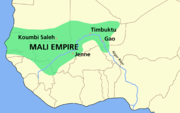 Mali was once part of three famed West African empires which controlled trans-Saharan trade
in gold, salt, slaves, and other precious commodities. These Sahelian kingdom
s had neither rigid geopolitical boundaries nor rigid ethnic identities. The earliest of these empires was the Ghana Empire
, which was dominated by the Soninke, a Mande
-speaking people. The nation expanded throughout West Africa from the 8th century until 1078, when it was conquered by the Almoravids
.
The Mali Empire
later formed on the upper Niger River
, and reached the height of power in the 14th century. Under the Mali Empire, the ancient cities of Djenné
and Timbuktu
were centers of both trade and Islamic learning. The empire later declined as a result of internal intrigue, ultimately being supplanted by the Songhai Empire
. The Songhai people originated in current northwestern Nigeria
. The Songhai had long been a major power in West Africa subject to the Mali Empire's rule.
In the late 14th century, the Songhai gradually gained independence from the Mali Empire and expanded, ultimately subsuming the entire eastern portion of the Mali Empire. The Songhai Empire's eventual collapse was largely the result of a Moroccan
invasion in 1591, under the command of Judar Pasha
. The fall of the Songhai Empire marked the end of the region's role as a trading crossroads. Following the establishment of sea routes by the European powers
, the trans-Saharan trade routes lost significance.
One of the worst famine
s in the region's recorded history occurred in the 18th century. According to John Iliffe, "The worst crises were in the 1680s, when famine extended from the Senegambian coast to the Upper Nile and 'many sold themselves for slaves, only to get a sustenance', and especially in 1738–56, when West Africa's greatest recorded subsistence crisis, due to drought and locusts, reportedly killed half the population of Timbuktu
."
Mali fell under the control of the French during the late 19th century. By 1905, most of the area was under firm French control as a part of French Sudan
. In early 1959, French Sudan (which changed its name to the Sudanese Republic) and Senegal
united to become the Mali Federation
. The Mali Federation gained independence from France on 20 June 1960. Senegal withdrew from the federation in August 1960, which allowed the Sudanese Republic to become the independent Republic of Mali on 22 September 1960. Modibo Keïta
was elected the first president. Keïta quickly established a one-party state, adopted an independent African and socialist orientation with close ties to the East, and implemented extensive nationalization of economic resources.
On 19 November 1968, following progressive economic decline, the Keïta regime was overthrown in a bloodless military coup led by Moussa Traoré
, a day which is now commemorated as Liberation Day
. The subsequent military-led regime, with Traoré as president, attempted to reform the economy. However, his efforts were frustrated by political turmoil and a devastating drought
between 1968 to 1974, which killed thousands of people from famine. The Traoré regime faced student unrest beginning in the late 1970s and three coup attempts. However, the Traoré regime repressed all dissenters until the late 1980s.
The government continued to attempt economic reforms, and the populace became increasingly dissatisfied. In response to growing demands for multi-party democracy, the Traoré regime allowed some limited political liberalization, but refused to usher in a full-fledged democratic system. In 1990, cohesive opposition movements began to emerge, and was complicated by the turbulent rise of ethnic violence in the north following the return of many Tuaregs to Mali.
Anti-government protests in 1991 led to a coup, a transitional government, and a new constitution
. In 1992, Alpha Oumar Konaré
won Mali's first democratic
, multi-party presidential election. Upon his reelection in 1997, President Konaré pushed through political and economic reforms and fought corruption. In 2002, he was succeeded in democratic elections by Amadou Toumani Touré
, a retired general, who had been the leader of the military aspect of the 1991 democratic uprising. Today, Mali is one of the most politically and socially stable countries in Africa.
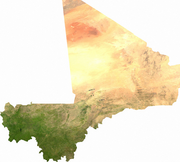

Mali is a landlocked nation in West Africa, located southwest of Algeria
. It lies between latitudes 10°
and 25°N
, and longitudes 13°W
and 5°E
.
At 1240000 square kilometres (478,767 sq mi), Mali is the world's 24th-largest country and is comparable in size to South Africa or Angola
. Most of the country lies in the southern Sahara
, which produces a hot, dust-laden Sudanian savanna
zone. Mali is mostly flat, rising to rolling northern plains covered by sand
. The Adrar des Ifoghas
lies in the northeast.
The country's climate ranges from tropical in the south to arid
in the north. Most of the country receives negligible rainfall; drought
s are frequent. Late June to early December is the rainy season. During this time, flooding of the Niger River is common, creating the Inner Niger Delta. The nation has considerable natural resources, with gold, uranium, phosphates, kaolinite
, salt and limestone
being most widely exploited. Mali faces numerous environmental challenges, including desertification
, deforestation
, soil erosion, and inadequate supplies
of potable water.
s and 703 commune
s. Mayors and elected members of the city councils officiate the arrondissements.
The regions
and districts are:
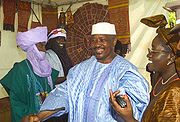 Mali is a constitutional democracy governed by the Constitution of 12 January 1992, which was amended in 1999. The constitution provides for a separation of powers among the executive, legislative, and judicial branches of government. The system of government can be described as "semi-presidential."
Executive power is vested in a president, who is elected to a five-year term by universal suffrage
and is limited to two terms. The president serves as a chief of state and commander in chief of the armed forces. A prime minister appointed by the president serves as head of government and in turn appoints the Council of Ministers. The unicameral National Assembly is Mali’s sole legislative body, consisting of deputies elected to five-year terms. Following the 2007 elections, the Alliance for Democracy and Progress
held 113 of 160 seats in the assembly. The assembly holds two regular sessions each year, during which it debates and votes on legislation that has been submitted by a member or by the government. Democracy-wise things looked positive after the local elections at the end of April 2009, though significant shortcomings and attempts at manipulation still existed.
Mali’s constitution provides for an independent judiciary, but the executive continues to exercise influence over the judiciary by virtue of power to appoint judges and oversee both judicial functions and law enforcement. Mali's highest courts are the Supreme Court, which has both judicial and administrative powers, and a separate Constitutional Court that provides judicial review of legislative acts and serves as an election arbiter. Various lower courts exist, though village chiefs and elders resolve most local disputes in rural areas.
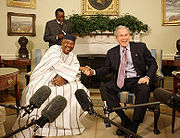 Mali's foreign policy
orientation has become increasingly pragmatic and pro-Western over time. Since the institution of a democratic form of government in 2002
, Mali’s relations with the West in general and with the United States
in particular have improved significantly. Mali has a longstanding yet ambivalent relationship with France, a former colonial ruler
. Mali is active in regional organizations such as the African Union
. Working to control and resolve regional conflicts, such as in Côte d’Ivoire, Liberia
, and Sierra Leone
, is one of Mali’s major foreign policy goals. Mali feels threatened by the potential for the spillover of conflicts in neighboring states, and relations with those neighbors are often uneasy. General insecurity along borders in the north, including cross-border banditry
and terrorism, remain troubling issues in regional relations.
Mali’s military forces
consist of an army, which includes land forces and air force, as well as the paramilitary Gendarmerie and Republican Guard, all of which are under the control of Mali's Ministry of Defense and Veterans, headed by a civilian
. The military is underpaid, poorly equipped, and in need of rationalization. Organization has suffered from the incorporation of Tuareg irregular forces into the regular military following a 1992 agreement between the government and Tuareg rebel forces. The military has generally kept a low profile since the democratic transition of 1992. The incumbent president, Amadou Toumani Touré
, is a former army general and as such reportedly enjoys widespread military support. In the annual human rights report for 2003, the U.S. Department of State rated civilian control of security forces as generally effective but noted a few "instances in which elements of the security forces acted independently of government authority.". Western powers such as the United States have also helped Mali's military with training and equipment.
.jpg) Mali is one of the poorest countries in the world. The average worker's annual salary is approximately US$1,500. Between 1992 and 1995, Mali implemented an economic adjustment program that resulted in economic growth and a reduction in financial imbalances. The program increased social and economic conditions, and led to Mali joining the World Trade Organization
Mali is one of the poorest countries in the world. The average worker's annual salary is approximately US$1,500. Between 1992 and 1995, Mali implemented an economic adjustment program that resulted in economic growth and a reduction in financial imbalances. The program increased social and economic conditions, and led to Mali joining the World Trade Organization
on 31 May 1995. The gross domestic product (GDP) has risen since. In 2002, the GDP amounted to US$3.4 billion, and increased to US$5.8 billion in 2005, which amounts to an approximately 17.6% annual growth rate.
Mali's key industry is agriculture. Cotton is the country's largest crop export and is exported west throughout Senegal and the Ivory Coast. During 2002, 620,000 tons of cotton were produced in Mali but cotton prices declined significantly in 2003. In addition to cotton, Mali produces rice, millet
, corn
, vegetables, tobacco, and tree crops. Gold, livestock and agriculture amount to eighty percent of Mali's exports. Eighty percent of Malian workers are employed in agriculture while fifteen percent work in the service sector. However, seasonal variations lead to regular temporary unemployment of agricultural workers. Mali's resource in livestock consists of millions of cattle, sheep, and goats. Approximately 40% of Mali's herds were lost during the Sahel drought
in 1972–74.
 In 1991, with the assistance of the International Development Association
, Mali relaxed the enforcement of mining codes which led to renewed foreign interest and investment in the mining industry. Gold is mined in the southern region and Mali has the third highest gold production in Africa (after South Africa and Ghana
). The emergence of gold as Mali’s leading export product since 1999 has helped mitigate some of the negative impact of the cotton and Côte d’Ivoire crises. Other natural resources include kaolin, salt, phosphate
, and limestone
.
Electricity and water are maintained by the Energie du Mali, or EDM, and textiles are generated by Industry Textile du Mali, or ITEMA. Mali has made efficient use of hydroelectricity
, consisting of over half of Mali's electrical power. In 2002, 700 GWh of hydroelectric power were produced in Mali.
The Malian government participates in foreign involvement, concerning commerce and privatization. Mali underwent economic reform, beginning in 1988 by signing agreements with the World Bank
and the International Monetary Fund
. During 1988 to 1996, Mali's government largely reformed public enterprises. Since the agreement, sixteen enterprises were privatized, twelve partially privatized, and twenty liquidated. In 2005, the Malian government conceded a railroad company to the Savage Corporation. Two major companies, Societé de Telecommunications du Mali (SOTELMA
) and the Cotton Ginning Company (CMDT
), are expected to be privatized in 2008.
Mali is a member of the Organization for the Harmonization of Business Law in Africa (OHADA
).
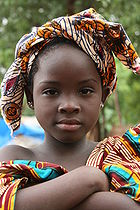 In July 2009, Mali's population was an estimated 14.5 million. The population is predominantly rural (68% in 2002), and 5–10% of Malians are nomadic. More than 90% of the population lives in the southern part of the country, especially in Bamako
, which has over 1 million residents.
In 2007, about 48% of Malians were less than fifteen years old, 49% were 15–64 years old, and 3% were 65 and older. The median age was 15.9 years. The birth rate
in 2007 was 49.6 births per 1,000, and the total fertility rate
was 7.4 children per woman. The death rate in 2007 was 16.5 deaths per 1,000. Life expectancy
at birth was 49.5 years total (47.6 for males and 51.5 for females). Mali has one of the world's highest rates of infant mortality
, with 106 deaths per 1,000 live births in 2007.
Mali’s population encompasses a number of sub-Saharan ethnic groups, most of which have historical, cultural, linguistic, and religious commonalities. The Bambara are by far the largest single ethnic group, making up 36.5% of the population. Collectively, the Bambara, Soninké, Khassonké
, and Malinké
, all part of the broader Mandé
group, constitute 50% of Mali's population. Other significant groups are the Fula
(17%), Voltaic (12%), Songhai (6%), and Tuareg and Moor
(10%). Mali historically has enjoyed reasonably good inter-ethnic relations; however, some hereditary servitude relationships exist, as do ethnic tensions between the Songhai and the Tuareg. Over the past 40 years, persistent drought
has forced many Tuareg to give up their nomad
ic way of life.
Mali’s official language is French, but numerous (40 or more) African languages
also are widely used by the various ethnic groups. About 80% of Mali’s population can communicate in Bambara
, which is the country’s principal lingua franca
and marketplace language.
(mostly Sunni and Sufi), approximately 5% are Christian (about two-thirds Roman Catholic
and one-third Protestant) and the remaining 5% adhere to indigenous or traditional animist beliefs
. Atheism
and agnosticism
are believed to be rare among Malians, most of whom practice their religion on a daily basis. Islam as practiced in Mali is moderate, tolerant, and adapted to local conditions; relations between Muslims and practitioners of minority religious faiths are generally amicable. The constitution establishes a secular state
and provides for freedom of religion
, and the government largely respects this right.
, and inadequate hygiene
and sanitation
. Mali's health and development indicators rank among the worst in the world. In 2000, only 62–65 percent of the population was estimated to have access to safe drinking water and only 69 percent to sanitation services of some kind. In 2001, the general government expenditures on health totaled about US$4 per capita at an average exchange rate. Medical facilities in Mali are very limited, and medicines are in short supply. Malaria
and other arthropod
-borne diseases are prevalent in Mali, as are a number of infectious disease
s such as cholera
and tuberculosis
. Mali’s population also suffers from a high rate of child malnutrition
and a low rate of immunization
. An estimated 1.9 percent of the adult and children population was afflicted with HIV/AIDS that year, among the lowest rates in Sub-Saharan Africa
.
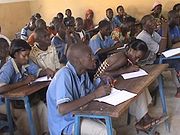 Public education in Mali is in principle provided free of charge and is compulsory for nine years between the ages of seven and sixteen. The system encompasses six years of primary education beginning at age seven, followed by six years of secondary education. However, Mali’s actual primary school enrollment rate is low, in large part because families are unable to cover the cost of uniforms, books, supplies, and other fees required to attend. In the 2000–01 school year, the primary school enrollment rate was 61% (71% of males and 51% of females); in the late 1990s, the secondary school enrollment rate was 15% percent (20% of males and 10% of females). The education system is plagued by a lack of schools in rural areas, as well as shortages of teachers and materials. Estimates of literacy rates in Mali range from 27–30% to 46.4%, with literacy rates significantly lower among women than men.
According to the World Health Organization in 2001 an estimated 91.6% of Mali's girls and women have had some form of female genital cutting
performed on them.
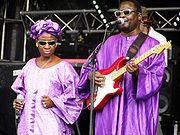 Malian musical traditions
are derived from the griot
s, who are known as "Keeper of Memories".
Malian music
is diverse and has several different genres. Some famous Malian influences in music are kora
virtouso musician Toumani Diabaté
, the late roots and blues guitarist Ali Farka Touré
, the Tuareg band Tinariwen
, and several Afro-pop artists such as Salif Keita
, the duo Amadou et Mariam, Oumou Sangare
, and Habib Koité
.
Though Mali's literature is less famous than its music, Mali has always been one of Africa's liveliest intellectual centers. Mali's literary tradition is passed mainly by word of mouth, with jalis reciting or singing histories and stories known by heart. Amadou Hampâté Bâ
, Mali's best-known historian, spent much of his life writing these oral traditions down for the world to remember. The best-known novel by a Malian writer is Yambo Ouologuem
's Le devoir de violence, which won the 1968 Prix Renaudot
but whose legacy was marred by accusations of plagiarism. Other well-known Malian writers include Baba Traoré, Modibo Sounkalo Keita, Massa Makan Diabaté
, Moussa Konaté
, and Fily Dabo Sissoko
.
The varied everyday culture of Malians reflects the country's ethnic and geographic diversity. Most Malians wear flowing, colorful robes called boubous
that are typical of West Africa. Malians frequently participate in traditional festivals, dances, and ceremonies. Rice and millet
are the staples of Malian cuisine, which is heavily based on cereal grains. Grains are generally prepared with sauces made from leaves such spinach
or baobab
leaves, with tomato, or with peanut
sauce, and may be accompanied by pieces of grilled meat (typically chicken, mutton, beef, or goat). Malian cuisine varies regionally.
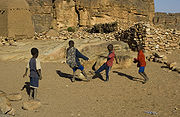
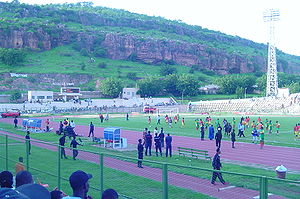 The most popular sport in Mali
is football (soccer), which became more prominent after Mali hosted the 2002 African Cup of Nations. Most towns have regular games; the most popular teams nationally are Djoliba AC
, Stade Malien
, and Real Bamako, all based in the capital. Informal games are often played by youths using a bundle of rags as a ball.
The country has produced notable players for French teams, including Salif Keita
and Jean Tigana
. Frédéric "Fredi" Kanouté, named 2007 African Footballer of the Year, currently plays for Sevilla FC
in Spain's La Liga
. Mahamadou Diarra
, the captain of the Mali national team, played for Real Madrid
for four seasons before moving to AS Monaco FC
and Seydou Keita
plays for FC Barcelona
. Other notable players currently on European squads include, Mamady Sidibe
(Stoke City), Mohammed Sissoko (Juventus), Sammy Traore
(Paris Saint-Germain), Adama Coulibaly
(AJ Auxerre), Kalifa Cisse, Jimmy Kebe
(Reading F.C.
), Dramane Traoré
(Lokomotiv Moscow), Garra Dembele (Levski Sofia
) and others.
Basketball is another major sport; the Mali women's national basketball team
, led by Hamchetou Maiga
, competed at the 2008 Beijing Olympics. Traditional wrestling
(la lutte) is also somewhat common, though popularity has declined in recent years. The game wari
, a mancala
variant, is a common pastime.
West Africa
West Africa or Western Africa is the westernmost region of the African continent. Geopolitically, the UN definition of Western Africa includes the following 16 countries and an area of approximately 5 million square km:-Flags of West Africa:...
. Mali borders Algeria
Algeria
Algeria , officially the People's Democratic Republic of Algeria , also formally referred to as the Democratic and Popular Republic of Algeria, is a country in the Maghreb region of Northwest Africa with Algiers as its capital.In terms of land area, it is the largest country in Africa and the Arab...
on the north, Niger
Niger
Niger , officially named the Republic of Niger, is a landlocked country in Western Africa, named after the Niger River. It borders Nigeria and Benin to the south, Burkina Faso and Mali to the west, Algeria and Libya to the north and Chad to the east...
on the east, Burkina Faso
Burkina Faso
Burkina Faso – also known by its short-form name Burkina – is a landlocked country in west Africa. It is surrounded by six countries: Mali to the north, Niger to the east, Benin to the southeast, Togo and Ghana to the south, and Côte d'Ivoire to the southwest.Its size is with an estimated...
and the Côte d'Ivoire
Côte d'Ivoire
The Republic of Côte d'Ivoire or Ivory Coast is a country in West Africa. It has an area of , and borders the countries Liberia, Guinea, Mali, Burkina Faso and Ghana; its southern boundary is along the Gulf of Guinea. The country's population was 15,366,672 in 1998 and was estimated to be...
on the south, Guinea
Guinea
Guinea , officially the Republic of Guinea , is a country in West Africa. Formerly known as French Guinea , it is today sometimes called Guinea-Conakry to distinguish it from its neighbour Guinea-Bissau. Guinea is divided into eight administrative regions and subdivided into thirty-three prefectures...
on the south-west, and Senegal
Senegal
Senegal , officially the Republic of Senegal , is a country in western Africa. It owes its name to the Sénégal River that borders it to the east and north...
and Mauritania
Mauritania
Mauritania is a country in the Maghreb and West Africa. It is bordered by the Atlantic Ocean in the west, by Western Sahara in the north, by Algeria in the northeast, by Mali in the east and southeast, and by Senegal in the southwest...
on the west. Its size is just over 1,240,000 km² with a population of 14.5 million. Its capital is Bamako
Bamako
Bamako is the capital of Mali and its largest city with a population of 1.8 million . Currently, it is estimated to be the fastest growing city in Africa and sixth fastest in the world...
.
Mali consists of eight regions and its borders on the north reach deep into the middle of the Sahara
Sahara
The Sahara is the world's second largest desert, after Antarctica. At over , it covers most of Northern Africa, making it almost as large as Europe or the United States. The Sahara stretches from the Red Sea, including parts of the Mediterranean coasts, to the outskirts of the Atlantic Ocean...
, while the country's southern region, where the majority of inhabitants live, features the Niger
Niger River
The Niger River is the principal river of western Africa, extending about . Its drainage basin is in area. Its source is in the Guinea Highlands in southeastern Guinea...
and Sénégal
Sénégal River
The Sénégal River is a long river in West Africa that forms the border between Senegal and Mauritania.The Sénégal's headwaters are the Semefé and Bafing rivers which both originate in Guinea; they form a small part of the Guinean-Malian border before coming together at Bafoulabé in Mali...
rivers. The country's economic structure centers around agriculture
Agriculture
Agriculture is the cultivation of animals, plants, fungi and other life forms for food, fiber, and other products used to sustain life. Agriculture was the key implement in the rise of sedentary human civilization, whereby farming of domesticated species created food surpluses that nurtured the...
and fishing
Fishing
Fishing is the activity of trying to catch wild fish. Fish are normally caught in the wild. Techniques for catching fish include hand gathering, spearing, netting, angling and trapping....
. Some of Mali's natural resources are gold, uranium
Uranium
Uranium is a silvery-white metallic chemical element in the actinide series of the periodic table, with atomic number 92. It is assigned the chemical symbol U. A uranium atom has 92 protons and 92 electrons, of which 6 are valence electrons...
, and salt.
Present-day Mali was once part of three West African empires that controlled trans-Saharan trade
Trans-Saharan trade
Trans-Saharan trade requires travel across the Sahara to reach sub-Saharan Africa. While existing from prehistoric times, the peak of trade extended from the 8th century until the late 16th century.- Increasing desertification and economic incentive :...
: the Ghana Empire
Ghana Empire
The Ghana Empire or Wagadou Empire was located in what is now southeastern Mauritania, and Western Mali. Complex societies had existed in the region since about 1500 BCE, and around Ghana's core region since about 300 CE...
, the Mali Empire
Mali Empire
The Mali Empire or Mandingo Empire or Manden Kurufa was a West African empire of the Mandinka from c. 1230 to c. 1600. The empire was founded by Sundiata Keita and became renowned for the wealth of its rulers, especially Mansa Musa I...
(from which Mali is named), and the Songhai Empire
Songhai Empire
The Songhai Empire, also known as the Songhay Empire, was a state located in western Africa. From the early 15th to the late 16th century, Songhai was one of the largest Islamic empires in history. This empire bore the same name as its leading ethnic group, the Songhai. Its capital was the city...
. In the late 19th century, during the Scramble for Africa
Scramble for Africa
The Scramble for Africa, also known as the Race for Africa or Partition of Africa was a process of invasion, occupation, colonization and annexation of African territory by European powers during the New Imperialism period, between 1881 and World War I in 1914...
, France seized control of Mali making it a part of French Sudan
French Sudan
French Sudan was a colony in French West Africa that had two separate periods of existence, first from 1890 to 1899, then from 1920 to 1960, when the territory became the independent nation of Mali.-Colonial establishment:...
. French Sudan (then known as the Sudanese Republic) joined with Senegal in 1959, achieving independence in 1960 as the Mali Federation
Mali Federation
The Mali Federation was a country in West Africa. It was formed by a union between Senegal and the Sudanese Republic...
. Shortly thereafter, following Senegal's withdrawal from the federation, the Sudanese Republic declared itself the independent Republic of Mali. After a long period of one-party rule, a 1991 coup led to the writing of a new constitution and the establishment of Mali as a democratic, multi-party state. About half the population live below the international poverty line of US$1.25 a day.
History
Trans-Saharan trade
Trans-Saharan trade requires travel across the Sahara to reach sub-Saharan Africa. While existing from prehistoric times, the peak of trade extended from the 8th century until the late 16th century.- Increasing desertification and economic incentive :...
in gold, salt, slaves, and other precious commodities. These Sahelian kingdom
Sahelian kingdom
The Sahelian kingdoms were a series of kingdoms or empires that were centered on the sahel, the area of grasslands south of the Sahara. The wealth of the states came from controlling the trade routes across the desert. Their power came from having large pack animals like camels and horses that...
s had neither rigid geopolitical boundaries nor rigid ethnic identities. The earliest of these empires was the Ghana Empire
Ghana Empire
The Ghana Empire or Wagadou Empire was located in what is now southeastern Mauritania, and Western Mali. Complex societies had existed in the region since about 1500 BCE, and around Ghana's core region since about 300 CE...
, which was dominated by the Soninke, a Mande
Mande languages
The Mande languages are spoken in several countries in West Africa by the Mandé people and include Mandinka, Soninke, Bambara, Bissa, Dioula, Kagoro, Bozo, Mende, Susu, Yacouba, Vai, and Ligbi...
-speaking people. The nation expanded throughout West Africa from the 8th century until 1078, when it was conquered by the Almoravids
Almoravids
The Almoravids were a Berber dynasty of Morocco, who formed an empire in the 11th-century that stretched over the western Maghreb and Al-Andalus. Their capital was Marrakesh, a city which they founded in 1062 C.E...
.
The Mali Empire
Mali Empire
The Mali Empire or Mandingo Empire or Manden Kurufa was a West African empire of the Mandinka from c. 1230 to c. 1600. The empire was founded by Sundiata Keita and became renowned for the wealth of its rulers, especially Mansa Musa I...
later formed on the upper Niger River
Niger River
The Niger River is the principal river of western Africa, extending about . Its drainage basin is in area. Its source is in the Guinea Highlands in southeastern Guinea...
, and reached the height of power in the 14th century. Under the Mali Empire, the ancient cities of Djenné
Djenné
Djenné is an Urban Commune and town in the Inland Niger Delta region of central Mali. In the 2009 census the commune had a population of 32,944. Administratively it is part of the Mopti Region....
and Timbuktu
Timbuktu
Timbuktu , formerly also spelled Timbuctoo, is a town in the West African nation of Mali situated north of the River Niger on the southern edge of the Sahara Desert. The town is the capital of the Timbuktu Region, one of the eight administrative regions of Mali...
were centers of both trade and Islamic learning. The empire later declined as a result of internal intrigue, ultimately being supplanted by the Songhai Empire
Songhai Empire
The Songhai Empire, also known as the Songhay Empire, was a state located in western Africa. From the early 15th to the late 16th century, Songhai was one of the largest Islamic empires in history. This empire bore the same name as its leading ethnic group, the Songhai. Its capital was the city...
. The Songhai people originated in current northwestern Nigeria
Nigeria
Nigeria , officially the Federal Republic of Nigeria, is a federal constitutional republic comprising 36 states and its Federal Capital Territory, Abuja. The country is located in West Africa and shares land borders with the Republic of Benin in the west, Chad and Cameroon in the east, and Niger in...
. The Songhai had long been a major power in West Africa subject to the Mali Empire's rule.
In the late 14th century, the Songhai gradually gained independence from the Mali Empire and expanded, ultimately subsuming the entire eastern portion of the Mali Empire. The Songhai Empire's eventual collapse was largely the result of a Moroccan
Saadi Dynasty
The Saadi dynasty of Morocco , began with the reign of Sultan Mohammed ash-Sheikh in 1554, when he vanquished the last Wattasids at the Battle of Tadla....
invasion in 1591, under the command of Judar Pasha
Judar Pasha
Judar Pasha was a military leader of Morocco's Saadi Dynasty and the conqueror of the Songhai Empire.Born a Spaniard, Judar had been captured as a baby. As a young boy he joined the service of Moroccan Sultan Ahmad I al-Mansur Saadi...
. The fall of the Songhai Empire marked the end of the region's role as a trading crossroads. Following the establishment of sea routes by the European powers
European exploration of Africa
European exploration of Africa began with Ancient Greeks and Romans, who explored and established settlements in North Africa. Fifteenth Century Portugal, especially under Henry the Navigator probed along the West African coast. Scientific curiosity and Christian missionary spirit soon were...
, the trans-Saharan trade routes lost significance.
One of the worst famine
Famine
A famine is a widespread scarcity of food, caused by several factors including crop failure, overpopulation, or government policies. This phenomenon is usually accompanied or followed by regional malnutrition, starvation, epidemic, and increased mortality. Every continent in the world has...
s in the region's recorded history occurred in the 18th century. According to John Iliffe, "The worst crises were in the 1680s, when famine extended from the Senegambian coast to the Upper Nile and 'many sold themselves for slaves, only to get a sustenance', and especially in 1738–56, when West Africa's greatest recorded subsistence crisis, due to drought and locusts, reportedly killed half the population of Timbuktu
Timbuktu
Timbuktu , formerly also spelled Timbuctoo, is a town in the West African nation of Mali situated north of the River Niger on the southern edge of the Sahara Desert. The town is the capital of the Timbuktu Region, one of the eight administrative regions of Mali...
."
Mali fell under the control of the French during the late 19th century. By 1905, most of the area was under firm French control as a part of French Sudan
French Sudan
French Sudan was a colony in French West Africa that had two separate periods of existence, first from 1890 to 1899, then from 1920 to 1960, when the territory became the independent nation of Mali.-Colonial establishment:...
. In early 1959, French Sudan (which changed its name to the Sudanese Republic) and Senegal
Senegal
Senegal , officially the Republic of Senegal , is a country in western Africa. It owes its name to the Sénégal River that borders it to the east and north...
united to become the Mali Federation
Mali Federation
The Mali Federation was a country in West Africa. It was formed by a union between Senegal and the Sudanese Republic...
. The Mali Federation gained independence from France on 20 June 1960. Senegal withdrew from the federation in August 1960, which allowed the Sudanese Republic to become the independent Republic of Mali on 22 September 1960. Modibo Keïta
Modibo Keïta
Modibo Keita ; was the first President of Mali and the Prime Minister of the Mali Federation. He espoused a form of African socialism.-Youth:...
was elected the first president. Keïta quickly established a one-party state, adopted an independent African and socialist orientation with close ties to the East, and implemented extensive nationalization of economic resources.
On 19 November 1968, following progressive economic decline, the Keïta regime was overthrown in a bloodless military coup led by Moussa Traoré
Moussa Traoré
General Moussa Traoré is a Malian soldier and politician. As a Lieutenant, he led the military ouster of President Modibo Keïta in 1968. Thereafter he served as Head of State from 1968-1979, and President of Mali from 1979 to 1991, when he was overthrown by popular protests and military coup...
, a day which is now commemorated as Liberation Day
Liberation Day
Liberation Day is a day, often a public holiday, that marks the liberation of a place, similar to an independence day. Liberation marks the date of either a revolution, as in Cuba, or the end of an occupation by another state, thereby differing from independence in the meaning of secession from...
. The subsequent military-led regime, with Traoré as president, attempted to reform the economy. However, his efforts were frustrated by political turmoil and a devastating drought
Sahel drought
[[File:Greening Sahel 1982-1999.jpg|thumb|300px|Recent "Greening" of the Sahel: The results of trend analyses of time series over the Sahel region of seasonally integrated NDVI using NOAA AVHRR NDVI-data from 1982 to 1999...
between 1968 to 1974, which killed thousands of people from famine. The Traoré regime faced student unrest beginning in the late 1970s and three coup attempts. However, the Traoré regime repressed all dissenters until the late 1980s.
The government continued to attempt economic reforms, and the populace became increasingly dissatisfied. In response to growing demands for multi-party democracy, the Traoré regime allowed some limited political liberalization, but refused to usher in a full-fledged democratic system. In 1990, cohesive opposition movements began to emerge, and was complicated by the turbulent rise of ethnic violence in the north following the return of many Tuaregs to Mali.
Anti-government protests in 1991 led to a coup, a transitional government, and a new constitution
Constitution of Mali
The 1992 Constitution of Mali was approved by a referendum on 12 January 1992 after being drawn up by a national conference in August 1991. The constitution provides for multi party democracy within a semi-presidential system.-Background:...
. In 1992, Alpha Oumar Konaré
Alpha Oumar Konaré
Alpha Oumar Konaré was the President of Mali for two five-year terms , and was Chairperson of the African Union Commission from 2003 to 2008.-Scholarly career:...
won Mali's first democratic
Democracy
Democracy is generally defined as a form of government in which all adult citizens have an equal say in the decisions that affect their lives. Ideally, this includes equal participation in the proposal, development and passage of legislation into law...
, multi-party presidential election. Upon his reelection in 1997, President Konaré pushed through political and economic reforms and fought corruption. In 2002, he was succeeded in democratic elections by Amadou Toumani Touré
Amadou Toumani Touré
Amadou Toumani Touré is the president of Mali. He overthrew a military ruler, Moussa Traoré in 1991, then handed power to civilian authorities the next year...
, a retired general, who had been the leader of the military aspect of the 1991 democratic uprising. Today, Mali is one of the most politically and socially stable countries in Africa.
Geography
Mali is a landlocked nation in West Africa, located southwest of Algeria
Algeria
Algeria , officially the People's Democratic Republic of Algeria , also formally referred to as the Democratic and Popular Republic of Algeria, is a country in the Maghreb region of Northwest Africa with Algiers as its capital.In terms of land area, it is the largest country in Africa and the Arab...
. It lies between latitudes 10°
10th parallel north
The 10th parallel north is a circle of latitude that is 10 degrees north of the Earth's equatorial plane. It crosses Africa, the Indian Ocean, South Asia, Southeast Asia, the Pacific Ocean, Central America, South America and the Atlantic Ocean....
and 25°N
25th parallel north
The 25th parallel north is a circle of latitude that is 25 degrees north of the Earth's equatorial plane. It crosses Africa, Asia, the Indian Ocean, the Pacific Ocean, North America and the Atlantic Ocean....
, and longitudes 13°W
13th meridian west
The meridian 13° west of Greenwich is a line of longitude that extends from the North Pole across the Arctic Ocean, Greenland, the Atlantic Ocean, Africa, the Southern Ocean, and Antarctica to the South Pole....
and 5°E
5th meridian east
The meridian 5° east of Greenwich is a line of longitude that extends from the North Pole across the Arctic Ocean, Europe, Africa, the Atlantic Ocean, the Southern Ocean, and Antarctica to the South Pole....
.
At 1240000 square kilometres (478,767 sq mi), Mali is the world's 24th-largest country and is comparable in size to South Africa or Angola
Angola
Angola, officially the Republic of Angola , is a country in south-central Africa bordered by Namibia on the south, the Democratic Republic of the Congo on the north, and Zambia on the east; its west coast is on the Atlantic Ocean with Luanda as its capital city...
. Most of the country lies in the southern Sahara
Sahara
The Sahara is the world's second largest desert, after Antarctica. At over , it covers most of Northern Africa, making it almost as large as Europe or the United States. The Sahara stretches from the Red Sea, including parts of the Mediterranean coasts, to the outskirts of the Atlantic Ocean...
, which produces a hot, dust-laden Sudanian savanna
Sudan (region)
The Sudan is the name given to a geographic region to the south of the Sahara, stretching from Western to Eastern Africa. The name derives from the Arabic bilâd as-sûdân or "land of the Blacks"...
zone. Mali is mostly flat, rising to rolling northern plains covered by sand
Sand
Sand is a naturally occurring granular material composed of finely divided rock and mineral particles.The composition of sand is highly variable, depending on the local rock sources and conditions, but the most common constituent of sand in inland continental settings and non-tropical coastal...
. The Adrar des Ifoghas
Adrar des Ifoghas
The Adrar des Ifoghas is a sandstone massif in Mali's Kidal Region, having an area of about 250,000 km².The area is characterized by wide, shallow valleys, and is strewn with piles of eroded granite blocks...
lies in the northeast.
The country's climate ranges from tropical in the south to arid
Arid
A region is said to be arid when it is characterized by a severe lack of available water, to the extent of hindering or even preventing the growth and development of plant and animal life...
in the north. Most of the country receives negligible rainfall; drought
Drought
A drought is an extended period of months or years when a region notes a deficiency in its water supply. Generally, this occurs when a region receives consistently below average precipitation. It can have a substantial impact on the ecosystem and agriculture of the affected region...
s are frequent. Late June to early December is the rainy season. During this time, flooding of the Niger River is common, creating the Inner Niger Delta. The nation has considerable natural resources, with gold, uranium, phosphates, kaolinite
Kaolinite
Kaolinite is a clay mineral, part of the group of industrial minerals, with the chemical composition Al2Si2O54. It is a layered silicate mineral, with one tetrahedral sheet linked through oxygen atoms to one octahedral sheet of alumina octahedra...
, salt and limestone
Limestone
Limestone is a sedimentary rock composed largely of the minerals calcite and aragonite, which are different crystal forms of calcium carbonate . Many limestones are composed from skeletal fragments of marine organisms such as coral or foraminifera....
being most widely exploited. Mali faces numerous environmental challenges, including desertification
Desertification
Desertification is the degradation of land in drylands. Caused by a variety of factors, such as climate change and human activities, desertification is one of the most significant global environmental problems.-Definitions:...
, deforestation
Deforestation
Deforestation is the removal of a forest or stand of trees where the land is thereafter converted to a nonforest use. Examples of deforestation include conversion of forestland to farms, ranches, or urban use....
, soil erosion, and inadequate supplies
Water supply
Water supply is the provision of water by public utilities, commercial organisations, community endeavours or by individuals, usually via a system of pumps and pipes...
of potable water.
Regions and cercles
Mali is divided into eight regions (régions) and one district. Each region has a governor. Since Mali's regions are very large, the country is subdivided into 49 cercles, 288 arrondissementArrondissement
Arrondissement is any of various administrative divisions of France, certain other Francophone countries, and the Netherlands.-France:The 101 French departments are divided into 342 arrondissements, which may be translated into English as districts. The capital of an arrondissement is called a...
s and 703 commune
Commune
Commune may refer to:In society:* Commune, a human community in which resources are shared* Commune , a township or municipality* One of the Communes of France* An Italian Comune...
s. Mayors and elected members of the city councils officiate the arrondissements.
The regions
Regions of Mali
||Mali is divided into eight regions and one capital district. Each of the regions bears the name of its principal city. The regions are divided into 49 cercles. The cercles and the capital district are divided into 703 communes....
and districts are:
- GaoGao RegionThe Gao Region is located in eastern Mali. The region's capital city is Gao. Gao Region is bordered to the south and east by Niger, to the north by Kidal Region, and to the west by Tombouctou Region. Common ethnicities in the Gao Region include the Songhai, Bozo, Tuareg, Bambara, and Kounta...
- KayesKayes RegionKayes Region is one of eight first level national subdivisions, called Regions in Mali. It is the first administrative area of Mali and covers an area of 120,760 km²...
- KidalKidal RegionKidal is the eighth administrative region of Mali, covering 151,430 km². Its capital is the city of Kidal.-Geography:The region is bordered on the west by Tomboctou Region, to the south by Gao Region, to the east by Niger and to the north by Algeria....
- KoulikoroKoulikoro RegionKoulikoro is a region in Mali. It is the second administrative area of Mali and covers an area of 90,120 km². Its capital is the city of Koulikoro.- Geography :...
- MoptiMopti RegionMopti is the fifth administrative region of Mali, covering 79,017 km². Its capital is the city of Mopti.-Geography:Mopti Region is bordered by Tombouctou Region to the north, Ségou Region to the southwest, and Burkina Faso to the southeast....
- SégouSégou RegionSégou is the fourth most populous administrative region in Mali, whose capital is the town of Ségou.-Geography:Situated at the center of Mali, Ségou Region covers 64,947 km²...
- SikassoSikasso RegionSikasso is the southern-most region of Mali. The capital city of the same name is the 3rd-largest city and is growing rapidly due to people fleeing the violence in Côte d'Ivoire to the south. Major ethnic groups include the Senoufo, known for masks and reverence for animals, the Samago, known for...
- Tombouctou (Timbuktu)
- Bamako (capital district)
Politics and government
Executive power is vested in a president, who is elected to a five-year term by universal suffrage
Universal suffrage
Universal suffrage consists of the extension of the right to vote to adult citizens as a whole, though it may also mean extending said right to minors and non-citizens...
and is limited to two terms. The president serves as a chief of state and commander in chief of the armed forces. A prime minister appointed by the president serves as head of government and in turn appoints the Council of Ministers. The unicameral National Assembly is Mali’s sole legislative body, consisting of deputies elected to five-year terms. Following the 2007 elections, the Alliance for Democracy and Progress
Alliance for Democracy and Progress (Mali)
The Alliance for Democracy and Progress is an alliance of political parties in Mali, that supports president Amadou Toumani Touré. In the 1 July and 22 July 2007 Malian parliamentary elections, the member parties of the alliance won 113 out of 160 seats....
held 113 of 160 seats in the assembly. The assembly holds two regular sessions each year, during which it debates and votes on legislation that has been submitted by a member or by the government. Democracy-wise things looked positive after the local elections at the end of April 2009, though significant shortcomings and attempts at manipulation still existed.
Mali’s constitution provides for an independent judiciary, but the executive continues to exercise influence over the judiciary by virtue of power to appoint judges and oversee both judicial functions and law enforcement. Mali's highest courts are the Supreme Court, which has both judicial and administrative powers, and a separate Constitutional Court that provides judicial review of legislative acts and serves as an election arbiter. Various lower courts exist, though village chiefs and elders resolve most local disputes in rural areas.
Foreign relations and military
Foreign relations of Mali
Following independence in 1960, Mali initially followed a socialist path and was aligned ideologically with the communist bloc. But Mali's foreign policy orientation became increasingly pragmatic and pro-Western over time. Since the institution of a democratic form of government in 2002, Mali's...
orientation has become increasingly pragmatic and pro-Western over time. Since the institution of a democratic form of government in 2002
2000s in Mali
Konaré stepped down after his constitutionally mandated limit of two terms and did not run in the 2002 elections. Touré then reemerged, this time as a civilian...
, Mali’s relations with the West in general and with the United States
Mali-United States relations
Mali-United States relations are excellent and expanding. They are based on shared goals of averting suffering and strengthening democracy. The bilateral agenda is dominated by efforts to increase broad-based growth, improve health and educational facilities, promote the sustainable use of...
in particular have improved significantly. Mali has a longstanding yet ambivalent relationship with France, a former colonial ruler
French Sudan
French Sudan was a colony in French West Africa that had two separate periods of existence, first from 1890 to 1899, then from 1920 to 1960, when the territory became the independent nation of Mali.-Colonial establishment:...
. Mali is active in regional organizations such as the African Union
African Union
The African Union is a union consisting of 54 African states. The only all-African state not in the AU is Morocco. Established on 9 July 2002, the AU was formed as a successor to the Organisation of African Unity...
. Working to control and resolve regional conflicts, such as in Côte d’Ivoire, Liberia
Liberia
Liberia , officially the Republic of Liberia, is a country in West Africa. It is bordered by Sierra Leone on the west, Guinea on the north and Côte d'Ivoire on the east. Liberia's coastline is composed of mostly mangrove forests while the more sparsely populated inland consists of forests that open...
, and Sierra Leone
Sierra Leone
Sierra Leone , officially the Republic of Sierra Leone, is a country in West Africa. It is bordered by Guinea to the north and east, Liberia to the southeast, and the Atlantic Ocean to the west and southwest. Sierra Leone covers a total area of and has an estimated population between 5.4 and 6.4...
, is one of Mali’s major foreign policy goals. Mali feels threatened by the potential for the spillover of conflicts in neighboring states, and relations with those neighbors are often uneasy. General insecurity along borders in the north, including cross-border banditry
Banditry
Banditry refers to the life and practice of bandits which the Oxford English Dictionary defines as "one who is proscribed or outlawed; hence, a lawless desperate marauder, a brigand: usually applied to members of the organized gangs which infest the mountainous districts of Italy, Sicily, Spain,...
and terrorism, remain troubling issues in regional relations.
Mali’s military forces
Military of Mali
Mali's armed forces are the Army, Air Force, Gendarmerie, Republican Guard, National Guard, and National Police . They number some 7,000 and are under the control of the Minister of Armed Forces and Veterans. The IISS Military Balance 2009 lists an Army of 7,350, Air Force of 400, and Navy of 50...
consist of an army, which includes land forces and air force, as well as the paramilitary Gendarmerie and Republican Guard, all of which are under the control of Mali's Ministry of Defense and Veterans, headed by a civilian
Civilian control of the military
Civilian control of the military is a doctrine in military and political science that places ultimate responsibility for a country's strategic decision-making in the hands of the civilian political leadership, rather than professional military officers. One author, paraphrasing Samuel P...
. The military is underpaid, poorly equipped, and in need of rationalization. Organization has suffered from the incorporation of Tuareg irregular forces into the regular military following a 1992 agreement between the government and Tuareg rebel forces. The military has generally kept a low profile since the democratic transition of 1992. The incumbent president, Amadou Toumani Touré
Amadou Toumani Touré
Amadou Toumani Touré is the president of Mali. He overthrew a military ruler, Moussa Traoré in 1991, then handed power to civilian authorities the next year...
, is a former army general and as such reportedly enjoys widespread military support. In the annual human rights report for 2003, the U.S. Department of State rated civilian control of security forces as generally effective but noted a few "instances in which elements of the security forces acted independently of government authority.". Western powers such as the United States have also helped Mali's military with training and equipment.
Economy
World Trade Organization
The World Trade Organization is an organization that intends to supervise and liberalize international trade. The organization officially commenced on January 1, 1995 under the Marrakech Agreement, replacing the General Agreement on Tariffs and Trade , which commenced in 1948...
on 31 May 1995. The gross domestic product (GDP) has risen since. In 2002, the GDP amounted to US$3.4 billion, and increased to US$5.8 billion in 2005, which amounts to an approximately 17.6% annual growth rate.
Mali's key industry is agriculture. Cotton is the country's largest crop export and is exported west throughout Senegal and the Ivory Coast. During 2002, 620,000 tons of cotton were produced in Mali but cotton prices declined significantly in 2003. In addition to cotton, Mali produces rice, millet
Millet
The millets are a group of small-seeded species of cereal crops or grains, widely grown around the world for food and fodder. They do not form a taxonomic group, but rather a functional or agronomic one. Their essential similarities are that they are small-seeded grasses grown in difficult...
, corn
Maize
Maize known in many English-speaking countries as corn or mielie/mealie, is a grain domesticated by indigenous peoples in Mesoamerica in prehistoric times. The leafy stalk produces ears which contain seeds called kernels. Though technically a grain, maize kernels are used in cooking as a vegetable...
, vegetables, tobacco, and tree crops. Gold, livestock and agriculture amount to eighty percent of Mali's exports. Eighty percent of Malian workers are employed in agriculture while fifteen percent work in the service sector. However, seasonal variations lead to regular temporary unemployment of agricultural workers. Mali's resource in livestock consists of millions of cattle, sheep, and goats. Approximately 40% of Mali's herds were lost during the Sahel drought
Sahel drought
[[File:Greening Sahel 1982-1999.jpg|thumb|300px|Recent "Greening" of the Sahel: The results of trend analyses of time series over the Sahel region of seasonally integrated NDVI using NOAA AVHRR NDVI-data from 1982 to 1999...
in 1972–74.
International Development Association
The International Development Association , is the part of the World Bank that helps the world’s poorest countries. It complements the World Bank's other lending arm — the International Bank for Reconstruction and Development — which serves middle-income countries with capital investment and...
, Mali relaxed the enforcement of mining codes which led to renewed foreign interest and investment in the mining industry. Gold is mined in the southern region and Mali has the third highest gold production in Africa (after South Africa and Ghana
Ghana
Ghana , officially the Republic of Ghana, is a country located in West Africa. It is bordered by Côte d'Ivoire to the west, Burkina Faso to the north, Togo to the east, and the Gulf of Guinea to the south...
). The emergence of gold as Mali’s leading export product since 1999 has helped mitigate some of the negative impact of the cotton and Côte d’Ivoire crises. Other natural resources include kaolin, salt, phosphate
Phosphate
A phosphate, an inorganic chemical, is a salt of phosphoric acid. In organic chemistry, a phosphate, or organophosphate, is an ester of phosphoric acid. Organic phosphates are important in biochemistry and biogeochemistry or ecology. Inorganic phosphates are mined to obtain phosphorus for use in...
, and limestone
Limestone
Limestone is a sedimentary rock composed largely of the minerals calcite and aragonite, which are different crystal forms of calcium carbonate . Many limestones are composed from skeletal fragments of marine organisms such as coral or foraminifera....
.
Electricity and water are maintained by the Energie du Mali, or EDM, and textiles are generated by Industry Textile du Mali, or ITEMA. Mali has made efficient use of hydroelectricity
Hydroelectricity
Hydroelectricity is the term referring to electricity generated by hydropower; the production of electrical power through the use of the gravitational force of falling or flowing water. It is the most widely used form of renewable energy...
, consisting of over half of Mali's electrical power. In 2002, 700 GWh of hydroelectric power were produced in Mali.
The Malian government participates in foreign involvement, concerning commerce and privatization. Mali underwent economic reform, beginning in 1988 by signing agreements with the World Bank
World Bank
The World Bank is an international financial institution that provides loans to developing countries for capital programmes.The World Bank's official goal is the reduction of poverty...
and the International Monetary Fund
International Monetary Fund
The International Monetary Fund is an organization of 187 countries, working to foster global monetary cooperation, secure financial stability, facilitate international trade, promote high employment and sustainable economic growth, and reduce poverty around the world...
. During 1988 to 1996, Mali's government largely reformed public enterprises. Since the agreement, sixteen enterprises were privatized, twelve partially privatized, and twenty liquidated. In 2005, the Malian government conceded a railroad company to the Savage Corporation. Two major companies, Societé de Telecommunications du Mali (SOTELMA
Sotelma
Sotelma is a private telecommunications company in Mali. The company is based in Bamako. Sotelma provides local telephony, international telephony, internet service and mobile telephone service, etc. Its mobile service subsidiary is Malitel...
) and the Cotton Ginning Company (CMDT
Compagnie malienne pour le développement du textile
The Compagnie malienne pour le développement du textile , created in 1974, is a Malian cotton company. The company is owned by the Malian state and is charged with the production and marketing of Mali's cotton...
), are expected to be privatized in 2008.
Mali is a member of the Organization for the Harmonization of Business Law in Africa (OHADA
Ohada
OHADA is a system of business laws and implementing institutions adopted by sixteen West and Central African nations. OHADA is the French acronym for "Organisation pour l'Harmonisation en Afrique du Droit des Affaires", which translates into English as "Organisation for the Harmonization of...
).
Demographics
Bamako
Bamako is the capital of Mali and its largest city with a population of 1.8 million . Currently, it is estimated to be the fastest growing city in Africa and sixth fastest in the world...
, which has over 1 million residents.
In 2007, about 48% of Malians were less than fifteen years old, 49% were 15–64 years old, and 3% were 65 and older. The median age was 15.9 years. The birth rate
Birth rate
Crude birth rate is the nativity or childbirths per 1,000 people per year . Another word used interchangeably with "birth rate" is "natality". When the crude birth rate is subtracted from the crude death rate, it reveals the rate of natural increase...
in 2007 was 49.6 births per 1,000, and the total fertility rate
Total Fertility Rate
The total fertility rate of a population is the average number of children that would be born to a woman over her lifetime if she were to experience the exact current age-specific fertility rates through her lifetime, and she...
was 7.4 children per woman. The death rate in 2007 was 16.5 deaths per 1,000. Life expectancy
Life expectancy
Life expectancy is the expected number of years of life remaining at a given age. It is denoted by ex, which means the average number of subsequent years of life for someone now aged x, according to a particular mortality experience...
at birth was 49.5 years total (47.6 for males and 51.5 for females). Mali has one of the world's highest rates of infant mortality
Infant mortality
Infant mortality is defined as the number of infant deaths per 1000 live births. Traditionally, the most common cause worldwide was dehydration from diarrhea. However, the spreading information about Oral Re-hydration Solution to mothers around the world has decreased the rate of children dying...
, with 106 deaths per 1,000 live births in 2007.
Mali’s population encompasses a number of sub-Saharan ethnic groups, most of which have historical, cultural, linguistic, and religious commonalities. The Bambara are by far the largest single ethnic group, making up 36.5% of the population. Collectively, the Bambara, Soninké, Khassonké
Khassonké
The Khassonké are an ethnic group of Mali's Kayes Region. Descendants of the Fula and Malinké Khasso kingdoms, they speak the Khassonke/Xaasongaxango language, a Manding language similar to Bambara....
, and Malinké
Mandinka people
The Mandinka, Malinke are one of the largest ethnic groups in West Africa with an estimated population of eleven million ....
, all part of the broader Mandé
Mandé
Mandé or Manden is a large group of related ethnic groups in West Africa who speak any of the many Mande languages spread throughout the region. Various Mandé groups are found in Benin, Burkina Faso, Côte d'Ivoire, Chad, The Gambia, Ghana, Guinea, Guinea-Bissau, Liberia, Mali, Mauritania, Niger,...
group, constitute 50% of Mali's population. Other significant groups are the Fula
Fula people
Fula people or Fulani or Fulbe are an ethnic group spread over many countries, predominantly in West Africa, but found also in Central Africa and Sudanese North Africa...
(17%), Voltaic (12%), Songhai (6%), and Tuareg and Moor
Moors
The description Moors has referred to several historic and modern populations of the Maghreb region who are predominately of Berber and Arab descent. They came to conquer and rule the Iberian Peninsula for nearly 800 years. At that time they were Muslim, although earlier the people had followed...
(10%). Mali historically has enjoyed reasonably good inter-ethnic relations; however, some hereditary servitude relationships exist, as do ethnic tensions between the Songhai and the Tuareg. Over the past 40 years, persistent drought
Sahel drought
[[File:Greening Sahel 1982-1999.jpg|thumb|300px|Recent "Greening" of the Sahel: The results of trend analyses of time series over the Sahel region of seasonally integrated NDVI using NOAA AVHRR NDVI-data from 1982 to 1999...
has forced many Tuareg to give up their nomad
Nomad
Nomadic people , commonly known as itinerants in modern-day contexts, are communities of people who move from one place to another, rather than settling permanently in one location. There are an estimated 30-40 million nomads in the world. Many cultures have traditionally been nomadic, but...
ic way of life.
Mali’s official language is French, but numerous (40 or more) African languages
African languages
There are over 2100 and by some counts over 3000 languages spoken natively in Africa in several major language families:*Afro-Asiatic spread throughout the Middle East, North Africa, the Horn of Africa, and parts of the Sahel...
also are widely used by the various ethnic groups. About 80% of Mali’s population can communicate in Bambara
Bambara language
Bambara, more correctly known as Bamanankan , its designation in the language itself , is a language spoken in Mali by as many as six million people...
, which is the country’s principal lingua franca
Lingua franca
A lingua franca is a language systematically used to make communication possible between people not sharing a mother tongue, in particular when it is a third language, distinct from both mother tongues.-Characteristics:"Lingua franca" is a functionally defined term, independent of the linguistic...
and marketplace language.
Religion
Islam came to west Africa in the 11th century and remains the predominant religion in most countries here. An estimated 90% of Malians are MuslimIslam in Mali
Muslims currently make up approximately 90 percent of the population of Mali, the largest country in West Africa. The majority of Muslims in Mali are Sunni.-History:...
(mostly Sunni and Sufi), approximately 5% are Christian (about two-thirds Roman Catholic
Roman Catholicism in Mali
The Roman Catholic Church in Mali is part of the worldwide Catholic Church, under the spiritual leadership of the Pope and curia in Rome.There are just under 200,000 Catholics in Mali - around 1.5% of the total population.-Dioceses:* Archdiocese of Bamako...
and one-third Protestant) and the remaining 5% adhere to indigenous or traditional animist beliefs
African Traditional Religion
The traditional religions indigenous to Africa have, for most of their existence, been orally rather than scripturally transmitted. They are generally associated with animism. Most have ethno-based creations stories...
. Atheism
Atheism
Atheism is, in a broad sense, the rejection of belief in the existence of deities. In a narrower sense, atheism is specifically the position that there are no deities...
and agnosticism
Agnosticism
Agnosticism is the view that the truth value of certain claims—especially claims about the existence or non-existence of any deity, but also other religious and metaphysical claims—is unknown or unknowable....
are believed to be rare among Malians, most of whom practice their religion on a daily basis. Islam as practiced in Mali is moderate, tolerant, and adapted to local conditions; relations between Muslims and practitioners of minority religious faiths are generally amicable. The constitution establishes a secular state
Secular state
A secular state is a concept of secularism, whereby a state or country purports to be officially neutral in matters of religion, supporting neither religion nor irreligion. A secular state also claims to treat all its citizens equally regardless of religion, and claims to avoid preferential...
and provides for freedom of religion
Freedom of religion
Freedom of religion is a principle that supports the freedom of an individual or community, in public or private, to manifest religion or belief in teaching, practice, worship, and observance; the concept is generally recognized also to include the freedom to change religion or not to follow any...
, and the government largely respects this right.
Health and education
Mali faces numerous health challenges related to poverty, malnutritionMalnutrition
Malnutrition is the condition that results from taking an unbalanced diet in which certain nutrients are lacking, in excess , or in the wrong proportions....
, and inadequate hygiene
Hygiene
Hygiene refers to the set of practices perceived by a community to be associated with the preservation of health and healthy living. While in modern medical sciences there is a set of standards of hygiene recommended for different situations, what is considered hygienic or not can vary between...
and sanitation
Sanitation
Sanitation is the hygienic means of promoting health through prevention of human contact with the hazards of wastes. Hazards can be either physical, microbiological, biological or chemical agents of disease. Wastes that can cause health problems are human and animal feces, solid wastes, domestic...
. Mali's health and development indicators rank among the worst in the world. In 2000, only 62–65 percent of the population was estimated to have access to safe drinking water and only 69 percent to sanitation services of some kind. In 2001, the general government expenditures on health totaled about US$4 per capita at an average exchange rate. Medical facilities in Mali are very limited, and medicines are in short supply. Malaria
Malaria
Malaria is a mosquito-borne infectious disease of humans and other animals caused by eukaryotic protists of the genus Plasmodium. The disease results from the multiplication of Plasmodium parasites within red blood cells, causing symptoms that typically include fever and headache, in severe cases...
and other arthropod
Arthropod
An arthropod is an invertebrate animal having an exoskeleton , a segmented body, and jointed appendages. Arthropods are members of the phylum Arthropoda , and include the insects, arachnids, crustaceans, and others...
-borne diseases are prevalent in Mali, as are a number of infectious disease
Infectious disease
Infectious diseases, also known as communicable diseases, contagious diseases or transmissible diseases comprise clinically evident illness resulting from the infection, presence and growth of pathogenic biological agents in an individual host organism...
s such as cholera
Cholera
Cholera is an infection of the small intestine that is caused by the bacterium Vibrio cholerae. The main symptoms are profuse watery diarrhea and vomiting. Transmission occurs primarily by drinking or eating water or food that has been contaminated by the diarrhea of an infected person or the feces...
and tuberculosis
Tuberculosis
Tuberculosis, MTB, or TB is a common, and in many cases lethal, infectious disease caused by various strains of mycobacteria, usually Mycobacterium tuberculosis. Tuberculosis usually attacks the lungs but can also affect other parts of the body...
. Mali’s population also suffers from a high rate of child malnutrition
Malnutrition
Malnutrition is the condition that results from taking an unbalanced diet in which certain nutrients are lacking, in excess , or in the wrong proportions....
and a low rate of immunization
Immunization
Immunization, or immunisation, is the process by which an individual's immune system becomes fortified against an agent ....
. An estimated 1.9 percent of the adult and children population was afflicted with HIV/AIDS that year, among the lowest rates in Sub-Saharan Africa
Sub-Saharan Africa
Sub-Saharan Africa as a geographical term refers to the area of the African continent which lies south of the Sahara. A political definition of Sub-Saharan Africa, instead, covers all African countries which are fully or partially located south of the Sahara...
.
According to the World Health Organization in 2001 an estimated 91.6% of Mali's girls and women have had some form of female genital cutting
Female genital cutting
Female genital mutilation , also known as female genital cutting and female circumcision, is defined by the World Health Organization as "all procedures that involve partial or total removal of the external female genitalia, or other injury to the female genital organs for non-medical reasons."FGM...
performed on them.
Culture
Music of Mali
The Music of Mali is dominated by forms derived from the ancient Mande Empire. The Mande people make up most of the country's population, and their musicians, professional performers called jeliw , have produced a vibrant popular music scene alongside traditional folk music...
are derived from the griot
Griot
A griot or jeli is a West African storyteller. The griot delivers history as a poet, praise singer, and wandering musician. The griot is a repository of oral tradition. As such, they are sometimes also called bards...
s, who are known as "Keeper of Memories".
Malian music
Music of Mali
The Music of Mali is dominated by forms derived from the ancient Mande Empire. The Mande people make up most of the country's population, and their musicians, professional performers called jeliw , have produced a vibrant popular music scene alongside traditional folk music...
is diverse and has several different genres. Some famous Malian influences in music are kora
Kora (instrument)
The kora is a 21-string bridge-harp used extensively in West Africa.-Description:A kora is built from a large calabash cut in half and covered with cow skin to make a resonator, and has a notched bridge. It does not fit well into any one category of western instruments and would have to be...
virtouso musician Toumani Diabaté
Toumani Diabaté
Toumani Diabaté is a Malian kora player. In addition to performing the traditional music of Mali, he has also been involved in cross-cultural collaborations with flamenco, blues, jazz, and other international styles.-Biography:...
, the late roots and blues guitarist Ali Farka Touré
Ali Farka Touré
Ali Ibrahim “Farka” Touré was a Malian singer and guitarist, and one of the African continent’s most internationally renowned musicians. His music is widely regarded as representing a point of intersection of traditional Malian music and its North American cousin, the blues...
, the Tuareg band Tinariwen
Tinariwen
Tinariwen is a band of Tuareg-Berber musicians from the Sahara Desert region of northern Mali. The band was formed around 1979 in refugee camps in Libya but returned to Mali after a cease-fire in the 1990s...
, and several Afro-pop artists such as Salif Keita
Salif Keita
Salif Keïta is an internationally recognized afro-pop singer-songwriter from Mali. He is unique not only because of his reputation as the Golden Voice of Africa, but because he has albinism and is a direct descendant of the founder of the Mali Empire, Sundiata Keita...
, the duo Amadou et Mariam, Oumou Sangare
Oumou Sangaré
Oumou Sangare is a Malian Wassoulou musician, sometimes referred to as "The Songbird of Wassoulou." Wassoulou is a historic region south of the Niger River, and the music there is descended from traditional hunting songs, and is accompanied by a calabash...
, and Habib Koité
Habib Koité
Habib Koité is a Malian singer, songwriter and guitarist. His supporting cast, Bamada, is a super-group of West African talent, including Kélétigui Diabaté playing balafon.- Musical style :...
.
Though Mali's literature is less famous than its music, Mali has always been one of Africa's liveliest intellectual centers. Mali's literary tradition is passed mainly by word of mouth, with jalis reciting or singing histories and stories known by heart. Amadou Hampâté Bâ
Amadou Hampâté Bâ
Amadou Hampâté Bâ was a Malian writer and ethnologist.-Biography:...
, Mali's best-known historian, spent much of his life writing these oral traditions down for the world to remember. The best-known novel by a Malian writer is Yambo Ouologuem
Yambo Ouologuem
Yambo Ouologuem is a Malian writer. His first novel, Le Devoir de Violence , won the Prix Renaudot. He later published Lettre à la France nègre , and Les mille et une bibles du sexe under the pseudonym Utto Rodolph...
's Le devoir de violence, which won the 1968 Prix Renaudot
Prix Renaudot
The Prix Théophraste-Renaudot or Prix Renaudot is a French literary award which was created in 1926 by ten art critics awaiting the results of the deliberation of the jury of the Prix Goncourt....
but whose legacy was marred by accusations of plagiarism. Other well-known Malian writers include Baba Traoré, Modibo Sounkalo Keita, Massa Makan Diabaté
Massa Makan Diabaté
Massa Makan Diabaté was a Malian historian, author, and playwright.-Biography:Born in 1938 in Kita, Massa Makan Diabaté was the descendant of a long line of West African poets ....
, Moussa Konaté
Moussa Konaté
Moussa Konaté is a Malian writer, born in 1951 in Kita, Mali.A graduate in Humanities at Mali's Ecole Normale Supérieure in Bamako, he was a teacher for several years before turning to writing...
, and Fily Dabo Sissoko
Fily Dabo Sissoko
Fily Dabo Sissoko was a Malian author and political leader, born 15 May 1900 at Horokoto . He died 30 June 1964, imprisoned at Kidal...
.
The varied everyday culture of Malians reflects the country's ethnic and geographic diversity. Most Malians wear flowing, colorful robes called boubous
Boubou (clothing)
The Grand Boubou/Bubu is one of the names for a flowing wide sleeved robe worn by men in much of West Africa, and to a lesser extent in North Africa, related to the Dashiki suit...
that are typical of West Africa. Malians frequently participate in traditional festivals, dances, and ceremonies. Rice and millet
Millet
The millets are a group of small-seeded species of cereal crops or grains, widely grown around the world for food and fodder. They do not form a taxonomic group, but rather a functional or agronomic one. Their essential similarities are that they are small-seeded grasses grown in difficult...
are the staples of Malian cuisine, which is heavily based on cereal grains. Grains are generally prepared with sauces made from leaves such spinach
Spinach
Spinach is an edible flowering plant in the family of Amaranthaceae. It is native to central and southwestern Asia. It is an annual plant , which grows to a height of up to 30 cm. Spinach may survive over winter in temperate regions...
or baobab
Baobab
Adansonia is a genus of eight species of tree, six native to Madagascar, one native to mainland Africa and the Arabian Peninsula and one to Australia. The mainland African species also occurs on Madagascar, but it is not a native of that island....
leaves, with tomato, or with peanut
Peanut
The peanut, or groundnut , is a species in the legume or "bean" family , so it is not a nut. The peanut was probably first cultivated in the valleys of Peru. It is an annual herbaceous plant growing tall...
sauce, and may be accompanied by pieces of grilled meat (typically chicken, mutton, beef, or goat). Malian cuisine varies regionally.
Sports
Football in Mali
In the West African nation of Mali, Football is played widely and followed avidly. Large professional clubs and international competition draw much popular attention, and the sport is played as a pastime.-Popularity:...
is football (soccer), which became more prominent after Mali hosted the 2002 African Cup of Nations. Most towns have regular games; the most popular teams nationally are Djoliba AC
Djoliba AC
Djoliba Athletic Club is a Malian football club and one of the two biggest teams in Mali alongside the Stade Malien. The team is based in the capital city of Bamako. It has its headquarters and three training stadia at Complex Sportif Hérémakono, in the Heremakono Quartier...
, Stade Malien
Stade Malien
Stade Malien is a Malian football and sports club based in Bamako. One of the two dominant clubs of Malian football, their eastern Bamako training grounds host other sports as well, including a successful basketball club.-Football club:...
, and Real Bamako, all based in the capital. Informal games are often played by youths using a bundle of rags as a ball.
The country has produced notable players for French teams, including Salif Keita
Salif Keita (footballer)
Salif Keïta Traoré , known as Keita, is a retired Malian footballer who played as a striker.-Club career:In his country, Keita played for AS Real Bamako and Stade Malien...
and Jean Tigana
Jean Tigana
Jean Amadou Tigana is a manager and former French international footballer, having played in midfield and managed professional football extensively throughout France, including 52 appearances and 1 goal for the France national football team during the 1980s.-Playing career:Tigana started his...
. Frédéric "Fredi" Kanouté, named 2007 African Footballer of the Year, currently plays for Sevilla FC
Sevilla FC
Sevilla Fútbol Club S.A.D. is a Spanish professional football club based in Seville, Spain that plays in the Spanish La Liga championship.They are one of the most successful clubs in Spanish football having won a 1 La Liga title, 5 Spanish "Copa del Rey" Cups, 1 Spanish Super Cup and 2 UEFA...
in Spain's La Liga
La Liga
The Primera División of the Liga Nacional de Fútbol Profesional , commonly known as La Liga or, for sponsorship reasons, Liga BBVA since 2008, is the top professional association football division of the Spanish football league system...
. Mahamadou Diarra
Mahamadou Diarra
Mahamadou Diarra is a Malian footballer who plays as a defensive midfielder for Mali national team. He is captain of the national team.-Early career:Diarra started his career with Greek side OFI Crete...
, the captain of the Mali national team, played for Real Madrid
Real Madrid C.F.
Real Madrid Club de Fútbol , commonly known as Real Madrid, is a professional football club based in Madrid, Spain. The club have won a record 31 La Liga titles, the Primera División of the Liga de Fútbol Profesional , 18 Copas del Rey, 8 Spanish Super Cups, 1 Copa Eva Duarte and 1 Copa de la...
for four seasons before moving to AS Monaco FC
AS Monaco FC
Association Sportive de Monaco Football Club are a French football club based in Fontvieille, Monaco. The club was founded in 1924 and currently play in Ligue 2, the second tier of French football. The team plays its home matches at the Stade Louis II located within Fontvieille...
and Seydou Keita
Seydou Keita (footballer)
Seydou Keita is a Malian footballer who plays for FC Barcelona in Spain and the Malian national team. He also holds a French passport.A versatile midfielder, he can operate as both a central or defensive midfielder.-Marseille:...
plays for FC Barcelona
FC Barcelona
Futbol Club Barcelona , also known as Barcelona and familiarly as Barça, is a professional football club, based in Barcelona, Catalonia, Spain....
. Other notable players currently on European squads include, Mamady Sidibe
Mamady Sidibe
Mamady Sidibe is a Malian footballer who plays for Stoke City as a striker. He has previously played for Swansea City and Gillingham. He has played internationally for Mali, making his debut in 2002.-Early life in France:...
(Stoke City), Mohammed Sissoko (Juventus), Sammy Traore
Sammy Traoré
Sammy Traoré is a French and Malian football defender, who currently a free agent. He makes good use of the stepover technique, rarely seen in defenders, to maintain possession and also start an attacking move....
(Paris Saint-Germain), Adama Coulibaly
Adama Coulibaly
Adama Coulibaly is a Malian football defender. He was born in Bamako, Mali, and began his career in his local club, Djoliba AC. Coulibaly recently transferred to AJ Auxerre after spending a decade with his former club RC Lens. The transfer fee was priced at 2 million euros...
(AJ Auxerre), Kalifa Cisse, Jimmy Kebe
Jimmy Kébé
Jimmy Boubou Kébé is a France-born Malian footballer who plays for Reading as a winger.-Reading:On 16 January 2008, Kébé agreed to join Reading, but his then club US Boulogne initially refused to let him end his season-long loan early...
(Reading F.C.
Reading F.C.
Reading Football Club is an English association football club based in the town of Reading, Berkshire who currently play in the Championship...
), Dramane Traoré
Dramane Traoré
Dramane Traoré is a Malian footballer player who plays as a striker for Ukrainian club FC Metalurh Donetsk.- International :...
(Lokomotiv Moscow), Garra Dembele (Levski Sofia
PFC Levski Sofia
"Levski Sofia" redirects here. For the sports club, see Levski Sofia .PFC Levski Sofia, otherwise simply known as Levski or Levski Sofia, is a professional football club based in Sofia, Bulgaria...
) and others.
Basketball is another major sport; the Mali women's national basketball team
Mali women's national basketball team
The Mali women's national basketball team is the nationally-controlled basketball team representing Mali at world basketball competitions for women. The Malian squad had 1 continental championship which came in 2007 with a win over host Senegal.-History:...
, led by Hamchetou Maiga
Hamchétou Maïga
Hamchétou Maïga-Ba is a Malian professional women's basketball player most recently with the Minnesota Lynx of the WNBA. She is also a member of the Mali women's national basketball team.-At Old Dominion:...
, competed at the 2008 Beijing Olympics. Traditional wrestling
Lutte Traditionnelle
Lutte Traditionnelle is the name used to describe related styles of West African Folk wrestling, known as Laamb in Senegal, Boreh in The Gambia, Evala in Togo, and KoKowa / Kokawa in Hausa areas of Nigeria and Niger, or simply Lutte Traditionnelle, in Niger and Burkina Faso...
(la lutte) is also somewhat common, though popularity has declined in recent years. The game wari
Oware
Oware is an abstract strategy game of Akan origin. Part of the mancala family, it is played throughout West Africa and the Caribbean. Among its many names are Ayò , Awalé , Wari , Ouri, Ouril or Uril , Warri , Adji , and Awélé...
, a mancala
Mancala
Mancala is a family of board games played around the world, sometimes called "sowing" games, or "count-and-capture" games, which describes the game-play. Mancala games play a role in many African and some Asian societies comparable to that of chess in the West, or the game of Go in Eastern Asia...
variant, is a common pastime.
Fashion
Mali launched its first ever Fashion Week in 2011. On July 28, 2011 at a press conference held at the United Nations representatives from Mali and fashion label BEBENOIR announced the inaugural Mali Fashion Week will take place December 12, 2011 through December 18, 2011 at the Musee Du Mali in Bamako, the capital city of Mali. Mali Fashion Week showcases the lines of international fashion designers.See also
- Malian passportMalian passportMalian passports are issued to citizen of Mali to travel outside of the country. It is the only primarily proof for international travel. It can also be used for identification in national registration card or drivers license. It is also the primary proof for citizenship...
- LGBT rights in Mali
Further reading
- Constitution of Mali. A student-translated English version is also available.
- Hudgens, Jim, Richard Trillo, and Nathalie Calonnec. The Rough Guide to West Africa. Rough GuidesRough GuidesRough Guides Ltd is a travel guidebook and reference publisher, owned by Pearson PLC. Their travel titles cover more than 200 destinations, and are distributed worldwide through the Penguin Group...
(2003). ISBN 1-84353-118-6. - Mali country profile. Library of CongressLibrary of CongressThe Library of Congress is the research library of the United States Congress, de facto national library of the United States, and the oldest federal cultural institution in the United States. Located in three buildings in Washington, D.C., it is the largest library in the world by shelf space and...
Federal Research DivisionFederal Research DivisionThe Federal Research Division is the research and analysis unit of the United States Library of Congress.The Federal Research Division provides directed research and analysis on domestic and international subjects to agencies of the United States government, the District of Columbia, and...
(January 2005). This article incorporates text from this source, which is in the public domainPublic domainWorks are in the public domain if the intellectual property rights have expired, if the intellectual property rights are forfeited, or if they are not covered by intellectual property rights at all...
. - Mwakikagile, GodfreyGodfrey MwakikagileGodfrey Mwakikagile is a prominent Tanzanian scholar, writer and specialist in African studies.-Childhood:He was born in the town of Kigoma in western Tanzania - what was then Tanganyika - on 4 October 1949 and was baptised Godfrey about two months later on Christmas day, 25 December 1949, as a...
. Military Coups in West Africa Since The Sixties, Huntington, New York: Nova Science Publishers, 2001. - Milet, Eric & Jean-Luc Manaud. Mali. Editions Olizane (2007). ISBN 2-88086-351-1.
- Moseley, W.G. 2007. “Mali.” Encyclopedia of Environment and Society. Edited by Paul Robbins. Sage Publications. Volume 3, pgs 1085–1086.
- Pye-Smith, Charlie & Rhéal Drisdelle. Mali: A Prospect of Peace? Oxfam (1997). ISBN 0-85598-334-5.
- Velton, Ross. Mali. Bradt Travel Guides (2004). ISBN 1-84162-077-7.
External links
- Mali Fashion Week Press Conference at United Nations.