


Raffia palm

Encyclopedia
The Raffia palms are a genus
of twenty species of palms
native to tropical regions of Africa
, especially Madagascar
, with one species (R. taedigera) also occurring in Central
and South America
. They grow up to 16 m tall and are remarkable for their compound pinnate leaves
, the longest in the plant kingdom; leaves of R. regalis up to 25.11 m long and 3 m wide are known. The plants are either monocarpic
, flowering once and then dying after the seeds are mature, or hapaxanthic, with individual stems dying after fruiting but the root system remaining alive and sending up new stems.
 Raffia fibres have many uses, especially in the area of textiles and in construction. In their local environments, they are used for ropes, sticks and supporting beams, and various roof coverings are made out of its fibrous branches and leaves.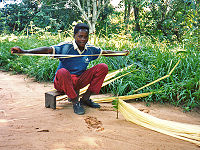
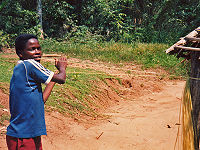 The membrane on the underside of each individual frond leaf is taken off to create a long thin fibre which can be dyed and woven as a textile into products ranging from hats to shoes to decorative mats. Plain raffia fibres are exported and used as garden ties or as a "natural" string in many countries. Especially when one wishes to graft trees, raffia is used to hold plant parts together as this natural rope has many benefits for this purpose.
Raffia palm also provides an important cultural drink. The sap contains sugars. It is traditionally collected by cutting a box in the top of the palm and suspending a large gourd to collect the milky white liquid. Unlike oil palm
s, this process kills the tree. Sap from both the raffia and oil palms can be allowed to ferment over a few days. When first collected from the tree, it is sweet and appears slightly carbonated. As it ages more sugar is converted. The sap is usually called wine. The raffia wine tends to be sweeter at any age when compared to oil palm wine
. Both kinds of palm wine can also be distilled into strong liquors, such as Ogogoro
. Traditionally in some cultures where raffia and/or oil palm are locally available, guests and spirits are offered these drinks from the palm trees.
 The raffia palm is important in societies such as that of the Province of Bohol
in the Philippines, Kuba
of Democratic Republic of the Congo
, Nso of Cameroon
, the Igbo
and Ibibio
/Annang
of southestern Nigeria
and the Yoruba
of southwestern Nigeria, among several other West African ethnic nations.
Genus
In biology, a genus is a low-level taxonomic rank used in the biological classification of living and fossil organisms, which is an example of definition by genus and differentia...
of twenty species of palms
Arecaceae
Arecaceae or Palmae , are a family of flowering plants, the only family in the monocot order Arecales. There are roughly 202 currently known genera with around 2600 species, most of which are restricted to tropical, subtropical, and warm temperate climates...
native to tropical regions of Africa
Africa
Africa is the world's second largest and second most populous continent, after Asia. At about 30.2 million km² including adjacent islands, it covers 6% of the Earth's total surface area and 20.4% of the total land area...
, especially Madagascar
Madagascar
The Republic of Madagascar is an island country located in the Indian Ocean off the southeastern coast of Africa...
, with one species (R. taedigera) also occurring in Central
Central America
Central America is the central geographic region of the Americas. It is the southernmost, isthmian portion of the North American continent, which connects with South America on the southeast. When considered part of the unified continental model, it is considered a subcontinent...
and South America
South America
South America is a continent situated in the Western Hemisphere, mostly in the Southern Hemisphere, with a relatively small portion in the Northern Hemisphere. The continent is also considered a subcontinent of the Americas. It is bordered on the west by the Pacific Ocean and on the north and east...
. They grow up to 16 m tall and are remarkable for their compound pinnate leaves
Leaf
A leaf is an organ of a vascular plant, as defined in botanical terms, and in particular in plant morphology. Foliage is a mass noun that refers to leaves as a feature of plants....
, the longest in the plant kingdom; leaves of R. regalis up to 25.11 m long and 3 m wide are known. The plants are either monocarpic
Monocarpic
Monocarpic plants are those that flower, set seeds and then die. Other terms with the same meaning are hapaxanth and semelparous. The term was first used by Alphonse de Candolle....
, flowering once and then dying after the seeds are mature, or hapaxanthic, with individual stems dying after fruiting but the root system remaining alive and sending up new stems.
Species
|
Raphia regalis Raphia regalis is a species of flowering plant in the Arecaceae family.It is found in Angola, Cameroon, Republic of the Congo, Gabon, and Nigeria.Its natural habitat is subtropical or tropical moist lowland forests.It is threatened by habitat loss.... Becc. Raphia vinifera Raphia vinifera, the West African piassava palm, bamboo palm or West African bass fibre is a palm tree species in the genus Raphia. It is particularly abundant along the creeks of Niger Delta, Cross River, Lagos and Ikorodu in Nigeria. The nut contains bitter oil, which has the property of... P.Beauv. |
Cultivation and uses
Raffia palm also provides an important cultural drink. The sap contains sugars. It is traditionally collected by cutting a box in the top of the palm and suspending a large gourd to collect the milky white liquid. Unlike oil palm
Oil palm
The oil palms comprise two species of the Arecaceae, or palm family. They are used in commercial agriculture in the production of palm oil. The African Oil Palm Elaeis guineensis is native to West Africa, occurring between Angola and Gambia, while the American Oil Palm Elaeis oleifera is native to...
s, this process kills the tree. Sap from both the raffia and oil palms can be allowed to ferment over a few days. When first collected from the tree, it is sweet and appears slightly carbonated. As it ages more sugar is converted. The sap is usually called wine. The raffia wine tends to be sweeter at any age when compared to oil palm wine
Palm wine
Palm wine also called Palm Toddy also called "Kallu" written in Malayalam and கள்ளு in Tamil or simply Toddy is an alcoholic beverage created from the sap of various species of palm tree such as the palmyra, and coconut palms...
. Both kinds of palm wine can also be distilled into strong liquors, such as Ogogoro
Ogogoro
Ogogoro is a west African alcoholic drink, usually brewed locally. It is most popular in Nigeria, where it is known as the country's homebrew...
. Traditionally in some cultures where raffia and/or oil palm are locally available, guests and spirits are offered these drinks from the palm trees.
Bohol
Bohol is an island province of the Philippines located in the Central Visayas region, consisting of Bohol Island and 75 minor surrounding islands. Its capital is Tagbilaran City. With a land area of and a coastline long, Bohol is the tenth largest island of the Philippines...
in the Philippines, Kuba
Kuba Kingdom
The Kuba Kingdom was a pre-colonial Central African state bordered by the Sankuru, Lulua, and Kasai rivers in the southeast of what is today the Democratic Republic of the Congo...
of Democratic Republic of the Congo
Democratic Republic of the Congo
The Democratic Republic of the Congo is a state located in Central Africa. It is the second largest country in Africa by area and the eleventh largest in the world...
, Nso of Cameroon
Cameroon
Cameroon, officially the Republic of Cameroon , is a country in west Central Africa. It is bordered by Nigeria to the west; Chad to the northeast; the Central African Republic to the east; and Equatorial Guinea, Gabon, and the Republic of the Congo to the south. Cameroon's coastline lies on the...
, the Igbo
Igbo people
Igbo people, also referred to as the Ibo, Ebo, Eboans or Heebo are an ethnic group living chiefly in southeastern Nigeria. They speak Igbo, which includes various Igboid languages and dialects; today, a majority of them speak English alongside Igbo as a result of British colonialism...
and Ibibio
Ibibio people
The Ibibio are a people of southeastern Nigeria. They are related to the Anaang and the Efik peoples. During colonial period in Nigeria, the Ibibio Union asked for recognition by the British as a sovereign nation . The Annang, Efik, Ekid, Oron and Ibeno share personal names, culture, and traditions...
/Annang
Annang
The Annang is a cultural and ethnic group that lives in the Coastal Southeast Nigeria...
of southestern Nigeria
Nigeria
Nigeria , officially the Federal Republic of Nigeria, is a federal constitutional republic comprising 36 states and its Federal Capital Territory, Abuja. The country is located in West Africa and shares land borders with the Republic of Benin in the west, Chad and Cameroon in the east, and Niger in...
and the Yoruba
Yoruba people
The Yoruba people are one of the largest ethnic groups in West Africa. The majority of the Yoruba speak the Yoruba language...
of southwestern Nigeria, among several other West African ethnic nations.