


Guinea

Encyclopedia
Guinea , officially the Republic of Guinea , is a country in West Africa
. Formerly known as French Guinea
(Guinée française), it is today sometimes called Guinea-Conakry to distinguish it from its neighbour Guinea-Bissau
. Guinea is divided into eight administrative regions
and subdivided into thirty-three prefectures
. Conakry
is the capital, largest city and economic centre. The other major cities in the country include Labe, Nzérékoré, Kankan, Kindia, Mamou, Boke, and Guéckédou.
Guinea's 10 million people belong to twenty-four ethnic groups
. The largest and most prominent groups are the Fula
43% , Mandinka
35%, and Susu
20%
Guinea has almost 246000 square kilometres (94,981 sq mi). It forms a crescent by curving from its western border on the Atlantic Ocean
toward the east and the south. Its northern border is shared with Guinea-Bissau
, Senegal
, and Mali
, the southern one with Sierra Leone
, Liberia
, and Côte d'Ivoire
. The Niger River
's source is in the Guinea Highlands
in southeastern Guinea.
. Guinea declared its independence from France on 2 October 1958. From independence until the presidential election of 2010, Guinea was governed by a number of autocratic
rulers, which has contributed to making Guinea one of the poorest countries in the world.
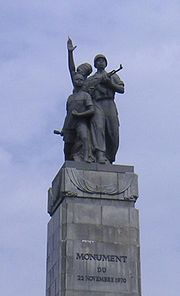
became President upon Guinea's independence. By violent oppression, he ruled until 26 March 1984, when he died unexpectedly. Following a brief coup d'état, Lansana Conté
became the President after Touré. The constitution and parliament were suspended and he established a committee for national recovery. Conté clung to power until his death in 2008.
On 23 December 2008, Moussa Dadis Camara
seized control
of Guinea as the head of a junta
. On 28 September 2009, the junta ordered its soldiers to attack people who had gathered to protest any attempt by Camara to become President. The soldiers went on a rampage of rape, mutilation, and murder.
On 3 December 2009, an aide shot Camara during a dispute about the rampage of September 2009. Camara went to Morocco for medical care. Vice-President (and defense minister) Sékouba Konaté
flew back from Lebanon
to run the country in Camara's absence.
On 12 January 2010 Camara was flown from Morocco to Burkina Faso
. After meeting in Ouagadougou
on 13 and 14 January, Camara, Konaté and Blaise Compaoré
, President of Burkina Faso, produced a formal statement of twelve principles promising a return of Guinea to civilian rule within six months. It was agreed that the military would not contest the forthcoming elections, and Camara would continue his convalescence outside Guinea. On 21 January 2010 the military junta appointed Jean-Marie Doré
as Prime Minister of a six-month transition government, leading up to elections.
The presidential election was set to take place on 27 June and 18 July 2010, it was held as being the first free and fair election since independence in 1958.
The first round took place normally on the 27 June 2010 with ex Prime Minister Cellou Dalein Diallo
and his rival Alpha Condé
emerging as the two runners-up for the second round.
However, due to allegations of electoral fraud, the second round of the election was postponed until 19 September 2010. A delay until 10 October was announced by the electoral commission (CENI), subject to approval by Sekouba Konaté. Yet another delay until 24 October was announced in early October. Elections were finally held on 7 November. Voter turnout was high, and the elections went relatively smoothly.
16 November 2010, Alpha Condé
, the leader of the opposition party Rally of the Guinean People (RGP), was officially declared the winner of a 7 November run-off in Guinea's presidential election. He has promised to reform the security sector and review mining contracts if elected.
On the night of July 18, 2011, President Condé's residence was attacked in an attempted coup. The attack included a fierce firefight and rocket propelled grenades. The president was unharmed. Sixteen people have been charged with the attempted assassination. Most of those indicted are close associates of Sekouba Konaté.
The legal voting age is 18.
of the equator. Guinea is divided into four natural regions with distinct human, geographic, and climatic characteristics:
Guinea is divided into seven administrative regions
and subdivided into thirty-three prefectures
.
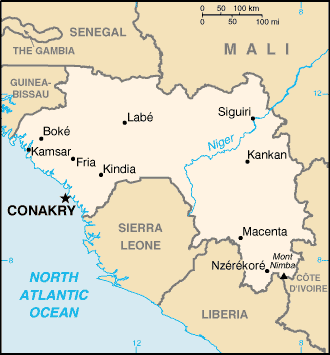 At 245857 km² (94,925.9 sq mi), Guinea is roughly the size of the United Kingdom and slightly smaller than the US state of Oregon
. There are 320 km (198.8 mi) of coastline and a total land border of 3400 km (2,112.7 mi). Its neighbours are Côte d'Ivoire
(Ivory Coast), Guinea-Bissau
, Liberia
, Mali
, Senegal
and Sierra Leone
. It lies mostly between latitudes 7°
and 13°N
, and longitudes 7°
and 15°W
(a small area is west of 15°).
The country is divided into four main regions: the Basse-Coté lowlands
, populated mainly by the Susu ethnic group; the cooler, mountainous Fouta Djallon
that run roughly north-south through the middle of the country, populated by Fulas, the Sahelian Haute-Guinea to the northeast, populated by Malinké
, and the forested jungle regions in the southeast, with several ethnic groups. Guinea's mountains are the source for the Niger, the Gambia, and Senegal Rivers, as well as the numerous rivers flowing to the sea on the west side of the range in Sierra Leone and Ivory Coast.
The highest point in Guinea is Mount Nimba
at 1750 m (5,741.5 ft). Although the Guinean and Ivorian sides of the Nimba Massif
are a UNESCO
Strict Nature Reserve, the portion of the so-called Guinean Backbone continues into Liberia
, where it has been mined for decades; the damage is quite evident in the Nzérékoré Region
at 7°32′17"N 8°29′50"W.
reserves. Guinea also has diamonds, gold, and other metals. The country has great potential for hydroelectric power. Bauxite and alumina are currently the only major exports. Other industries include processing plants for beer, juices, soft drinks and tobacco. Agriculture employs 80% of the nation's labor force. Under French rule, and at the beginning of independence, Guinea was a major exporter of bananas, pineapples, coffee, peanut
s, and palm oil
.
s (metric tons) of bauxite
– and perhaps up to one-half of the world's reserves. In addition, Guinea's mineral wealth includes more than 4-billion tonnes of high-grade iron ore, significant diamond and gold deposits, and undetermined quantities of uranium
. Guinea has considerable potential for growth in agricultural and fishing sectors. Soil, water, and climatic conditions provide opportunities for large-scale irrigated farming and agro industry. Possibilities for investment and commercial activities exist in all these areas, but Guinea's poorly developed infrastructure and rampant corruption continue to present obstacles to large-scale investment projects.
Joint venture bauxite mining and alumina operations in northwest Guinea historically provide about 80% of Guinea's foreign exchange
. Bauxite
is refined into alumina, which is later smelted
into aluminium
. The Compagnie des Bauxites de Guinea (CBG), which exports about 14 million tonnes of high-grade bauxite annually, is the main player in the bauxite industry. CBG is a joint venture, 49% owned by the Guinean Government and 51% by an international consortium known as Halco Mining Inc., a joint venture of Dadco Mining and Rio Tinto Alcan. The Compagnie des Bauxites de Kindia (CBK), a joint venture between the Government of Guinea and Russki Alumina, produces some 2.5 million tonne
s annually, nearly all of which is exported to Russia
and Eastern Europe. Dian Dian, a Guinean/Ukrainian
joint bauxite venture, has a projected production rate of 1000000 t (1,102,311 ST; 984,204 LT) per year, but is not expected to begin operations for several years. The Alumina Compagnie de Guinée
(ACG), which took over the former Friguia Consortium, produced about 2.4 million tonnes in 2004 as raw material for its alumina refinery. The refinery exports about 750,000 tonnes of alumina. Both Global Alumina and Alcoa-Alcan have signed conventions with the Government of Guinea to build large alumina refineries with a combined capacity of about 4 million tonnes per year.
Diamonds and gold also are mined and exported on a large scale. AREDOR, a joint diamond-mining venture between the Guinean Government (50%) and an Australian, British, and Swiss consortium
, began production in 1984 and mined diamonds that are 90% gem quality. Production stopped from 1993 until 1996, when First City Mining, of Canada, purchased the international portion of the consortium. The bulk of diamonds are mined artisanally. The largest gold mining operation in Guinea is a joint venture between the government and Ashanti Goldfields of Ghana
. Société Minière de Dinguiraye (SMD) also has a large gold mining facility in Lero, near the Malian border.
Guinea has large reserves of the steel-making raw material, iron ore. Rio Tinto is the majority owner of the $6 billion Simandou iron ore project, which the firm says is the world's best unexploited resource. Rio Tinto has signed a binding agreement with Aluminum Corp. of China Ltd. to establish the joint venture for the Simandou iron ore project. This project is said to be of the same magnitude as the Pilbara in Western Australia . In the 1960s, Thomas Price, then vice president of US-based steel company Kaiser Steel, said, "I think this [the Pilbara] is one of the most massive ore bodies in the world."
Reforms since 1985 include eliminating restrictions on agriculture and foreign trade, liquidation of some government-owned corporation
s, the creation of a realistic exchange rate
, increased spending on education, and cutting the government bureaucracy. In July 1996, President Lansana Conté
appointed a new government, which promised major economic reforms, including financial and judicial reform, rationalization of public expenditures, and improved government revenue collection. Under 1996 and 1998 International Monetary Fund
(IMF)/World Bank
agreements, Guinea continued fiscal reforms and privatization, and shifted governmental expenditures and internal reforms to the education, health, infrastructure, banking, and justice sectors.
The government revised the private investment code in 1998 to stimulate economic activity in the spirit of free enterprise. The code does not discriminate between foreigners and nationals and allows for repatriation of profits. While the code restricts development of Guinea's hydraulic resources to projects in which Guineans have majority shareholdings and management control, it does contain a clause permitting negotiations of more favourable conditions for investors in specific agreements. Foreign investments outside Conakry are entitled to more favourable terms. A national investment commission has been formed to review all investment proposals. Guinea and the United States have an investment guarantee agreement that offers political risk insurance to American investors through the Overseas Private Investment Corporation
(OPIC). In addition, Guinea has inaugurated an arbitration court system, which allows for the quick resolution of commercial disputes.
Cabinet changes in 1999, which increased corruption, economic mismanagement, and excessive government spending, combined to slow the momentum for economic reform. The informal sector continues to be a major contributor to the economy.
Until June 2001, private operators managed the production, distribution, and fee-collection operations of water and electricity under performance-based contracts with the Government of Guinea. However, the two utilities are plagued by inefficiency and corruption. Foreign private investors in these operations departed the country in frustration.
In 2002, the IMF suspended Guinea's Poverty Reduction and Growth Facility
(PRGF) because the government failed to meet key performance criteria. In reviews of the PRGF, the World Bank noted that Guinea had met its spending goals in targeted social priority sectors. However, spending in other areas, primarily defense, contributed to a significant fiscal deficit. The loss of IMF funds forced the government to finance its debts through Central Bank
advances. The pursuit of unsound economic policies has resulted in imbalances that are proving hard to correct.
Under then-Prime Minister Diallo, the government began a rigorous reform agenda in December 2004 designed to return Guinea to a PRGF with the IMF. Exchange rates have been allowed to float, price controls on gasoline have been loosened, and government spending has been reduced while tax collection has been improved. These reforms have not reduced inflation, which hit 27% in 2004 and 30% in 2005. Currency depreciation is also a concern. The Guinea franc was trading at 2550 to the dollar in January 2005. It hit 5554 to the dollar by October 2006.
Despite the opening in 2005 of a new road connecting Guinea and Mali, most major roadways remain in poor repair, slowing the delivery of goods to local markets. Electricity and water shortages are frequent and sustained, and many businesses are forced to use expensive power generators and fuel to stay open.
Even though there are many problems plaguing Guinea's economy, not all foreign investors are reluctant to come to Guinea. Global Alumina's proposed alumina refinery has a price tag above $2 billion. Alcoa and Alcan are proposing a slightly smaller refinery worth about $1.5 billion. Taken together, they represent the largest private investment in sub-Saharan Africa
since the Chad-Cameroon oil pipeline
. Also, Hyperdynamics Corporation, an American oil company, signed an agreement in 2006 to develop Guinea's offshore Senegal Basin oil deposits in a concession of 31000 square miles (80,289.6 km²); it is pursuing seismic exploration.
On 13 October 2009, Guinean Mines Minister Mahmoud Thiam announced that the China International Fund
would invest more than $7bn (£4.5bn) in infrastructure. In return, he said the firm would be a "strategic partner" in all mining projects in the mineral-rich nation. He said the firm would help build ports, railway lines, power plants, low-cost housing and even a new administrative centre in the capital, Conakry
. In September 2011, Mohamed Lamine Fofana, the Mines Minister following the 2010 election, said that the government had overturned the agreement by the the ex-military junta.
Youth unemployment, however, remains a large problem. Guinea needs an adequate policy to address the concerns of the urban youth. The problem is the disparity between their life and what they see on television. As the youth cannot find jobs, seeing the economic power and consumerism of richer countries only serves to frustrate them further.
with Hyperdynamics Corporation (Houston, TX) in 2006 to explore a large offshore tract, recently in partnership with Dana Petroleum PLC (Aberdeen, United Kingdom). The initial well, the Sabu-1, is scheduled to begin drilling in October 2011 at a site in approximately 700 meters of water. The Sabu-1 will target a four-way anticline
prospect with upper Cretaceous sands and is anticipated to be drilled to a total depth of 3,600 meters.
ceased operating in the mid-1980s . Domestic air services are intermittent. Most vehicles in Guinea are 20+ years old, and cabs are any four-door vehicle which the owner has designated as being for hire. Locals, nearly entirely without vehicles of their own, rely upon these taxis (which charge per seat) and small buses to take them around town and across the country. There is some river traffic on the Niger and Milo rivers. Horses and donkeys pull carts, primarily to transport construction materials.
Iron mining at Simandou
(South) in the southeast beginning in 2007 and at Kalia in the east is likely to result in the construction of a new heavy-duty standard gauge
railway and deepwater port. Iron mining at Simandou
North will load to a new port near Buchanan
in Liberia, in exchange for which, rehabilitation of the Conakry
to Kankan
line will occur.
Conakry International Airport
is the largest airport in the country, with flights to other cities in Africa as well as to Europe.
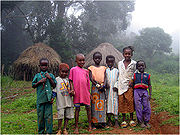 The population of Guinea is estimated at 10.2 million. Conakry
, the capital and largest city, is the hub of Guinea's economy, commerce, education, and culture.
(Malinke), Susu
, Pular
(Fulfulde or Fulani), Kissi
, Kpelle
, and Loma
.
It is also quite common that the people of Guinea also like to use their feet for sign language. They do this through series of dances and also by sitting on the ground and using their feet more effectively. This is mostly seen in the Western area.
, comprise 34,2% of the population and are mostly found in the Futa djallon region. The Mandinka
, also known as Mandingo or Malinké, comprise 32,5% of the population and are mostly found in eastern Guinea concentrated around the Kankan
and Kissidougou
prefectures. The Soussou, comprising 15,8%, are predominantly in western areas around the capital Conakry
, Forécariah
, and Kindia
. Smaller ethnic groups make up the remaining 17,5% of the population, including Kpelle, Kissi, Zialo, Toma and others. The Mandinka, Soussou or(Jallonke, Kpelle, Kissi, Zialo, Toma, Jahanke all speak Mande branch of Niger-Congo language family. Thus this group combined together constitute majority of the population.
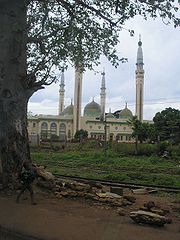 Islam is the majority religion. Approximately 85% of the population is Muslim, while 8% is Christian, and 7% holds traditional animist beliefs. Guinean Muslims are generally Sunni
and Sufi; there are relatively few Shi'a
in Guinea. Christian groups include Roman Catholics, Anglicans
, Baptists, Seventh-day Adventists
, and other Evangelical
groups. Jehovah's Witnesses
are active in the country and recognized by the Government. There is a small Baha'i
community. There are small numbers of Hindus
, Buddhists
, and traditional Chinese religious groups among the expatriate
community.
Guinea's armed forces are divided into five branches – army, navy, air force, the paramilitary National Gendarmerie
and the Republican Guard
– whose chiefs report to the Chairman of the Joint Chiefs of Staff, who is subordinate to the Minister of Defense. In addition, regime security forces include the National Police Force (Sûreté National). The Gendarmerie, responsible for internal security, has a strength of several thousand.
The army, with about 15,000 personnel, is by far the largest branch of the armed forces. It is mainly responsible for protecting the state borders, the security of administered territories, and defending Guinea's national interests. Air force personnel total about 700. The force's equipment includes several Russian-supplied fighter planes and transports. The navy has about 900 personnel and operates several small patrol craft and barges.
of 1987 formally promoted community-based methods of increasing accessibility of drugs and health care
services to the population, in part by implementing user fees. The new strategy dramatically increased accessibility through community-based healthcare (including community ownership and local budgeting), resulting in more efficient and equitable provision of services. A comprehensive strategy was extended to all areas of health care, with subsequent improvement in health indicators and improvement in health care efficiency and cost.
Guinea's public health code is defined by Law No. L/97/021/AN of 19 June 1997 promulgating the Public Health Code. The law provides for the protection and promotion of health and for the rights and duties of the individual, the family, and community throughout the territory of the Republic of Guinea.
In June 2011, the Guinean government announced the establishment of an air solidarity levy on all flights taking off from national soil, with funds going to UNITAID
to support expanded access to treatment for HIV/AIDS, TB and malaria. Guinea is among the growing number of countries and development partners using market-based transactions taxes and other innovative financing
mechanisms to expand financing options for health care in resource-limited settings.
released a report on The State of the World's Midwifery. It contained new data on the midwifery workforce and policies relating to newborn and maternal mortality for 58 countries. The 2010 maternal mortality rate per 100,000 births for Guinea is 680. This is compared with 859.9 in 2008 and 964.7 in 1990. The under 5 mortality rate, per 1,000 births is 146 and the neonatal mortality as a percentage of under 5's mortality is 29. The aim of this report is to highlight ways in which the Millennium Development Goals
can be achieved, particularly Goal 4 – Reduce child mortality and Goal 5 – improve maternal death. In Guinea the number of midwives per 1,000 live births is 1 and 1 in 26 shows us the lifetime risk of death for pregnant women.
to face a generalized epidemic.
An estimated 170,000 adults and children were infected at the end of 2004. The spread of the epidemic was attributed to factors such as proximity to high-prevalence countries, a large refugee population, internal displacement and subregional instability.
became popular in the 1960s after Guinean independence.
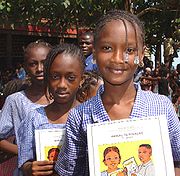 The literacy rate of Guinea is one of the lowest in the world: in 2003 it was estimated that only 29.5% of adults were literate (42.6% of males and 18.1% of females).
Primary education is compulsory for 8 years, but most children do not attend for so long, and many do not go to school at all. In 1999, primary school attendance was 40 percent.Children, particularly girls, are kept out of school in order to assist their parents with domestic work or agriculture.
West Africa
West Africa or Western Africa is the westernmost region of the African continent. Geopolitically, the UN definition of Western Africa includes the following 16 countries and an area of approximately 5 million square km:-Flags of West Africa:...
. Formerly known as French Guinea
French Guinea
French Guinea was a French colonial possession in West Africa. Its borders, while changed over time, were in 1958 those of the independent nation of Guinea....
(Guinée française), it is today sometimes called Guinea-Conakry to distinguish it from its neighbour Guinea-Bissau
Guinea-Bissau
The Republic of Guinea-Bissau is a country in West Africa. It is bordered by Senegal to the north, and Guinea to the south and east, with the Atlantic Ocean to its west....
. Guinea is divided into eight administrative regions
Regions of Guinea
||Guinea is divided into 8 administrative regions which are further subdivided into 34 prefectures.*Boké Region*Conakry Region*Faranah Region*Kankan Region*Kindia Region*Labé Region*Mamou Region*Nzérékoré Region-See also:*ISO 3166-2:GN...
and subdivided into thirty-three prefectures
Prefectures of Guinea
||Guinea is divided into 8 regions among which the national capital Conakry ranks as a special zone. The other 7 regions are further subdivided into 33 prefectures...
. Conakry
Conakry
Conakry is the capital and largest city of Guinea. Conakry is a port city on the Atlantic Ocean and serves as the economic, financial and cultural centre of Guinea with a 2009 population of 1,548,500...
is the capital, largest city and economic centre. The other major cities in the country include Labe, Nzérékoré, Kankan, Kindia, Mamou, Boke, and Guéckédou.
Guinea's 10 million people belong to twenty-four ethnic groups
Demographics of Guinea
This article is about the demographic features of the population of Guinea, including population density, ethnicity, education level, health of the populace, economic status, religious affiliations and other aspects of the population....
. The largest and most prominent groups are the Fula
Fula people
Fula people or Fulani or Fulbe are an ethnic group spread over many countries, predominantly in West Africa, but found also in Central Africa and Sudanese North Africa...
43% , Mandinka
Mandinka people
The Mandinka, Malinke are one of the largest ethnic groups in West Africa with an estimated population of eleven million ....
35%, and Susu
Susu people
The Soso are a major Mande ethnic group living primarily in Guinea. Smaller communities are also located in the neighboring countries of Sierra Leone, Senegal and Mali. The Susu are descendants of the thirteenth century Mali Empire...
20%
Guinea has almost 246000 square kilometres (94,981 sq mi). It forms a crescent by curving from its western border on the Atlantic Ocean
Atlantic Ocean
The Atlantic Ocean is the second-largest of the world's oceanic divisions. With a total area of about , it covers approximately 20% of the Earth's surface and about 26% of its water surface area...
toward the east and the south. Its northern border is shared with Guinea-Bissau
Guinea-Bissau
The Republic of Guinea-Bissau is a country in West Africa. It is bordered by Senegal to the north, and Guinea to the south and east, with the Atlantic Ocean to its west....
, Senegal
Senegal
Senegal , officially the Republic of Senegal , is a country in western Africa. It owes its name to the Sénégal River that borders it to the east and north...
, and Mali
Mali
Mali , officially the Republic of Mali , is a landlocked country in Western Africa. Mali borders Algeria on the north, Niger on the east, Burkina Faso and the Côte d'Ivoire on the south, Guinea on the south-west, and Senegal and Mauritania on the west. Its size is just over 1,240,000 km² with...
, the southern one with Sierra Leone
Sierra Leone
Sierra Leone , officially the Republic of Sierra Leone, is a country in West Africa. It is bordered by Guinea to the north and east, Liberia to the southeast, and the Atlantic Ocean to the west and southwest. Sierra Leone covers a total area of and has an estimated population between 5.4 and 6.4...
, Liberia
Liberia
Liberia , officially the Republic of Liberia, is a country in West Africa. It is bordered by Sierra Leone on the west, Guinea on the north and Côte d'Ivoire on the east. Liberia's coastline is composed of mostly mangrove forests while the more sparsely populated inland consists of forests that open...
, and Côte d'Ivoire
Côte d'Ivoire
The Republic of Côte d'Ivoire or Ivory Coast is a country in West Africa. It has an area of , and borders the countries Liberia, Guinea, Mali, Burkina Faso and Ghana; its southern boundary is along the Gulf of Guinea. The country's population was 15,366,672 in 1998 and was estimated to be...
. The Niger River
Niger River
The Niger River is the principal river of western Africa, extending about . Its drainage basin is in area. Its source is in the Guinea Highlands in southeastern Guinea...
's source is in the Guinea Highlands
Guinea Highlands
The Guinea Highlands is a densely forested mountainous plateau extending from the southern Fouta Djallon highlands in southeastern Guinea through to northern Sierra Leone and Liberia, and northwestern Côte d'Ivoire ....
in southeastern Guinea.
History
The land that is now Guinea belonged to a series of African empires until France colonized it in the 1890s, and made it part of French West AfricaFrench West Africa
French West Africa was a federation of eight French colonial territories in Africa: Mauritania, Senegal, French Sudan , French Guinea , Côte d'Ivoire , Upper Volta , Dahomey and Niger...
. Guinea declared its independence from France on 2 October 1958. From independence until the presidential election of 2010, Guinea was governed by a number of autocratic
Autocracy
An autocracy is a form of government in which one person is the supreme power within the state. It is derived from the Greek : and , and may be translated as "one who rules by himself". It is distinct from oligarchy and democracy...
rulers, which has contributed to making Guinea one of the poorest countries in the world.
Governments since independence
Ahmed Sékou TouréAhmed Sékou Touré
Ahmed Sékou Touré was an African political leader and President of Guinea from 1958 to his death in 1984...
became President upon Guinea's independence. By violent oppression, he ruled until 26 March 1984, when he died unexpectedly. Following a brief coup d'état, Lansana Conté
Lansana Conté
Lansana Conté was the second President of Guinea from 3 April 1984 until his death. He was a Muslim and a member of the Susu ethnic group.-Early life:...
became the President after Touré. The constitution and parliament were suspended and he established a committee for national recovery. Conté clung to power until his death in 2008.
On 23 December 2008, Moussa Dadis Camara
Moussa Dadis Camara
Captain Moussa Dadis Camara now called Moïse Dadis Camara is an ex-officer of the Guinean army who served as the President of the Republic of Guinea's National Council for Democracy and Development , which seized power in a military coup d'état on 23 December 2008 after the...
seized control
2008 Guinean coup d'état
The 2008 Guinean coup d'état was a Guinean military coup d'état that occurred in Guinea on 23 December 2008, shortly after the death of long-time President Lansana Conté...
of Guinea as the head of a junta
Military junta
A junta or military junta is a government led by a committee of military leaders. The term derives from the Spanish language junta meaning committee, specifically a board of directors...
. On 28 September 2009, the junta ordered its soldiers to attack people who had gathered to protest any attempt by Camara to become President. The soldiers went on a rampage of rape, mutilation, and murder.
On 3 December 2009, an aide shot Camara during a dispute about the rampage of September 2009. Camara went to Morocco for medical care. Vice-President (and defense minister) Sékouba Konaté
Sékouba Konaté
Brigadier General Sékouba Konaté is an officer of the Guinean army and formerly served as the Vice President of its military junta, the National Council for Democracy and Development. After attending military academy, he received the nickname "El Tigre" for his action in battle, and gained such...
flew back from Lebanon
Lebanon
Lebanon , officially the Republic of LebanonRepublic of Lebanon is the most common term used by Lebanese government agencies. The term Lebanese Republic, a literal translation of the official Arabic and French names that is not used in today's world. Arabic is the most common language spoken among...
to run the country in Camara's absence.
On 12 January 2010 Camara was flown from Morocco to Burkina Faso
Burkina Faso
Burkina Faso – also known by its short-form name Burkina – is a landlocked country in west Africa. It is surrounded by six countries: Mali to the north, Niger to the east, Benin to the southeast, Togo and Ghana to the south, and Côte d'Ivoire to the southwest.Its size is with an estimated...
. After meeting in Ouagadougou
Ouagadougou
Ouagadougou is the capital of Burkina Faso and the administrative, communications, cultural and economic center of the nation. It is also the country's largest city, with a population of 1,475,223 . The city's name is often shortened to Ouaga. The inhabitants are called ouagalais...
on 13 and 14 January, Camara, Konaté and Blaise Compaoré
Blaise Compaoré
Blaise Compaoré has been the President of Burkina Faso since 1987 following a coup d'état that ousted then-President Thomas Sankara. In 2011, a mutiny by soldiers over unpaid housing allowances forced him to flee the capital for his hometown...
, President of Burkina Faso, produced a formal statement of twelve principles promising a return of Guinea to civilian rule within six months. It was agreed that the military would not contest the forthcoming elections, and Camara would continue his convalescence outside Guinea. On 21 January 2010 the military junta appointed Jean-Marie Doré
Jean-Marie Doré
Jean-Marie Doré is a Guinean politician who was Prime Minister of Guinea from January 2010 to December 2010. Doré, who is the President of the Union for the Progress of Guinea , was an opposition leader for years before being chosen to head a transitional government that was in place during the...
as Prime Minister of a six-month transition government, leading up to elections.
The presidential election was set to take place on 27 June and 18 July 2010, it was held as being the first free and fair election since independence in 1958.
The first round took place normally on the 27 June 2010 with ex Prime Minister Cellou Dalein Diallo
Cellou Dalein Diallo
Cellou Dalein Diallo is a Guinean economist and politician who was Prime Minister of Guinea from 2004 to 2006. Currently he is President of the Union of Democratic Forces of Guinea , an opposition party....
and his rival Alpha Condé
Alpha Condé
Alpha Condé is a Guinean politician who has been President of Guinea since December 2010. He was a political science professor at the University of Paris and spent decades in opposition to a succession of regimes in Guinea, unsuccessfully running against President Lansana Conté in the 1993 and...
emerging as the two runners-up for the second round.
However, due to allegations of electoral fraud, the second round of the election was postponed until 19 September 2010. A delay until 10 October was announced by the electoral commission (CENI), subject to approval by Sekouba Konaté. Yet another delay until 24 October was announced in early October. Elections were finally held on 7 November. Voter turnout was high, and the elections went relatively smoothly.
16 November 2010, Alpha Condé
Alpha Condé
Alpha Condé is a Guinean politician who has been President of Guinea since December 2010. He was a political science professor at the University of Paris and spent decades in opposition to a succession of regimes in Guinea, unsuccessfully running against President Lansana Conté in the 1993 and...
, the leader of the opposition party Rally of the Guinean People (RGP), was officially declared the winner of a 7 November run-off in Guinea's presidential election. He has promised to reform the security sector and review mining contracts if elected.
On the night of July 18, 2011, President Condé's residence was attacked in an attempted coup. The attack included a fierce firefight and rocket propelled grenades. The president was unharmed. Sixteen people have been charged with the attempted assassination. Most of those indicted are close associates of Sekouba Konaté.
The legal voting age is 18.
Regions and prefectures
The Republic of Guinea covers 245857 square kilometres (94,926 sq mi) of West Africa about 10 degrees north10th parallel north
The 10th parallel north is a circle of latitude that is 10 degrees north of the Earth's equatorial plane. It crosses Africa, the Indian Ocean, South Asia, Southeast Asia, the Pacific Ocean, Central America, South America and the Atlantic Ocean....
of the equator. Guinea is divided into four natural regions with distinct human, geographic, and climatic characteristics:
- Maritime Guinea (La Guinée Maritime) covers 18% of the country
- Mid-Guinea (La Moyenne-Guinée) covers 20% of the country
- Upper-Guinea (La Haute-Guinée) covers 38% of the country
- Forested Guinea (Guinée forestièreGuinée ForestièreGuinée Forestière is a forested mountainous region in southeastern Guinea, extending into northeastern Sierra Leone. It is one of four natural regions into which Guinea is divided and covers 23% of the country...
) covers 23% of the country, and is both forested and mountainous
Guinea is divided into seven administrative regions
Regions of Guinea
||Guinea is divided into 8 administrative regions which are further subdivided into 34 prefectures.*Boké Region*Conakry Region*Faranah Region*Kankan Region*Kindia Region*Labé Region*Mamou Region*Nzérékoré Region-See also:*ISO 3166-2:GN...
and subdivided into thirty-three prefectures
Prefectures of Guinea
||Guinea is divided into 8 regions among which the national capital Conakry ranks as a special zone. The other 7 regions are further subdivided into 33 prefectures...
.
| Region | Capital | Population(2010) |
|---|---|---|
| Conakry Region | Conakry Conakry Conakry is the capital and largest city of Guinea. Conakry is a port city on the Atlantic Ocean and serves as the economic, financial and cultural centre of Guinea with a 2009 population of 1,548,500... |
2,325,190 |
| Nzérékoré Region Nzérékoré Region The Nzérékoré Region is a region in the southern part of Guinea. Its capital and largest city is Nzérékoré. It is one of the eight regions of Guinea... |
Nzérékoré Nzérékoré Nzérékoré, also spelled N'Zérékoré, is the largest city in the Guinée Forestière region of south-eastern Guinea and is capital of the Nzérékoré Prefecture. It is Guinea's third largest city . It was the centre of a rising against French rule in 1911. It is now known as a market town, and for its... |
1,528,908 |
| Kankan Region Kankan Region The Kankan Region is located in eastern Guinea. It is bordered by the countries of Mali and Côte d'Ivoire and the Guinean regions of Nzérékoré and Faranah.Prefectures of Kankan Region include:*Kankan Prefecture*Kérouané Prefecture*Kouroussa Prefecture... |
Kankan Kankan Kankan is the largest city in Guinea in land area, and the third largest in population at 207,790 . The city is located on the Milo River in eastern Guinea and lying about 345 miles east of Conakry.... |
1,427,568 |
| Kindia Region Kindia Region The Kindia Region is located in western Guinea. It is bordered by the country of Sierra Leone and the Guinean regions of Conakry, Labé, Mamou, and Boké.Prefectures of Kindia Region include:*Coyah Prefecture*Dubréka Prefecture*Forécariah Prefecture... |
Kindia Kindia Kindia is the third largest city in Guinea, lying about 85 miles north east of the nation's capital Conakry.Population 181,126 . - Overview :... |
1,326,727 |
| Boké Region Boké Region The Boké Region is located in western Guinea. It is bordered by the countries of Senegal and Guinea-Bissau and the Guinean regions of Kindia and Labé... |
Boké Boké Boké is the capital city of Boké Prefecture within the Boké Region of Lower Guinea near the border with Guinea-Bissau. It is also a sub-prefecture of Guinea. Located along the Rio Nuñez which flows to its not-too-distant mouth on the Atlantic Ocean, Boké is a port. It is known for the Fortin de... |
965,767 |
| Labé Region Labé Region The Labé Region is located in north-central Guinea. It is bordered by the countries of Senegal and Mali and the Guinean regions of Faranah, Kindia, Mamou, and Boké.Prefectures of Labé Region include:*Koubia Prefecture*Labé Prefecture*Lélouma Prefecture... |
Labé Labé Labé is the main city and administrative capital of the Fouta Djallon region of Guinea. It has a population of about 58,649 . It is the second largest city in the country after the capital Conakry... |
903,386 |
| Faranah Region Faranah Region The Faranah Region is located in east-central Guinea. It is bordered by the countries of Sierra Leone and Mali and the Guinean regions of Kankan, Mamou, Nzérékoré, and Labé.-Prefectures:Prefectures of Faranah Region include:*Dabola Prefecture... |
Faranah Faranah Faranah is a town and sub-prefecture in central Guinea, lying by the River Niger.Population 87,083 . The town is mainly inhabited by the Mandinka people.- History :... |
839,083 |
| Mamou Region Mamou Region The Mamou Region is located in central Guinea. It is bordered by the country of Sierra Leone and the Guinean regions of Faranah, Labé, and Kindia.Mamou Region's prefectures include:*Dalaba Prefecture*Mamou Prefecture*Pita Prefecture... |
Mamou Mamou Mamou is a city and sub prefecture in a valley of the Fouta Djallon area of Guinea. Population 76,269 .- History :It grew around the railway line from Conakry to Kankan and soon became the local administrative headquarters. Its main industry used to be until the 1990s decade meat processing, while... |
719,011 |
- The capital ConakryConakryConakry is the capital and largest city of Guinea. Conakry is a port city on the Atlantic Ocean and serves as the economic, financial and cultural centre of Guinea with a 2009 population of 1,548,500...
with a population of 1,548,470 ranks as a special zone.
Geography
Oregon
Oregon is a state in the Pacific Northwest region of the United States. It is located on the Pacific coast, with Washington to the north, California to the south, Nevada on the southeast and Idaho to the east. The Columbia and Snake rivers delineate much of Oregon's northern and eastern...
. There are 320 km (198.8 mi) of coastline and a total land border of 3400 km (2,112.7 mi). Its neighbours are Côte d'Ivoire
Côte d'Ivoire
The Republic of Côte d'Ivoire or Ivory Coast is a country in West Africa. It has an area of , and borders the countries Liberia, Guinea, Mali, Burkina Faso and Ghana; its southern boundary is along the Gulf of Guinea. The country's population was 15,366,672 in 1998 and was estimated to be...
(Ivory Coast), Guinea-Bissau
Guinea-Bissau
The Republic of Guinea-Bissau is a country in West Africa. It is bordered by Senegal to the north, and Guinea to the south and east, with the Atlantic Ocean to its west....
, Liberia
Liberia
Liberia , officially the Republic of Liberia, is a country in West Africa. It is bordered by Sierra Leone on the west, Guinea on the north and Côte d'Ivoire on the east. Liberia's coastline is composed of mostly mangrove forests while the more sparsely populated inland consists of forests that open...
, Mali
Mali
Mali , officially the Republic of Mali , is a landlocked country in Western Africa. Mali borders Algeria on the north, Niger on the east, Burkina Faso and the Côte d'Ivoire on the south, Guinea on the south-west, and Senegal and Mauritania on the west. Its size is just over 1,240,000 km² with...
, Senegal
Senegal
Senegal , officially the Republic of Senegal , is a country in western Africa. It owes its name to the Sénégal River that borders it to the east and north...
and Sierra Leone
Sierra Leone
Sierra Leone , officially the Republic of Sierra Leone, is a country in West Africa. It is bordered by Guinea to the north and east, Liberia to the southeast, and the Atlantic Ocean to the west and southwest. Sierra Leone covers a total area of and has an estimated population between 5.4 and 6.4...
. It lies mostly between latitudes 7°
7th parallel north
The 7th parallel north is a circle of latitude that is 7 degrees north of the Earth's equatorial plane. It crosses Africa, the Indian Ocean, South Asia, Southeast Asia, the Pacific Ocean, South America and the Atlantic Ocean....
and 13°N
13th parallel north
The 13th parallel north is a circle of latitude that is 13 degrees north of the Earth's equatorial plane. It crosses Africa, Asia, the Indian Ocean, the Pacific Ocean, Central America, the Caribbean and the Atlantic Ocean....
, and longitudes 7°
7th meridian west
The meridian 7° west of Greenwich is a line of longitude that extends from the North Pole across the Arctic Ocean, the Atlantic Ocean, Europe, Africa, the Southern Ocean, and Antarctica to the South Pole....
and 15°W
15th meridian west
The meridian 15° west of Greenwich is a line of longitude that extends from the North Pole across the Arctic Ocean, Greenland, Iceland, the Atlantic Ocean, Africa, the Southern Ocean, and Antarctica to the South Pole....
(a small area is west of 15°).
The country is divided into four main regions: the Basse-Coté lowlands
Guinean forest-savanna mosaic
The Guinean forest-savanna mosaic is an ecoregion of West Africa, a band of interlaced forest, savanna, and grassland running east to west and dividing the tropical moist forests near the coast from the West Sudanian savanna of the interior.-Setting:...
, populated mainly by the Susu ethnic group; the cooler, mountainous Fouta Djallon
Fouta Djallon
Fouta Djallon is a highland region in the centre of Guinea, West Africa. The indigenous name is Fuuta-Jaloo...
that run roughly north-south through the middle of the country, populated by Fulas, the Sahelian Haute-Guinea to the northeast, populated by Malinké
Mandinka people
The Mandinka, Malinke are one of the largest ethnic groups in West Africa with an estimated population of eleven million ....
, and the forested jungle regions in the southeast, with several ethnic groups. Guinea's mountains are the source for the Niger, the Gambia, and Senegal Rivers, as well as the numerous rivers flowing to the sea on the west side of the range in Sierra Leone and Ivory Coast.
The highest point in Guinea is Mount Nimba
Mount Nimba
Mount Richard-Molard is a mountain along the border of Côte d'Ivoire and Guinea in West Africa. At 1,752 m it is the highest point in both nations. The mountain is the highest peak of the Nimba Range , straddling the border between the two countries and Liberia...
at 1750 m (5,741.5 ft). Although the Guinean and Ivorian sides of the Nimba Massif
Mount Nimba Strict Nature Reserve
Mount Nimba Strict Nature Reserve is a protected area and UNESCO World Heritage Site in both Guinea and Côte d'Ivoire. A further extension of the reserve to include areas in Liberia has also been proposed....
are a UNESCO
UNESCO
The United Nations Educational, Scientific and Cultural Organization is a specialized agency of the United Nations...
Strict Nature Reserve, the portion of the so-called Guinean Backbone continues into Liberia
Liberia
Liberia , officially the Republic of Liberia, is a country in West Africa. It is bordered by Sierra Leone on the west, Guinea on the north and Côte d'Ivoire on the east. Liberia's coastline is composed of mostly mangrove forests while the more sparsely populated inland consists of forests that open...
, where it has been mined for decades; the damage is quite evident in the Nzérékoré Region
Nzérékoré Region
The Nzérékoré Region is a region in the southern part of Guinea. Its capital and largest city is Nzérékoré. It is one of the eight regions of Guinea...
at 7°32′17"N 8°29′50"W.
Economy
Guinea has abundant natural resources including 25% or more of the world's known bauxiteBauxite
Bauxite is an aluminium ore and is the main source of aluminium. This form of rock consists mostly of the minerals gibbsite Al3, boehmite γ-AlO, and diaspore α-AlO, in a mixture with the two iron oxides goethite and hematite, the clay mineral kaolinite, and small amounts of anatase TiO2...
reserves. Guinea also has diamonds, gold, and other metals. The country has great potential for hydroelectric power. Bauxite and alumina are currently the only major exports. Other industries include processing plants for beer, juices, soft drinks and tobacco. Agriculture employs 80% of the nation's labor force. Under French rule, and at the beginning of independence, Guinea was a major exporter of bananas, pineapples, coffee, peanut
Peanut
The peanut, or groundnut , is a species in the legume or "bean" family , so it is not a nut. The peanut was probably first cultivated in the valleys of Peru. It is an annual herbaceous plant growing tall...
s, and palm oil
Palm oil
Palm oil, coconut oil and palm kernel oil are edible plant oils derived from the fruits of palm trees. Palm oil is extracted from the pulp of the fruit of the oil palm Elaeis guineensis; palm kernel oil is derived from the kernel of the oil palm and coconut oil is derived from the kernel of the...
.
Mining
Richly endowed with minerals, Guinea possesses over 25 billion tonneTonne
The tonne, known as the metric ton in the US , often put pleonastically as "metric tonne" to avoid confusion with ton, is a metric system unit of mass equal to 1000 kilograms. The tonne is not an International System of Units unit, but is accepted for use with the SI...
s (metric tons) of bauxite
Bauxite
Bauxite is an aluminium ore and is the main source of aluminium. This form of rock consists mostly of the minerals gibbsite Al3, boehmite γ-AlO, and diaspore α-AlO, in a mixture with the two iron oxides goethite and hematite, the clay mineral kaolinite, and small amounts of anatase TiO2...
– and perhaps up to one-half of the world's reserves. In addition, Guinea's mineral wealth includes more than 4-billion tonnes of high-grade iron ore, significant diamond and gold deposits, and undetermined quantities of uranium
Uranium
Uranium is a silvery-white metallic chemical element in the actinide series of the periodic table, with atomic number 92. It is assigned the chemical symbol U. A uranium atom has 92 protons and 92 electrons, of which 6 are valence electrons...
. Guinea has considerable potential for growth in agricultural and fishing sectors. Soil, water, and climatic conditions provide opportunities for large-scale irrigated farming and agro industry. Possibilities for investment and commercial activities exist in all these areas, but Guinea's poorly developed infrastructure and rampant corruption continue to present obstacles to large-scale investment projects.
Joint venture bauxite mining and alumina operations in northwest Guinea historically provide about 80% of Guinea's foreign exchange
Foreign exchange reserves
Foreign-exchange reserves in a strict sense are 'only' the foreign currency deposits and bonds held by central banks and monetary authorities. However, the term in popular usage commonly includes foreign exchange and gold, Special Drawing Rights and International Monetary Fund reserve positions...
. Bauxite
Bauxite
Bauxite is an aluminium ore and is the main source of aluminium. This form of rock consists mostly of the minerals gibbsite Al3, boehmite γ-AlO, and diaspore α-AlO, in a mixture with the two iron oxides goethite and hematite, the clay mineral kaolinite, and small amounts of anatase TiO2...
is refined into alumina, which is later smelted
Smelting
Smelting is a form of extractive metallurgy; its main use is to produce a metal from its ore. This includes iron extraction from iron ore, and copper extraction and other base metals from their ores...
into aluminium
Aluminium
Aluminium or aluminum is a silvery white member of the boron group of chemical elements. It has the symbol Al, and its atomic number is 13. It is not soluble in water under normal circumstances....
. The Compagnie des Bauxites de Guinea (CBG), which exports about 14 million tonnes of high-grade bauxite annually, is the main player in the bauxite industry. CBG is a joint venture, 49% owned by the Guinean Government and 51% by an international consortium known as Halco Mining Inc., a joint venture of Dadco Mining and Rio Tinto Alcan. The Compagnie des Bauxites de Kindia (CBK), a joint venture between the Government of Guinea and Russki Alumina, produces some 2.5 million tonne
Tonne
The tonne, known as the metric ton in the US , often put pleonastically as "metric tonne" to avoid confusion with ton, is a metric system unit of mass equal to 1000 kilograms. The tonne is not an International System of Units unit, but is accepted for use with the SI...
s annually, nearly all of which is exported to Russia
Russia
Russia or , officially known as both Russia and the Russian Federation , is a country in northern Eurasia. It is a federal semi-presidential republic, comprising 83 federal subjects...
and Eastern Europe. Dian Dian, a Guinean/Ukrainian
Ukraine
Ukraine is a country in Eastern Europe. It has an area of 603,628 km², making it the second largest contiguous country on the European continent, after Russia...
joint bauxite venture, has a projected production rate of 1000000 t (1,102,311 ST; 984,204 LT) per year, but is not expected to begin operations for several years. The Alumina Compagnie de Guinée
Alumina Company of Guinea
The Alumina Company of Guinea is a bauxite mining company based in Fria, Guinea. They are the main aluminium producing company in the country, and was once part-owned by the government of Guinea in Conakry and by the Reynolds Metals Company of Richmond, Virginia of the United States...
(ACG), which took over the former Friguia Consortium, produced about 2.4 million tonnes in 2004 as raw material for its alumina refinery. The refinery exports about 750,000 tonnes of alumina. Both Global Alumina and Alcoa-Alcan have signed conventions with the Government of Guinea to build large alumina refineries with a combined capacity of about 4 million tonnes per year.
Diamonds and gold also are mined and exported on a large scale. AREDOR, a joint diamond-mining venture between the Guinean Government (50%) and an Australian, British, and Swiss consortium
Consortium
A consortium is an association of two or more individuals, companies, organizations or governments with the objective of participating in a common activity or pooling their resources for achieving a common goal....
, began production in 1984 and mined diamonds that are 90% gem quality. Production stopped from 1993 until 1996, when First City Mining, of Canada, purchased the international portion of the consortium. The bulk of diamonds are mined artisanally. The largest gold mining operation in Guinea is a joint venture between the government and Ashanti Goldfields of Ghana
Ghana
Ghana , officially the Republic of Ghana, is a country located in West Africa. It is bordered by Côte d'Ivoire to the west, Burkina Faso to the north, Togo to the east, and the Gulf of Guinea to the south...
. Société Minière de Dinguiraye (SMD) also has a large gold mining facility in Lero, near the Malian border.
Guinea has large reserves of the steel-making raw material, iron ore. Rio Tinto is the majority owner of the $6 billion Simandou iron ore project, which the firm says is the world's best unexploited resource. Rio Tinto has signed a binding agreement with Aluminum Corp. of China Ltd. to establish the joint venture for the Simandou iron ore project. This project is said to be of the same magnitude as the Pilbara in Western Australia . In the 1960s, Thomas Price, then vice president of US-based steel company Kaiser Steel, said, "I think this [the Pilbara] is one of the most massive ore bodies in the world."
Problems and reforms
The Guinean Government adopted policies in the 1990s to return commercial activity to the private sector, promote investment, reduce the role of the state in the economy, and improve the administrative and judicial framework. Guinea has the potential to develop, if the government carries out its announced policy reforms, and if the private sector responds appropriately. So far, corruption and favouritism, lack of long-term political stability, and the lack of a transparent budgeting process continue to dampen foreign investor interest in major projects in Guinea.Reforms since 1985 include eliminating restrictions on agriculture and foreign trade, liquidation of some government-owned corporation
Government-owned corporation
A government-owned corporation, state-owned company, state-owned entity, state enterprise, publicly owned corporation, government business enterprise, or parastatal is a legal entity created by a government to undertake commercial activities on behalf of an owner government...
s, the creation of a realistic exchange rate
Exchange rate
In finance, an exchange rate between two currencies is the rate at which one currency will be exchanged for another. It is also regarded as the value of one country’s currency in terms of another currency...
, increased spending on education, and cutting the government bureaucracy. In July 1996, President Lansana Conté
Lansana Conté
Lansana Conté was the second President of Guinea from 3 April 1984 until his death. He was a Muslim and a member of the Susu ethnic group.-Early life:...
appointed a new government, which promised major economic reforms, including financial and judicial reform, rationalization of public expenditures, and improved government revenue collection. Under 1996 and 1998 International Monetary Fund
International Monetary Fund
The International Monetary Fund is an organization of 187 countries, working to foster global monetary cooperation, secure financial stability, facilitate international trade, promote high employment and sustainable economic growth, and reduce poverty around the world...
(IMF)/World Bank
World Bank
The World Bank is an international financial institution that provides loans to developing countries for capital programmes.The World Bank's official goal is the reduction of poverty...
agreements, Guinea continued fiscal reforms and privatization, and shifted governmental expenditures and internal reforms to the education, health, infrastructure, banking, and justice sectors.
The government revised the private investment code in 1998 to stimulate economic activity in the spirit of free enterprise. The code does not discriminate between foreigners and nationals and allows for repatriation of profits. While the code restricts development of Guinea's hydraulic resources to projects in which Guineans have majority shareholdings and management control, it does contain a clause permitting negotiations of more favourable conditions for investors in specific agreements. Foreign investments outside Conakry are entitled to more favourable terms. A national investment commission has been formed to review all investment proposals. Guinea and the United States have an investment guarantee agreement that offers political risk insurance to American investors through the Overseas Private Investment Corporation
Overseas Private Investment Corporation
The Overseas Private Investment Corporation is an independent agency of the United States Government that mobilizes U.S. private sector investment in new and emerging markets overseas in order to support both the sustainable economic development of those markets and the creation of American jobs...
(OPIC). In addition, Guinea has inaugurated an arbitration court system, which allows for the quick resolution of commercial disputes.
Cabinet changes in 1999, which increased corruption, economic mismanagement, and excessive government spending, combined to slow the momentum for economic reform. The informal sector continues to be a major contributor to the economy.
Until June 2001, private operators managed the production, distribution, and fee-collection operations of water and electricity under performance-based contracts with the Government of Guinea. However, the two utilities are plagued by inefficiency and corruption. Foreign private investors in these operations departed the country in frustration.
In 2002, the IMF suspended Guinea's Poverty Reduction and Growth Facility
Poverty Reduction and Growth Facility
The Poverty Reduction and Growth Facility is an arm of the International Monetary Fund which lends to the world's poorest countries. It was created in September 1999, replacing the Enhanced Structural Adjustment Facility....
(PRGF) because the government failed to meet key performance criteria. In reviews of the PRGF, the World Bank noted that Guinea had met its spending goals in targeted social priority sectors. However, spending in other areas, primarily defense, contributed to a significant fiscal deficit. The loss of IMF funds forced the government to finance its debts through Central Bank
Central bank
A central bank, reserve bank, or monetary authority is a public institution that usually issues the currency, regulates the money supply, and controls the interest rates in a country. Central banks often also oversee the commercial banking system of their respective countries...
advances. The pursuit of unsound economic policies has resulted in imbalances that are proving hard to correct.
Under then-Prime Minister Diallo, the government began a rigorous reform agenda in December 2004 designed to return Guinea to a PRGF with the IMF. Exchange rates have been allowed to float, price controls on gasoline have been loosened, and government spending has been reduced while tax collection has been improved. These reforms have not reduced inflation, which hit 27% in 2004 and 30% in 2005. Currency depreciation is also a concern. The Guinea franc was trading at 2550 to the dollar in January 2005. It hit 5554 to the dollar by October 2006.
Despite the opening in 2005 of a new road connecting Guinea and Mali, most major roadways remain in poor repair, slowing the delivery of goods to local markets. Electricity and water shortages are frequent and sustained, and many businesses are forced to use expensive power generators and fuel to stay open.
Even though there are many problems plaguing Guinea's economy, not all foreign investors are reluctant to come to Guinea. Global Alumina's proposed alumina refinery has a price tag above $2 billion. Alcoa and Alcan are proposing a slightly smaller refinery worth about $1.5 billion. Taken together, they represent the largest private investment in sub-Saharan Africa
Sub-Saharan Africa
Sub-Saharan Africa as a geographical term refers to the area of the African continent which lies south of the Sahara. A political definition of Sub-Saharan Africa, instead, covers all African countries which are fully or partially located south of the Sahara...
since the Chad-Cameroon oil pipeline
Chad-Cameroon Petroleum Development and Pipeline Project
The Chad–Cameroon Petroleum Development and Pipeline Project is a controversial project to develop the production capacity of oilfields near Doba in southern Chad, and to create a 1,070 km pipeline to transport the oil to facilities on the coast of Cameroon. The project was launched on...
. Also, Hyperdynamics Corporation, an American oil company, signed an agreement in 2006 to develop Guinea's offshore Senegal Basin oil deposits in a concession of 31000 square miles (80,289.6 km²); it is pursuing seismic exploration.
On 13 October 2009, Guinean Mines Minister Mahmoud Thiam announced that the China International Fund
China International Fund
China International Fund is a Chinese-owned officially private company based in Hong Kong that describes its major businesses as including "large-scale national reconstruction projects and infrastructure construction in developing countries". The CIF and its associated companies in Hong Kong and...
would invest more than $7bn (£4.5bn) in infrastructure. In return, he said the firm would be a "strategic partner" in all mining projects in the mineral-rich nation. He said the firm would help build ports, railway lines, power plants, low-cost housing and even a new administrative centre in the capital, Conakry
Conakry
Conakry is the capital and largest city of Guinea. Conakry is a port city on the Atlantic Ocean and serves as the economic, financial and cultural centre of Guinea with a 2009 population of 1,548,500...
. In September 2011, Mohamed Lamine Fofana, the Mines Minister following the 2010 election, said that the government had overturned the agreement by the the ex-military junta.
Youth unemployment, however, remains a large problem. Guinea needs an adequate policy to address the concerns of the urban youth. The problem is the disparity between their life and what they see on television. As the youth cannot find jobs, seeing the economic power and consumerism of richer countries only serves to frustrate them further.
Oil
Guinea signed a Production sharing agreementProduction sharing agreement
Production sharing agreements are a common type of contract signed between a government and a resource extraction company concerning how much of the resource extracted from the country each will receive....
with Hyperdynamics Corporation (Houston, TX) in 2006 to explore a large offshore tract, recently in partnership with Dana Petroleum PLC (Aberdeen, United Kingdom). The initial well, the Sabu-1, is scheduled to begin drilling in October 2011 at a site in approximately 700 meters of water. The Sabu-1 will target a four-way anticline
Anticline
In structural geology, an anticline is a fold that is convex up and has its oldest beds at its core. The term is not to be confused with antiform, which is a purely descriptive term for any fold that is convex up. Therefore if age relationships In structural geology, an anticline is a fold that is...
prospect with upper Cretaceous sands and is anticipated to be drilled to a total depth of 3,600 meters.
Transportation
The railway which operated from Conakry to KankanKankan
Kankan is the largest city in Guinea in land area, and the third largest in population at 207,790 . The city is located on the Milo River in eastern Guinea and lying about 345 miles east of Conakry....
ceased operating in the mid-1980s . Domestic air services are intermittent. Most vehicles in Guinea are 20+ years old, and cabs are any four-door vehicle which the owner has designated as being for hire. Locals, nearly entirely without vehicles of their own, rely upon these taxis (which charge per seat) and small buses to take them around town and across the country. There is some river traffic on the Niger and Milo rivers. Horses and donkeys pull carts, primarily to transport construction materials.
Iron mining at Simandou
Simandou
Simandou is a 110 km long range of hills located in the Nzérékoré Region of southeastern Guinea, in the country's mountainous, forested Guinée Forestière region...
(South) in the southeast beginning in 2007 and at Kalia in the east is likely to result in the construction of a new heavy-duty standard gauge
Standard gauge
The standard gauge is a widely-used track gauge . Approximately 60% of the world's existing railway lines are built to this gauge...
railway and deepwater port. Iron mining at Simandou
Simandou
Simandou is a 110 km long range of hills located in the Nzérékoré Region of southeastern Guinea, in the country's mountainous, forested Guinée Forestière region...
North will load to a new port near Buchanan
Buchanan, Liberia
Buchanan is the third largest city in Liberia, lying on Waterhouse Bay, part of the Atlantic Ocean. It is referred to as Gbezohn in the local Bassa language. As of the 2008 census, Buchanan has a population of 34,270. Of this, 16,984 were male and 17,286 female....
in Liberia, in exchange for which, rehabilitation of the Conakry
Conakry
Conakry is the capital and largest city of Guinea. Conakry is a port city on the Atlantic Ocean and serves as the economic, financial and cultural centre of Guinea with a 2009 population of 1,548,500...
to Kankan
Kankan
Kankan is the largest city in Guinea in land area, and the third largest in population at 207,790 . The city is located on the Milo River in eastern Guinea and lying about 345 miles east of Conakry....
line will occur.
Conakry International Airport
Conakry International Airport
Conakry International Airport , also known as Gbessia International Airport, is an airport located in Conakry, the capital of the Republic of Guinea in West Africa. It is divided into domestic and international terminals...
is the largest airport in the country, with flights to other cities in Africa as well as to Europe.
Demography
Conakry
Conakry is the capital and largest city of Guinea. Conakry is a port city on the Atlantic Ocean and serves as the economic, financial and cultural centre of Guinea with a 2009 population of 1,548,500...
, the capital and largest city, is the hub of Guinea's economy, commerce, education, and culture.
Languages
The official language of Guinea is French. Other significant languages spoken are ManinkaManinka language
Maninka, or more precisely Eastern Maninka, is the name of several closely related languages and dialects of the southeastern Manding subgroup of the Mande branch of the Niger–Congo languages...
(Malinke), Susu
Susu language
Sosoxui is the language of the Soso people of Guinea, West Africa. It is in the Mande language family.It is one of the national languages of Guinea and spoken mainly in the coastal region of the country. The language was also used by people in present-day Guinea as a trade language.e.g...
, Pular
Fula language
The Fula or Fulani language is a language of West Africa. It is spoken as a first language by the and related groups from Senegambia and Guinea to Cameroon and Sudan...
(Fulfulde or Fulani), Kissi
Kissi language
Kissi is a language split into two parts, northern and southern. The northern dialect is spoken in Guinea and in Sierra Leone. In its northern form, it often uses loanwords from the Malinke and the Mende language....
, Kpelle
Kpelle language
The Kpelle language is spoken by the Kpelle people and is part of the Mande family of languages. Guinean Kpelle [gkp] , spoken by half a million people, concentrated primarily, but not exclusively, in the forest regions of Guinea, whose capital, Nzérékoré, is the third largest city in Guinea and...
, and Loma
Loma language
Loma is a Mande language spoken by the Loma people of Liberia and Guinea.Dialects of Loma proper in Liberia are Gizima, Wubomei, Ziema, Bunde, Buluyiema...
.
It is also quite common that the people of Guinea also like to use their feet for sign language. They do this through series of dances and also by sitting on the ground and using their feet more effectively. This is mostly seen in the Western area.
Ethnicity
The population of Guinea comprises about 24 ethnic groups (mostly Black). The Fulas or FulaniFula people
Fula people or Fulani or Fulbe are an ethnic group spread over many countries, predominantly in West Africa, but found also in Central Africa and Sudanese North Africa...
, comprise 34,2% of the population and are mostly found in the Futa djallon region. The Mandinka
Mandinka people
The Mandinka, Malinke are one of the largest ethnic groups in West Africa with an estimated population of eleven million ....
, also known as Mandingo or Malinké, comprise 32,5% of the population and are mostly found in eastern Guinea concentrated around the Kankan
Kankan Prefecture
Kankan is a prefecture located in the Kankan Region of Guinea. The capital is Kankan. The prefecture covers an area of 11,564 km.² and has an estimated population of 235,000.-Sub-prefectures:...
and Kissidougou
Kissidougou Prefecture
Kissidougou is a prefecture located in the Faranah Region of Guinea. The capital is Kissidougou. The prefecture covers an area of 8,872 km.² and has an estimated population of 214,000.-Sub-prefectures:...
prefectures. The Soussou, comprising 15,8%, are predominantly in western areas around the capital Conakry
Conakry
Conakry is the capital and largest city of Guinea. Conakry is a port city on the Atlantic Ocean and serves as the economic, financial and cultural centre of Guinea with a 2009 population of 1,548,500...
, Forécariah
Forécariah
Forécariah is a Sub-prefecture and town located in western Guinea.Population 21,710 . It is the capital of Forécariah Prefecture.- Famous people :It was the birthplace of Henri Duparc, the film director.- Mining :...
, and Kindia
Kindia
Kindia is the third largest city in Guinea, lying about 85 miles north east of the nation's capital Conakry.Population 181,126 . - Overview :...
. Smaller ethnic groups make up the remaining 17,5% of the population, including Kpelle, Kissi, Zialo, Toma and others. The Mandinka, Soussou or(Jallonke, Kpelle, Kissi, Zialo, Toma, Jahanke all speak Mande branch of Niger-Congo language family. Thus this group combined together constitute majority of the population.
Religion
Sunni Islam
Sunni Islam is the largest branch of Islam. Sunni Muslims are referred to in Arabic as ʾAhl ūs-Sunnah wa āl-Ǧamāʿah or ʾAhl ūs-Sunnah for short; in English, they are known as Sunni Muslims, Sunnis or Sunnites....
and Sufi; there are relatively few Shi'a
Shi'a Islam
Shia Islam is the second largest denomination of Islam. The followers of Shia Islam are called Shi'ites or Shias. "Shia" is the short form of the historic phrase Shīʻatu ʻAlī , meaning "followers of Ali", "faction of Ali", or "party of Ali".Like other schools of thought in Islam, Shia Islam is...
in Guinea. Christian groups include Roman Catholics, Anglicans
Anglicanism
Anglicanism is a tradition within Christianity comprising churches with historical connections to the Church of England or similar beliefs, worship and church structures. The word Anglican originates in ecclesia anglicana, a medieval Latin phrase dating to at least 1246 that means the English...
, Baptists, Seventh-day Adventists
Seventh-day Adventist Church
The Seventh-day Adventist Church is a Protestant Christian denomination distinguished by its observance of Saturday, the original seventh day of the Judeo-Christian week, as the Sabbath, and by its emphasis on the imminent second coming of Jesus Christ...
, and other Evangelical
Evangelicalism
Evangelicalism is a Protestant Christian movement which began in Great Britain in the 1730s and gained popularity in the United States during the series of Great Awakenings of the 18th and 19th century.Its key commitments are:...
groups. Jehovah's Witnesses
Jehovah's Witnesses
Jehovah's Witnesses is a millenarian restorationist Christian denomination with nontrinitarian beliefs distinct from mainstream Christianity. The religion reports worldwide membership of over 7 million adherents involved in evangelism, convention attendance of over 12 million, and annual...
are active in the country and recognized by the Government. There is a small Baha'i
Bahá'í Faith
The Bahá'í Faith is a monotheistic religion founded by Bahá'u'lláh in 19th-century Persia, emphasizing the spiritual unity of all humankind. There are an estimated five to six million Bahá'ís around the world in more than 200 countries and territories....
community. There are small numbers of Hindus
Hinduism
Hinduism is the predominant and indigenous religious tradition of the Indian Subcontinent. Hinduism is known to its followers as , amongst many other expressions...
, Buddhists
Buddhism
Buddhism is a religion and philosophy encompassing a variety of traditions, beliefs and practices, largely based on teachings attributed to Siddhartha Gautama, commonly known as the Buddha . The Buddha lived and taught in the northeastern Indian subcontinent some time between the 6th and 4th...
, and traditional Chinese religious groups among the expatriate
Expatriate
An expatriate is a person temporarily or permanently residing in a country and culture other than that of the person's upbringing...
community.
Military
Guinea's armed forces are divided into five branches – army, navy, air force, the paramilitary National Gendarmerie
Gendarmerie
A gendarmerie or gendarmery is a military force charged with police duties among civilian populations. Members of such a force are typically called "gendarmes". The Shorter Oxford English Dictionary describes a gendarme as "a soldier who is employed on police duties" and a "gendarmery, -erie" as...
and the Republican Guard
Republican Guard
Republican Guard is the organization of a republic which serves to protect the President and the government. Usually synonymous with Presidential Guard.* Albanian Republican Guard* Algerian Republican Guard...
– whose chiefs report to the Chairman of the Joint Chiefs of Staff, who is subordinate to the Minister of Defense. In addition, regime security forces include the National Police Force (Sûreté National). The Gendarmerie, responsible for internal security, has a strength of several thousand.
The army, with about 15,000 personnel, is by far the largest branch of the armed forces. It is mainly responsible for protecting the state borders, the security of administered territories, and defending Guinea's national interests. Air force personnel total about 700. The force's equipment includes several Russian-supplied fighter planes and transports. The navy has about 900 personnel and operates several small patrol craft and barges.
Healthcare
Guinea has been reorganizing its health system since the Bamako InitiativeBamako Initiative
The Bamako Initiative was a formal statement adopted by African health ministers in 1987 in Bamako, Mali, to implement strategies designed to increase the availability of essential drugs and other healthcare services for Sub-Saharan Africans....
of 1987 formally promoted community-based methods of increasing accessibility of drugs and health care
Health care
Health care is the diagnosis, treatment, and prevention of disease, illness, injury, and other physical and mental impairments in humans. Health care is delivered by practitioners in medicine, chiropractic, dentistry, nursing, pharmacy, allied health, and other care providers...
services to the population, in part by implementing user fees. The new strategy dramatically increased accessibility through community-based healthcare (including community ownership and local budgeting), resulting in more efficient and equitable provision of services. A comprehensive strategy was extended to all areas of health care, with subsequent improvement in health indicators and improvement in health care efficiency and cost.
Guinea's public health code is defined by Law No. L/97/021/AN of 19 June 1997 promulgating the Public Health Code. The law provides for the protection and promotion of health and for the rights and duties of the individual, the family, and community throughout the territory of the Republic of Guinea.
In June 2011, the Guinean government announced the establishment of an air solidarity levy on all flights taking off from national soil, with funds going to UNITAID
Unitaid
UNITAID is an international facility for the purchase of drugs against HIV/AIDS, Malaria and Tuberculosis. It was founded in September 2006 on the initiative of Brazil and France, and is to a great part financed by so called innovative development financing mechanisms, namely a solidarity levy on...
to support expanded access to treatment for HIV/AIDS, TB and malaria. Guinea is among the growing number of countries and development partners using market-based transactions taxes and other innovative financing
Innovative financing
Innovative financing refers to a range of non-traditional mechanisms to raise additional funds for development aid through "innovative" projects such as micro-contributions, taxes, public-private partnerships and market-based financial transactions....
mechanisms to expand financing options for health care in resource-limited settings.
Maternal and Child Health Care
In June 2011, the United Nations Population FundUnited Nations Population Fund
The United Nations Population Fund is a UN organization. The work of the UNFPA involves promotion of the right of every woman, man and child to enjoy a life of health and equal opportunity. This is done through major national and demographic surveys and with population censuses...
released a report on The State of the World's Midwifery. It contained new data on the midwifery workforce and policies relating to newborn and maternal mortality for 58 countries. The 2010 maternal mortality rate per 100,000 births for Guinea is 680. This is compared with 859.9 in 2008 and 964.7 in 1990. The under 5 mortality rate, per 1,000 births is 146 and the neonatal mortality as a percentage of under 5's mortality is 29. The aim of this report is to highlight ways in which the Millennium Development Goals
Millennium Development Goals
The Millennium Development Goals are eight international development goals that all 193 United Nations member states and at least 23 international organizations have agreed to achieve by the year 2015...
can be achieved, particularly Goal 4 – Reduce child mortality and Goal 5 – improve maternal death. In Guinea the number of midwives per 1,000 live births is 1 and 1 in 26 shows us the lifetime risk of death for pregnant women.
HIV/AIDS
The first cases of HIV/AIDS were reported in 1986. Though levels of AIDS are significantly lower than in a number of other African countries, as of 2005, Guinea was considered by the World Health OrganizationWorld Health Organization
The World Health Organization is a specialized agency of the United Nations that acts as a coordinating authority on international public health. Established on 7 April 1948, with headquarters in Geneva, Switzerland, the agency inherited the mandate and resources of its predecessor, the Health...
to face a generalized epidemic.
An estimated 170,000 adults and children were infected at the end of 2004. The spread of the epidemic was attributed to factors such as proximity to high-prevalence countries, a large refugee population, internal displacement and subregional instability.
Culture
Like other West African countries, Guinea has a rich musical tradition. The group Bembeya JazzBembeya Jazz
Bembaya Jazz National is a Guinean jazz group that gained fame in the 1960s for their infectious Afropop rhythms. They are considered one of the most significant bands in Guinean music. Many of their recordings are based on traditional folk music in the country and have been fused with jazz and...
became popular in the 1960s after Guinean independence.
Education
Primary education is compulsory for 8 years, but most children do not attend for so long, and many do not go to school at all. In 1999, primary school attendance was 40 percent.Children, particularly girls, are kept out of school in order to assist their parents with domestic work or agriculture.