
|
|
|
|
Kalahari Desert
|
| |
|
| |
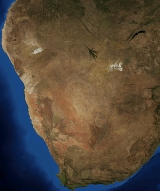
The Kalahari Desert is a large, arid desert area in southwestern Sub-Saharan Africa extending 900,000 kmē (225,000 sq. mi.), covering much of Botswana and parts of Namibia and South Africa. It has huge tracts of excellent grazing after good rains. ved from the Tswana word Kgala, meaning "the great thirst", or Khalagari, Kgalagadi or Kalagare, meaning "a waterless place", the Kalahari has vast areas covered by red sand without any permanent surface water.

Discussion
Ask a question about 'Kalahari Desert'
Start a new discussion about 'Kalahari Desert'
Answer questions from other users
|
Recent Posts

Encyclopedia
The Kalahari Desert is a large, arid desert area in southwestern Sub-Saharan Africa extending 900,000 kmē (225,000 sq. mi.), covering much of Botswana and parts of Namibia and South Africa. It has huge tracts of excellent grazing after good rains.
Climate
Derived from the Tswana word Kgala, meaning "the great thirst", or Khalagari, Kgalagadi or Kalagare, meaning "a waterless place", the Kalahari has vast areas covered by red sand without any permanent surface water. Drainage is by dry valleys, seasonally inundated pans, and the large salt pans of the Makgadikgadi Pan in Botswana and Etosha Pan in Namibia. However, the Kalahari is not a true desert. Parts of the Kalahari receive over 250 mm of erratic rainfall annually and are quite well vegetated; it is only truly arid in the southwest (under 175 mm of rain annually), making the Kalahari a fossil desert. Summer temperatures in the Kalahari range from 20 to 45°C (68113°F).
The Kalahari Desert was once a much wetter place. The ancient Lake Makgadikgadi dominated the area, covering the Makgadikgadi Pan and other areas, until its final drainage some 10,000 years ago. It may have once covered as much as 275,000 kmē and was approximately 30 m deep.
Ecology
Despite its aridity, the Kalahari supports a variety of fauna and flora. The native flora includes acacia trees and many other herbs and grasses. Some of the areas within the Kalahari are seasonal wetlands, such as the Makgadikgadi Pans of Botswana. This area, for example, supports numerous halophilic species, and in the rainy season, tens of thousands of flamingos visit these pans.
Game reserves
The Kalahari has a number of game reserves—the Central Kalahari Game Reserve (CKGR, the world's second largest protected area), Khutse Game Reserve and the Kgalagadi Transfrontier Park. Animals that live in the region include brown hyenas, lions, meerkats, giraffes, warthogs, jackals, several species of antelope (including the eland, gemsbok, springbok, hartebeest, steenbok, kudu, and duiker), and many species of birds and reptiles. Vegetation in the Kalahari consists mainly of grasses and acacias, but there are over 400 identified plant species present (including the wild watermelon, or Tsamma melon). Camel rides across the desert are also available.
Population
The San people, or Bushmen, have lived in the Kalahari for 20,000 years as hunter-gatherers. That means they survive by hunting wild game with bows and arrows and gathering edible plants, such as berries, melons and nuts, as well as insects. Bushmen rarely drink water; they get most of their water requirements from plant roots and desert melons found on or under the desert floor. They often store water in the blown-out shells of ostrich eggs. The San have their own characteristic language that includes clicking sounds. These Bushmen live in huts built from local materials—the frame is made of branches, and the roof is thatched with long grass. The Bantu-speaking Tswana, Kgalagadi, and Herero and a small number of European settlers also live in the Kalahari.
Settlements within the Kalahari
Botswana
Namibia
South Africa
- Rietfontein
- Noenieput
- Severn
The Kalahari desert in popular culture
- A Far Off Place, film, starring Reese Witherspoon and Ethan Randall, based on the books A Story Like the Wind and A Far Off Place by Laurens Van Der Post
- The Gods Must Be Crazy, film
- Meerkat Manor, television series documenting the Kalahari Meerkat Project
- Survivorman, survival television series
- Top Gear, British television series, featuring an episode following a desert challenge in which Jeremy Clarkson, Richard Hammond, and James May attempt to drive three old cars across Botswana, including the Kalahari Desert
- The Power of the Sword, novel by Wilbur Smith
- "Lions of the Kalahari", song by Sam Roberts
- The Lost World of The Kalahari, novel by Laurens van der Post
See also
External links
|
| |
|
|