
|
|
|
|
Igbo people
|
| |
|
| |
Igbo people (also referred to as the Ibo(e), Ebo(e), Eboans or Heebo) are an ethnic group living chiefly in southeastern Nigeria. They speak Igbo, which includes various Igboid languages and dialects; today, a majority of them speak English alongside Igbo as a result of British colonialism. Igbo people are among the three largest and most influential ethnic groups in Nigeria; the other two are the Hausa and the Yoruba people.

Discussion
Ask a question about 'Igbo people'
Start a new discussion about 'Igbo people'
Answer questions from other users
|
Recent Posts

Encyclopedia
Igbo people (also referred to as the Ibo(e), Ebo(e), Eboans or Heebo) are an ethnic group living chiefly in southeastern Nigeria. They speak Igbo, which includes various Igboid languages and dialects; today, a majority of them speak English alongside Igbo as a result of British colonialism. Igbo people are among the three largest and most influential ethnic groups in Nigeria; the other two are the Hausa and the Yoruba people. Due to the effects of migration and the Atlantic slave trade, there are Igbo populations in countries such as Cameroon and Equatorial Guinea, as well as outside Africa. Their exact population outside Africa is unknown, but today many African Americans and Afro Caribbeans are of Igbo descent. In rural areas, the Igbo are mostly farmers. Their most important crop is the yam; celebrations are held annually to celebrate its harvesting. Other staple crops include cassava, and taro.
Before British colonialism, the Igbo were a politically fragmented group. Various subgroups were set according to clan, lineage, village affiliation and dialect. There was no centralized chieftaincy, hereditary aristocracy, or kingship customs except in the kingdoms of Nri, Arochukwu and Onitsha. This political system changed significantly under British colonialism in the 19th century; Eze (kings) were introduced into most local communities by Frederick Lugard as "Warrant Chiefs".
By the mid-20th century, a strong sense of an Igbo identity developed. Certain conflicts with other Nigerian ethnicities led to the Igbo dominant Eastern Nigeria, seceding from Nigeria to create the independent state of Biafra. The Nigerian-Biafran war (6 July 1967 – 15 January 1970) broke out shortly after. The end of the war led to the defeated Republic of Biafra being reabsorbed back into Nigeria.
Identity
It would be difficult to define a single Igbo identity because of their heavily fragmented and autonomous communities. Before knowledge of Europeans and full exposure to other ethnic groups neighbouring them, the Igbo had not had a strong identity as one people. Upon engaging in a close textual reading of Olaudah Equiano's 1789 narrative, historian Alexander X. Byrd argues that the Igbo identity has its origins in slavery, emerging in the "holding patterns" of coastal towns in West Africa.
As in the case of most ethnic groups located in sub-saharan Africa, the British and fellow Europeans had identified the Igbo as a tribe. Chinua Achebe, among other scholars, had challenged this because of its negative connotations and possible wrong definiton. The suggestion was that the Igbo should be defined as a nation similar to the Cherokee or Japanese, although the Igbo do not have an official recognized state of their own.
Etymology
There are several theories regarding the etymology of the word Igbo. It is presumed that it has Sudanic origin, derived from the verb gboo. Charles Kingsley Meek, writer of Law and Authority in a Nigerian Tribe, had suggested that it may originate from the neighboring Igala, coming from the word onigbo, a word for slave. As of now, the origin of Igbo is still unclear.
Igbo had been spelled Ibo by British colonialist until the 20th century. Ibo can still be found being used, but Igbo is considered the correct and preferred spelling by the Igbo and has been used in many different publications. The word now has three uses, to describe indigenous Igbo territory, domestic speakers of the language and the language spoken by them.
History
Origin
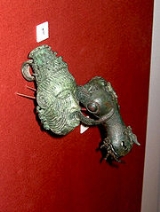
, now at the British Museum.]]
Pottery dated at around 4500 B.C.E. that shows similarities with later Igbo work has been found at Nsukka, and pottery and tools at nearby Ibagwa; the traditions of the Umueri clan have as their source the Anambra valley, and in the 1970s the Owerri, Okigwi, Orlu and Awka divisions were generally supposed from linguistic and cultural evidence to have been "an Igbo heartland".
There is evidence that the ancestors of the Igbo people and most of their neighbors were the proto-Kwa group, which came from the African Great Lakes and Mountains of the Moon of East and Central Africa and settled at the old Sahara grasslands. It was the desertification of the Sahara that forced some of the Kwa people to migrate farther south to the north of the Niger Benue confluence and founded Nok.
Elements of the Kwa people migrated south of this confluence and later became the Igala, Idoma, Yoruba, Igbo, and possibly the Tiv peoples. The Kwa people's first areas of settlement in Igboland was the North Central uplands (Nsukka-Afikpo-Awka-Orlu) over a 5000 year period. Elements from the Orlu area migrated south, east, and northeast while elements from the Awka area migrated westwards across the Niger river and became the Igbo subgroup now known as the Anioma. The Igbo share linguistic ties with the Bini, Igala, Yoruba, and Idoma peoples.
Nri Kingdom
The city of Nri is considered to be the foundation of Igbo culture. Nri and Aguleri, where the Igbo creation myth originates, are in the territory of the Umueri clan, who trace their lineages back to the patriarchal king-figure, Eri. Eri's origins are unclear, though he has been described as a "sky being" sent by Chukwu (God). He has been characterized as having first given societal order to the people of Anambra.
Archaeological evidence suggests that Nri hegemony in Igboland may go back as far as the 9th century, and royal burials have been unearthed dating to at least the 10th century. Eri, the god-like founder of Nri, is believed to have settled the region around 948 with other related Igbo cultures following after in the 13th century. The first Eze Nri (King of Nri), Ěfikuánim, followed directly after him. According to Igbo oral tradition, his reign started in 1043. At least one historian puts Ěfikuánim's reign much later, around 1225 AD.
The Kingdom of Nri was a religio-polity, a sort of theocratic state, that developed in the central heartland of the Igbo region. The Nri had a taboo symbolic code with six types. These included human (such as the birth of twins), animal (such as killing or eating of pythons), object, temporal, behavioral, speech and place taboos. The rules regarding these taboos were used to educate and govern Nri's subjects. This meant that, while certain Igbo may have lived under different formal administration, all followers of the Igbo religion had to abide by the rules of the faith and obey its representative on earth, the Eze Nri.
Traditional society
Traditional Igbo political organization was based on a quasi-democratic republican system of government. In tight knit communities, this system guaranteed its citizens equality, as opposed to a feudalist system with a king ruling over subjects. This government system was witnessed by the Portuguese who first arrived and met with the Igbo people in the 15th century. With the exception of a few notable Igbo towns such as Onitsha, which had kings called Obi, and places like the Nri Kingdom and Arochukwu, which had priest kings; Igbo communities and area governments were overwhelmingly ruled solely by a republican consultative assembly of the common people. Communities were usually governed and administered by a council of elders.
Although title holders were respected because of their accomplishments and capabilities, they were never revered as kings, but often performed special functions given to them by such assemblies. This way of governing was immensely different from most other communities of Western Africa, and only shared by the Ewe of Ghana.
Mathematics in traditional Igbo society is evident in their calendar, banking system and strategic betting game called Okwe. In their indigenous calendar, a week had four days, a month consisted of seven weeks and thirteen months made a year. In the last month, an extra day was added. This calendar is still used in indigenous Igbo villages and towns to determine market days. Their banking system for loans and savings, called Isusu, is still in use today and they settled law matters via mediators.
Used as a ceremonial script by secret societies, the Igbo had a traditional ideographic set of symbols called Nsibidi, originating from the neighboring Ejagham people. Igbo people produced bronzes from as early as the 9th century, some of which have been found at the town of Igbo Ukwu, Anambra state.
A system of slavery existed among the Igbo after and before the arrival and knowledge of Europeans. Slavery in Igbo areas was described by Olaudah Equiano in his narrative. He describes the conditions of the slaves in his community of Essaka, and points out the difference between the treatment of slaves under the Igbo in Essaka, and those in the custody of Europeans in West Indies:
The Niger coast acted as a contact point between African and European traders from the years 1434–1807. This contact between the Africans and Europeans began with the Portuguese, then the Dutch and finally the British. Even prior to European contact, Igbo trade routes stretched as far as Mecca, Medina and Jeddah.
Transatlantic slave trade
was a multi-lingual American actor and writer whose father was of Igbo descent.]]
The transatlantic slave trade which took place between the 16th and late 19th century affected the Igbo heavily. Most Igbo slaves were taken from the Bight of Biafra (also known as the Bight of Bonny). This area included modern day southeastern Nigeria, Western Cameroon, Equatorial Guinea and parts of Northern Gabon. Major trade ports for goods and slaves in the area included Bonny and Calabar Town. A large number of slaves from the Bight of Biafra would have been Igbo. Slaves were usually kidnapped from the shore or were bought from fellow Africans by European slave traders to be taken to the Americas and Europe. 14.6% of slaves were taken from the Bight of Biafra between 1650 and 1900, the third greatest percentage in the era of the transatlantic slave trade. Igbo slaves were known for being rebellious and having a high count of suicide in defiance of slavery. For still unknown reasons, Igbo women were highly sought after.
Contrary to common belief, European slave traders were fairly informed about various African ethnic groups, leading to slavers targeting certain ethnic groups which plantation owners preferred. Ethnic groups consequently became fairly saturated in certain parts of the Americas. The Igbo where dispersed to colonies such as Jamaica, Cuba, Haiti, Barbados, United States, Belize, Trinidad and Tobago among others. Elements of Igbo culture can still be found in these places. For example, in Jamaican Patois the Igbo word unu, meaning you plural, is still used as well as the term red Ibo (or red eboe) which describes a fair skinned black person, because of the reported prevalence of fair skin among the Igbo. The word Bim, a name for Barbados, was commonly used by enslaved Barbadians (Bajans). This word is said to derive from the Igbo language, derived from bi mu (or either bem, Ndi bem, Nwanyi ibem or Nwoke ibem) , but it may have other origins (see: Barbados etymology).
In the United Sates the Igbo were found common in the state of Maryland (ironically, recent immigrants still are) and Virginia, and of a total of 37,000 Africans that arrived in Virginia from Calabar in the 1700s, 30,000 were Igbo according to Douglas Chambers.
Colonial period
The arrival of the British in the 1870s and increased encounters between the Igbo and other ethnicities near the Niger River led to a deepening sense of a distinct Igbo ethnic identity. The Igbo proved remarkably decisive and enthusiastic in their embrace of Christianity and Western education. Due to the incompatibility of the Igbo decentralized style of government and the centralized system required for British indirect rule, British colonial rule was marked with open conflicts and much tension. Under British colonial rule, the diversity within each of Nigeria's major ethnic groups slowly decreased and distinctions between the Igbo and other large ethnic groups, such as the Hausa and the Yoruba, became sharper.
Colonial rule drastically transformed Igbo society as seen in the book Things Fall Apart. British rule brought about changes in culture such as the introduction of Warrant Chiefs as Eze (traditional rulers) where there had been no such monarchies. Christianity had played a great part in the infiltration of foreign ideology into Igbo society and culture, sometimes shunning parts of the culture. The rumours that the Igbo women were being assessed for taxation sparked off the 1929 Igbo Women's War in Aba (also known as the 1929 Aba Riots), a massive revolt of women never encountered before in Igbo history.
Living conditions changed under colonial rule. The tradition of building houses out of mud walls and thatched roofs died while houses started being built with cement blocks and zinc roofs. Roads for vehicles were built. Buildings such as hospitals and schools were erected in many parts of Igboland. Along with this change came electricity and running water in the early 20th century. Electricity brought new devices such as radios and televisions which are now common place in most Igbo households.
Nigerian–Biafran War
A series of ethnic clashes between Northern Muslims and the Igbo (and other peoples) of Eastern Nigeria living in Northern Nigeria took place between 1966 and 1967. This was followed by the assassination of the Nigerian military head of state General Johnson Aguiyi-Ironsi by elements in the army and by the failure of peace talks between the military government that deposed Ironsi and the regional government of Eastern Nigeria at the Aburi Talks in Ghana in 1967. These events led to a regional council of the peoples of Eastern Nigeria deciding that the region should secede and proclaim the Republic of Biafra on May 30, 1967. General Emeka Odumegwu-Ojukwu had made this declaration and became the Head of state of the new republic. The war, which came to be known as the Nigerian Civil War or the Nigerian-Biafran War, lasted from July 6, 1967 until January 15, 1970, after which the federal government reabsorbed Biafra into Nigeria. Several million Eastern Nigerians, especially Igbo, are believed to have died between the pogroms and the end of the civil war. In their brief struggle for self-determination, the people of Biafra earned the respect of figures such as Jean Paul Sartre and John Lennon, who returned his British honor, MBE, partly in protest against British collusion in the Nigeria-Biafra war.
In July 2007, the former leader of Biafra, General Emeka Odumegwu-Ojukwu, renewed calls for the secession of the Biafran state as a sovereign entity.
"The only alternative is a separate existence...What upsets the Igbo population is we are not equally Nigerian as the others".
General Emeka Odumegwu-Ojukwu, July 2007
Modern
After the Nigerian–Biafran War, Igboland was devastated. Many hospitals, schools, and homes had been completely destroyed in the war. In addition to the loss of their savings, many Igbo people found themselves discriminated against by other ethnic groups and the new non-Igbo federal government. Subgroups also started to disassociate themselves with the Igbo after the war, such as the Ikwerre. The post-war era saw the changing of names of both people and places to non-Igbo sounding words such as the changing of the name of the town of Igbuzo to the Anglicized Ibusa.
Due to the discrimination, many Igbo had trouble finding employment, and the Igbo became one of the poorest ethnic groups in Nigeria during the early 1970s. Igboland was gradually rebuilt over a period of twenty years and the economy was again prospering due to the rise of the petroleum industry in the adjacent Niger Delta region. This led to new factories being set up in southern Nigeria. Many Igbo people eventually took government positions, although many were engaged in private business and constituted and still constitute the bulk of Nigerian informal economy. Recently, there has been a wave of Igbo immigration to other African countries, Europe, and the Americas.
Culture
Igbo culture includes the various customs, practices and traditions of the Igbo people. It comprises archaic practices as well as new concepts added into the Igbo culture either through evolution and outside influences. These customs and traditions include the Igbo people's visual art, music and dance forms, as well as their attire, cuisine and language dialects. Because of their various subgroups, the variety of their culture is heightened further.
Language and literature
The Igbo language was used by John Goldsmith as an example to justify deviating from the classical linear model of phonology as laid out in The Sound Pattern of English. It is written in the Roman script as well as the Nsibidi formalized pictograms which is used by the Ekpe society and Okonko fraternity. Nsibidi is not widely used. These pictograms existed among the Igbo before the 1500s, but died out after it became popular amongst secret societies, who then made Nsibidi a secret form of communication. Igbo is a tonal language, like Yoruba and Chinese. There are hundreds of different dialects and Igboid languages that the Igbo language is comprised of, such as the Ikwerre and Ekpeye dialects.
In 1789, The Interesting Narrative of the Life of Olaudah Equiano was published in London, England, written by Olaudah Equiano, a former slave. The book featured 79 Igbo words. In the first and second chapter, the book illustrates various aspects of Igbo life based on Olaudah Equiano's life in his hometown of Essaka. Although the book was one of the first books published to include Igbo material, Geschichte der Mission der Evangelischen Bruder auf den Carabischen , published in 1777, was the first book to publish any Igbo material.
In 1939, Dr. Ida C. Ward led a research expedition on Igbo dialects which could possibly be used as a basis of a standard Igbo dialect, also known as Central Igbo. This dialect included that of the Owerri and Umuahia groups, including the Ohuhu dialect. This proposed dialect was gradually accepted by missionaries, writers, publishers, and Cambridge University.
Perhaps the most popular and renowned novel that deals with the Igbo and their traditional life was the 1959 book by Chinua Achebe, Things Fall Apart. The novel concerns influences of British colonialism and Christian missionaries on a traditional Igbo community during an unspecified time in the late nineteenth or early twentieth century. The bulk of the novel takes place in Umuofia, one of nine villages on the lower Niger.
Performing arts
The Igbo people have a musical style into which they incorporate various percussion instruments: the udu, which is essentially designed from a clay jug; an ekwe, which is formed from a hollowed log; and the ogene, a hand bell designed from forged iron. Other instruments include opi, a wind instrument similar to the flute, igba, and ichaka.
Another popular musical form among the Igbo is Highlife. A widely popular musical genre in West Africa, Highlife is a fusion of jazz and traditional music. The modern Igbo Highlife is seen in the works of Dr Sir Warrior, Oliver De Coque and Chief Osita Osadebe, who were among the most popular Igbo Highlife musicians of the twentieth century.
Masking is one of the most common art styles in Igboland and is linked strongly with Igbo traditional music. A mask can be made of wood or fabric, along with other materials including iron and vegetation. Masks have a variety of uses, mainly in social satires, religious rituals, secret society initiations (such as the Ekpe society) and public festivals, which now include Christmas time celebrations. Best known are the Agbogho Mmuo masks of the Northern Igbo which represent the spirits of deceased maidens and their mothers with masks symbolizing beauty.
Other impressive masks include Northern Igbo Ijele masks. At 12 feet high, Ijele masks consist of platforms 6 feet in diameter, supporting figures made of colored cloth and representing everyday scenes with objects such as leopards. Ijele masks are used for honoring the dead to ensure the continuity and well-being of the community and are only seen on rare occasions such as the death of a prominent figure in the community.
There are many Igbo dance styles, but perhaps, Igbo dance is best known for its Atilogwu dance troops. These performances include acrobatic stunts such as high kicks and cartwheels, with each rhythm from the traditional instruments indicating a movement to the dancer.
Visual art and architecture
Igbo art is generally known for various types of masquerade, masks and outfits symbolising people animals or abstract conceptions. Bronze castings found in the town of Igbo Ukwu from the 9th century, constitute the earliest sculptures discovered in Igboland. Here, the grave of a well established man of distinction and a ritual store, dating from the 9th century AD, contained both chased copper objects and elaborate castings of leaded bronze. Some popular Igbo art styles include Uli designs. The majority of the Igbo carve and use masks, although the function of masks vary from community to community. Igbo art is also famous for Mbari architecture.
Mbari houses of the Owerri-Igbo, which are large open-sided shelters, square in plan, are examples of Igbo architecture. They house many life-sized, painted figures (sculpted in mud to appease the Alusi (deity) and Ala, the earth goddess, who is supported by other deities of thunder and water). Other sculptures are of officials, craftsmen, foreigners (mainly Europeans), animals, legendary creatures and ancestors. Mbari houses take years to build. Because the process of building is regarded as a sacred act, they are left to decay, new ones being constructed rather than old ones maintained.
Everyday houses were made of mud and thatched roofs with bare earth floors with carved design doors. Some houses had elaborate designs both in the interior and exterior. These designs could include Uli art designed by Igbo women.
It is near impossible to describe a general Igbo art style because the Igbo are heavily fragmented. This has added to the development of a great variety of art styles and cultural practices.
Religion and rites of passage
Today, the majority of the Igbo people are Christian, with the Roman Catholic Church which well over half of all Igbo profess as their church. There are also a small population of Igbo Jews. The ancient Igbo religion and traditions are known as Odinani. In Igbo mythology, which is part of their ancient religion, the supreme God is called Chukwu ("great spirit"); Chukwu created the world and everything in it and is associated with all things on Earth. Chukwu is also a solar deity. To the ancient Igbo, the Cosmos was divided into four complex parts: creation, known as Okike; supernatural forces or deities called Alusi; Mmuo, which are spirits; and Uwa, the world.
Chukwu is the supreme deity in Odinani as he is the creator in their pantheon and the Igbo people believe that all things come from him and that everything on earth, heaven and the rest of the spiritual world is under his control. Linguistic studies of the Igbo language suggests the name Chukwu is a portmanteau of the Igbo words: Chi (spiritual being) and Ukwu (great in size). Alusi, also known as Arusi or Arushi (depending on dialect), are minor deities that are worshiped and served in Odinani. There are a list of many different Alusi and each has its own purpose. When an individual deity is no longer needed, or becomes too violent, it is discarded.
The Igbo also believe in reincarnation. People are believed to reincarnate into families that they were part of while alive. Before a relative dies, it is said that the soon to be deceased relative sometimes give clues of who they will reincarnate as in the family. Once a child is born, he or she is believed to also gives signs of who they have reincarnated as. This can be through behavior, physical traits and statements by the child. A diviner can also help in detecting who the child has reincarnated from. It is considered an insult if a male is said to have reincarnated as a female.
Children are not allowed to call elders by their names without using an honorific (as this is considered disrespectful). Children are also required to greet elders when seeing them for the first time in the day as a sign of respect and good upbringing. Children usually add the Igbo honorifics Mazi or Dede before an elder's name when addressing them.
Burials
After a death, the body of a prominent member of society is placed on a stool in a sitting posture and is clothed in the deceased's finest garments. Animal sacrifices may also be offered in sacrifice to them and they can also be well perfumed. Burial usually follows within twenty-four hours of death. The head of a home is usually buried beneath the floor of his house. Different types of deaths warrant different types of burials. This is also affected by an individual's age, gender and status in society. For example, children are buried in hiding and out of sight, their burials usually take place in the early mornings and late nights. A simple untitled man is buried in front of his house and a simple mother is buried in her place of origin in a garden or a farm-area that belonged to her father. Presently, a majority of the Igbo bury their dead in the western way, although it is not uncommon for burials to be practiced in the traditional Igbo ways.
Marriage
The process of marrying usually involves asking the young woman's consent, introducing the woman to the man's family and the same for the man to the woman's family, testing the bride's character, checking the woman's family background and paying the brides wealth. Sometimes marriages had been arranged from birth through negotiation of the two families.
In the past, many Igbo men practiced polygamy. The polygamous family is made up of a man and his wives and all their children. Men sometimes married multiple wives for economic reasons so as to have more people in the family, including children, to help on farms.
Christian marriage and civil marriage have changed the Igbo family since colonization. Igbo people now tend to enter monogamous courtships and create nuclear families, mainly because of Western influence.
Attire
Traditionally, the attire of the Igbo generally consisted of little clothing as the purpose of clothing originally was to conceal private parts, although elders were fully clothed. Children were usually nude from birth till their adolescence (the time when they were considered to have something to hide) but sometimes ornaments such as beads were worn around the waist for spiritual reasons. Uli body art was used to decorate both men and women in the form of lines forming patterns and shapes on the body.
Women traditionally carry their babies on their backs with a strip of clothing binding the two with a knot at her chest, a practice used by many ethnic groups across Africa. This method has been modernized in the form of the child carrier. In most cases Igbo women did not cover their breast areas. Maidens usually wore a short wrapper with beads around their waist and other ornaments such as necklaces and beads. Both men and women wore wrappers.
Men would wear loin cloths that wrapped round their waist and between their legs to be fastened at their back, the type of clothing appropriate for the intense heat as well as jobs such as farming.
In Olaudah Equiano's narrative, Equiano describes fragrances that were used by the Igbo in the community of Essaka;
In the same era as the rise of colonial forces in Nigeria, the way the Igbo dressed also changed. These changes made the Igbo adopt Westernized clothing such as shirts and trousers. Clothing worn before colonialism became "traditional" and worn on special occasions. Although the Igbo wore them, the traditional clothing itself became westernized with the introduction of various types of Western clothing including shoes, hats, trousers, etc. Modern Igbo traditional attire, for men, is generally made up of the Isiagu top which resembles the Dashiki worn by other African groups. Isiagu (or Ishi agu) is usually patterned with lions heads embroidered over the clothing and can be a plain color. It is worn with trousers and can be worn with either a traditional title holders hat or with the traditional Igbo stripped men's hat. For women, a puffed sleeve blouse (influenced by European attire) along with two wrappers and a head tie are worn.
Cuisine
The yam is very important to the Igbo as it is their staple crop. There are celebrations such as the New yam festival which are held for the harvesting of the yam. During the festival yam is eaten throughout the communities as celebration. Yam tubers are also shown off by individuals as a sign of success and wealth.
Rice has replaced yam for ceremonial occasions. Other foods include cassava, garri, maize and plantains. Soups or stews are included in a typical meal, prepared with a vegetable (such as Okra, of which the word derives from the Igbo language, Okwuru) to which pieces of fish, chicken, beef, or goat meat are added. Jollof rice is popular throughout West Africa. Palm wine is a popular alcoholic beverage among the Igbo.
Demographics
The Igbo in Nigeria are found in Abia, Anambra, Ebonyi, Enugu Imo, Delta, as well as in some parts of Bayelsa and Rivers State. The Igbo language is predominant throughout these areas, although English (the national language) is also spoken. Prominent towns and cities in Igboland include Aba, Owerri, Enugu, Onitsha, Abakaliki, Afikpo, Agbor, Orlu, Okigwe, Umuahia, Asaba and Port Harcourt amongst others.
There is a significant number of Igbo people found in other parts of Nigeria by migration, such as in the city of Lagos.
The official population count of ethnic groups in Nigeria has remained controversial as a majority of these groups have claimed that the government deliberately deflates the official population of one group, to give the other numerical superiority. The CIA World Factbook puts the Igbo population between 24 and 25 million, which includes the various subgroups of the Igbo.
Southeastern Nigeria, which is inhabited primarily by the Igbo, is the most densely populated area in Nigeria, and possibly in all of Africa. Most ethnicities that inhabit southeastern Nigeria, such as the closely related Efik and Ibibio people, are sometimes regarded as Igbo by other Nigerians and ethnographers who are not well informed about the southeast.
Diaspora
After the Nigerian-Biafran War, many Igbo people emigrated out of the traditional Igbo homeland in southeastern Nigeria due to an absence of federal presence, lack of jobs, and poor infrastructure. In recent decades the Igbo region of Nigeria has suffered from frequent environmental damage mainly related to the oil industry. Igbo people have moved to both Nigerian cities such as Lagos and Abuja, and other countries such as Gabon, Canada, the United Kingdom and the United States. Prominent Igbo communities outside Africa include those of London in the United Kingdom and Houston, California, Atlanta, and Washington, D.C. in the United States.
With genealogy tracing by means of DNA testing, the African diaspora due to the atlantic slave trade is being uncovered by descendants of the victims of the trade who have researched their family history. In the 2003 PBS program African American Lives, Bishop T.D. Jakes had his DNA analyzed; his Y chromosome showed that he is descended from the Igbo. American actors Forest Whitaker and Blair Underwood have also traced their genealogy back to the Igbo people.
See also
Further reading
External links
|
| |
|
|