
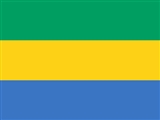
Gabon
Gabon, officially the Gabonese Republic, is a country in west central
Africa. It borders on
Equatorial Guinea,
Cameroon,
Republic of the Congo and the
Gulf of Guinea. Since its independence from
France on August 17, 1960, the Republic has been ruled by only two autocratic Presidents; the incumbent
El Hadj Omar Bongo has been in power since 1967 and is currently Africa's longest-serving Head of State. Gabon introduced a multiparty system and a new democratic constitution in the early 1990s that allowed for a more transparent electoral process and for reforms of governmental institutions.
Encyclopedia
Gabon, officially the
Gabonese Republic, is a country in west central
Africa. It borders on
Equatorial Guinea,
Cameroon,
Republic of the Congo and the
Gulf of Guinea. Since its independence from
France on August 17, 1960, the Republic has been ruled by only two autocratic Presidents; the incumbent
El Hadj Omar Bongo has been in power since 1967 and is currently Africa's longest-serving Head of State. Gabon introduced a multiparty system and a new democratic constitution in the early 1990s that allowed for a more transparent electoral process and for reforms of governmental institutions. A small population, abundant natural resources, and foreign private investment have helped make Gabon one of the more prosperous countries in the region.
History
The earliest inhabitants of the area were
Pygmy peoples. They were largely replaced and absorbed by Bantu tribes during
Bantu migrations. Several
Bantu groups occupied the area that is now Gabon when
France occupied it in 1885. In 1910, Gabon became one of the four territories of
French Equatorial Africa, a federation that survived until 1959. These territories became independent on August 17, 1960.
The first president of Gabon, elected in 1961, was Léon M’ba, with
Omar Bongo as his vice president. When M'Ba died in 1967, Bongo replaced him as president, and has been the head of state ever since winning each contested election with a substantial majority.
Government
In March 1991 a new constitution was adopted. Among its provisions are a Western-style bill of rights, the creation of the National Council of Democracy that also oversees the guarantee of those rights and a governmental advisory board which deals with economic and social issues. Multi-party legislative elections were held in 1990-91 even though opposition parties had not been declared formally legal.
President
El Hadj Omar Bongo Ondimba, in power since 1967 and the longest-serving African head of state, was re-elected to another 7-year term according to poll results returned from elections held on November 27 2005. According to figures provided by Gabon's Interior Ministry, this was achieved with 79.1% of the votes cast. In 2003 the President amended the Constitution of Gabon to remove any restrictions on the number of terms a president is allowed to serve. The president retains strong powers, such as authority to dissolve the National Assembly, declare a state of siege, delay legislation, conduct referenda, and appoint and dismiss the prime minister and cabinet members.
In provisional results his ruling Gabonese Democratic Party won 84 out of 120 parliamentary seats. As with previous Gabonese elections in which the opposition parties have contested, there were several accusations of electoral fraud, bribery, and calls for a boycott. There were also incidences of violence and protest, particularly in the first round of voting held two weeks prior. However, several international observers including the Economic Community of Central African States have reported that the election "met international standards" for
democratic voting.
Gabon has a small, professional military of about 5,000 personnel, divided into army, navy, air force, gendarmerie, and national police. Gabonese forces are oriented to the defense of the country and have not been trained for an offensive role. A well-trained, well-equipped 1,800-member guard provides security for the president.
Administrative divisions
Gabon is divided into 9 provinces and 37 departments.
The
provinces include:
Estuaire,
Haut-Ogooué,
Moyen-Ogooué,
Ngounié,
Nyanga,
Ogooué-Ivindo,
Ogooué-Lolo,
Ogooué-Maritime, and
Woleu-Ntem.
Geography
Gabon is located on the
Atlantic coast of central Africa. Clockwise from the northwest, it is bounded by
Equatorial Guinea,
Cameroon, and the
Republic of Congo.
Gabon's largest river is the Ogooué. Gabon is also noted for efforts to preserve the natural environment with what may be the largest area of nature parks in the world.
Administratively, Gabon is divided into 9 provinces and further divided into 37 departments .
Economy
Gabon is more prosperous than most nearby countries, with a per capita income of four times the average for
Sub-Saharan Africa. This is in large part due to offshore
oil production that has produced substantial wealth, although the distribution of income from this industry is extremely unequal. Gabon was a full member of
OPEC from 1975 to 1995.
During the 1990s, devaluation of the CFA franc left Gabon struggling to pay its overseas debt;
France and the
IMF have provided further loans and aid in exchange for the implementation of changes to the economy.
Demographics
Almost all Gabonese are of
Bantu origin. Gabon has at least 40 ethnic groups with separate languages and cultures. The largest is the
Fang. Others include the Myene, Bandjabi, Eshira, Bapounou, and Okande. Ethnic group boundaries are less sharply drawn in Gabon than elsewhere in
Africa.
French, the official language, is a unifying force. More than 10,000
French people live in Gabon, and France predominates foreign cultural and commercial influences. Historical and environmental factors caused Gabon's population to decline between 1900 and 1940. It is one of the least-densely inhabited countries in Africa, and a labor shortage is a major obstacle to development and a draw for foreign workers. The population is generally accepted to be just over 1 million but remains in dispute.
Culture
Gabonese music is little-known in comparison with regional giants like the
Democratic Republic of the Congo and
Cameroon. The country boasts an array of folk styles, as well as pop stars like
Patience Dabany . Dabany's albums, though recorded in Los Angeles, have a distinctively Gabonese element and are popular throughout Francophone Africa. Other musicians include guitarists like Georges Oyendze, La Rose Mbadou and Sylvain Avara, and the singer Oliver N'Goma. Imported rock and hip hop from the US and UK are popular in Gabon, as are
rhumba, makossa and
soukous.
Gabonese folk instruments include the
obala.
- Bwiti
- Ethnic groups of Gabon
- List of writers from Gabon
- Music of Gabon
Miscellaneous topics
References
- David E. Gardinier and Douglas A. Yates,
- David E. Gardinier, Historical Dictionary of Gabon, 2nd ed. - a comprehensive work, with a bibliography of 1,453 items
- James F. Barnes, Gabon: Beyond the Colonial Legacy
External links
Government
- official site
- government information and links
- official site
News
Overviews
- [https://www.cia.gov/cia/publications/factbook/geos/gb.html CIA World Factbook - Gabon]
Ethnic groups
- Culture and music of the first inhabitants of Gabon
Directories
- directory category
Tourism