

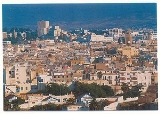
Tunis

Encyclopedia
Tunis is the capital of both the Tunisian Republic and the Tunis Governorate
. It is Tunisia's largest city, with a population of 728,453 as of 2004; the greater metropolitan area holds some 2,412,500 inhabitants.
Situated on a large Mediterranean Sea
gulf (the Gulf of Tunis
), behind the Lake of Tunis
and the port of La Goulette
(Halq al Wadi), the city extends along the coastal plain and the hills that surround it. At the centre of more modern development (from the colonial era and later) lies the old medina
. Beyond this district lie the suburbs of Carthage
, La Marsa, and Sidi Bou Said.
The medina is found at the centre of the city: a dense agglomeration of alleys and covered passages, full of intense scents and colours, boisterous and active trade, and a surfeit of goods on offer ranging from leather
to plastic, tin
to the finest filigree
, tourist souvenirs to the works of tiny crafts shops.
Just through the Sea Gate (also known as the Bab el Bahr and the Porte de France) begins the modern city, or Ville Nouvelle, transversed by the grand Avenue Habib Bourguiba (often referred to by popular press and travel guides as "the Tunisian Champs-Élysées
"), where the colonial-era buildings provide a clear contrast to smaller, older structures. As the capital city of the country, Tunis is the focus of Tunisian political and administrative life; it is also the centre of the country's commercial activity. The expansion of the Tunisian economy in recent decades is reflected in the booming development of the outer city where one can see clearly the social challenges brought about by rapid modernization in Tunisia.
name تونس which can be pronounced as "Tūnus", "Tūnas", or "Tūnis". All three variations were mentioned by the Greek-Syrian geographer al-Rumi Yaqout
in his Mu'jam al-Bûldan
(Dictionary of Countries).
Different explanations exist for the origin of the name Tunis. Some scholars relate it to the Phoenician goddess Tanit
h ('Tanit or Tanut), as many ancient cities were named after patron deities. Some Muslim scholars proposed that the name derives from Arabic roots or identified it with the original town of Tarshish. Others claim that it originated from Tynes, which was mentioned by Diodoros and Polybius in the course of descriptions resembling present-day Al-Kasba; one of Tunis's suburbs.
Another possibility is that it was derived from the Berber
verbal root ens which means "to lie down" or "to pass the night". Given the variations of the precise meaning over time and space, the term Tunis can possibly mean "camp at night", "camp", or "stop". There are also some mentions in ancient Roman sources of such names of nearby towns as Tuniza (currently El Kala), Thunusuda (currently Sidi Meskine), Thinissut (currently Bouregba Bir), and Thunisa (currently Ras Jebel
). As all of these Berber villages were situated on Roman roads, they undoubtedly served as a rest-stations or stops.
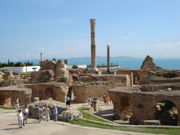 The historical study of Carthage is problematic. Because its culture and records were destroyed by the Romans at the end of the Third Punic War
, very few Carthaginian primary historical sources
survive. While there are a few ancient translations of Punic texts into Greek and Latin, as well as inscriptions on monuments and buildings discovered in North Africa, the main sources are Greek
and Roman
historians, including Livy
, Polybius
, Appian
, Cornelius Nepos
, Silius Italicus
, Plutarch
, Dio Cassius
, and Herodotus
. These writers belonged to peoples in competition, and often in conflict, with Carthage. Greek cities contended with Carthage over Sicily
, and the Romans
fought three wars against Carthage
. Not surprisingly, their accounts of Carthage are extremely hostile; while there are a few Greek authors who took a favourable view, these works have been lost.
Recent excavation has brought much more primary material to light. Some of these finds contradict aspects of the traditional picture of Carthage, and much of the material is still ambiguous.
 The existence of the town is attested by sources dating from the 4th century BC.
In the 2nd millennium BC a town, originally named Tunes, was founded by Berbers
and also over time occupied by Numidians
. In 146 BC, the Romans
destroyed Tunis (along with Carthage). However, the city was subsequently rebuilt under the rule of Augustus
and became an important town under Roman control and the center of a booming agricultural industry. Situated on a hill, Tunis served as an excellent point from which the comings and goings of naval and caravan traffic to and from Carthage could be observed. Tunis was one of the first towns in the region to fall under Carthaginian control, and in the centuries that followed Tunis was mentioned in the military histories associated with Carthage. Thus, during Agathocles' expedition, which landed at Cape Bon in 310 BC, Tunis changed hands on various occasions.
When Agathocles died in 288 BC, a large company of Italian mercenaries who had previously been held in his service found themselves suddenly without employment. Rather than leave Sicily, they seized the city of Messana. Naming themselves Mamertines
(or "sons of Mars"), they became a law unto themselves, terrorizing the surrounding countryside.
The Mamertines became a growing threat to Carthage and Syracuse alike. In 265 BC, Hiero II
, former general of Pyrrhus and the new tyrant of Syracuse, took action against them. Faced with a vastly superior force, the Mamertines divided into two factions, one advocating surrender to Carthage, the other preferring to seek aid from Rome. As a result, embassies were sent to both cities.
While the Roman Senate
debated the best course of action, the Carthaginians eagerly agreed to send a garrison to Messana. A Carthaginian garrison was admitted to the city, and a Carthaginian fleet sailed into the Messanan harbor. However, soon afterwards they began negotiating with Hiero. Alarmed, the Mamertines sent another embassy to Rome asking them to expel the Carthaginians.
 Hiero's intervention had placed Carthage's military forces directly across the narrow channel of water that separated Sicily from Italy. Moreover, the presence of the Carthaginian fleet gave them effective control over this channel, the Strait of Messina
, and demonstrated a clear and present danger to nearby Rome and her interests. The Roman Senate was unable to decide on a course of action and referred the matter to the people, who voted to intervene.
The Roman attack on the Carthaginian forces at Messana triggered the first of the Punic Wars
. Over the course of the next century, these three major conflicts between Rome and Carthage would determine the course of Western civilization. The wars included a Carthaginian invasion led by Hannibal
, which nearly prevented the rise of the Roman Empire. Eventual victory by Rome was a turning point which meant that the civilization of the ancient Mediterranean would pass to the modern world via Southern Europe instead of North Africa.
Shortly after the First Punic War, Carthage faced a major mercenary revolt
which changed the internal political landscape of Carthage (bringing the Barcid
family to prominence), and affected Carthage's international standing, as Rome used the events of the war to base a claim by which it seized Sardinia
and Corsica
.
During the Mercenary War
, it is possible that Tunis served as a center for the native population of the area, and that its population was mainly composed of peasants, fishermen, and craftsmen. Compared to the ancient ruins of Carthage, the ruins of ancient Tunis are not as large. According to Strabo
, it was destroyed by the Romans during the Third Punic War
. Both Tunis and Carthage were destroyed; Tunis, however, was rebuilt first. The city is mentioned in the Tabula Peutingeriana
as Thuni. In the system of Roman roads for the Roman province of Africa, Tunis had the title of mutatio ("way station, resting place"). Tunis, increasingly Romanized, was also eventually Christianized and became the seat of a bishop
. However, Tunis remained modestly sized compared to Carthage during this time.
Muslims. The medina
of Tunis, the oldest section of the city, dates from this period, during which the region was conquered by Arab troops led by the Ghassanid
general Hassan Ibn Numan. The city had the natural advantage of coastal access, via the Mediterranean, to the major ports of southern Europe. Early on, Tunis played a military role; the Arabs recognized the strategic importance of its proximity to the Strait of Sicily
. From the beginning of the 8th century Tunis was the chef-lieu
of the area: it became the Arabs' naval
base in the western Mediterranean Sea
, and took on considerable military importance. Under the Aghlabid
s, the people of Tunis revolted numerous times, but the city profited from economic improvements and quickly became the second most important in the kingdom. It was briefly the national capital, from the end of the reign of Ibrahim II in 902, until 909 when the Shi'ite Berbers
took over Ifriqiya
and founded the Fatimid Caliphate.
Local opposition to the authorities began to intensify in September 945, when the Kharijite
insurgents
occupied Tunis, resulting in general pillaging. With the rise of the Zirid dynasty Tunis gained importance, but the Sunni population tolerated Shi'ite rule less and less, and carried out massacres against the Shi'ite community. In 1048 the Zirid ruler Al-Muizz ibn Badis
rejected his city's obedience to the Fatimids and re-established Sunni rites throughout all of Ifriqiya. This decision infuriated the Shi'ite caliph
Al-Mustansir Billah. To punish the Zirids, he unleashed the Banu Hilal
Arab tribe on Ifriqaya; a large part of the country was put to fire, the Zirid capital Kairouan
was razed in 1057, and only a few coastal towns, including Tunis and Mahdia
, escaped destruction. Exposed to violence from the hostile tribes that settled around the city, the population of Tunis repudiated the authority of the Zirids and swore allegiance to the Hammadid
prince El Nacer ibn Alennas
, who was based in Béjaïa
, in 1059. The governor appointed by Béjaïa, having reestablished order in the country, did not hesitate to free himself from the Hammadids to found the Khourassanid dynasty with Tunis as its capital. This small independent kingdom picked up the threads of trade and commerce with other nations, and brought the region back to peace and prosperity.
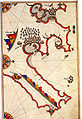 From the 12th century to the 16th century, the old city was controlled by the Almohad
and the Hafsid Berber dynasties. During this period Tunis was one of the richest and grandest cities in the Islamic world, with a population of about 100,000.
'Abd al-Mumin took Tunis, overthrew the last Khourassanid leader and installed a new government in the kasbah
of Tunis. The Almohad conquest marked the beginning of the dominance of the city in Tunisia. Having previously played a minor role behind Kairouan
and Mahdia
, Tunis was promoted to the rank of provincial capital. In 1228, Governor Abû Zakariya Yahyâ seized power and, a year later, took the title of Emir and founded the Hafsid dynasty
. The city became the capital of a Hafsid kingdom stretching towards Tripoli
and Fez
. Walls were built to protect the emerging principal town of the kingdom, surrounding the medina, the kasbah and the new suburbs of Tunis. In 1270 the city was taken briefly by Louis IX of France
, who was hoping to convert the Hafsid sovereign to Christianity. King Louis easily captured Carthage
, but his army soon fell victim to an outbreak of dysentery. Louis himself died before the walls of the capital and the army was forced out. At the same time, driven by the reconquest of Spain, the first Andalusian Muslims and Jews arrived in Tunis and would become of fundamental importance to the economic prosperity of the Hafsid capital and the development of its intellectual life.
took nominal control of Tunis in 1534 when Barbarossa Hayreddin captured it
from the Hafsid Sultan Mulai Hassan, who fled to the court of Charles V, Holy Roman Emperor
and King of Spain. Charles, suffering losses from the corsairs operating out of Djerba
, Tunis, and Algiers
, agreed to reinstate Mulai Hassan in exchange for his acceptance of Spanish suzerainty. A naval expedition led by Charles himself was dispatched in 1535, and the city was quickly recaptured. The victory
against the corsairs is recorded in a tapestry at the Royal Palace of Madrid
. The resulting protectorate lasted until the Ottomans retook Tunis in 1574. After 1591, the Ottoman governors (Bey
s) were relatively independent, and both piracy and trade continued to flourish.
In April 1655 the English admiral Robert Blake
was sent to the Mediterranean to extract compensation from states that had been attacking English shipping. Only the Bey of Tunis refused to comply, with the result that Blake's fifteen ships attacked the Bey's arsenal at Porto Farina (Ghar el Melh), destroying nine Algerian ships and two shore batteries, the first time in naval warfare that shore batteries had been eliminated without landing men ashore.
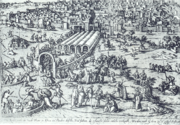 In the 16th century Tunis was one of the principal theatres of confrontation between the Spanish monarchy and the Ottoman Empire
. Ottoman troops, under the leadership of Hayreddin Barbarossa, appeared before the Bab El Jazira on 18 August 1534 and pillaged the city. Charles V, called to the rescue by European leaders menaced by the Ottoman advance in the Mediterranean, retook the city on 6 August 1535, and restored Hafsid
sovereignty.
Confronting the difficulties previously encountered, the Ottoman Uluç Ali Reis, at the head of an army of janissaries and Kabyles, retook Tunis in 1569. However, following the Battle of Lepanto
in 1571, the Spanish succeeded in retaking the city and re-establishing the Hafsid sovereign. Following these conflicts, the city finally fell into Ottoman hands in August 1574. Having become an Ottoman province governed by a Pasha
who was appointed by the Sultan based in Constantinople
, the country was not slow to attain a certain autonomy (1591). Under the rule of dey
s and Moorish
bey
s, the capital sprang into new life. Its population grew by additions from various ethnicities, among which were Moorish refugees from Spain, and economic activities diversified. To traditional industry and trade with distant lands was added the activity of the Barbary pirates, then in their golden age. Profits obtained from the trade in Christian slaves
allowed the rulers to build sumptuous structures that revived the architectural heritage of the Middle Ages.
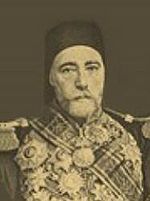 At the beginning of the 18th century, Tunisia entered into a new period in its history with the advent of the Husainid dynasty
. Successive Husainid rulers made great progress in developing the city and its buildings. During this period, the city prospered as a centre of commerce. Taking advantage of divisions within the ruling house, Algerians captured Tunis in 1756 and put the country under supervision. At the beginning of the 19th century, Hammouda Bey faced bombardment by the Venetian fleet, and the city experienced a rebellion in 1811. Under the reign of Hussein Bey II
, naval defeats by the English (1826) and French (1827) saw the French become increasingly active in the city and in the economy.
Various sources estimate the 19th-century population to have ranged from 90,000 to 110,000 inhabitants. During the later 19th century, Tunis became increasingly populated by Europeans, particularly the French, and immigration dramatically increased the size of the city. This resulted in the first demolition of the old city walls, from 1860, to accommodate growth in the suburbs. The city spilled outside the area of the earlier town and the banks of the lake, and the new districts were modernised with running water (1860), lighting gas (1872), roads, waste collection (1873), and communication with adjacent suburbs and the city centre. The crafts and traditional trades declined somewhat, as the newcomers increased trade with Europe, introducing the first modern industries and new forms of urban life.
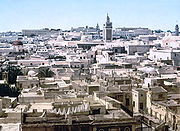
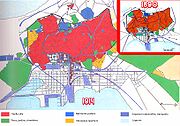 The French occupied the city from 1881 to 1956, having established a protectorate
system of administration that recognized the nominal authority of local government. In those years there were huge European colonies (like the Tunisian Italians
) in Tunis. Europeans formed half the population. The city expanded and created new boulevards and neighborhoods.
The creation of the French protectorate
in 1881 was a turning point in Tunis's history, causing rapid redevelopment of the city in the span of two to three decades. The city rapidly spread out of its fortifications: it divided into a traditional Arab-populated old city, and a new city populated by immigrants, with a different structure from that of the traditional medina
. Tunis also benefited from French construction of a water supply
, natural gas and electricity networks, public transport
services and other public infrastructure.
Tunis was quiet during the First World War. After the war, the city faced new transformations as the modern portion grew in importance and extended its network of boulevards and streets in all directions. In addition, a series of satellite cities emerged on the urban rim and encroached on the municipality of Tunis proper. In the economic sphere, commercial activities expanded and diversified as modern industries continued to grow, while traditional industry continued to decline.
During World War II, Tunis was held by Axis
forces from November 1942 to May 1943. It was their last base in Africa, as they escaped to Italy after being surrounded by Allied
forces from Algeria in the west and from Libya in the east. On 7 May 1943, at 15:30 in the afternoon, Tunis fell to the Allies, who had defeated most of the German Fifth Panzer Army left guarding the city. At midday on 20 May 1943, the Allies held a victory parade on Avenue Maréchal Galliéni and Avenue Jules Ferry to signal the end of fighting in North Africa. Having succeeded in driving the Axis powers out of Tunisia, the Allies used Tunis as a base of operations to stage assaults against the island of Pantelleria
, then Sicily
, and finally Italy
.
Following the Second World War, suburbs grew up quickly around Tunis to facilitate rapid industrialization.
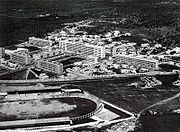 After independence in 1956, Tunis has consolidated its role as the capital, first with the establishment of a constitution stating that the Chamber of Deputies and the Presidency of the Republic must have their headquarters in Tunis and its suburbs. In a very short time, the colonial city transformed rapidly. As the city has grown and native Tunisians gradually began to replace the extensive European population, conflict between the Arab city and the European city has gradually decreased with the arabization of the population.
Because of population pressure and the rate of migration to the capital, the city continued to grow, even with the creation of new districts in the suburbs. Old buildings have gradually been renovated and upgraded and new buildings have come to influence the urban landscape. At the same time, an active policy of industrialization is developing the municipal economy.
The Arab League
was headquartered in Tunis from 1979 to 1990. The Arab League, which represents 22 Arab nations, transferred its headquarters to Tunis in 1979 because of Egypt's peace with Israel but has been headquartered back in Egypt since 1990.
The Palestine Liberation Organization
also had its headquarters in Tunis, from 1970s to 2003.
In 1985, the PLO's headquarters was bombed
by the Israeli Air Force
(F-15), killing approximately 60 people.
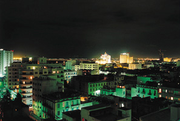
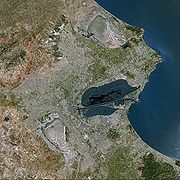
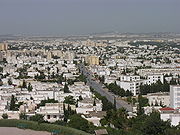 Tunis is located in north-eastern Tunisia
on the Lake of Tunis
, and is connected to the Mediterranean sea's Gulf of Tunis
by a canal which terminates at the port of La Goulette
/ Halq al Wadi. The ancient city of Carthage
is located just north of Tunis along the coastal part.
The city of Tunis is built on a hill slope down to the lake of Tunis. These hills contain the places, Notre-Dame de Tunis, Ras Tabia, La Rabta, La Kasbah, Montfleury and La Manoubia which altitudes beyond just 50 meters. The city is located at the crossroads of a narrow strip of land between Lake Tunis and Séjoumi. The isthmus
between them is what geologists call the "Tunis dome", which includes hills of limestone and sediments. It forms a natural bridge and since ancient times several major roads linking to Egypt
and elsewhere in Tunisia have branched out from. The roads are also dependent with Carthage
, emphasising its political and economic importance not only in Tunisia but in Africa in Roman Times.
The Greater Tunis area has an area of 300,000 hectares, 30,000 of which is urbanized, the rest being shared between bodies of water (20,000 hectares of lakes or lagoons) and agricultural or natural land (250,000 hectares). However, urban growth, which is estimated to be increasing by 500 hectares per year, is gradually changing the landscape with urban sprawl
.
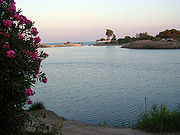
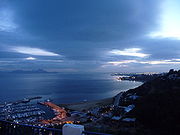 Tunis has a warm-summer Mediterranean climate
(Köppen climate classification
Csa), characterized by a hot and dry season and a cool and rainy season. The local climate is also affected somewhat by the latitude of the city, the moderating influence of the Mediterranean and the terrain of the hills.
Winter is the wettest season of the year, when more than a third of the annual rainfall falls during this period, raining on average every two or three days. The sun may still increase the temperature from 7 °C (44.6 °F) in the morning to 16 °C (60.8 °F) in the afternoon on average during the winter. Frosts are rare or non existent. In spring, rainfall declines by half. The sunshine becomes dominant in May when it reaches 10 hours a day on average. In March temperatures may vary between 8 °C (46.4 °F) and 18 °C (64.4 °F), and between 13 °C (55.4 °F) and 24 °C (75.2 °F) in May. However, it is common for temperatures to soar even as early as April with record temperatures reaching 40 °C (104 °F). In summer, rain is completely absent and the sunlight is at a maximum. The average temperatures in the summer months of June, July, and August, are very high. Sea breezes may mitigate the heat, but sometimes the sirocco
winds reverse the trend. In autumn, it begins to rain, often with short thunderstorms, which can sometimes cause flash floods or even flood some parts of the city. The month of November marks a break in the general heat with average temperatures ranging from 11 °C (51.8 °F) to 20 °C (68 °F).
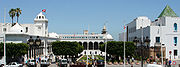 Tunis has been the capital of Tunisia since 1159. Under Articles 43 and 24 of the Constitution of 1959
, Tunis and its suburbs host the national institutions: the Presidential Palace, which is known as Carthage Palace
, residence of the President of the Tunisian Republic
, the Chamber of Deputies
and the Chamber of Councillors
and parliament, the Constitutional Council and the main judicial institutions, the Bardo National Museum and various other government departments and public bodies.
, 4 for the Party of Popular Unity, 3 for the Unionist Democratic Union
and 1 for the Social Liberal Party
.
The City Council meets four times a year but may meet by special request of the mayor. The council's regulatory responsibilities include the municipal budget, building development, and actions to be undertaken under the National Development Plan. It also provides advice on all projects to be implemented by the state, the governorate or a public body.
Unlike other mayors in Tunisia, the mayor of Tunis is appointed by decree of the President of the Republic from among the members of the City Council. Abbes Mohsen is the current Mayor of Tunis, and has been in office since 2000 when he succeeded Mohamed Ali Bouleymane. He was re-elected and confirmed in his post after the municipal elections of 2005.
In addition to the municipal institutions, each of the fifteen districts has a municipal council meeting each month in the presence of elected officials and representatives of the administrations, to address the issues of the day.
Revenues are generated by the proceeds of taxes on buildings and vacant lots, fees for the rental of municipal property, income from the operation of the public, advertising, and that the fact that the municipality has capital shares in some companies. On the expenditure side, provision is made for the consolidation of hygiene
and cleanliness, the state of the environment and urban design, infrastructure maintenance, rehabilitation and renovation of facilities, and strengthening the logistics and means of work and transport.
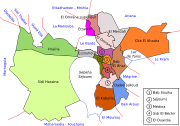 The city of Tunis, whose size has increased significantly during the second half of the 20th century, now extends over several governorates in the Tunis Governorate
with the surrounding areas extending over parts of the governorates of Ben Arous
, Ariana
and Manouba
.
The municipality of Tunis is divided into 15 municipal districts: These include El Bab Bhar, Bab Souika, Cité El Khadra, Jelloud Jebel El Kabaria, El Menzah, El Ouardia, Ettahrir, Ezzouhour, Hraïria, Medina, El Omrane, El Omrane Higher Séjoumi, Sidi El-Bashir and Sidi Hassine.
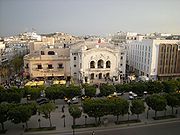
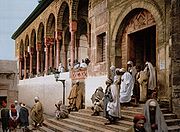
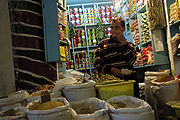
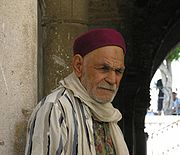 In the years following independence, the population of the metropolitan area continues to grow: the increase of 21.1% from 1956 to 1966 and by 28.5% from 1966 to 1975 (55.6% between 1956 and 1975). This steady growth is accompanied by changes which affect the nature of the settlement of the capital. Decolonization led to the exodus of some minorities whose numbers are dwindling every year. The gaps created by their departure are abundantly filled by Tunisians who are emigrating to Tunis from other parts of the country.
At the beginning of the 21st century, the city of Tunis exceeds 2,000,000 inhabitants. After independence, the Tunisian government implemented a plan to cope with population growth of the city and country, a system of family planning, to attempt to lower the rate of population growth. However, between 1994 and 2004, the population of the governorate of Tunis grew more than 1.03% per annum. It represents, in the 2004 census, 9.9% of the total population of Tunisia. As in the rest of Tunisia, literacy
in the region of Tunis has evolved rapidly during the second half of the 20th century and reaches a level slightly higher than the national average. However education is only exceeded by the neighbouring governorate of Ariana which has many institutions of education.
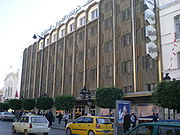
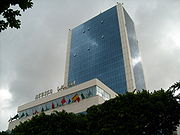 Products include textiles, carpets, and olive oil
. Tourism also provides a significant portion of the city's income.
Because of the concentration of political command (headquarters of the central government, presidency, parliament, ministries and central government) and culture (festivals and mainstream media), Tunis is the only nationally ranking metropolis. Tunis is the heartland of the Tunisian economy and is the industrial and economic hub of the country, home to one third of Tunisian companies—including almost all the head offices of companies with more than fifty employees, with the exception of the Compagnie des Phosphates de Gafsa, headquartered in Gafsa
—and produces a third of the national gross domestic product. Tunis attracts foreign investors (33% of companies, 26% of investments and 27% of employment), excluding several areas due to economic imbalances. The urban unemployment rate of university graduates is increasing and the illiteracy rate remains high among the elderly (27% of women and 12% of men). The number of people living below the poverty line, falling at the national level, remains higher in urban areas. In addition, unemployment is high in young people aged 18 to 24, with one in three unemployed as compared to one in six at the national level. In Greater Tunis, the proportion of young unemployed is at 35%.
Primary industry such as agriculture, however, is active in specialized agricultural areas on the suburbs, particularly in the wine and olive oil industries. Indeed, thanks to a generally flat terrain and the two main rivers in Tunisia, the Medjerda to the north and the Milian to the south, soils are fertile. Tunis has several large plains, the most productive are in Ariana
and La Soukra
(north), the plain of Manouba
(west) and the plain of Mornag
(south). In addition, groundwater is easily accessible through the drilling of deep wells, providing water for the different agriculture crops. The soils are heavy and contain limestone in the north but are lighter and sandy containing clay
in the south. There is much diversification in the municipality of Tunis, with Durum
grown in Manouba, Olives and olive oil in Ariana and Mornag, wine (Mornag), and fruit, vegetable and legumes are grown in all regions.
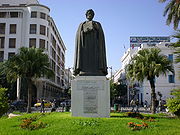
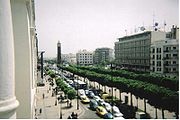
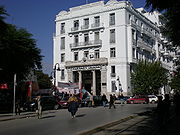
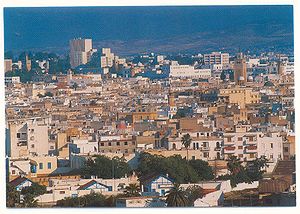 The Médina, built on a gentle hill slope on the way down to the Tunis Lake, is the historical heart of the city and home to many monuments, including palaces, such as the Dar Ben Abdallah and Dar Hussein, the mausoleum of Tourbet El Bey or many mosques such as Zitouna Mosque. Some of the fortifications have now largely disappeared around it, and it is flanked by the two suburbs of Bab Souika to the north and Bab El Jazira to the south. Located near the Bab Souika, the neighborhood of Halfaouine which gained international attention through the dissemination of the film Halfaouine, l'enfant des terrasses.
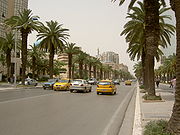
But east of the original nucleus, first with the construction of the French Consulate, the modern city was built gradually with the introduction of the French protectorate at the end of the 19th century, on open land between the city and the lake. The axis to the structure of this part of the city is the Avenue Habib Bourguiba
, designed to by the French to be a Tunisian form of Champs-Elysees
in Paris with its cafes, major hotels, shops and cultural venues. On both sides of the tree lines avenue, north and south, the city was extended in various districts, with the northern end welcoming residential and business districts while the south receives industrial districts and poorer peoples.
North of the Bourguiba Avenue is the district of La Fayette, which is still home to the Great Synagogue of Tunis and the Habib Thameur Gardens, built on the site of the ancient Jewish cemetery which lies outside the walls. South-east, the district of La Petite Sicile (Little Sicily
) is adjacent to the old port area and takes its name from its original population of workers from Italy
. It is now the subject of a redevelopment project including the construction of the twin towers. North of it, is the long avenue Mohamed V, which leads to the Boulevard of 7 November through the neighborhood of the big banks where there are hotels and Abu Nawas Lake and the headquarters of the ruling party of Tunisia. It leads to the Belvedere area around the place Pasteur. This is where the Belvedere Park lies, the largest in the city and its zoo and the Pasteur Institute founded by Adrien Loir
in 1893. By continuing to the north are the most exclusive neighborhoods of Mutuelleville which houses the French Lycée Pierre-Mendès-France, the Sheraton Hotel and some embassies.
Still further north of the Belvedere Park, behind the Boulevard of 7 November are the neighborhoods of El Menzah and El Manar now reaching the peaks of the hills overlooking the north of the town . They support a range of residential and commercial buildings. To the west of the park lies the district of El Omrane which holds the main Muslim
cemetery in the capital and the warehouses of public transport. Heading east is the Tunis-Carthage International Airport
and the neighborhoods of Borgel, giving his name to the existing Jewish and Christian cemeteries in the capital, and the neighbourhood of Montplaisir. Beyond that, several kilometers north-east, on the road to La Marsa
, the Berges du Lac
was built on land reclaimed from the north shore of the lake near the airport, which has holds offices of Tunisian and foreign companies, many embassies as well as shops.
Southwest of the Medina, on the crest of the hills across the Isthmus of Tunis, is the Montfleury district then on down to the foothills of Séjoumi, the poor neighborhood of Mellassine. Northwest of the latter, north of the National Route 3 leading to the west, is the city of Ezzouhour
(formerly El Kharrouba), which spans more than three kilometers and is divided into five sections. It is still surrounded with farmland and vegetables are grown which supply many of the souk
s in the region.
The south of Tunis is made up of disadvantaged neighborhoods, especially due to the strong industry in this part of the metropolis. These include Jebel Jelloud, located in the south-east of Tunis, which concentrates on the heavy industry
of cement
production, the treatment plant of phosphate
s, etc. .) .The main cemetery in Tunis, the Djellaz Cemetery dominates this part of town, perched on the slopes of a rocky outcrop.
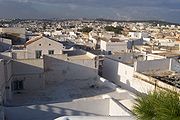
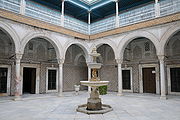
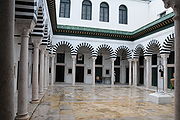 The medina of Tunis has been a UNESCO World Heritage Site since 1979. The Medina contains some 700 monuments, including palaces, mosques, mausoleum
s, madrasas and fountains dating from the Almohad and the Hafsid periods. These ancient buildings include:
With an area of 270 hectares (over 29 hectares for the Kasbah) and more than 100,000 people, the Medina comprises one-tenth of the population of Tunis. The planning of the Medina of Tunis has the distinction of not grid lines or formal geometric compositions. However, studies were undertaken in the 1930s with the arrival of the first anthropologists who found that the space of the Medina is not random: the houses are based on a socio-cultural code according to the types of complex human relations.
Domestic architecture (palaces and townhouses), official and civilian (libraries and administrations), religious (mosques and zaouïas) and services (commercial and fondouks) are located in the Medina. The notion of public space is ambiguous in the case of Medina where the streets are seen as an extension of the houses and subject to social tags. The concept of ownership is low however and souks often spill out onto public roads. Today, each district has its culture and rivalries can be strong.
The northern end supports the football club of Esperance Sportive de Tunis while at the other end is the rival African Club. The Medina also has a social sectorization: with the neighborhood of El Bey Tourbet and the Kasbah district being aristocratic, with a population of judges and politicians, while the streets of Pacha often being military and bourgeois.
Founded in 698 is the Zitouna Mosque and the surrounding area which developed throughout the Middle Ages
, dividing Tunis into a main town in two suburbs, in the north (Bab Souika) and the south (Bab El Jazira). The area became the capital of a powerful kingdom during the Hafsid era, and was considered a religious and intellectual home and economic center for the Middle East, Africa and Europe. A great fusion of influences can be seen blending Andalusian
styles with eastern influences, and Roman or Byzantine
columns, and typical Arab architecture, characterized by the archways.
The architectural heritage is also omnipresent in the homes of individuals and small palace officials as well as in the palace of the sovereign of Kasbah. Although some palaces and houses date back to the Middle Ages, a greater number of prestigious houses were built in the 17th, 18th and 19th centuries such as Dar Othman (early 17th century) Dar Ben Abdallah (18th century), Dar Hussein, Dar Cherif and other houses. The main palace beys are those of La Marsa, Bardo and Ksar Said. If we add the mosques and oratories (about 200), the Madrassah (El Bachia, Slimania, El Achouria, Bir
El Ahjar, El Nakhla, etc..), The zaouia
s (Mahrez Sidi Sidi Ali Azouz, Sidi Abdel Kader, etc.) and Tourbet El Fellari, Tourbet Aziza Othman and Tourbet El Bey the number of monuments in Tunis approaches 600. Unlike Algiers
, Palermo
and Naples
, its historical heart has never suffered from major natural disasters or urban radical interventions. The main conflicts and potentially destructive human behavior has been experienced in the city occurred relatively recently following the country's independence which it why it made into a World Heritage Site
by UNESCO in 1979. At the beginning of the 21st century, the Medina is one of the best preserved urban locations in the Arab world.
Furthermore, along the boulevards, the contribution of the architectural period 1850-1950 can be felt in the buildings, such as the government buildings of the nine ministries and the headquarters of the municipality of Tunis.
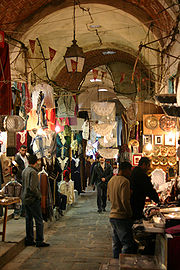 The souks are a network of covered streets lined with shops and traders and artisans ordered by specialty. Clothing merchants, perfumers, fruit sellers, booksellers and wool merchants have goods at the souks, while fishmongers, blacksmiths and potters tend to be relegated to the periphery of the markets.
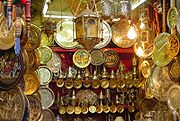 North of the Zitouna Mosque is the Souk El Attarine, built in the early 18th century. It is known for its essences and perfumes. From this souk, there is a street leading to the Souk Ech-Chaouachya (Chechya). The main company that operates it is one of the oldest in the country and they are generally descendants of Andalusian immigrants expelled from Spain. Attached to El Attarine are two other souks: the first, which runs along the western coast of Zitouna Mosque, is the Souk El Kmach which is noted for its fabrics, and the second, the Souk El Birka, which was built in the 17th century and houses embroiderers and jewelers. Given the valuable items it sells, it is the only souk whose doors are closed and guarded during the night. In the middle there is a square where the former slave market stood until the middle of the 19th century.
Souk El Birka leads to Souk El Leffa, a souk that sells all kinds of carpets, blankets and other weavings, and extends with the Souk Es Sarragine, built in the early 18th century and specializing in leather. At the periphery are the souks Et Trouk, El Blat, El Blaghgia, El Kébabgia, En Nhas (copper), Es Sabbaghine (dyeing) and El Grana that sell clothing and blankets and was occupied by Jewish merchants.
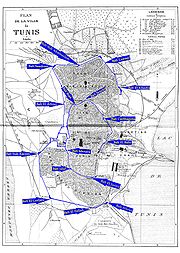
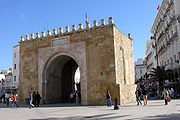 From the early days of its founding, Tunis has been considered an important military base. The Arabs geographer El Yacoubi has written that in the 9th century Tunis was surrounded by a wall of brick and clay except the side of the sea where it was stone. Bab El-Jazeera, perhaps the oldest gate of the south wall, opened onto the southern road. Bab Cartagena gave access to Carthage, important for bringing in construction materials needed for the city. Bab Souika (initially known as Bab El Saqqayin) had a strategic role to keep the roads to Bizerte
, Béja
and Le Kef. Bab Menara (initially known as Bab El Artha) opened onto the medina and on the suburb of El Haoua. As for El Bab Bhar, it allowed access to some fondouks where Christian merchants lived in Tunis.
With the development of the capital under the reign of the Hafsids, two emerging suburbs grew outside the walls; Bab El Jazira in the south and Bab Souika to the north. In the early 14th century, Hafsid Darba Abû al-Muhammad al-Mustansir Lihyânî ordered the construction of a second chamber including the Medina and two suburbs outside. Six new gates were built including Bab El Khadra, Bab Saadoun, Bab El Allouj (initially called Bab Er-Rehiba), Khalid or Bab Bab Sidi Abdallah Cherif, Bab El Fellah and Bab Alioua. In the Ottoman period, four new gates were established: Bab Laassal, Bab Sidi Abdesselam, Bab El Bab Gorjani and Sidi Kacem. The city retains some of these gates including Bab El Khadra, Bab El Bhar and Bab Jedid but some of the earlier ones have long disappeared.
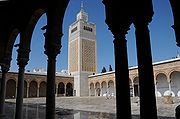 As in the rest of Tunisia, a very large majority of the population of Tunis (around 98%) is Sunni Muslim. The capital is home to a large number of mosques in various architectural styles, signs of construction of their respective eras. The main and oldest of them, is the Zitouna Mosque, founded in 698 and built in 732 and is in the heart of the Medina. It was completely rebuilt in 864 and is a prestigious place of worship, and was long an important place of culture and knowledge with the Zitouna University on the premises until the independence of Tunisia. It still hosts the main ceremonies marking the dates on the Muslim calendar and is regularly attended by the president.
The medina contains most of the major mosques in the capital which were built before the advent of the French protectorate. The mosque in the Kasbah, was founded in 1230. Practicing the Hanafi
rite since 1584, it is recognisable mainly by the dome as well as its minaret, similar to the Koutoubia in Marrakesh and is the highest in the city. Ksar Mosque
, also of the Hanafi
rite, is located in front of Dar Hussein (Bab Menara) and was built in the 12th century. The Hammouda Pasha Mosque, built in 1655, is the second mosque built by the Hanafi rite in Tunis. Youssef Dey Mosque
operated primarily as public speaking venue before becoming a real mosque in 1631. Sidi Mahrez mosque
is the largest mosque Hanafi mosque in terms of area but not the tallest. Built in 1692, it resembles the Ottoman Süleymaniye Mosque in Istanbul
. The Saheb Ettabaâ Mosque
, built between 1808 and 1814 was the last mosque built by the Tunis Husseinites before the French occupation.
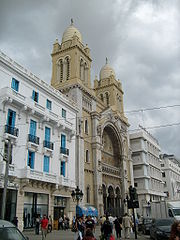
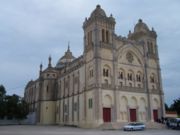
The presence of modern churches in Tunis are also testimony to the French presence for half a century. Tunis is the seat of the Diocese of Tunis, with the seat located at the Cathedral of St Vincent de Paul
, The church was built in 1897 on the site of the old Christian cemetery of Saint-Antoine. This includes a network of Catholic buildings, including the Church of St. Joan of Arc, but also with the Protestant Reformed Church and the Anglican church Saint-Georges. The small Orthodox
community is in it centered around the Greek Orthodox Church (1862), managed by the Greek Embassy and the Russian Orthodox Church (1957), reflecting the presence in Tunisia of a small colony of white Russian refugees and immigrants.
Judaism meanwhile enjoys a long tradition of presence in the city despite the emigration of a large part of the community after independence. Among the places of worship are Beit Yaacouv Synagogue and especially the Great Synagogue of Tunis, built at the end of the 1940s to replace the former Great Synagogue which was demolished as part of the Jewish redevelopment area, the Hara.
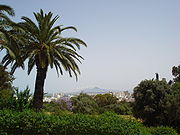 Tunis has some large parks, many of which were installed at the end of the 19th century by the authorities of the French protectorate. The largest Park, Belvédère Park, was founded in 1892 overlooks Lake Tunis. It is the oldest public park in the country and is built in the landscape style common to France. The park covers an area of more than one hundred hectares across roads that can be explored on foot or by car. It is also home to Tunis Zoo, which houses African fauna, and the Museum of Modern Art
.
Habib Thameur garden in Tunis has a central pond and flower beds. The Gorjani garden, is an English garden located southwest of the city, which notably takes an irregular form, partly due to the steep topography of the land.
 Located in an old bey
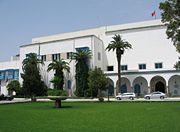
lic palace (the palace of the Bey of Tunis since the end of the 18th century), the Bardo National Museum is the most important archaeological
museum in the Maghreb
, and has one of the richest Roman mosaic collections in the world. Its collections developed rapidly, thanks to numerous archaeological discoveries in the surrounding territory.
In 1964 the Dar Ben Abdallah, a palace probably dating back to the 18th century, became the seat of the capital's Museum of Arts and Popular Traditions. In its exposition halls it holds numerous traditional items, witnesses of the everyday lives of families of the Medina quarter
.
The Museum of the National Movement is situated in Dar Maâkal Az-Zaïm, which was the residence of nationalist Habib Bourguiba
for the entirety of the fight for independence. After the advent of independence, a museum was built there to relate the details of the national struggle between 1938 and 1952.
The National Military Museum, opened in 1989 in the suburbs west of the city, holds a collection of 23,000 weapons, 13,000 of which date back to the 19th century, and some of which were used by the Tunisian troops during the Crimean War
.
, and in particular to promote Tunisian music. The group is made up of 22 members (both instrument players and choral musicians
).
The Musical Troupe of the City of Tunis was created in 1954 by Salah El Mahdi. In 1955 he charged his student Mohamed Saâda to direct the ensemble, which at that time assembled the best artists, and later integrated the ensemble of Radio Tunis. This group contributed to the rise to stardom of numerous Tunisian singers, including Oulaya.
The Association of Arab Orchestra of the City of Tunis began its activities at the end of April 1982, as a workshop linked to the cultural center of the city. It worked on promoting Arab music, on music education and training, and on cooperation with various partners both in Tunisia and abroad. The Tunisian Symphonic Orchestra, created in 1969 by the Minister of Culture, has also produced monthly concerts at the Municipal Theater and in various cultural spaces in the city.
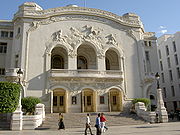 Tunis is a center of Tunisian culture. The Théâtre municipal de Tunis, upon creation on 20 November 1902, showcases opera
, ballet
, symphonic concerts, drama, etc. On the stage of this theater, many performances are regularly given by Tunisian, Arabic and international actors. The National Theatre of Tunisia
is an important public enterprise in Tunis, and since 1988 been located in the Khaznadar palace (dating from the middle of the 19th century and situated in the Halfaouine quarter), renamed "Theater Palace." In 1993, it also took possession of the former movie theater
Le Paris, with a 350-person seating capacity. During each "cultural season" (from October 1 to 30 June) the theater holds over 80 showings. The Al Hamra theater was the second theater to be opened in Tunis, situated on El Jazira Road. Al Hambra was one of the most famous theaters in the capital during the 1930s and 1940s. After being closed for fifteen years, it was turned into a small theater in 1986, and since 2001 has held the first Arab-African center for theater training and research. One should also note the El Teatro and Étoile du Nord theater groups.
Other arts are also represented in the capital. The National Center of the Arts established the puppet theatre in 1976. The National School of Circus Arts was founded following a meeting between the Director of the National Theater and the Director General of the National Center for Arts of Châlons-en-Champagne (France) in 1998. In addition, various small theatres and cultural centres are scattered throughout the city and display various artistic performances.
Film producers and cinema have long been present in the city of Tunis. Indeed, the first animated film was shown in Tunis by the Lumiere brothers as early as 1896. The first screenings were held the following year and the first cinema, the Omnia Pathé, opened on October 1908. The first film club opened in Tunis in 1946 and the Globe, in 1965.
In 1990, Ferid Boughedir shot the notable film Halfaouine, l'enfant des terrasses in Halfaouine district. The films The English Patient
(1996) and The Last Days of Pompeii
(2003) were also shot in studios in Tunis.
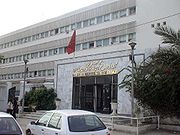 Tunis and its suburbs have many of the major Tunisian universities including the University of Tunis, Tunisia Private University
, Zitouna University
, the University of Tunis – El Manar, the University of Carthage and the University of Manouba. It therefore has the highest concentration of students in Tunisia, with a student population of 75,597 as of 2006.
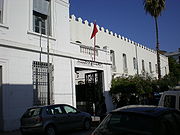 There are also a number of other post-secondary institutions, such as the National School of Engineers of Tunis, the National School of Science, the Graduate School of Communications of Tunis, and the Higher Institute of Technological Studies in Communications of Tunis. In addition, private training institutes include the Open University
of Tunis, the Central University Private Business Administration and Technology, the Graduate School of Private Engineering and Technology, and the North African Institute of Economics and Technology.
Among the high schools in the capital, the best-known are the Lycée de la Rue du Pacha (founded 1900), Lycée Bab El Khadhra, Lycée de la Rue de Russie, Lycée Bourguiba (formerly Lycée Carnot de Tunis), and the Lycée Alaoui. Until independence, Sadiki College (founded 1875) and Khaldounia (founded 1896) were also among the most recognized. A legacy of the French presence in the country remains, and the city retains many French schools, the most important being the Lycée Pierre Mendes-France at Mutuelleville
.
Students can pursue language studies at small private schools such as Center Sidi Bou Said for Languages (Centre Sidi Bou Said de Langues et d'Informatique)in the picturesque Tunis suburb of Sidi Bou Said, next to the Sidi Bou Said TGM station that specializes in Arabic, offering classes in Modern Standard Arabic (MSA), classical Arabic, Tunisian Arabic and the various dialects of North Africa, the Gulf and the Levant.
Housed in a former home of a Hafsid scholar, the library of the Khaldounia was founded in 1896 along with the creation of the educational institution. After independence and following the consolidation of programs of education, the association ceased operations but the library is now linked to the National Library, which provides for its management.
Built in the 17th century, the Dar Ben Achour also contains a library. Acquired in the late 1970s by the municipality of Tunis, the house was restored in 1983 into a library.
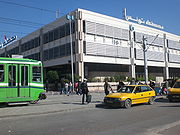
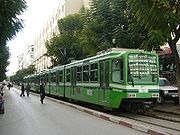
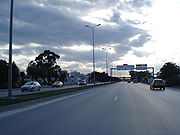
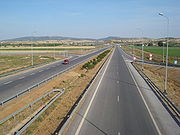 Tunis is served by the Tunis-Carthage International Airport
. The growing metropolitan area is served by an extensive network of public transportation including buses, an above-ground light rail system (le Metro), as well a regional train line (the TGM
) that links the city centre to its closest northern suburbs. Multi-lane autoroutes surround the city and serve the increasing number of privately owned cars one encounters in Tunisia.
The Tunis area is served by the métro léger
(Ar.
: المترو الخفيف لمدينة تونس) and TGM
(Tunis-Goulette-Marsa), as well as bus services, and is linked to other places in Tunisia by SNCFT, the national railways. The important transport authorities are the Société des Transports de Tunis
(STT) and the Ministry of Transport (Airports)
The A1 motorway
connects Tunis with Sfax
to the south, and the A3
with Oued Zarga and Béja
to the west, while the A4
is the link with Bizerte
.
The city has, as of the beginning of the 21st century, a public transportation system developed under the management of the Société des transports de Tunis (STT). In addition to some 200 bus routes, the first light rail line opened in 1985. The Métro léger de Tunis
network has extended gradually since then to reach the suburbs. The capital is also linked to its northern suburbs by the railway line that crosses the lake, dividing the lake into two.
In addition, a new mass transit is planned for the Greater Tunis in 2009. This is the RTS (rapid rail network), the local equivalent of the Paris RER
, which will carry tens of thousands of travellers from the distant suburbs of Tunis to the centre by using either existing tracks or new tracks yet to be built. It will be divided into lines whose priority will be based on certain criteria such as population density and the lack of coverage for a given area. Among the priorities are the following: Tunis-Borj Cédria (23 km) where modernization and electrification are already planned; Tunis-Mohamedia-Fouchana (19.4 km); Tunis-Manouba-Mnihla (19.2 km); Tunis-Ezzouhour-Sidi Hassine Séjoumi (13.9 km). In addition, the TGM will be integrated into the light-rail network and a new line built around Ayn Zaghouan and Bhar Lazrag (8.4 km). Such an operation would require the upgrading of the docks' TGM stations so that they becone suitable for light rail trains. Among other projects are a line to the city of Ennasr (8.4 km) and the extension of the Tunis-Ettadhamen to Mnihla (1.7 km). For its part, the south light-rail line was extended in November 2008 to El Mourouj
with a length of 6.8 km. The total length of the network will eventually be in the range of 84 km.
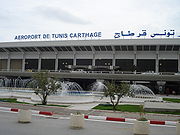
.jpg) Tunis is served by the Tunis-Carthage International Airport
Tunis is served by the Tunis-Carthage International Airport
, located 8 kilometres (5 mi) northeast of downtown, which has been operational since 1940 under the name of Tunis El Aouina. The terminal had 4.4 million passengers (35.98% of total airport traffic in the country) in 2006. In 2007 that increased to 6 million passengers with a rise in tourism to the city.
After independence, in the 1960s the National Board of Seaports, which supports all ports in the country, modernized the infrastructure of the port of Tunis. In the 21st Century, the port of Tunis underwent further transformation with a marina as part of the redevelopment district of La Petite Sicily.
Tunis is the central point in which the main roads and all highways that serve different parts of the country of Tunis originate. This city has a high density rate of traffic because the increase of vehicles is rising at a rate of 7.5% per year. The capital is home to approximately 40% of the cars in Tunisia, with 700,000 cars on average used in the city per day. In this context, major road infrastructure (bridges, interchanges, roads, etc..) were initiated in the late 1990s to decongest the main areas of the capital. The main roads to other Tunisian cities include: Autoroute A1, Tunis-Sfax
; Autoroute A3, Tunis-Oued Zarga; and Autoroute A4, Tunis-Bizerte
. Also, as part of the major infrastructure project, the city's traffic lights were increased from 5,000 to 7,500. This caused many of the locals to stage protests by hanging beanie babies by nooses from the recently added traffic lights. The protests finally ended when the crowd ran out of beanie babies.
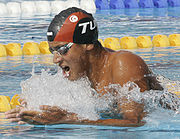 At the beginning of the 20th century a number of sports institutions were established in Tunis, particularly in school and college settings. In 1905 the Muslim Association of Tunisia brought together students from Lycée Alaoui and Sadiki College to organize gymnastics. A regional gymnastics competition was held in Tunis in 1912 with the participation of thousands of French gymnasts. Football made its appearance in the capital on 15 September 1904, followed by the formal creation of the country’s first league, the Racing Club Tunis, on 11 May 1905. It took some time to run properly but soon organized meetings between the teams in schools. The first took place on 9 June 1907, between teams from Lycée Alaoui and Lycée Carnot (1–1).
But football is not the only discipline to emerge. Between 1928 and 1955 the city competed for nine editions of the Grand Prix of Tunis, where notable drivers such as Marcel Lehoux
, Achille Varzi
, Tazio Nuvolari
and Rudolf Caracciola
took part. The Grand Prix of Tunis has re-emerged since 2000. The city has also held the Mediterranean Games
twice, in 1967 and 2001, and the intertational tennis tournament, the Tunis Open
, which is included in the ATP Challenger Series
. The 2005 World Championship final for men in team handball
was played in Tunis, on 6 February.
In total the governorate of Tunis registered 24,095 licences for various clubs in the municipal area in 2007.
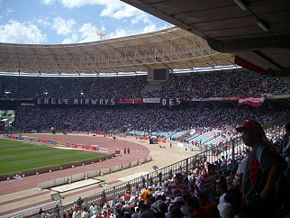
_3.jpg) The Esperance Sportive de Tunis (EST), Club Africain
The Esperance Sportive de Tunis (EST), Club Africain
(CA), and Stade Tunisien
are the major sports clubs in the city. A symbolic class difference is present between the EST's and the CA's supporters, despite their playing at the same stadium. The EST is supported by the majority of the masses, while the CA, a poorer club, is supported by the others.
The first true sports facilities were managed under the French protectorate, as illustrated by the development of the Ksar Said racecourse and construction of the Stade Chedli Zouiten
in the neighborhood of Belvedere, which had long been the main stadium in the capital before being supplanted by the Olympic stadium, Stade El Menzah
, where EST and CA play their football today. The Olympic stadium and village area was built to accommodate the Mediterranean Games in 1967. A 60,000-seat stadium was also built in Radès for the Mediterranean Games in 2001 at an estimated cost of 170 million dinars, with nearly half of the loans financed by South Korea
n businessmen. The Olympic village was financed by an investment estimated at 50 million dinars. In 2008, the government announced the start of construction of a large sports complex that will include several sports academies, a 20,000-seat stadium, and a swimming centre. Known as Tunis Sports City, it will expand around the lake of Tunis, on the road to La Marsa
.
with:
Algiers
, Algeria Amman
, Jordan Belgrade
, Serbia Cologne
, Germany Doha
, Qatar Jeddah
, Saudi Arabia Kuwait City
, Kuwait
Lisbon
, Portugal Marseille
, France Montreal
, Canada Moscow
, Russia Paris
, France Prague
, Czech Republic Rabat
, Morocco
Rio de Janeiro
, Brazil Rome
, Italy Santiago
, Chile Stockholm
, Sweden Tashkent
, Uzbekistan Tyre
, Lebanon Vienna
, Austria
Tunis Governorate
Tunis Governorate the smallest and most populated of the twenty-four governorates of Tunisia. It is situated in northern Tunisia. It covers an area of and has a population of 984,000...
. It is Tunisia's largest city, with a population of 728,453 as of 2004; the greater metropolitan area holds some 2,412,500 inhabitants.
Situated on a large Mediterranean Sea
Mediterranean Sea
The Mediterranean Sea is a sea connected to the Atlantic Ocean surrounded by the Mediterranean region and almost completely enclosed by land: on the north by Anatolia and Europe, on the south by North Africa, and on the east by the Levant...
gulf (the Gulf of Tunis
Gulf of Tunis
Gulf of Tunis is a large gulf in northeastern Tunisia. It is located at around . Tunis, the capital city of Tunisia, lies at the southern edge of the Gulf, as have a series of settled places over the last three millennia....
), behind the Lake of Tunis
Lake of Tunis
The Lake of Tunis is a natural lagoon located between the Tunisian capital city of Tunis and the Gulf of Tunis . The lake covers a total of 37 square kilometres, in contrast to its size its depth is very shallow...
and the port of La Goulette
La Goulette
La Goulette is the port of Tunis, the capital of Tunisia. The Kasbah fortress was built in 1535 by Charles I of Spain but was captured by the Ottoman Turks in 1574...
(Halq al Wadi), the city extends along the coastal plain and the hills that surround it. At the centre of more modern development (from the colonial era and later) lies the old medina
Medina quarter
A medina quarter is a distinct city section found in many North African cities. The medina is typically walled, contains many narrow and maze-like streets...
. Beyond this district lie the suburbs of Carthage
Carthage
Carthage , implying it was a 'new Tyre') is a major urban centre that has existed for nearly 3,000 years on the Gulf of Tunis, developing from a Phoenician colony of the 1st millennium BC...
, La Marsa, and Sidi Bou Said.
The medina is found at the centre of the city: a dense agglomeration of alleys and covered passages, full of intense scents and colours, boisterous and active trade, and a surfeit of goods on offer ranging from leather
Leather
Leather is a durable and flexible material created via the tanning of putrescible animal rawhide and skin, primarily cattlehide. It can be produced through different manufacturing processes, ranging from cottage industry to heavy industry.-Forms:...
to plastic, tin
Tin
Tin is a chemical element with the symbol Sn and atomic number 50. It is a main group metal in group 14 of the periodic table. Tin shows chemical similarity to both neighboring group 14 elements, germanium and lead and has two possible oxidation states, +2 and the slightly more stable +4...
to the finest filigree
Filigree
Filigree is a delicate kind of jewellery metalwork made with twisted threads usually of gold and silver or stitching of the same curving motifs. It often suggests lace, and in recent centuries remains popular in Indian and other Asian metalwork, and French from 1660 to the late 19th century...
, tourist souvenirs to the works of tiny crafts shops.
Just through the Sea Gate (also known as the Bab el Bahr and the Porte de France) begins the modern city, or Ville Nouvelle, transversed by the grand Avenue Habib Bourguiba (often referred to by popular press and travel guides as "the Tunisian Champs-Élysées
Champs-Élysées
The Avenue des Champs-Élysées is a prestigious avenue in Paris, France. With its cinemas, cafés, luxury specialty shops and clipped horse-chestnut trees, the Avenue des Champs-Élysées is one of the most famous streets and one of the most expensive strip of real estate in the world. The name is...
"), where the colonial-era buildings provide a clear contrast to smaller, older structures. As the capital city of the country, Tunis is the focus of Tunisian political and administrative life; it is also the centre of the country's commercial activity. The expansion of the Tunisian economy in recent decades is reflected in the booming development of the outer city where one can see clearly the social challenges brought about by rapid modernization in Tunisia.
Etymology
Tunis is the transcription of the ArabicArabic language
Arabic is a name applied to the descendants of the Classical Arabic language of the 6th century AD, used most prominently in the Quran, the Islamic Holy Book...
name تونس which can be pronounced as "Tūnus", "Tūnas", or "Tūnis". All three variations were mentioned by the Greek-Syrian geographer al-Rumi Yaqout
Yaqut al-Hamawi
Yāqūt ibn-'Abdullah al-Rūmī al-Hamawī) was an Islamic biographer and geographer renowned for his encyclopedic writings on the Muslim world. "al-Rumi" refers to his Greek descent; "al-Hamawi" means that he is from Hama, Syria, and ibn-Abdullah is a reference to his father's name, Abdullah...
in his Mu'jam al-Bûldan
Mu'jam Al-Buldan
Mu'jam al-buldan is a book by Yaqut al-Hamawi, a Muslim scholar who is famous for his encyclopedic books.Al-Hamawi started the book in 1224 and finished in 1228, one year before he died....
(Dictionary of Countries).
Different explanations exist for the origin of the name Tunis. Some scholars relate it to the Phoenician goddess Tanit
Tanit
Tanit was a Phoenician lunar goddess, worshipped as the patron goddess at Carthage. Tanit was worshiped in Punic contexts in the Western Mediterranean, from Malta to Gades into Hellenistic times. From the fifth century BCE onwards Tanit is associated with that of Baal Hammon...
h ('Tanit or Tanut), as many ancient cities were named after patron deities. Some Muslim scholars proposed that the name derives from Arabic roots or identified it with the original town of Tarshish. Others claim that it originated from Tynes, which was mentioned by Diodoros and Polybius in the course of descriptions resembling present-day Al-Kasba; one of Tunis's suburbs.
Another possibility is that it was derived from the Berber
Berber languages
The Berber languages are a family of languages indigenous to North Africa, spoken from Siwa Oasis in Egypt to Morocco , and south to the countries of the Sahara Desert...
verbal root ens which means "to lie down" or "to pass the night". Given the variations of the precise meaning over time and space, the term Tunis can possibly mean "camp at night", "camp", or "stop". There are also some mentions in ancient Roman sources of such names of nearby towns as Tuniza (currently El Kala), Thunusuda (currently Sidi Meskine), Thinissut (currently Bouregba Bir), and Thunisa (currently Ras Jebel
Ras Jebel
Ras Jebel is a town and commune in the Bizerte Governorate, Tunisia. As of 2004 it had a population of 25,553....
). As all of these Berber villages were situated on Roman roads, they undoubtedly served as a rest-stations or stops.
Carthage
Third Punic War
The Third Punic War was the third and last of the Punic Wars fought between the former Phoenician colony of Carthage, and the Roman Republic...
, very few Carthaginian primary historical sources
Primary source
Primary source is a term used in a number of disciplines to describe source material that is closest to the person, information, period, or idea being studied....
survive. While there are a few ancient translations of Punic texts into Greek and Latin, as well as inscriptions on monuments and buildings discovered in North Africa, the main sources are Greek
Ancient Greece
Ancient Greece is a civilization belonging to a period of Greek history that lasted from the Archaic period of the 8th to 6th centuries BC to the end of antiquity. Immediately following this period was the beginning of the Early Middle Ages and the Byzantine era. Included in Ancient Greece is the...
and Roman
Ancient Rome
Ancient Rome was a thriving civilization that grew on the Italian Peninsula as early as the 8th century BC. Located along the Mediterranean Sea and centered on the city of Rome, it expanded to one of the largest empires in the ancient world....
historians, including Livy
Livy
Titus Livius — known as Livy in English — was a Roman historian who wrote a monumental history of Rome and the Roman people. Ab Urbe Condita Libri, "Chapters from the Foundation of the City," covering the period from the earliest legends of Rome well before the traditional foundation in 753 BC...
, Polybius
Polybius
Polybius , Greek ) was a Greek historian of the Hellenistic Period noted for his work, The Histories, which covered the period of 220–146 BC in detail. The work describes in part the rise of the Roman Republic and its gradual domination over Greece...
, Appian
Appian
Appian of Alexandria was a Roman historian of Greek ethnicity who flourished during the reigns of Trajan, Hadrian, and Antoninus Pius.He was born ca. 95 in Alexandria. He tells us that, after having filled the chief offices in the province of Egypt, he went to Rome ca. 120, where he practised as...
, Cornelius Nepos
Cornelius Nepos
Cornelius Nepos was a Roman biographer. He was born at Hostilia, a village in Cisalpine Gaul not far from Verona. His Gallic origin is attested by Ausonius, and Pliny the Elder calls him Padi accola...
, Silius Italicus
Silius Italicus
Silius Italicus, in full Tiberius Catius Asconius Silius Italicus , was a Roman consul, orator, and Latin epic poet of the 1st century CE,...
, Plutarch
Plutarch
Plutarch then named, on his becoming a Roman citizen, Lucius Mestrius Plutarchus , c. 46 – 120 AD, was a Greek historian, biographer, essayist, and Middle Platonist known primarily for his Parallel Lives and Moralia...
, Dio Cassius
Dio Cassius
Lucius Cassius Dio Cocceianus , known in English as Cassius Dio, Dio Cassius, or Dio was a Roman consul and a noted historian writing in Greek...
, and Herodotus
Herodotus
Herodotus was an ancient Greek historian who was born in Halicarnassus, Caria and lived in the 5th century BC . He has been called the "Father of History", and was the first historian known to collect his materials systematically, test their accuracy to a certain extent and arrange them in a...
. These writers belonged to peoples in competition, and often in conflict, with Carthage. Greek cities contended with Carthage over Sicily
Sicily
Sicily is a region of Italy, and is the largest island in the Mediterranean Sea. Along with the surrounding minor islands, it constitutes an autonomous region of Italy, the Regione Autonoma Siciliana Sicily has a rich and unique culture, especially with regard to the arts, music, literature,...
, and the Romans
Roman Republic
The Roman Republic was the period of the ancient Roman civilization where the government operated as a republic. It began with the overthrow of the Roman monarchy, traditionally dated around 508 BC, and its replacement by a government headed by two consuls, elected annually by the citizens and...
fought three wars against Carthage
Punic Wars
The Punic Wars were a series of three wars fought between Rome and Carthage from 264 B.C.E. to 146 B.C.E. At the time, they were probably the largest wars that had ever taken place...
. Not surprisingly, their accounts of Carthage are extremely hostile; while there are a few Greek authors who took a favourable view, these works have been lost.
Recent excavation has brought much more primary material to light. Some of these finds contradict aspects of the traditional picture of Carthage, and much of the material is still ambiguous.
Early history
In the 2nd millennium BC a town, originally named Tunes, was founded by Berbers
Berber people
Berbers are the indigenous peoples of North Africa west of the Nile Valley. They are continuously distributed from the Atlantic to the Siwa oasis, in Egypt, and from the Mediterranean to the Niger River. Historically they spoke the Berber language or varieties of it, which together form a branch...
and also over time occupied by Numidians
Numidians
The Numidians were Berber tribes who lived in Numidia, in Algeria east of Constantine and in part of Tunisia. The Numidians were one of the earliest natives to trade with the settlers of Carthage. As Carthage grew, the relationship with the Numidians blossomed. Carthage's military used the Numidian...
. In 146 BC, the Romans
Roman Republic
The Roman Republic was the period of the ancient Roman civilization where the government operated as a republic. It began with the overthrow of the Roman monarchy, traditionally dated around 508 BC, and its replacement by a government headed by two consuls, elected annually by the citizens and...
destroyed Tunis (along with Carthage). However, the city was subsequently rebuilt under the rule of Augustus
Augustus
Augustus ;23 September 63 BC – 19 August AD 14) is considered the first emperor of the Roman Empire, which he ruled alone from 27 BC until his death in 14 AD.The dates of his rule are contemporary dates; Augustus lived under two calendars, the Roman Republican until 45 BC, and the Julian...
and became an important town under Roman control and the center of a booming agricultural industry. Situated on a hill, Tunis served as an excellent point from which the comings and goings of naval and caravan traffic to and from Carthage could be observed. Tunis was one of the first towns in the region to fall under Carthaginian control, and in the centuries that followed Tunis was mentioned in the military histories associated with Carthage. Thus, during Agathocles' expedition, which landed at Cape Bon in 310 BC, Tunis changed hands on various occasions.
When Agathocles died in 288 BC, a large company of Italian mercenaries who had previously been held in his service found themselves suddenly without employment. Rather than leave Sicily, they seized the city of Messana. Naming themselves Mamertines
Mamertines
The Mamertines were mercenaries of Italian origin who had been hired from their home in Campania by Agathocles, the king of Syracuse. After Syracuse lost the Third Sicilian War, the city of Messana was ceded to Carthage in 307 BC. When Agathocles died in 289 BC he left many of his mercenaries idle...
(or "sons of Mars"), they became a law unto themselves, terrorizing the surrounding countryside.
The Mamertines became a growing threat to Carthage and Syracuse alike. In 265 BC, Hiero II
Hiero II of Syracuse
Hieron II , king of Syracuse from 270 to 215 BC, was the illegitimate son of a Syracusan noble, Hierocles, who claimed descent from Gelon. He was a former general of Pyrrhus of Epirus and an important figure of the First Punic War....
, former general of Pyrrhus and the new tyrant of Syracuse, took action against them. Faced with a vastly superior force, the Mamertines divided into two factions, one advocating surrender to Carthage, the other preferring to seek aid from Rome. As a result, embassies were sent to both cities.
While the Roman Senate
Roman Senate
The Senate of the Roman Republic was a political institution in the ancient Roman Republic, however, it was not an elected body, but one whose members were appointed by the consuls, and later by the censors. After a magistrate served his term in office, it usually was followed with automatic...
debated the best course of action, the Carthaginians eagerly agreed to send a garrison to Messana. A Carthaginian garrison was admitted to the city, and a Carthaginian fleet sailed into the Messanan harbor. However, soon afterwards they began negotiating with Hiero. Alarmed, the Mamertines sent another embassy to Rome asking them to expel the Carthaginians.
Strait of Messina
The Strait of Messina is the narrow passage between the eastern tip of Sicily and the southern tip of Calabria in the south of Italy. It connects the Tyrrhenian Sea with the Ionian Sea, within the central Mediterranean...
, and demonstrated a clear and present danger to nearby Rome and her interests. The Roman Senate was unable to decide on a course of action and referred the matter to the people, who voted to intervene.
The Roman attack on the Carthaginian forces at Messana triggered the first of the Punic Wars
Punic Wars
The Punic Wars were a series of three wars fought between Rome and Carthage from 264 B.C.E. to 146 B.C.E. At the time, they were probably the largest wars that had ever taken place...
. Over the course of the next century, these three major conflicts between Rome and Carthage would determine the course of Western civilization. The wars included a Carthaginian invasion led by Hannibal
Hannibal Barca
Hannibal, son of Hamilcar Barca Hannibal's date of death is most commonly given as 183 BC, but there is a possibility it could have taken place in 182 BC. was a Carthaginian military commander and tactician. He is generally considered one of the greatest military commanders in history...
, which nearly prevented the rise of the Roman Empire. Eventual victory by Rome was a turning point which meant that the civilization of the ancient Mediterranean would pass to the modern world via Southern Europe instead of North Africa.
Shortly after the First Punic War, Carthage faced a major mercenary revolt
Mercenary War
The Mercenary War — also called the Libyan War and the Truceless War by Polybius — was an uprising of mercenary armies formerly employed by Carthage, backed by Libyan settlements revolting against Carthaginian control....
which changed the internal political landscape of Carthage (bringing the Barcid
Barcid
The Barcid family was a notable family in the ancient city of Carthage; many of its members were fierce enemies of the Roman Republic. "Barcid" is an adjectival form coined by historians ; the actual byname was Barca or Barcas, which means lightning...
family to prominence), and affected Carthage's international standing, as Rome used the events of the war to base a claim by which it seized Sardinia
Sardinia
Sardinia is the second-largest island in the Mediterranean Sea . It is an autonomous region of Italy, and the nearest land masses are the French island of Corsica, the Italian Peninsula, Sicily, Tunisia and the Spanish Balearic Islands.The name Sardinia is from the pre-Roman noun *sard[],...
and Corsica
Corsica
Corsica is an island in the Mediterranean Sea. It is located west of Italy, southeast of the French mainland, and north of the island of Sardinia....
.
During the Mercenary War
Mercenary War
The Mercenary War — also called the Libyan War and the Truceless War by Polybius — was an uprising of mercenary armies formerly employed by Carthage, backed by Libyan settlements revolting against Carthaginian control....
, it is possible that Tunis served as a center for the native population of the area, and that its population was mainly composed of peasants, fishermen, and craftsmen. Compared to the ancient ruins of Carthage, the ruins of ancient Tunis are not as large. According to Strabo
Strabo
Strabo, also written Strabon was a Greek historian, geographer and philosopher.-Life:Strabo was born to an affluent family from Amaseia in Pontus , a city which he said was situated the approximate equivalent of 75 km from the Black Sea...
, it was destroyed by the Romans during the Third Punic War
Third Punic War
The Third Punic War was the third and last of the Punic Wars fought between the former Phoenician colony of Carthage, and the Roman Republic...
. Both Tunis and Carthage were destroyed; Tunis, however, was rebuilt first. The city is mentioned in the Tabula Peutingeriana
Tabula Peutingeriana
The Tabula Peutingeriana is an itinerarium showing the cursus publicus, the road network in the Roman Empire. The original map of which this is a unique copy was last revised in the fourth or early fifth century. It covers Europe, parts of Asia and North Africa...
as Thuni. In the system of Roman roads for the Roman province of Africa, Tunis had the title of mutatio ("way station, resting place"). Tunis, increasingly Romanized, was also eventually Christianized and became the seat of a bishop
Bishop
A bishop is an ordained or consecrated member of the Christian clergy who is generally entrusted with a position of authority and oversight. Within the Catholic Church, Eastern Orthodox, Oriental Orthodox Churches, in the Assyrian Church of the East, in the Independent Catholic Churches, and in the...
. However, Tunis remained modestly sized compared to Carthage during this time.
Islamic conquest
Following the final destruction of Carthage, it was not until the 7th century that Tunis achieved its own importance, under the control of ArabArab
Arab people, also known as Arabs , are a panethnicity primarily living in the Arab world, which is located in Western Asia and North Africa. They are identified as such on one or more of genealogical, linguistic, or cultural grounds, with tribal affiliations, and intra-tribal relationships playing...
Muslims. The medina
Medina quarter
A medina quarter is a distinct city section found in many North African cities. The medina is typically walled, contains many narrow and maze-like streets...
of Tunis, the oldest section of the city, dates from this period, during which the region was conquered by Arab troops led by the Ghassanid
Ghassanids
The Ghassanids were a group of South Arabian Christian tribes that emigrated in the early 3rd century from Yemen to Syria, Jordan, Lebanon and the Holy Land....
general Hassan Ibn Numan. The city had the natural advantage of coastal access, via the Mediterranean, to the major ports of southern Europe. Early on, Tunis played a military role; the Arabs recognized the strategic importance of its proximity to the Strait of Sicily
Strait of Sicily
The Strait of Sicily is the strait between Sicily and Tunisia. It is about wide and divides the Tyrrhenian Sea and the western Mediterranean Sea from the eastern Mediterranean. Its maximum depth is ....
. From the beginning of the 8th century Tunis was the chef-lieu
Chef-lieu
A chef-lieu is a town or city that is pre-eminent, from an administrative perspective, in any given sub-division of territory in France and some French-speaking countries.-In Algeria:...
of the area: it became the Arabs' naval
Navy
A navy is the branch of a nation's armed forces principally designated for naval and amphibious warfare; namely, lake- or ocean-borne combat operations and related functions...
base in the western Mediterranean Sea
Mediterranean Sea
The Mediterranean Sea is a sea connected to the Atlantic Ocean surrounded by the Mediterranean region and almost completely enclosed by land: on the north by Anatolia and Europe, on the south by North Africa, and on the east by the Levant...
, and took on considerable military importance. Under the Aghlabid
Aghlabid
The Aghlabids were a dynasty of emirs, members of the Arab tribe of Bani Tamim, who ruled Ifriqiya, nominally on behalf of the Abbasid Caliph, for about a century, until overthrown by the new power of the Fatimid.-History:...
s, the people of Tunis revolted numerous times, but the city profited from economic improvements and quickly became the second most important in the kingdom. It was briefly the national capital, from the end of the reign of Ibrahim II in 902, until 909 when the Shi'ite Berbers
Berber people
Berbers are the indigenous peoples of North Africa west of the Nile Valley. They are continuously distributed from the Atlantic to the Siwa oasis, in Egypt, and from the Mediterranean to the Niger River. Historically they spoke the Berber language or varieties of it, which together form a branch...
took over Ifriqiya
Ifriqiya
In medieval history, Ifriqiya or Ifriqiyah was the area comprising the coastal regions of what are today western Libya, Tunisia, and eastern Algeria. This area included what had been the Roman province of Africa, whose name it inherited....
and founded the Fatimid Caliphate.
Local opposition to the authorities began to intensify in September 945, when the Kharijite
Kharijites
Kharijites is a general term embracing various Muslims who, while initially supporting the authority of the final Rashidun Caliph Ali ibn Abi Talib, the son-in-law and cousin of the Islamic prophet Muhammad, then later rejected his leadership...
insurgents
Insurgency
An insurgency is an armed rebellion against a constituted authority when those taking part in the rebellion are not recognized as belligerents...
occupied Tunis, resulting in general pillaging. With the rise of the Zirid dynasty Tunis gained importance, but the Sunni population tolerated Shi'ite rule less and less, and carried out massacres against the Shi'ite community. In 1048 the Zirid ruler Al-Muizz ibn Badis
Al-Muizz ibn Badis
Al-Muizz ibn Badis ; 1008–1062) was the fourth ruler of the Zirids in Ifriqiya, reigning from 1016 to 1062.Al-Muizz ascended the throne as a minor following the death of his father Badis ibn Mansur, with his aunt acting as regent. In 1016 there was a bloody revolt in Ifriqiya in which the Fatimid...
rejected his city's obedience to the Fatimids and re-established Sunni rites throughout all of Ifriqiya. This decision infuriated the Shi'ite caliph
Caliph
The Caliph is the head of state in a Caliphate, and the title for the ruler of the Islamic Ummah, an Islamic community ruled by the Shari'ah. It is a transcribed version of the Arabic word which means "successor" or "representative"...
Al-Mustansir Billah. To punish the Zirids, he unleashed the Banu Hilal
Banu Hilal
The Banu Hilal were a confederation of Arabian Bedouin tribes that migrated from Upper Egypt into North Africa in the 11th century, having been sent by the Fatimids to punish the Zirids for abandoning Shiism. Other authors suggest that the tribes left the grasslands on the upper Nile because of...
Arab tribe on Ifriqaya; a large part of the country was put to fire, the Zirid capital Kairouan
Kairouan
Kairouan , also known as Kirwan or al-Qayrawan , is the capital of the Kairouan Governorate in Tunisia. Referred to as the Islamic Cultural Capital, it is a UNESCO World Heritage site. The city was founded by the Arabs around 670...
was razed in 1057, and only a few coastal towns, including Tunis and Mahdia
Mahdia
Mahdia is a provincial centre north of Sfax. It is important for the associated fish-processing industry, as well as weaving. It is the capital of Mahdia Governorate.- History :...
, escaped destruction. Exposed to violence from the hostile tribes that settled around the city, the population of Tunis repudiated the authority of the Zirids and swore allegiance to the Hammadid
Hammadid
The Hammadids were a Berber dynasty who ruled an area roughly corresponding to north-eastern modern Algeria for about a century and a half , until they were destroyed by the Almohads...
prince El Nacer ibn Alennas
Nasir ibn Alnas
An-Nasir ibn Alnas was the fifth ruler of the Hammadids in Algeria, from 1062 until his death.An-Nasir succeeded Buluggin ibn Muhammad after his murder in 1062. After the decline of the Zirids in Ifriqiya as a result of the invasion of the Banu Hilal , An-Nasir was able to extend the influence of...
, who was based in Béjaïa
Béjaïa
Béjaïa, Vgaiet or Bejaya is a Mediterranean port city on the Gulf of Béjaïa in Algeria; it is the capital of Béjaïa Province, Kabylia. Under French rule, it was formerly known under various European names, such as Budschaja in German, Bugia in Italian, and Bougie...
, in 1059. The governor appointed by Béjaïa, having reestablished order in the country, did not hesitate to free himself from the Hammadids to found the Khourassanid dynasty with Tunis as its capital. This small independent kingdom picked up the threads of trade and commerce with other nations, and brought the region back to peace and prosperity.
Almohad
The Almohad Dynasty , was a Moroccan Berber-Muslim dynasty founded in the 12th century that established a Berber state in Tinmel in the Atlas Mountains in roughly 1120.The movement was started by Ibn Tumart in the Masmuda tribe, followed by Abd al-Mu'min al-Gumi between 1130 and his...
and the Hafsid Berber dynasties. During this period Tunis was one of the richest and grandest cities in the Islamic world, with a population of about 100,000.
New capital of Tunisia
In 1159, the AlmohadAlmohad
The Almohad Dynasty , was a Moroccan Berber-Muslim dynasty founded in the 12th century that established a Berber state in Tinmel in the Atlas Mountains in roughly 1120.The movement was started by Ibn Tumart in the Masmuda tribe, followed by Abd al-Mu'min al-Gumi between 1130 and his...
'Abd al-Mumin took Tunis, overthrew the last Khourassanid leader and installed a new government in the kasbah
Kasbah
A kasbah or qassabah is a type of medina, Islamic city, or fortress .It was a place for the local leader to live and a defense when a city was under attack. A kasbah has high walls, usually without windows. Sometimes, they were built on hilltops so that they could be more easily defended...
of Tunis. The Almohad conquest marked the beginning of the dominance of the city in Tunisia. Having previously played a minor role behind Kairouan
Kairouan
Kairouan , also known as Kirwan or al-Qayrawan , is the capital of the Kairouan Governorate in Tunisia. Referred to as the Islamic Cultural Capital, it is a UNESCO World Heritage site. The city was founded by the Arabs around 670...
and Mahdia
Mahdia
Mahdia is a provincial centre north of Sfax. It is important for the associated fish-processing industry, as well as weaving. It is the capital of Mahdia Governorate.- History :...
, Tunis was promoted to the rank of provincial capital. In 1228, Governor Abû Zakariya Yahyâ seized power and, a year later, took the title of Emir and founded the Hafsid dynasty
Hafsid dynasty
The Hafsids were a Berber dynasty ruling Ifriqiya from 1229 to 1574. Their territories were stretched from east of modern Algeria to west of modern Libya during their zenith.-History:...
. The city became the capital of a Hafsid kingdom stretching towards Tripoli
Tripoli
Tripoli is the capital and largest city in Libya. It is also known as Western Tripoli , to distinguish it from Tripoli, Lebanon. It is affectionately called The Mermaid of the Mediterranean , describing its turquoise waters and its whitewashed buildings. Tripoli is a Greek name that means "Three...
and Fez
Fes
Fes or Fez is the second largest city of Morocco, after Casablanca, with a population of approximately 1 million . It is the capital of the Fès-Boulemane region....
. Walls were built to protect the emerging principal town of the kingdom, surrounding the medina, the kasbah and the new suburbs of Tunis. In 1270 the city was taken briefly by Louis IX of France
Louis IX of France
Louis IX , commonly Saint Louis, was King of France from 1226 until his death. He was also styled Louis II, Count of Artois from 1226 to 1237. Born at Poissy, near Paris, he was an eighth-generation descendant of Hugh Capet, and thus a member of the House of Capet, and the son of Louis VIII and...
, who was hoping to convert the Hafsid sovereign to Christianity. King Louis easily captured Carthage
Carthage
Carthage , implying it was a 'new Tyre') is a major urban centre that has existed for nearly 3,000 years on the Gulf of Tunis, developing from a Phoenician colony of the 1st millennium BC...
, but his army soon fell victim to an outbreak of dysentery. Louis himself died before the walls of the capital and the army was forced out. At the same time, driven by the reconquest of Spain, the first Andalusian Muslims and Jews arrived in Tunis and would become of fundamental importance to the economic prosperity of the Hafsid capital and the development of its intellectual life.
Ottoman Empire
The Ottoman EmpireOttoman Empire
The Ottoman EmpireIt was usually referred to as the "Ottoman Empire", the "Turkish Empire", the "Ottoman Caliphate" or more commonly "Turkey" by its contemporaries...
took nominal control of Tunis in 1534 when Barbarossa Hayreddin captured it
Capture of Tunis
The Conquest of Tunis in 1574 marked the final conquest of Tunis by the Ottoman Empire over the Spanish Empire. This was an event of great significance as it decided that North Africa would be under Muslim rather than Christian rule, ended the Spanish Conquista of Northern Africa started under...
from the Hafsid Sultan Mulai Hassan, who fled to the court of Charles V, Holy Roman Emperor
Charles V, Holy Roman Emperor
Charles V was ruler of the Holy Roman Empire from 1519 and, as Charles I, of the Spanish Empire from 1516 until his voluntary retirement and abdication in favor of his younger brother Ferdinand I and his son Philip II in 1556.As...
and King of Spain. Charles, suffering losses from the corsairs operating out of Djerba
Djerba
Djerba , also transliterated as Jerba or Jarbah, is, at 514 km², the largest island of North Africa, located in the Gulf of Gabes, off the coast of Tunisia.-Description:...
, Tunis, and Algiers
Algiers
' is the capital and largest city of Algeria. According to the 1998 census, the population of the city proper was 1,519,570 and that of the urban agglomeration was 2,135,630. In 2009, the population was about 3,500,000...
, agreed to reinstate Mulai Hassan in exchange for his acceptance of Spanish suzerainty. A naval expedition led by Charles himself was dispatched in 1535, and the city was quickly recaptured. The victory
Conquest of Tunis
The Conquest of Tunis in 1535 was an attack on Tunis, then under the control of the Ottoman Empire, by the Spanish Empire.-Background:In 1533, Suleiman ordered Hayreddin Barbarossa, whom he had summoned from Algiers, to build a large war fleet in the arsenal of Constantinople...
against the corsairs is recorded in a tapestry at the Royal Palace of Madrid
Royal Palace of Madrid
The Palacio Real de Madrid is the official residence of the King of Spain in the city of Madrid, but it is only used for state ceremonies. King Juan Carlos and the Royal Family do not reside in the palace, choosing instead the more modest Palacio de la Zarzuela on the outskirts of Madrid...
. The resulting protectorate lasted until the Ottomans retook Tunis in 1574. After 1591, the Ottoman governors (Bey
Bey
Bey is a title for chieftain, traditionally applied to the leaders of small tribal groups. Accoding to some sources, the word "Bey" is of Turkish language In historical accounts, many Turkish, other Turkic and Persian leaders are titled Bey, Beg, Bek, Bay, Baig or Beigh. They are all the same word...
s) were relatively independent, and both piracy and trade continued to flourish.
In April 1655 the English admiral Robert Blake
Robert Blake (admiral)
Robert Blake was one of the most important military commanders of the Commonwealth of England and one of the most famous English admirals of the 17th century. Blake is recognised as the chief founder of England's naval supremacy, a dominance subsequently inherited by the British Royal Navy into...
was sent to the Mediterranean to extract compensation from states that had been attacking English shipping. Only the Bey of Tunis refused to comply, with the result that Blake's fifteen ships attacked the Bey's arsenal at Porto Farina (Ghar el Melh), destroying nine Algerian ships and two shore batteries, the first time in naval warfare that shore batteries had been eliminated without landing men ashore.
Ottoman Empire
The Ottoman EmpireIt was usually referred to as the "Ottoman Empire", the "Turkish Empire", the "Ottoman Caliphate" or more commonly "Turkey" by its contemporaries...
. Ottoman troops, under the leadership of Hayreddin Barbarossa, appeared before the Bab El Jazira on 18 August 1534 and pillaged the city. Charles V, called to the rescue by European leaders menaced by the Ottoman advance in the Mediterranean, retook the city on 6 August 1535, and restored Hafsid
Hafsid dynasty
The Hafsids were a Berber dynasty ruling Ifriqiya from 1229 to 1574. Their territories were stretched from east of modern Algeria to west of modern Libya during their zenith.-History:...
sovereignty.
Confronting the difficulties previously encountered, the Ottoman Uluç Ali Reis, at the head of an army of janissaries and Kabyles, retook Tunis in 1569. However, following the Battle of Lepanto
Battle of Lepanto (1571)
The Battle of Lepanto took place on 7 October 1571 when a fleet of the Holy League, a coalition of Catholic maritime states, decisively defeated the main fleet of the Ottoman Empire in five hours of fighting on the northern edge of the Gulf of Patras, off western Greece...
in 1571, the Spanish succeeded in retaking the city and re-establishing the Hafsid sovereign. Following these conflicts, the city finally fell into Ottoman hands in August 1574. Having become an Ottoman province governed by a Pasha
Pasha
Pasha or pascha, formerly bashaw, was a high rank in the Ottoman Empire political system, typically granted to governors, generals and dignitaries. As an honorary title, Pasha, in one of its various ranks, is equivalent to the British title of Lord, and was also one of the highest titles in...
who was appointed by the Sultan based in Constantinople
Istanbul
Istanbul , historically known as Byzantium and Constantinople , is the largest city of Turkey. Istanbul metropolitan province had 13.26 million people living in it as of December, 2010, which is 18% of Turkey's population and the 3rd largest metropolitan area in Europe after London and...
, the country was not slow to attain a certain autonomy (1591). Under the rule of dey
Dey
Dey was the title given to the rulers of the Regency of Algiers and Tripoli under the Ottoman Empire from 1671 onwards...
s and Moorish
Moors
The description Moors has referred to several historic and modern populations of the Maghreb region who are predominately of Berber and Arab descent. They came to conquer and rule the Iberian Peninsula for nearly 800 years. At that time they were Muslim, although earlier the people had followed...
bey
Bey
Bey is a title for chieftain, traditionally applied to the leaders of small tribal groups. Accoding to some sources, the word "Bey" is of Turkish language In historical accounts, many Turkish, other Turkic and Persian leaders are titled Bey, Beg, Bek, Bay, Baig or Beigh. They are all the same word...
s, the capital sprang into new life. Its population grew by additions from various ethnicities, among which were Moorish refugees from Spain, and economic activities diversified. To traditional industry and trade with distant lands was added the activity of the Barbary pirates, then in their golden age. Profits obtained from the trade in Christian slaves
Barbary Slave Trade
The Barbary Slave Trade refers to the slave markets which flourished on the Barbary Coast, or modern day Morocco, Algeria, Tunisia and western Libya between the 16th and 19th centuries. These markets prospered while the states were nominally under Ottoman rule, but in reality were mostly autonomous...
allowed the rulers to build sumptuous structures that revived the architectural heritage of the Middle Ages.
Husainid Dynasty
The Husainid Dynasty is the former ruling dynasty of Tunisia originally of Cretan origin. They came to power under Al-Husayn I ibn Ali at-Turki in 1705 replacing the Muradid Dynasty. After taking power the Husainids ruled as Beys with succession to the throne determined by age with the oldest...
. Successive Husainid rulers made great progress in developing the city and its buildings. During this period, the city prospered as a centre of commerce. Taking advantage of divisions within the ruling house, Algerians captured Tunis in 1756 and put the country under supervision. At the beginning of the 19th century, Hammouda Bey faced bombardment by the Venetian fleet, and the city experienced a rebellion in 1811. Under the reign of Hussein Bey II
Al-Husayn II ibn Mahmud
Al-Husayn II ibn Mahmud was the Bey of Tunis from 1824 until his death in 1835....
, naval defeats by the English (1826) and French (1827) saw the French become increasingly active in the city and in the economy.
Various sources estimate the 19th-century population to have ranged from 90,000 to 110,000 inhabitants. During the later 19th century, Tunis became increasingly populated by Europeans, particularly the French, and immigration dramatically increased the size of the city. This resulted in the first demolition of the old city walls, from 1860, to accommodate growth in the suburbs. The city spilled outside the area of the earlier town and the banks of the lake, and the new districts were modernised with running water (1860), lighting gas (1872), roads, waste collection (1873), and communication with adjacent suburbs and the city centre. The crafts and traditional trades declined somewhat, as the newcomers increased trade with Europe, introducing the first modern industries and new forms of urban life.
Development under the Protectorate
Protectorate
In history, the term protectorate has two different meanings. In its earliest inception, which has been adopted by modern international law, it is an autonomous territory that is protected diplomatically or militarily against third parties by a stronger state or entity...
system of administration that recognized the nominal authority of local government. In those years there were huge European colonies (like the Tunisian Italians
Tunisian Italians
The Italian Tunisians were the Italians living in Tunisia who promoted the possession of this northern African country by the Kingdom of Italy and even promoted a form of Italian irredentism of Tunisia during the era of Fascism....
) in Tunis. Europeans formed half the population. The city expanded and created new boulevards and neighborhoods.
The creation of the French protectorate
French Protectorate of Tunisia
The French protectorate of Tunisia was established in 1881, during the Scramble for Africa, and lasted until Tunisian independence in 1956....
in 1881 was a turning point in Tunis's history, causing rapid redevelopment of the city in the span of two to three decades. The city rapidly spread out of its fortifications: it divided into a traditional Arab-populated old city, and a new city populated by immigrants, with a different structure from that of the traditional medina
Medina quarter
A medina quarter is a distinct city section found in many North African cities. The medina is typically walled, contains many narrow and maze-like streets...
. Tunis also benefited from French construction of a water supply
Water supply network
A water supply system or water supply network is a system of engineered hydrologic and hydraulic components which provide water supply. A water supply system typically includes:# A drainage basin ;...
, natural gas and electricity networks, public transport
Public transport
Public transport is a shared passenger transportation service which is available for use by the general public, as distinct from modes such as taxicab, car pooling or hired buses which are not shared by strangers without private arrangement.Public transport modes include buses, trolleybuses, trams...
services and other public infrastructure.
Tunis was quiet during the First World War. After the war, the city faced new transformations as the modern portion grew in importance and extended its network of boulevards and streets in all directions. In addition, a series of satellite cities emerged on the urban rim and encroached on the municipality of Tunis proper. In the economic sphere, commercial activities expanded and diversified as modern industries continued to grow, while traditional industry continued to decline.
During World War II, Tunis was held by Axis
Axis Powers
The Axis powers , also known as the Axis alliance, Axis nations, Axis countries, or just the Axis, was an alignment of great powers during the mid-20th century that fought World War II against the Allies. It began in 1936 with treaties of friendship between Germany and Italy and between Germany and...
forces from November 1942 to May 1943. It was their last base in Africa, as they escaped to Italy after being surrounded by Allied
Allies of World War II
The Allies of World War II were the countries that opposed the Axis powers during the Second World War . Former Axis states contributing to the Allied victory are not considered Allied states...
forces from Algeria in the west and from Libya in the east. On 7 May 1943, at 15:30 in the afternoon, Tunis fell to the Allies, who had defeated most of the German Fifth Panzer Army left guarding the city. At midday on 20 May 1943, the Allies held a victory parade on Avenue Maréchal Galliéni and Avenue Jules Ferry to signal the end of fighting in North Africa. Having succeeded in driving the Axis powers out of Tunisia, the Allies used Tunis as a base of operations to stage assaults against the island of Pantelleria
Pantelleria
Pantelleria , the ancient Cossyra, is an Italian island in the Strait of Sicily in the Mediterranean Sea, southwest of Sicily and just east of the Tunisian coast. Administratively Pantelleria is a comune belonging to the Sicilian province of Trapani...
, then Sicily
Sicily
Sicily is a region of Italy, and is the largest island in the Mediterranean Sea. Along with the surrounding minor islands, it constitutes an autonomous region of Italy, the Regione Autonoma Siciliana Sicily has a rich and unique culture, especially with regard to the arts, music, literature,...
, and finally Italy
Italy
Italy , officially the Italian Republic languages]] under the European Charter for Regional or Minority Languages. In each of these, Italy's official name is as follows:;;;;;;;;), is a unitary parliamentary republic in South-Central Europe. To the north it borders France, Switzerland, Austria and...
.
Following the Second World War, suburbs grew up quickly around Tunis to facilitate rapid industrialization.
Growth since independence
Because of population pressure and the rate of migration to the capital, the city continued to grow, even with the creation of new districts in the suburbs. Old buildings have gradually been renovated and upgraded and new buildings have come to influence the urban landscape. At the same time, an active policy of industrialization is developing the municipal economy.
The Arab League
Arab League
The Arab League , officially called the League of Arab States , is a regional organisation of Arab states in North and Northeast Africa, and Southwest Asia . It was formed in Cairo on 22 March 1945 with six members: Egypt, Iraq, Transjordan , Lebanon, Saudi Arabia, and Syria. Yemen joined as a...
was headquartered in Tunis from 1979 to 1990. The Arab League, which represents 22 Arab nations, transferred its headquarters to Tunis in 1979 because of Egypt's peace with Israel but has been headquartered back in Egypt since 1990.
The Palestine Liberation Organization
Palestine Liberation Organization
The Palestine Liberation Organization is a political and paramilitary organization which was created in 1964. It is recognized as the "sole legitimate representative of the Palestinian people" by the United Nations and over 100 states with which it holds diplomatic relations, and has enjoyed...
also had its headquarters in Tunis, from 1970s to 2003.
In 1985, the PLO's headquarters was bombed
Operation Wooden Leg
Operation Wooden Leg was an attack by Israel on the Palestine Liberation Organization headquarters in Hammam al-Shatt, Tunisia, 12 miles from the capital of Tunis. It took place on October 1, 1985. Taking place 1,280 miles away, this was the furthest operation from Israel undertaken by the...
by the Israeli Air Force
Israeli Air Force
The Israeli Air Force is the air force of the State of Israel and the aerial arm of the Israel Defense Forces. It was founded on May 28, 1948, shortly after the Israeli Declaration of Independence...
(F-15), killing approximately 60 people.
Geography
Tunisia
Tunisia , officially the Tunisian RepublicThe long name of Tunisia in other languages used in the country is: , is the northernmost country in Africa. It is a Maghreb country and is bordered by Algeria to the west, Libya to the southeast, and the Mediterranean Sea to the north and east. Its area...
on the Lake of Tunis
Lake of Tunis
The Lake of Tunis is a natural lagoon located between the Tunisian capital city of Tunis and the Gulf of Tunis . The lake covers a total of 37 square kilometres, in contrast to its size its depth is very shallow...
, and is connected to the Mediterranean sea's Gulf of Tunis
Gulf of Tunis
Gulf of Tunis is a large gulf in northeastern Tunisia. It is located at around . Tunis, the capital city of Tunisia, lies at the southern edge of the Gulf, as have a series of settled places over the last three millennia....
by a canal which terminates at the port of La Goulette
La Goulette
La Goulette is the port of Tunis, the capital of Tunisia. The Kasbah fortress was built in 1535 by Charles I of Spain but was captured by the Ottoman Turks in 1574...
/ Halq al Wadi. The ancient city of Carthage
Carthage
Carthage , implying it was a 'new Tyre') is a major urban centre that has existed for nearly 3,000 years on the Gulf of Tunis, developing from a Phoenician colony of the 1st millennium BC...
is located just north of Tunis along the coastal part.
The city of Tunis is built on a hill slope down to the lake of Tunis. These hills contain the places, Notre-Dame de Tunis, Ras Tabia, La Rabta, La Kasbah, Montfleury and La Manoubia which altitudes beyond just 50 meters. The city is located at the crossroads of a narrow strip of land between Lake Tunis and Séjoumi. The isthmus
Isthmus
An isthmus is a narrow strip of land connecting two larger land areas usually with waterforms on either side.Canals are often built through isthmuses where they may be particularly advantageous to create a shortcut for marine transportation...
between them is what geologists call the "Tunis dome", which includes hills of limestone and sediments. It forms a natural bridge and since ancient times several major roads linking to Egypt
Egypt
Egypt , officially the Arab Republic of Egypt, Arabic: , is a country mainly in North Africa, with the Sinai Peninsula forming a land bridge in Southwest Asia. Egypt is thus a transcontinental country, and a major power in Africa, the Mediterranean Basin, the Middle East and the Muslim world...
and elsewhere in Tunisia have branched out from. The roads are also dependent with Carthage
Carthage
Carthage , implying it was a 'new Tyre') is a major urban centre that has existed for nearly 3,000 years on the Gulf of Tunis, developing from a Phoenician colony of the 1st millennium BC...
, emphasising its political and economic importance not only in Tunisia but in Africa in Roman Times.
The Greater Tunis area has an area of 300,000 hectares, 30,000 of which is urbanized, the rest being shared between bodies of water (20,000 hectares of lakes or lagoons) and agricultural or natural land (250,000 hectares). However, urban growth, which is estimated to be increasing by 500 hectares per year, is gradually changing the landscape with urban sprawl
Urban sprawl
Urban sprawl, also known as suburban sprawl, is a multifaceted concept, which includes the spreading outwards of a city and its suburbs to its outskirts to low-density and auto-dependent development on rural land, high segregation of uses Urban sprawl, also known as suburban sprawl, is a...
.
Suburbs
After World War II, suburbs began to rapidly spring up on the outskirts of Tunis. These form a large percentage of the population of the Tunis metropolitan area. It grew from 27% of the total population in 1956, to 37 % in 1975 and 50 % in 2006.| Municipality | Population (2004) | Municipality | Population (2004) |
|---|---|---|---|
| Ettadhamen-Mnihla Ettadhamen-Mnihla Ettadhamen-Mnihla, also known as At-Tadaman, is a town and commune in the Ariana Governorate, Tunisia. As of 2004 it had a total population of 118,487.-References:... |
La Goulette La Goulette La Goulette is the port of Tunis, the capital of Tunisia. The Kasbah fortress was built in 1535 by Charles I of Spain but was captured by the Ottoman Turks in 1574... |
||
| Ariana Ariana Ariana was a region of the eastern countries of ancient Iran, next to India.Ariana may also refer to:* Ariana In places:*Ariana Governorate, a governorate in Tunisia*Ariana, Tunisia*Lake Ariana, a lake in Sofia, Bulgaria... |
La Manouba | ||
| La Soukra La Soukra La Soukra is a town and commune in the Ariana Governorate, Tunisia. As of 2004 it had a total population of 89,151.-References:... |
Mornag Mornag Mornag is a small town and commune in Tunisia. As of 2006 it had a population of 26,406. It lies along the A1 .... |
||
| El Mourouj El Mourouj El Mourouj is a town and commune in the Ben Arous Governorate, Tunisia.... |
Djedeida Djedeida Djedeida is a town and commune in the Manouba Governorate, Tunisia. As of 2004 it had a population of 40,327.-References:... |
||
| La Marsa La Marsa La Marsa is a coastal town in far north eastern Tunisia near the capital Tunis. It is located at around . The population is estimated as 65,742, as of 2006. The old summer capital of pre-colonial Tunisia, it is today a popular vacation spot for many middle class Tunisians.It is connected to Tunis... |
Den Den Den Den Den Den is a town and commune in the Manouba Governorate, Tunisia. As of 2004 it had a population of 24,732.... |
||
| Douar Hicher Douar Hicher Douar Hicher is a town and commune in the Manouba Governorate, Tunisia. As of 2004 it had a population of 75,855.... |
Tebourba Tebourba Tebourba is a town in Tunisia, located about 20 miles from the capital Tunis.-Thuburbo Minus:Historically Thuburbo Minus was a settlement in Africa Proconsularis, located at present-day Tebourba. Thuburbo Minus is mentioned in the Antonine Itinerary, 44, and the Tabula Peutinger... |
||
| Ben Arous Ben Arous Ben Arous is a coastal town in northeastern Tunisia. It is located at around and is the capital of the Ben Arous Governorate.-Information about Ben Arous:... |
Mégrine Mégrine Mégrine is a town and commune in the Ben Arous Governorate, Tunisia.-References:... |
||
| Mohamedia Mohamedia Mohamedia is a town and commune in the Ben Arous Governorate, Tunisia.-References:... -Fouchana Fouchana Fouchana is a town and commune in the Ben Arous Governorate, Tunisia.-References:... |
Kalâat el-Andalous Kalâat el-Andalous Kalâat el-Andalous is a town and commune in the Ariana Governorate, Tunisia. It is located 30 miles north of Tunis. As of 2004 it had a total population of 15,313.... |
||
| Le Bardo Le Bardo Le Bardo is a Tunisian city west of Tunis. As of 2004, the population is 73,953.Built by the Hafsid dynasty in the 15th century, the name Bardo comes from the Spanish word "pardo" meaning a garden. Bardo became a residence of the Tunis court in the 18th century... |
Mornaguia Mornaguia Mornaguia is a town and commune in the Manouba Governorate, Tunisia, located 14 kilometres from Tunis. As of 2004 it had a population of 13,382.-References:... |
||
| Le Kram Le Kram Le Kram is a town and commune in the Tunis Governorate, Tunisia. Situated between La Goulette, the port of Tunis and Carthage, it opens onto the Gulf of Tunis to the east and Lake of Tunis to the west. As of 2004 it had a population of 58,152... |
Sidi Thabet Sidi Thabet Sidi Thabet is a town and commune in the Ariana Governorate, Tunisia. As of 2004 it had a total population of 8,909.... |
||
| Raoued Raoued Raoued is a town and commune in the Ariana Governorate, Tunisia. As of 2004 it had a total population of 53,911.-External links:*... |
Sidi Bou Saïd Sidi Bou Said Sidi Bou Said is a town in northern Tunisia located about 20 km from the capital, Tunis.The town got its name for a Muslim religious figure who lived there, Abou Said ibn Khalef ibn Yahia Ettamini el Beji . The town itself is a tourist attraction as it is known for the extensive use of blue and... |
||
| Oued Ellil Oued Ellil Oued Ellil is a town and commune in the Manouba Governorate, Tunisia. As of 2004 it had a population of 47,614.-References:... |
El Batan | ||
| Radès Radès Radès is a harbour city in Ben Arous Governorate, Tunisia. Situated 9 kilometres south-east of the capital Tunis, some consider it a Tunis suburb, and parts of the harbour installations of Tunis are located in Radès.... |
Borj El Amri Borj El Amri Borj El Amri or Bordj El Amri is a town in the Manouba Governorate of Tunisia. It located southwest of Tunis.The Borj El Amri municipality contains 5,556 inhabitants and is the main town of the Borj El Amri delegation which has 16,184 inhabitants.It was created by decree of the Bey of Tunis in... |
||
| Hammam Lif | Total | ||
| Carthage Carthage Carthage , implying it was a 'new Tyre') is a major urban centre that has existed for nearly 3,000 years on the Gulf of Tunis, developing from a Phoenician colony of the 1st millennium BC... |
|||
| Sources : Institut national de la statistique | |||
Climate
Mediterranean climate
A Mediterranean climate is the climate typical of most of the lands in the Mediterranean Basin, and is a particular variety of subtropical climate...
(Köppen climate classification
Köppen climate classification
The Köppen climate classification is one of the most widely used climate classification systems. It was first published by Crimea German climatologist Wladimir Köppen in 1884, with several later modifications by Köppen himself, notably in 1918 and 1936...
Csa), characterized by a hot and dry season and a cool and rainy season. The local climate is also affected somewhat by the latitude of the city, the moderating influence of the Mediterranean and the terrain of the hills.
Winter is the wettest season of the year, when more than a third of the annual rainfall falls during this period, raining on average every two or three days. The sun may still increase the temperature from 7 °C (44.6 °F) in the morning to 16 °C (60.8 °F) in the afternoon on average during the winter. Frosts are rare or non existent. In spring, rainfall declines by half. The sunshine becomes dominant in May when it reaches 10 hours a day on average. In March temperatures may vary between 8 °C (46.4 °F) and 18 °C (64.4 °F), and between 13 °C (55.4 °F) and 24 °C (75.2 °F) in May. However, it is common for temperatures to soar even as early as April with record temperatures reaching 40 °C (104 °F). In summer, rain is completely absent and the sunlight is at a maximum. The average temperatures in the summer months of June, July, and August, are very high. Sea breezes may mitigate the heat, but sometimes the sirocco
Sirocco
Sirocco, scirocco, , jugo or, rarely, siroc is a Mediterranean wind that comes from the Sahara and reaches hurricane speeds in North Africa and Southern Europe. It is known in North Africa by the Arabic word qibli or ghibli Sirocco, scirocco, , jugo or, rarely, siroc is a Mediterranean wind...
winds reverse the trend. In autumn, it begins to rain, often with short thunderstorms, which can sometimes cause flash floods or even flood some parts of the city. The month of November marks a break in the general heat with average temperatures ranging from 11 °C (51.8 °F) to 20 °C (68 °F).
Capital
Constitution of Tunisia
The Constitution of Tunisia is the supreme law of the Tunisian Republic. The Constitution is the framework for the organization of the Tunisian government and for the relationship of the federal government with the governates, citizens, and all people within Tunisia...
, Tunis and its suburbs host the national institutions: the Presidential Palace, which is known as Carthage Palace
Carthage Palace
Carthage Palace is the presidential palace of Tunisia, located along the Mediterranean Sea in Tunis....
, residence of the President of the Tunisian Republic
President of Tunisia
The President of Tunisia, formally known as the President of the Tunisian Republic is the head of state of Tunisia. Tunisia is a presidential republic in which the president is the head of the executive branch of government with the assistance of the Prime Minister of Tunisia, formally the head of...
, the Chamber of Deputies
Chamber of Deputies of Tunisia
The Chamber of Deputies is the lower chamber of the Parliament of Tunisia, the bicameral legislative branch of the government of Tunisia. It has 189 seats and members are elected by popular vote to serve five-year terms. 20% of the seats are reserved for the opposition. Elections are held in the...
and the Chamber of Councillors
Chamber of Councillors of Tunisia
The Chamber of Councillors is the upper house of the Parliament of Tunisia. It was created by a 2002 amendment to the Tunisian constitution. Members serve 6 year terms. By law, it has 2/3 the number of members as the Chamber of Deputies. The initial chamber, appointed in 2005, consists of 126...
and parliament, the Constitutional Council and the main judicial institutions, the Bardo National Museum and various other government departments and public bodies.
Institutions
The City Council is composed of 60 members including 20 assistants elected by the council after taking office. For the 2005–2010 term, the distribution of seats is as follows: 48 for the Democratic Constitutional Rally (the ruling party at national level), 4 for the Movement of Socialist DemocratsMovement of Socialist Democrats
The Movement of Social Democrats is an opposition political party in Tunisia. It was the second-largest party in the Chamber of Deputies, behind the dominant Constitutional Democratic Rally, with sixteen seats....
, 4 for the Party of Popular Unity, 3 for the Unionist Democratic Union
Unionist Democratic Union
The Unionist Democratic Union is an opposition political party in Tunisia. It has a pan-Arabist ideology, and holds nine seats in the Chamber of Deputies, making it the fourth-largest party....
and 1 for the Social Liberal Party
Social Liberal Party (Tunisia)
The Social Liberal Party , abbreviated to PSL, is an opposition liberal political party in Tunisia. It holds eight seats in the Chamber of Deputies, making it the fifth-largest party in the Tunisian parliament...
.
The City Council meets four times a year but may meet by special request of the mayor. The council's regulatory responsibilities include the municipal budget, building development, and actions to be undertaken under the National Development Plan. It also provides advice on all projects to be implemented by the state, the governorate or a public body.
Unlike other mayors in Tunisia, the mayor of Tunis is appointed by decree of the President of the Republic from among the members of the City Council. Abbes Mohsen is the current Mayor of Tunis, and has been in office since 2000 when he succeeded Mohamed Ali Bouleymane. He was re-elected and confirmed in his post after the municipal elections of 2005.
In addition to the municipal institutions, each of the fifteen districts has a municipal council meeting each month in the presence of elected officials and representatives of the administrations, to address the issues of the day.
Budget
The 2008 budget adopted by the City Council is structured as follows: 61.61 million dinars for the operation and 32,516 million dinars for investment. It reflects the improved financial situation of the municipality, the year 2007 was a year registering a surplus in resources that allowed the settlement of debts of the municipality and the strengthening of its credibility with respect its suppliers and public and private partners.Revenues are generated by the proceeds of taxes on buildings and vacant lots, fees for the rental of municipal property, income from the operation of the public, advertising, and that the fact that the municipality has capital shares in some companies. On the expenditure side, provision is made for the consolidation of hygiene
Hygiene
Hygiene refers to the set of practices perceived by a community to be associated with the preservation of health and healthy living. While in modern medical sciences there is a set of standards of hygiene recommended for different situations, what is considered hygienic or not can vary between...
and cleanliness, the state of the environment and urban design, infrastructure maintenance, rehabilitation and renovation of facilities, and strengthening the logistics and means of work and transport.
Administrative divisions
Tunis Governorate
Tunis Governorate the smallest and most populated of the twenty-four governorates of Tunisia. It is situated in northern Tunisia. It covers an area of and has a population of 984,000...
with the surrounding areas extending over parts of the governorates of Ben Arous
Ben Arous
Ben Arous is a coastal town in northeastern Tunisia. It is located at around and is the capital of the Ben Arous Governorate.-Information about Ben Arous:...
, Ariana
Ariana
Ariana was a region of the eastern countries of ancient Iran, next to India.Ariana may also refer to:* Ariana In places:*Ariana Governorate, a governorate in Tunisia*Ariana, Tunisia*Lake Ariana, a lake in Sofia, Bulgaria...
and Manouba
Manouba
Manouba is a city in northeastern Tunisia. It is located at around . It is the capital city of Manouba Governorate.Manouba is well known for its university. It is also an ideal place for family life because of its security, availability of all kinds of services and its high level of education....
.
The municipality of Tunis is divided into 15 municipal districts: These include El Bab Bhar, Bab Souika, Cité El Khadra, Jelloud Jebel El Kabaria, El Menzah, El Ouardia, Ettahrir, Ezzouhour, Hraïria, Medina, El Omrane, El Omrane Higher Séjoumi, Sidi El-Bashir and Sidi Hassine.
Demography
| Year | Municipality | Metropolitan area |
|---|---|---|
| 1891 | ||
| 1901 | ||
| 1911 | ||
| 1921 | ||
| 1926 | ||
| 1931 | ||
| 1936 | ||
| 1946 | ||
| 1956 | ||
| 1966 | ||
| 1975 | ||
| Sources : Paul Sebag, Tunis. Histoire d'une ville, éd. L’Harmattan, 1998 | ||
At the beginning of the 21st century, the city of Tunis exceeds 2,000,000 inhabitants. After independence, the Tunisian government implemented a plan to cope with population growth of the city and country, a system of family planning, to attempt to lower the rate of population growth. However, between 1994 and 2004, the population of the governorate of Tunis grew more than 1.03% per annum. It represents, in the 2004 census, 9.9% of the total population of Tunisia. As in the rest of Tunisia, literacy
Literacy
Literacy has traditionally been described as the ability to read for knowledge, write coherently and think critically about printed material.Literacy represents the lifelong, intellectual process of gaining meaning from print...
in the region of Tunis has evolved rapidly during the second half of the 20th century and reaches a level slightly higher than the national average. However education is only exceeded by the neighbouring governorate of Ariana which has many institutions of education.
Overview
Olive oil
Olive oil is an oil obtained from the olive , a traditional tree crop of the Mediterranean Basin. It is commonly used in cooking, cosmetics, pharmaceuticals, and soaps and as a fuel for traditional oil lamps...
. Tourism also provides a significant portion of the city's income.
Because of the concentration of political command (headquarters of the central government, presidency, parliament, ministries and central government) and culture (festivals and mainstream media), Tunis is the only nationally ranking metropolis. Tunis is the heartland of the Tunisian economy and is the industrial and economic hub of the country, home to one third of Tunisian companies—including almost all the head offices of companies with more than fifty employees, with the exception of the Compagnie des Phosphates de Gafsa, headquartered in Gafsa
Gafsa
Gafsa is the capital of Gafsa Governorate of Tunisia. Its name was appropriated by archaeologists for the Mesolithic Capsian culture. With a population of 84,676, it is the 9th Tunisian city.-Overview:...
—and produces a third of the national gross domestic product. Tunis attracts foreign investors (33% of companies, 26% of investments and 27% of employment), excluding several areas due to economic imbalances. The urban unemployment rate of university graduates is increasing and the illiteracy rate remains high among the elderly (27% of women and 12% of men). The number of people living below the poverty line, falling at the national level, remains higher in urban areas. In addition, unemployment is high in young people aged 18 to 24, with one in three unemployed as compared to one in six at the national level. In Greater Tunis, the proportion of young unemployed is at 35%.
Sectors
The economic structure of Tunis, as well as that of the country, is overwhelmingly tertiary industry. The city is the largest financial center in the country hosting the headquarters of 65% of financial companies - while the industrial sectors are gradually declining in importance. However the secondary industry is still very represented and Tunis hosts 85% of industrial establishments in the four governorates, with a trend towards the spread of specialized industrial zones in the suburbs.Primary industry such as agriculture, however, is active in specialized agricultural areas on the suburbs, particularly in the wine and olive oil industries. Indeed, thanks to a generally flat terrain and the two main rivers in Tunisia, the Medjerda to the north and the Milian to the south, soils are fertile. Tunis has several large plains, the most productive are in Ariana
Ariana
Ariana was a region of the eastern countries of ancient Iran, next to India.Ariana may also refer to:* Ariana In places:*Ariana Governorate, a governorate in Tunisia*Ariana, Tunisia*Lake Ariana, a lake in Sofia, Bulgaria...
and La Soukra
La Soukra
La Soukra is a town and commune in the Ariana Governorate, Tunisia. As of 2004 it had a total population of 89,151.-References:...
(north), the plain of Manouba
Manouba
Manouba is a city in northeastern Tunisia. It is located at around . It is the capital city of Manouba Governorate.Manouba is well known for its university. It is also an ideal place for family life because of its security, availability of all kinds of services and its high level of education....
(west) and the plain of Mornag
Mornag
Mornag is a small town and commune in Tunisia. As of 2006 it had a population of 26,406. It lies along the A1 ....
(south). In addition, groundwater is easily accessible through the drilling of deep wells, providing water for the different agriculture crops. The soils are heavy and contain limestone in the north but are lighter and sandy containing clay
Clay
Clay is a general term including many combinations of one or more clay minerals with traces of metal oxides and organic matter. Geologic clay deposits are mostly composed of phyllosilicate minerals containing variable amounts of water trapped in the mineral structure.- Formation :Clay minerals...
in the south. There is much diversification in the municipality of Tunis, with Durum
Durum
Durum wheat or macaroni wheat is the only tetraploid species of wheat of commercial importance that is widely cultivated today...
grown in Manouba, Olives and olive oil in Ariana and Mornag, wine (Mornag), and fruit, vegetable and legumes are grown in all regions.
Urban landscape
But east of the original nucleus, first with the construction of the French Consulate, the modern city was built gradually with the introduction of the French protectorate at the end of the 19th century, on open land between the city and the lake. The axis to the structure of this part of the city is the Avenue Habib Bourguiba
Avenue Habib Bourguiba
Avenue Habib Bourguiba is the central thoroughfare of Tunis, and the historical political and economic heart of Tunisia. It bears the name of the first President of the Republic of Tunisia and the national leader of the Tunisian independence movement...
, designed to by the French to be a Tunisian form of Champs-Elysees
Champs-Élysées
The Avenue des Champs-Élysées is a prestigious avenue in Paris, France. With its cinemas, cafés, luxury specialty shops and clipped horse-chestnut trees, the Avenue des Champs-Élysées is one of the most famous streets and one of the most expensive strip of real estate in the world. The name is...
in Paris with its cafes, major hotels, shops and cultural venues. On both sides of the tree lines avenue, north and south, the city was extended in various districts, with the northern end welcoming residential and business districts while the south receives industrial districts and poorer peoples.
North of the Bourguiba Avenue is the district of La Fayette, which is still home to the Great Synagogue of Tunis and the Habib Thameur Gardens, built on the site of the ancient Jewish cemetery which lies outside the walls. South-east, the district of La Petite Sicile (Little Sicily
Sicily
Sicily is a region of Italy, and is the largest island in the Mediterranean Sea. Along with the surrounding minor islands, it constitutes an autonomous region of Italy, the Regione Autonoma Siciliana Sicily has a rich and unique culture, especially with regard to the arts, music, literature,...
) is adjacent to the old port area and takes its name from its original population of workers from Italy
Italy
Italy , officially the Italian Republic languages]] under the European Charter for Regional or Minority Languages. In each of these, Italy's official name is as follows:;;;;;;;;), is a unitary parliamentary republic in South-Central Europe. To the north it borders France, Switzerland, Austria and...
. It is now the subject of a redevelopment project including the construction of the twin towers. North of it, is the long avenue Mohamed V, which leads to the Boulevard of 7 November through the neighborhood of the big banks where there are hotels and Abu Nawas Lake and the headquarters of the ruling party of Tunisia. It leads to the Belvedere area around the place Pasteur. This is where the Belvedere Park lies, the largest in the city and its zoo and the Pasteur Institute founded by Adrien Loir
Adrien Loir
Adrien Loir was a French bacteriologist who was born in Lyon. He was a nephew of Louis Pasteur, and for much of his career was associated with the Pasteur Institute....
in 1893. By continuing to the north are the most exclusive neighborhoods of Mutuelleville which houses the French Lycée Pierre-Mendès-France, the Sheraton Hotel and some embassies.
Still further north of the Belvedere Park, behind the Boulevard of 7 November are the neighborhoods of El Menzah and El Manar now reaching the peaks of the hills overlooking the north of the town . They support a range of residential and commercial buildings. To the west of the park lies the district of El Omrane which holds the main Muslim
Muslim
A Muslim, also spelled Moslem, is an adherent of Islam, a monotheistic, Abrahamic religion based on the Quran, which Muslims consider the verbatim word of God as revealed to prophet Muhammad. "Muslim" is the Arabic term for "submitter" .Muslims believe that God is one and incomparable...
cemetery in the capital and the warehouses of public transport. Heading east is the Tunis-Carthage International Airport
Tunis-Carthage International Airport
Tunis–Carthage Airport is the international airport serving Tunis in Tunisia.The airport is named for the historic city of Carthage, located just north of the airport. It is the base of operations for four airlines: Tunisair, Nouvelair Tunisia, Tunisair Express and Tunisavia...
and the neighborhoods of Borgel, giving his name to the existing Jewish and Christian cemeteries in the capital, and the neighbourhood of Montplaisir. Beyond that, several kilometers north-east, on the road to La Marsa
La Marsa
La Marsa is a coastal town in far north eastern Tunisia near the capital Tunis. It is located at around . The population is estimated as 65,742, as of 2006. The old summer capital of pre-colonial Tunisia, it is today a popular vacation spot for many middle class Tunisians.It is connected to Tunis...
, the Berges du Lac
Berges du Lac
Les Berges du Lac is an affluent neighborhood in Tunis, Tunisia. It has developed since the 1980s after building polders in the of Tunis Lake.It harbors many embassies and prestigious companies and institutions, including:...
was built on land reclaimed from the north shore of the lake near the airport, which has holds offices of Tunisian and foreign companies, many embassies as well as shops.
Southwest of the Medina, on the crest of the hills across the Isthmus of Tunis, is the Montfleury district then on down to the foothills of Séjoumi, the poor neighborhood of Mellassine. Northwest of the latter, north of the National Route 3 leading to the west, is the city of Ezzouhour
Ezzouhour
Ezzouhour is a town and commune in the Sousse Governorate, Tunisia. As of 2004 it had a population of 11,669....
(formerly El Kharrouba), which spans more than three kilometers and is divided into five sections. It is still surrounded with farmland and vegetables are grown which supply many of the souk
Souk
A souq is a commercial quarter in an Arab, Berber, and increasingly European city. The term is often used to designate the market in any Arabized or Muslim city, but in modern times it appears in Western cities too...
s in the region.
The south of Tunis is made up of disadvantaged neighborhoods, especially due to the strong industry in this part of the metropolis. These include Jebel Jelloud, located in the south-east of Tunis, which concentrates on the heavy industry
Heavy industry
Heavy industry does not have a single fixed meaning as compared to light industry. It can mean production of products which are either heavy in weight or in the processes leading to their production. In general, it is a popular term used within the name of many Japanese and Korean firms, meaning...
of cement
Cement
In the most general sense of the word, a cement is a binder, a substance that sets and hardens independently, and can bind other materials together. The word "cement" traces to the Romans, who used the term opus caementicium to describe masonry resembling modern concrete that was made from crushed...
production, the treatment plant of phosphate
Phosphate
A phosphate, an inorganic chemical, is a salt of phosphoric acid. In organic chemistry, a phosphate, or organophosphate, is an ester of phosphoric acid. Organic phosphates are important in biochemistry and biogeochemistry or ecology. Inorganic phosphates are mined to obtain phosphorus for use in...
s, etc. .) .The main cemetery in Tunis, the Djellaz Cemetery dominates this part of town, perched on the slopes of a rocky outcrop.
Médina
Mausoleum
A mausoleum is an external free-standing building constructed as a monument enclosing the interment space or burial chamber of a deceased person or persons. A monument without the interment is a cenotaph. A mausoleum may be considered a type of tomb or the tomb may be considered to be within the...
s, madrasas and fountains dating from the Almohad and the Hafsid periods. These ancient buildings include:
- The Great Mosque (including the Muslim University and library)
- Aghlabid Ez-Zitouna Mosque ("Mosque of the Olive") built in 723 by Obeid Allah Ibn-al-Habhab to celebrate the new capital.
- The Dar-al-Bey, or Bey's Palace, comprises architecture and decoration from many different styles and periods and is believed to stand on the remains of a Roman theatre as well as the 10th century palace of Ziadib-Allah II al Aghlab.
With an area of 270 hectares (over 29 hectares for the Kasbah) and more than 100,000 people, the Medina comprises one-tenth of the population of Tunis. The planning of the Medina of Tunis has the distinction of not grid lines or formal geometric compositions. However, studies were undertaken in the 1930s with the arrival of the first anthropologists who found that the space of the Medina is not random: the houses are based on a socio-cultural code according to the types of complex human relations.
Domestic architecture (palaces and townhouses), official and civilian (libraries and administrations), religious (mosques and zaouïas) and services (commercial and fondouks) are located in the Medina. The notion of public space is ambiguous in the case of Medina where the streets are seen as an extension of the houses and subject to social tags. The concept of ownership is low however and souks often spill out onto public roads. Today, each district has its culture and rivalries can be strong.
The northern end supports the football club of Esperance Sportive de Tunis while at the other end is the rival African Club. The Medina also has a social sectorization: with the neighborhood of El Bey Tourbet and the Kasbah district being aristocratic, with a population of judges and politicians, while the streets of Pacha often being military and bourgeois.
Founded in 698 is the Zitouna Mosque and the surrounding area which developed throughout the Middle Ages
Middle Ages
The Middle Ages is a periodization of European history from the 5th century to the 15th century. The Middle Ages follows the fall of the Western Roman Empire in 476 and precedes the Early Modern Era. It is the middle period of a three-period division of Western history: Classic, Medieval and Modern...
, dividing Tunis into a main town in two suburbs, in the north (Bab Souika) and the south (Bab El Jazira). The area became the capital of a powerful kingdom during the Hafsid era, and was considered a religious and intellectual home and economic center for the Middle East, Africa and Europe. A great fusion of influences can be seen blending Andalusian
Andalusian people
The Andalusians are the people of the southern region in Spain approximated by what is now called Andalusia. They are generally not considered an ethnically distinct people because they lack two of the most important markers of distinctiveness: their own language and an awareness of a presumed...
styles with eastern influences, and Roman or Byzantine
Byzantine
Byzantine usually refers to the Roman Empire during the Middle Ages.Byzantine may also refer to:* A citizen of the Byzantine Empire, or native Greek during the Middle Ages...
columns, and typical Arab architecture, characterized by the archways.
The architectural heritage is also omnipresent in the homes of individuals and small palace officials as well as in the palace of the sovereign of Kasbah. Although some palaces and houses date back to the Middle Ages, a greater number of prestigious houses were built in the 17th, 18th and 19th centuries such as Dar Othman (early 17th century) Dar Ben Abdallah (18th century), Dar Hussein, Dar Cherif and other houses. The main palace beys are those of La Marsa, Bardo and Ksar Said. If we add the mosques and oratories (about 200), the Madrassah (El Bachia, Slimania, El Achouria, Bir
El Ahjar, El Nakhla, etc..), The zaouia
Zaouia
A zaouia or zawiya is an Islamic religious school or monastery. The term is Maghrebi and West African, roughly corresponding to the Eastern term madrassa...
s (Mahrez Sidi Sidi Ali Azouz, Sidi Abdel Kader, etc.) and Tourbet El Fellari, Tourbet Aziza Othman and Tourbet El Bey the number of monuments in Tunis approaches 600. Unlike Algiers
Algiers
' is the capital and largest city of Algeria. According to the 1998 census, the population of the city proper was 1,519,570 and that of the urban agglomeration was 2,135,630. In 2009, the population was about 3,500,000...
, Palermo
Palermo
Palermo is a city in Southern Italy, the capital of both the autonomous region of Sicily and the Province of Palermo. The city is noted for its history, culture, architecture and gastronomy, playing an important role throughout much of its existence; it is over 2,700 years old...
and Naples
Naples
Naples is a city in Southern Italy, situated on the country's west coast by the Gulf of Naples. Lying between two notable volcanic regions, Mount Vesuvius and the Phlegraean Fields, it is the capital of the region of Campania and of the province of Naples...
, its historical heart has never suffered from major natural disasters or urban radical interventions. The main conflicts and potentially destructive human behavior has been experienced in the city occurred relatively recently following the country's independence which it why it made into a World Heritage Site
World Heritage Site
A UNESCO World Heritage Site is a place that is listed by the UNESCO as of special cultural or physical significance...
by UNESCO in 1979. At the beginning of the 21st century, the Medina is one of the best preserved urban locations in the Arab world.
Furthermore, along the boulevards, the contribution of the architectural period 1850-1950 can be felt in the buildings, such as the government buildings of the nine ministries and the headquarters of the municipality of Tunis.
Other landmarks
- The Bardo MuseumBardo MuseumThe Bardo National Museum is a museum located in Tunis, Tunisia.-Location:...
was originally a 13th century Hafsid palace, located in the (then) suburbs of Tunis. It contains a major collection of Roman empires and other antiquities of interest from Ancient GreeceAncient GreeceAncient Greece is a civilization belonging to a period of Greek history that lasted from the Archaic period of the 8th to 6th centuries BC to the end of antiquity. Immediately following this period was the beginning of the Early Middle Ages and the Byzantine era. Included in Ancient Greece is the...
, Tunisia, and from the Arab period. - The ruins of CarthageCarthageCarthage , implying it was a 'new Tyre') is a major urban centre that has existed for nearly 3,000 years on the Gulf of Tunis, developing from a Phoenician colony of the 1st millennium BC...
are nearby, along the coast to the northeast, with many ancient ruins.
Souks
Souk El Birka leads to Souk El Leffa, a souk that sells all kinds of carpets, blankets and other weavings, and extends with the Souk Es Sarragine, built in the early 18th century and specializing in leather. At the periphery are the souks Et Trouk, El Blat, El Blaghgia, El Kébabgia, En Nhas (copper), Es Sabbaghine (dyeing) and El Grana that sell clothing and blankets and was occupied by Jewish merchants.
Walls and gates
Bizerte
Bizerte or Benzert , is the capital city of Bizerte Governorate in Tunisia and the northernmost city in Africa. It has a population of 230,879 .-History:...
, Béja
Béja
Beja is a town in Tunisia, Africa. It is the capital of the Béja Governorate. It is located 105 km from Tunis, between the Medjerdah River and the Mediterranean, against the foothills of the Khroumire, the town of Beja is situated on the sides of Djebel Acheb, facing the greening meadows,...
and Le Kef. Bab Menara (initially known as Bab El Artha) opened onto the medina and on the suburb of El Haoua. As for El Bab Bhar, it allowed access to some fondouks where Christian merchants lived in Tunis.
With the development of the capital under the reign of the Hafsids, two emerging suburbs grew outside the walls; Bab El Jazira in the south and Bab Souika to the north. In the early 14th century, Hafsid Darba Abû al-Muhammad al-Mustansir Lihyânî ordered the construction of a second chamber including the Medina and two suburbs outside. Six new gates were built including Bab El Khadra, Bab Saadoun, Bab El Allouj (initially called Bab Er-Rehiba), Khalid or Bab Bab Sidi Abdallah Cherif, Bab El Fellah and Bab Alioua. In the Ottoman period, four new gates were established: Bab Laassal, Bab Sidi Abdesselam, Bab El Bab Gorjani and Sidi Kacem. The city retains some of these gates including Bab El Khadra, Bab El Bhar and Bab Jedid but some of the earlier ones have long disappeared.
Religious buildings
The medina contains most of the major mosques in the capital which were built before the advent of the French protectorate. The mosque in the Kasbah, was founded in 1230. Practicing the Hanafi
Hanafi
The Hanafi school is one of the four Madhhab in jurisprudence within Sunni Islam. The Hanafi madhhab is named after the Persian scholar Abu Hanifa an-Nu‘man ibn Thābit , a Tabi‘i whose legal views were preserved primarily by his two most important disciples, Abu Yusuf and Muhammad al-Shaybani...
rite since 1584, it is recognisable mainly by the dome as well as its minaret, similar to the Koutoubia in Marrakesh and is the highest in the city. Ksar Mosque
Ksar Mosque
Ksar Mosque or Jemaâ Al Ksar, also of the Hanafi rite, is a mosque in Tunis, Tunisia.-History:Located in front of Dar Hussein , it was built in the early 12th century...
, also of the Hanafi
Hanafi
The Hanafi school is one of the four Madhhab in jurisprudence within Sunni Islam. The Hanafi madhhab is named after the Persian scholar Abu Hanifa an-Nu‘man ibn Thābit , a Tabi‘i whose legal views were preserved primarily by his two most important disciples, Abu Yusuf and Muhammad al-Shaybani...
rite, is located in front of Dar Hussein (Bab Menara) and was built in the 12th century. The Hammouda Pasha Mosque, built in 1655, is the second mosque built by the Hanafi rite in Tunis. Youssef Dey Mosque
Youssef Dey Mosque
Youssef Dey Mosque, also known as Al B'chamqiya, is a mosque in Tunis, Tunisia, located in Medina area of the city. It is an official Historical Monument....
operated primarily as public speaking venue before becoming a real mosque in 1631. Sidi Mahrez mosque
Sidi Mahrez Mosque
Sidi Mahrez Mosque, also known as Mohamed Bey El Mouradi Mosque, is a mosque in Tunis, Tunisia, located in Medina area of the city. It is an official Historical Monument...
is the largest mosque Hanafi mosque in terms of area but not the tallest. Built in 1692, it resembles the Ottoman Süleymaniye Mosque in Istanbul
Istanbul
Istanbul , historically known as Byzantium and Constantinople , is the largest city of Turkey. Istanbul metropolitan province had 13.26 million people living in it as of December, 2010, which is 18% of Turkey's population and the 3rd largest metropolitan area in Europe after London and...
. The Saheb Ettabaâ Mosque
Saheb Ettabaâ Mosque
Saheb Ettabaâ Mosque, also known as Youssef Saheb Al Tabaa Mosque, is a mosque in Tunis, Tunisia, located in the Halfaouine area of the city. It is an official Historical Monument. It is the last great mosque built in Tunis before the establishment of French protectorate in 1881.-Structure:It bears...
, built between 1808 and 1814 was the last mosque built by the Tunis Husseinites before the French occupation.
The presence of modern churches in Tunis are also testimony to the French presence for half a century. Tunis is the seat of the Diocese of Tunis, with the seat located at the Cathedral of St Vincent de Paul
Cathedral of St Vincent de Paul
The Cathedral of St Vincent de Paul is a Roman Catholic cathedral in Tunis. Dedicated to Saint Vincent de Paul, patron saint of charity, the cathedral is the see of the Archdiocese of Tunis...
, The church was built in 1897 on the site of the old Christian cemetery of Saint-Antoine. This includes a network of Catholic buildings, including the Church of St. Joan of Arc, but also with the Protestant Reformed Church and the Anglican church Saint-Georges. The small Orthodox
Eastern Orthodox Church
The Orthodox Church, officially called the Orthodox Catholic Church and commonly referred to as the Eastern Orthodox Church, is the second largest Christian denomination in the world, with an estimated 300 million adherents mainly in the countries of Belarus, Bulgaria, Cyprus, Georgia, Greece,...
community is in it centered around the Greek Orthodox Church (1862), managed by the Greek Embassy and the Russian Orthodox Church (1957), reflecting the presence in Tunisia of a small colony of white Russian refugees and immigrants.
Judaism meanwhile enjoys a long tradition of presence in the city despite the emigration of a large part of the community after independence. Among the places of worship are Beit Yaacouv Synagogue and especially the Great Synagogue of Tunis, built at the end of the 1940s to replace the former Great Synagogue which was demolished as part of the Jewish redevelopment area, the Hara.
Parks and greenery
Museum of Modern Art
The Museum of Modern Art is an art museum in Midtown Manhattan in New York City, on 53rd Street, between Fifth and Sixth Avenues. It has been important in developing and collecting modernist art, and is often identified as the most influential museum of modern art in the world...
.
Habib Thameur garden in Tunis has a central pond and flower beds. The Gorjani garden, is an English garden located southwest of the city, which notably takes an irregular form, partly due to the steep topography of the land.
Museums
Bey
Bey is a title for chieftain, traditionally applied to the leaders of small tribal groups. Accoding to some sources, the word "Bey" is of Turkish language In historical accounts, many Turkish, other Turkic and Persian leaders are titled Bey, Beg, Bek, Bay, Baig or Beigh. They are all the same word...
lic palace (the palace of the Bey of Tunis since the end of the 18th century), the Bardo National Museum is the most important archaeological
Archaeology
Archaeology, or archeology , is the study of human society, primarily through the recovery and analysis of the material culture and environmental data that they have left behind, which includes artifacts, architecture, biofacts and cultural landscapes...
museum in the Maghreb
Maghreb
The Maghreb is the region of Northwest Africa, west of Egypt. It includes five countries: Morocco, Algeria, Tunisia, Libya, and Mauritania and the disputed territory of Western Sahara...
, and has one of the richest Roman mosaic collections in the world. Its collections developed rapidly, thanks to numerous archaeological discoveries in the surrounding territory.
In 1964 the Dar Ben Abdallah, a palace probably dating back to the 18th century, became the seat of the capital's Museum of Arts and Popular Traditions. In its exposition halls it holds numerous traditional items, witnesses of the everyday lives of families of the Medina quarter
Medina quarter
A medina quarter is a distinct city section found in many North African cities. The medina is typically walled, contains many narrow and maze-like streets...
.
The Museum of the National Movement is situated in Dar Maâkal Az-Zaïm, which was the residence of nationalist Habib Bourguiba
Habib Bourguiba
Habib Bourguiba was a Tunisian statesman, the Founder and the first President of the Republic of Tunisia from July 25, 1957 until 7 November 1987...
for the entirety of the fight for independence. After the advent of independence, a museum was built there to relate the details of the national struggle between 1938 and 1952.
The National Military Museum, opened in 1989 in the suburbs west of the city, holds a collection of 23,000 weapons, 13,000 of which date back to the 19th century, and some of which were used by the Tunisian troops during the Crimean War
Crimean War
The Crimean War was a conflict fought between the Russian Empire and an alliance of the French Empire, the British Empire, the Ottoman Empire, and the Kingdom of Sardinia. The war was part of a long-running contest between the major European powers for influence over territories of the declining...
.
Music
Tunis holds some of the most prestigious musical institutions in the country. The group La Rachidia was founded there in 1934 to safeguard Arab musicArab music
Arabic music or Arab music is the music of the Arab World, including several genres and styles of music ranging from Arabic classical to Arabic pop music and from secular to sacred music....
, and in particular to promote Tunisian music. The group is made up of 22 members (both instrument players and choral musicians
Choir
A choir, chorale or chorus is a musical ensemble of singers. Choral music, in turn, is the music written specifically for such an ensemble to perform.A body of singers who perform together as a group is called a choir or chorus...
).
The Musical Troupe of the City of Tunis was created in 1954 by Salah El Mahdi. In 1955 he charged his student Mohamed Saâda to direct the ensemble, which at that time assembled the best artists, and later integrated the ensemble of Radio Tunis. This group contributed to the rise to stardom of numerous Tunisian singers, including Oulaya.
The Association of Arab Orchestra of the City of Tunis began its activities at the end of April 1982, as a workshop linked to the cultural center of the city. It worked on promoting Arab music, on music education and training, and on cooperation with various partners both in Tunisia and abroad. The Tunisian Symphonic Orchestra, created in 1969 by the Minister of Culture, has also produced monthly concerts at the Municipal Theater and in various cultural spaces in the city.
Performing Arts
Opera
Opera is an art form in which singers and musicians perform a dramatic work combining text and musical score, usually in a theatrical setting. Opera incorporates many of the elements of spoken theatre, such as acting, scenery, and costumes and sometimes includes dance...
, ballet
Ballet
Ballet is a type of performance dance, that originated in the Italian Renaissance courts of the 15th century, and which was further developed in France and Russia as a concert dance form. The early portions preceded the invention of the proscenium stage and were presented in large chambers with...
, symphonic concerts, drama, etc. On the stage of this theater, many performances are regularly given by Tunisian, Arabic and international actors. The National Theatre of Tunisia
National Theatre of Tunisia
The National Theatre of Tunisia is a Tunisian Government-owned corporation of a cultural nature. Financially autonomous, the theatre was created by Law No. 113 of 30 December 1983 relating to acts 73-74 of the Finance Act of 1983 and meets the same rules and regulations as public institutions...
is an important public enterprise in Tunis, and since 1988 been located in the Khaznadar palace (dating from the middle of the 19th century and situated in the Halfaouine quarter), renamed "Theater Palace." In 1993, it also took possession of the former movie theater
Movie theater
A movie theater, cinema, movie house, picture theater, film theater is a venue, usually a building, for viewing motion pictures ....
Le Paris, with a 350-person seating capacity. During each "cultural season" (from October 1 to 30 June) the theater holds over 80 showings. The Al Hamra theater was the second theater to be opened in Tunis, situated on El Jazira Road. Al Hambra was one of the most famous theaters in the capital during the 1930s and 1940s. After being closed for fifteen years, it was turned into a small theater in 1986, and since 2001 has held the first Arab-African center for theater training and research. One should also note the El Teatro and Étoile du Nord theater groups.
Other arts are also represented in the capital. The National Center of the Arts established the puppet theatre in 1976. The National School of Circus Arts was founded following a meeting between the Director of the National Theater and the Director General of the National Center for Arts of Châlons-en-Champagne (France) in 1998. In addition, various small theatres and cultural centres are scattered throughout the city and display various artistic performances.
Film producers and cinema have long been present in the city of Tunis. Indeed, the first animated film was shown in Tunis by the Lumiere brothers as early as 1896. The first screenings were held the following year and the first cinema, the Omnia Pathé, opened on October 1908. The first film club opened in Tunis in 1946 and the Globe, in 1965.
In 1990, Ferid Boughedir shot the notable film Halfaouine, l'enfant des terrasses in Halfaouine district. The films The English Patient
The English Patient (film)
The English Patient is a 1996 romantic drama film based on the novel of the same name by Sri Lankan-Canadian writer Michael Ondaatje. The film, written for the screen and directed by Anthony Minghella, won nine Academy Awards, including Best Picture...
(1996) and The Last Days of Pompeii
The Last Days of Pompeii
The Last Days of Pompeii is a novel written by the baron Edward Bulwer-Lytton in 1834. Once a very widely read book and now relatively neglected, it culminates in the cataclysmic destruction of the city of Pompeii by the eruption of Mount Vesuvius in AD 79.The novel uses its characters to contrast...
(2003) were also shot in studios in Tunis.
Festivals
The city holds several festivals each year, of which the largest is the Carthage International Festival which takes place in July and August with international attraction. Founded in 1964, much of the festival is held in an old amphitheater of Carthage (with a capacity of 7,500 seats), and hosts the performances of singers, musicians, actors, dancers and films on display on outdoor screens.Education
Tunisia Private University
The Tunisia Private University is a university located in Tunis, Tunisia. It was founded in 1973 and is organized in 6 Faculties.-Organization:These are the 6 faculties, schools and institute in which the university is divided into:...
, Zitouna University
University of Ez-Zitouna
Ez-Zitouna University is located in Tunis. It is claimed to be the oldest teaching establishment in the Arab World, since the Ez-Zitouna madrassa was founded in 737 C.E...
, the University of Tunis – El Manar, the University of Carthage and the University of Manouba. It therefore has the highest concentration of students in Tunisia, with a student population of 75,597 as of 2006.
Open University
The Open University is a distance learning and research university founded by Royal Charter in the United Kingdom...
of Tunis, the Central University Private Business Administration and Technology, the Graduate School of Private Engineering and Technology, and the North African Institute of Economics and Technology.
Among the high schools in the capital, the best-known are the Lycée de la Rue du Pacha (founded 1900), Lycée Bab El Khadhra, Lycée de la Rue de Russie, Lycée Bourguiba (formerly Lycée Carnot de Tunis), and the Lycée Alaoui. Until independence, Sadiki College (founded 1875) and Khaldounia (founded 1896) were also among the most recognized. A legacy of the French presence in the country remains, and the city retains many French schools, the most important being the Lycée Pierre Mendes-France at Mutuelleville
Mutuelleville
Mutuelleville is a district of Tunis, the capital of Tunisia. It is located north of the downtown area, and borders Parc du Belvedere on its southwest end. The main street through Mutuelleville is Avenue Jugurtha....
.
Students can pursue language studies at small private schools such as Center Sidi Bou Said for Languages (Centre Sidi Bou Said de Langues et d'Informatique)in the picturesque Tunis suburb of Sidi Bou Said, next to the Sidi Bou Said TGM station that specializes in Arabic, offering classes in Modern Standard Arabic (MSA), classical Arabic, Tunisian Arabic and the various dialects of North Africa, the Gulf and the Levant.
Libraries
Tunis has some of the most important libraries in Tunisia including the National Library of Tunisia which was first installed in 1924 in the Medina, in a building built in 1810 by Hammouda Bey to serve as barracks for troops and then a jail. Now too small, the library moved to its current location on Boulevard 9 April in 1938. The new building contains a reading room, conference room, laboratories, an exhibition gallery, a block of technical and administrative services, a restaurant, a parking and green space areas.Housed in a former home of a Hafsid scholar, the library of the Khaldounia was founded in 1896 along with the creation of the educational institution. After independence and following the consolidation of programs of education, the association ceased operations but the library is now linked to the National Library, which provides for its management.
Built in the 17th century, the Dar Ben Achour also contains a library. Acquired in the late 1970s by the municipality of Tunis, the house was restored in 1983 into a library.
Public transport
Tunis-Carthage International Airport
Tunis–Carthage Airport is the international airport serving Tunis in Tunisia.The airport is named for the historic city of Carthage, located just north of the airport. It is the base of operations for four airlines: Tunisair, Nouvelair Tunisia, Tunisair Express and Tunisavia...
. The growing metropolitan area is served by an extensive network of public transportation including buses, an above-ground light rail system (le Metro), as well a regional train line (the TGM
TGM
Tunis-Goulette-Marsa or TGM is a 19 km Tunisian railway line linking the capital Tunis with La Marsa via La Goulette.The TGM was the first railway in Tunisia and inaugurated in 1872. Since 1905 it has been known as the TGM...
) that links the city centre to its closest northern suburbs. Multi-lane autoroutes surround the city and serve the increasing number of privately owned cars one encounters in Tunisia.
The Tunis area is served by the métro léger
Métro léger de Tunis
The Métro léger de Tunis is an expanding public transportation network for the Tunis area that was started in 1985...
(Ar.
Arabic language
Arabic is a name applied to the descendants of the Classical Arabic language of the 6th century AD, used most prominently in the Quran, the Islamic Holy Book...
: المترو الخفيف لمدينة تونس) and TGM
TGM
Tunis-Goulette-Marsa or TGM is a 19 km Tunisian railway line linking the capital Tunis with La Marsa via La Goulette.The TGM was the first railway in Tunisia and inaugurated in 1872. Since 1905 it has been known as the TGM...
(Tunis-Goulette-Marsa), as well as bus services, and is linked to other places in Tunisia by SNCFT, the national railways. The important transport authorities are the Société des Transports de Tunis
Société des transports de Tunis
The Société des transports de Tunis or Transtu is the parastatal authority to manage public mass transit in the greater Tunis area. It supervises the bus network, the Métro léger de Tunis and the TGM rail link to La Marsa...
(STT) and the Ministry of Transport (Airports)
The A1 motorway
A1 motorway (Tunisia)
The A1 motorway is a road connecting Tunis and Sfax....
connects Tunis with Sfax
Sfax
Sfax is a city in Tunisia, located southeast of Tunis. The city, founded in AD 849 on the ruins of Taparura and Thaenae, is the capital of the Sfax Governorate , and a Mediterranean port. Sfax has population of 340,000...
to the south, and the A3
A3 motorway (Tunisia)
TheA3 links Tunis capital of Tunisia, the village of Oued Zarga . Eventually, the highway linking the capital to the border Algeria nne through Bou Salem, or 217 miles across the Tunisian territory....
with Oued Zarga and Béja
Béja
Beja is a town in Tunisia, Africa. It is the capital of the Béja Governorate. It is located 105 km from Tunis, between the Medjerdah River and the Mediterranean, against the foothills of the Khroumire, the town of Beja is situated on the sides of Djebel Acheb, facing the greening meadows,...
to the west, while the A4
A4 motorway (Tunisia)
The A4 is a motorway connecting Tunis and Bizerte....
is the link with Bizerte
Bizerte
Bizerte or Benzert , is the capital city of Bizerte Governorate in Tunisia and the northernmost city in Africa. It has a population of 230,879 .-History:...
.
The city has, as of the beginning of the 21st century, a public transportation system developed under the management of the Société des transports de Tunis (STT). In addition to some 200 bus routes, the first light rail line opened in 1985. The Métro léger de Tunis
Métro léger de Tunis
The Métro léger de Tunis is an expanding public transportation network for the Tunis area that was started in 1985...
network has extended gradually since then to reach the suburbs. The capital is also linked to its northern suburbs by the railway line that crosses the lake, dividing the lake into two.
In addition, a new mass transit is planned for the Greater Tunis in 2009. This is the RTS (rapid rail network), the local equivalent of the Paris RER
RER
The RER is a rapid transit system in France serving Paris and its suburbs. The RER is an integration of a modern city-centre underground rail and a pre-existing set of commuter rail lines. It has several connections with the Paris Métro within the city of Paris. Within the city, the RER...
, which will carry tens of thousands of travellers from the distant suburbs of Tunis to the centre by using either existing tracks or new tracks yet to be built. It will be divided into lines whose priority will be based on certain criteria such as population density and the lack of coverage for a given area. Among the priorities are the following: Tunis-Borj Cédria (23 km) where modernization and electrification are already planned; Tunis-Mohamedia-Fouchana (19.4 km); Tunis-Manouba-Mnihla (19.2 km); Tunis-Ezzouhour-Sidi Hassine Séjoumi (13.9 km). In addition, the TGM will be integrated into the light-rail network and a new line built around Ayn Zaghouan and Bhar Lazrag (8.4 km). Such an operation would require the upgrading of the docks' TGM stations so that they becone suitable for light rail trains. Among other projects are a line to the city of Ennasr (8.4 km) and the extension of the Tunis-Ettadhamen to Mnihla (1.7 km). For its part, the south light-rail line was extended in November 2008 to El Mourouj
El Mourouj
El Mourouj is a town and commune in the Ben Arous Governorate, Tunisia....
with a length of 6.8 km. The total length of the network will eventually be in the range of 84 km.
Infrastructure
Tunis-Carthage International Airport
Tunis–Carthage Airport is the international airport serving Tunis in Tunisia.The airport is named for the historic city of Carthage, located just north of the airport. It is the base of operations for four airlines: Tunisair, Nouvelair Tunisia, Tunisair Express and Tunisavia...
, located 8 kilometres (5 mi) northeast of downtown, which has been operational since 1940 under the name of Tunis El Aouina. The terminal had 4.4 million passengers (35.98% of total airport traffic in the country) in 2006. In 2007 that increased to 6 million passengers with a rise in tourism to the city.
After independence, in the 1960s the National Board of Seaports, which supports all ports in the country, modernized the infrastructure of the port of Tunis. In the 21st Century, the port of Tunis underwent further transformation with a marina as part of the redevelopment district of La Petite Sicily.
Tunis is the central point in which the main roads and all highways that serve different parts of the country of Tunis originate. This city has a high density rate of traffic because the increase of vehicles is rising at a rate of 7.5% per year. The capital is home to approximately 40% of the cars in Tunisia, with 700,000 cars on average used in the city per day. In this context, major road infrastructure (bridges, interchanges, roads, etc..) were initiated in the late 1990s to decongest the main areas of the capital. The main roads to other Tunisian cities include: Autoroute A1, Tunis-Sfax
Sfax
Sfax is a city in Tunisia, located southeast of Tunis. The city, founded in AD 849 on the ruins of Taparura and Thaenae, is the capital of the Sfax Governorate , and a Mediterranean port. Sfax has population of 340,000...
; Autoroute A3, Tunis-Oued Zarga; and Autoroute A4, Tunis-Bizerte
Bizerte
Bizerte or Benzert , is the capital city of Bizerte Governorate in Tunisia and the northernmost city in Africa. It has a population of 230,879 .-History:...
. Also, as part of the major infrastructure project, the city's traffic lights were increased from 5,000 to 7,500. This caused many of the locals to stage protests by hanging beanie babies by nooses from the recently added traffic lights. The protests finally ended when the crowd ran out of beanie babies.
Sport
But football is not the only discipline to emerge. Between 1928 and 1955 the city competed for nine editions of the Grand Prix of Tunis, where notable drivers such as Marcel Lehoux
Marcel Lehoux
Marcel Lehoux was a French racing driver.Lehoux was born in Vendée in France. He placed second at the Grand Prix de la Marne at Reims in 1929, behind Zenelli and ahead of his friend, Philippe Étancelin, making a Bugatti sweep of the podium. At the 1930 Algerian Grand Prix, he followed Étancelin...
, Achille Varzi
Achille Varzi
Achille Varzi , was an Italian Grand Prix driver.-Career:Born in Galliate, province of Novara , Achille Varzi was the son of a prosperous textile manufacturer...
, Tazio Nuvolari
Tazio Nuvolari
Tazio Giorgio Nuvolari was an Italian motorcycle and racecar driver, known as Il Mantovano Volante or Nivola. He was the 1932 European Champion in Grand Prix motor racing...
and Rudolf Caracciola
Rudolf Caracciola
Otto Wilhelm Rudolf Caracciola , more commonly Rudolf Caracciola , was a racing driver from Remagen, Germany. He won the European Drivers' Championship, the pre-1950 equivalent of the modern Formula One World Championship, an unsurpassed three times...
took part. The Grand Prix of Tunis has re-emerged since 2000. The city has also held the Mediterranean Games
Mediterranean Games
The Mediterranean Games are a multi-sport games held every four years, mainly for nations bordering the Mediterranean Sea, where Europe, Africa and Asia meet. The idea was proposed at the 1948 Summer Olympics by Muhammed Taher Pasha, chairman of the Egyptian Olympic Committee, and they were first...
twice, in 1967 and 2001, and the intertational tennis tournament, the Tunis Open
Tunis Open
The Tunis Open is a professional tennis tournament played on outdoor red clay courts. It is currently part of the Association of Tennis Professionals Challenger Tour. It is held annually at the Tennis Club de Tunis in Tunis, Tunisia, since 2005....
, which is included in the ATP Challenger Series
ATP Challenger Series
The ATP Challenger Tour, known until the end of 2008 as the ATP Challenger Series, is a series of international men's professional tennis tournaments...
. The 2005 World Championship final for men in team handball
Team handball
Handball is a team sport in which two teams of seven players each pass a ball to throw it into the goal of the other team...
was played in Tunis, on 6 February.
In total the governorate of Tunis registered 24,095 licences for various clubs in the municipal area in 2007.
| Club | Stadium | Foundation | Championships of Football | Championships of volley-ball | Championships of handball | Championships of basketball |
|---|---|---|---|---|---|---|
| Club Africain Club Africain The Club Africain , also known as CA or Al Nadi Al Ifriki, is a Tunisian omnisport club founded in 1920 in Tunis. Club Africain football section is best known for its section of football... |
Stade El Menzah Stade El Menzah Stade El Menzah is a multi-purpose stadium, located in the north of Tunis, Tunisia. Built in 1967, it has a maximum seating capacity of 45,000. It also has other minor complementary athletic facilities... |
1920 | 12 | 7 | 8 | 1 |
| Espérance Sportive de Tunis | Stade El Menzah Stade El Menzah Stade El Menzah is a multi-purpose stadium, located in the north of Tunis, Tunisia. Built in 1967, it has a maximum seating capacity of 45,000. It also has other minor complementary athletic facilities... |
1919 | 20 | 15 | 24 | 3 |
| Stade Tunisien Stade Tunisien Stade Tunisien is a football club from Tunis, Tunisia. Alongside with Club Africain and Espérance it forms the group of three best teams in the capital city. Founded in 1948, the team plays in green, red and white colours, after the Bey colours as the team was under their patronage until the... |
Stade Chedli Zouiten Stade Chedli Zouiten Stade Chedli Zouiten is a multi-purpose stadium in Tunis, Tunisia. It is currently used by football team Stade Tunisien. The stadium holds 20,000 people.... |
1948 | 4 | 0 | 0 | 0 |
Club Africain
The Club Africain , also known as CA or Al Nadi Al Ifriki, is a Tunisian omnisport club founded in 1920 in Tunis. Club Africain football section is best known for its section of football...
(CA), and Stade Tunisien
Stade Tunisien
Stade Tunisien is a football club from Tunis, Tunisia. Alongside with Club Africain and Espérance it forms the group of three best teams in the capital city. Founded in 1948, the team plays in green, red and white colours, after the Bey colours as the team was under their patronage until the...
are the major sports clubs in the city. A symbolic class difference is present between the EST's and the CA's supporters, despite their playing at the same stadium. The EST is supported by the majority of the masses, while the CA, a poorer club, is supported by the others.
The first true sports facilities were managed under the French protectorate, as illustrated by the development of the Ksar Said racecourse and construction of the Stade Chedli Zouiten
Stade Chedli Zouiten
Stade Chedli Zouiten is a multi-purpose stadium in Tunis, Tunisia. It is currently used by football team Stade Tunisien. The stadium holds 20,000 people....
in the neighborhood of Belvedere, which had long been the main stadium in the capital before being supplanted by the Olympic stadium, Stade El Menzah
Stade El Menzah
Stade El Menzah is a multi-purpose stadium, located in the north of Tunis, Tunisia. Built in 1967, it has a maximum seating capacity of 45,000. It also has other minor complementary athletic facilities...
, where EST and CA play their football today. The Olympic stadium and village area was built to accommodate the Mediterranean Games in 1967. A 60,000-seat stadium was also built in Radès for the Mediterranean Games in 2001 at an estimated cost of 170 million dinars, with nearly half of the loans financed by South Korea
South Korea
The Republic of Korea , , is a sovereign state in East Asia, located on the southern portion of the Korean Peninsula. It is neighbored by the People's Republic of China to the west, Japan to the east, North Korea to the north, and the East China Sea and Republic of China to the south...
n businessmen. The Olympic village was financed by an investment estimated at 50 million dinars. In 2008, the government announced the start of construction of a large sports complex that will include several sports academies, a 20,000-seat stadium, and a swimming centre. Known as Tunis Sports City, it will expand around the lake of Tunis, on the road to La Marsa
La Marsa
La Marsa is a coastal town in far north eastern Tunisia near the capital Tunis. It is located at around . The population is estimated as 65,742, as of 2006. The old summer capital of pre-colonial Tunisia, it is today a popular vacation spot for many middle class Tunisians.It is connected to Tunis...
.
Twin towns — Sister cities
Tunis is twinnedTown twinning
Twin towns and sister cities are two of many terms used to describe the cooperative agreements between towns, cities, and even counties in geographically and politically distinct areas to promote cultural and commercial ties.- Terminology :...
with:
Algiers
Algiers
' is the capital and largest city of Algeria. According to the 1998 census, the population of the city proper was 1,519,570 and that of the urban agglomeration was 2,135,630. In 2009, the population was about 3,500,000...
, Algeria Amman
Amman
Amman is the capital of Jordan. It is the country's political, cultural and commercial centre and one of the oldest continuously inhabited cities in the world. The Greater Amman area has a population of 2,842,629 as of 2010. The population of Amman is expected to jump from 2.8 million to almost...
, Jordan Belgrade
Belgrade
Belgrade is the capital and largest city of Serbia. It is located at the confluence of the Sava and Danube rivers, where the Pannonian Plain meets the Balkans. According to official results of Census 2011, the city has a population of 1,639,121. It is one of the 15 largest cities in Europe...
, Serbia Cologne
Cologne
Cologne is Germany's fourth-largest city , and is the largest city both in the Germany Federal State of North Rhine-Westphalia and within the Rhine-Ruhr Metropolitan Area, one of the major European metropolitan areas with more than ten million inhabitants.Cologne is located on both sides of the...
, Germany Doha
Doha
Doha is the capital city of the state of Qatar. Located on the Persian Gulf, it had a population of 998,651 in 2008, and is also one of the municipalities of Qatar...
, Qatar Jeddah
Jeddah
Jeddah, Jiddah, Jidda, or Jedda is a city located on the coast of the Red Sea and is the major urban center of western Saudi Arabia. It is the largest city in Makkah Province, the largest sea port on the Red Sea, and the second largest city in Saudi Arabia after the capital city, Riyadh. The...
, Saudi Arabia Kuwait City
Kuwait City
-Suburbs:Although the districts below are not usually recognized as suburbs, the following is a list of a few areas surrounding Kuwait city:Al-Salam ""السلام"" -Economy:...
, Kuwait
Lisbon
Lisbon
Lisbon is the capital city and largest city of Portugal with a population of 545,245 within its administrative limits on a land area of . The urban area of Lisbon extends beyond the administrative city limits with a population of 3 million on an area of , making it the 9th most populous urban...
, Portugal Marseille
Marseille
Marseille , known in antiquity as Massalia , is the second largest city in France, after Paris, with a population of 852,395 within its administrative limits on a land area of . The urban area of Marseille extends beyond the city limits with a population of over 1,420,000 on an area of...
, France Montreal
Montreal
Montreal is a city in Canada. It is the largest city in the province of Quebec, the second-largest city in Canada and the seventh largest in North America...
, Canada Moscow
Moscow
Moscow is the capital, the most populous city, and the most populous federal subject of Russia. The city is a major political, economic, cultural, scientific, religious, financial, educational, and transportation centre of Russia and the continent...
, Russia Paris
Paris
Paris is the capital and largest city in France, situated on the river Seine, in northern France, at the heart of the Île-de-France region...
, France Prague
Prague
Prague is the capital and largest city of the Czech Republic. Situated in the north-west of the country on the Vltava river, the city is home to about 1.3 million people, while its metropolitan area is estimated to have a population of over 2.3 million...
, Czech Republic Rabat
Rabat
Rabat , is the capital and third largest city of the Kingdom of Morocco with a population of approximately 650,000...
, Morocco
Rio de Janeiro
Rio de Janeiro
Rio de Janeiro , commonly referred to simply as Rio, is the capital city of the State of Rio de Janeiro, the second largest city of Brazil, and the third largest metropolitan area and agglomeration in South America, boasting approximately 6.3 million people within the city proper, making it the 6th...
, Brazil Rome
Rome
Rome is the capital of Italy and the country's largest and most populated city and comune, with over 2.7 million residents in . The city is located in the central-western portion of the Italian Peninsula, on the Tiber River within the Lazio region of Italy.Rome's history spans two and a half...
, Italy Santiago
Santiago, Chile
Santiago , also known as Santiago de Chile, is the capital and largest city of Chile, and the center of its largest conurbation . It is located in the country's central valley, at an elevation of above mean sea level...
, Chile Stockholm
Stockholm
Stockholm is the capital and the largest city of Sweden and constitutes the most populated urban area in Scandinavia. Stockholm is the most populous city in Sweden, with a population of 851,155 in the municipality , 1.37 million in the urban area , and around 2.1 million in the metropolitan area...
, Sweden Tashkent
Tashkent
Tashkent is the capital of Uzbekistan and of the Tashkent Province. The officially registered population of the city in 2008 was about 2.2 million. Unofficial sources estimate the actual population may be as much as 4.45 million.-Early Islamic History:...
, Uzbekistan Tyre
Tyre
Tyre is a city in the South Governorate of Lebanon. There were approximately 117,000 inhabitants in 2003, however, the government of Lebanon has released only rough estimates of population numbers since 1932, so an accurate statistical accounting is not possible...
, Lebanon Vienna
Vienna
Vienna is the capital and largest city of the Republic of Austria and one of the nine states of Austria. Vienna is Austria's primary city, with a population of about 1.723 million , and is by far the largest city in Austria, as well as its cultural, economic, and political centre...
, Austria