

Austronesian languages

Encyclopedia
The Austronesian languages are a language family
widely dispersed throughout the islands of Southeast Asia
and the Pacific, with a few members spoken on continental Asia
that are spoken by about 386 million people. It is on par with Indo-European
, Niger-Congo
, Afroasiatic and Uralic
as one of the best-established ancient language families. Otto Dempwolff
, a German scholar, was the first researcher to extensively explore Austronesian using the comparative method
. Another German scholar, Wilhelm Schmidt, coined the German word austronesisch which comes from Latin
auster "south wind" plus Greek
nêsos "island". The name Austronesian was formed from the same roots. The family is aptly named, as the vast majority of Austronesian languages are spoken on islands: only a few languages, such as Malay
and the Chamic languages
, are indigenous
to mainland Asia. Many Austronesian languages have very few speakers, but the major Austronesian languages are spoken by tens of millions of people and one Austronesian language, Indonesian
, is spoken by over 185 million people, making it the 8th most spoken language in the world. Also, some Austronesian languages are official language
s of their respective countries (see the list of Austronesian languages).
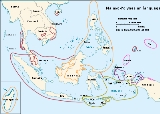
Different sources count languages differently, but Austronesian and Niger-Congo are the two largest language families in the world, each having roughly one-fifth of the languages counted. The geographical span of Austronesian was the largest of any language family before the spread of Indo-European in the colonial period, ranging from Madagascar
off the southeastern coast of Africa to Easter Island
in the eastern Pacific. Hawaiian
, Rapanui
, and Malagasy
(spoken on Madagascar
) are the geographic outliers of the Austronesian family.
According to Robert Blust
(1999), Austronesian is divided in several primary branches, all but one of which are found exclusively on Taiwan
. The Formosan languages
of Taiwan are grouped into as many as nine first-order subgroups of Austronesian. All Austronesian languages spoken outside Taiwan (including its offshore Yami language) belong to the Malayo-Polynesian
branch, sometimes called Extra-Formosan.
. This phenomenon has frequently been referred to as focus. However, the relevant literature is beginning to avoid this term. Many linguists feel that the phenomenon is better described as voice, and that the terminology creates confusion with more common uses of the word focus within linguistics.
The Austronesian languages tend to use reduplication
(repetition of all or part of a word, such as wiki-wiki
or agar-agar), and, like many East
and Southeast Asia
n languages, most have highly restrictive phonotactics
, with generally small numbers of phoneme
s and predominantly consonant–vowel syllables.
comparative method
on the basis of cognate sets
, sets of words similar in sound and meaning which can be shown to be descended from the same ancestral word in Proto-Austronesian
according to regular rules. Some cognate sets are very stable. The word for eye in many Austronesian languages is mata (from the most northerly Austronesian languages, Formosan languages
such as Bunun
and Amis
all the way south to Māori
). Other words are harder to reconstruct. The word for two is also stable, in that it appears over the entire range of the Austronesian family, but the forms (e.g. Bunun rusya, lusha; Amis tusa; Māori tua, rua) require some linguistic expertise to recognise. The Austronesian Basic Vocabulary Database gives word lists (coded for cognacy) for approximately 500 Austronesian languages.
, making it difficult to recognize boundaries between branches. However, it is clear that the greatest genealogical diversity is found among the Formosan languages
of Taiwan, and the least diversity among the islands of the Pacific, supporting a dispersal of the family from Taiwan or China. The first comprehensive classification to reflect this was .
The seminal article in the classification of Formosan—and, by extension, the top-level structure of Austronesian—is . Prominent Formosanists (linguists who specialize in Formosan languages) take issue with some of its details, but it remains the point of reference for current linguistic analyses, and is shown below. The Malayo-Polynesian languages are frequently included within Blust's Eastern Formosan branch due to their shared leveling of proto-Austronesian *t, *C to /t/ and *n, *N to /n/, their shift of *S to /h/, and vocabulary such as *lima "five" which are not attested in other Formosan languages.
There appear to have been two great migrations of Austronesian languages that quickly covered large areas, resulting in multiple local groups with little large-scale structure. The first was Malayo-Polynesian across the Philippines, Indonesia, and Melanesia. The Central Malayo-Polynesian languages
are not similar to each other because they're closely related, but because they are reflect strong substratum effects from non-Austronesian languages
. The second was Oceanic languages into Polynesia and Micronesia .
In addition to Malayo-Polynesian, thirteen Formosan families are broadly accepted. Debate centers primarily around the relationships between these families. Of the classifications presented here, links two families into a Western Plains group, two more in a Northwestern Formosan group, and three into an Eastern Formosan group, while also links five families into a Northern Formosan group. The Austronesian Basic Vocabulary Database (2008) accepts Northern, rejects Eastern, links Tsouic
and Rukai
(two highly divergent languages), and links Malayo-Polynesian with Paiwan in a Paiwanic group. splits Tsouic, and notes that Tsou, Rukai, and Puyama fall outside of reconstructions of Proto-Austronesian.
Other studies have presented phonological evidence for a reduced Paiwanic family of Paiwanic, Puyuma, Bunun, Amis, and Malayo-Polynesian, but this is not reflected in vocabulary. The Eastern Formosan peoples Basay, Kavalan, and Amis share a homeland motif that has them coming originally from an island called Sinasay or Sanasay . The Amis, in particular, maintain that they came from the east, and were treated by the Puyuma, amongst whom they settled, as a subservient group .
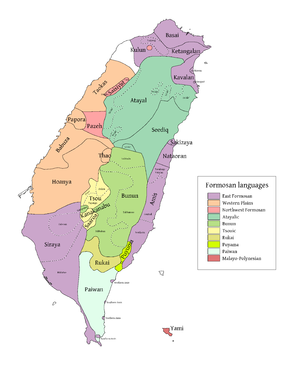
(clockwise from the southwest)
's East Formosan, and unites the other northern languages. Li
proposes a Proto-Formosan (F0) ancestor and equates it with Proto-Austronesian (PAN), following the model in Starosta (1995). Rukai and Tsouic are seen as highly divergent, although the position of Rukai is highly controversial.
}
}
's Northern Formosan
, but breaks up Blust
's East Formosan, and suggests Paiwan may be the closest to Malayo-Polynesian. It also unites Tsouic
and Rukai
, the two most divergent languages in Li.
This is an obvious, low-level grouping
These groups are linked with an estimated 97% probability.
Another low-level grouping
Tsou and Rukai are connected with moderate confidence, estimated at 85% probability.
Malayo-Polynesian and Paiwan are linked with a low level of confidence (74%).
proposed a new classification of the Austronesian language family based on morphological evidence from various Formosan languages. He proposed that the current reconstructions for Proto-Austronesian actually correspond to an intermediate stage, which he terms "Proto-Nuclear Austronesian". Notably, Ross' classification does not support the unity of the Tsouic languages
, instead considering the Southern Tsouic languages of Kanakanavu and Saaroa to be a separate branch. This supports Chang's (2006) claim that Tsouic is not a valid group.
. From the standpoint of historical linguistics
, the home (in linguistic terminology, Urheimat
) of the Austronesian languages is the main island of Taiwan
, also known as Formosa; on this island the deepest divisions in Austronesian are found, among the families of the native Formosan languages
. According to Robert Blust
, the Formosan languages form nine of the ten primary branches of the Austronesian language family . noted this when he wrote:
At least since , linguists have generally accepted that the chronology of the dispersal of languages within a given language family can be traced from the area of greatest linguistic variety to that of the least. For example, English in North America has large numbers of speakers, but relatively low dialectal diversity, while English in Great Britain has much higher diversity; such low linguistic variety by Sapir's thesis suggests a recent origin of North American English in Great Britain. While some scholars suspect that the number of principal branches among the Formosan languages may be somewhat less than Blust's estimate of nine (e.g. ), there is little contention among linguists with this analysis and the resulting view of the origin and direction of the migration. For a recent dissenting analysis, see .
To get an idea of the original homeland of the Austronesian people, scholars can probe evidence from archaeology and genetics. Studies from the science of genetics
have produced conflicting outcomes. Some researchers find evidence for a proto-Austronesian homeland on the Asian mainland (e.g.), while others mirror the linguistic research, rejecting an East Asian origin in favor of Taiwan (e.g.). Archaeological evidence (e.g.) is more consistent, suggesting that the ancestors of the Austronesians spread from the South Chinese mainland to Taiwan at some time around 8,000 years ago. Evidence from historical linguistics suggests that it is from this island that seafaring peoples migrated, perhaps in distinct waves separated by millennia, to the entire region encompassed by the Austronesian languages . It is believed that this migration began around 6,000 years ago . However, evidence from historical linguistics cannot bridge the gap between those two periods. The view that linguistic evidence connects Austronesian languages to the Sino-Tibetan ones, as proposed for example by , is a minority one. As states:
Linguistic analysis of the Proto-Austronesian language stops at the western shores of Taiwan; any related mainland language(s) have not survived. The only exceptions, the Chamic languages
, derive from more recent migration to the mainland .
.
Austric
A link with the Austro-Asiatic languages
in an 'Austric' phylum is based mostly on typological evidence. There is also morphological evidence of a connection between the conservative Nicobarese languages
and Austronesian languages of the Philippines. Paul K. Benedict
extended the Austric proposal to include the Kradai (Tai–Kadai) and Miao–Yao (Hmong–Mien) families, but this has not been followed by other linguists.
Austro-Tai
A competing Austro-Tai
proposal linking Austronesian and Tai–Kadai is supported by Weera Ostapirat, Roger Blench
, and Laurent Sagart, and is based on the traditional comparative method
. proposes a series of regular correspondences linking the two families and assumes a primary split, with Kradai speakers being the Austronesians who stayed behind in their Chinese homeland. suggests that, if the connection is valid, the relationship is unlikely to be one of two sister families. Rather, he suggests that proto-Kradai speakers were Austronesians who migrated to Hainan Island and back to the mainland from the northern Philippines, and that their distinctiveness results from radical restructuring following contact with Hmong–Mien and Sinitic. Sagart's 2005 proposal , which may have some support from human population genetics , is that proto-Kradai was an early Austronesian language that may have back-migrated from northeastern Taiwan to the southeastern coast of China. The apparently cognate words in Kradai and Austronesian might be explained either as commonly inherited vocabulary, or as loanwords from this hypothetical (but perhaps Malayo-Polynesian
) language into proto-Kradai. Sagart also suggests that Austronesian, in which he includes Kradai, is ultimately related to the Sino-Tibetan languages
and probably has its origin in a Neolithic community of the coastal regions of prehistoric North China
or East China
.
Sino-Austronesian
French linguist and Sinologist Laurent Sagart
considers the Austronesian languages to be related to the Sino-Tibetan languages
, and also groups the Tai–Kadai languages as more closely related to the Malayo-Polynesian languages
. He also groups the Austronesian languages in a recursive-like fashion, placing Tai–Kadai as a sister branch of Malayo-Polynesian.
Japanese
A few linguists have proposed that Japanese may be a distant relative of the Austronesian family, but this is rejected by all mainstream linguistic specialists . The evidence for any sort of connection is slight, and many linguists think it is more plausible that Japanese might have instead been influenced by Austronesian languages, perhaps by an Austronesian substratum
. Those who propose this scenario suggest that the Austronesian family once covered the islands to the north of Formosa (western Japanese areas such as the Ryūkyū Islands
and Kyūshū
) as well as to the south. However, there is no genetic evidence for an especially close relationship between speakers of Austronesian languages and speakers of Japonic languages
, so if there was any prehistoric interaction between them, it is likely to have been one of simple cultural exchange without significant ethnic mixing. In fact, genetic analyses consistently show that the Ryukyuans
between Taiwan and the main islands of Japan
are genetically less similar to the Taiwanese aborigines than are the Japanese, which suggests that if there was any interaction between proto-Austronesian and proto-Japonic, it occurred on the mainland prior to the extinction of Austronesian languages on mainland China and the introduction of Japonic to Japan, not in the Ryukyus. More commonly, Japanese is placed in the Altaic language family
, though this has never been satisfactorily demonstrated.
Ongan
It has recently been proposed that the Austronesian and the Ongan
protolanguage are the descendants of an Austronesian–Ongan protolanguage .
Language family
A language family is a group of languages related through descent from a common ancestor, called the proto-language of that family. The term 'family' comes from the tree model of language origination in historical linguistics, which makes use of a metaphor comparing languages to people in a...
widely dispersed throughout the islands of Southeast Asia
Maritime Southeast Asia
Maritime Southeast Asia refers to the maritime region of Southeast Asia as opposed to mainland Southeast Asia and includes the modern countries of Indonesia, Malaysia, the Philippines, Brunei, East Timor and Singapore....
and the Pacific, with a few members spoken on continental Asia
Asia
Asia is the world's largest and most populous continent, located primarily in the eastern and northern hemispheres. It covers 8.7% of the Earth's total surface area and with approximately 3.879 billion people, it hosts 60% of the world's current human population...
that are spoken by about 386 million people. It is on par with Indo-European
Indo-European languages
The Indo-European languages are a family of several hundred related languages and dialects, including most major current languages of Europe, the Iranian plateau, and South Asia and also historically predominant in Anatolia...
, Niger-Congo
Niger-Congo languages
The Niger–Congo languages constitute one of the world's major language families, and Africa's largest in terms of geographical area, number of speakers, and number of distinct languages. They may constitute the world's largest language family in terms of distinct languages, although this question...
, Afroasiatic and Uralic
Uralic languages
The Uralic languages constitute a language family of some three dozen languages spoken by approximately 25 million people. The healthiest Uralic languages in terms of the number of native speakers are Hungarian, Finnish, Estonian, Mari and Udmurt...
as one of the best-established ancient language families. Otto Dempwolff
Otto Dempwolff
Otto Dempwolff was a German linguist and anthropologist who became famous for his research into Austronesian languages...
, a German scholar, was the first researcher to extensively explore Austronesian using the comparative method
Comparative method
In linguistics, the comparative method is a technique for studying the development of languages by performing a feature-by-feature comparison of two or more languages with common descent from a shared ancestor, as opposed to the method of internal reconstruction, which analyzes the internal...
. Another German scholar, Wilhelm Schmidt, coined the German word austronesisch which comes from Latin
Latin
Latin is an Italic language originally spoken in Latium and Ancient Rome. It, along with most European languages, is a descendant of the ancient Proto-Indo-European language. Although it is considered a dead language, a number of scholars and members of the Christian clergy speak it fluently, and...
auster "south wind" plus Greek
Greek language
Greek is an independent branch of the Indo-European family of languages. Native to the southern Balkans, it has the longest documented history of any Indo-European language, spanning 34 centuries of written records. Its writing system has been the Greek alphabet for the majority of its history;...
nêsos "island". The name Austronesian was formed from the same roots. The family is aptly named, as the vast majority of Austronesian languages are spoken on islands: only a few languages, such as Malay
Malay language
Malay is a major language of the Austronesian family. It is the official language of Malaysia , Indonesia , Brunei and Singapore...
and the Chamic languages
Chamic languages
The Chamic languages, also known as Aceh–Chamic and Achinese–Chamic, are a group of ten languages spoken in parts of Cambodia, Vietnam, and Hainan, classified as Malayic languages in the Austronesian language family....
, are indigenous
Indigenous language
An indigenous language or autochthonous language is a language that is native to a region and spoken by indigenous peoples but has been reduced to the status of a minority language. This language would be from a linguistically distinct community that has been settled in the area for many generations...
to mainland Asia. Many Austronesian languages have very few speakers, but the major Austronesian languages are spoken by tens of millions of people and one Austronesian language, Indonesian
Indonesian language
Indonesian is the official language of Indonesia. Indonesian is a normative form of the Riau Islands dialect of Malay, an Austronesian language which has been used as a lingua franca in the Indonesian archipelago for centuries....
, is spoken by over 185 million people, making it the 8th most spoken language in the world. Also, some Austronesian languages are official language
Official language
An official language is a language that is given a special legal status in a particular country, state, or other jurisdiction. Typically a nation's official language will be the one used in that nation's courts, parliament and administration. However, official status can also be used to give a...
s of their respective countries (see the list of Austronesian languages).
Different sources count languages differently, but Austronesian and Niger-Congo are the two largest language families in the world, each having roughly one-fifth of the languages counted. The geographical span of Austronesian was the largest of any language family before the spread of Indo-European in the colonial period, ranging from Madagascar
Madagascar
The Republic of Madagascar is an island country located in the Indian Ocean off the southeastern coast of Africa...
off the southeastern coast of Africa to Easter Island
Easter Island
Easter Island is a Polynesian island in the southeastern Pacific Ocean, at the southeasternmost point of the Polynesian triangle. A special territory of Chile that was annexed in 1888, Easter Island is famous for its 887 extant monumental statues, called moai, created by the early Rapanui people...
in the eastern Pacific. Hawaiian
Hawaiian language
The Hawaiian language is a Polynesian language that takes its name from Hawaii, the largest island in the tropical North Pacific archipelago where it developed. Hawaiian, along with English, is an official language of the state of Hawaii...
, Rapanui
Rapa Nui language
Rapa Nui , also known as Pascuan or Pascuense, is an Eastern Polynesian language spoken on the island of Rapa Nui, also known as Easter Island....
, and Malagasy
Malagasy language
Malagasy is the national language of Madagascar, a member of the Austronesian family of languages. Most people in Madagascar speak it as a first language as do some people of Malagasy descent elsewhere.-History:...
(spoken on Madagascar
Madagascar
The Republic of Madagascar is an island country located in the Indian Ocean off the southeastern coast of Africa...
) are the geographic outliers of the Austronesian family.
According to Robert Blust
Robert Blust
Robert A. Blust is a prominent linguist in several areas, including historical linguistics, lexicography and ethnology. Blust specializes in the Austronesian languages and has made major contributions to the field of Austronesian linguistics....
(1999), Austronesian is divided in several primary branches, all but one of which are found exclusively on Taiwan
Taiwan
Taiwan , also known, especially in the past, as Formosa , is the largest island of the same-named island group of East Asia in the western Pacific Ocean and located off the southeastern coast of mainland China. The island forms over 99% of the current territory of the Republic of China following...
. The Formosan languages
Formosan languages
The Formosan languages are the languages of the indigenous peoples of Taiwan. Taiwanese aborigines currently comprise about 2% of the island's population. However, far fewer can still speak their ancestral language, after centuries of language shift...
of Taiwan are grouped into as many as nine first-order subgroups of Austronesian. All Austronesian languages spoken outside Taiwan (including its offshore Yami language) belong to the Malayo-Polynesian
Malayo-Polynesian languages
The Malayo-Polynesian languages are a subgroup of the Austronesian languages, with approximately 385.5 million speakers. These are widely dispersed throughout the island nations of Southeast Asia and the Pacific Ocean, with a smaller number in continental Asia...
branch, sometimes called Extra-Formosan.
Structure
It is difficult to make generalizations about the languages that make up a family as diverse as Austronesian. Speaking very broadly, the Austronesian languages can be divided into three groups of languages: Philippine-type languages, Indonesian-type languages and post-Indonesian type . The first group is characterized by relatively strong verb-initial word order and Philippine-type voice alternationsAustronesian alignment
Austronesian alignment, commonly known as the Philippine- or Austronesian-type voice system, is a typologically unusual morphosyntactic alignment that combines features of ergative and accusative languages...
. This phenomenon has frequently been referred to as focus. However, the relevant literature is beginning to avoid this term. Many linguists feel that the phenomenon is better described as voice, and that the terminology creates confusion with more common uses of the word focus within linguistics.
The Austronesian languages tend to use reduplication
Reduplication
Reduplication in linguistics is a morphological process in which the root or stem of a word is repeated exactly or with a slight change....
(repetition of all or part of a word, such as wiki-wiki
Wiki Wiki Shuttle
The Wiki Wiki Shuttle is a zero-fare shuttle bus system at the Honolulu International Airport. Shuttles run between 6:00 AM and 10:00 PM, carrying people and baggage between the various terminals....
or agar-agar), and, like many East
East Asia
East Asia or Eastern Asia is a subregion of Asia that can be defined in either geographical or cultural terms...
and Southeast Asia
Southeast Asia
Southeast Asia, South-East Asia, South East Asia or Southeastern Asia is a subregion of Asia, consisting of the countries that are geographically south of China, east of India, west of New Guinea and north of Australia. The region lies on the intersection of geological plates, with heavy seismic...
n languages, most have highly restrictive phonotactics
Phonotactics
Phonotactics is a branch of phonology that deals with restrictions in a language on the permissible combinations of phonemes...
, with generally small numbers of phoneme
Phoneme
In a language or dialect, a phoneme is the smallest segmental unit of sound employed to form meaningful contrasts between utterances....
s and predominantly consonant–vowel syllables.
Lexicon
The Austronesian language family has been established by the linguisticLinguistics
Linguistics is the scientific study of human language. Linguistics can be broadly broken into three categories or subfields of study: language form, language meaning, and language in context....
comparative method
Comparative method
In linguistics, the comparative method is a technique for studying the development of languages by performing a feature-by-feature comparison of two or more languages with common descent from a shared ancestor, as opposed to the method of internal reconstruction, which analyzes the internal...
on the basis of cognate sets
Cognate
In linguistics, cognates are words that have a common etymological origin. This learned term derives from the Latin cognatus . Cognates within the same language are called doublets. Strictly speaking, loanwords from another language are usually not meant by the term, e.g...
, sets of words similar in sound and meaning which can be shown to be descended from the same ancestral word in Proto-Austronesian
Proto-Austronesian language
The Proto-Austronesian language is the reconstructed ancestor of the Austronesian languages, one of the world's major language families. However, Ross notes that what may be the most divergent languages, Tsou, Rukai, and Puyuma, are not addressed by the reconstructions, which therefore cannot...
according to regular rules. Some cognate sets are very stable. The word for eye in many Austronesian languages is mata (from the most northerly Austronesian languages, Formosan languages
Formosan languages
The Formosan languages are the languages of the indigenous peoples of Taiwan. Taiwanese aborigines currently comprise about 2% of the island's population. However, far fewer can still speak their ancestral language, after centuries of language shift...
such as Bunun
Bunun language
The Bunun language is spoken by the Bunun people of Taiwan. It is one of the Formosan languages, a geographic group of Austronesian languages, and is subdivided in five dialects: Isbukun, Takbunuaz, Takivatan, Takibaka and Takituduh. Isbukun, the dominant dialect, is mainly spoken in the south of...
and Amis
Amis language
Amis is the Formosan language of the Amis Ami, an indigenous tribal people living along the east coast of Taiwan . It is spoken from Hualien in the north to Taitung in the south, with another population near the southern end of the island, though the northern varieties are sometimes considered a...
all the way south to Māori
Maori language
Māori or te reo Māori , commonly te reo , is the language of the indigenous population of New Zealand, the Māori. It has the status of an official language in New Zealand...
). Other words are harder to reconstruct. The word for two is also stable, in that it appears over the entire range of the Austronesian family, but the forms (e.g. Bunun rusya, lusha; Amis tusa; Māori tua, rua) require some linguistic expertise to recognise. The Austronesian Basic Vocabulary Database gives word lists (coded for cognacy) for approximately 500 Austronesian languages.
Classification
The internal structure of the Austronesian languages is complex. The family consists of many similar and closely related languages with large numbers of dialect continuaDialect continuum
A dialect continuum, or dialect area, was defined by Leonard Bloomfield as a range of dialects spoken across some geographical area that differ only slightly between neighboring areas, but as one travels in any direction, these differences accumulate such that speakers from opposite ends of the...
, making it difficult to recognize boundaries between branches. However, it is clear that the greatest genealogical diversity is found among the Formosan languages
Formosan languages
The Formosan languages are the languages of the indigenous peoples of Taiwan. Taiwanese aborigines currently comprise about 2% of the island's population. However, far fewer can still speak their ancestral language, after centuries of language shift...
of Taiwan, and the least diversity among the islands of the Pacific, supporting a dispersal of the family from Taiwan or China. The first comprehensive classification to reflect this was .
The seminal article in the classification of Formosan—and, by extension, the top-level structure of Austronesian—is . Prominent Formosanists (linguists who specialize in Formosan languages) take issue with some of its details, but it remains the point of reference for current linguistic analyses, and is shown below. The Malayo-Polynesian languages are frequently included within Blust's Eastern Formosan branch due to their shared leveling of proto-Austronesian *t, *C to /t/ and *n, *N to /n/, their shift of *S to /h/, and vocabulary such as *lima "five" which are not attested in other Formosan languages.
There appear to have been two great migrations of Austronesian languages that quickly covered large areas, resulting in multiple local groups with little large-scale structure. The first was Malayo-Polynesian across the Philippines, Indonesia, and Melanesia. The Central Malayo-Polynesian languages
Central Malayo-Polynesian languages
The Central Malayo-Polynesian linkage is an erstwhile branch of Austronesian languages. The languages are spoken in the Lesser Sunda and Maluku Islands of the Banda Sea, in an area corresponding closely to the Indonesian provinces of East Nusa Tenggara and Maluku and the nation of East Timor , but...
are not similar to each other because they're closely related, but because they are reflect strong substratum effects from non-Austronesian languages
Papuan languages
The Papuan languages are those languages of the western Pacific which are neither Austronesian nor Australian. The term does not presuppose a genetic relationship. The concept of Papuan peoples as distinct from Melanesians was first suggested and named by Sidney Herbert Ray in 1892.-The...
. The second was Oceanic languages into Polynesia and Micronesia .
In addition to Malayo-Polynesian, thirteen Formosan families are broadly accepted. Debate centers primarily around the relationships between these families. Of the classifications presented here, links two families into a Western Plains group, two more in a Northwestern Formosan group, and three into an Eastern Formosan group, while also links five families into a Northern Formosan group. The Austronesian Basic Vocabulary Database (2008) accepts Northern, rejects Eastern, links Tsouic
Tsouic languages
The Tsouic languages are three Formosan languages, Tsou proper and the Southern languages Kanakanabu and Saaroa. The Southern Tsouic languages of Kanakanabu and Saaroa have the smallest phonemic inventories out of all the Formosan languages, with each language having only 13 consonants and 4 vowels...
and Rukai
Rukai language
Rukai is the mother tongue of the Rukai, one indigenous people of Taiwan . It is a divergent Formosan language of the Austronesian languages language family. There are some 10,000 speakers, some monolingual. There are several dialects, of which Mantauran, Tona, and Maga are divergent.Rukai is...
(two highly divergent languages), and links Malayo-Polynesian with Paiwan in a Paiwanic group. splits Tsouic, and notes that Tsou, Rukai, and Puyama fall outside of reconstructions of Proto-Austronesian.
Other studies have presented phonological evidence for a reduced Paiwanic family of Paiwanic, Puyuma, Bunun, Amis, and Malayo-Polynesian, but this is not reflected in vocabulary. The Eastern Formosan peoples Basay, Kavalan, and Amis share a homeland motif that has them coming originally from an island called Sinasay or Sanasay . The Amis, in particular, maintain that they came from the east, and were treated by the Puyuma, amongst whom they settled, as a subservient group .
Blust (1999)
- Austronesian
(clockwise from the southwest)
- TsouTsou languageTsou is a divergent Austronesian language spoken by the Tsou people of Taiwan.-Classification:Tsou has traditionally been considered part of a Tsouic branch of Austronesian...
- SaaroaSaaroa languageSaaroa is a Southern Tsouic language is spoken by the Saaroa, a tribe of indigenous people on Taiwan . It is a Formosan language of the Austronesian family.-Language evolution:...
- KanakanabuKanakanabu languageKanakanabu is a Southern Tsouic language is spoken by the Kanakanabu, an indigenous people of Taiwan . It is a Formosan language of the Austronesian family....
- ThaoThao languageThao , also known as Sao, is the language of the Thao people, a tribe of Taiwanese aborigines in the region of Sun Moon Lake in central Taiwan. In 2000 there were approximately 5 or 6 speakers living in Dehua village , all but one of whom were over the age of sixty...
(AKA Sao. Brawbaw, Shtafari dialects) - Central Western Plains
- BabuzaBabuza languageBabuza is a Formosan language of the Babuza and Taokas, indigenous peoples of Taiwan. It is related to or perhaps descended from Favorlang, attested from the 16th century.Babuza was once spoken along much of the western coast of Taiwan...
(Taokas, Poavosa dialects; old FavorlangFavorlang languageFavorlang is an extinct Formosan language closely related to Babuza.Although Favorlang is considered by Taiwanese linguist Paul Jen-kuei Li to be a separate language, it is nevertheless very closely related to Babuza. In fact, the name Favorlang is derived from Babuza...
) - Papora-HoanyaPapora-Hoanya languageThe Sinicized Papora and Hoanya dialects constituted a Formosan language of Taiwan. They were spoken across the middle western side of the island, around Lishui, Chingshui, Shalu, and inland to Taichung....
(Papora, Hoanya dialects)
- Babuza
- SaisiyatSaisiyat languageSaisiyat is the language of the Saisiyat, a tribe of indigenous people on Taiwan . It is a Formosan language of the Austronesian family...
(Taai, Tungho dialects) - PazehPazeh languagePazeh is the language of the Pazeh, a Taiwanese aboriginal people). It is a Formosan language of the Austronesian languages language family. Kulun was a dialect. There was only one remaining native speaker of Pazeh proper, 96-year-old Pan Jin-yu. Since her death, however, the language is extinct...
(AKA Kulun)
- AtayalAtayal languageThe Atayal language is spoken by the Atayal people of Taiwan. Squliq and C’uli’ are two major dialects...
- SeediqSeediq languageSeediq is an Atayalic language spoken in the mountains of Northern Taiwan by the Seediq and Truku people. There are 4,750 speakers out of a total of 25,000 ethnic members .-Subdivisions:Seediq consists of three main dialects...
(AKA Truku, Taroko)
- Northern (Kavalanic)
- BasayBasay languageBasay was a Formosan language spoken around modern-day Taipei in northern Taiwan by the Basay, Qauqaut, and Trobiawan peoples. Trobiawan, Linaw, and Qauqaut were other dialects ....
(Trobiawan, Linaw–Qauqaut dialects) - KavalanKavalan languageKavalan was formerly spoken in the Northeast coast area of Taiwan by the Kavalan people . It is an East Formosan language of the Austronesian family....
- Ketagalan or Ketangalan
- Basay
- Central (Ami)
- AmisAmis languageAmis is the Formosan language of the Amis Ami, an indigenous tribal people living along the east coast of Taiwan . It is spoken from Hualien in the north to Taitung in the south, with another population near the southern end of the island, though the northern varieties are sometimes considered a...
- Nataoran (North Amis)
- Sakizaya
- Amis
- SirayaSiraya languageSiraya is a Formosan language spoken until the end of the 19th century by the indigenous Siraya people of Taiwan. Dialects of Siraya included Taivoa and Makatao....
- (Mantauran, Tona, and Maga dialects are divergent)
Li (2008)
This classification retains BlustRobert Blust
Robert A. Blust is a prominent linguist in several areas, including historical linguistics, lexicography and ethnology. Blust specializes in the Austronesian languages and has made major contributions to the field of Austronesian linguistics....
's East Formosan, and unites the other northern languages. Li
Paul Jen-kuei Li
Paul Jen-kuei Li is a research fellow at the Institute of Linguistics, Academia Sinica in Taipei, Taiwan. Li is a leading specialist on Formosan languages, and has published dictionaries on the Pazih and Kavalan languages.-References:...
proposes a Proto-Formosan (F0) ancestor and equates it with Proto-Austronesian (PAN), following the model in Starosta (1995). Rukai and Tsouic are seen as highly divergent, although the position of Rukai is highly controversial.
- F0: Formosan = Austronesian
}
-
-
- Mantauran
- Maga–Tona, Budai–Labuan–Taromak
- F1
-
}
-
-
-
- TsouTsou languageTsou is a divergent Austronesian language spoken by the Tsou people of Taiwan.-Classification:Tsou has traditionally been considered part of a Tsouic branch of Austronesian...
- Southern Tsouic
- SaaroaSaaroa languageSaaroa is a Southern Tsouic language is spoken by the Saaroa, a tribe of indigenous people on Taiwan . It is a Formosan language of the Austronesian family.-Language evolution:...
- KanakanabuKanakanabu languageKanakanabu is a Southern Tsouic language is spoken by the Kanakanabu, an indigenous people of Taiwan . It is a Formosan language of the Austronesian family....
- Saaroa
- Tsou
- F2
-
-
- }
-
-
-
- Northwestern (Plains)
- SaisiyatSaisiyat languageSaisiyat is the language of the Saisiyat, a tribe of indigenous people on Taiwan . It is a Formosan language of the Austronesian family...
–Kulon–PazehPazeh languagePazeh is the language of the Pazeh, a Taiwanese aboriginal people). It is a Formosan language of the Austronesian languages language family. Kulun was a dialect. There was only one remaining native speaker of Pazeh proper, 96-year-old Pan Jin-yu. Since her death, however, the language is extinct... - Western
- ThaoThao languageThao , also known as Sao, is the language of the Thao people, a tribe of Taiwanese aborigines in the region of Sun Moon Lake in central Taiwan. In 2000 there were approximately 5 or 6 speakers living in Dehua village , all but one of whom were over the age of sixty...
- West Coast (Papora–Hoanya–BabuzaBabuza languageBabuza is a Formosan language of the Babuza and Taokas, indigenous peoples of Taiwan. It is related to or perhaps descended from Favorlang, attested from the 16th century.Babuza was once spoken along much of the western coast of Taiwan...
–Taokas)
- Thao
- Saisiyat
- AtayalicAtayalic languagesThe Atayalic languages are a group of Formosan languages spoken in northern Taiwan. Robert Blust considers them to form a primary branch within the Austronesian language family, However, Paul Jen-kuei Li groups them into the Northern Formosan branch, which includes the Northwestern Formosan...
- Squliq AtayalAtayal languageThe Atayal language is spoken by the Atayal people of Taiwan. Squliq and C’uli’ are two major dialects...
- Ts'ole' AtayalAtayal languageThe Atayal language is spoken by the Atayal people of Taiwan. Squliq and C’uli’ are two major dialects...
(= C'uli') - SeediqSeediq languageSeediq is an Atayalic language spoken in the mountains of Northern Taiwan by the Seediq and Truku people. There are 4,750 speakers out of a total of 25,000 ethnic members .-Subdivisions:Seediq consists of three main dialects...
- Squliq Atayal
- Northwestern (Plains)
-
-
-
- }
-
-
-
- KavalanKavalan languageKavalan was formerly spoken in the Northeast coast area of Taiwan by the Kavalan people . It is an East Formosan language of the Austronesian family....
–BasayBasay languageBasay was a Formosan language spoken around modern-day Taipei in northern Taiwan by the Basay, Qauqaut, and Trobiawan peoples. Trobiawan, Linaw, and Qauqaut were other dialects .... - SirayaSiraya languageSiraya is a Formosan language spoken until the end of the 19th century by the indigenous Siraya people of Taiwan. Dialects of Siraya included Taivoa and Makatao....
–AmisAmis languageAmis is the Formosan language of the Amis Ami, an indigenous tribal people living along the east coast of Taiwan . It is spoken from Hualien in the north to Taitung in the south, with another population near the southern end of the island, though the northern varieties are sometimes considered a...
- Kavalan
- ? Southern [uncertain]
-
-
- }
-
-
-
- Isbukun
- Northern and Central (Takitudu and Takbanuao)
-
-
-
- }
-
Austronesian Basic Vocabulary Database (2008)
This investigation keeps LiPaul Jen-kuei Li
Paul Jen-kuei Li is a research fellow at the Institute of Linguistics, Academia Sinica in Taipei, Taiwan. Li is a leading specialist on Formosan languages, and has published dictionaries on the Pazih and Kavalan languages.-References:...
's Northern Formosan
Northern Formosan languages
The Northern Formosan languages is a proposed grouping of Formosan languages that includes the Atayalic languages, the Western Plains languages , and the Northwest Formosan languages .The Northern Formosan subgroup was first proposed by Paul Jen-kuei Li in 1985...
, but breaks up Blust
Robert Blust
Robert A. Blust is a prominent linguist in several areas, including historical linguistics, lexicography and ethnology. Blust specializes in the Austronesian languages and has made major contributions to the field of Austronesian linguistics....
's East Formosan, and suggests Paiwan may be the closest to Malayo-Polynesian. It also unites Tsouic
Tsouic languages
The Tsouic languages are three Formosan languages, Tsou proper and the Southern languages Kanakanabu and Saaroa. The Southern Tsouic languages of Kanakanabu and Saaroa have the smallest phonemic inventories out of all the Formosan languages, with each language having only 13 consonants and 4 vowels...
and Rukai
Rukai language
Rukai is the mother tongue of the Rukai, one indigenous people of Taiwan . It is a divergent Formosan language of the Austronesian languages language family. There are some 10,000 speakers, some monolingual. There are several dialects, of which Mantauran, Tona, and Maga are divergent.Rukai is...
, the two most divergent languages in Li.
- Austronesian
This is an obvious, low-level grouping
- BasayBasay languageBasay was a Formosan language spoken around modern-day Taipei in northern Taiwan by the Basay, Qauqaut, and Trobiawan peoples. Trobiawan, Linaw, and Qauqaut were other dialects ....
(Trobiawan, Linaw–Qauqaut dialects) - KavalanKavalan languageKavalan was formerly spoken in the Northeast coast area of Taiwan by the Kavalan people . It is an East Formosan language of the Austronesian family....
- Ketagalan
These groups are linked with an estimated 97% probability.
- ThaoThao languageThao , also known as Sao, is the language of the Thao people, a tribe of Taiwanese aborigines in the region of Sun Moon Lake in central Taiwan. In 2000 there were approximately 5 or 6 speakers living in Dehua village , all but one of whom were over the age of sixty...
(AKA Sao. Brawbaw, Shtafari dialects) - Western Plains
- BabuzaBabuza languageBabuza is a Formosan language of the Babuza and Taokas, indigenous peoples of Taiwan. It is related to or perhaps descended from Favorlang, attested from the 16th century.Babuza was once spoken along much of the western coast of Taiwan...
(AKA FavorlangFavorlang languageFavorlang is an extinct Formosan language closely related to Babuza.Although Favorlang is considered by Taiwanese linguist Paul Jen-kuei Li to be a separate language, it is nevertheless very closely related to Babuza. In fact, the name Favorlang is derived from Babuza...
. Taokas, Poavosa dialects) - Papora-HoanyaPapora-Hoanya languageThe Sinicized Papora and Hoanya dialects constituted a Formosan language of Taiwan. They were spoken across the middle western side of the island, around Lishui, Chingshui, Shalu, and inland to Taichung....
(Papora, Hoanya dialects)
- Babuza
- SaisiyatSaisiyat languageSaisiyat is the language of the Saisiyat, a tribe of indigenous people on Taiwan . It is a Formosan language of the Austronesian family...
(Taai, Tungho dialects) - PazehPazeh languagePazeh is the language of the Pazeh, a Taiwanese aboriginal people). It is a Formosan language of the Austronesian languages language family. Kulun was a dialect. There was only one remaining native speaker of Pazeh proper, 96-year-old Pan Jin-yu. Since her death, however, the language is extinct...
(AKA Kulun) - AtayalicAtayalic languagesThe Atayalic languages are a group of Formosan languages spoken in northern Taiwan. Robert Blust considers them to form a primary branch within the Austronesian language family, However, Paul Jen-kuei Li groups them into the Northern Formosan branch, which includes the Northwestern Formosan...
- AtayalAtayal languageThe Atayal language is spoken by the Atayal people of Taiwan. Squliq and C’uli’ are two major dialects...
(Squliq, C’uli’) - SeediqSeediq languageSeediq is an Atayalic language spoken in the mountains of Northern Taiwan by the Seediq and Truku people. There are 4,750 speakers out of a total of 25,000 ethnic members .-Subdivisions:Seediq consists of three main dialects...
(AKA Truku, Taroko)
- Atayal
Another low-level grouping
- Sakizaya
- Nataoran (North Amis)
- AmisAmis languageAmis is the Formosan language of the Amis Ami, an indigenous tribal people living along the east coast of Taiwan . It is spoken from Hualien in the north to Taitung in the south, with another population near the southern end of the island, though the northern varieties are sometimes considered a...
- BununBunun languageThe Bunun language is spoken by the Bunun people of Taiwan. It is one of the Formosan languages, a geographic group of Austronesian languages, and is subdivided in five dialects: Isbukun, Takbunuaz, Takivatan, Takibaka and Takituduh. Isbukun, the dominant dialect, is mainly spoken in the south of...
Tsou and Rukai are connected with moderate confidence, estimated at 85% probability.
- TsouicTsouic languagesThe Tsouic languages are three Formosan languages, Tsou proper and the Southern languages Kanakanabu and Saaroa. The Southern Tsouic languages of Kanakanabu and Saaroa have the smallest phonemic inventories out of all the Formosan languages, with each language having only 13 consonants and 4 vowels...
- TsouTsou languageTsou is a divergent Austronesian language spoken by the Tsou people of Taiwan.-Classification:Tsou has traditionally been considered part of a Tsouic branch of Austronesian...
- SaaroaSaaroa languageSaaroa is a Southern Tsouic language is spoken by the Saaroa, a tribe of indigenous people on Taiwan . It is a Formosan language of the Austronesian family.-Language evolution:...
- KanakanabuKanakanabu languageKanakanabu is a Southern Tsouic language is spoken by the Kanakanabu, an indigenous people of Taiwan . It is a Formosan language of the Austronesian family....
- Tsou
- RukaiRukai languageRukai is the mother tongue of the Rukai, one indigenous people of Taiwan . It is a divergent Formosan language of the Austronesian languages language family. There are some 10,000 speakers, some monolingual. There are several dialects, of which Mantauran, Tona, and Maga are divergent.Rukai is...
(Mantauran, Tona, and Maga dialects are divergent)
- SirayaSiraya languageSiraya is a Formosan language spoken until the end of the 19th century by the indigenous Siraya people of Taiwan. Dialects of Siraya included Taivoa and Makatao....
(Taivoan, Makatao dialects)
- PuyumaPuyuma languageThe Puyuma language is the language of the Puyuma people, a tribe of indigenous people on Taiwan . It is a divergent Formosan language of the Austronesian family...
Malayo-Polynesian and Paiwan are linked with a low level of confidence (74%).
- PaiwanPaiwan languagePaiwan is a native language of Taiwan, spoken by the Paiwan people, one tribe of the Taiwanese aborigines. Paiwan is a Formosan language of the Austronesian language family...
(southern tip of Formosa) - Malayo-PolynesianMalayo-Polynesian languagesThe Malayo-Polynesian languages are a subgroup of the Austronesian languages, with approximately 385.5 million speakers. These are widely dispersed throughout the island nations of Southeast Asia and the Pacific Ocean, with a smaller number in continental Asia...
Ross (2009)
In 2009, Malcolm RossMalcolm Ross
Malcolm David Ross is a linguist and professor at the Australian National University. He has published work on Austronesian and Papuan languages, historical linguistics, and language contact.-External links:**...
proposed a new classification of the Austronesian language family based on morphological evidence from various Formosan languages. He proposed that the current reconstructions for Proto-Austronesian actually correspond to an intermediate stage, which he terms "Proto-Nuclear Austronesian". Notably, Ross' classification does not support the unity of the Tsouic languages
Tsouic languages
The Tsouic languages are three Formosan languages, Tsou proper and the Southern languages Kanakanabu and Saaroa. The Southern Tsouic languages of Kanakanabu and Saaroa have the smallest phonemic inventories out of all the Formosan languages, with each language having only 13 consonants and 4 vowels...
, instead considering the Southern Tsouic languages of Kanakanavu and Saaroa to be a separate branch. This supports Chang's (2006) claim that Tsouic is not a valid group.
- Austronesian
- (Mantauran and Tona–Maga dialects are divergent)
- Subdivisions not addressed, apart from Saaroa–Kanakanabu being separate from Tsou.
Homeland
The protohistory of the Austronesian people can be traced farther back through time than can that of the Proto-Austronesian languageProto-Austronesian language
The Proto-Austronesian language is the reconstructed ancestor of the Austronesian languages, one of the world's major language families. However, Ross notes that what may be the most divergent languages, Tsou, Rukai, and Puyuma, are not addressed by the reconstructions, which therefore cannot...
. From the standpoint of historical linguistics
Historical linguistics
Historical linguistics is the study of language change. It has five main concerns:* to describe and account for observed changes in particular languages...
, the home (in linguistic terminology, Urheimat
Urheimat
Urheimat is a linguistic term denoting the original homeland of the speakers of a proto-language...
) of the Austronesian languages is the main island of Taiwan
Taiwan
Taiwan , also known, especially in the past, as Formosa , is the largest island of the same-named island group of East Asia in the western Pacific Ocean and located off the southeastern coast of mainland China. The island forms over 99% of the current territory of the Republic of China following...
, also known as Formosa; on this island the deepest divisions in Austronesian are found, among the families of the native Formosan languages
Formosan languages
The Formosan languages are the languages of the indigenous peoples of Taiwan. Taiwanese aborigines currently comprise about 2% of the island's population. However, far fewer can still speak their ancestral language, after centuries of language shift...
. According to Robert Blust
Robert Blust
Robert A. Blust is a prominent linguist in several areas, including historical linguistics, lexicography and ethnology. Blust specializes in the Austronesian languages and has made major contributions to the field of Austronesian linguistics....
, the Formosan languages form nine of the ten primary branches of the Austronesian language family . noted this when he wrote:
At least since , linguists have generally accepted that the chronology of the dispersal of languages within a given language family can be traced from the area of greatest linguistic variety to that of the least. For example, English in North America has large numbers of speakers, but relatively low dialectal diversity, while English in Great Britain has much higher diversity; such low linguistic variety by Sapir's thesis suggests a recent origin of North American English in Great Britain. While some scholars suspect that the number of principal branches among the Formosan languages may be somewhat less than Blust's estimate of nine (e.g. ), there is little contention among linguists with this analysis and the resulting view of the origin and direction of the migration. For a recent dissenting analysis, see .
To get an idea of the original homeland of the Austronesian people, scholars can probe evidence from archaeology and genetics. Studies from the science of genetics
Genetics
Genetics , a discipline of biology, is the science of genes, heredity, and variation in living organisms....
have produced conflicting outcomes. Some researchers find evidence for a proto-Austronesian homeland on the Asian mainland (e.g.), while others mirror the linguistic research, rejecting an East Asian origin in favor of Taiwan (e.g.). Archaeological evidence (e.g.) is more consistent, suggesting that the ancestors of the Austronesians spread from the South Chinese mainland to Taiwan at some time around 8,000 years ago. Evidence from historical linguistics suggests that it is from this island that seafaring peoples migrated, perhaps in distinct waves separated by millennia, to the entire region encompassed by the Austronesian languages . It is believed that this migration began around 6,000 years ago . However, evidence from historical linguistics cannot bridge the gap between those two periods. The view that linguistic evidence connects Austronesian languages to the Sino-Tibetan ones, as proposed for example by , is a minority one. As states:
Linguistic analysis of the Proto-Austronesian language stops at the western shores of Taiwan; any related mainland language(s) have not survived. The only exceptions, the Chamic languages
Chamic languages
The Chamic languages, also known as Aceh–Chamic and Achinese–Chamic, are a group of ten languages spoken in parts of Cambodia, Vietnam, and Hainan, classified as Malayic languages in the Austronesian language family....
, derive from more recent migration to the mainland .
Distant relations
Genealogical links have been proposed between Austronesian and various families of East and especially Southeast AsiaSoutheast Asia
Southeast Asia, South-East Asia, South East Asia or Southeastern Asia is a subregion of Asia, consisting of the countries that are geographically south of China, east of India, west of New Guinea and north of Australia. The region lies on the intersection of geological plates, with heavy seismic...
.
Austric
A link with the Austro-Asiatic languages
Austro-Asiatic languages
The Austro-Asiatic languages, in recent classifications synonymous with Mon–Khmer, are a large language family of Southeast Asia, also scattered throughout India and Bangladesh. The name Austro-Asiatic comes from the Latin words for "south" and "Asia", hence "South Asia"...
in an 'Austric' phylum is based mostly on typological evidence. There is also morphological evidence of a connection between the conservative Nicobarese languages
Nicobarese languages
The Nicobarese languages form an isolated group of half a dozen closely related Austro-Asiatic languages, spoken by the majority of the inhabitants of the Nicobar Islands of India. They have a total of about 30,000 speakers...
and Austronesian languages of the Philippines. Paul K. Benedict
Paul K. Benedict
Paul K. Benedict was an American linguist who specialized in languages of East and Southeast Asia. He is well-known for his 1942 proposal of the Austro-Tai language family and also his reconstruction of Proto-Sino-Tibetan and Proto-Tibeto-Burman.-References:...
extended the Austric proposal to include the Kradai (Tai–Kadai) and Miao–Yao (Hmong–Mien) families, but this has not been followed by other linguists.
Austro-Tai
A competing Austro-Tai
Austro-Tai languages
Austro-Tai is a hypothesis that the Tai–Kadai and Austronesian language families of southern China and the Pacific are genealogically related. Related proposals include Austric and Sino-Austronesian .-Origins:...
proposal linking Austronesian and Tai–Kadai is supported by Weera Ostapirat, Roger Blench
Roger Blench
Roger Blench is a British linguist, ethnomusicologist and development anthropologist. He has an M.A. and a Ph.D. from the University of Cambridge and remains based in Cambridge, England...
, and Laurent Sagart, and is based on the traditional comparative method
Comparative method
In linguistics, the comparative method is a technique for studying the development of languages by performing a feature-by-feature comparison of two or more languages with common descent from a shared ancestor, as opposed to the method of internal reconstruction, which analyzes the internal...
. proposes a series of regular correspondences linking the two families and assumes a primary split, with Kradai speakers being the Austronesians who stayed behind in their Chinese homeland. suggests that, if the connection is valid, the relationship is unlikely to be one of two sister families. Rather, he suggests that proto-Kradai speakers were Austronesians who migrated to Hainan Island and back to the mainland from the northern Philippines, and that their distinctiveness results from radical restructuring following contact with Hmong–Mien and Sinitic. Sagart's 2005 proposal , which may have some support from human population genetics , is that proto-Kradai was an early Austronesian language that may have back-migrated from northeastern Taiwan to the southeastern coast of China. The apparently cognate words in Kradai and Austronesian might be explained either as commonly inherited vocabulary, or as loanwords from this hypothetical (but perhaps Malayo-Polynesian
Malayo-Polynesian languages
The Malayo-Polynesian languages are a subgroup of the Austronesian languages, with approximately 385.5 million speakers. These are widely dispersed throughout the island nations of Southeast Asia and the Pacific Ocean, with a smaller number in continental Asia...
) language into proto-Kradai. Sagart also suggests that Austronesian, in which he includes Kradai, is ultimately related to the Sino-Tibetan languages
Sino-Tibetan languages
The Sino-Tibetan languages are a language family comprising, at least, the Chinese and the Tibeto-Burman languages, including some 250 languages of East Asia, Southeast Asia and parts of South Asia. They are second only to the Indo-European languages in terms of the number of native speakers...
and probably has its origin in a Neolithic community of the coastal regions of prehistoric North China
North China
thumb|250px|Northern [[People's Republic of China]] region.Northern China or North China is a geographical region of China. The heartland of North China is the North China Plain....
or East China
East China
East China is a geographical and a loosely-defined cultural region that covers the eastern coastal area of China.Although an intangible and loosely defined concept, for administrative and governmental purposes, the region is defined by the government of the People's Republic of China to include...
.
Sino-Austronesian
French linguist and Sinologist Laurent Sagart
Laurent Sagart
Laurent Sagart is a director of research at the Centre de recherches linguistiques sur l'Asie orientale unit of the Centre National de la Recherche Scientifique . Born at Paris in 1951, he earned his Ph.D. in 1977 at the University of Paris 7 and his Doctorat d'Etat in 1990 at University of...
considers the Austronesian languages to be related to the Sino-Tibetan languages
Sino-Tibetan languages
The Sino-Tibetan languages are a language family comprising, at least, the Chinese and the Tibeto-Burman languages, including some 250 languages of East Asia, Southeast Asia and parts of South Asia. They are second only to the Indo-European languages in terms of the number of native speakers...
, and also groups the Tai–Kadai languages as more closely related to the Malayo-Polynesian languages
Malayo-Polynesian languages
The Malayo-Polynesian languages are a subgroup of the Austronesian languages, with approximately 385.5 million speakers. These are widely dispersed throughout the island nations of Southeast Asia and the Pacific Ocean, with a smaller number in continental Asia...
. He also groups the Austronesian languages in a recursive-like fashion, placing Tai–Kadai as a sister branch of Malayo-Polynesian.
Japanese
A few linguists have proposed that Japanese may be a distant relative of the Austronesian family, but this is rejected by all mainstream linguistic specialists . The evidence for any sort of connection is slight, and many linguists think it is more plausible that Japanese might have instead been influenced by Austronesian languages, perhaps by an Austronesian substratum
Substratum
In linguistics, a stratum or strate is a language that influences, or is influenced by another through contact. A substratum is a language which has lower power or prestige than another, while a superstratum is the language that has higher power or prestige. Both substratum and superstratum...
. Those who propose this scenario suggest that the Austronesian family once covered the islands to the north of Formosa (western Japanese areas such as the Ryūkyū Islands
Ryukyu Islands
The , also known as the , is a chain of islands in the western Pacific, on the eastern limit of the East China Sea and to the southwest of the island of Kyushu in Japan. From about 1829 until the mid 20th century, they were alternately called Luchu, Loochoo, or Lewchew, akin to the Mandarin...
and Kyūshū
Kyushu
is the third largest island of Japan and most southwesterly of its four main islands. Its alternate ancient names include , , and . The historical regional name is referred to Kyushu and its surrounding islands....
) as well as to the south. However, there is no genetic evidence for an especially close relationship between speakers of Austronesian languages and speakers of Japonic languages
Japonic languages
Japonic languages is a term which identifies and characterises the Japanese which is spoken on the main islands of Japan and the Ryukyuan languages spoken in the Ryukyu Islands. This widely accepted linguistics term was coined by Leon Serafim....
, so if there was any prehistoric interaction between them, it is likely to have been one of simple cultural exchange without significant ethnic mixing. In fact, genetic analyses consistently show that the Ryukyuans
Ryukyuans
The are the indigenous peoples of the Ryukyu Islands between the islands of Kyūshū and Taiwan. The generally recognized subgroups of Ryukyuans are Amamians, Okinawans, Miyakoans, Yaeyamans, and Yonagunians. Geographically, they live in either Okinawa Prefecture or Kagoshima Prefecture...
between Taiwan and the main islands of Japan
Japan
Japan is an island nation in East Asia. Located in the Pacific Ocean, it lies to the east of the Sea of Japan, China, North Korea, South Korea and Russia, stretching from the Sea of Okhotsk in the north to the East China Sea and Taiwan in the south...
are genetically less similar to the Taiwanese aborigines than are the Japanese, which suggests that if there was any interaction between proto-Austronesian and proto-Japonic, it occurred on the mainland prior to the extinction of Austronesian languages on mainland China and the introduction of Japonic to Japan, not in the Ryukyus. More commonly, Japanese is placed in the Altaic language family
Altaic languages
Altaic is a proposed language family that includes the Turkic, Mongolic, Tungusic, and Japonic language families and the Korean language isolate. These languages are spoken in a wide arc stretching from northeast Asia through Central Asia to Anatolia and eastern Europe...
, though this has never been satisfactorily demonstrated.
Ongan
It has recently been proposed that the Austronesian and the Ongan
Ongan languages
Ongan, or South Andamanese, is a small family of two languages, Önge and Jarawa, spoken in the southern Andaman Islands:*Ongan**Önge or Onge; 96 speakers in 1997, mostly monolingual...
protolanguage are the descendants of an Austronesian–Ongan protolanguage .
See also
- AustronesiaAustronesiaAustronesia, in historical terms, refers to the homeland of the peoples who speak Austronesian languages, including Malay, Filipino, Indonesian, Maori, Malagasy, native Hawaiian, the Fijian language and around a thousand other languages...
- Austronesian Formal Linguistics AssociationAustronesian Formal Linguistics AssociationThe Austronesian Formal Linguistics Association is a learned society that provides forums for collaborative research of Austronesian languages. It was founded in 1994 at the University of Toronto by Anna Maclachlan, Diane Massam, Richard McGinn, Barry Miller and Lisa Travis;and is now administered...
- Austronesian peopleAustronesian peopleThe Austronesian-speaking peoples are various populations in Oceania and Southeast Asia that speak languages of the Austronesian family. They include Taiwanese aborigines; the majority ethnic groups of East Timor, Indonesia, Malaysia, the Philippines, Brunei, Madagascar, Micronesia, and Polynesia,...
- List of Austronesian languages
- List of Austronesian regions
Further reading
- Bengtson, John D., The “Greater Austric” Hypothesis, Association for the Study of Language in Prehistory.
- Blust, R. A. (1983). Lexical reconstruction and semantic reconstruction: the case of the Austronesian "house" words. Hawaii: R. Blust.
- Cohen, E. M. K. (1999). Fundaments of Austronesian roots and etymology. Canberra: Pacific Linguistics. ISBN 0858834367
- Marion, P., Liste Swadesh élargie de onze langues austronésiennes, éd. Carré de sucre, 2009
- Pawley, A., & Ross, M. (1994). Austronesian terminologies: continuity and change. Canberra, Australia: Dept. of Linguistics, Research School of Pacific and Asian Studies, The Australian National University. ISBN 0858834243
- Sagart, Laurent, Roger Blench, and Alicia Sanchez-Nazas (Eds.) (2004). The peopling of East Asia: Putting Together Archaeology, Linguistics and Genetics. London: RoutledgeCurzon. ISBN 0-415-32242-1.
- Tryon, D. T., & Tsuchida, S. (1995). Comparative Austronesian dictionary: an introduction to Austronesian studies. Trends in linguistics, 10. Berlin: Mouton de Gruyter. ISBN 110127296
- Wittmann, Henri (1972). "Le caractère génétiquement composite des changements phonétiques du malgache." Proceedings of the International Congress of Phonetic Sciences 7.807-10. La Haye: Mouton.
- Wolff, John U., "Comparative Austronesian Dictionary. An Introduction to Austronesian Studies", Language, vol. 73, no. 1, pp. 145–56, Mar 1997,ISSN-0097-8507
External links
- Austronesian Basic Vocabulary Database – ABVD (contains over 650 Austronesian Languages)
- Swadesh lists of Austronesian basic vocabulary words (from Wiktionary's Swadesh-list appendix)
- Ethnologue report for Austronesian
- MultiTree Project page on Austronesian at the LINGUIST List
- Summer Institute of Linguistics site showing languages (Austronesian and Papuan) of Papua New Guinea.
- Austronesian Language Resources (defunct? moved?) (@ archive.org)
- Spreadsheet of 1600+ Austronesian and Papuan number names and systems – ongoing study to determine their relationships and distribution
- Languages of the World: The Austronesian (Malayo-Polynesian) Language Family
- Introduction to Austronesian Languages and Culture (video) (Malayo-Polynesian) Language Family