


Imperial cult

Encyclopedia
State religion
A state religion is a religious body or creed officially endorsed by the state...
in which an emperor
Emperor
An emperor is a monarch, usually the sovereign ruler of an empire or another type of imperial realm. Empress, the female equivalent, may indicate an emperor's wife or a woman who rules in her own right...
, or a dynasty
Dynasty
A dynasty is a sequence of rulers considered members of the same family. Historians traditionally consider many sovereign states' history within a framework of successive dynasties, e.g., China, Ancient Egypt and the Persian Empire...
of emperors (or rulers of another title), are worship
Worship
Worship is an act of religious devotion usually directed towards a deity. The word is derived from the Old English worthscipe, meaning worthiness or worth-ship — to give, at its simplest, worth to something, for example, Christian worship.Evelyn Underhill defines worship thus: "The absolute...
ped as messiah
Messiah
A messiah is a redeemer figure expected or foretold in one form or another by a religion. Slightly more widely, a messiah is any redeemer figure. Messianic beliefs or theories generally relate to eschatological improvement of the state of humanity or the world, in other words the World to...
s, demigod
Demigod
The term "demigod" , meaning "half-god", is commonly used to describe mythological figures whose one parent was a god and whose other parent was human; as such, demigods are human-god hybrids...
s or deities
Deity
A deity is a recognized preternatural or supernatural immortal being, who may be thought of as holy, divine, or sacred, held in high regard, and respected by believers....
. "Cult
Cult (religious practice)
In traditional usage, the cult of a religion, quite apart from its sacred writings , its theology or myths, or the personal faith of its believers, is the totality of external religious practice and observance, the neglect of which is the definition of impiety. Cult in this primary sense is...
" here is used to mean "worship
Worship
Worship is an act of religious devotion usually directed towards a deity. The word is derived from the Old English worthscipe, meaning worthiness or worth-ship — to give, at its simplest, worth to something, for example, Christian worship.Evelyn Underhill defines worship thus: "The absolute...
", not in the modern pejorative sense. The cult may be one of personality
Cult of personality
A cult of personality arises when an individual uses mass media, propaganda, or other methods, to create an idealized and heroic public image, often through unquestioning flattery and praise. Cults of personality are usually associated with dictatorships...
in the case of a newly arisen Euhemerus
Euhemerus
Euhemerus was a Greek mythographer at the court of Cassander, the king of Macedon. Euhemerus' birthplace is disputed, with Messina in Sicily as the most probable location, while others champion Chios, or Tegea.-Life:...
figure or one of national identity (e.g., Egyptian Pharaoh
Pharaoh
Pharaoh is a title used in many modern discussions of the ancient Egyptian rulers of all periods. The title originates in the term "pr-aa" which means "great house" and describes the royal palace...
, Ethiopian Empire
Ethiopian Empire
The Ethiopian Empire also known as Abyssinia, covered a geographical area that the present-day northern half of Ethiopia and Eritrea covers, and included in its peripheries Zeila, Djibouti, Yemen and Western Saudi Arabia...
or Empire of Japan
Empire of Japan
The Empire of Japan is the name of the state of Japan that existed from the Meiji Restoration on 3 January 1868 to the enactment of the post-World War II Constitution of...
) or supranational identity in the case of a multi-ethnic state (e.g., Imperial Era China, Roman Empire
Roman Empire
The Roman Empire was the post-Republican period of the ancient Roman civilization, characterised by an autocratic form of government and large territorial holdings in Europe and around the Mediterranean....
). A divine king is a monarch
Monarch
A monarch is the person who heads a monarchy. This is a form of government in which a state or polity is ruled or controlled by an individual who typically inherits the throne by birth and occasionally rules for life or until abdication...
who is held in a special religious significance by his subjects, and serves as both head of state and a deity
Deity
A deity is a recognized preternatural or supernatural immortal being, who may be thought of as holy, divine, or sacred, held in high regard, and respected by believers....
or head religious figure. This system of government combines theocracy
Theocracy
Theocracy is a form of organization in which the official policy is to be governed by immediate divine guidance or by officials who are regarded as divinely guided, or simply pursuant to the doctrine of a particular religious sect or religion....
with an absolute monarchy
Absolute monarchy
Absolute monarchy is a monarchical form of government in which the monarch exercises ultimate governing authority as head of state and head of government, his or her power not being limited by a constitution or by the law. An absolute monarch thus wields unrestricted political power over the...
.
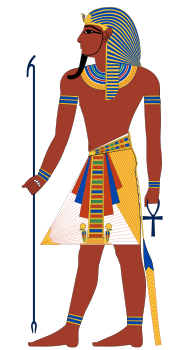
Ancient Egypt
The Ancient EgyptAncient Egypt
Ancient Egypt was an ancient civilization of Northeastern Africa, concentrated along the lower reaches of the Nile River in what is now the modern country of Egypt. Egyptian civilization coalesced around 3150 BC with the political unification of Upper and Lower Egypt under the first pharaoh...
ian male Pharaohs were believed to be incarnations of the god Horus
Horus
Horus is one of the oldest and most significant deities in the Ancient Egyptian religion, who was worshipped from at least the late Predynastic period through to Greco-Roman times. Different forms of Horus are recorded in history and these are treated as distinct gods by Egyptologists...
, derived by being the son of the sun deity, Hathor
Hathor
Hathor , is an Ancient Egyptian goddess who personified the principles of love, beauty, music, motherhood and joy. She was one of the most important and popular deities throughout the history of Ancient Egypt...
(or later, Isis), or the sky deity, Nut
Nut (goddess)
In the Ennead of Egyptian mythology, Nut was the goddess of the sky.-Goddess of the sky:...
.
Ancient China
In ancient China, an emperor was considered the Son of Heaven. The scionKinship
Kinship is a relationship between any entities that share a genealogical origin, through either biological, cultural, or historical descent. And descent groups, lineages, etc. are treated in their own subsections....
and representative of heaven on earth, he was the ruler of all under heaven
All under heaven
Tianxia is a phrase in the Chinese language and an ancient Chinese cultural concept that denoted either the entire geographical world or the metaphysical realm of mortals, and later became associated with political sovereignty.In ancient China, tianxia denoted the lands, space, and area divinely...
, the bearer of the Mandate of Heaven
Mandate of Heaven
The Mandate of Heaven is a traditional Chinese philosophical concept concerning the legitimacy of rulers. It is similar to the European concept of the divine right of kings, in that both sought to legitimaze rule from divine approval; however, unlike the divine right of kings, the Mandate of...
, his commands considered sacred edicts. A number of legendary figures preceding the proper imperial era of China also hold the honorific title of emperor, such as the Yellow Emperor
Yellow Emperor
The Yellow Emperor or Huangdi1 is a legendary Chinese sovereign and culture hero, included among the Three Sovereigns and Five Emperors. Tradition holds that he reigned from 2697–2597 or 2696–2598 BC...
and the Jade Emperor
Jade Emperor
The Jade Emperor in Chinese folk culture, is the ruler of Heaven and all realms of existence below including that of Man and Hell, according to a version of Taoist mythology. He is one of the most important gods of the Chinese traditional religion pantheon...
.
Ancient Rome
King Numitor
Numitor
In Roman mythology, King Numitor of Alba Longa, son of Procas, descendant of Aeneas the Trojan, was the father of Rhea Silvia. He was overthrown by his brother, Amulius, and thrown out of his kingdom where he had ruled. Amulius also murdered his sons, in an effort to remove power from his brother...
corresponds to the regal-sacred principle in early Roman history. The "founder of Rome" Romulus
Romulus
- People:* Romulus and Remus, the mythical founders of Rome* Romulus Augustulus, the last Western Roman Emperor* Valerius Romulus , deified son of the Roman emperor Maxentius* Romulus , son of the Western Roman emperor Anthemius...
was heroized into "Quirinus", the "undefeated god", of whom the later Caesars identified with and considered themselves incarnations.
Varro
Varro
Varro was a Roman cognomen carried by:*Marcus Terentius Varro, sometimes known as Varro Reatinus, the scholar*Publius Terentius Varro or Varro Atacinus, the poet*Gaius Terentius Varro, the consul defeated at the battle of Cannae...
spoke of the initiatory mystery and power of Roman regality (adytum et initia regis), inacessible to the exoteric communality.
In Plutarch
Plutarch
Plutarch then named, on his becoming a Roman citizen, Lucius Mestrius Plutarchus , c. 46 – 120 AD, was a Greek historian, biographer, essayist, and Middle Platonist known primarily for his Parallel Lives and Moralia...
's Phyrro, 19.5, the Greek ambassador declared amid the Roman Senate he felt instead like being in the midst of "a whole assembly of Kings".
As the Roman Empire
Roman Empire
The Roman Empire was the post-Republican period of the ancient Roman civilization, characterised by an autocratic form of government and large territorial holdings in Europe and around the Mediterranean....
developed as the dictator
Dictator
A dictator is a ruler who assumes sole and absolute power but without hereditary ascension such as an absolute monarch. When other states call the head of state of a particular state a dictator, that state is called a dictatorship...
-prince
Prince
Prince is a general term for a ruler, monarch or member of a monarch's or former monarch's family, and is a hereditary title in the nobility of some European states. The feminine equivalent is a princess...
Julius Caesar
Julius Caesar
Gaius Julius Caesar was a Roman general and statesman and a distinguished writer of Latin prose. He played a critical role in the gradual transformation of the Roman Republic into the Roman Empire....
left his crucial mark on Roman history, the Imperial cult gradually developed more formally and constituted the worship of the Roman emperor
Roman Emperor
The Roman emperor was the ruler of the Roman State during the imperial period . The Romans had no single term for the office although at any given time, a given title was associated with the emperor...
as a god. This practice began at the start of the Empire under Augustus
Augustus
Augustus ;23 September 63 BC – 19 August AD 14) is considered the first emperor of the Roman Empire, which he ruled alone from 27 BC until his death in 14 AD.The dates of his rule are contemporary dates; Augustus lived under two calendars, the Roman Republican until 45 BC, and the Julian...
, and became a prominent element of Roman religion
Religion in ancient Rome
Religion in ancient Rome encompassed the religious beliefs and cult practices regarded by the Romans as indigenous and central to their identity as a people, as well as the various and many cults imported from other peoples brought under Roman rule. Romans thus offered cult to innumerable deities...
.
The cult spread over the whole Empire within a few decades, more strongly in the east than in the west. Emperor Diocletian
Diocletian
Diocletian |latinized]] upon his accession to Diocletian . c. 22 December 244 – 3 December 311), was a Roman Emperor from 284 to 305....
further reinforced it when he demanded the proskynesis
Proskynesis
Proskynesis refers to the traditional Persian act of prostrating oneself before a person of higher social rank....
and adopted the adjective sacrum for all things pertaining to the imperial person.
The deification of emperors was gradually abandoned after the emperor Constantine I started supporting Christianity
Christianity
Christianity is a monotheistic religion based on the life and teachings of Jesus as presented in canonical gospels and other New Testament writings...
. However, the concept of the imperial person as "sacred" carried over, in a Christianized form, into the Byzantine Empire
Byzantine Empire
The Byzantine Empire was the Eastern Roman Empire during the periods of Late Antiquity and the Middle Ages, centred on the capital of Constantinople. Known simply as the Roman Empire or Romania to its inhabitants and neighbours, the Empire was the direct continuation of the Ancient Roman State...
.
Ancient Japan

Ujigami
An is a guardian god or spirit of a particular place in the Shinto religion of Japan.- Usage :The ujigami was prayed to for a number of reasons, including protection from sickness, success in endeavors, and good harvests.- History :...
), and the royal family or clan tended to define their ancestor as the dominant, or most important kami
Kami
is the Japanese word for the spirits, natural forces, or essence in the Shinto faith. Although the word is sometimes translated as "god" or "deity", some Shinto scholars argue that such a translation can cause a misunderstanding of the term...
of the time. Later in history, this was considered common practice by noble families, and the head members of the family, including that of the imperial family, were not seen to be divine. It was not until the Meiji period
Meiji period
The , also known as the Meiji era, is a Japanese era which extended from September 1868 through July 1912. This period represents the first half of the Empire of Japan.- Meiji Restoration and the emperor :...
, that the Japanese Emperor
Emperor of Japan
The Emperor of Japan is, according to the 1947 Constitution of Japan, "the symbol of the state and of the unity of the people." He is a ceremonial figurehead under a form of constitutional monarchy and is head of the Japanese Imperial Family with functions as head of state. He is also the highest...
began to be venerated under a system of State Shinto
State Shinto
has been called the state religion of the Empire of Japan, although it did not exist as a single institution and no "Shintō" was ever declared a state religion...
, along with a growing sense of nationalism.
- ArahitogamiArahitogamiis a Japanese word meaning a kami who is a human being.It first appears in Kojiki , but is assumed to have been used before this book....
- the concept of a god who is a human being applied to Emperor HirohitoHirohito, posthumously in Japan officially called Emperor Shōwa or , was the 124th Emperor of Japan according to the traditional order, reigning from December 25, 1926, until his death in 1989. Although better known outside of Japan by his personal name Hirohito, in Japan he is now referred to...
, up until the end of World War IIWorld War IIWorld War II, or the Second World War , was a global conflict lasting from 1939 to 1945, involving most of the world's nations—including all of the great powers—eventually forming two opposing military alliances: the Allies and the Axis...
. - Ningen-sengen, the declaration with which Emperor Hirohito, on New Year's Day 1946, (formally) declined claims of divinity, keeping with traditional family values as expressed in the Shinto religion.
Tibet
Tibetan Buddhism use the tulku system, an ancient way of finding the reincarnation of a previous deceased lama: they are usually young boys, sometimes of wealthy and influential families and sometimes of peasant families like the current 14th Dalai Lama, that are found and enthroned as the reincarnation of an enlightened person that has already deceased. Every tulku are still called on the title of RinpocheRinpoche
Rinpoche or Rinboqê is an honorific used in Tibetan Buddhism. It literally means "precious one," and is used to address or describe Tibetan lamas and other high-ranking or respected teachers. This honor is generally bestowed on reincarnated lamas, or Tulkus, by default...
and is given as much respect as his previous reincarnation. Complying with each and every wish of a child- or adult tulku is not unusual. Tulkus lead responsible lives because of their status as a bodhisattva. While many tulkus are monks, some tulkus choose to lead lay lives with families of their own.
Examples of divine kings in history
Some examples of historic leaders who are often considered divine kings are:- Africa
- PharaohPharaohPharaoh is a title used in many modern discussions of the ancient Egyptian rulers of all periods. The title originates in the term "pr-aa" which means "great house" and describes the royal palace...
s of Ancient EgyptAncient EgyptAncient Egypt was an ancient civilization of Northeastern Africa, concentrated along the lower reaches of the Nile River in what is now the modern country of Egypt. Egyptian civilization coalesced around 3150 BC with the political unification of Upper and Lower Egypt under the first pharaoh... - Ghanas (Kings) of the Empire of Ghana
- Haile Selassie I of EthiopiaEthiopiaEthiopia , officially known as the Federal Democratic Republic of Ethiopia, is a country located in the Horn of Africa. It is the second-most populous nation in Africa, with over 82 million inhabitants, and the tenth-largest by area, occupying 1,100,000 km2...
was an Ethiopian Orthodox ChristianChristianA Christian is a person who adheres to Christianity, an Abrahamic, monotheistic religion based on the life and teachings of Jesus of Nazareth as recorded in the Canonical gospels and the letters of the New Testament...
, and did not consider himself devine, but the Rastafari movementRastafari movementThe Rastafari movement or Rasta is a new religious movement that arose in the 1930s in Jamaica, which at the time was a country with a predominantly Christian culture where 98% of the people were the black descendants of slaves. Its adherents worship Haile Selassie I, Emperor of Ethiopia , as God...
in JamaicaJamaicaJamaica is an island nation of the Greater Antilles, in length, up to in width and 10,990 square kilometres in area. It is situated in the Caribbean Sea, about south of Cuba, and west of Hispaniola, the island harbouring the nation-states Haiti and the Dominican Republic...
saw him as the second coming of Christ.
- Pharaoh

- Asia
- Chinese pseudo-ChristianChristianA Christian is a person who adheres to Christianity, an Abrahamic, monotheistic religion based on the life and teachings of Jesus of Nazareth as recorded in the Canonical gospels and the letters of the New Testament...
leader Hong XiuquanHong XiuquanHong Xiuquan , born Hong Renkun, style name Huoxiu , was a Hakka Chinese who led the Taiping Rebellion against the Qing Dynasty, establishing the Taiping Heavenly Kingdom over varying portions of southern China, with himself as the "Heavenly King" and self-proclaimed brother of Jesus Christ.-Early...
, leader of the Taiping RebellionTaiping RebellionThe Taiping Rebellion was a widespread civil war in southern China from 1850 to 1864, led by heterodox Christian convert Hong Xiuquan, who, having received visions, maintained that he was the younger brother of Jesus Christ, against the ruling Manchu-led Qing Dynasty...
, claimed to be Christ's younger brother, and attempted to establish rule as a divine king. - Korean Buddhist monk Gung-ye, King of TaebongTaebongTaebong or Later Goguryeo was a state established by Gung Ye on the Korean peninsula in 901, during the Later Three Kingdoms period.-History:...
. - The Japanese emperor HirohitoHirohito, posthumously in Japan officially called Emperor Shōwa or , was the 124th Emperor of Japan according to the traditional order, reigning from December 25, 1926, until his death in 1989. Although better known outside of Japan by his personal name Hirohito, in Japan he is now referred to...
up to the end of World War IIWorld War IIWorld War II, or the Second World War , was a global conflict lasting from 1939 to 1945, involving most of the world's nations—including all of the great powers—eventually forming two opposing military alliances: the Allies and the Axis...
. - Javanese Kings during Hindu-Buddhist era (4th century – 15th century AD) such as SailendraSailendraSailendra is the name of an influential Indonesian dynasty that emerged in 8th century Java.The Sailendras were active promoters of Mahayana Buddhism and covered the Kedu Plain of Central Java with Buddhist monuments, including the world famous Borobudur.The Sailendras are considered to be a...
dynasty, Kediri, SinghasariSinghasariSinghasari was a kingdom located in east Java between 1222 and 1292. The kingdom succeeded Kingdom of Kediri as the dominant kingdom in eastern Java.-Foundation:...
, and Majapahit empire. - Kings of Khmer EmpireKhmer EmpireThe Khmer Empire was one of the most powerful empires in Southeast Asia. The empire, which grew out of the former kingdom of Chenla, at times ruled over and/or vassalized parts of modern-day Laos, Thailand, Vietnam, Burma, and Malaysia. Its greatest legacy is Angkor, the site of the capital city...
, Cambodia. - SrivijayaSrivijayaSrivijaya was a powerful ancient thalassocratic Malay empire based on the island of Sumatra, modern day Indonesia, which influenced much of Southeast Asia. The earliest solid proof of its existence dates from the 7th century; a Chinese monk, I-Tsing, wrote that he visited Srivijaya in 671 for 6...
emperors. - The Dalai LamaDalai LamaThe Dalai Lama is a high lama in the Gelug or "Yellow Hat" branch of Tibetan Buddhism. The name is a combination of the Mongolian word далай meaning "Ocean" and the Tibetan word bla-ma meaning "teacher"...
s of TibetTibetTibet is a plateau region in Asia, north-east of the Himalayas. It is the traditional homeland of the Tibetan people as well as some other ethnic groups such as Monpas, Qiang, and Lhobas, and is now also inhabited by considerable numbers of Han and Hui people...
.
- Chinese pseudo-Christian
- Americas
- Kings of the MayanMaya civilizationThe Maya is a Mesoamerican civilization, noted for the only known fully developed written language of the pre-Columbian Americas, as well as for its art, architecture, and mathematical and astronomical systems. Initially established during the Pre-Classic period The Maya is a Mesoamerican...
city-states of the Classical period - Inca Emperors in Pre-Columbian PeruPeruPeru , officially the Republic of Peru , is a country in western South America. It is bordered on the north by Ecuador and Colombia, on the east by Brazil, on the southeast by Bolivia, on the south by Chile, and on the west by the Pacific Ocean....
- Kings or Akua Alii of the Hawaiian Islands before 1839
- Kings of the Mayan
- Europe
- Many Roman emperorRoman EmperorThe Roman emperor was the ruler of the Roman State during the imperial period . The Romans had no single term for the office although at any given time, a given title was associated with the emperor...
s were declared gods by the Roman SenateRoman SenateThe Senate of the Roman Republic was a political institution in the ancient Roman Republic, however, it was not an elected body, but one whose members were appointed by the consuls, and later by the censors. After a magistrate served his term in office, it usually was followed with automatic...
(generally after their death). (See Imperial cult (ancient Rome)Imperial cult (ancient Rome)The Imperial cult of ancient Rome identified emperors and some members of their families with the divinely sanctioned authority of the Roman State...
)
- Many Roman emperor
In Popular Culture
- The Imperial Cult of the Imperium of Man in Warhammer 40,000Warhammer 40,000Warhammer 40,000 is a tabletop miniature wargame produced by Games Workshop, set in a dystopian science fantasy universe. Warhammer 40,000 was created by Rick Priestley in 1987 as the futuristic companion to Warhammer Fantasy Battle, sharing many game mechanics...
is perhaps the most famous example of this in modern culture. - The diarchalDiarchyDiarchy , from the Greek δι- "twice" and αρχια, "rule", is a form of government in which two individuals, the diarchs, are the heads of state. In most diarchies, the diarchs hold their position for life and pass the responsibilities and power of the position to their children or family when they...
rulers of Equestria in My Little Pony: Friendship is MagicMy Little Pony: Friendship is MagicMy Little Pony: Friendship Is Magic is an animated television series that premiered on October 10, 2010 on the United States cable network The Hub, and is based on Hasbro's My Little Pony line of toys and animated works. The series is produced by Hasbro Studios and DHX Media Vancouver...
, Princesses Celestia and Luna, are revered as immortal, and attributed with the ability to control the movement of the sun and moon.
See also
- AtenismAtenismAtenism, or the Amarna heresy, refers to the religious changes associated with the eighteenth dynasty Pharaoh Amenophis IV, better known under his adopted name, Akhenaten...
- ApotheosisApotheosisApotheosis is the glorification of a subject to divine level. The term has meanings in theology, where it refers to a belief, and in art, where it refers to a genre.In theology, the term apotheosis refers to the idea that an individual has been raised to godlike stature...
- Cult of personalityCult of personalityA cult of personality arises when an individual uses mass media, propaganda, or other methods, to create an idealized and heroic public image, often through unquestioning flattery and praise. Cults of personality are usually associated with dictatorships...
- Euhemerism
- God EmperorGod EmperorAs manifested historically in various cultures, the term "God Emperor" refers to a monarch considered to be subject to no earthly authority.- Non-fictional :*Chinese Sovereign*Imperial cult *Japanese Emperor*Pharaoh*Sapa Inca...