
All Topics  
Barley


   Email Print
   Bookmark   Link


Barley


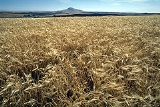
Barley (Hordeum vulgare) is an annualAnnual plant

Botanically, an annual plant is a plant that usually germinates, flowers and dies in one year....
 cerealCereal

Cereal crops are mostly grasses cultivated for their edible grains or seeds ....
 grainGRAIN

GRAIN is an international non-governmental organization based in Barcelona, Spain, which works toward sustainable agricultur...
, which serves as a major animal feed crop, with smaller amounts used for maltMalt

Malting is a process applied to cereal grains, in which the grains are made to germinate and then are quickly dried before t...
ing and in health food. It is a member of the grass family PoaceaePoaceae

The true grasses are monocotyledonous plants in the Family Poaceae, also known as Gramineae....
. In 2005, barley ranked fourth in quantity produced and in area of cultivation of cereal crops in the world (560,000 km²).
The domesticated form (H. vulgare) is descended from wild barleyFacts About Hordeum

Hordeum is a genus of about 30 species of annual and perennial grasses, native throughout the temperate Northern Hemisph...
 (H. spontaneum). Both forms are diploid (2n=14 chromosomeChromosome

A chromosome is a large macromolecule into which DNA is normally packaged in a cell....
s). As wild barley is interfertile with domesticated barley, the two forms are often treated as one species, Hordeum vulgare, divided into subspecies spontaneum (wild) and subspecies vulgare (domesticated). The main difference between the two forms is the brittle rachisRachis

The rachis is the main axis of the inflorescence, or spike, of wheat and other cereals, to which the spikelets are attached....
 of the former, which enables seed dispersal in the wild.

Crop history

Wild barley comes from Epi-PaleolithicPaleolithic

The term Paleolithic was coined by archaeologist John Lubbock in 1865, and refers to a prehistoric era distinguished by the...
 sites in the LevantFacts About Levant

'Levant' or in Arabic ?????, Ash-Sham is an imprecise geographical term historically referring to a large area...
, beginning in the Natufian. The earliest domesticated barley occurs at Aceramic NeolithicNeolithic

| style="border-bottom:3px solid; background:#efefef;" | This time period is part of theHolocene epoch....
 sites in the Near East such as the (PPN B) layers of TellTell

Tell or tall, meaning "hill" or "mound", is a type of archaeological site in the form of an earthen mound that results...
 Abu Hureyra in SyriaSyria

Syria , officially the Syrian Arab Republic , is a country in the Middle East....
. Barley was one of the first crops domesticatedNeolithic founder crops

The Neolithic founder crops are the eight species of plant that were domesticated by early Holocene farming communities in ...
 in the Near East, at the same time as einkorn and emmerEmmer

Emmer wheat, also known as farro especially in Italy, is a low yielding, awned wheat....
 wheat.
Barley in Egyptian hieroglyphs
jt barley determinativeDeterminative

A determinative is an ideogram used to mark classes of words in pictographic languages; example classes include "dead people...
/ideogramIdeogram

An ideogram or ideograph is a graphical symbol that represents an idea, rather than a group of letters arranged according t...
M34
jt (common) spellingi-t-U9:M33
šma determinative/ideogramU9

Barley was alongside emmer wheat, a staple cereal of ancient EgyptAncient Egypt

Ancient Egypt was a long-lived ancient civilization in north-eastern Africa....
, where it was used to make breadBread Overview

Bread is a staple food which is prepared by baking, steaming, or frying dough....
 and beerBeer Overview

Beer is one of the world's oldest alcoholic beverages, possibly brewed for the first time over 10,000 years ago, according t...
; together, these were a complete diet. The general name for barley is jt (hypothetically pronounced "eat"); šma (hypothetically pronounced "SHE-ma") refers to Upper EgyptUpper Egypt

Upper Egypt is a narrow strip of land that extends from the cataract boundaries of modern-day Aswan to the area between El-...
ian barley and is a symbol of Upper Egypt. According to DeuteronomyDeuteronomy

Deuteronomy is the fifth book of the Hebrew Bible....
 8:8, barley is one of the "Seven SpeciesSeven Species

The Seven Species are seven types of fruits and grains enumerated in the Hebrew BibleDeuteronomy as being special produ...
" of crops that characterize the fertility of the Promised LandPromised land

According to the Bible, the Land of Israel was promised to the descendants of Hebrew patriarchs Abraham, Isaac, and Jacob by God, ...
 of CanaanCanaan

Canaan .Canaan is an ancient term for a region approximating present-day Israel and Palestine plus adjoining coastal lands ...
, and barley has a prominent role in the IsraeliteIsraelite

An Israelite is a member of the Twelve Tribes of Israel, descended from the twelve sons of the Biblical patriarch Jaco...
 sacrifices described in the PentateuchPentateuch

Pentateuch is a Greek word that is derived from two words: penta meaning "five", and teukhos which means "implement...
 (see e.g. NumbersBook of Numbers

The Book of Numbers is the fourth of the books of the Pentateuch, called in the Hebrew ba-midbar ?????, i.e., "in the de...
 5:15). A religious importance extended into the Middle AgesMiddle Ages

The Middle Ages formed the middle period in a traditional schematic division of European history into three "ages": the clas...
 in Europe, and saw barley's use in justiceJustice

Justice is the ideal, morally correct state of things and persons....
, via alphitomancyAlphitomancy

Alphitomancy is a form of divination involving barley cakes or loaves of barley bread....
 and the corsnedCorsned

In Anglo-Saxon law, corsned , also known as the accursed or sacred morsel, or the morsel of execratio...
.

In ancient Greece, the ritual significance of barley possibly dates back to the earliest stages of the Eleusinian MysteriesEleusinian Mysteries

The Eleusinian Mysteries were annual initiation ceremonies for the cult of Demeter and Persephone based at Eleusis in ancien...
. The preparatory kykeonKykeon

Kykeon was an Ancient Greek drink made mainly of water, barley and herbs....
or mixed drink of the initiates, prepared from barley and herbHerb

Herbs are plants grown for culinary, medicinal, or in some cases even spiritual value....
s, was referred to in the Homeric hymn to DemeterDemeter Overview

Dmtr is the Greek goddess of agriculture, the pure nourisher of youth and the green earth, the health-giving cycle of lif...
, who was also called "Barley-mother".

The practice was to dry the barley groatsGroats

Groats are the hulled and crushed grains of various cereals, such as oats, wheat or buckwheat....
 and roast them before preparing the porridge, according to Pliny the ElderPliny the Elder

Gaius Plinius Secundus, better known as Pliny the Elder, was an ancient author and natural philosopher of some import...
's Natural History (xviii.72). This produces maltMalt

Malting is a process applied to cereal grains, in which the grains are made to germinate and then are quickly dried before t...
 that soon ferments and becomes slightly alcoholic.

Tibetan barley has been the only major staple foodStaple food

A staple food is a food that forms the basis of a traditional diet, particularly that of the poor....
 in TibetTibet Summary

Tibet is a region in Central Asia and the home of the Tibetan people....
 for centuries. It is made into a flour product called tsampaTsampa

Tsampa is a Tibetan staple foodstuff, particularly prominent in the central part of the country....
.

Palaeoethnobotanists have found that barley has been grown in the Korean Peninsula since the Early Mumun Pottery PeriodMumun pottery period

The Mumun pottery period is an archaeological era in Korean prehistory that dates to approximately 1500-300 B.C.....
 (c. 1500–850 BCE) along with other crops such as millet, wheat, and legumes.

As of 1881

According to the 1881 Household CyclopediaHousehold Cyclopedia

The Household Cyclopedia was an American 1881 guide to housekeeping....
:


Next to wheatWheat

Wheat is a grass that is cultivated worldwide....
 the most valuable grain is barley, especially on light and sharp soils. It is a tender grain and easily hurt in any of the stages of its growth, particularly at seed time; a heavy shower of rain will then almost ruin a crop on the best prepared land; and in all the after processes greater pains and attention are required to ensure success than in the case of other grains. The harvest process is difficult, and often attended with danger; even the threshing of it is not easily executed with machines, because the awn generally adheres to the grain, and renders separation from the straw a troublesome task. Barley, in fact, is raised at greater expense than wheat, and generally speaking is a more hazardous crop. Except upon rich and genial soils, where climate will allow barley to be perfectly reared, it ought not to be cultivated.

Preparation of ground
Barley is chiefly taken after turnips, sometimes after peasPEAS

P.E.A.S. is an acronym in artificial intelligence that stands for Performance, Environment, Actuators, Sensors....
 and beans, but rarely by bad farmers either after wheat or oatOat

The Oat is a species of cereal grain, and the seeds of this plant....
s, unless under special circumstances. When sown after turnips it is generally taken with one furrow, which is given as fast as the turnips are consumed, the ground thus receiving much benefit from the spring frosts. But often two, or more furrows are necessary for the fields last consumed, because when a spring drought sets in, the surface, from being poached by the removal or consumption of the crop, gets so hardened as to render a greater quantity of ploughing, harrowing and rolling necessary than would otherwise be called for. When sown after beans and peas, one winter and one spring ploughing are usually bestowed: but when after wheat or oats, three ploughings are necessary, so that the ground may be put in proper condition. These operations are very ticklish in a wet and backward season, and rarely in that case is the grower paid for the expense of his labor. Where land is in such a situation as to require three ploughings before it can be seeded with barley, it is better to summer-fallow it at once than to run the risks which seldom fail to accompany a quantity of spring labor. If the weather be dry, moisture is lost during the different processes, and an imperfect braird necessarily follows; if it be wet the benefit of ploughing is lost, and all the evils of a wet seed time are sustained by the future crop.

The quantity sown is different in different cases, according to the quality of the soil and other circumstances. Upon very rich lands eight pecks per acre [11 t/km²] are sometimes sown; twelve [16 t/km²] is very common, and upon poor land more is sometimes given.

By good judges a quantity of seed is sown sufficient to ensure a full crop, without depending on its sending out offsets; indeed, where that is done few offsets are produced, the crop grows and ripens equally, and the grain is uniformly good.

Production

Top Ten Barley Producers — 2005
(million metric tonne)
16.7
12.1
11.7
10.4
9.3
9.0
6.6
5.5
4.6
4.4
World Total 138
Source:
UN Food & Agriculture Organization (FAO)


Barley was grown in about 100 countries worldwide in 2005. The world production in 1974 was 148,818,870 tonnes, showing little change in the amount of barley produced worldwide.

Cultivars

Barley can be divided by the number of kernel rows in the head. Two forms have been cultivated; two-row barley (formerly known as Hordeum distichum but now also classed as Hordeum vulgare), and six-row barley (Hordeum vulgare). In two-row barley only one spikelet at each node is fertile; in the four-row and six-row forms, all three are fertile. A four-row type (formerly classed as (Hordeum tetrastichum) is actually a six-row type with very lax structure.

Two-row barley is the oldest form, wild barley having two rows as well. Two-row barley has a lower protein content than six-row barley and thus more fermentable sugars content. High proteinProtein

Proteins are large organic compounds made of amino acids arranged in a linear chain and joined by peptide bonds....
 barley is best suited for animal feed. Malting barley is usually lower protein ('low grain nitrogen', usually produced without a late fertilizer application) which shows more uniform germination, needs shorter steeping, and has less protein in the extract that can make beer cloudy. Two-row barley is traditionally used in English ale style beers. Six-row barley is common in some American lagerLager

Lager is a well attenuated beer brewed in cool conditions using a slow-acting brewers yeast, known as a bottom-fermenting ye...
 style beers, whereas two-row malted summer barley is preferred for traditional German beers. Four-row is unsuitable for brewing.

Barley is widely adaptable and is currently a major crop of the temperate areas where it is grown as a summer crop and tropical areas where it is sown as a winter crop. Its germinationFacts About Germination

Germination is the process where growth emerges from a resting stage....
 time is anywhere from 1 to 3 days. Barley likes to grow under cool conditions but is not particularly winter hardy.

Uses


Half of the United States' barley production is used as an animal feed. A large part of the remainder is used for maltMalt Overview

Malting is a process applied to cereal grains, in which the grains are made to germinate and then are quickly dried before t...
ing and is a key ingredient in beerBeer

Beer is one of the world's oldest alcoholic beverages, possibly brewed for the first time over 10,000 years ago, according t...
 and whiskyWhisky

Whisky, or whiskey, refers to a broad category of alcoholic beverages that are distilled from grains and aged in oak c...
 production. Two-row barley is traditionally used in German and English beers, and six-row barley was traditionally used in American beers. Both varieties are in common usage in America now. Non-alcoholic drinks such as barley waterBarley water

Barley water, usually flavoured with lemon or other fruit, is a popular soft drink in England....
 and mugichaMugicha

Mugicha is the Japanese name for a type of tisane made from roasted barley....
 (popular in KoreaKorea

KoreaOne of the world's oldest civilizations, Korea began with the founding of Gojoseon in 2333 BC, according to the Dangun...
 and JapanJapan

is an island country in East Asia. Located in the Pacific Ocean, it lies to the east of China, Korea, and Russia, stretching from...
) are also made from unhulled barley. Barley is also used in soups and stews, particularly in Eastern Europe. A small amount is used in health foods and coffee substituteCoffee substitute

Coffee substitutes are non-coffea products, usually without caffeine, used to substitute coffee while preserving its taste....
s.

Barley is more tolerant of soil salinity than wheat, which might explain the increase of barley cultivation on Mesopotamia from the 2nd millennium BC onwards. Barley is not as cold tolerant as the winter wheats (Triticum aestivum), fall rye (Secale cereale) or winter Triticale (X TricticaleWitt.), but may be sown as a winter crop in warmer areas of the world such as Australia.

Barley must have its fibrous outer hull removed before it can be eaten. Barley grains with their hulls still on are called covered barley or 'hulled barley". Once the grain has had the inedible hull removed, it is called dehulled barley. At this stage, the grain still has its branBran

Bran is the hard outer layer of cereal grains, and consists of combined aleurone and pericarp....
 and germCereal germ

The germ is the "heart" of the cereal kernel, the embryo of the seed, and a concentrated source of several essential nutrien...
, which are nutritious. Dehulled barley is considered a whole grainWhole grain

Whole grains are cereal grains which retain the bran and germ as well as the endosperm, in contrast to refined grains which ...
, and is a popular health foodHealthy diet

A healthy diet contains a balance of food groups and all the nutrients necessary to promote good health....
. Pearl barley or pearled barley is hulled barley which has been processed further to remove the bran. It may be polished, a process known as "pearling". Dehulled or pearl barley may be processed into a variety of barley products, including flourFlour

An ingredient used in many foods, flour is a fine powder made from cereals or other starchy food sources....
, flakes similar to oatmealOatmeal Overview

Oatmeal is a product made by processing oats....
, and gritsGrits

Grits is a type of maize porridge and a food common in the Southern United States, and southern Manchuria consisting of coa...
.

According to a recent study, eating whole grain barley can regulate blood sugar for up to 10 hrs after consumption compared to white or even whole-grain wheat, which has a similar glycemic indexGlycemic index

Glycemic index is a ranking system for carbohydrates based on their immediate effect on blood glucose levels....
.

An additional barley product is the straw. It is placed in mesh bags and floated in fish ponds or water gardens to help reduce algal growth without harming the plants or animals in the habitat.

Plant diseases

This plant is known or likely to be susceptible to barley mild mosaic bymovirusBarley mild mosaic bymovirus Summary

Barley mild mosaic bymovirus is a plant virus....
 as well as Bacterial blightBacterial blight (barley)

Bacterial blight is a disease of barley caused by the bacterial pathogen Xanthomonas campestris pv....
. Barley can be susceptible to many diseases but plant breeders have been working hard to incorporate resistance. The devastation caused by any one disease will depend upon the susceptibility of the variety being grown and the environmental conditions during disease development.

Composition

The Encyclopædia Britannica Eleventh Edition (1910–1911) cites the following composition of
barley meal according to Ernst von BibraFacts About Ernst von Bibra

?Dr. Ernst Freiherr von Bibra was a German Naturalist and author....
, omitting the salts:

WaterWater

Water is a tasteless, odorless substance that is essential to all known forms of life and is known as the universal solve...
15%
Nitrogenous compoundsNitrogen

Nitrogen is a chemical element which has the symbol N and atomic number 7 in the periodic table....
12.981%
GumNatural gum

Natural gums are polysaccharides of natural origin, capable of causing a large viscosity increase in solution, even at small...
6.744%
SugarSugar

In general use, non-scientists take "sugar" to mean sucrose, also called "table sugar" or saccharose, a white crystalline solid di...
3.2%
StarchStarch Overview

Starch is a complex carbohydrate which is insoluble in water; it is used by plants as a way to store excess glucose....
59.95%
FatFat

Fats consist of a wide group of compounds that are generally soluble in organic solvents and largely insoluble in water....
2.17%

Naming

In British EnglishBritish English

British English is a term used to distinguish the form of the English language used in the British Isles from forms used el...
 barley may be referred to as corn.

See also

  • John BarleycornJohn Barleycorn

    John Barleycorn is a folksong from Britain....
  • Maris OtterMaris Otter

    Maris Otter is a variety of Barley commonly used in the production of malt for the Brewing industry....


External links

  • Aim: Resistant barley with improved malting and fodder qualities